Get in touch with Ebestron Company

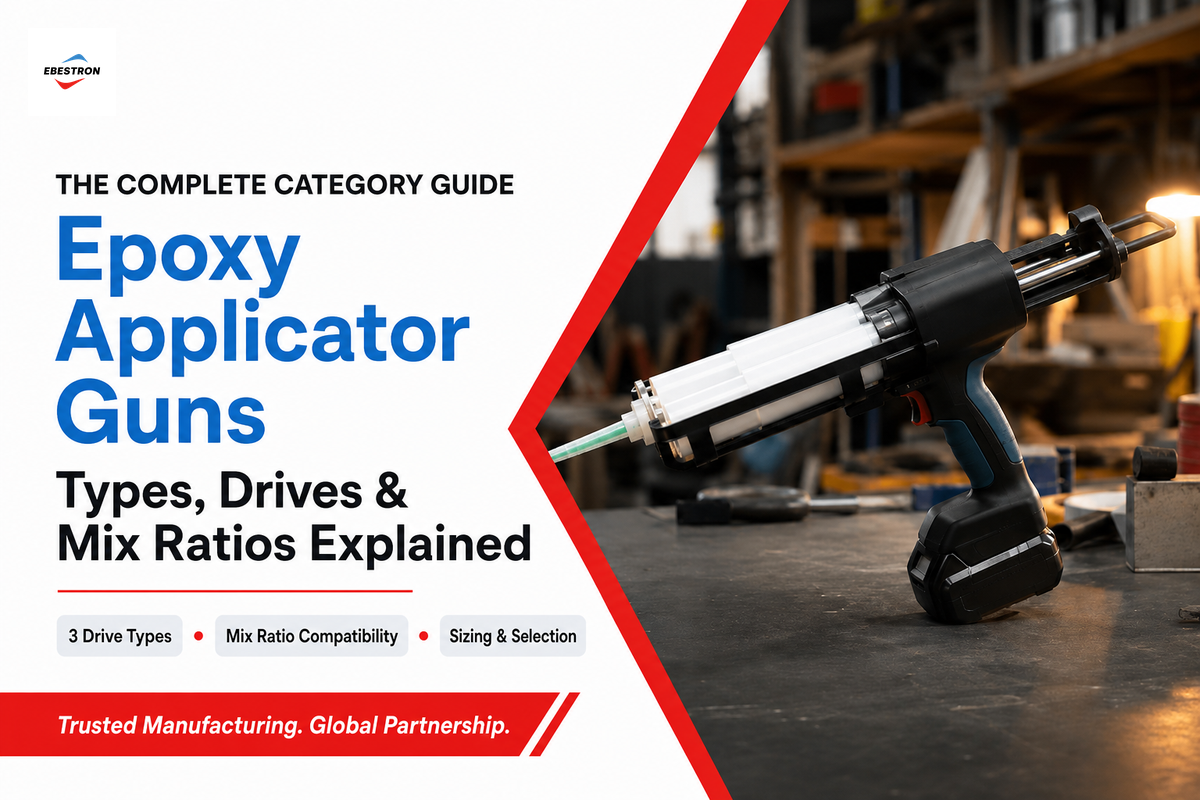
Quick Specs
| Drive types | Manual, pneumatic, battery-electric |
| Common mix ratios | 1:1, 2:1, 4:1, 10:1 |
| Cartridge sizes | 50, 200, 400, 600 mL (plus size-label variants) |
| Thrust ratio range | Roughly 10:1–26:1 mechanical advantage |
| Primary use cases | Structural bonding, panel repair, anchor setting, electrical potting |
Epoxy applicator guns are hand tools designed to dispense a 2-part epoxy adhesives from a dual-cartridge cartridge at a fixed, repeatable ratio. Unlike a single-tube caulk gun, an epoxy gun forces two plungers at once to ensure that the resin and hardener are expelled from the cartridge together, are then fed through a mixing nozzle, and cure at the ratio prescribed by the manufacturer – not whatever ratio you’re eyeballing on a stir stick.
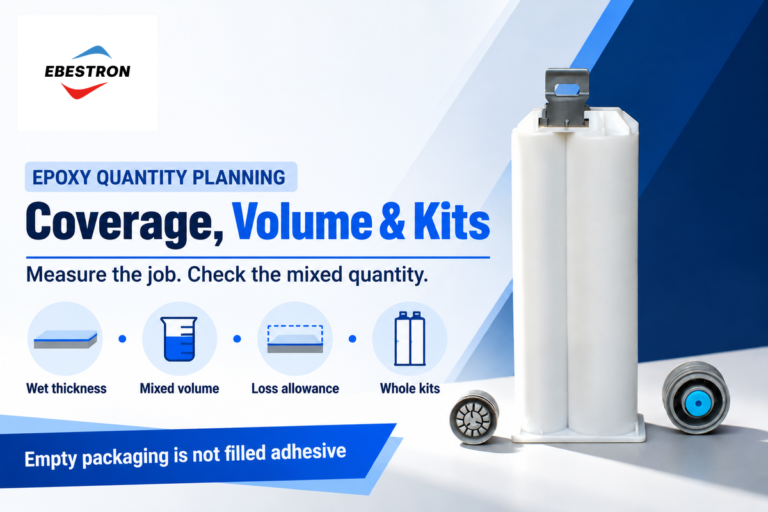
Epoxy applicator guns dispense a 2-part epoxy adhesives from dual-cartridge packaging at a constant ratio, commonly 1:1, 2:1, 4:1, or 10:1. They’re usually available in 50 ml to 600mL capacities and are used for tasks that include structural bonding, panel repair and anchor installation. Hand-mixing 2-part epoxy generally doesn’t provide the necessary ratio control for such tasks.
Key Points
- Electric/battery driven doesn’t always mean better. If you’ve an occasional low-volume job, then the better choice for you’ll be a manual gun.
- Cartridge volumes often have manufacturer-rounding labels. (e.g., a 45mL cartridge might be advertised as a 50mL)
- Make sure that the plunger set for the gun is matched to the cartridge mix ratio. (e.g. 1:1 hardware can’t effectively dispense a 10:1 cartridge)
- Most Professional dual-cartridge guns exert about 10:1 to 26:1 mechanical force advantage on the trigger
- Not all static mixing nozzles fit all cartridge sizes and brands.
What Is an Epoxy Applicator Gun?
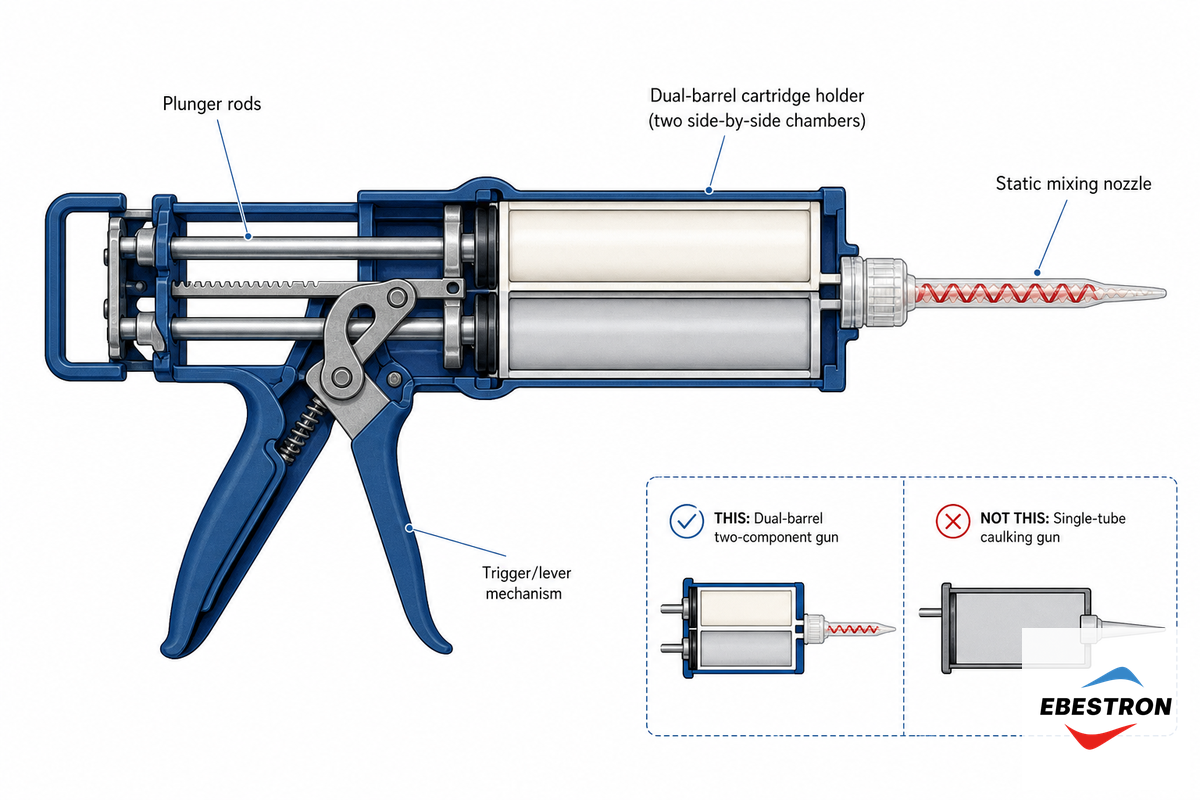
An epoxy applicator gun (often also referred to as an epoxy dispenser, a adhesive applicator or part of an epoxy gun kit) is an battery-electric, pneumatic or manual handheld tool that uses a dual-barrel cartridge to deliver a 2-part epoxy adhesive (what a layperson might call epoxy glue). Pressing the trigger causes two plungers to move in unison and eject both parts of the adhesive into a static mixing nozzle in precisely the ratio in which they were packaged.
These tools exist to keep the two epoxy components at the correct mixed ratio. If two-part epoxy components were to be hand-mixed out of separate buckets or cans by a production line worker, it would be difficult to get a consistent ratio, and the process would inevitably entrain air bubbles into the mix with each stir. A cartridge-and-gun assembly mix the two parts mechanically, and the mixing nozzle finishes the job. That process is precisely why the tools are utilized on both large-scale production lines by industrial manufacturers and on-site for repair of damaged plastic, metal, or composite structures. That wide variety of applications is exactly why drive type (discussed below) matters so much.
Just to be clear, this isn’t the floor-coating roller also commonly marketed as an “epoxy applicator” (a tool designed to spread epoxy on a floor), but the dispensing tool. This article’s terminology (dispenser gun, bi-mixer) mirrors the naming convention used in Adhesives & Sealants Industry’s own applicator primer.
Confusing the two “epoxy applicator” product categories is a common and costly mistake for first-time B2B buyers — a search for “epoxy applicator” turns up both tools, and ordering the wrong one wastes a purchase cycle. Ebestron’s own product line is limited to the dual-cartridge dispensing gun category (10:1–26:1 thrust ratio, 50–600 mL cartridges) precisely because that’s the tool structural and panel-repair customers actually need, not the floor-coating side of the naming overlap.
How Epoxy Applicator Guns Work: Plunger, Ratio & Mixing Nozzle Mechanics
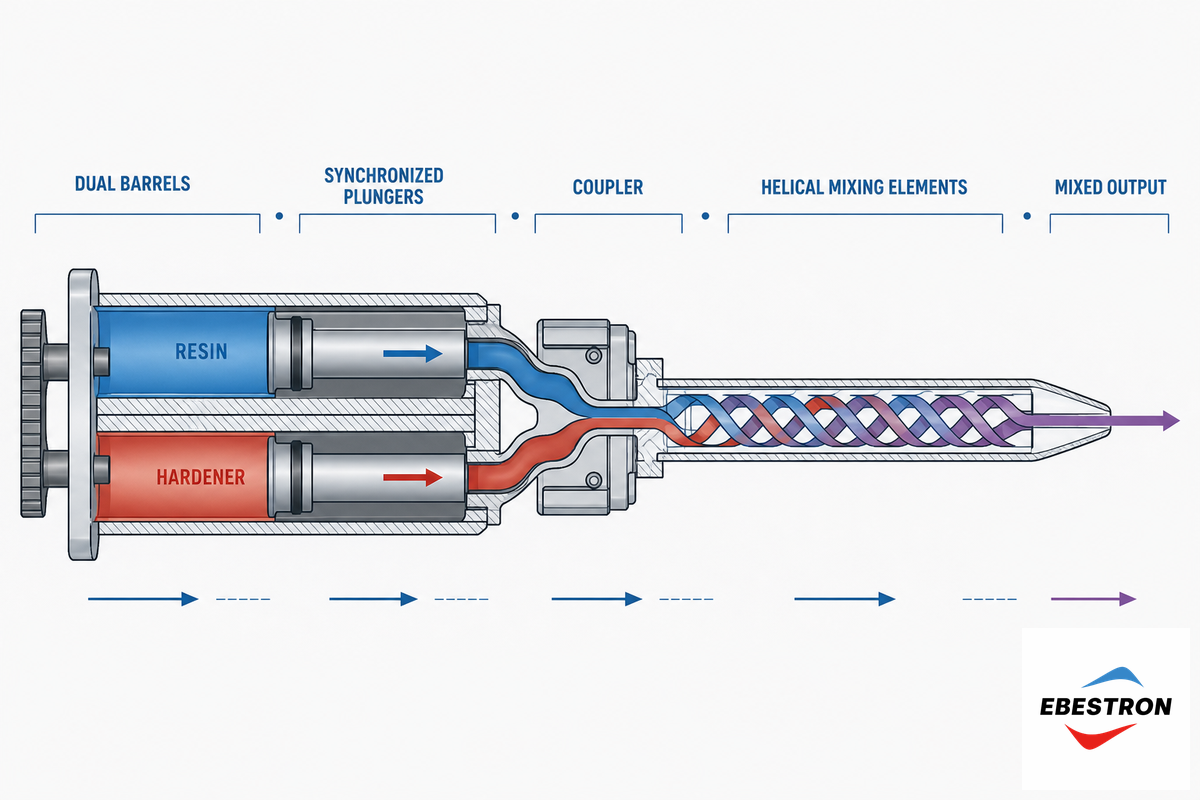
Epoxy applicator guns work by driving two synchronized plungers that push resin and hardener out of a dual-barrel cartridge in a fixed ratio, through a shared coupler, and into a static mixing nozzle. Helical elements inside the nozzle fold and blend the two streams as they travel, so the adhesive exits fully mixed and ready to apply without a stir stick. The mechanism is covered in more detail below, including the patented linkage that keeps the ratio locked.
How do epoxy guns work?
Squeezing the trigger actuates a ratcheting or piston mechanism that simultaneously pushes two plungers, one into each of the cartridge’s barrels. Because the plungers are dimensioned to match the cartridge’s internal ratio, they deliver the correct resin-to-hardener proportion automatically as they travel down the tube, with no manual stirring or measuring involved.
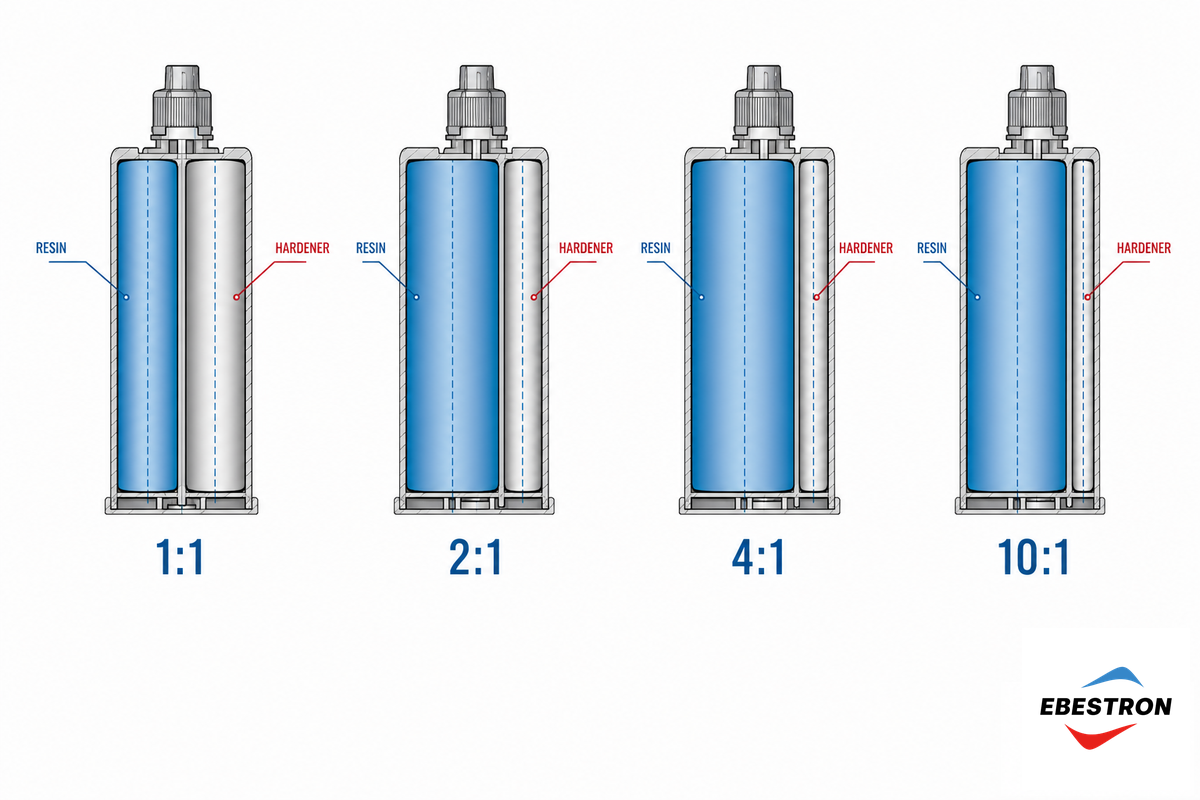
A 10:1 cartridge, for example, has a resin barrel roughly 10 times the cross-section of the hardener barrel. Both plungers feed into a common coupler that deposits their contents into a static mixing nozzle, where helical mixing elements blend the two streams as they travel down the tube. By the time the adhesive reaches the tip, it’s thoroughly homogenized and ready to dispense — no stirring stick required. It’s this synchronized epoxy mixing that makes precise application and controlled amounts of two-component adhesive achievable shot after shot.
This isn’t a suggestion; it’s mechanically mandated: synchronized push-rod linkages described in U.S. Patent 5,104,005 for a dual-component, mechanically operated caulking gun couple the movement of both plungers so that neither can move faster than the other on a properly functioning unit. (This explains why a misconfigured gun – a gun’s mechanical linkage for the wrong ratio – doesn’t bond well even if you do everything else right.)
📐 Engineering Note
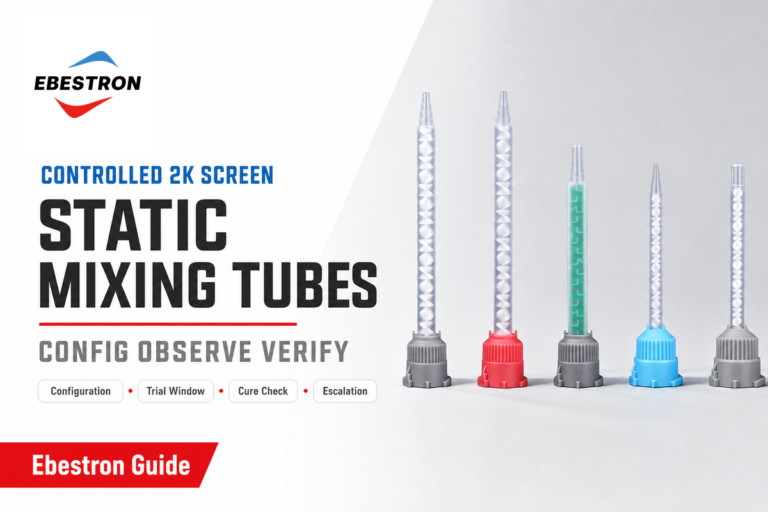
The static mixing nozzle itself is also a separate patented system (EP 0121342 B1) composed of a tube that has numerous internal helical mixing elements which fold and split the flowing materials as they pass down the nozzle. Typically, less elements are needed in thinner, faster flowing adhesives with a 75-100mm nozzle, while thick, slower reacting structural adhesives may require a 150-200mm nozzle to achieve thorough mixing without streaks.
Epoxy Gun Types by Drive Mechanism: Manual, Pneumatic & Battery-Powered
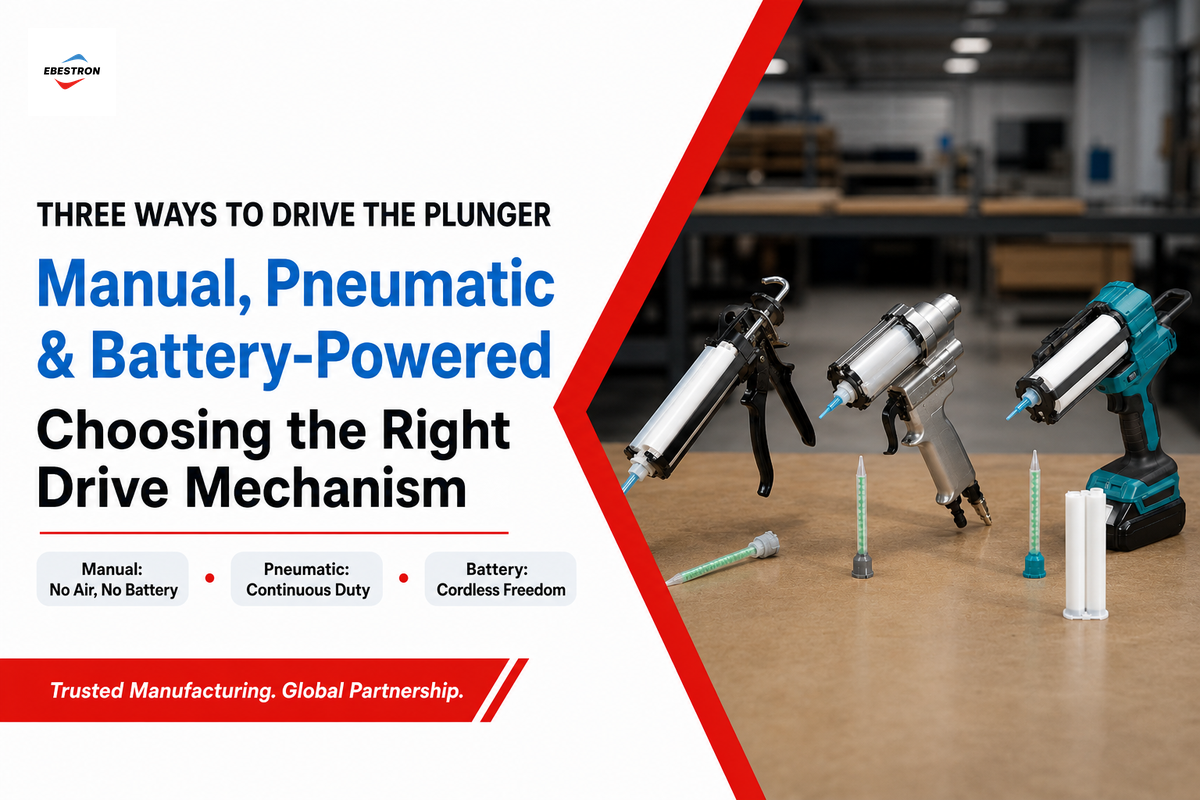
There are three drive types of epoxy applicator guns available, each optimized for a specific range of viscosities, batch sizes and site-based power needs. Handheld dispensing equipment traces back to the single-barrel, 600ml 1:1 dispensers, per Adhesives & Sealants Industry magazine.
Manual and pneumatic remain the two most common styles, but a small class of professional guns adds adjustable plunger adapter sets for accurate dispensing across a wider number of ratio family types. Manual epoxy guns have no outside power, are actuated with a lever or ratchet, and have no “charge time”; when empty, they’ll usually weigh 0.3–0.8 kg. These are the most affordable option, but are best for intermittent, low-volume work; sustained, hard pulling to dispense higher viscosity adhesive quickly fatigues a hand and leads to a poor bead quality. Pneumatic epoxy guns draw power from a shop’s air compressor line – often at about 90-125 PSI and typically regulated down to around 80-100 PSI for most cartridge-gun applications – and drive their plungers with compressed air to generate hundreds of pounds of thrust. Professional models may offer more than 400 lbs of force, so that power and ease comes with a compressor commitment; this is often the choice for production or assembly line use when a worker dispenses adhesive for extended periods. Battery-electric guns provide that same consistent, powered thrust without a compressor or air line, by using an internal battery – usually rated for a couple hundred trigger cycles per charge – which can be a great option in job sites lacking compressed air.
| Factor | Manual | Pneumatic | Battery-Electric |
|---|---|---|---|
| Best viscosity range | Low to medium | Medium to high | Medium to high |
| Comfortable batch size | Single cartridge, occasional use | High-volume, all-day cycles | Moderate-to-high, mobile |
| Jobsite power requirement | None | Compressed air line | Charged battery pack only |
| Relative cost tier | $ | $$ | $$$ |
| Trigger fatigue risk | High on long runs | Low | Low |
| Best-fit scenario | Field repair, one-off jobs | Fixed assembly-line station | Remote or mobile site work |
Choosing electric or pneumatic doesn’t mean automatically selecting the “right” gun. Unless your work calls for dispensing a few cartridges a week, the investment in – and charging time or compressor upkeep of – a powered unit simply won’t pay for itself. The manual gun is the most reliable for those who work part-time or dispense only a few times per month precisely because it has no power source to worry about charging or connecting to. It’s when the dispensing task become repetitive that the power tools truly pay for themselves. For a deeper cost/thrust-ratio breakdown by drive type, including total-cost-of-ownership math, see Ebestron’s epoxy gun buyer’s guide.
The 9-Row Drive-Ratio Configuration Chart
There are a total of nine realistic gun options when crossing three major types of drive mechanisms with the three most common ratio tiers. This makes for an easy, consolidated reference for anyone specifying guns for mixed-use facilities.
| Configuration Type | Drive | Ratio Tier | Cartridge Fit | Best-Fit Scenario |
|---|---|---|---|---|
| Manual 1:1/2:1 | Manual | 1:1 or 2:1 | 50–200ml | Field repair, general bonding |
| Manual 4:1 | Manual | 4:1 | 200–400ml | Occasional high-strength anchor work |
| Manual 10:1 | Manual | 10:1 | 400–600ml | Low-volume structural anchor jobs |
| Pneumatic 1:1/2:1 | Pneumatic | 1:1 or 2:1 | 50–200ml | Assembly-line general bonding |
| Pneumatic 4:1 | Pneumatic | 4:1 | 200–400ml | High-volume anchor production |
| Pneumatic 10:1 | Pneumatic | 10:1 | 400–600ml | High-volume structural production |
| Battery 1:1/2:1 | Battery-electric | 1:1 or 2:1 | 50–200ml | Mobile or remote general bonding |
| Battery 4:1 | Battery-electric | 4:1 | 200–400ml | Remote anchor installation |
| Battery 10:1 | Battery-electric | 10:1 | 400–600ml | Remote structural work, no air access |
Mix Ratios Explained: 1:1, 2:1, 4:1 & 10:1 Compatibility
Do epoxy guns work with any mix ratio?
No — not all cartridge-dispensing guns are compatible with all cartridges. If a cartridge is built for one ratio (say 4:1 resin-to-hardener), a gun dispensing another ratio (say 10:1) won’t do the job correctly, because the two plungers have a fixed size difference that sets the volume ratio automatically, regardless of what the cartridge itself was engineered for.
Some higher-end professional guns include multiple plunger-and-adapter kits that let them dispense 1:1, 2:1, 4:1, or 10:1 cartridges as needed — but that’s a manual component swap the user performs, not something the gun handles automatically.
The most common ratio families — 1:1, 2:1, 4:1, and 10:1 — directly reflect the resin-to-hardener chemistry formulated by adhesive manufacturers. epoxy resin bonding systems, two-part systems applied in both structural and pavement contexts, are identified per ASTM C881/C881M-20a (the active version currently), and the analogous AASHTO M235M specification, by Type I-VII (physical properties), Grade 1-3 (flowability/viscosity), and Class A-F (application temperatures), but that standard classifies the adhesive’s chemical function rather than specifying cartridge ratios for use with dispensing guns. The 1:1, 2:1, 4:1, and 10:1 ratios stenciled on guns and cartridges are adhesive manufacturers’ dispensers hardware conventions, not an official ASTM ratio scheme. Nonetheless, the gun’s plunger arrangement has to physically match the specified ratio the adhesive was formulated for. professional epoxy systems used for construction and structural adhesives will almost always label the proper ratio on the cartridge and in the technical data sheets-double-check both.
💡 Worked Example
Here’s a worked example, not a 50ml epoxy cartridge but a larger one: a cartridge labelled “10:1 by volume,” with 400 ml total volume. If mixed according to that ratio, approximately 364 ml will be resin and 36 ml will be hardener per fully utilized cartridge. Prior to loading the gun, make sure that your gun’s plunger is stamped “10:1”-not “4:1,” “2:1,” etc. Those numbers specify the exact ratio of the plunger diameter machined for the inside of the gun, and the result of using the wrong plunger is that the dispensed amount of hardener is slightly too low or too high, although the cartridge itself physically fits into the gun.
| Ratio | Typical Context |
|---|---|
| 1:1 | General structural bonding, panel repair |
| 2:1 | Structural and automotive body adhesives |
| 4:1 | High-strength anchor and construction adhesives |
| 10:1 | Higher-hardener-ratio structural and anchor systems |
Not mixing according to the correct ratio isn’t merely an aesthetic problem: it will result in an unbalanced cross-link in the epoxy curing chemistry, leading to a bond that’s significantly less strong and is too soft, too brittle, or otherwise structurally deficient. This type of weak-bond failure is the primary hazard of mismatched gun/cartridge combinations. Most technical data sheets begin specifying a reduction in bond strength if the ratio error is greater than approximately 10% out of specification, although actual tolerances vary by formula.
Cartridge Sizes, Capacity & Static Mixing Nozzle Compatibility
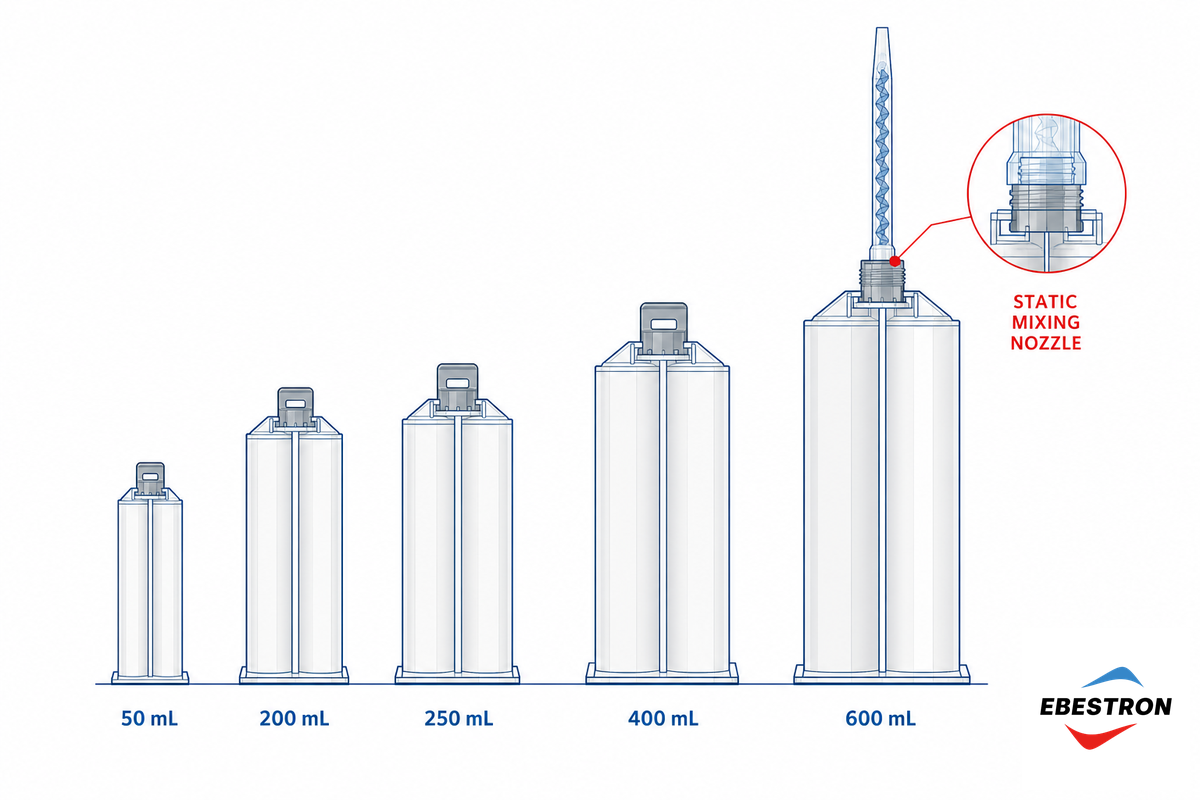
There are several standard capacities (commonly 50ml, 200ml, 400ml, 600ml) at which epoxy cartridges are sold, but makers may not have similar packaging methods, so that one physical adhesive cartridge will come packaged with different total volume markings than other brands. One major cartridge retailer reported that, while not a proven industry-wide fact, “50ml” cartridges of one manufacturer often fit and are compatible with 45ml-labeled cartridges of another.
| Nominal Size | Commonly Seen Variant Label |
|---|---|
| 50ml | 45ml |
| 200ml | 250ml |
| 400ml | 490ml |
| 600ml | — |
The gun’s plunger frame – sometimes sold separately as a bare dispenser gun body – has to physically fit the cartridge barrel length and diameter (a 50ml cartridge barrel commonly runs around 30mm across, versus roughly 45mm for a 400ml cartridge), so a “50ml gun” is really a frame sized for that cartridge family regardless of which exact label is on the box. Most gun frames and cartridges are rated for reliable use across roughly -10°C to 40°C ambient conditions; outside that range, plastic components can become brittle or the adhesive’s viscosity can shift enough to affect dispensing. Pair the cartridge with matching epoxy mixing nozzles – nozzles are sized to the cartridge’s flow rate and element count needed for full mixing, and a nozzle built for a 50ml cartridge won’t mix a 400ml cartridge’s higher flow rate completely, which shows up as visible streaking in the cured bead. Nozzle bore diameters commonly range from about 4.5mm on small cartridges up to 8mm or more on the largest, so the physical fit at the coupler is worth checking alongside the flow-rate match. Ordering a mismatched cartridge/nozzle pair is a common problem on first bulk orders — Ebestron ships cartridges and matching static mixing nozzles as a paired part number precisely because the two are not interchangeable across size classes, which avoids the wasted purchase cycle of discovering the mismatch after a shipment arrives.
Dual-Cartridge vs Single-Cartridge Mechanics
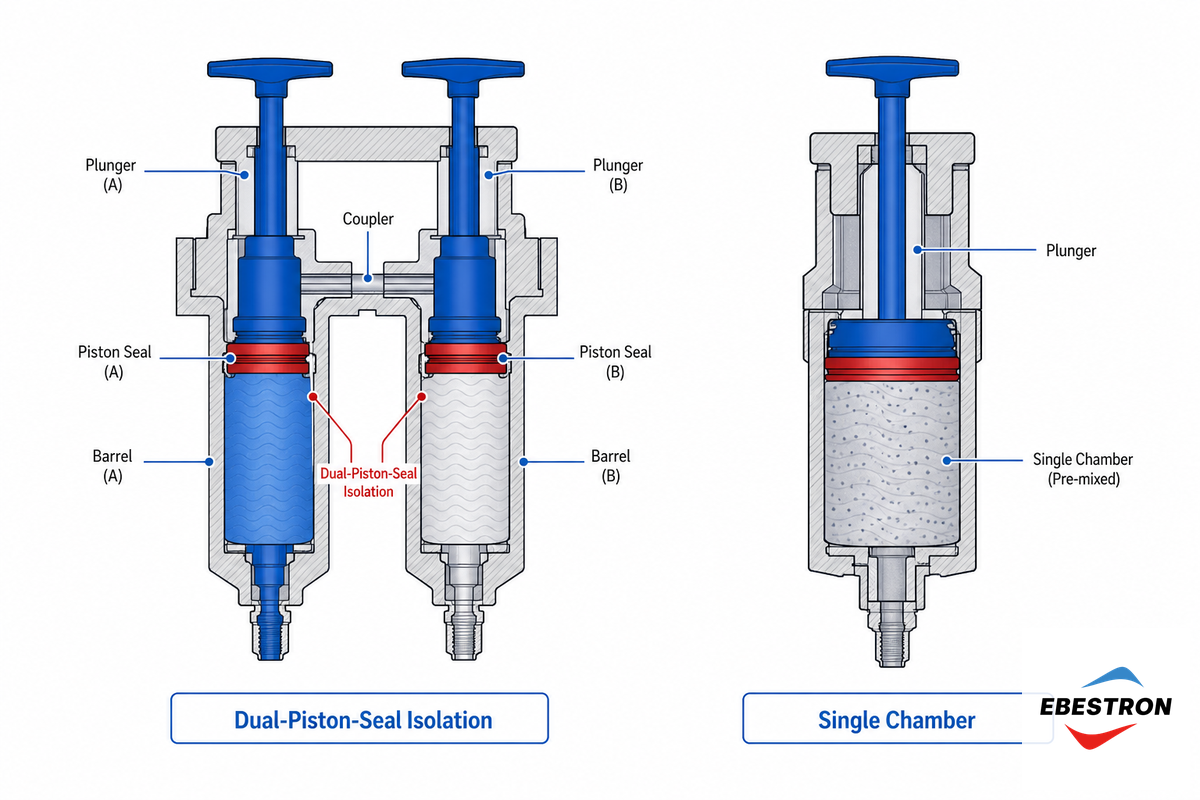
Most structural epoxy guns are built around dual-barrel cartridges specifically because two-part epoxy has to stay separated until the moment of application – mixing resin and hardener inside a single sealed cartridge would start the cure clock before the cartridge ever reach the gun. U.S. Patent Application 2011/0081499, covering dual-component dispensing and mixing systems, documents the dual-piston-seal design that keeps each barrel’s contents isolated under pressure until they meet at the shared coupler – the seals, not just the barrel walls, are what prevent premature cross-contamination during storage and transport. Unopened shelf life varies by formulation — check the specific adhesive’s technical data sheet rather than assuming a generic window.
Single-barrel cartridges do exist for pre-mixed or one-part adhesives (hot-melt sticks, single-component sealants), but they’re a fundamentally different product category from a two-part epoxy system – a single-cartridge gun has no ratio to enforce because there’s nothing to combine. Search volume for “dual cartridge epoxy gun” has shown some month-to-month volatility over the past year, which reads more like normal query noise around a stable niche term than an actual shift in whether dual-cartridge remains the standard – the underlying chemistry hasn’t changed, and dual-barrel is still the default architecture for any true two-part epoxy dispensing system. This risk isn’t hypothetical: a single-barrel tool used on a two-part cartridge is the structural reason so many “epoxy gun doesn’t work” complaints trace back to a tool/cartridge mismatch rather than a defective product, which is why Ebestron sells dual-cartridge guns as matched systems rather than generic frames.
Epoxy Gun vs Caulking Gun vs Hot-Melt Glue Gun: Key Differences
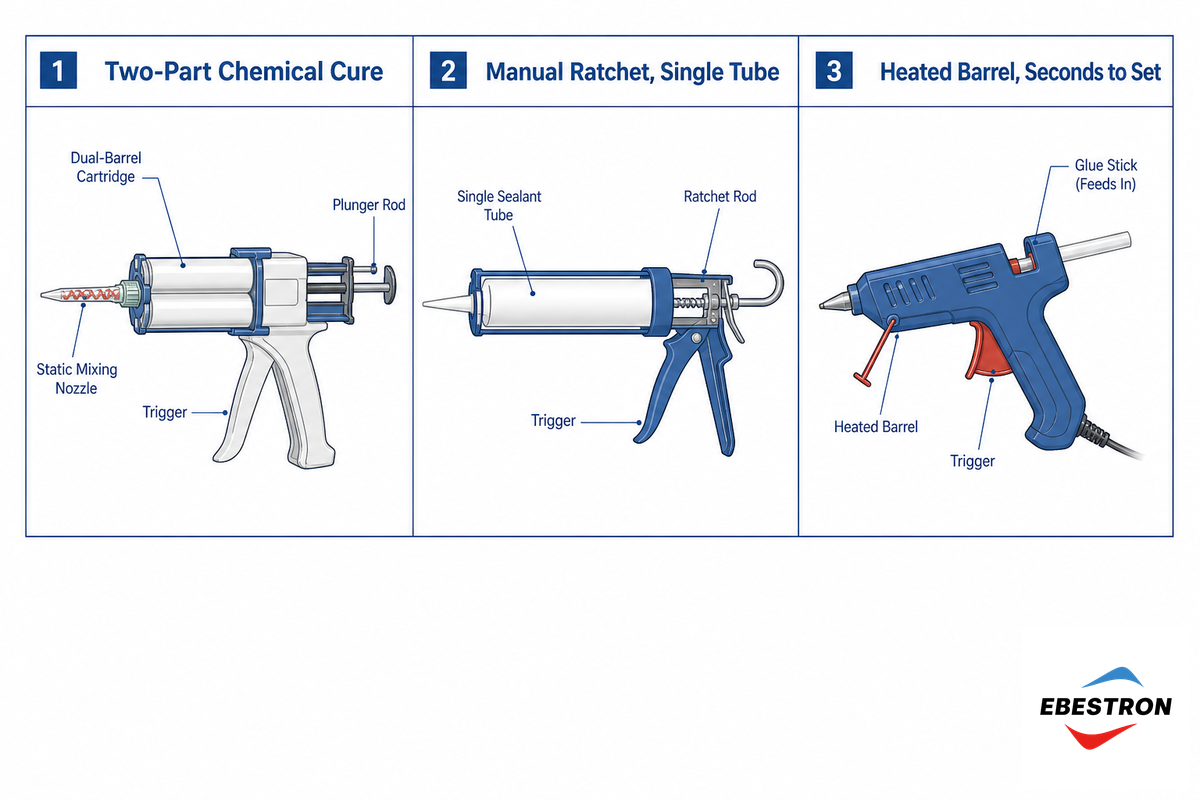
How is an epoxy cartridge gun different from a hot melt glue gun?
An epoxy gun dispenses a structural, chemically curing adhesive from a cartridge; a hot-melt glue gun melts a solid glue stick with heat and lays down a bond that set as it cools. Hot-melt bonds are fast and low-strength – fine for craft and light assembly work, but not built to carry structural load the way a properly cured two-part epoxy joint is.
✔ Epoxy Applicator Gun
- Structural, load-bearing bond strength
- Fixed mechanical mix ratio (no guesswork)
- Requires matching cartridge ratio and mixing nozzle
⚠ Single-Tube Caulk / Hot-Melt Gun
- No mix ratio to enforce, single component only
- Faster set time, generally lower bond strength
- Can’t dispense a two-part epoxy cartridge correctly
An often very costly mistake is to pick up a single-barrel caulk gun when what you’ve is actually a two-part epoxy cartridge (the dual-barrel type look much like a caulk tube, but there’s a second internal plunger) – a single-barrel gun *can* hold the cartridge but has no second plunger to actuate and so only dispenses half the contents, or crushes the cartridge internally. Proper dual-barrel cartridge dispensing requires a tool with two synchronized plungers activated by a trigger mechanism-something single-barrel guns simply aren’t designed to do. Cross-compatibility of a gun built for one cartridge system to another isn’t absolute: as Ebestron’s 2-K dispensing gun buyer’s guide points out, each gun is specifically designed for a given cartridge system, ratio, and volume; only related side-by-side systems may be mutually compatible.
Choosing the Right Epoxy Gun Size & Drive for Your Application

What size epoxy gun do I need?
Select your gun based on your cartridge size first (50/200/400/600 mL, confirmed against the adhesive spec sheet), then your cartridge’s mix ratio, then your choice of drive type based on how frequently you plan to dispense. Size and ratio are constraints set by the adhesive itself; drive type is more a matter of comfort and throughput.
This guide intentionally focuses on gun selection only — your adhesive supplier can advise on which epoxy formulation is correct based on its ASTM C881/C881M-20a type/grade/class (physical properties, temperature requirements), which also factors into your choice of gun. The best epoxy applicator guns for a given shop aren’t necessarily the most powerful ones on the market — they’re professional epoxy applicator guns matched to the specific cartridge size, ratio, and duty cycle that shop actually runs; heavy duty epoxy applicator guns built for continuous production use commonly lean pneumatic or battery-electric rather than manual.
The 4-Question Drive-Type Fit Check
Before ordering, do a quick self-check to determine if you need manual, pneumatic, or battery-electric drive.
Answer these four questions in order
- Viscosity: Is your adhesive highly viscous (above 50,000 cP)? Opt for pneumatic or battery-electric; a manual gun quickly becomes very difficult to operate.
- Volume: Dispensing multiple cartridges daily? A powered drive can save you effort and time; for occasional use, manual works perfectly fine.
- Power access: No compressed air and no convenient power outlets on your job site? A battery-electric gun is the only option; pneumatic guns generally are more cost-effective per unit.
- Budget: manual guns commonly run $25-$150, pneumatic guns roughly $150-$600, and battery-electric guns typically cost between $300-$800+. If your requirements point toward manual (occasional, low-viscosity, with air access), it will be the least expensive option without performance compromises.
Refer to the complete product lineup for Ebestron’s dual-cartridge epoxy applicator guns to review full specification ranges, thrust-ratio options, and details regarding bulk/OEM purchases. For information about 2-K dispensing guns beyond epoxy-specific applications, consult Ebestron’s 2-K dispensing gun buyer’s guide.
Proper Use, Maintenance & Common Issues
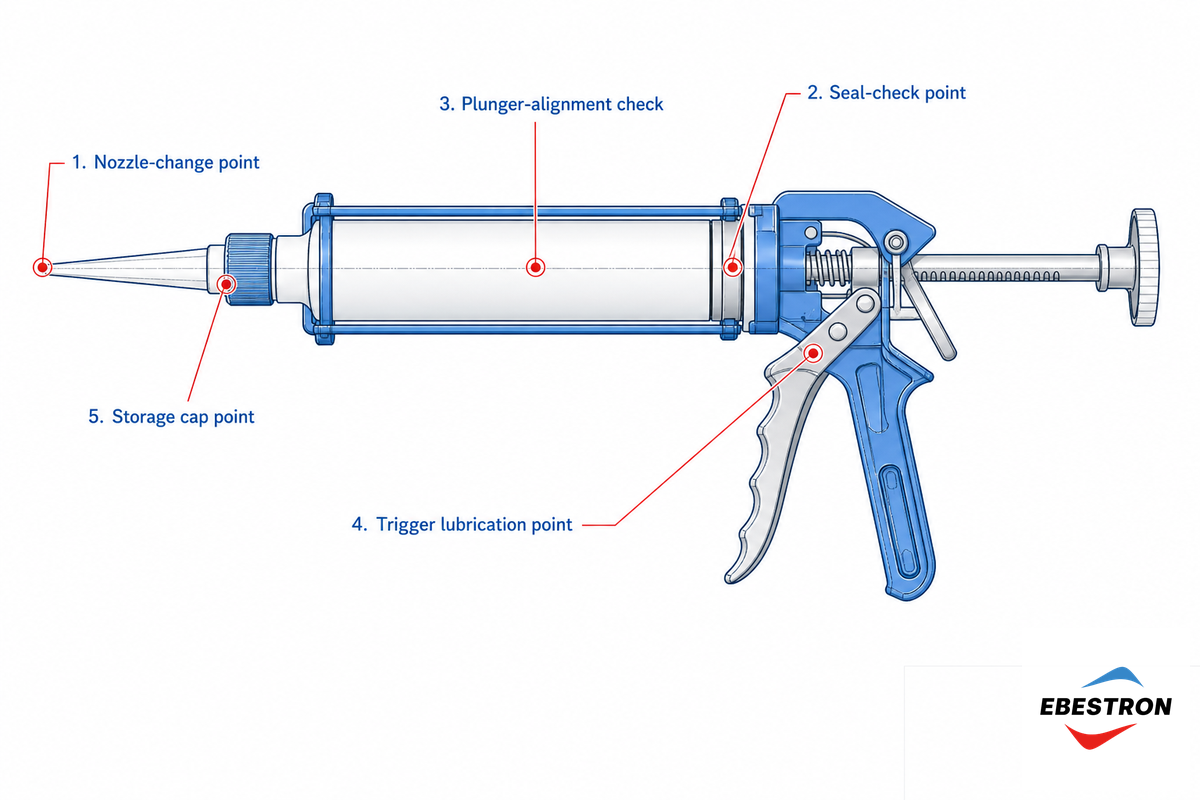
Most of the epoxy gun issues encountered by users fall into two field error categories. First is using the incorrect sized mixing nozzle for the cartridge; for example, a nozzle designed for a smaller cartridge will be unable to properly mix the higher output of a larger one, and this manifests as unmixed streaking of the cured bead, rather than an even, uniform color. The second error is to leave a used nozzle attached to the cartridge between uses: cured adhesive inside the mixing tube will impede flow upon next activation, and over-application of force could result in a blown seal, rather than a clear clog. Always cap or replace a nozzle when not in use. Typical working time (pot life) for most general-purpose structural epoxies after mixing at 20-25°C room temperature is 5-15 min, and full handling strength is reached in roughly 24 hours – always refer to your product’s technical data sheet for these specifications as cold ambient temperatures can greatly extend pot life, and warmer ones can reduce it by up to half.
“Failing to use the recommended mix ratio, over-or under-applying one of the two components, will disrupt the balance and result in a soft, weak, or brittle epoxy as opposed to a finished cured strength as per the product specification.”
— Industry adhesive-application engineers, via field guidance
In the interest of safety, by far the greatest hazard with epoxy applicator guns isn’t the mechanism itself, but rather dermal exposure to the uncured resin and hardener. According to OSHA, epoxy resin adhesives can lead to dermatitis and sensitization, and the agency has stated that dermal contact represents a more significant route of exposure than inhalation when workers handle epoxy resin mixtures. As such, glove use and prompt attention to any skin contamination are more load-bearing occupational safety practices than tool grounding procedures for most epoxy gun operators. For more in-depth troubleshooting on dispensing guns than what can be covered here, including scenarios with no-flow, clogging and uneven-bead situations, refer to Ebestron’s detailed dispensing gun troubleshooting guide and 2K dispensing problems guide.
Industry Outlook: What’s Changing in Adhesive Dispensing Tools
While market growth figures are far from definitive, the most convincing argument for battery-powered epoxy gun models stems from a practical, jobsite reality: the uncertainty of power access. Whether it’s an remote repair site, work performed on a roof, or a service call with a mobile setup, there’s no guarantee of access to a wall socket or a compressor. A battery-powered gun is the only way to provide the advantage of powered operation in those settings without the need for a portable compressor. That operational necessity, rather than a trending search interest, is why procurement departments are planning to add battery-powered guns, often capable of operating down to about 0°C and yielding several hundred trigger pulls per charge, to their tool inventories for 2026; searches for “battery powered epoxy gun” remain at best stagnant over the past year on a small base, indicating this trend is pre-emptive, not responsive, to any increase in search volume for epoxy guns in particular.
From several independent market research reports: The adhesive / fluid dispensing equipment (a far wider classification than only epoxy guns) market as a whole is estimated to expand at a mid-single-digit CAGR in the period up through the early 2030s. Take this at order-of-magnitude level for category context, but don’t assume it pertains to adoption of battery-electric epoxy-gun drive type: no report on hand broke out battery-electric epoxy guns as its own segment.
Consider, in short: for those planning tooling refreshes for 2026, take an inventory of what job sites lack shop air/power before specifying that every single one of the new tools you purchase be battery-electric; in the shop for sites already connected to an air line, a pneumatic drive will still prove less costly per unit without job site access tradeoff.
Frequently Asked Questions
Q: What is an epoxy gun?
View Answer
An epoxy gun is a handheld tool — manual, pneumatic, or battery-electric — that dispenses two-part epoxy adhesive from a dual-cartridge at a fixed mix ratio. Pulling the trigger drives two plungers together so resin and hardener exit in the correct proportion and blend inside a static mixing nozzle before reaching the work surface.
Q: Do epoxy guns work with any mix ratio?
See Answer
No. A gun’s plunger set is machined for one ratio family — commonly 1:1, 2:1, 4:1, or 10:1 — and cannot correctly dispense a cartridge built for a different ratio. Some professional guns accept swappable plunger adapters for a limited range, but that’s a deliberate hardware change, not automatic compatibility across ratios.
Q: What is the difference between a manual epoxy gun and a pneumatic epoxy gun?
View Answer
A manual gun is trigger- or lever-operated with no external power, making it the lowest-cost option but tiring on long, high-viscosity runs. A pneumatic gun connects to a compressed air line and drives the plungers with air pressure, giving more consistent thrust and less operator fatigue — the standard choice for high-volume assembly-line dispensing rather than occasional field repair.
Q: What size epoxy gun do I need?
See Answer
Match your gun to your cartridge’s nominal capacity — 50, 200, 400, or 600 mL — and confirm the ratio hardware matches your adhesive’s spec sheet before ordering. Getting the capacity wrong is a common first-order mistake: a frame sized for a 50 mL cartridge physically won’t accept a 400 mL one, so check the cartridge label before you specify the gun, not after it arrives.
Q: How is an epoxy cartridge gun different from a hot melt glue gun?
View Answer
An epoxy gun dispenses a chemically curing, structural two-part adhesive from a cartridge at a fixed ratio, reaching full handling strength in about 24 hours. A hot-melt glue gun instead melts a solid glue stick with heat and sets within seconds as it cools — fast, low-strength, and not built for structural load. The two tools and their cartridges aren’t interchangeable for anything load-bearing.
Q: Are epoxy applicator guns and caulking guns the same thing?
See Answer
No. A single-tube caulking gun drives one plunger and has no way to enforce a mix ratio, while an epoxy applicator gun drives two synchronized plungers to keep resin and hardener proportioned correctly. Mistaking one for the other is a common ordering error since the dual-barrel cartridge can visually resemble a caulk tube.
Q: How long does an opened epoxy cartridge last before it sets?
View Answer
This varies by formulation and is set by the adhesive manufacturer’s stated pot life and shelf life, not by the gun — check your specific product’s technical data sheet rather than assuming a generic time frame, since pot life can range from minutes to hours depending on the epoxy chemistry and ambient temperature.
Q: Can any static mixing nozzle fit any epoxy cartridge?
View Answer
No. Nozzles are sized to a cartridge’s flow rate and element count needed for complete mixing — a nozzle built for a smaller cartridge won’t fully mix a larger cartridge’s higher output, which shows up as visible streaking in the cured adhesive rather than a uniform blend.
Why We Write This
Ebestron is the manufacturer of adhesive dispensing guns and dual-cartridge packaging systems; this guide specifies our epoxy applicator guns (in 10:1 to 26:1 thrust ratio and 50 to 600mL cartridge size ranges), and focuses on how the dispensing mechanism actually functions, plunger synchronization, mix-ratio hardware, nozzle sizing, since existing published guidance mostly comprises product specifications rather than operational mechanics. Reviewed by the Ebestron technical team. Learn more about Ebestron.
References & Sources
- U.S. Patent 5,104,005, Dual Component Mechanically Operated Caulking GunUSPTO / Google Patents
- U.S. Patent Application 2011/0081499, Dual Component Dispensing and Mixing SystemsUSPTO / Google Patents
- EP 0121342 B1, Static Mixing DeviceEuropean Patent Office / Google Patents
- OSHA eTools, Finishing Chemicals: Hazards and Solutions (epoxy resin dermatitis/sensitization)U.S. Department of Labor / OSHA
- OSHA Technical Manual, Section III Chapter 1, Health HazardsU.S. Department of Labor / OSHA
- ASTM C881/C881M-20a, Standard Specification for Epoxy-Resin-Base Bonding Systems for ConcreteASTM International
- Understanding the Capabilities of Handheld Dispensing EquipmentAdhesives & Sealants Industry
- Applicators 101Adhesives & Sealants Industry
Related Articles
- How to Choose a 2-K Dispensing Guna broader buyer’s guide covering all two-component dispensing gun systems, not just epoxy
- Mixpac & Cox-Compatible Dispensing Gunscross-brand cartridge compatibility for common dispensing systems
- Pneumatic Cartridge Dispensing Guns: The Complete Guidedeeper coverage of compressor sizing and air-line setup for pneumatic drives
- Sulzer Mixpac & 3M Compatible Mixersstatic mixing nozzle cross-reference and brand-switching guidance