Get in touch with Ebestron Company
400 ml & 600 ml Dual Cartridges, High-Volume Two-Component Adhesive Packaging That Holds Ratio Across a Full Bead Run
Empty side-by-side 400 ml and 600 ml dual cartridges for two-part adhesives, epoxy, PU, MMA, silicone and acrylic, in 1:1, 2:1 and 4:1 ratios, PP / PA / PBT bodies, B/C-System bayonet outlet, CE & RoHS, built for high-volume production filling and OEM private label.
Get a Wholesale / OEM Quote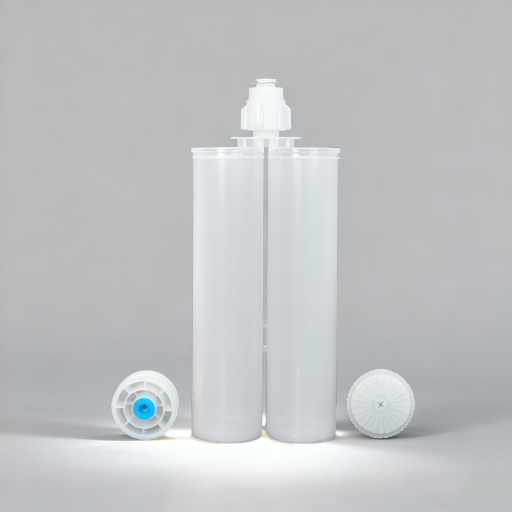
Specifications
- Large-format twin-barrel volumes Format
- 1:1 / 2:1 / 4:1 Volumetric mix ratios
- PP·PA·PBT Body materials by chemistry
- B/C-System Side-by-side bayonet outlet
- ±5% Target mix-ratio tolerance
- 490 lbf Pneumatic thrust @ 100 PSI
Buyer role: All, Engineers, Procurement, Line Managers
Curing in the Barrel, a Half-Used 600 ml That Gelled, Wrong-Fit Tooling: What a Bad Large-Format Cartridge Costs
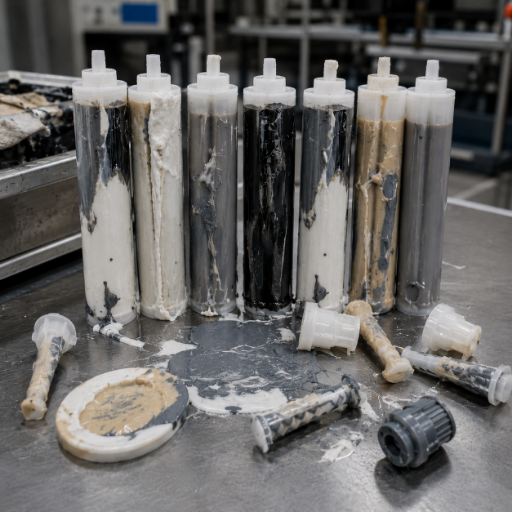
Issue 01: Mixing Errors & Scrap
A 400 ml or 600 ml dual cartridge moves a lot of adhesive in one shot, and that’s exactly why a poor one is expensive: when it fails, it wastes a large charge, not a small one. Mixing errors are the single largest source of scrap in bonding and potting work, because an off-ratio shot of two component glue cures soft, cures slow, or fails to cure at all, and an off-ratio of more than 5% can measurably cut bond strength, chemical resistance and Tg while raising outgassing. On a 300 ml chamber that drift spreads across a whole structural bead run before anyone catches it.
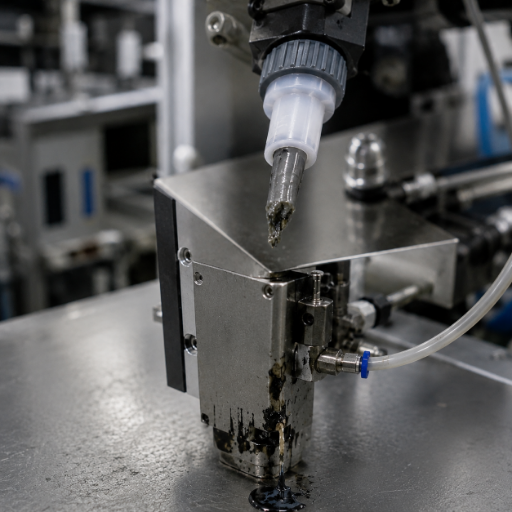
Issue 02: Gel-in-Nozzle & Hardware Defects
Large format adds a failure mode the small sizes rarely show: gel-in-the-nozzle waste. Pot life is short and temperature-sensitive, a 10-minute work life at 23 °C can drop to roughly 5 minutes at 31 °C, so if a job draws less than the cartridge holds, the remaining two-part epoxy can cure inside the nozzle before it’s dispensed. Pair that with the usual hardware defects, a crooked piston that weeps and drifts the ratio; a non-vented piston that traps an air slug across a 200–300 ml fill, and air entrapment can be detrimental to the mechanical strength of the joint; a thin or warped barrel that lets reactive epoxy cure inside storage above about 30 °C, because curing epoxy generates heat and heat accelerates the cure, and a “cheap” large cartridge quietly becomes the most expensive part on the line.
Auditing a recurring cure-in-barrel or half-cartridge gel loss?
Request Sample Kit →Ebestron 400 ml & 600 ml Dual Cartridge: Ratios, Materials and System Fit
Here’s the honest version of large-format cartridge selection: the body isn’t a commodity, and the material you pick decides whether your chemistry survives months of storage in a bigger barrel. Ebestron won’t claim one material fit everything. Epoxy, polyurethane and silicone systems run well in PP (polypropylene), which resists most acids, bases and common solvents at the lowest cost. Methacrylate (MMA) resins with volatile monomers need PA (polyamide) or PBT, because those barrels hold dimensional stability under load and resist the aromatics, ketones and oils that would swell PP. For industrial buyers in the EU and US the structural reason this matters more at 400–600 ml is shelf life: a swollen 300 ml chamber shifts dimension, the piston seal drifts, and the ±5% ratio window is gone before the cartridge ever reaches a gun.
Technical Deep-Dive, 400 ml & 600 ml Cartridge Specification
| Parameter | 400 ml Dual Cartridge | 600 ml Dual Cartridge |
|---|---|---|
| Total volume | 400 ml (2 × 200 ml at 1:1) | 600 ml (2 × 300 ml at 1:1) |
| Volumetric ratios | 1:1, 2:1, 4:1 | 1:1 (2:1 on request) |
| Body material | PP / PA / PBT by chemistry | PP / PA / PBT by chemistry |
| Outlet system | B/C-System side-by-side bayonet, twin-bore | B/C-System side-by-side bayonet, twin-bore |
| Piston | Twin, vented; O-ring sealing ring | Twin, vented; O-ring sealing ring |
| Mix-ratio target | ±5% volumetric (per adhesive TDS) | ±5% volumetric (per adhesive TDS) |
| Recommended tooling | 400 ml manual or pneumatic dual gun | 600 ml pneumatic dual gun (490 lbf @ 100 PSI) |
| Service temperature | Material-dependent; PA/PBT for elevated heat | Material-dependent; PA/PBT for elevated heat |
| Compliance | CE, RoHS | CE, RoHS |
Capacity × Ratio Build Matrix, Pick the Barrel by Chemistry, Not by Price
Most suppliers list “all sizes, all ratios” and leave you guessing. Our Capacity × Ratio Build Matrix maps your adhesive chemistry to the volume, ratio and body material that actually fit it, so an empty adhesive cartridge order matches the resin before it ships:
| Adhesive chemistry | Volume | Ratio | Body | Typical large-format use |
|---|---|---|---|---|
| Epoxy, structural | 400 / 600 ml | 1:1 / 2:1 | PP | Automotive body-panel bonding |
| Epoxy, high-strength bond | 400 ml | 4:1 | PP | Composite & metal joining |
| Polyurethane (PU) | 400 / 600 ml | 1:1 / 2:1 | PP | Façade & insulation-panel bonding |
| Silicone, 2K | 400 ml | 1:1 | PP | Large gasket / weather seal |
| Methacrylate (MMA) | 400 / 600 ml | 1:1 / 2:1 | PA / PBT | Structural metal & composite |
| Acrylic, dissimilar bond | 400 ml | 1:1 | PBT | Mixed-substrate assembly |
| Polyurea coating | 600 ml | 1:1 | PP / PBT | Protective lining at volume |
| Anchoring resin | 400 / 600 ml | 1:1 / 2:1 | PP | Chemical anchoring / bolt set |
| Potting compound | 600 ml | 1:1 / 2:1 | PP | Large electrical encapsulation |
| Low-viscosity reactive | 400 ml | 1:1 | PBT + O-ring piston | High-throughput precision dosing |
400 ml vs 600 ml, and When to Size Up From 200 ml or Down From Bulk Meter-Mix
At 400 and 600 ml, the value is throughput: more bonded length per shot, fewer reloads, fewer changeovers across a high-volume shift. But the trade-off is real and it runs the other way, oversize the barrel for the job and 30–40% of the charge can gel in the nozzle before you use it, because pot life expires before the cartridge empties. The honest large-format rule is to size the cartridge to your dispensed volume per pot-life window, not to “bigger is cheaper.” Our Large-Format Changeover Economics table puts that decision in numbers:
| Decision factor | 200 ml | 400 ml | 600 ml | Bulk meter-mix rig |
|---|---|---|---|---|
| Charge per cartridge | 200 ml | 400 ml | 600 ml | 20–200 L |
| Bead length per shot | short run | long run | longest run | continuous |
| Equipment capex | $0 hand gun | low (manual / pneumatic) | low (pneumatic, 490 lbf) | high (metering plant) |
| Best job size | mid-volume + field | high per-job volume | highest per-job volume | continuous single chemistry |
| Reloads per shift | frequent | fewer | fewest | none (bulk feed) |
| Changeover | instant | instant | instant | purge / clean cycle |
| Oversize / gel risk | low | moderate | higher if job < charge | n/a |
| Waste per stop | 1 nozzle | 1 nozzle | 1 nozzle (larger charge at risk) | line purge |
| Ratio options | 1:1 / 2:1 | 1:1 / 2:1 / 4:1 | 1:1 (2:1 on request) | near-unlimited |
Here’s the honest trade-off, and the structural reason Ebestron sizes by job rather than by list price: a disposable cartridge isn’t always the cheapest route. At very high single-formulation volume a bulk meter-mix machine wins on material cost. But for high per-job volume across multiple formulations, on-demand re-sealable use and field work, the 400 ml and 600 ml cartridges that Ebestron engineers skip the metering machine entirely, a documented dispensing approach in filings such as US7144170. Most buyers step up from a 200 ml dual cartridge to 400 ml when a single bead run outgrows the smaller charge, and only move to bulk when one chemistry exceeds roughly 50 L per day.
Where 400 ml and 600 ml Cartridges Earn Their Volume: High-Throughput Outcomes by Industry
The same large-format dual cartridge that Ebestron builds shows up wherever the bead is long and the volume is high, because the value is consistent dosing on demand without a metering machine.
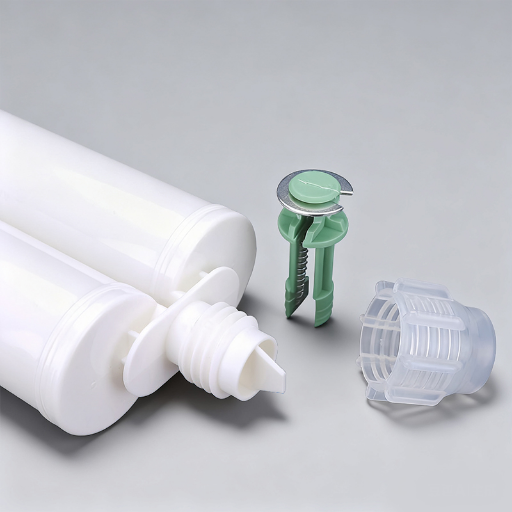
Industry Deployments
For industrial buyers in the EU and US automotive body shops, the 400 and 600 ml carry structural epoxy and MMA for body-panel bonding, seam sealing and EV battery-enclosure assembly, where a 5% ratio slip can fail a crash-relevant joint. In construction and infrastructure, the 600 ml runs PU and anchoring resin for façade panels, crack injection and chemical bolt-setting at a scale where a 200 ml would mean constant reloads. In industrial assembly and electronics, the 400 ml feeds large potting and encapsulation shots and the structural bonding of metal, plastic and composite parts that must cure clean.
Compliance: CE, RoHS and Material Conformity
For industrial buyers in the EU and US evaluating a 2023-founded supplier, compliance is where trust is earned, because an undocumented material is a procurement risk that can stall a line audit for 5 working days. Ebestron keeps it concrete: every Ebestron 400 ml and 600 ml cartridge carries CE and RoHS, and the structural reason the body resin is stated on the spec sheet is conformity, for example, polyolefin grades governed by food-contact frameworks such as FDA 21 CFR 177.1520 when the chamber contacts a sensitive formulation. That is the gap Ebestron closes that a reseller cannot.
CE
Conformité Européenne
RoHS
Restricted substances
PP / PA / PBT
Material conformity by use
±5%
Mix-ratio target
Wholesale and OEM: MOQ, Lead Time, Private-Label Filling and Supply Stability
Large-format cartridge pricing isn’t one number, so Ebestron won’t pretend it’s. For industrial buyers in the EU and US, the hidden risk is supply, not price: a stockout that idles a high-volume filling line costs far more in one 8-hour shift than the cartridges themselves, and lead times in this trade typically run 4 to 8 weeks. What drives your unit cost and lead time is a handful of factors you control at the RFQ stage, and the structural reason an empty adhesive cartridge program from Ebestron beats a reseller is that production, 400 ml and 600 ml tooling, and filling sit under one roof.
-
Body material drives the baseline: PP is cheapest; PA / PBT carry a premium for aggressive chemistries.
-
Order volume & MOQ resin raw-material minimums drive cartridge MOQ; consolidating 400 ml and 600 ml runs lowers your effective minimum.
-
Customization changes both price and lead time, standard bayonet vs custom tooling, color, or private-label print.
-
Filling scope empty cartridges vs OEM contract filling of your two-component formulation.
-
Lead time depends on stock: standard stock ships fastest, while custom tooling and sampling extend the schedule.
System Resources
Engineering & Sizing Tools for Dual Cartridges
FAQ
What is a 400 ml or 600 ml dual cartridge?
It is a side-by-side package with two barrels that keep the two parts of a reactive adhesive separated until use, then dispense them together through a static mixer in a fixed ratio. The 400 ml holds 400 ml total (2 × 200 ml at 1:1); the 600 ml holds 600 ml (2 × 300 ml at 1:1).
Should I choose 400 ml or 600 ml?
Size the cartridge to the adhesive you actually dispense within one pot-life window, not to the lowest unit price. Pick 600 ml when a single bead run is long and you want the fewest reloads; pick 400 ml when the job is large but the per-shot volume could leave a 600 ml part-used and gelling in the nozzle. When a run sits on the boundary, send us the job volume and pot life and the Ebestron team will recommend the size.
Do 400 ml and 600 ml cartridges need a pneumatic gun?
A 400 ml runs on a manual or pneumatic dual gun; a 600 ml is best on a pneumatic gun, which delivers around 490 lbf of thrust at 100 PSI through an adjustable air regulator. Pneumatic thrust keeps the bead steady across a long large-format shot where hand force would tire and drift.
Which material — PP, PA or PBT — should I order?
As a working rule, epoxy, polyurethane and silicone run well in PP, which resists most acids, bases and common solvents at the lowest cost. Methacrylate (MMA) and other volatile-monomer resins need PA or PBT instead, because those bodies hold dimensional stability under load and resist the aromatics, ketones and oils that would swell a PP barrel over months of storage — and that stability matters more in a larger 300 ml chamber. PBT also gives the most consistent piston seal for low-viscosity reactive resins. The Capacity × Ratio Build Matrix above maps the common chemistries; when a formulation sits on the boundary, send the resin technical data sheet and we match the cartridge before you commit to a run.
Will Ebestron 400 ml and 600 ml cartridges fit my existing guns and static mixers?
Yes — they use the standard side-by-side bayonet geometry (B/C-System), so they fit standard 400 ml and 600 ml manual and pneumatic dispensers and the static mix nozzles built for that system. Tell us the dispenser you run and we confirm the match before you order, because a wrong-fit cartridge wastes a whole large-format batch.
How do I keep two part epoxy from curing inside a large cartridge?
Keep reactive components separated until the moment of use, store the cartridge cool, and dispense through a static mix tip rather than mixing in the open. Because curing epoxy is exothermic, warmth speeds the cure, and a 600 ml charge holds more heat — so a dimensionally stable, well-sealed barrel and correct storage do most of the work. Between uses, leave the used nozzle in place as a seal and fit a fresh nozzle to continue, rather than leaving an open mixed path.
Can I get empty cartridges for private-label or OEM filling?
Yes — Ebestron supplies empty 400 ml and 600 ml dual cartridges for wholesale and runs OEM contract filling and private-label print. MOQ and lead time depend on material, volume and customization; request a quote with your parameters.
Trending now

![Dynamic Mixing Systems for 2K Sealants [Guide]](https://adhesivespackage.com/wp-content/uploads/2026/10/dynamic-mixing-systems-for-2k-sealants-guide-featured-1-150x150.png)