
Get in touch with Ebestron Company


Updated October 2026
Dynamic Mixing Systems for 2K Sealants can deliver a smooth-looking bead that still fails a later check. An illustrative example would be the operator seeing consistent color, but quality holding the parts because the A:B delivery record is incomplete. Speed of rotation of the powered rotor wouldn’t answer the correct question. The team must understand what finally reached the head, how it was blended, and if the cured material is appropriate for the end use.
Dynamic Mixing Systems for 2K Sealants are systems that use a powered rotor to blend separately supplied components. Upstream metering controls the A:B ratio. Acceptance for production also requires evidence of material-specific cure and application.
Quick reference: four different checks
- Metering: the quantity and ratio of delivered components.
- Mixing: how the powered head combines those components.
- Cure: Cure is the development of the material properties required by its specification.
- Application: performance on the intended substrate and joint or part.
Engineers, quality and maintenance staff can use this information to organize production acceptance, restart and fault-diagnosis checks. Equipment selection has a separate place. The static versus dynamic mixing comparison explains the rationale for the selection, and the Ebestron dynamic mixing solutions page covers the system and integration discussion.
What Dynamic Mixing Does in a 2K Sealant System
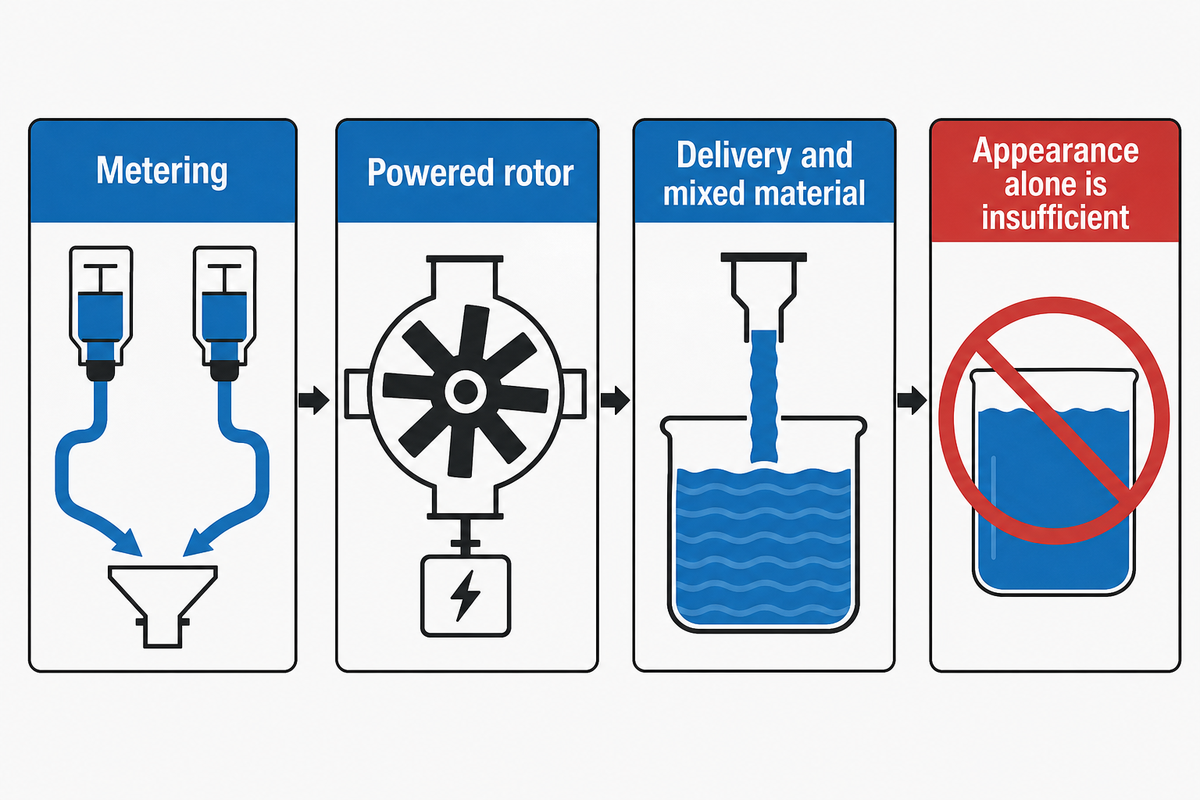
Dynamic mixing employs a powered rotor to blend two components within a mixing head. Separate functions of the system are metering and mixing: control of the feed proportions and how the components blend. Therefore a qualifying check should assess delivery and the mixed material, as opposed to treating a homogeneous appearance as proof that both steps were achieved.
Bulk mixing machines may have pumps, valves and a motorized chamber. Cartridge setups can dispense material through a powered mixing nozzle with a manual or an automatic dispensing drive. Architectures like those require different hardware tests. A nozzle accessory doesn’t validate the performance of a complete automatic metering system.
Tom Buckley, a Henkel application engineer, describes these separate material-handling functions in Dispensing Two-Part Adhesives, a historical engineering article. Its explanation is useful background, rather than a current equipment specification.
In adhesive dispensing, the quoted “meter mix” is a request to confirm both functions. If a supplier uses “AB” or “auto” in a description, clarify which components and operations those cover. Neither term indicates that the head has a powered rotor.
- Confirm how A and B are proportioned.
- Identify the powered rotor and its drive connection.
- Locate the point where separate streams first meet.
- Define the evidence needed after dispensing.
It’s premature to buy a 2K dynamic mixing head if the upstream delivery isn’t verified. Neither a high viscosity paste nor a strange ratio establishes system compatibility. The formulation and the entire material path still need to be evaluated in a trial.
For the delivery check, apply the NIST measurement-result traceability principles to the actual measured quantities. They aren’t an equipment approval.
Follow the Material from Metering to the Bead
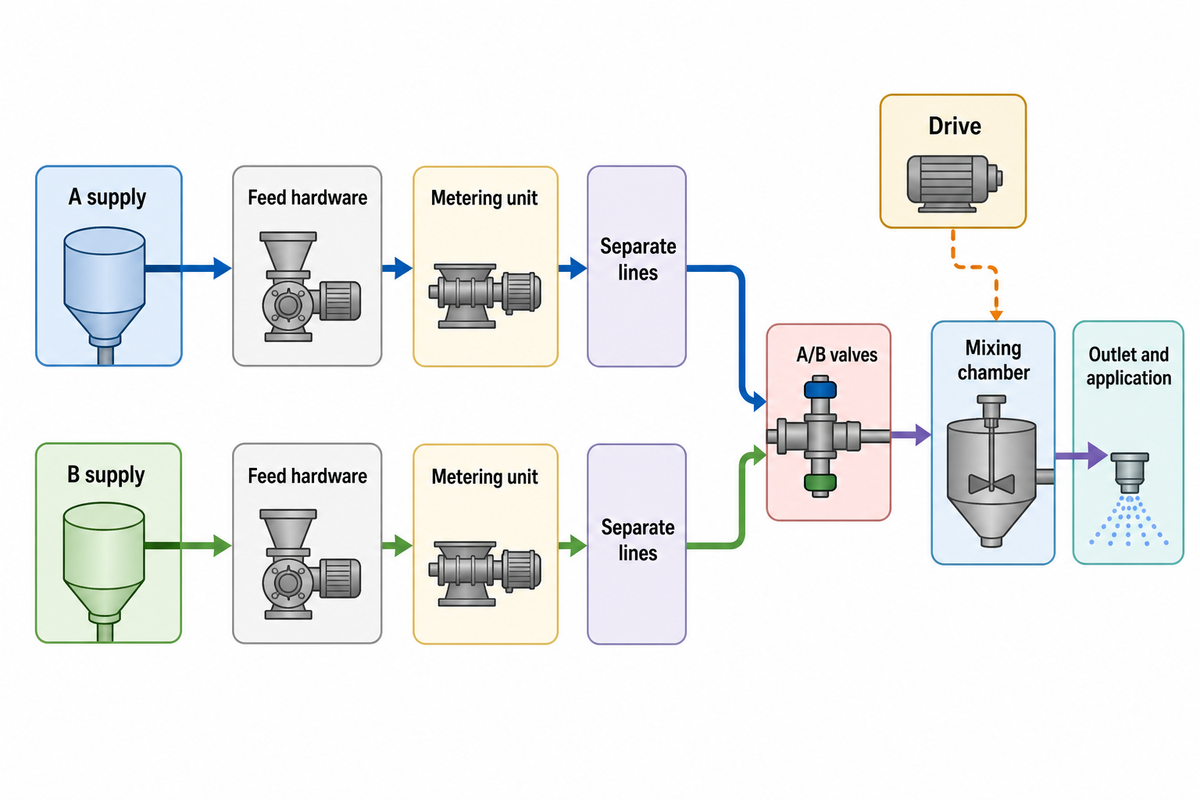
The material path starts from the separate supplies of A and B, through the delivery hardware, to a joining point, mixing chamber and outlet. Record that path for the specific installation being studied. Pump behavior, valve timing, the rotor and outlet have different responsibilities. As a result, a change in a component can affect the evidence required for the complete dispensing process.
Create a marked drawing, then inspect it against the installed equipment. Show recirculation branches, pressure-sensing locations and the components that retain mixed material. If a two-component cartridge is used, show its format and connection separate from the dispensing drive.
| Location | What to record | What the record answers |
|---|---|---|
| A supply | Material identity, lot and conditioning temperature in °C | Was the intended component available? |
| B supply | Identity, lot and storage release | Was the matching component used? |
| Feed hardware | Delivery state and supply alarms | Could either side be starved? |
| Metering unit | Ratio basis and output in g/s or mL/s | Were proportions checked on the right basis? |
| Separate lines | Routing and approved pressure limits in bar | Where can restriction or retained material occur? |
| A/B valves | Timing and measurement location | What reaches the joining point? |
| Mixing chamber | Chamber and rotor revision | Which geometry was qualified? |
| Drive | Commanded speed in rpm and available status feedback | Did the rotor run as intended? |
| Outlet and application | Nozzle revision, shot mass in g and bead geometry in mm | Which deposited material was assessed? |
Published in 2011 by ViscoTec-America’s CEO Gerald Pfeiler, Precision Dosing describes rheology and how changes in pressure affect delivery. Supplier authorship matters: Product descriptions often explain the science behind the product, but claims and performance guarantees shouldn’t be extrapolated beyond the product.
Prior to requesting a head drop-in, check feed, drive and controller interfaces. Separate the hardware from the claim that the system is ready for mass production.
For a modular installation, mark module boundaries on the drawing for each connection of hoses and pipes. Identify which interfaces the replacement retains and which require reassessment.
Show measurement locations in the drawing as well. Traceability guidance from NIST is focused on the result, not the presence of a calibrated device.
Build a Material-Specific Operating Window
An operating window is the documented combination of material condition, timing, mixer operation and delivery that has been assessed for a particular process. Capture temperature, pause and output values, and speed of the rotor. A particular adjustment range for a given machine shouldn’t be considered an approved sealant recipe; a result for one formulation shouldn’t be transferred to another without evidence.
Ask the material supplier for the ratio basis, density data where conversion is needed, processing conditions and the relevant working-life or pot life method. ISO 10364:2024 addresses working-life determination for multicomponent adhesives. Its methods need not give identical results; it does not qualify a dynamic mixer.
Can a dynamic mixer correct an off-ratio feed?
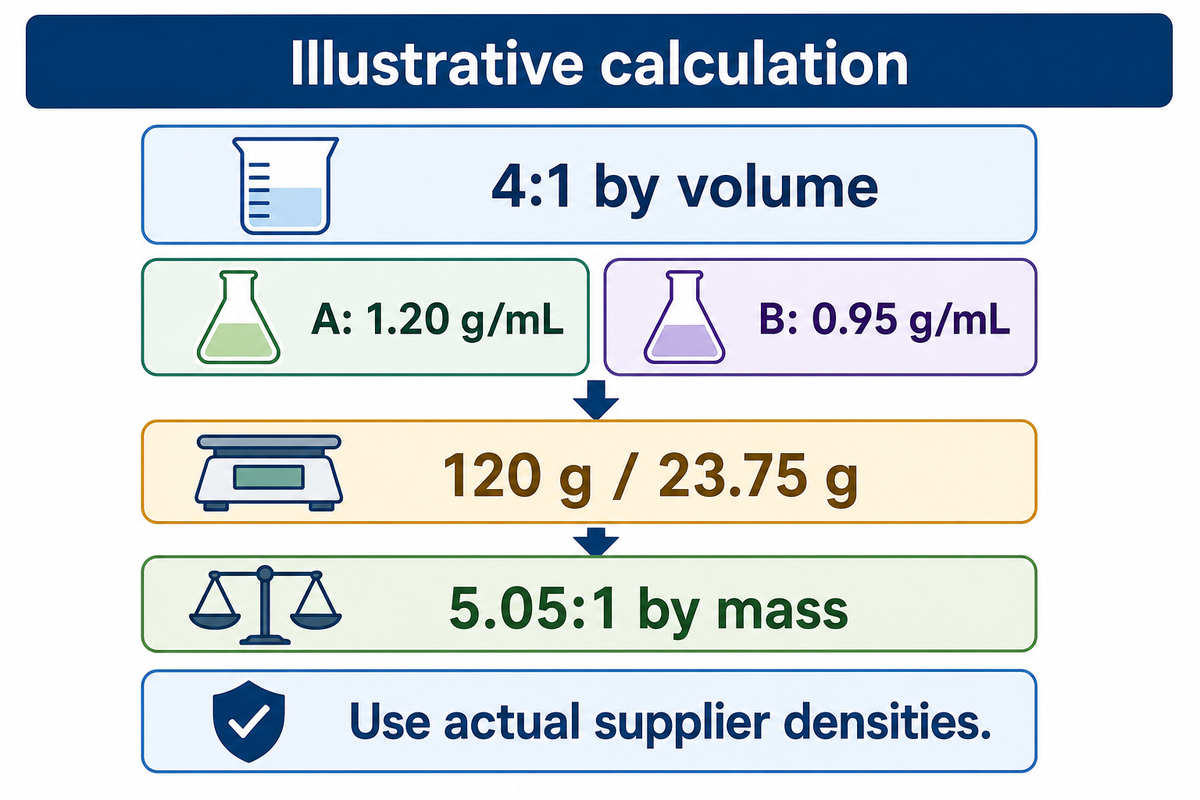
A dynamic mixer can’t provide a missing component. Establish the A:B delivery result before adjusting blending settings. The volume ratio and weight ratio can be different for components with different densities. Identify the supplier’s basis, measurement location and conditions, and then compare the result to the material specification.
Illustrative calculation: suppose a material requires 4:1 by volume, with A at 1.20 g/mL and B at 0.95 g/mL at the specified measurement condition. Collecting 100 mL of A and 25 mL of B gives 120 g and 23.75 g. The mass ratio is 120 ÷ 23.75 = 5.05:1, while the volume ratio remains 4:1. Weighing 120 g of A against 30 g of B would give about 3.17:1 by volume, despite a 4:1 mass ratio. Substitute the actual supplier densities; the weight and volume ratio converter can assist with that calculation.
Measurement precision is also relevant to the decision. NIST’s metrological traceability guidance mentions that instrument calibration alone doesn’t ensure traceability and fitness for purpose. Determine the weighing instrument, its status, repeatability, and environmental factors and uncertainty appropriate to the rule of acceptance.
Engineering note
Density values and weighing uncertainty are included in the ratio result for illustrative 100 mL/ 25 mL checks. Permitted deviations are to be taken from approved material/ process specifications. NIST provides measurement principles; it supplies no universal ±1% sealant acceptance tolerance.
Purchasing objections are best resolved by providing relevant trial data for a material. More controller rpm settings don’t address whether the bond or cure is acceptable.
In the case of high viscosity materials, determine how the trial represents actual feed conditions. If vacuum conditioning is proposed, request the formulation-specific method and evidence. It isn’t a general remedy for bubbles.
Validate the Process with a 4-Stage Bead Evidence Chain
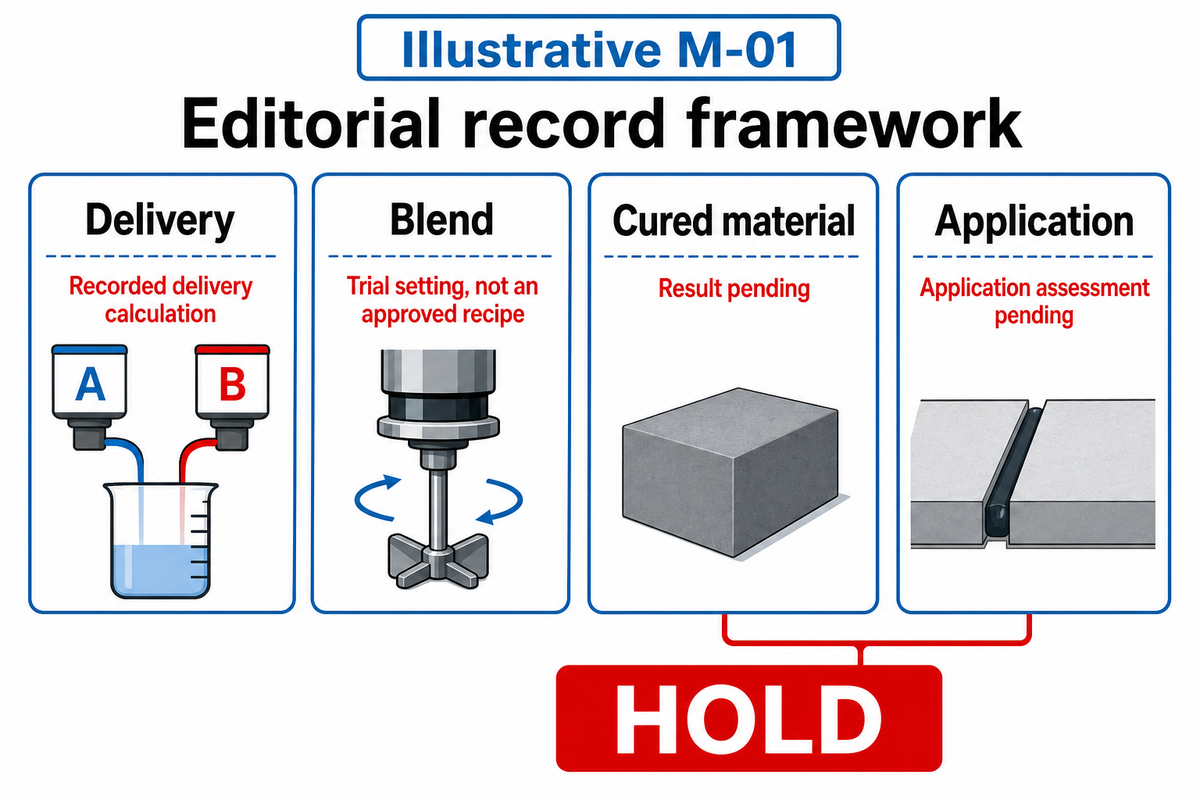
The 4-Stage Bead Evidence Chain provides a framework to link the delivery, blend and cured-material results to the intended application. The 4-Stage Bead Evidence Chain organizes that documentation so missing evidence is visible. It provides a framework whereby missing links in the Evidence Chain are visibly indicated.
It is an editorial record framework; actual acceptance limits and methods must come from the material, application and applicable specification.
4-Stage Bead Evidence Chain
The 4-Stage bead Evidence Chain links the required delivery, blend, and cured-material records to the given application. No individual observation is accepted as complete acceptance.
- Delivery: confirm components, ratio basis and representative delivery conditions.
- Blend: record the mixer configuration and observations using the agreed method.
- Cured material: Assess properties at specified conditioning and test times.
- Application: assess the intended substrate, joint or part against its own requirements.
Method scope determines what a result means. ASTM C1183/C1183M-13(2024) covers laboratory extrusion rate for building sealants. ISO 24068-2:2021 addresses cure-property development in building and civil-engineering sealant test joints. Neither is a blanket approval for a rotor, formulation or industrial assembly.
Filled example, trial M-01: each numerical entry is illustrative. The quality lead has a recorded delivery calculation and sample identification, but the application test hasn’t been performed. The correct disposition is HOLD, even if the bead looks good.
| Stage | Recorded evidence | Decision / next owner |
|---|---|---|
| Delivery | A 120 g; B 23.75 g; hypothetical densities 1.20 and 0.95 g/mL | Calculated 4:1 volume basis; quality checks uncertainty and specified tolerance |
| Blend | Head revision H-A; trial 500 rpm; output 2 g/s; sample temperature 23 °C | Trial setting recorded, not an approved recipe; process engineer assesses the specified mixing method |
| Cured material | Sample M-01-C; planned observation at 24 hours under the agreed method | Result pending; laboratory records measured properties and conditions |
| Application | Joint J-01; illustrative 6 mm width; intended substrate identified | Application assessment pending; quality retains HOLD |
Building-joint sealants need a defined end-use class and substrate. ASTM C920-18(2024) explicitly cautions that qualifying sealants are not suitable for every application. ASTM C1521-19(2025) evaluates installed weatherproofing-joint adhesion/cohesion; it does not establish full weatherseal performance or straightforward failure causation.
The scheduled observation at 24 hours in M-01 is an example, not a universal cure time. Release is dependent upon completed, appropriate evidence. Successfully completed extrusion tests can’t resolve an unresolved substrate-adhesion requirement.
Control Startup, Pauses, and Restart
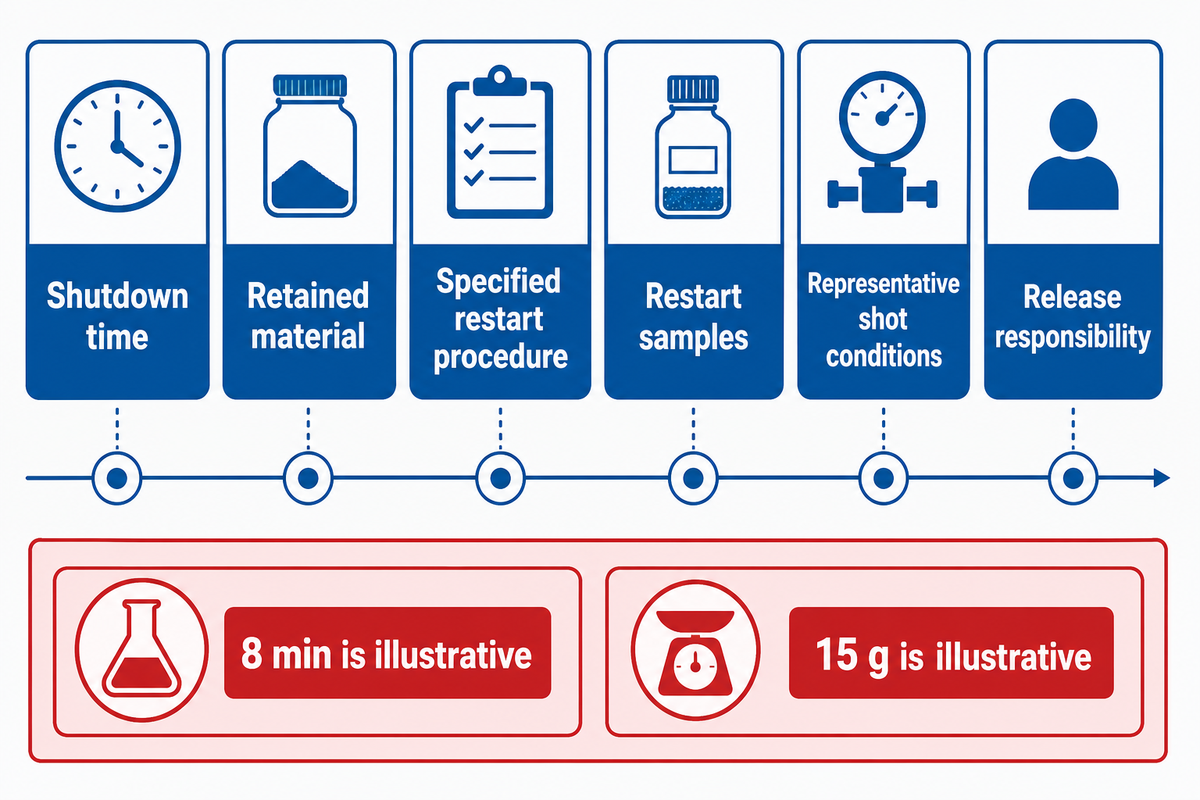
Recorded checks are required for restart and for start-up, because constant running doesn’t describe all delivery conditions. Use equipment and material instructions to define priming, allowed idle time and treatment of mixed material retained in equipment. Keep the output separated until the required delivery, mixing and downstream acceptance evidence is established.
Pfeiler’s historical delivery article discusses delivery fluctuations around the beginning and end of a shot. This mechanism is a basis for assessing the actual production sequence, rather than accepting a long continuous dispense as a substitute for qualifying short shots.
Where adhesive working life informs the restart assessment, name the method used. ISO 10364:2024 offers working-life methods, not a permitted pause duration for this head or formulation.
In an illustrative continuation of M-01, the line pauses for 8 min after making 15 g shots. The operator logs the pause and segregates the sample, M-01-R, from saleable material. A maintenance technician confirms the revision of the head and the procedure used. Quality requests the missing delivery check and the scheduled material assessment. No one declares that an 8 min pause is permissible merely because the next bead has the same color.
- Record shutdown time and the condition of retained material.
- Apply the specified replacement, cleaning or restart procedure.
- Identify restart samples and check representative shot conditions.
- Record the disposition and the person responsible for release.
If a restart requires replacing consumables, the plan must include the availability of spares. Possible savings on mixing elements can be negated when a shift lacks the approved replacement or cannot identify which procedure is applicable.
The illustrative 8 min pause and 15 g shot define a question to test, not a limit to copy. Establish restart acceptance with the actual formulation, head and production sequence.
Trace Streaks, Soft Spots, and Bubbles to Their Source
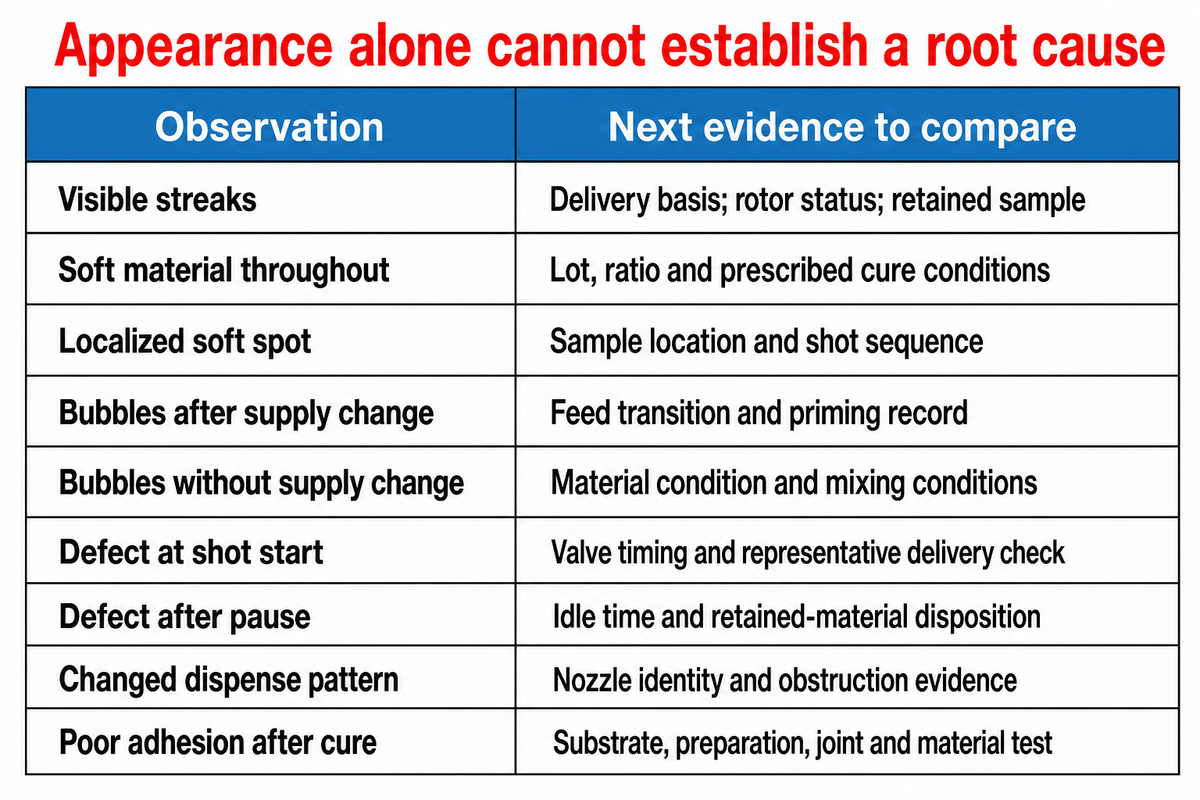
Bubbles, streaks, and softness are observations to be investigated. These may be a result of competing causes. Separate evidence for delivery, blend, material condition and application before changes to settings are made. A diagnostic matrix can assist in focusing the next investigation. However, appearance alone can’t establish a root cause. A change still needs to be tested against the relevant acceptance requirements.
How can you tell a mixing defect from a material problem?
Examine the defect against other records: component identity and condition, delivery measurements, mixer status and the required cured-property results. A confirmed ratio error focuses attention upstream. Acceptable delivery leaves other alternatives open, such as blending, conditioning, or method of application. Samples and lots need to be tracked to provide the material supplier and equipment team the opportunity to review the evidence.
One visible consumer epoxy discussion illustrates a question: One batch in the mix remained tacky while the other batches cured. This leaves uncertainty about batch proportions and mixing. This question reflects useful language, but isn’t evidence pertaining to an industrial repair method. Other uncontrolled variations, such as adding hardener or heat, or using a solvent without formulation directives would introduce another uncontrolled change.
| Observation | Evidence to compare | Next action / owner |
|---|---|---|
| Visible streaks | Delivery basis; rotor status; retained sample | Process engineer checks delivery before a speed trial |
| Soft material throughout | Lot, ratio and prescribed cure conditions | Quality and material supplier review formulation evidence |
| Localized soft spot | Sample location and shot sequence | Quality maps the defect; avoid assuming one cause |
| Bubbles after supply change | Feed transition and priming record | Maintenance checks the approved supply procedure |
| Bubbles without supply change | Material condition and mixing conditions | Supplier and process engineer compare hypotheses |
| Defect at shot start | Valve timing and representative delivery check | Process engineer assesses the start transient |
| Defect after pause | Idle time and retained-material disposition | Operator segregates restart output |
| Changed dispense pattern | Nozzle identity and obstruction evidence | Maintenance follows the equipment procedure |
| Poor adhesion after cure | Substrate, preparation, joint and material test | Application specialist assesses the end-use method |
C1521’s caution about adhesive-failure causation relates specifically to weatherproofing joints, but it explains why a failed bond doesn’t necessarily point to the mixer. Preserve alternative causes until the applicable test and records distinguish between them.
For M-01-R, an observation of 24 hours and a hypothetical 15 g restart sample are associated to the same lot and head revision. The records help analyze causes, and neither number creates a diagnosis. Don’t purchase a replacement rotor, solely, based on a soft bead.
Adapt Checks for Polyurethane, Silicone, and Epoxy

Polyurethane, silicone, and epoxy describe broad material families rather than complete processing instructions. The exact formulation and final use determine the ratio, working conditions and acceptance properties of the material. Keep the requirements for foaming, sealing, bonding and encapsulation distinct. Get the supplier’s instructions and consider the requirements carefully before setting a family-wide Rotor setting and cure criteria.
- Polyurethane / PU: confirm formulation conditioning and whether foaming is intended; review the uncured material’s safety data.
- Silicone / RTV: identify the supplied components and specified cure conditions rather than relying on the family label.
- Epoxy resins: establish ratio basis, working-life method and the properties required after cure.
- End use: distinguish a building joint, automotive seal, gasketing, coating or encapsulation before choosing an acceptance method.
OSHA’s isocyanate overview mentions that exposure to isocyanates in polyurethane manufacture and adhesives is of concern. Assess the formulation and control the exposure; a general label such as PU glue can’t be relied upon to provide the safety data.
The illustrative 23 °C sample and 24 hours observation from M-01 can’t be transferred to a different compound. Work involving electronic products also introduces specific requirements; information on electronics potting cartridge systems is provided elsewhere.
For an offer described as urethane processing, verify the exact formulation. When electronics are encapsulated, state whether the work is to dispense a controlled bead, or to pour into a cavity. Don’t substitute hand stirring for the assessed mixing process without a documented trial.
Plan Cleaning and Changeovers Around Head Design
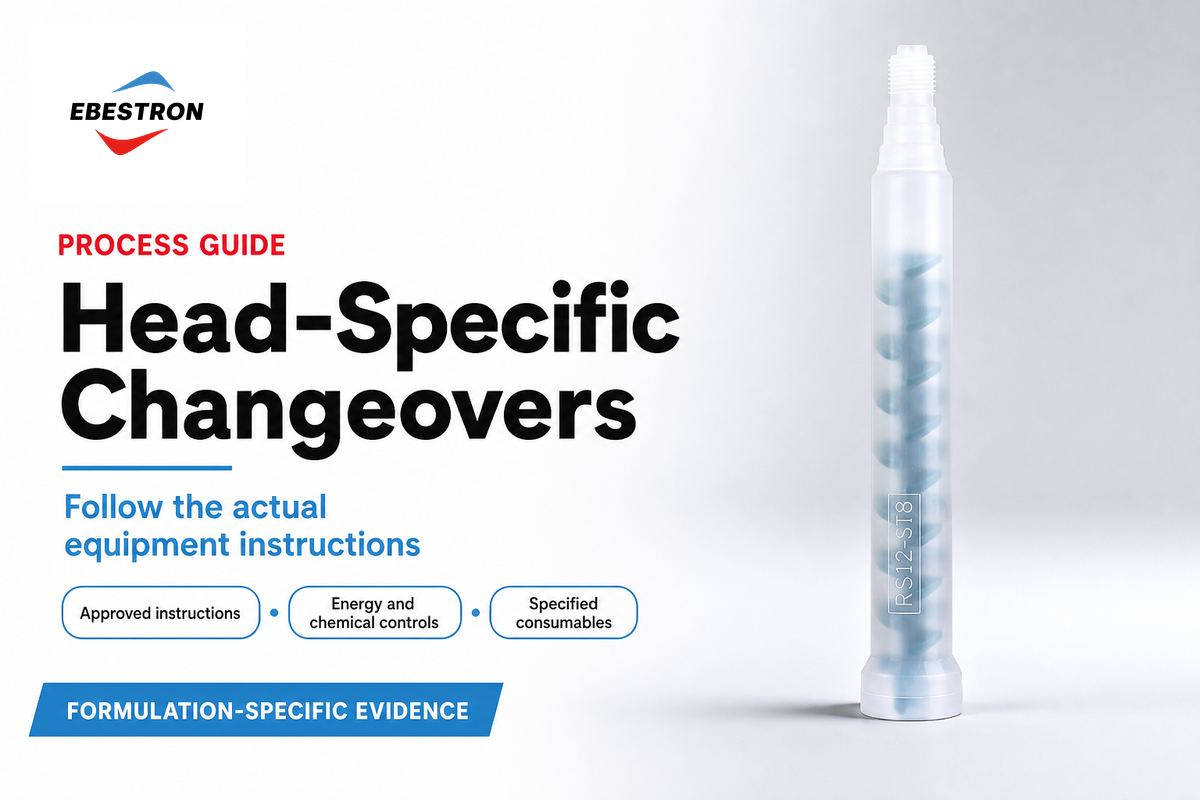
Cleaning is determined by the head’s wetted path, materials retained, and approved maintenance method. Is the system equipped with replaceable mixing elements? Is there a documented flushing circuit or disassembly procedure? A suitable procedure for one head is no evidence that another can be cleaned with the same fluid. Chemical compatibility and the protection of the worker must be included with the assessment of hazardous energy.
The descriptions of original equipment include both disposable mixing elements and design-specific rinsing arrangements. State the actual equipment instructions, allowed cleaning agent, and route of waste. Abrasive filler, cured residue and incompatible raw materials belong in the maintenance discussion. No general recommendations of water or solvent can be extrapolated from the word dynamic.
For applicable US workplaces, OSHA 29 CFR 1910.147 addresses hazardous-energy servicing within its stated scope. Stored energy and verified isolation matter when the procedure applies.
“Push buttons, selector switches and other control circuit type devices are not energy isolating devices.”
For applicable US workplaces, addressing the safety-data-sheets and employee hazard training is also included in OSHA 1910.1200. Determine the handling, exposure control and reactivity of components and the cleaning agent. Apply the site’s safety process to select control measures; this manual specifies no universal protective equipment.
Do
- Identify wetted parts and approved instructions.
- Record energy and chemical controls.
- Stock the specified consumables.
Don’t
- Transfer a flushing fluid between designs.
- Substitute a stop button for applicable isolation.
- Restart with unidentified retained material.
An illustrative 8 min pause is still a process record, not a cleaning trigger. Agree the changeover rule for the material and the responsibility for the spare part before accepting an equipment offer.
Hand Off a Validated Process to Production

Production handoffs for automation capture the assessed material, hardware, settings, methods and responsibilities in a controlled operating record. Provide evidence that supports release and document the conditions requiring holds and reassessments. Procurement needs the appropriate parts, maintenance needs the approved service instructions, and quality needs traceable samples and application-specific acceptance results.
Automation changes who commands and records the sequence; it does not remove the need for acceptance evidence.
An ASI report on Staiger’s automated dispensing application describes recording the selected system’s mixing-motor status. It’s a named ViscoTec/preeflow supplier-affiliated customer case, not Ebestron test data. The practical question is whether your controller provides the evidence your process requires.
| Recipient | Transferred record | Disposition |
|---|---|---|
| Process engineer | H-A head; illustrative trial 500 rpm / 2 g/s / 23 °C | Trial revision retained; no production recipe issued |
| Quality lead | 120 g A / 23.75 g B; cure sample at planned 24 hours; application test pending | HOLD pending method-suitable results and ratio acceptance |
| Maintenance | Approved cleaning/replacement method and spare list requested | Service readiness unresolved |
| Operator | 15 g shot example; 8 min pause event; M-01-R segregated | Restart output excluded from release |
| Procurement | Material, cartridge/head revision and controller interface identified | Compatibility confirmation required before ordering |
New terminology launched by the market should also be scrutinized. In March 2026, Essemtec’s own two-component announcement described static mixer needles. A 2K label, for example, doesn’t mean a powered rotor is involved. When evaluating a new offer, request the drawing of the material path, drive, and control to determine the adequacy of the new offer.
Define the required flexibility using specific material, shot, and changeover cases, and request trial records to support those cases.
Retain the basis of measurement acceptance in the handoff. NIST’s guidance on traceability and fitness for purpose prevents a calibration label from standing in for a suitable result.
Use the following requests in your discussion with the supplier; provide your own values for material, rather than using recommended limits.
| Parameter | Recommended range | Why it matters | How to verify |
|---|---|---|---|
| Material and ratio | Supplier-specified mass or volume basis | Defines what must be delivered | Current formulation instruction and ratio record |
| Output | Required g/s or mL/s, including shot sequence | Defines the assessed delivery condition | Representative production trial |
| Rotor operation | Material-assessed rpm window | Connects mixing to the selected head | Drive status and material results |
| Temperature | Supplier/process range in °C | Defines conditioning and measurement inputs | Recorded material condition |
| Pause and restart | Validated idle time in min | Controls retained-material disposition | Identified restart sample and procedure |
| Application acceptance | End-use-specific property and units | Prevents appearance-only release | Named method, substrate and acceptance rule |
Key takeaway
Release a 2K dispensing process only against its documented material and application requirements. The four-stage record makes missing evidence visible; it cannot supply missing test results.
When determining system compatibility and the supply of consumables, the Ebestron dispensing team should be provided with the relevant material instruction, hardware revision and any unresolved checks. Give details of the evidence still required prior to production release.
Frequently Asked Questions
How do dynamic mixing systems for 2K sealants work?
View Answer
Separate components are delivered to a mixing head, where a powered rotor blends them before application. The metering arrangement controls proportions; the mixing head supplies blending energy. The complete process still needs checks for component identity, delivery, material properties and the intended application. Confirm the specific cartridge or bulk architecture rather than assuming every two-component installation uses the same hardware.
Can a dynamic mixer correct the wrong A:B ratio?
View Answer
No. A rotor cannot add the missing component to an off-ratio feed. Check upstream delivery against the formulation’s mass or volume basis. When weighing a volume-ratio material, use the component-specific density information and a suitable measurement system. Resolve the delivery result before testing whether a change in rotor operation improves blending.
Why can a 2K sealant bead remain soft after dispensing?
View Answer
Softness can leave several explanations open, including component delivery, mixing, material identity or condition, and the specified cure environment. Identify the lot and sample, compare the delivery record, and assess properties at the required test conditions. Consult the formulation instructions before attempting a correction. A soft bead alone does not identify the mixer as the cause.
What rotor speed should I use?
View Answer
Use the speed assessed for your formulation, output and head geometry. Equipment adjustment capability and illustrative trial settings are not an approved operating recipe.
How should I qualify a restart after a production pause?
View Answer
Define the restart sequence using the equipment and formulation instructions, including retained-material treatment and any required replacement or cleaning. Record the pause duration and relevant material conditions. Identify restarted output separately, obtain representative delivery and mixing evidence, and complete the required material or application assessments before release. Quality should record both the disposition and the acceptance method. A visually consistent restart bead is insufficient when the delivery result is missing. If the process differs from the assessed sequence, keep the affected output on hold while the responsible team determines what needs reassessment. The permitted idle time, purge quantity and sampling frequency require application-specific evidence; the illustrative records in this guide provide no universal values for those decisions.
Does uniform color prove that the sealant will perform correctly?
View Answer
No. Color is an observation, while performance also depends on suitable delivery, cured material and application evidence. Use the formulation’s specified tests and the relevant end-use acceptance requirements.
Related application resources
- Dispensing drive formats for cartridge-based application discussions.
- Nozzle connection types for a separate static-nozzle reference.
How Ebestron Frames This Process Guide
Shanghai Ebestron New Materials Co., Ltd. presents Ebestron as an adhesive-packaging consumables manufacturer. This dynamic mixing guide combines public technical sources with clearly marked illustrative records. The examples are educational; they aren’t Ebestron customer trials or proprietary performance data. Material suppliers, equipment documentation and application requirements provide the actual acceptance criteria.
References & Sources
- Dispensing Two-Part Adhesives, Tom Buckley, Henkel application engineer; historical ASSEMBLY article reprinted by Adhesives & Sealants Industry.
- Precision Dosing, Gerald Pfeiler, ViscoTec-America CEO, 2011; Adhesives & Sealants Industry.
- ISO 10364:2024, working life of multicomponent adhesives, International Organization for Standardization; public scope.
- Metrological Traceability: Frequently Asked Questions and NIST Policy, National Institute of Standards and Technology.
- ASTM C1183/C1183M-13(2024), ASTM International, public scope listed by the American National Standards Institute.
- ISO 24068-2:2021, degree of cure in sealant test joints, International Organization for Standardization; public scope.
- ASTM C920-18(2024), elastomeric joint sealants, ASTM International; public scope and significance.
- ASTM C1521-19(2025), installed weatherproofing sealant joints, ASTM International; public scope and limitations.
- Isocyanates overview, Occupational Safety and Health Administration.
- 29 CFR 1910.147, control of hazardous energy, Occupational Safety and Health Administration.
- 29 CFR 1910.1200, hazard communication, Occupational Safety and Health Administration.
- Automated Dispensing Improves Processing Stability in Solenoid Valve Production, Adhesives & Sealants Industry; ViscoTec/preeflow supplier-affiliated Staiger case.