Get in touch with Ebestron Company
Static Mixing Nozzles & Tubes for 2-Part Adhesives
Mixpac/3M-Compatible, Factory-Direct Disposable Static Mixers
Buy your disposable static mixers from the factory that makes them — not from a distributor marking up Sulzer and 3M. You get the full helical and Quadro range, every cartridge system, and a genuinely low MOQ. Plus a part-number cross-reference, so you order the exact fit the first time instead of guessing.
System Specifications
- 4–13 mm diameters
- 12–56 elements
- 1:1 · 2:1 · 4:1 · 10:1
- A/B/C/F systems + bell
- Helical & Quadro
[NOZZLE DYNAMICS]
Off-Ratio Mixing Wrecks the Bond — The Static Mixer That Prevents It
A two-part epoxy is stoichiometrically balanced. So an off-ratio or incomplete mix makes it cure erratically — sometimes only partially — and you are left with low bond strength and reduced physical properties. The static mixing nozzle is the part that prevents this, blending part A and part B into one homogeneous bead the moment you dispense.
A static mixing nozzle — also called a static mixing tube or mixing tip — is a one-time-use tube with stationary internal elements. Those elements divide and recombine the two adhesive streams until the bead runs uniform. Reactive two-component systems are demanding enough that the dispensing nozzle itself is patented technology (US Patent US6601782B1). Get the nozzle wrong, and the chemistry never gets its chance to work.
Where the cost actually hides
Here is what most buyers miss: the waste is bigger than the nozzle price. Industry reports indicate that a conventional helical or square mixer can retain up to 20 ml of adhesive in every nozzle, while smarter element geometries cut that by roughly 75% (Adhesives & Sealants Industry, The Next Generation of Static Mixing Nozzles).
-
01
Retained adhesive
every nozzle you don’t finish sets up — capped or not — and ends up in the bin
-
02
Purge loss
that first 25–50 mm bead is never fully mixed, so it gets purged onto a towel
-
03
Rework
a weak joint from an under-mixed bead costs you far more than the tube ever did
So the job of a good static mixer is narrow, and it is measurable: mix to ratio in the fewest elements that still reach homogeneity, hold as little adhesive as possible, and fit your existing gun so nothing leaks.
When a mixer fails, the reason is structural, not random — too few elements for the viscosity gap, or a bore that traps and wastes adhesive. Ebestron engineers each element in a static mixer to reach full homogeneity in the shortest path, because shorter means up to 75% less retained waste.
[SYS-ARCHITECTURE]
The Ebestron Static Mixer Range — Diameters, Elements, Systems & Cartridge Fit
Every static mixing nozzle is defined by six things: element shape, mix ratio, inner diameter, number of elements, connection interface, and outlet termination. Ebestron builds the full range, so you can match any dual cartridge on your bench — anything from 50ml hand guns up to 400 ml meter-mix equipment.
Our model codes follow the same diameter–element convention the industry already uses. A 13-element 5.4 mm mixer reads as 05-13; a 24-element 8.7 mm mixer as 08-24. Read a Sulzer Mixpac part number and you can read ours. Each disposable mixing dispenser is a manufactured assembly with its own process patents, such as US5333755A.
Static Mixer Spec Disclosure Table
| Ebestron code | Bore Ø | Elements | Shape | Connection | Cartridge / system | Typical ratio |
|---|---|---|---|---|---|---|
| MA 04-16 | 4.0 mm | 16 | Helical | Bayonet | 50 ml A-system (AA) | 1:1 · 2:1 |
| MB 05-21 | 5.4 mm | 21 | Helical | Bayonet | 50 ml B / S-system | 1:1 · 2:1 · 4:1 |
| MA 05-24Q | 5.4 mm | 24 (Quadro) | Square | Bayonet | 50 ml A-system | 1:1 · 10:1 |
| MC 08-18 | 8.7 mm | 18 | Helical | Bell-mouth | 200 ml C-system | 1:1 · 2:1 |
| MF 08-24 | 8.7 mm | 24 | Helical | Bell / threaded | 200–400 ml F-system | 1:1 · 2:1 |
| MFQ 08-24 | 8.7 mm | 24 (Quadro) | Square | Bell / threaded | 200–400 ml F-system | 1:1 · 2:1 |
| MC 10-24 | 10 mm | 24 | Helical | Bell-mouth | 200 ml meter-mix | 1:1 · 4:1 |
| ML 13-36 | 13 mm | 36 | Helical | Threaded nut | 400+ ml / meter-mix | 1:1 · 2:1 · 10:1 |
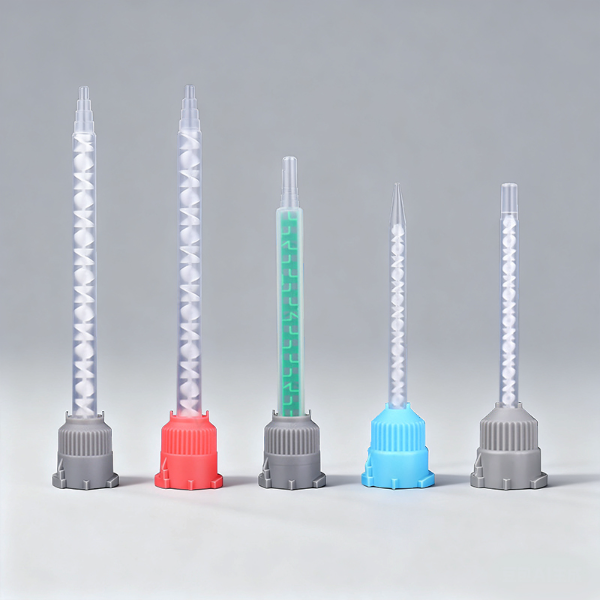
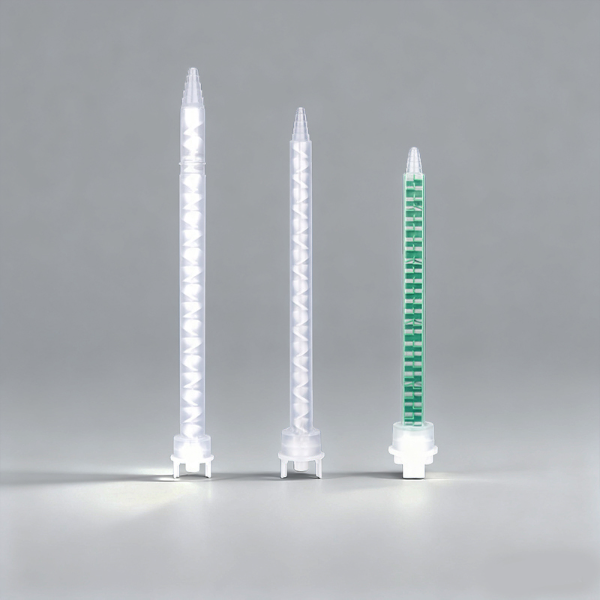
Element counts run 12, 16, 18, 20, 24, 32, 48 and 56; bore diameters span 4–13 mm. Round helical sections are color-keyed white, yellow or blue, and square Quadro sections are green — the same visual code your operators already know by sight.
Round helical vs square Quadro
Helical elements are the traditional spiral design in a round nozzle, and they suit most general bonding. Quadro (square) elements double the mixing per length, so the nozzle can run shorter — which means it holds less adhesive and purges less on every shot (industry data indicates up to 75% less retained waste).
On high-volume lines, where retained waste compounds across thousands of cartridges, the standard vs Quadro static mixer choice usually favors Quadro — because its doubled elements cut nozzle length, and the trapped adhesive with it. The honest trade-off is a slightly higher unit price against lower waste. Ebestron stocks both geometries in every bore, so you are not forced to compromise.
Send your cartridge spec for a matched sample →
// QC LOG_EXECUTE
We gauge every batch of mixers on three things before it ships: bore diameter within tolerance so it seats without leaking, element count exactly as marked, and a clean bayonet or bell so it locks on the first try. A mixer that fits wrong wastes more adhesive than it costs.
Choosing the Right Nozzle — The 6-Factor Static Mixer Selection Framework
Here is the counter-intuitive part: more elements is not always better. Adding elements improves mixing, sure — but it also raises pressure drop, so the adhesive gets harder to push and more material stays trapped inside (Statiflo, on pressure drop; ACS, Kenics CFD study; element geometry is itself patented, e.g. US6899453B2). What you want is the fewest elements that still reach homogeneity for your specific material.
Run any nozzle decision through these six factors, in that order. Each one narrows the field before the next even comes up.
| # | Factor | What it sets | Rule of thumb |
|---|---|---|---|
| 01 | Connection | Must match your gun/cartridge | Bayonet (50 ml) · bell (meter-mix) · threaded (large) |
| 02 | Cartridge size | Bore diameter family | 50 ml → 4–5.4 mm · 200–400 ml → 8.7–13 mm |
| 03 | Mix ratio | Element count band | 1:1 mixes easiest · 10:1 needs more elements |
| 04 | Viscosity gap | Element count up | Large A/B viscosity difference → more elements |
| 05 | Shot size | Diameter & element count | Large shot → larger bore, fewer elements Small bead → smaller bore, more elements |
| 06 | Material | Helical vs Quadro | Hard-to-mix or high-waste line → Quadro |
For most 2-part epoxies, the homogeneity window lands at 15–24 elements; only thin, low-viscosity systems mix fully in 4–6. When two components differ sharply in viscosity, step the element count up — not down.
Here is the honest version: the right count is simply the smallest one that still mixes, because every extra element piles on pressure and waste. Ebestron specs it to your material rather than overselling elements you do not need.
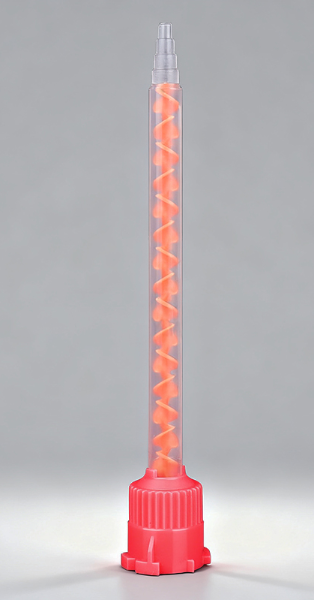
Not sure which code fits your gun and material?
Send us your specs →Ebestron vs Sulzer Mixpac & 3M — Compatibility Cross-Reference
[DATA.MATRIX]
Mixpac-3M Compatibility Cross-Reference Matrix
Most buyers already run Sulzer Mixpac or 3M nozzles, and they are searching mixpac nozzles for the same fit at lower cost. Here is the catch: nobody publishes a cross-reference, so switching feels risky and expensive. So we built the table the distributors leave out — Ebestron, working from the published Sulzer naming convention.
Cross-system cartridge-and-nozzle compatibility is itself the subject of patents such as EP2446973A2.
[PROCUREMENT]
Generic, not lesser
Generic compatible nozzles are designed to mimic the specs of the name brand, so a properly built equivalent performs the same on your gun. The honest trade-off is availability — a few highly niche mixers are still only made by the original brand.
Two facts work in your favor here. Name-brand nozzles are often sold only in packs of hundreds or thousands, while we ship from sample packs upward. And a like-for-like generic? It typically costs a fraction of the branded price in bulk.
| Sulzer Mixpac | 3M | Ebestron equivalent | Elements / Ø | Cartridge |
|---|---|---|---|---|
| MAH 05-13T | — | MA 05-13 | 13 / 5.4 mm | 50 ml A-system |
| MBH / MBQ 05-21 | — | MB 05-21 | 21 / 5.4 mm | 50 ml B/S-system |
| MCH 08-18 | 3M 08193 | MC 08-18 | 18 / 8.7 mm | 200 ml |
| MFQ 08-24 | 3M 08194 | MFQ 08-24 | 24 / 8.7 mm | 200–400 ml |
| MGQ / MC 10-24 | — | MC 10-24 | 24 / 10 mm | 200 ml meter-mix |
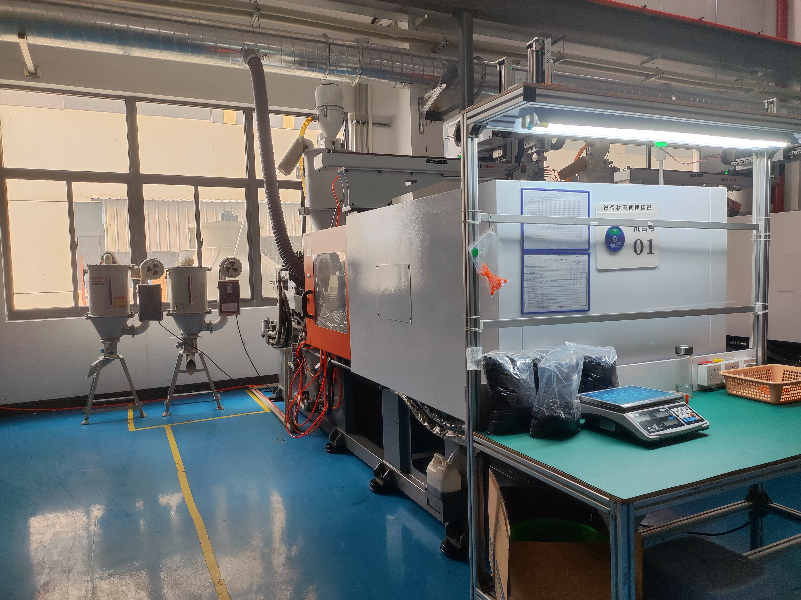
TAP OR HOVER FOR TCO DATA
Where the savings come from
The nozzle is cheap. The adhesive it traps is not. With a conventional mixer retaining up to 20 ml per tube — a cost newer geometries cut by roughly 75% — it is waste, not unit price, that drives cost on a busy line.
- Move high-volume stations to shorter Quadro mixers — that alone cuts retained adhesive
- Spec the fewest elements that still mix to ratio; less drag means less trapped material
- Right-size the bore to the shot, and you stop over-purging on every pull
These figures reflect published industry averages, not any one project — your exact savings come down to adhesive cost, shot size and line rate.
Built for Consistent Mixing — Materials, Performance & Applications
A mixer only earns its place if it dispenses clean, holds little, and seats without leaking. Ebestron builds the housing and elements in glass-filled polypropylene and PBT for rigidity, because the bore has to stay in tolerance across the whole run to mix on-ratio. That chemical resistance covers epoxy, polyurethane, MMA and silicone. Flow-path and reverse-flow mixer designs in this class are documented in dispensing patents such as US4969747A.
How operators get a clean bond every time
- Purge the first bead: run 25–50 mm onto a towel first — the leading slug never mixes fully
- Match the element count to the viscosity gap, so you don’t whip air into the bead
- Replace, don’t clean: a cured nozzle is scrap, so keep spares right at the gun
Where they go to work
These same mixer families serve very different benches. Structural and automotive/MRO bonding, electronics potting and encapsulation, dental and medical impression tips, construction chemical anchoring, resin casting, composite repair — all of it runs on these cartridge systems.
Running a specific adhesive or industry?
Get a sample matched to your application →
QC.SYS_COMPLIANCE
Quality Assurance — Material Compliance & Batch Consistency
For a switching buyer, the real question is not “is it cheaper.” It is “will it be the same in every box.” Consistency on a consumable is a process problem — and that is the reason Ebestron verifies bore and element count in-house, rather than outsourcing the check.
01
Dimensional check: we verify bore diameter and element count every batch, so fit and mix never drift
02
Material compliance: RoHS- and REACH-conformant resins, with FDA 21 CFR food-contact and medical-grade material options on request
03
Connection gauge: every bayonet and bell interface is test-seated, so it locks without leaking
RoHS / REACH
material compliance
FDA 21 CFR
food/medical-grade option
Per-batch QC
bore + element verified
Factory-direct
R&D · production · QC in-house
[DOC_SCAN] CERTIFICATION_MATRIX_VIEW
LIVE VERIFICATION
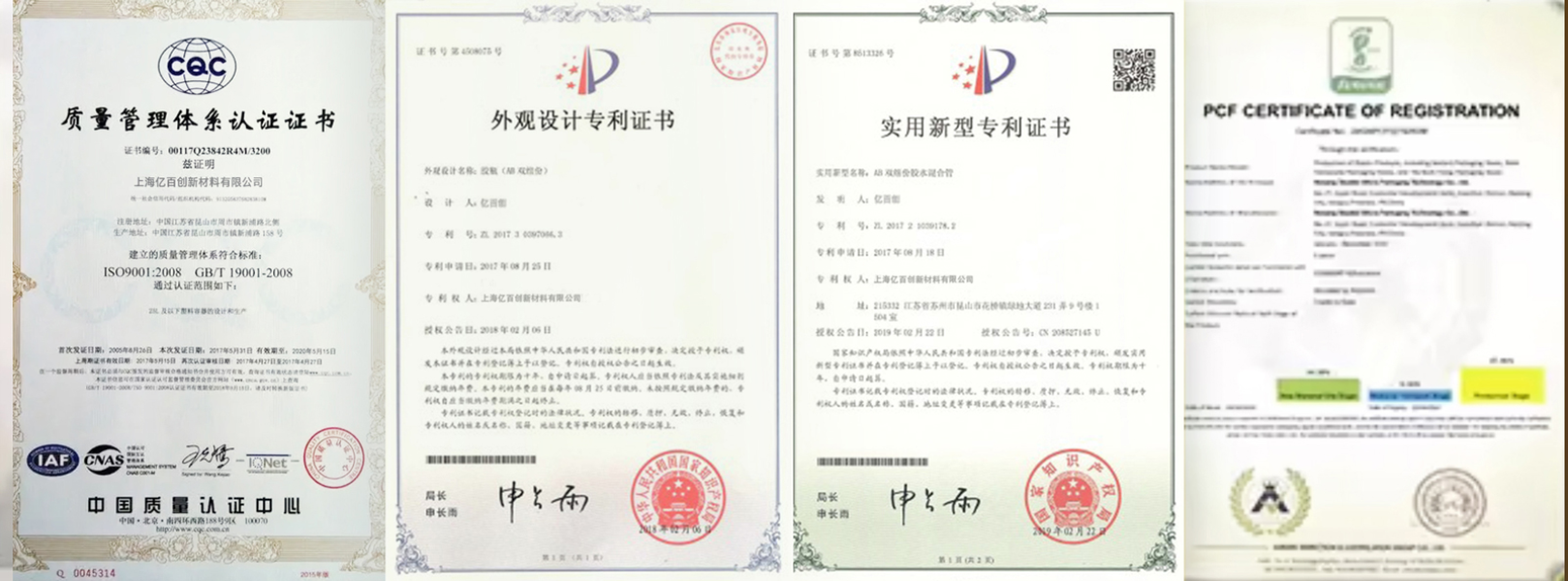
SYSTEM / CAPABILITIES
Wholesale & OEM — MOQ, Lead Time, Custom Colors & Private Label
Buying factory-direct should remove friction, not add it. Because Ebestron makes the mixers rather than reselling them, you can start small and scale up — no forced thousand-piece minimums, and no hidden risk just to test a fit. The cartridge-and-mixer interface our parts replicate is documented in dispensing patents such as US6601782B1, so a compatible build is a known quantity, not a gamble.
- Low MOQ: qualify the fit with a sample pack first, before you commit to bulk
- Custom colors & private label: brand the consumable as your own, not ours
- OEM part numbers: we map to your internal SKUs, so your ordering process stays unchanged
What drives your quotation
Ebestron prices static mixers on a few clear levers, not a single list price — because a consumable buyer needs a number that scales with volume. Tell us the inputs, and you get a firm quote back fast.
Order volume
Sample pack → standard cartons → bulk pallets, each tier improving unit cost
Model & geometry
Helical vs Quadro, element count and bore
Custom color
Color-key your mixers by ratio for line error-proofing
Private label / OEM
Your part numbers, bag print and packaging
Lead time
Stock items vs custom tooling windows
ENGINEERING RESOURCES
Dispensing & Mixing Engineering Tools
Access our dedicated calculators and cross-reference matrices to optimize nozzle selection, verify brand compatibility, and measure retained adhesive waste cost.
[APP-01]
Static Mixer Cross-Reference Lookup
Find the exact Ebestron equivalent for Sulzer Mixpac or 3M part numbers. Ensure precise fitment and material compatibility before procurement.
Open Tool →
[APP-02]
6-Factor Static Mixer Selector
Determine the required element count, geometry (Helical/Quadro), and bore size based on your specific epoxy mix ratio, viscosity gap, and shot size.
Open Tool →
[APP-03]
Adhesive Waste Cost Calculator
Calculate the financial impact of retained adhesive inside dispensing nozzles, and measure ROI when upgrading to shorter, low-waste mixer geometries.
Open Tool →
[SYS.ACT] INQUIRY_PORT
Get the exact static mixing nozzle that fits — from the factory
Send us your cartridge type, mix ratio and volume. We’ll confirm the equivalent code, ship samples, and quote your MOQ.
KNOWLEDGE BASE
FAQ — Static Mixing Nozzles & Tubes
These come up most often when a buyer switches supplier — because a wrong fit fails the bond and wastes adhesive. Ebestron answers each one against the spec: bore, element count, and ISO-grade material control. Every mixer we ship is checked to that spec first.
Yes — for the standard systems. Our codes map to the Sulzer naming (A/B/C/F systems by bore and element count) and to common 3M part numbers like 08193 and 08194. Send us your cartridge or current part number, we confirm the equivalent, and then we prove it with a free sample.
Helical mixers use spiral elements in a round nozzle, and they suit general bonding. Quadro mixers use square elements that mix more per length — so the nozzle is shorter, holds less adhesive, and works out cheaper on high-volume lines.
Most 2-part epoxies reach a homogeneous mix at 15–24 elements; only thin, low-viscosity systems mix fully in 4–6. Step the count up when the two components differ sharply in viscosity — and down when the shot size is large.
Yes — that is normal. The leading 25–50 mm bead is never fully mixed, so purge it onto a towel before you apply. Forum users on hobby and aerospace builds raise this constantly; it is expected behavior, not a defective tube.
Air entrainment usually traces back to one of two things: dispensing too fast, or an element count mismatched to the viscosity gap. A correctly sized mixer plus a steady, moderate dispense rate keeps the bead bubble-free. Tell us the adhesive and we’ll size it for you.
They are disposable — one and done. Once the two parts mix and cure inside, the nozzle is scrap; solvent cleaning is messy, costly, and a health risk. Keep spares at the gun instead.
MOQ starts at sample-pack level, so you can qualify the fit before any bulk order at all. We also handle custom colors, private label, and OEM part numbers for production buyers.