Get in touch with Ebestron Company
Two-Component Adhesive Dispensing Systems & Cartridge Manufacturer
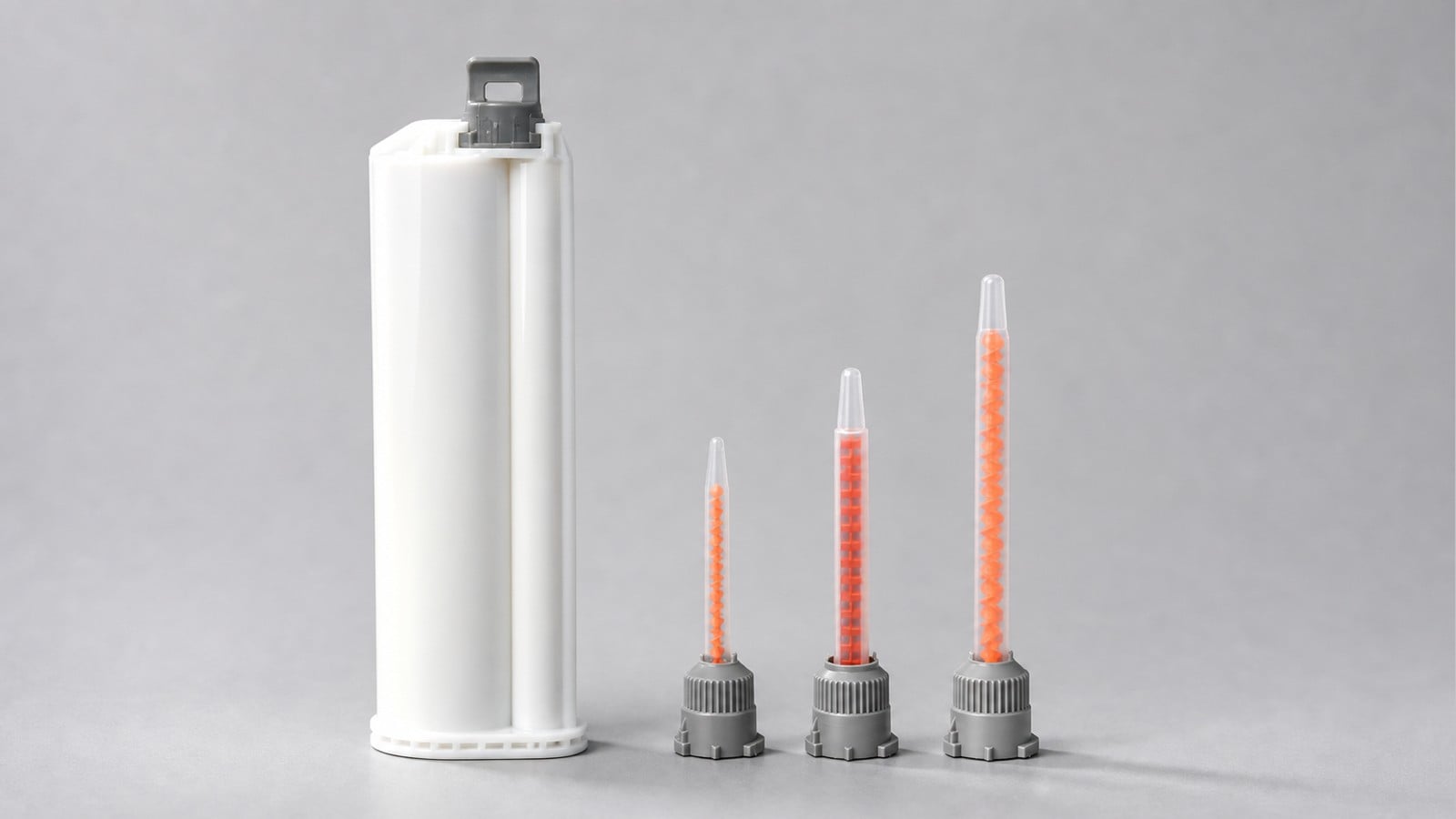
Empty dual cartridges, static mixing nozzles, dynamic mixing systems, dispensing guns, and precision tips-engineered to fit the Sulzer Mixpac, Nordson, 3M, and Cox systems you already run.
Ebestron is a two-component adhesive cartridge manufacturer in Jiangsu, China, that supplies the full set of 2K dispensing consumables that meter, mix, and apply two-part epoxy, polyurethane, acrylic, and silicone-not the adhesive, but every cartridge, nozzle, gun, and tip that delivers it on-ratio.
- OEM · ODM · Private Label
- 50–1500 mL cartridges
- Ratios 1:1 · 2:1 · 4:1 · 10:1
- Mixpac / Nordson / 3M Compatible
- Factory-Direct
5
2K consumable lines
50–1500 mL
Cartridge range
1:1–10:1
Mix ratios
7–48
Mixer elements
PP/PA/PBT/PE
Cartridge materials
5 Industries
Served worldwide
Why a Mismatched Cartridge, Mixer, or Gun Quietly Wastes Your Adhesive
System Definition
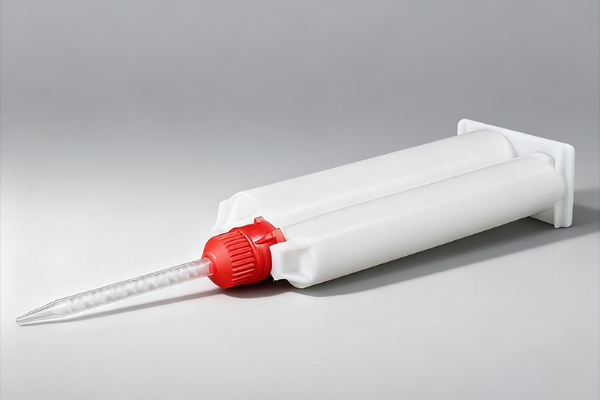
A two-component dispensing system is the empty dual cartridge, the static mixing nozzle, and the dispensing gun that keep Part A and Part B separate until the moment of application, then blend them on-ratio as they leave the tip (a function protected by dispensing-and-mixing IP such as US 7,527,172 B2). Get any one of the three wrong and the mix goes off-ratio-which is where bond failures, wasted adhesive, and rejected parts come from.
Most buyers blame the adhesive when a bond fail. In practice, the failure usually start in the hardware. When resin and hardener are scooped and hand-mixed, air gets folded into the bond line, and those voids “can lead to bonding failure”-the reason controlled cartridge-and-mixer dispensing replaced hand mixing on production lines in the first place. Even with a cartridge, an un-purged fresh tube means “the first squeeze of adhesive being resin or hardener rich (this affects curing and strength)” until the pistons equalize-which is why a short purge onto a paper towel matter before the first real bead.
The waste is just as real, and it hides inside the nozzle. Every static mixer retains a fixed volume of mixed adhesive that gets thrown away with the disposable tube-anywhere from 0.24 mL on a small MAH 03-07S to 17.70 mL on an MCH 10-32T and 21.94 mL on an MFH 10-32T. Oversize the mixer “just to be safe” and you multiply that discarded two-part adhesive on every single shot. With a structural, potting, or thermally-conductive adhesive, that retained volume is a recurring material loss the purchase-order line item never shows.
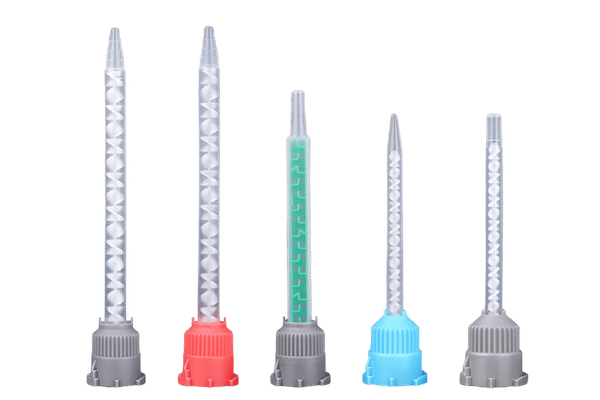
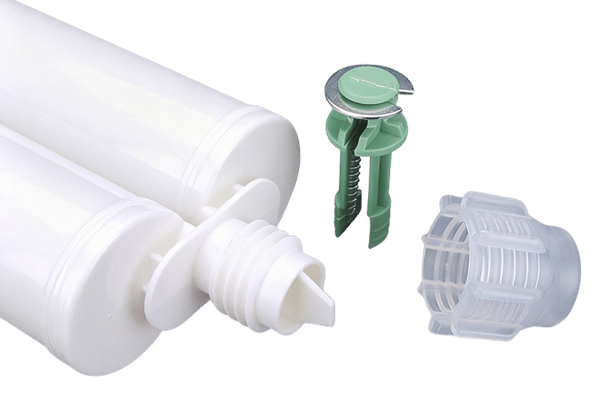
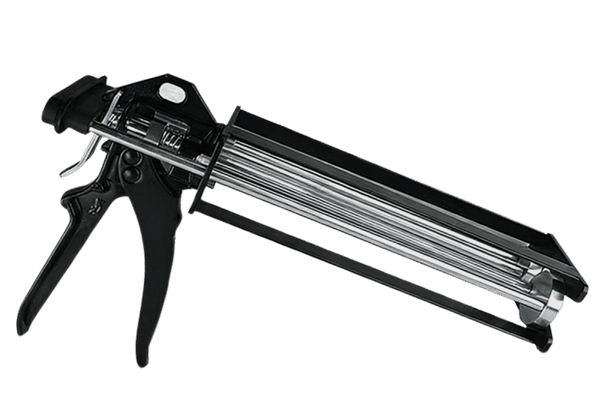
One Matched Set
This is the work Ebestron’s hardware exists to remove. We manufacture the cartridges, nozzles, guns, and tips as one matched set so the ratio that leave the tip is the ratio the adhesive data sheet specifies-and so you aren’t buying mixer length, retained-volume waste, or operator fatigue you didn’t need. The sections below walk through the five product lines, the cross-brand compatibility most suppliers bury in a spec sheet, and how to choose the right combination for your chemistry.
EBESTRON 2K DISPENSING CONSUMABLES:
FIVE PRODUCT LINES, ONE SUPPLIER.
Every one of the five lines has been packaged the correct way-dual cartridges hold and on-ratio the adhesives and sealants and have excellent shelf lives with no part migration. When ordering packaging for 2K cartridges from an outsider supplier it’s necessary to have packaging, two-component chemistry and a dispensing product designed in a concerted effort so there’s no entrained air trapped in the dual components, so that there will be no ratio loss and so that dispensing results in a neat dispense with no leaks, which is so often the case when the elements are from separate suppliers. Single-component cartridges and dual syringes for low-volume dispensing and R&D applications are also offered by Ebestron.
If most of the competition offer a product by product page approach, a buyer will typically have to shop at least three different companies. There’s likely one selling cartridges, a second selling nozzles and a third selling guns, each with its own minimums, lead times and risks. This is Ebestron’s answer, the 5-Line 2K Dispensing Consumables Portfolio Map. Each line links to its full catalog page, as if the buyer were dealing with a single source. These five lines conform to the Mixpac-Nordson-3M cartridge and nozzle conventions of mixing two-components discussed in the next section.
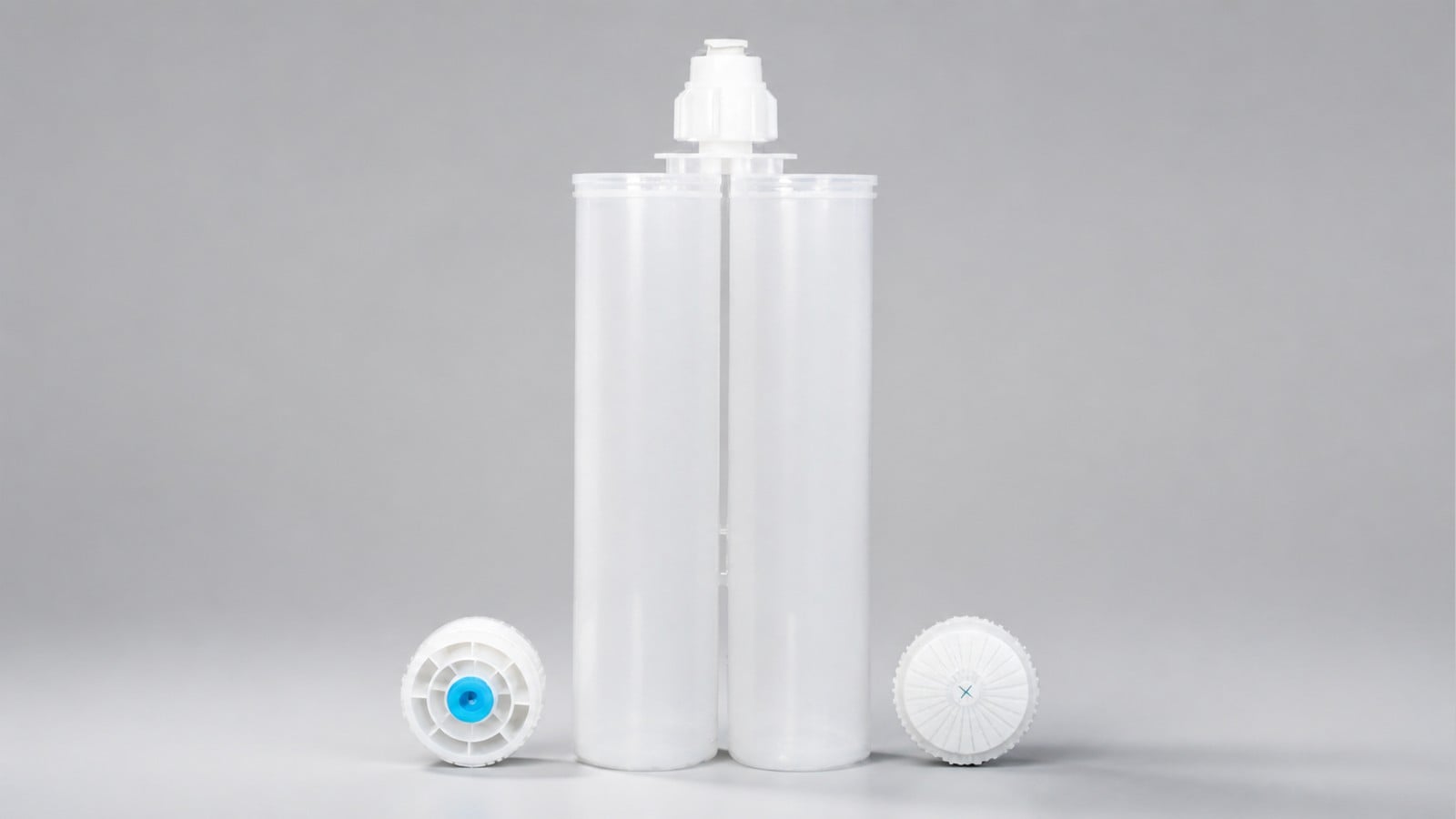
Two-Component Dual Cartridges
50 / 200 / 400 / 600 mL · 1:1, 2:1, 4:1, 10:1 · PP / PA / PBT / PE · side-by-side & coaxial
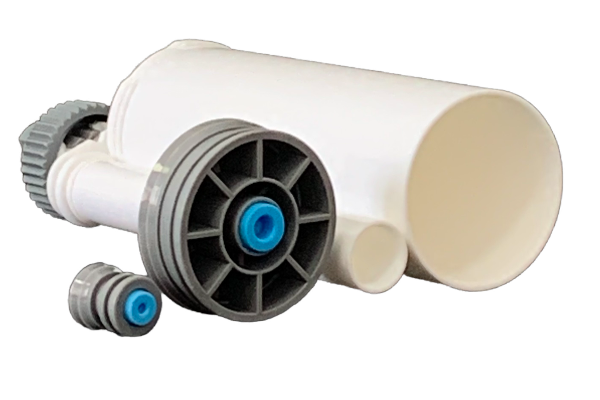
Empty dual-chamber cartridges designed to keep two-component materials separated until needed for dispensing or dispensing with a mixing nozzle. Offered in open and sealed tip versions (open with vented pistons for rear fill or closed head and open to air) with various options such as private labeled OEM, wholesale, and bulk orders.
brands packaging their own 2K adhesive, sealant, or potting compound.
ACCESS DATASHEET ⯈
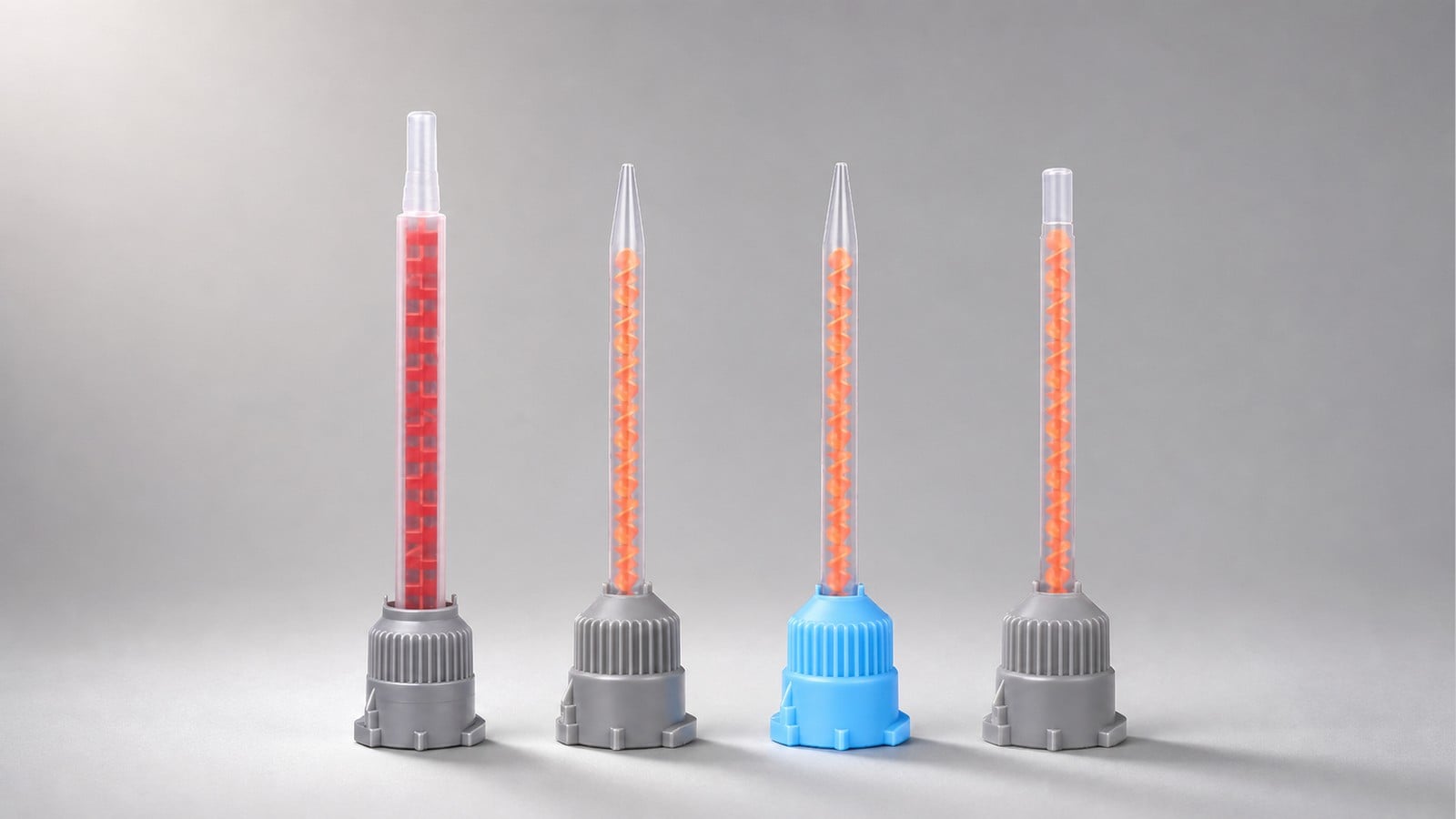
Static Mixing Nozzles
7–48 elements · I.D. 3–13 mm · helical, quadro & turbo · bayonet / bell / Luer outlets
Disposable static mixers, also sold as epoxy mixing nozzles or static mixing tubes, that blend and recombine the two-component adhesives and sealants at the point of dispense. The purpose of a static mixer is to homogenize resin and hardener with no moving parts, so helical and square (quadro) geometries are matched to your viscosity and ratio for an optimized bead without unnecessary tube length or waste.
matching mix quality to chemistry while controlling retained-volume waste.
ACCESS DATASHEET ⯈
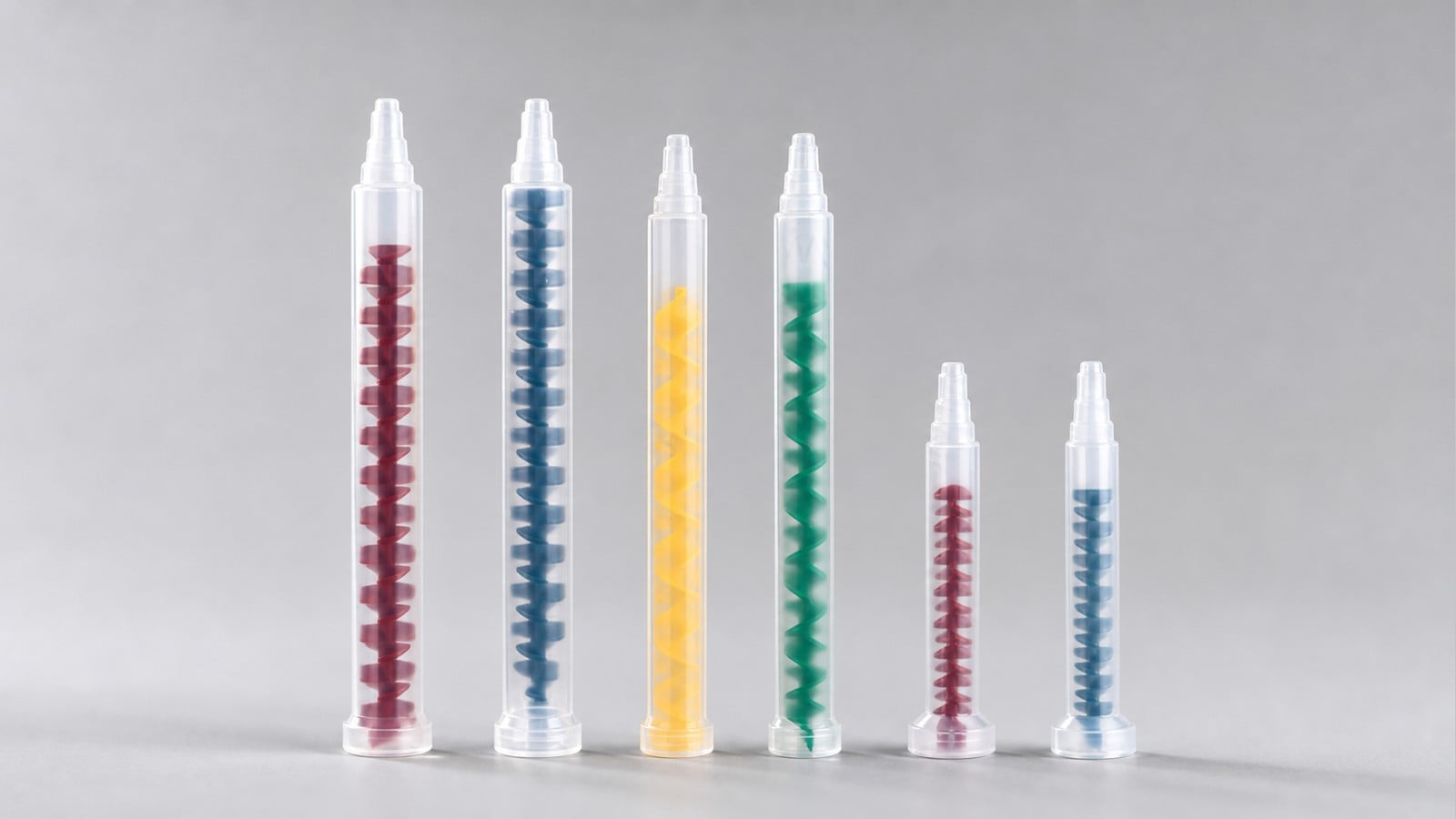
Dynamic Mixing Systems for 2K Sealants
Motor-driven mixing · 2K polyurethane · 3M Dynamic Mixing System compatible
Rotor/gear mixing to handle high viscosity, non-newtonian 2K sealants and adhesives where static mixing elements aren’t sufficient. Each mixer has been designed to replace existing static nozzles in 3M automatic, semi-automatic and hand dispensing equipment.
insulating-glass, structural-glazing, and high-viscosity polyurethane sealant lines.
ACCESS DATASHEET ⯈
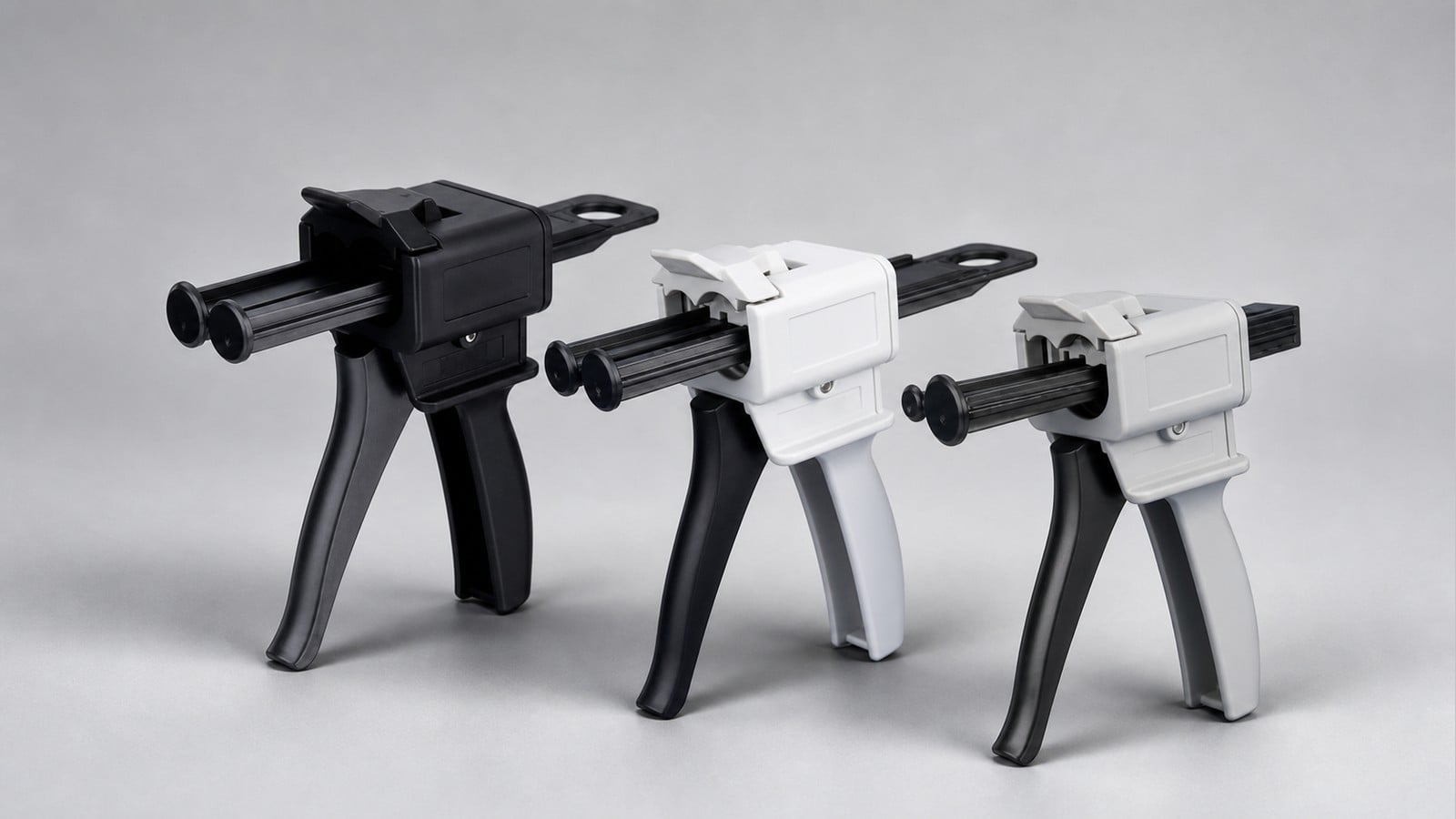
Two-Component Dispensing Guns
Manual · pneumatic (0.4–0.7 MPa / 4–7 bar) · battery / electric · Mixpac & Cox compatible
Dispensers that translate hand, motor or air input into a controlled, proportional, measured bead, from a manual epoxy applicator gun for low cycle counts to a pneumatic epoxy gun for higher production rates, plus cordless models for field work with no air line.
matching dispensing force and duty cycle to your cartridge and ratio.
ACCESS DATASHEET ⯈
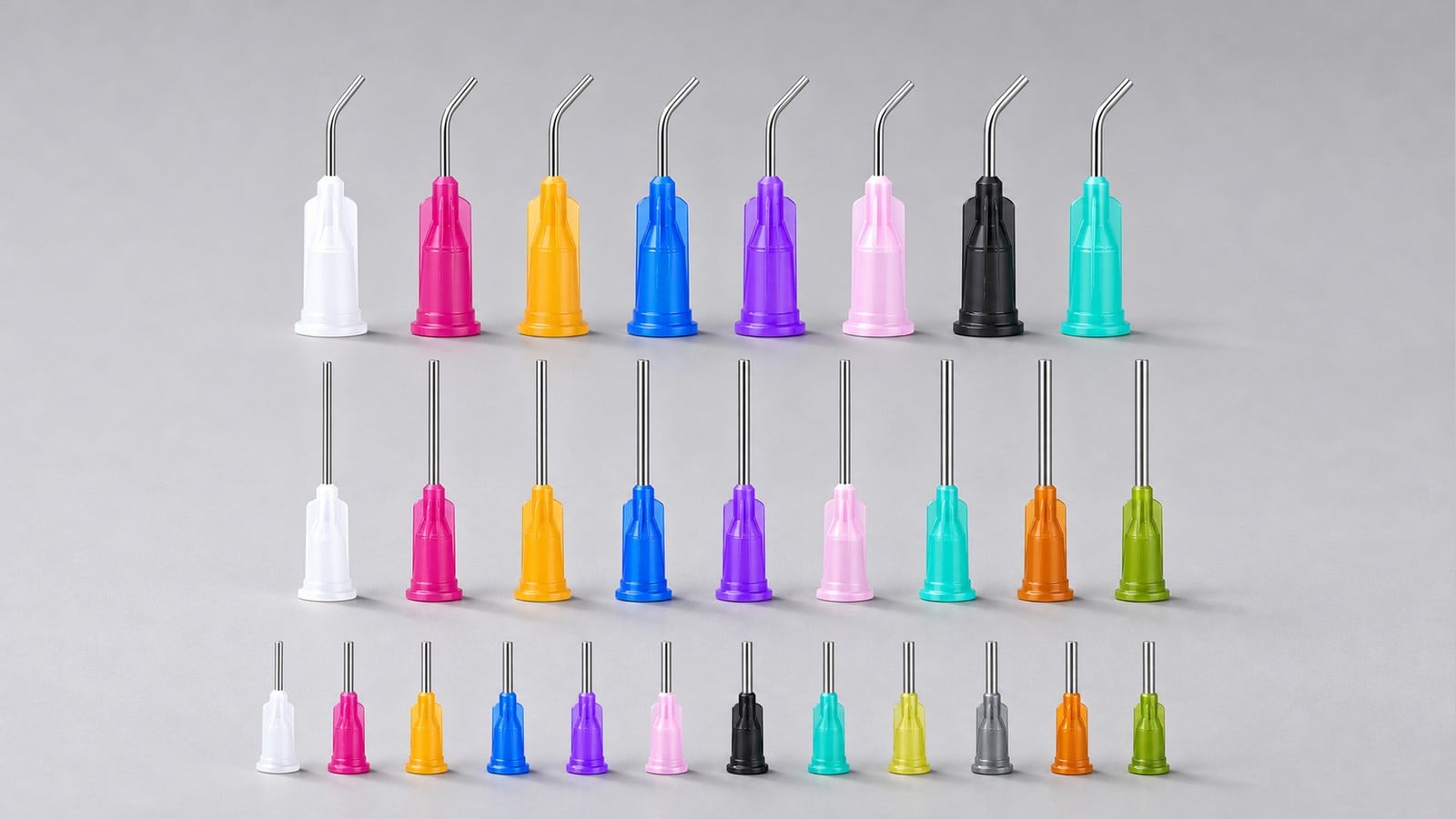
Industrial Dispensing Needles & Precision Tips
Blunt tip · Luer-lock · stainless steel · plastic / flexible / Teflon-lined
The fine-control end of the system: blunt tip dispensing needles, tapered needles, stainless precision tips, and flexible extensions for tight-tolerance bead placement, with Luer-lock fittings compatible with Nordson, Fisnar, and Loctite tips and available in flexible and rigid materials.
micro-dispensing, electronics, and precise bead geometry off a Luer-lock mixer.
ACCESS DATASHEET ⯈
Industries We Serve
Aerospace · construction anchoring · medical-grade · automotive panel bonding · electronics potting
Application-matched cartridge, mixer, and tip configurations for the five industries that drive most 2K dispensing demand, each with the format and ratio it expects, and an Ebestron equivalent for the gun you already run.
finding the consumable set already proven in your sector.
ACCESS DATASHEET ⯈
CORE ADVANTAGES
Matched Ratio
Cartridge, mixer & gun built to one ratio family — no off-ratio bead.
Format Compatibility
Fits Sulzer Mixpac, Nordson, 3M, Cox and Loctite interfaces.
Controlled Waste
Mixer length matched to chemistry, not over-specified.
Flexible MOQ
Small trial quantities through bulk OEM private-label runs.
Ebestron Compatibility Cross-Reference: Mixpac, Nordson, 3M & Cox
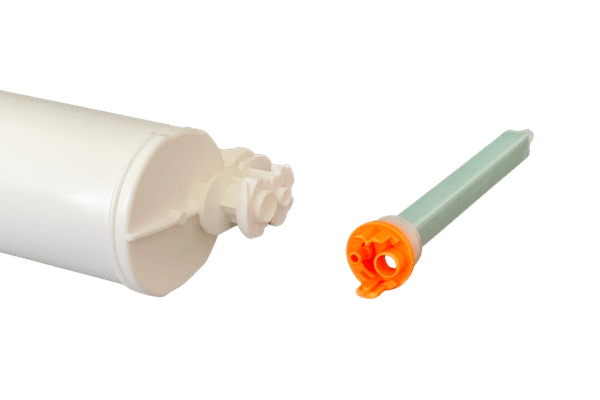
Will an Ebestron cartridge or nozzle lock onto the gun you already own? For most open systems, yes – you match three things: the cartridge system (A, B, C, F or K), the connection type (bayonet, bell, or integral threaded nut), and the mix ratio (1:1, 2:1, 4:1 or 10:1). The table below is the Ebestron 2K Compatibility Cross-Reference Matrix; the one honest caveat is below it.
Compatibility is the single biggest reason a 2K consumables order gets returned, and it’s the question almost every competitor leave you to figure out from a spec sheet. The de-facto interface standard in this category is the Sulzer Mixpac (medmix) system set; Nordson, 3M, and Cox each layer their own naming on top of the same physical conventions. Here’s how Ebestron consumables map to the systems you’re most likely running:
DATA_MATRIX // SPEC_SET_2K
[SCROLL →]
| Cartridge System | Volume | Ratios | Connection | Matched Static Mixer | Typical Gun |
|---|---|---|---|---|---|
| Mixpac A-System | 50 / 75 mL | 1:1, 2:1, 4:1, 10:1 | Bayonet (twist-lock) | MAH (1:1/2:1), MAHX (4:1/10:1) | Manual / pneumatic 50 mL |
| Mixpac B-System* | 25 / 50 / 75 mL | 1:1, 2:1, 4:1, 10:1 | Interlock (anti-cross-contam.) | MBH / MBHX | Standard 50 mL gun |
| Mixpac C-System | up to 400 mL | 1:1, 2:1 | Bell (retaining nut) | MCH / MCQ | Manual, pneumatic, battery |
| Mixpac F-System* | 200 / 400 mL | 1:1, 2:1, 4:1, 10:1 | Interlock | MFH (helix), MFQX (quadro) | 200 / 400 mL manual / pneumatic |
| Mixpac K-System | 2.5 / 5 / 10 mL | 1:1, 2:1, 4:1, 10:1 | Integrated plunger | MKH / MKHX | Micro / lab dispenser |
| 3M Scotch-Weld EPX | 48.5 / 50 mL · 200 / 400 mL | 1:1, 2:1, 10:1 | EPX bayonet / bell | Square green & orange mixers | EPX Plus II applicator |
| Nordson EFD side-by-side | 50 mL & up | 1:1, 2:1, 4:1 | Bayonet / bell | Spiral / square mixers | 2K manual / pneumatic tool |
| Cox / standard cartridge | 200 / 400 mL | 1:1, 2:1, 4:1, 10:1 | Bell / cradle | Bell-mouth mixer | Cox A-series applicator |
| Bulk / OEM custom | 50–1500 mL | 1:1–10:1 | Per your drawing | Spec-matched | Per your line |
*The Sulzer Mixpac B-System and F-System use patented connections that are “generally not compatible with other systems.” We’ll tell you up front which of your formats accept a cross-compatible consumable and which remain OEM-only – because a returned order help no one. If you’re unsure which system you run, we can identify it.
Round (helical) mixer elements are typically white, yellow or blue; square (quadro) elements are green for 1:1 and 2:1 ratios, with orange often used for the wider 4:1 and 10:1 ratios. Brand, diameter, and element count are frequently molded into the nozzle body for re-ordering.
How to Choose: Cartridge Size × Ratio × Material × Mixer Elements
There’s no single “correct” 2K consumable – there’s the correct one for your chemistry, ratio and viscosity. The most common and most expensive mistake is following a rule of thumb. Sulzer Mixpac’s own technical authority calls the popular shortcut “all epoxies need 24 elements” outright dangerous: an element count that’s right for one application can be wrong for another with the same adhesive. Use the Cartridge Selection Decision Grid below as a starting point, then validate on your actual material. Treat element count as an engineering trade-off, not a fixed number: more elements mix harder chemistries but raise back-pressure and retained-volume waste — the design space covered by static-mixer patents such as US 12,434,206 B2.
Cartridge Selection Decision Grid
Static mixer element count by adhesive chemistry
| Adhesive chemistry | Typical element count | Note |
|---|---|---|
| Acrylic / methacrylate | 8–20 | Fast-set; fewer elements, watch working time |
| Epoxy (most common) | 15–24 | More if viscosities differ greatly or ratio ≥ 4:1 |
| Polyurethane foam | 10–24 | Expansion sensitive to mix quality |
| Polysulfide | 24–32 | High element count for reliable cure |
| Silicone | 20–30 | Often 2K RTV; verify on material |
| Urethane | 24–36 | Widest band; high-ratio systems need the most |
Match mixer diameter to viscosity
| Material viscosity | Mixer inner diameter | Behaviour |
|---|---|---|
| Thin (< 5,000 cps) | 2.36–6.35 mm | Low back-pressure; small bead |
| Medium (5,000–50,000 cps) | 5.4–8 mm | General-purpose structural |
| Thick (> 50,000 cps) | > 9.3 mm | High-filler; needs gun thrust to match |
Format and Material
Cartridge format follows the same logic. A 1:1 ratio uses equal chambers; 2:1, 4:1, and 10:1 use stepped chambers, and the higher the ratio the tighter the accuracy that cartridge, mixer and gun must hold together. Material choice tracks the chemistry and shelf-life: polypropylene (PP) for broad chemical resistance and cost, nylon (PA) for strength under pressure, PBT for dimensional stability, and PE pistons with EPDM or silicone seals – or no O-ring – depending on viscosity. Formats run from 50 mL to 1500 mL, so the same selection logic scales from a precise lab shot to a high-volume industrial bead without changing your method.
Format range
50–1500
mL · per cartridge
PP · PA · PBT · PE
The five questions that size a 2K consumable set
Before a quote, confirm five things:
- 01the mix ratio your adhesive needs by volume
- 02the viscosity of the harder-to-pump component
- 03the shot size and daily cycle count
- 04the cartridge system and gun you already run
- 05the tip geometry the joint requires
Those five answers fix the cartridge size, the element count, the mixer diameter, and the tip, whether you’re doing fine electronics dosing or structural anchoring.
“The questions we ask every new customer are the same four: what is your mix ratio, your viscosity, your shot size, and the gun you already own. Answer those and the cartridge, the element count, and the tip almost choose themselves. The failures we see in the field nearly always trace back to skipping one of the four.”Ebestron Engineering Team
Side-by-Side vs Coaxial Cartridge Selector
Each of the two components come in a physically different package.
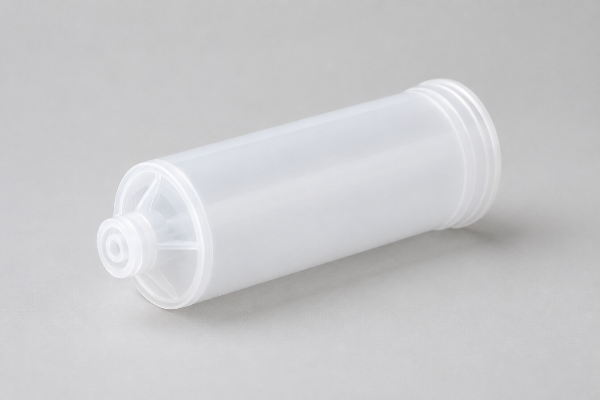
Side-by-Side
A side-by-side cartridge with two chambers laid out parallel comes with the simplest gun design (most common and least expensive ratio configuration). Pushing a side-by-side cartridge to a higher ratio at existing gun geometry means off-ratio shootings.
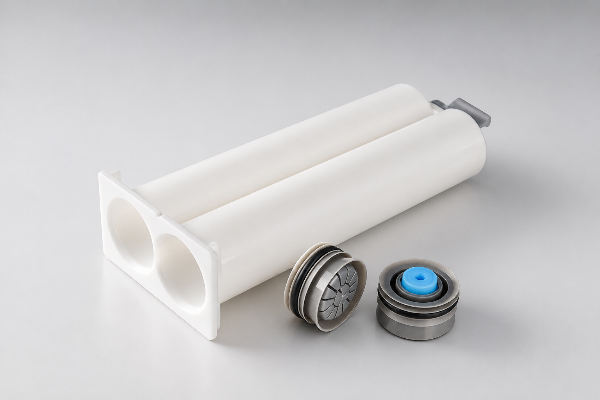
Coaxial
Coaxial cartridges have one chamber contained within another, and are intended to go around a parallel pair where length, a specific valve type, or other factors might otherwise require parallel-chamber design. That’s just what coaxial cartridge types were made for.
Where On-Ratio 2K Dispensing Earns Its Keep
The cartridge-plus-static-mixer system is the dispensing backbone of several regulated and high-volume sectors. The five Ebestron serves most are below, each with the format and ratio that sector expects.
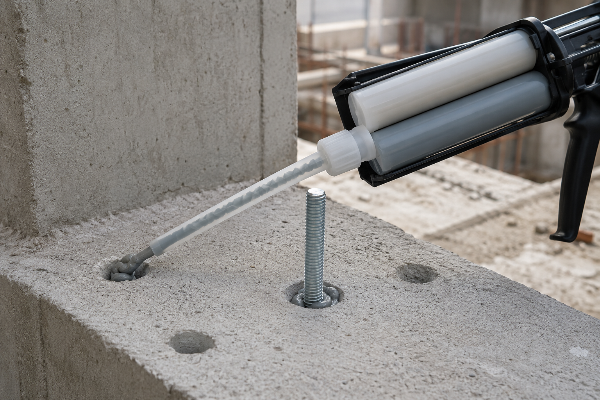
Construction Anchoring
This is the most rigorously documented use of the hardware. In code-evaluated epoxy anchoring, the resin and hardener are “completely mixed as they’re dispensed from the dual cartridge through a static mixing nozzle, directly into the anchor hole” — a system explicitly defined in ICC-ES evaluation reports as the two-component adhesive in cartridges plus static mixing nozzles plus dispensing tools. Rebar and threaded-rod anchoring into cracked and uncracked concrete and masonry relies on exactly the medium-to-large cartridge formats Ebestron supplies.
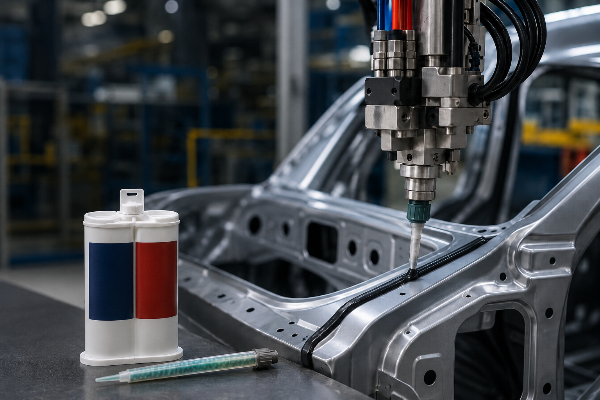
Automotive Panel Bonding
Two-part structural chemistries in 2K cartridges are dispensed through static mixers for body-panel bonding, seam sealing, and battery-module production. Vibration and dynamic load resistance are key criteria and ratio stability over long dispense cycles determines success.
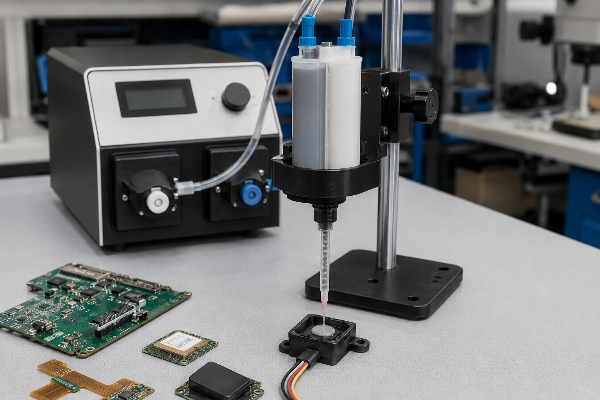
Electronics Potting & Encapsulation
Two-component potting compounds for PCB component fixing, connector sealing, GPS-unit filling, and flexible-circuit encapsulation are packaged in small-format cartridges. Here the payoff for point-of-dispense mixing is tangible: Part A and Part B stay separate until the nozzle, so you swap the disposable mixer when it cures instead of scrapping a pre-mixed batch on a pot-life clock. This is where the Luer-lock precision tips earn their place.
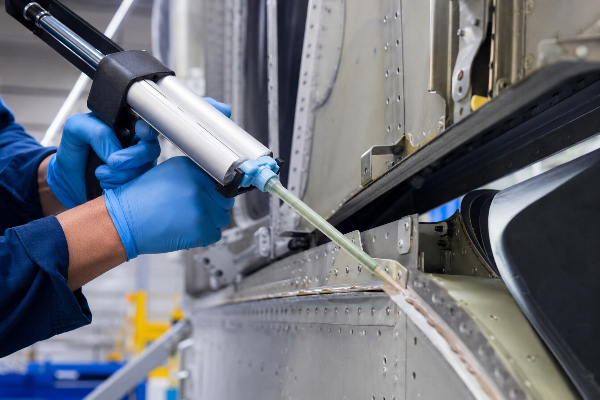
Aerospace
Handheld cartridge systems are favored by airframe and aerospace assembly for bonding spread over large areas and in tight locations that automated meter-mix equipment can’t reach, the same reason they show up in plant maintenance.
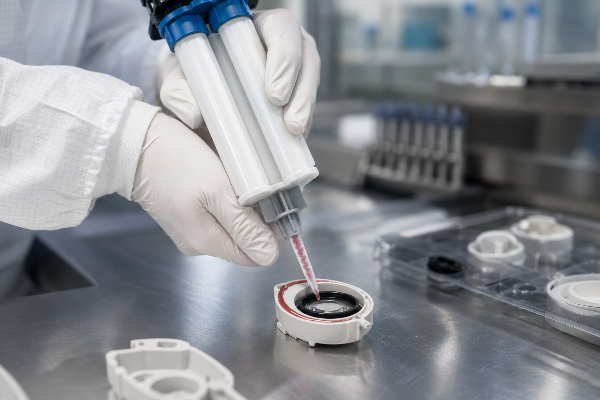
Medical-Grade
For both lens-to-housing bonding and the rest of device assembly, we offer the two-part cartridge epoxies in which the most critical aspects – the precision, consistency of the dispense bead, and the clarity of the point-of-dispense mixing – trump overall throughput. What dictates the choice of the piston and material for these is the compatibility need of the adhesive.
Building for one of these sectors?
Request samples matched to your application →Why Ebestron: Integrated R&D, Production, Quality Control & Service
An honest objection come up about any China-based consumables supplier: quality risk, and the instinct to pay an OEM premium for a name. It’s worth separating the part from the brand. Independent trade coverage of generic versus name-brand static mixers is blunt about it, compatible nozzles are typically “designed to mimic the specs of the name-brand mixers” and can be “equal (or higher) in quality to its name-brand equivalents,” at a fraction of the cost. So the real question isn’t “brand or generic” — it’s whether the manufacturer hold the dimensions and materials that make a part perform.
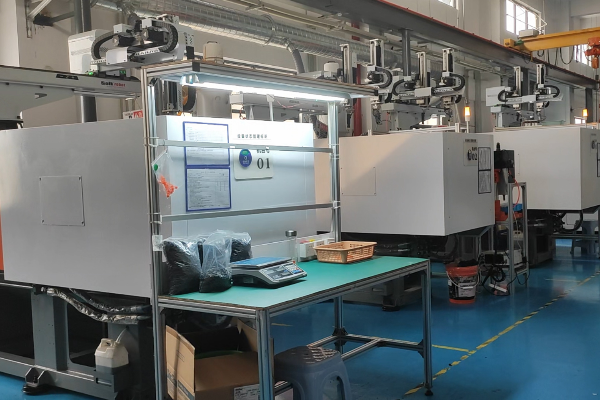
Engineered reliability
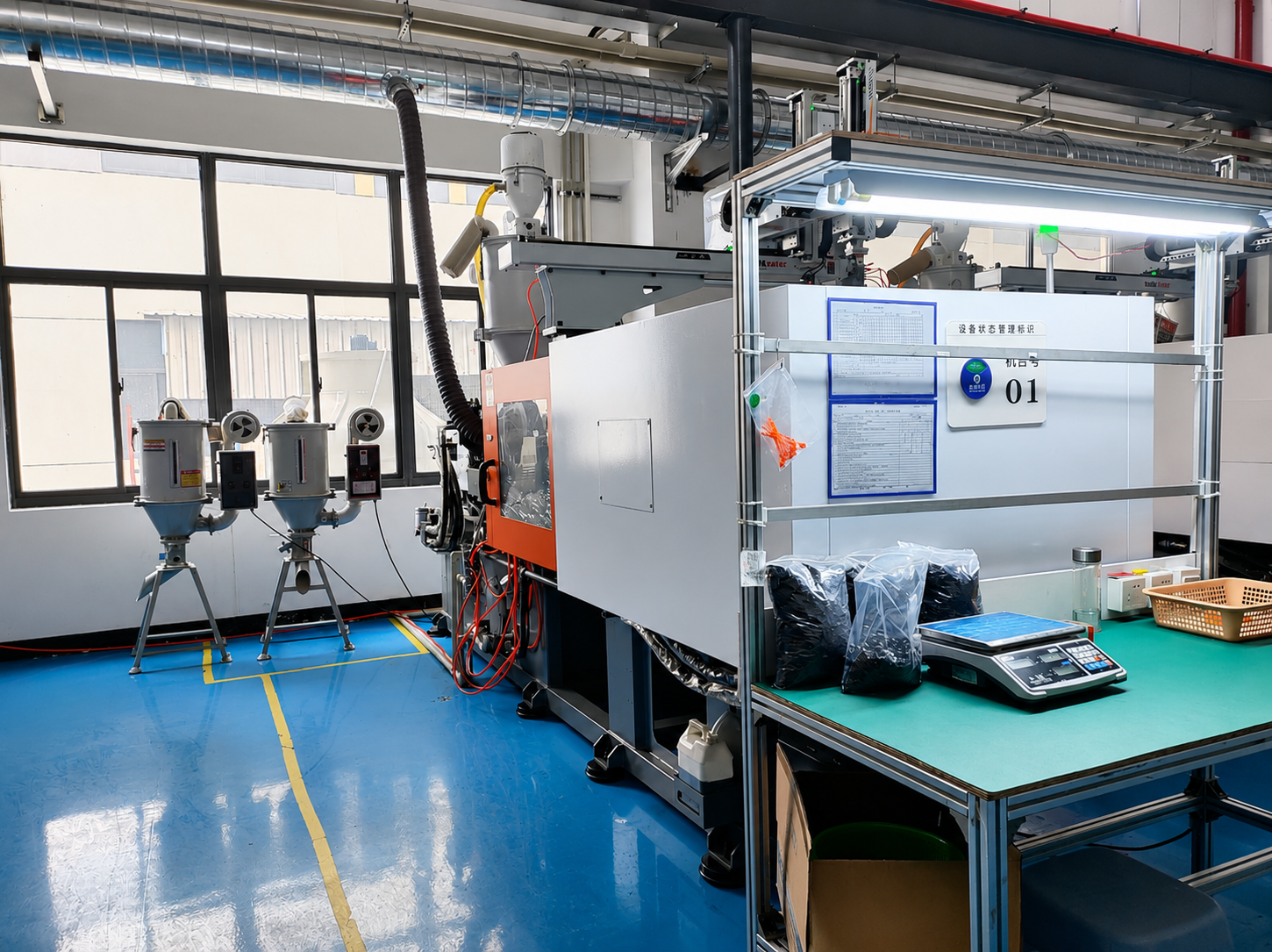
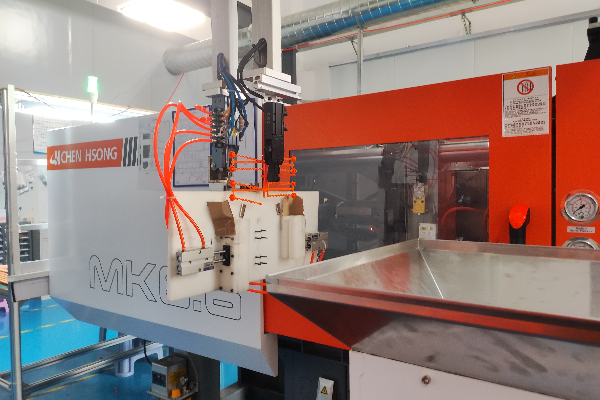
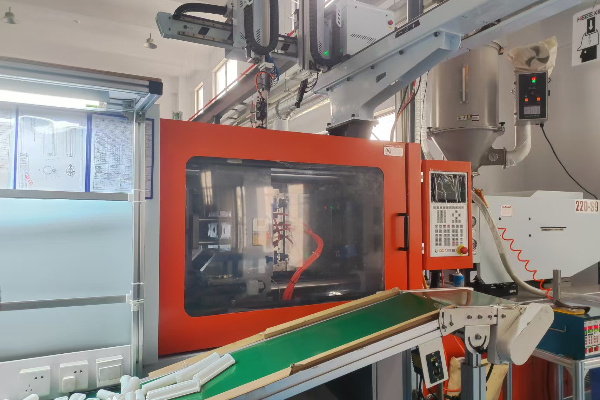
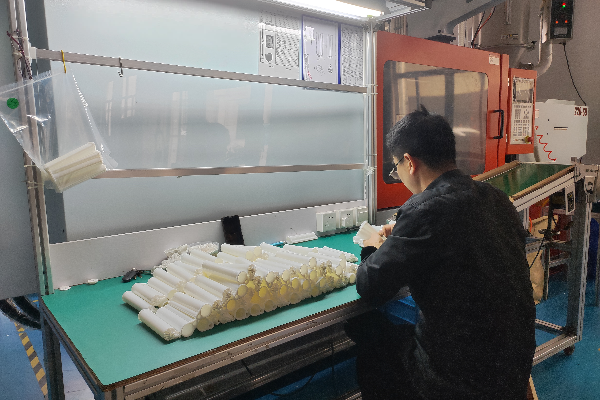
That’s the space we aim for. Our research and development team is our production team, our sales team, and our customer service team, the engineers who conceive a cartridge design are the ones who test it. In production we use advanced injection-molding equipment under a strict quality-control system, and our technicians verify that every part meet the dimensional and material standards of the adhesive-packaging industry.
What that means in practice is reliability you can engineer around. You get a properly sealed application instead of a leak because the bore and the piston mate precisely; you get a consistent bead at the correct mixture instead of an off-ratio one because element geometry is repeatable. When a part also has to resist the chemistry it carries, a moisture-sensitive sealant, or a high-temperature potting compound in a sealed container, material selection becomes a deliberate decision, not a default. We match the polymer and seal to your application rather than ship one grade for everything, and we document why, so your own engineers can validate the choice.
What to ask any 2K consumables supplier (including us)
When you source this category, bring your engineer and ask for a supplier that can verify in writing: the dimensional tolerance on the cartridge bore and piston, the polymer grade and the basis of its chemical-resistance properties, how each part is inspected before shipment, and lot traceability from raw material to finished goods. A supplier that can’t answer those four is selling you a brand, not a part. We answer all four on request, and we welcome the audit.
Audit RequestIP & Compliance
This corner of adhesive-packaging is genuinely innovating, which is why active intellectual property is worth watching when you pick a long-term supplier. Recent and foundational US patents cover the exact product geometry, for example:
US 12,434,206 B2
a granted static mixer for blending at least two components
US 9,862,001 B2
a side-by-side cartridge dispensing device
US 6,848,480 B2
a self-bleeding dual-fluid cartridge filling process
We design around the open conventions and respect the protected ones, which is exactly why an integrated factory that runs its own R&D, tooling, molding, and QC beats a trading company reselling someone else’s parts: when a dimension drifts, there’s one team to fix it, not a supply chain to chase.
PROCUREMENT: OEM, MOQ, SAMPLES, LEAD TIME & GLOBAL SHIPPING
Often the procurement pain in this category isn’t the unit price, but the order structure. Consumer named brand parts are sometimes found only in multiples of 100s or 1,000s of pieces, making them nonviable for small to midvolume buyers, and it’s the exact reason teams begin seeking parts for cross-compatible usage. A couple reasons contribute to a 2K consumable estimate and it’s worth aligning the team upfront on which apply to save on emails:
Where Ebestron flexes that an OEM brand will not
We carry trial quantities, run OEM private-label orders, and can ODM a new cartridge configuration to your drawing and material — including self-bleeding cartridge filling methods like US 6,848,480 B2, so you never have to buy thousands just to find out it fits. For a configured quote with lead time, request a quote with your format, ratio, and target volume, and we’ll respond with the matched cartridge, mixer, and gun.
Request a Quote-
[01] FORMAT
Cartridge format & volume
Size (50–1500 mL), ratio, side-by-side vs coaxial, material grade -
[02] MIXER
Mixer specification
Element count, geometry (helical/quadro), diameter, outlet style -
[03] QUANTITY
Order quantity
Trial sample run vs bulk vs scheduled blanket order -
[04] CUSTOM
Customization
Stock part vs OEM color/logo vs ODM new tooling -
[05] DOCS
Documentation
Standard part vs drawings, 3D models, compatibility chart, COA
[LOGISTICS-DATA]
Shipping: We supply to anywhere in the world direct from the factory. For specification items relying on figures we’re unable to generically post (we can’t post MOQs, lead times, pricing that vary based on quantity and format without quoting you for it), we quote these per order.
One framing help procurement teams compare suppliers fairly: a 2K consumable is part of your fluid dispensing equipment spend, not a one-off purchase. The cartridge, mixer, and tip recur with every shot, so the reliability of the part, consistent bore dimensions, repeatable piston travel, no batch-to-batch drift, is what protects the far more expensive adhesive flowing through it across tens of thousands of dispensing cycles. A part that cost a few cents more but eliminates a single scrapped assembly has already paid for the order. That’s the lens we ask buyers to use, and the one our quotations are built to answer.
Two-Component Dispensing Tools
[T-01]
Compatibility Finder
Evaluate chemical compatibility between your specific two-part adhesive formulation and our polymer cartridge/mixer materials to prevent degradation.
INITIATE
[T-02]
Mixer Element Selector
Calculate the required number of mixing elements based on the viscosity differential and mix ratio of your A/B components for optimal homogenization.
INITIATE
[T-03]
Ratio Weight/Volume Converter
Instantly convert specific gravity data into accurate volumetric or weight mix ratios to ensure precise calibration of your dispensing equipment.
INITIATE
[T-04]
Nozzle Waste Cost Estimator
Quantify the retained adhesive volume within static mixing nozzles to accurately project production material costs and optimize budget forecasting.
INITIATE
For open systems, yes. Cross-compatible nozzles are engineered to mimic the name-brand specs and lock onto the same bayonet, bell, or threaded-nut connection. The exception is the Sulzer Mixpac B-System and F-System, which use patented connections “generally not compatible with other systems.” Match the system letter, connection type, and ratio, and a compatible nozzle perform the same job at a lower cost.
It depends on the chemistry and ratio, not a universal number. Most two-part epoxies need 15–24 elements; acrylics often run 8–20 and urethanes 24–36. Add elements when Part A and Part B differ greatly in viscosity, or when the ratio is 4:1 or wider. Treat “all epoxies need 24 elements” as a warning sign, not advice, validate on your actual material.
Also ratios cited on a data sheet typically use the weight ratio whereas a dual cartridge provide ratio by volume and they don’t correspond if the components have differing densities. For example, 20:1 by weight can become 12.5:1 by volume when Part A is 1.6 g/cm³ and Part B is 1.0 g/cm³. Confusing the two can keep an adhesive from reaching full cure, so always confirm the volumetric ratio the cartridge need to deliver.
Handheld cartridges come in a defined set of ratios, 1:1, 2:1, 4:1, and 10:1 (3:2 also exists) — across 50, 200, 400, and 600 mL formats, with bulk and micro sizes available. Non-standard ratios such as 100:36 aren’t possible in a cartridge and require meter-mix-dispense equipment instead.
A 2K cartridge, dual-chamber unit requires a specially matched dispensing gun since an incorrectly matched gun will dispense the components off ratio and lead to incomplete cure, weak bonding, or a sticky surface. Some dual cartridges are manufactured to fit a common caulking gun; however, in most production environments, a calibrated and integrated 2K manually operated, pneumatic (4-7 bar), or cordless gun is used. Let’s know your cartridge type and size and we can find the best tool.
Every static mixer retains a fixed volume of mixed adhesive, from under 1 mL on small mixers to over 17 mL on large ones, that gets discarded with the disposable tube. Shortening the nozzle to save material is a false economy: epoxy is sensitive to proper mixing, and too few elements yields an under-cured bond. Choose the shortest mixer that still give complete mixing for your chemistry, not the shortest one on the shelf.
They can be used side by side for any standard ratio as long as your dispensing equipment can work using parallel chambers (typically called parallel gun and most of the products are supplied as dual cartridges for parallel cartridge gun and it’s also most common and least expensive option), versus what’s normally called a coaxial or concentric system which can be considered as a straight column within a column; coax is generally selected when your total length limitations prevent the parallel and double-barrel type, your material flow does need to remain perfectly stable, or if one of the cartridges will result in a greatly increased mix ratio compared to what a dual gun can produce.
Match three things in order. First, the cartridge system and connection, a 50 mL bayonet cartridge needs a 50 mL bayonet gun, and a 200/400 mL bell cartridge needs a bell-mount gun. Second, the mix ratio: the gun must advance both pistons at the cartridge’s 1:1, 2:1, 4:1, or 10:1 ratio. Third, the thrust to the viscosity: high-filler structural epoxy needs a pneumatic (4–7 bar) or battery 2K gun, not hand force. If adhesive comes out without the nozzle but not through it, the cause is usually a blocked or too-short mixer, or a viscosity too high for that nozzle, not the gun.
Because structural cartridge adhesives run from tens of thousands to several hundred thousand cps, well above what hand pressure can overcome. As one technical source put it, “sometimes cartridges are just really hard to dispense by hand,” and operators report that “getting a controlled amount was difficult due to hand fatigue as the day went on.” For repeated cycles or high-viscosity material, a pneumatic (4–7 bar) or battery 2K gun gives constant pressure and a consistent bead.
Both. You’re welcome to test our cartridges, mixers, and tips on a sample basis before a bulk order, at standard wholesale rates, with OEM private-label and ODM custom runs also available. You aren’t required to commit to a hundred-unit pack to check a fit, order samples matched to your cartridge, gun, and mix ratio first.