
Get in touch with Ebestron Company
Static Mixing Nozzles: Helical, Quadro & Turbo Mixers for Two-Part Adhesives
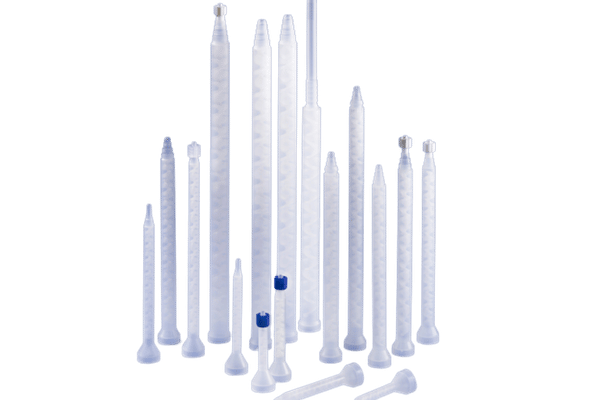
It’s a static mixing nozzle that dictates whether your two-part adhesive cures at full strength or falls flat in the bead. We make them all-Helical, Quadro, and Turbo elements in every interface, shape, and ratio-and ship them factory-direct, certified, and compliant with the cartridge systems you use today.
3
Element geometries (Helical / Quadro / Turbo)
3.2–13 mm
Inner-diameter range
8–48
Mixing elements per nozzle
1:1 – 10:1
Mix ratios (1:1/2:1/4:1/10:1)
CE + ROHS
Material compliance documented
5–10 days
Production + free samples
Why Two-Part Adhesives Fail Without the Right Static Mixing Nozzle
A two-part adhesive can’t cure to full strength unless resin and hardener leave the nozzle as one homogeneous material. When the static mixing nozzle is mismatched to the application-too few elements, wrong geometry, improper cartridge fit-the bead will come out streaked or off-ratio before it ever touches the part and the bond is already flawed.
That failed bond isn’t the adhesive’s fault. Process, not material, causes more than 98% of two-part adhesive failures, according to industry analyses- contamination, inadequate surface prep, inaccurate ratio mixing.[5] Once off-ratio two-component epoxy starts curing, that ratio is permanently locked in and unreacted molecules will never solidify.
That’s why Ebestron sizes nozzles to the application, not the slogans. A 50-ml structural bond for an automotive production line requires a different mixing approach than a 400-ml electronics potting application, so our factory matches every application element count, geometry, and interface to your specific chemistry prior to shipping.
Mixing is mechanical, not chemical. A static mixing nozzle contains a series of static elements that cut and combine the streams to mix fully just as the adhesive exits the nozzle-all with no moving parts and no separate mixing step. Our nozzle design also keep the two reactive fluids separated until they enter the mixer to prevent precure and clogging at the cartridge [cartridge fluid separator, Nordson EP2446973A2].
“Once the curing process begins, the ratio is locked in, and the unreacted material is destined to remain soft or tacky.”
An honest rule on element count
Dispense with the claim that “all epoxies need 24 elements.” Experts warn against such rigid approaches to mixing-the only measure of success is whether the cured adhesive passes peel, shear and tensile testing. We’ll match the nozzle to your chemistry, not a slogan.
Matching the Nozzle to Your Adhesive — Epoxy, Acrylic, PU & Silicone
Every two-component chemistry performs differently in the mixer, so the mixing nozzle that perfectly blends a thin 1:1 acrylic would streak a stiff 10:1 polyurethane. Most two-part epoxies achieve sufficient mixing with 15-24 elements, while wider ratio and wide viscosity differentials (part A to B) pull that number higher.
| Adhesive chemistry | Typical ratio | Element guidance | Mixing note |
|---|---|---|---|
| Epoxy (2-part) | 1:1 – 2:1 | 16–24 elements | Most-searched 2K nozzle; viscosity contrast drives the count up |
| Methacrylate / acrylic | 1:1 – 10:1 | 18–24 elements | Fast cure; purge promptly within pot life |
| Polyurethane (PU) | 2:1 – 4:1 | 20–32 elements | Higher viscosity contrast; needs more shear |
| Silicone | 1:1 – 10:1 | 16–24 elements | Watch back-pressure on long nozzles |
That is why the mixing nozzle, not the cartridge attachment, is the part that warrants specified by name. As the original cartridge maker put it: “material manufacturers specify a mixing tip model for a reason – the quality and consistency of the mix is important.”
Helical vs Quadro vs Turbo:
Which Mixing Element for Your Job
SEC.1 // THEORY
Most users jump for a “higher number of elements” or a longer mixing tube, hoping that will mean a safer mix. The opposite is almost always true-higher pressure drop, higher output forces, and the waste of costly adhesive in the tube.
It’s geometry, not number, that explains it. Each mixing element cuts the flow into pieces then puts it back together. Since a division-and-recombination step doubles the number of layers the flow passes, n mixing elements give you roughly 2n layers and a 24-element nozzle yields 16.7 million. A 13-element lattice element can mix a 500-1,000 cps adhesive better than a 24- or 32-element helical element, because the shape of the elements-not just how many there are-determines the number of additional layers each element creates.
[DIAGRAM: FLOW LAYER DIVISION MODEL]
Engineering note — how mix quality is measured
Mix quality is a metric known as Coefficient of Variation (CoV); 0.05 and less is “well mixed.”. Within the laminar flows applicable to 2K adhesive, achievable CoV is purely a function of material rheology, element shape and quantity [division-and-recombination mechanism, US7032843]. Just 10 elements will take you to ~95% mixedness; beyond that point, you’re just adding pressure loss and waste volume for very diminishing returns on CoV reduction .
[SYS.02] SELECTOR MATRIX
The Helical–Quadro–Turbo Element Selector
Your right element is determined by mix ratio and viscosity ratio (A to B), not by which design is newest. Since we make all three shapes, you can pick the geometry that’s best for your application rather than relying on the new universal element design for everything.
| Element geometry | How it mixes | Nozzle length & waste | Best ratio | Best viscosity | Ebestron series |
|---|---|---|---|---|---|
| Helical (round) | Alternating left/right spiral baffles; classic division-and-recombination | Standard length; baseline retained volume | 1:1 to 10:1 (widest range) | Low to high | Round 06-16, 08-18, 10-24, 13-36 |
| Quadro (square) | Square grid; doubles formed layers per element vs helix | Shorter nozzle, lower retained waste, lower back-pressure | 1:1 to 4:1 | Low to medium | Square 05-24, 06-24, 08-24 |
| Turbo | High-turbulence element; highest conversion of discharge force into shear | Short nozzle; efficient on tough mixes | 1:1 to 2:1 | Medium with high contrast | Turbo 08-24T class |
Quadro and turbulence elements give the highest quality mix in the shortest nozzle while retaining the least amount of adhesive per element [turbulence-enhancing element geometry, US12263454]. More elements is not the honest answer either: as one installer put it, “the supplied nozzles were 10 element ones and we changed to 14 element ones and had no further problems.” Geometry and count are a trade-off you size on purpose. Per unit pressure drop, Quadro elements are more efficient in converting discharge force to sheer. For a given pressure drop, they deliver the best mix quality with the least waste volume in the same nozzle length as Quadro elements and the original helical Jonugibs.
03
Where Quadro and Turbo are not the answer
Still, geometry efficiency has limits. In high ratio applications, the “optimised” turbulence elements lose efficiency compared to helical ones, so a perfect mix may not even be possible in the most compact geometries . If you’re working a stiff 10:1 application, take the slightly longer Helical nozzle; we’ll suggest you do so.
Some purchasers just buy a slightly longer nozzle and hope for the best; one customer reporting “no further problems” went from a 10-element to a 14-element nozzle after incomplete mixing on their previous setup[12]. Best practice is to consciously choose your geometry and element count-something enabled by the part coding we’ll detail here.
Want the geometry choice mapped to your exact adhesive and ratio?
Request a Custom Nozzle Recommendation
Ebestron’s Range — Interface, Shape, Ratio & Tip Type
Users will routinely mention this online, “…you know the different size tubes use different mixes and different plungers and it is not super easy to find a reference chart.”. The code described below is that reference chart-our system enables precise matching of any static mixing nozzle Ebestron with any cartridge type.
Reading the 08-24 SKU Decoder
Our part number conventions are based on industry standards. The first integer represents the inner bore diameter (in mm); the next number is the count of elements (always in increments of four). For example, an 08-24 code indicates an 8mm ID with 24 elements. A letter designating the geometry (‘Q’, ‘H’, ‘T’, or ‘L’) follows.
Read any nozzle in five seconds
[innerdiametermm] – [element count] + interface/shape tag (Helical round, Quadro square, Turbo T). Diameter dictates back-pressure and flow, element count dictates mixing layers. This process reflects the design principles used by OEM systems (e.g., the Sulzer MAH 06-21T is a 6.3mm 21-element nozzle), which allows easy direct part cross-reference.
Full specification table
We supply actual specifications (not estimates) in our disposable static mixing tubes – otherwise known as static mixing tubes or mixing tips. Their inner diameters vary from 3.2mm to 13mm, and element counts range from 8 to 48 mixing elements; suitable for applications, from 50ml handheld cartridges up to 400ml pneumatic systems.
| Ebestron SKU | Geometry / shape | Interface | Inner dia. | Elements | Mix ratios | Cartridge |
|---|---|---|---|---|---|---|
| 03-17 | Helical / round | Bayonet | 3.2 mm | 17 | 1:1 · 2:1 | 50 ml / dual syringe |
| 04-16 | Helical / round | Bell-Mouth | 4.0 mm | 16 | 1:1 | 50 ml |
| 05-24 | Quadro / square | Spiral / Bayonet | 5.0 mm | 24 | 1:1 · 10:1 | 50 ml |
| 05-32 | Helical / round | Bell-Mouth | 5.0 mm | 32 | 1:1 · 2:1 | 50 / 200 ml |
| 06-16 | Helical / round | Bayonet | 6.0 mm | 16 | 1:1 · 2:1 | 50 ml |
| 06-24 | Quadro / square | Spiral | 6.0 mm | 24 | 1:1 · 4:1 | 50 / 200 ml |
| 08-18 | Helical / round | Bell-Mouth | 8.0 mm | 18 | 1:1 · 2:1 | 200 ml |
| 08-24 | Quadro / square | Bell-Mouth | 8.0 mm | 24 | 1:1 · 2:1 · 4:1 | 200 / 400 ml |
| 10-24 | Helical / round | Bell-Mouth | 10.0 mm | 24 | 1:1 · 10:1 | 200 / 400 ml |
| 13-36 | Helical / round | Bell-Mouth | 13.0 mm | 36 | 1:1 | 400 ml |
High-ratio systems are precisely manufactured rather than guesswork: our mixers, for 4:1 and 10:1 ratios, employ a unique intake design that buffers the more rapidly moving component, preventing an out-of-ratio mixture for the initial squeeze [high-ratio intake design, US11944947]. We manufacture our mixers with polyacetal (POM) to withstand the significant pressure generated by meter-mix machines and provide a PP or nylon housing.
Interface and tip types
Fit and bead size are controlled by two additional specifications: how the nozzle is secured to the cartridge (interface) and the tip shape itself.
- Spiral / Screw. Threaded connection for 3M EPX style systems and fixed-nut designs.
- Bell-Mouth. Retaining-nut connections for our 200ml and 400ml pneumatic cartridges.
- Bayonet — quick twist-lock for 50 ml handheld cartridges.
| Tip type | Use it for |
|---|---|
| Stepped (cuttable) | General bonding; trim the steps to set bead size and flow |
| Tapered | Fine deposits and tight, hard-to-reach joints |
| Luer Lock | Connects to syringes and needles for micro-dispensing |
| Full Bore | Maximum flow for high-viscosity adhesive and large beads |
Need a size or interface not shown?
Request a Free Sample KitCompatibility: OEM Cartridges & Dispensing Systems
Fit is the most common challenge with aftermarket nozzles. Users report issues such as the nozzle not physically attaching to their cartridge and consequently being forced into place with duct tape – “not the best practice”.[12] A misfitting mixer will produce poor bead results, introduce air into the mix and cause cross-contamination between the A & B components.
Trouble starts when buyers assume the mixing ratio determines fit compatibility. This is a false premise. “A mixture that’s out of ratio does not necessarily signify the components will fit one another; different brands of cartridge may work with the same ratio, but exhibit varying shapes of the outlet port, dimensions of the sealing surface and attachment methods”.
Correct mixture ratio is not the only factor in controlled bonding; proper blending is an essential, often-overlooked step in these processes [ISO 21368:2022, adhesively bonded structures]. Buyers put it plainly: “Ratio match does not confirm fit compatibility.” That is the honest trade-off of an open cartridge ecosystem, and it is why we test a sample before any bulk order.
Match on four things, then confirm with a sample
For compatibility, first consider your cartridge model (A, B, C, F, or 3M EPX), then the interface type (bell-mouth, spiral, or bayonet), and next the inner diameter and element count – in that exact order. We highly recommend testing a free sample with your actual mixing gun and adhesive before placing large orders. We’d far prefer to send a sample than see another taped-up nozzle on your assembly line.
The Ebestron OEM Cartridge Cross-Reference
This guide charts the primary OEM cartridge systems against corresponding Ebestron interfaces and SKU classes. This information, often omitted from supplier listings, is precisely what buyers most frequently seek.
| OEM system | Cartridge | Interface | Ebestron equivalent class |
|---|---|---|---|
| Mixpac / medmix A-System | 50 ml | Bayonet, single outlet | Bayonet 03-17 / 06-16 |
| Mixpac / medmix B-System | 50 ml | Twist-lock, separate outlets + piston retention | Bayonet B-style 06-xx |
| Mixpac / medmix C-System | 200 / 400 ml | Bell-mouth / threaded retaining nut | Bell-Mouth 08-18 / 10-24 |
| Mixpac / medmix F-System | 200 / 400 ml | Snap-in, self-venting lip seal | Bell-Mouth F-style 08-24 |
| 3M EPX (Scotch-Weld) | 50 ml | Spiral / gray twist inlet | Spiral 05-24 / 06-24 |
| Nordson | 50–400 ml | By interface (bell / bayonet) | Match interface + inner diameter |
| Loctite / Henkel | 50 ml | A-style bayonet | Bayonet 06-16 (21-element class) |
Applicator Integration — Manual, Pneumatic & Meter-Mix
Because mixing happens at the nozzle tip, it has to suit the cartridge, and the applicator too. Our range of interfaces accommodates all deployment variations.
| Applicator | Typical interface / cartridge | Where it runs |
|---|---|---|
| Manual cartridge gun | Bayonet / 50 ml | Field repair, construction anchoring, low volume, no power |
| Pneumatic gun | Bell-Mouth / 200–400 ml | Production bonding, sealing, consistent pressure |
| Automated meter-mix / robot | Bell-Mouth, integral / bulk | Electronics potting, dam-and-fill, thermal gap fill, RIM |
Match your exact gun and cartridge in one sheet
Request Recommendation
Reader focus: Engineering + Production · Procurement (cost)
Ebestron vs Name-Brand & Aftermarket: Spec, Cost & Supply Compared
For name-brand versus generic, the market has found common ground already. The top name brand products are so similar to compatibles that trade distributors advise a nozzle purchase of them for a “very large cost advantage”-when bought at scale, and so “far cheaper than name brand”. A buyer’s real question is whether an aftermarket nozzle will work, and which manufacturer will prove it.
Sticker price is not the real cost; a standard nozzle leaves a few millilitres of adhesive behind, which on a 50 ml cartridge is 6-10% of the product lost. Any unit price is negligible when the value lost by the nozzle on a lot of what product, in addition to a rejected batch resulting from a poorly made mix outweigh the initial outlay.
There’s another cost not captured in dollars; at over 98%, process costs, not formulation costs contribute to adhesive failures and their accompanying permanent tack-dry issues, a “a few hundred dollars upfront now isn’t meaningful when you throw parts away and miss your deadline” as noted by a composite manufacturer.
Where Ebestron stands
Where we out compete any generic offering is substance a merchant never provide; our data sheet, certifications, and cross-referencing with factory direct pricing. The grade of material is important, particularly food contact adhesives with PP and nylon which has specifications for the relevant governing body, FDA 21 CFR 177 for indirectly added foodstuffs [FDA 21 CFR 177, indirect food additives].
| Dimension | Name-brand OEM | Typical generic | Ebestron |
|---|---|---|---|
| Per-SKU specs (diameter + elements) | Partial | Often hidden | Published for every SKU |
| Element geometries | Helical + Quadro | Varies | Helical + Quadro + Turbo |
| Certified materials | Varies | Often none | CE + ROHS documented |
| OEM cross-reference chart | No | No | On-page + downloadable PDF |
| Pack / MOQ flexibility | Packs of 100s–1000s | Small + bulk | Free samples to bulk volume |
| Price model | Premium | Low | Manufacturer-direct, no markup |
| Lead time | Regional stock | Varies | 5–10 day production + air DDP 3–12 days |
Though we produce some standard part numbers, the price is extremely narrow, so our ability to give a spec sheet you trust will prove important, and backed up by certified material. This data is not a claim of similarity to another brand; it is proof for the product itself that you may test for free.
See how we line up against your current nozzle:
Request a Custom Spec-and-Cost Comparison
Certified Quality & the Manufacturer-Direct Advantage
[TXT-01] // PROCESS
Any sample kits requested for 2023 manufacturers should, and will be, rigorously inspected. Standard process dictates to “ask the supplier to provide a certificate and that can be checked against certification databases from accredited institutions such as UKAS or ANAB”, and a preliminary sample must always precede mass production purchase commitments. We provide a facility page built specifically to clear that screen, not to win on slogans.
[TXT-02] // RISK
Another cost never shows on the invoice: a missed delivery. A failed inspection on a lot or untraceable Certificate can cause delay on a production line, and convert what seems like an economical decision on price to a costly mishap – thus why supply teams rigorously vet all prospective manufacturers before signing off. Ebestron, a real static mixing nozzles manufacturer not a trader of product from afar-responds to client inquiry directly from our production line, furnishing reliable Certification and an inspectable sample, from a 50ml kit up to a 400ml production run.
01 //
CE
Material conformity
02 //
ROHS
Restricted substances
03 //
OEM / ODM
Custom + private label
04 //
Factory-direct
Kunshan, China
[SYS-QA: DIRECT]
Our production is supplied to a verified quality system [ISO 9001 quality management] with environmental condition monitoring control [ISO 14001], and our CE and RoHS documentation is a component level declaration of conformity for the nozzle polymers – restricted-substance legislation compliance, plainly printed rather than dressed up as an electronics safety mark it is not.
Being the factory, not a reseller, gives us this structural edge; we can punch a custom inner diameter, remove an element count, cast a private-label enclosure, or hold a specification across reorders – because the tooling and the quality control are ours, not a supplier two steps up the supply chain.
“Our documentation of CE and RoHS conformity is at the component level, and we send a sample before any bulk purchase, because we’d rather pass your incoming inspection than argue about it after the container hits the dock.”— Ebestron Quality & Engineering Team
Vetting us for a first order?
Request a compliance pack with CE, RoHS and test certificates
[SYS-LOGISTICS: SUPPLY CHAIN]
Procurement Made Simple: MOQ, Lead Time, Samples & Volume Pricing
Delivery, not price, is the practical concern with an overseas supplier. Under DDP terms, “sellers will nearly always opt for the slowest” delivery method, and shipping by sea leaves from China generally takes 25-55 days; air freight generally takes 3-7. Generic concept of “fast shipping” is where that concern derives from.
That control counts whether you order a 50 ml sample kit or a 400 ml production bulk shipment. Because the Ebestron factory ships directly, the lead time Ebestron quotes is the lead time you receive, and the same specification applies across reorders – the reason an industrial purchaser can schedule a production production line with it.
What we commit to in writing
production is shipped in 5-10 days, and we ship air DDP in 3-12 working days – a time window, not a vague promise. We quote landed DDP cost up front so a low unit cost does not rebound as freight and duties later, and we provide free samples before any bulk to confirm the specification on your gun first.
Pack flexibility is part of the benefit. Name-brand nozzles are often available only in hundreds or thousands, but we send from a single samples kit up to production volume, with volume-breaks on price for bulk. Reorders maintain the same specification due to our ISO9001 procedures [traceable quality management], so the nozzle you approved is what you continue to receive.
-
01[SAMPLES]Samples: free, matched to your cartridge system and ratio, before any bulk placement.
-
02[MOQ VOL]MOQ: flexible – from samples packs to large-volume runs; contact us for a quote on your SKU mix.
-
03[OEM SPEC]Private label / OEM: custom housing, color, and packaging is available.
Ready to price your volume?
Request a factory-direct quote with lead time and a free sample
Engineering & Selection Tools
Built exclusively for adhesive filling facilities and process engineers. Optimize your two-part fluid dispensing operations, increase production line efficiency, and effectively control production costs through professional data calculation and parameter matching.
Static Mixing Nozzle Selector
Tech Spec Matching
Accurately match the most suitable Helical, Quadro, or Turbo static mixing nozzles based on your adhesive viscosity, mix ratio (1:1 to 10:1), and precise volumetric dispensing requirements.
OEM Cross-Reference Guide
Compatibility Solution
Seamless drop-in replacement for existing brand consumables. Quickly find highly cost-effective, fully compatible alternatives to industry standards (such as Sulzer Mixpac) to ensure zero production downtime.
Adhesive Waste & Cost Calculator
Retained Volume Analysis
Quantify retained adhesive waste inside nozzles. Input unit price and volume to accurately assess the direct financial impact of nozzle selection on your filling and dispensing operations.
FAQ — Static Mixing Nozzle Selection
What is a static mixing nozzle and how does it work?
It is a disposable tube of stationary elements that holds a two-part cartridge. As the resin and hardener are extruded, each element works of itself repeatedly split and recombine the streams of the ELNOK. The adhesive leaves the tip fully homogenized without moving parts and without a separate mixing step.
What is the difference between Helical, Quadro, and Turbo mixers?
Helical features round alternating spiral baffles and covers the broadest range of ratios and viscosities, and thus remains our default for stiff 10:1 systems. Quadro uses a square-grid that achieves full mix in a shorter nozzle with less retained waste and Turbo is high-turbulence for difficult chemistries – but both degrade at high ratios and viscosities, where Helical is the safer choice.
How many mixing elements do I need?
Most two-part epoxies mix to 15-24 elements. Go higher at wide ratio, or where the viscosity of Part A greatly exceeds Part B; more elements do not always produce a better mix and increase back-pressure and waste.
Which nozzle fits my Mixpac, 3M EPX, or Nordson cartridge?
Match to your cartridge system, interface, inner diameter and element count. Ratio is insufficient. Review the above cross-reference table and order a free sample to test on your gun.
Which nozzle should I use for two-part epoxy, polyurethane, or silicone?
Epoxies and silicones commonly require 16-24 elements. Use higher counts for high-viscosity polyurethane and wide ratios. Send us your chemistry and ratio and we will assist with your spec.
Are Ebestron nozzles CE and RoHS compliant?
Yes, CE and RoHS certifications for use with nozzle polymers in meeting material substance restrictions are provided as a declaration of conformity at the material level and we can supply them with your sample order to satisfy your receiving inspection documentation needs.
Why is there adhesive left in the nozzle, and how do I reduce waste?
Each nozzle contributes a volume of non-mixed adhesive. A 50ml cartridge will retain 6-10% of its product. Matching your nozzle length to your application can significantly reduce retained material waste by achieving full mix in a shorter length (e.g., a matching Quadronozzle).
Can I reuse a static mixing nozzle?
No, adhesive solidifies once mixed, permanent blockages result from flushing. Our nozzles cost so little that replacing them beats attempting solvent cleaning.
What are your MOQ, lead time, and sample terms?
production orders offer DDP (Air Freight Direct) delivery in 3-12 days, 5-10 days in many locations. FlexibleMOQ from single kits to bulk, with no charge for system-matched samples and OEM Private Label programs. Contact us for your specific SKU-based pricing.
Trending now

![Dynamic Mixing Systems for 2K Sealants [Guide]](https://adhesivespackage.com/wp-content/uploads/2026/10/dynamic-mixing-systems-for-2k-sealants-guide-featured-1-150x150.png)