Get in touch with Ebestron Company
Adhesive Toll Manufacturing & Contract Filling Services for 2K Cartridges
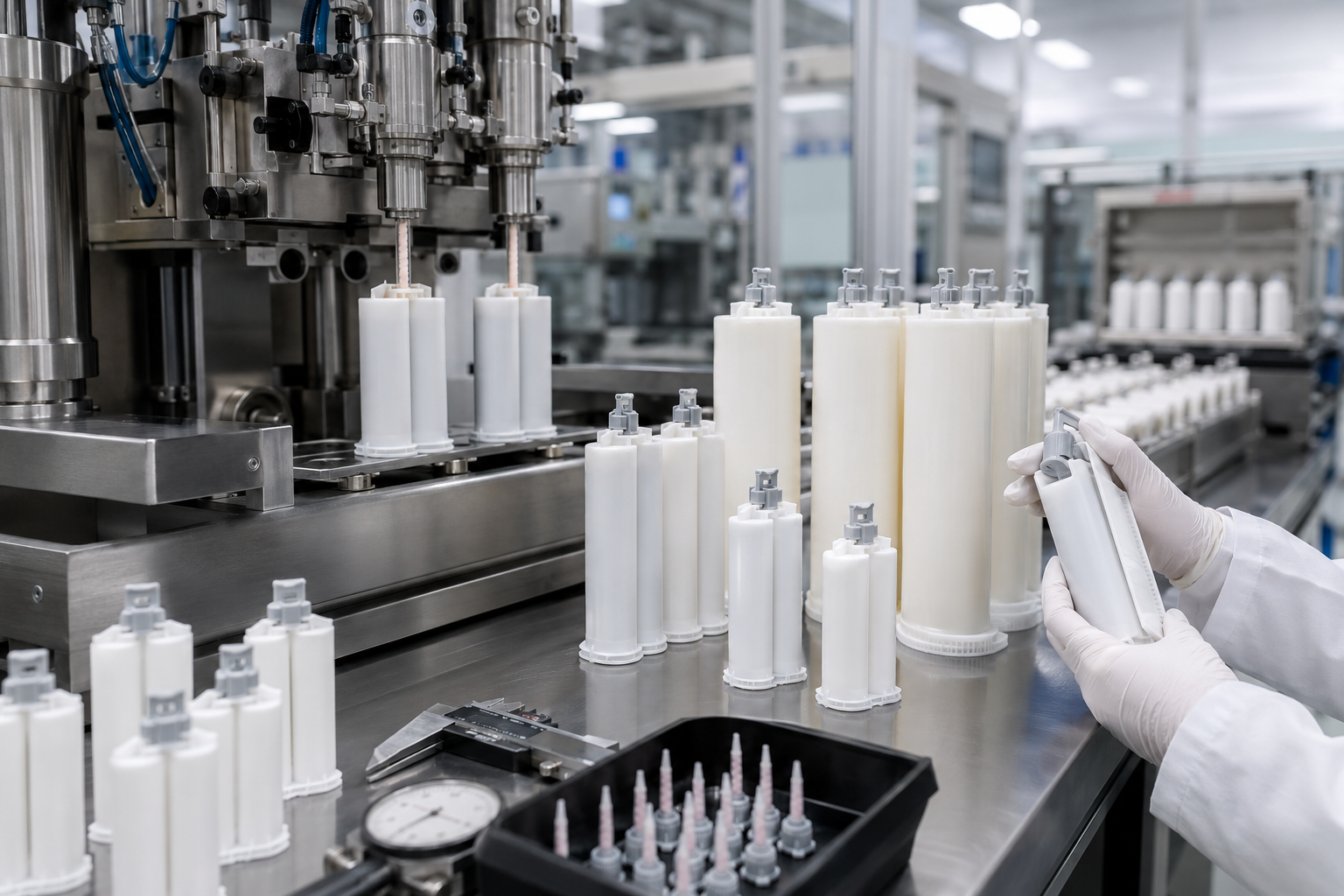
Ebestron fills your adhesive formulation into retail-ready dual cartridges – epoxy, polyurethane, silicone, MMA, all ratios from 1:1 to 10:1. Your raw materials. Your formula. Our equipment, our quality control, your finished cartridges. CE/RoHS certified Kunshan factory. Trial runs welcome.
- CE Certified
- RoHS Compliant
- Ratios 1:1 to 10:1
- 50–600mL Formats
- ±2% Ratio Accuracy
- Kunshan, Jiangsu Factory
1:1 – 10:1
Fill Ratios
50–600mL
Cartridge Formats
±2%
Ratio Accuracy
CE + RoHS
EU Certified
7+
Resin Systems
IP Lock
Your Formula Stays Yours
What Is Toll Manufacturing? — And How It Keeps Your Formula Yours
Your adhesive formula is your business – the R&D investment, the performance edge, the margin. toll manufacturing is the production model built to protect it.
When you supply the base resins and hardeners, Ebestron provides the fill equipment, the volumetric metering expertise, and quality control. You pay a per-unit processing fee – the “toll” – and receive finished, sealed cartridges ready for distribution. Your raw materials stay in your ownership throughout. Your formula never transfers to a third party.
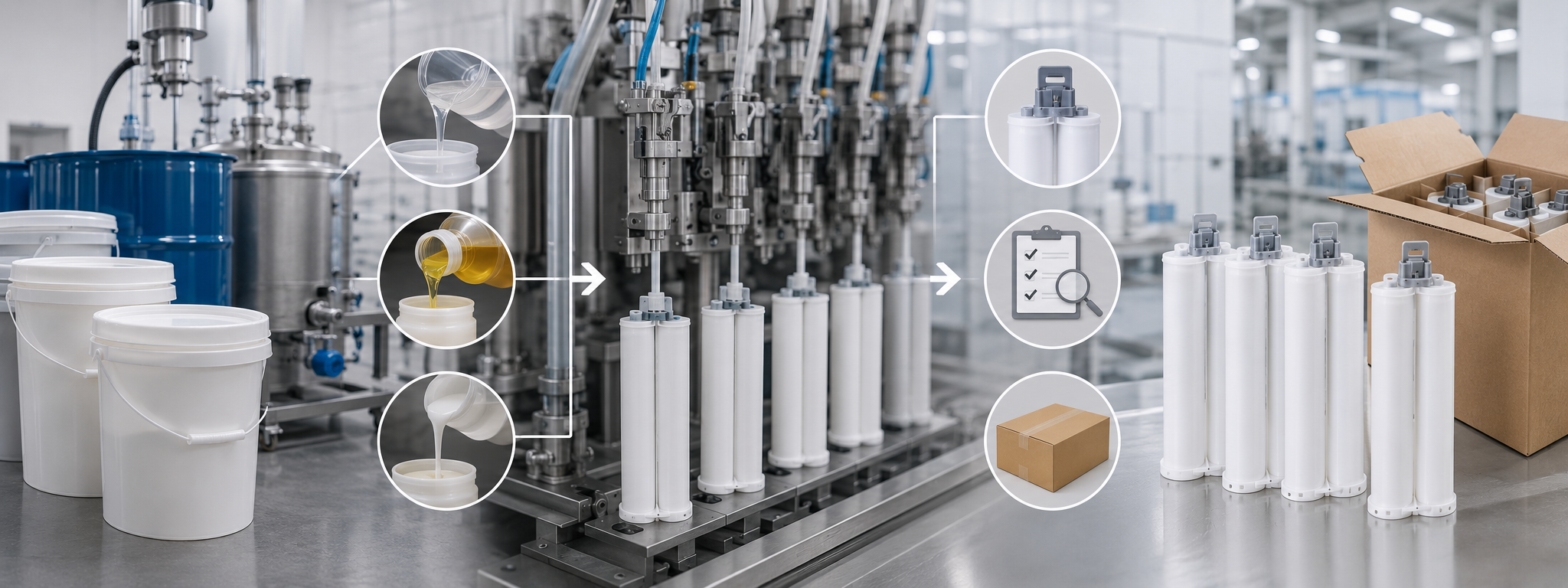
This differs fundamentally from contract manufacturing, where the manufacturer sources the raw materials itself. In a toll model, you keep full supply chain visibility and cost control. You know what your materials cost because you buy them. You know the formula is protected because you never hand it over – only the specifications needed to configure the fill heads. supply chain management remains entirely within your procurement strategy: you negotiate raw material pricing and select approved suppliers independently of your toll manufacturing partner.
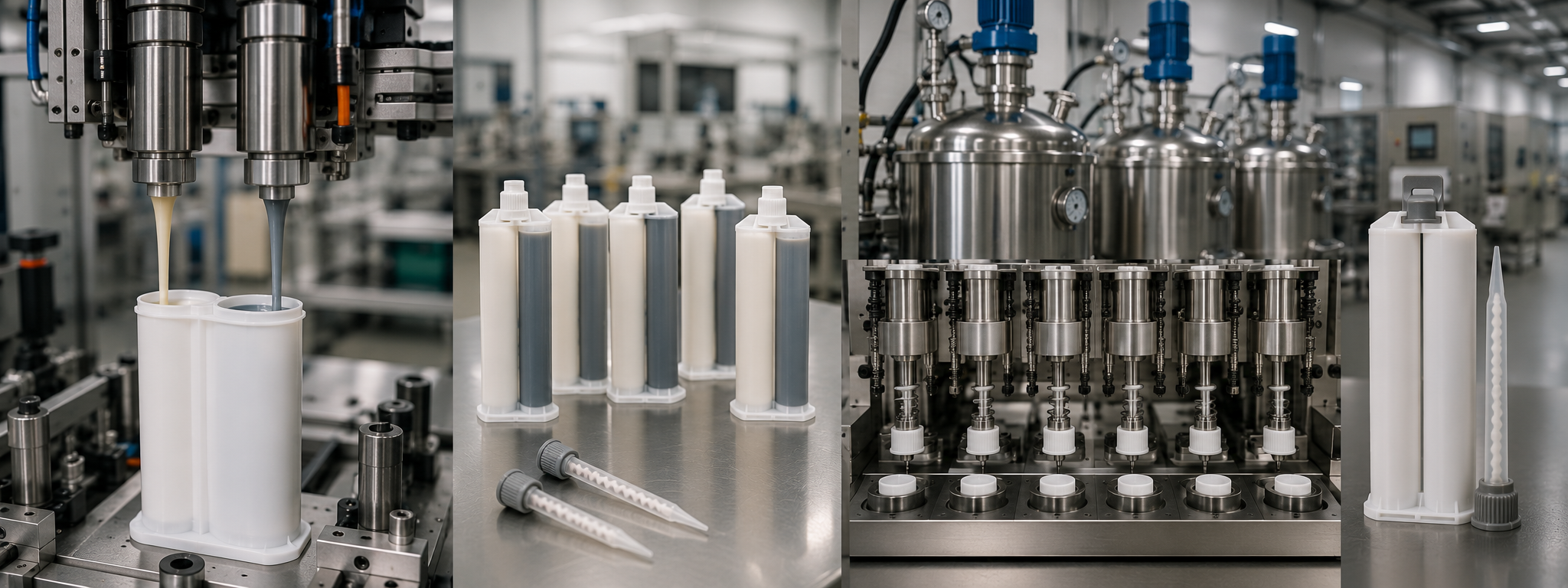
For adhesive brands, this distinction carries particular weight when the product is a 2K (two-component) system. Dual cartridges require precise volumetric metering at your A:B ratio – that means dedicated fill equipment calibrated per chemistry type, ratio-matched pistons, and separate purge cycles to prevent cross-contamination between components. Most adhesive formulators don’t own this infrastructure. toll manufacturing gives you access to it without the capital commitment or the headcount.
Output Specifications
Ebestron provides finished 2K cartridges – epoxy, polyurethane, silicone, MMA, polysulfide, and hybrid systems – from your materials to your packaging specification. Ratio accuracy guaranteed at 2%, certified under CE and RoHS for EU distribution.
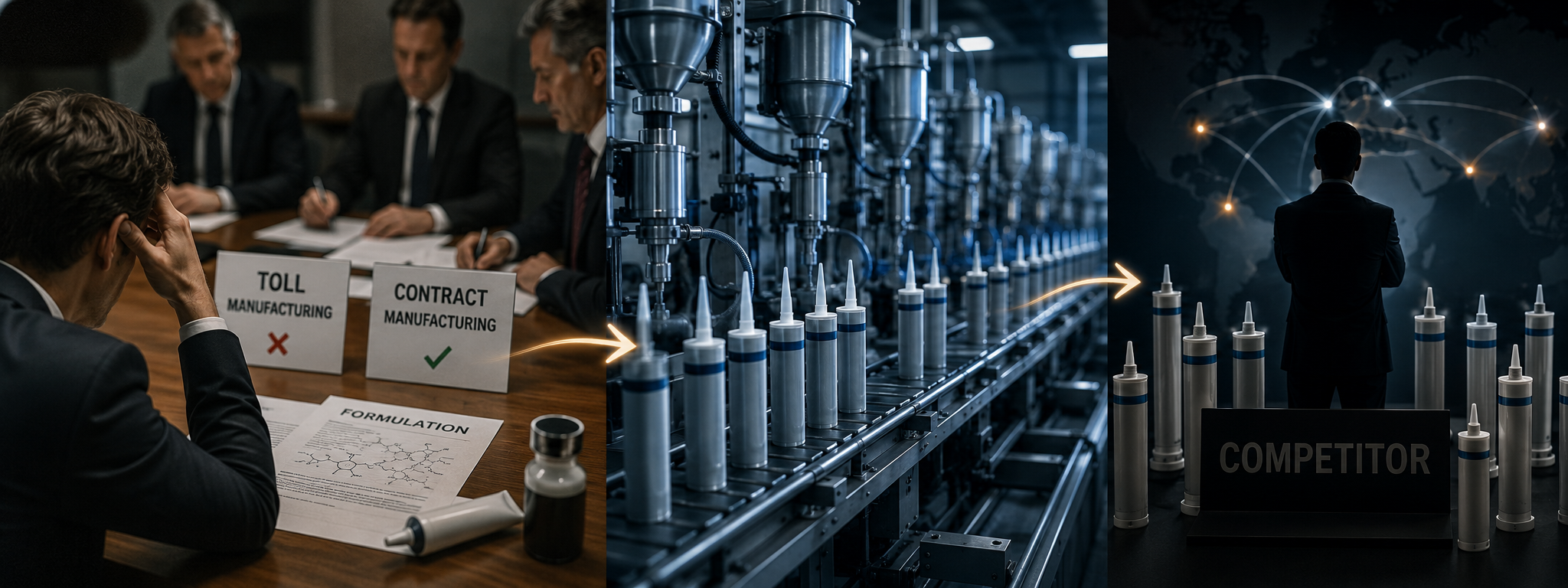
The most common mistake in this space: buyers confuse toll manufacturing with contract manufacturing, sign the wrong agreement type, and lose formula control without realizing it. Without an NDA signed before formula review and a toll-specific IP clause in the production agreement, your formulation can become a template for a competitor’s identical product — structural risk that stays invisible until it’s already happened.
Why Adhesive Brands Outsource 2K Cartridge Filling
The assumption that toll manufacturing is only for brands that can’t afford their own equipment gets it backwards. Established adhesive companies in construction and automotive sectors outsource cartridge filling not because they lack capital, but because it’s strategically smarter: flexible volume, no equipment maintenance burden, no minimum operator headcount.
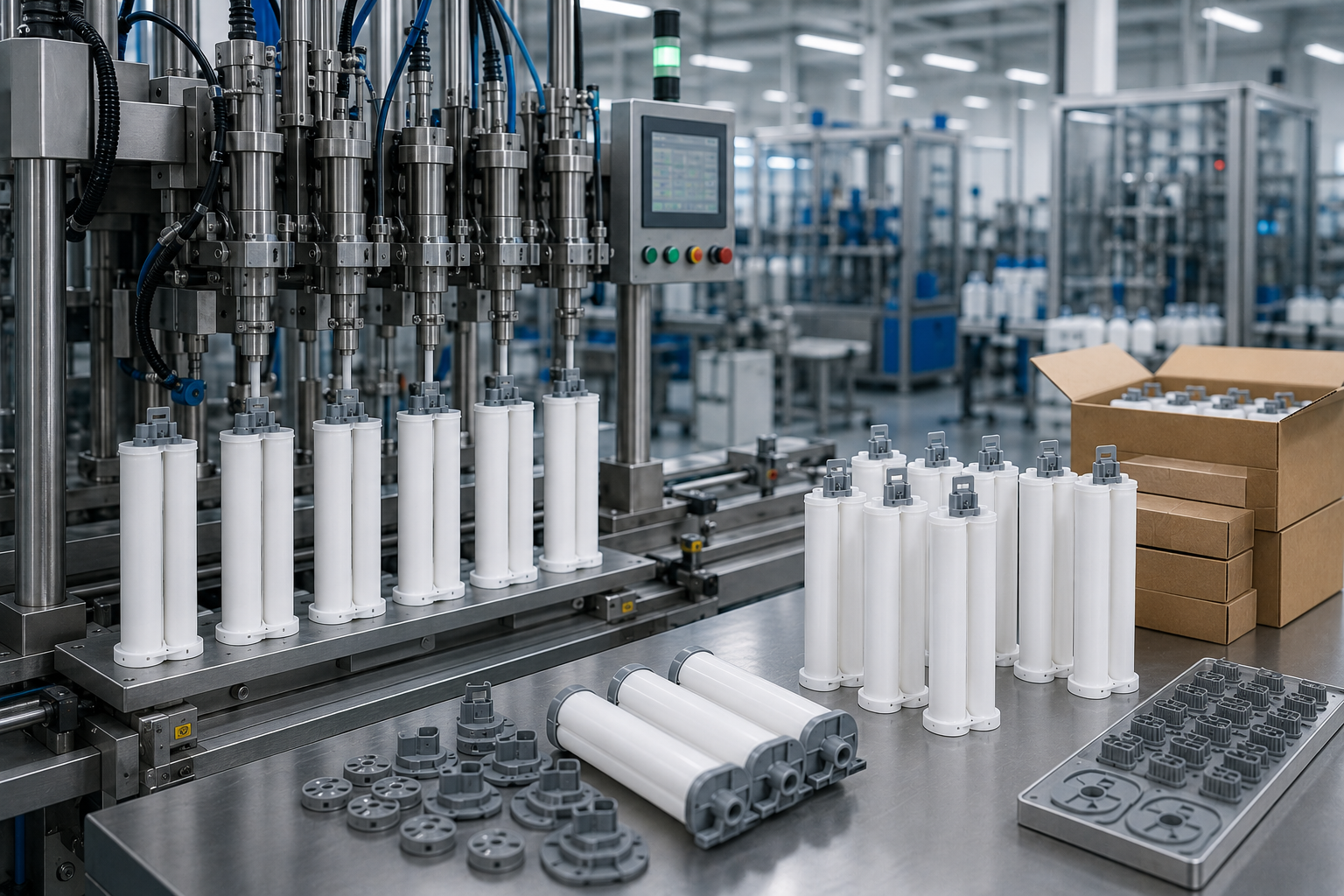
Engineering Requirements:
- Separate volumetric heads calibrated per A:B ratio
- Heated fill capability for high-viscosity systems (>30k cP)
- Independent A/B circuits with purge cycles
- PLC-controlled 2% ratio accuracy
Performance Advantage — TCO Framework
Skip the Fill Line. Your Capital Stays in R&D.
Fixed infrastructure costs accrue regardless of utilization; with toll manufacturing, your fill costs scale directly with actual production volume. You bring the formulation, we provide machinery, validation, and quality gates.
Request a per-unit toll fill fee quote – no formula disclosure required at this stage.
Request Custom Quote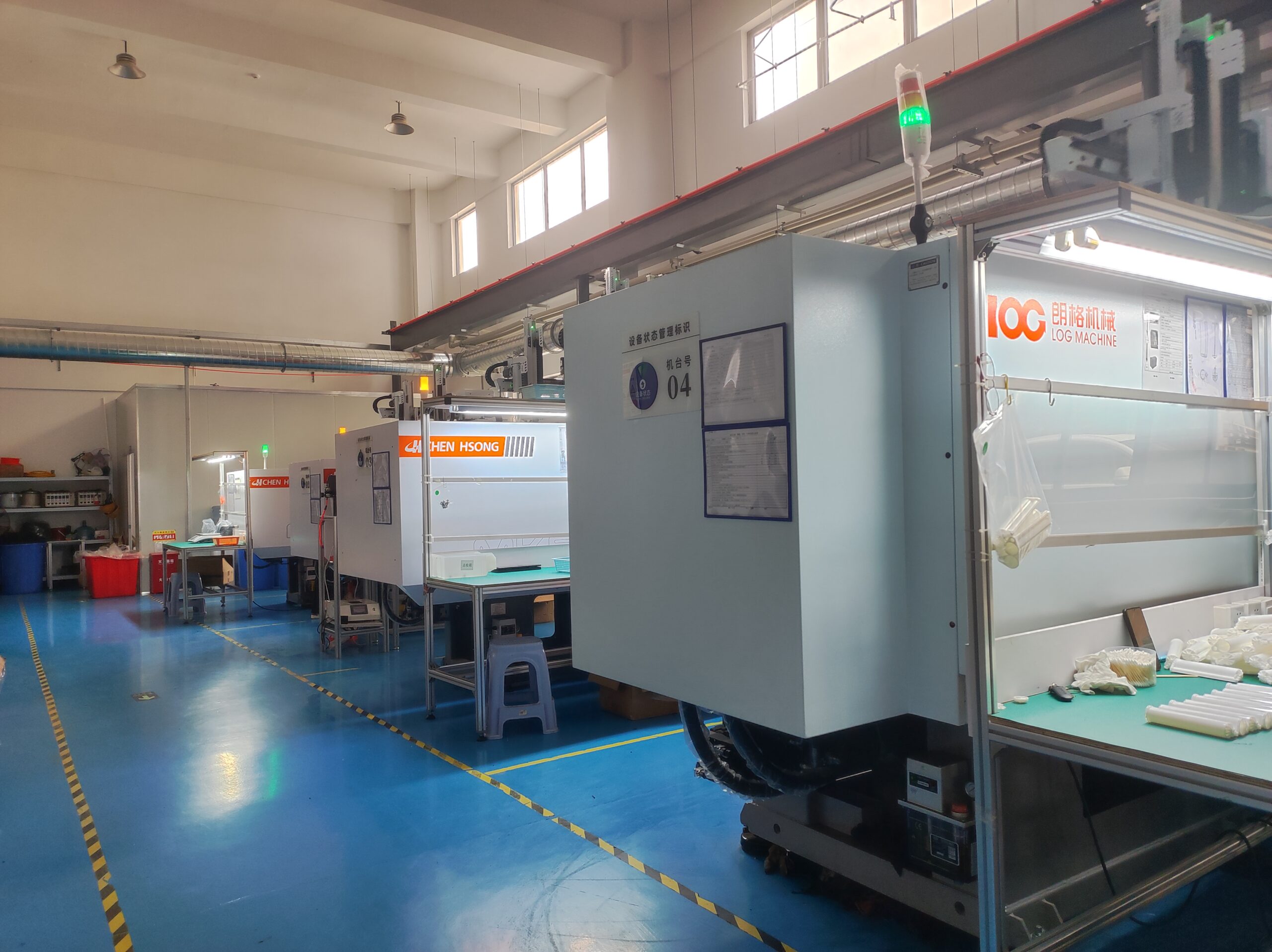
Our Toll Manufacturing Capabilities, 2K Cartridge Fill Specs
All resin systems present unique challenges due to viscosity profile, pot life, and cartridge specifications. This matrix outlines Ebestron’s toll fill capabilities across the nine commonest 2K adhesive chemistries:
| Resin System | Viscosity Range (cP) | Pot Life | Formats Supported | A:B Ratio | Key Application |
|---|---|---|---|---|---|
| Epoxy, standard cure | 500 – 20,000 | 5 – 30 min | 50, 150, 200, 400 mL | 1:1, 2:1 | Construction anchoring, structural bonding |
| Epoxy, fast-set | 100 – 5,000 | 1 – 5 min | 50, 150 mL | 1:1, 2:1 | On-site repair, maintenance bonding |
| Epoxy, high-ratio | 1,000 – 30,000 | 10 – 60 min | 150, 200, 400 mL | 4:1, 10:1 | Marble anchoring, stone bonding |
| Polyurethane (PU) | 200 – 8,000 | 3 – 20 min | 50, 150, 200 mL | 1:1, 2:1 | Flexible seals, gap filling |
| Silicone 2K | 50,000 – 300,000 | 30 – 120 min | 150, 200, 400 mL | 1:1 | Electronics potting, automotive seals |
| Hybrid epoxy-PU | 500 – 15,000 | 5 – 30 min | 50, 150, 200 mL | 2:1 | Structural bonds, multi-substrate |
| Methacrylate (MMA) | 200 – 5,000 | 3 – 8 min | 50, 150 mL | 1:1, 2:1 | Metal bonding, structural repair |
| Polysulfide 2K | 10,000 – 80,000 | 60 – 180 min | 200, 400 mL | 1:1, 3:1 | Marine sealants, aerospace applications |
| Moisture-cure PU (1K) | 2,000 – 25,000 | N/A | 150, 200, 400 mL | Single | Window sealant, gap filling |
ASSESSMENT
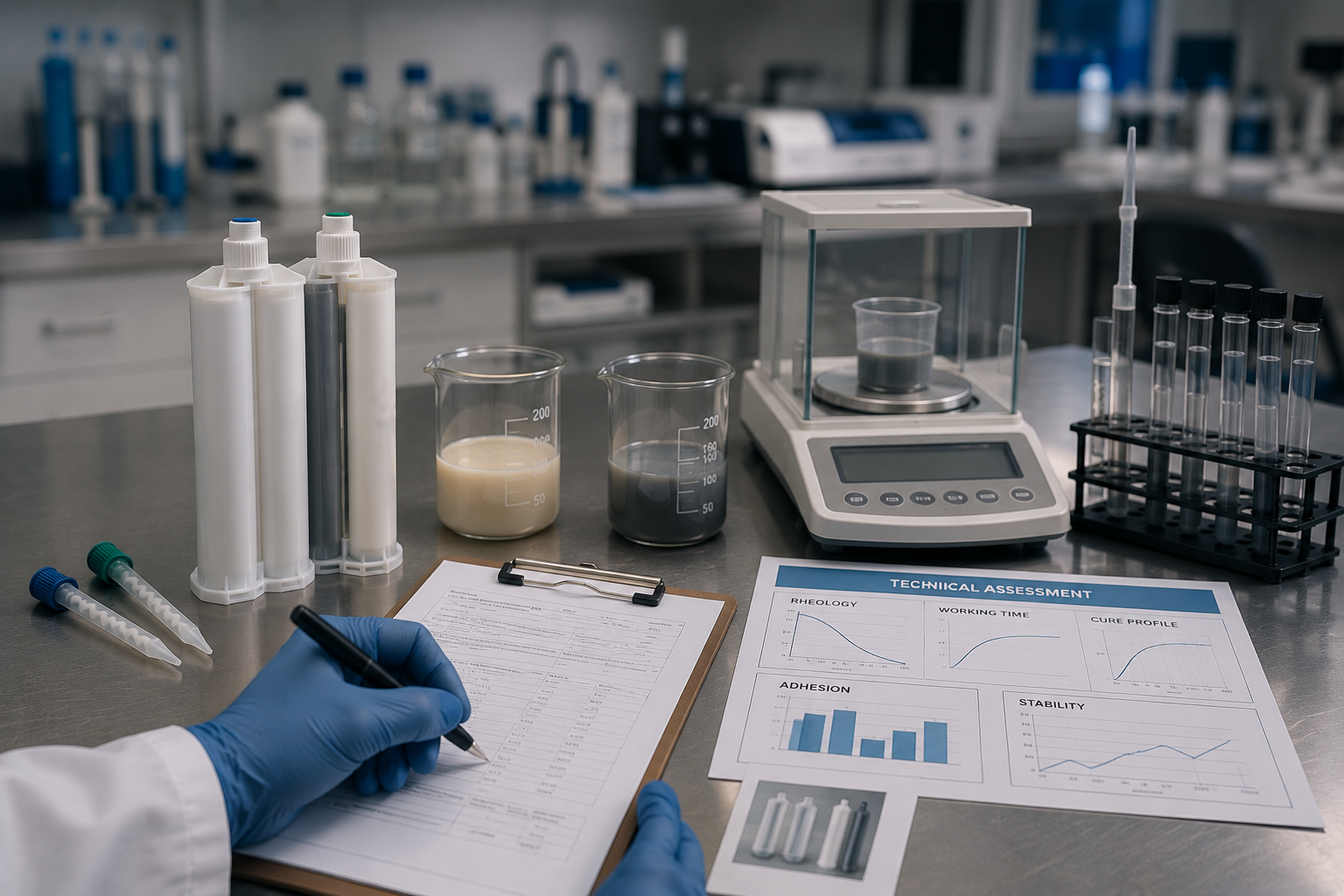
Technical Evaluation
Capability varies with each formula and cartridge. Please submit your chemistry and we’ll provide an initial technical assessment.
PRECISION & MATERIALS
Fill Specification
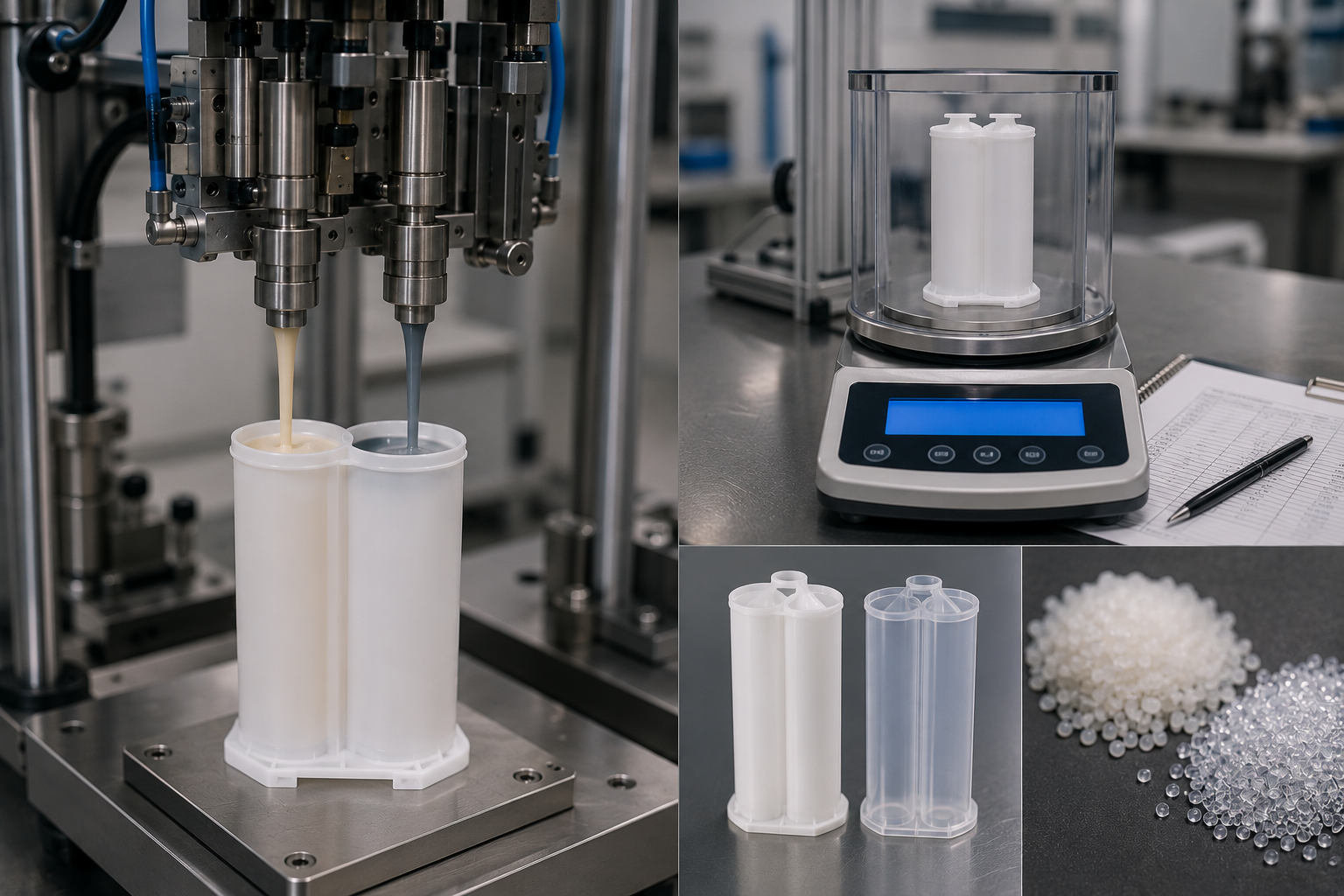
Ratio accuracy: ±2% across A:B volumes, verified by weight-based QC sampling. Available Cartridge Materials: PE/PP.
COVERAGE
Process Support
Format Options: Side-by-side and coaxial configurations. The toll filling process covers: Format types, ratio requirements, and quality certifications.
How Our Toll Manufacturing Process Works
Most clients naturally ask what happens next. At Ebestron’s Kunshan facility, our toll fill process is engineered to eliminate common in-house fill risks — inconsistent ratio accuracy, missing CoA documentation, and IP exposure at formula handoff. Unlike batch-only contract fillers, each of the five stages carries a specific output commitment: CoA per trial batch (ratio accuracy ±2%, seal integrity result, unit yield), NDA before formula review, and signed agreement before production begins.

01
STAGE 01
Submit Inquiry
Tell us the following information: cartridge format, chemistry type, ratio, and estimated annual volume (you need not disclose the formula itself). We’ll analyze the information against our available equipment for a feasibility assessment and response within two business days.

02
STAGE 02
Technical Assessment + NDA
Our team analyses the fill specs against our toll fill head specifications. We sign a Non-Disclosure agreement before any proprietary formulation data or raw material specifications are disclosed. This agreement protects your IP; formula-only-in-NDA is the first step of the IP Lock protocol.
03
STAGE 03
Trial Fill Run
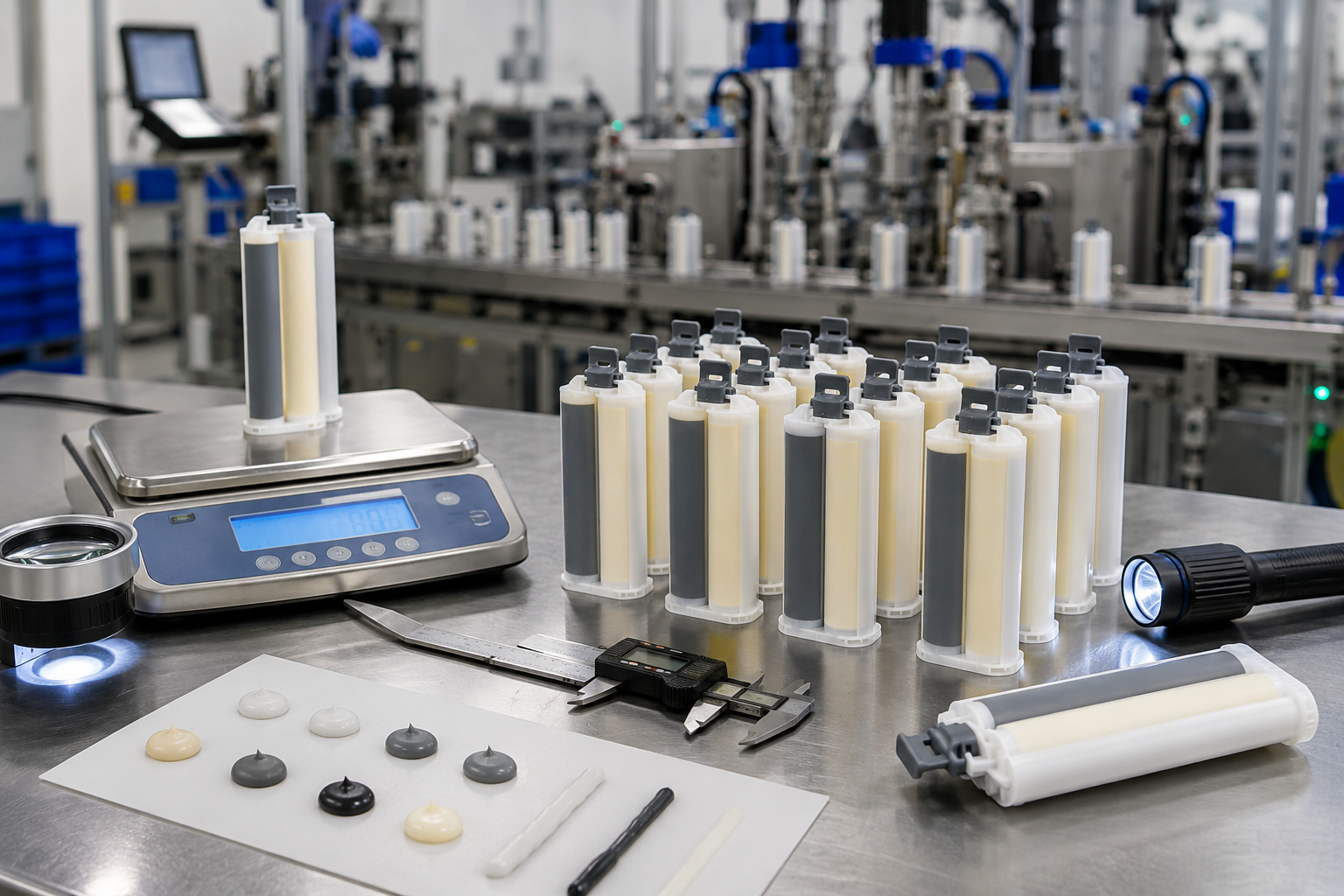
We perform a production trial batch of 10-50 units that confirm fill accuracy, cure, seal integrity, and adhesion, providing you with a detailed Certificate of Analysis (CoA). This is the quality gate where you confirm fit-before production order placement.

04
STAGE 04
Toll Manufacturing Agreement
Our standard client agreements include a description of raw material ownership (yours), minimum order volumes, CoA requirements per lot, protection of proprietary formulations, and warranty conditions. Contract negotiation takes 5–10 business days post-NDA execution.
05
STAGE 05
Volume Production + QC + Delivery
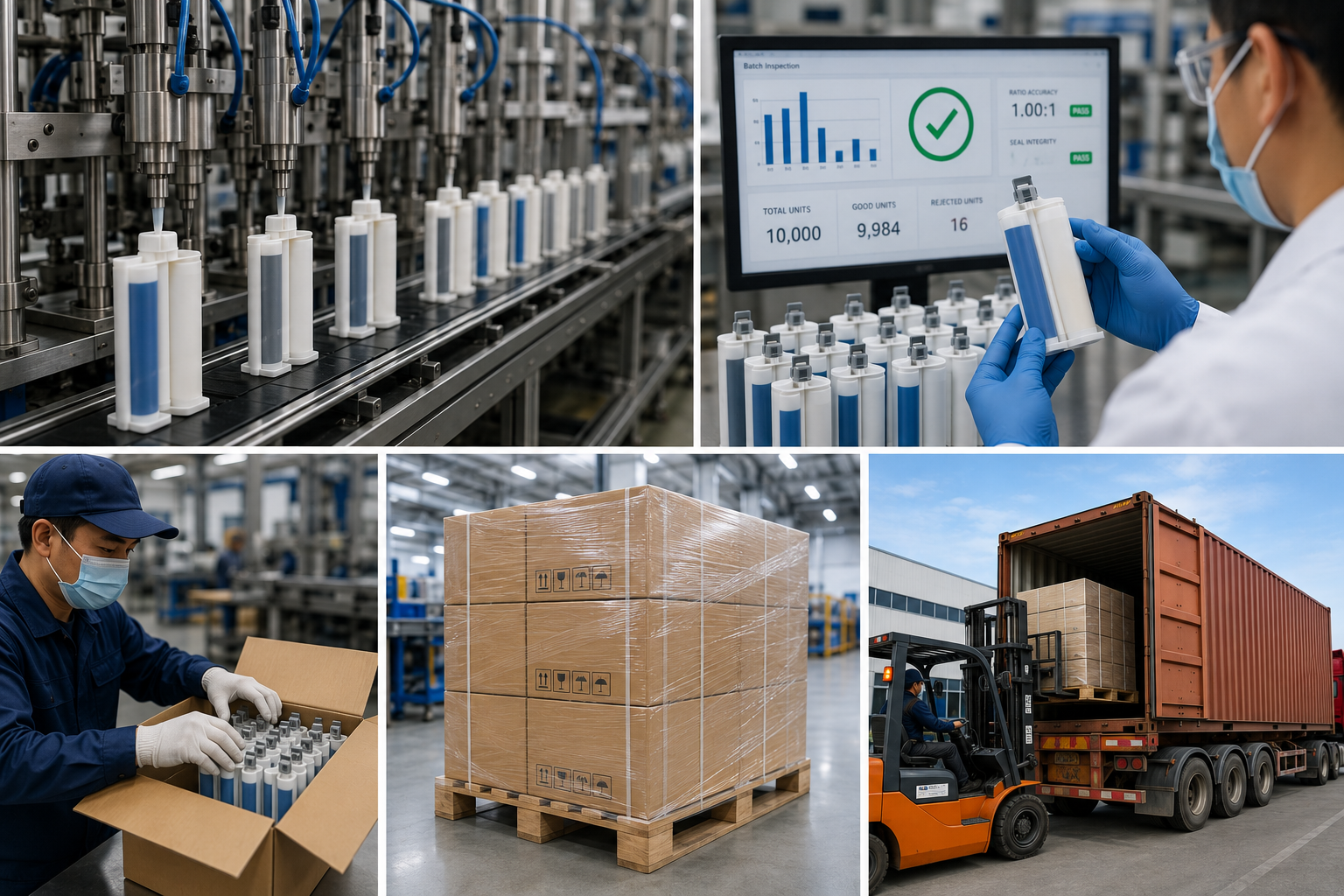
We do batch production per your specification, issue CoA per batch (ratio accuracy, seal integrity, number of total good units vs rejected), pack cartridges into pallets, and ship out. Typical lead time for a production run after we receive your material and sign specifications is 15-25 business days.
Can’t wait to see the fill quality before you commit to volume? Start here. Trial run.
Request a 10-unit Sample Batch →Quality Assurance, Certifications & China Manufacturing Advantage
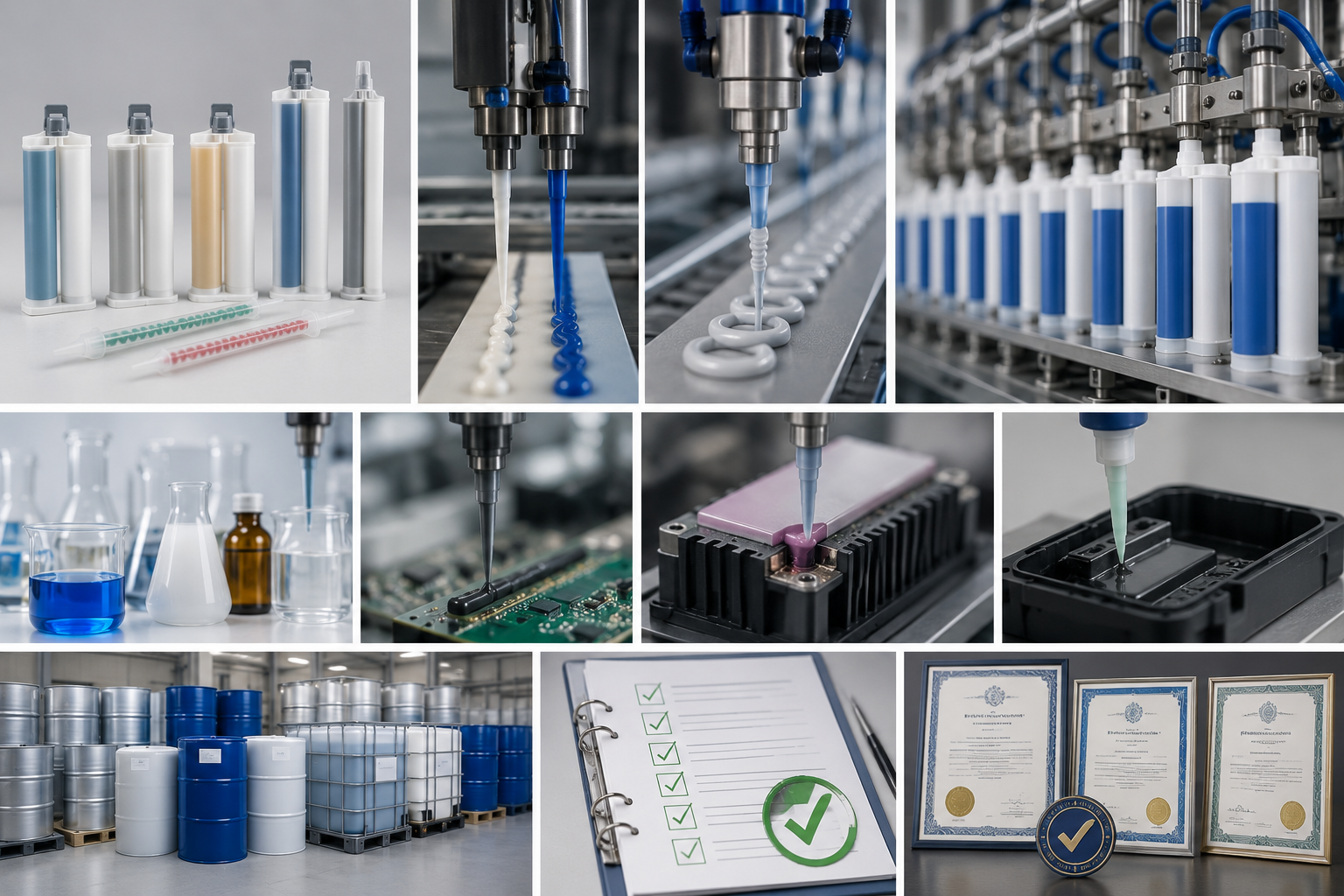
CEEU Directive Compliant
Construction & Electronics Markets
RoHSHazardous Substances
EU Restriction Compliance
ISOISO-Aligned QA
QA process per ISO 9001 framework
CoACertificate of Analysis
Detailed verification per production batch
“
We run weight-based ratio verification on every batch, each cartridge pair is spot-checked against the calibrated fill head specification. If the A:B mass ratio deviates beyond ±2% of target, the batch stops before sealing. That’s not a quality promise; it’s a physical gate built into our production flow. The fill head can’t deliver a cartridge that passes QC without passing ratio verification first.
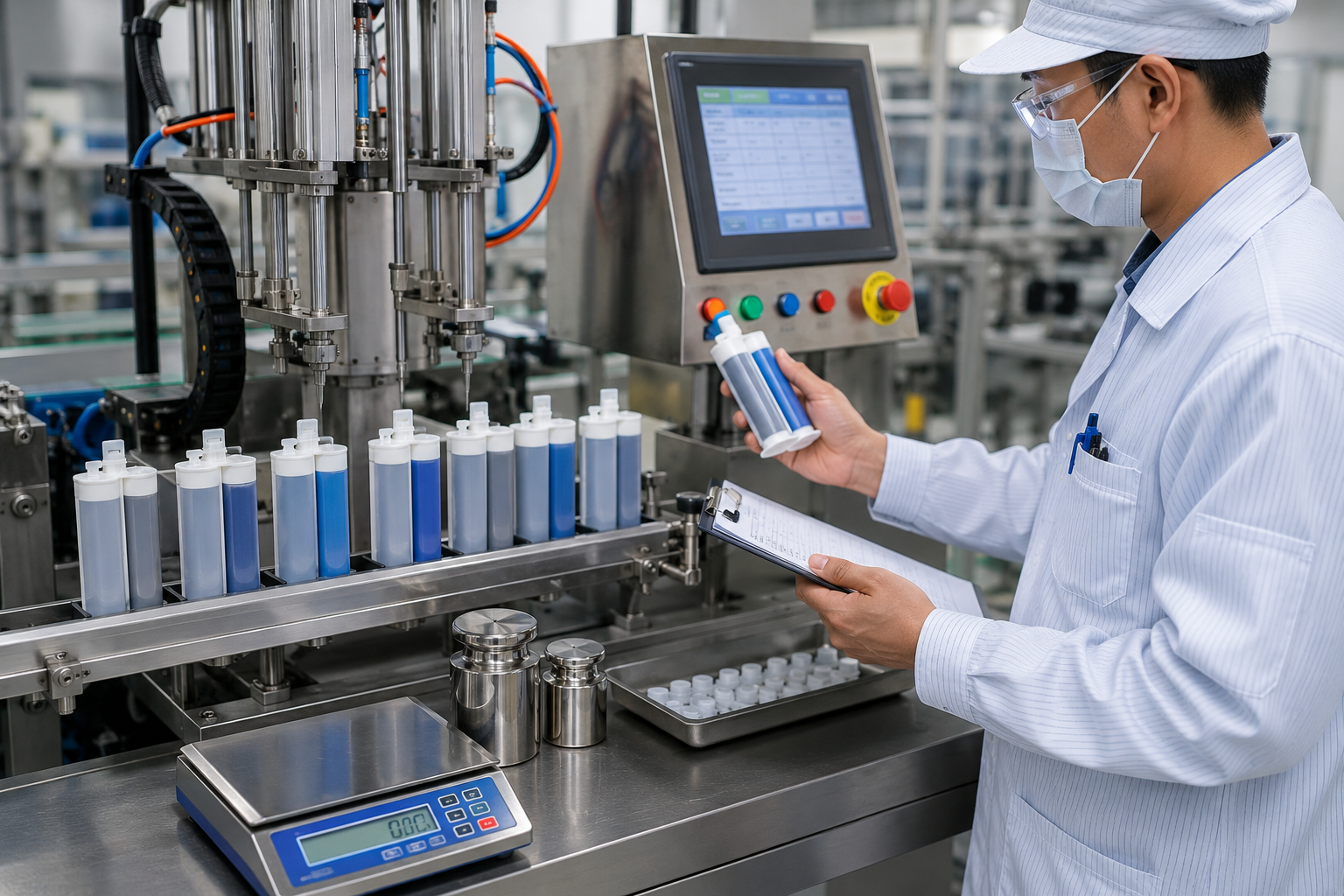
In-Process Quality Control (QC)
In-process QC gaps at low-quality toll fillers, no documented SOPs, no in-process ratio checks, no per-batch CoA, are the root cause of most adhesive contract fill disputes. The risk is structural: batch failures emerge at the customer’s dispensing stage, not at the fill stage, by which point they’ve already been shipped. Deviations, even within a few percentage points, can result in incomplete curing, reduced bond strength, or long-term instability, as adhesive industry research confirms. The ability to carry your quality process to the point of fill at Ebestron’s Kunshan operation via its weight-based fill ratio qc.
The “honest truth” of China toll manufacturing: Quality at the EU tier and cost of China manufacturing need CE and RoHS compliance, CoA on every batch, and a fill QC process that will simply shut itself off if out of specs cartridges are filled. That quality advantage comes in the form of production process from Ebestron as compared to off-the-shelf contract fillers. Test for yourself, verify on your trial.
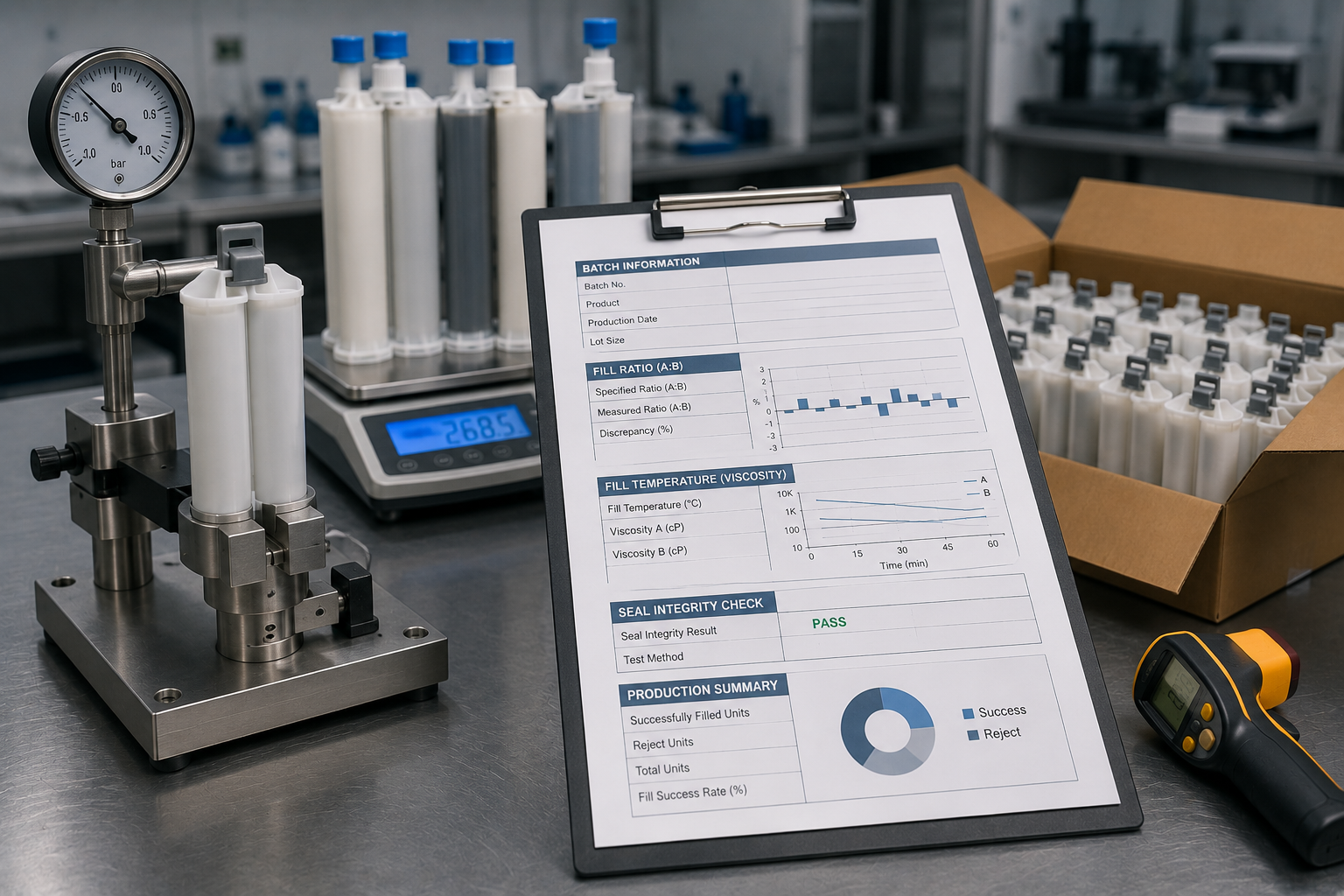
Per-Batch Certificate of Analysis (CoA)
Your production batch ships with a Certificate of Analysis indicating any discrepancy on your A:B fill ratio (in%), the measured fill ratio at the fill temperature (viscosity), result of the seal integrity check, as well as the number of successfully filled units vs reject units. We’ll follow your specified quality standards criteria mentioned in your toll manufacturing agreement which assures you an auditable trail of consistent quality as the top 10 EU or North American distributors would require when qualifying a potential toll manufacturing partner.
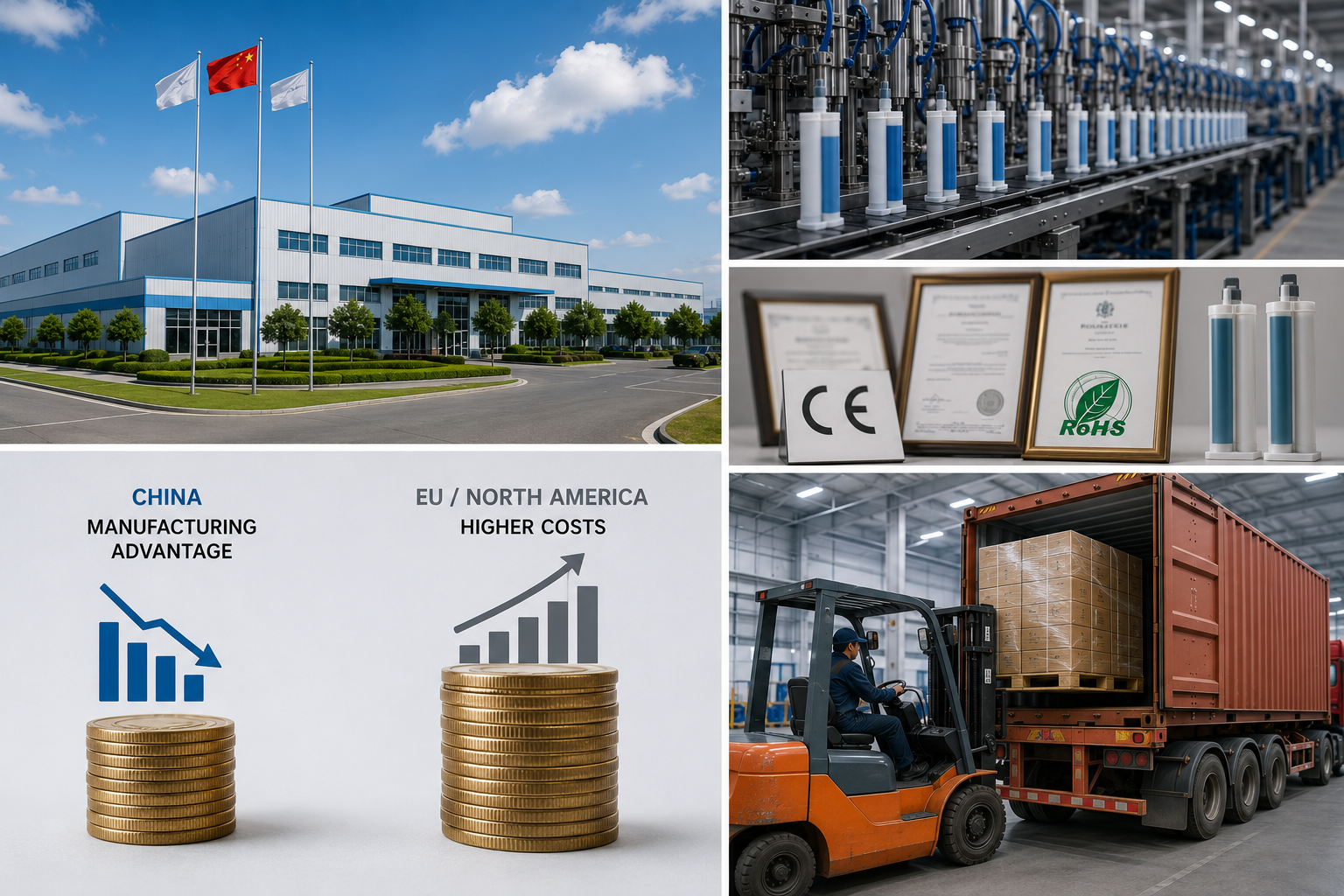
China Manufacturing Advantage
CE marking and RoHS are European market demands, not Chinese standards. We at Ebestron hold both CE and RoHS because our final product design is oriented toward EU distribution channels. We supply many European construction sealant/auto-adhesive distributors or OEMs and therefore are fully capable of meeting those stringent quality standard documentation requirements and produce at the far lower Chinese cost of production, as long as your final application falls within general construction sealants or auto-adhesives where CE & RoHS are common (Ebestron can only assume they will be based on the fact they are asked).
Labor, utilities, and facility overhead at the Kunshan facility run measurably lower than comparable toll filling operations in the EU or North America. Since you supply materials, you cut out the material markup layers too – allowing for auditable manufacturing costs and a competitive filling fee per cartridge. You can see the savings directly by conducting a trial run before committing to a larger volume.
Need CE and/or RoHS documented sample batch for your distributor? They’re ready.
Request a Sample Batch + CoA →Cartridge Formats & Fill Equipment
The issue for 2K cartridge filling isn’t the chemistry-it’s the equipment match. Viscous silicone above 50,000 cP gnaws against standard fill pistons and shot weights get erratic. Reactive chemicals demand isolated A/B fill circuits-no risk of contamination. And large ratio systems (4:1, 10:1) demand different piston sizes than what fits a 1:1 filling equipment setup.
Ebestron’s Kunshan facility actually runs multiple, distinct fill line configurations by chemistry type-instead of trying to run all materials across a single machine. This expertise in equipment compatibility is how we deliver CE/RoHS certified filling for all nine chemistries across the capability matrix.
Side-by-Side vs. Coaxial Cartridges
The two types of common double-cartridge arrangements accommodate different viscosity ranges and mixing:
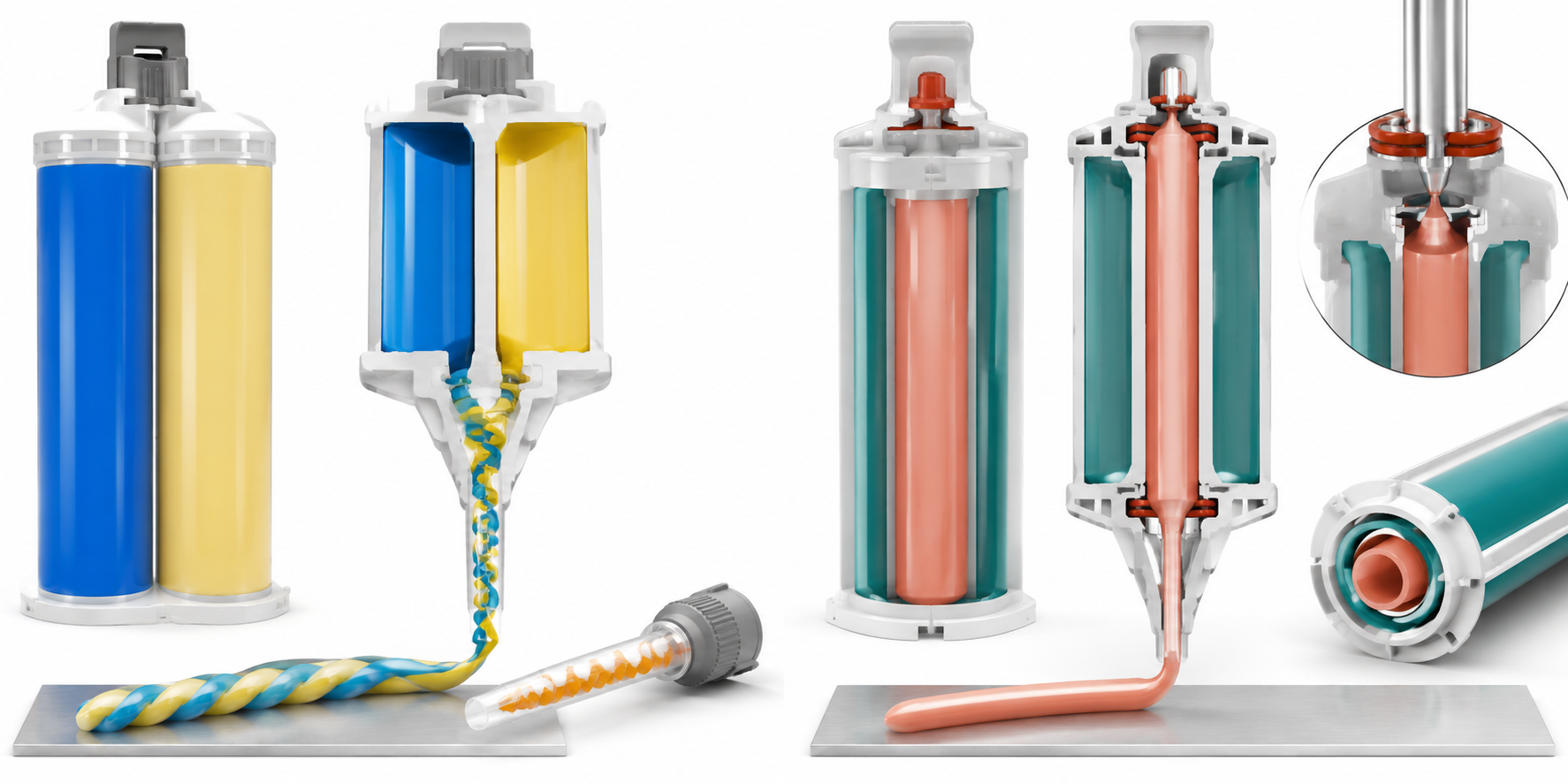
- Side-by-side (parallel barrel): Most epoxy, PU, MMA and hybrid systems come standard. The A and B components are contained in two separate cylindrical tubes placed next to each other and are supplied into a mixing nozzle. Both static helical as well as dynamic rotary nozzles are supported. For viscosities from ambient up to approximately 50,000 cP.
- Coaxial (inner tube / outer annulus): Used for high-viscosity silicone systems and reactive materials where the inner component must be precisely metered within the outer barrel. Front-filling design, as detailed in European Patent EP3677345A1, seals between the filling nozzle and the cartridge outlet to prevent contamination during high-viscosity fill operations.
Available Formats
Ebestron toll-fills into our own formats of cartridges and a full material compatibility and seal geometry check are prequalified to all the sizes.
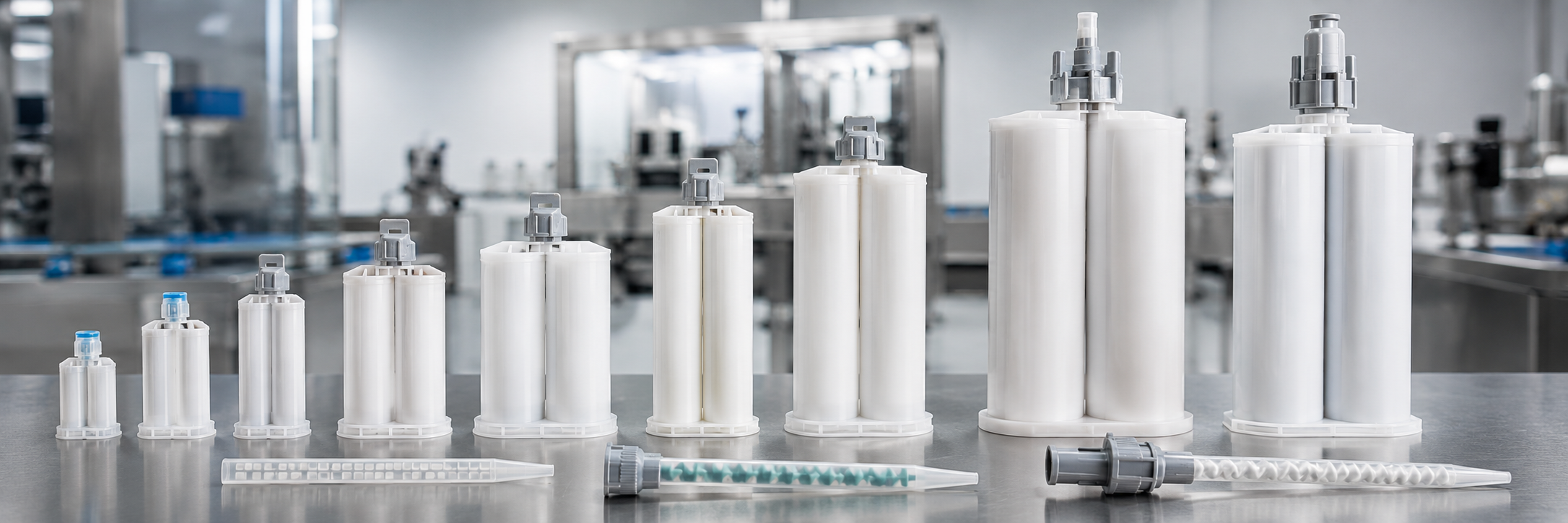
[SYS-01] Dual-Barrel Containers
50mL / 75mL / 100mL / 150mL / 200mL / 250mL / 400mL / 490mL / 600mL PE and PP formats. Side-by-side and coaxial configurations. PE for standard epoxy/PU liquid adhesive systems; PP for reactive or solvent-containing systems.
[SYS-02] Nozzle Selection
Mixing nozzles (standard static square type, helical static type and dynamic rotary type), resolution of nozzle is chosen based upon resin chemistry at technical assessment stage.
All of our Adhesive Dual Cartridges feature toll-filling into cartridge formats identical to those our facilities produce. That means we’ve already validated dimensional tolerance and piston design for every size on offer, before you consider us.
Still looking for a specific cartridge format for your resin system? Ask for a spec sheet on your desired size.
Request a Format Spec Sheet →Industries We Serve
The need to provide a broad product range outsource 2K cartridge for many application-driven areas of adhesives has meant a wide variety of products. For example within two part applications alone there are different: – Ratios between resin chemistries (A:B) – Viscosities – Sizes of cartridge. Because this has meant that 2k products were traditionally fill and then mixed down the line this lead to large numbers of specialist fill lines and considerable over heads within organisations. Ebestron now offers a flexible 2K toll facility to manufacture to the individual requirements of each resin chemistry irrespective of the industry sector application (we cover all 6 of the most popular two part applications), from a single manufacturing site, ensuring competitive costs.
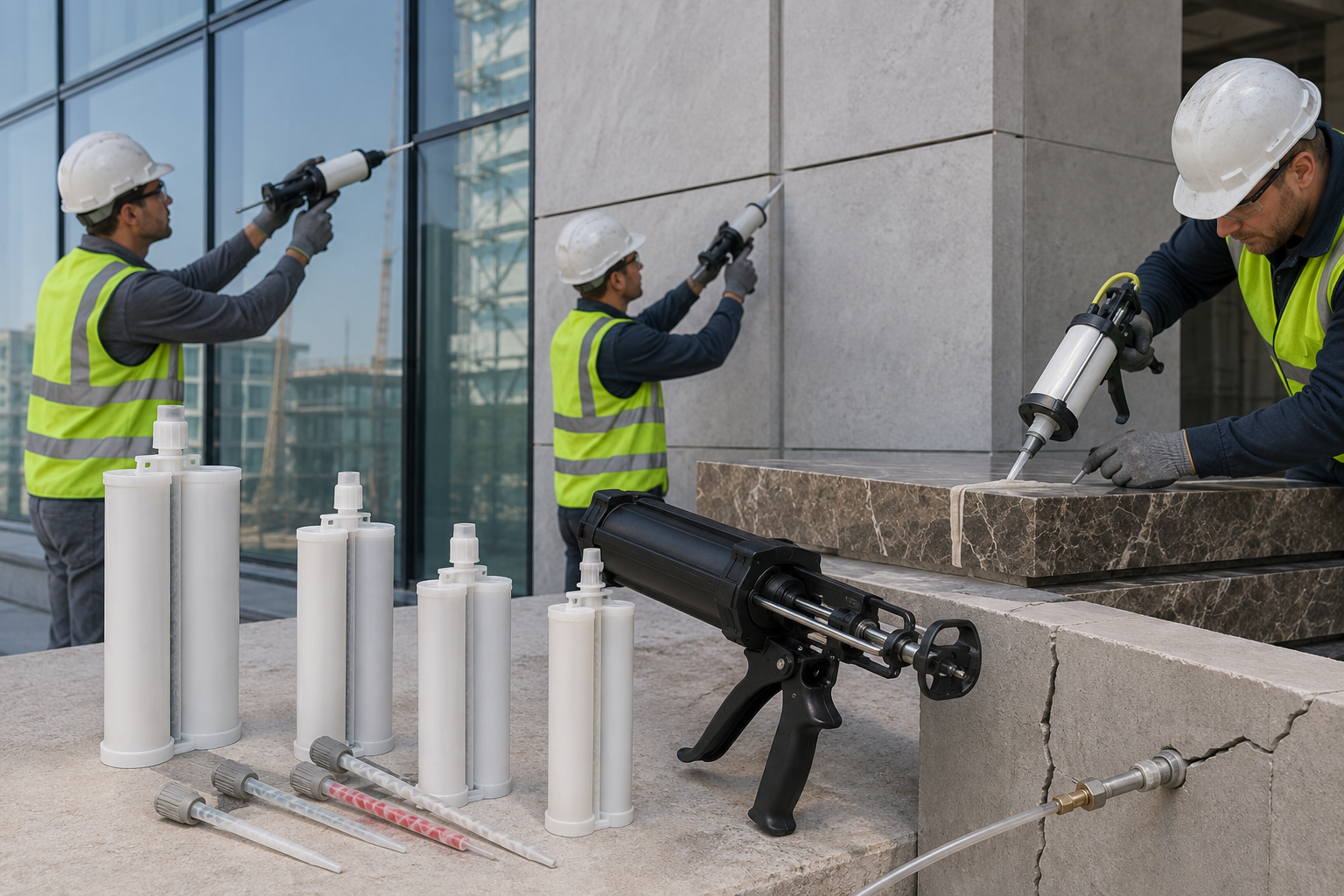
Construction
Epoxy embeddeds. Structural glazing sealants. Faade joint fillers. Stone bonding 1:1, 2:1 ratios; crack injection & marble embeddeds 4:1, 10:1 ratios. 200 400mL pack sizes for professional use.
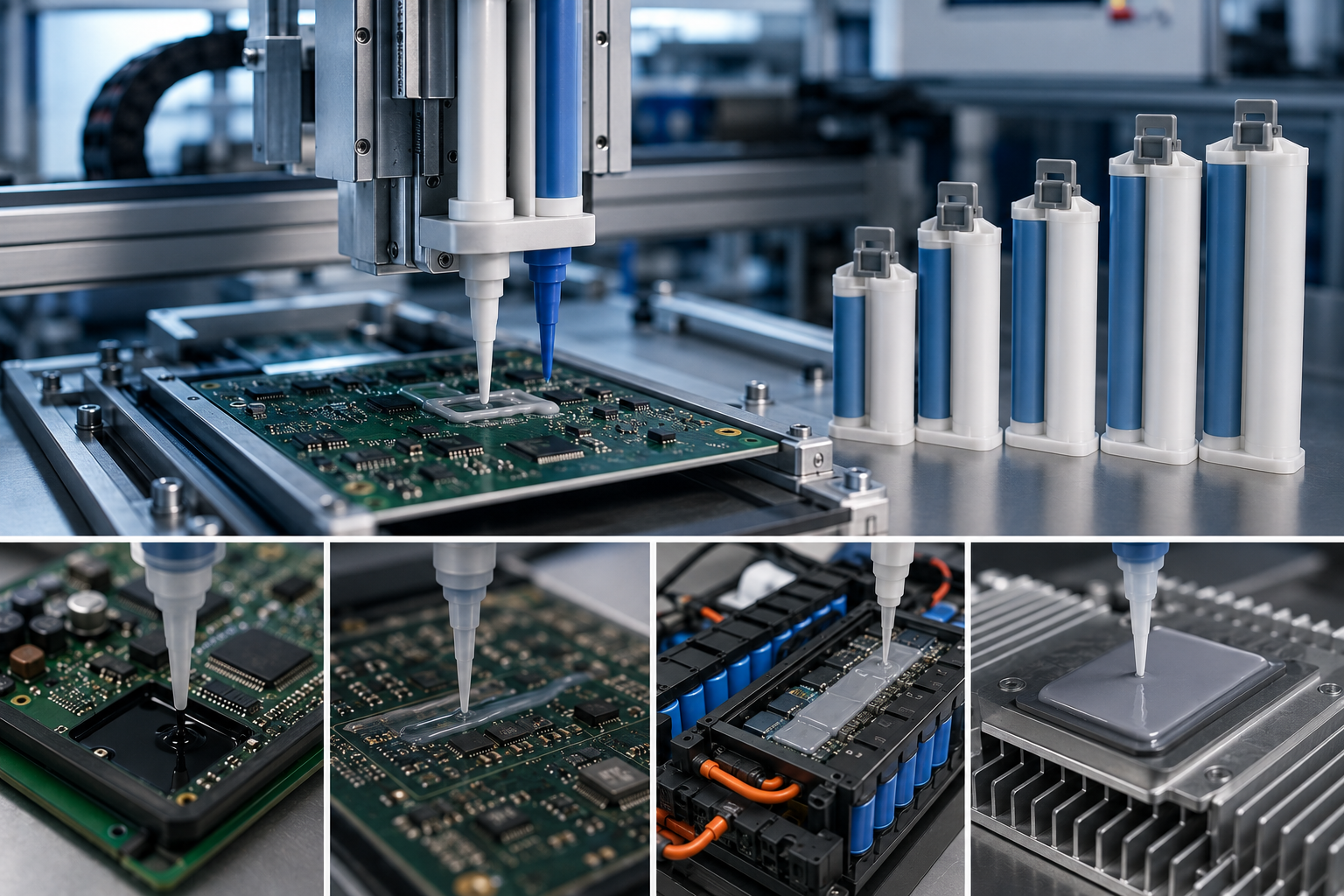
Electronics
Potting compounds, conformal coating adhesives and PCB and EV battery module thermal interface materials. 1:1 Low-viscosity Epoxy & Silicone 2K. 50-150ml Cartridges for precision dispensing systems.

Automotive
Multi-substrate assembly structural bonding, adhesives for EV battery modules, gasket sealants. Hybrid epoxy-PU at 2:1, suitable for metal-to-composite bond. High-temperature cure is also acceptable on this one, in the shape of formulations.
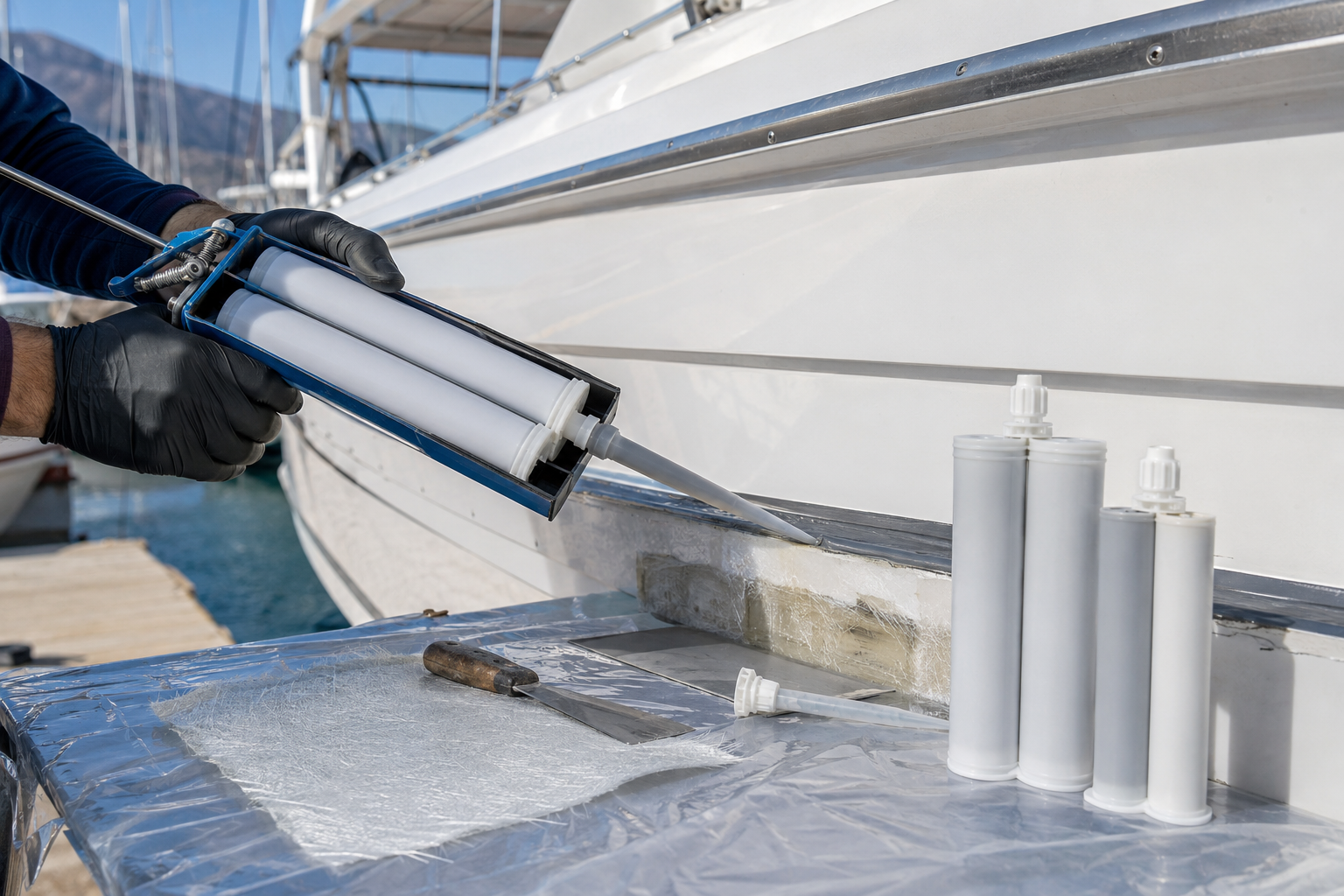
Marine
Hull repair compounds; deck sealants; fiberglass bonding. Two component (2K) polysulfide at 1:1 and 3:1 ratios, built to withstand UV and saltwater exposure. Available 200-400mL packaging for marine grade sealant applications.
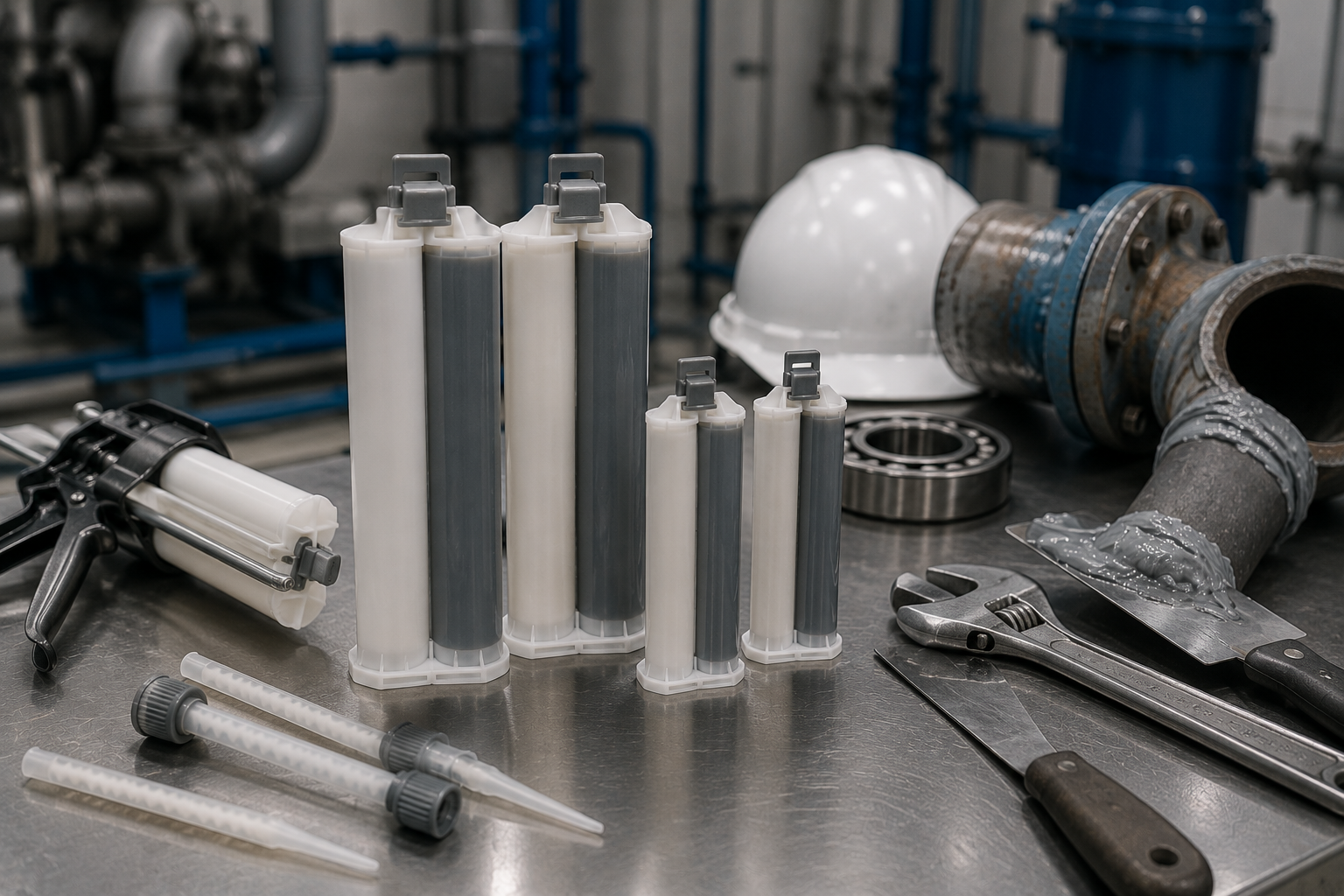
Industrial MRO
Metal Repair Compoundsanti-corrosion sealants pipe repair adhesive- Fast-set epoxy at 1:1 and 2:1 to maximize production.50-150ml packs for maintenance-use.
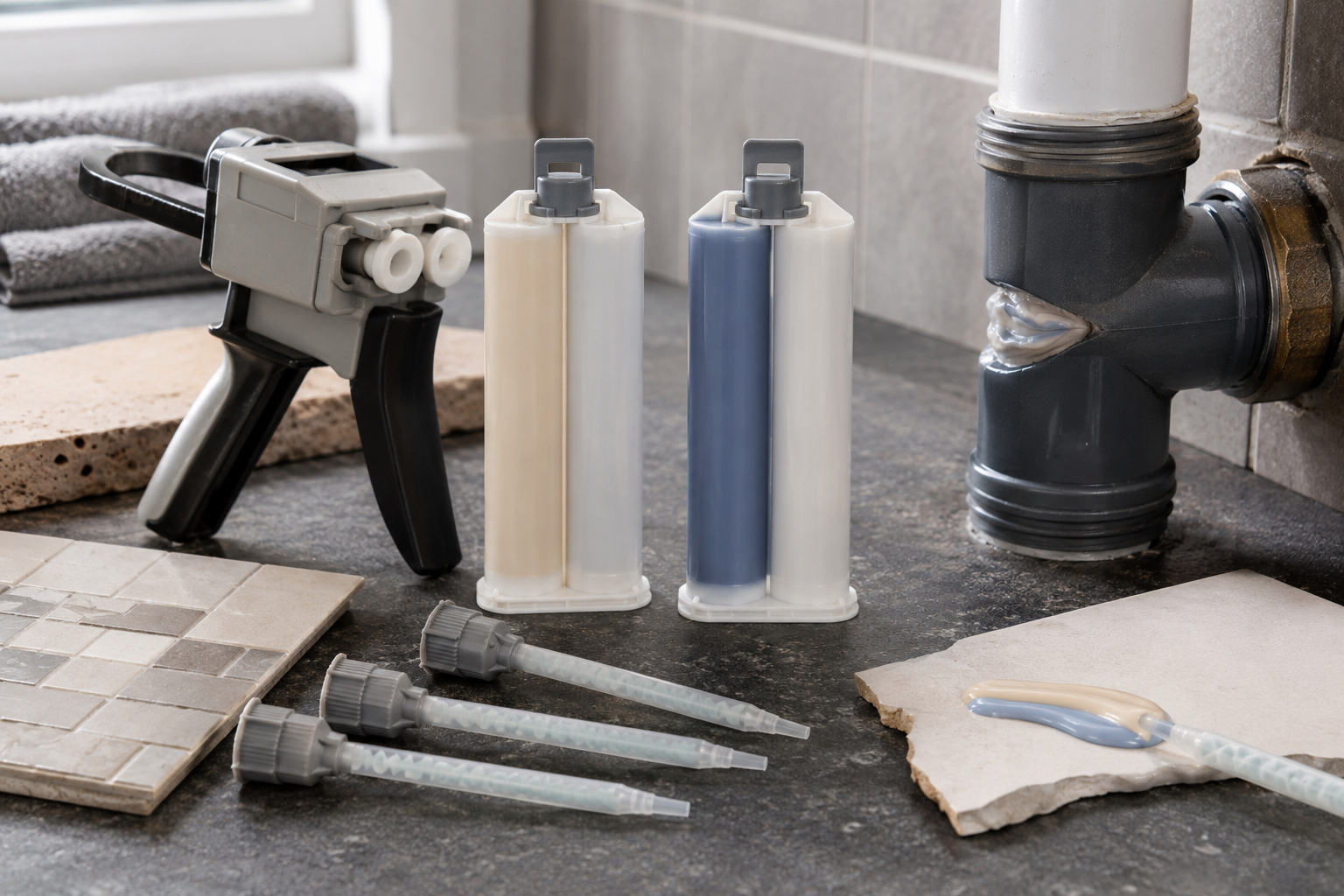
Consumer / DIY
Home Repair Adhesives Tile and Stone Compounds Plumbing Repair Kits – in 50ml packages (at 1:1 and 2:1 ratios) housed in consumer friendly retail ready cartridges ready for standard dispensing guns.
Toll Manufacturing vs. Contract Manufacturing, Key Differences
Buyers and manufacturers alike use these two terms interchangeably, which can result in an agreement that doesn’t reflect the client’s real needs. This confusion is particularly hazardous for brands as the wrong agreement type can risk ceding proprietary formula control, lose formula visibility, and open up opportunities for competitors to introduce “near identical” alternatives. For brand owners, the difference between toll and contract manufacturing is substantial.
The protection of intellectual property (IP) in China is a recognized legal issue in cross-border manufacturing agreements. In fact, Chinese IP protection in the context of toll and contract law is specifically highlighted in guidance for BRIC country IP assignment. In a toll agreement, it’s very clear that a contract with an explicit IP clause will be enforceable, but a simple verbal promise won’t. In the honest estimation, Chinese toll manufacturing IP will be protected the same way it’s protected with an NDA and express IP clause in a European toll agreement (with post termination clauses included), however the question is whether your toll partner’s form agreement contains all three.
FEATURE
TOLL MANUFACTURING (EBESTRON MODEL)
CONTRACT MANUFACTURING
Who supplies raw materials
You (the client) — you own materials throughout
The manufacturer sources and purchases raw materials
Formula / IP ownership
Exclusively yours, Ebestron never acquires formulation rights
May be shared or assigned to the contract manufacturer
Processing fee model
Per-unit toll fee (you see your own material cost separately)
All-in per-unit price (manufacturer’s material markup embedded)
Supply chain visibility
Full, you buy materials at your negotiated price
Limited, CM controls material sourcing and cost
Best for
Brands with established raw material suppliers + proprietary formulas
New brands without raw material sourcing relationships
Ebestron offering
✔ Primary model
Available on request, contact us to discuss
Buyer Framework: The 3-Gate Toll Partner Checklist
Review three specific approval stages before signing any toll manufacturing agreement for 2K adhesive cartridge fillings. Almost invariably, any buyer who has ever been disappointed by the toll fill process will trace the source of the failure back to one of these three points.
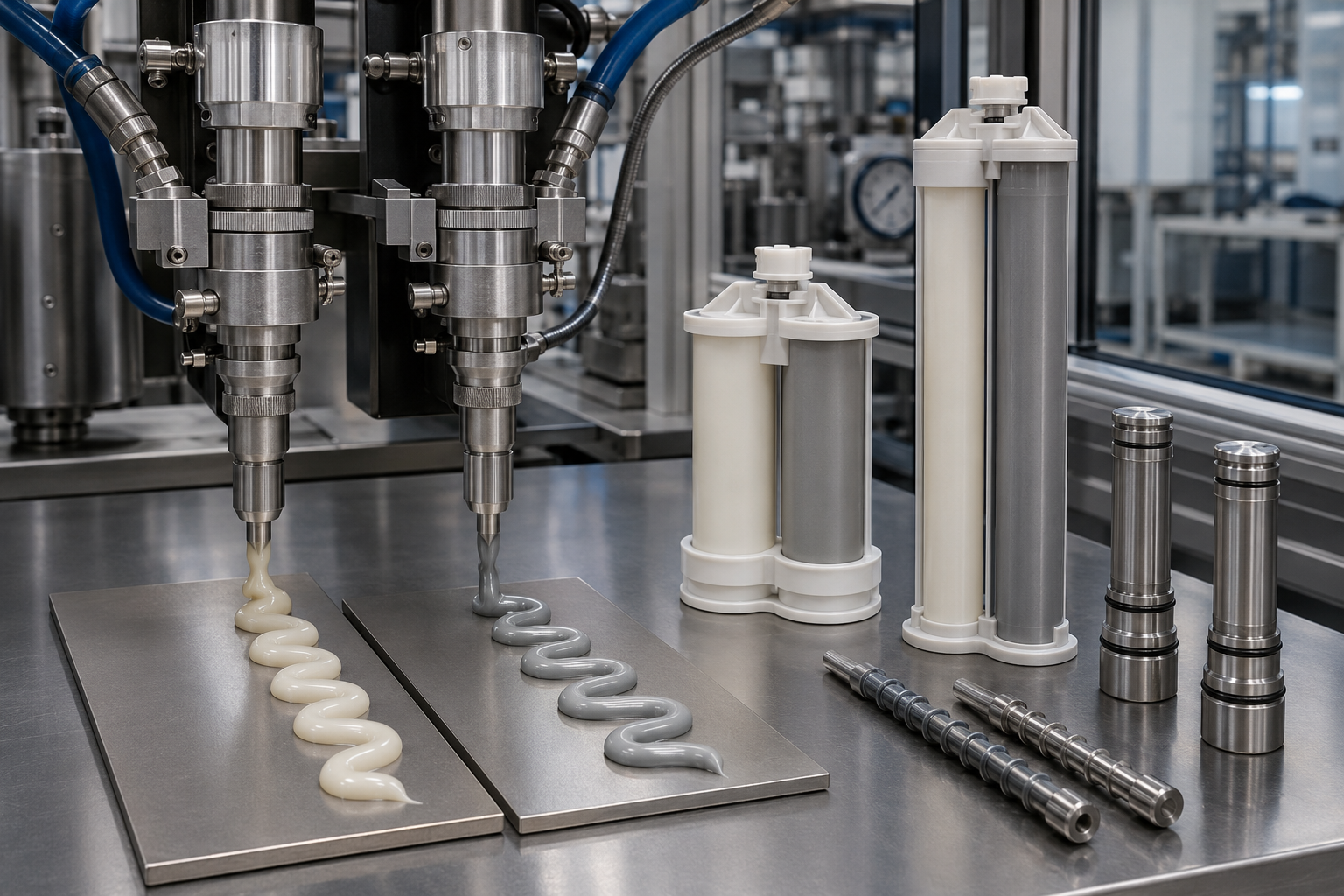
GATE 01
Equipment Compatibility
Can their fill heads handle your resin viscosity and required ratio?
Ask for the fill head specification sheet before signing. Reactive adhesives often have viscosities above 30,000 cP; 2K silicones can exceed 300,000 cP. Not all filling machines handle such high-viscosity materials. Check also whether the fill head’s piston ratio matches your blend ratio — a 10:1 A:B system needs a differently sized piston than a 1:1 blend. Mismatched ratio pistons are the most common cause of ratio drift in toll filling operations.
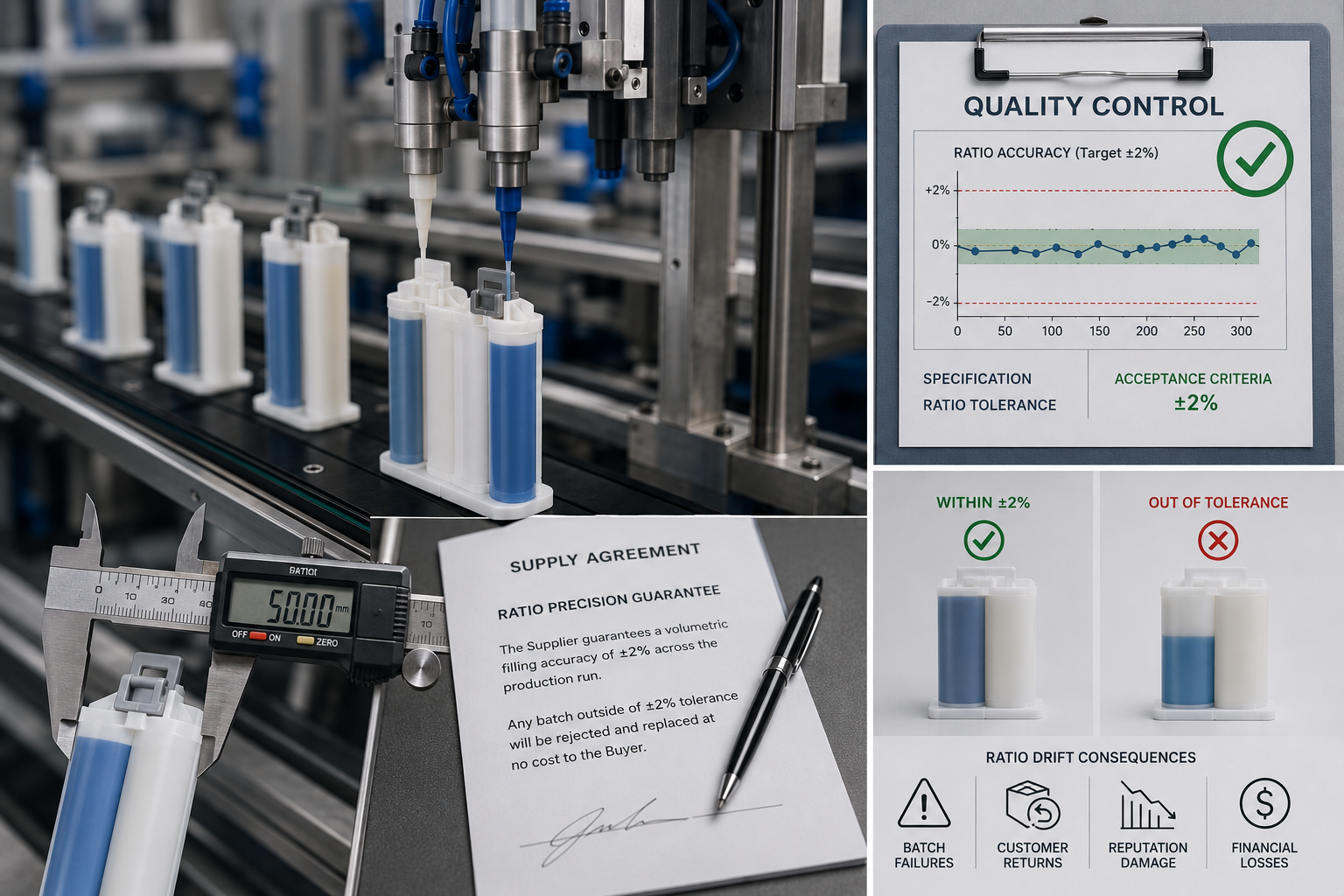
GATE 02
Ratio Precision Guarantee
Is ±2% accuracy written into the agreement, not just “best effort”?
A volumetric filling machine used for routine production runs will deliver ratio accuracy of within 2% across the run. This is the standard spec provided by manufacturers of 2K fill heads. If your prospective toll partner can’t guarantee in the contract, and with a reject policy, a ratio tolerance of 2%, then the agreement will be incomplete. When ratio drift occurs, it leads to batch failures which often only surface when your end customer uses the product. Your exposure will be linked directly to your toll fill partner’s specification.

GATE 03
IP Lock
Does the agreement explicitly prohibit producing similar formulations for competitors?
An NDA provides protection of confidential information. The IP clause in the toll manufacturing agreement provides protection for your formula from being reproduced for third parties on your technical specs. Both are needed – but the function is different. The IP clause must be written, word for word, into the signed toll agreement. It will say, among other things, “third-party can’t reproduce client’s formula” and “client’s raw material technical specifications can’t be used by toll manufacturer as a basis for third-party work, even after contract termination.” All these three terms are included in Ebestron’s standard agreement.
Starting a Toll Manufacturing Agreement with Ebestron
Process Flow
The agreement process will take a standardized sequence structured to protect all parties before production begins.
- 01
First, an NDA will be signed.
- 02
Only after an NDA is signed and our toll agreement has been executed can production commence.
- 03
Finally, your trial production batch will be reviewed and approved.
Buyer Due Diligence
Buyer due diligence is severely understated. toll manufacturing deals will entail financial verification, and a background investigation and audit for your production partners. The last thing you want is quality control gaps or IP theft found after significant volumes are produced. The process we’ve at Ebestron provides 10-50 units under trial agreement that should demonstrate the quality, ratios and packaging will be produced accurately prior to volume contracts or significant CapEx expenditure. It will provide tangible evidence for decision-making beyond mere verbal assurances of quality.
10–50Units / Trial Agreement
Agreement Timeline
NDA:Signed within 2 business days of inquiry
Estimated time to complete the technical assessment —3-5 business days from receipt of NDA (ratio verification, viscosity validation, format compliance review).
Time estimate to sign —5-10 business days
Trial fill run:Scheduled immediately after agreement execution
Time to first volume order delivery:15–25 business days from receipt of materials and approved specification sheets
What the Toll Manufacturing Agreement Covers
Ebestron is the only vendor that’s equipped to provide all five essential toll agreement components. The honest answer on what a complete toll agreement must contain: all five elements together — not two or three with the rest relegated to a side letter.
raw material ownership is retained at all times by the client, and is confirmed by the consignment receipt upon delivery. minimum batch run requirements, stringent CoA specifications with limits on ratio accuracy (e.g. ±X %), seal integrity, and units per rejected units, and IP protection that specifically prohibits third-party replication of client’s formulation are all covered, in depth, in our toll agreement. As the IP protections are included in the agreement, a separate NDA is unnecessary. Each production batch is shipped with an individual, clearly labeled CoA showing batch, date of manufacture, final ratio accuracy, and final units. This provides the procurement team sufficient information for your supplier qualification audits. Please see our agreement by requesting a quote-there’s no obligation!
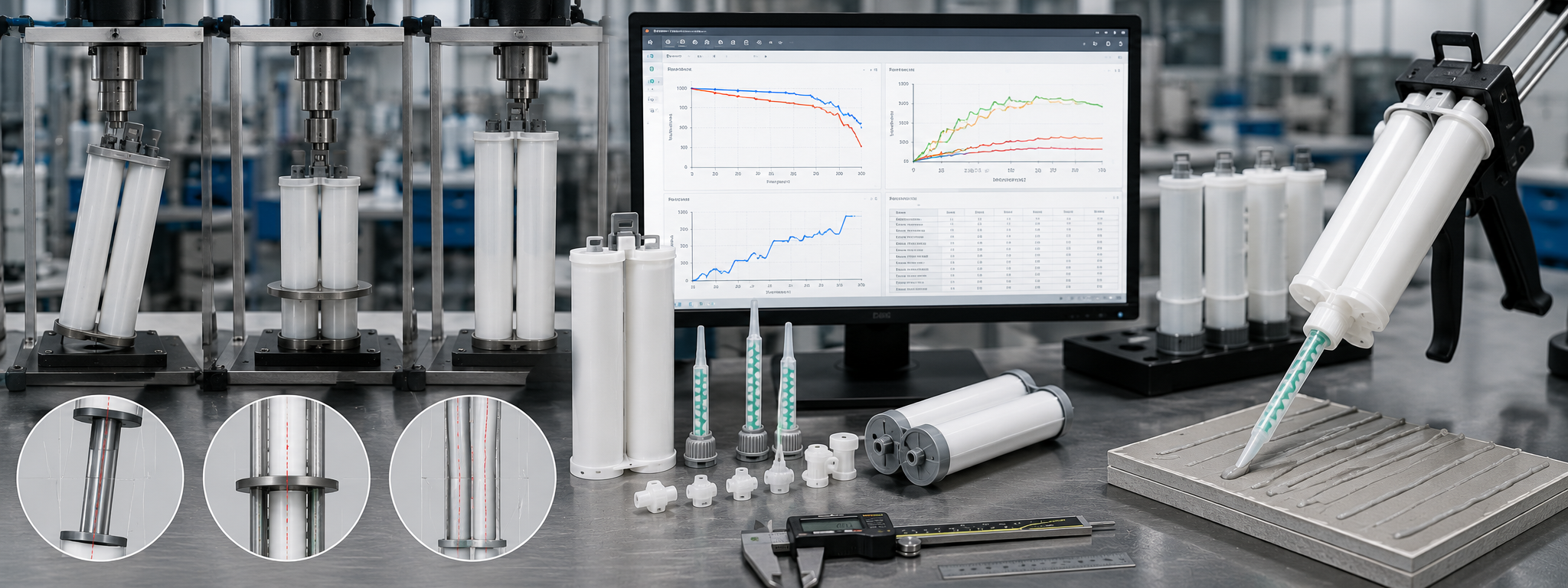
- [01]Raw Material Ownership
- [02]Minimum Batch Run
- [03]CoA Specifications
- [04]IP Protection
- [05]Per-Batch Labeled CoA
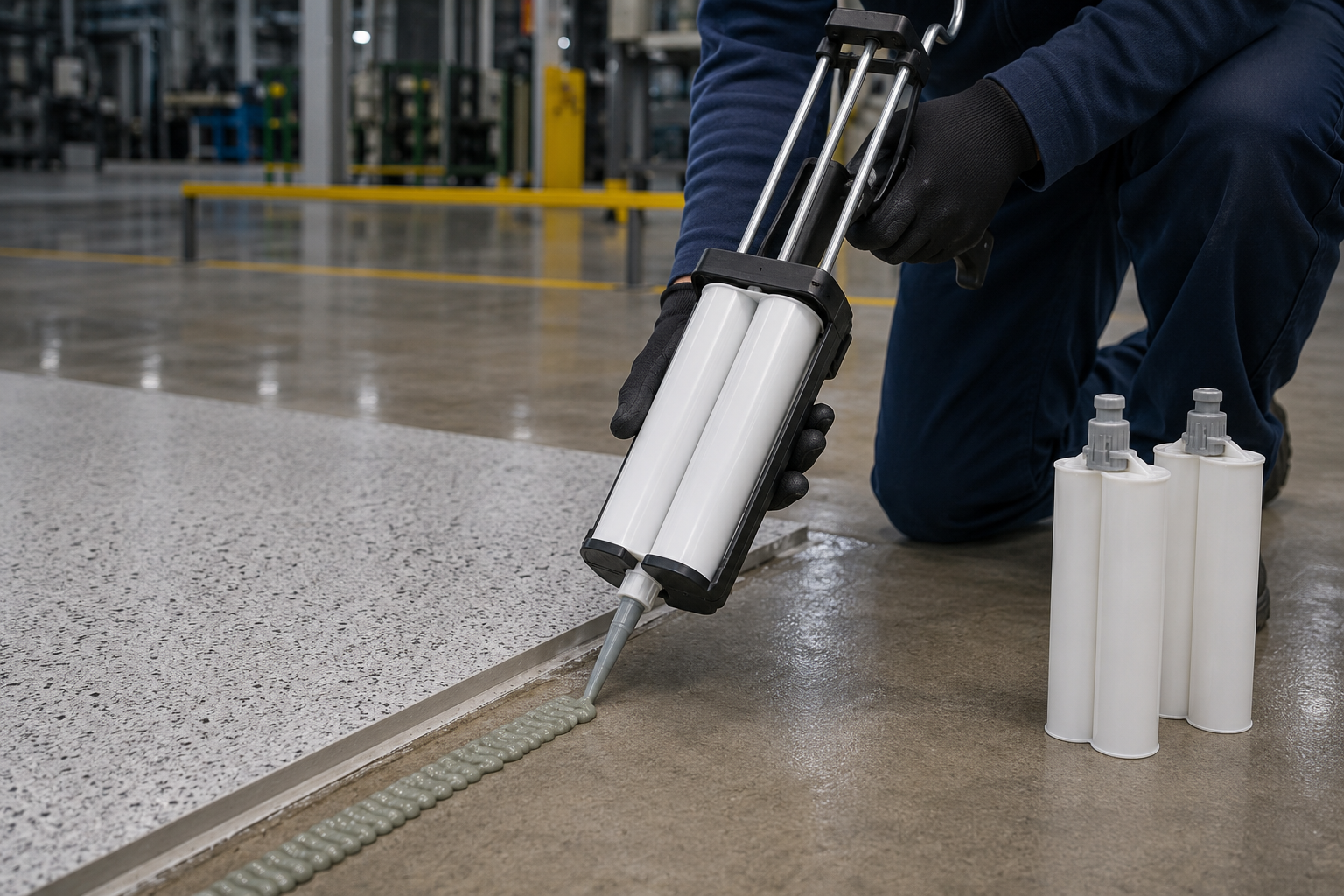
This level of documentation is standard practice for toll manufacturing partnerships in the chemical and adhesive industries, and it’s what European and North American distribution buyers request when auditing their suppliers’ supply chains.
If your process involves mixing components (especially in liquid systems, and importantly, 2K cartridges where accuracy and quality directly impact end product performance), Contact Ebestron to begin your toll fill agreement. Share your cartridge format, target ratio, and anticipated annual volume and we can begin with no formula disclosure.
Review Ebestron’s standard toll manufacturing agreement terms before committing.
Request a Quote + Agreement Preview →Toll Manufacturing Planning Tools
Spec your fill volume, match an adhesive chemistry, and compare toll manufacturing against in-house filling before you request a quote.
Fill Volume Calculator
Estimate required fill volume by cartridge format and batch size for your toll fill run.
Open Fill Volume Calculator →Chemistry Selector
Match your application to a suitable two-component adhesive chemistry and format.
Open Chemistry Selector →Toll vs In-house Calculator
Compare toll manufacturing against in-house filling for your projected annual volume.
Open Toll vs In-house Calculator →Frequently Asked Questions
What’s a toll manufacturing production agreement? It’s where you provide the raw materials and the toll manufacturer does the work-using their equipment, expertise, and quality control systems to package them-for a fee of your making (your “toll”), and you maintain complete ownership of the raw material and the formulation throughout. For a brand manufacturing adhesives with their own secret blend of resins and hardeners and dispensing it in 2K cartridges, a toll manufacturing agreement with us means they send us their ingredients, and we return sealed, filled cartridges.
This terminology is derived from the chemicals industry – much like a toll toll road, where you pay to use roads you don’t own. With toll manufacturing, you’re paying to use a manufacturer’s equipment and formulation expertise, rather than purchasing the raw materials directly, as with contract manufacturing.
In toll manufacturing, the client supplies all the raw materials and retains IP; the toll manufacturer is paid per unit manufactured. With contract manufacturing, the manufacturer (sources) purchases the raw materials (or supplies it to their customer’s specifications), and the client defines the final product. toll manufacturing gives greater control over material costs, supply chain visibility, and IP protection (see below). Refer to the comparison chart (above) for more details.
We can manufacture epoxy (1:1 to 10:1), polyurethane (PU), silicone 2K, methacrylate (MMA), polysulfide, hybrid epoxy-PU, and single-component moisture-cure polyurethane. To initiate the process, simply submit your resin chemistry for technical review, with no formula disclosure at this stage. We can fill viscosities up to ~300,000 cP using a heated filling system.
Trial production minimums begin with the smallest batch size that permits valid confirmation of ratio accuracy, seal integrity and cure properties. Please advise on your desired cartridge format and chemistry to receive a specific trial minimum (this depends on the setup time required for your particular fill equipment configuration). Standard production minimums and price tiers are detailed with the production proposal.
We’ll enter into a confidentiality agreement before sharing any specific formulas, formulation data, or raw material specifications. Ebestron’s standard toll manufacturing agreement includes explicit intellectual property protection provisions: we’re contractually barred from producing or providing competing formulations to third parties based on your proprietary formulations and material specifications. Such obligations survive contract termination. China IP protection is an expressed consideration in transnational manufacturing legal documentation, particularly regarding border transactions – concerns often arise not from the legal framework itself failing to recognize intellectual property rights in China, but from agreements lacking specific IP clauses leaving areas unaddressed even by general NDA terms. China-based toll agreements that contain properly drafted IP clauses are directly enforceable under the PRC’s contract law. Refer to Gate 3 on “The 3-Gate Toll Partner Checklist” (above) to ascertain which contractual elements should be present. Obtain a proposal from us to review Ebestron’s proposed IP protections prior to entering into any agreement.
EU market entry requires CE Marking (compliance with directives in effect for the specific product categories). In many EU markets, RoHS Compliance (Restriction of Hazardous Substances) is a requirement for electronics and building materials. We provide a Certificate of Analysis (CoA) with every production lot summarizing ratio accuracy, seal integrity, and yield. EU distributors and OEMs qualifying new toll manufacturing suppliers require these qualifications and certifications.