
Get in touch with Ebestron Company
Stainless Steel Dispensing Needles & Precision Tips
Find a needle for the fluid, not the fluid for the needle. Ebestron makes blunt-tip industrial dispensing needles in 8G-30G, all in 304 and 316L stainless steel, built to feed into the same 2-part adhesives line we already supply you in cartridges, mixers and guns.
8G–30G
Gauge range, all-steel & plastic-hub
304 / 316L
Stainless grade specified per SKU
4 lengths
1/4″, 1/2″, 1″, 1.5″
ISO 80369-7
Luer lock / luer slip fit
CE + RoHS
Compliance, MSDS on request
OEM
Custom gauge, length, bend, private label
Precision Dispensing Starts at the Tip — the Industrial Blunt Needle, Solved
Stainless steel dispensing needles are a short, non-coring blunt tube for luer lock connection to a syringe or cartridge to dispense a precisely measured drop, bead or amount of adhesive, epoxy, cyanoacrylate or solder paste. A dispensing needle is not a syringe used for skin penetration; the end is flattened or beveled flat for dispensed material. Choosing the wrong dispensing needle will be an instant expensive fail.
Why the tip decides the deposit
An inner diameter too small for the fluid forces material through a restriction, causing pressure spikes, pulsing and accelerated clogging. A tip too large floods the part, wastes material and drips between cycles. Either way you get inconsistent beads, rework and line downtime — and a weak bond is often the most costly form of adhesive waste, since it shows up as rejects, returns and repackaging.
So the issue is not what a dispensing needle is. It’s what gauge,tip style and steel type meet your process fluid’s parameters. The difference between them is a clean bead versus a clogged tip. Ebestron makes industrial dispensing needles so you have an answer, serving North American, European, and Asian buyers that dispense adhesive, epoxy and solder paste from their own 30 mL and 55 mL syringe barrels or cartridges.
+ [SPECIFICATION MATRIX]
Ebestron Stainless Steel Dispensing Needles — Gauges, Lengths & Hub Options
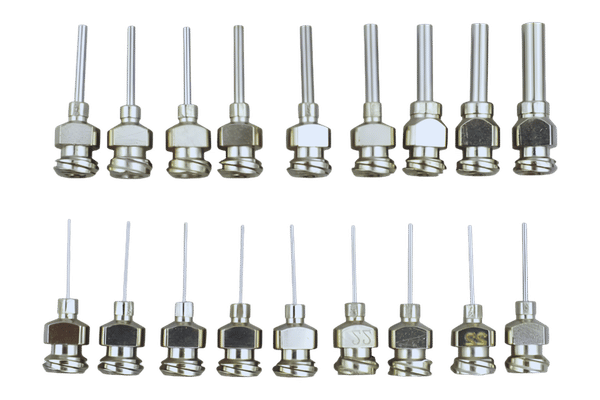
Ebestron uses two needle product families that will cover almost every manual and automatic dispensing application on your bench or production line. Full stainless steel dispensing needles employ one-piece construction: a single-piece stainless steel tube for the cannula and stainless steel or metal for the hub for high-stress or frequent use. Plastic hub stainless needles pair a steel cannula with a color-coded polypropylene hub for quick gauge identification by sight in one second.
| Needle family | Construction | Gauge span | Lengths | Best for |
|---|---|---|---|---|
| All-Stainless Steel (blunt) | Steel cannula + steel / metal hub | 8G–24G | 1/4″, 1″, 1.5″ | Heavy epoxy, sealant, solder paste, reuse, automated valves |
| Stainless + Polypropylene Hub | Steel cannula + PP luer hub | 16G–30G | 1/4″, 1/2″, 1″, 1.5″ | General 2-part adhesive, color-coded gauge ID, disposable use |
| Bent / Angled (45° & 90°) | Steel cannula, formed | By request | By request | Tight, recessed or side-entry joints |
| PTFE-lined & Tapered | OEM / custom | By request | By request | Cyanoacrylate anti-clog, high-viscosity smooth flow |
While polypropylene hubs come standard, they can be had in nickel-plated brass for an all-metal solution or supplied with PTFE liners to protect your fluid if it attacks steel. Ebestron precision cuts all of its dispensing tubes to ensure clean ends (blunt non-hypodermic); and its staff then finishes them and attaches them to standard luer slip or luer lock syringe barrels, and they can machine to custom gauge, length, bend, and Private label the needles for their customers. This ensures against the inconsistent internal diameter and burr on a resold needle.
The Ebestron Gauge-to-Viscosity Dispensing Selector
Here’s the counterintuitive part most buyers get wrong, and why Ebestron leads with it: the smallest needle rarely does the best job. Across the dispensing industry, the mantra is to use the largest gauge–the smallest gauge number–that still dispenses your desired bead, because a too-small bore builds back pressure, induces pulsing, and clogs the fastest–and the quickest route to a failed fine deposit or inconsistent line.
Read viscosity in centipoise (cP)
For a feel of the scale: water is 1 cP, maple syrup about 5,000 cP, ketchup about 50,000 cP, and peanut butter about 250,000 cP. Thin cyanoacrylate runs 1–10 cP and wicks like water; gel grades reach 500–3,000+ cP. Two-part epoxy spans roughly 100 cP to over 1,500,000 cP, and RTV silicone sealants sit around 2,000–150,000 cP.
Dispensing needle gauges are based on the Birmingham (or Stubs) wire gauge series, with an additional ISO 6009:2016 specification covering outside diameter and needle color. This table cross-references standard-wall inside diameters with the viscosity range each gauge handles cleanly.
Quick gauge call
Heavy pastes call for 14G or lower, general beads run best at 20G, and water-thin cyanoacrylate dispenses through 25G to 30G tips. For exceptionally tough cements or greases, reach for 12G or less — all-steel 8G to 13G needles extend this dispensing needle gauge chart upward. Ebestron ships every gauge against the ISO 6009:2016 color code, and offers tapered dispensing tips where a smoother flow path beats a straight bore.
All-steel 8G to 13G needle extend this needle gauge range for the really dense cements and grease compounds, and Ebestron ships all tips matched against the ISO 6009:2016 color-coding so the hub color tells you exactly what you’re using. And two warnings that prevent you from mistaking Ebestron’s chart as sales literature are almost never included by competing suppliers.
Want this as a one-page reference for the shop floor?
Download PDF Reference
+ [SYS-DATA: COMPATIBILITY MATRIX]
Which Tip for Which Fluid — the 5-Tip Fluid Compatibility Matrix
Stainless steel is not always the ideal tip. The naked steel of a cannula can gouge and scratch delicate components; plus, if using thin Cyanoacrylates, they tend to dry in the metal, clogs develop, and a specialized, PTFE-lined needle must be substituted. Failure to take this step will doom fragile circuit boards to failure, so Ebestron views tip selection as an engineering issue.
Below, that matrix maps the five tip styles Ebestron builds or sources — from a blunt tip dispensing needle to tapered dispensing tips and PTFE liners — against the fluids industrial buyers dispense most. Recommended, workable and avoid are graded from dispensing-trade guidance, then matched to the tip that ships against ISO 80369-7 luer hubs.
| Tip style | Thin CA | Gel CA | Epoxy | Silver epoxy | UV-cure | Solder paste | RTV / sealant | Solvent / flux |
|---|---|---|---|---|---|---|---|---|
| All-Stainless (blunt) | × | ▲ | ● | ● | ▲ | ● | ● | ● |
| Stainless + PP hub | × | ▲ | ● | ▲ | ▲ | ● | ● | ● |
| Tapered | ▲ | ● | ● | ▲ | ● | ▲ | ● | ▲ |
| PTFE-lined | ● | ● | ▲ | ▲ | ● | × | ▲ | ● |
| Flexible PP | ▲ | ▲ | × | × | × | × | ▲ | ▲ |
[RAW_LOG] Foreslået Funktionsdygtig Udelad (Recommended / Workable / Avoid)
Cyanoacrylate requires a PTFE-lined tip as the liner overhangs the steel so the glue cannot cure onto metal outlets.
It is, for example, much better for silver epoxies to flow through a hard all-steel (frequently beveled) rather than a softer plastic tip.
Gentle handling for delicate boards, lenses or coated pieces means using flexible polypropylene and tapered points to avoid scratching.
Send Ebestron your fluid and substrate and get a tip-style recommendation with samples
Request Sample Recommendation
[MATERIAL SPECIFICATION]
What “Stainless Steel” Really Means: the 304 vs 316L Chemical-Resistance Window
Usually there’s just “stainless steel.” Which grades live in your chemicals, that’s our job to spell it out – per SKU. This list is where 304 is the ticket and where 316L really comes in.
| Attribute | 304 stainless | 316L stainless |
|---|---|---|
| Composition | ~18% Cr, 8% Ni | adds 2–3% molybdenum, max 0.03% carbon |
| Chloride / acid resistance | Standard | ~2–3× better pitting & crevice resistance |
| Weld / heat sensitization | Standard | Low-carbon resists carbide formation |
| Choose it for | General adhesive, epoxy, UV-cure, most 2-part | Acidic or aggressive adhesives, anaerobics, solvents, chlorides, long contact |
“Burrs and molding flash are the quiet killers in dispensing — they change a deposit before anyone notices a problem. We inspect the cannula bore and the hub seat on every production lot, and we will tell a customer to use 316L or a PTFE liner even when it is not the part they asked us to quote.”
Not sure whether your fluid needs 304, 316L or a PTFE liner?
[SYS-01] SUPPLIER COMPARISON
Manufacturer-Direct vs Catalog Distributors — an Honest Comparison
The great majority of our dispensing needles come to you by way of the catalog distributor reselling someone else’s tubing. The difference begins to appear in the details which a user requires and which a reseller cannot provide. This table is Ebestron versus the generic catalog method and not versus any single manufacturer’s tubing.
On cost, we will not claim a number we cannot stand behind. Published dollar ROI on a consumable this small does not exist, and the honest version is total cost of ownership, not price per unit. That trade-off — a higher unit price buying fewer rejects and less downtime — is the comparison that matters.
Where the real money is
Reports from field and trade constantly link the expensive failures to the dirty and worn needles: by hand cleaning, by line stopping, by rework, by scrap. A consistent bore and right grade reduces those events, and this is often where a specified needle proves to be more cost effective than an inexpensive set with variable bore. Reusable stainless is not always more inexpensive than a disposable: when you add in the costs of cleaning labor, contamination risk, and wearing of metal needles, disposables can often be cost effective; hence, we quote both options.
[ACTION REQ] EVALUATION
Comparing us to a current supplier?
Request a sample kit and a side-by-side quote
Built for 2-Part Adhesive Lines: Certifications, QC & System Compatibility
As a last component in a chain, a needle is only as effective as the components to which it attaches. As manufacturer of the entire chain – Ebestron’s needle luer to your cartridge/mixer is precisely the same standard as the mixer to the cartridge and cartridge to the gun.
CE
Conformity marking
RoHS
Restricted substances
ISO 80369-7
Luer lock / slip fit
ASTM A967
Passivation
MSDS
Material traceability on request
On the needle, we focus quality control on the bore and the hub’s bore seal, as these two areas drive deposit quality. Each lot inspection report, available with every production lot shipped from our Kunshan, China facility, measures bourns, flash, and all dimensions for variation.
One supplier for the whole 2K dispensing chain
We make two-component dispensing guns, dual cartridges in 1:1, 2:1 and 10:1 ratios, both static and dynamic mixer nozzles, and these dispense needles. With your needle, mixer, cartridge, and gun sourced from a single manufacturer like Ebestron, you know the luer interfaces will match, and there is no risk of leaks at thread interfaces under pressure, and no more complex, 5-vendor solutions with countless adaptors.
Need the matching cartridge, mixer or gun too?
Ask for the full 2-part dispensing line
Engineering Tools & Calculators
Gauge & Viscosity Selector
Open SelectorTip Type & Grade Finder
Open FinderReusable vs. Disposable Cost Estimator
Open Estimator
[SYS-04] TECHNICAL FAQ
Frequently Asked Questions
Match the inner diameter to your fluid viscosity, then pick the largest gauge that still places your bead. Thin cyanoacrylate runs through 25G to 30G, medium adhesives through 20G to 23G, and thick epoxy or sealant through 14G to 18G. For filled fluids like solder paste, size the bore to the particles, not the viscosity. Ebestron’s selector above shows how to choose dispensing needle gauge step by step, because the bore has to match both viscosity and particle size.
A PTFE-lined tip. Some cyanoacrylates can cure on contact with metal, rendering an all-steel needle useless if your job allows it. That’s where PTFE lining comes in. The non-stick liner material protrudes from the outlet, which keeps the tip opening at your dispensing point clean and free of cured adhesive until you shoot again.
No. There is also a choice of 5 tip styles and materials as illustrated in the 5-tip matrix above, which influences flow rate, curing speed and needle wear. Flexible tips are ideal for delicate parts but won’t tolerate epoxies; PTFE can hold an opening until dispensing time but doesn’t tolerate filled products like solder pastes.
The needle has either too small a bore, the material has started curing in the bore, or particles are packed in the bore. Start by stepping up 1 gauge. Then consider using a PTFE-lined tip, which allows the outer wall of the tip itself to project to form your fluid’s exit point from the needle. Before stepping up fluid pressure, first make sure your inner diameter will accommodate your filler material, and, if needed, try a tapered tip; excessive pressure will accelerate wear.
No. These are blunt, non-coring industrial needles for dispensing fluids, not for injection. They share the gauge sizing system but have a flat or chamfered tip and are not sterile medical devices. The blunt tip needle vs hypodermic difference is the tip geometry, not the gauge.
316L adds 2% of molybdenum and minimizes carbon to improve on 304’s good chloride and acid resistance with excellent overall chemical resistance. For more sensitive adhesive applications, especially those involving chlorides or reactive elements, select the improved 316L stainless.
Both share the standard 6% luer taper under ISO 80369-7. Luer slip seals by friction fit; luer lock adds a threaded collar that screws on and resists separation under pressure. That taper standard is the basis of luer lock needle compatibility with the syringe barrels Ebestron customers already run.
Yes, sample kits are available and we can also manufacture custom gauge, lengths, bend angles, and hubs, along with our private label manufacturing of custom gauge needles with matching cartridges, mixers and dispensers.
Trending now