Get in touch with Ebestron Company


Quick Specs
| Cartridge sizes | 50-600 mL (Ebestron pneumatic line) |
| Mix ratios | 1:1, 2:1, 10:1 |
| Regulated air pressure | 80-100 psi (5.5-6.9 bar); 120 psi (8.3 bar) ceiling for hand-held 2K guns |
| Typical air demand | Roughly 2-3 SCFM per cycle on common cartridge sizes (calculated, not a fixed spec — see below) |
| Cleaning-air pressure limit (OSHA) | Under 30 psi (2.1 bar), with chip guarding and PPE (29 CFR 1910.242(b)) |
Pneumatic cartridge dispensing guns transform shop air into a reliable, tireless bead of two-component adhesives, but the gun is only half of a pneumatic. Whether that bead hold on ratio shift after shift or drifts by week three depends as much on the compressor and the air line connecting it to the gun as it does on the gun itself. While most buying guides stop short at the gun, this guide picks up where they leave off: how to size the compressor, rig the air line, keep seals and regulators tuned, and determine whether an off-target bead is caused by an air supply issue or a problem with the gun itself.
The pneumatic cartridge dispensing gun requires filtered air supplied at regulated pressure (80-100 psi), a compressor that’s properly sized for the application’s actual cycle-by-cycle air requirements and not just nameplate CFM rating, and a filter-regulator-lubricator that prevents moisture and particulates from entering the valve. If any of these requirements isn’t met, the symptoms-a wavering or inconsistent bead-appear to be unrelated to the air system.
Key Points
- There are no listed “CFM” ratings available from any manufacturer for a cartridge dispensing gun; it must be calculated from cylinder volume and cycle time.
- Buying an air compressor “just to be safe” to a higher capacity than needed is a commonly made, costly mistake, not a sensible safeguard.
- The cleaning of a gun or air line with compressed air is governed by an OSHA standard specific to air usage (29 CFR 1910.242(b)), rather than the general workplace hazardous-location rule often cited by purchasing resources.
- When the dispensed adhesive bead isn’t performing to expectation, an air supply issue is often the culprit-and it’s typically treated differently than a gun malfunction.
What Is a Pneumatic Cartridge Dispensing Gun (and What This Guide Covers)
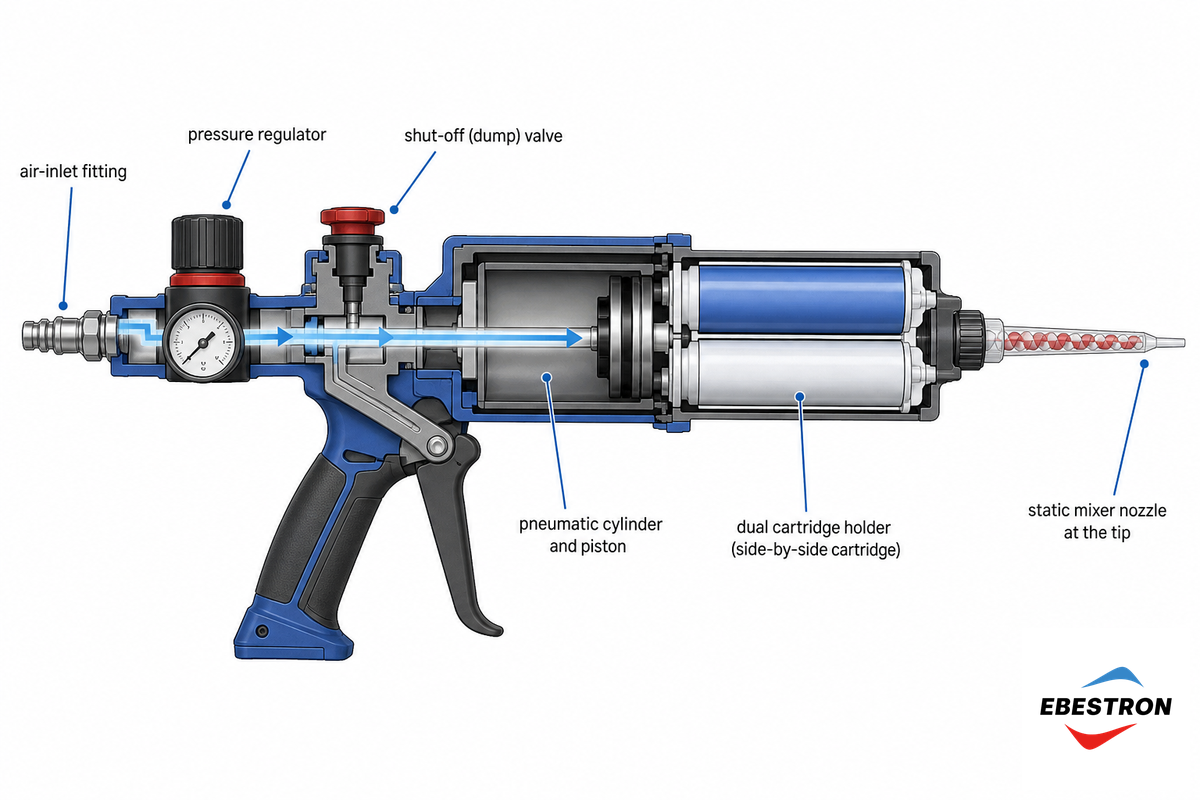
A pneumatic cartridge dispensing gun is a manually held applicator tool that uses compressed shop air rather than an electrical power source or hand-operated trigger to operate the plungers on both sides of a two-component adhesive cartridge and apply the material at a constant ratio through a static mixer.
This compressed air serves as the manual force replacement for better consistency and application control. For this reason, pneumatic cartridge dispensing guns are prevalent in shops applying adhesives in high volume or where the material is too stiff to apply with hand power. Some markets still call this category a pneumatic caulking gun, though that label blurs an important distinction covered by ISO 4414:2010’s general safety rules for pneumatic fluid power systems: a single-component caulk gun has no way to hold two parts on-ratio, while a 2K cartridge gun’s whole job is metering both sides together. Ebestron builds its pneumatic guns, dual cartridges, and static mixers in-house under one CE/RoHS-compliant quality system rather than sourcing the three separately, which is the reason the fitment between them is guaranteed rather than assumed.
This buying guide assumes that you’ve already made the decision whether a pneumatic cartridge dispensing gun is right for your shop, with detailed information on the pneumatic system versus hand-driven and battery-powered epoxy guns covered in our Comparison of Pneumatic vs. Hand-Powered vs. Battery-Powered guide and The 3-Drive Epoxy Gun Buying Guide. Here, we answer the remaining, practical questions about using your existing Ebestron pneumatic cartridge dispensing gun, including what it truly needs in terms of air, how to correctly install the air supply line, what maintenance is needed for long-term reliable operation, and how to distinguish between an air-system fault and a problem with the gun.
How Pneumatic Cartridge Guns Work: Regulator, Shut-Off Valve & Thrust
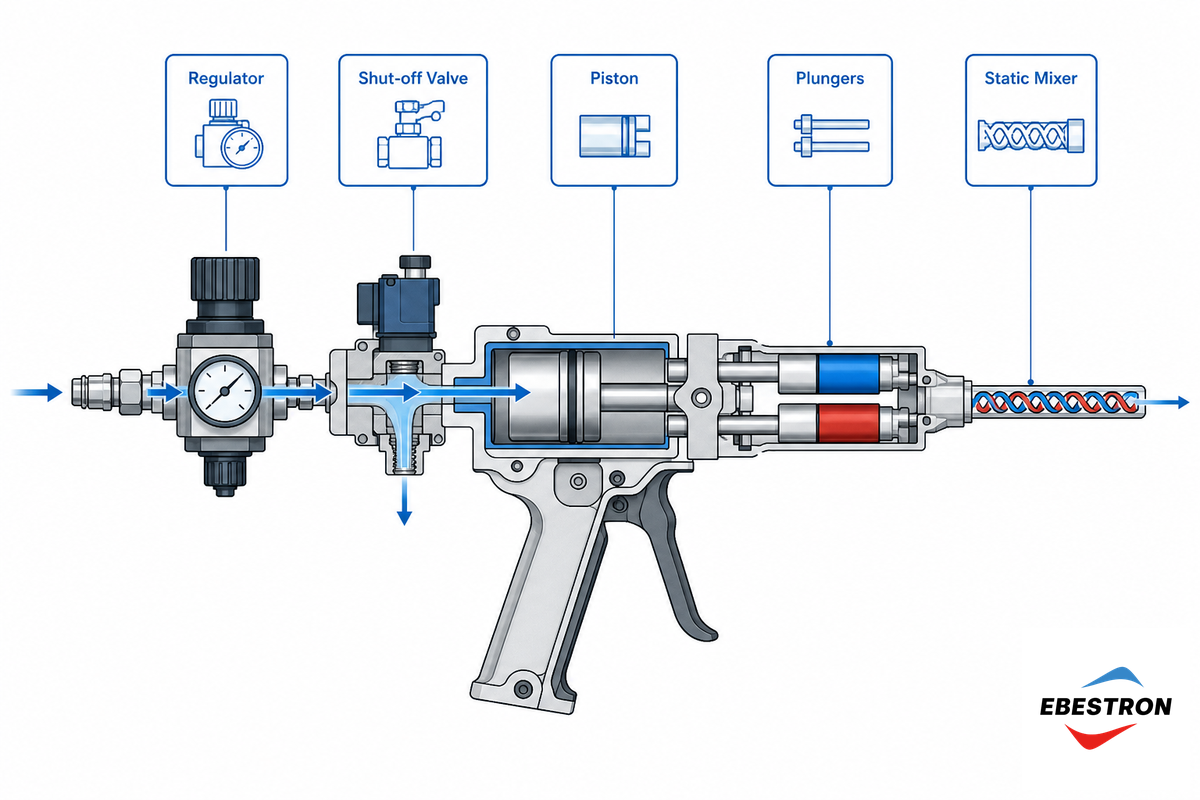
Air gets into the gun via a fitting, moves through an adjustable regulator for control of working pressure, then through a shut-off (air dump) valve into a cylinder where it acts on a piston, pushing both cartridge plungers forward together (in the ratio built into the plunger set).
Without that shutoff valve (placed between regulator and piston) remaining line pressure would keep shoving the plunger for a beat or two after the operator released the trigger. This would lead to a drip, or a drawn-out blob at the end of a bead. Miss this distinction on the shop floor and the failure mode is easy to misdiagnose: a bead that’s weak or inconsistent gets blamed on a bad batch of cartridges, cartridges get swapped for weeks, and the actual cause — a regulator that’s crept out of calibration — never gets touched.
This isn’t an engineering coincidence — it’s patented. US Patent 9,862,001 B2, of Sulzer Mixpac/Medmix, details a constant velocity dispense drive mechanism which includes the same temporary plunger withdrawal upon release of the trigger mechanism as is found in virtually any 2K gun on the market for prevention of drips.
📐 Engineering Note
Regulator pressure and thrust ratio (they’re two separate numbers but both important.) The former is the air pressure pushing through – the regulators commonly used with hand-held 2K dispensing guns read out 80-100 psi (5.5-6.9 bar), and 120 psi (8.3 bar) seems about the top of the effective range – while the latter, fixed in the mechanism of the dispensing gun itself, is what amplifies that pressure at the plunger. The 18:1 thrust ratio dispensing gun on a 90psi regulated air supply puts out far less actual force on the plunger tip than a 26:1 unit at the same pressure. Pumping regulator pressure above the rated limits of the mixer and cartridge doesn’t make it faster. It makes it more likely you split the cartridge or blow the mixer seal.
Sizing Your Air Compressor: CFM, Tank Size & Duty Cycle
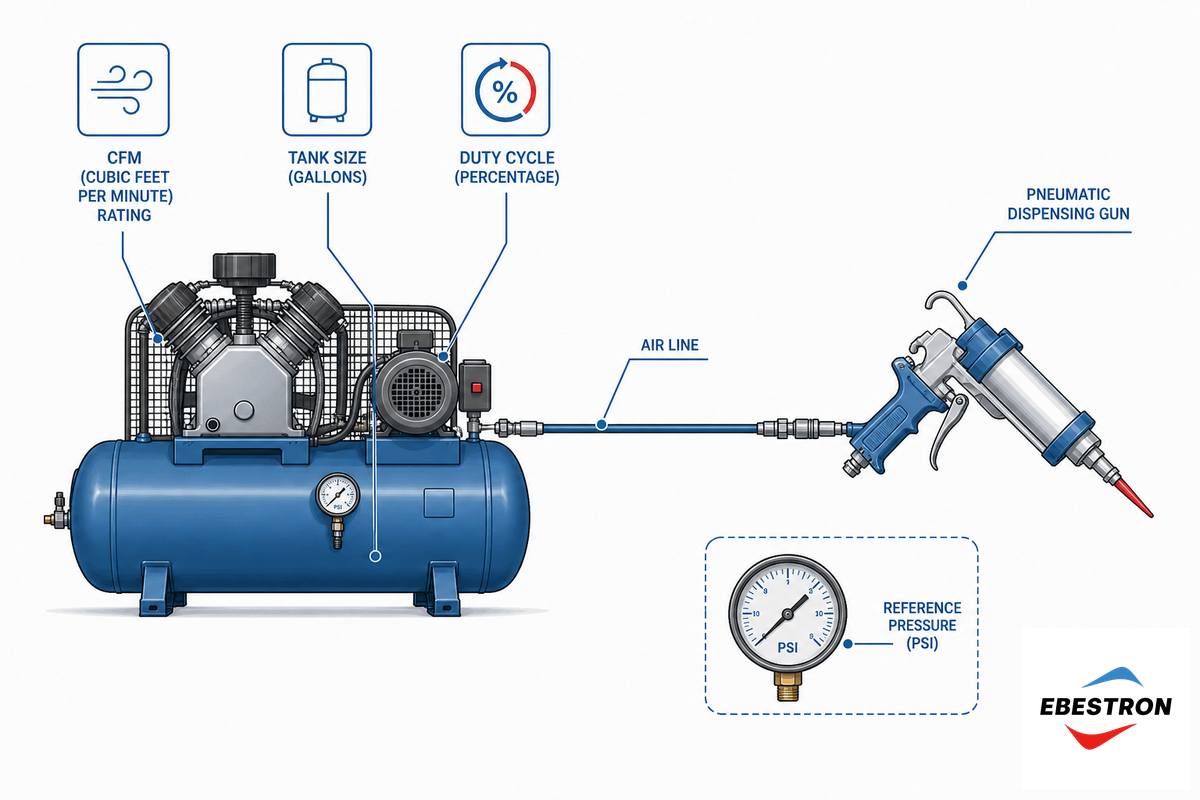
Here’s a fact that very few purchasers expect: Not one of the cartridge-gun makers ever prints a CFM value for its pneumatic dispensing guns-unlike an impact wrench or a die grinder which shows you its rating. A dispensing gun isn’t a continuous-flow tool — air usage occurs in tiny increments in the microsecond it take the plunger to cycle forward in each shot, and you have to calculate the true demand by yourself from its cylinder’s displacement and your shot frequency rather than the name plate.
Sources in the industry describe the underlying calculation as a standard pneumatic-cylinder air-consumption formula: SCFM = 2 × (piston area × stroke length) × cycles per minute × compression factor, divided by 1,728 cubic inches per cubic foot, where the compression factor is (line pressure + 14.7) ÷ 14.7. An example commonly cited in pneumatics engineering references shows that a 2-inch bore by 4-inch stroke cylinder, cycling at 30 times a minute at 80 psi, requires about 2.81 SCFM of free air. Although the cartridge gun’s piston is much smaller, the same basic math applies, so by plugging in your own gun’s actual bore and stroke figures (from its datasheet) and your real shots-per-minute, you can derive your own genuine usage number instead of guessing.
| Application type | Daily volume | Duty cycle | Recommended compressor | Tank sizing rule of thumb |
|---|---|---|---|---|
| Lab / prototype bench | Under 10 cartridges | Sporadic | Small single-stage (1.5-2 HP class) | ~1 gallon of tank per CFM of compressor output |
| Light production bench | 10-30 cartridges | Intermittent | Small single-stage (2-3 HP class) | ~1 gallon per CFM |
| Medium production bench | 30-100 cartridges | Steady, single line | Mid single-stage (5 HP class) | ~2 gallons per CFM for smoother regulation |
| Heavy single-gun production | 100+ cartridges | Continuous, single station | 5-7.5 HP single-stage or small two-stage | ~2-3 gallons per CFM |
| Multi-gun cell (2 guns) | 150-250 cartridges combined | Continuous, shared line | Shared compressor sized to combined SCFM plus headroom | ~2-3 gallons per CFM |
| Multi-gun cell (3-4 guns) | 300+ cartridges combined | Continuous, multi-station | Dedicated shop compressor with individual drops | Up to 3 gallons per CFM (DOE guidance) to buffer simultaneous demand |
| Automotive panel bonding line | High, structural adhesive | Continuous, line-paced | Mid-to-large single-stage sized to line takt time | ~2-3 gallons per CFM |
| Electronics potting bench | Low-to-medium, precise dosing | Intermittent, precision-critical | Small single-stage with tight regulation, oil-free preferred | ~1-2 gallons per CFM |
| Construction anchoring, shop/field | Variable, high-viscosity anchor resin | Intermittent, portable | Portable single-stage matched to jobsite power | ~1-2 gallons per CFM |
If you were running one gun at 2.8 average SCFM, and only intermittently dispensing air rather than continuously running at 2.8 SCFM, a small single stage compressor, maybe rated 4-5 SCFM at 90 psi, with a modest air tank would suffice – its only role being to catch up between shots rather than run continuously at 2.8 SCFM. If you add another gun to the same supply line, then you need to assume something more like twice that average air delivery – which usually indicates that you should up your compressor size a step rather than trying to run two guns at near a single small compressor’s limits.
⚠️ Important — Bigger Is Not Automatically Safer
Many are tempted to simply buy the biggest unit the budget will allow “just to be safe.” But if you ask the people who conduct audits on compressed-air systems in many plants, over-sizing is a real and common and costly problem. Purchasing a 50 HP unit where a 25 HP unit would easily suffice may be costing you thousands of dollars a year in electricity since a larger compressor draws more energy across the entire operating spectrum. The key to compressor selection is SCFM, operating cycle, and perhaps adding an additional air receiver or variable frequency drive for the occasional demand, not oversizing to the point that energy dollars go to waste — this exact sizing-and-oversizing tradeoff is what the U.S. Department of Energy’s compressed-air system sourcebook walks plants through in far more depth than any single gun vendor’s spec sheet will.
“Many manufacturers believe it’s a good idea to oversize their air compressor… It rarely pays off. If your demand is highly variable, a variable-speed drive can reduce energy costs by ramping down motor speed when demand is low — but even then, it usually doesn’t make sense to buy a compressor sized for peak demand you rarely see.”
— Brad Taylor, Fluid-Aire Dynamics
Setting Up the Air Line: Filter, Regulator, Lubricator & Moisture Trap
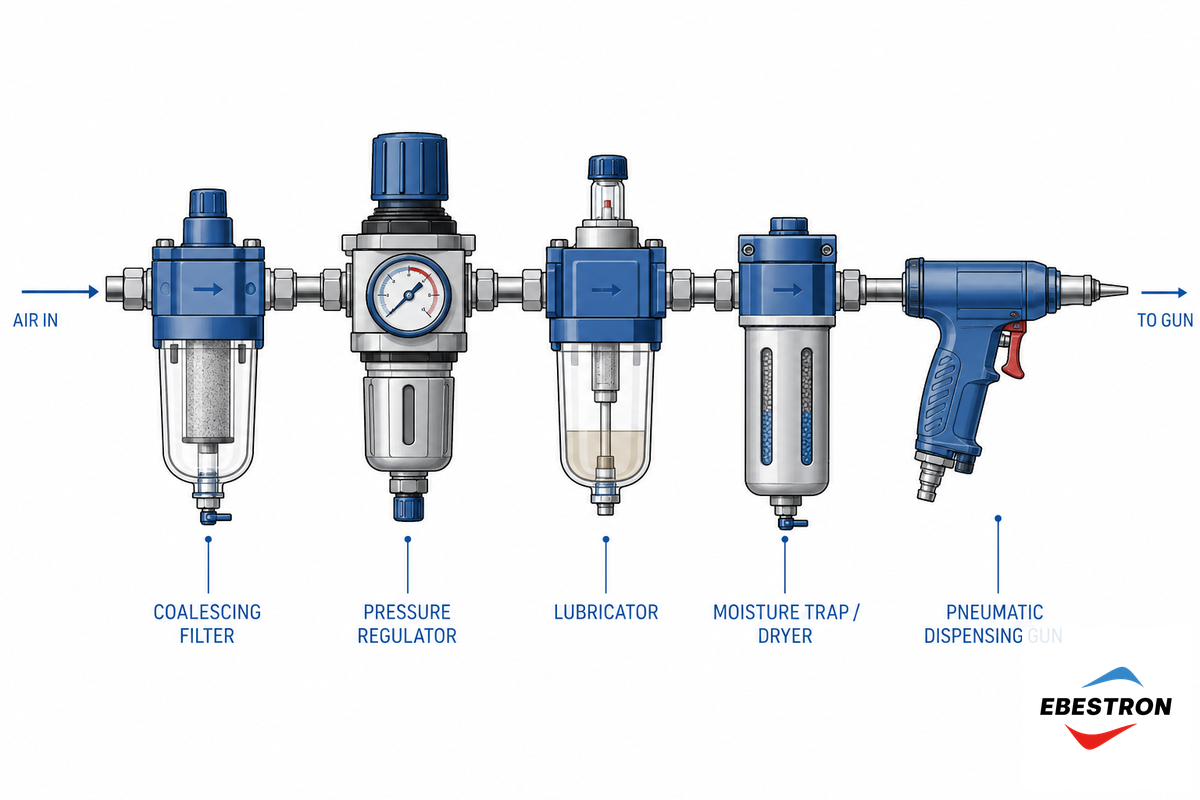
Even the compressor itself is only part of the story. What goes on between the air receiver and the gun-the line set, the filters, the regulators-can and does make the air that hit your piston clean and dry at the pressure you demand, or dirty and wet, causing silent wear on the regulator seats and on the shutoff valve stems. Mounting the filter-regulator-lubricator assembly as close to the gun as the workstation layout allows, and connecting the gun itself through a quick-connect adapter rather than a permanent fitting, also makes it far faster to swap a second air-powered gun onto the same drop when a line is shared.
| Component | What it does | If you skip it |
|---|---|---|
| Coalescing filter | Strips particulate and bulk moisture from the line | Grit accelerates regulator seat and O-ring wear |
| Regulator | Sets and holds working pressure independent of upstream fluctuation | Pressure drifts with compressor cycling, bead thickness varies shot to shot |
| Moisture trap / dryer | Removes condensed water before it reaches the gun | Moisture corrodes internal valve components and can push into the cartridge interface |
| Lubricator (if gun spec calls for it) | Adds a fine oil mist to reduce internal friction and seal wear | Faster wear on the piston seal in guns designed to run lubricated |
The greatest villain here’s moisture, and the fact that it’s such a quiet one. Moisture typically doesn’t cause immediate noticeable leaks; it can manifest weeks later as a sticky regulator, an corroded valve seat, or an unexplained lack of consistency from shot to shot. Also, the increased pressure loss caused by a partially wet airline often looks just like the symptoms of an undersized compressor-another reason it’s so difficult to know if it’s your gun or your air supply that’s causing problems (see the Troubleshooting Guide, later).
💡 Pro Tip
Filter differential pressure gauges are normally calibrated at rated flow.
It is very easy for a partially plugged air filter to show minimal restriction at low flow, but then cut off air supply the moment demand goes up, so these should be checked regularly based on usage hours, not just gauge readings.
For those who regularly open an air line (blowing out a fitting, cleaning out a connection with the air gun) keep in mind that OSHA has a regulation for the use of compressed air in the cleaning of equipment (29 CFR 1910.242(b)) that restricts use to under 30 psi when such usage involves chip guarding and personal protective equipment; this rule is distinct from the rules governing the classification of hazardous locations often cited by manufacturers’ guidelines for motor selection.
Maintenance Schedule: Seals, Trigger Valve & Regulator Calibration
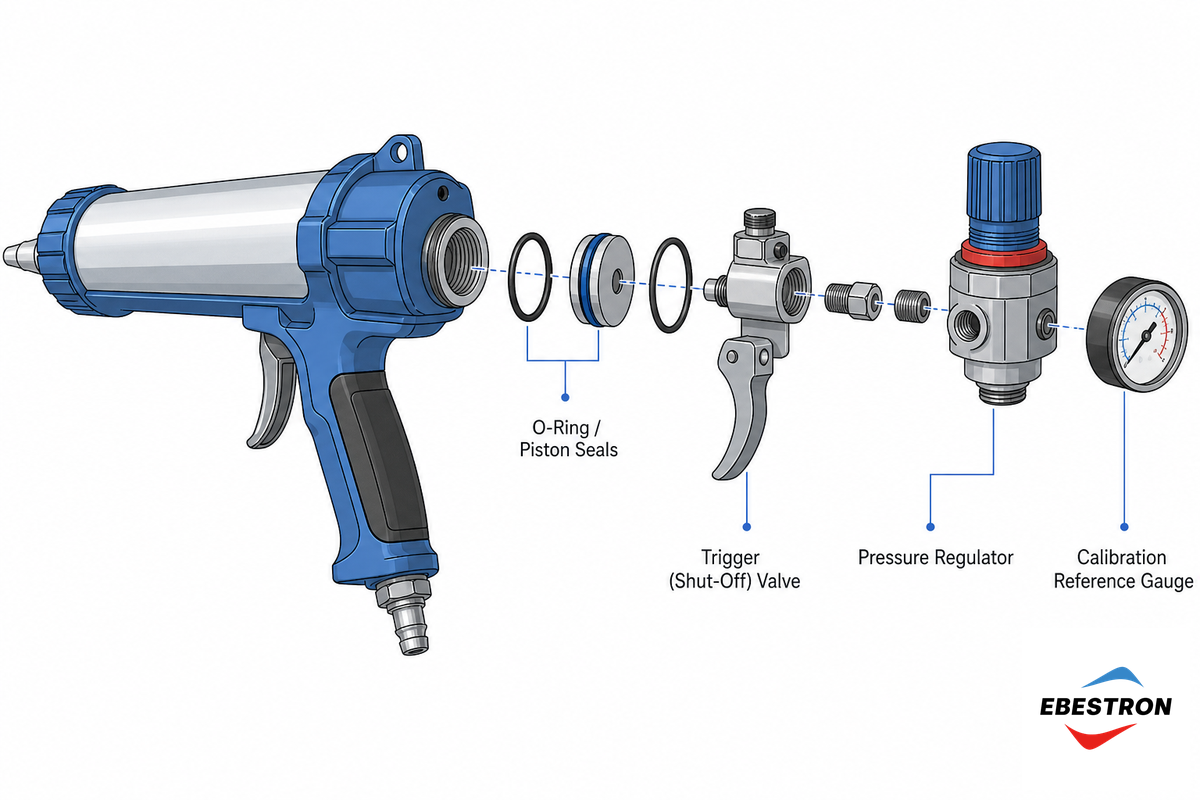
No cartridge-gun-specific maintenance-interval standard exists that has been published by any standards body — the intervals below are derived from common pneumatic-tool and compressed-air-system maintenance procedures and aren’t from a manual specifically intended for adhesive dispensing guns. The closest thing to a governing document is ISO 4414:2010, Pneumatic Fluid Power — General Rules and Safety Requirements, which sets the general upkeep and inspection expectations for pneumatic systems without naming this specific tool category. Regard the schedule below as a basic check list to customize to your operational parameters, not as a rigid factory spec.
| Item | Typical interval | What to check |
|---|---|---|
| Wipe-down & visual check | Every shift / after every job | Adhesive residue on plunger and trigger mechanism |
| Filter/regulator inspection | Quarterly (roughly 3 months) | Differential pressure, moisture in bowl, regulator drift from set point |
| O-ring / seal replacement | 3-6 months | Piston seal wear, air leakage past the seal |
| Shaft/oil seal (if applicable) | 6-12 months | Replace sooner at first sign of leakage |
| Full thorough service | Annual | Regulator calibration against a reference gauge, full valve inspection |
If the bead on your gun has been wandering from the original setting when commissioning it, a poorly set regulator is one of the most common-and often-overlooked-culprits. Best to check the regulator setting against a calibrated reference gauge before suspecting either the gun or the cartridge is malfunctioning. Most O-ring and seal work needs only partial disassembly of the gun body — pull the trigger-valve assembly, swap the worn parts, and reassemble; it rarely calls for a full repair-shop teardown or sending the gun back to your supplier for service.
Troubleshooting Pneumatic-Specific Problems: Is It the Air, or the Gun?
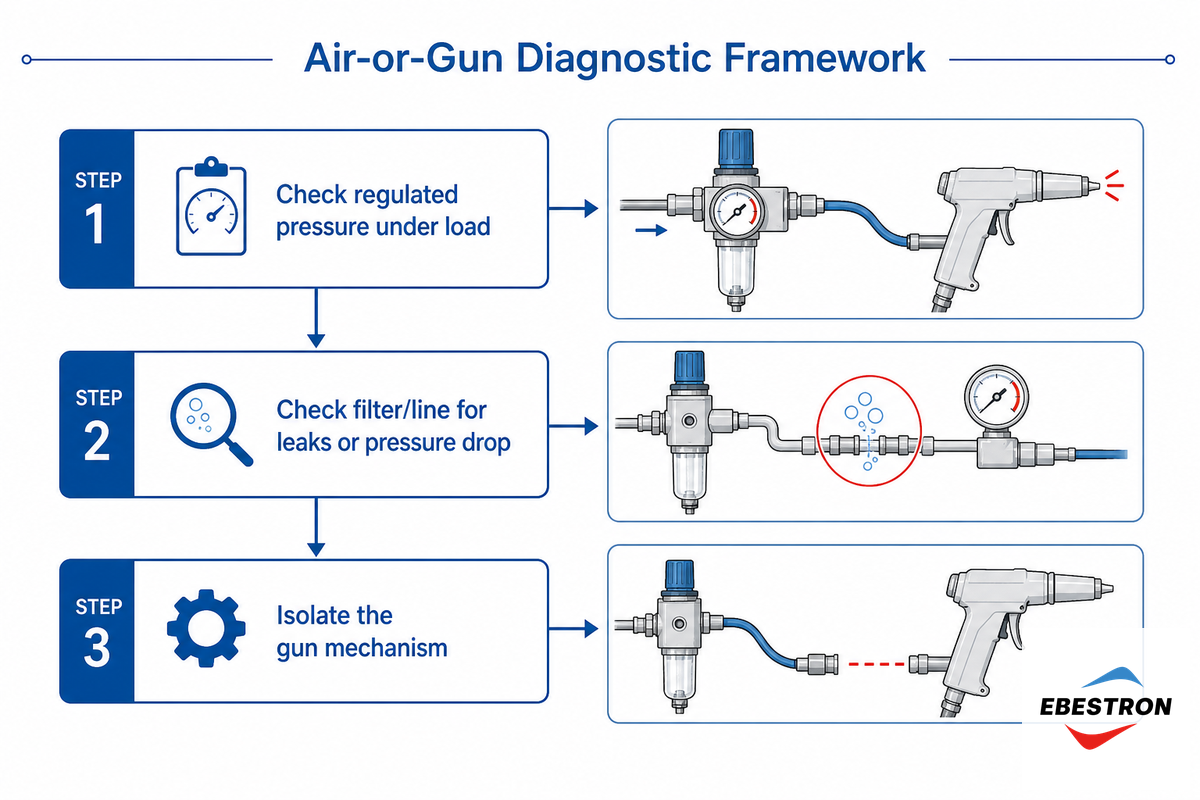
When your pneumatic cartridge gun begins to act up, it’s a natural impulse to assume either the gun or the cartridge is the problem. Quite frequently the culprit lies farther up the supply line in the air delivery system — and the fix vary significantly depending on where the air-side malfunction is located. Before reaching for the tool kit, use the 3-Point Air or Gun Diagnostic Framework below.
The 3-Point Air or Gun Diagnostic Framework
The 3 checks that can separate an air-supply problem from a gun/cartridge issue — load-bearing air line pressure, behavior of the shut-off valve as the trigger is released, and condition of filter and air/moisture separation equipment – should all be conducted on the air-supply system before you open the gun.
| Symptom | Check this first (air side) | If air checks out (gun/cartridge side) |
|---|---|---|
| Bead thins out mid-cartridge | Line pressure at the gun under load — pressure drop from a restricted filter or undersized line | Worn piston seal losing thrust |
| Gun won’t dispense at all | Compressor actually running, regulator not backed off to zero, line not kinked/disconnected | Blocked or hardened static mixer (not an air problem — see our gun- and cartridge-side dispensing problems guide) |
| Drips after trigger release | Shut-off/air-dump valve holding residual pressure | Worn anti-drip mechanism inside the gun body |
| Bead inconsistent across a shift, no clear pattern | Moisture in the line, filter differential creeping up unnoticed | Regulator drifted out of calibration |
Consistent with field reports concerning pneumatic caulk and cartridge guns, we’ve observed a comparison of two supposedly identical guns, in one case the travel of the plunger per squeeze of the trigger on one gun being only half that of the other gun, this difference being attributed to a disparity in thrust and regulator pressures rather than a defect in the gun mechanism itself. When force output from what should be two identical setups appears inconsistent, examine the air side first to determine whether or not you’ve a mechanical problem.
Where Pneumatic Still Wins: Duty Cycle, Viscosity & Hazardous-Area Facilities

Assuming that you’re familiar with the principles of the pneumatic air-system system discussed previously, you might ask whether it’s worth staying on pneumatic or migrating to a battery-powered gun. There are two conditions under which it definitely makes sense to continue using your pneumatic system.
One such condition is the facility class of the workplace. Hazardous locations (as classified by 29 CFR 1910.307) are subject to special restrictions on the use of electrical apparatus, including standard battery-powered equipment, unless such equipment is approved as being intrinsically safe or explosion-proof for use in such locations. The pneumatic system avoid these restrictions altogether by using a standard compressed-air supply and an on-board gun without its own motor and battery system; accordingly, use of a pneumatic gun is dictated by facility compliance rather than personal preference. Getting this decision wrong has a real cost either direction: a facility that standardizes on battery-electric guns inside a classified paint-mixing or solvent area can fail a safety inspection outright under 29 CFR 1910.307, while over-committing an entire mobile field crew to compressed air just adds an idle compressor no one uses to the capital budget.
The second factor favoring continuing with the pneumatic systems is duty cycle. High and sustained volume applications in fixed workstations such as assembly line work that are serviced by properly sized compressors and air lines are well within the capacity of the pneumatic systems; they don’t require the hassle of recharging or replacing batteries and they allow continuous operation from a compressed-air source at the end of a hose. For remote field applications that don’t include compressed air, a battery-electric 2K gun clearly is preferable — worth noting that some buyers searching for a cordless caulking gun or electric caulking gun are actually after this same battery-electric 2K category and haven’t realized their single-component caulk tool won’t hold a two-part ratio — but see our full manual vs pneumatic vs battery-electric comparison for reference if you still need to select a power system.
Ready to spec the system, not just the gun?
The pneumatic cartridge dispensing guns manufactured by Ebestron are engineered to work in concert with a suitable compressor system, across 50-600 mL cartridges and 1:1, 2:1, and 10:1 ratios.
The Real Cost of Running a Pneumatic Gun: A Worked Air-Consumption Example

We call compressed air “the fourth utility” – and for good reason, as according to industry sources, energy accounts for about 80% of the total cost of owning a compressed-air system. A good chunk of this energy is wasted as heat during the compression cycle, rather than used to perform work on the tool. So, the price tag on a gun is a mere blip on the radar in comparison. Consider a shop that never runs this math: production stays flat but the energy bill keeps climbing, and with no compressor-runtime log there’s no way to tell a well-tuned system from a leaking one — if the unit is cycling through roughly 30% of the shift with no gun actually dispensing — in line with industry estimates that leaks alone account for about 30% of compressed-air waste in an average shop — that’s the signature of an undetected leak or a stuck-open valve somewhere in the line, not the cartridges themselves — exactly the failure mode the DOE’s own compressed-air-system guidance flags as the single biggest source of wasted generation capacity in a plant.
Historically, the U.S. Department of Energy has referenced compressed-air generation costs of 15 to 30 cents per 1,000 cubic feet where a facility’s own cost is unknown; with current electricity rates, industry sources place many systems in the 25-35 cent range. A published DOE/ENERGY STAR cost-per-CFM calculation illustrates how a facility can derive its own figure: annual energy cost (motor horsepower × 0.746 × operating hours × electricity rate ÷ motor efficiency) divided by annual air volume in thousand cubic feet. Worked through with a 100 HP compressor running 4,000 hours a year at $0.10/kWh and 92% motor efficiency, delivering 450 CFM, the result comes out to roughly $0.30 per 1,000 cubic feet.
📐 Worked Example — Cost Per Cartridge
Consider that 2.81 SCFM cylinder-consumption example from the compressor-sizing chapter above, a $0.30 per 1,000 cubic feet facility air-cost rate, and a cartridge that cycles every 20 seconds to dispense to a fully loaded 400 ml cartridge: This is around 0.9 to 1.0 cubic feet of free air used per cartridge. This represents just fractions of a cent of air cost per cartridge. Why goes that unrecognized? The main cost driver for air isn’t per cartridge usage, but rather the wasteful background operations from a leaky, unregulated, and oversized system that runs all day every day-which is what that 80% of lifetime cost refers to. So if you’re shopping listings of pneumatic cartridge dispensing guns for sale and comparing them purely on the sticker price of the tool, you’re benchmarking the smallest line item in the whole equation.
Industry Outlook: Why Air-System Design Still Matters as Battery-Electric Grows
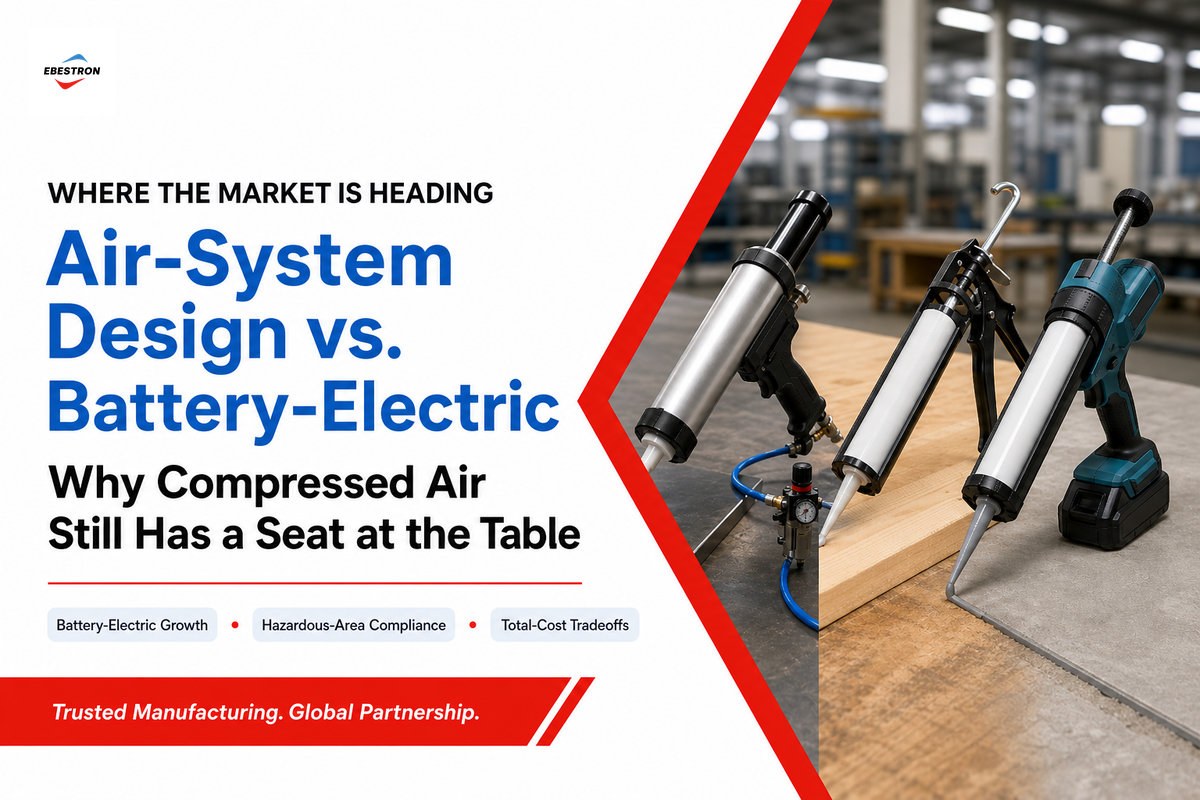
By far the biggest trend we’re seeing in two-component dispensing equipment is the move toward battery-electric guns – and for the right reasons (ergonomics, reliable bead delivery) not necessarily just novelty; we explore this transition more thoroughly in our 3-drive epoxy gun buyer’s guide. That said, this doesn’t mean that the pneumatic infrastructure is a dead-end street. The facility’s hazard classification and duty cycle, and not the newest type of drive, determines your destiny; a hazardous location class site will preclude standard battery-operated devices in the context of 29 CFR 1910.307 no matter what’s happening broadly in the rest of the world, and a stationary high-volume application gets more true bang for the buck from an adequately sized compressor and airline than from charging a succession of batteries. The adhesive’s dispensing equipment, to provide some market perspective alone, is believed to represent an overall industry market estimated around $13 billion in 2025 and trending toward low-$20 billions in mid-2030s-and not in a vacuum, but this is an explanation for this background. Facilities that pick a drive based on which trend is loudest, rather than on these two variables, tend to find out the hard way — often after the battery-electric units are already on order — that half the bench sits in a classified area where compressed air was never optional under 29 CFR 1910.307 in the first place — a compliance fact no market-growth report will flag for you.
Here’s the bottom line takeaway if you’re ordering new gear for 2026: don’t allow the convenience of “the battery is available now” to override proper air-system design for any pneumatic line that you plan to keep. Properly sizing a compressor, real FRL components, and following a maintenance routine are what provide a pneumatic gun the consistent shift-to-shift operation the buyers you want to attract when they move to battery are seeking in the first place.
Frequently Asked Questions
Q: Do I need a special air compressor for a pneumatic cartridge dispensing gun?
View Answer
A pneumatic cartridge dispensing gun does not need a specialty compressor, but it does need one correctly sized to the gun’s actual cycle-by-cycle air demand rather than to a nameplate CFM figure, since manufacturers do not publish CFM ratings for this tool category. Size the unit to your cylinder displacement, cycle rate, and regulated pressure.
Not necessarily a “specialty” compressor, but a correctly sized one. A pneumatic cartridge dispensing gun operates only during each dispensing cycle and doesn’t pull air continuously; its actual demand has to be calculated based on the gun’s cylinder displacement, rate of cycles, and your regulated pressure (likely just a few SCFM average on most cartridge sizes), not read from the nameplate, since cartridge-gun manufacturers do not publish standard CFM ratings for this tool category. A small single-stage compressor with an adequately sized tank will do a decent job for one-gun benches, and then add more compressor capacity to support additional guns and higher usage patterns.