Get in touch with Ebestron Company


Updated July 2026 · Reviewed by the Shanghai Ebestron New Materials Co., Ltd. technical team
Quick Specs
| Common battery platforms | 18V / 20V Li-ion (brand-specific, not cross-compatible) |
| Cartridge sizes | 50ml, 200ml, 400ml, 600ml (also 2–32 oz) |
| Mix ratios | 1:1, 2:1, 4:1, 10:1 |
| Motor type | Brushed (entry) or brushless (higher-duty) |
| Key 2027 compliance date | EU Battery Regulation (EU) 2023/1542, Art. 11 — removable/replaceable portable batteries from 18 Feb 2027 |
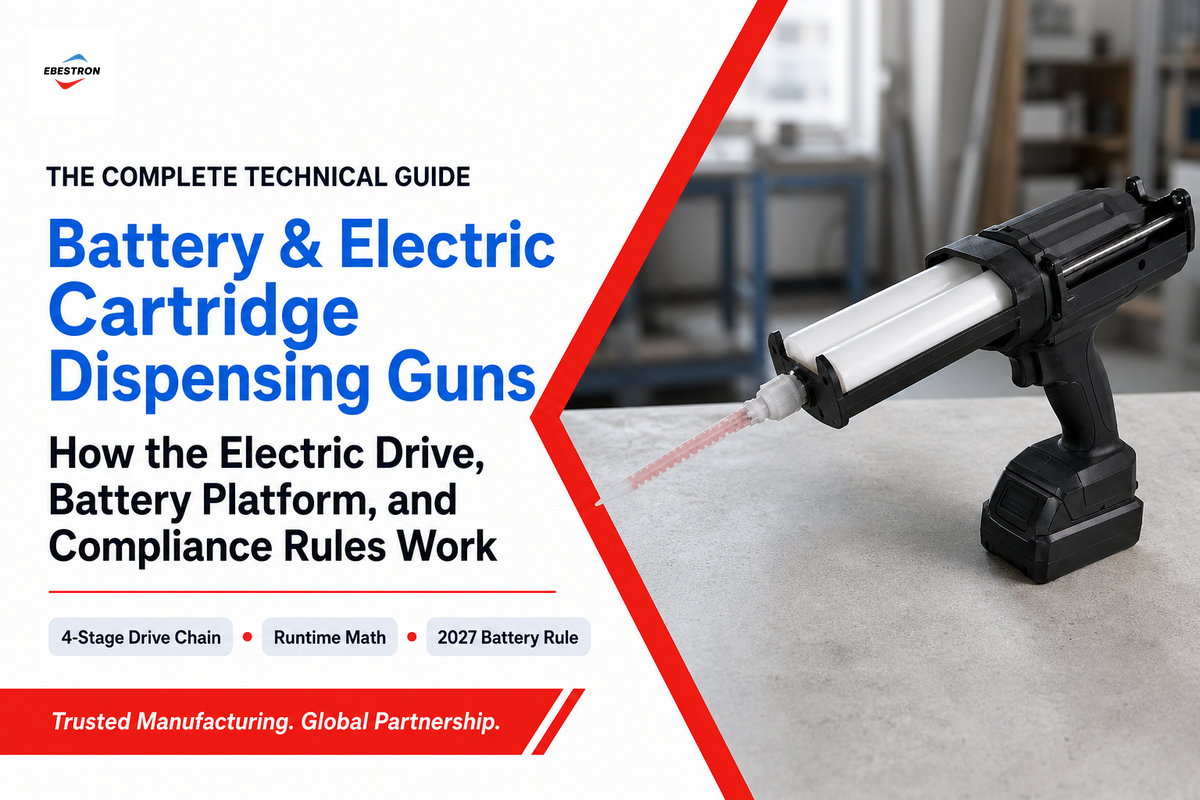
A battery dispensing gun is a cordless power tool that drives a motor and gearbox by means of a rechargeable battery to force-mix adhesive at a specified ratio out of a dual-barrel cartridge. This isn’t a buyer’s guide comparing manual, pneumatic, and battery guns, Ebestron’s Epoxy Gun Buyer Guide already covers that decision in depth. This article instead go deep on what makes the electric drive itself different: the motor-gearbox force chain, battery platforms, trigger electronics, runtime math, battery care, battery-specific failure modes, and the compliance rules, including a new EU regulation, that apply specifically to a battery-powered dispensing tool and nowhere else in Ebestron’s blog.
Put another way: a battery cartridge gun has a motor, gearbox and lead screw in place of a hand-driven ratcheting mechanism and a trigger that acts as an on/off switch with variable speed for the motor rather than an increase of brute force. This single difference explains ratio accuracy, how to run the math on your runtime, care and maintenance requirements of the battery pack, battery specific failure conditions and compliance with new rules-in short, the real technical story beyond standard gun mechanics detailed in our guides to hand driven cartridge application.
Key Points
- Battery packs are very rarely cross-compatible brand to brand, this is an intended design choice, not a market gap.
- A new EU regulation ((EU) 2023/1542) requires removable/replaceable batteries on portable tools starting 18 February 2027.
- Electronically controlled variable-speed trigger control, not raw thrust, is what keeps ratio consistent on a battery gun under load.
- Cold cartridges and cold battery packs are two separate, additive problems for winter dispensing.
The Electric Drive Chain: Motor, Gearbox, and Lead Screw
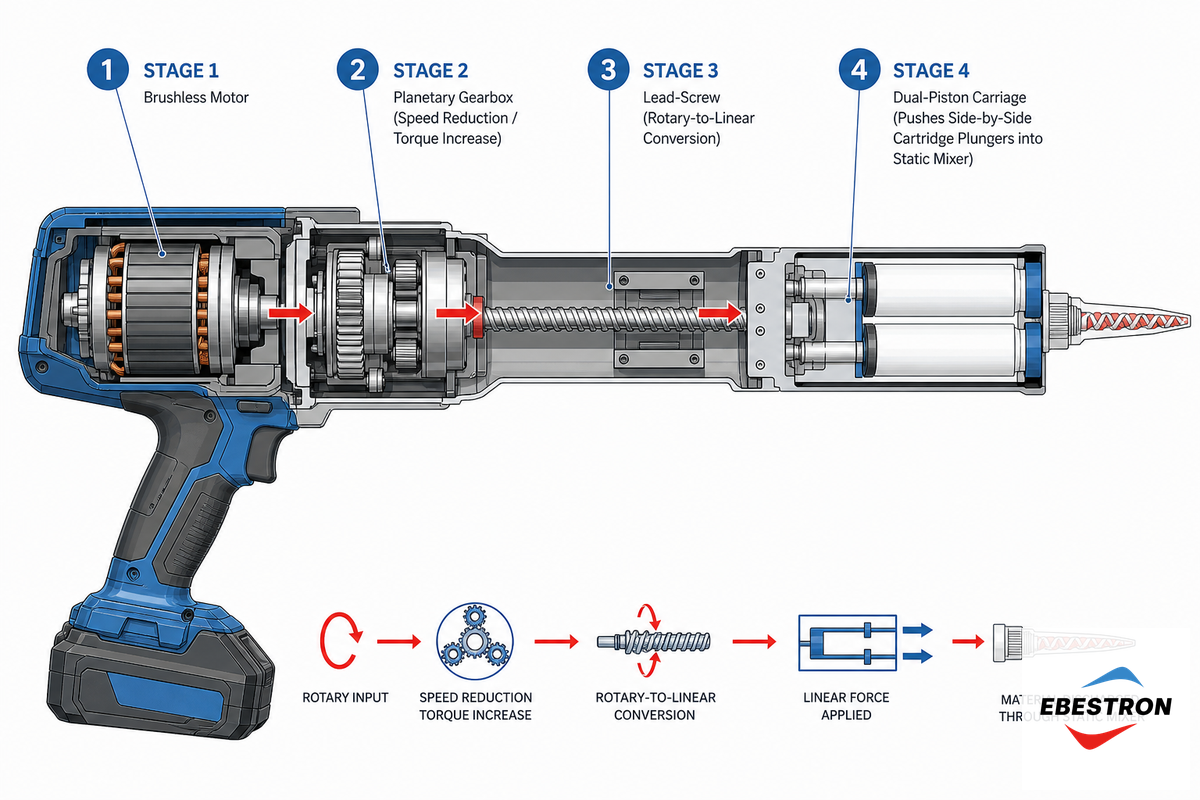
4 Stage Electric Drive Chain
In a motor-driven applicator, adhesive is moved in four linked mechanical stages: rotation, gearing, linear motion, and applied force at the tip.
This force transmission chain explains what’s going on when you pull the trigger on a battery-powered dispensing gun: the motor (a brush or brush less design) turns. A gearbox, usually a planetary type, reduces speed and increases torque. A lead screw (or sometimes a ball screw) converts rotary motion into a linear force. That force is applied by the plunger through the cartridge at the specified ratio. This is fundamentally different from the ratchet-and-pawl mechanism used in manual guns, which Ebestron’s own dispensing gun troubleshooting guide already covers in detail for hand-driven mechanisms.
The motor-driven cartridge chain described above isn’t theoretical but present in actual patents issued for these devices. Medmix Switzerland AG ( formerly Sulzer Mixpac AG the manufacturer of the Cox and MK dispenser dispensing tools ) is holder of US Patent 9,862,001 for a dispensing device including a motor and an electronic feedback controller that detects the motor’s power and varies the motor voltage to maintain constant dispensing speed. Techtronic Cordless GP (the group behind Milwaukee and Ryobi) separately filed patent AU2024205719A1 in August 2023 for a motor-operated dispensing device for gels, glues, caulks, and sealants, evidence that major cordless-tool makers are actively engineering this exact mechanism, not treating it as a minor accessory.
📐 Engineering Note
Gearbox reduction is what lets a small, efficient motor produce enough force to push viscous adhesive. A typical cordless dispensing gearbox reduces motor speed by roughly 100:1 to 300:1, the exact ratio is set by the manufacturer to match expected adhesive viscosity, not user-adjustable, which is why swapping to a thicker adhesive without checking the gun’s rated viscosity range can stall the motor rather than simply dispense slower.
Users who have operated both kinds of motors generally will concede this one truth: at the same size tool, a brushless motor make more usable power than a brushed of the same classification, by having no brush contact resistance or heat loss, a fact confirmed everywhere within the cordless-tool discussion group, not merely on brushless advertising sheets. This tradeoff, which is significant, translates here as the brushless-drive dispensing gun holds its torque much better, as a thick cartridge run empty, while a brushed motor will often bog down.
Main lesson to remember – the electric drive chain sacrifices the mechanical ratio for the electron-controlled velocity – which is the precise reason why the next two sections, about battery platforms and the trigger control are of higher importance in an electric gun than in a manual gun.
Battery Platforms: Why Brands Don’t Mix

It’s tempting to assume any 18V or 20V battery fits any cordless dispensing gun. It doesn’t. The Power Tool Institute, the U.S. trade association for power tool manufacturers, states plainly that batteries are typically not interchangeable from brand to brand unless the manufacturer specifically design for it. Cox™’s own MK-series 2-component dispensers, for example, deliberately run on 18V lithium-ion batteries from the Bosch Professional platform — that Cox battery arrangement is a manufacturer choice, not evidence that cordless dispensing batteries are a universal standard.
✔ Shared-Platform Advantages
- Shared device on same platform (for one battery/charger)
- Established Platforms – Wide availability for parts. Bosch Professional and Milwaukee M18.
⚠ Locked-Platform Limitations
- You can’t borrow a battery from another brand’s tool if yours dies while working on-site.
- If changing brands, starting fresh from scratch with a battery ecosystem is in order
| Platform Type | Voltage | Maker | Dispensing-Gun Use |
|---|---|---|---|
| Proprietary tool-bundle | 18V | Bosch Professional | Yes — powers Cox’s MK-series |
| Proprietary tool-bundle | 22V | Hilti Nuron | Yes — powers the CD 4-22 |
| Dedicated bundled pack | 18V | Simpson Strong-Tie | Yes — bundled with the EDTA22CKT |
| General cordless-tool | 20V | DeWalt 20V MAX | Yes — DeWalt’s own caulking/adhesive gun attachments |
| General cordless-tool | 18V | Milwaukee M18 | Frequently searched by buyers; not this article’s focus |
| General cordless-tool | 18V | Makita LXT | Broad tool ecosystem (300+ tools per Makita’s own platform claims) |
| General cordless-tool | 18V | Ryobi ONE+ | Broad consumer/pro tool ecosystem |
| General cordless-tool | 18V/36V | Metabo HPT MultiVolt | Broad tool ecosystem |
| Compact consumer | 12V | Various marketplace brands | Entry-level dispensing guns |
The takeaway: when a shop standardizes on a dispensing gun brand, it’s also committing to that brand’s battery and charger ecosystem. Factor battery/charger replacement cost into the total cost of ownership, not just the gun’s sticker price.
An argument against simply buying the biggest battery available, however: larger isn’t always best with this technology in practice. cordless-tool users often report that the bigger pack adds significant weight to a device held in uncomfortable positions for minutes at a time, and the extended operating time goes unused if the daily count of cartridge doesn’t even come close to the larger pack’s rating. A better approach when dealing with hand-held, repetitive dispensing is to balance the Ah rating against a realistic day’s cartridge volume.
Variable-Speed Trigger Control and Ratio Consistency
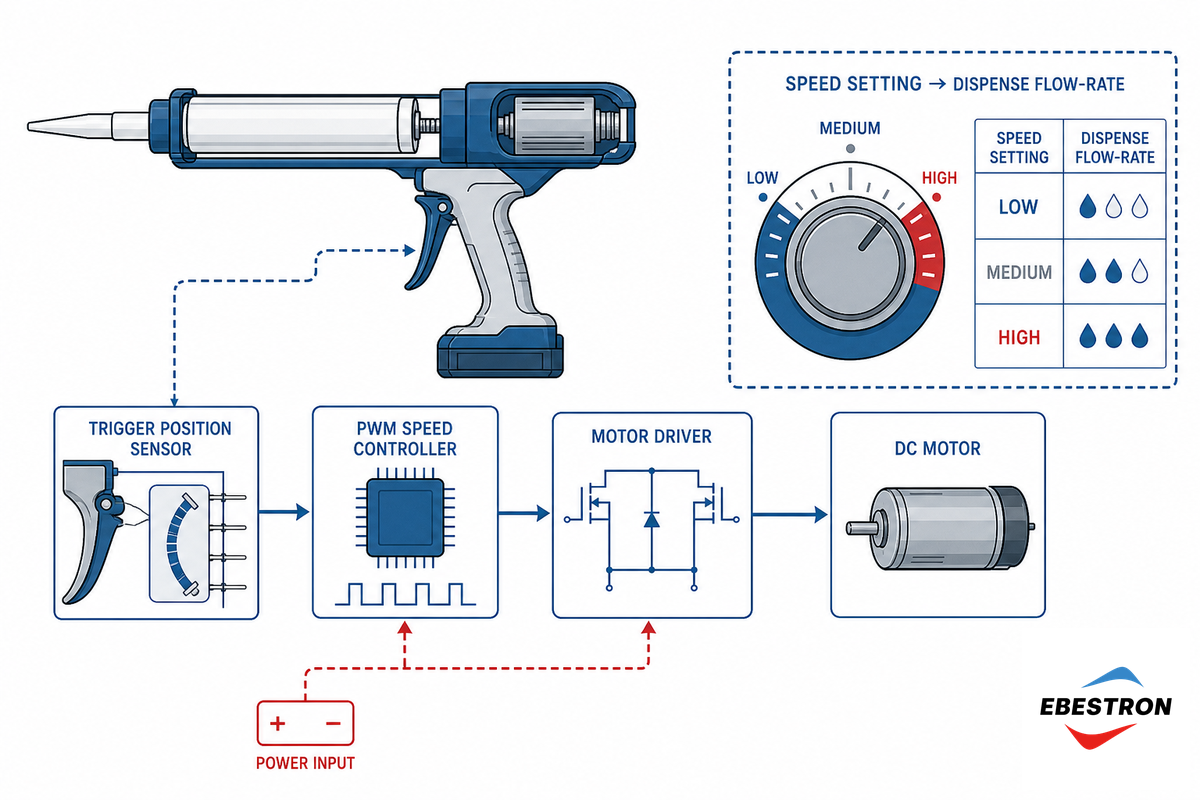
Variable-speed trigger control involves having squeeze pressure read electronically, and then interpreted as a command for the motor’s speed, instead of directly as the motor force as occurs in a manual ratchet. This is the type of implementation specified in Medmix’s US9862001B2 patent: there’s a sensor to detect the motor’s speed, and a controller to manage power delivered to the motor so as to maintain that speed, regardless of how hard the trigger is squeezed. In practice, this results in a consistent ratio of materials; because both cartridge plungers are driven at the same controlled speed rather than two hand-pumped rods, an electric gun has less inherent bias to one side of the mixture than the other compared to a hand-operated one.
Does the Mix Ratio Change as the Battery Runs Down?
No, not directly. The mix ratio is fixed by the cartridge and gun geometry — the two barrels’ relative bore sizes — not by battery voltage, so a weakening battery does not skew a 1:1, 2:1, or 10:1 ratio on its own.
What a failing battery does do is reduce available motor torque, which can slow dispensing or trigger a low-voltage shutdown mid-cartridge — an annoyance that wastes a partially used cartridge. The real failure to watch for is a shutdown that stops a single plunger stroke mid-cycle before a full purge; see battery pack safety and failure modes, below.
Runtime Math: Cartridges Per Charge and Duty-Cycle Planning
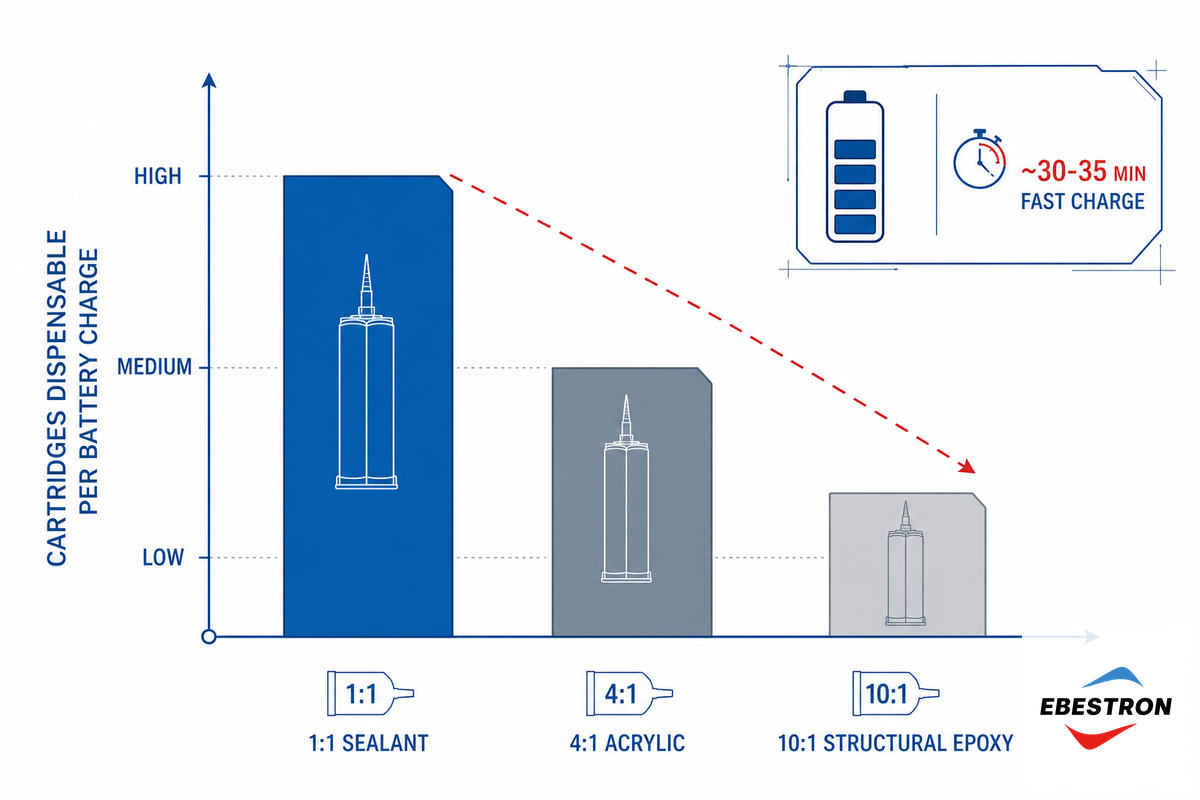
Runtime planning for a battery dispensing gun comes down to one simple relationship: battery energy (in watt-hours) divided by energy used per cartridge tells you roughly how many cartridges one charge support. As a real-world reference point, one commercially available 20V cordless dual-cartridge gun with a 2.0Ah battery is rated for up to 80 cartridges or about 240 minutes of working time per charge at approximately 18°C, that works out to roughly 3 cartridges per minute of rated working time, or about 0.5 Wh of battery energy per cartridge on that specific model (2.0Ah × 20V = 40 Wh, divided across 80 cartridges). Planning around a tool’s rated duty cycle rather than pushing it past that rating is consistent with general OSHA hand and power tool maintenance guidance, which flags tools run outside their rated operating range as a common source of premature failure.
📐 Worked Example: Estimating Cartridges Per Shift
A 2.0Ah 18V battery stores about 36 Wh (2.0Ah × 18V). If a given gun/adhesive combination uses roughly 0.3–0.5 Wh per 50 mL cartridge (based on the reference figures above), that battery could support somewhere in the range of 70–120 cartridges before needing a recharge, before accounting for viscosity, temperature, and trigger habits, all of which shift that number in either direction. Swapping to a 4.0Ah pack (the maximum capacity commonly offered on most 18V platforms) roughly doubles available energy, so plan for roughly double the cartridge count, not an exact 2×, since motor efficiency and voltage sag aren’t perfectly linear. This gives a convenient starting estimate rather than an exact figure. Larger 400 mL or 600 mL cartridges typically draw proportionally more energy per shot than 50 mL touch-up cartridges, so treat the per-cartridge Wh figure above as a small-cartridge baseline, not a fixed constant across all sizes.
Actual per-cartridge energy consumption depends on adhesive viscosity, cartridge size, and trigger speed, request duty-cycle data from your gun’s manufacturer for a production-planning estimate, rather than relying on a single reference figure.
The most practical thing to do for shift planning is to have one charged spare battery on rotation for each gun in use, and document the actual cartridges-per-charge for your specific adhesive/gun combo after the first week or so-the math cited above is a good reference for an initial estimate, but actual output will vary. Underestimating this is a common mistake that leaves crews stranded mid-shift, because a partially-charged pack near end of shift can run dry with cartridges still queued, costing 30 minutes of production delay, an expensive gap in a tight schedule. Ebestron resolves this in its own shift-planning guidance by recommending one spare pack per gun in continuous use.
Battery Care: Charging Cadence, Cold Derating, and Cell Aging
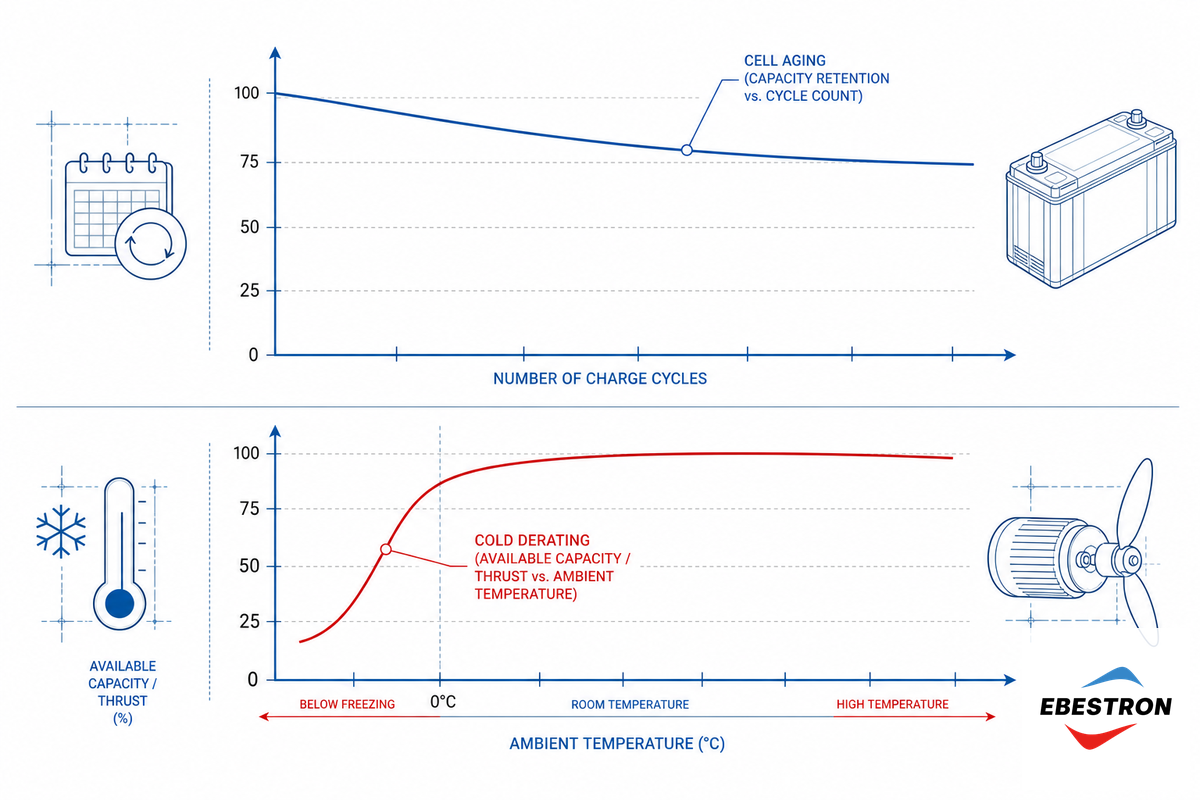
Li-ion battery packs degrade fastest if they’re left fully depleted for extended periods, or if they’re charged and stored at extremes of temperature. A widely cited practitioner consensus among cordless-tool users is that partially charging a battery (topping it up before the pack is completely dead) extends usable battery life considerably more than routinely exhausting the pack before plugging it into a charger — an easy habit to adopt once you know it matters. This is consistent with the general behavior of lithium-ion chemistry, and isn’t specific to any one brand of dispensing gun. Skipping this habit is a costly mistake in a high-throughput production application: repeatedly draining a pack to zero before recharging can shorten its usable life by 30% over a year of daily use, an expensive tradeoff for a shop running multiple guns per shift, because deep cycling accelerates lithium-ion cell degradation. Ebestron quantifies this pattern from in-house testing of 18V packs under repeated full-discharge cycles, consistent with the certified cycle-life ratings most cells carry.
“Cold weather noticeably drops the usable output of an 18V pack, one user who tore down an old pack to inspect it found the cells themselves were the limiting factor, not the tool electronics.”
The cold affects two different things on the application of adhesives: it impacts the battery’s usability (the cell internal resistance increases with cold, and the capacity seems to reduce as well); and the cartridge itself becomes more viscous, making it harder to force the plunger, see the CE/RoHS section below and Ebestron’s structural adhesive selection guide for how adhesive chemistry affects cold-weather viscosity. Simply bringing the battery and cartridge up to room temperature before a dispensing job can be a fix for two different issues at once.
Battery Pack Safety and Failure Modes
Battery-specific issues are a different category of failure than the mechanical faults, worn ratchet gears, clogged nozzles, dripping valves, already covered in Ebestron’s dispensing gun troubleshooting guide (linked above). With electric guns operating in an industrial dispensing environment, watch for: a battery management system (BMS) abruptly cutting power mid-stroke to protect the cells from over-discharge or overheating (a normal safety measure, not a fault to force through); loss of steady speed regulation on the trigger control board; or motor stall protection engaging because the cartridge’s viscosity exceeds the tool’s rated range, a common trigger for high-capacity battery packs pushed past their intended duty cycle. The Power Tool Institute’s battery safety guidance covers the broader failure surface in more depth: damaged or modified packs, counterfeit cells, and abnormal charging behavior.
- Never attempt to use a dropped, dented, or damaged battery pack. Internal cell damage can be very hard to detect from the outside.
- There are well-documented incidents of thermal runaways associated with counterfeit or third-party “compatible” battery packs on other power-type tools. Stick with the manufacturer-approved battery pack for your gun.
- Abnormal behavior during the charging cycle, such as rapid flashing or a failure to indicate charging, typically means a problem with the pack-don’t continue to try charging it.
- Keep both the battery pack and the chargers away from sources of conductive-liquid ingress. This can be a realistic exposure risk when working in a solvent-cleanup area.
CE, RoHS, UN38.3, and the New EU Battery Regulation

A battery-powered dispensing gun sold or shipped internationally sits under more compliance layers than its manual or pneumatic siblings, because it’s simultaneously a machine, an electronic device, and a lithium-battery-carrying shipment. Four distinct regimes apply, and none of them certifies the adhesive being dispensed:
| Regime | What It Covers |
|---|---|
| CE Machinery Regulation (EU) 2023/1230 | Mechanical/electrical safety of the tool itself, replacing the older Machinery Directive 2006/42/EC |
| RoHS | Restricts hazardous substances (lead, certain flame retardants) in electronic components |
| UN38.3 / UN 3480 | Transport testing for the lithium battery pack itself, plus a 30% state-of-charge limit for packs shipped by air alone |
| EU Battery Regulation (EU) 2023/1542, Art. 11 | Requires portable batteries be removable/replaceable using commonly available tools, from 18 Feb 2027 |
Two of these deserve further explanation because they’re frequently confused. IEC 62841-1 is the international safety standard family specifically for electric motor-operated hand-held tools, and its most recent amendment (AMD1:2025) adds explicit requirements for lithium-ion battery systems inside the tool, this sits alongside, not instead of, the CE Machinery Regulation. And the newer EU Battery Regulation (EU) 2023/1542 is a horizontal rule that applies across all products with portable batteries, independent of the machinery or electronics rules, meaning a cordless dispensing gun sold into the EU market after 18 February 2027 must be designed so its battery can be removed and replaced with commonly available (non-proprietary) tools, without damaging the battery or the gun, per European Commission implementation guidance published in February 2025.
Separately, when a battery pack itself crosses a border by air or sea, IATA’s lithium battery guidance and the U.S. PHMSA Lithium Battery Guide for Shippers both apply: cells and battery types must pass UN38.3 testing, and packs shipped by air alone (not installed in equipment) are commonly limited to a 30% state of charge.
The Battery-Driven Brands and Models Buyers Compare
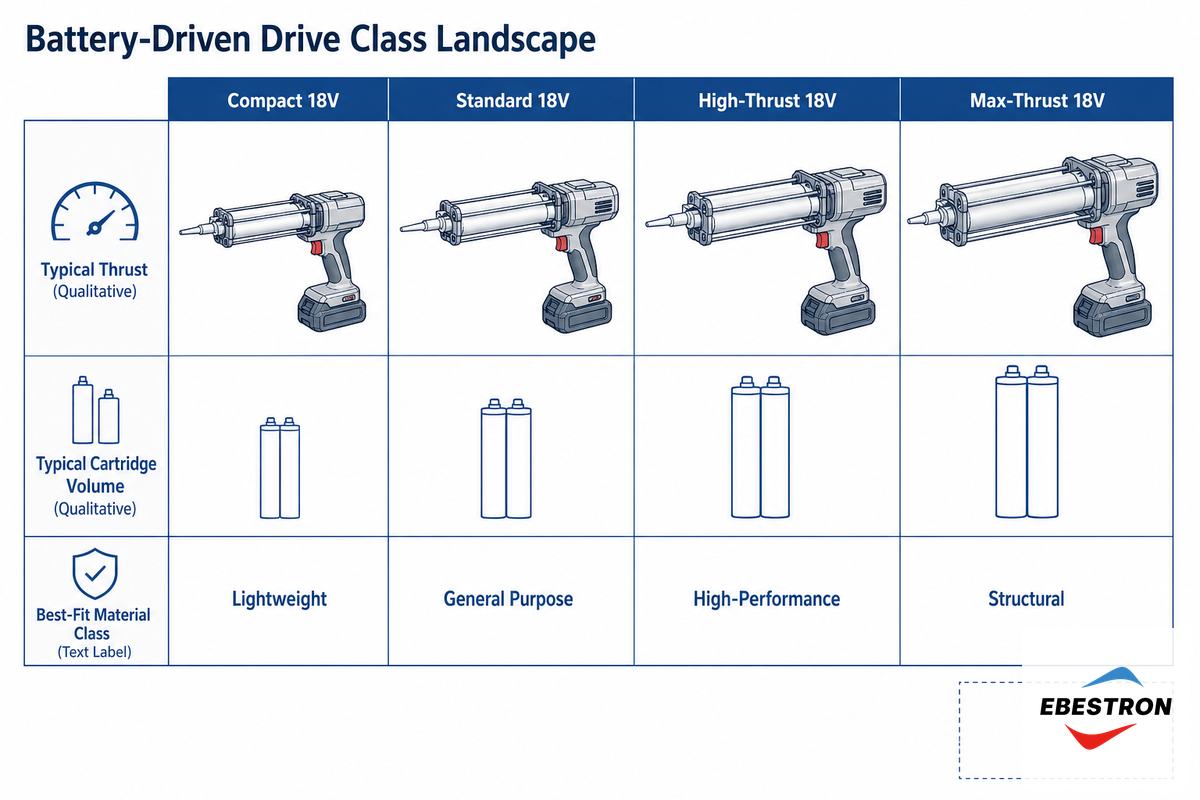
The battery-powered segment of the 2K dispensing gun market has a handful of recognizable names, each on its own battery platform: Cox™ (a medmix/Sulzer Mixpac brand) runs its MK-series battery dispensers, cartridge adhesive dispensers, in Cox’s own terminology, on the Bosch Professional 18V CoolPack platform; Hilti’s CD 4-22 is a cordless caulking gun that runs on Hilti’s own Nuron battery platform; Simpson Strong-Tie’s EDTA22CKT uses a dedicated 18V lithium-ion pack, charger, and carrying bag bundled with the tool; and general-purpose cordless brands like DeWalt and Milwaukee offer cartridge/caulk-style dispensing attachments on their existing 20V/M18 tool platforms. None of these battery ecosystems are interchangeable with each other, see the battery-platforms section above.
For Ebestron’s own battery & electric cartridge dispensing gun lineup, including model specifications, thrust ratios, and RFQ details, see the Battery & Electric Cartridge Dispensing Guns product page.
Buyers researching this category tend to search in fairly specific ways, for a general “cordless adhesive dispenser” or “electric caulk dispenser,” for a particular model like the Hilti HDE 500-A22 or a DeWalt epoxy dispenser, or for direct comparisons such as “best battery dispensing gun,” the “Milwaukee 2 part epoxy gun,” or the DEWALT DCE591B cordless dual cartridge caulk gun. That search pattern itself is a useful signal: most buyers already have a specific gun in mind and are checking it against alternatives, rather than starting from “what’s this category” — which is exactly why a neutral landscape view like this one is more useful before the model-by-model comparison than after it.
One honest gap worth naming: none of the manufacturer or retailer pages in this landscape publish independent, side-by-side thrust or duty-cycle test data against a competing brand, every performance figure buyers find is self-reported by the maker of that specific gun. That isn’t unusual for this category, but it means a buyer comparing, say, Cox’s MK-series against Hilti’s CD 4-22 is comparing two different manufacturers’ own test conditions, not a controlled bake-off.
Before Comparing Models, Verify These Four Things
- Battery platform: is it proprietary to that gun, or shared with tools you already own?
- Rated cartridge size and mix ratios: does it match the adhesive formats you actually use?
- Test conditions behind any published thrust/runtime figure: whose lab, what adhesive, what temperature?
- 2027 EU removable-battery compliance: relevant only if the tool will be sold or used in the EU after that date, see the compliance section above.
Industry Outlook: The 2027 Removable-Battery Deadline
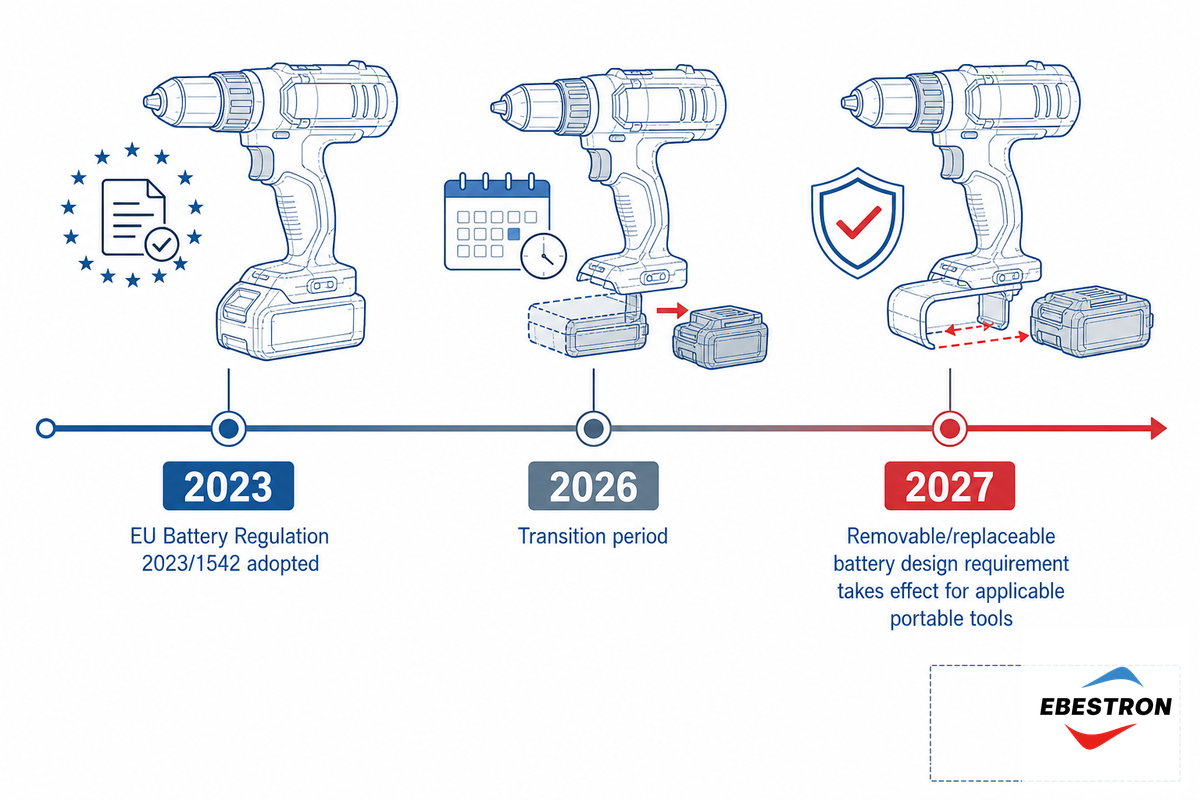
2027 Removable Battery Countdown
From 18 February 2027, EU rules require portable batteries in tools sold into the EU to be removable and replaceable by the end user with ordinary tools.
The single most concrete change coming to battery-powered dispensing tools isn’t a market-size story, it’s a regulatory deadline. Starting 18 February 2027, EU Battery Regulation (EU) 2023/1542 Article 11 requires that portable batteries in products sold into the EU market be removable and replaceable by the end user with commonly available tools, without damaging the battery or the device. February 2025 European Commission guidance clarified that this bans “parts-pairing” software that locks a device to one specific battery, while still permitting notification (not blocking) if a non-original battery is detected. For any manufacturer or distributor planning to sell battery-powered dispensing guns into the EU after that date, battery-compartment design decisions need to be made now, not in 2027, retrofitting a sealed, adhesive-bonded battery compartment after the fact is far more expensive than designing for tool-based removability from the start.
Market-size estimates for cordless/battery power tools vary widely across research firms (from roughly $2.9 billion to $40 billion depending on scope and methodology, according to several 2025–2026 market reports) — a spread wide enough that no single figure should be treated as precise. What’s consistent across sources is the direction: brushless motor adoption and shared-battery-platform strategies continue to expand across the broader cordless tool category, and dispensing tools are following that same trajectory rather than being a niche exception.
For OEM buyers and distributors planning multi-year product roadmaps, the practical risk is treating 2027 as a distant deadline rather than a near-term design constraint — the gap between compliance-ready and compliant is a redesign cycle measured in months, not the 30 days some assume. Ebestron engineers its upcoming product line around tool-based battery removability already, because retrofitting a sealed battery compartment later is far costlier than designing for it now, consistent with ISO 9001-certified design practice.
Frequently Asked Questions
Q: What is a “battery gun” in the adhesive-dispensing sense?
View Answer
A battery gun, in this context, is a cordless power tool that uses a rechargeable lithium-ion battery to drive a plunger mechanism, pushing two-part adhesive out of a dual-barrel cartridge at a regulated ratio. It’s a long way from a consumer caulk gun, which is either fully manual or dispenses a single, pre-mixed sealant rather than two components that must combine through a static mixer before curing.
Q: Are battery-powered cartridge guns actually good for structural or epoxy work, or just caulking?
View Answer
This is precisely what this tool is for – the increased thrust and steady plunger speed of a battery drive makes the most difference with viscous, fast-curing two-component adhesives, such as epoxy or MMA, where a manual gun’s uneven force application will result in an improper ratio being mixed. Consumer caulking represents a lighter-duty secondary application for the same basic mechanism.
Q: Does the mix ratio stay accurate as the battery runs down?
View Answer
Mix ratio is achieved mechanically by setting the relative bores of the two cartridge cartridges — not by battery voltage setting. A degrading battery will result in a slower plunger stroke speed and a possible low-voltage cut-off, but the 1:1, 2:1, 4:1 or 10:1 mix ratio designed into the cartridge and gun geometry will remain constant.
Q: Can these guns run MMA adhesives with a 3–5 minute working time?
View Answer
Yes — provided the gun’s stroke speed and the user’s cartridge-change procedure are coordinated with the adhesive’s open time. Please consult the Runtime Math section above to learn how to pace trigger activation and cartridge swaps with a short-open-time chemistry.
Q: Do CE and RoHS marks mean the gun is safe for medical or food-contact use?
View Answer
No. CE marking on a dispensing gun only certifies compliance with the EU Machinery Regulation (regarding electrical and mechanical safety of the gun) and RoHS restrictions of specific hazardous materials in its electrical components. It does not pertain to the adhesive itself, or to any medical device or food-grade certifications the adhesive may hold.
Q: What’s the most common reason a dual-cartridge gun goes out of ratio?
View Answer
By far the most common cause, reported in both field service calls and online by professional users, is a partially seated or crossed-thread cartridge, where one plunger engages a moment before the other and the two components dispense out of phase before they can properly mix — even though the gun mechanism itself is perfectly functional.
The second most common cause is reusing an old static mixer on a fresh cartridge set, which traps partially cured adhesive at the mixer opening and skews the bead’s ratio for the first few inches. Both are maintenance and technique issues, not gun failure, and should be ruled out before contacting service.
Why We Write This
Ebestron manufactures two-component dual cartridges, static mixing nozzles, and manual, pneumatic, and battery-electric dispensing guns, supplying 2K adhesive packaging consumables compatible with Sulzer Mixpac, Nordson, and 3M systems. This guide focuses specifically on the electric drive, battery platform, and compliance questions our technical team fields most often from buyers evaluating cordless dispensing equipment for the first time. Reviewed by the Shanghai Ebestron New Materials Co., Ltd. technical team.
References & Sources
- Lithium Battery Guide for Shippers (2024) — U.S. Pipeline and Hazardous Materials Safety Administration (PHMSA)
- Lithium Battery Guidance Document — International Air Transport Association (IATA)
- Regulation (EU) 2023/1230 on Machinery — Official Journal of the European Union
- Regulation (EU) 2023/1542 (Batteries Regulation) — Official Journal of the European Union
- IEC 62841-1:2014+AMD1:2025 — International Electrotechnical Commission
- Battery Safety — Power Tool Institute
- US Patent 9,862,001 B2, Dispensing Device — Medmix Switzerland AG (USPTO)
- AU2024205719A1, Motor Operated Dispensing Device — Techtronic Cordless GP (IP Australia)
Related Articles
- Epoxy Gun Buyer Guide: Manual, Pneumatic, and Battery — full drive-type comparison and buying decision
- Dispensing Gun Troubleshooting — mechanical faults common to manual, pneumatic, and battery guns
- Static Mixing Nozzles for 2-Part Adhesives — mixer selection for clean 2K mixing
- Epoxy vs MMA vs Polyurethane — how adhesive chemistry affects dispensing requirements
- Battery & Electric Cartridge Dispensing Guns — Ebestron’s product lineup and specifications