Get in touch with Ebestron Company

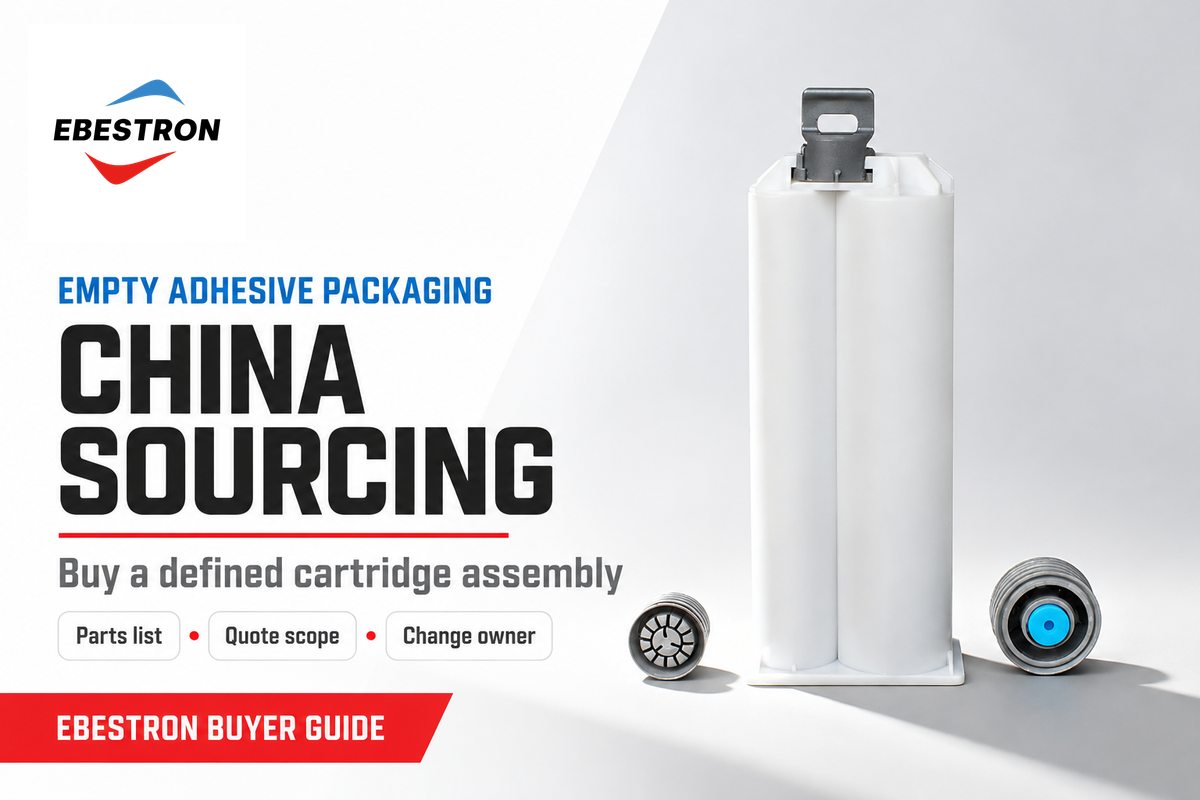
Sourcing 2-K Cartridges from China: Buyer’s Guide provides information to aid the purchasing of empty industrial adhesive cartridges. Define the complete assembly, identify the company responsible for supplying it, and compare quotations on the same delivery basis. Routine orders require approved parts and named ownership for changes.
Sourcing 2-K Cartridges from China: Buyer’s Guide covers four areas: a complete bill of material, accountable supplier, similar quotes and repeat order controls. Buy empty packaging against an agreed parts list and drawing revision.
Updated October 2026 · Empty industrial adhesive packaging · U.S. purchasing teams
Key points
- A lower barrel price can produce a higher complete-assembly total.
- Factory, trading company and distributor describe business roles; the order still needs an accountable seller.
- Nominal capacity and mix ratio belong beside the exact outlet, pistons and dispenser reference.
- A repeat order needs traceable lots and agreed handling of material, tooling and component changes.
Quick purchasing specifications
Ebestron’s catalog lists nominal 50 mL, 200 mL, 400 mL and 600 mL dual-cartridge families. The buying unit is an empty assembly with separately identified accessories; the quote must say whether pistons and mixers are installed, loose or shipped separate. Filled adhesive, application approval and usable fill quantity are separate purchasing fields.
How to source one complete cartridge assembly, not just a barrel
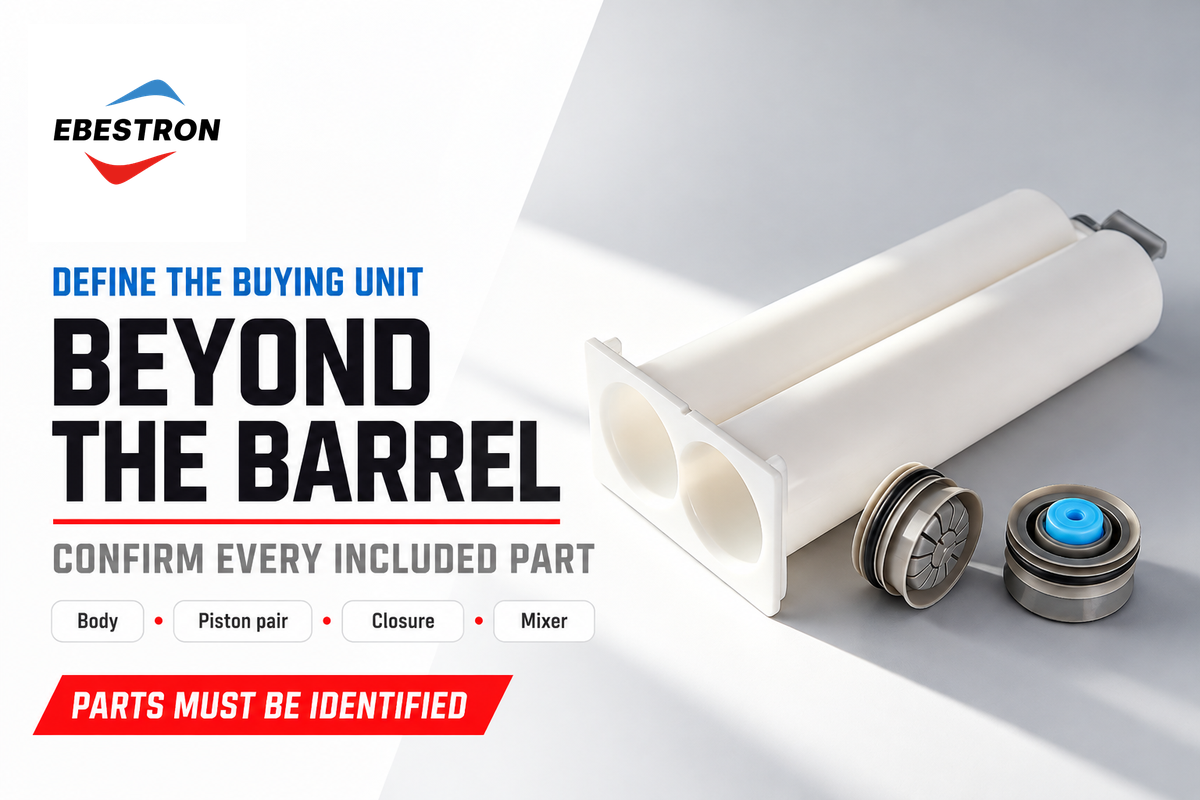
A complete order for dual cartridges identifies the body, both pistons, closure and mixer and specifies the condition of delivery. Narrowing nominal volume of the product identifies the family; drawing revision directs the supplier on what to deliver. Start with the required complete dispensing assembly and work backward to separate purchased parts; don’t select a cheap barrel first.
Empty two-component cartridges keep the adhesive components apart before dispensing. A purchasing description such as “400 mL, 2:1” leaves several decisions open: the outlet shape, piston design, closure arrangement, material grade and connection to the applicator. Those omissions matter because different people may price, fill and use the package. Procurement needs a repeatable item; the filling team needs the right loose or assembled parts; the plant needs a package that fits its equipment. The Ebestron dual-cartridge catalog is the starting point for identifying the family.
Every part in the assembly should be identified. “Cap included” should identify the complete closure, including any separately required sealing piece. If pistons are included, the identification should contain the quantity, the side (A or B) and how they’re packed. If a mixer is included, the identification should include how many are included for each cartridge and the coupling. An accepted photograph is useful for orientation. A controlled drawing shows the dimension, revision, and other information needed for purchase.
A proposal to change an item already approved needs to be differentiated from that item. An alternate mixer or body may be proposed on a different line and be evaluated independently. If both items retain the same sales name, give the proposed assembly a distinct purchasing identifier until its disposition is settled. Receiving personnel should never have to evaluate photos to decide which of the proposed items the buyer wishes to purchase.
| Catalog family | Listed ratio | What the purchasing line still identifies |
|---|---|---|
| 50 mL | 1:1 | Body drawing, piston pair, closure and mixer reference |
| 50 mL | 2:1 | Ratio-specific body and piston pair, plus dispenser reference |
| 50 mL | 4:1 | Both chamber/piston references and the outlet drawing |
| 50 mL | 10:1 | Small-side piston identity and the approved applicator pairing |
| 200 mL | 1:1 | Body dimensions, outlet, closure and delivery condition |
| 200 mL | 2:1 | Body and plunger arrangement for the selected dispenser |
| 400 mL | 1:1 | Matched components and full assembly drawing revision |
| 400 mL | 2:1 | Both piston references and the mixer connection |
| 400 mL | 4:1 | Ratio-specific assembly and dispensing equipment reference |
| 600 mL | 1:1 | Body, closure, piston pair and selected dispenser interface |
Source: Ebestron’s current public catalog listings. These are nominal product options. The nominal 50 mL options and 200 mL cartridge range give the corresponding family context.
Separate physical fit from material suitability
Physical fit covers the barrel envelope, flange, outlet connection, piston contact and the dispenser’s pushing arrangement. The material suitability pertains to the body and all wetted elements in contact with the formulation. A mixer that locks to an outlet addresses just one element of the task. Purchase records should maintain the entire approved set of part numbers to ensure that a closure or piston isn’t substituted without proper review.
A family name of a polymer is too broad for a controlled repeat purchase. Grade, additive package and color are part of the material definition. In their February 2026 ASI article on reliable cartridge systems, medmix’s Tobias Bodenmüller and Michael Kipperer distinguish typical datasheet values from material specifications with agreed tolerances. Applying the same principle to purchase order records, ensure the material being ordered is known and what properties are agreed to be controlled.
Consider a contract filler preparing an order for a nominal 400 mL, 2:1 package. Purchasing gets a body price. The filling team assumes pistons are packed loose. The end user expects a particular mixer connection. If those expectations stay in separate emails, the supplier can fulfill the body line while the filler still lacks a usable kit. A single assembly sheet resolves the expectation mismatch. The body drawing shows a revision, A and B pistons have separate references, the closure has a complete part description, and the mixer connection and count are agreed upon. The filler now is able to order loose components and not confuse that with the fully assembled retail kit.
For a 50 mL package, the working drawing and gun reference should go with the approved ratio. The purchasing team changing from a 1:1 item to a 10:1 item is changing more than just a label on the carton. The component list should follow the selected geometry. The same is true when moving from a 200 mL family to a 400 mL family: retain the exact dispenser and outlet reference, rather than assuming a match across capacities.
Nominal volume defines the catalog family. The volume or mass basis for the fill quantity should be in a different field, so that both the filler and supplier use the same basis. The same is true for the adhesive supplier’s required ratio. Avoid informal formulation changes when selecting a package. A buyer who needs a different adhesive working time should resolve that with the formulation owner rather than ordering a different cartridge ratio.
When a purchasing team receives the response “our current gun is already on the line,” the team should keep that gun reference on the request. This establishes the current gun as a design input. The detailed selection work can be performed according to the site’s guide to matching the dispensing gun. The purchase order should maintain the final selection.
A 400 mL, 2:1 cartridge purchase becomes repeatable when its body, two piston references, complete closure and mixer are tied to one revision. The nominal capacity gets the buyer into the right family and the matched parts list allows procurement and the filling line to have the same part to procure and reorder.
Verify suppliers behind the cartridge quote
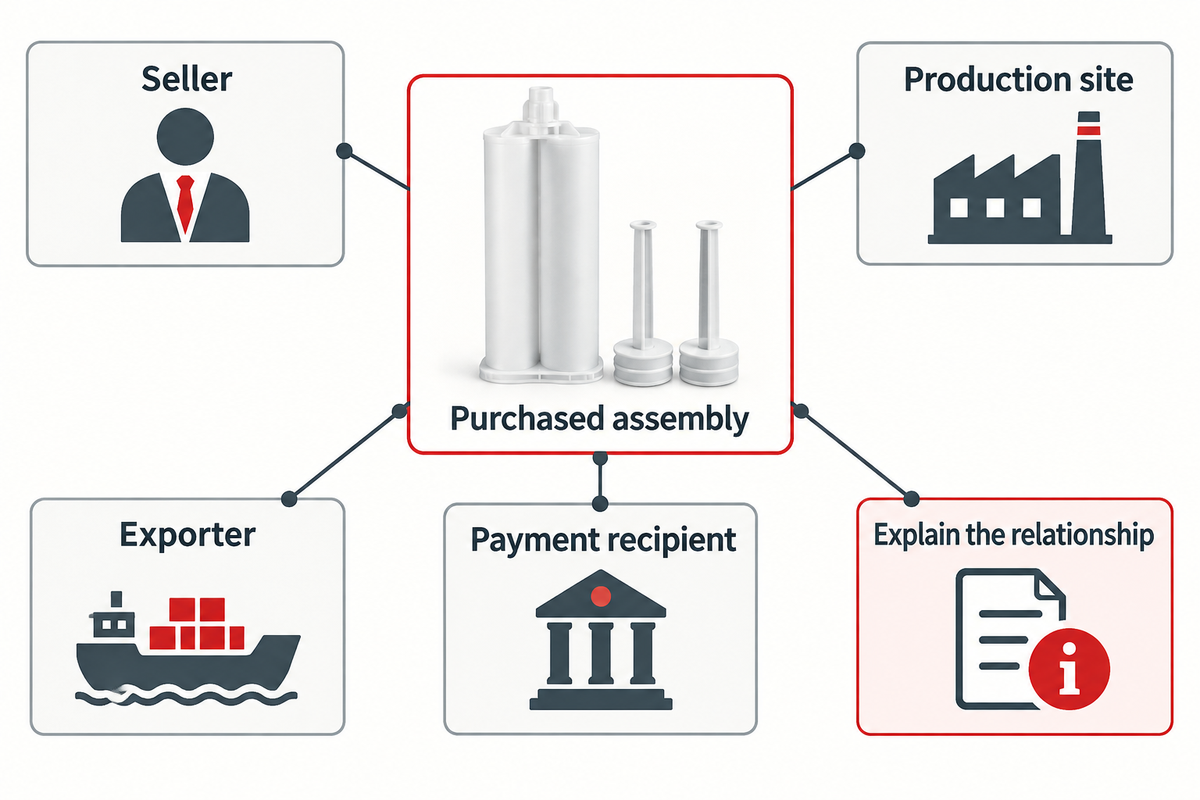
Supplier verification differentiates the company taking the order, the production site making the parts and the assembly purchased. Reconcile those identities prior to signing the commercial terms. A trustworthy supply arrangement explains who molds, buys, assembles and ships each component, then names the party responsible for a nonconforming delivery and its agreed remedy.
Sourcing on Alibaba, Global Sources or trade shows can assist a buyer to find suppliers. These are discovery channels. It’s prudent to authenticate the firm and item being purchased prior to signing the commercial terms instead of treating a search engine result as a source. Keep the Chinese legal company name, registration identifier, business address and contracting name together. Where the exporter, payment recipient or production site differs, the order file needs a clear explanation of the relationship.
It’s important to delineate company legitimacy and the production capability. A registered trading company can source the part; a registered manufacturer can produce the part outside its assessed process or site. Supplier reports are easier to use when procurement reads their date, address, business type and production scope together. The main concern should be what work is performed at the assessed site for the body, piston, cap or mixer being purchased.
Chinese suppliers can integrate different manufactured and purchased components under similar product descriptions. To find reliable suppliers, evaluate the proposed work split as well as the offered product categories. Chinese manufacturers, who mold the body, may use a different source for closure; that arrangement requires a defined incoming part and change response path. A longer catalog shouldn’t replace the exact part discussion.
All parties may have to communicate in Chinese with the production team. Assign that role and retain agreed terms in the controlled record. The person interpreting a question should be able to define the part and version. Sales, procurement and quality can then clarify the answer against the same item, as opposed to interpreting a general description as a new specification.
The conformity assessment guidance of NIST distinguishes management system assessment from certification, inspection and testing. Keep these activities distinct in the supplier file. An assessment of a company answers a different question from a test on an assembled part. An independent factory audit can assess a process, but the purchasing team still needs to correlate the findings to a part and the production route.
How do I know if I’m talking to a factory or a middleman?
ID the entities that mold, own/control the tooling, keep part records and handle order changes. A factory describes its own production work; a middleman coordinates work performed elsewhere. The important difference is the responsibility for quoted assembly including subcontracted pistons, closures and mixers, rather than the wording in a sales profile.
Trading companies can still provide a clear, workable supply arrangement. Their role must be reflected in the order documents, and production source and corrective action path agreed. If the seller is the manufacturer of the complete assembly, the process evidence for the part(s) in question should corroborate that. Assume an unexplained difference between the seller, payee and stated production site is an unresolved commercial difference prior to the first order.
Read certificates against the work being purchased
For certification, retain the issuing body, certificate number, covered entity, site, scope and validity dates. The scope should make sense for the activity on the order. A quality-management-system certificate belongs to its named organization and covered activities; the drawing, component list and product acceptance conditions still define what the buyer receives. ISO explains that independent certification bodies issue ISO 9001 certificates; ISO itself does not perform that certification.
Keep outsourced work visible. If a supplier molds the cartridge body but purchases the piston pair, the quality-control processes for those incoming parts matter to the final assembly. If printing or private-label packing happens at another site, the label revision and order traceability need a responsible owner. The concern is mapping the supply chain for this purchase, not collecting irrelevant certificates from a range of products.
A practical source of doubt is the gap between a good sample and the eventual production order. This can be resolved by assigning the sample a name. This can be the part number or reference, the materials, the revision level of the drawing and how the sample was created. When the sample becomes the purchasing reference, both parties should be able to find the same record. In the case of consistent quality, an identified sample would be better than an unidentified sample left on a desk.
Give U.S. import traceability its own owner
U.S. purchasing teams also need an importer-of-record contact and a plan for upstream records. In its Uyghur Forced Labor Prevention Act enforcement FAQ, U.S. Customs and Border Protection describes supply-chain documentation used in applicability reviews, including transaction records, parties involved, raw-material origins and transport records. The focus is not only on the last seller in the supply chain; requirements can extend to the inputs. The import team should address the relevant reviews.
Purchasing can manage the document request and has a named supplier contact for it. Confidential upstream records may require an agreement on the means for sharing; the objective is having an accessible record chain when required by the importer. Country of origin on a carton and the full chain of relevant inputs are separate fields. No particular factory, trading company or distributor should be presumed cleared solely because of its business type.
Reliable suppliers make their role clear and provide part specific answers. The named supplier, stated production route, identified assembly, and an applicable means for addressing defects, give the purchaser the confidence to make the purchase. The quality assurance team can assess the sufficiency of the technical documentation and the procurement team can address the contracts, while the import team assesses the entry requirements.
Many suppliers can provide a blank 50 mL body. Many suppliers can offer an empty 50 mL body; the useful shortlist consists of those whose response resolves the requested assembly and commercial responsibilities. Based on this, comparing manufacturers in China keeps the supplier search connected to the purchase. An unresolved component source, drawing revision or payee relationship, is a specific item to settle, as compared to a general notion that a business is good or bad.
Factory, distributor or sourcing agent: choose the supply route
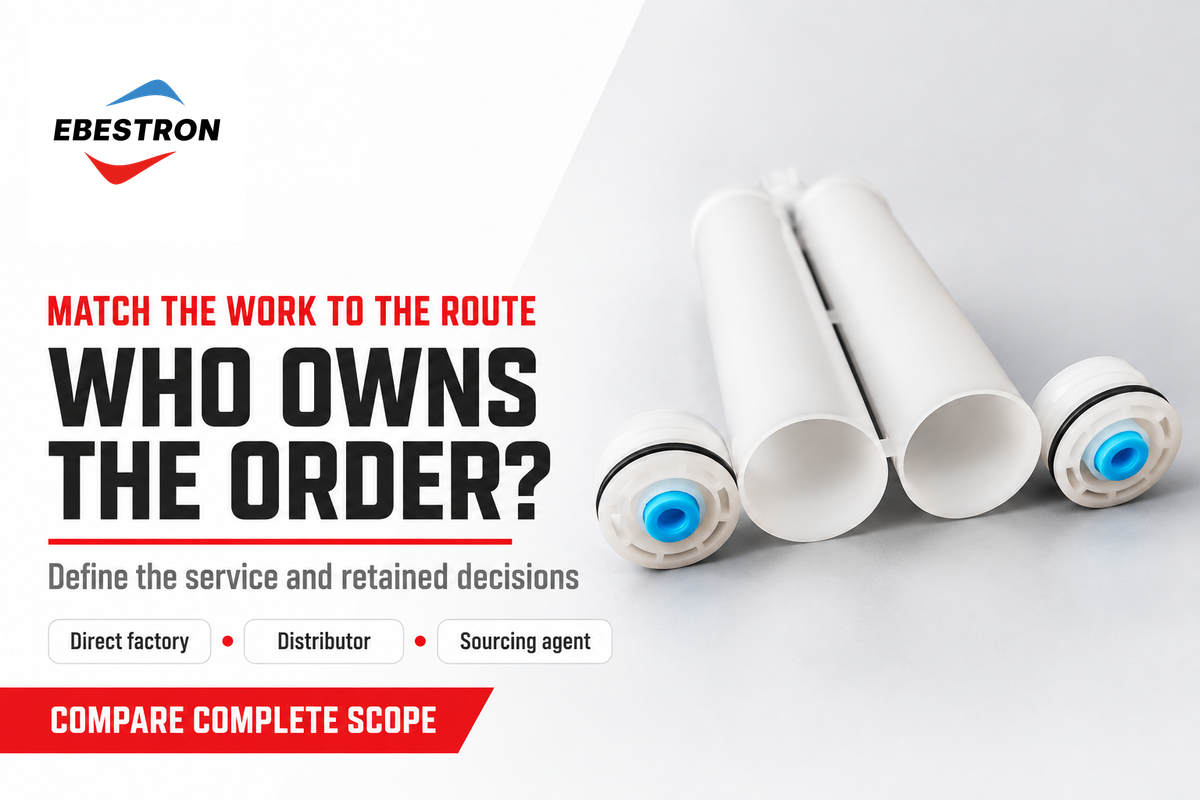
A factory is suitable for a stable repeat purchase that your team can manage directly; a distributor is suitable for available stock, mixed quantities or local support; a sourcing agent fills a defined coordination gap. Choose the route for goods ownership, who provides technical solutions and who resolves an incomplete or defective delivery, and then compare its complete commercial scope.
Businesses that source products from China can split procurement and support services in several ways. A buyer may purchase goods directly and hire local help to inspect them or let a China sourcing agent arrange both. These are different contracts. Choosing the right sourcing partner begins with the capability the buyer lacks, not a presumption that every intermediary adds waste or that every factory gives a better price.
A sourcing strategy should say what tasks will be done by the buyer. Limited sourcing experience may require local coordination, while a developed technical team may only need an inspection service. Choose the best fit by adjusting the service to that gap. Claiming to be among the best sourcing agents is less valuable than defining the authority, deliverables and corrective action.
| Route | Useful fit | Commercial responsibility to define | Work retained by the buyer |
|---|---|---|---|
| Direct factory | Stable cartridge assembly and repeat demand | Seller, production site, supplied components and change notices | Specification approval, replenishment planning and import arrangements |
| Distributor | Suitable stock, small orders or mixed-part replenishment | Stock ownership, exact source references, lot identity and returns | Application approval and acceptance of the supplied revision |
| Sourcing agent | A defined gap in local coordination or supplier follow-up | Procurement authority, service fee, supplier commission and defect handling | Acceptance decisions and oversight of the agreed services |
Source: Editorial purchasing framework, informed by procurement responsibilities described by the U.S. Bureau of Labor Statistics. Include specific stock and services in each quotation.
A direct factory route keeps the technical communication close to the production source when the seller controls the relevant work. It may work for a fixed 200 mL, 2:1 assembly with a predictable reorder pattern and a buyer able to control the specifications. The buyer retains the decisions to approve a new part, set the level of inventory to be carried, and the arrangements that sit outside the factory’s delivery terms.
An offer is most useful when the desired 50 mL assembly is readily available in an appropriate quantity and location. Value may be in the form of stock carrying, breaking large packs or consolidating accessories where such services are provided. A distributor should retain the part reference and lot records. A convenient local box becomes less useful when a replacement mixer or piston arrives without a traceable identity.
Buyers who use sourcing agents should express the service scope in operational terms like supplier communication, quote comparisons, site visits, production follow-up or inspection coordination. A sourcing agent usually has an agreed service scope, but the agreement must define whether the agent buys the goods, acts for the buyer or presents a third party seller. Supplier commissions and reimbursable expenses should be disclosed along with the service fee. The term “agent” creates a wide discretionary area.
If a maintenance distributor regularly needs several 50 mL formats in small quantities, and a contract filler needs a 400 mL 2:1 package repeatedly, the distributor’s task is assortment and replenishment. A contract filler has the task of keeping one approved assembly unchanged. A route that bundles the maintenance buyer’s items may save coordination work even if its body line is higher. The contract filler may wish to have a direct technical contact and a fixed change-notice path. Neither choice is dictated by the term “factory direct.” Each buyer is free to specify the required service with price, and see what responsibilities are retained by the buyer’s team. The choice is dictated by the nature of the order and the buyer’s technical ownership.
Minimum order quantities need about the same level of detail. A bulk order for one standard body, a mixed order of accessories and a custom-colored large order can have different quoted MOQs. Record the minimums against the exact SKUs and delivery condition. Low-MOQ sourcing is useful when it fits demand, but dividing a manufacturing batch into smaller releases can also leave stock ownership and cash flow to resolve.
For a recurring 400 mL purchase, the chosen route should preserve access to the approved component identities and the person who can authorize a production change. For a mixed 50 mL replenishment, the traceability of the stock and the right pack size may have more benefit. Route selection works best when the buyer can identify the service being purchased.
Compare quotes with the 1,000-Assembly Quote Test
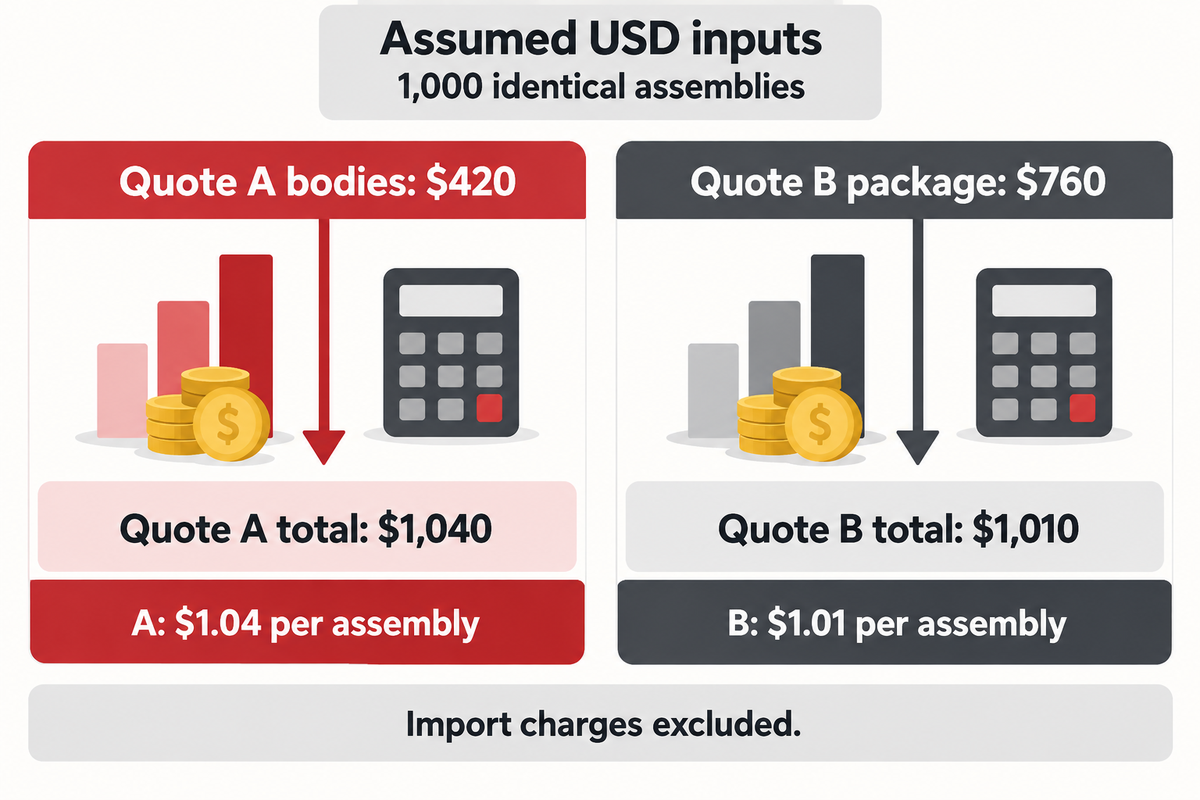
The 1,000-Assembly Quote Test compares quotations for the same quantity, parts list and delivery boundary. Set the assembly first, then add missing components, packing and similar freight charges. Keep unresolved items visible so the lower quoted line price doesn’t become the purchasing decision, before both suppliers price the order.
Assumed inputs: a buyer requires 1,000 identical nominal 400 mL, 2:1 empty assemblies, all with the same approved body drawings, material grade, piston pair, complete closure and two specified mixers. All amounts below are in USD for that batch, quoting on the same day, with the same validity. Freight and handling allowances use the same delivery boundary. Import duties and other import charges are excluded and will be assessed separately.
| Cost or scope item | Quote A | Quote B | Purchasing treatment |
|---|---|---|---|
| Empty bodies / listed package | $420 | $760 | A lists bodies; B includes the matched components below |
| Matched piston pairs | $110 | Included | Same A-side and B-side references |
| Complete closures | $35 | Included | Same closure and separately required sealing parts |
| Specified mixers | $180 | Included | Two per assembly: 2,000 mixers in each batch |
| Packing | $55 | $40 | Same loose/assembled condition and packing requirement |
| Freight and handling allowance | $240 | $210 | Same destination boundary and included service scope |
| Comparable known batch total | $1,040 | $1,010 | Add the same categories before comparison |
| Known cost per assembly | $1.04 | $1.01 | Batch total divided by 1,000 assemblies |
| Import duties and other import charges | Excluded | Excluded | Complete separately; no zero value assumed |
| Difference on this boundary | $30 higher | $0.03 less per assembly | Compare only after any remaining scope difference is resolved |
Arithmetic: Quote A is $420 + $110 + $35 + $180 + $55 + $240 = $1,040. Quote B is $760 + $40 + $210 = $1,010. Dividing by 1,000 gives $1.04 and $1.01 per complete assembly. The body-only offer starts $340 lower, yet its comparable known total finishes $30 higher. That reversal comes from the priced inclusions, not a different cartridge or a forecast of supplier performance.
Procurement can use the same spreadsheet during negotiation. A request for better price is to reduce a certain line, change order pattern, or offer a different pack arrangement. Any proposed substitution then gets a new comparison. If a supplier reduces mixer quantity from two per cartridge to one, the buying unit has changed and the lower total belongs on a separate line.
Align the freight basis before adding totals
The delivery rule specifies its version and named place. A factory-door price and a quote that includes transportation to a forwarder’s point contain different work. The differences may be in the terms and conditions and the rights and obligations of the parties. The ICC Academy explanation of EXW and FCA under Incoterms 2020 highlights the differences in the responsibilities for loading and performing export-clearance. Keep those differences next to the price instead of trying to solve the puzzle with an unknown freight allowance after supplier selection.
A freight forwarder can quote transport work after receiving packing details and handover point. The packing list should identify quantity, carton arrangement and the parts included, while shipment measurements support the freight calculation. Included charges and schedules vary with sea freight, courier and other modes of service. During acquisition, check the actual service rendered and compare; don’t evaluate a mode name as a complete delivery quote.
When another party arranges transport, ensure customs clearance and importer responsibility and destination charges are evident. A delivered-price label should be read against the named rule and contract scope. The known total of the quote worksheet is helpful for negotiation. Completed import assessment should be given to the import team. Records should meet at the same shipment and item rather than leave a gap between “goods purchased” and “goods received”.
Keep one denominator through the sourcing process
The denominator is the number of complete assemblies in the agreed scope. We can’t compare a quote for 1,000 bodies plus 500 piston pairs as 1,000 complete units. The same applies to mixers quoted packed by bag or closures quoted in a different carton count. Quote quantities must be converted to the required parts list and the total divided. Any shortages remain as cost or supply issues.
Accessories should also have their own references as component substitutions can alter price and assembly. Quoting the right mixer connection type and the agreed quantity per cartridge should be included in the quote. A cheaper, unapproved nozzle isn’t a reduction in the original quote.
When repeating purchases, leave quote validity and the basis for future price changes. Discussing material, order quantity, and packing, and freight are easier when clear. A changed line on the offer should be indicated to allow finance to distinguish a change in the purchasing price from a change in the product or service being purchased.
Retain a superseded offer in the file when the price changes. The new quote will need its own date and reference to the offer being replaced. Finance can then determine if a price difference is due to a change in the delivery service or less/more accessories. The accepted purchase order should reference the accepted offer. A low number taken from a previous email shouldn’t survive as the comparison value after its scope has changed.
Cash flow should be next to the total. Payment terms define when cash leaves the buyer, while ownership of the stock defines whose inventory is waiting between production and release. A low unit price tied to a larger commitment can result in more stock being produced than is required. Compare those commitments with the actual consumption plan rather than treating all quoted volume breaks as cost savings.
The worked 400 mL comparison makes a $340 body-line advantage a $30 batch disadvantage once the same components and freight boundaries are accounted for. Procurement can reproduce the calculation with its own current offers: complete the same parts list, resolve unknowns, add comparable charges and divide by the same assembly count.
Keep quality control tied to the approved configuration
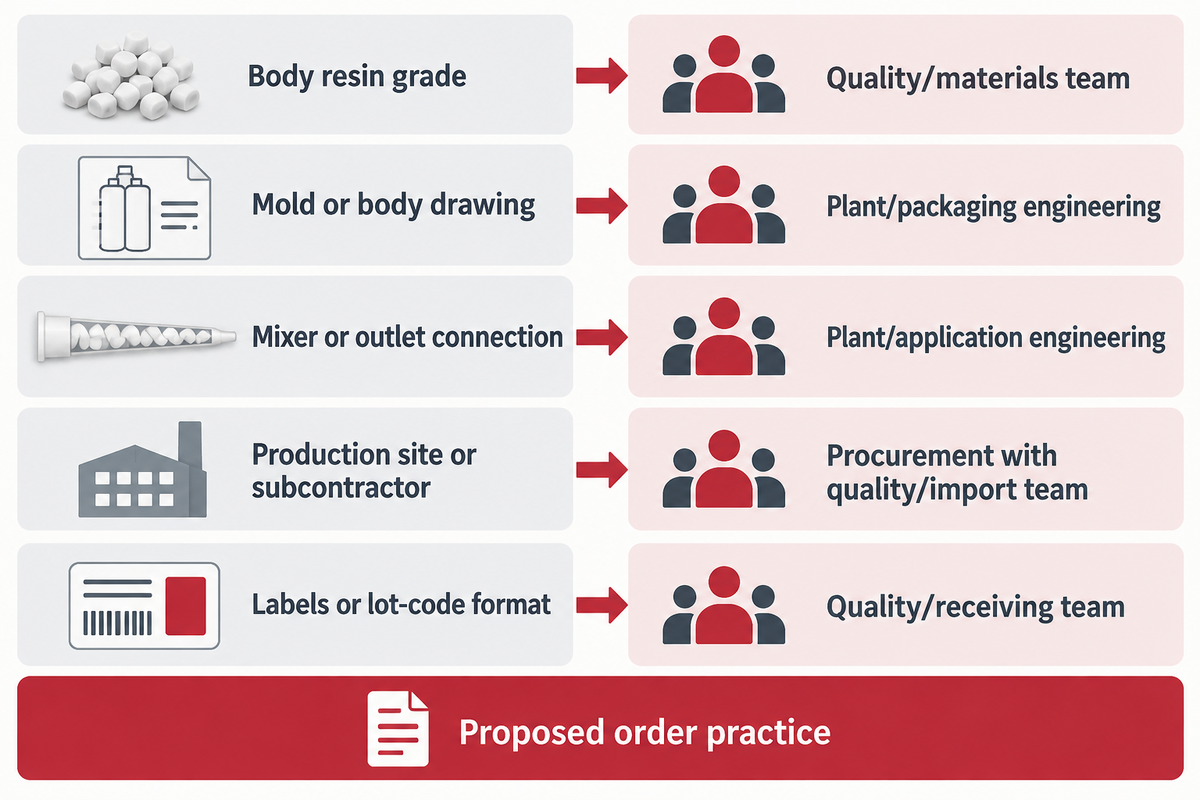
Repeat-order quality control links the approved assembly to each shipment and gives consequential changes a named decision owner. Keep the body drawing, material grade, piston pair, closure and mixer references together. Incoming inspection provides a comparative check of the delivered lot against the purchase order, while changes to the process and/or material follow the agreed change path prior to release.
A production purchase requires an acceptance record, rather than simply a statement confirming that products meet requirements. This record shows what was checked, the conditions utilized, the result, and the product or lot involved. Quality staff can differentiate dimensional observations from filling or dispensing results. Procurement can then explain a nonconformity against the agreed purchase order rather than debating from their memory of the sample and the supplier’s representation of the sample.
To ensure quality checks, give quality control (QC) a defined job at each handoff. The supplier’s outgoing checks, the independent inspector’s assignment and the buyer’s receiving checks can cover different characteristics. The purchasing guide should specify those jobs and the records expected from each job. This division enables the buyer to verify product quality against the agreed assembly without presuming that all checks were repeated by all parties.
Can I trust a supplier’s sample?
Yes, a sample may be utilized as a reference to the exact assembly that was checked. This reference includes the body, pistons, closure, mixer and drawing revision, together with filling and dispensing conditions. A production reference sample is useful when both parties can trace it to the product to be ordered and the criteria utilized to accept it.
The first production lot needs its identification and acceptance record created separately. Preserve the link between the approved sample and the supplied parts, including any agreed material or process changes. If the sample used a different component, the production order should have a deliberate decision on that difference. The buyer’s quality team owns the acceptance decision; the supplier owns the delivery commitments in the order.
Acceptance sampling addresses a defined lot. The NIST/SEMATECH e-Handbook section on acceptance sampling separates that short-run decision from long-run quality control. Third-party inspection can add an independent observation of a shipment, provided the inspector has the approved references and agreed criteria. Repeat orders also need change records and continuing supplier follow-up.
“acceptance sampling plans are one-shot deals”
Supplier Change Notice by Failure Consequence
A supplier Change Notice by Failure Consequence assigns each proposed component or production change to the buyer responsible for its effect.
Use the following table as a potential purchasing Addendum. Consequences show what the buyer needs to evaluate; they don’t reflect failure rates, or automatically warrant rejection. The idea is to steer a variation to the correct person prior to shipping, rather than leave procurement to theorize the supplier’s new part’s importance from the part name.
| Changed item | Possible purchasing consequence | Record for review | Buyer decision owner |
|---|---|---|---|
| Body resin grade | Different material properties or formulation contact behavior | Old/new grade, agreed material specification and affected lots | Quality/materials team |
| Colorant or additive package | Change to the agreed material composition | Changed ingredient description and supplier’s impact assessment | Quality/materials team |
| Mold or body drawing | Dimensional fit may change at an interface | Drawing comparison and relevant dimensional results | Plant/packaging engineering |
| A-side piston | Different fit or movement in its chamber | Part identity, material and assembly evaluation | Quality and filling team |
| B-side piston | Change on the smaller chamber may affect the selected assembly | Separate B-side reference and relevant trial record | Quality and filling team |
| Closure or sealing piece | Different storage closure or outlet fit | Complete closure parts list and applicable evaluation | Quality/packaging team |
| Mixer or outlet connection | Different attachment or dispensing arrangement | Both mating references and approved assembly record | Plant/application engineering |
| Production site or subcontractor | New production and traceability route | Site role, affected parts, lots and proposed controls | Procurement with quality/import team |
| Packing or supplied condition | Different receiving and filling-line work | Loose/assembled condition, quantities and packing revision | Receiving and filling team |
| Labels or lot-code format | Receiving records may lose the link to the approved item | Old/new label and lot-record mapping | Quality/receiving team |
source: editorial purchasing method, leveraging component distinctions in the product documentation reviewed, and using the material specification distinction defined by the medmix authors in ASI. Assigning owners is a proposed order practice, not a certification rule.
A short clause can make the table usable: “Notify the buyer in writing before changing an agreed material grade, part reference, drawing, production site or supplied condition. Identify the affected parts and lots, describe the change and obtain the named buyer’s written disposition, before supplying the changed item.” The parties must agree how the clause balances with existing inventory, open orders and urgent replacement needs.
Consider a filler reordering an approved 200 mL, 1:1 assembly. The supplier suggests a different piston material while using the same sales description. The purchasing team is able to capture the price effect, but the filling and quality teams need the old/new piston references and affected lots to verify if the approved assembly has been changed. The notice routes that decision before the shipment. If the change is accepted, the purchase record gains a new approved reference and effective lot. If the change isn’t approved, the supplier and buyer resolve the remaining stock or replacement plan against the original order. The process allocates the proposal a decision maker, without the need to define a universal test pressure or fixed sample size.
Define inspection work before production
The inspection brief must define the item, lot, characteristics and acceptance method. A dimension on a controlled drawing is different from a visual packing check, and both are different from application testing with adhesive. Keep the above mentioned tasks separate. A passed packing inspection must not be considered approval for material contact. The sampling arrangement belongs with the agreed inspection method and shipment context.
Inspection records are most beneficial when they capture the identity of samples and discrepancies. The supplier must have a description of the discrepancy. The buyer has to decide what to do with the defect. The buyer needs a disposition: accept, contain, replace, rework under an agreed process, or investigate further. A photograph of a defect can be added to the record. The definition and agreement of the defect to be resolved can be found in a drawing or agreed criterion.
Like quality issues, affected stock for this process would benefit from having a defined boundary as well. Locate the affected lot and any associated open orders for the changed part. Assign the review to the quality owner. The procurement team can coordinate the logistics and the commercial remedy for the affected quantity. The intended effect of this process is to ensure that the new item and lot identity are maintained, so that the receiving team is able to distinguish the “good” material from the material awaiting disposition.
For application work, use the formulation, filling arrangement and dispensing equipment intended for the purchase. Description of the body and wetted parts shouldn’t be at the family level of the resin. Safety and quality reviews of the adhesive should be done by the formulation and application teams. Buying empty plastic hardware and selecting conditions for a reactive formulation are related tasks with different owners.
The more detailed technical dossier is covered in the bulk and OEM qualification guide. Keep this sourcing order focused on the agreed references, which shipments are being accepted, and who owns a change. That focus should prevent us from creating a second, parallel qualification system when purchases are made.
A repeat 200 mL order should be traceable to the same approved body, piston pair, closure and mixer references, or to an expressly accepted revision. Lot acceptance deals with the delivered batch. Written change notices with named owners should maintain the next lot connected to the purchase decision that created the order.
What is changing in China sourcing, and what belongs in your brief
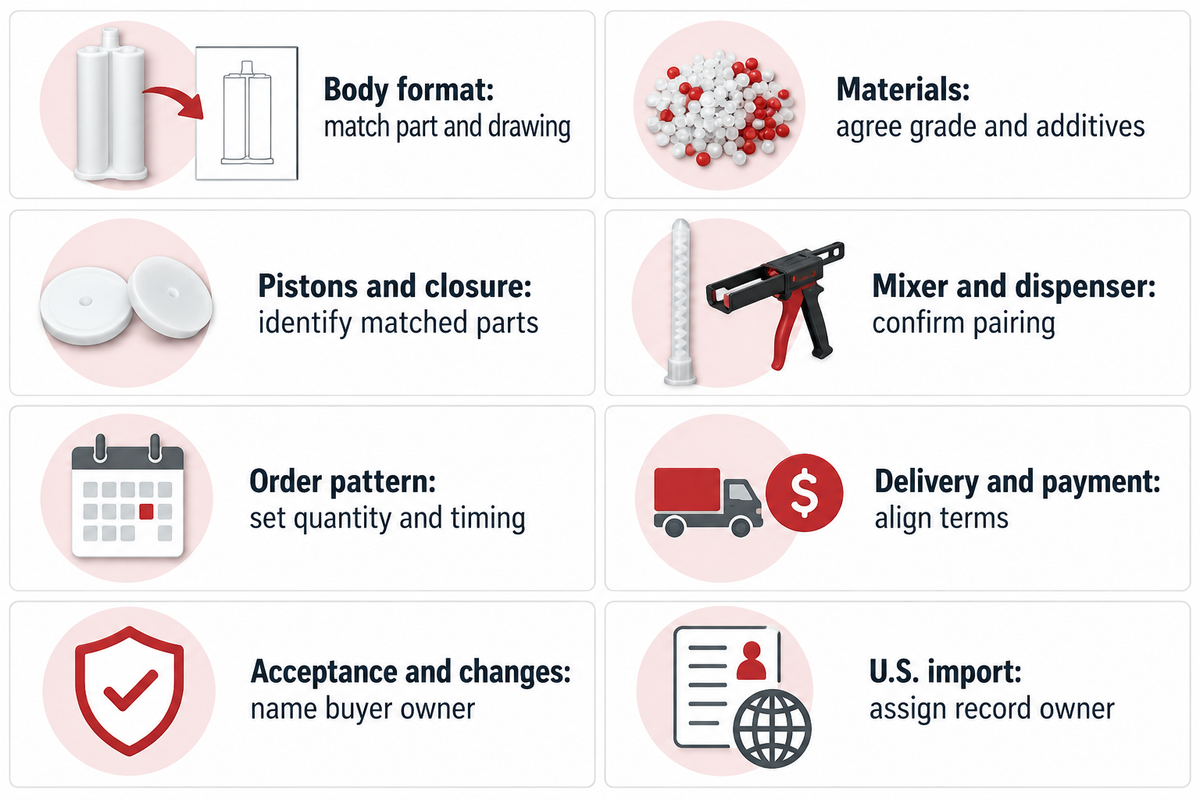
China sourcing in 2026 requests details of recent certifications and evidence of handling material changes, together with the same complete-assembly description. ISO has published a revised quality-management-system edition, while cartridge development includes changing material choices. Indicate the relevant edition, material grade and change-contact details in the request to ensure that suppliers respond to the same purchasing questions.
Keep the edition and material-change questions current
ISO identifies ISO 9001:2026 as the current edition and describes a three-year transition for organizations certified to the previous edition. A buyer reviewing a supplier’s certificate should preserve its covered entity, scope and dates and the certification body’s transition information. A 2015 certificate and a 2026 standard reference should be read in that transition context rather than automatically treated as the same document.
The comments regarding material are practical as well. The February 2026 ASI cartridge systems article discusses the development of materials and the role of defined specifications. Its authors are from medmix. Their article describes product development and testing and indicates the work of that company. The purchasing action is to keep any proposed resin or additive change tied to the affected assembly, approved properties and review owner.
New buyers can start sourcing with one completed request rather than a broad request for “best price.” Suppliers in China can respond more precisely when the target market, intended delivery condition and part references are clear. The same brief also provides a common task for an agent, distributor, or inspector. Successful sourcing becomes a series of resolved order fields, rather than a larger collection of unrelated supplier brochures.
A new purchase of empty cartridges from China in 2026 would prompt the sourcing questions to describe which assembly, which seller, and which quoted scope and which owner. Keeping those answers together requires attention to detail at the handoff between procurement and the filling line. The completed brief describes the accepted references rather than presenting a new set of unanswered questions.
A filled request for an empty 400 mL assembly
Include the fields below in your request. The 400 mL, 2:1 entry is an example format given in the catalog, and the buyer will need to insert their own approved drawing, parts and delivery requirements. “Open” means an answer is still required before that item is considered approved. Keep the supplier’s responses to the same line, rather than placing the responses in a separate chat.
RFQ checklist: copy these fields into your quote request.
| Parameter | Recommended range | Why it matters | How to verify |
|---|---|---|---|
| Body format | 400 mL nominal;2:1; empty body | Identifies the starting catalog family | Match the quoted part and drawing revision |
| Material and wetted parts | Exact grade/additives:open | Keeps the approved material identity intact | Review agreed material specification and application record |
| Pistons and closure | Matched A/B pair; complete closure:references open | Defines the complete assembly | Compare supplier response with the approved parts list |
| Mixer and dispenser | Selected references and mixer quantity:open | Connects purchasing to the intended equipment | Review the complete mating assembly |
| Order and release pattern | Quantity, frequency and required date:buyer to fill | Lets the supplier price the actual demand | Read MOQ, packing and stock commitments together |
| Delivery and payment | Currency, validity, rule/version, named place:open | Gives finance one commercial boundary | Reconcile charges, payment milestones and payee |
| Acceptance and changes | Agreed lot checks and buyer owner:open | Routes a defect or substitution to the right person | Attach the approved criteria and written change path |
| U.S.import handoff | Importer contact and traceability record owner:open | Connects the supplier response to entry work | Import team reviews the required upstream records |
Confirm the quoted MOQ for the exact item, the component pack quantities and whether the offer covers loose or assembled parts. Ask for the body, piston, closure and mixer references, the material description and any production or subcontractor differences. Verify the contracting/payee arrangement through established contacts, and assign the buyer responsible for each open technical or import question. Keep these requests in one brief so that every supplier can return a comparable answer.
Choosing the right order size also means deciding what happens after qualification. The first order can establish the agreed receiving record and document flow, then regular releases can follow the approved assembly and change terms. A sourcing partner in China can support the work, while the decision for acceptance remains with the buyer. This should be done prior to the release of a large order.
- Define the assembly ; Put the body, matched parts and drawing revision into one request.
- Resolve the quotation ; Align component inclusions, quantities and delivery scope.
- Release the approved order ; Record acceptance, lot identity and the owners of changes and import work.
The sequence keeps the commercial decision connected to the actual package. This also provides a supplier with a useful response path: quote the defined assembly, identify deviations, and resolve open items. Procurement can compare those responses directly rather than infer what short prices may include.
Key takeaway
Buy one defined assembly, compare the same delivered scope, and keep repeat orders tied to approved parts and a written change owner.
Frequently asked questions
How Do I Buy Directly from China Suppliers?
Buy directly against a defined empty-cartridge assembly and an identified contracting company.
Put the drawing revision, body material, piston pair, closure and mixer references in the request. Add the order quantity, delivery basis and acceptance owner so the manufacturer can quote a complete scope. Resolve deviations before placing the order, and keep the approved references in the production and receiving records. Direct communication works best when both sides are discussing the same purchased item.
Do I need someone in China to source safely?
Local support is useful when it fills a specific coordination or inspection gap.
A sourcing agent can handle defined communication, site follow-up or inspection arrangements, while the buyer keeps control of the specification and acceptance decision. Name the services, the fee basis and the party responsible for a defective delivery. If the buyer’s own team can manage those tasks, direct purchasing with separately commissioned support can also be a workable arrangement.
How can you ensure product quality before shipping?
Use an agreed inspection brief tied to the approved assembly and the identified shipment lot.
The brief should identify the applicable drawings, parts, material requirements and acceptance criteria. Keep dimensional checks, packing checks and application results separate, with their conditions and outcomes recorded. An inspector can review the defined lot; repeat purchases also need change notices and supplier follow-up. The quality owner should settle any discrepancy before the affected order is released for its intended use.
How much do Chinese sourcing agents charge?
Compare the agent’s written fee basis and included work for your specific purchase.
A percentage, a fixed fee and reimbursable visits describe different service arrangements. Keep minimum charges, supplier commissions and defect-handling duties beside the price. That makes the service comparable without relying on a universal fee percentage.
What payment methods are safest for international sourcing?
Use a payment arrangement your finance team can verify against the seller and agreed deliverables.
Keep payment terms, payee identity and order milestones in the same file. Finance should independently check a change of bank details through an established contact before money moves. If platform protection is offered, read its applicable terms, covered transaction and dispute process before relying on it. Payment controls work alongside the approved assembly and supplier checks; they do not replace those purchasing decisions or promise recovery after a dispute.
What should you do if you encounter a dispute with a supplier?
Describe the specific order discrepancy and use the agreed corrective-action process.
Preserve the drawing, order, lot identifiers, inspection results and correspondence. Name the requested remedy and keep replacements traceable. Procurement and quality should coordinate the response against the contract and the approved item.
Which company is the best for sourcing from China?
Choose the supplier that can fulfill your exact assembly, order pattern and agreed responsibilities.
For stable repeat packaging, direct technical access may suit the buyer. For small mixed orders, a distributor with the right traceable stock may fit better. A sourcing agent can fill a defined local coordination gap. Compare complete quotations, part records and the change-response path before making that choice. The best site to source products is only a discovery starting point; the purchasing decision concerns the particular seller and assembly.
Send an assembly request, not a barrel-only inquiry
Send Ebestron the nominal capacity and ratio, drawing or part references, and the list of pistons/closures/mixers, order pattern and destination. Fill in the blank fields from the brief, so the response can address the full purchase request. Begin with the available dual-cartridge formats, and request an empty cartridge assembly quote.
How this purchasing guide was prepared
GW prepared this Ebestron guide with public cartridge catalogs, and original institutional guidance and a completed purchasing model for empty two-component packaging. The 1,000-assembly exercise uses assumed inputs to explain quotation scope. The change-notice method assigns buyer responsibilities; it is an editorial purchasing aid rather than a reported factory trial or a claim of independent supplier certification.
References & Sources
- Sustainability Without Sacrifice: Reliable Cartridge Systems for Demanding Adhesive Applications ; Adhesives & Sealants Industry, February 17, 2026; Tobias Bodenmüller and Michael Kipperer, medmix.
- Conformity Assessment Basics ; National Institute of Standards and Technology; foundational assessment terminology.
- ISO 9001 explained ; International Organization for Standardization; certification-body role.
- FAQs: Uyghur Forced Labor Prevention Act Enforcement ; U.S. Customs and Border Protection; supply-chain documentation and importer responsibilities.
- Purchasing Managers, Buyers, and Purchasing Agents ; U.S. Bureau of Labor Statistics; procurement duties, updated 2026.
- FCA & EXW Incoterms 2020 explained: Key differences ; ICC Academy, Miguel Angel Bustamante Morales; January 7, 2025.
- What is Acceptance Sampling? ; NIST/SEMATECH e-Handbook of Statistical Methods,§6.2.1; foundational sampling guidance.
- ISO 9001:2026:What businesses need to know ; International Organization for Standardization; current edition and transition.