Get in touch with Ebestron Company

Updated July 2026 | Reviewed for adhesive packaging fit by Ebestron
To the plant, workshop, and purchasing teams, 1K versus 2K adhesive might seem like a chemistry discussion, but it becomes a process question. How will the adhesive cure, how much risk does the operator carry, and can the packaging system maintain the mix ratio through an entire bead run?
The simple answer is: Use 1K adhesive when the task favors a simple dispensing setup and the trigger for cure is easily controlled. Use 2K adhesive when the bond requires controlled room-temperature cure, gap filling, or a chemical reaction only initiated after two materials are combined. Then, consider the packaging.
Quick Specs: 1K vs 2K Adhesive
| 1K adhesive | One component. Cures by a chemistry-specific trigger such as moisture, heat, UV or visible light, oxygen exclusion, surface moisture, or metal activation. |
| 2K adhesive | Two separate components. In epoxy, this is usually resin and hardener; cure begins after the streams are mixed. |
| Main process risk | 1K: trigger and environment. 2K: mix ratio, static mixer, pot life, cartridge or meter-mix equipment, and operator discipline. |
| Packaging decision | 2K may use a small cartridge, dual cartridge, syringe, pail-and-meter-mix system, or bulk setup. Packaging is not the same thing as the adhesive chemistry. |
| Best first question | Can the line control cure, ratio, bead length, pot life, and waste with the equipment it already has? |
1K advantages
- No on-site resin/hardener mixing step.
- Lower setup burden for operators.
- No static mixer waste when the job pauses.
- Works well if heat, moisture, UV, or other curing trigger is consistent.
2K advantages
- Cure starts when the two components meet.
- Selected chemistries may allow for easier room-temperature cure and gap-filling properties.
- Work-window selection can come from the adhesive grade.
- Packaging can separate components until the moment of dispense.
What 1K And 2K Mean In Adhesive Systems
In the language of adhesives and sealants, 1K stands for one component, and 2K for two components. The letter “K” is German for component. One-part adhesives are ready to use as they come in one container. Two-part adhesives keep their two reactive components separated until time of application.
According to Adhesives & Sealants Industry, 2K adhesives are typically epoxies, reactive acrylics or polyurethanes. 1K adhesive can range from moisture-curing, heat-curing, UV or visible-light curing, cyanoacrylates to anaerobic chemistries. Thus, the 1K or 2K indication only tells you the component count, not the entire material profile.
Although one-part polyurethane sealants, heat-curing 1K epoxies, UV adhesives, and anaerobic threadlockers all fall under the 1K umbrella, they cure differently. Two-part epoxies, 2K polyurethane adhesives, 2K MMAs and 2K acrylic adhesives vary significantly by chemistry, strength characteristics, odor profile, substrate suitability and working time.
Packaging selection should follow adhesive selection, not precede it. For 2K cartridges, proper sealing, ratio and mixing rely on a precise match between the gun, plunger, mixer and working time of the adhesive.
Ebestron technical review note, adhesive packaging team
Cure Mechanism: External Conditions vs Resin/Hardener Reaction
The most significant difference between 1K and 2K adhesives isn’t the number printed on the cartridge, but the control mechanism for cure. In practical terms, it determines whether the process is controlled by environmental conditions, the application equipment or the mixed material.
Many 1K adhesives require an external condition to initiate cure. For example, 1K moisture-curing polyurethane and silicone need the presence of moisture to penetrate the bond line. UV adhesives require light exposure to achieve curing. Heat-curing epoxies rely on a specific temperature profile, and anaerobic adhesives require a lack of oxygen and the presence of metal ions to initiate curing. When this external factor is reliable, the job is straightforward. If this factor is disrupted, however, the adhesive might remain soft, cure slowly, or fail in the middle of thick bond lines.
With 2K adhesives, many of these uncertainties are transferred to the dispensing stage. Once the two components are mixed, a chemical reaction starts, and the buyer has more control over the initiation of the cure process. However, this control comes at the cost of process risk: the operator must maintain a correct mix ratio, use the right static mixer, limit pause times after mixing, and complete the adhesive bead within the adhesive’s pot-life.
Engineering Note
If a 2K adhesive is labeled with a 5-minute work life, that timer starts at the mixing process, not after the bead hits the part. A long hose, long static mixer, periodic pauses, or a hot shop will use up that work time before you can join parts.
Strength, Durability, And Adhesive Failure Risk
Many purchasing conversations start with the wrong question, “Is 2K stronger than 1K?” A better question is, “Which adhesive system achieves the target bond strength under our surface prep, bond-line thickness, cure schedule, and service environment?”
ASTM D1002-10(2019), Apparent Shear Strength of Adhesively Bonded Metal Single-Lap-Joint Specimens, defines a standard test method for lap shear. It goes on to explain, “Values from small single-lap specimens are generally not directly transferable to adherends other than metals, or to bond-lines of significantly greater thickness, other environmental conditions or joining process.” Simply put, a lap shear number proves capability of an adhesive system under test conditions, it’s not an unqualified promise on a real part.
In “Adhesion and Performance of an Epoxy Adhesive Used for Bonding” an open-access research article published in Materials it was reported that incorrect hardener-to-epoxy ratios degraded the joint strength. While the article’s results were specific to epoxy, the general lesson for 2K systems holds that accurate mixing ratios are a component of bond strength control.
The labels matter too. The public SIS page for ISO 10365:2022 describes its standards covering the main categories of adhesive joint failure patterns. Quality teams should, upon examination of a failed bond, sort out adhesive cohesion, substrate adhesion, substrate failure, and mixed failure before concluding the chemistry is to blame.
| Observed failure | Likely question to ask | Next check |
|---|---|---|
| Soft or tacky bond | Did the mix ratio drift or did the bead miss the required cure window? | Purge sample, cure coupon, cartridge ratio, adhesive date code. |
| Clean peel from substrate | Was the surface cleaned, abraded, primed, or activated as the adhesive data sheet requires? | Surface prep log, contamination check, substrate trial. |
| Streaked or two-color bead | Did the static mixer provide enough elements for the ratio and viscosity? | Mixer type, element count, first-bead purge, flow balance. |
| First joint fails, later joints pass | Was the off-ratio leading bead discarded before bonding? | Operator work instruction and purge length. |
Cost And Equipment: What Changes When You Move From 1K To 2K
The cost of 1K adhesive is easy to calculate, and often just the sticker price on the container – tube, cartridge, pail, film. Hidden costs accrue when cure is slow, blocked, requires specialized heating or UV equipment, or when the bond-line thickness is greater than the cure trigger can penetrate.
2K adhesive cost is less visible, more distributed. The actual adhesive may only be a fraction of a line item on a quote. Working system costs for 2K may include dual cartridges, static mixers, guns, caps, purge waste, training time, ratio check efforts, and parts scrapped for off-ratio material. Financial buyers who look at a quote often miss this; production floor managers who see stoppages and scrapped assemblies rarely do.
Cost-per-accepted-bond worksheet
- Adhesive used per part, in ml.
- Purge and mixer waste per job start, in ml.
- Static mixer cost per session.
- Operator minutes for load, equalize, purge, dispense, and cleanup.
- Rejection rate from under-cure, streaked bead, air void, or improper surface preparation.
- Rework cost per rejected part.
After completing this worksheet, a 2K adhesive that appeared to be more expensive on a per-ml basis may emerge as the more economical choice if it can improve cycle times or reduce field failures. Conversely, it might lose out if the shop isn’t equipped with the right gun, mixer, or training. Total accepted bond wins, not just initial price.
Pot Life, Open Time, And Production Speed
Pot life, open time, fixture time, and full cure are all distinct measurements. Pot life indicates the working time after adhesive mixing. Open time is the duration an applied adhesive can remain exposed before assembly of parts. Fixture time is the time at which an assembled product may be safely handled. Full cure is the point at which an adhesive reaches the tested and stated properties.
For 1K, the relevant question is often whether the cure trigger reaches the whole bond. For 2K, the relevant question is whether the plant can finish the planned bead before the mixed adhesive thickens, gels, or cures in the mixer. Long beads in a 600 ml cartridge can be fine for one adhesive and risky for another adhesive with shorter pot life.
To determine if it works, test with a full representative bead in a gun/mixer at your shop temperature. Document start time, purge length, bead length, whether shots were interrupted, and when trigger pressure changed. If the mixer resistance occurs before you finish the bead, the issue may involve work life, mixer length, adhesive viscosity, cartridge volume, or gun thrust, not just adhesive chemistry.
When 2K Adhesive Needs Dual Cartridges, Static Mixers, And Ratio Control
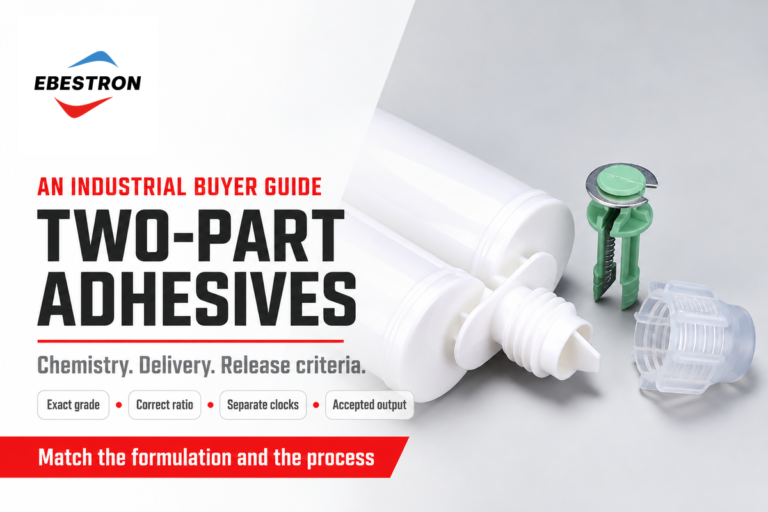
Two-part adhesives require separation but not necessarily dual packaging. They can come in small side-by-side tubes, larger dual syringes, larger dual cartridges, pails, drums or be dispensed through meter-mix equipment. Dual packaging options usually follow selection of adhesive type, volume required, desired bead length, and production process.
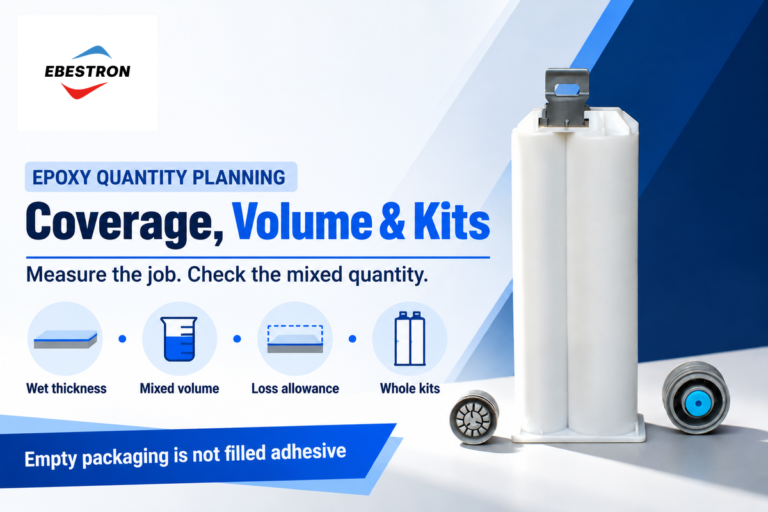
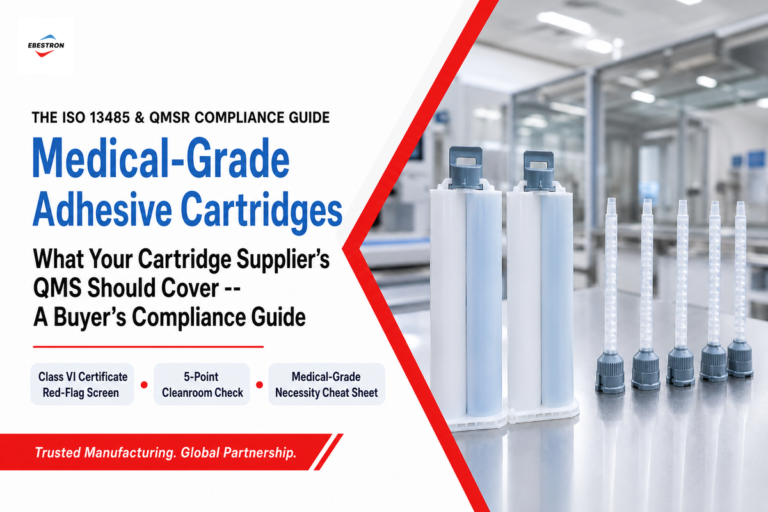
Ebestron’s 400 ml and 600 ml product family is designed for side-by-side two-component adhesive packaging, with listed ratio options including 1:1, 2:1, and 4:1, material choices such as PP, PA, and PBT, and B/C-System side-by-side bayonet outlets. For buyers already in a 2K cartridge workflow, see Ebestron’s 400 ml and 600 ml dual cartridges for two-part adhesives.
2K Packaging Readiness Checklist
- Mix ratio (1:1, 2:1, 4:1, 10:1 or any ratio from adhesive data sheet).
- Viscosity balance (equal or uneven flow rates of the two components).
- Shot size: ml per part and ml per shift.
- Bead length (short spot, repeated bead application or long continuous bead).
- Work life (time to gel after static mixer at shop temperature).
- Mixer fit: inlet, element count, length, and outlet diameter.
- Gun fit (cartridge size, ratio drive, thrust, and manual, pneumatic or battery-powered gun type).
- Body material (PP, PA, PBT or other suitable material depending on the chemistry of the adhesive).
That checklist also defines a better RFQ. Instead of asking only for “a 2K cartridge,” procurement can send ratio, viscosity, shot size, bead length, pot life, mixer requirement, and gun type. QA can add acceptance checks. Finance can compare waste and rework. Plant managers can decide whether cartridges still fit the volume or whether a meter-mix setup should be evaluated.
1K vs 2K By Chemistry: Epoxy, Polyurethane, MMA, Silicone, And Acrylic
A two-component adhesive is not necessarily different from a one-component adhesive simply by the number of components. A one-component epoxy and a two-component epoxy might both be acceptable, but each has a different cure and packaging approach. A one-component polyurethane sealant may not perform the same functions or require the same speed as a two-component polyurethane adhesive with respect to bond line thickness, strength and durability. MMA and acrylic systems have different smell, speed and adhesion characteristics to substrates. Silicones can perform the function of seals, potting and accommodating movement but may not require the strength that some epoxy applications demand.
| Chemistry | 1K question | 2K question | Packaging question |
|---|---|---|---|
| Epoxy | Can the part accept the required heat or activation method? | Can resin and hardener be mixed on ratio within the work window? | Does the bead fit syringe, cartridge, dual cartridge, or meter-mix use? |
| Polyurethane adhesive | Can moisture reach the bond line at the needed depth and speed? | Does the process need controlled cure through thicker material? | Can the cartridge and mixer handle viscosity and cure speed? |
| MMA / acrylic | Is the one-part format suitable for the substrate and work environment? | Does the job need fast structural cure and controlled open time? | Can operators manage odor, speed, purge, and mixer changes? |
| Silicone | Will moisture cure reach the full bond or seal depth? | Does the job need a two-part cure for thicker sections or potting? | Will the package prevent air, cross-contamination, and flow imbalance? |
The most direct guide to comparing specific epoxies to MMAs and polyurethanes can be found in Ebestron’s epoxy vs MMA vs polyurethane guide, rather than on this page, which focuses on the one component vs. two component adhesive decision and packaging.
Decision Matrix: Choose 1K, 2K Cartridge, Or Meter-Mix
Most of the 1K vs 2K arguments come down to production workflow. The decision matrix below keeps the curing process, packaging constraint, and accepted-bond cost in one decision map.
| Path | Use when | Hidden bottleneck | Next action |
|---|---|---|---|
| 1K adhesive | Cure trigger is controlled, the bead is not too deep for that trigger, and the shop wants fewer dispensing steps. | Blocked moisture, weak UV reach, missing heat cycle, or slow center cure. | Confirm cure schedule on the adhesive data sheet and trial the thickest bond line. |
| Small 2K cartridge or syringe | Trial work, repair, low shot volume, lab bonding, or a short bead within one work-life window. | Off-ratio first bead, trapped air, and poor mixer fit. | Run a purge coupon and verify mixed bead color, cure, and failure mode. |
| 400 ml / 600 ml dual cartridge | Repeated medium-to-long beads, higher shot volume, side-by-side package fit, and manual, pneumatic, or battery dispensing. | Gun thrust, ratio drive, pot life, and mixer waste over repeated starts. | Send ratio, viscosity, shot size, bead length, and gun type for cartridge-fit review. |
| Meter-mix system | Repeated use of the same chemistry runs at production volume and cartridges create too much mixer waste or loading time. | Cleaning, calibration, downtime, capital cost, and changeover if several adhesives are used. | Compare cost per accepted bond, not only equipment price. |
For the tooling side of that decision, use Ebestron’s 2K dispensing gun selection guide, static mixing nozzle type guide, and static vs dynamic mixing comparison. They cover the hardware details that this page only flags.
Common Buyer Mistakes
Most poor 1K vs 2K decisions come from asking the wrong first question. Use the list below when procurement, QA, and production teams review an adhesive change.
Off-Ratio Failure Triage
- Treating 2K as automatically stronger. Ask for the adhesive data sheet, test method, substrate, bond-line thickness, and cure schedule.
- Ignoring pot life after the static mixer. A 2K adhesive that works on a short bead may fail on a long run if it gels before the bead is complete.
- Choosing the wrong ratio cartridge. A 2:1 adhesive does not belong in a 1:1 drive system.
- Pairing stiff material with an underpowered gun. High viscosity and cold storage can turn a hand gun into a ratio problem.
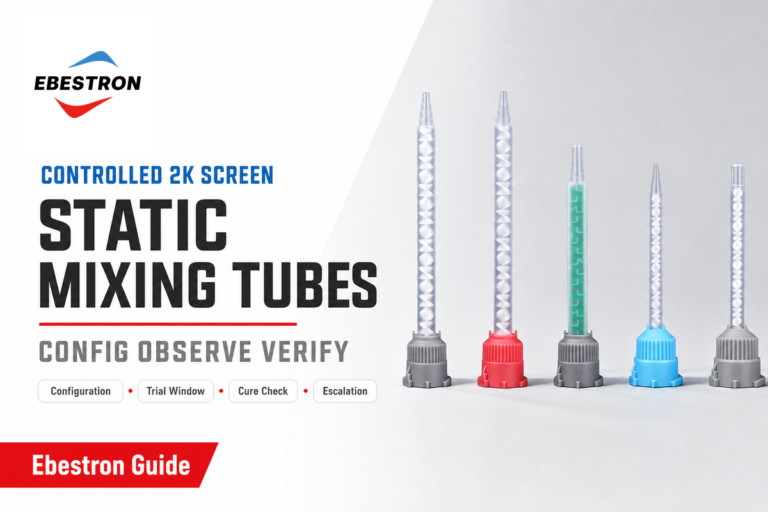
- Using a mixer as a generic accessory. Mixer inlet, element count, length, and outlet size affect bead quality.
- Skipping the first-bead purge. The first material through a new mixer can be off ratio; trial it before the part.
For step-by-step procedure, Ebestron’s two-part adhesive cartridge guide owns that workflow. For fault diagnosis after a failed bead, see the 2K dispensing problems guide.
2026 Outlook: Process Control Matters More Than The Label
Related demand appears around two-part epoxy adhesive, polyurethane adhesive, static mixers, adhesive cartridges, and dispensing guns. Exact query “1K vs 2K adhesive” has no reported search volume, but the live search results show clear comparison intent. That points to an article role: educate the buyer before the product-page visit.
In 2026, the practical shift is not simply “more 2K.” Decision pressure is rising on mixed-material bonding, field repair, electronics potting, panel bonding, and production lines where the cost of a failed bead is visible. Buyers will ask for faster cure, lower rework, and less waste. Possible answers include 1K, 2K cartridge, or meter-mix. Correct choice is the one your shop can run repeatedly with measurable cure, ratio, and failure-mode checks.
Ask Ebestron To Check Your Cartridge Fit
Ebestron manufactures adhesive dispensing guns, dual cartridges, and mixing tubes in Jiangsu, China, with research and development, production, sales, and customer service under one adhesive packaging system supplier.
Send the adhesive ratio, viscosity, shot size, bead length, expected work life, and current gun type. Ebestron’s response can focus on whether a 400 ml or 600 ml dual cartridge, mixer, and gun setup fits the process.
Frequently Asked Questions
What is the difference between 1K and 2K adhesive?
View Answer
1K adhesive has one component and cures by a chemistry-specific trigger. 2K adhesive has two components that are mixed before cure. In factory use, the difference reaches beyond chemistry: cure trigger, equipment, work life, ratio control, packaging, and operator training all affect whether the bond is repeatable.
Is 2K adhesive stronger than 1K adhesive?
View Answer
No. Strength depends on chemistry, surface prep, substrate, bond-line thickness, cure schedule, loading type, and service environment.
What is the difference between 1K and 2K epoxy?
View Answer
1K epoxy is supplied as one material and often needs heat or another activation condition. 2K epoxy keeps resin and hardener separate until application. After mixing, the epoxy system begins curing, so ratio control and pot life become part of the process.
Does every 2K adhesive need a static mixer?
View Answer
Cartridge-based 2K adhesive usually needs a static mixer or another controlled mixing method. Bulk production may use meter-mix equipment. Hand mixing can work for small samples, but structural or repeatable production work should not rely on guesswork because ratio streaks, air pockets, and short work life can hide inside one good-looking bead.
When should I use a 400 ml or 600 ml dual cartridge?
View Answer
Use larger dual cartridges when the job has repeated beads, higher shot volume, and a work-life window that fits the planned run. Before choosing 400 ml or 600 ml, record ml per part, bead length, ratio, viscosity, mixer type, purge length, and expected starts per shift. Do not size only by cartridge price; include purge waste, mixer changes, gun thrust, and whether the bead can be completed before the adhesive gels.
About This Analysis
This guide is for users comparing 1K and 2K adhesive systems as they decide on which cartridges, guns, and mixers to use. It uses a combination of Ebestron first-party packaging data, public standards web pages, industry press, and open-access research. Users must always verify specific adhesive performance data with the supplier’s technical data sheet and a trial under the intended substrate, bead size, and cure conditions.
Related Ebestron Resources
- 400 ml / 600 ml dual cartridges for larger two-component adhesive packaging.
- What is a static mixer? A primer for readers new to cartridge mixing.
- Mixer element selector for static mixer planning.
- Ratio weight / volume converter for ratio checks.
- Thrust ratio drive selector for gun fit review.
- Static mixers for cartridge-based two-component dispensing.
- Dispensing guns for manual, pneumatic, and production use.
References & Sources
- Understanding Two-Component Adhesives – Adhesives & Sealants Industry.
- ASTM D1002-10(2019) – ASTM International.
- Adhesive Standards – ASTM International.
- ASTM D1002 Lap Shear Testing Guide – Instron.
- Adhesive Joint Degradation Due to Hardener-to-Epoxy Ratio Inaccuracy – Materials via PubMed Central.
- ISO 10365:2022 public scope page – Swedish Institute for Standards.
- 400 ml & 600 ml Dual Cartridges – Ebestron.