Get in touch with Ebestron Company


Updated July 2026
Two part adhesive dispensing is a controlled process for metering, mixing and placing two reactive adhesive components through a cartridge or bulk-feed path. It runs from piston movement to static mixer design, post-mix bead inspection, operator protection and supplier validation. Many buyers choose two part adhesive guns by just looking at cartridge cost, unaware that it can lead to ratio failure, lost purge or rejected beads.
This buying guide is intended for factories looking to compare two-component adhesive cartridges (empty or filled), adhesive dispensing guns, static mixers, and meter-mix dispensing equipment. First, determine what samples you should request, what measurements to take, and what to include in the Request for Quote, all before you start seeing streaks or slow curing.
Quick Specs
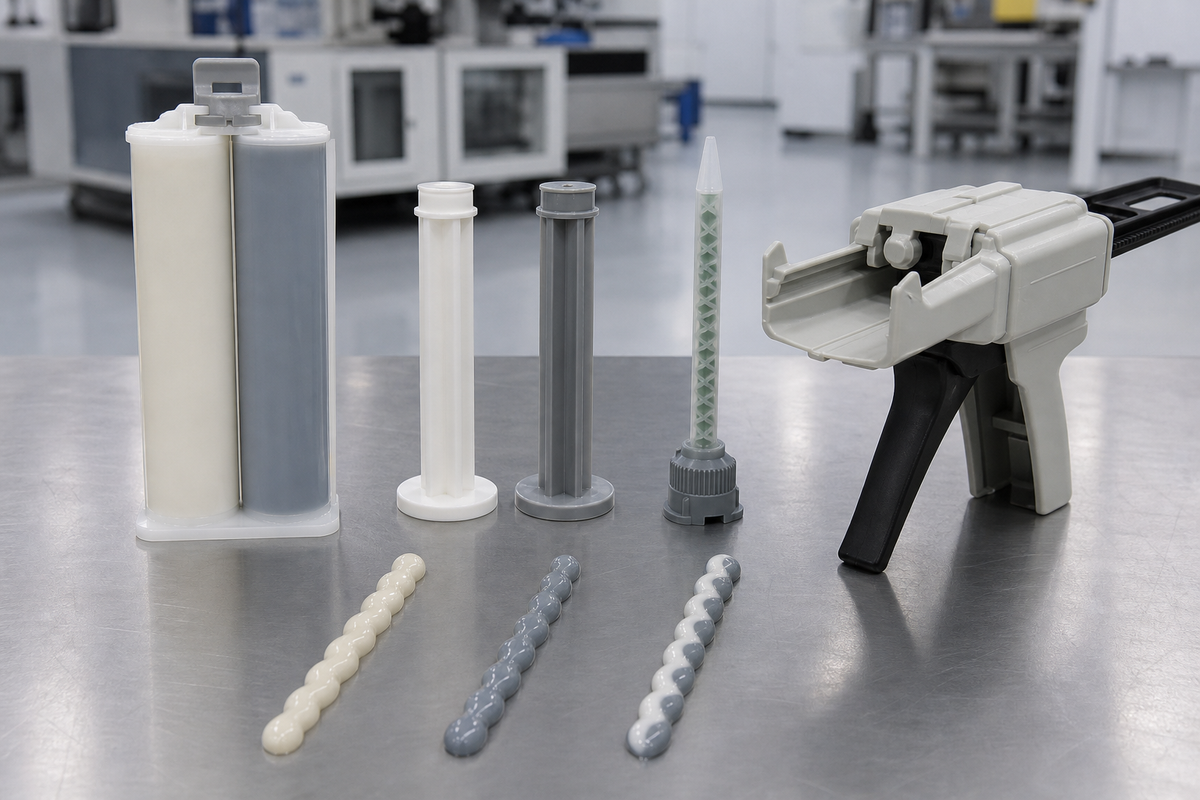
| System choices | Manual cartridge gun, pneumatic cartridge gun, automated cartridge dispense, meter-mix dispense equipment |
|---|---|
| Ebestron public cartridge range | 50ml, 75ml, 100ml, 200ml, 250ml, 400ml and 1500ml; 1:1, 2:1, 4:1 and 10:1 ratios |
| Material path | PP, PA and PBT barrel options; chemistry fit still requires SDS review and sample validation |
| Best first action | Measure ratio, viscosity, shot volume, purge practice, mixer retained volume and acceptance criteria before asking for price |
What Two Part Adhesive Dispensing Means In A Factory
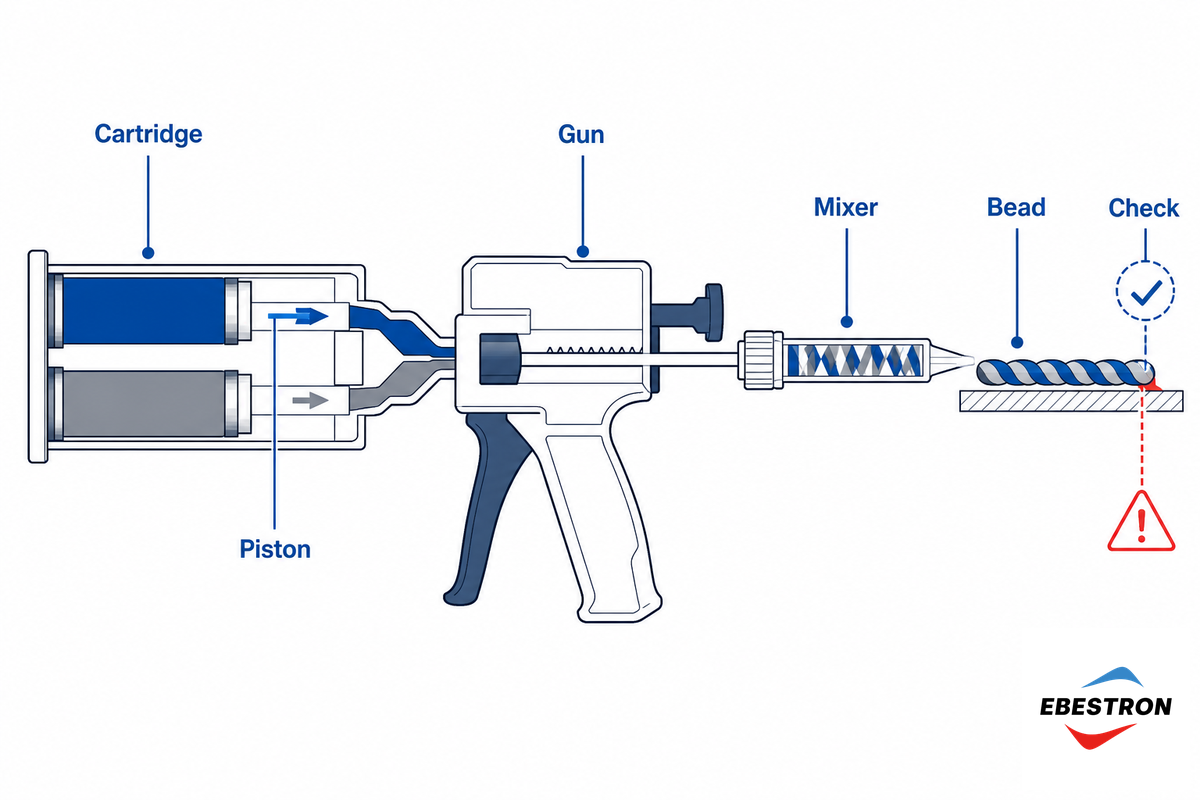
Two component adhesive dispensing is the practice of accurately measuring and mixing two materials that cure upon contact to achieve the desired bead characteristics in the specified application area. In practice, the dispensing process combines the material’s data sheet, the storage (cartridge/tank), the path to dispensing (pistons), the dispensing tool (gun/valve), the mixing tool (static mixer), the shape of the final bead, and the inspection criteria used.
This “6-Link Chain” is critical, as no two-component adhesive is forgiving of loosely controlled dispensing processes. Even with a standard 10:1 ratio cartridge, uneven piston travel, improper purging of the initial mixed material, or the wrong static mixer for the adhesive’s viscosity, will result in a flawed bead. Likewise, even a meter-mix dispenser will fail if maintenance and calibration isn’t up-to-date or the material isn’t properly conditioned prior to use.
For a purchasing team, a better approach than “which two part epoxy gun is best” is to ask “which dispensing system architecture best controls the single biggest risk to my process: changeover time, off-ratio curing, pot life, retained waste, operator exposure, production rate, or quote predictability?”
That is why the same project appears in purchasing research as adhesive dispensing systems, epoxy dispenser, adhesive dispensing equipment, robotic adhesive dispenser, 2 part epoxy dispensing equipment, automated adhesive dispensing system or two part epoxy dispenser. Related sourcing language such as two component epoxy dispensing systems, two component 2k dispensing, dual component cartridge guns, meter mix dispense equipment and two part adhesive dispensers points to the same factory problem: the buyer must match tool architecture to chemistry, application risk and validation evidence before price comparison.
System Selection: Cartridge Gun, Pneumatic Gun, Automation Or Meter-Mix?
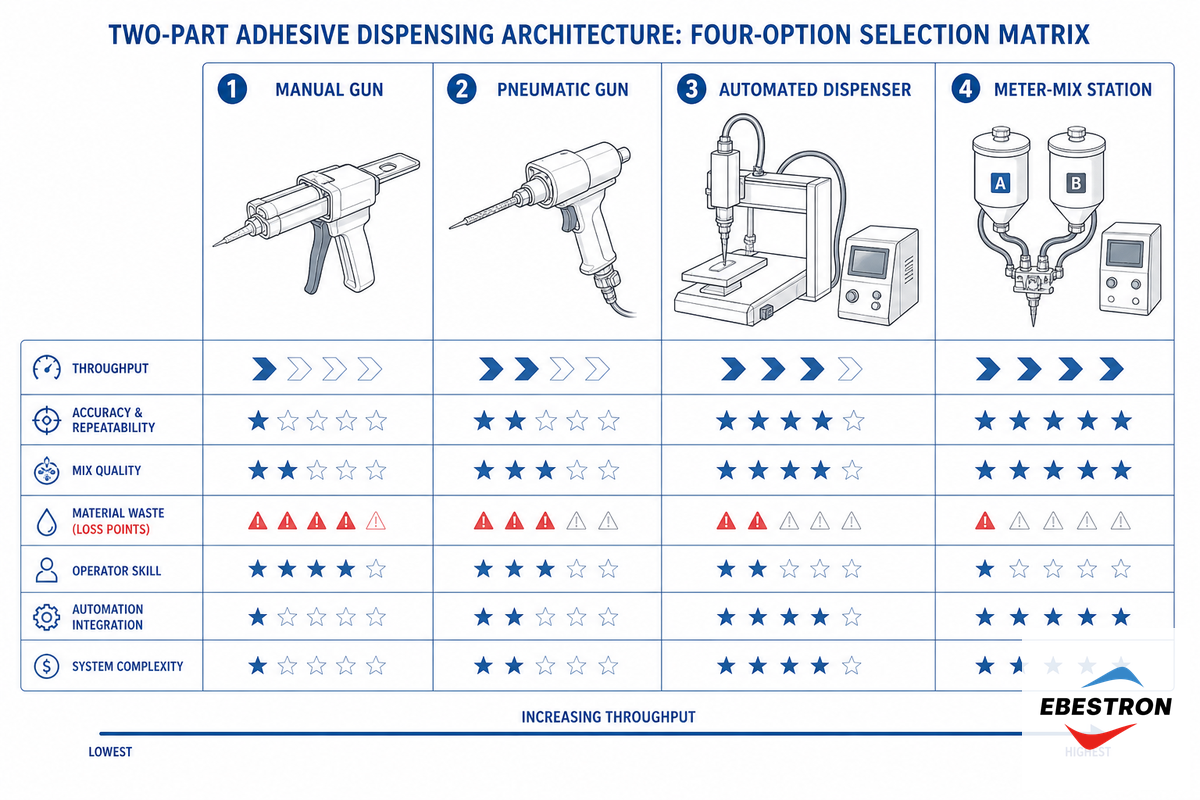
When considering new dispensing equipment, identify the underlying process bottleneck before consulting the product catalog. Cartridge dispensing is generally the more practical option for testing, repair, lower-volume production, or jobs with a high product mix. Meter-mix equipment begins to make sense when the constraint is high volume, the need for automation, real-time ratio monitoring, or the potential for worker exposure and high-volume bulk material economics.
| Hidden bottleneck | Cartridge dispensing usually fits | Meter-mix usually fits | Limitations / not suitable for |
|---|---|---|---|
| SKU changeovers | Frequent chemistry or color changes; sample lab; service kits | Stable product family and repeat setup | Cartridges can be costly if every shift discards many mixers |
| Ratio assurance | Good when cartridge geometry, pistons and purge practice are controlled | Better when continuous monitoring, metering and data logging are required | No system removes the need for sample validation |
| Capital risk | Lower initial setup, easier trial and lower maintenance burden | Higher commitment, but may support uptime and throughput where line volume is stable | Avoid universal payback claims without plant data |
| Waste visibility | Mixer retained volume and purge loss are easy to estimate | Bulk feed can reduce cartridge handling, but flushing and maintenance waste still exist | A cheap nozzle can be expensive if retained volume is high |
| Operator exposure | Good for controlled small quantities if SDS, PPE and ventilation fit the chemistry | Better when exposure control needs enclosed feed, fixed work cells or written procedures | MMA and PU systems need safety review, not only tool review |
| RFQ readiness | Send cartridge size, ratio, viscosity, mixer interface and trial quantity | Send flow rate, shot pattern, automation signals, cleanout method and uptime target | Do not ask for a price before defining acceptance criteria |
This table serves as a guide to the buying decision rather than an absolute benchmark. Data available from the supply chain points the direction for these decisions but offers no universal “daily shot count” threshold that works for every adhesive, substrate, bead design, or line.
The 6-Link Ratio-Control Chain
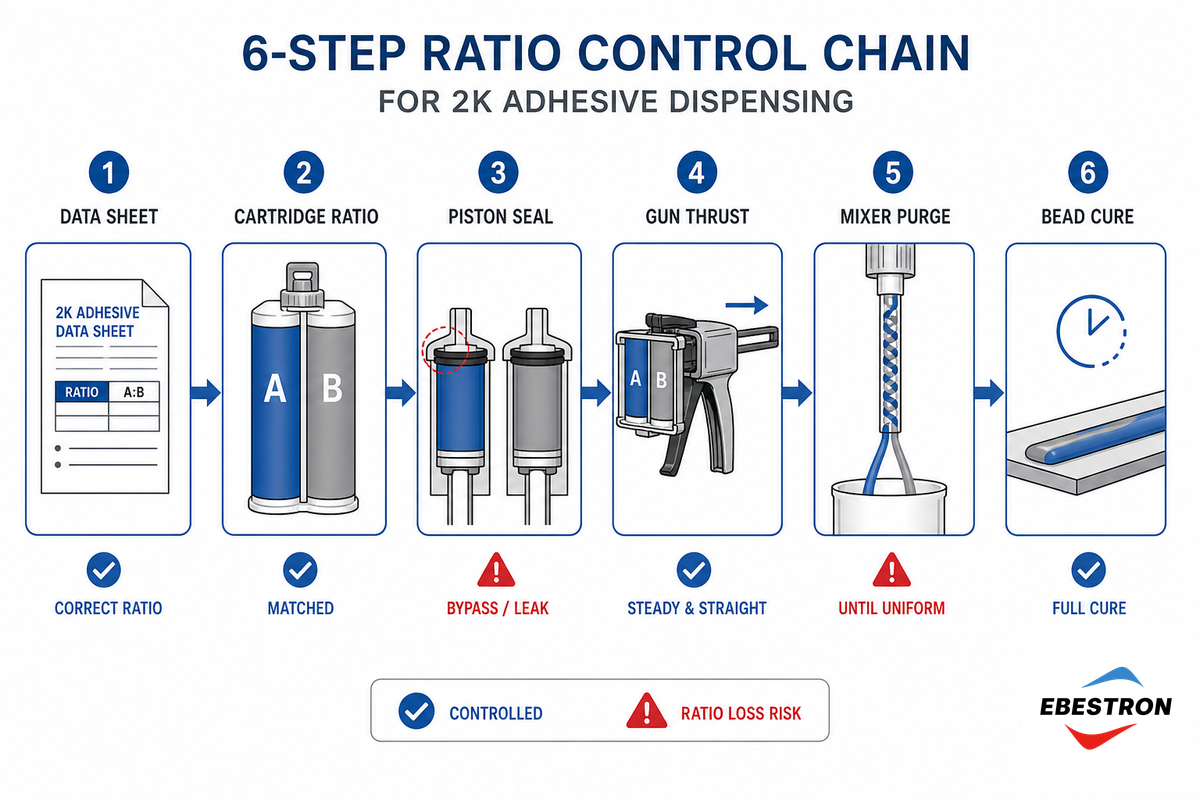
Use the 6-Link Ratio-Control Chain to identify problems with your dispensing ratio before blaming your cartridge supplier. It connects the data-sheet ratio, cartridge chamber design, piston travel, mixer design, purge effectiveness, and bead inspection criteria.
Reports from the field indicate that the top problems in two-component adhesive dispensing include incorrect mix ratio, premature cure within the static mixer, and over-purging. Each failure manifests in similar results on the part but require a unique solution.
| Link | What can go wrong | What to verify | Limitations / not suitable for |
|---|---|---|---|
| 1. Ratio translation | Weight ratio is mistaken for volume ratio | Compare adhesive TDS ratio basis with cartridge ratio | Do not assume 1:1 by volume equals 1:1 by weight |
| 2. Cartridge geometry | Wrong chamber footprint or piston pair | Confirm A/B/C/F/S system and ratio footprint | Footprint-compatible does not mean every accessory is interchangeable |
| 3. Piston movement | Piston lag, trapped air or blow-by | Check first-shot balance and piston seal condition | A new cartridge will not fix a damaged gun thrust plate |
| 4. Mixer choice | Fit is correct but element count or diameter is wrong | Match interface, viscosity, ratio and outlet; validate on the actual adhesive | Element count alone is not a guarantee of residence-time behavior |
| 5. First-shot purge | Unmixed front material enters the part | Set a purge rule by mixer volume and application risk | Do not reuse disposable static mixers after cure starts |
| 6. Bead inspection | Streaks, soft cure or voids are found too late | Define color, hardness, cure window and sample pull checks | Small coupon results are not design allowables without engineering review |
Static Mixer Selection: Interface, Element Count And Waste
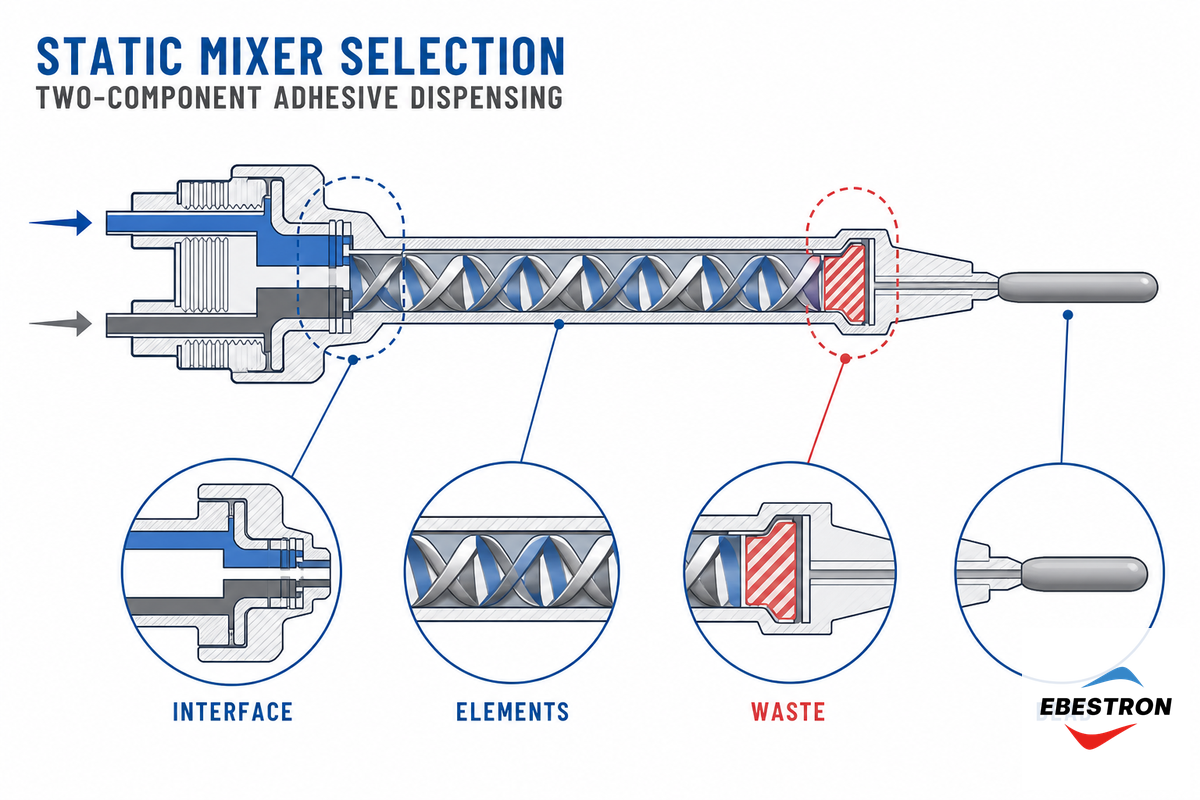
While static mixers are designed for easy integration with a cartridge, simply matching the connection point isn’t sufficient. At the outlet, the mixer can mask an incompatible adhesive if factors such as viscosity, ratio, pressure drop, flow rate, pot life, and bead design exceed the mixer’s limitations.
Nordson’s published static mixer guidance ties choice to cartridge, material, mixed viscosity, and housing outlet types, and different sample element ranges by chemistry. Ebestron’s public tools ask for the mix ratio, viscosity, and viscosity gap, then suggest a starting element count, cautioning buyers to validate with their actual adhesive.
“18 elements or 24 elements?” is therefore not the right question.
Instead ask, “What’s the shortest mixer that ensures complete mixing at the actual flow rate, bead size, and working time we use?” A shorter mixer can reduce residual waste, but if it’s too short it can lead to streaking. A longer mixer can improve mixing, but it also increases back pressure and discards more cured material during each tip change.
Buyer check:
Obtain from suppliers an initial mixer recommendation and then validate with your actual adhesive, substrate, bead size, open time, and dispense speed. Use element-count tables to screen possibilities, not as definitive process approval.
Chemistry Fit: Barrel Material, SDS And Process Validation
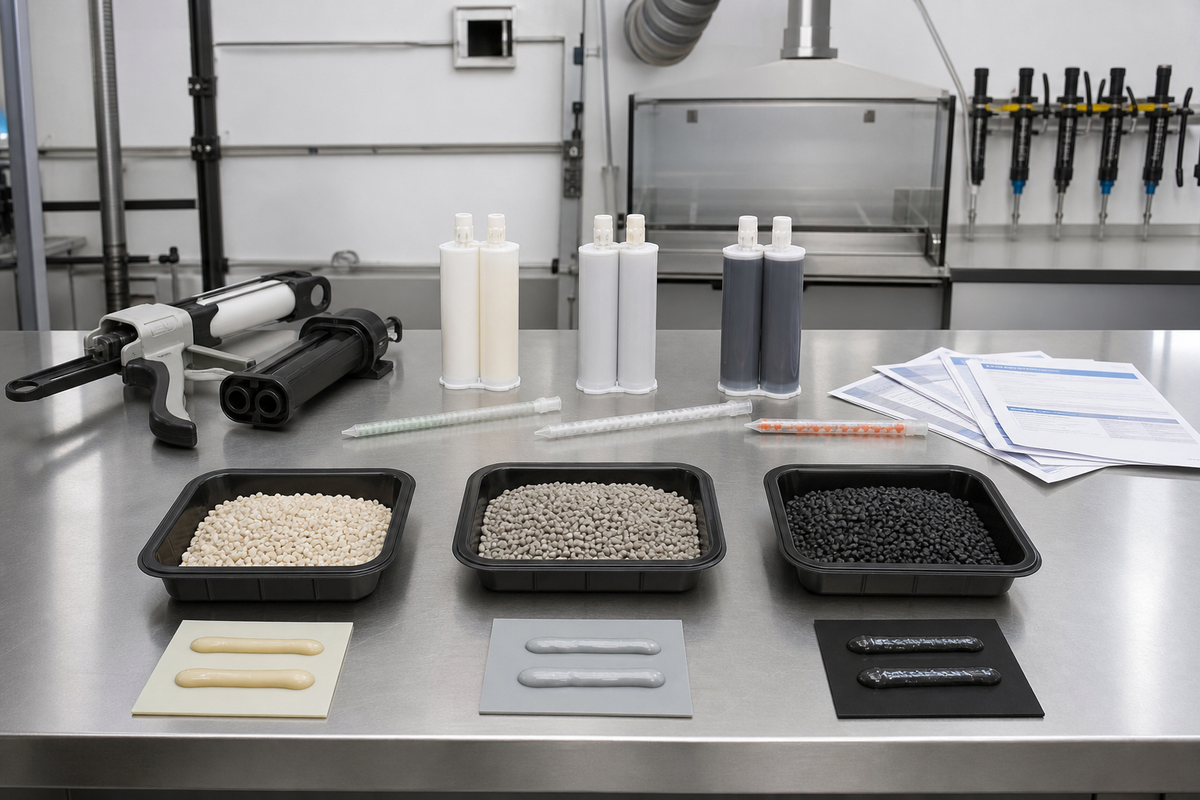
Three layers compose a chemistry fit: the chemical compatibility, worker safety, and application verification. For epoxy, polyurethane, MMA, acrylic and silicone systems, PP, PA or PBT barrel materials may fit the cartridge requirement, but cartridge material is only part of the story.
When using polyurethane systems, first examine all isocyanate exposure controls prior to the approval of any dispense method. OSHA references isocyanate exposure to irritation of the skin and mucous membranes, breathing difficulty, and occupational asthma; planning for SDS review, ventilation, and PPE therefore belong in the purchase process.
For certain acrylic systems, as well as for MMA, don’t restrict the choice solely to speed of cure. Methyl methacrylate is listed by the NIOSH as a Class IB flammable liquid, which requires control over ignition sources, ventilation, SDS review, and handling procedures in the sample room before upscaling.
Food-contact and packaging applications require the same diligence. 21 CFR 175.105 specifies the limits for adhesives used in the packaging, storage, or transport of food. It can’t be generalized for all cartridges or for every instance of adhesive application after cure.
A practical problem is that a chemically compatible barrel can still fail application approval because the process ignores exposure limits, ignition controls or validation records. Where MMA is relevant, the NIOSH Pocket Guide lists a 100 ppm / 410 mg/m3 time-weighted exposure limit and a 50 F flash point; where PU is relevant, OSHA frames isocyanates as an occupational asthma and irritation risk. Ebestron can screen PP, PA and PBT cartridge options for a sample request, but the buyer still needs SDS review, plant EHS approval and a documented bead test before OEM release.
Cost Per 1,000 Good Beads
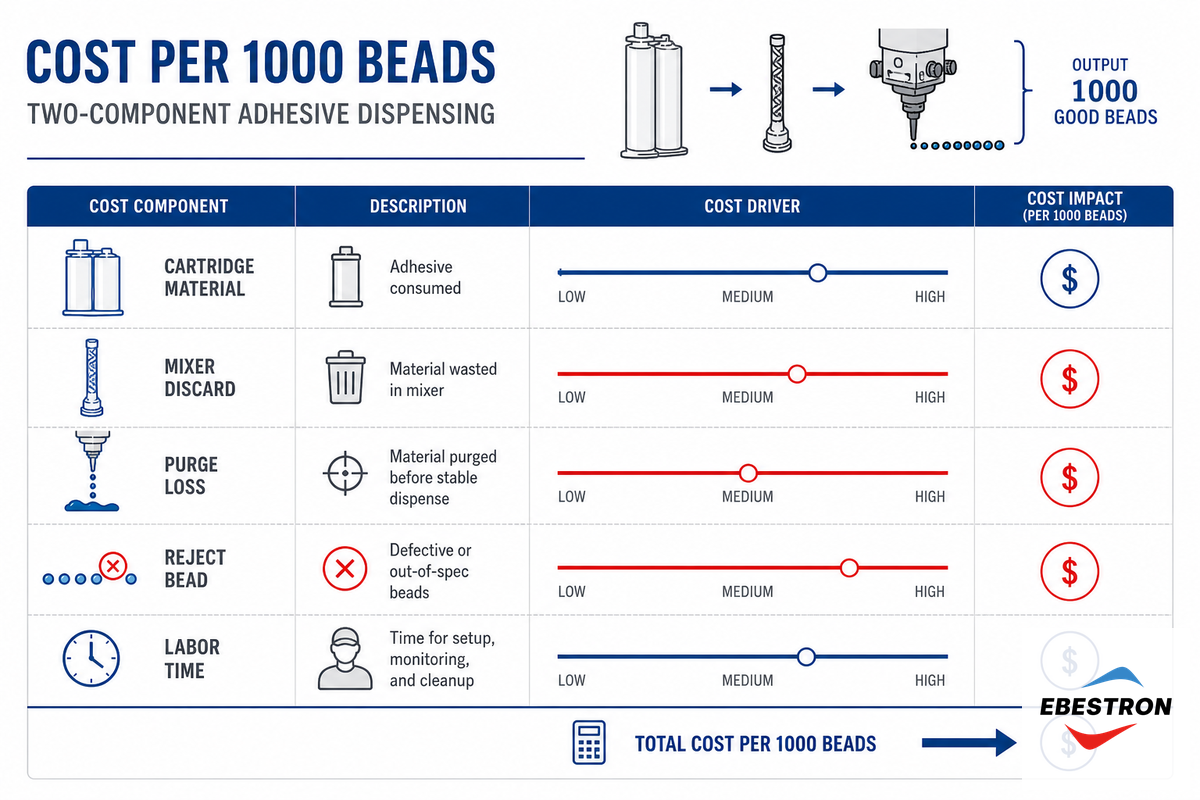
What should the true unit of cost be for purchasing two-component adhesive dispensers?
I suggest using cost per thousand accepted beads which will include the cost of cartridge/bulk material, mixer residual waste, the initial dispense, rejects, and operator labor costs.
A helpful tool from Ebestron’s website can estimate annual mixer retained waste using cost per mL for the adhesive, mixer residual volume, daily nozzle use, and number of days in operation.
Prior to obtaining any quotations, the same calculation could be developed into a purchasing spreadsheet.
| Cost line | What to enter | Why it changes the decision | Limitations / not suitable for |
|---|---|---|---|
| Material used per bead | Average mL per accepted bead | Normalizes bead size across systems | Needs actual sample weights or dispense volume |
| Mixer retained waste | Retained mL x tips per 1,000 beads | Makes oversized mixers visible | Published retained volumes must be verified by the selected mixer |
| First-shot purge | Purge mL per new tip or cartridge | Captures startup discipline | Do not reduce purge below validated mix quality |
| Rejected beads | Rejected units x material and labor | Connects quality to finance | Requires plant data; use a range if unknown |
| Operator time | Minutes for tip change, purge, inspection and cleanup | Shows when automation or meter-mix may pay back | Do not use a generic wage rate without finance approval |
| Validation cost | Trial pieces, destructive tests, aging checks and test records | Prevents a cheap sample from becoming an expensive launch | Small specimen tests are comparative, not universal design proof |
| Measurement category | Example field to record | Why it matters | Limitations / not suitable for |
|---|---|---|---|
| Bead geometry | 50 mm bead length and target width | Links cartridge output to actual part geometry | Use your drawing value, not this example |
| Purge time | 10 sec after new mixer installation | Separates mixed material from unmixed front material | Never shorten below validated mix quality |
| Pause window | 5 min before tip change review | Captures cure risk inside the static mixer | Depends on adhesive pot life and shop temperature |
| Open time | 20 min working window from the adhesive TDS | Sets operator and fixture timing | Confirm with the adhesive supplier’s TDS |
| Back pressure | 80 psi or plant-approved gauge reading | Shows whether mixer length or viscosity is overloading the gun | Do not exceed gun or cartridge rating |
| Air supply | 6 bar regulated pneumatic input | Keeps pneumatic dispensing repeatable | Manual guns need a different check |
| Reject rate | Buyer-entered reject-rate band by symptom category | Turns quality into finance data | Use a range if the sample size is small |
| Tip-change load | 20 tips/day and 250 days/year | Connects retained waste to annual spend | Use your actual shift pattern |
| Inspection interval | 1 hr visual bead check during trial | Catches drift before a full batch is made | Critical joints may need tighter checks |
| Cure hold | 24 hours before handling test | Prevents false approval before cure develops | Use adhesive TDS and plant temperature |
| Aging screen | 7 days under the buyer’s selected condition | Exposes delayed failures before launch | Not a substitute for formal qualification |
| Safety exposure | 100 ppm TWA limit check where MMA is relevant | Keeps chemistry selection tied to SDS controls | Use official SDS and site safety rules |
Use the table as a unit checklist not as a criterion for best. Typical trial forms often have columns for 0.2mm shim checks, 3mm bead width, 25mm overlap, 60 min open-time observation, 2 hr interim cure review, 24 hour handling hold, 7 day aging screen, 80 psi back-pressure notes, 6 bar air supply, 2% reject rate band, and 5% purge loss band. Finance can then add a $/year waste line item after the plant can supply actual adhesive cost and shift counts.
When Cartridge Dispensing Stops Winning
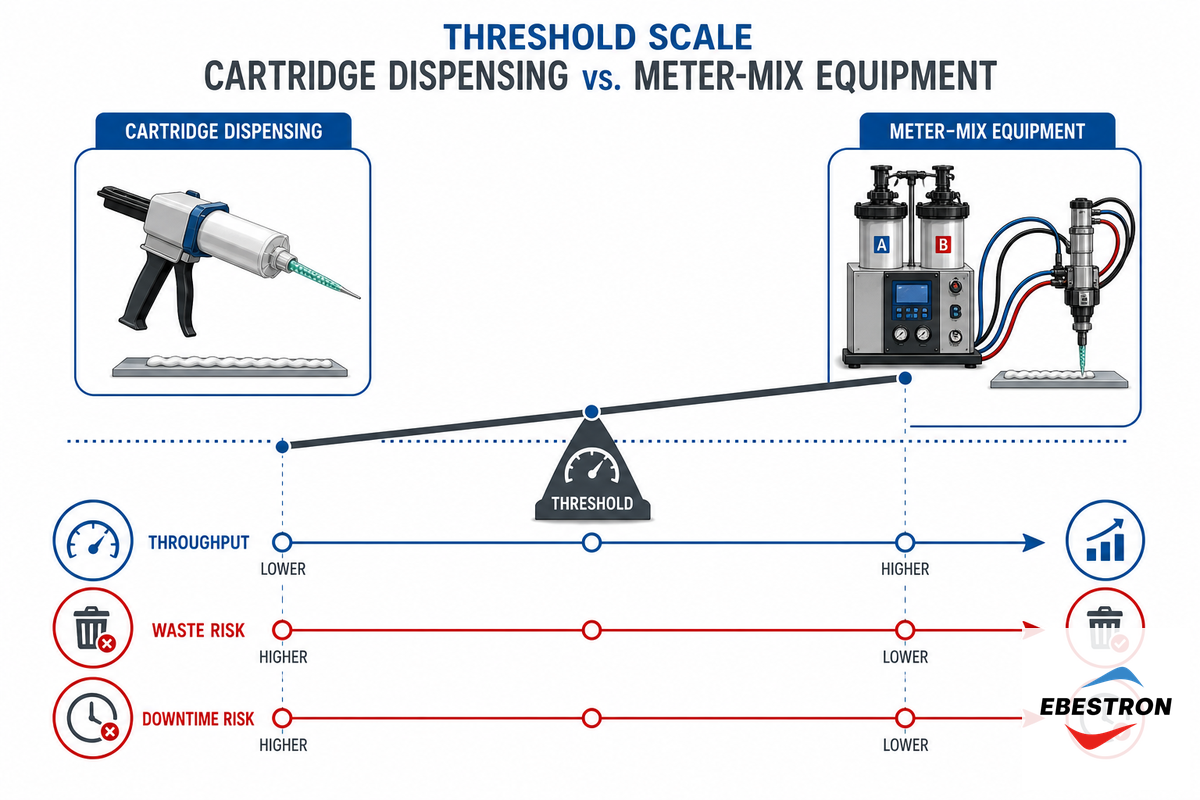
Cartridge dispensing ceases to win when flexibility is no longer the prime value. Signs of repeated high volume work, frequent purge loss, a record of ratio complaints, a history of rejected expensive parts, or a robotic cell requiring data logging and reproducible shot control should give a warning.
Don’t try to devise a generic daily-shot cut-off. Try instead a staged evaluation process: prove the cartridge process using a clear RFQ and a sampling plan; then calculate cost per thousand good beads; and finally investigate whether the actual bottleneck is material handling, ratio monitoring, maintenance, operator exposure or line speed.
If the bottleneck is costly and reproducible, then meter-mix should enter the project.
If the bottleneck is SKU variety, field service, short pot life, small batch validation or a private-label cartridge supply channel, cartridge could still be the better solution.
A competent supplier should know when to advise against the meter-mix solution due to a lack of repeatable volume or plant maintenance readiness.
Purchasing rule: do not upgrade to meter-mix because one cartridge quote looks expensive. Use the 1,000-Good-Bead Cost Ledger first; if your actual data shows repeated ratio failures, high purge loss, 20 tips/day changeover pressure or rejected critical parts, then meter-mix deserves a trial. If Ebestron can validate the needed cartridge ratio, mixer interface and sample plan for a mixed-SKU application, cartridge dispensing remains the lower-risk path.
RFQ Checklist For Samples And Supplier Quotes
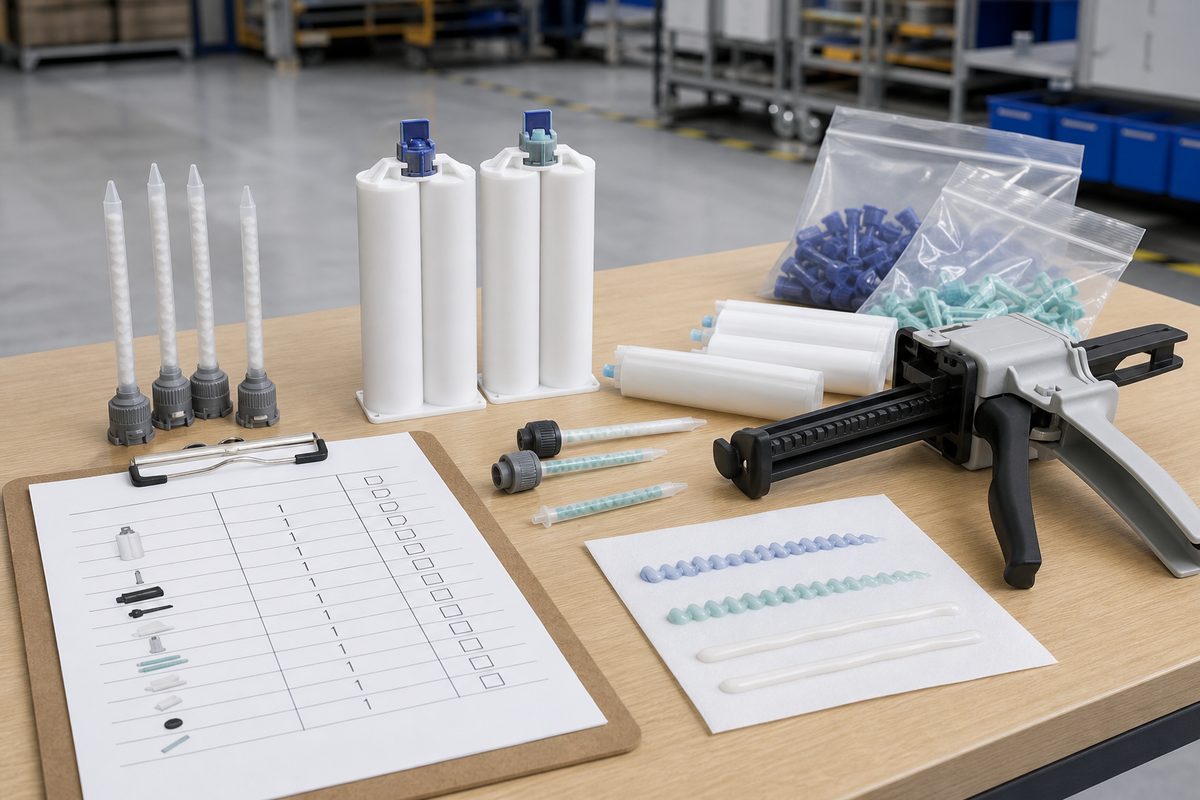
An RFQ for a two-part adhesive cartridge system should present an obvious choice.
If all the customer requires is a price, the supplier will have to make assumptions about chemistry, ratio, viscosity, dispensing gun, mixer interface, tip style, annual quantity, and the acceptance test criteria.
| RFQ field | What to send | Why it matters | Limitations / not suitable for |
|---|---|---|---|
| Adhesive chemistry | Epoxy, PU, MMA, acrylic, silicone or other | Drives material compatibility and safety review | Never omit SDS for PU/MMA systems |
| Ratio basis | Volume ratio and weight ratio if both exist | Prevents a 1:1 weight/volume misunderstanding | Do not assume the data-sheet basis |
| Viscosity and gap | A-side and B-side viscosity at working temperature | Affects mixer diameter, element count and pressure | Supplier recommendations still need trial validation |
| Cartridge system | A/B/C/F/S footprint, size, ratio and existing gun | Avoids a physically incompatible sample | Use footprint-compatible wording for branded systems |
| Mixer interface | Bayonet, bell-mouth, spiral or other interface | Connects cartridge, static mixer and bead size | Physical fit is not proof of mixing quality |
| Acceptance criteria | Cure window, bead appearance, hardness, destructive test, aging condition | Turns a sample into a decision | Avoid changing criteria after the sample arrives |
| Commercial path | Trial quantity, annual quantity, packaging, private label, record needs | Lets the supplier quote a realistic package | Do not compare prototype pricing to production pricing |
| Safety review | SDS, ventilation, PPE and ignition controls where required | Prevents chemistry surprises during scale-up | Supplier samples do not replace site EHS approval |
Failure Diagnosis Before You Change Suppliers
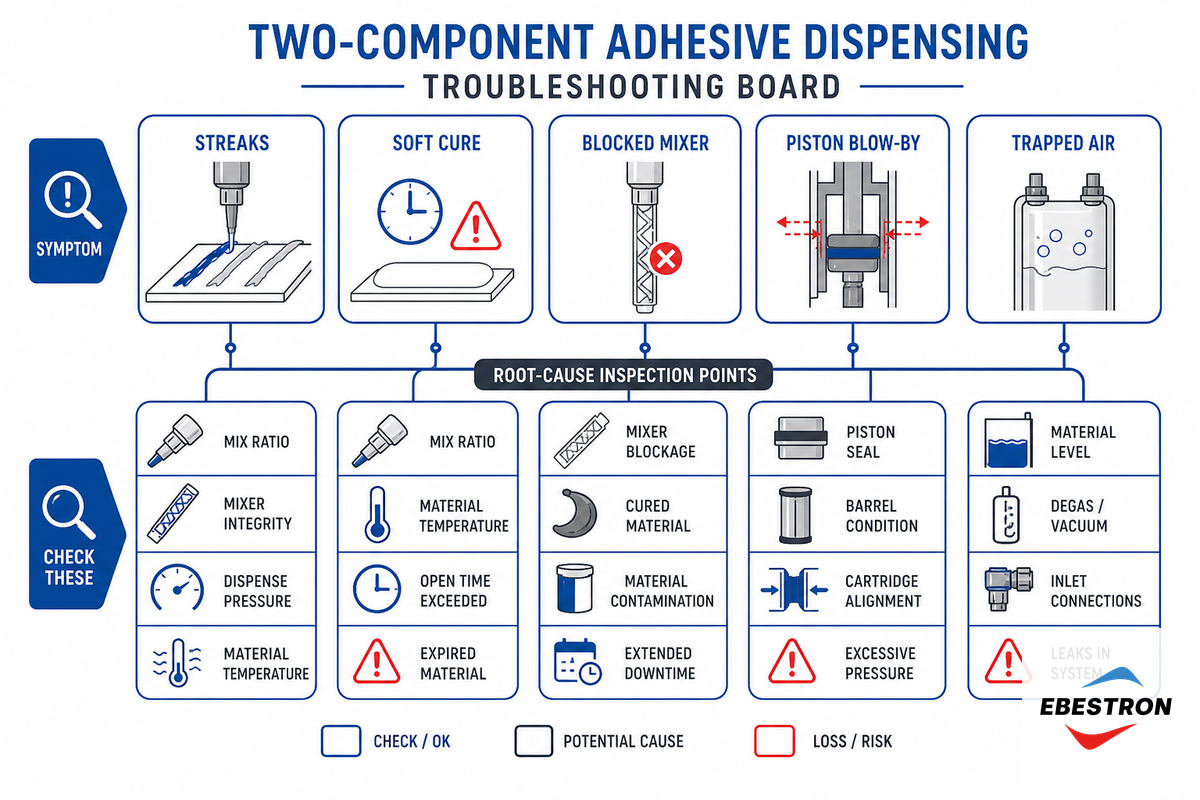
Poor cure, streaks, plugged mixers and piston blow-by don’t all originate from the same cause.
Replacing the supplier can resolve problems related to the cartridge molding process, pistons, or seals, but a significant portion of the defects are traced to ratio translation issues, mixer design, purging techniques, application temperatures or handling.
| Symptom | Likely first checks | Supplier question | Limitations / not suitable for |
|---|---|---|---|
| Soft or tacky cure | Ratio basis, piston movement, purge, temperature, shelf life | Which cartridge ratio and piston set matches this TDS? | Do not blame material until ratio path is checked |
| Color streaks | Mixer interface, element count, viscosity gap, flow rate | Which mixer was validated with this adhesive? | More elements may increase pressure or waste |
| Blocked mixer | Pot life, pause time, heat, previous cure in tip | What open-time rule should operators use? | Do not force material through a curing mixer |
| Piston blow-by | Gun thrust plate, piston seal, cartridge storage, viscosity | Which piston style is specified for this viscosity? | A stronger gun can worsen damage if alignment is wrong |
| Good bead but field failure | Substrate prep, environmental aging, load case, validation method | Which test proves this exact joint, not just a coupon? | ASTM D1002 is comparative; it is not a universal design value |
Get help matching cartridges, mixers and RFQ details
Ebestron can evaluate the required cartridge size, ratio, material, mixer interface, and sampling criteria before issuing a request for bulk wholesale or OEM private-label manufacturing.
Frequently Asked Questions
Q: What is two part adhesive dispensing?
Two part adhesive dispensing is the controlled metering, mixing and placement of two reactive adhesive components so the bead cures at the intended ratio in production.
In a factory, the system usually includes a dual cartridge or bulk feed, pistons or pumps, a dispensing gun or valve, a static mixer, a purge rule and an inspection method. This term covers manual cartridge work, pneumatic cartridge guns, automated dispensing and meter-mix dispense equipment. Tool name matters less than whether the process controls ratio, mixing, bead placement, waste and safety for the actual adhesive.
Q: What are the best adhesive systems for automated dispensing?
The best automated system depends on repeat volume, viscosity, ratio risk, bead geometry, safety controls and whether the plant needs data logging for the job.
Cartridge-based automation can work well for moderate repeat jobs, controlled samples or products with frequent material changes. Meter-mix equipment becomes more attractive when the same material runs repeatedly, line uptime matters, ratio monitoring is required or rejects are expensive. Do not choose automation only because it sounds precise. Verify the adhesive pot life, flow rate, pressure drop, mixer choice, maintenance skill and acceptance tests first.
Q: Which static mixer is right for two-component adhesive?
A suitable static mixer fits the cartridge interface and proves complete mixing at the adhesive’s ratio, viscosity, flow rate and bead size during trial dispensing.
Start with the physical interface, such as bayonet, bell-mouth or spiral. Then check chemistry, viscosity gap, working temperature, element count, inner diameter, outlet shape and retained volume. Supplier tables can give a starting point, but final choice should be validated with the actual adhesive, substrate, open time and dispense speed. Physical fit alone is not proof of adequate mixing.
Q: When should I switch from cartridges to meter-mix equipment?
Switch only when the plant’s bottleneck is repeatable enough to justify bulk feed, metering maintenance, calibration, operator training and process monitoring for production scale decisions.
Good triggers include repeated high-volume jobs, frequent purge loss, costly rejected parts, robotic dispensing, ratio traceability requirements and stable material families. Weak triggers include a single expensive cartridge quote, an unproven sample, or a vague belief that automation always reduces waste. Build a cost per 1,000 good beads model first. If cartridge flexibility still solves the job, stay with cartridges.
Q: Why does two-part adhesive cure soft or streaky?
Soft cure or streaks usually mean ratio, mixing, purge, temperature, shelf life or substrate preparation should be checked before the supplier is blamed during trial production.
Check the 6-Link Ratio-Control Chain first. Then review substrate prep and aging.
Q: Can Ebestron cartridges fit Mixpac or Nordson-style guns?
Ebestron publishes footprint-compatible language for common cartridge systems, but the safe RFQ wording is “fits standard system footprints,” not “identical OEM replacement” for accessories and samples.
Send the cartridge system, ratio, size, existing gun model and mixer interface before ordering samples. Ebestron’s public compatibility tools reference common A-System, B-System, C-System, F-System and other footprints, but accessories still need confirmation by size, ratio, thrust plate, plunger alignment and mixer connection. If you need a branded-system cross-reference, ask for a compatibility check with photos, part numbers and sample cartridges. Also ask the supplier to confirm whether the quote covers only empty cartridges or a matched package with pistons, caps, O-rings and static mixers. That avoids a common purchasing problem: a cartridge arrives, but the shop still lacks the correct mixer interface or thrust plate.
Related Ebestron Resources
References & Sources
- Real-Time Monitoring Brings Process Control to Two-Part Adhesive Dispensing – ASSEMBLY Magazine
- Isocyanates Overview – Occupational Safety and Health Administration
- Methyl Methacrylate Pocket Guide – NIOSH / CDC
- ASTM D1002-10(2019) – ASTM International
- ASTM F88/F88M-21 – ASTM International
- ASTM D3078-02(2021)e1 – ASTM International
- 21 CFR 175.105 Adhesives – eCFR
- Residence Time Distributions for In-Line Chaotic Mixers – arXiv