Get in touch with Ebestron Company


Updated July 2026 · Reviewed by the Ebestron technical team.
Static mixing nozzles for 2-part adhesives are the small, disposable tubes that turn two separate chemical streams, resin and hardener, into one uniformly blended bead as it leaves a dual cartridge. If you landed on this exact phrase because the whole topic is new to you, this guide is built for that moment: one map of every branch of the subject, with a direct link to the deep-dive on each one.
Twelve other pages on this site already cover the pieces of this topic in real depth, element types, cross-brand compatibility, static-versus-dynamic systems, cartridge operation, dispensing troubleshooting, element-count selection. This page doesn’t try to out-write any of them; it’s the newcomer’s starting point, built to route you to whichever deep-dive actually answers your question.
Quick Specs
| Also called | Static mixer, mixer tip, mixing tube, disposable static mixer |
| Attaches to | Bayonet (50ml adhesive cartridges), bell (200 ml to 400ml cartridges and larger), or threaded inline cartridges and meter-mix guns |
| Element geometries | Helical (spiral) or Quadro (square) |
| Common mix ratios | 1:1 up to 10:1 |
| Common bore range | 3–13 mm |
| Element count range | 7–49 elements (most epoxies fall in the 15–24 band) |
Static Mixing Nozzle Basics: What It Is (And What It’s Not)
What is a static mixing nozzle?
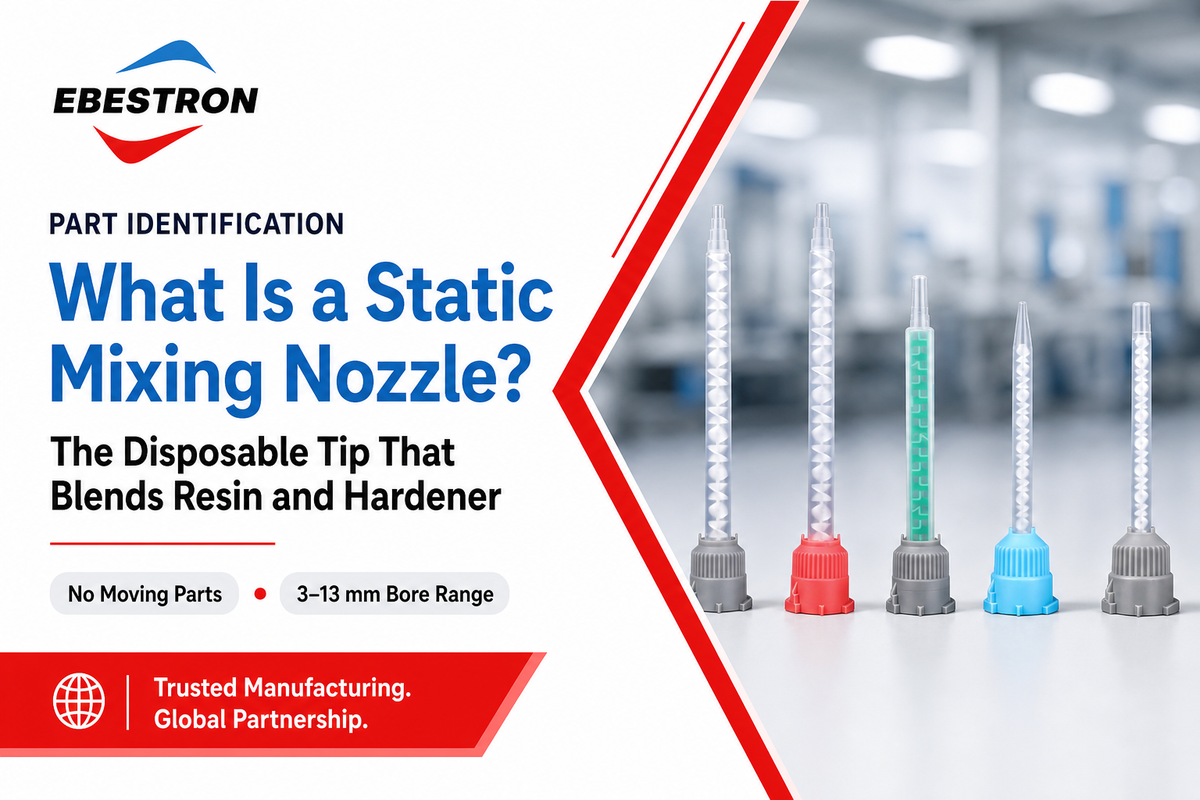
A static mixing nozzle is a disposable plastic tube packed with a fixed series of internal baffles, called elements, that blend two adhesive components as they’re pushed through, with no motor and no moving parts. It’s built as one of the nozzles for two-part adhesives on the market, letting you mix two-part adhesives without a powered mixer: attach it to a two-part cartridge, squeeze the gun, and resin and hardener exit as one homogenous bead, ready to apply.
This mixing mechanism dates back further than most buyers assume: the original patent for this exact split-and-recombine design was filed in 1965 by researchers at Arthur D. Little Inc., and the core geometry hasn’t changed much since. Modern versions are suited to structural, composite, and general assembly bonding alike.
What it’s not: a static mixing nozzle isn’t the same thing as an industrial pipe-section “motionless mixer” used to blend chemicals inside a process line, those are permanent, bolted-in devices sized in inches of pipe diameter, not disposable cartridge tips. Watch for a supplier quote that mentions a “static mixer” for a plant process rather than an adhesive dispenser; that’s the wrong category entirely, and it’s a mistake that can delay a project by days once the wrong part number is already in a purchase order.
As a manufacturer of these parts, Ebestron fields this exact “what’s this thing” question from first-time buyers on a regular basis, usually from someone who inherited an assembly-line adhesive spec from a predecessor and need to reorder without a lookup table.
Same Part, Five Different Names
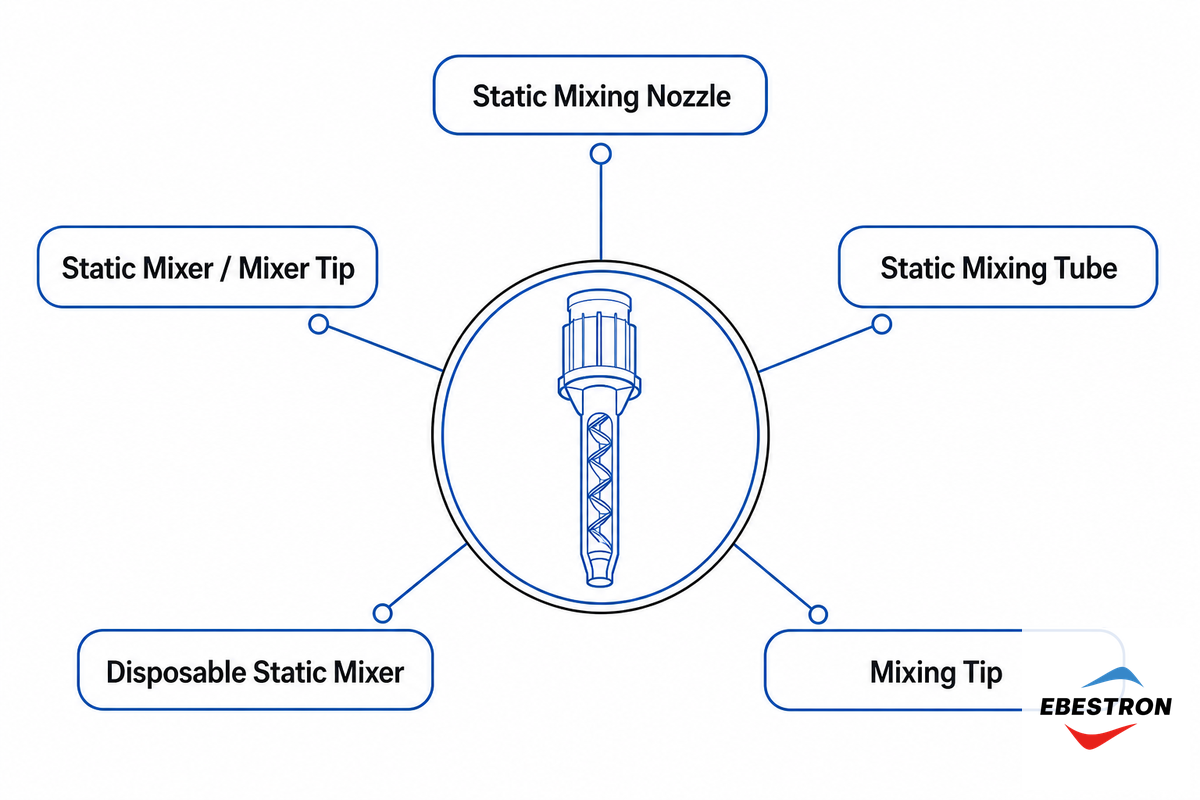
New buyers often assume they’ve found five different products when they’re really looking at one. Suppliers, catalogs, and adhesive datasheets don’t use consistent language, and that inconsistency alone causes more purchasing mistakes than any technical spec:
| Name you’ll see | Where it shows up |
|---|---|
| Static mixing nozzle | Most common search term; used generically across brands |
| Static mixer / mixer tip | Distributor catalogs, shortened for SKU listings |
| Static mixing tube | Some manufacturer datasheets, emphasizing the tube form factor |
| Disposable static mixer | Procurement/spec documents, emphasizing single-use status |
| Mixing tip | Shop-floor shorthand used by dispensing technicians |
Quick check: if a listing mentions a dual cartridge, a mix ratio, and an element count together, it’s this part, regardless of which of the five names the seller used. On 3M-branded nozzles, molded markings even flag whether a given tip suits adhesives, sealers and foams, or a spray outlet, one more reason to read the markings, not just the box label, on a 2-part cartridge order. For the full name-to-name cross-reference by brand and connection type, see our static mixing nozzle types guide.
The Mechanics Behind Static Mixing: No Moving Parts Required
How do static mixing nozzles work?
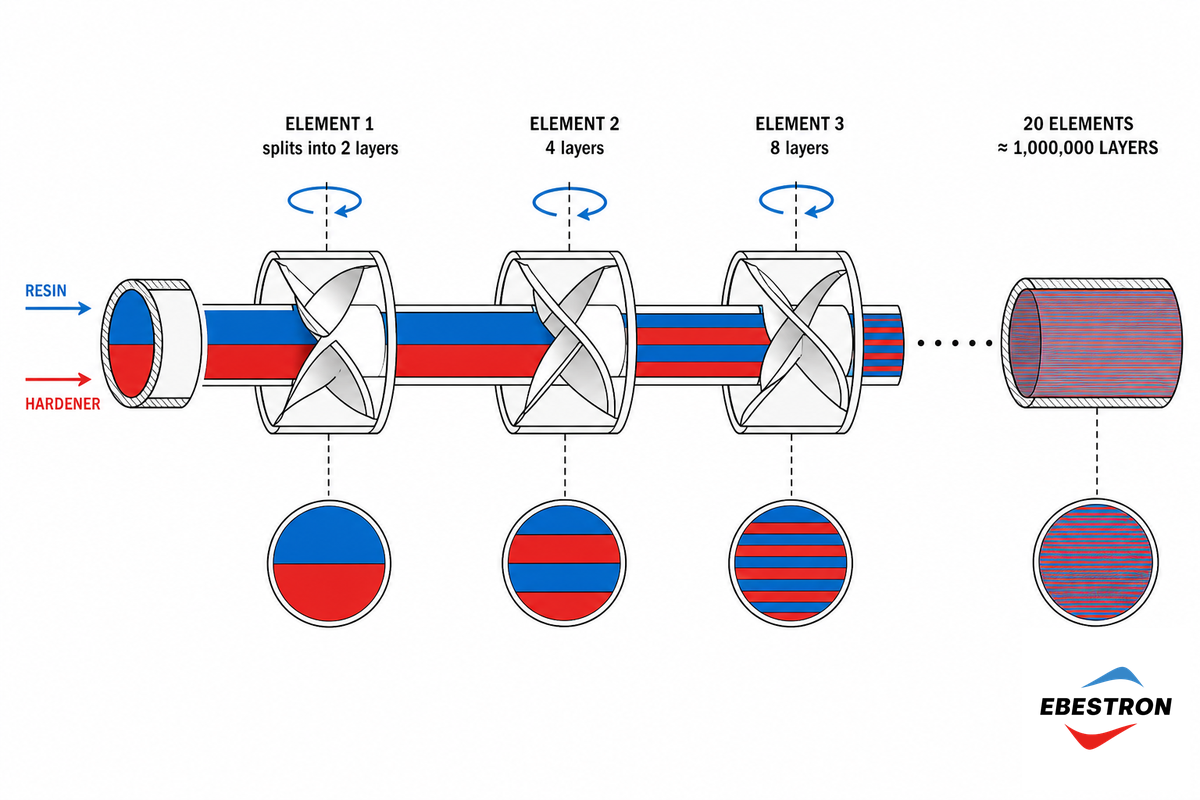
Each element inside the tube is a curved, twisted baffle that splits the combined resin-and-hardener stream into two partial streams and rotates them; the next element splits and rotates again, and so on down the tube. Mixing engineers call this doubling behavior a baker’s transformation, after the way a baker folds dough into thinner and thinner layers. Twenty elements produce on the order of a million layers, enough to erase any visible difference between the two components.
This isn’t marketing description, it’s the literal claim language of the original 1966 patent, which describes elements that “split” the stream and “impart a double rotational motion.” The same patent gives a number many modern buyers over-shop past: for a 1/4-inch (6.4 mm) bore tube, the inventors found 12 to 14 elements enough to properly mix epoxy resin, not the 24+ many catalogs default to. A 2003 peer-reviewed review (Thakur et al., Trans IChemE) reaches the same conclusion differently, element geometry and viscosity ratio, not raw element count, govern mixing quality.
One nuance worth flagging, because it’s easy to over-simplify: a spatially even mix and an evenly timed one aren’t automatically the same thing. Fluid-dynamics research on chaotic and in-line mixers (comparing Kenics, F-type, and multi-level laminating geometries) shows that even well-split streams can retain a spread in how long individual fluid elements actually spend inside the mixer, element count alone doesn’t fully describe that spread, since it also depends on cross-section shape and flow geometry, not chemistry labels. For most epoxy and polyurethane cartridge work that spread doesn’t change the outcome, but on fast-curing, short-working-time chemistries it’s part of why manufacturers specify a minimum element count rather than letting buyers round down, and it’s the reason element count is a starting filter in this guide, not the final word.
Practically speaking, element count is a proxy for “enough splitting to fully blend the components,” not a target number to maximize. Ebestron’s technical team sizes element count against this exact mechanism, because an under-mixed bead is a hidden failure mode, it can look fine at application and only show up as a weak or brittle bond weeks later, after the part has already shipped. More on that trade-off in the mistakes section below.
Two Element Shapes, One Job: Helical vs Quadro (Overview Only)
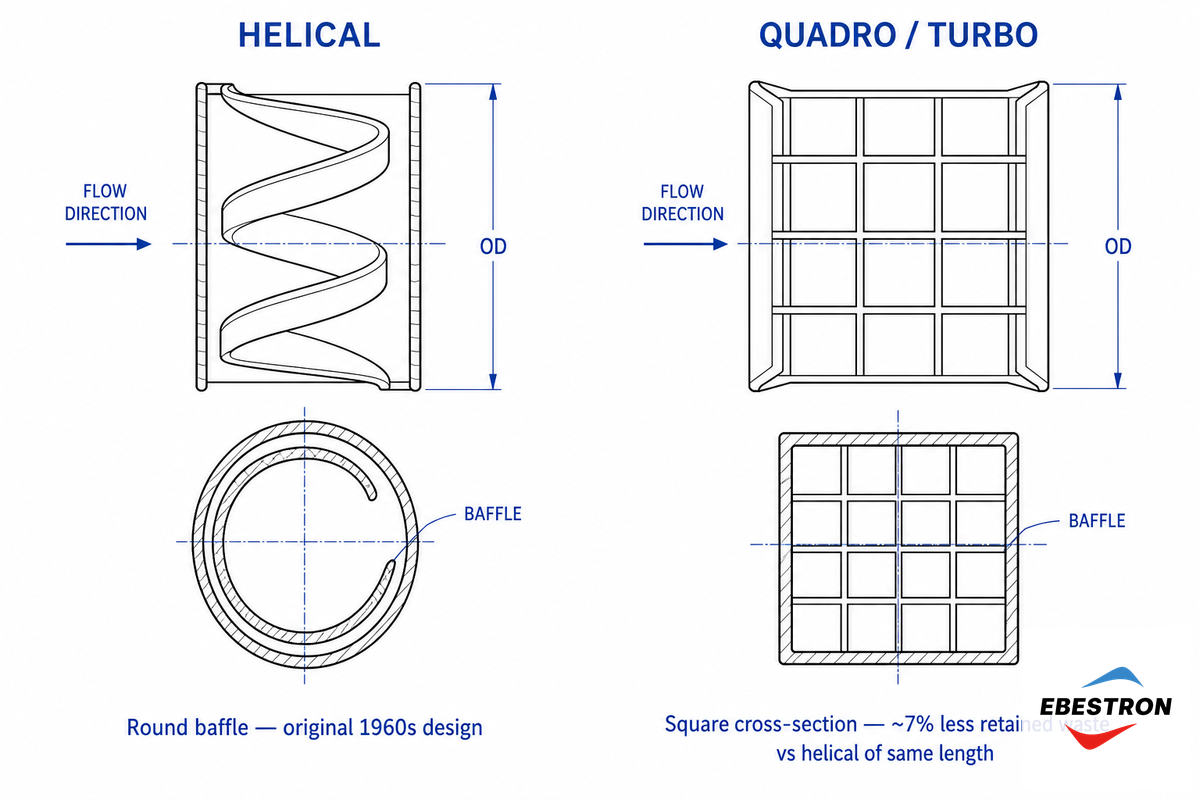
Inside the tube, the baffles come in two common geometries. Helical elements are round, spiral-shaped baffles, the original 1960s design and still the most widely used. A Quadro mixer (also called Turbo or square) uses a square cross-section grid instead, which lets the same mixing job happen in a shorter tube for less waste.
The waste difference is real but modest: per Adhesives & Sealants Industry trade-press reporting, Quadro elements cut retained-adhesive waste by roughly 7% versus helical elements of the same length, a genuine improvement, not a dramatic fix, and it traces to a single reported figure rather than several independently cross-checked measurements. Both geometries rely on the same doubling mechanism, so a Quadro nozzle needs a broadly similar element count to a helical one for the same chemistry, it’s shorter per element, not fewer elements overall.
Element count isn’t the only trade-off. Adding elements for more mixing margin also raises back pressure and can slow flow rate, the resistance the gun push against, since fluid is threading through more baffles in the same bore (inner diameter). On a manual gun that’s extra hand fatigue; on a pneumatic or meter-mix system it’s pump load. Sizing bore to viscosity first, then element count to chemistry, keeps that resistance manageable regardless of geometry.
Choosing the wrong geometry for the job is rarely catastrophic, but it’s a recurring, avoidable cost: because retained adhesive is a direct expense on every single nozzle change, an automotive or electronics assembly line running hundreds of changes a month feel the 7% difference in the materials budget even though no single change looks expensive on its own. This overview is intentionally brief. For the full side-by-side on connection types, bore sizing, and when Quadro is worth paying extra for, see our dedicated static mixing nozzle types guide.
Choosing by Adhesive Chemistry: Epoxy, Polyurethane, Silicone, Acrylic
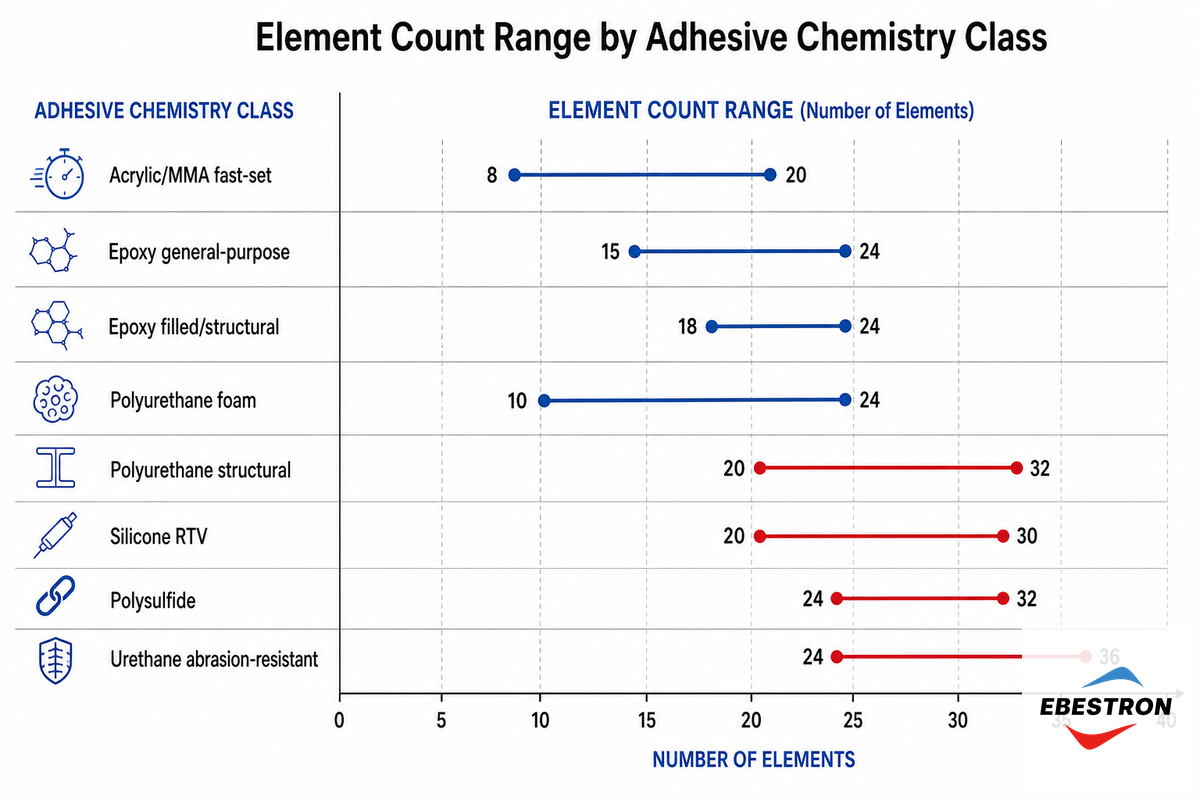
If you searched for a 2 part epoxy mixing nozzle specifically, chemistry is the first filter for element count and bore diameter, before you even look at a specific brand’s part-number chart, epoxy mixing nozzles are just one branch of the chemistry-specific selection below. Across epoxy, urethane, and silicone, the glue-mixing job is the same, fold two reactive parts into a uniform blend, but the right starting point differs by class. Close 1:1 ratios with low viscosity mix in fewer elements; wide ratios or a big viscosity gap between resin and hardener need more:
| Chemistry class | Typical mix ratio | Element range | Bore range |
|---|---|---|---|
| Acrylic / MMA, fast-set | 1:1 – 10:1 | 8–20 | 2.4–6.4 mm |
| Epoxy, general-purpose | 1:1 – 2:1 | 15–24 | 4.0–6.4 mm |
| Epoxy, filled / structural | 1:1 – 4:1 | 18–24 | 5.4–8.0 mm |
| Methacrylate (MMA), structural | 1:1 – 10:1 | 16–24 | 4.0–8.0 mm |
| Polyurethane, foam | 1:1 | 10–24 | 4.0–8.0 mm |
| Polyurethane, structural | 2:1 – 4:1 | 20–32 | 6.4–9.0 mm |
| Silicone (RTV) | 1:1 – 10:1 | 20–30 | 5.4–8.0 mm |
| Polysulfide | 2:1 | 24–32 | 6.4–9.3 mm |
| Urethane, abrasion-resistant | 4:1 – 10:1 | 24–36 | 8.0–12.6 mm |
Source: industry selection ranges (Adhesives & Sealants Industry; manufacturer selection guides). Treat as starting ranges, final element count and bore also depend on element geometry and a validated mix-quality test, not chemistry class alone.
⚠️ Important
Treat this table as a starting range, not a spec. A peer-reviewed study of Kenics-style elements found that a low-aspect-ratio element needed 12 elements to hit a target mix quality, while a high-aspect-ratio element needed only 4 to hit the same quality — geometry can matter as much as raw count. Use the chemistry band above to narrow your search, then confirm with a test bead on your actual substrate, not a rule of thumb.
“Element count…has become an erroneous method for reliably selecting a mixing nozzle for a given application. It is far more reliable to compare mixer options using direct empirical data.”
Adhesives & Sealants Industry, trade-press analysis on static mixer selection
Chemistry also changes how fast the bond develop strength. One academic automotive-hood bonding study found acrylic reaching 3.67 MPa shear strength after 1 hour of pre-curing, versus epoxy reaching only 0.87 MPa after 4 hours without external heat, driven by acrylic’s fast free-radical cure versus epoxy’s slower esterification step. Treat that as one data point from one bonding scenario, not a universal ranking; cure speed still depends heavily on your formulation and cure temperature.
Chemistry drives handling precautions too. Polyurethane systems involve isocyanate componentsOSHA identifies occupational asthma and eye/nose/throat/skin irritation as the main hazards, and NIOSH sets an exposure limit as low as 0.05 mg/m³ for MDI, a common polyurethane isocyanate. Epoxy curing agents carry their own profile, California public-health guidance lists specific limits by curing-agent class. None of this is a nozzle-selection factor, but it’s part of the same purchasing conversation, and a ventilation/PPE question for your safety team.
Reading Any Brand’s Part Number (The 5-Minute Version)
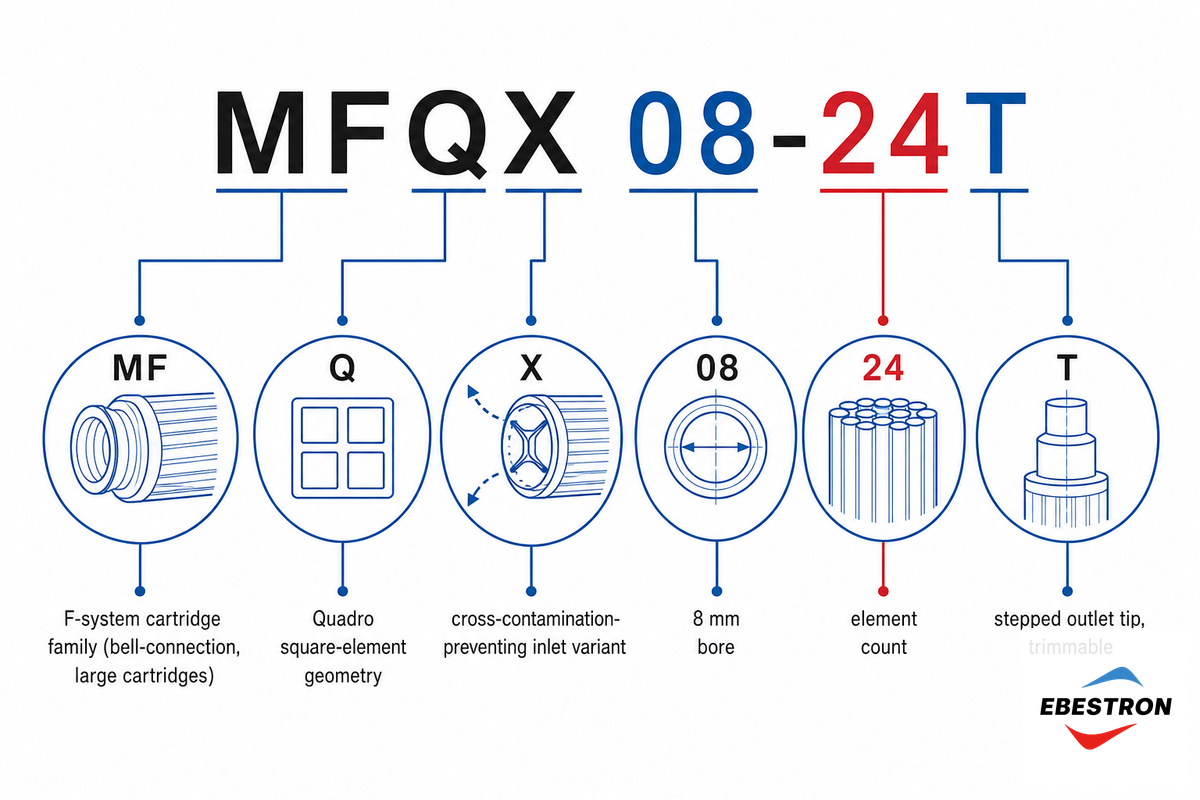
Cross-brand static mixer nozzles, Sulzer Mixpac, Nordson, 3M, MedMix, and generic equivalents, used on everything from small bayonet tips to 200ml bell-connection cartridges, mold three pieces of information directly into the part number: the cartridge system letter, the bore diameter, and the element count. Once you know the pattern, you can decode almost any SKU without a lookup table.
Take a real example: MFQX 08-24T. Reading left to rightMF identifies the F-system cartridge family (bell-connection inlet, larger cartridges), Q flags Quadro square-element geometry, X marks the cross-contamination-preventing inlet variant, 08 is the 8 mm bore, 24 is the element count, and the trailing T denotes a stepped outlet tip trimmable to adjust bead size. Patent EP0885651A1, on this class of dual-inlet mixer geometry (inventor Wilhelm A. Keller), explains why inlet design matters as much as the bore number: merging the two components evenly before the first element reduce how many elements are needed downstream, part of why two nozzles with the same element count can still perform differently.
These three numbers matter together, not individually. Reorder by matching bore, element count, and cartridge-system letter, not just the element count on the label. Getting any one of them wrong is a common, expensive mistake: order the wrong bore and the nozzle either won’t seat on the cartridge or floods the joint with an oversized bead, and both outcomes mean scrapped material and a delayed line. Ebestron manufactures nozzles across all of the major cartridge systems specifically so buyers can cross-reference a part number against a manufacturer’s own compatibility data instead of guessing from a photo. For a full interactive breakdown across brands, see the static mixer spec code decoder.
Static or Dynamic? A 30-Second Gut Check
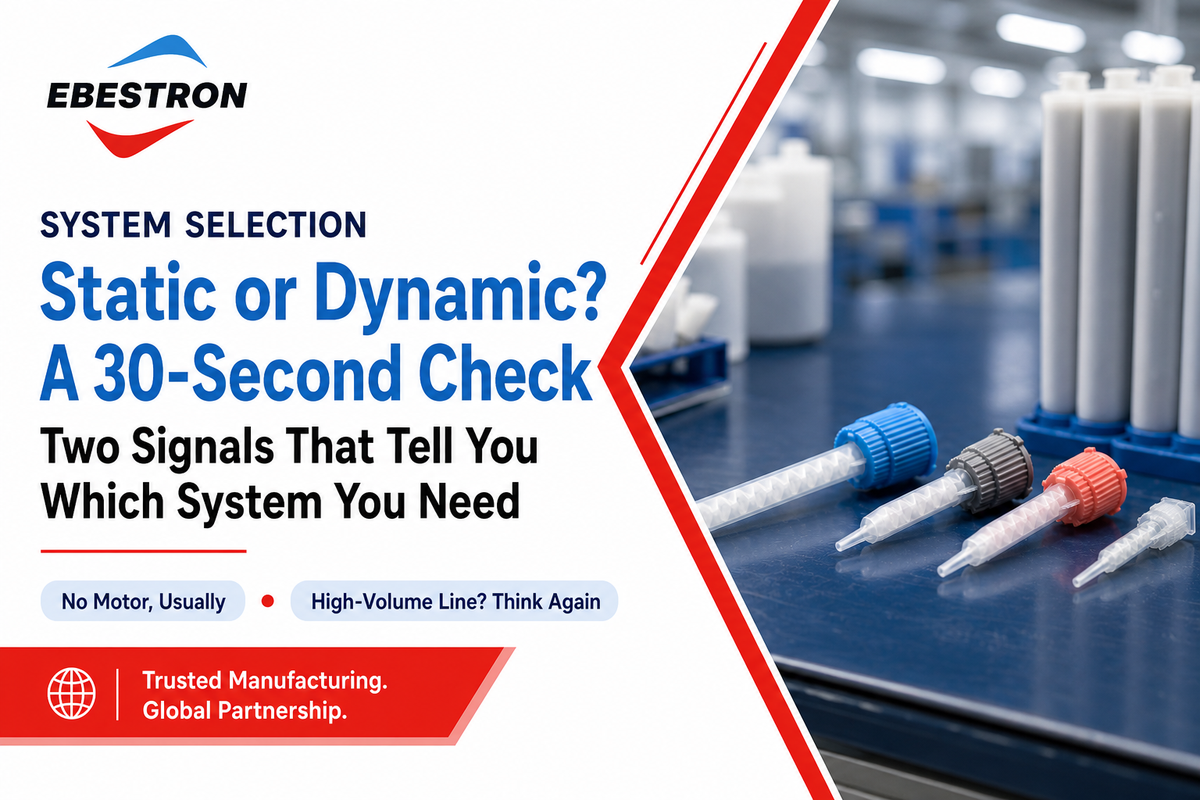
Everything above assumes a static (no-motor) mixer, which covers the large majority of cartridge-based 2K dispensing. Two signals suggest it’s worth looking at a motor-driven dynamic mixing system instead: a large viscosity gap between resin and hardener that static elements struggle to fully blend, or a high-volume automated line where a reusable mixing head beats replacing a disposable nozzle every cycle. Picking the wrong side of this decision is a costly mistake either way, forcing a wide viscosity gap through static elements risks an under-mixed bead, while over-buying a dynamic system for a low-volume line wastes capital on hardware the job never needed. Ebestron supplies both static and dynamic systems, so this isn’t a nudge toward the pricier option. If either signal applies, our static vs dynamic mixing comparison walks through the full decision.
The 4 Mistakes First-Time Buyers Make
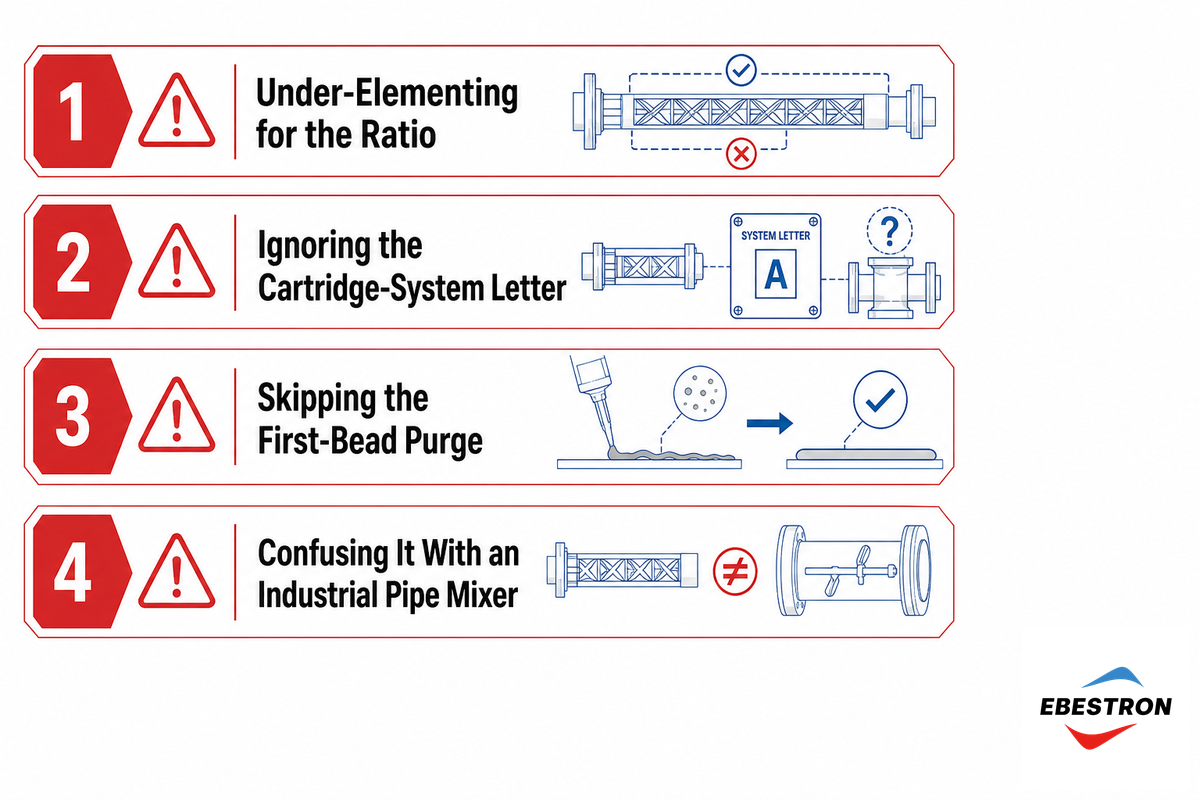
Most first-order problems with a new static mixing nozzle trace back to one of four avoidable mistakes, not a defective part. Ebestron’s technical team sees these four causes repeatedly in support requests from first-time buyers, and each one is a cheap fix once you know to look for it:
-
✔
Under-elementing for the ratio. Sizing for a 1:1 epoxy won’t fully blend a 10:1 polyurethane, off-ratio components need more folds to homogenize, and patent literature on multi-ratio dispensing specifically flags this failure at the inlet, where the larger-volume component can suppress the smaller one before mixing even starts. -
✔
Ignoring the cartridge-system letter. Bayonet-inlet nozzles won’t seat on bell-connection cartridges, no matter how close the bore is. Match the letter first, Sulzer’s A-System and B-System, for example, aren’t interchangeable with its own C-System or F-System despite looking similar. -
✔
Skipping the first-bead purge. The first slug out of a fresh nozzle is unmixed by design, discard roughly the nozzle’s own internal volume before applying to get consistent results. Forum discussion of dispensing setups repeatedly traces bad first beads to skipping this step, or to air pulled in at the cartridge outlet rather than the element count. -
✔
Confusing it with an industrial pipe mixer. Disposable cartridge nozzles and permanent process-line motionless mixers are different product categories, quoting one against the other wastes a sourcing cycle.
For the deeper troubleshooting guide covering clogs, leakage, and inconsistent beads once you’re already dispensing, see 7 common 2K dispensing problems. For the full cartridge operating procedure including the purge step in context, see how to use a two-part adhesive cartridge.
The Static-Mixer Newcomer’s Compass, Where to Go Next by Question

The Static-Mixer Newcomer’s Compass is a single routing table built for one purpose: point you at the exact page that answers your specific follow-up question, instead of making you re-read a dozen pages to find it. Every deep-dive linked below covers its topic in far more depth than this overview page attempts to.
| Your question | Go to | Why |
|---|---|---|
| “What element types and connections exist, and how do I compare them?” | Static Mixing Nozzle Types | Full bayonet/bell/cross breakdown with sizing charts |
| “Should I be looking at a static or a dynamic (motor-driven) mixer?” | Static vs Dynamic Mixing | Full decision framework by viscosity and volume |
| “How do I actually run a cartridge, start to finish?” | How to Use a Two-Part Adhesive Cartridge | Step-by-step operating procedure, purge to cure |
| “My bead looks wrong / is clogging / won’t cure evenly — why?” | 7 Common 2K Dispensing Problems | Symptom-to-cause troubleshooting guide |
| “Should I pick an 18-element or 24-element nozzle for my job?” | 18 vs 24 Element Static Mixers | Head-to-head waste, back-pressure, and mixing-margin comparison |
| “I know my chemistry and cartridge system — where do I match a full spec and buy?” | Static Mixing Nozzles for 2-Part Adhesives (full catalog) | Complete spec-matching and purchasing hub |
Industry Outlook, What’s Changing for Buyers in 2026

Two changes are worth tracking for a 2026 project, because getting caught on an outdated spec is an avoidable, quantifiable cost at requalification time. First, element-geometry research is still active, not settled, a 2025 peer-reviewed study evaluated five custom intermixer geometries (Split Path, Helix Array, Full Turn Helix, Half Moon, and Cross Bars), and at least one vendor has publicly claimed a computer-optimized design reaching full mix in as few as seven elements versus the conventional 24–32 — worth tracking as a vendor-reported figure, not settled fact, since it’s a single manufacturer’s own published claim.
Second, the reference standard governing pot-life determination for multi-component structural adhesives (ISO 10364) received a 2024 revision, a reminder that chemistry, not just hardware, keeps moving; confirm your adhesive’s data sheet is tested against the current edition. Adhesive-dispensing equipment market-size estimates swing widely by analyst firm, figures reported in 2025 range from roughly $9 billion to $38 billion depending purely on how each firm scopes the category, so treat any single dollar figure as directional background, not a number to size a sourcing decision around. Standards and geometry research like this is the more useful buyer signal.
Frequently Asked Questions
Q: Are static mixing nozzles interchangeable between brands?
View Answer
Sometimes, but never assume it without checking the cartridge-system letter first. Many generic static mixing nozzles are built to fit Sulzer Mixpac, Nordson, and 3M cartridge families — but proprietary connection types on some brands are not cross-compatible even when the bore diameter matches exactly. Check in this order: system letter (A/B/C/F), then inlet type (bayonet/bell/threaded), then bore and element count — the first two are hard incompatibilities, the last two are performance trade-offs. See our full cross-brand static mixing nozzle types guide for the complete compatibility breakdown by brand.
Q: What is a Turbo or Quadro static mixer?
View Answer
Turbo and Quadro both refer to the same square-cross-section element geometry, as opposed to the traditional round helical (spiral) design. Quadro elements let the same mixing job happen in a shorter tube, cutting retained-adhesive waste by roughly 7% compared to a helical nozzle of the same length — but they rely on the same underlying doubling mechanism, so element count stays broadly similar between the two geometries. See the helical vs Quadro overview above for the full comparison, and our dedicated types guide for connection and sizing detail.
Q: What is the difference between a bayonet and a bell-mouth mixer?
View Answer
Bayonet is a twist-and-lock connection built for small (typically 50 ml) dual cartridges on manual or pneumatic hand guns. Bell-mouth is a wider inlet secured with a separate retaining nut, built for larger 200–600+ ml cartridges and meter-mix equipment where higher back-pressure is common. The two are not interchangeable — matching connection type is the first filter in any nozzle purchase, ahead of element count or bore diameter. Our static mixing nozzle types guide covers every connection family in full.
Q: Can static mixer nozzles be reused after the first application?
View Answer
No — once cured, it’s permanently clogged.
Q: How much adhesive is wasted per nozzle after use?
View Answer
It depends on nozzle length and bore diameter — trade-press reporting has put conventional helical and square mixers at up to roughly 20 mL of combined purge-and-retained waste per nozzle, with Quadro geometry trimming a portion of that through a shorter tube. Because waste scales directly with your specific bore and element count, use the adhesive waste calculator to size the figure for your own nozzle spec and annual change count rather than relying on a generic average.
Q: What is the difference between inline and static mixers?
View Answer
These terms describe two genuinely different product categories, not a spec variation within one. A static mixing nozzle is the disposable cartridge tip covered throughout this guide. An “inline mixer” more often refers to a permanent, pipe-mounted process mixer used in continuous chemical or fluid-processing lines — the same category this guide’s opening section warns against confusing with a dispensing nozzle. If a quote uses “inline mixer” language for what should be a disposable cartridge tip, confirm the application before ordering.
Why We Write This
Ebestron manufactures two-component static mixing nozzles across bayonet, bell, and threaded systems, compatible with Mixpac, Nordson, 3M, and Loctite cartridges. This orientation guide exists because our own site had twelve other pages on static mixing nozzles and zero pages built for someone encountering the term for the first time, this is that missing first stop, cross-linked to the deeper technical pages our engineering team already maintains.
References & Sources
- US3286992A, Mixing DeviceArmeniades, Johnson & Raphael, Arthur D. Little Inc. (USPTO via Google Patents)
- EP0885651A1, MixerWilhelm A. Keller (EPO via Google Patents)
- Static Mixers for High-Viscosity SystemsU.S. National Library of Medicine (PMC)
- ISO 10364:2024, Structural Adhesives, Pot Life of Multi-Part AdhesivesISO
- Design and Performance Assessment of Custom Static Intermixer DesignsElsersawy et al., Scientific Reports (Nature, 2025)
- The Next Generation of Static Mixing NozzlesAdhesives & Sealants Industry
- Static Mixers in the Process Industries, A ReviewThakur, Vial, Nigam, Nauman & Djelveh, Trans IChemE (ScienceDirect)
- Isocyanates, OverviewOccupational Safety and Health Administration (OSHA)
- NIOSH Pocket Guide, Methylene Bisphenyl Isocyanate (MDI)National Institute for Occupational Safety and Health (NIOSH/CDC)
- Chemical Reaction Mechanism of Pre-Curing Process of Two-Component Adhesive Based on Deformation Behavior for Automobile HoodLi et al., arXiv preprint
- Epoxy Resin Systems, Health and Safety GuidanceCalifornia Department of Public Health (CDPH)
Related Articles
- Static Mixing Nozzle Types: Bayonet, Bell-Mouth, Cross & Square Connections Explained
- Static vs Dynamic Mixing for 2-K Adhesives: When Each System Wins
- How to Use a Two-Part Adhesive Cartridge
- 7 Common 2K Adhesive Dispensing Problems: Causes, Fixes & Prevention
- 18 vs 24 Element Static Mixers: Selection Guide