Get in touch with Ebestron Company


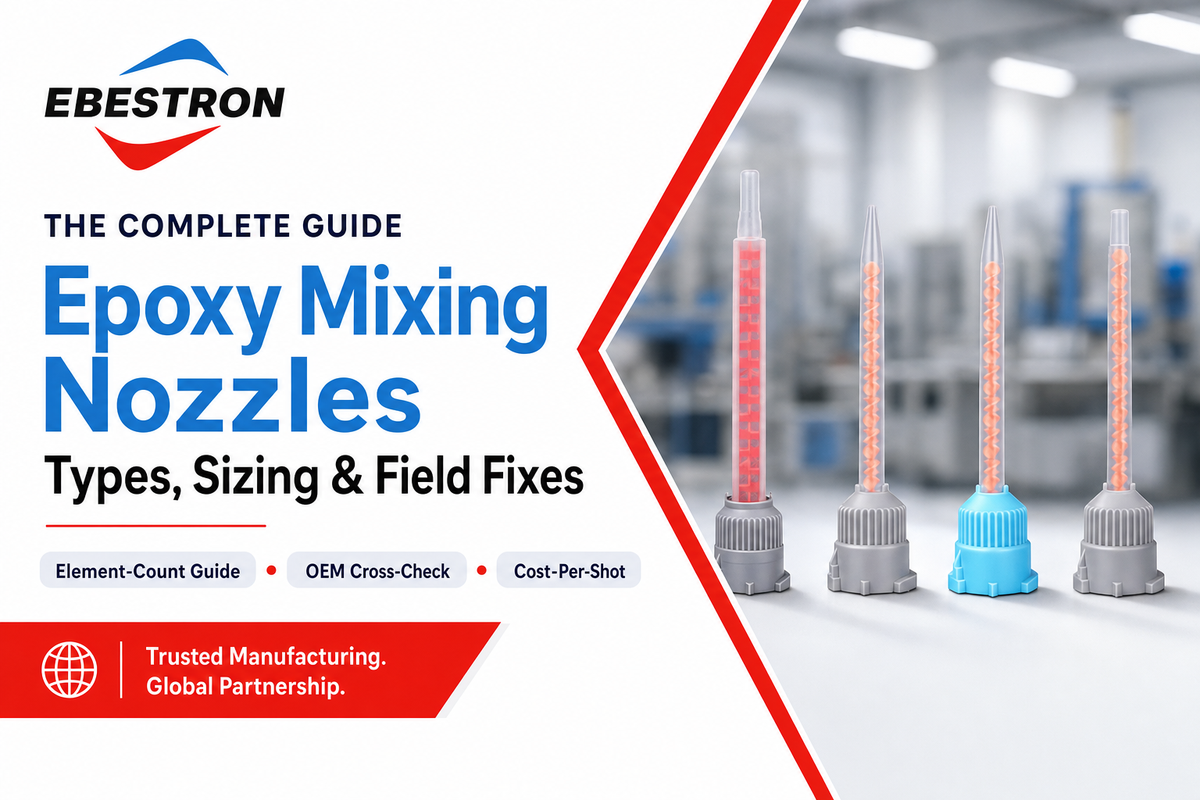
Epoxy mixing nozzles are the standard static mixing nozzle connected to a two-component epoxy cartridge, and they do the one job a cartridge can’t do on its own: blend resin and hardener into a uniform, fully cured bead as it’s dispensed. Skip the nozzle, or pick the wrong one, and the epoxy that come out isn’t epoxy in any usable sense – it’s two unmixed streams that will never reach full strength. This guide walks through what the part actually does, why epoxy’s own chemistry changes which nozzle you need, how to size and cross-reference one, and how to fix it when something goes wrong.
💡 Direct Answer
An epoxy mixing nozzle is a disposable static-mixer tip that splits and recombines resin and hardener through internal helical or Quadro elements as they’re dispensed from a dual-cartridge. Element count and geometry – not brand name – determine whether the bead that comes out is fully mixed.
Quick Specs
| Common element counts | 10, 16, 18, 24, 32 (industrial range: 7-48) |
| Mix-ratio port families | 1:1, 2:1, 10:1 |
| Cartridge size compatibility | 50ml, 200ml, 400ml |
| Element geometry types | Helical, cross-grid/Quadro, square |
What Is an Epoxy Mixing Nozzle (and What Does It Actually Do)?
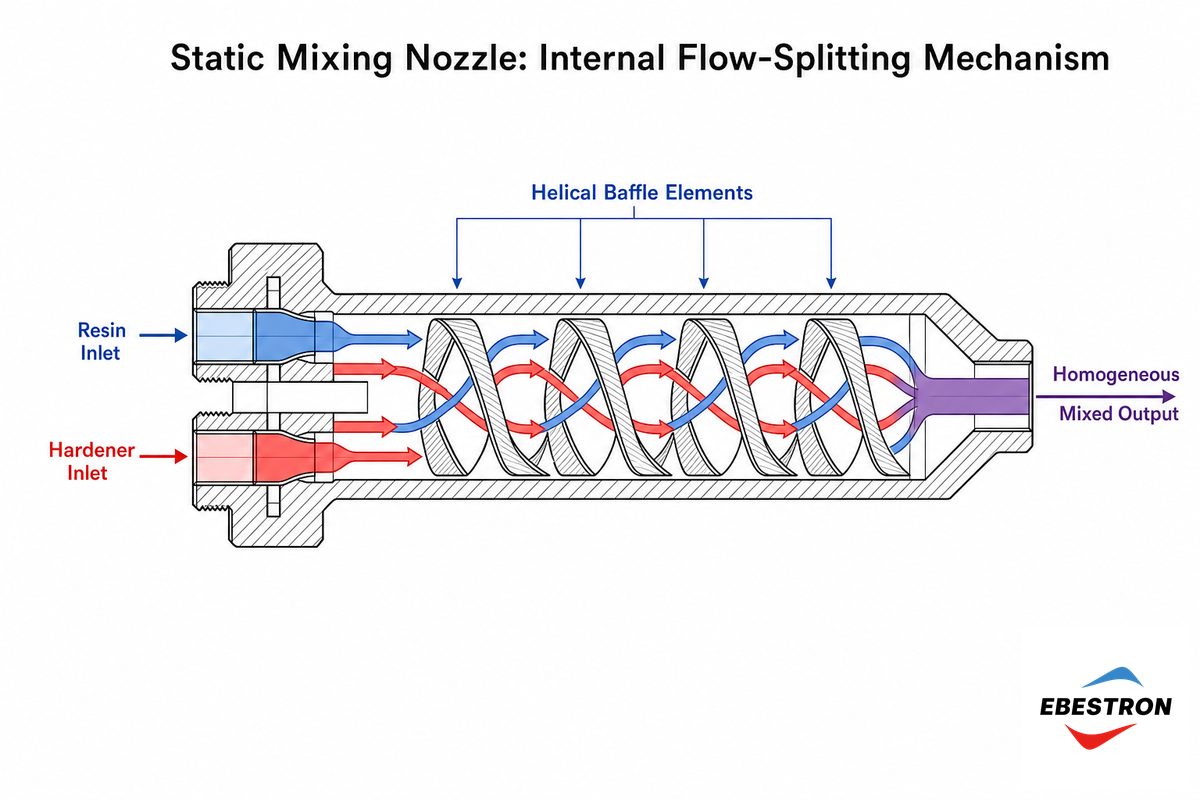
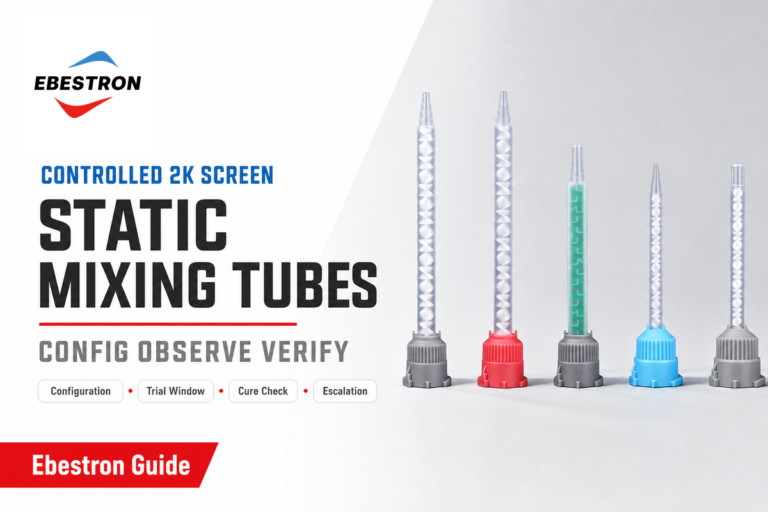
Also called a mixer tip or mixing tube, a standard static mixing nozzle is a hollow plastic tube packed with internal baffles. When two-component epoxy is pushed through it from a dual-cartridge, each baffle splits the combined stream, rotates it, and recombines it with the next split. Repeat that 10 to 30-odd times and the resin and hardener that entered as two separate ribbons exit as one homogeneous bead.
No electricity, no moving parts – the mixing energy come entirely from the pressure of the dispensing gun pushing material through the geometry, a design lineage documented in static-mixer patent literature going back decades (see US7390121).
Two design families dominate the market: the standard (helical) static mixer uses twisted, alternating-handed baffle elements – the oldest and most common design – while the Quadro (cross-grid or square) mixer uses a grid of perpendicular vanes instead of a twisted ribbon; some manufacturers favor it for higher-viscosity or filled compounds. Adhesives & Sealants Industry trade coverage also notes that mixing nozzles typically have the brand, diameter, and element count molded directly into the plastic – the fastest way to identify a nozzle in the field once its original packaging is gone.
Skip this part and the mistake shows up within 5 minutes: two unmixed streams that fail to cure to full strength, because an empty or wrong-sized mixing chamber creates a problem no amount of clamping pressure can fix afterward. Ebestron engineers every factory-direct nozzle to the same fitment tolerance as the OEM original it replaces, precisely because that tolerance is where the failure actually starts.
Some older technical literature also calls the internal baffle a mixing rod, since early designs used a rod-shaped insert rather than a stack of discrete elements. Every nozzle has an inlet end that seats against the cartridge and an outlet end where the mixed bead exits, and adhesive mixing performance depends on both ends being correctly matched to the cartridge, not just the element count in between. You may also see it called a “glue nozzle” informally, or a “static mixer” on a data sheet – same part, different names depending on who’s writing the catalog. For the full range of static mixing nozzles for 2-part adhesives across chemistries beyond epoxy, see the complete product line. The same basic mixer nozzle design also covers acrylic and polyurethane two-part systems, though this guide’s element-count and pot-life guidance is specific to epoxy adhesive chemistry. Static mixing nozzles for epoxy specifically are also sometimes shortened to “epoxy mixers” or, in older catalogs, a “glue gun” tip, though a hand-held hot glue gun is a completely different tool.
Why Epoxy Specifically Needs the Right Nozzle, The Epoxy Open-Time Mixing Window
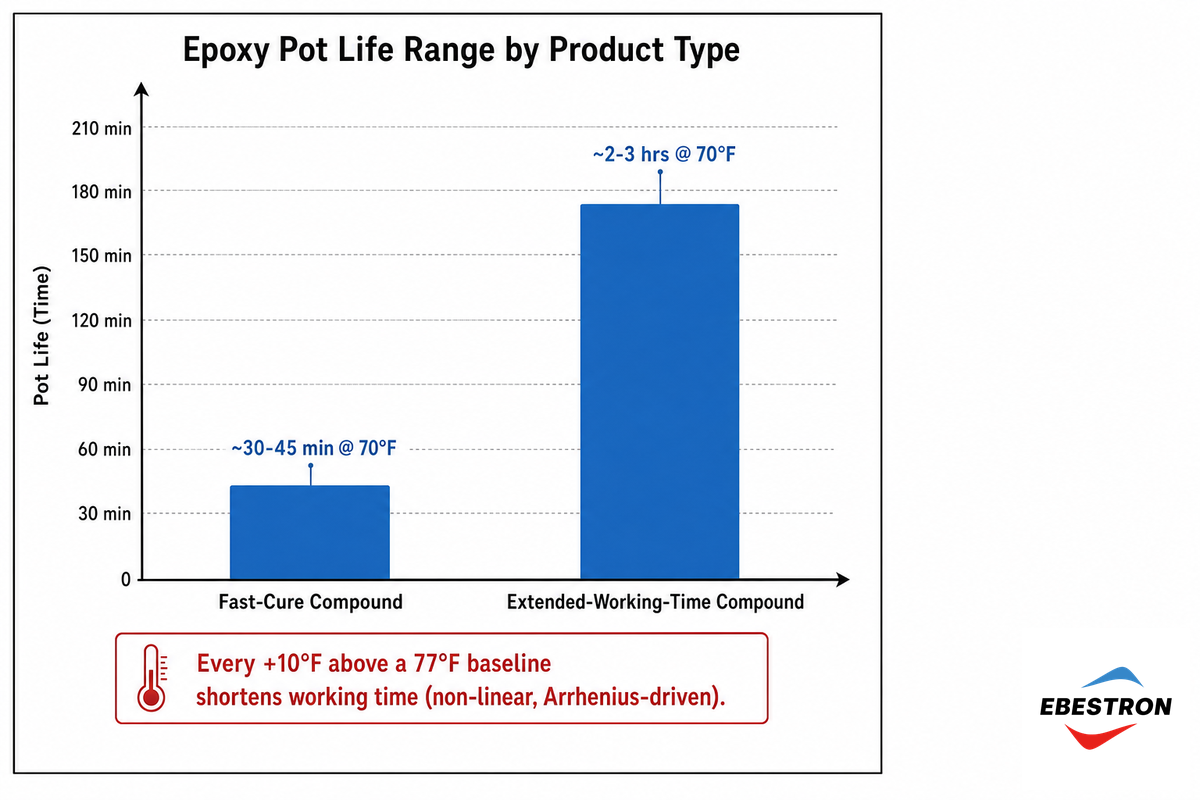
The Epoxy Open-Time Mixing Window: the length of time an epoxy stays workable after mixing (its pot life / open time) sets a hard ceiling on how much dwell time a nozzle can add before the material inside it starts to gel.
Pot life is usually measured at a standard lab condition – some where in the range of 70-77°F (21-25°C) for a specific volume of material (say, one quart) – and varies across epoxies. Chocking and grouting epoxy compounds offer an illustration of the range: Some formulations list pot life at about 30-45 minutes at 70°F, while others in the same general product line have 2-3 hours of workability at that temperature, according to manufacturer tech sheets. Temperature matters too, and not in a linear fashion; the cross-linking between the resin and hardener is exothermic, following an Arrhenius type kinetic profile, meaning the reaction accelerates faster than per degree as the temperature increase. One widely used industry rule of thumb suggests 5 minutes of working life are lost for every 10°F increase above a 77°F base. It’s a useful ballpark for short-pot-life systems, but should be viewed as an approximation derived from one trade reference and not as a rigid law applying equally to 30-minute systems and 3-hour systems.
This is why the nozzle isn’t a universal accessory. A short-pot-life epoxy can develop some degree of gelling within the mixer when paused; it’s material that has started cross-linking during the break and will show up as partially blocked nozzle down-stream (see Troubleshooting below). A larger mixer internal volume raises the probability that this gelling will happen. With a longer-pot-life system, the margin of error is much greater. Precise behavior and its shift with temperature both come down to the specific mix chemistry. Always check the tech sheets for the particular epoxy.
In practice, on the bench or in the field, the risk is a nozzle that gels internally before a job is even finished – a struggle every applicator eventually hits at least once. Two ASTM methods guide the official measuring of pot life, neither specifically addressing nozzles: ASTM D1338 covers the working life of fluid and paste materials – including the mixing of a two-component material immediately before use – and ASTM D4473 addresses the curing of thermosetting resin materials including both gel time and cure time. Typical technical data sheets are based on results generated via these procedures, not an arbitrary manufacturer estimate. The mixing-chamber volume itself is a fixed design parameter of the nozzle (see the internal geometry described in US7390121), so pot-life margin has to be checked against a specific nozzle’s dead volume, not just the epoxy’s data sheet in isolation.
“A static mixer is typically the choice device used to mix two-component adhesives just before application, but it’s the internal geometry of the static mixer itself – not just the chemistry of the cartridge – that dictates how much time you actually have available to work after the gun trigger is pulled.”
Adhesives & Sealants Industry, trade coverage on static mixing nozzle technology
Mixing Element Design: Helical vs Quadro, and Why Element Count Matters
What Is a Mixing Element and What Does It Do?
Internally each mixing element is a single interior baffle that separates the incoming flow in half, spins and stacks it on top of itself for the next element to do the same. With each element approximately doubling the layers of the incoming flow, the striation level grows exponentially, hence the disproportionate increase in mixing thoroughness as element count rises.
The formula is approximately 2^n, where n is the element count. Industrial mixers are commonly configured with anywhere between 7 and 48 elements, with 10, 16, 18, 24, and 32 as the most frequently specified counts (an 18-element nozzle is one of the most common middle-ground picks). Fewer elements also means a physically shorter nozzle, which is one more reason next-generation low-viscosity-materials geometries advertise less waste per change.
That 2^n isn’t a rounding issue; a 10 element mixer creates approximately 1024 flow layers (2^10), while a 24 element mixer produces more than 16.7 million layers (2^24)! Therefore, a 32-element mixer does more than just double the number of 16-element mixer components; it has exponentially more internal layers.
It’s also true that element count alone is an oversimplification that get included in most buying guides. One manufacturer is now advertising a second generation mixing element design that requires roughly 75% less elements than their conventional designs in order to provide a similar degree of uniformity, with as few as 7 elements providing comparable mixing to what previously required 32 element design. Although this reported 75% reduction figure is a vendor-specific claim, and not an independently verified industry-wide benchmark, the fundamental principle that element geometry, not simply element count, impacts mixing quality is well established and the idea is supported by other published design principles. Another advantage is that conventional 32 element mixers may waste up to 20ml of material each time the nozzle is changed.
⚠️ Important
Don’t compare mixers solely based on element count; a 32-element mixer and a 7-element mixer with a second-generation geometry can be equivalent in mixing uniformity.
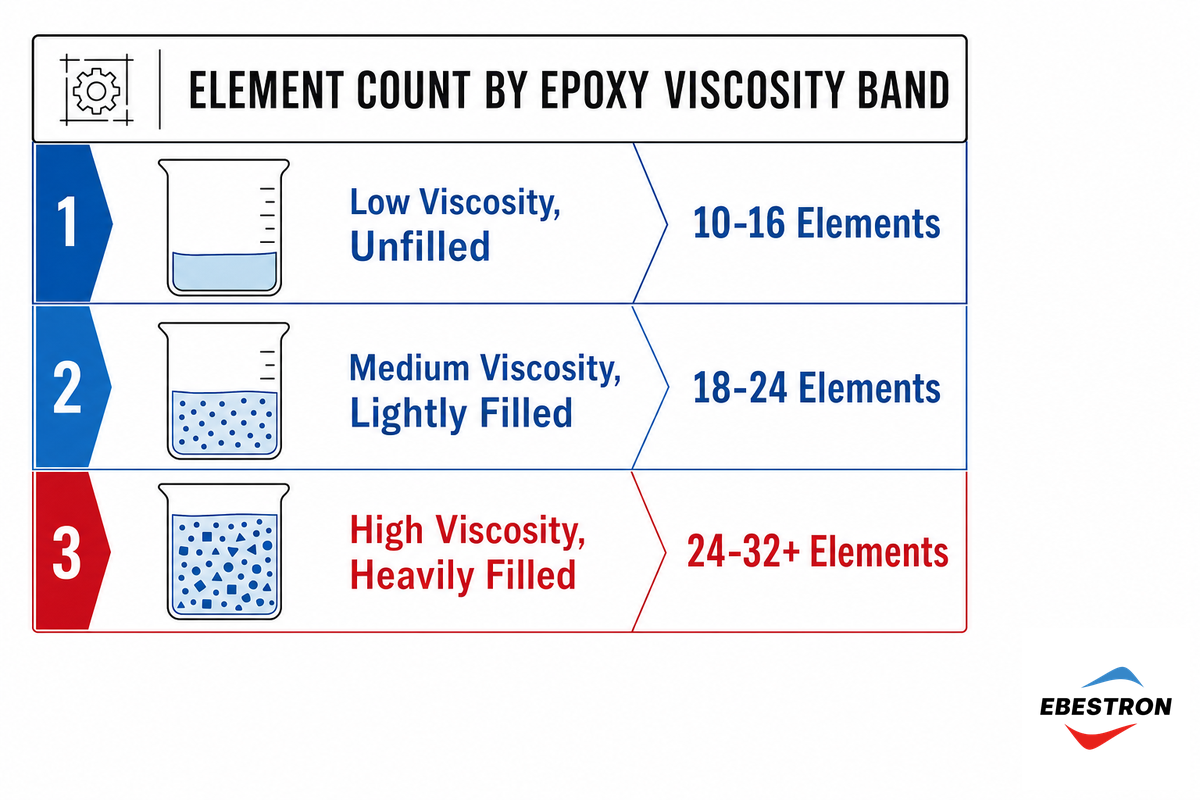
| Epoxy Viscosity Band | Typical Element Count (Conventional Helical) | Notes |
|---|---|---|
| Low viscosity, unfilled (hundreds of mPa·s) | 10-16 elements | Fastest flow, shortest nozzle; check pot life margin per H2-2 |
| Medium viscosity, lightly filled | 18-24 elements | Most general-purpose structural epoxies fall here |
| High viscosity, heavily filled (up to hundreds of thousands of mPa·s) | 24-32+ elements | Thixotropic/non-sag and metal-filled epoxies; consider next-gen geometry to control waste |
Static mixer flow is generally characterized by chemists as mixing well enough if radial variation coefficient is less than 0.05; it also turns out that the required mixing length scales with the viscosity difference between stream components if the difference is by several orders of magnitude – same physics as shown at cartridge-nozzle scale when you need more mixing elements to handle viscous filler-filled epoxy than low viscosity unfilled epoxy. An earlier fluid-dynamics study of in-line mixers offers more details on that last point; that study suggest mixer residence-time distribution is never Gaussian, regardless of how many mixing elements are inside it, and performance really correlates to the internal flow-path geometry (how cross section changes with mixer position) and overall geometry rather than just the number of elements – a better way to phrase “element count isn’t everything.”
Matching Nozzle to Cartridge: Size, Thread/Bayonet Fit, and Mix-Ratio Ports
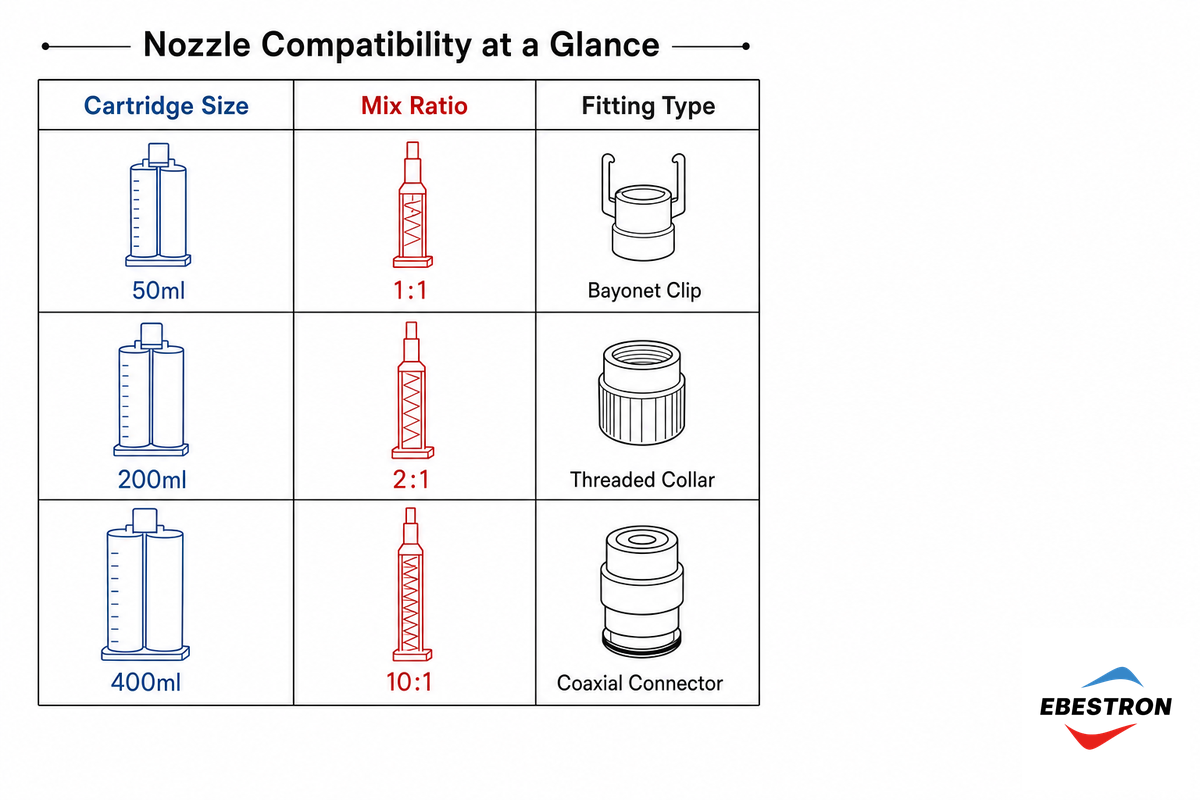
Buyers sourcing mixing nozzles for two-part adhesive cartridges most often need to size for 200ml and 400ml dual-cartridge dispensers, since those two volumes cover the bulk of production and field use. To begin with there are three factors which must all agree for the nozzle to even function on your gun, cartridge volume, ratio and fitting size. If any one factor is incorrect the nozzle simply won’t sit, won’t seal, or will meter the incorrect ratio of resin and hardener regardless of the quality of its internal components. It’s an easy mistake to make once, because the wrong ratio port can still physically thread onto the wrong cartridge – the gap only shows up when the cured bead fails at a fraction of its rated strength, sometimes within a 24-hour cure window.
| Cartridge Size | Mix Ratio | Fitting Type | Typical Element Count* |
|---|---|---|---|
| 50ml | 1:1 | Bayonet | 10-16 |
| 50ml | 2:1 | Bayonet | 12-18 |
| 200ml | 1:1 | Bayonet | 12-18 |
| 200ml | 2:1 | Threaded (F system) | 16-24 |
| 200ml | 4:1 | Threaded (F system) | 18-24 |
| 400ml | 1:1 | Threaded (F-connection) | 16-24 |
| 400ml | 2:1 | Threaded (F-connection) | 18-24 |
| 400ml | 4:1 | Threaded (F-connection) | 20-28 |
| 400ml | 10:1 | Coaxial | 24-32 |
(Element-count ranges are Ebestron’s proprietary selection guide based on both the viscosity-band table and general cartridge-fitting guidelines, not one specific publication.) Verify against your individual epoxy technical data sheet.
Don’t just assume the ratio based on the epoxy category alone. The common assumption is that the two-part epoxy is “Basically always 2:1 hardener to resin,” but actual formulas can range anywhere from 1:1 to 3:1 to 5:1, based on the particular chemistries, and the proper nozzle’s internal ratio ports need to match the actual output ratio of the cartridge, not a general guide line. Putting a 10:1 nozzle on a 2:1 cartridge will do more than just mix poorly; it will actually inject disproportionate amounts of hardener and resin into the bead.
Most buyers underestimate how much nozzle length goes with number of elements. A two-feed static mixer patent for epoxy, illustrated with a real 65/35 (parts-by-weight) epoxy resin/curing agent system, describes a straight mixing tube with 10-14 elements under 6 inch long, increasing element count as viscosity increase (which is the same guidance given above based on viscosity bands). If you’re sizing the two-component adhesive dual cartridge system too, then cartridge size & nozzle suitability should be given together.
OEM vs Factory-Direct: The OEM Nozzle Cross-Check
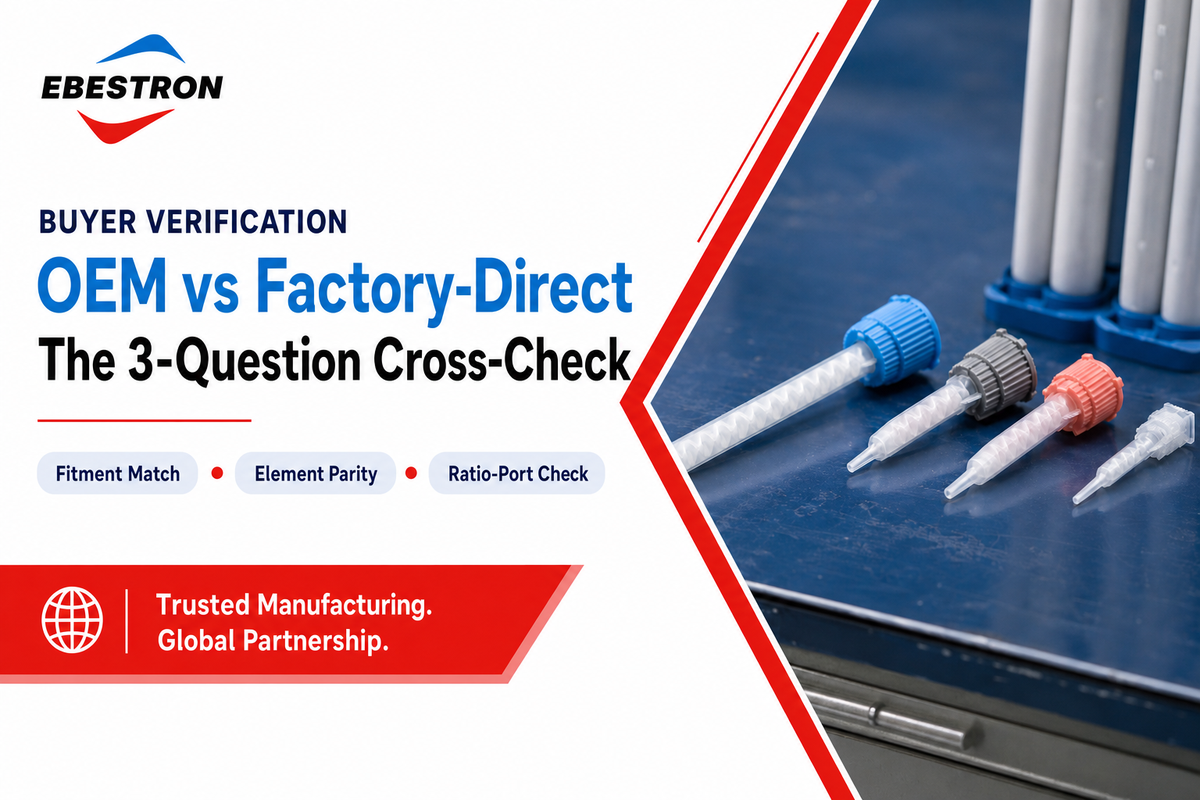
The OEM Nozzle Cross-Check is a 3-question test you can do before replacing a branded nozzle (3M Scotch-Weld EPX, Loctite, J-B Weld, Araldite) with a factory direct or generic equivalent. Buyers often start this search from a specific brand name – looking up a 2 part epoxy mixing nozzle under “3M Epoxy Mixing Nozzles,” a J-B Weld epoxy mixing nozzle, or simply the best epoxy mixing nozzles for their application – before realizing the underlying part (an Epoxy Static Mixing Nozzle by any other name) is largely interchangeable across brands once fitment and element count match:
- Does it physically fit? Make sure bayonet vs threaded fitting and barrel diameter matches your gun and cartridge, this is a pass/fail, not a judgment call.
- Is the number of elements equal to (or greater than) the OEM spec for the viscosity band on your epoxy? One substitution you can make that will subtly under-mix your epoxy: using a non-OEM nozzle with fewer elements.
- Are your ratio ports configured correctly for the true output ratio of your cartridge? The ratio of your cartridge’s internal plunger, not the one on your epoxy’s literature.
Pass all three, and you get a factory direct nozzle that’s literally the same part as the one in a different box labeled for an OEM brand, because the mixing physics of the nozzle don’t pay attention to who put their name on it. Flub even one of them and “well, it’s almost the same size” doesn’t save you.
This 3 question test just checks out the nozzle – which is a physical item with nothing clever up its sleeve to disguise. This is a different question than whether a standard epoxy product has the same chemical formulation as the name-brand product – this falls under the OSHA Hazard Communication standard (29 CFR 1910.1200), which states a chemical has the same product identifier and hazards as a reference product IF the manufacturers SDSs are equivalent. And even with that, under that standard, manufacturer are allowed to keep their formulation proprietary by specifying ranges of components, e.g. 1-5% instead of 2.5%.
💡 Pro Tip
You may notice markings in the cast of your existing nozzle. Take down brand, diameter, element count – most everything is etched on the barrel and if you get a factory-direct replacement nozzle the quickest way to go about doing it. The same type of comparison regarding branded versus generic question can be asked about our two-component adhesive dual cartridge buying guide where we break down buying the whole system.
Ebestron manufactures factory-direct epoxy mixing nozzles and static mixers produced to match the same fitment and element count you’ve come to expect – browse the full epoxy mixing nozzles product range for size options, element counts, and ratios. Request a Sample →
How to Use an Epoxy Mixing Nozzle Correctly
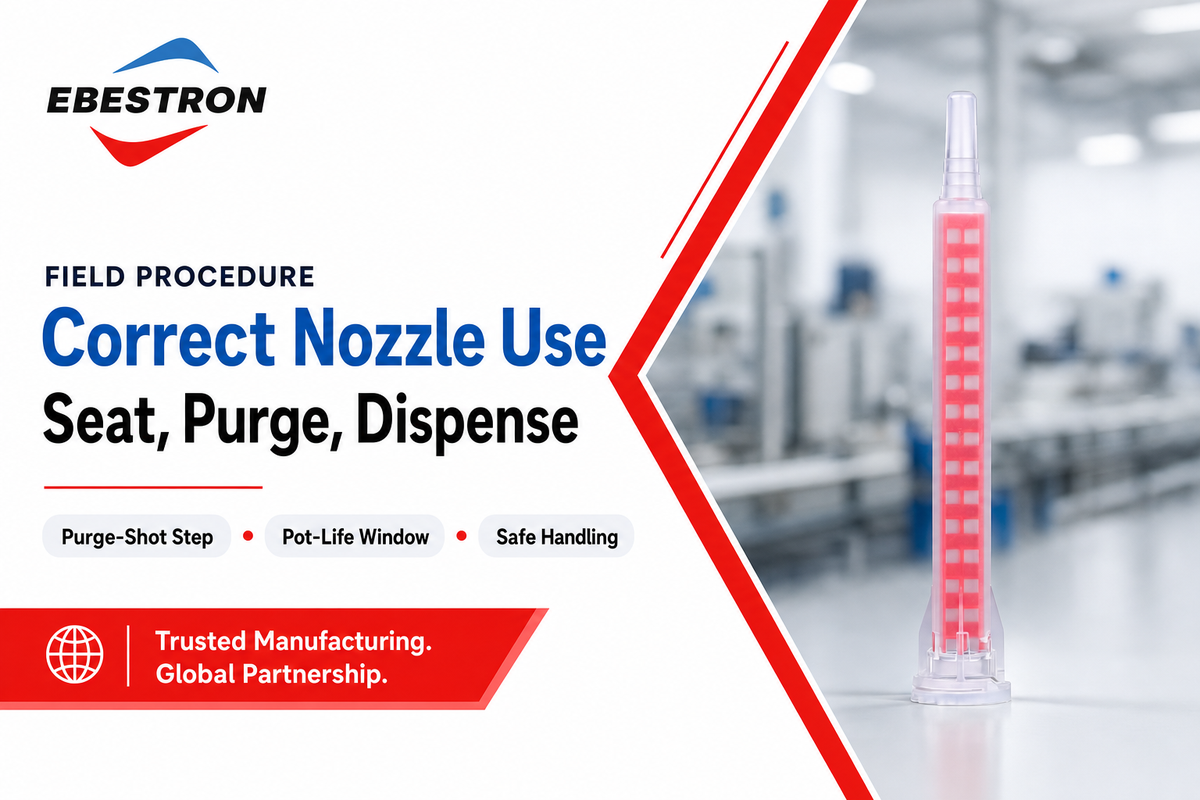
Proper mixing on almost every two-part epoxy dispenser comes down to the same four steps, from hand-held adhesive cartridges to a bench-mounted dispenser: fit the nozzle all the way down onto the adapter (a quarter-turn bayonet twist-on or screw-in hand tight), squeeze out a brief shot of “purged” material from dispense (before it ever hits the joint itself), don’t use that purged material and throw it out instead, and remove the nozzle entirely if you aren’t working continuously. Make sure that your dispensing gun isn’t the issue – a badly fitted, mismatched two-component adhesive dispensing gun can create unequal plunger pressure that can interrupt steady state mixing with the correct size nozzle attached.
Purge bead has more impact than one might realize. Because the hollow mixing chamber of a brand-new nozzle is free of any epoxy to begin with, the first material that comes out will either be rich in resin or rich in hardener, until the chamber is fully primed and it begins to achieve steady state mixing – that bead get discarded to take out the off-ratio mixture before it makes contact with the bonding surface.
The uncured epoxy resin and hardener is a handling hazard in itself, not just a question of mixing quality: the uncured ingredients are frequent skin sensitizers under OSHA’s hazard classification rules, so gloves and eye protection are a standard precaution on the part of standard when changing nozzles and discarding purge shots, and spent nozzles and purge shots should be handled the same as other cured epoxy scrap – to solid waste, not to the drain.
⚠️ Important
When you’re done dispensing, if there is still epoxy dribbling from the tip of the nozzle, stop dispensing, make sure the air in the cartridge is bled before proceeding: when an air bubble is trapped, it compresses when pushed out of the nozzle tip and expands when it’s done pushing the plunger out, keeping the dribble going after you’ve stopped, thus compromising the ratio in that portion of the bead.
Troubleshooting: Streaking, Clogging, and Incomplete Mix
What Happens If There Are Too Few Mixing Elements?
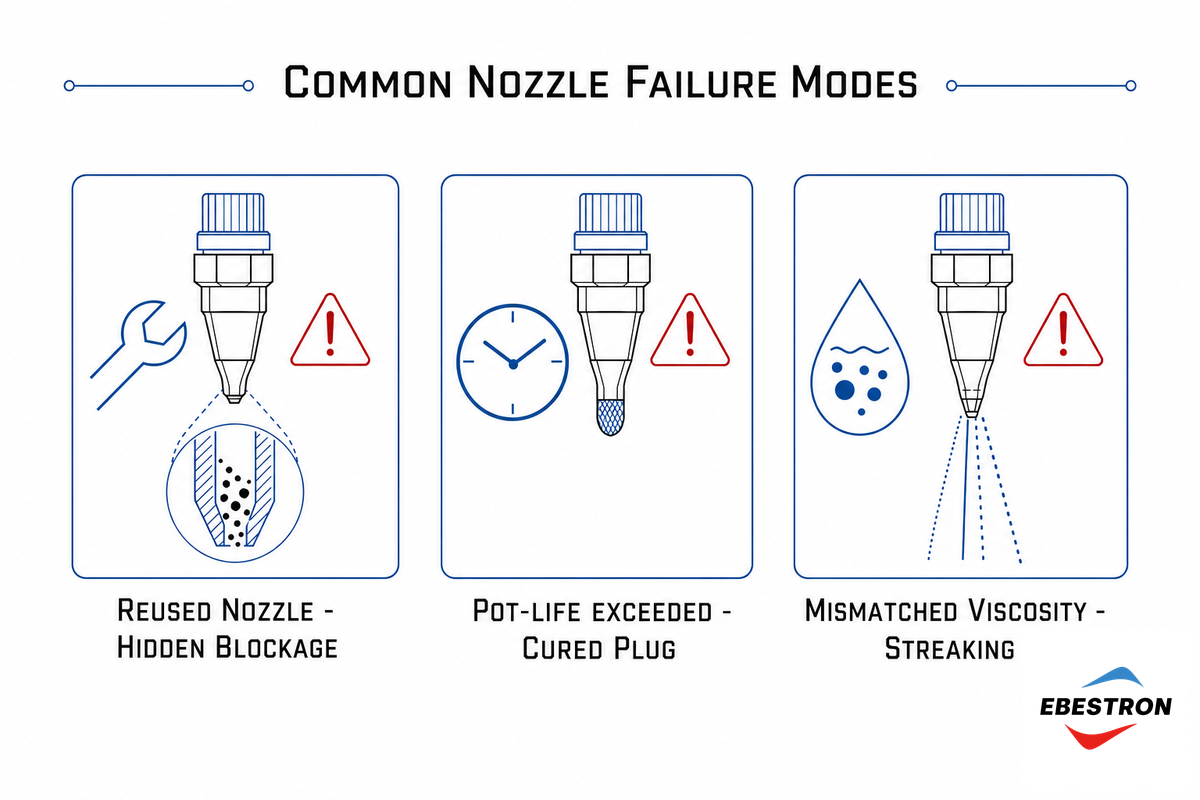
If too few mixing elements, or a nozzle size that’s wrong for the number of elements, are installed, the bead cross-section is divided into zones where one material or the other dominates; the results are visually evident streaking and/or localized hard, soft, or uncured areas in the final cured bead. In fact, those areas have poor structural integrity even if the surface appearance is fine.
Static-mixer design patents such as US7390121, used in industrial adhesive dispensing equipment across many manufacturers, describe exactly why element geometry, not just count, governs whether these failure modes occur. Three causes account for most streaks and clogs, in order of frequency:
- Re-using nozzles. Pulling a used nozzle off the gun, wiping it down and putting it back on the gun often leave cured epoxy material in the internal helical path that partially restricts the passage; you can’t see it but it’s there.
- Allowing the job to idle past the open time for epoxy. When the job takes longer to do than the pot life for epoxy, the material inside the mixing tube start to cure and plug up the channel part-way through the application.
- Using a nozzle designed for low-viscosity, unfilled material on a highly-filled, high-viscosity epoxy product; unless the nozzle geometry and number of elements are matched to the viscosity, epoxy won’t mix properly, regardless of the proper installation of the correct number of elements in a appropriately-sized housing.
The solution for all three is discipline: don’t try to re-use your mixing nozzles; don’t allow the application of your epoxy to run longer than the pot life from start to finish on a given nozzle; remove your nozzle immediately upon completion of the application, don’t leave it “to be re-used tomorrow.”
Disposable Nozzle Economics: Cost-Per-Shot and Waste Considerations
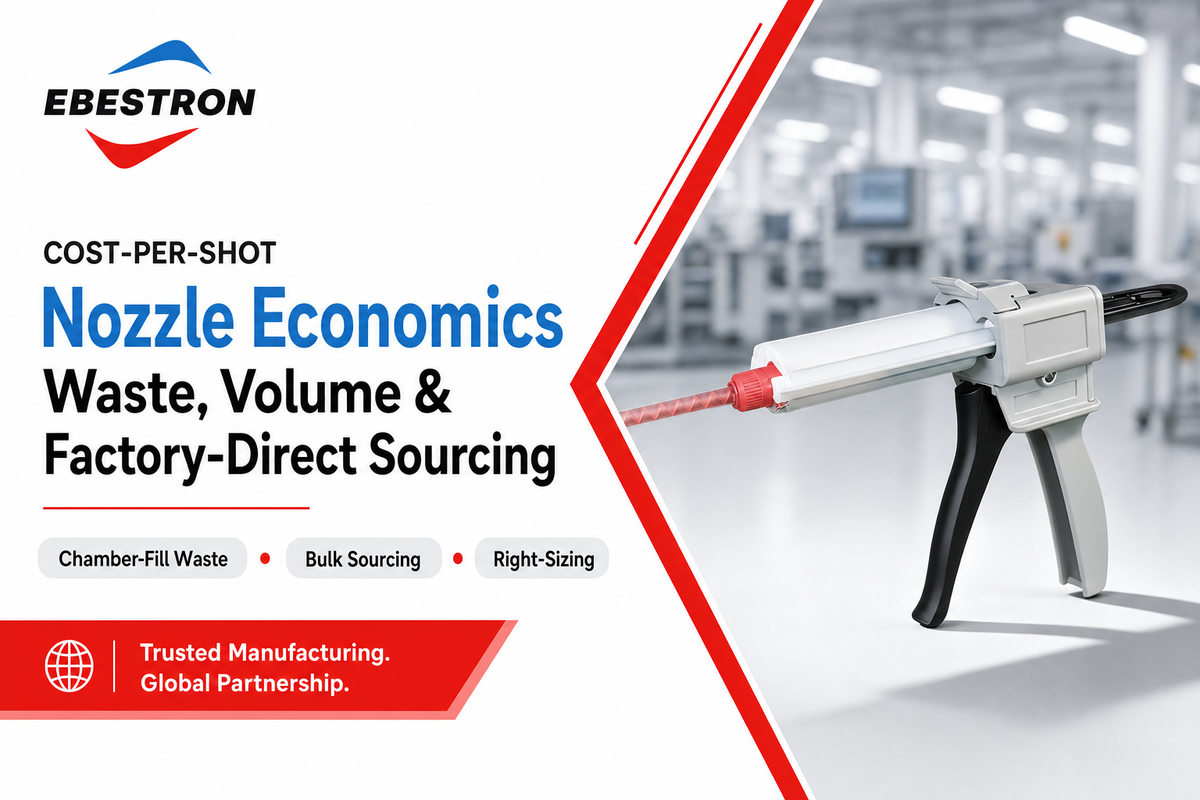
Each time you change a nozzle you lose a little bit of the epoxy, which is the material that fills up the mixing chamber and never ends up being delivered as a useful bead. Past trade press coverage of traditional helical and square mixer designs put the per-nozzle-change loss as high as 20 mL; at 50 mL on a dual cartridge that upper-bound estimate is a nearly 40% loss of cartridge volume due to chamber fill before you’ve even dispensed one gram to the joint-that’s a cost to consider when you’re doing dozens of cartridges a week, rather than a yearly repair. A shop running 40 cartridges a month at even half of that loss is spending a chunk of a cartridge on chamber fill before adding on the cost of the purge shot.
Two variables affect the actual value of that lost chamber fill: internal nozzle volume (a smaller or newer nozzle configuration, with fewer elements, will contain less material, following the same element-to-chamber-volume relationship described in static-mixer patent literature), and frequency of nozzle change (influenced by how rigidly a “never reuse” rule is applied, discussed below). For a shop, the easiest way to impact this loss is by buying factory-direct for your required sizes and element counts-not defaulting to a single oversized universal nozzle for every task. We touch on the same cost-per-shot economics on the cartridge side with our 50ml dual cartridge sizing guide. In the field, an oversized wrong-sized nozzle is the expensive mistake production teams make most often, because nobody re-checks nozzle sizing once a shop settles on a single default part number. Ebestron’s factory-direct pricing is built around matching sizes to actual production volume, not a one-size-fits-all catalog SKU.
Industry Outlook: What’s Changing in 2-Part Epoxy Dispensing

More so than a change in the nozzle market itself, the clearest driver behind nozzle consumable trends is the overall shift from mechanical fasteners to structural adhesive bonding in automotive assembly, electronics manufacturing, and general fabrication work. In addition, more and more small shops are beginning to use hand-held dual-cartridge dispensing guns previously found only on larger production lines. Combined, this trend increases nozzle changes per shop, even during periods when search interest in “epoxy mixing nozzles” is flat; interest for the term remained within a stable, slightly seasonal 210-390/month band with no year-over-year directional growth. This flat curve represents search intent, not physical part consumption, so plan nozzle consumables for your dual-cartridge dispensing throughput in 2026, not for search volume.
On the technical side, next-generation flow-splitting geometries – the subject of continuing static-mixer design patent activity and detailed in the element-count discussion above – are the more significant innovation; they provide the same mixing quality with fewer elements, resulting in less material wasted per nozzle change. Although they haven’t yet supplanted traditional helical and Quadro designs, they represent a concrete opportunity for high-volume shops. Global adhesive dispensing equipment is estimated to be around $8.7 billion in 2025, and is projected to reach the low-to-mid teens by the mid-2030s with single-digit growth, but this industrywide projection offers limited insight into per-shop nozzle consumable costs. For a growing shop, the practical risk isn’t market size – it’s the hidden gap between planned production line throughput and the nozzle inventory on hand, a mismatch that in practice causes more schedule delay than any single equipment failure. Ebestron’s in-house production keeps standard element counts and sizes in stock precisely to close that gap on short notice.
FAQ
Q: What Is a Mixing Element?
View Answer
A mixing element is a single internal baffle inside a static mixing nozzle. Each element splits the incoming resin-and-hardener stream, rotates the two halves, and recombines them before the next element repeats the process, so a nozzle with more elements has more opportunities to fully blend the two components before the bead exits the tip.
Q: Why Use Mixing Elements Instead of Mixing by Hand?
View Answer
Static mixing elements deliver a consistent, repeatable ratio every time because the dual-cartridge plunger meters resin and hardener at a fixed rate, and the elements do the blending automatically as material is dispensed. Hand-mixing depends on the operator’s technique and introduces air bubbles and ratio drift that a properly sized static mixer avoids.
Q: Do All Mixing Element Geometries Work the Same Way?
View Answer
No. Helical elements twist the flow in alternating directions; Quadro/cross-grid elements use a perpendicular vane grid instead. Newer flow-splitting geometries can reach the same mixing uniformity with significantly fewer elements than a conventional helical or square design, so two nozzles with very different element counts can still produce comparably well-mixed epoxy.
Q: What Is the Most Appropriate Mixing Element Geometry for a Given Application?
View Answer
Match geometry and element count to your epoxy’s viscosity band: thin epoxies mix well with fewer elements (10-16), heavily filled or high-viscosity systems need more (24-32), or a newer lower-element-count geometry built for equivalent performance.
Q: Can I Reuse an Epoxy Mixing Nozzle After It Sits Overnight?
View Answer
No — treat mixing nozzles as single-use. Epoxy left inside the mixing chamber past its pot life cures in place and forms a hard, permanent blockage in the internal channels, and even a nozzle that looks clean after wiping usually has residue narrowing the passage. A fresh nozzle costs far less than a failed bond caused by a partially clogged one.
Q: What’s the Difference Between “Static Mixing Nozzle” and “Static Mixer”?
View Answer
In adhesive dispensing, the two terms are used interchangeably for the same disposable cartridge-tip part — the same accessory covered in our industrial dispensing needles & precision tips guide is a related but distinct category (needles meter fluid without mixing it) — and catalogs from most adhesive suppliers list them under either name without distinction. In broader industrial usage, though, “static mixer” more often refers to a much larger inline pipe mixer used in chemical processing or municipal water treatment — a different piece of equipment entirely, sized for continuous pipeline flow rather than a hand-held cartridge, even though it uses a related flow-splitting principle internally. If you’re specifically searching for cartridge accessories rather than process piping equipment, “mixing nozzle” or “mixer tip” is the more precise search term and avoids pulling up industrial process-mixer results by mistake.
Why We Write This
We make adhesive dispensing guns, dual cartridges, and mixing nozzles for two-component adhesive products, so the question “which nozzle do I need for a specific epoxy chemistry?” comes up often on our customer support lines. Here we cover the element-count, sizing, and troubleshooting basics we want every customer to know before placing a first order. Everything here’s cross-checked against independent trade and patent literature, not generated purely from memory.
Reviewed by the Ebestron technical team
References & Sources
- US7390121, Static Mixer Module — United States Patent and Trademark Office
- US3286992A, Two-Feed Static Mixing Device — United States Patent and Trademark Office
- ASTM D1338, Standard Test Methods for Working Life of Liquid or Paste Adhesives — ASTM International
- 29 CFR 1910.1200, Hazard Communication Standard — U.S. Occupational Safety and Health Administration
- The Next Generation of Static Mixing Nozzles — Adhesives & Sealants Industry
- Numerical Study of Viscous Fluid Flows in a Kenics Static Mixer — academic research repository
- Understanding Cure Times and Pot Life in Epoxy Formulations — ASTC Global
- Two Part Epoxy Static Mixer, Introducing Air Bubbles — Eng-Tips Engineering Forum