Get in touch with Ebestron Company

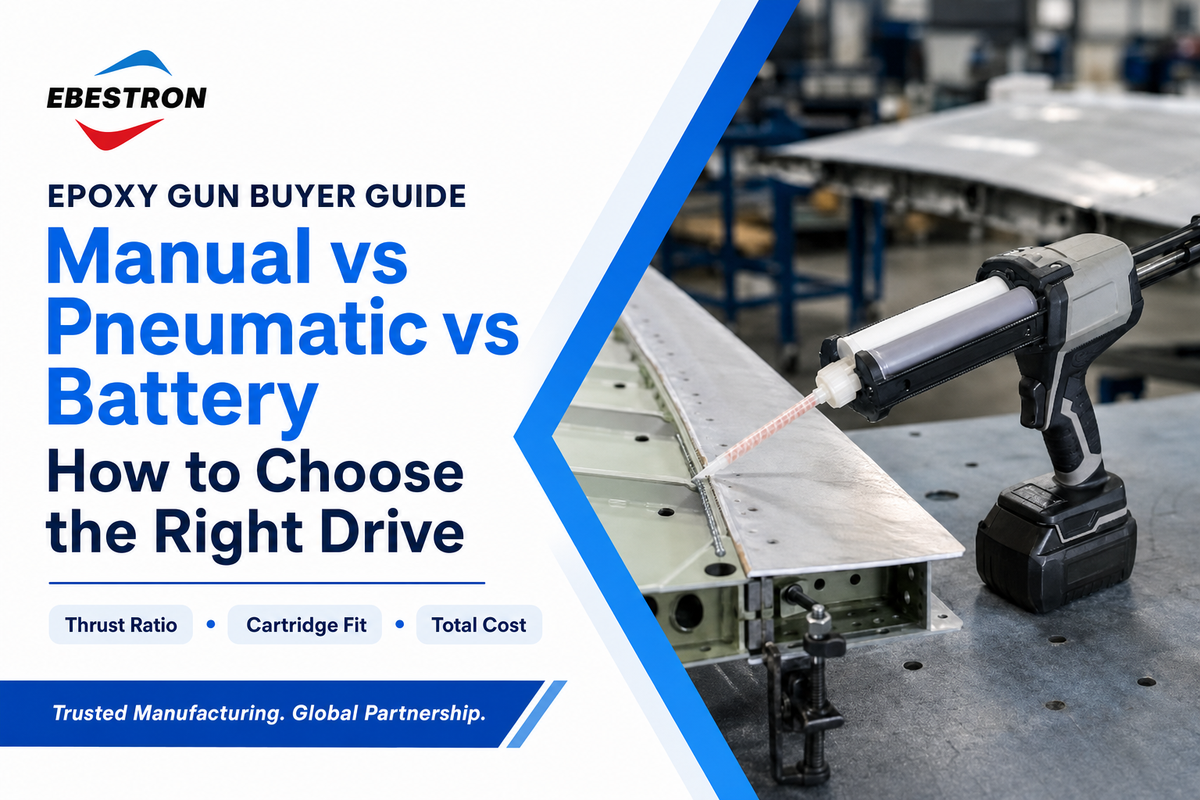
An epoxy gun looks simple, yet the drive that pushes the plungers, hand, compressed air, or battery, decides whether your two-component bond cures on-ratio or fails in service. This guide compares the three drive types of a cartridge epoxy gun the way a procurement engineer actually has to: by thrust ratio, cartridge size, dispensing force, duty cycle, and total cost.
Short answer. An epoxy gun is a cartridge dispensing gun that drives both chambers of a two-part adhesive through a static mixing nozzle, so the resin and hardener leave the tip already blended to the correct mix ratio. The three drive types are manual (hand lever), pneumatic (compressed air) and battery-electric (cordless motor); which one to buy depend on your daily cartridge volume, adhesive viscosity and where the work happens.
💡 Key points
- The cordless model usually weighs the most of all three designs, not the least, it carries its own motor and battery (Albion’s 490ml twin-cartridge model: manual 2.9 lb, pneumatic 9 lb, cordless 15 lb).
- A higher thrust ratio isn’t “more powerful for everything” — it trades material-per-pull for push force, and pushed too far it can over-pressurize and burst a cartridge.
- Off-ratio mixing is asymmetric: peer-reviewed testing shows an excess of hardener damages a rigid epoxy joint far more than a shortage does.
- Compressed air carries a hidden cost, the U.S. Department of Energy rates it among the most expensive plant utilities, with much of it lost to leaks before it reaches the tool.
Quick Specs, Drive Types at a Glance
| Drive types | Manual · Pneumatic · Battery-electric (cordless) |
| Typical thrust ratios | 10:1 · 18:1 · 26:1 (dual-switch 12:1/24:1 available) |
| Cartridge sizes | 45ml · 50ml · 200ml · 250ml · 400ml · 490ml · 600ml |
| Mix ratios | 1:1 · 2:1 · 4:1 · 10:1 (set by the dual cartridge + nozzle) |
| Pneumatic air supply | Regulate to 80–100 psi (≈5.5–7 bar); ceiling ~120 psi (8.2 bar) |
| Governing standards | ISO 10365:2022 · ASTM C881 · ICC-ES AC308 (the adhesive/anchor, not the gun) |
What an Epoxy Dispensing Gun Is (and How It Differs From a Caulk Gun)
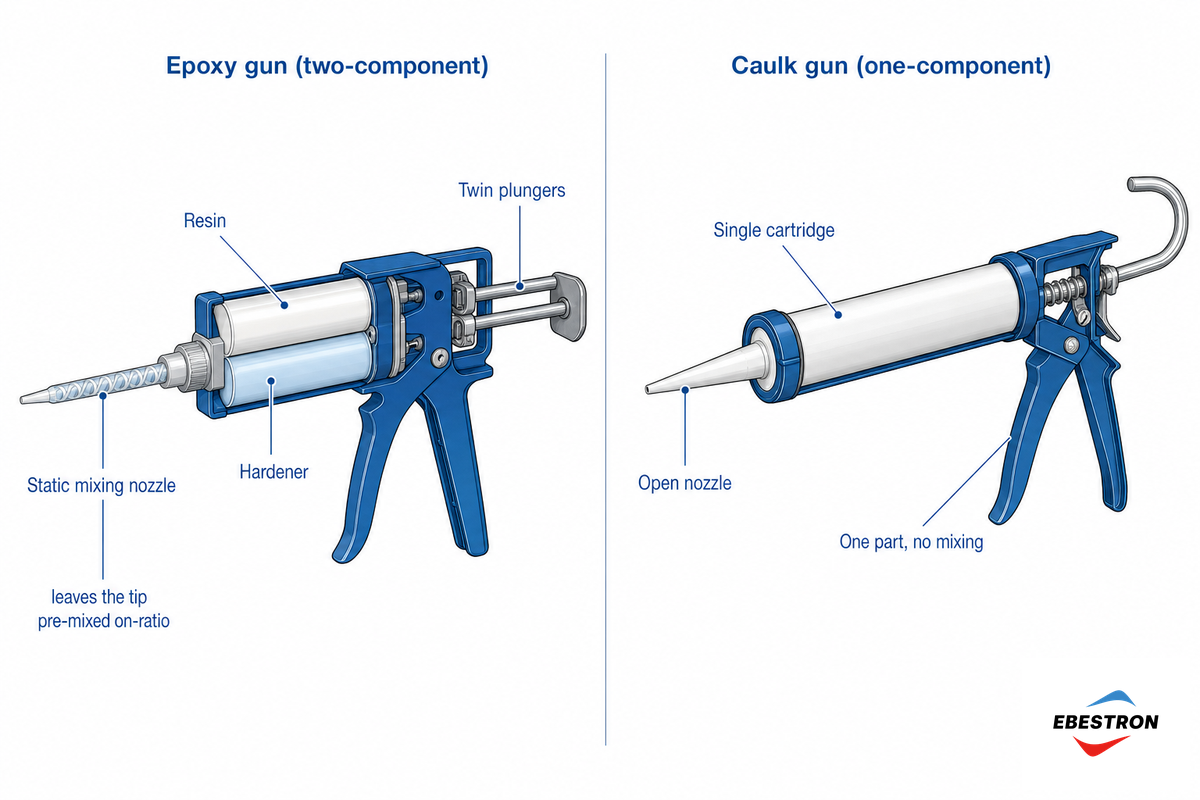
An epoxy dispensing gun is one in which two separately packaged resin and hardener components are dispensed together and perfectly mixed through a special static-mixing nozzle. This combination tool ensure a perfectly on-ratio dispensing of a high-strength bond to be utilized with a structural, chemically curing adhesive. They’re, of course, used to apply epoxies not just any two-part epoxy glue from a professional epoxy applicator or adhesive applicator, though many people colloquially call it the same.
Though similar in overall appearance, a single-component caulk gun and an epoxy gun are worlds apart in their function, and can’t be substituted for one another. A hot-melt glue gun melts and applies a solid hot melt stick with the use of heat. A two-component epoxy dispenser gun utilizes an epoxy product sold in dual cartridge form; it mixes two-part epoxies for perfectly ratioed delivery directly to the job at hand from a static mixing nozzle. It’s the static mixing element and matched dual component cartridge that’s responsible for the structural reliability achieved with a two-component epoxy that a simple single component ( cartridge style caulk guns ) has absolutely no capacity of delivering.
How is an epoxy cartridge gun different from a hot-melt glue gun?
An epoxy cartridge gun dispenses two reactive components from a dual cartridge and combines them on-ratio inside a static mixer, giving a chemically cured structural bond. A hot-melt glue gun instead melts a solid thermoplastic stick and lays down adhesive that bonds only as it cools, then re-softens when warm. One cures by reaction and resists heat and load; the other re-melts, so they are different product classes.
One thing does not define the gun: there is no ISO or ASTM standard for the dispensing tool itself. The standards in this field govern the adhesive and the jointISO 10365:2022 names the failure patterns of a bonded assembly, and ASTM C881 specifies two-component epoxy systems furnished as Component A (resin) plus Component B (curing agent). The gun itself is specified by cartridge maker, capacity and mix ratio.
The Three Drive Types at a Glance
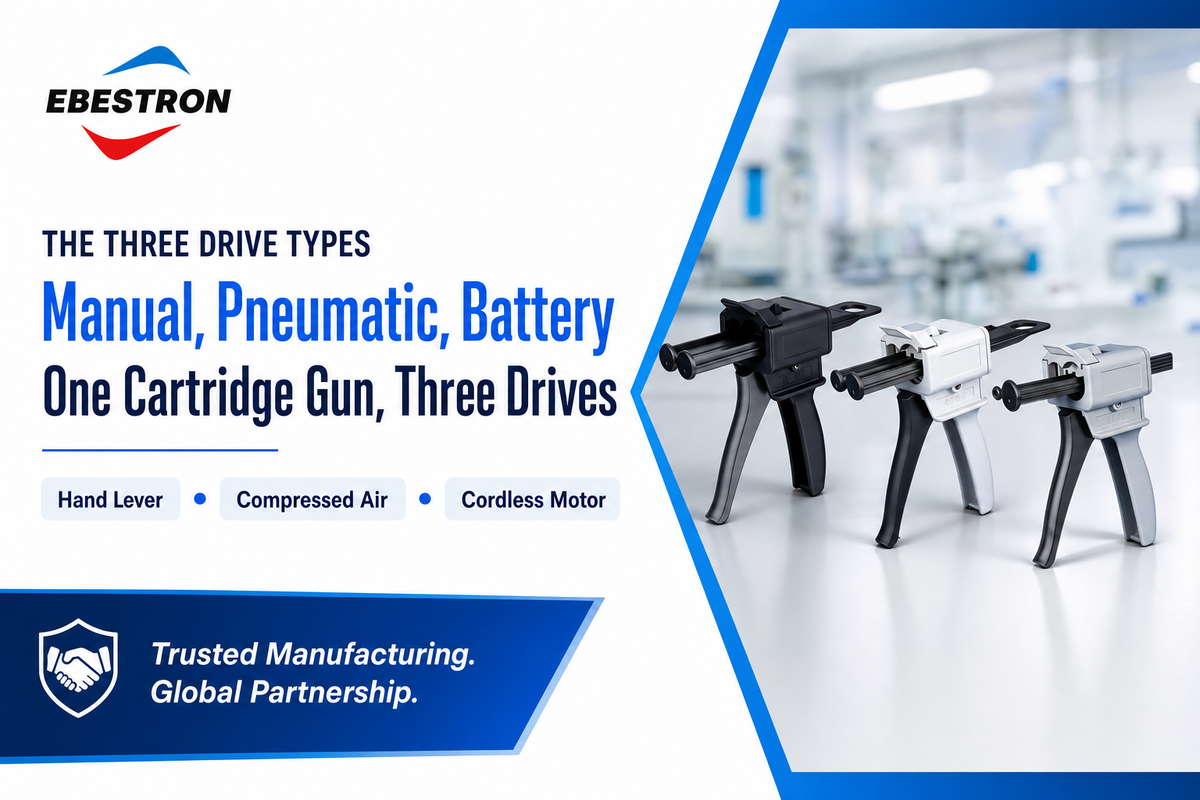
Manual, pneumatic, and battery-electric represent the three drive types for the same family of cartridge gun, and as trade-press and manufacturer catalogs all partition the market, Nordson EFD has cordless, pneumatic, and manual 2K dispense guns designed for the identical cartridges, and the dual-ram drive train behind them is documented in patents such as Albion US5104005A. A best head-to-head comparison comes with a single product line available in all three drives: Albion’s 400 Series, a 490 ml dual side-by-side cartridge gun at 10:1, published with equivalent test basis under the three types of drive. Compare all three across Ebestron’s two-component dispensing guns.
| Attribute | Manual | Pneumatic | Battery-electric |
|---|---|---|---|
| Power source | Hand trigger | Compressed air, 80–100 psi | 18V Li-ion motor |
| Dispensing force (490ml 10:1) | 900 lbf | 1130 lbf | 950 lbf |
| Tool weight | 2.9 lb (lightest) | 9 lb | 15 lb (heaviest) |
| Typical thrust ratio | 10:1–26:1 | n/a (air-driven) | motor-driven, to ~5–7 kN |
| Bead consistency | Pulsing, hand-paced | Steady (regulated) | Constant feed, speed-settable |
| Utilities needed | None | Compressor + air hose (tether) | Charged battery, no air |
| Field portability | High (light, no power) | Low (tied to compressor) | High (cordless, but heavy) |
| Runtime / throughput | Operator-limited (fatigue) | Unlimited at the hose | ~25 loads/charge, 35s/load |
| Best duty cycle | Low / intermittent | High, fixed bench/line | Medium, high, mobile/field |
| Approx price band | $24–$300 | $295–$590+ | Highest (motor + battery + charger) |
Force/weight/runtime figures are representative manufacturer specifications for one 490ml 10:1 cartridge-gun platform; prices are directional, as of mid-2026, and vary by brand and region.
📐 Engineering Note
Reading down the columns of the table, rather than “which is strongest”, is more informative. On the same 490 ml platform, the pneumatic drive provides peak raw force (1130 lbf) at the cost of tethers and significant weight; the cordless drive nearly meets the pneumatic (950 lbf) in force but is the highest weight gun at 15 lbs, and the manual gun is the lowest weight at 2.9 lbs, free to walk to the jobsite, but limited by the operator’s grip strength on what’s otherwise a very capable 900 lbf-maximum output tool.
Manual Cartridge Guns: When Hand Power Is Enough
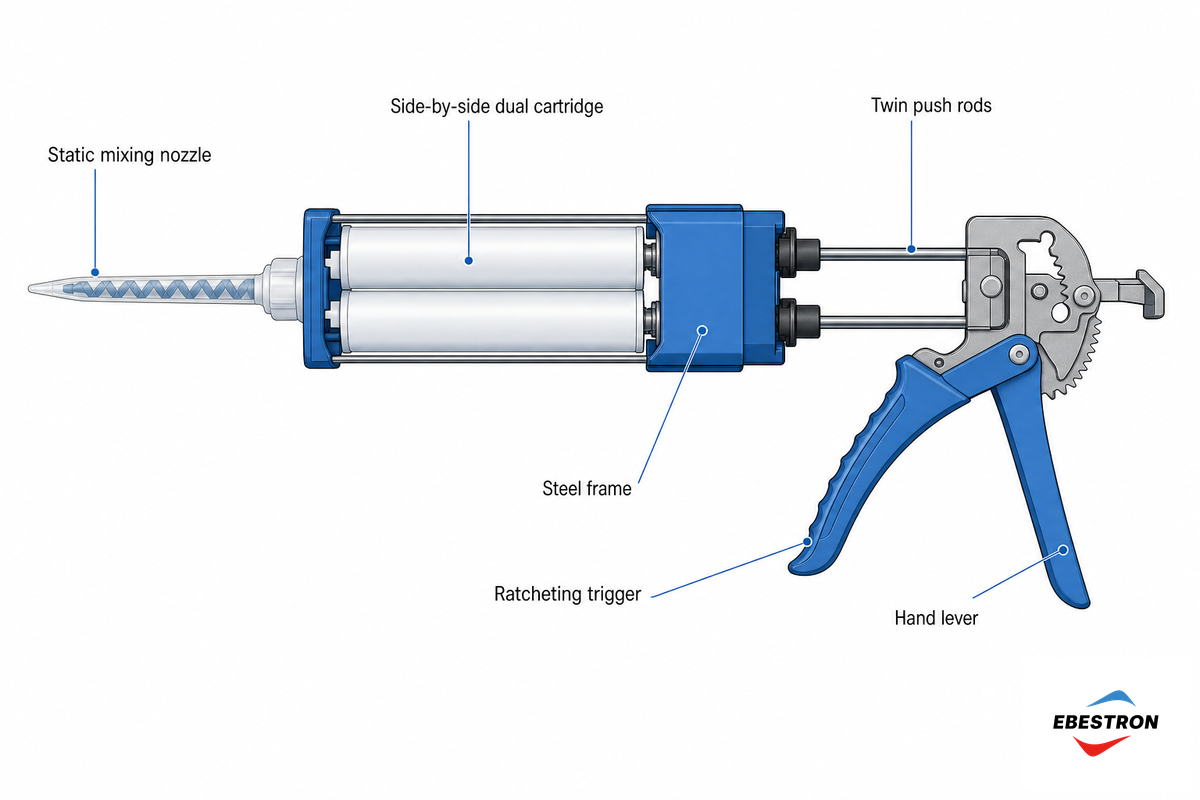
The appropriate tool-not a downgrade-for low-volume, precision, or economical applications where portability and a longer dispensing window rather than raw speed are concerns is the manual epoxy gun. Its manual drive is a ratcheting trigger actuating both plungers of the twin cartridge equally; a U.S. patent on Albion’s two-component mechanism (US5104005A) clearly illustrates the screw-thread-driven ram to keep both plungers moving together perfectly. A rugged steel-framed body avoids flexing, which can quietly over-feed either side, critically when bonding metals, aluminum, and composite substrates where joint integrity is paramount; a durable frame, and that frame durability under load, keeps the two resin cartridges dispensing on-ratio.
Manual output is constrained ergonomically-not mechanically. NIOSH guidance on hand-tool design recommends triggering effort not exceeding 2.2 lbs (approximately 9.8 N) and trigger travel not exceeding 0.75 inches; thick epoxy with the wrong manual gun forces the operator to exceed both with every trigger pull, and the impact on carpal tunnel syndrome isn’t trivial. As the landmark Silverstein epidemiology reported by NIOSH found, an odds ratio of 5.5 for carpal tunnel from highly repetitive work increases to 15.5 when high force combines with high repetition. Thus for a production setting, the best argument is for one of the powered drive.
Thrust for manual guns increases with the size of the cartridge-e.g., about 140 lbf for a 50 ml composite gun and as high as 900 lbf for a 490 ml double-side gun at 26:1. You’ll want to choose the highest ratio which you can tolerate at your desired bead rate. See the matching section below for guidance on ratios. Ebestron’s manual cartridge dispensing guns span 50ml to 600ml at 10:1 to 26:1.
Pneumatic Cartridge Guns: Air-Powered Consistency
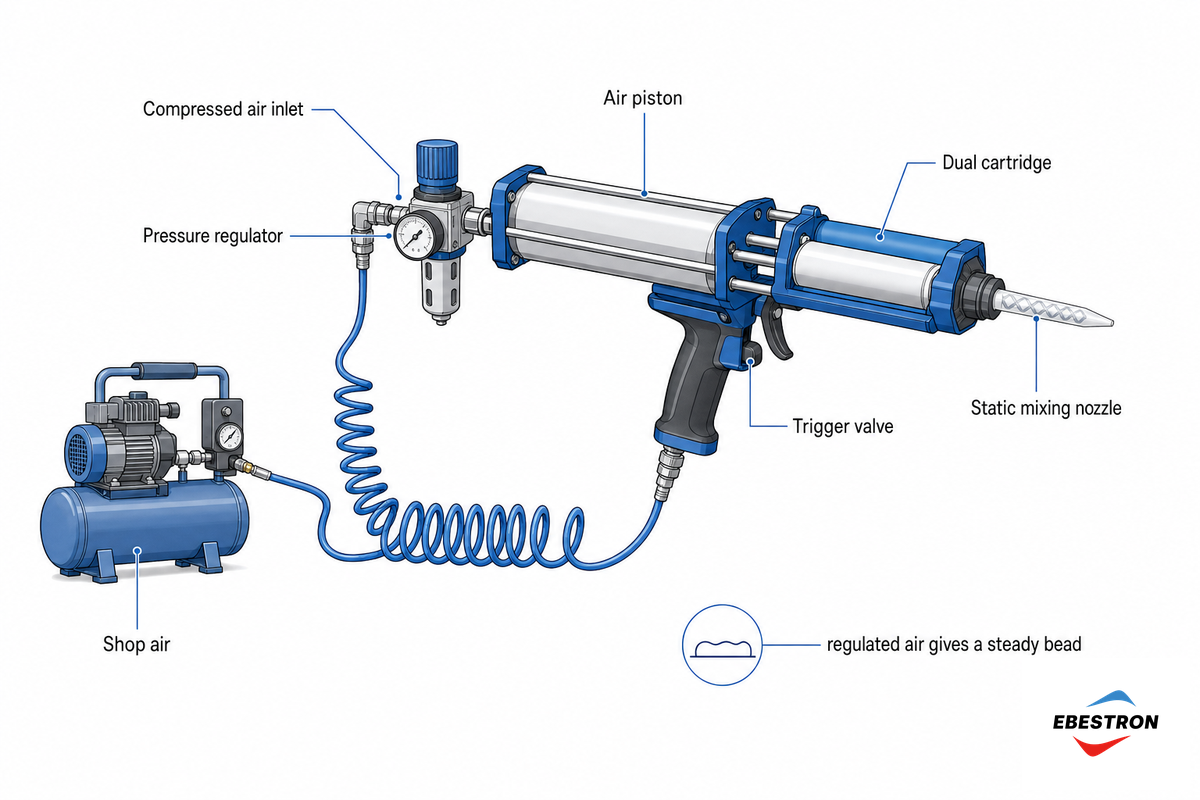
What is the difference between a manual epoxy gun and a pneumatic epoxy gun?
A manual gun multiplies your grip force through the thrust ratio and dispenses in pulses paced by the operator, which causes fatigue and bead variability as the pace rises. A pneumatic gun replaces the hand with regulated air, giving a steady, fatigue-free bead at constant pressure. The trade is utilities and mobility: it needs a shop compressor and hose, so it lives at a fixed station, not wherever the work is.
A step up from manual is typically a pneumatic dispensing gun for the reason that they often cost less up front than battery units, and in some cases, are lighter. Industrial models maintain a pressure band, for example, Simpson Strong-Tie anchor directions indicate setting an adjustable regulator for 80-100 psi, and an upper limit exists around 120 psi (8.2 bar) for hand-held 2K devices — air drawn from a compressed-air system the U.S. Department of Energy flags as one of the costliest plant utilities. At the cartridge, this pressure equates to useful force; typical 400ml pneumatics are rated for approximately 5 kN at 6.8 bar, greater for larger cartridges. The typical remedy to hand applying a “virtually impossible to dispense by hand” high-viscosity or filled epoxy adhesive is a pneumatic gun, providing air pressure as a backup.
✔ Pneumatic advantages
- Steady, fatigue-free bead at regulated pressure
- Lower purchase cost than cordless
- Handles high-viscosity 2K a hand can’t
- Effectively unlimited runtime at the hose
⚠ Pneumatic limitations
- Tethered to a compressor and air hose
- Hidden energy cost (see TCO section)
- Run wide-open it can blow out or burst a cartridge
- Poor fit for field or mobile work
Battery / Cordless-Electric Guns: Programmable Dispensing
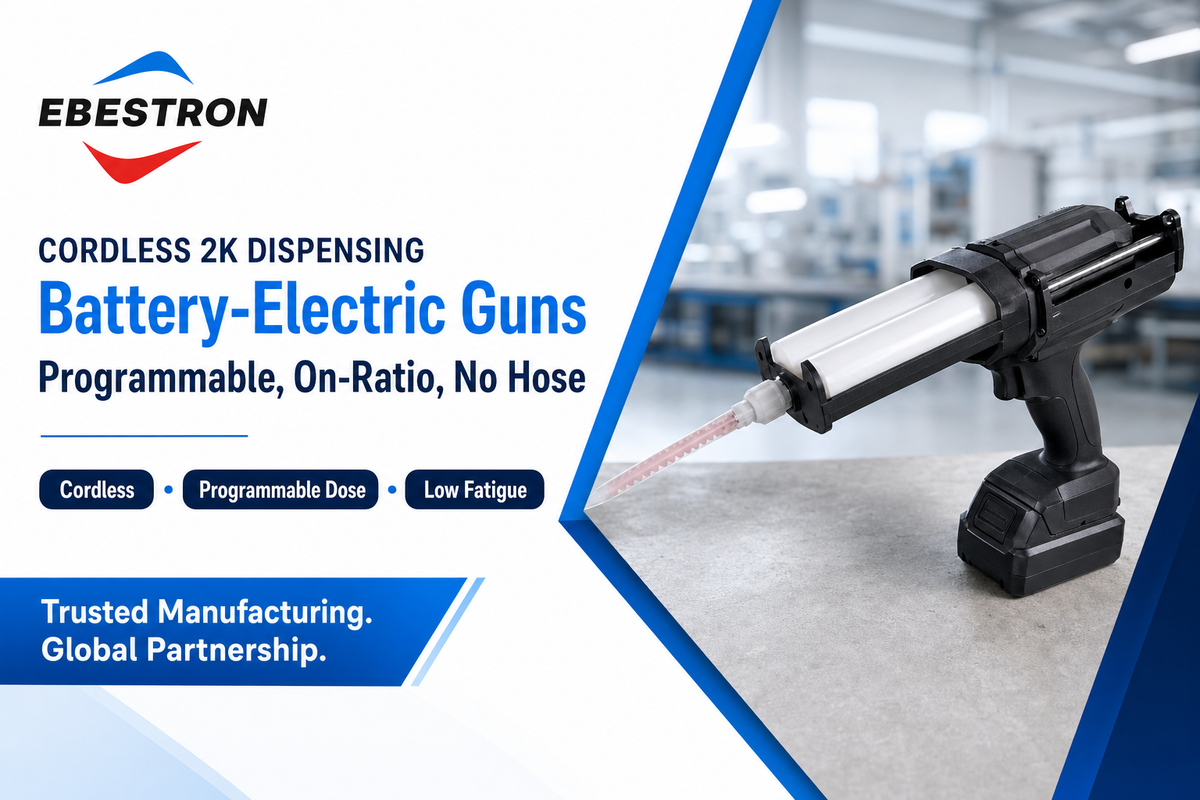
Less mentioned in buyer guidelines, and where the quickest advancement has occurred, are battery-electric (cordless) epoxy applicators. These apply power directly to plungers via a brush-less motor and a battery pack to achieve a constant bead at adjustable speed, while eliminating compressor cords. The logic controlling the motor-kept at a steady pace and reversed momentarily to prevent drips by retracting plungers upon releasing the trigger-is covered in a Sulzer Mixpac/Medmix patent (US9862001B2).
“In recent years, developments in lithium-ion battery technology have reduced and reversed the power advantage previously held by pneumatic tools.”
This change is evident in power specifications: cordless 2K devices are now commonly capable of delivering 5-7 kN and can dispense a 490ml load in approximately 35 seconds, achieving about 25 full loads per fast 30-minute battery charge. Individual doses are adjustable from several hundred to about 1 ml. However, anecdotal reports from the field note that the anti-drip feature on some units creates a momentary delay in starting the bead when the trigger is re-engaged, so crews must develop a feel for this interruption. The trajectory is concrete: the first 2K cordless dispensers were built so a construction crew could replace full-bed mortar with spot-bonded epoxy on stone cladding, cutting assembly labor by more than 50%. See the battery-electric cartridge guns for programmable cordless dosing.
⚠️ Where battery is the wrong call: classified hazardous areas
However, this freedom does have boundaries. In classified hazardous locations, such as paint finishing rooms, petroleum processing, and chemical facilities, OSHA 1910.307 requires electrical equipment to be certified as explosion-proof or intrinsically safe for the location. Because standard battery-powered equipment is inherently an ignition source and typically is prohibited, pneumatic guns are the safety-compliant option regardless of usage level in such circumstances. In addition, transporting and using lithium spare batteries may involve some regulatory complexities for field service personnel.
Matching Gun to Cartridge: Thrust Ratio, Mix Ratio and Size
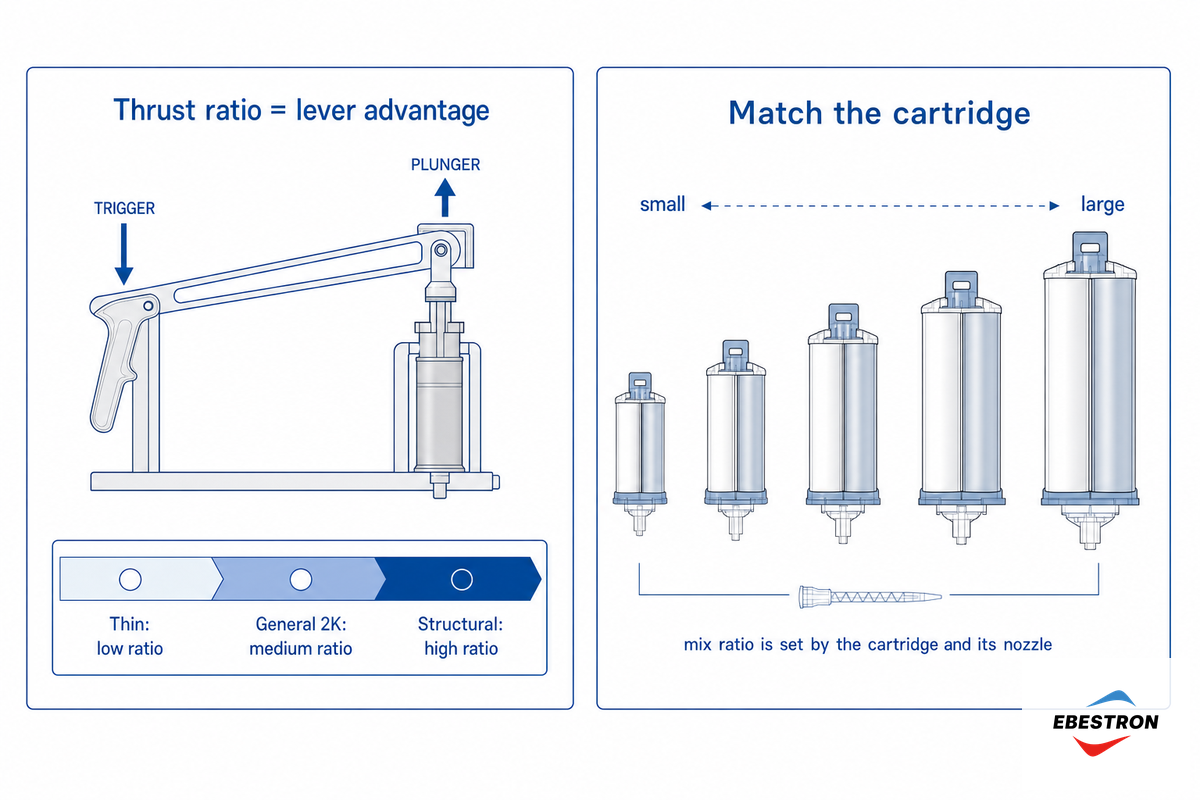
Most decision-relevant spec is thrust ratio – the lever advantage that connects your index-finger pull on your trigger to the cartridge plunger push rod. An 18:1 gun delivers 1 lb force on the trigger to 18 lbs at the plunger tip. The rules for how that transfers from any cartridge gun translate from cartridge-based viscosity as: thin-material to 6:1 to 10:1, generic adhesive 12:1 to 18:1, 2K structural (high-viscosity) 20:1+. Commercial epoxy dispensers use identical rules-published ratings for 26:1 guns show 900 lbf on the plunger with 167 psi; 18:1 guns around 3.9 kN (900 lbf) are published.
📐 Thrust-Ratio Sizing Check (worked example)
The most practical three-test procedure helps you gauge your own guns. Take any hand-mixed, two-component cartridge of high-viscosity structural epoxy, in our case a 400 ml, 1:1 part, for test: (1) 1:1 – The dual push-rod cartridges have their plungers advance together – no mixing-force penalty. (2) Cartridge volume, and high viscosity create high-pressure at the plunger tip – pressure and strain on your hands and trigger finger increase significantly as cartridges empty of high-viscosity fill. (3) High-viscosity materials at 18:1 create high plunger pressure (and pain): step up to a 26:1 gun (at 167 psi on the plunger tip), or better yet move to a power tool, so that hand stress doesn’t become the primary issue. Plug in your intended cartridge (45 ml through 600 ml) and its viscosity grade to predict.
Other variables complete the match. Mix ratio, (1:1 to 10:1), is dictated by the specific twin cartridge and the integrated matched nozzle – the ratio will never be wrong due to an incompatible static-mixer setup (that’s what’s called “on-ratio delivery”!) — the property that lap-shear standards such as ISO 4587 are built to measure. Size of the twin-cartridge package itself goes from 45 ml & 50 ml, up through 200 ml, 250 ml, 400 ml, 490 ml and 600 ml capacities. Any given gun often takes adhesive cartridges of varied size – a 50 to 600ml tube – and ratio up to 10:1, just by changing a bayonet holder for a differently-sized cart (the same body style as a cartridge caulk gun). (A quick note of caution about those mixing nozzles: the number of mixing-elements in epoxy mixing nozzles alone doesn’t tell the whole story, and even a high-quality nozzle for mixing epoxy shows a loss of about 19-20 ml adhesive per nozzle due to purges and retaining the epoxy product at the mixing tip).
What size epoxy gun do I need?
Size the gun to fit the cartridge, not the bond’s total volume. Read the cartridge for capacity (50ml to 600ml) and mix ratio (1:1 to 10:1), then pick a gun rated for that exact size and ratio, with plungers that seat fully against both pistons. For thick or large cartridges, raise the thrust ratio or go powered; for small precise work a 50ml, 10:1 manual gun is plenty.
Which Drive Should You Choose? The 3 Drive Duty Cycle Crosswalk
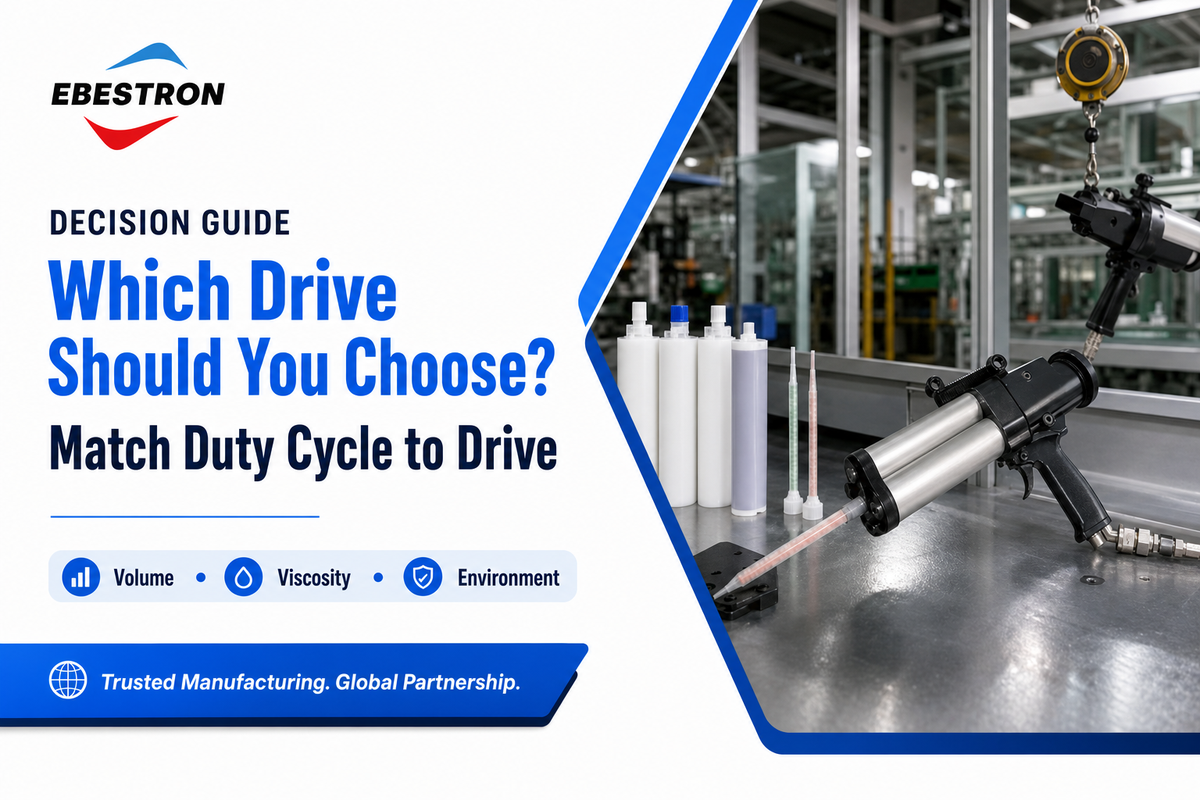
The 3-Drive Duty-Cycle Crosswalk matches your real conditions — daily cartridge count, viscosity, job-site environment and budget — to a recommended drive, so the choice stops being about the “best” tool and becomes the one that fits. The trade-press sequence is simple: weigh force, material volume and, per NIOSH ergonomics, the repetition your operators face; if a power tool is indicated, default to pneumatic, then step up to cordless when portability matters.
| Your situation | Recommended drive | Why |
|---|---|---|
| <10 cartridges/day, low viscosity | Manual | No fatigue risk; lowest cost; full control |
| Small, precise beads, tight access | Manual | Lightest (2.9 lb); zero spin-up; long open time |
| High-viscosity / filled 2K, any volume | Pneumatic or cordless | Hand force can’t generate the back-pressure |
| Fixed bench / production line, high volume | Pneumatic | Cheapest powered option; steady bead at the hose |
| Field / mobile, no air supply | Cordless | Go-anywhere; no compressor or hose |
| Consistent dosing critical for bond | Cordless | Constant-velocity motor; settable speed/dose |
| Long linear footage daily | Pneumatic or cordless | Removes hand fatigue over the shift |
| Tight tool budget, occasional use | Manual | Lowest capital; no compressor or charger |
| Already running a compressor line | Pneumatic | Marginal cost low if air is already there |
| Classified hazardous area (paint / petroleum / chemical / dust) | Pneumatic or manual | Electric tools restricted unless approved for the location (OSHA 1910.307) |
Cost and Total Cost of Ownership
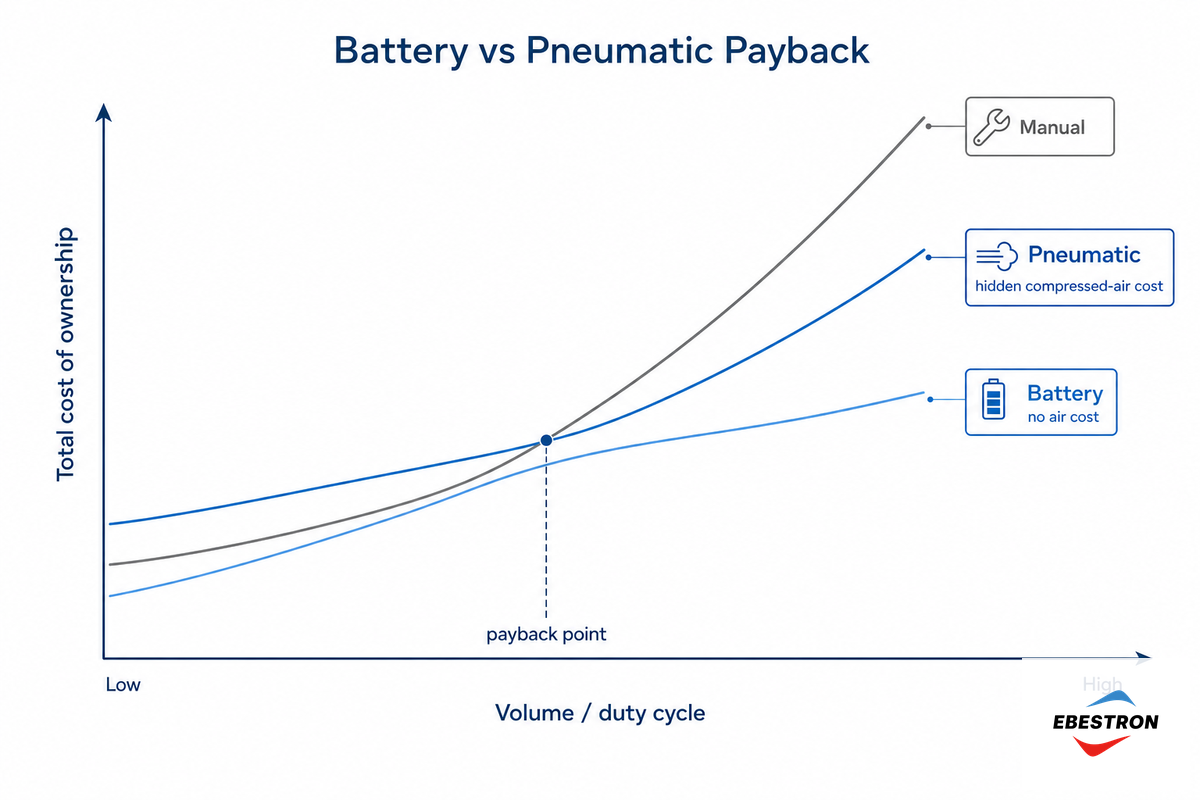
Manual guns are the cheapest per purchase, while cordless tops them in cost, but the Battery-vs-Pneumatic Payback Curve, purchase price plus consumables plus running costs plus labor, often reorders them at high duty cycle. The biggest hidden running cost is usually compressed air; the U.S. Department of Energy rates compressed air as one of the most expensive plant utilities and notes that, on top of compressor maintenance and disposing of oily condensate, as much as 10% of a plant’s electricity can go to producing compressed air, and a large share of that is lost to leakage before it ever reaches the tool. There’s no compressed-air cost with a cordless gun; your cost is the battery lifecycle.
Along with dispensing gun it’s essential that you factor in the cost of the consumables too. A cartridge of epoxy will be vastly more expensive ounce-for-ounce than the bulk epoxy; it goes without saying that with single-use static mixers the usage will add up very quickly (prepare for to purchase one new nozzle for each batch of epoxy). Each static mixer produces around 19-20 ml of wasted epoxy for a purge on each job; a pneumatic or cordless tool pays its own way fastest if you dispense large volumes on a daily basis, and especially if you don’t have the capacity for and /or the existing facility of an in-house air compressor (although in this instance a cordless tool will offer a faster pay-off). A manual gun will only become financially advantageous for infrequent repairs or if you only use it for kit building and only dispense the premium 2K epoxies on a fairly regular basis. Treat any new epoxy gun kit or 2K cartridge system that you purchase – gun, filler-grade adhesive and consumables – as an investment that could potentially take many months to repay, if ever. The consumable bill adds up fast: one composite builder reports running through four 2-ounce cartridges to bond a single airframe — about $52 of premium adhesive per part.
On-Ratio Failure Triangle: Common Drive-Selection Mistakes
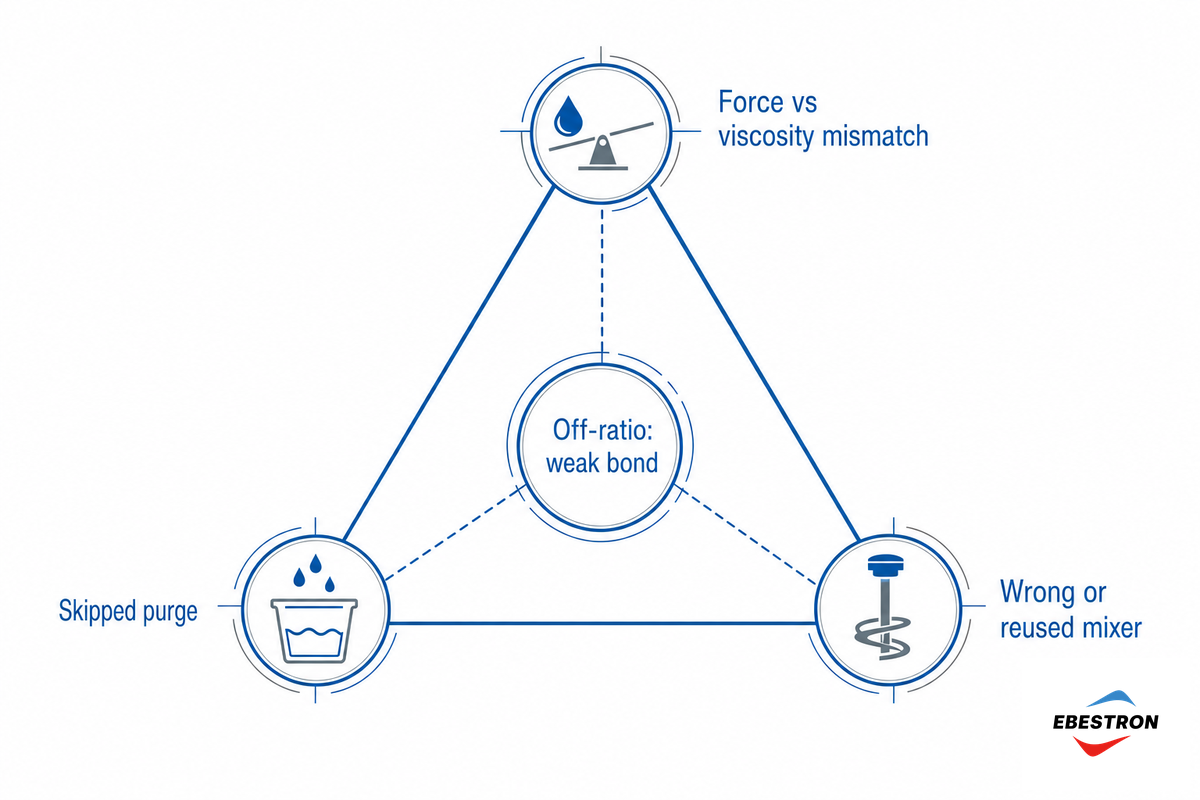
The On-Ratio Failure Triangle names the three causes that turn an otherwise strong bonded joint weak, regardless of the dispensing drive: an improper match between force and viscosity, a skipped purge, and a mismatched mixer. It matters because, as Assembly Magazine reports, more than 98% of adhesive problems aren’t the adhesive itself but the process, off-ratio mixing, insufficient mixing, inconsistent amount, and contamination.
The three failure modes
- Incorrectly spec’d thrust-force to the relevant viscosity. If you under-spec the thrust to the viscosity; operators squeeze very hard, will soon become tired, will squeeze inconsistently, waste more epoxy and not spread it properly. if you over-spec then the pressure could be too high, blowing a cartridge apart (one company, to this effect, caps this sort of function to provide consistent results when dispensing from even the largest cartridges).
- Skipped or omitted initial first-pull purge. The initial output from a freshly inserted or mixed new 2K cartridge contains resin or hardener imbalances due to the slightly opposing pistons. Many 2K manufacturer’s like Simpson and Hilti specify dispending product to the side of the joint until it matches colour on both surfaces – should the cartridge have been partially used then a new mixer should be attached and discarded first few squirts.
- Mixer selection or reuse.Wrongly dimensioned mixers, shortened mixers or reusing a single-use mixer will ensure an incomplete mixture across the surface and create weaker bonds, also know as soft spot areas.
⚠️ Counterintuitive: off-ratio error is not symmetric
An earlier peer-reviewed study in 2022 indicated that just 10% surplus of hardener could result in significant weakening in rigid bonds and often the converse- a shortfall of hardener- could increase or minimally affect strength. An excess hardener supply is the stronger danger, which accounts for the fact that strong gun frame construction, a seated plunger, and minimizing movement will help prevent over-dispensing.
Industry Outlook: The Shift to Battery-Electric Dispensing (Updated June 2026)
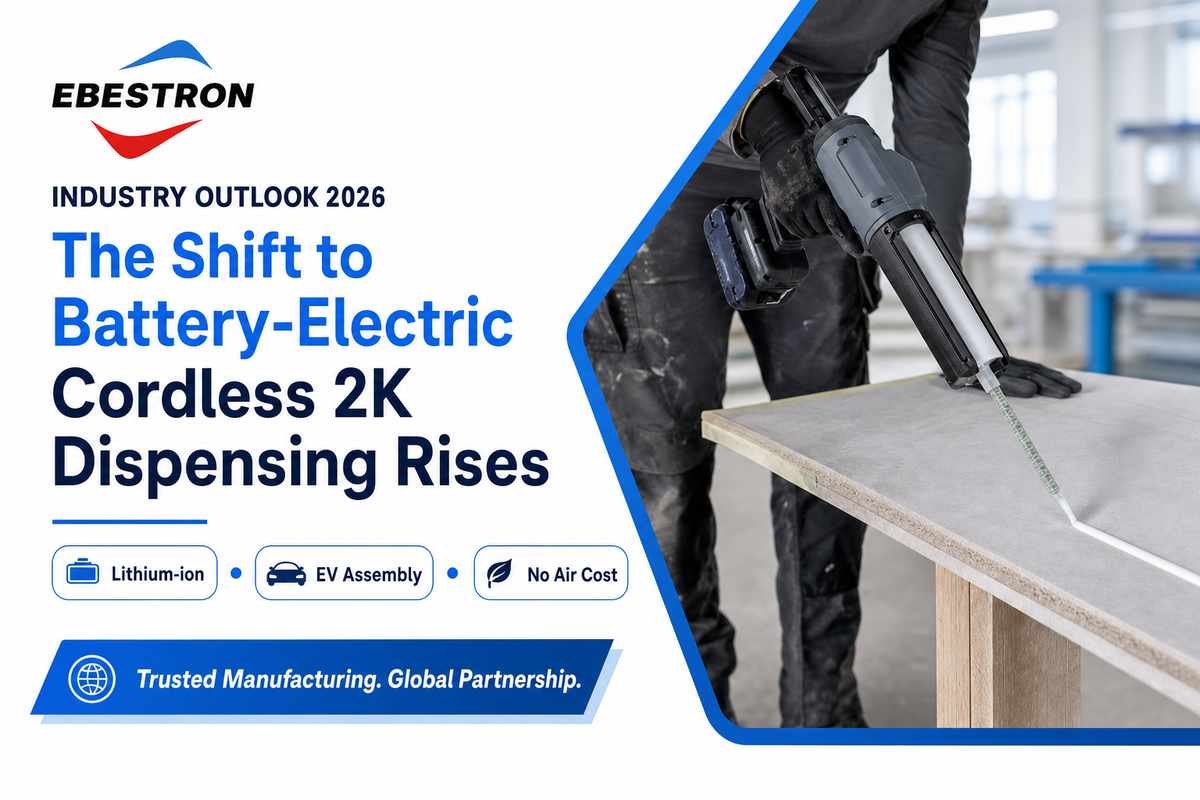
The drive itself is electrifying, and that’s a procurement signal rather than a convenience. Lithium-ion development has erased the force advantage pneumatic tools once held, cordless 2K guns now add constant-velocity control and anti-drip (US9862001B2), and electric-vehicle battery assembly has pulled purpose-built cordless 2K guns into production. The practical decision impact: at high duty cycle and in field or EV work, cordless now competes with pneumatic on force while sidestepping the compressed-air cost penalty entirely.
Two things to act on if you are specifying for 2026 and beyond. First, cite current standards: ISO 10365 moved to its 2022 edition (the 1992 version is withdrawn), and ICC-ES republished its adhesive-anchor acceptance criteria, AC308, in April 2025, datasheets still citing ISO 10365:1992 are out of date. Second, for market context only: research firms project the electric power-source segment and the two-component (2K) segment as the fastest-growing parts of the adhesive-dispensing-equipment market, with EV battery bonding as a named driver, directional background, not a spec.
Frequently Asked Questions
What is an epoxy gun?
View Answer
Epoxy gun: An epoxy gun is a cartridge gun that carries a dual 2 chamber cartridge and pushes both plungers forward together, driving the epoxy into a static mixing nozzle, where it is premixed ready for the dispensed dual cartridge to meet the substrate ready to harden and become a structural epoxy bond instead of simply a paste line (unlike standard 1 component caulk guns). epoxy guns are available in hand held manual, battery electric and air assisted.
Is epoxy stronger than a hot-melt glue gun bond?
View Answer
Yes, for structural bonding. Two-part epoxy from a cartridge gun cures by chemical reaction into a rigid, load-bearing, heat-resistant bond, whereas a hot-melt glue gun bonds only by cooling and re-softens when it gets warm again. The catch is that epoxy strength depends on accurate on-ratio mixing, so the gun and the static nozzle matter as much as the adhesive itself.
Do epoxy guns work with any mix ratio?
View Answer
No, the gun must match the cartridge’s mix ratio. The ratio (1:1, 2:1, 4:1, 10:1) is built into the dual cartridge and its matched static mixing nozzle, and the plungers must seat correctly on both pistons. A gun built for 1:1 cannot meter a 10:1 cartridge. Some bodies adapt to a different ratio via a new cartridge holder or plunger plate, but a geometry mismatch dispenses off-ratio adhesive that cures weak.
What is the best tool to apply two-part epoxy?
View Answer
A dual-cartridge dispensing gun with a static mixing nozzle, in the drive type that suits your volume and location: manual for low-volume precision work, pneumatic for fixed high-volume lines, and cordless for mobile or field work where no compressed air is available.
Are battery-electric dispensing guns worth it for low-volume shops?
View Answer
Often not. Trade guidance is explicit that an electric gun is not always necessary: for low daily volume, tight workspaces, longer open-time adhesives, high-precision beads, or a tight budget, a quality manual gun gives more control at a fraction of the cost. A cordless gun earns its premium when you dispense thick 2K all shift, need a consistent metered bead for bond quality, or work in the field with no air supply, where the higher cost pays back.
Do I need a special gun for 10:1 cartridges?
View Answer
Yes — a 10:1 cartridge needs a gun (or plunger set) built for a 10:1 ratio, so both plungers advance at the correct displacement. A 1:1 gun will not meter it correctly; many guns offer 10:1 conversion parts, so confirm the cartridge ratio first.
Can one gun handle multiple cartridge sizes?
View Answer
Sometimes, within a family. Some gun bodies accept conversion kits, an adapter plate and matched plungers, so one tool runs a 400ml and a converted 200ml or 600ml format. But there is no universal gun, so standardizing on one cartridge family is simplest.
Specifying a 2K dispensing gun for production?
Ebestron carries manual, pneumatic and battery-electric cartridge guns and associated static mixers and dual cartridges to use with Sulzer Mixpac, Nordson, 3M and Cox systems. Just give us the cartridge size, mix ratio and duty cycle and we’ll spec the appropriate drive and consumables. That’s including the thrust ratio and nozzle that insure your bond is on-ratio.
Why We Wrote This
Ebestron manufactures the packaging side of two-component adhesives, the dual cartridges, static mixing nozzles, and the manual, pneumatic, and battery-electric dispensing guns that pair with them. We wrote this drive-type comparison because most “epoxy gun” guides stop at one sentence per drive and skip the thrust-ratio, cartridge-fit, and on-ratio details that actually decide whether a 2K bond holds. Reviewed by the Ebestron technical team.
References & Sources
- Hand-Tool Ergonomics, Trigger Force and Repetition Guidance — NIOSH / U.S. Centers for Disease Control and Prevention
- Hand/Wrist Cumulative Trauma, Force and Repetition Odds Ratios — NIOSH / U.S. CDC
- 29 CFR 1910.307, Hazardous (Classified) Locations — U.S. Occupational Safety and Health Administration
- Improving Compressed Air System Performance (Sourcebook) — U.S. Department of Energy
- ISO 10365:2022, Adhesives: Designation of Main Failure Patterns — International Organization for Standardization
- ASTM C881/C881M-20a, Epoxy-Resin-Base Bonding Systems for Concrete — ASTM International
- ASTM D1002-10(2019) — Lap-Shear Strength of Adhesively Bonded Metal — ASTM International
- ICC-ES AC308 (2024), published April 2025, Post-Installed Adhesive Anchors — ICC Evaluation Service
- Adhesive Joint Strength vs Hardener Dosage Inaccuracy (Materials, 2022) — U.S. National Library of Medicine (PMC)
- Understanding the Capabilities of Handheld Dispensing Equipment (2022) — Adhesives & Sealants Industry
- Applicators 101 (2010) — Adhesives & Sealants Industry
- Troubleshooting Adhesive Bonding Issues (2016) — Assembly Magazine
- US Patent US9862001B2, Dispensing Device (constant-velocity drive, anti-drip)Sulzer Mixpac / Medmix (via Google Patents)
- US Patent US5104005A, Dual-Component Mechanically Operated Caulking GunAlbion Engineering (via Google Patents)
Related Articles
- Manual cartridge dispensing guns, thrust ratios and sizes
- Pneumatic cartridge guns for high-viscosity 2K adhesives
- Battery-electric cartridge guns, cordless dispensing
- Epoxy applicator guns and the epoxy gun selector tool
- Static mixing nozzles for two-part adhesives
- Two-part adhesive dual cartridges (50ml–600ml)
- Mixpac- and Cox-compatible dispensing guns