Get in touch with Ebestron Company

Updated July 2026
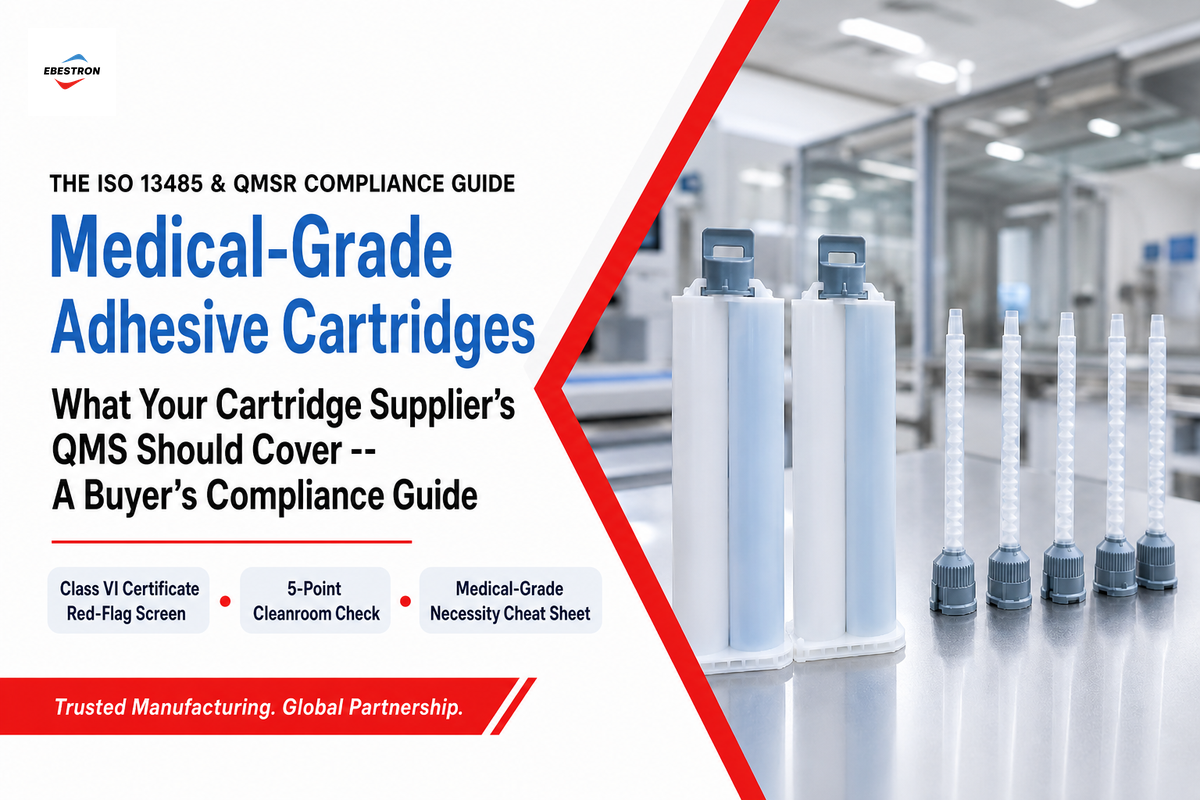
The two-part dispensing packages that deliver epoxy, cyanoacrylate, silicone, or UV-cure resin to bond components inside a medical device -needle hubs, catheter joints, diagnostic housings, wearable sensors – are medical-grade adhesive cartridges. Purchasing one is easy. Figuring out what “medical-grade” actually obligates your supplier to prove – and what it obligates you as the device manufacturer to check – is where most sourcing teams get stuck. This guide will walk you through the ISO 13485/FDA QMSR mechanics, how to actually verify a USP Class VI or ISO 10993 certificate, rather than just storing it, and a screen to decide if you actually need medical-grade at all.
Quick Specs
| Governing device-QMS regulation | FDA QMSR (21 CFR Part 820), effective February 2, 2026 |
| QMS standard incorporated by reference | ISO 13485:2016 |
| Material biocompatibility screen | USP <88> Class VI (Systemic Injection, Intracutaneous, Implantation tests) |
| Device-level biological evaluation | ISO 10993-1 (6th edition, 2025 — 2018 edition accepted through July 1, 2029) |
| Cleanroom filling reference | ISO 14644-1 (Class 7 / Class 8 particle count) |
What “Medical-Grade” Actually Requires (Beyond the Marketing Term)
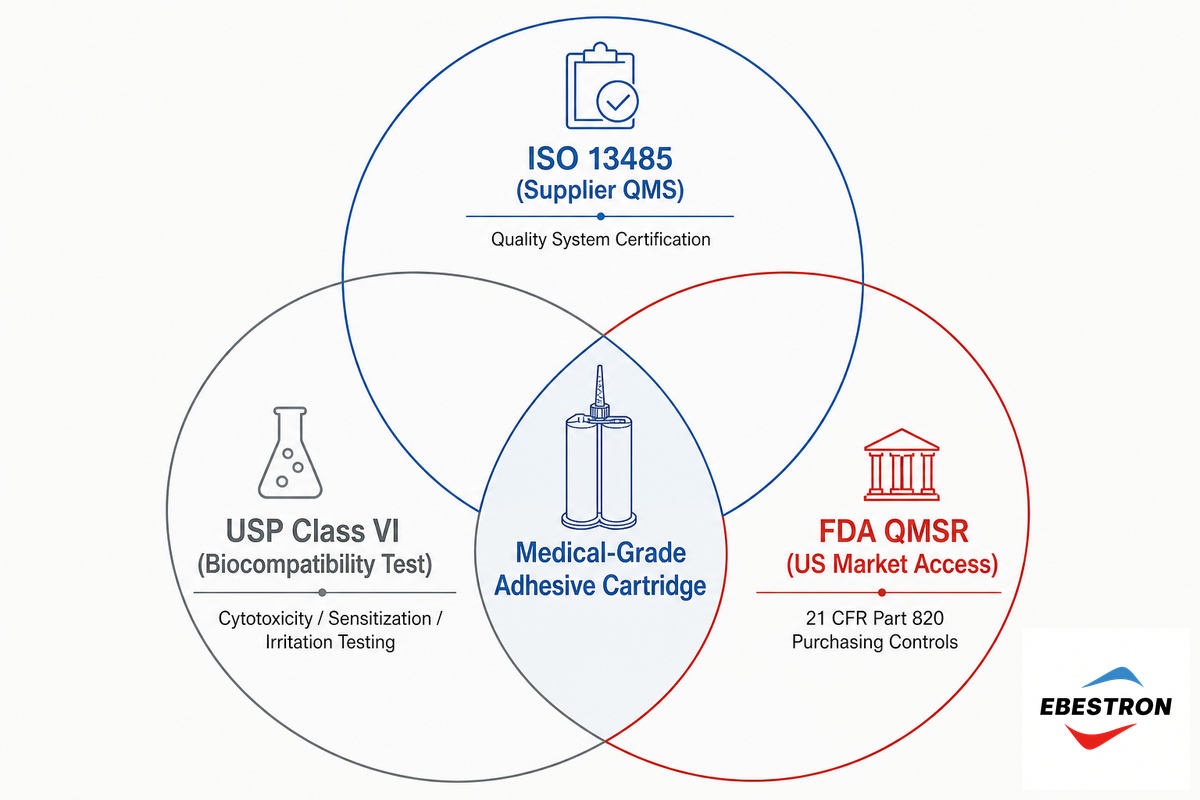
“Medical-grade” is not a regulatory classification — no agency issues a certificate saying a material is generically approved for medical use. What actually exists are three checkable layers: material-level biocompatibility (USP Class VI), device-level biological evaluation (ISO 10993), and quality-system certification (ISO 13485).
It’s the FDA’s job to regulate finished devices, not to declare raw materials fit for all purposes, so when a supplier’s website calls something a “medical-grade adhesive cartridge,” that’s marketing language, not legally operative text. None of the three layers above can be skipped just because a supplier claims to meet one or two others.
Also, it’s essential to understand the kind of “medical adhesive” you’re searching for, since the phrase commonly lumps together two fundamentally different categories of products. Medical tapes and wound-care adhesives intended for direct contact with the skin require a focus on breathability and durability on an extended basis, which is a different engineering problem from a two-part epoxy or cyanoacrylate cartridge for the assembly of components such as a catheter hub or diagnostic housing, which will never touch a patient. If your search for “medical grade adhesive” led you to suppliers of skin tape, you’re likely in a different segment than where the search for an assembled cartridge dispensing system would lead. Stick-to-skin medical grade tape falls under its own FDA Class II special-controls guidance for topical skin adhesives — a pressure-sensitive wound care solution engineered for continuous skin contact and prolonged contact with the human body, not for bonding rigid or semi-rigid components inside a device housing. Both get marketed under the same “medical adhesive” umbrella, but they solve different engineering problems entirely.
⚠️ Important
There is no such thing as “FDA-approved plastic” or “FDA-approved adhesive.” The FDA’s role is to approve or clear the finished device, not the individual raw materials used to construct it. Anyone telling you that their specific material has achieved FDA approval is describing a legal status that does not exist in regulation.
ISO 13485 and the FDA QMSR: What Your Cartridge Supplier’s QMS Should Cover
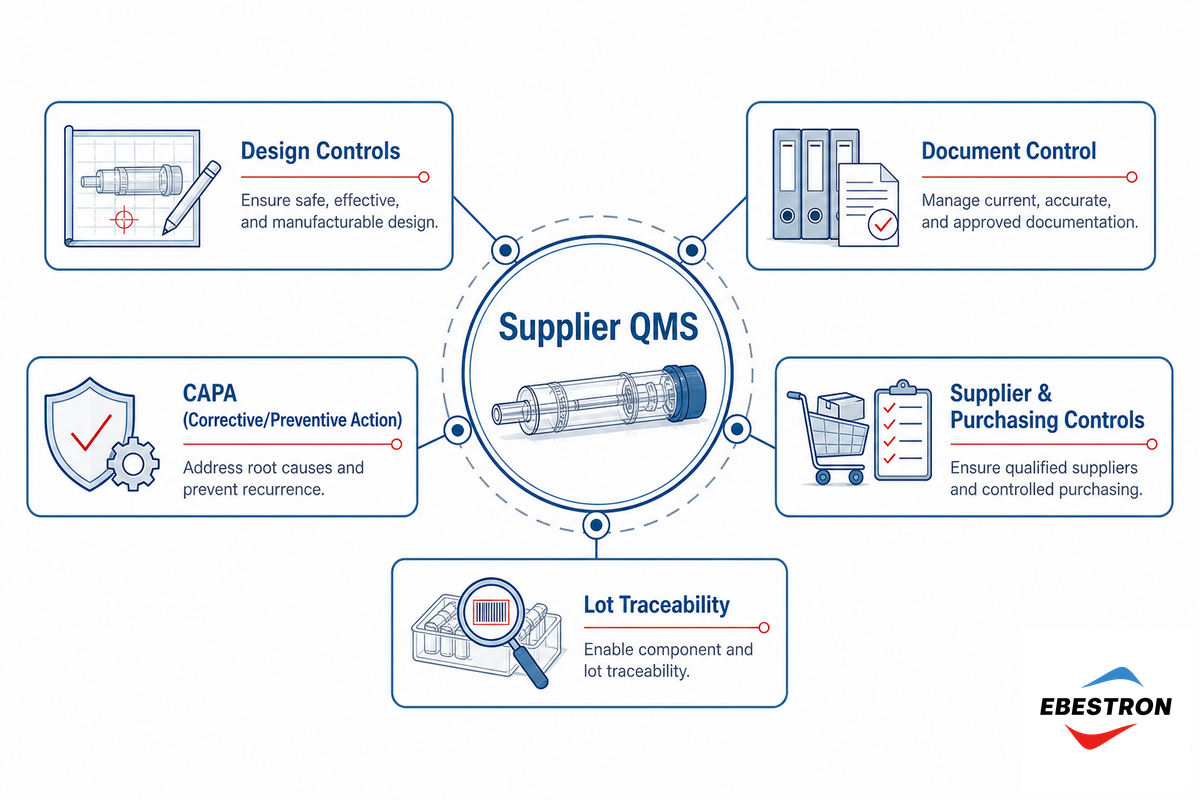
Here is a commonly misconstrued point for buyers: According to 21 CFR 820.1, its provisions are directly applicable to the manufacturers of finished devices. Component or parts manufacturers, including an empty-cartridge supplier, are generally not subject to Part 820 unless their function involves activities associated with the production of a finished device or the provision of contract manufacturing services. Therefore, if a cartridge supplier asserts their company is “ISO 13485 certified,” it is not a legally mandated certification that the FDA imposes upon them, but rather a voluntary step many component suppliers undertake, because the actual legal obligation rests with you, the finished device manufacturer.
Under the new Quality Management System Regulation (QMSR), which amends 21 CFR Part 820 as of February 2, 2026 (and which incorporates by reference ISO 13485:2016), the requirement for you to review and document your component suppliers (cartridge manufacturers included) is driven by the purchasing controls clause. That is where “always ask for ISO 13485” truly comes into play. This isn’t a rule that the cartridge supplier is breaking if they fail to do it; it is a control that *you* must implement for your supply chain.
The FDA’s own QMSR page is clear about another common misunderstanding:
“A certificate of conformance to ISO 13485 will not exempt a manufacturer from an FDA inspection.”
U.S. Food and Drug Administration, Quality Management System Regulation FAQ
QMSR also restores some regulatory ground previously beyond the FDA’s reach. Whereas internal audit reports and management review outputs were specifically exempt from inspection under the old QSR, QMSR eliminates that exemption. Moreover, a number of FDA-specific terms are being harmonized with ISO-the Device Master Record and Design History File are being replaced by a “Medical Device File” and “Design & Development File” construct, respectively. Make sure your in-house records aren’t relying exclusively on the older terms before an auditor requests to see them.
The Supplier Documentation Continuum
You don’t need the same level of paperwork for every component purchase. It should be dictated by what the cartridge is bonding.
| Tier | Example application | What you request | Typical cartridge size |
|---|---|---|---|
| 1 — Certificate copy | External device housing seam | ISO 13485 certificate with scope, issue date, expiry, and the accredited certification body’s name | 50 mL |
| 1 — Certificate copy | Non-patient-contact enclosure | Same as above | 200 mL |
| 2 — Material dossier | Diagnostic instrument housing | Tier 1 plus the resin’s USP Class VI report and lot-level Certificate of Analysis | 50 mL |
| 2 — Material dossier | External wearable sensor shell | Same as above | 1–30 mL dual-syringe |
| 2 — Material dossier | Short-term skin-adjacent clip or mount | Same as above | 50 mL |
| 3 — Full quality-file cross-reference | Catheter hub assembly | Tier 2 plus the supplier’s scope-of-approval statement mapped to your purchasing-control records | 1–30 mL dual-syringe |
| 3 — Full quality-file cross-reference | Implantable-adjacent component | Same as above, plus a documented change-notification agreement | 50 mL |
| 3 — Full quality-file cross-reference | Permanent-contact assembly | Same as above | 50–200 mL |
| 3 — Full quality-file cross-reference | High-volume structural potting near implant site | Same as above | 400 mL |
Need the specific paperwork Ebestron ships with a medical-grade order? Request the compliance documentation pack →
Verifying a USP Class VI / ISO 10993 Certificate: A Practical Audit Checklist
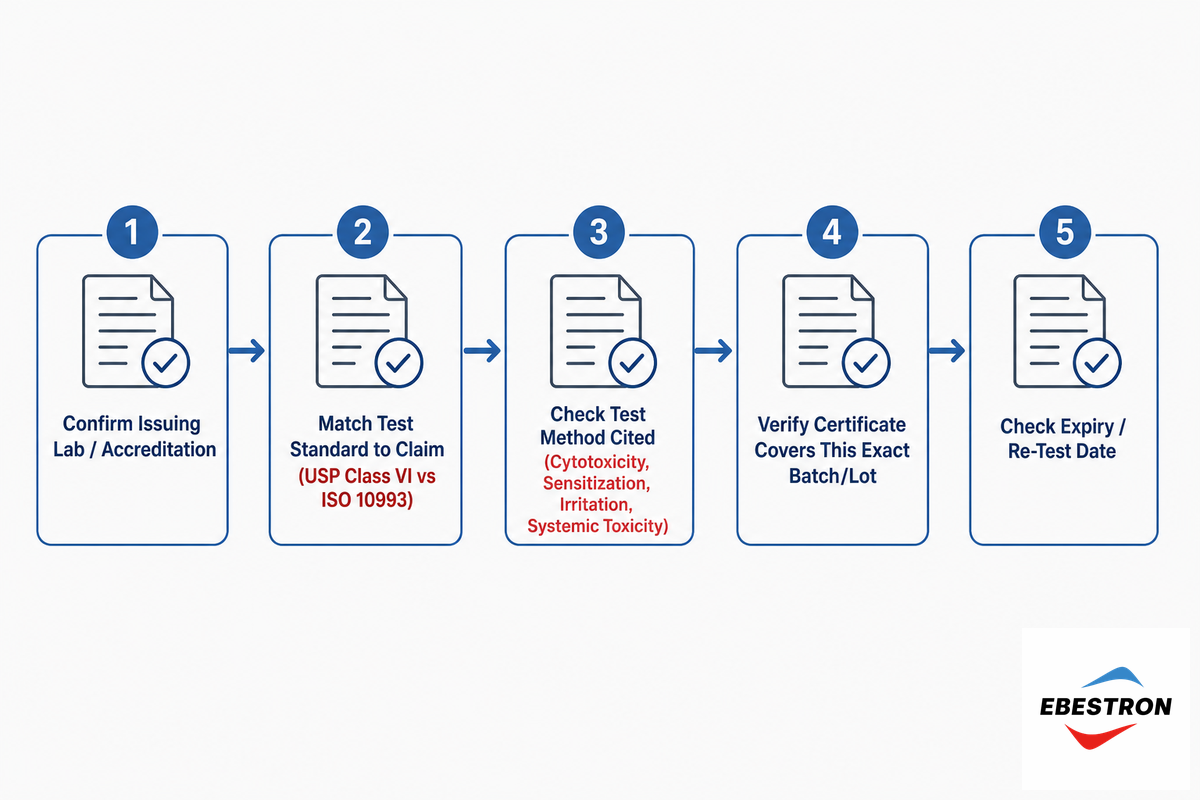
USP Class VI and ISO 10993 answer different questions, and Ebestron provides an overview of how to differentiate the two on our Medical-Grade Adhesive Cartridges solutions page. This discussion, however, will focus on how to handle a certificate once it is in your possession.
USP <88> Biological Reactivity Tests consists of three individual tests-Systemic Injection and Intracutaneous tests (which apply to elastomeric materials) and an Implantation test (for plastics and other polymers used in containers, parenteral preparation accessories, and device components). It is a material-level screening, not a surrogate for demonstrating how the actual device performs in vivo for its intended duration of contact-and, according to the FDA’s guidance on recognized standards, ISO 10993 has broader acceptance as a device-level biological evaluation than USP alone. It is not a one-to-one substitute; passing a Class VI test is not sufficient to negate the need for ISO 10993 testing. Another update to be aware of is that the FDA partially recognizes the sixth edition (2025) of ISO 10993-1. Declarations of conformity to the 2018 edition are only valid through July 1, 2029. If a certificate does not specify the ISO 10993 edition, ask.
The Class VI Certificate Red-Flag Screen
- Certificate must be issued by an accredited and identifiable testing laboratory, not simply “internally verified”
- The specified contact-duration category (limited, prolonged, or permanent) accurately reflects your device’s application, rather than a generic statement.
- The date on the certificate and the material lot on which testing was performed must match; a Class VI test on a different formulation or lot can’t be silently applied to another.
- Ask to receive a copy of the full test report and not only a one page summary letter
- ISO 10993 citations (if any) should state an edition/year because of the change to the sixth edition in 2025
Cleanroom Classification for Medical Cartridge Filling
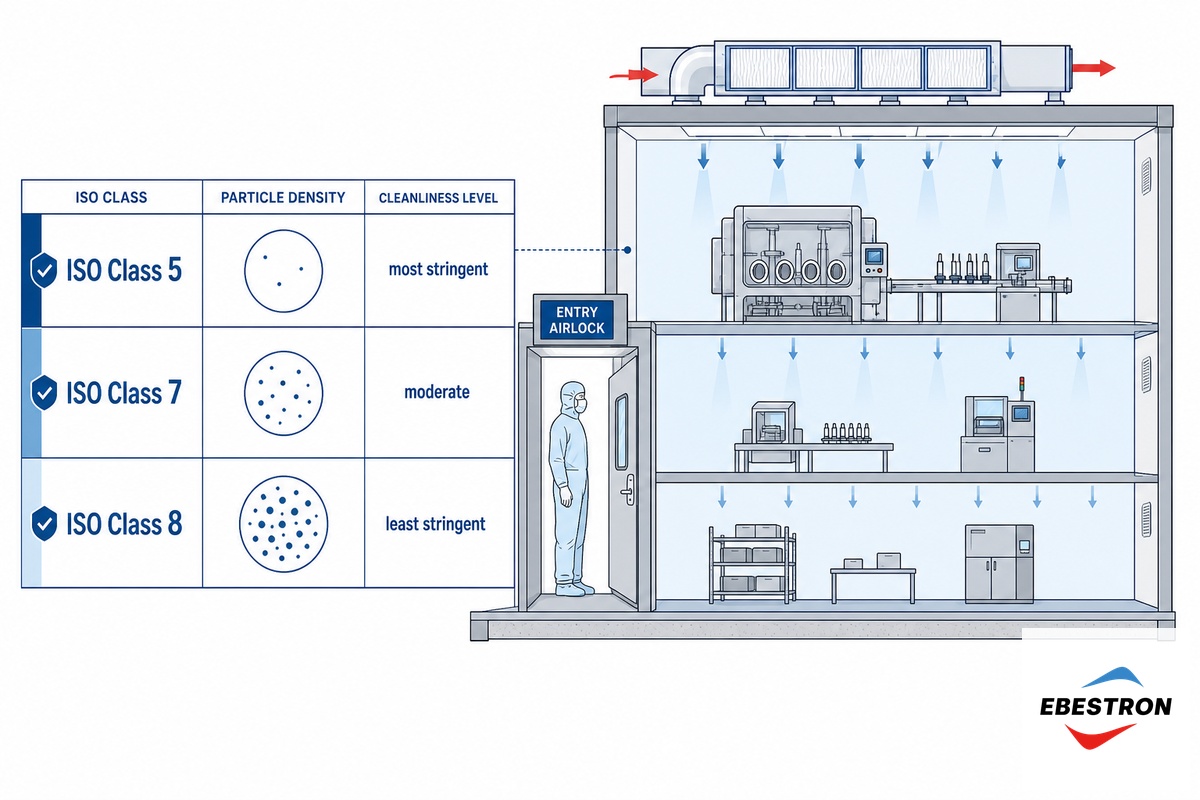
Filling of cartridges that have medical-contact adhesives generally falls under ISO 14644-1, which classifies air cleanliness by counting airborne particles ≥0.5µm per cubic meter of air. In this space, two classifications come up most often:
| ISO Class | Max particles/m³ (≥0.5µm) | Typical air changes/hour | Legacy Fed-Std-209E equivalent |
|---|---|---|---|
| ISO Class 7 | 352,000 | ~60 ACH | Class 10,000 |
| ISO Class 8 | 3,520,000 | ~20 ACH | Class 100,000 |
💡 Pro Tip
Worked example: a filling line measured at 200,000 particles/m³ (≥0.5µm) in operation is below the 352,000 limit for ISO Class 7. A line operating at 1,000,000 particles/m³ would fail Class 7 but pass Class 8’s 3,520,000 limit. Find out from your supplier what class their filling line is rated to, and what measurement condition they’ve quoted (at rest or in-operation) – they are two very different numbers. Most filling lines also hold ambient temperature near 20°C, controlled within about 2°C, to limit resin viscosity drift during dispensing.
Still, many of today’s suppliers, some with a history in this sector, still refer to their facility with old U.S. Federal Standard 209E nomenclature such as “Class 100” or “Class 100,000.” As a rough approximation, Class 100 equates to ISO Class 5 and Class 100,000 to ISO Class 8. When suppliers cite only old terms, ask them directly what they mean in terms of ISO 14644-1, because mapping of the old terms is not universally the same in all sources.
A useful point to know: ISO 14644-1 covers only the counting of airborne particles. Bioburden, surface cleaning or chemical contamination are outside the scope of the standard and addressed in the adjacent standards. Even if a vendor meets the particle count requirements of Class 7, that does not mean they meet any biological or surface cleaning requirements, those must be investigated independently.
How Two-Part Medical Device Assembly Cartridges Are Built
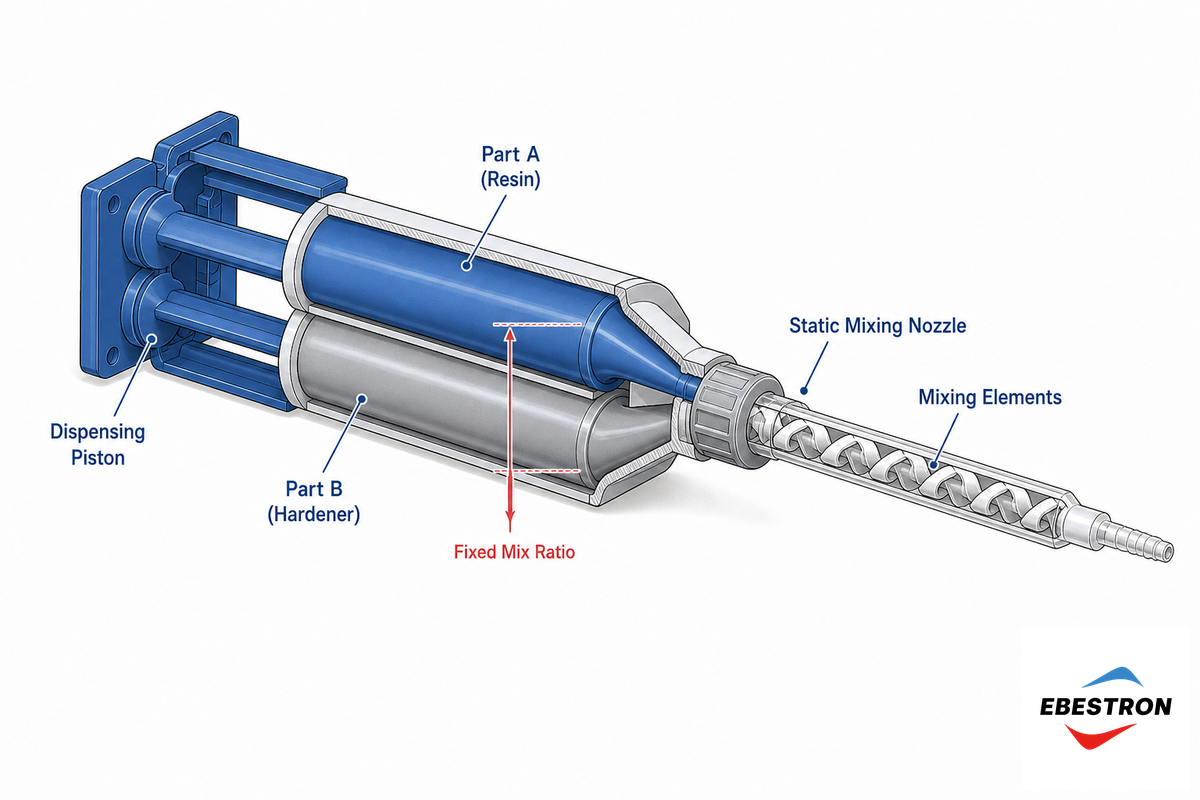
Two-part cartridges keep resin and hardener separated in individual chambers until dispensing, protecting shelf life and letting a facility dispense on demand instead of hand-mixing each batch. This is why two-part adhesives are the go-to method for joining dissimilar substrates — plastics to metals, or plastics to ceramics — with far less heat and stress than welding or brazing, especially when one substrate is a thin-walled catheter or fragile diagnostic housing.
Cartridge bodies are usually moulded in polypropylene or nylon, though medical-grade, USP Class VI-capable resin types are available if required by the application. Choice of chemistry will depend on the required cure profile and bond: epoxies are typically used for high-strength structural joints, cyanoacrylates are ideal for fast-fixture assembly, silicones are suitable for flexible or thermally resistant bonds, and UV/light-cure systems work well where a transparent cure trigger can be utilized in the production line. A matching of the cartridge’s mix ratio to the number of elements in the static mixer and the mechanical advantage of the dispensing gun will maintain the dispensed ratio shot-to-shot; a high-viscosity or 10:1 formula, for example, requires far more mechanical force to dispense than a 1:1 system – this topic is discussed more in-depth on our page on sizing and compatibility. For recommendations regarding static mixers and dispensing equipment, consult our guidelines on pneumatic cartridge dispensing guns and Sulzer Mixpac & 3M compatible static mixers.
Ebestron’s adhesive systems span several chemistries beyond the basics above. A two-part epoxy system pairs a resin with a hardener to form rigid bonds and strong bonds that hold up better under mechanical stress than a simple superglue (cyanoacrylate adhesive) joint, which cures faster but is more brittle once set — the same chemistry sold as super glue at retail. UV-cure adhesives cure on exposure to UV light, giving fast, rapid curing without a separate mixing step, which is useful for surgical instruments and other components assembled at volume. Most medical-grade systems ship as a dual cartridge (two-part, side-by-side) format — commonly a 50 mL cartridge (listed as 50ml in some catalogs) — though single-barrel unit-dose options exist for low-volume work; keeping the cartridge and static mixer dimensionally matched, and getting the mix ratio by weight (or by volume, per your data sheet) right, is what a dispenser gun is built to enforce. In medical device manufacturing broadly, these adhesive components turn up in blood filters, wearable devices, and medical electronic housings — any assembly built to bond medical device parts without welding or fasteners. Cartridge bodies themselves are usually polypropylene or nylon, occasionally rubber or polycarbonate for specialized housings; manufacturability at volume depends on holding those dimensions consistent batch to batch.
A mismatched mixer element count is a genuine failure risk, not a specification footnote. Too few elements and the resin and hardener never fully homogenize, leaving a soft, under-cured joint that can slip or fail under load; too many elements for a low-viscosity chemistry wastes material and can shear-thin the resin before it ever reaches the substrate. This is the structural reason a bond that looks cured within 24 hours can still fail a peel or shear test days later if the actual dispensed ratio drifted from spec by even 5%. Ebestron engineers the static mixer element count to the specific viscosity and ratio combination requested, sized in-house against precision tolerances, rather than defaulting to one generic mixer across every resin family. Pot life also varies by chemistry: a fast cyanoacrylate can set within 60 seconds of dispensing, while a slower two-part epoxy may offer several minutes of working time before the joint reaches its initial 24 hour cure and a full 7 day cure strength.
Do You Actually Need Medical-Grade? A Buyer’s Requirements Screen
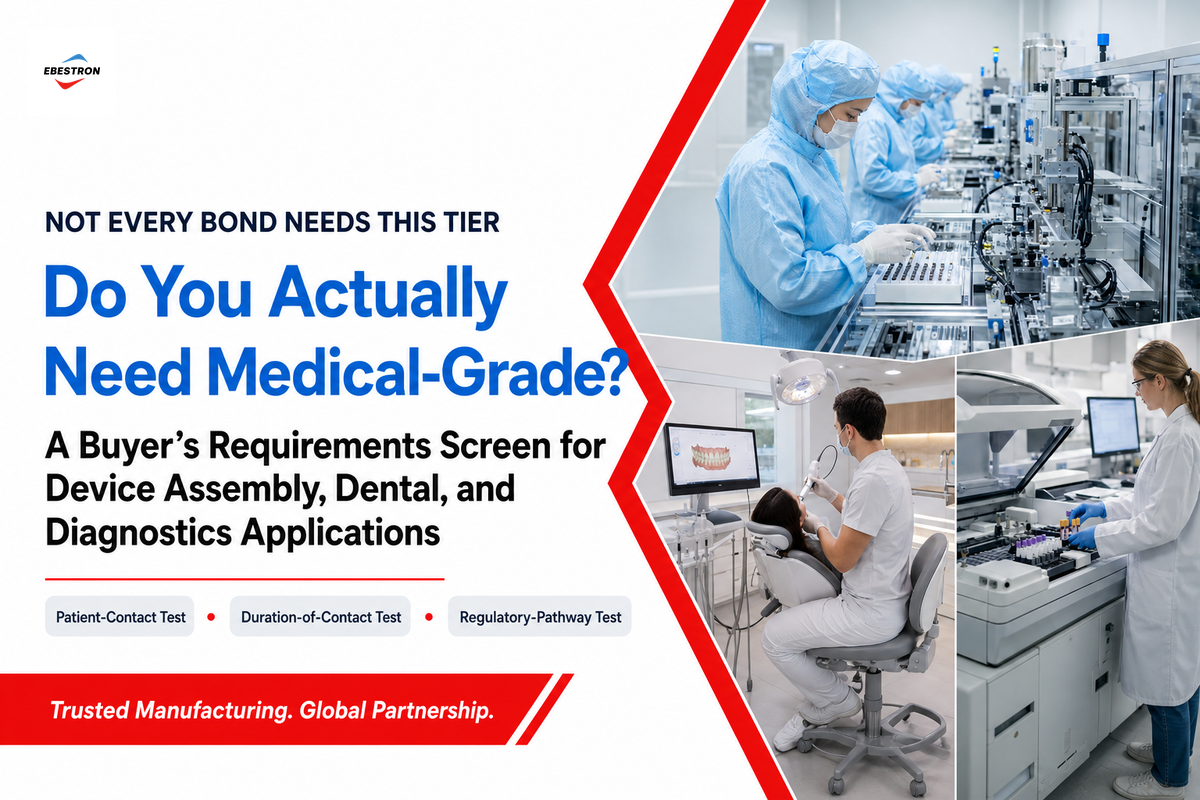
Not all device-adjacent bonding needs a medical-grade cartridge. This is an earlier and separate question from “How do I qualify a specific supplier?” – It asks whether the requirement is actually relevant to your part at all, prior to contacting potential suppliers. Run your application through the 5-Signal Necessity Framework below before you contact a single supplier.
The Medical-Grade Necessity Cheat Sheet
| Signal | If yes → |
|---|---|
| Does the bonded assembly contact the patient directly, even briefly? | Biocompatibility screening (USP Class VI at minimum) is likely required |
| Is contact duration prolonged or permanent rather than limited/transient? | Full ISO 10993 device-level evaluation, not Class VI alone |
| Will the assembled device undergo terminal sterilization (EtO, gamma, or steam autoclave)? | Confirm the adhesive’s sterilization compatibility, not just its base biocompatibility — some formulations lose flexibility under repeated autoclaving, while UV-cure cyanoacrylates can gain strength after gamma exposure |
| Is the finished product regulated as a Class II/III device rather than Class I? | Higher paperwork burden on every component in the bill of materials, cartridge included |
| Does your own quality system require purchasing-control records for this component under QMSR? | You need the supplier’s records now, independent of what the supplier volunteers |
Zero “yes”s don’t mean a medical-grade cartridge is out of the question, but it likely means you can use a standard-grade cartridge and allocate those resources to the truly necessary applications that warrant the paper trail. If you’re unsure which class your finished device falls into, the FDA’s own device classification guidance is the starting point, since that classification is what sets the paperwork bar for every component on the bill of materials.
Terminal sterilization exposure varies by method: ethylene oxide cycles are generally gentler on adhesive bonds than gamma radiation, but a reusable device may see multiple sterilization cycles over its expected wear time, so ask for cycle-count data rather than a single-exposure result. Compliance with ISO and USP biocompatibility standards should rest on actual biocompatibility testing data for your specific resin and lot, not a generic data sheet — the same discipline applies to adhesion claims, since bond strength to your specific substrate is what actually matters, not a resin’s reputation.
Common Compliance Mistakes Buyers Make When Sourcing Cartridges
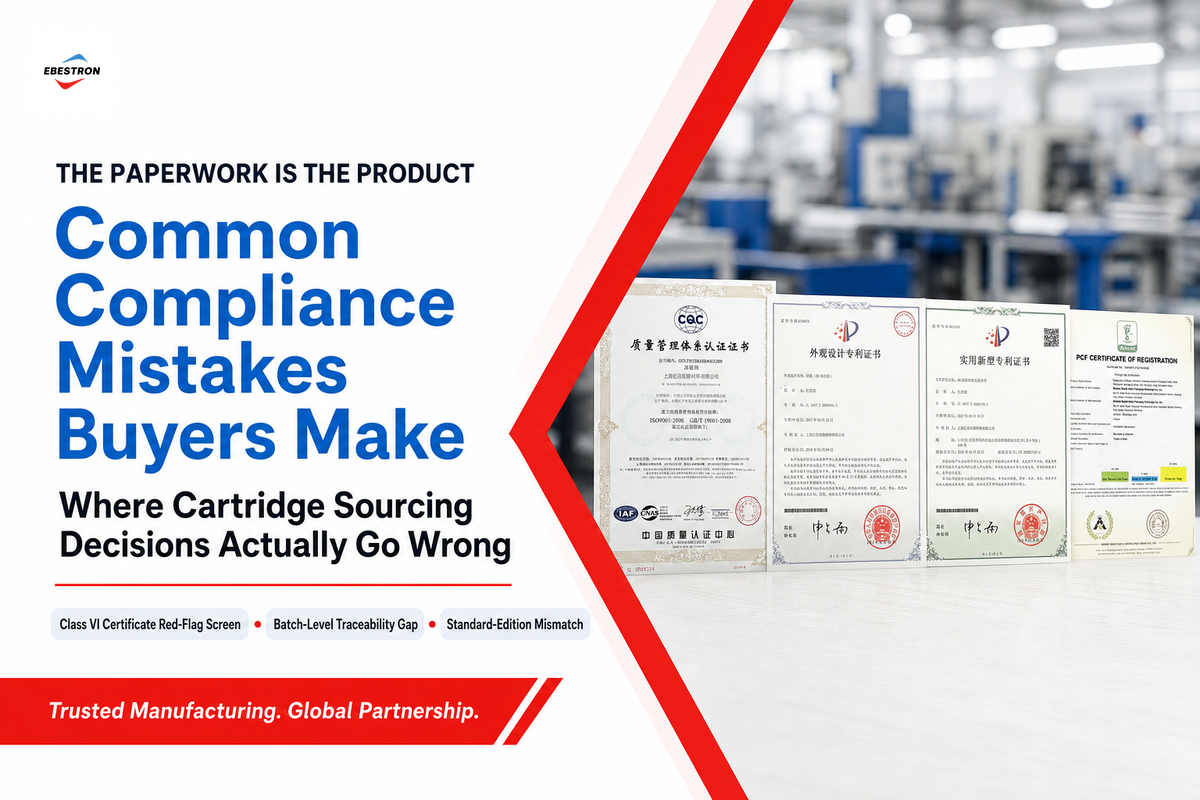
- Assuming a certificate is valid in perpetuity. Per BSI’s own ISO 13485 certification FAQ, the certificate operates on a 3 year cycle that includes annual surveillance audits, followed by a full recertification audit in year 3. Thus, the certificate you filed two years ago may be approaching expiry, or its scope may have narrowed since issuance.
- Treating any USP Class VI certification as appropriate for all durations of contact. A resin that is USP Class VI compliant for limited contact is not suitable for prolonged or permanent contact without the correlating ISO 10993 evaluation.
- Assuming private-label or filled cartridges automatically inherit the filler’s regulatory status. Regulatory status and its supporting paperwork are usually assigned to a specific manufacturer or importer and aren’t transferable to a private-label customer; OEM or private-label relationships don’t absolve either party of their compliance responsibilities, and these roles should be clearly defined in a written agreement rather than assumed.
Industry Outlook: Where Medical Device Component Compliance Is Headed
The QMSR Compliance Timeline
The leading cause for the next few years is regulatory, not market-size prediction: FDA’s QMSR (Quality Management System Regulation), moving from the legacy system to an ISO 13485:2016-based framework, is now in effect and changes the required content of your internal purchasing-control records – even if your cartridge supplier is not directly impacted. AAMI’s own harmonization brief frames this as the biggest structural change to US device-QMS oversight in decades.
- January 31 – February 2, 2024: Final QMSR rule posted for public inspection, then published in the Federal Register, opening a 2 year transition window
- February 2, 2026: QMSR becomes effective; compliance is required
- July 1, 2029: Last date FDA will accept ISO 10993-1:2018 based declaration of conformity before the 2025 6th edition is required
Here’s what it means for buyers: audit your own purchasing controls now against the QMSR’s terminology (Medical Device File / Design & Development File), not the old DHF/DMR language, and make sure any biocompatibility you hold lists ISO 10993-1’s current edition, not a generic standard number. Google searches for “medical device quality management system” are already way up through early-to-mid 2026-consistent with manufacturers dealing with this transition, not seasonal blips. Separately, the ISO 13485 technical committee moved its standard review to 2025, so a new edition of ISO 13485 could appear a couple of years down the line – check periodically rather than at just one point in time.
Frequently Asked Questions
Q: What Are the Different Types of Medical-Grade Adhesive Chemistries?
View Answer
The main chemistries used in medical-grade cartridges are epoxies (high-strength structural bonds, often two-part), cyanoacrylates (fast-fixture cure, including UV-cure variants that gain strength after gamma sterilization), silicones (flexible, thermally stable bonds tolerating repeated autoclaving), and UV/light-cure acrylics (rapid on-demand cure for automated lines). Each has a different cure profile, viscosity, and sterilization tolerance, so the right choice depends on the substrate pair and sterilization method involved.
Q: What Documentation Should Come With a Medical-Grade Cartridge Order?
View Answer
At minimum, a certificate of conformance identifying the material grade and lot. For patient-adjacent applications, request the resin’s USP Class VI test report (not just a summary letter), the supplier’s ISO 13485 certificate with scope and expiry, and lot traceability documentation. The right tier depends on how the assembly contacts the patient — see the Supplier Documentation Continuum above for how to scale the request.
Q: Does an ISO 13485-Certified Supplier Automatically Mean the Cartridge Is Biocompatible?
View Answer
No — these are two separate layers. ISO 13485 certifies that a company’s quality management system is capable of consistently producing and documenting its output; it says nothing about whether a specific resin has passed USP Class VI or ISO 10993 testing. A supplier can be ISO 13485-certified for their manufacturing process while still requiring you to separately verify the material’s biocompatibility data for the specific resin and lot you’re buying.
Q: Is Gorilla Glue Medical-Grade?
View Answer
No. Off-the-shelf cyanoacrylate and polyurethane consumer adhesives are not tested to USP Class VI or ISO 10993, and they are not intended for use inside or on a medical device — exactly the kind of assumption a Necessity Screen review is meant to catch early, before it becomes a paperwork gap during an audit.
Q: What Glue Do Hospitals Use Instead of Stitches?
View Answer
That’s a topical skin-closure cyanoacrylate (surgical skin adhesive), a clinically-applied product regulated as its own device category — a different product entirely from the two-part cartridge systems used to bond components during device assembly, which this guide covers.
Q: How Do Sterilization Methods (EtO, Gamma, Autoclave) Affect Adhesive Bond Integrity?
View Answer
It depends heavily on chemistry. Silicones generally tolerate gamma, EtO, and steam autoclaving well, though repeated cycles at 121°C to 132°C can eventually cause brittleness. Some UV-cure cyanoacrylates actually gain strength after gamma exposure. Repeated autoclaving — high heat, humidity, and pressure together — is the toughest condition for most bonds, so ask about repeat-cycle data if your device is reusable.
Q: Where Can I Buy Medical-Grade Adhesive Cartridges?
View Answer
Before comparing suppliers, confirm what to verify: an ISO 13485-scoped certificate, USP Class VI/ISO 10993 records matched to your contact duration, and lot traceability. Request samples and a documentation pack from a supplier who can produce all three without delay — that responsiveness is itself a signal worth weighing.
Q: What Types of Certification Should a Medical-Grade Adhesive Cartridge Have?
View Answer
Look for three things together, not any single one alone: an ISO 13485-certified manufacturing QMS (scope and expiry checked), a USP Class VI report for the specific resin, and — where the application needs it — an ISO 10993 evaluation citing a current edition. No certification covers all three at once, which is exactly why buyers checking only one tend to have gaps.
References & Sources
- Quality Management System Regulation (QMSR)U.S. Food and Drug Administration
- 21 CFR 820.1, ScopeElectronic Code of Federal Regulations
- ISO 13485:2016, Medical devices, Quality management systemsInternational Organization for Standardization
- ISO 14644-1:2015, Cleanrooms, classification of air cleanlinessInternational Organization for Standardization
- USP <88> Biological Reactivity Tests, In VivoUnited States Pharmacopeia
- QMSR: What You Need to Know About Global HarmonizationAAMI
- The Adhesive Bonding of Medical DevicesMD+DI
The Team Behind This Report
This guide was compiled from ISO, FDA, and USP source documents rather than from internal Ebestron test data. We manufacture medical-grade adhesive cartridges, but we wrote this piece to help buyers evaluate any supplier’s paperwork, our own included. Where the underlying research showed a genuine regulatory nuance (like the QMSR’s purchasing-controls mechanism or the 2025 ISO 10993-1 edition transition), we’ve flagged it rather than smoothing it into a simpler-sounding claim. Reviewed by the Shanghai Ebestron New Materials Co., Ltd. technical team.
Related Articles
- Medical-Grade Adhesive Cartridges, Sizes, Ratios & Compatibilitythe product/procurement side of this same category
- Pneumatic Cartridge Dispensing Guns Guidecompressor sizing and air-system setup for cartridge dispensing
- Sulzer Mixpac & 3M Compatible Mixers Guidestatic mixer selection and cross-compatibility
- About Ebestronwho manufactures the systems referenced in this guide