Get in touch with Ebestron Company

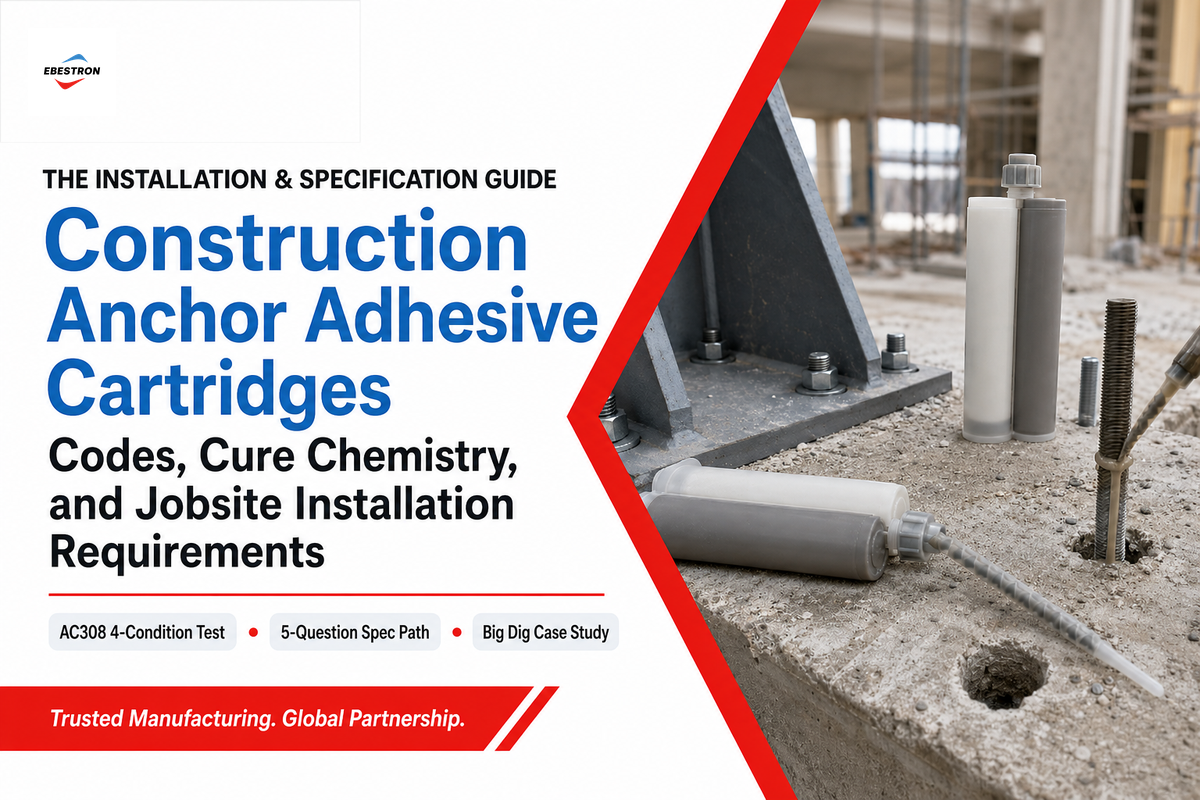
Construction anchor adhesive cartridges are the two-component chemical fastening systems specified by structural engineers, GCs, and installers to bond threaded rod and rebar into drilled concrete and masonry holes. Getting the chemistry, code reference, and install sequence right isn’t optional – the industry’s most cited failure case cost a life over one skipped variable. This guide runs through how these systems cure, which codes actually govern them in 2026, how to prep an install, and the mistakes that turn a qualified anchor into a field failure.
Construction anchor adhesive cartridges have a two-part epoxy, vinylester, polyester, or epoxy-acrylate resin that cures once mixed through a static nozzle. Present US qualification is through ACI CODE-355.4-24 and ICC-ES AC308(24); EU jobs are EAD 330499-02-0601.
Key Points
- Anchor systems qualified only for uncracked concrete are a genuine spec hazard in seismic or retrofit zones – cracked-concrete qualification is a different, tougher test under AC308.
- Sustained-tension and overhead installs have a unique failure mode (epoxy creep) that resulted in the 2006 Big Dig tunnel ceiling collapse – hence certified-installer mandates.
- More static-mixer elements isn’t always better mixing; element geometry and length trade off against back-pressure and wasted material.
- ACI CODE-355.4-24 (as called out by ACI 318-25) and EAD 330499-02-0601 are newer than the old reference numbers most buyer pages still cite.
Quick Specs
| Resin chemistries | Epoxy, epoxy-acrylate, vinylester, polyester |
| Cartridge formats | Side-by-side, coaxial, glass capsule |
| Common mix ratios | 1:1 to 10:1, discrete steps |
| US qualification | ACI CODE-355.4-24, referenced by ACI 318-25; ICC-ES AC308(24) |
| EU qualification | EAD 330499-02-0601 (supersedes -01-0601) |
| Typical shelf life | 12-18 months at 5-25°C storage |
What Are Construction Anchor Adhesive Cartridges?
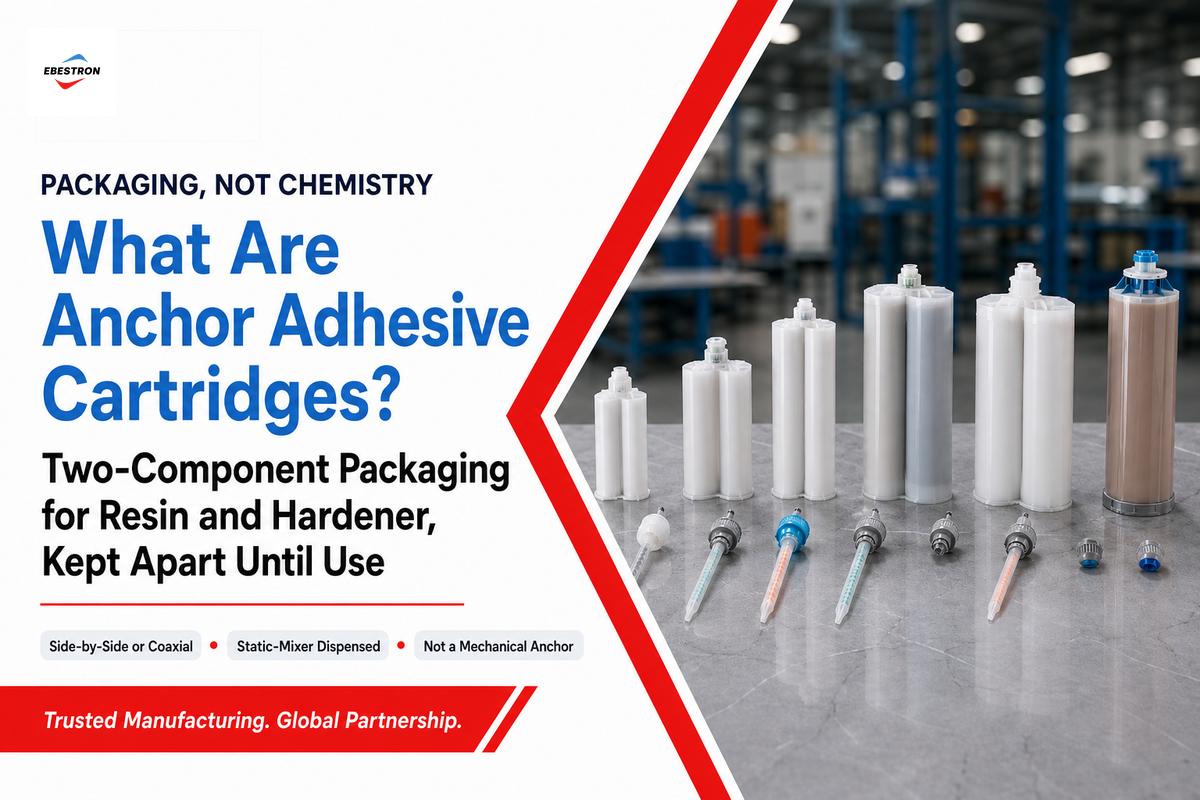
A construction anchor adhesive cartridge is a two-component container – usually side-by-side or coaxial – that keeps a resin and a hardener physically separate until the moment of use. Loaded into a gun, the two parts are forced through a static mixing nozzle at a fixed ratio, blended in-line, and injected directly into a drilled hole around a threaded rod or rebar dowel. By itself, the cartridge is packaging engineering, not chemistry.
This confusion is a real pain point on real jobsites: a foreman sent to a hardware counter for “anchor adhesive” can walk out with a filled, ready-to-use consumer cartridge from a hardware-store shelf, or with the wrong empty cartridge format for the crew’s existing gun and nozzle stock – two very different purchases that both answer to the same generic name. Any mismatch between the cartridge, the nozzle, and the resin ratio is one of the fastest ways to turn a qualified anchor into a field failure. Colloquially, the dispensing gun sits in the same family as a caulk gun, though dedicated 2-K cartridge guns are built for much higher thrust; the static mixing nozzle itself is discussed in Choosing the Right Static Mixing Nozzle below.
This distinguishes the cartridge system from mechanical anchors (expansion bolts, wedge anchors), which depend purely on friction or keying and involve no chemical cure step at all. Chemical anchor adhesive accomplishes the bonding to both the base material and the embedded rod – hence the chemistry and cure environment are as important as the mechanical fit. That bonding requirement is also why chemical anchor systems go through a distinct qualification pathway (ICC-ES AC308 and ACI 355.4 in the US, covered in detail below) that mechanical anchors, which qualify under a separate ACI 355.2 pathway, don’t share.
Cartridges are also called 2-component or two component adhesive cartridges, or generically a resin anchor system; in Europe the phrase “injection mortar” is often a synonym for chemical anchor adhesive (for mortar-based resin systems dispensed in similar manner). Both new construction and retrofit projects use the same basic cartridge-gun-nozzle system for doweling threaded rod or rebar into drilled holes – what changes is the chemistry, not the mechanics of installing anchors.
How Anchor Adhesive Cures and Bonds
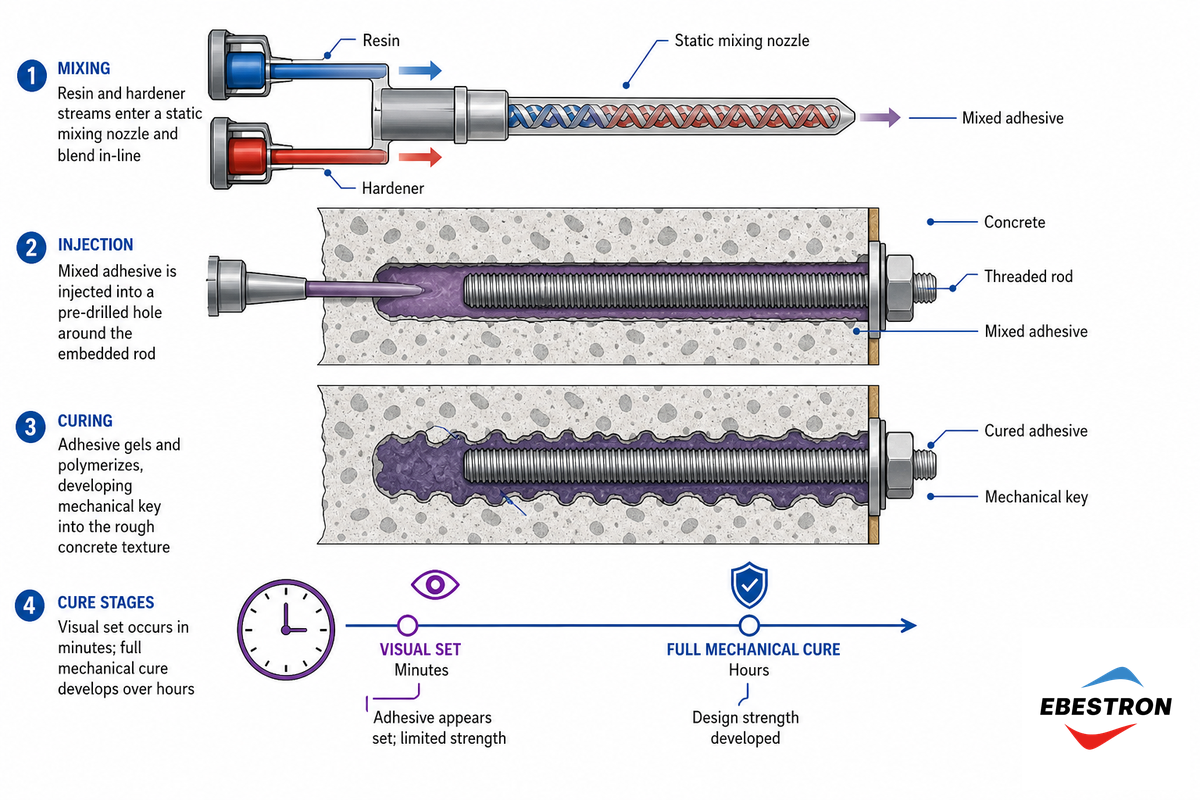
Mixing the two components starts polymerization: the resin’s reactive groups join into a hard, solid structure. As the mixture gels and cures, it develops mechanical key into the microscopic surface texture of the drilled hole and adhesive bonding to the substrate and the rod or rebar. How well that bond performs depends on the resin chemistry’s intrinsic adhesion, the concrete’s condition (cracked, uncracked, wet, or dry), and how thoroughly the two components were mixed before injection.
The same mixing-and-metering mechanism is documented in USPTO patent US7807740B2 for two-component reaction-resin anchor fastening systems. On a real jobsite, a rebar dowel that looks fully set within minutes of injection can still be developing its full mechanical key over the following hours. Most bond-strength disputes have a root cause in that gap between visual set and full cure, which is exactly why the codes discussed below (ACI CODE-355.4-24 and ICC-ES AC308) exist: because a resin that looks cured is not the same as a resin proven, through standardized third-party testing rather than a marketing claim, to carry a specific rated load – a distinction that can be worth a 30-50% swing in real-world holding capacity, as the hole-preparation data below shows. (The importance of selecting the right nozzle, covered next, isn’t a minor issue either.)
Is Chemical Anchor Adhesive the Same as Epoxy?
No. Epoxy is one of four common chemistry families used in anchor adhesive cartridges, not a synonym for the category. Also commonly sold as chemical anchor adhesive are epoxy-acrylate, vinylester and polyester-based systems. Each type offer varying cure speeds, temperature resistances, and chemical resistance. Therefore, a cartridge labelled a “chemical anchor adhesive” could have any one of these four chemistry types, and the specifier must look for the actual resin chemistry not just the product category when comparing performance data.
Resin Chemistry Families: What They Mean for Installers
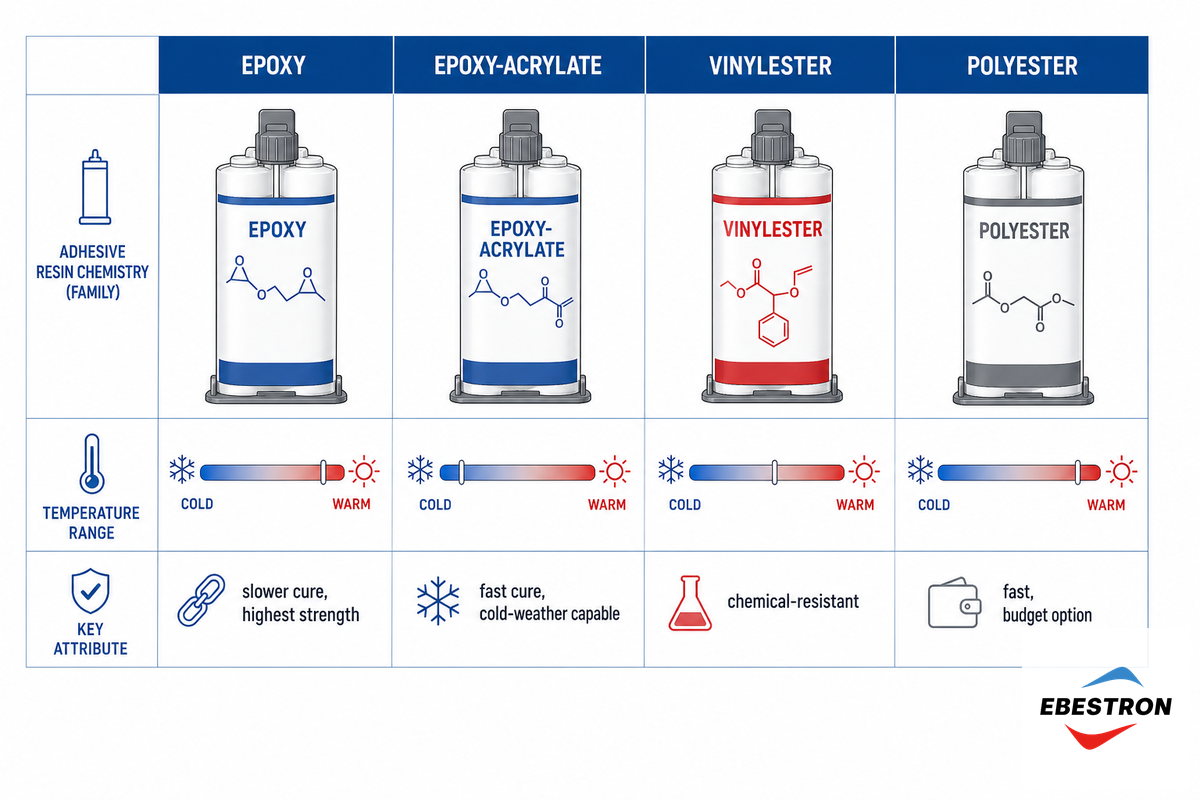
Choosing between epoxy vs vinylester anchor adhesive – and the two other common chemistries – is not interchangeable on a job, and a chemical anchor bolt assembly specified with the wrong resin family for the site conditions is a real spec failure, not just a preference. Those differences become critical in the case of a time-sensitive job or when temperatures are on either extreme, in part because the base resin systems themselves – styrene-bearing vinylester and unsaturated polyester chemistries in particular – have documented compatibility constraints with certain plastics, per USPTO patent US5378743 on low-styrene-emission vinyl ester formulations:
| Chemistry | Typical Cure Speed | Install Temp Range | Where It’s Typically Chosen |
|---|---|---|---|
| Epoxy (pure) | Slower, higher ultimate strength | Moderate to warm | Structural/sustained-load anchoring |
| Epoxy-acrylate | Fast, moderate strength | Cold to moderate | Fast-turnaround, cool-weather work |
| Vinylester | Fast to moderate | Moderate to warm | Chemical-resistance-sensitive sites |
| Polyester | Fast, lower cost | Moderate to warm | Light-duty, budget-constrained work |
As rough guide to working temperature ranges, standard epoxy usually cures across a 10°-32°C (50°-90°F) window, epoxy-acrylates and some cold-formulated epoxy formulations can work down to -7°C (20°F), and vinylester and polyester systems generally fall within a 5°-35°C (40°-95°F) window, although always confirm against the product data sheet. Ultimate bond strengths for typical structural epoxy formulations are often between 1,500 and 3,000 psi in dry, uncracked concrete, but this varies with each product and with the substrate. Actual cure times and strength figures will vary based on manufacturer and product-batch; refer to the product technical data sheet for accurate numbers. It should be noted that a fifth class of products exists. Certain vinylester and polyester formulations are marketed as acrylic adhesive and acrylic adhesive (modified) systems. These are often promoted as having lower odor or as being Styrene-free for use in interior or occupied space construction projects. In exchange for quicker set-up and easier handling in job conditions, these usually provide lower overall bond strength than the higher-performing epoxy formulas. That’s why epoxy anchoring generally remain the preferred system choice for applications subject to the highest continuous load or the highest shear stress requirements, while the acrylic or vinylester choices are commonly specified for applications where time is critical or the job is in an occupied building.
Codes and Compliance: ACI 355.4, AC308, and EAD 330499
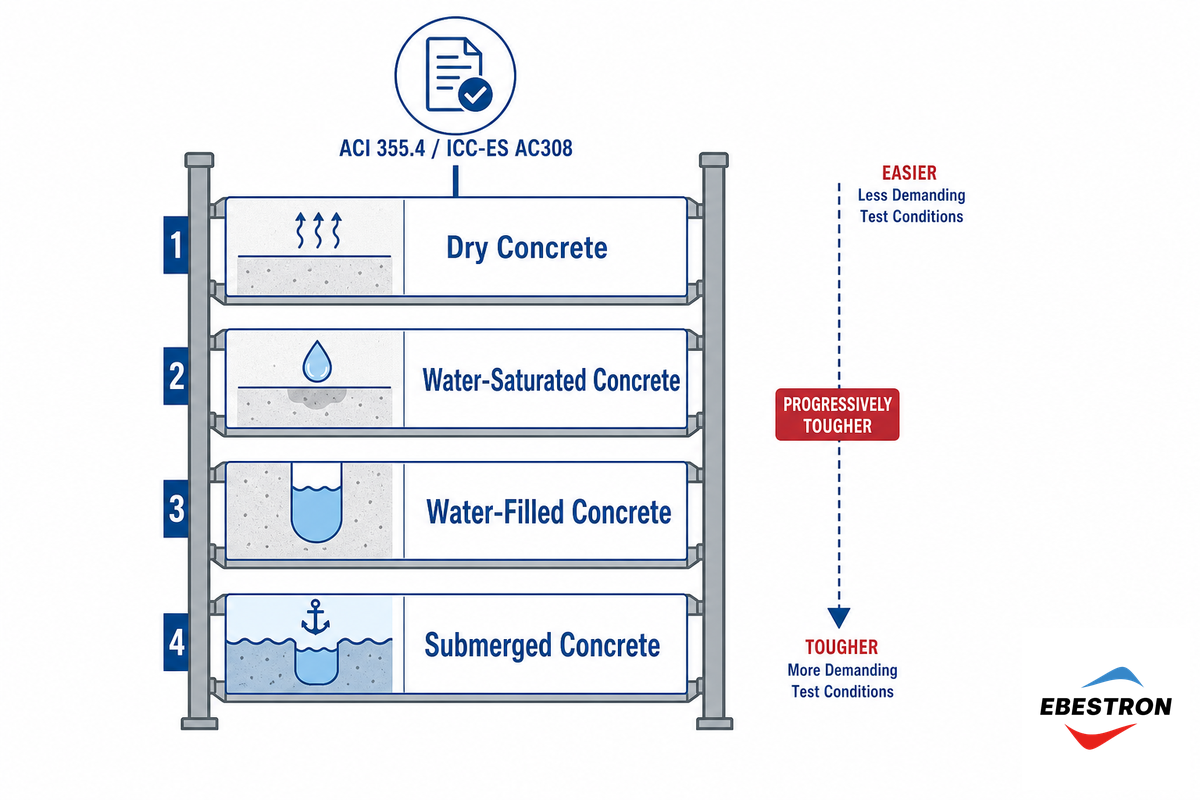
AC308’s 4-Condition Qualification Matrix
Currently, post-installed adhesive anchor in the US is primarily managed under ACI CODE-355.4-24, referenced by the 2025 ACI 318 standard in anchorage design. ICC-ES AC308 continues to serve as the layer of acceptance criteria that takes ACI 355.4 test results and converts them into an evaluation report recognized under the IBC and IRC – these work in tandem, not as alternative approaches. In the EU, the relevant document is EAD 330499-02-0601, which superseded the older version of the standard (the -01-0601 edition) and included variations for sustained tension, alternate drilling, seismic, fire, and increased service life. It’s interesting to note the number of consumer-facing web pages that still cite older standards simply out of habit; check prior to copying a certification claim into your own specifications. In areas outside of North America, “fixings” are the more general term for anchors and related systems-including both mechanical and chemical-type applications-which may be encountered in European or UK-sourced specs that avoid using the word “anchor” directly.
| Condition | What It Simulates | Why It’s Tested Separately |
|---|---|---|
| Dry concrete | Baseline condition | Reference bond-strength value |
| Water-saturated concrete | Damp holes, recent rain | Moisture can interfere with cure and bond |
| Water-filled concrete | Standing water in the hole | Displaces adhesive, dilutes bond at the interface |
| Submerged concrete | Underwater installation | Toughest bond-retention condition to qualify for |
What Is the Difference Between a Chemical Anchor and a Mechanical Anchor?
Chemical anchors bond a threaded rod or rebar into a drilled hole with cured adhesive, developing capacity through adhesion and mechanical keying. A mechanical anchor – a wedge or expansion anchor – develops capacity through friction or keying as it’s torqued, with no chemical bonding step. Because they don’t rely on outward expansion, chemical anchors are usually preferred near slab edges or in cracked concrete, but they need a cure period before load can be applied, unlike mechanical anchors.
Installation Requirements: Hole Prep, Moisture, Temperature, and Sustained Load
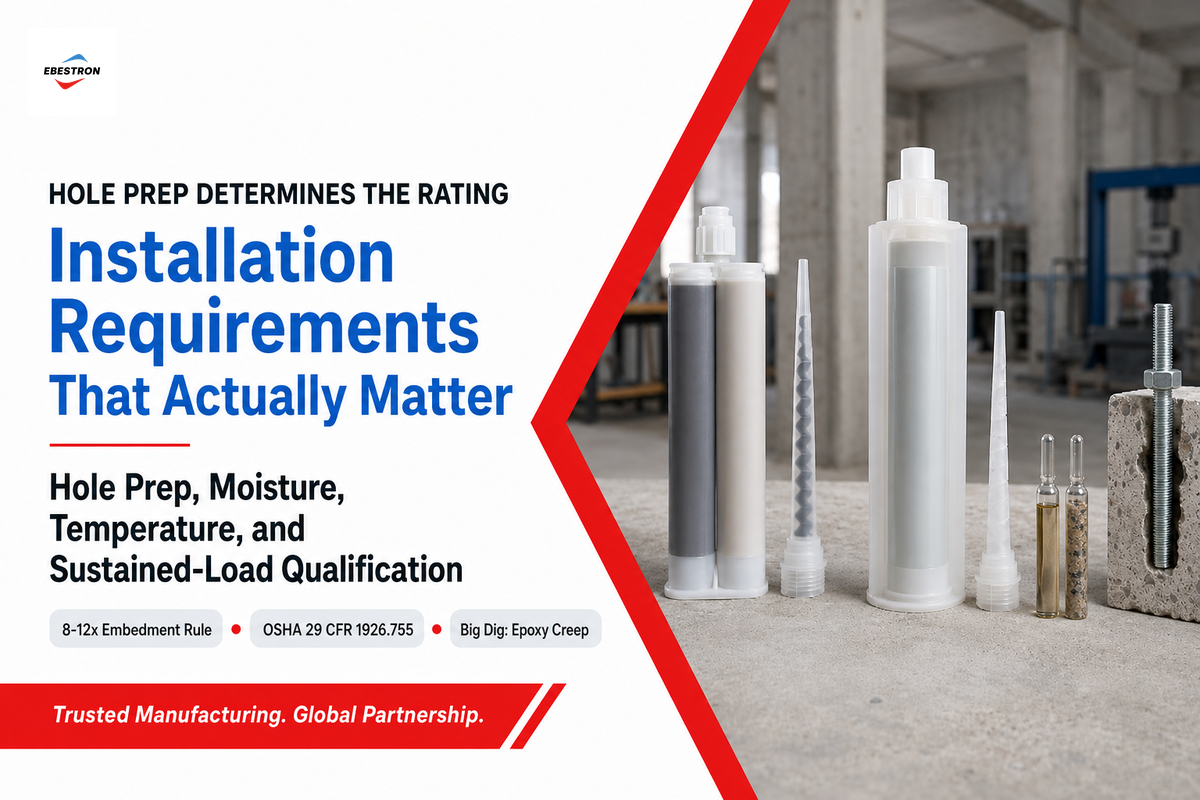
In section 17.8.2.1 of ACI 318, it’s stipulated that an adhesive-anchor specification will identify the concrete’s moisture level, concrete and hole-temperature, and the specific hole drilling and cleaning procedures-all these factors, not the installer, determine which tests the system actually underwent to obtain its evaluation report. Drilling a hole with an improperly matched bit, cleaning a hole improperly, or installing an anchor at a temperature outside the tested range amounts to a different system than what was certified. Engineering trade-press analysis of adhesive-anchor testing has reported capacity reductions on the order of 30 to 50% from an oversized or poorly cleaned hole in some test programs — figures that vary by study and installation, but that make the point clearly: hole preparation, not a flaw in the resin, is a common and preventable cause of an anchor that tests weak.
📐 Engineering Note
The OSHA standard at 29 CFR 1926.755 dictates that at least 4 anchor rods be installed to secure structural steel column base plates, and that each anchor rod assembly is capable of resisting at least a 300 lb eccentric gravity load at a 18 in distance from the outer face of the column; the standard also states that field modifications to existing anchor rods aren’t permitted unless approved by the registered design professional. While the provision specifically pertains to structural steel column base plate anchorage, and doesn’t necessarily apply to all chemical anchor applications, it serves to illustrate just how stringently field alterations to anchor rods are controlled in structural steel work.
Among installation variables, sustained tension under overhead or upwardly inclined installation is the one most buyer-facing pages ignore entirely under overhead or upwardly inclined installation. On July 10, 2006, a section of the I-90 connector tunnel’s suspended concrete ceiling in Boston – some 26 tons of concrete panels and hardware – dropped from its epoxy-anchored support system and crushed a passing vehicle below, fatally injuring one of its two occupants. A National Transportation Safety Board investigation (NTSB/HAR-07/02) identified the failure’s cause as epoxy creep – slow, time-dependent deformation of the adhesive under a constant sustained tensile load that allowed the anchor bolts to pull loose over months, even after passing pull tests at installation. The specific epoxy formulation hadn’t been properly tested for performance under sustained tension in an overhead installation, and that incident is the reason both ACI 318 and ACI 355.4 qualification now distinguish overhead/upwardly inclined, sustained tension applications as a higher performance category, and is also why specialized certified-installer programs exist.
“Powers Fasteners failed to provide sufficiently complete, accurate, and detailed information about the suitability of its epoxy for sustaining long-term tensile loads, a gap that would not have surfaced in a standard short-duration bond test.”
NTSB Highway Accident Report HAR-07/02 findings, summarized
If you’re dealing with an overhead or upwardly inclined installation that uses anchors in sustained tension – such as a suspended ceiling, an overhead equipment rack, or signage – then ensure the anchor system’s evaluation report explicitly addresses sustained-load qualification in accordance with current ACI 355.4 standards and that your installer holds the required certification. This isn’t merely a bureaucratic step; it’s a direct response to the deficiency revealed in the Big Dig collapse.
Typical Installation Parameters (confirm against your product’s data sheet)
| Hole diameter oversize | Commonly rod diameter + 3-5 mm, per manufacturer data sheet |
| Embedment depth | Typically 8-12× rod diameter (roughly 100-240 mm for a 12 mm rod) |
| Minimum edge distance | Typically ≥5× rod diameter (roughly 60 mm for a 12 mm rod) to limit breakout risk |
| Standard-epoxy cure-to-load time | Roughly 1-24 hr depending on temperature |
| Fast-cure chemistry cure-to-load time | As fast as 15-30 min at 20°C+ |
| Minimum install temperature (standard epoxy) | Commonly ~5°C; cold-formulated variants rated lower |
Choosing the Right Static Mixing Nozzle
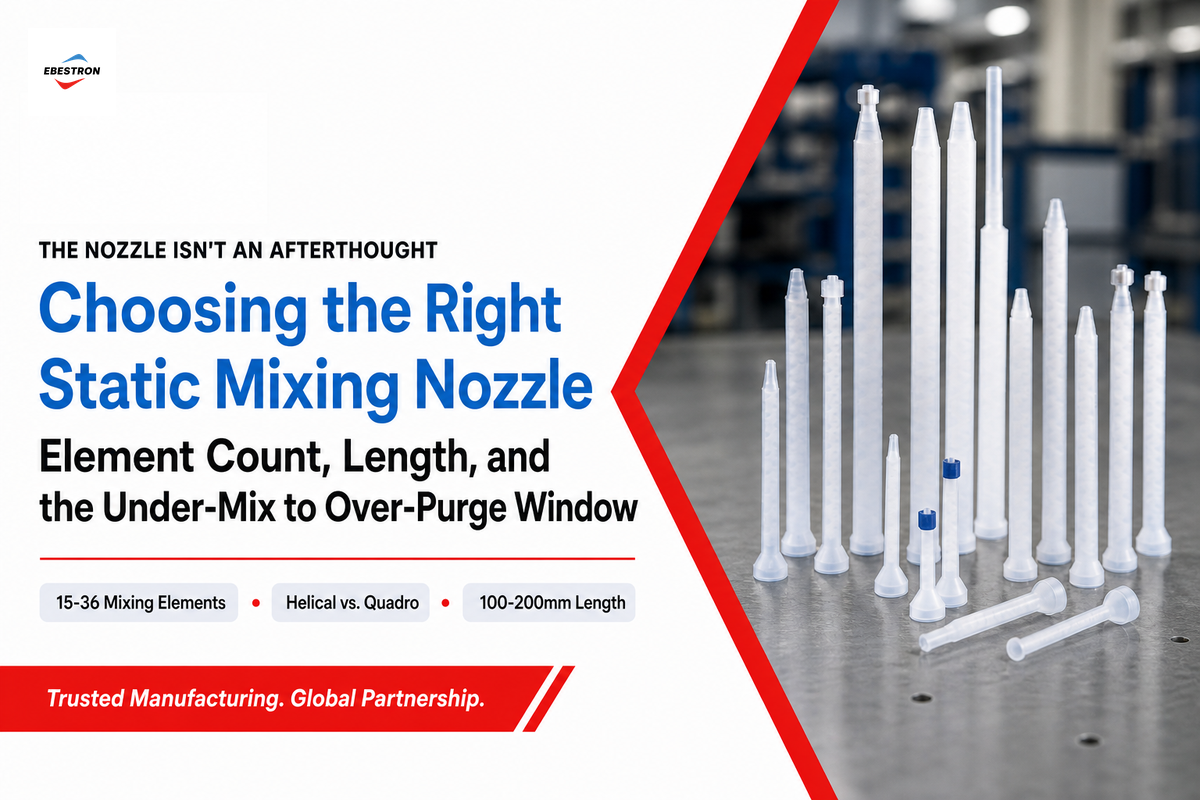
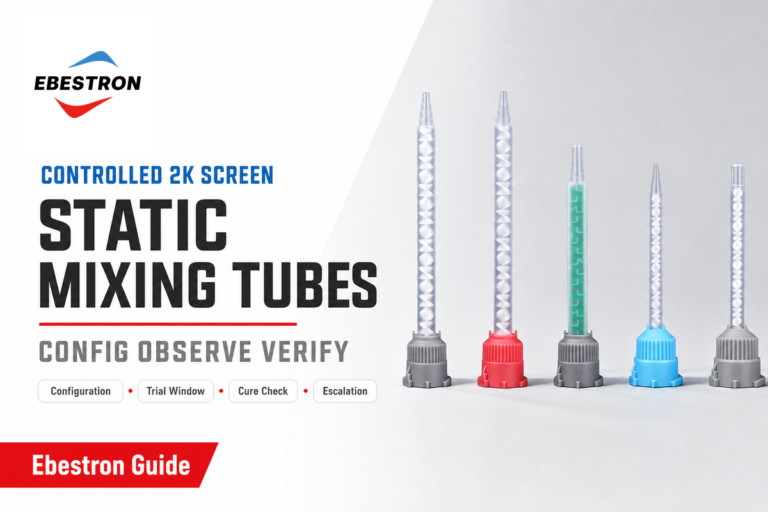
You can perfectly match a gun, a resin, and the anchor, and still have an under-performing installation if the static mixing nozzle is incorrect. Static mixers work by dividing the resin flow into several segments and recombining them by forcing them through an array of helical or square-profile (Quadro) mixing elements – each element repeats a split-and-recombine sequence, increasing mixing quality with every element the resin encounters. Typical epoxy nozzles are designed with 15 to 24 elements, increasing to 36 elements for higher-viscosity and more difficult-to-mix systems, and commonly run about 100 to 200 mm in length.
A 15-to-36 Element Trade-Off Framework
⚠️ Important — The Under-Mix to Over-Purge Nozzle Window
More elements isn’t automatically better. too few and the splitting-and-recombining sequence isn’t completed, resulting in a streaked bead or a soft spot in the dispensed cure. Too many, or a nozzle that’s just too long, can increase pressure on the gun and cause a large amount of resin to be retained in the nozzle after a shot is dispensed. The shorter, Quadro-profile elements are more efficient than the longer, helical-profile elements, and a shorter Quadro nozzle will often match or outperform a longer helical nozzle at mixing quality while expending less material and generating less gun pressure. The choice between nozzle lengths and element designs is driven by gun thrust capacity, viscosity, and mixing performance.
Checking a cartridge’s ratio and volume against a compatible helical or Quadro-turbo static mixer before ordering is a five-minute check that avoids a jobsite delay discovering the nozzle doesn’t fit the gun or under-mixes the resin.
Whether the cartridge is a dual cartridge (side-by-side) or a coaxial cartridge format also affects nozzle choice – coaxial cartridges use a concentric inner/outer tube design and usually need a matched coaxial-specific mixer, while dual cartridge (side-by-side) formats accept a broader range of interchangeable static mixers. An epoxy gun’s thrust ratio – the mechanical advantage the gun’s plunger mechanism provides – has to be high enough to push the resin through the nozzle’s full element count without stalling, which is a second reason a longer, higher-element-count nozzle isn’t a free upgrade: it also demands more from the gun.
Cracked vs. Uncracked Concrete: Why It Changes Your Anchor Choice
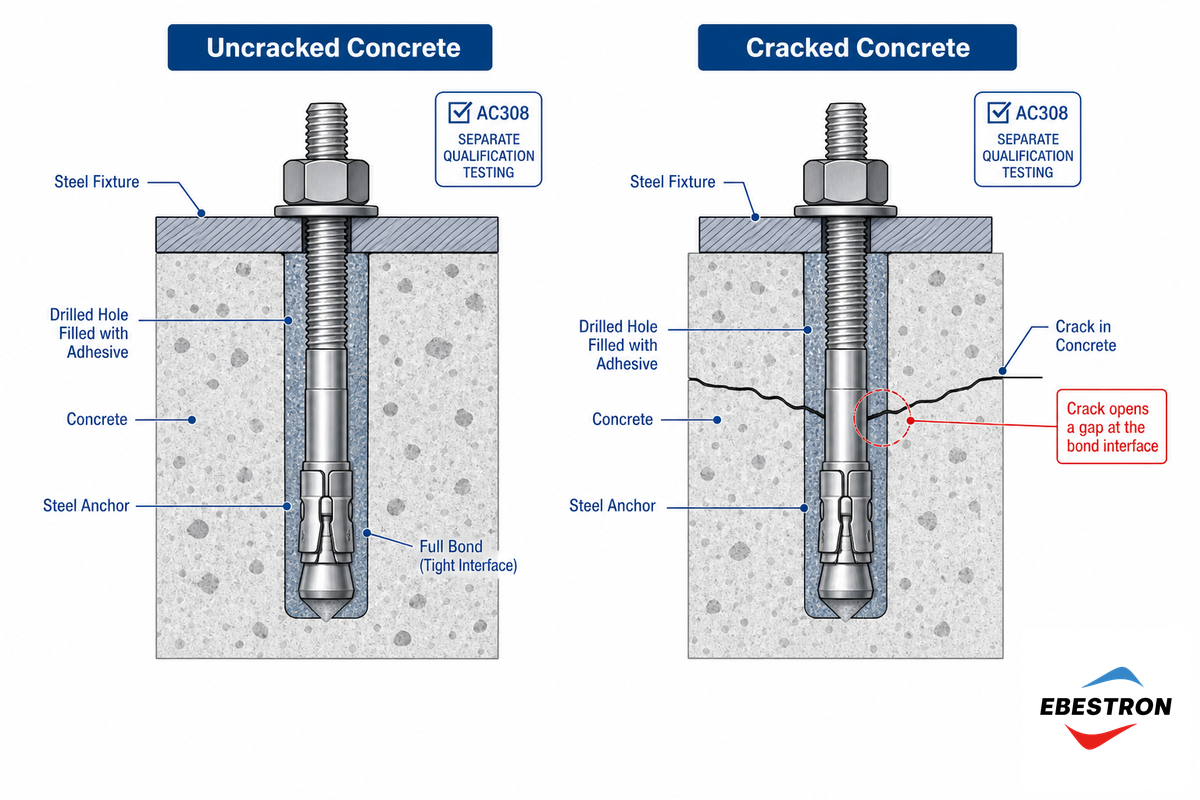
An anchor system qualified only for uncracked concrete hasn’t been tested under the condition most likely to exist in a seismic-retrofit or heavily loaded structural application – cracked concrete opens a gap at the bond interface that a system designed only for solid, uncracked material was never evaluated against. AC308’s four-condition test ladder (above) is what separates a “cracked concrete” rating from an “uncracked concrete only” rating, and the two aren’t interchangeable on a spec sheet: specifying an uncracked-only system for a location that may crack under load is a documented, testable gap, not a theoretical risk. Anchor systems tested and rated for both cracked and uncracked concrete carry the broadest approval and are the safer default whenever the loading history or seismic exposure of a structure isn’t fully known at spec-writing time.
Concrete density is a related, less commonly discussed variable. One 2024 academic study (102 tests) found unconfined tensile capacity for post-installed adhesive anchors in lightweight concrete running around 40% of comparable normal-weight concrete capacity – a single-paper figure, not a design value, but directionally significant enough that lightweight-concrete substrates should be verified with project-specific testing rather than assumed to perform the same as normal-weight concrete, and the same ACI CODE-355.4-24 qualification pathway is what any anchor system must clear regardless of substrate density.
Common Installation Mistakes
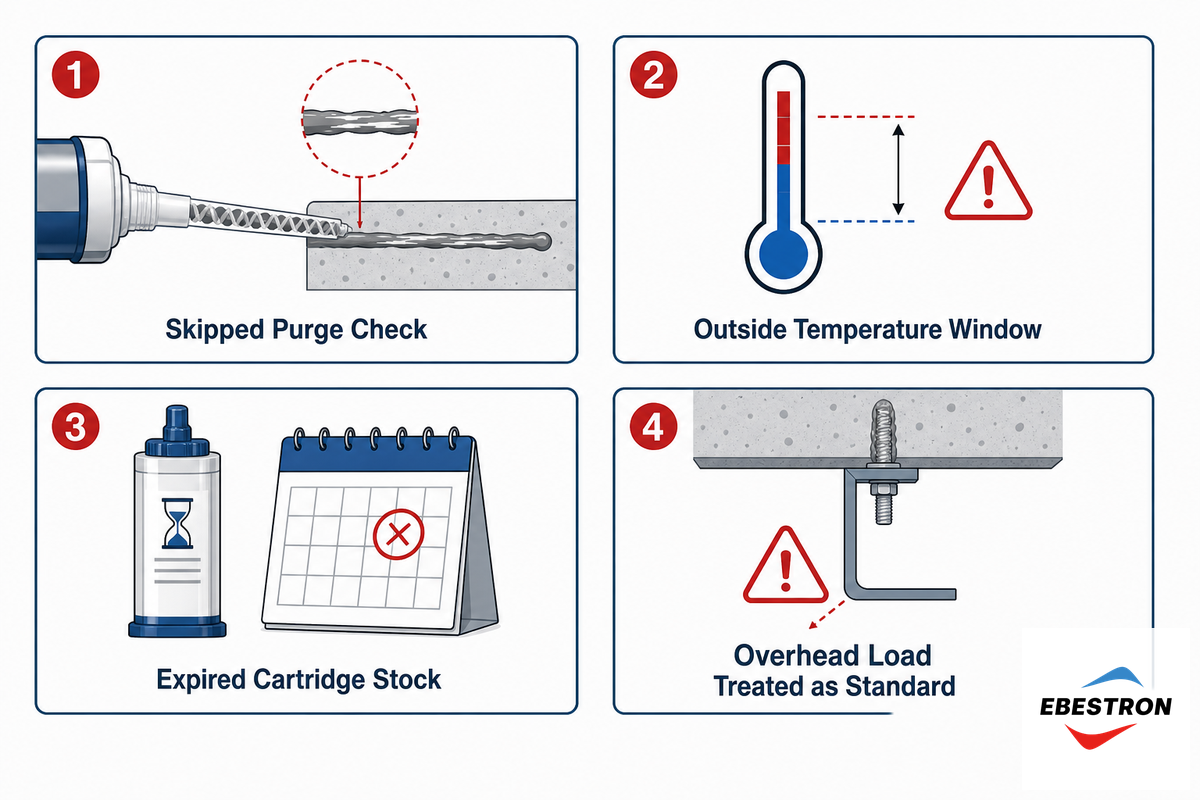
Field engineers on industry forums consistently flag the same handful of preventable errors. A recurring piece of practitioner advice from an engineering discussion thread on CR4/GlobalSpec: open a new cartridge, confirm both components are actually flowing, attach the mixer firmly, and purge the gun until the bead run a uniform color and consistency before trusting the first shot into an anchor hole – the sacrificed purge material is far cheaper than discovering a soft, uncured anchor days later.
- ✔Skipping the purge-and-check-uniform-bead step before the first shot into a hole
- ✔Installing outside the material’s qualified temperature window (most systems specify roughly 5-25°C for storage, and manufacturers publish separate cure-temperature ranges for installation)
- ✔Using cartridge stock past its 12-18 month shelf life (stored above roughly 25°C or below 5°C) without a visual re-check for separation, discoloration, or swelling
- ✔Treating an overhead or sustained-tension installation the same as a standard downward installation without verifying the anchor system’s sustained-load qualification
A 5-Question Anchor Spec Decision Path
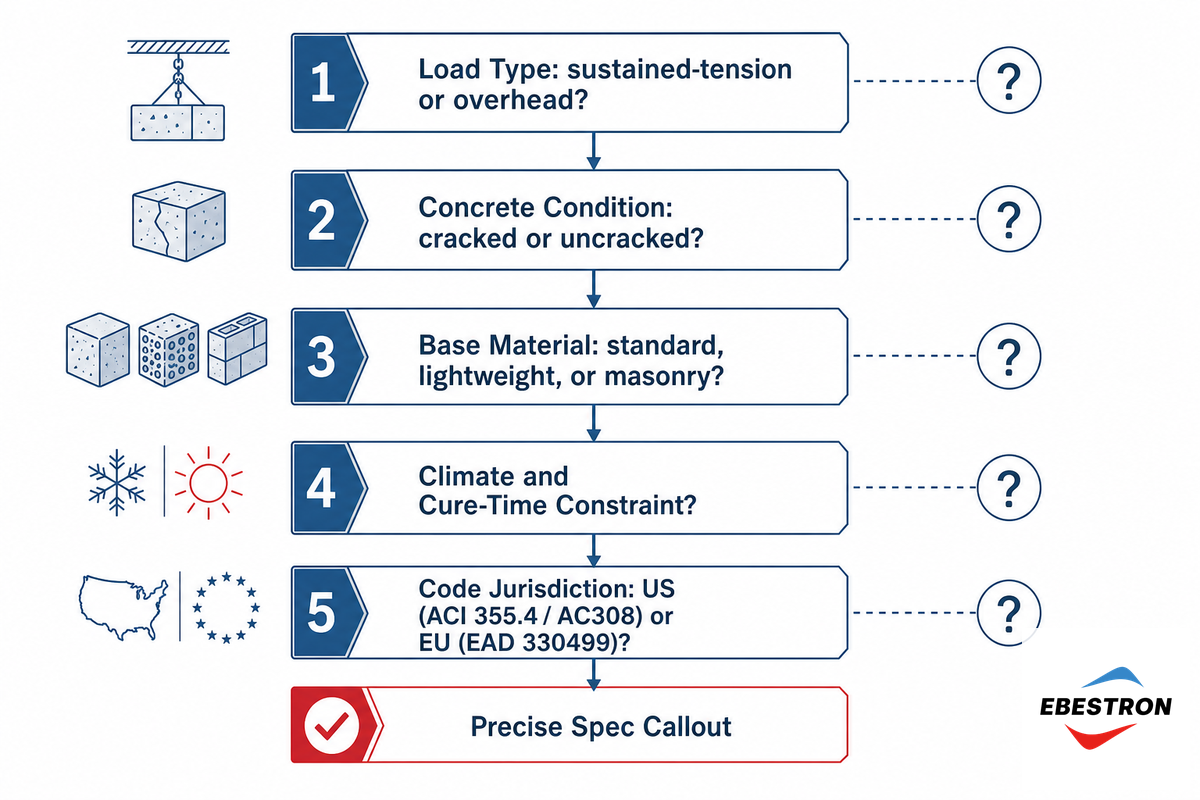
Here are five questions that will transform “I need a chemical anchor” into a precise spec callout- answered in sequence:
The Anchor Spec Decision Path
- Load type: sustained-tension, overhead, or upwardly-inclined? If so, verify sustained-load qualification and installer certification prior to proceeding further.
- Concrete condition: cracked, expected-to-crack (seismic, cyclic load) or definitely uncracked? Align to an AC308-rated system proven in the field for those conditions.
- Base material: standard weight, lightweight concrete or masonry? lightweight and masonry substrates demand project-specific validation, not assumption of capacity.
- Climate and cure-time constraint: cold climate or tight schedule? Favor epoxy-acrylate or vinylester chemistry systems with fast cold-cure profiles over standard epoxy.
- Code jurisdiction: US job confirm the evaluation report cites current ACI CODE-355.4-24/AC308(24); EU job confirm EAD 330499-02-0601, not its now obsolete -01-0601 edition.
A 10-Scenario Installation Type Matrix
Applying the 5-question process to 10 common job-site conditions leads to the consistent and reliable recommendation that’s illustrated in the table below. It’s intended as a first step in decision-making and isn’t a replacement for the anchor manufacturer’s own evaluation-report data:
| Installation Type | Concrete Condition | Recommended Chemistry | Standard to Confirm |
|---|---|---|---|
| Standard structural, downward | Uncracked, dry | Epoxy | AC308 uncracked-rated |
| Seismic / retrofit zone | Cracked or may crack | Epoxy or vinylester (cracked-rated) | AC308 cracked-concrete rated |
| Sustained tension, overhead | Any | Epoxy, sustained-load qualified | ACI CODE-355.4-24 sustained-load + certified installer |
| Cold weather, below ~5°C | Dry to damp | Epoxy-acrylate | Manufacturer cold-cure data sheet |
| Fast-turnaround / same-shift load | Dry to damp | Epoxy-acrylate or polyester | Manufacturer rapid-cure rating |
| Water-saturated hole | Water-saturated | Epoxy or vinylester, water-saturated rated | AC308 water-saturated condition |
| Submerged / underwater | Submerged | Submerged-rated system (specialty) | AC308 submerged condition |
| Masonry / brick substrate | N/A (masonry) | Lower-viscosity, masonry-rated system | Manufacturer masonry evaluation report |
| Indoor, light-duty, budget-sensitive | Uncracked, dry | Polyester or acrylic, styrene-free | Manufacturer standard evaluation report |
| Lightweight concrete substrate | Uncracked or cracked | Project-verified system | Project-specific test data (capacity typically reduced vs. normal-weight) |
With chemistry, format and ratio requirements dictated by this five-question decision process, Ebestron’s construction anchor cartridge systems cover the empty coaxial and side-by-side packaging built to hold each of these resin chemistries, matched to the format compatible with your site’s needs.
Industry Outlook: What’s Changing in Anchor Adhesive Compliance
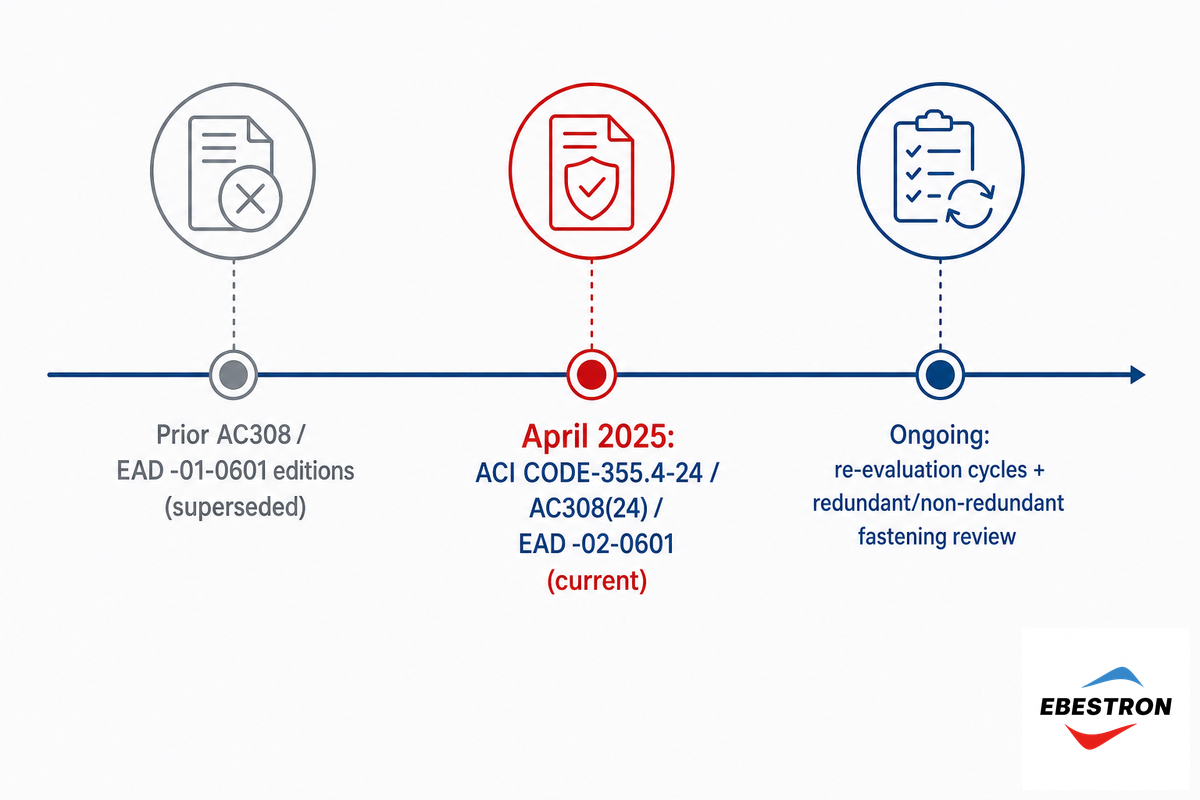
As of April 2025, ACI CODE-355.4-24 and ICC-ES AC308(24) reset the clock on adhesive anchor system qualification: evaluation reports based on old editions must be re-tested and re-issued on the standard renewal cycles and 318-25’s explicit differentiation of redundant and non-redundant fastenings means some older design approvals will be revisited for re-evaluation. For current jobsites specifying anchor systems, check the evaluated standard version of the system being specified rather than simply its name; an evaluation report with an pre-2024 AC308 edition in its history may no longer meet the current evaluation standards by the time a project spanning multiple years is installed. The same current version rule applies to jobsites in Europe; verify an evaluation report uses EAD 330499-02-0601, as the -01-0601 edition it replaced no longer serves as a benchmark for evaluation.
Because of the regulatory attention that followed the 2006 Big Dig incident, specification of sustained-tension and overhead installation approved systems will likely see continuing increasing demands. Other industry segments also will likely see more attention on the part of evaluation bodies. Meanwhile, market analysts place global chemical anchor market sales some where in the $1.3-$1.9 billion range over the next decade, but those figures are purely for informational background and aren’t drivers for regulatory change or for ensuring you’re correctly specified.
Frequently Asked Questions
Q: What is the strongest construction adhesive for concrete?
View Answer
Typically, pure epoxy systems have been regarded as the highest-strength, high-strength-rated option for use with solid, uncracked concrete, often in the 1,500-3,000 psi bond-strength range. However, “strongest” depends on the scenario – an epoxy may test poorly if not approved for cracked-concrete installation, while a vinylester system proven in cracked concrete could easily surpass it. Choose the chemistry that works best in your site conditions.
Q: Should you use adhesive with concrete anchors?
View Answer
Chemical adhesive anchors are generally favored over mechanical anchors near an edge or in cracked concrete, since they bond instead of wedging outward. Mechanical anchors remain a reasonable choice for straightforward uncracked-concrete installations with adequate edge distance where a quick, cure-free install matters most. The right pick depends on concrete condition, edge distance, and load type – not a universal rule either way.
Q: How long does anchor adhesive need to cure before load can be applied?
View Answer
Cure time before full load varies by resin chemistry and installation temperature. Epoxy-acrylate and vinylester resins cure faster than standard epoxy, and every chemistry cures more slowly in cold weather. Manufacturers publish cure-to-load-time tables by temperature; treating any single number as universal risks loading the anchor before it reaches rated strength.
Q: Can chemical anchor adhesive be installed in cold weather?
View Answer
Provided the chemistry is matched to the temperature, yes. Cold weather concrete anchor epoxy work is common, but standard epoxy cures slowly or poorly in cold conditions, so epoxy-acrylate and some vinylester resins engineered for cold-weather cure are the better fit. Adhesive anchor design should treat installation temperature as a specified parameter, not an afterthought – ACI 318 §17.8.2.1 makes it one of the three mandatory installation-spec variables.
Q: Does installing adhesive anchors require special certification?
View Answer
Specifically for sustained-tension, overhead, or upwardly inclined applications, yes. Current building code requires certified installer status precisely in this context, directly in response to incidents involving sustained-tension anchor failures. However, for typical downward-facing installations in structural settings, requirements differ by locale and project specification; irrespective of certification, following the manufacturer’s guidelines for installation and ACI 318 parameters for hole preparation is essential.
Q: What happens if I use the wrong mix ratio by accident?
View Answer
An off-ratio mix – usually from a mismatched nozzle, a faulty plunger, or a cartridge swapped between gun types – leaves excess unreacted resin or hardener in the cured mass, which can look fine but test well below rated strength. This is exactly why the purge-and-check-uniform-bead step matters: an off-ratio stream usually shows up as streaking or an inconsistent bead before it reaches the hole, if someone actually checks.
Why We Write This
Ebestron provides the empty cartridge, piston, and static-mixing-nozzle systems that contain construction anchor adhesive resins but doesn’t formulate or sell the filled adhesive. Therefore, our role is on the packaging and dispensing-mechanics side of the process. This guide focuses on the installation and specification questions our customers’ customers (installers and specifiers) pose to us indirectly, rather than repeating the technical data of our own products. Reviewed by the Shanghai Ebestron New Materials Co., Ltd. technical team.
References & Sources
- 29 CFR 1926.755, Column Anchorage — U.S. Occupational Safety and Health Administration
- Highway Accident Report HAR-07/02, Ceiling Collapse in the Interstate 90 Connector Tunnel — National Transportation Safety Board
- ACI CODE-355.4-24, Post-Installed Adhesive Anchors in Concrete: Qualification Requirements and Commentary — American Concrete Institute
- EAD 330499-02-0601, Bonded Fasteners for Use in Concrete — European Organisation for Technical Assessment
- AC308, Post-Installed Adhesive Anchors and Reinforcing Bars in Concrete Elements (April 2025) — ICC Evaluation Service
- Post-Installed Adhesive Anchors in Masonry — STRUCTURE Magazine
- Beyond Bond Strength of Adhesive Anchors — STRUCTURE Magazine
- ACI 318-25 Changes to Anchorage and Reinforcing Bar Provisions — STRUCTURE Magazine
- US7807740B2, Two-Component Reaction Resin and Static Mixer Anchor Fastening — USPTO / Google Patents
- US5378743, Stable Low Styrene Emission Vinyl Ester and Unsaturated Polyester Resin Composition — USPTO
- Epoxy Anchors Use and Problems (engineering discussion thread) — CR4 / GlobalSpec
Related Articles
- Battery & Electric Cartridge Dispensing Guns Guideelectric-drive dispensing gun selection and compliance
- Empty Two-Component Cartridges, Bulk & OEMcartridge packaging range and private-label options
- Custom Cartridge Design & Private LabelOEM cartridge sourcing considerations
- Industries We Serveconstruction, medical, electronics, and automotive cartridge applications