Get in touch with Ebestron Company


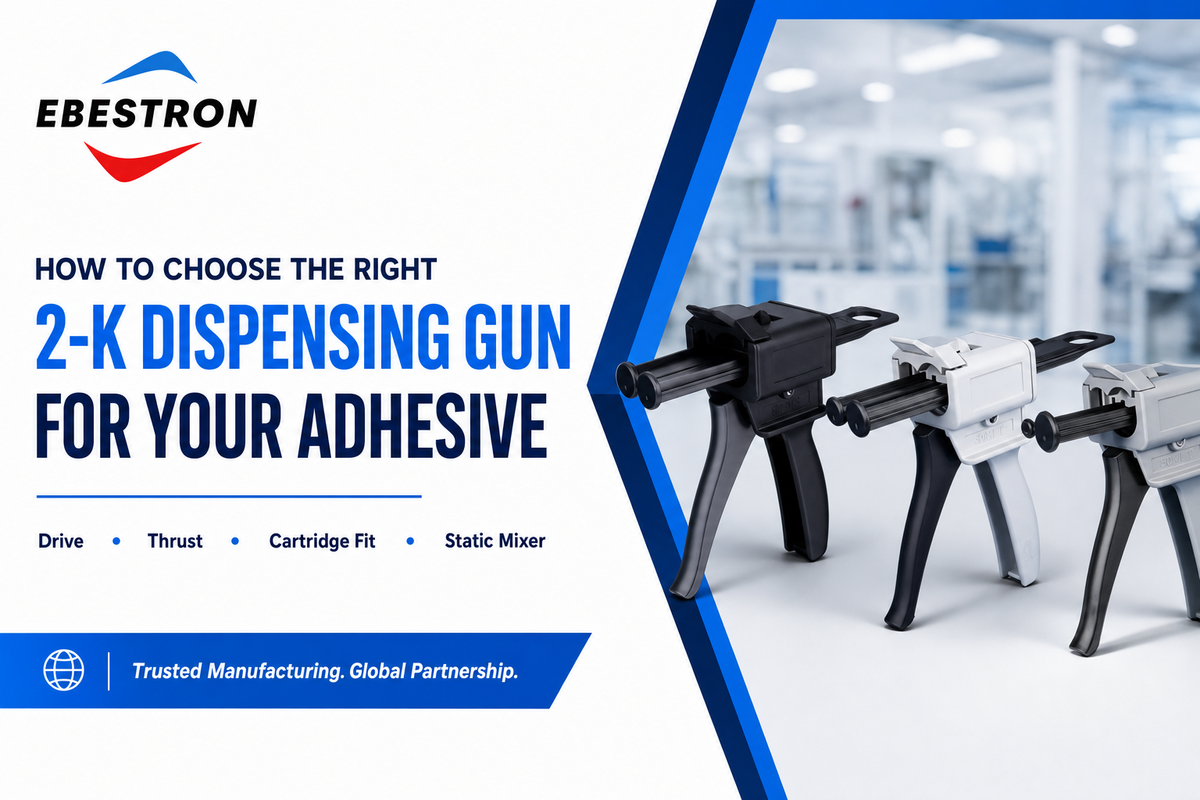
Knowing how to choose a 2K dispensing gun is the difference between a bonded joint that holds and a cartridge you bin half-used. A 2-K (two-component, or 2K) dispensing gun pushes resin and hardener at a fixed ratio out of two separate barrels and through one nozzle, so the wrong gun doesn’t just dispense slowly, it dispenses off-ratio, and off-ratio adhesive never reaches full strength. Five things decide the choice: drive type, cartridge size, mix ratio and brand system, thrust ratio, and static-mixer fitment.
One money-saving warning first: those 60,000-plus monthly searches for “caulking gun” point at a single-barrel tool for one-part sealant. A 2-K dispensing gun is a different animal. Use a consumer caulk gun to dispense a two-component epoxy and you’ve no way to hold the resin-to-hardener ratio, the divide between a caulk gun and an industrial dispenser is the first thing to get right.
2-K Gun Selection at a Glance
| Drive | Manual, pneumatic, or battery-electric — set by volume, throughput, and site power |
| Cartridge size | 50, 200, 400, 600, up to 1500 mL (50–1500 cc) |
| Mix ratio | 1:1, 2:1, 4:1, 10:1 (the plunger set must match) |
| Thrust ratio | 18:1 or 26:1 for most 2-K through a static mixer |
| Static mixer | Disposable; element count rises with viscosity difference and ratio spread |
What a 2-K Dispensing Gun Is, and Why a Caulk Gun Won’t Do
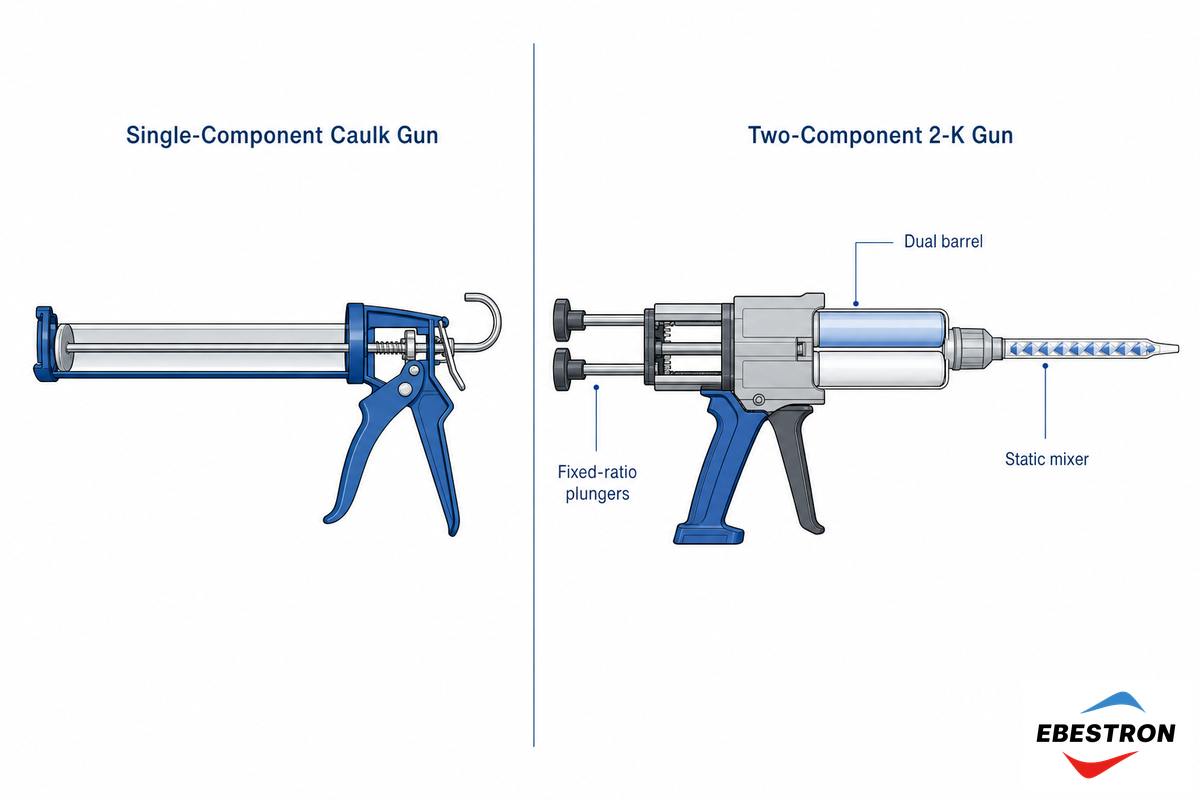
A 2-K dispensing gun is a handheld applicator that holds a dual-barrel cartridge and drives two fixed-ratio plungers together, metering a two-component adhesive (resin plus hardener) through a disposable static mixer at the nozzle. Because the barrel geometry and the plunger set fix the ratio, the two parts only meet inside the mixer, they stay separate until the moment they’re dispensed.
A single-component caulk or sausage gun can’t do this. It has one barrel and one plunger, so it has no way to combine two parts on-ratio. The U.S. Department of Energy’s published repair specs describe two-component structural epoxy as “supplied in cartridge and bulk systems” because the packaging is the metering device. Three features separate a real 2-K dispenser from a caulk gun:
- ✔ Dual barrelside-by-side or coaxial chambers hold resin and hardener separately.
- ✔ Fixed-ratio plungersa 2:1 gun advances one plunger twice as fast as the other, every stroke.
- ✔ A thrust class built for back-pressureforcing two pastes through a static mixer needs far more force than smoothing a bead of silicone.
Get this wrong and the symptom isn’t obvious. Off-ratio material can still look mixed yet cure soft, because even a 3–5% ratio error degrades cure and bond strength, a joint that should reach full strength in 24 hr can stay rubbery. That’s why the industrial two-component dispensing guns in this category are a separate product line from anything you’d buy for household sealant.
The 5-Variable 2-K Gun Selection Scorecard
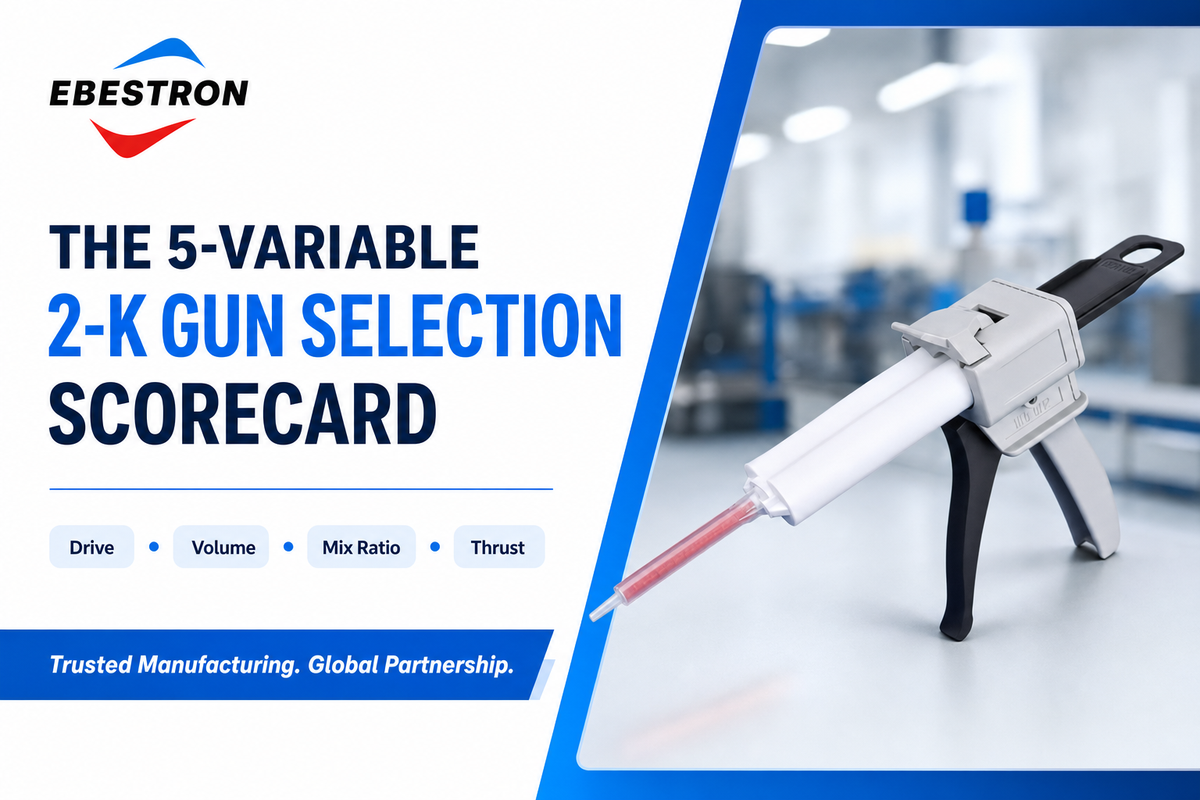
Before you compare brands, score your job against five variables. Run every candidate through the same list and the right gun usually picks itself, that’s the 5-Variable 2-K Gun Selection Scorecard.
| Variable | What to check | Failure if you get it wrong |
|---|---|---|
| 1. Drive type | Manual / pneumatic / battery-electric | Operator fatigue, or a powered gun you didn’t need |
| 2. Cartridge volume | 50, 200, 400, 600–1500 mL | Cartridge won’t seat in the cradle |
| 3. Brand / ratio system | Mixpac A/B/C/F, Nordson, Cox; side-by-side vs coaxial | Plunger set meters the wrong ratio |
| 4. Mix ratio | 1:1, 2:1, 4:1, 10:1 (by volume) | Off-ratio bead, weak cure |
| 5. Thrust ratio | 18:1 or 26:1 for paste through a mixer | Stalls on high-viscosity material, or splits the cartridge |
| 6. Material viscosity | Apparent viscosity at working temperature | Mixer back-pressure exceeds the gun’s force |
| 7. Throughput / duty | Shots per shift; intermittent or continuous | Slow line, or a gun too large to dose accurately |
| 8. Static-mixer interface | Bayonet vs bell, element count | Incomplete mix, tacky spots |
| 9. Power on site | Compressed air available? Cordless needed? | Air hose where you needed portability |
Variable 4 isn’t cosmetic: government test methods specify two-component epoxies mixed at a fixed ratio such as 2:1, and the plunger pair is what holds it. The next four sections take the high-stakes rows, drive, thrust, fitment, and mixer, one at a time.
Manual vs Pneumatic vs Battery-Electric: Picking the Drive
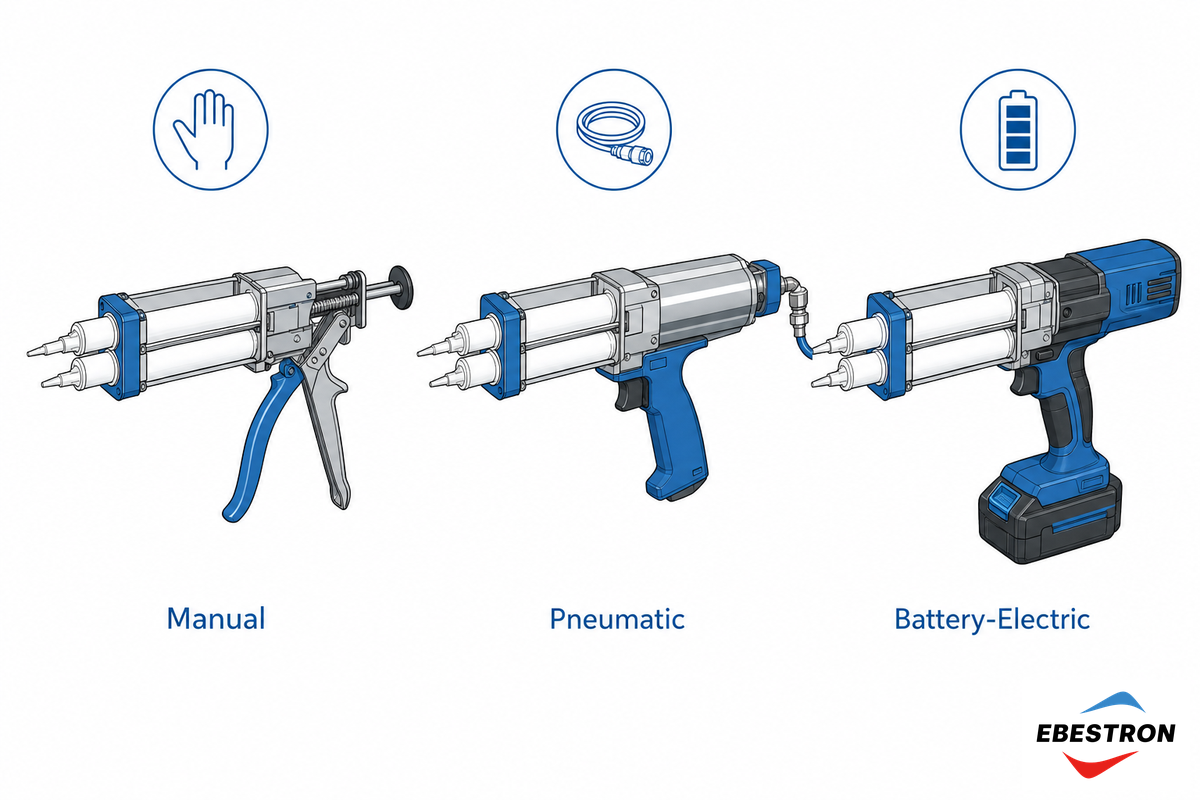
Should you buy a manual, pneumatic, or battery-electric gun? Honestly, no single drive wins, the right one fall out of your shot volume, your throughput, and whether compressed air reaches the bench.
The 3-Drive Gun Decision Tree
Work the 3-Drive Gun Decision Tree top to bottom: if precision on low volume matters most, stay manual; if you’ve got air and high volume, go pneumatic; if you need high force and portability together, go battery-electric.
| Factor | Manual | Pneumatic | Battery-electric |
|---|---|---|---|
| Power source | Hand | Compressed air | Lithium-ion battery |
| Typical thrust | 18:1–36:1 mechanical | Air-set, even flow | Up to ~5 kN motor |
| Throughput | Low | High | High |
| Operator fatigue | High on thick paste | Low | Low |
| Bead repeatability | Operator-dependent | Good | Good, adjustable speed |
| Portability | Excellent | Tethered to hose | Excellent (cordless) |
| Relative cost | Lowest | Mid | Highest |
| Best cartridge size | 50–490 mL | 200–600 mL | 400–900 mL |
| Best for | Low-volume, precise work | High-volume bench with air | High-force, cordless cells |
✔ When manual wins
- Lower-viscosity adhesive
- Tight or portable workspace
- Low volume, longer open time
- Precision matters most
⚠ When you need power
- High-viscosity paste
- High volume or fast cycle
- Short open time
- Repeatable bead across a shift
A pneumatic gun runs on shop air pressure of 60–100 PSI (4–7 bar) through an adjustable regulator, and the better models add a shut-off valve (an air-dump valve) that stops flow instantly to prevent drips, while the gun body stays lightweight and durable. A battery gun trades the hose for a self-contained configuration.
Once you’ve decided, match the drive to one of three landing pages: manual cartridge dispensing guns, pneumatic cartridge guns, or battery-electric cartridge guns.
Matching Thrust Ratio to Material Viscosity: the Match Curve
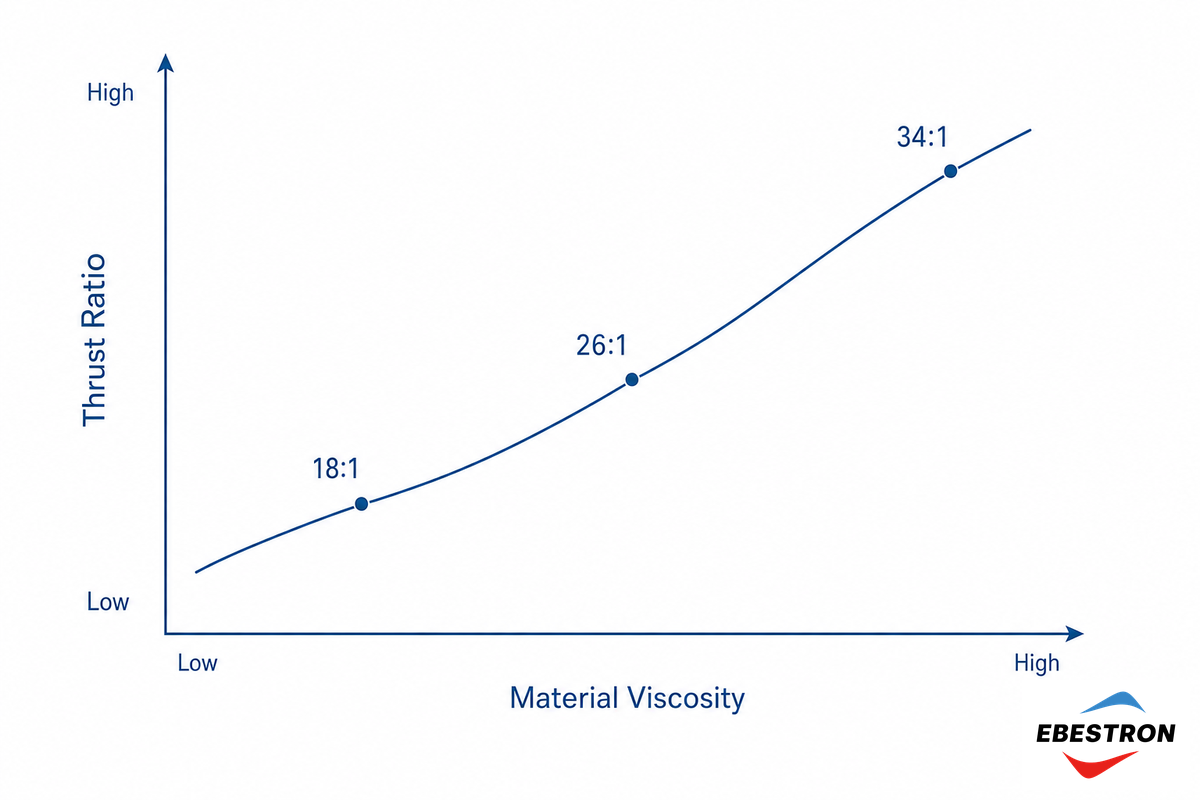
Thrust ratio is the gun’s mechanical advantage, how many units of plunger force you get for each unit of hand or air force. The Thrust-Ratio-to-Viscosity Match Curve says the thicker the material, the higher the thrust class you need. As a directional guide, manual guns run from 18:1 for standard paste up to 34:1–36:1 for very thick material, with maximum output forces of roughly 3.9 kN (400 kgf) at 18:1 and 4.9 kN (500 kgf) at 36:1.
One thing the spec sheets hide: viscosity is an apparent, shear-rate-dependent value, so a single TDS number only holds at its stated temperature and shear rate, it’s usually quoted at 25°C, and the same paste can stiffen sharply as a winter bench cool toward 5°C. Treat the curve as a starting band, not a precise formula, the real co-controllers are static-mixer back-pressure and cartridge size, with viscosity as one input. And force is only half the story, a peer-reviewed study shows an incorrect mix ratio cuts bonded-joint strength, so the ratio you dispense matters as much as the force you push it with.
📐 Engineering Note — the thrust ceiling
More thrust isn’t always better. Forcing two components through a static mixer create significant back-pressure, so for 2-K paste through a mixer only 18:1 and 26:1 mechanical guns are recommended; the very high 34:1–36:1 ratios belong to single-component caulk. Worked example: a high-viscosity 10:1 epoxy in a 400 mL cartridge feeding a long mixer needs a 26:1 manual gun (or a pneumatic gun), not an 18:1, but pushing a 34:1 gun onto a clogged tip can split the cartridge. Pick the lowest thrust class that still flows the bead cleanly.
“Viscosity is the spec that drives everything else. Know your material’s viscosity at operating temperature before any equipment conversation, even a 3 to 5 percent deviation in mix ratio can compromise cure and adhesion strength.”
Cartridge Size, Mix Ratio & Brand-System Fitment (50–600 mL, 1:1–10:1)
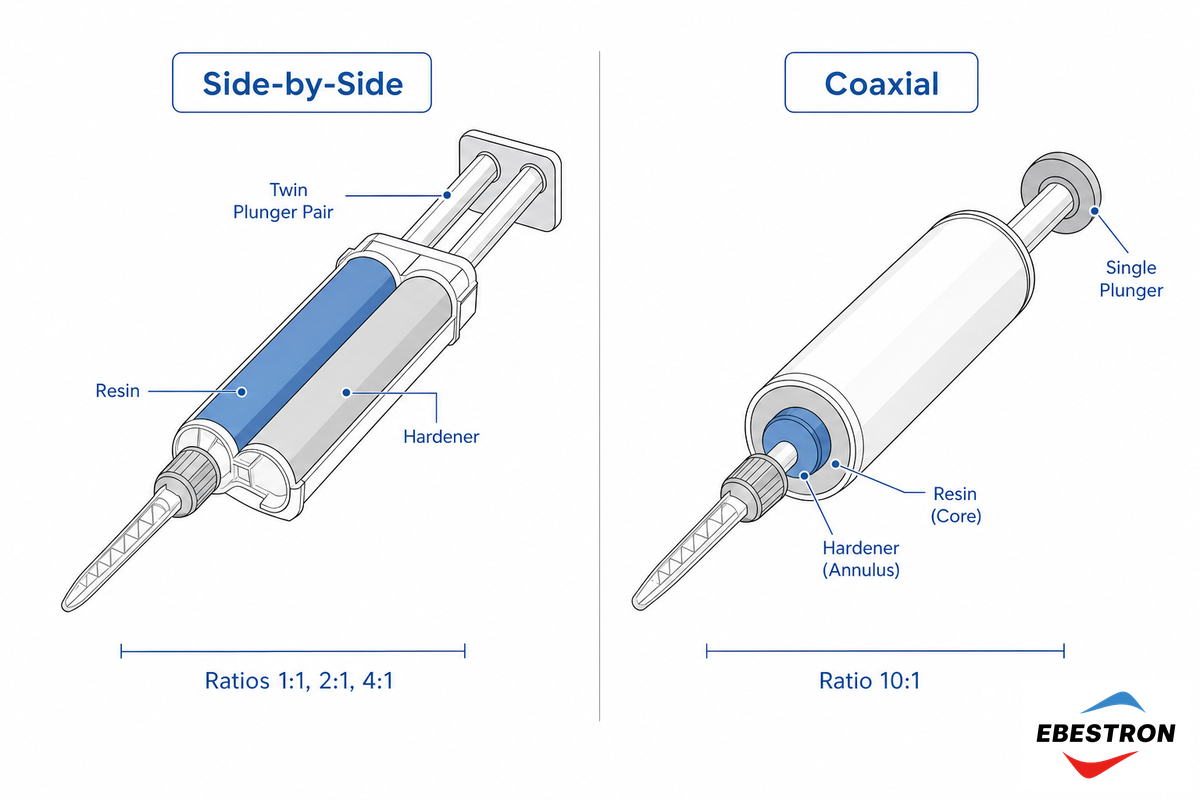
A 2-K dispensing gun is only useful if it fits your cartridge. Three things have to agree, the Cartridge-Nozzle-Gun Fitment Trio Test: the cartridge brand system, the mix ratio (set by the plunger pair), and the volume. A real shop question on r/Autobody — “can a 200 mL cartridge fit a 400 mL gun?” — is exactly the trap this test closes.
| Format | Common volumes | Typical ratios | Example systems |
|---|---|---|---|
| Side-by-side / side x side (square/round) | 50, 200, 400, 600 mL | 1:1, 2:1, 4:1 | Mixpac A/B/C/F, Nordson, Cox |
| Coaxial (concentric) | 150–380 mL | 10:1 | Mixpac coaxial |
| Bulk / refillable | up to 1500 mL (1500 cc) | meter-mix fed | refillable barrels |
One gun body accepts one family, and each cartridge system has its own unique design. A 50ml Mixpac A-system gun (side-by-side, rectangular flange) won’t hold a 400ml F-system cartridge, and a side-by-side gun can’t drive a coaxial 10:1 pack. Ebestron’s range is built to cross-reference these systems, so the Mixpac- and Cox-compatible guns and matching dual cartridges are listed by system so the trio lines up.
💡 Pro Tip — weight ratio is not volume ratio
Cartridge guns meter by volume, but data sheets often list both. The 3M™ Structural Adhesive SA9860 in a 400 mL dual-pack, for instance, is a 1.88:1 ratio by weight yet 2.0:1 by volume. Match the gun to the volumetric (by-volume) ratio, never the weight ratio.
Pairing the Gun With the Right Static Mixer
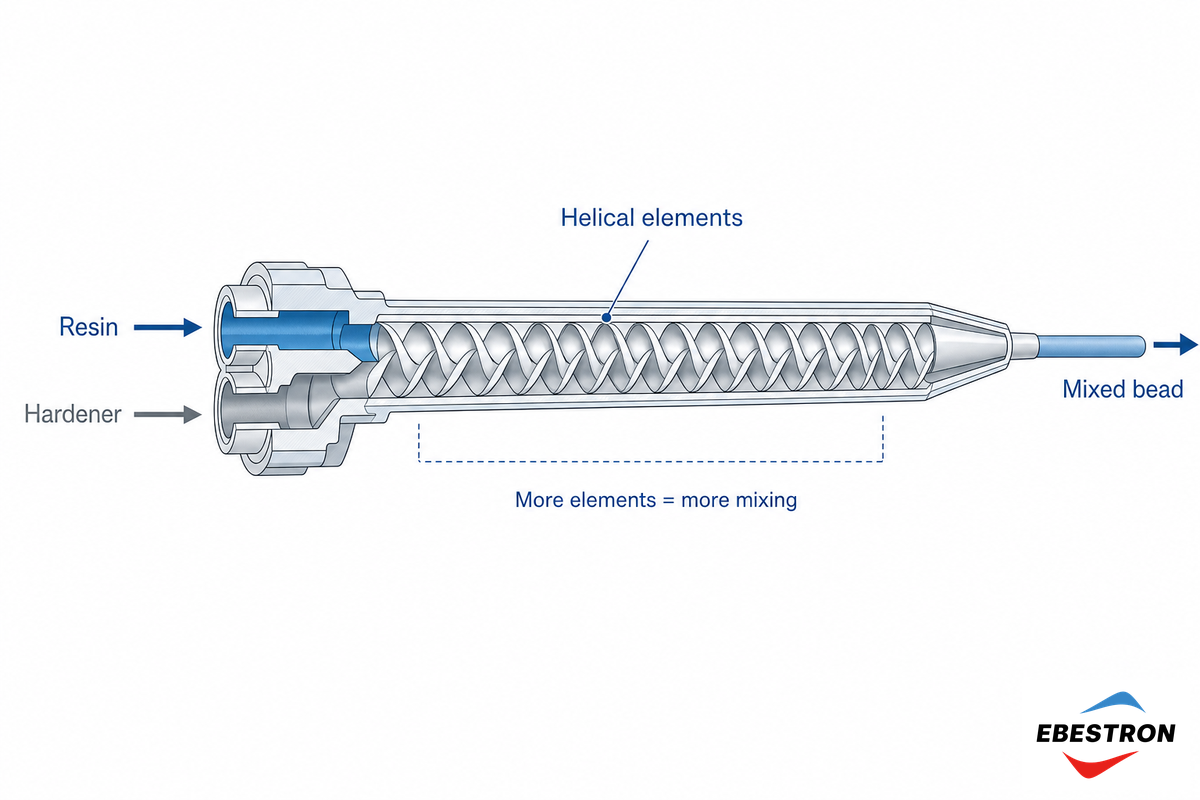
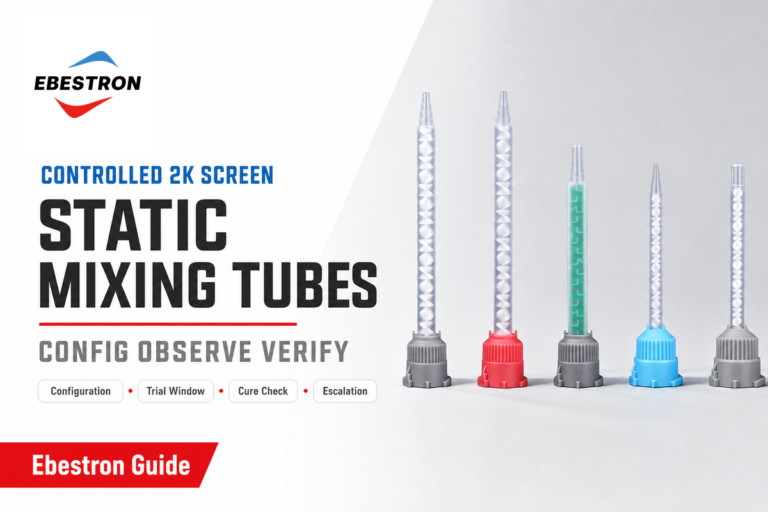
The gun, the cartridge, and the static mixer are a trio, choosing the gun without the mixer leave the job half-specified. A static mixer is a disposable plastic tube of helical or quadro elements that fold the two streams together as they pass; the A and B components stay separate until they enter it, which removes any worry about open time inside the cartridge. Bulk meter-mix rigs feed the mixer from a pump instead of a cartridge, but for handheld manual dispensing the disposable mixer on the cartridge is the norm.
Element count is the variable to size. Field practice for static-mixer selection runs like this:
- ✔ Faster dispensing → fewer, larger-diameter elements; slower dispensing → more, smaller elements.
- ✔ A greater viscosity difference between A and B → more elements to mix fully.
- ✔ A wider mix ratio (4:1, 10:1) → more elements than a 1:1 paste.
- ✔ Thicker material → a larger-diameter mixer (a 6–8 mm bore rather than 4 mm) to cut back-pressure and keep flow.
📐 Engineering Note — mixer-to-gun interface
A patent on dual-component dispensing describes the static mixing nozzle “in fluid communication with the cartridge,” which is the fit you must confirm: bayonet, bell, or screw-on. The producer of the filled cartridge specifies the matching mixer, the wrong tip means an incomplete mix even on the right gun. Browse matched two-component static mixers by system before buying tips loose.
Choosing by Application and Industry
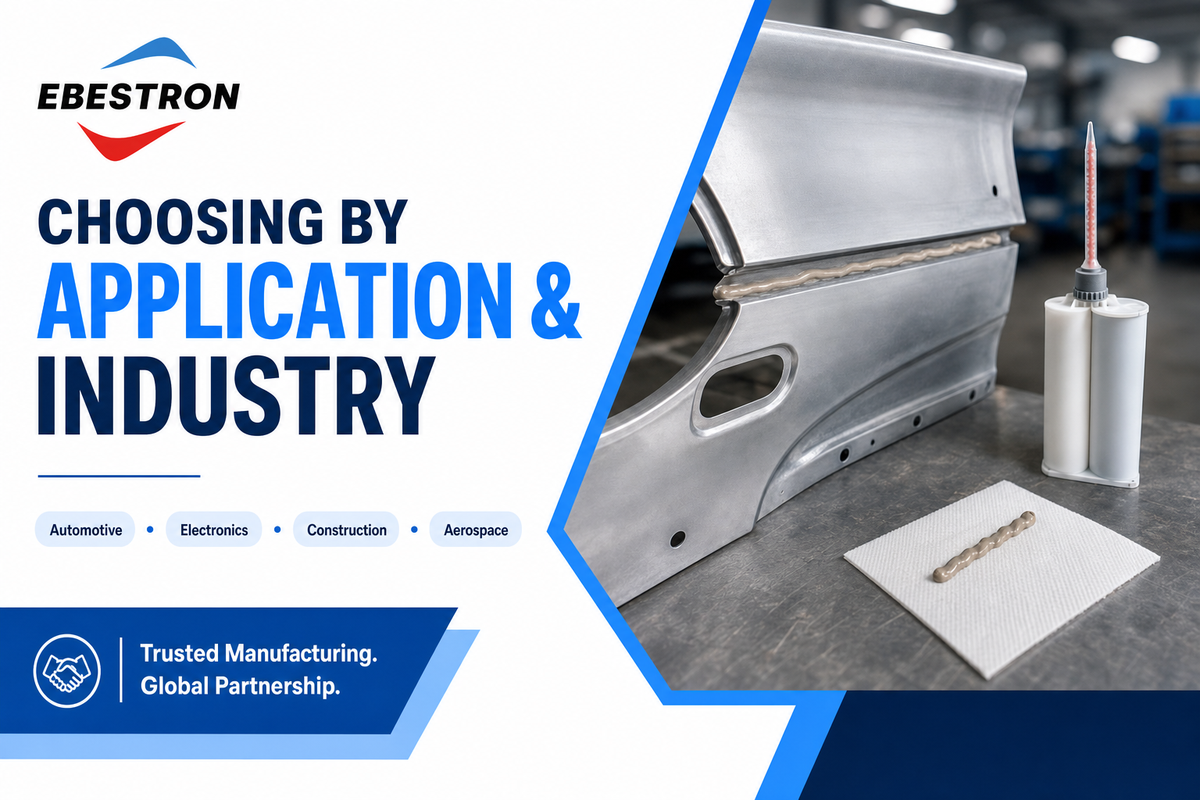
Different industries push the selection toward different corners of the scorecard. A high-throughput automotive line and a bench potting electronics cell rarely buy the same gun, even for the same chemistry.
| Application category | Typical material & ratio | Drive & size leaning |
|---|---|---|
| Automotive panel bonding | Structural acrylic / epoxy, 1:1–2:1 | Pneumatic, 400–600 mL |
| Electronics potting & underfill | Low-viscosity epoxy, 2:1–10:1 | Manual or syringe, 50–200 mL, precise control |
| Construction anchoring | Epoxy/polyester anchor resin, 10:1 | Manual 26:1 or battery, 400–600 mL |
| Aerospace sealing & bonding | Thixotropic epoxy / PU, 1:1–4:1 | Pneumatic, controlled, traceable |
| Medical device assembly | Biocompatible epoxy/silicone, 1:1–10:1 | Manual/syringe, 50 mL, hygiene-controlled |
| Marine & composite repair | Toughened epoxy/MMA, 1:1–2:1 | Manual or battery, 50–490 mL |
| Insulating glass / glazing | Two-part silicone/polysulfide, 8:1–14:1 | Pneumatic or pump-fed |
| Wind-blade composite bonding | Structural epoxy paste, 1:1–2:1 | Pneumatic/automated, 400–1500 mL |
| General MRO & maintenance | 2-part epoxy/acrylic, 1:1–10:1 | Manual 18:1–26:1, 50–200 mL |
Aerospace shows the pattern clearly: at FACC, a double-chamber cartridge dispensing system lets a thixotropic epoxy be applied as easily as a one-component adhesive on aircraft interior panels. In electronics, one gun may place underfill near solder joints or lay down a protective coating, work guided by potting and molding standards such as NASA KSC-STD-132so the manufacturing process, not the chemistry alone, sets the spec. (Hot-melt systems, which run at 120–200°C, fall outside the 2-K cartridge category entirely.) The chemistry sets the ratio; the line speed sets the drive.
Cost, Waste & Refillable vs Branded Cartridges
A 2-K gun’s purchase price is the small number. Over a year, the cartridges, mixers, and purged material dwarf it, so weigh total cost, not sticker price. Three levers move it:
Total-cost levers for 2-K dispensing
- Purge waste. Every cartridge change lose a first bead plus a filled mixer; large, infrequent shots waste less per part than many small ones.
- Mixer turnover. Mixers are disposable and effectively single-use, a high-mix-count job spends real money on tips.
- Refillable vs branded. Above a threshold volume, refillable or OEM-empty cartridges undercut branded packs; below it, the convenience of pre-filled wins.
When specifying new equipment, match the level of accuracy to the job: handheld guns and benchtop fluid dispensers suit small dispense amounts and precise dispensing applications, while high-volume lines move to automated dispensing products. Unlike a spray gun, a cartridge gun produce no overspray, so material loss is limited to purge.
As a rule of thumb, the cost of a bad shot decides the equipment tier: if one off-ratio dispense scraps a low-value part, a manual gun is fine; if it scraps a populated board or triggers rework, the repeatability of a powered gun pay for itself. For high-volume programs, weigh empty dual cartridges for OEM filling against branded packs.
Loading, Purging & On-Ratio Dispensing: 5 Field Mistakes
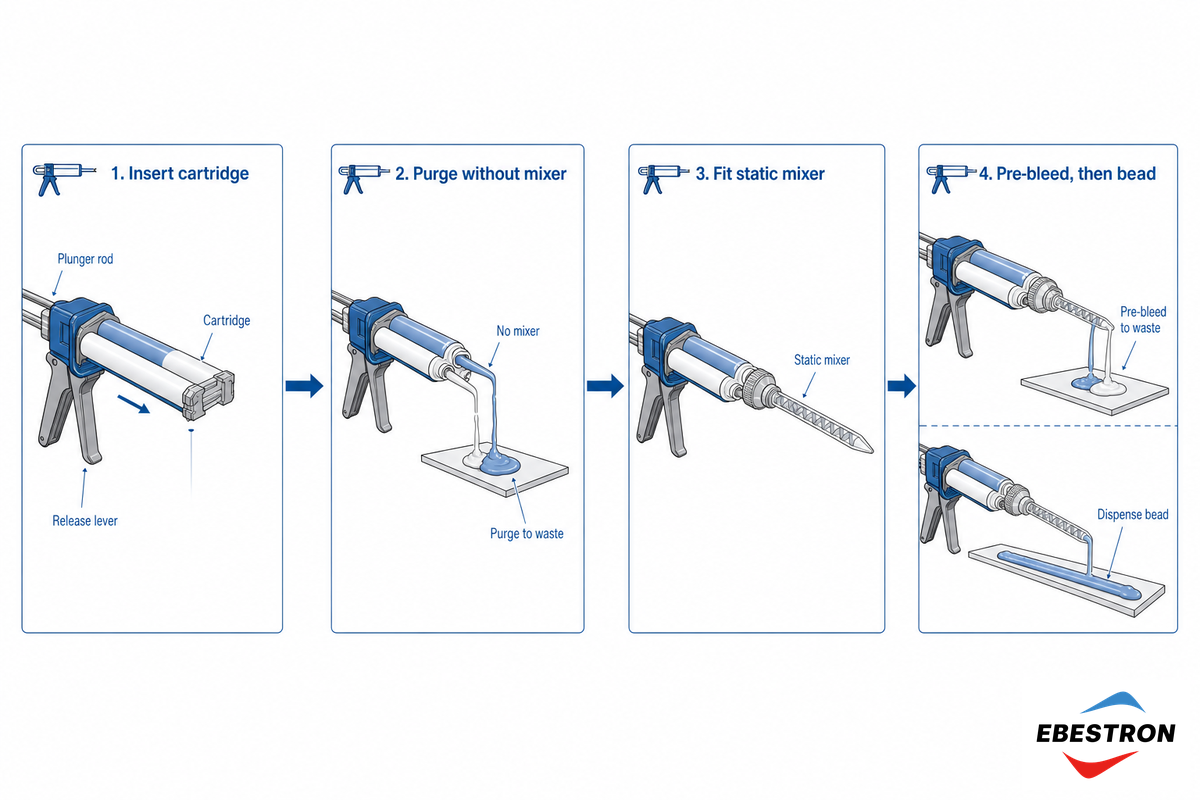
The best gun still fails in careless hands. These five mistakes show up again and again in practitioner reports and supplier dos-and-don’ts:
- Skipping the purge. Install the cartridge without the mixer, squeeze until both sides flow and discard, then fit the mixer and pre-bleed at least 3 inches (75 mm) before the bead reach the part. The first material out is always off-ratio.
- Reusing a mixer on a new cartridge. Never transfer a used static mixer, it carries cured material and throws off the start-up ratio.
- Letting the mixer sit. A loaded tip can clog in 10–15 minutes; pushing harder on a set tip can split the cartridge. Swap to a fresh mixer instead.
- Dispensing too slowly. Thin material can “side-wall” around the elements without mixing, maintain adequate velocity for a complete mix.
- Ignoring the chemistry’s hazards. 2-K polyurethane systems contain isocyanates; NIOSH calls for ventilation, PPE, and respiratory protection during mixing and handling, which is one more reason clean purging and anti-drip control matter.
⚠️ Important — read the bead
Tacky spots mean an incomplete mix (too few elements or too slow); a soft area means off-ratio material. Both are caught by a proper purge and the right mixer, not by curing harder.
What’s Changing: the Shift to Battery-Electric 2-K Guns
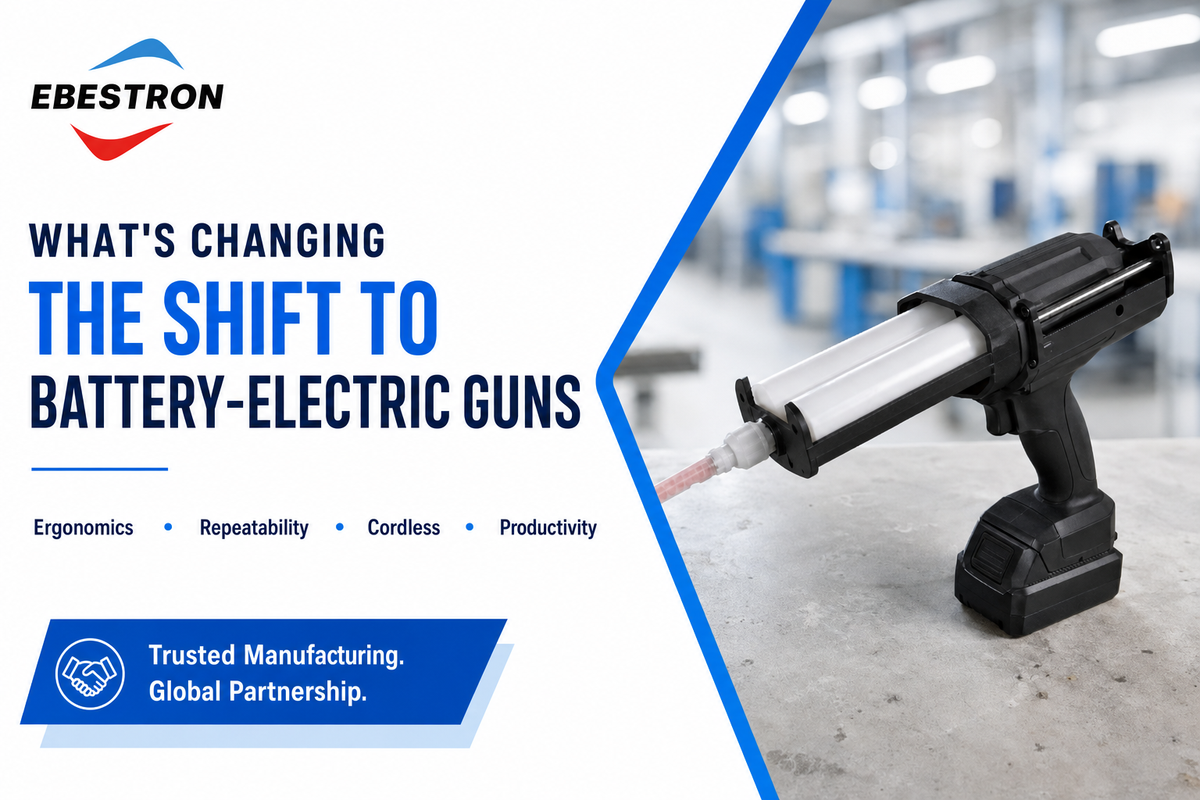
The clearest shift in 2-K dispensing is the move from manual and pneumatic drives to battery-electric guns, and it’s driven by ergonomics and repeatability, not novelty. High-thrust manual guns fatigue operators across a shift, and a hand-squeezed bead vary; a battery gun with adjustable speed delivers a more repeatable on-ratio bead and frees the bench from an air hose.
For any cell running cordless or away from compressed air, that’s a real productivity gain. Across the adhesives and sealants industry, dispensing automation is climbing alongside cordless tools, yet for hand-applied two-part adhesives the battery gun is the nearer-term upgrade.
The product evidence is already on the shelf: cordless multi-component guns now dispense 900 mL (600 × 300 mL) at 2:1 on an 18 V lithium-ion battery, with instant drive disengagement when the trigger releases to stop drips, and battery 2-K dispensing is established enough to be patented. For context, the adhesive dispensing equipment market is put at roughly USD 8.7 billion in 2025 (directional only), but the number that should move a 2026 purchase is simpler: if your team runs more than a few hundred cartridges a shift on thick paste, spec a battery model now rather than re-buying in eighteen months.
Frequently Asked Questions
Q: What is the difference between a 2-K dispensing gun and a caulk gun?
View Answer
A caulk gun has one barrel and one plunger, so it can only dispense a single-component sealant. A 2-K dispensing gun has two barrels and a fixed-ratio plunger pair that meters resin and hardener together through a static mixer, holding the mix ratio that two-component adhesives need to cure to full strength. They are different tools, not different sizes of the same tool.
Q: Manual, pneumatic, or battery, which 2-K dispensing gun should I choose?
View Answer
Choose manual for low-volume, high-precision work or a portable bench. Got compressed air and high volume? Go pneumatic. Need high force and a cord-free bench together? Battery-electric. No drive is best in the abstract — your shot volume, throughput, site power, and the cost of a single bad shot decide which drive earns its place on your bench.
Q: What thrust ratio do I need for my adhesive?
View Answer
For most two-component pastes dispensed through a static mixer, an 18:1 or 26:1 mechanical thrust ratio is the recommended window: 18:1 for standard viscosity, 26:1 for thick, high-viscosity material. The very high 34:1–36:1 ratios are for single-component caulk — on a 2-K mixer they risk splitting the cartridge. Pick the lowest class that flows your bead cleanly.
Q: Can one dispensing gun fit Mixpac, Nordson and Cox cartridges?
View Answer
Not always. A gun is built for a specific cartridge system, ratio, and volume. Cross-compatible guns exist for related side-by-side systems, but a side-by-side gun can’t drive a coaxial 10:1 pack. Always confirm the fitment trio — system, ratio, volume — before you buy.
Q: Do I need a different static mixer for each material and ratio?
View Answer
Often, yes. The static mixer is sized by element count, and the right count change with the job. A wider mix ratio, say 10:1 versus 1:1, needs more elements to reach a homogeneous mix, and a large difference in viscosity between the resin and hardener also calls for more elements.
Thicker materials want a larger-diameter mixer to cut back-pressure, while faster dispensing tolerates fewer, larger elements. Mixers are disposable and effectively single-use, so use a fresh one with each new cartridge and follow the cartridge producer’s recommended tip, since the wrong mixer leave an incomplete mix even on the correct gun.
Q: What cartridge sizes and mix ratios do 2-K dispensing guns handle?
View Answer
Common cartridge volumes are 50, 200, 400, and 600 mL, with bulk and refillable barrels up to 1500 mL. Standard mix ratios are 1:1, 2:1, 4:1, and 10:1 by volume — side-by-side packs cover the lower ratios and coaxial packs handle 10:1.
Why We Wrote This Guide
Ebestron manufactures the two-component packaging consumables this guide is about, dual cartridges, static mixers, dispensing guns, and tips compatible with Sulzer Mixpac, Nordson, Cox and 3M systems. The thrust-ratio, fitment, and mixer guidance here reflects how those parts have to line up on a real bench, cross-checked against published standards and supplier technical bulletins. Reviewed by the Ebestron technical team.
References & Sources
- KSC-STD-132 Rev E (2023), Potting and MoldingNASA Kennedy Space Center (meter/mix/dispense practice)
- NIOSH Publication 96-111, DiisocyanatesU.S. CDC/NIOSH (isocyanate exposure controls)
- Two-Component Structural Epoxy in Cartridge SystemsU.S. DOE / OSTI
- ISO 10365:2022, Adhesives, Designation of Main Failure PatternsISO (bonded-joint QA naming)
- Best Practices for Industrial Structural Adhesives, Ratio Checks for Two-Component MMD EquipmentParker
- Effect of Incorrect Mix Ratio on Strength of Two-Component Adhesive Jointspeer-reviewed study
Related Articles
- Thrust-ratio selector toolmatch a manual gun to your viscosity and cartridge
- Epoxy mixing nozzleselement count and sizing for 2-part adhesives
- 4-variable dispensing gun selectordrive, size, ratio, and system in one tool
- Battery-vs-manual payback estimatorwhen a cordless 2-K gun pays for itself