Get in touch with Ebestron Company

Updated July 2026 · Reviewed by the Shanghai Ebestron New Materials Co., Ltd technical team
Quick Specs
| Cartridge sizes | 50 / 200 / 400 / 600 / 1500 mL |
| Mix ratios | 1:1, 2:1, 4:1, 10:1 (by volume) |
| Barrel materials | PP, PA (nylon), PBT |
| System compatibility | Sulzer Mixpac (A/B/C/F), Nordson EFD, 3M, Cox |
| Rule of thumb | Start from your data sheet’s volumetric ratio, not the catalog photo. |
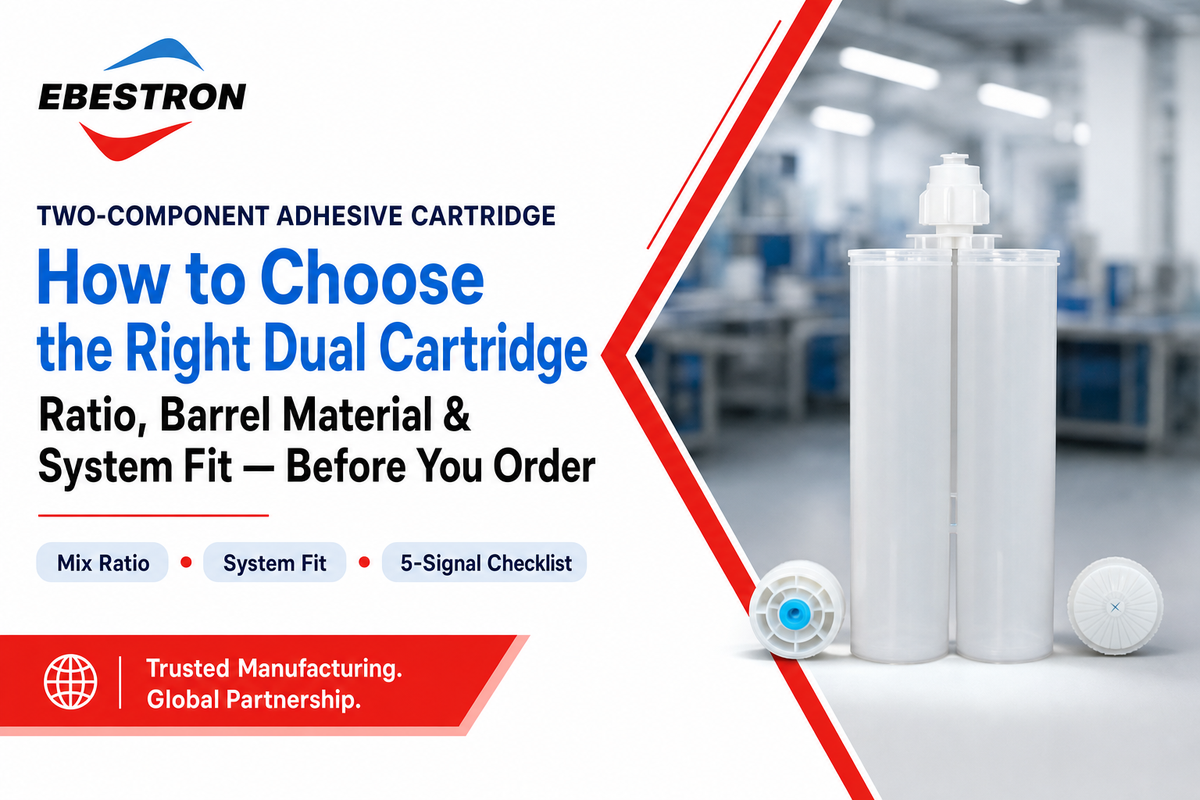
A two-component adhesive dual cartridge is the empty dual-chamber package that keeps a two-part adhesive’s resin and hardener separate until a static mixer combines them on-ratio at the point of dispense. Learning how to choose a two-component adhesive dual cartridge sounds easy until the wrong one shows up on your dock – off-ratio, won’t seat in your gun, or quietly bleeding money through a mixer that’s bigger than your job needs. This guide is the buyer’s-side decision path: the four numbers to pull off your data sheet before you shop, the system-lock-in question almost nobody asks, the waste economics that flip “cheaper per unit” into “more expensive per year,” and a five-signal checklist for catching a bad match before you ever pull the trigger.
In short:
Match your cartridge to your adhesive’s volumetric mix ratio, not the sticker price. Confirm whether your existing gun runs an open or a supplier-locked system before you order.
Match your cartridge to your adhesive’s volumetric mix ratio, not the sticker price. Confirm whether your existing gun runs an open or a supplier-locked system before you order.
Then size the volume to your shot count – the biggest cartridge is not always the cheapest one once retained-volume waste is counted.
💡 Key Takeaways
- Mix ratio on a data sheet is almost always by weight; a cartridge only ever doses by volume – confirm which number you’re reading.
- A locked (proprietary) gun system can turn a “cheap generic cartridge” into a return.
- Retained mixer volume – not the cartridge price – is often the real recurring cost.
- A supplier who won’t name a seal-test standard or send a sample is a red flag before price ever enters the conversation.
Why “Which Cartridge Do I Need” Is the Wrong First Question
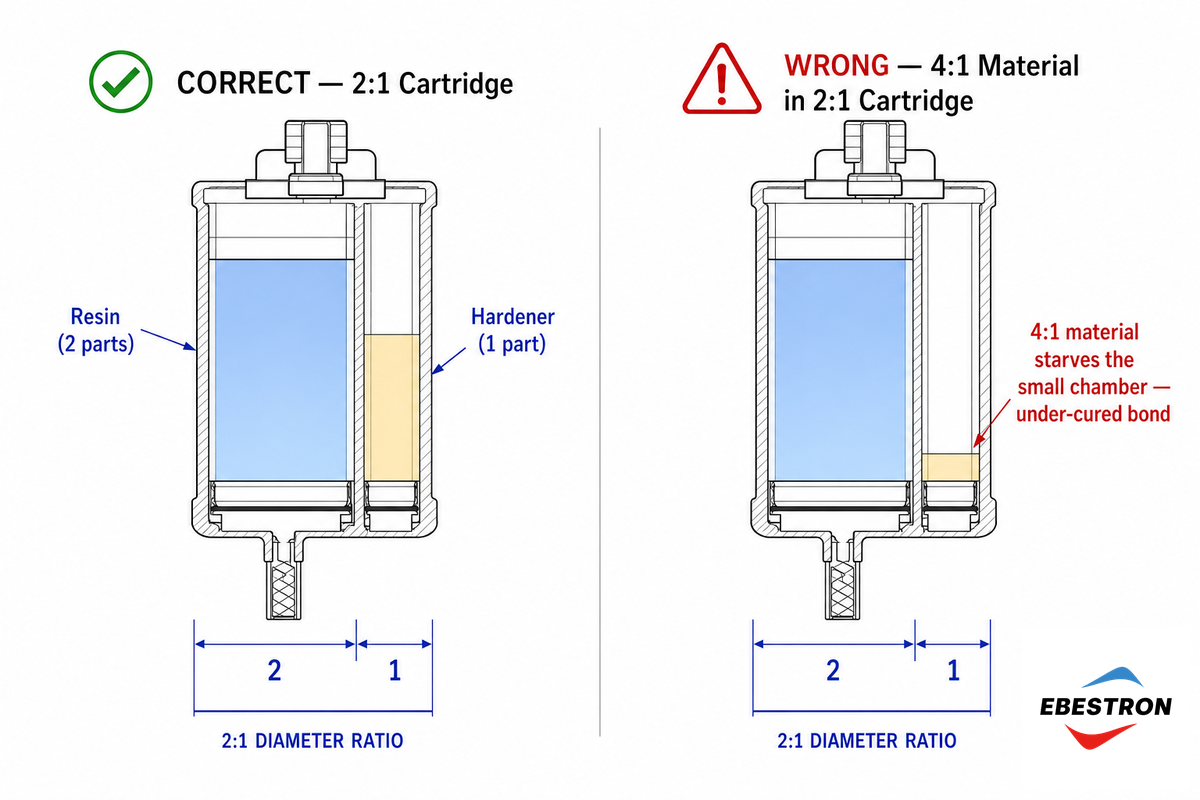
Most cartridge-selection mistakes happen before anyone opens a catalog. Buyers often spot a picture of a 400 mL cartridge that looks like the one already on the bench, order it, and only discover the mismatch when the chamber geometry doesn’t match the adhesive’s mix ratio – a genuine sourcing failure, not a shipping error.
The cartridge’s two chambers are sized to a specific volumetric ratio; a 4:1 material poured into geometry built for 2:1 starves one side of the mix and never fully cures, regardless of how well the substrate was prepared. This applies across chemistries – epoxy, polyurethane, acrylic, and silicone alike. Unlike a single-component cartridge or one-component adhesive that cures on its own, a two-component system depends on the reactive resin and hardener being mixed together in the correct ratio and fully cured through chemical reaction, not left to cure passively.
One maintenance buyer at a metal-fabrication shop reordered “the same 400 mL cartridge” for a new structural epoxy without checking the data sheet, because the old one and the new one looked identical on the shelf. That old adhesive ran 2:1; the replacement specified 4:1. Every joint bonded that week stayed tacky for days.
Correcting course cost nothing – matching the ratio on the datasheet to the cartridge geometry before ordering – but the rework cost a production day.
Your own adhesive’s data sheet, not the catalog page, is the right starting point – that’s the subject of the next section.
Start From Four Numbers on Your Data Sheet, Not the Catalog Page
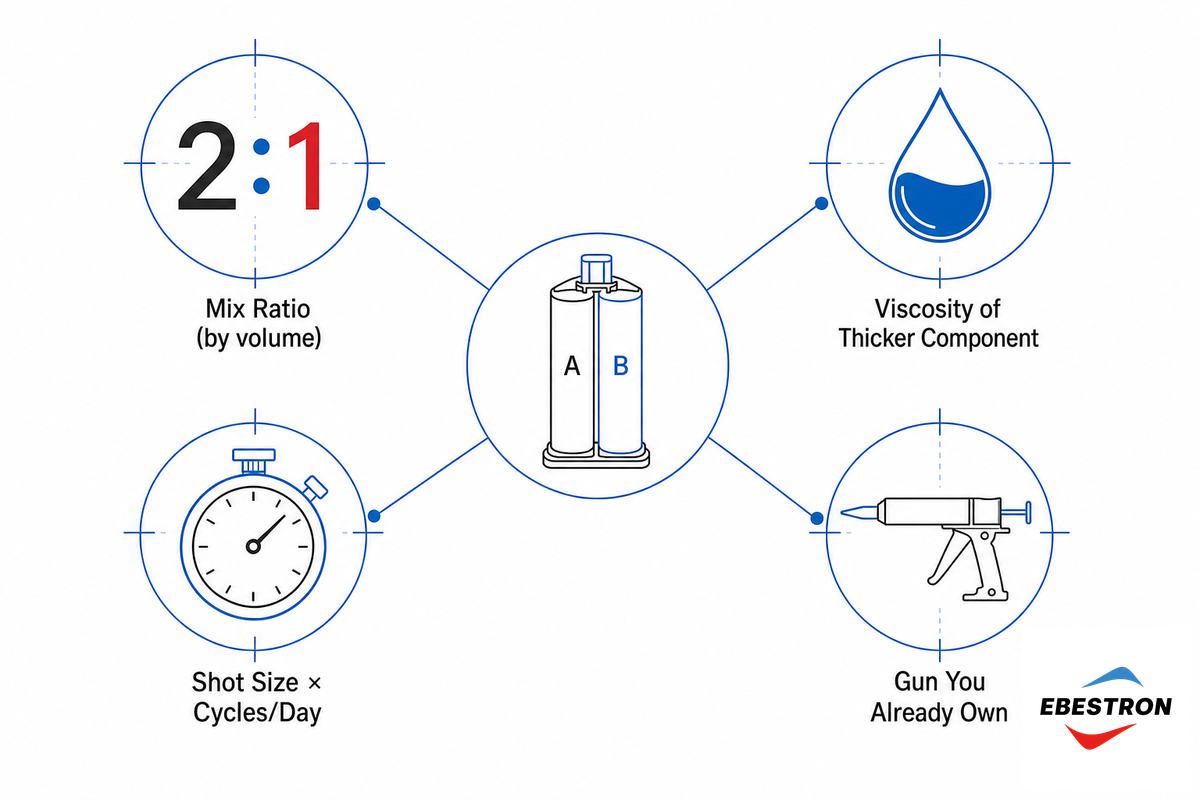
Before comparing a single cartridge model, pull four numbers from your adhesive’s technical data sheet: the volumetric mix ratio, the viscosity of the thicker component (often the secondary component, or hardener), your typical shot size and daily cycle count, and the piston-pump dispensing gun you already own. Every cartridge decision downstream – size, barrel material, mixer element count – is derived from these four, not the other way around.
| Data-sheet number | What it fixes | If you skip it |
|---|---|---|
| Mix ratio (by volume) | Cartridge chamber geometry (1:1 / 2:1 / 4:1 / 10:1) | Off-ratio dose, weak adhesion or an uncured bond |
| Viscosity (thicker part) | Mixer diameter, gun thrust needed | Gun stalls, mixer back-pressures |
| Shot size × cycles/day | Cartridge volume, mixer size | Over-buying capacity you waste (see next section) |
| Gun you already own | Cartridge system/connection type | New cartridge won’t seat at all |
📐 Engineering Note
Read the mix ratio by volume, not by weight, the two numbers commonly diverge for the same product because resin and hardener rarely share the same density, and a cartridge chamber only ever doses volume. If your data sheet only states a weight ratio, ask the adhesive supplier for the volumetric equivalent before you order the cartridge, or a correctly-dimensioned cartridge chamber will under-dose the lighter component regardless of how carefully you fill it.
The Open-System vs Locked-System Question You Must Ask Before You Order
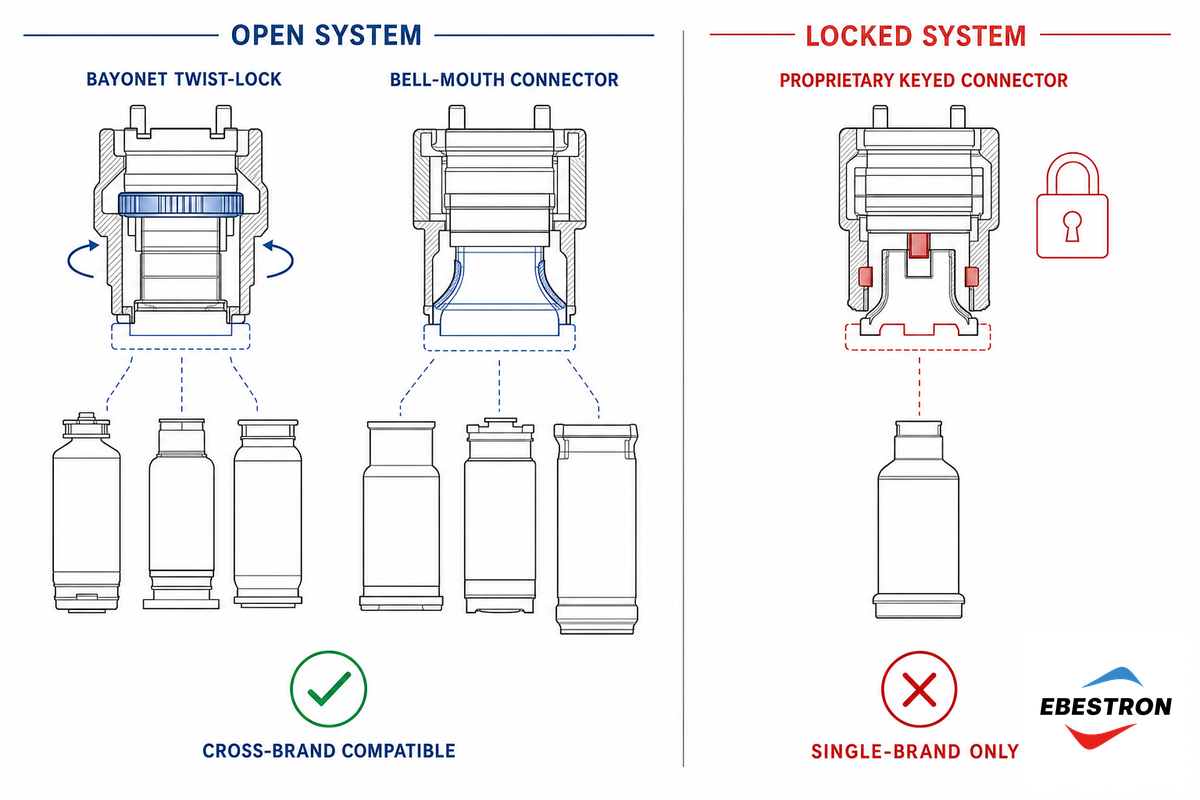
Don’t buy a cartridge before checking the dispense gun system, as there are two types: open or closed systems. Several key manufacturers share common physical conventions which ensure a “drop-in” fit: this includes Sulzer Mixpac A- and C-Systems; bayonet-style and bell-mouth variants from Nordson EFD; and similar products from 3M and Cox. Mixpac B and F-Systems are the exception, with proprietary connections they don’t intend to be compatible with the market standard — the same multi-component ratio-flexibility problem a Nordson-assigned U.S. patent on multi-cartridge dispensers addresses at the hardware level.
It sounds like a minor detail, but it’s why a 2K-cartridge order gets returned more often than a price complaint does — the buyer never checked which category their own gun falls into. Confirming this costs nothing: take a photo of the gun’s tip, see if it has a bayonet connection, bell-mouth, or integral threaded nut, and you’ll know the category for ordering your cartridge, without waiting for the box to arrive.
⚠️ Important
In practice, cross-brand colour and letter codes aren’t always as perfectly matched as they may seem. A supplier’s “A-System” outlet might resemble another’s “C-System.” Match your dispenser against your existing system before placing an order; a photograph of your gun’s nozzle will usually be sufficient for your supplier to advise the correct cartridge.
There’s a genuine third-party signal that open, cross-compatible systems are becoming the industry default rather than the exception: Swiss dispensing manufacturer medmix now markets its greenLine cartridge line specifically on “full system compatibility” alongside up to 100% recycled-content barrels. Dispensing-equipment distributors have covered the greenLine launch as a sustainability-driven standardization move, not a one-off product, a manufacturer-level admission that locking a customer to one proprietary interface is no longer the assumed default. See Industry Outlook below.
Side-by-Side vs Coaxial, Does Your Application Even Need to Ask?
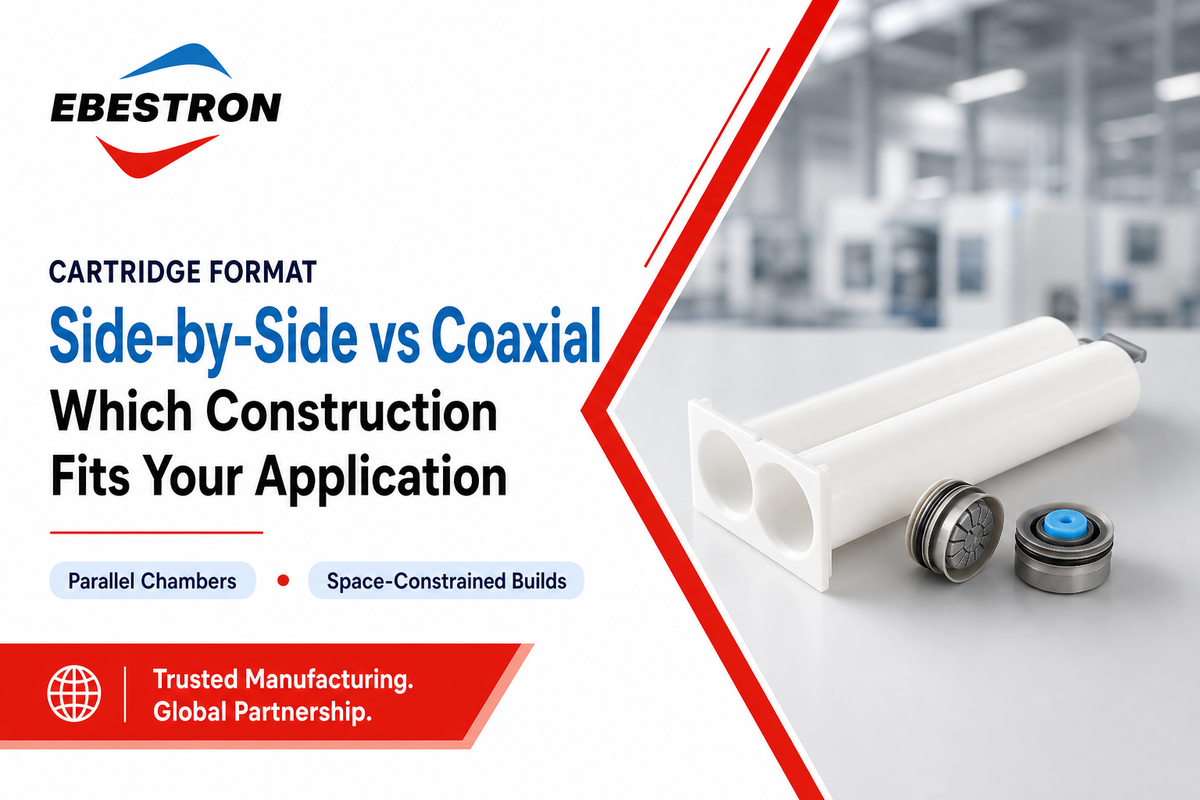
The vast majority of buyers have no real need to choose between side-by-side and coaxial cartridges at all. Side-by-side models, with their two parallel tubes, cover almost all construction, anchoring, and general assembly applications, and pair with the simplest, least expensive guns on the market.
Coaxial cartridge models, with one chamber nestled inside the other, fill their niche when space constraints on a construction or installation site prevent the use of a wider, side-by-side barrel — such as when bonding composite substrates and composite materials in aviation or marine assembly — or where a particular single-valve solution is needed that can’t be accommodated with parallel chambers. Most side-by-side cartridges pair with a simple handheld dispensing gun, which is one more reason they cover the majority of structural bonding jobs.
✔ Choose Side-by-Side When
- Standard bench or line assembly
- Budget/gun simplicity matters
- No tight space constraint
⚠ Consider Coaxial When
- Length/space envelope is tight
- Application demands one valve type
- Aerospace/marine footprint constraints
The Hidden Cost Buyers Miss, Retained-Volume Waste vs Sticker Price
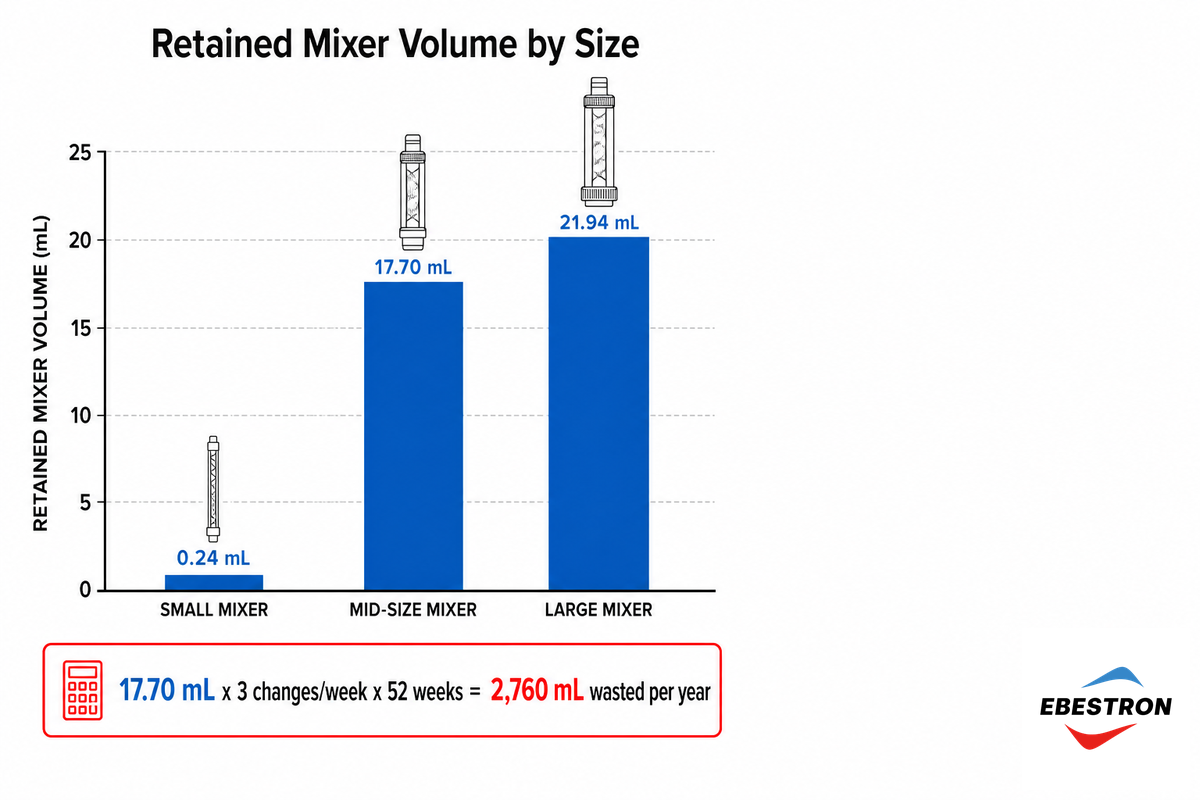
Sure, bigger cartridges can come with a smaller cost-per-milliliter at the register, but that cost ignores all the adhesive that never even makes it into the joint. Every static mixing nozzle holds a certain amount of mixed material that’s simply wasted every time you swap out the disposable tube: on a small mixer, it’s just 0.24 mL; on a mid-size mixer, it can be as much as 17.70 mL, and on a large mixer, 21.94 mL, depending on the element count and diameter. Buy the big cartridge “for cost savings” and pair it with an even bigger mixer, and that wasted volume multiplies for every shot.
📐 Engineering Note — worked example
Run 3 cartridge changes a week through a mixer that retains 17.70 mL each time, and you discard roughly 17.70 mL × 3 × 52 weeks ≈ 2,760 mL of already-mixed adhesive a year in mixer purge alone, before counting the separate first-bead purge on every fresh cartridge. Sizing the mixer to the job (not “the biggest one in stock, just in case”) is a real, calculable saving that a per-unit cartridge price never shows. This retained-volume math holds for a fast-cure acrylic just as much as for an anaerobic structural adhesive with a slower cure speed and higher bond strength – the waste scales with mixer size, not chemistry, and buying the more “cost-effective” large cartridge doesn’t change that math.
This is also why the branded-vs-generic cost comparison usually misses the point. In most 2K dispensing setups, the real captive cost isn’t the ~$2.60-per-unit empty cartridge, it’s the gun. Branded 50 mL system kits commonly run $1,500-$1,750 in gun and cartridge-frame cost; once a line is standardized on a particular patented gun, refill cartridges become the recurring cost that gun locks the buyer into, not the other way around. Retained-volume waste multiplies on top of whichever gun and cartridge combination you’ve chosen, regardless of brand.
Generic-Compatible vs Named-Brand, What to Verify, Not Take on Faith
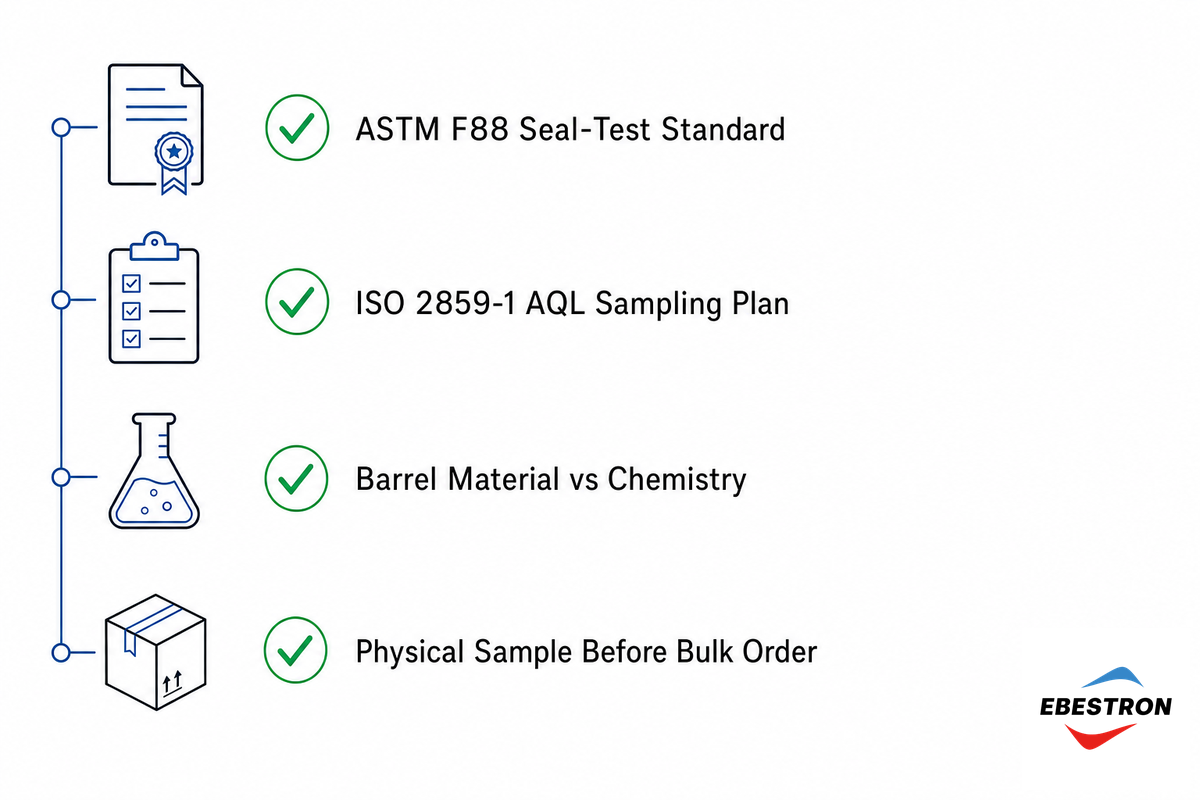
While ‘compatible’ can be printed on a specification sheet by anyone, before accepting it-regardless of who’s offering the quote-it’s important to request four items in writing and not simply take a vendor’s word for it:
“Every buyer who’s been burned by someone else’s ‘compatible’ cartridge asks us the same follow-up question afterward: what should I have asked before the purchase order, not after the shipment arrived. Ask for the seal-test standard by its actual number, not just the word ‘tested’ — and ask for a sample before you commit to volume, not after.”
- Request the seal-test standard being used. A vendor quoting a standard by its ASTM number, such as ASTM F88/F88M-23 (peel/seal strength), is referencing the current 2023 standard, not an obsolete version.
- Ask about the AQL sampling plan (ISO 2859-1) used on production lots, a supplier without a stated sampling standard is not running a controlled QC process, just eyeballing output.
- Confirm the plastic barrel material against your chemistry, not the other way around, PP offers the broadest chemical resistance for most epoxy adhesive, polyurethane adhesives, and silicone chemistries at the lowest cost; PA (nylon) is the correct call for MMA/acrylics because their volatile content needs a barrier for shelf life; confirm the material against the adhesive’s formulation before you order, not after.
- Ask whether the supplier’s gun recommendation covers manual, pneumatic, and battery-electric applicator options – the final properties of your cured bond depend on complete, thorough mixing, which a mismatched gun’s thrust can’t guarantee.
- Ask for a physical sample before you commit to volume – a vendor that won’t do that before you order in quantity wants you to skip the due diligence step for them.
Five Signals You Picked the Wrong Cartridge, Before You Even Dispense
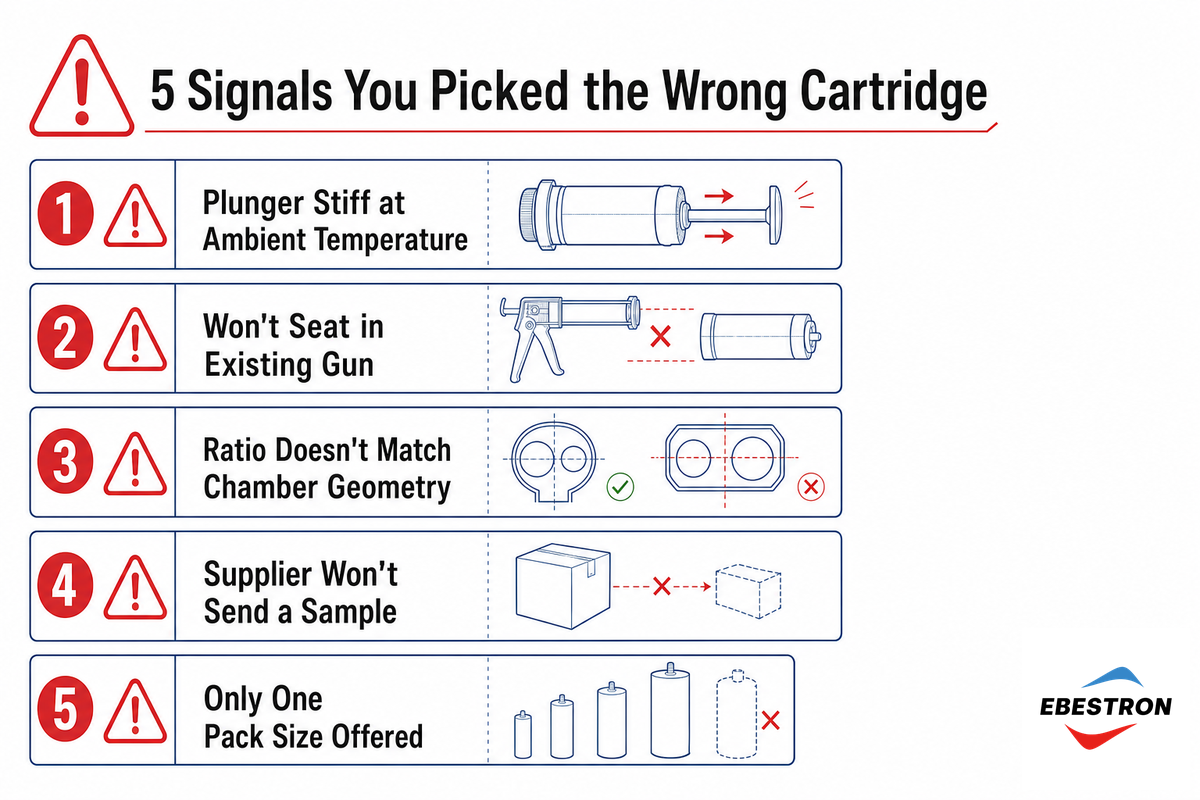
The “5-Signal Wrong-Cartridge Warning Checklist” you should go through before your first cartridge touches your static mixer each catches a problem you’ll otherwise catch only when you find a failed bond days later.
The 5-Signal Wrong-Cartridge Warning Checklist
- Plunger travel goes stiff at ambient temperature. A correctly matched gun-cartridge pair advances smoothly at 20-25°C; persistent stiffness usually means a viscosity mismatch, not a defective cartridge.
- Your existing gun won’t fully seat the cartridge. This means the connection type (bayonet, bell-mouth, integral threaded nut) or the system letter doesn’t match, confirm before forcing it.
- Datasheet ratio and chamber geometry don’t line up. Spotting a 4:1 material in a visibly 2:1-proportioned cartridge is a mismatch you can catch by eye before the first shot.
- Your supplier won’t send a sample before a bulk order. Reluctance to let you verify fit and seal quality first-hand is itself a signal.
- Only one fixed pack size is on offer. Not pricing flexibility into the process, no smaller trial quantity separate from a bulk run, costs you the ability to test before you commit.
Off-the-Shelf, Bulk, or Contract-Filled, Picking Your Procurement Path
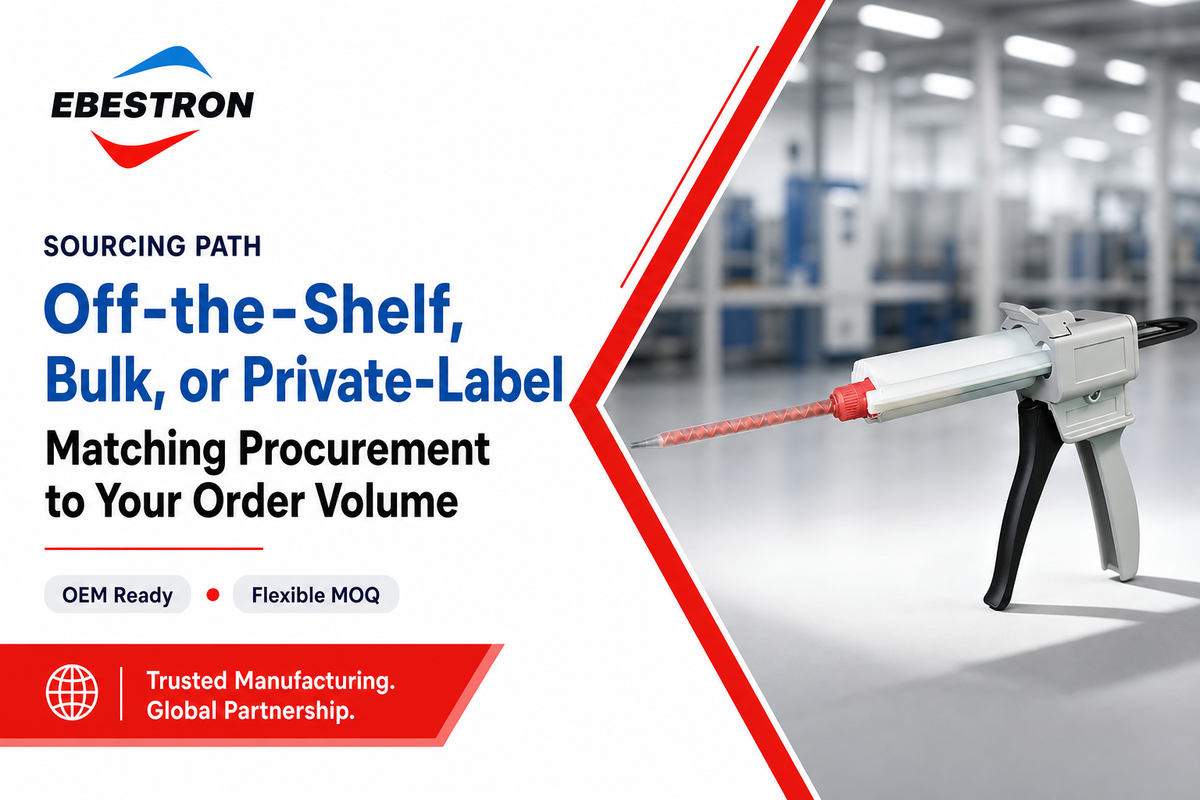
Once the technical compatibility question is resolved, the issue boils down to volume versus customization rather than an ironclad, three-option choice, with off-the-shelf empty cartridge in standard volumes being the go-to for the small job shop, while going with standard empty cartridge bulk buys with more flexible minimums suits high-volume production environments that want to mix materials easily without re-tooling. The third option, of course, is private label, which is the route to take for companies wanting their brand name on the cartridge, or wanting the adhesive pre-filled by the manufacturer rather than dispensed on-site. The three options are the most important variables here and being clear up front what’s included in a quote-product minimum, packaging minimum and lead time-will get you ahead of most common surprises in OEM sourcing.
Take the example of sourcing a two-part epoxy or polyurethane potting-compound in dual-cartridge dispensing format for a PCB manufacturing assembly line. A company doing about 200 units per month benefits more from standard, off-the-shelf empty cartridge. But once it crosses over 5,000 units per month, the cost and benefits of discussing bulk empty cartridge with private-label barrels begin to make a more significant impact; the transition point varies by industry but the logic remains constant.
Industry Outlook, Where Cartridge Sourcing Is Headed in 2026
For buyers, the decisive shift is that cross-brand standardization is now coming from the equipment manufacturers themselves, not just from third-party compatible suppliers. Sulzer Mixpac’s parent company, medmix, markets its greenLine cartridge set specifically on “full system compatibility” alongside up to 100% post-consumer recycled polypropylene content, a signal that the industry’s own brand-name players are moving away from treating proprietary lock-in as the default sales pitch. For buyers, that means the case for insisting on a single “safe” branded interface is weaker in 2026 than it was even two or three years ago: verified compatible parts and standardized interfaces are becoming the manufacturer-endorsed norm, not just a discount workaround.
If you’re planning to order in 2026, your next practical step should be to document your own supplies today-note down the exact system letter, connection type, and ratio your line runs-so you’ll be choosing between a compatible supplier and a name-brand one at the paperwork stage. Also look for recycled-content cartridge lines to start coming into purchasing discussions in parallel with cost and lead time; we expect soon that customers will ask about the percentage of recycled content, just as they ask about the ratio today. Market-research estimates for the broader adhesive-dispensing-equipment category point to modest single-digit annual growth through the early 2030s, useful as background context only, not a substitute for the standardization and waste-economics factors above that actually drive a specific sourcing decision.
Frequently Asked Questions
Q: Can I mix cartridges from different brands on the same dispensing line?
View Answer
Yes — as long as the system letter, connection type, and mix ratio match across brands. That’s exactly what an open system is designed to allow, and it’s why cross-compatible parts exist in the first place. Trouble starts only when you pair an open-system cartridge with a closed, proprietary gun format that was never designed to accept it.
Q: How do I know if my current gun is “open” or proprietary before I order?
View Answer
Before you buy, photograph the area where the cartridge engages with the gun, then share this photo with the supplier you’re considering. Most common forms, such as bayonet twist-lock and bell-mouth with a retaining nut, are open systems and match well among manufacturers-the reason why you’ll find so many of them in the compatible-parts market. There are proprietary variations, though, with connections protected by patents and flagged as non-interchangeable by the manufacturers. Five minutes spent confirming this beats returning shipments and waiting for the next production run.
Q: Is a bigger cartridge always the cheaper choice per shot?
View Answer
No. Larger cartridges usually pair with larger static mixers, and larger mixers retain more mixed adhesive per disposable change — sometimes over 20 mL versus under 1 mL on the smallest sizes. That retained volume is discarded on every single changeover, not just once. Size the cartridge and mixer to your actual shot count, not to the lowest sticker price.
What should a supplier’s sample kit actually prove before I commit to a bulk order?
View Answer
You can tell by checking three things, not just by a general impression of quality: does the cartridge insert smoothly into your gun, does the piston move without resistance at your normal working temperature, and is the dispensed material an even color without streaking at the ratio specified on your data sheet? If a sample can’t satisfy all three requirements, ask the supplier to provide one that will.
Do I need to requalify my process every time I switch cartridge suppliers?
View Answer
Not always. Normally, a simple fit-and-seal sample verification is sufficient if the replacement matches the system letter, connection, ratio, and barrel material. Changing any of those parameters-even barrel material or ratio geometry within the same system-requires a short requalification process.
About This Analysis
This guide was written to answer the question we hear most often before a purchase order, not after one: how do I check fit and supplier claims before I commit to volume. The retained-volume waste figures and cartridge specifications come from Ebestron’s own published product line (50-1500 mL two-component dual cartridges); the seal-test standards and system-compatibility notes are drawn from ASTM/ISO documentation and industry reporting on cross-brand dispensing formats. Reviewed by the Shanghai Ebestron New Materials Co., Ltd technical team.
References & Sources
- ASTM F88/F88M-23, Standard Test Method for Seal Strength of Flexible Barrier Materials – ASTM International
- ISO 2859-1:2026, Sampling Procedures for Inspection by Attributes – International Organization for Standardization
- US7140797B2, Multi-Cartridge Dispenser – Google Patents (assignee: Nordson Corp)
- Dispensing Two-Part Adhesives – Adhesives & Sealants Industry
- MIXPAC greenLine Sustainable Dispensing Solutions – medmix
- New Sustainable 2K Cartridge Expands MIXPAC greenLine Portfolio – Cox Dispensers
Related Articles
- Two-Component Adhesive Dual Cartridges, full specification range and selection tools – sizing, ratio, and system-compatibility charts for the complete Ebestron cartridge line
- How to Use a Two-Part Adhesive Cartridge (Step-by-Step) – once you’ve chosen a cartridge, the full dispensing, curing, and troubleshooting walkthrough
- Two-Component Dispensing Guns – matching gun drive type and thrust ratio to the cartridge you choose
- Static Mixing Nozzles – element count and retained-volume sizing for your chemistry