
Contacte a Ebestron



Os bicos misturadores de epóxi são os bicos misturadores estáticos padrão ligados a um cartucho de epóxi bicomponente e desempenham a função que o cartucho não consegue cumprir sozinho: misturar a resina e o endurecedor até formar um cordão uniforme e totalmente curado durante a aplicação. Se não utilizar o bico, ou escolher o bico errado, o epóxi que sai não serve para qualquer utilização: são dois fluxos por misturar que nunca atingirão a resistência máxima. Este guia explica a função desta peça, de que forma a química do epóxi influencia o bico necessário, como escolher as dimensões e encontrar referências equivalentes, e como resolver problemas quando algo corre mal.
💡 Resposta direta
Um bico misturador de epóxi é uma ponta descartável de misturador estático que divide e volta a combinar a resina e o endurecedor através de elementos helicoidais ou Quadro internos, durante a aplicação a partir de um cartucho duplo. O número e a geometria dos elementos de mistura — e não a marca — determinam se o cordão aplicado fica completamente misturado.
Especificações rápidas
| Números de elementos de mistura mais comuns | 10, 16, 18, 24, 32 (gama industrial: 7-48) |
| Tipos de encaixe segundo a proporção de mistura | 1:1, 2:1, 10:1 |
| Compatibilidade com as dimensões do cartucho | 50ml, 200ml, 400ml |
| Tipos de geometria dos elementos de mistura | Helicoidal, grelha cruzada/Quadro, quadrada |
O que é um bico misturador de epóxi (e qual é a sua função)? ”
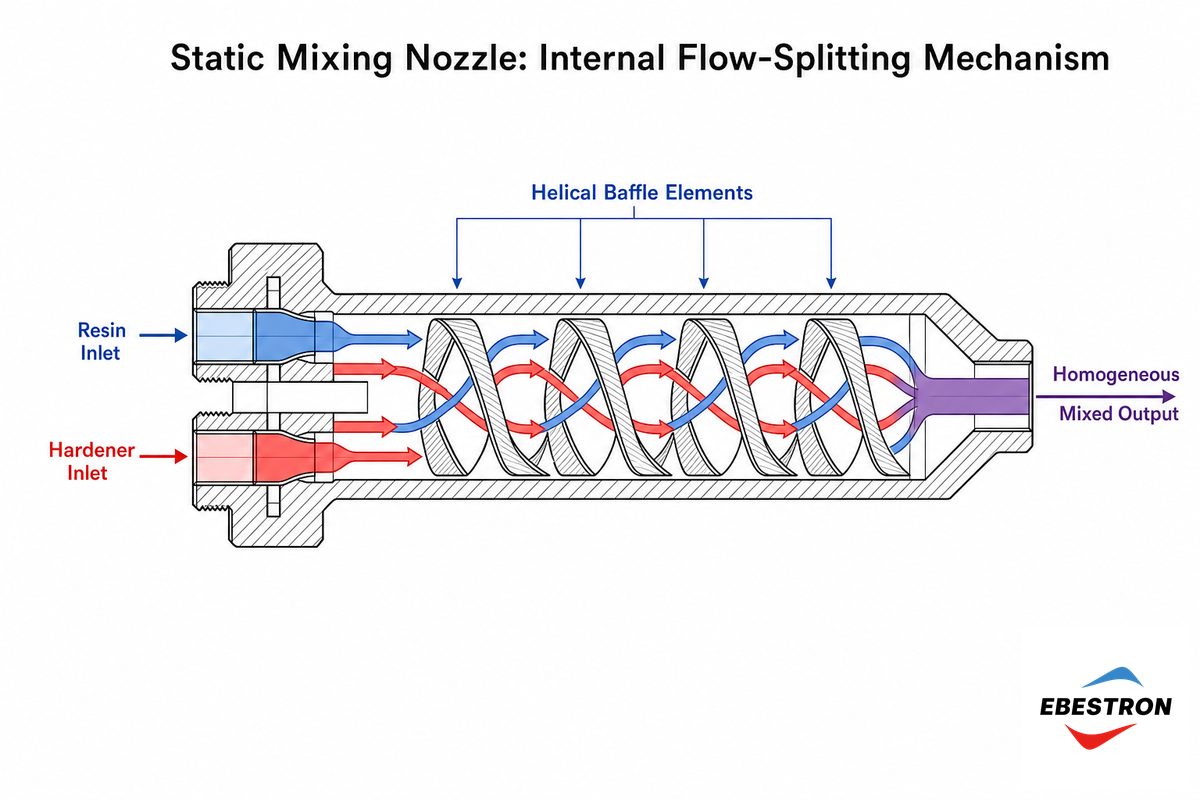
Também conhecido como ponta misturadora ou tubo misturador, um bico misturador estático padrão é um tubo oco de plástico com defletores internos. Quando o epóxi bicomponente é empurrado através do bico a partir de um cartucho duplo, cada defletor divide o fluxo combinado, roda-o e volta a combiná-lo com a divisão seguinte. Após repetir o processo 10 a 30 vezes, a resina e o endurecedor, que entraram em dois fluxos separados, saem como um único cordão homogéneo.
Não precisa de eletricidade nem tem peças móveis: a energia de mistura provém inteiramente da pressão exercida pela pistola doseadora ao empurrar o material através da geometria do bico. A história deste tipo de conceção está documentada em patentes de misturadores estáticos que remontam a várias décadas (consulte US7390121).
O mercado é dominado por duas famílias de conceção: o misturador estático padrão (helicoidal) utiliza elementos defletores torcidos e alternados — a conceção mais antiga e mais comum —, enquanto o misturador Quadro (grelha cruzada ou quadrada) utiliza uma grelha de palhetas perpendiculares em vez de uma fita torcida. Alguns fabricantes preferem-no para compostos de maior viscosidade ou com cargas. A publicação Adhesives & Sealants Industry refere também que os bicos misturadores costumam ter a marca, o diâmetro e o número de elementos de mistura moldados diretamente no plástico — a forma mais rápida de identificar um bico no local quando já não existe a embalagem original.
Se saltar esta etapa, o problema surge em 5 minutos: dois fluxos por misturar que não curam até atingirem a resistência máxima, porque uma câmara de mistura vazia ou com dimensões incorretas cria um problema que nenhuma pressão de aperto consegue resolver depois. A Ebestron fabrica todos os bicos diretamente na fábrica com a mesma tolerância de encaixe da peça original OEM que substituem, precisamente porque é nessa tolerância que a falha começa.
Alguma literatura técnica mais antiga também designa o defletor interno por haste misturadora, uma vez que os primeiros modelos utilizavam um inserto em forma de haste em vez de uma sequência de elementos distintos. Todos os bicos têm uma extremidade de entrada que encaixa no cartucho e uma extremidade de saída por onde sai o cordão misturado; o desempenho da mistura do adesivo depende de ambas estarem corretamente ajustadas ao cartucho, e não apenas do número de elementos de mistura intermédios. Também poderá encontrar a designação informal «bico para cola» ou «misturador estático» numa ficha técnica — trata-se da mesma peça, com nomes diferentes consoante quem redige o catálogo. Para conhecer toda a gama de bicos misturadores estáticos para adesivos de 2 componentes de outras químicas além do epóxi, consulte a linha completa de produtos. O mesmo modelo básico de bico misturador também é utilizado em sistemas bicomponentes de acrílico e poliuretano, embora as recomendações deste guia sobre o número de elementos de mistura e o tempo de vida útil da mistura sejam específicas da química dos adesivos epóxi. Os bicos misturadores estáticos para epóxi também são por vezes abreviados para «misturadores de epóxi» ou, em catálogos mais antigos, «ponta para pistola de cola», embora uma pistola manual de cola quente seja uma ferramenta completamente diferente.
Porque é que o epóxi exige um bico adequado, intervalo de mistura durante o tempo de trabalho do epóxi
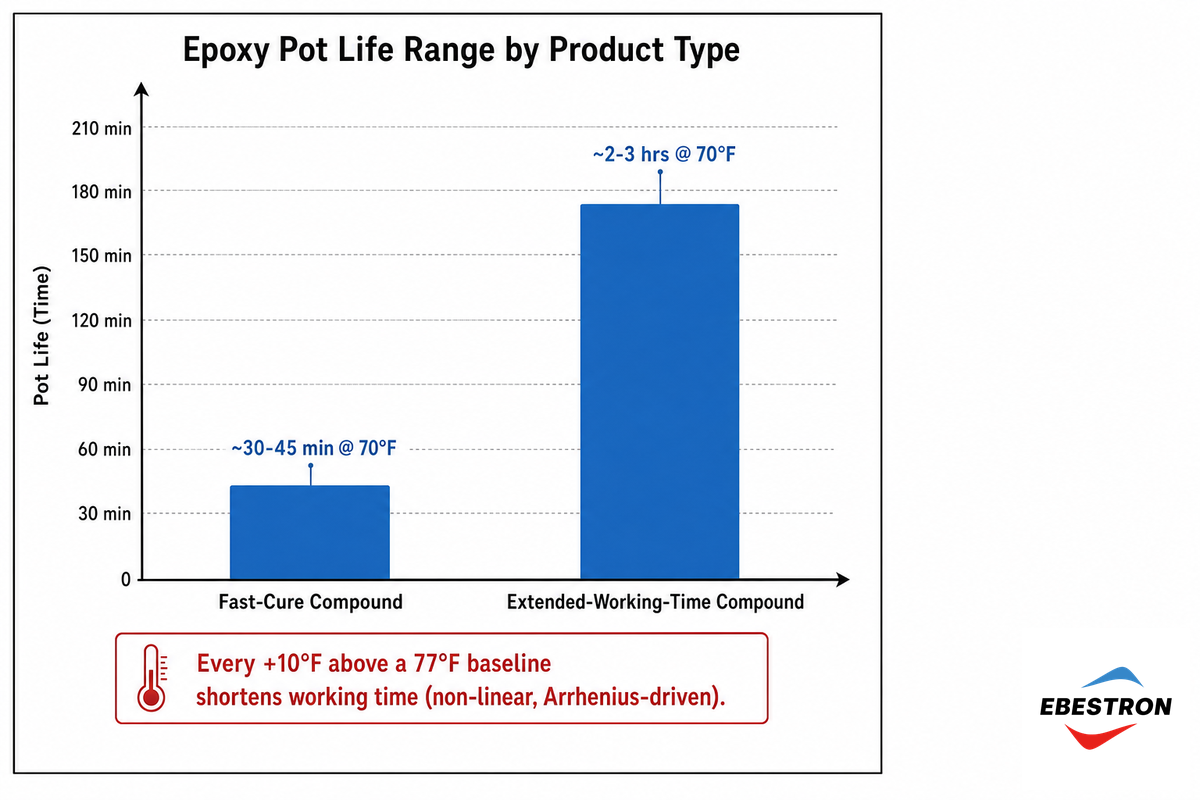
Intervalo de mistura durante o tempo de trabalho do epóxi: o período durante o qual o epóxi continua trabalhável após a mistura (tempo de vida útil da mistura / tempo aberto) estabelece um limite máximo para o tempo de permanência que o bico pode acrescentar antes de o material no seu interior começar a gelificar.
O tempo de vida útil da mistura é normalmente medido em condições laboratoriais padrão — algures entre 70-77°F (21-25°C), para um volume específico de material (por exemplo, um quart) — e varia consoante o epóxi. Os compostos epóxi para ancoragem e selagem de juntas ilustram essa variação: algumas fórmulas indicam um tempo de vida útil da mistura de cerca de 30-45 minutos a 70°F, enquanto outras da mesma gama geral de produtos permitem trabalhar durante 2-3 horas à mesma temperatura, segundo as fichas técnicas dos fabricantes. A temperatura também influencia o processo, e não de forma linear: a reticulação entre a resina e o endurecedor é exotérmica e segue um perfil cinético do tipo Arrhenius, o que significa que a reação acelera cada vez mais por grau à medida que a temperatura aumenta. Uma regra prática muito utilizada no setor indica que se perdem 5 minutos de tempo de trabalho por cada aumento de 10°F acima da referência de 77°F. É uma estimativa útil para sistemas com um tempo de vida útil da mistura curto, mas deve ser entendida como uma aproximação baseada numa referência do setor, não como uma regra rígida aplicável da mesma forma a sistemas de 30 minutos e de 3 horas.
É por isso que o bico não é um acessório universal. Um epóxi com um tempo de vida útil da mistura curto pode começar a gelificar no misturador durante uma pausa. O material começa a reticular durante a interrupção e pode deixar o bico parcialmente obstruído a jusante (consulte a secção de resolução de problemas). Um maior volume interno do misturador aumenta a probabilidade de gelificação. Num sistema com um tempo de vida útil da mistura mais longo, a margem de erro é muito maior. O comportamento exato e as alterações com a temperatura dependem da química específica da mistura. Consulte sempre as fichas técnicas do epóxi em causa.
Na prática, na bancada ou no local de aplicação, o risco é o bico gelificar internamente antes de terminar o trabalho — um problema que quase todos os aplicadores acabam por enfrentar. Dois métodos ASTM orientam a medição oficial do tempo de vida útil da mistura, embora nenhum aborde especificamente os bicos: a norma ASTM D1338 abrange o tempo de trabalho de materiais fluidos e em pasta, incluindo a mistura de um material bicomponente imediatamente antes da utilização; a norma ASTM D4473 aborda a cura de materiais de resina termoendurecível, incluindo o tempo de gelificação e o tempo de cura. As fichas técnicas típicas baseiam-se nos resultados obtidos através destes procedimentos, e não em estimativas arbitrárias dos fabricantes. O volume da câmara de mistura é um parâmetro fixo da conceção do bico (consulte a geometria interna descrita em US7390121). Por isso, a margem do tempo de vida útil da mistura tem de ser verificada em relação ao volume morto de um bico específico, e não apenas à ficha técnica do epóxi.
«Um misturador estático é normalmente o dispositivo escolhido para misturar adesivos bicomponentes imediatamente antes da aplicação, mas é a geometria interna do próprio misturador estático — e não apenas a química do cartucho — que determina quanto tempo de trabalho fica realmente disponível depois de se premir o gatilho da pistola.»
Artigo da Adhesives & Sealants Industry sobre a tecnologia dos bicos misturadores estáticos
Conceção dos elementos de mistura: helicoidal ou Quadro, e a importância do número de elementos
O que é um elemento de mistura e qual é a sua função?
No interior do misturador, cada elemento de mistura é um único defletor que divide ao meio o fluxo de entrada, roda-o e sobrepõe-no para que o elemento seguinte repita o processo. Como cada elemento duplica aproximadamente as camadas do fluxo de entrada, a estratificação aumenta exponencialmente. Por isso, a uniformidade da mistura melhora de forma desproporcional à medida que aumenta o número de elementos.
A fórmula é aproximadamente 2^n, em que n corresponde ao número de elementos de mistura. Os misturadores industriais são normalmente configurados com 7 a 48 elementos, sendo 10, 16, 18, 24 e 32 os números mais frequentemente especificados (um bico com 18 elementos é uma das opções intermédias mais comuns). Um menor número de elementos também significa um bico fisicamente mais curto, razão adicional pela qual as geometrias de nova geração para materiais de baixa viscosidade anunciam menos desperdício em cada substituição.
A expressão 2^n não é um simples arredondamento: um misturador com 10 elementos cria aproximadamente 1024 camadas de fluxo (2^10), enquanto um misturador com 24 elementos produz mais de 16,7 milhões de camadas (2^24)! Assim, um misturador com 32 elementos tem muito mais do dobro das camadas internas de um misturador com 16 elementos.
Também é verdade que os guias de compra mais comuns simplificam em excesso ao considerar apenas o número de elementos. Um fabricante anuncia atualmente uma conceção de elementos de mistura de segunda geração que exige cerca de 75% menos elementos do que as conceções convencionais para proporcionar um grau de uniformidade semelhante. Com apenas 7 elementos, consegue uma mistura comparável à de uma conceção que anteriormente exigia 32 elementos. Embora esta redução anunciada de 75% seja uma alegação específica do fabricante, e não um valor de referência verificado de forma independente para todo o setor, o princípio fundamental de que a geometria dos elementos — e não apenas o seu número — influencia a qualidade da mistura está bem estabelecido e é apoiado por outros princípios de conceção publicados. Outra vantagem é que os misturadores convencionais com 32 elementos podem desperdiçar até 20ml de material sempre que se substitui o bico.
⚠️ Importante
Não compare os misturadores apenas pelo número de elementos: um misturador com 32 elementos e outro com 7 elementos e uma geometria de segunda geração podem proporcionar uma uniformidade de mistura equivalente.
| Faixa de viscosidade do epóxi | Número habitual de elementos (helicoidal convencional) | Observações |
|---|---|---|
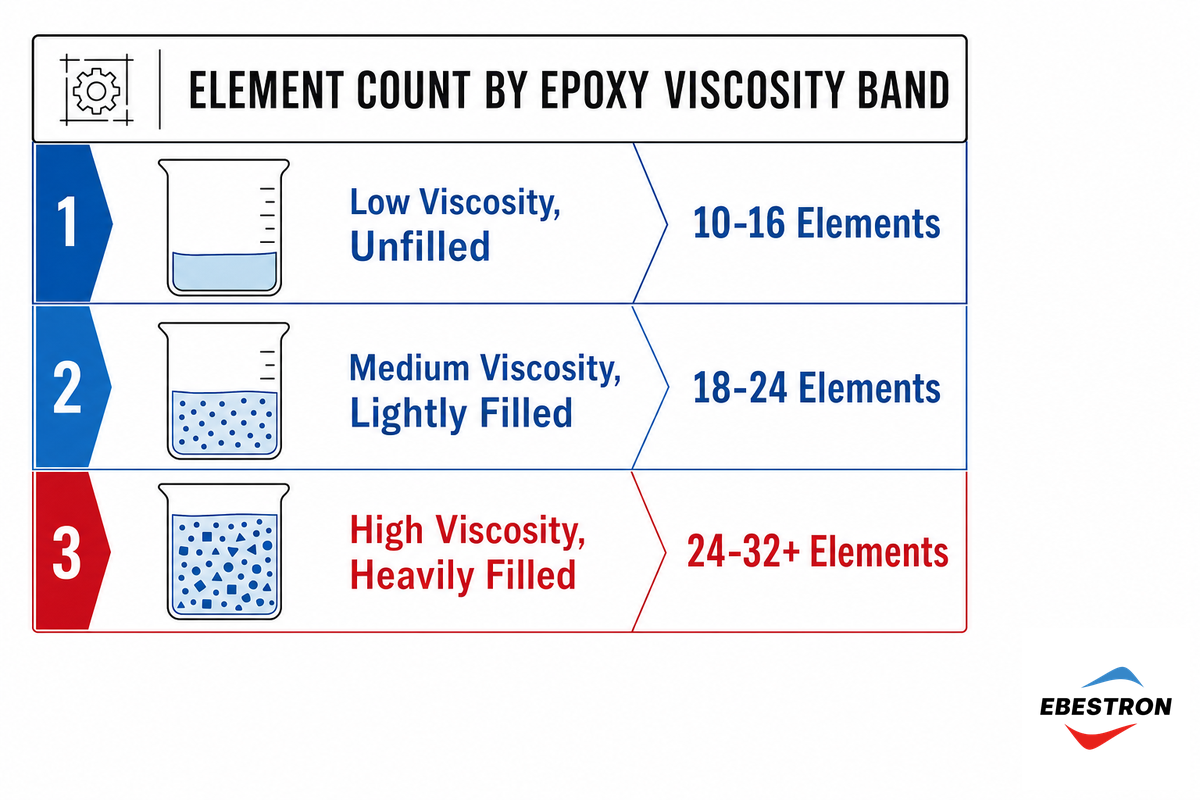
| Baixa viscosidade, sem cargas (centenas de mPa·s) | 10-16 elementos | Fluxo mais rápido, bico mais curto; verifique a margem do tempo de vida útil da mistura conforme H2-2 |
| Viscosidade média, com poucas cargas | 18-24 elementos | A maioria dos epóxis estruturais de utilização geral enquadra-se nesta faixa |
| Viscosidade elevada, com muitas cargas (até centenas de milhares de mPa·s) | 24-32+ elementos | Epóxis tixotrópicos, resistentes ao escorrimento e com cargas metálicas; considere geometrias de nova geração para controlar o desperdício |
Os químicos consideram, em geral, que um misturador estático proporciona uma mistura suficientemente homogénea quando o coeficiente de variação radial é inferior a 0.05. Verifica-se também que o comprimento de mistura necessário aumenta com a diferença de viscosidade entre os componentes do fluxo, quando esta abrange várias ordens de grandeza. Trata-se do mesmo fenómeno observado à escala do bico do cartucho: são necessários mais elementos de mistura para processar epóxi com cargas viscosas do que epóxi sem cargas e de baixa viscosidade. Um estudo anterior sobre dinâmica de fluidos em misturadores em linha aprofunda este último ponto. O estudo sugere que a distribuição do tempo de residência no misturador nunca é gaussiana, independentemente do número de elementos de mistura no seu interior, e que o desempenho está mais relacionado com a geometria do percurso interno do fluxo (a forma como a secção transversal varia ao longo do misturador) e com a geometria geral do que apenas com o número de elementos — uma forma mais precisa de dizer que «o número de elementos não é tudo».
Compatibilidade entre o bico e o cartucho: dimensões, encaixe roscado ou de baioneta e entradas da proporção de mistura
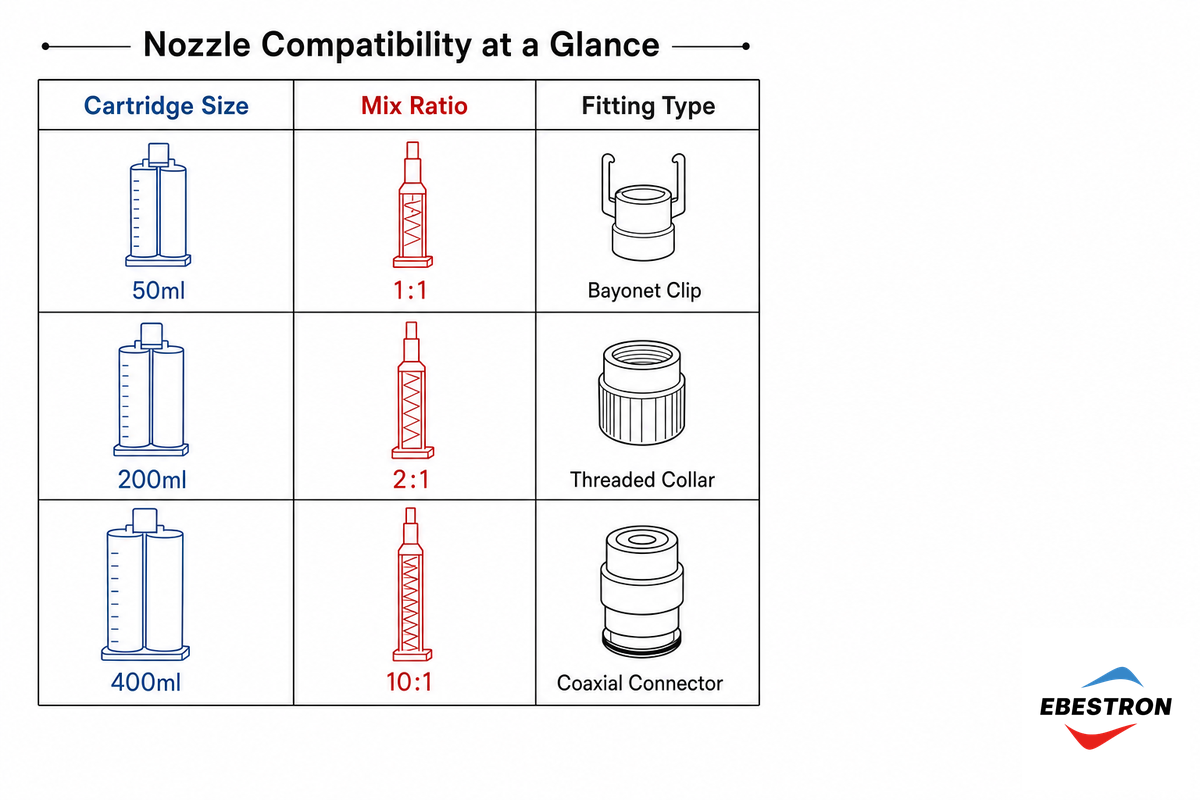
Os compradores que procuram bicos misturadores para cartuchos de adesivo bicomponente precisam, na maioria dos casos, de escolher os modelos para doseadores de cartucho duplo de 200ml e 400ml, uma vez que estes dois volumes abrangem a maior parte da produção e das aplicações no local. Para começar, há três fatores que têm de ser compatíveis para que o bico funcione na pistola: o volume do cartucho, a proporção de mistura e as dimensões do encaixe. Se algum destes fatores estiver incorreto, o bico não encaixa, não veda ou doseia a resina e o endurecedor na proporção errada, independentemente da qualidade dos componentes internos. É um erro fácil de cometer uma vez, porque uma entrada para proporção de mistura errada pode encaixar fisicamente numa rosca do cartucho: a diferença só se revela quando o cordão curado falha com uma fração da resistência nominal, por vezes dentro de um período de cura de 24-hour.
| Dimensões do cartucho | Proporção de mistura | Tipo de encaixe | Número habitual de elementos* |
|---|---|---|---|
| 50ml | 1:1 | Baioneta | 10-16 |
| 50ml | 2:1 | Baioneta | 12-18 |
| 200ml | 1:1 | Baioneta | 12-18 |
| 200ml | 2:1 | Rosqueado (sistema F) | 16-24 |
| 200ml | 4:1 | Rosqueado (sistema F) | 18-24 |
| 400ml | 1:1 | Rosqueado (encaixe F) | 16-24 |
| 400ml | 2:1 | Rosqueado (encaixe F) | 18-24 |
| 400ml | 4:1 | Rosqueado (encaixe F) | 20-28 |
| 400ml | 10:1 | Coaxial | 24-32 |
(Os intervalos de número de elementos são um guia de seleção exclusivo da Ebestron, baseado tanto na tabela de faixas de viscosidade como nas recomendações gerais para encaixes de cartuchos, e não numa publicação específica.) Verifique sempre a ficha técnica do epóxi em causa.
Não presuma a proporção de mistura com base apenas na categoria do epóxi. É comum assumir que «o epóxi bicomponente tem quase sempre uma proporção de mistura de 2:1 de endurecedor para resina», mas as fórmulas podem variar entre 1:1, 3:1 e 5:1, consoante a química específica. As entradas internas de proporção de mistura do bico adequado têm de corresponder à proporção real de saída do cartucho, e não a uma recomendação geral. A utilização de um bico de 10:1 num cartucho de 2:1 fará mais do que simplesmente proporcionar uma mistura deficiente: irá injetar no cordão quantidades desproporcionais de endurecedor e resina.
A maioria dos compradores subestima a relação entre o comprimento do bico e o número de elementos. Uma patente de misturador estático de duas entradas para epóxi, ilustrada com um sistema real de resina epóxi e agente de cura na proporção de 65/35 (em peso), descreve um tubo de mistura reto com 10-14 elementos e menos de 6 inch de comprimento. O número de elementos aumenta com a viscosidade, de acordo com a recomendação acima baseada nas faixas de viscosidade. Se também estiver a escolher o sistema de cartucho duplo para adesivo bicomponente, as dimensões do cartucho e a adequação do bico devem ser indicadas em conjunto.
OEM ou fornecimento direto da fábrica: verificação cruzada do bico OEM

O teste de verificação cruzada de bicos OEM tem 3 perguntas e pode ser feito antes de substituir um bico de marca (3M Scotch-Weld EPX, Loctite, J-B Weld, Araldite) por um equivalente direto de fábrica ou genérico. Os compradores começam muitas vezes a pesquisa pelo nome de uma marca específica — procuram um bico misturador para epóxi de 2 componentes em «Bicos misturadores de epóxi 3M», um bico misturador para epóxi J-B Weld ou simplesmente os melhores bicos misturadores para epóxi para a sua aplicação — antes de perceberem que a peça em si (um bico misturador estático para epóxi, qualquer que seja a designação) é, em grande medida, intercambiável entre marcas quando a compatibilidade com o equipamento e o número de elementos de mistura correspondem:
- Encaixa fisicamente? Confirme se o encaixe de baioneta ou roscado e o diâmetro do corpo do cartucho correspondem à pistola e ao cartucho. É uma verificação com resultado positivo ou negativo, não uma questão de opinião.
- O número de elementos é igual ou superior à especificação OEM para a faixa de viscosidade do epóxi? Uma substituição que pode resultar numa mistura ligeiramente insuficiente do epóxi é utilizar um bico que não seja OEM e tenha menos elementos.
- As entradas de proporção de mistura estão configuradas corretamente para a proporção real de saída do cartucho? A proporção depende do êmbolo interno do cartucho, não da indicada na documentação do epóxi.
Se as três verificações forem positivas, o bico de fornecimento direto da fábrica é literalmente a mesma peça que se encontra noutra embalagem com o nome de uma marca OEM, porque a física da mistura no bico não tem em conta quem colocou a marca. Se falhar apenas uma verificação, «bem, é quase do mesmo tamanho» não resolve o problema.
Este teste de 3 perguntas verifica apenas o bico, uma peça física sem qualquer mecanismo para esconder as suas características. É uma questão diferente da de saber se um produto epóxi padrão tem a mesma fórmula química do produto de marca: essa questão é abrangida pela norma de Comunicação de Perigos da OSHA (29 CFR 1910.1200), que determina que um produto químico tem o mesmo identificador de produto e os mesmos perigos de um produto de referência SE as fichas de dados de segurança dos fabricantes forem equivalentes. Mesmo neste caso, a norma permite aos fabricantes manter a fórmula confidencial, indicando intervalos dos componentes, por exemplo, 1-5% em vez de 2,5%.
💡 Dica profissional
Poderá encontrar marcações moldadas no bico que já utiliza. Anote a marca, o diâmetro e o número de elementos: quase tudo está gravado no corpo do cartucho. Se escolher um bico de substituição de fornecimento direto da fábrica, esta é a forma mais rápida de o fazer. A mesma comparação entre produtos de marca e genéricos pode ser feita no nosso guia de compra de cartuchos duplos para adesivo bicomponente, onde analisamos a escolha do sistema completo.
A Ebestron fabrica bicos misturadores de epóxi e misturadores estáticos com fornecimento direto da fábrica, concebidos para corresponder às mesmas especificações de encaixe e número de elementos a que está habituado. Consulte a gama completa de bicos misturadores de epóxi para ver as opções de dimensões, números de elementos e proporções. Solicite uma amostra →
Como utilizar corretamente um bico misturador de epóxi
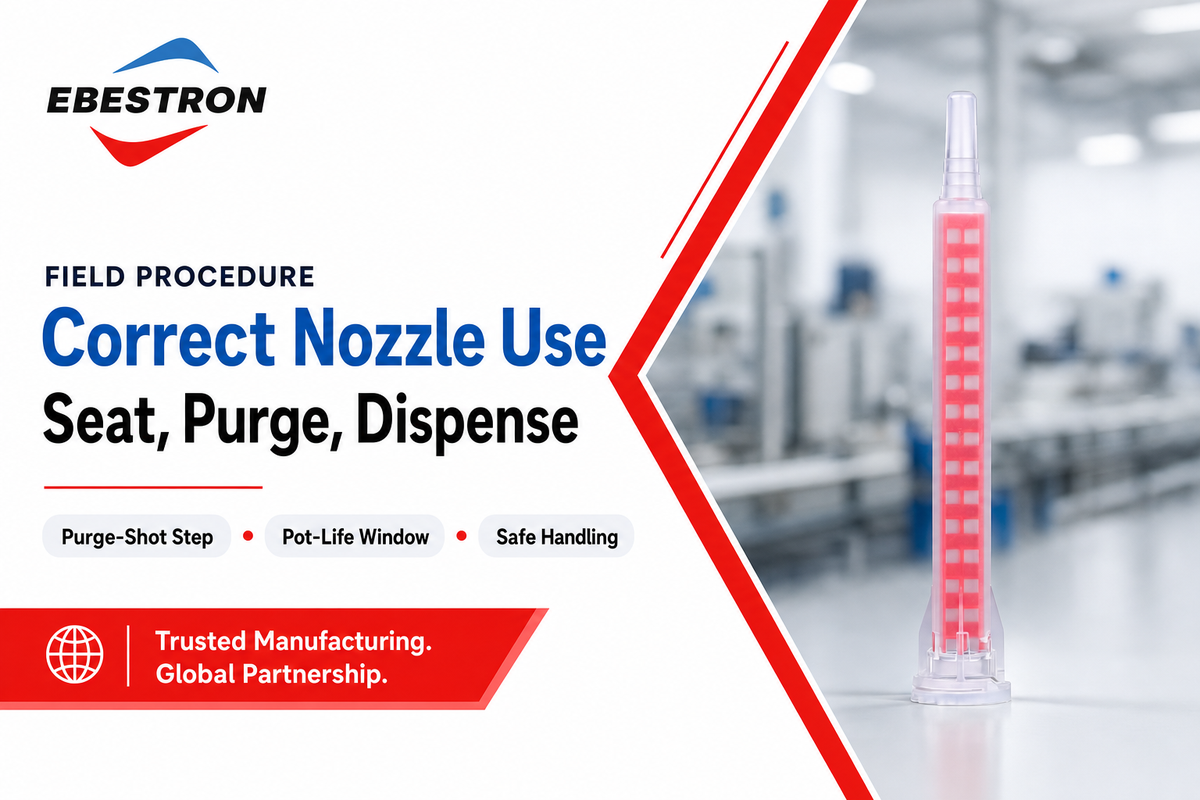
A mistura correta em quase todos os sistemas de doseamento de epóxi bicomponente depende dos mesmos quatro passos, desde cartuchos de adesivo manuais até sistemas de doseamento montados em bancada: encaixe o bico até ao fundo do adaptador (com um quarto de volta num encaixe de baioneta ou apertando à mão se for de rosca), doseie uma pequena quantidade inicial de material para purga (antes de este chegar à própria junta), não utilize esse material e descarte-o; se não estiver a trabalhar continuamente, retire completamente o bico. Certifique-se de que o problema não está na pistola doseadora: uma pistola doseadora de adesivo bicomponente mal encaixada ou incompatível pode criar uma pressão desigual nos êmbolos e interromper a mistura contínua, mesmo com um bico do tamanho correto.
A quantidade inicial expelida para purga tem mais impacto do que se poderia pensar. Como a câmara de mistura oca de um bico novo não contém epóxi, o primeiro material a sair terá excesso de resina ou de endurecedor, até a câmara ficar completamente preparada e a mistura se tornar contínua. Essa quantidade deve ser descartada para eliminar a mistura com proporção incorreta antes de entrar em contacto com a superfície de colagem.
A resina epóxi e o endurecedor por curar representam, por si só, um risco durante o manuseamento; não se trata apenas da qualidade da mistura: os componentes por curar são frequentemente sensibilizantes cutâneos segundo as regras de classificação de perigos da OSHA. Por isso, o uso de luvas e proteção ocular é uma precaução habitual ao trocar bicos e descartar material de purga. Os bicos usados e o material expelido para purga devem ser tratados como outros resíduos de epóxi curado: como resíduos sólidos, nunca pelo ralo.
⚠️ Importante
Quando terminar de dosear, se continuar a sair epóxi pela ponta do bico, pare e certifique-se de que o ar no cartucho foi purgado antes de prosseguir: uma bolha de ar retida comprime-se quando o material é expelido pelo bico e expande-se quando deixa de empurrar o êmbolo, mantendo o gotejamento depois de parar e comprometendo, assim, a proporção de mistura nessa parte do cordão.
Resolução de problemas: estrias, obstruções e mistura incompleta
O que acontece quando há poucos elementos de mistura?
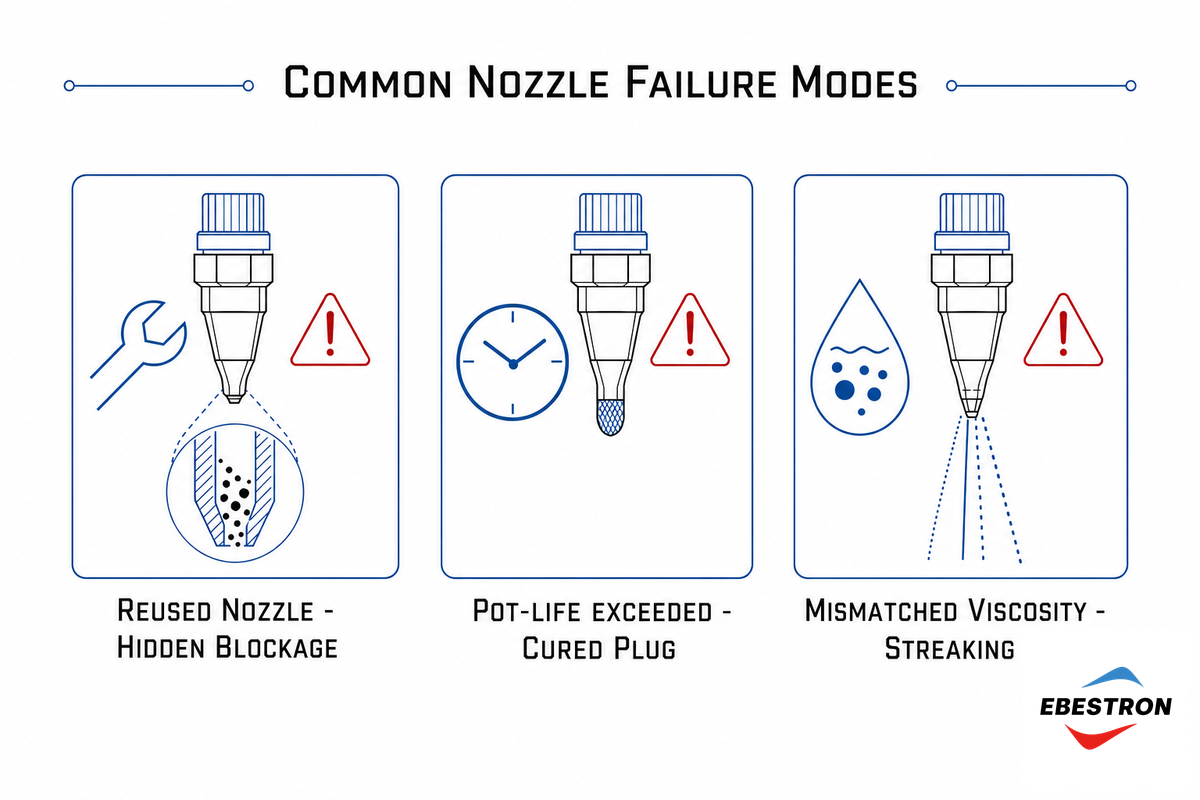
Se forem instalados poucos elementos de mistura, ou um bico de tamanho inadequado para o número de elementos, a secção transversal do cordão fica dividida em zonas dominadas por um ou outro material. O resultado são estrias visíveis e/ou zonas localizadas duras, moles ou por curar no cordão final depois de curado. Na verdade, essas zonas têm pouca integridade estrutural, mesmo que o aspeto da superfície seja bom.
Patentes de conceção de misturadores estáticos, como a US7390121, utilizada em equipamentos industriais de doseamento de adesivos de muitos fabricantes, descrevem precisamente por que motivo a geometria dos elementos, e não apenas o seu número, determina a ocorrência destes problemas. As três causas mais comuns de estrias e obstruções são, por ordem de frequência:
- Reutilização de bicos. Retirar da pistola um bico usado, limpá-lo e voltar a colocá-lo deixa frequentemente epóxi curado no percurso helicoidal interno, restringindo parcialmente a passagem. Não é visível, mas está lá.
- Deixar o trabalho parado para além do tempo aberto do epóxi. Quando o trabalho demora mais do que o tempo de vida útil da mistura, o material dentro do tubo misturador começa a curar e obstrui parcialmente o canal durante a aplicação.
- Utilizar um bico concebido para materiais sem carga e de baixa viscosidade com um epóxi de elevada viscosidade e com muita carga. Se a geometria do bico e o número de elementos não forem adequados à viscosidade, o epóxi não será bem misturado, mesmo que o número correto de elementos esteja devidamente instalado num corpo com o tamanho adequado.
A solução para os três problemas é agir com disciplina: não reutilize os bicos misturadores; não prolongue a aplicação do epóxi para além do seu tempo de vida útil da mistura, do início ao fim, com o mesmo bico; retire o bico imediatamente após concluir a aplicação. Não o deixe «para reutilizar amanhã».
Economia dos bicos descartáveis: custo por aplicação e gestão de resíduos

Sempre que troca de bico, perde uma pequena quantidade de epóxi: o material que enche a câmara de mistura e nunca chega a formar um cordão útil. Artigos anteriores da imprensa especializada sobre os tradicionais misturadores helicoidais e quadrados indicam perdas de até 20 mL por troca de bico. Num cartucho duplo de 50 mL, esse valor máximo corresponde a uma perda de quase 40% do volume do cartucho devido ao enchimento da câmara, antes de dosear sequer um grama na junta. É um custo a considerar quando se utilizam dezenas de cartuchos por semana, e não apenas numa reparação anual. Uma oficina que utilize 40 cartuchos por mês, mesmo com metade dessa perda, gasta uma parte significativa de um cartucho apenas a encher a câmara, sem contar ainda com o custo da quantidade inicial expelida para purga.
Dois fatores afetam o valor efetivo dessa perda no enchimento da câmara: o volume interno do bico (uma configuração mais pequena ou mais recente, com menos elementos, contém menos material, seguindo a mesma relação entre o número de elementos e o volume da câmara descrita na literatura sobre patentes de misturadores estáticos) e a frequência de troca dos bicos (influenciada pelo rigor com que se aplica a regra de «nunca reutilizar», abordada abaixo). Para uma oficina, a forma mais simples de reduzir esta perda é comprar diretamente ao fabricante os tamanhos e números de elementos necessários, em vez de optar por um único bico universal sobredimensionado para todas as tarefas. Abordamos a mesma economia de custo por aplicação no lado do cartucho, no nosso guia de dimensionamento de cartuchos duplos de 50ml. Na prática, a utilização de um bico sobredimensionado ou de tamanho errado é o erro dispendioso mais frequente nas equipas de produção, porque ninguém volta a verificar o tamanho do bico depois de a oficina escolher uma única referência padrão. Os preços de fábrica da Ebestron assentam na correspondência entre os tamanhos e o volume de produção real, e não num código de catálogo único para todas as aplicações.
Perspetivas do setor: o que está a mudar no doseamento de epóxi de 2 componentes

Mais do que uma mudança no próprio mercado dos bicos, a tendência mais evidente para os consumíveis de bicos decorre da transição geral de fixadores mecânicos para colagem estrutural com adesivos na montagem automóvel, no fabrico de componentes eletrónicos e nos trabalhos de fabrico em geral. Além disso, cada vez mais pequenas oficinas começam a utilizar pistolas doseadoras manuais para cartuchos duplos, antes encontradas apenas em linhas de produção maiores. Em conjunto, estas tendências aumentam o número de trocas de bico por oficina, mesmo quando o interesse de pesquisa por «bicos misturadores de epóxi» se mantém estável; o interesse pelo termo permaneceu num intervalo estável, com ligeira sazonalidade, de 210-390/mês, sem crescimento homólogo numa direção definida. Esta estabilidade da curva reflete a intenção de pesquisa, não o consumo físico de componentes. Por isso, planeie os consumíveis de bicos para o volume de doseamento dos seus cartuchos duplos em 2026, e não com base no volume de pesquisas.
Do ponto de vista técnico, as geometrias de divisão do fluxo da nova geração — tema da contínua atividade de patentes sobre o design de misturadores estáticos e abordadas acima na discussão sobre o número de elementos de mistura — são a inovação mais relevante; permitem obter a mesma qualidade de mistura com menos elementos, reduzindo o desperdício de material a cada substituição do bico. Embora ainda não tenham substituído os modelos helicoidais tradicionais e os Quadro, representam uma oportunidade concreta para as empresas com elevado volume de produção. Estima-se que o mercado mundial de equipamento para doseamento de adesivos ronde os $8,7 mil milhões em 2025 e se aproxime das dezenas baixas a médias de milhar de milhão em meados da década de 2030, com um crescimento de um dígito; ainda assim, esta projeção para todo o setor pouco revela sobre os custos de consumíveis de bicos em cada empresa. Para uma empresa em crescimento, o risco prático não está na dimensão do mercado, mas na diferença oculta entre a produtividade prevista da linha de produção e o stock de bicos disponível, um desfasamento que, na prática, provoca mais atrasos no calendário do que qualquer falha isolada de equipamento. A produção própria da Ebestron mantém em stock números de elementos de mistura e tamanhos padrão, precisamente para colmatar essa diferença com pouca antecedência.
Perguntas frequentes
P: O que é um elemento de mistura?
Ver resposta
Um elemento de mistura é um defletor interno individual dentro de um bico misturador estático. Cada elemento divide o fluxo de resina e endurecedor que entra, roda as duas metades e volta a juntá-las antes de o elemento seguinte repetir o processo. Assim, um bico com mais elementos oferece mais oportunidades para misturar completamente os dois componentes antes de o cordão sair pela ponta.
P: Porquê utilizar elementos de mistura em vez de misturar à mão?
Ver resposta
Os elementos de mistura estática proporcionam sempre uma proporção consistente e repetível, porque o êmbolo do cartucho duplo doseia a resina e o endurecedor a uma taxa fixa, enquanto os elementos fazem a mistura automaticamente durante o doseamento do material. A mistura manual depende da técnica do operador e introduz bolhas de ar e variações na proporção que um misturador estático devidamente dimensionado evita.
P: Todas as geometrias de elementos de mistura funcionam da mesma forma?
Ver resposta
Não. Os elementos helicoidais torcem o fluxo em direções alternadas; os elementos Quadro/de grelha cruzada utilizam, em vez disso, uma grelha de palhetas perpendiculares. As geometrias mais recentes de divisão do fluxo conseguem atingir a mesma uniformidade de mistura com significativamente menos elementos do que uma conceção helicoidal ou quadrada convencional. Por isso, dois bicos com números de elementos muito diferentes podem produzir epóxi com uma mistura igualmente homogénea.
P: Qual é a geometria de elementos de mistura mais adequada a cada aplicação?
Ver resposta
Adapte a geometria e o número de elementos à faixa de viscosidade do epóxi: os epóxis de baixa viscosidade misturam-se bem com menos elementos (10-16); os sistemas com muita carga ou de elevada viscosidade precisam de mais (24-32), ou de uma geometria mais recente com menos elementos, concebida para oferecer um desempenho equivalente.
P: Posso reutilizar um bico misturador de epóxi depois de ficar parado durante a noite?
Ver resposta
Não — considere os bicos misturadores produtos de utilização única. O epóxi que fica na câmara de mistura para além do seu tempo de vida útil da mistura cura no interior e forma uma obstrução dura e permanente nos canais internos. Mesmo um bico que pareça limpo depois de ser limpo costuma ter resíduos que estreitam a passagem. Um bico novo custa muito menos do que uma colagem falhada causada por um bico parcialmente obstruído.
P: Qual é a diferença entre «bico misturador estático» e «misturador estático»?
Ver resposta
No doseamento de adesivos, os dois termos são utilizados indistintamente para designar o mesmo componente descartável na ponta do cartucho. O acessório abordado no nosso guia de agulhas de dosagem industriais e pontas de precisão é uma categoria relacionada, mas distinta: as agulhas doseiam o fluido sem o misturar. A maioria dos catálogos de fornecedores de adesivos apresenta os dois termos sem distinção. Contudo, no uso industrial mais abrangente, «misturador estático» refere-se mais frequentemente a um misturador em linha de grandes dimensões, instalado numa tubagem e utilizado no processamento químico ou no tratamento de águas municipais. Trata-se de um equipamento completamente diferente, concebido para o fluxo contínuo em condutas e não para um cartucho manual, embora utilize internamente um princípio de divisão do fluxo semelhante. Se procura especificamente acessórios para cartuchos, e não equipamento para tubagens de processo, «bico misturador» ou «ponta misturadora» é o termo de pesquisa mais preciso e evita resultados de misturadores industriais de processo.
Por que escrevemos este artigo
Fabricamos pistolas doseadoras de adesivo, cartuchos duplos e bicos misturadores para adesivos bicomponentes. Por isso, recebemos frequentemente pedidos de ajuda de clientes com a pergunta «de que bico preciso para uma determinada composição química de epóxi?». Neste artigo, abordamos os princípios básicos sobre o número de elementos, o dimensionamento e a resolução de problemas que queremos que todos os clientes conheçam antes de fazerem a primeira encomenda. Tudo foi verificado com base em publicações técnicas e patentes independentes, não apenas na memória.
Revisto pela equipa técnica da Ebestron
Referências e fontes
- US7390121, módulo misturador estático — United States Patent and Trademark Office
- US3286992A, dispositivo de mistura estática com duas alimentações — United States Patent and Trademark Office
- ASTM D1338, métodos de ensaio padrão para o tempo de vida útil de adesivos líquidos ou em pasta — ASTM International
- 29 CFR 1910.1200, norma de comunicação de perigos — U.S. Occupational Safety and Health Administration
- A próxima geração de bicos misturadores estáticos — Adhesives & Sealants Industry
- Estudo numérico de escoamentos de fluidos viscosos num misturador estático Kenics — repositório de investigação académica
- Compreender os tempos de cura e o tempo de vida útil da mistura em formulações de epóxi — ASTC Global
- Misturador estático para epóxi bicomponente: introdução de bolhas de ar — Eng-Tips Engineering Forum




![Sistemas de mistura dinâmica para selantes 2K [Guia]](https://adhesivespackage.com/wp-content/uploads/2026/10/dynamic-mixing-systems-for-2k-sealants-guide-featured-1-150x150.png)