Get in touch with Ebestron Company

Updated June 2026 · Reviewed by the Ebestron technical team
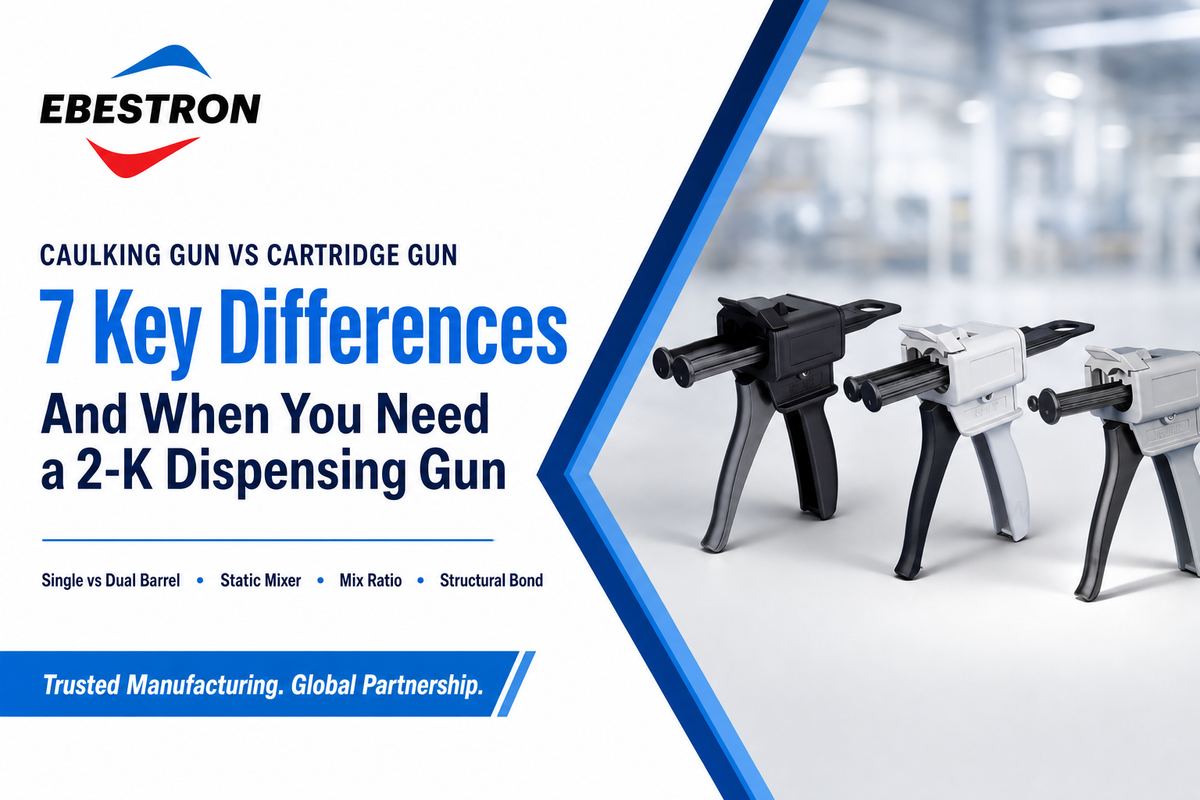
Caulking gun vs cartridge gun is really two different questions hiding in one tool name. In the hardware aisle, a “cartridge gun” is simply the cartridge format of a caulking gun, as opposed to a sausage or bulk gun. On a factory floor, a “cartridge gun” usually means a two-component (2-K) dispensing gun that pushes a resin and a hardener through a static mixer at a fixed ratio. The two look alike, cost very differently, and using the wrong one ruins the job. This guide separates them so you can match the tool to the work.
Short answer: A caulking gun dispenses one ready-mixed sealant from a single barrel; a two-component (2-K) cartridge dispensing gun pushes two reactive parts from twin barrels through a static mixing nozzle at a fixed ratio. The first seals gaps; the second bonds structurally. The defining difference is metering and mixing, not size or squeeze force.
Quick Specs: Caulking Gun vs 2-K Cartridge Gun
| Components dispensed | 1 (ready-mixed) vs 2 (resin + hardener) |
| Barrels | Single vs dual (side-by-side or coaxial) |
| Mixing | None (pre-mixed) vs static mixing nozzle |
| Ratio control | None vs fixed (1:1, 2:1, 4:1, 10:1) |
| Typical pack | 10 oz (300 ml) cartridge / 400–600 ml sausage / bulk vs 50–600 ml dual cartridge (range 23–1500 ml) |
| Typical thrust ratio | 3:1 to 18:1 (up to 26:1–34:1) vs balanced twin thrust |
| Primary job | Sealing gaps & joints vs structural bonding under load |
Values are industry-standard ranges.
Caulking Gun vs Cartridge Gun: At a Glance
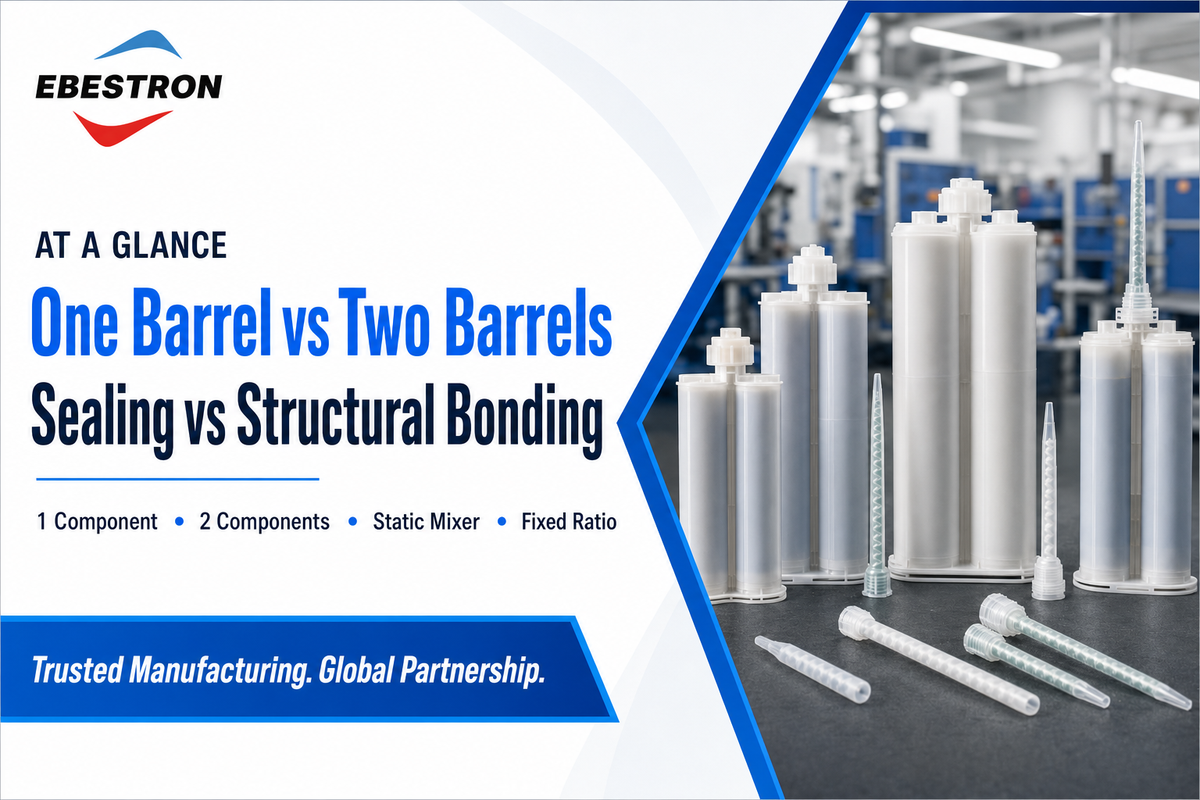
Even though the frame, the plunger, and the trigger on a caulk gun and a 2-component cartridge gun are the same, these are two different kinds of tools. The easiest way to tell them apart is what you get out of the tip: a single stream of pre-mixed goo, or two components that mix together at the nozzle? That’s pretty much the whole story: the One-Barrel vs Two-Barrel Rule determines the other differences almost as well as it does price and the strength of the seal you get. The structural side of that split is what adhesive-joint research measures as load transfer across the bonded area (ScienceDirect).
| Question | Caulking gun | 2-K cartridge dispensing gun |
|---|---|---|
| What does it dispense? | One ready-mixed sealant or adhesive | Two reactive parts (resin + hardener) |
| How does it mix? | No mixing — already mixed | Static mixing nozzle blends on dispense |
| What is the job? | Seal a gap against air and water | Bond two surfaces that carry load |
| Who buys it? | Homeowners, painters, builders | Assembly lines, fabricators, OEMs |
What Is a Caulking Gun?
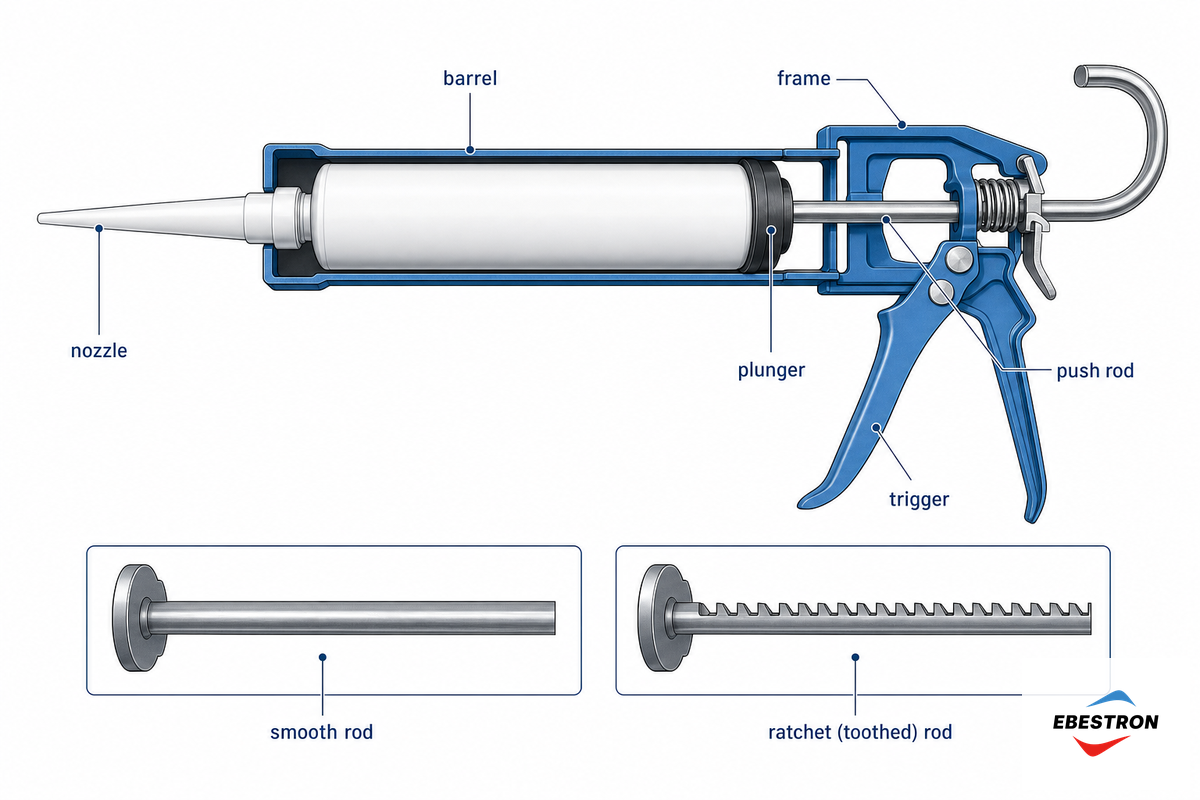
A caulking gun is any hand-operated device that pushes out a bead of ready-mixed material, either caulk or glue, from a cartridge or packet. When you squeeze the trigger, a plunger push a smooth or toothed rod into the cartridge pack, forcing sealant or glue out from the sliced end.
A smooth rod lets you back off the pressure the moment you release the trigger, so it stops cleanly with little drip, while a ratchet rod stays notched under pressure and tends to keep oozing after you let go. You do not need a caulk gun with anything fancy here: the push rod does the work, so you squeeze the trigger to advance it for smooth rod caulking and release the trigger to stop the flow. One simple rod caulking gun like this handles silicone caulking and acrylic alike. That plunger-and-rod design is old enough to appear across dispensing patents, including dual-component versions such as US Patent 5,104,005.
One number matters most: the thrust ratio. It describes the mechanical advantage you gain when you squeeze the trigger, so a higher ratio means more push per pull and a thick material flows with less hand effort. Thin silicone or acrylic flows easily at a low 3:1 to 6:1 ratio, while cold or heavy polyurethane sealant may want 18:1 or more, and heavy-duty guns reach 26:1 or even 34:1, though no single ratio is best for every material. An ergonomic, heavy-duty gun with the right ratio is the difference between a clean job and a sore hand by lunch. On a cold job site, a painter who reaches for a 6:1 gun and a tube of stiff polyurethane will fight the trigger all day, while an 18:1 gun lays the same bead with an easy squeeze.
⚠️ Common mistake
Treating the caulking gun as throwaway. Any worn ratchet that won’t maintain pressure leaves voids and blobs in the bead. To apply the caulk with precise application, cut the nozzle small with a utility knife, pierce the inner seal with a thin poker rod, keep a smooth motion to maintain a consistent bead, and release the pressure at the end of each run.
Cartridge vs Sausage vs Bulk: The Three Caulking Gun Formats
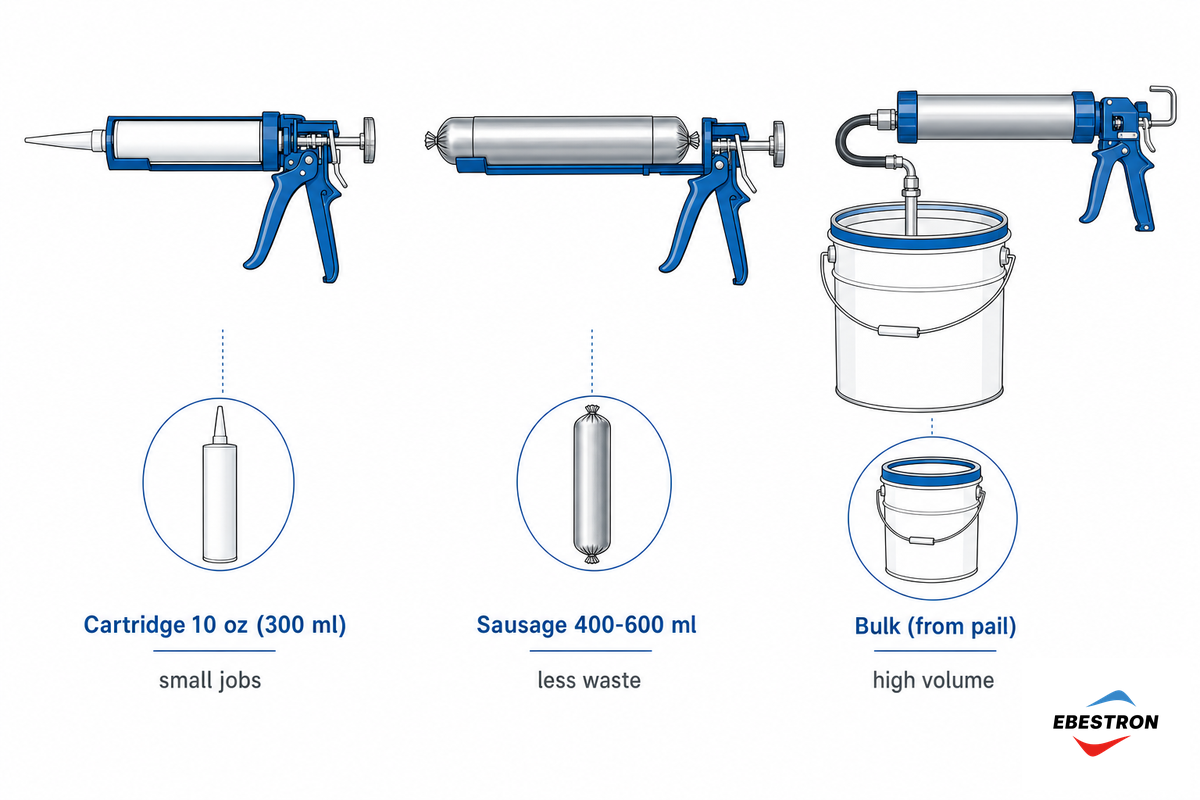
When people say “caulk gun,” they usually mean one of three loading formats: cartridge, sausage, or bulk. A cartridge caulk gun accepts a rigid 10 oz (300 ml) cartridge, which is the default standard equipment in most households for home and repair purposes. A sausage caulk gun is designed for accepting a flexible sausage of foil containing 400 ml or 600 ml, which allows you to dispense two or three times more material with the same amount of space while enabling an efficient material squeeze due to its collapsing properties. Last, but not least, a bulk caulk gun draws the material directly out of a large pail in order to provide exceptionally high volumes for extensive sealing projects.
| Format | Capacity | Best for | Trade-off |
|---|---|---|---|
| Cartridge | 10 oz (300 ml) | Intermittent, small jobs | Frequent reloads; caps and stores for weeks |
| Sausage | 400–600 ml foil pack | Continuous commercial sealing | Less waste, but opened packs dry within hours |
| Bulk | Loaded from a pail | High-volume firestop, curtain wall | Lowest cost per unit; messier to load |
Do you need a cartridge gun for caulk?
In most cases, a basic manual caulk gun is all you need for caulk, and its ease of use is the main draw. Nearly every brand sells silicone or acrylic in a 10 oz cartridge or caulk tube that is easy to load and unload in seconds, and an unsealed cartridge keeps for a couple of weeks, which makes it a popular choice for homeowners sealing a few windows.
Choosing the best caulking gun for this work comes down to a smooth rod and a drip-free release, not capacity; for repetitive runs, an electric caulking gun saves your hand. Cartridge caulking guns cover most jobs, so the question of choosing a caulking gun rarely means more than picking the best caulk gun you can hold comfortably; you only need a sausage caulking gun or a bulk gun once you use enough material per session to justify the cost. In short, when choosing the right caulking gun, the right caulk gun for silicone caulking is the simplest one that still gives you control. Understanding the differences between cartridge, sausage, and bulk guns comes down to a few key features: sausage guns minimize waste with a collapsing pack, while the sausage and bulk formats trade storage life for capacity. None of these single-component formats can place a structural bond, which calls for a two-component adhesive (Adhesives & Sealants Industry).
What Is a Two-Component (2-K) Cartridge Dispensing Gun?
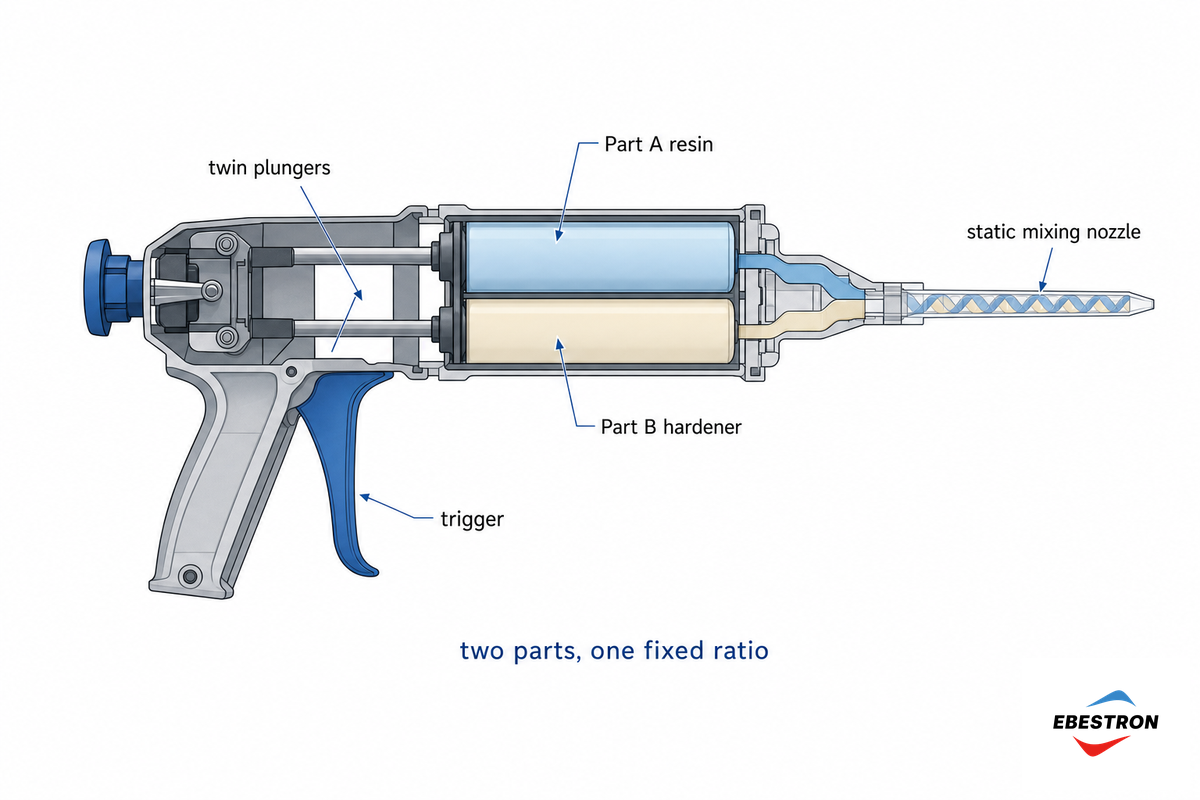
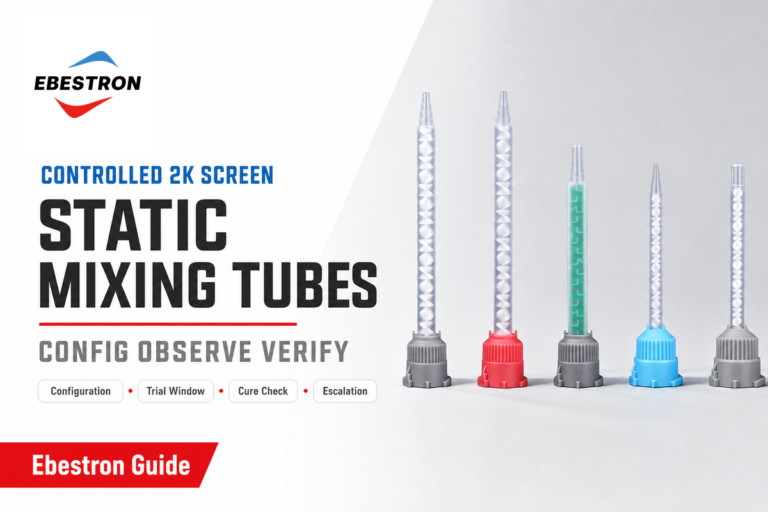
Now, in terms of professional tool upgrades, you encounter the two-component cartridge dispensing gun-more colloquially known as a “2-K” or “dual cartridge” gun-which represents the second bar on our “One-Barrel vs Two-Barrel Rule”. It holds paired cartridges that separate Part A (resin) and Part B (hardener). Driven by balanced plungers, both parts blend as they leave the gun through a static mixing nozzle, which you’ll never find on a single-component caulk gun.
However, don’t mistake this for merely an enhanced, more powerful version of its single-component cousin. Instead, a dual-component caulking gun shows up in the patent record as its own design, for example US Patent 5,104,005, a dual component mechanically operated caulking gun which uses a ball screw driving paired ram rods through a common transfer bar so both ejectors advance together from a dual cartridge. In practice, a dual cartridge holds 50, 200, 400, or 600 ml of adhesive, and according to the trade journal Adhesives & Sealants Industry, two-component systems such as epoxies, reactive acrylics, and polyurethanes only cure once Part A and Part B are combined. Because they begin reacting the instant they meet in the mixer, a 2-K gun must be purged before each use: an operator dispenses and discards a short bead at the start of a shift, then waits for the resin and hardener to flow in even, streak-free color before placing the first real bond. Importantly, ensure the gun matches the size and ratio of your cartridge, as 2-K guns aren’t universal to all types.
The 7-Point Caulking-Gun-vs-2K-Gun Difference Ladder
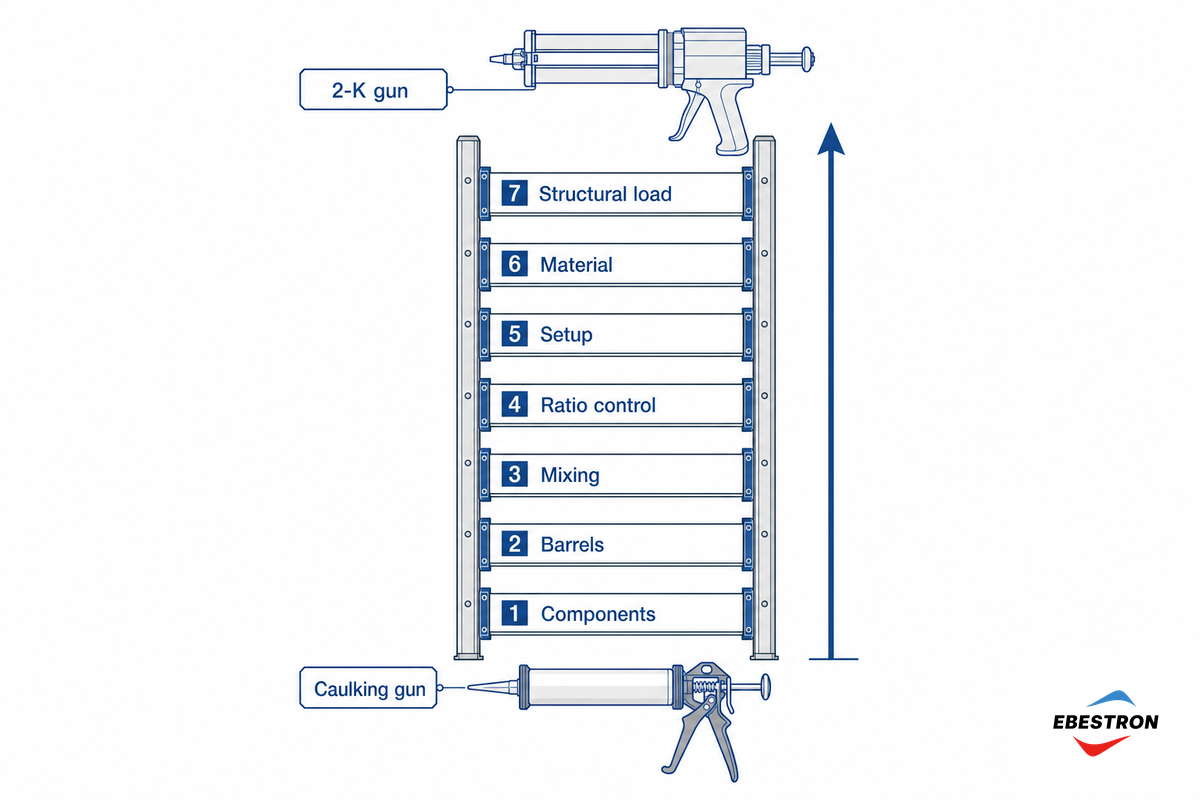
When juxtaposing the two devices, you’ll notice a progressive list of differences-moving from the more obvious to the one that determines the integrity of your bond. This “7-Point Caulking-Gun-vs-2K-Gun Difference Ladder” clearly differentiates them. Difference 7 matters most: only a metered, mixed two-part bond carries structural load, the property adhesive-joint studies put to the test (Union College).
| # | Dimension | Caulking gun | 2-K cartridge gun |
|---|---|---|---|
| 1 | Components | 1 (pre-mixed) | 2 (resin + hardener) |
| 2 | Barrels | Single | Dual (side-by-side or coaxial) |
| 3 | Mixing | None | Static mixing nozzle |
| 4 | Ratio control | None | Fixed (1:1, 2:1, 4:1, 10:1) |
| 5 | Setup | Cut nozzle, dispense | Fit mixer, purge, dispense |
| 6 | Material | Silicone, acrylic, PU sealant | Epoxy, PU, MMA, acrylic structural adhesive |
| 7 | Failure if wrong tool | Leaky seal | Unmixed, off-ratio, uncured bond |
Is a sealant gun the same as a caulking gun?
In casual terms yes. A caulk gun and a sealant gun are both names for one-component guns – your choice of name is dependent upon whether the cartridges are branded “caulk” or “sealant”. What separates single and double components is far more than nomenclature. Two-component or 2-K guns are in their own class because they measure as they dispense, and then combine the mixed product — a function impossible for single-component caulk and sealants guns.
Thrust Ratio, Mix Ratio & Static Mixing: The Mechanics That Separate Them
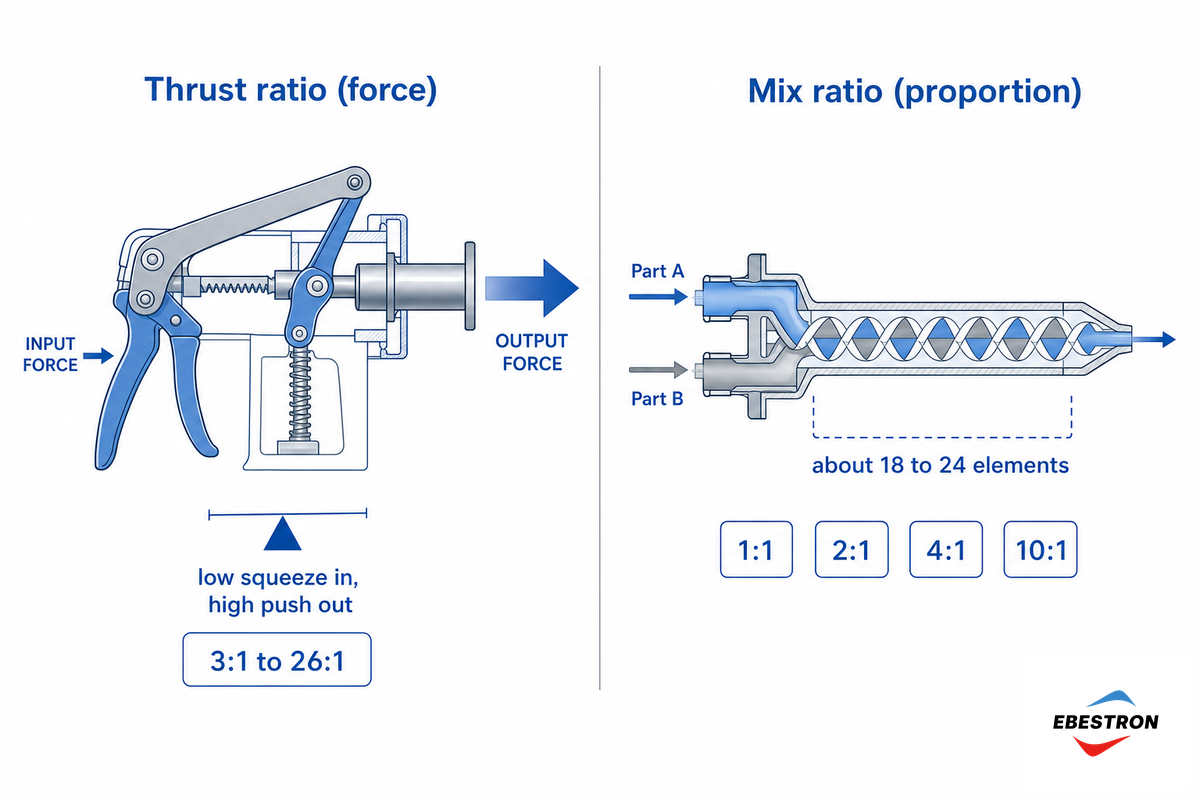
A caulk gun can’t complete a double-component process for two main reasons, thrust ratio and mix ratio; they’ve been historically conflated, and are distinctly different things.
Thrust ratio is about force. At 26:1, a gun multiplies your grip so a high-viscosity sealant flows with a light squeeze. Worked example: if a thin silicone runs fine on a 6:1 gun but a cold polyurethane stalls, moving to an 18:1 or 26:1 ratio gives the extra push without changing your hand effort, you match the ratio to the material, not to a “bigger is better” rule. Here’s the Thrust-to-Viscosity Force Gap: raw force helps a thick bead flow, but it does nothing to proportion two parts. A caulking gun can push hard and still have no way to meter resin against hardener.
Mix ratio is about proportion. Inside a 2-K cartridge, the volume of Part A is fixed against Part B, 1:1, 2:1, 4:1, or 10:1, and the static mixer’s internal elements, commonly 18 to 24 of them, fold the two streams together as they pass. Suppliers identify the mix ratio by the part number, not by color. On Sulzer Mixpac and medmix systems an “X” in the code (MAHX, MBHX, MCHX) marks the high-ratio 4:1 and 10:1 mixers, while the housing color mostly tracks the cartridge line rather than the ratio. Match the mixer to your cartridge’s stated ratio, never to color alone. Get the ratio or the mixing wrong and the adhesive stays soft; an inaccurate mix ratio and incomplete mixing are the two most common causes of a weak, uncured bond. Lap-shear tests of a properly mixed two-part epoxy confirm the bond only develops at the correct ratio (U.S. National Science Foundation).
| Mix ratio | Typical use | Mixer element note |
|---|---|---|
| 1:1 & 2:1 | Many epoxies, MMA, acrylics | Standard code, no “X” (e.g. MAH) |
| 4:1 & 10:1 | PU and high-disparity systems | High-ratio “X” code (e.g. MAHX) |
📐 Engineering Note
Structural adhesive joints are qualified by lap-shear tests such as ASTM D1002 and ISO 4587, which pull a single-lap metal-to-metal bond to failure. Structural adhesives commonly reach roughly 1000–4000 psi (about 6.9–27.6 MPa) of shear strength, depending on chemistry and substrate, but only when the two parts are mixed at the correct ratio. A static mixer with too few elements, or a skipped purge, leaves streaks of unmixed component that never reach that strength.
Single-Component Sealing vs Two-Component Structural Bonding
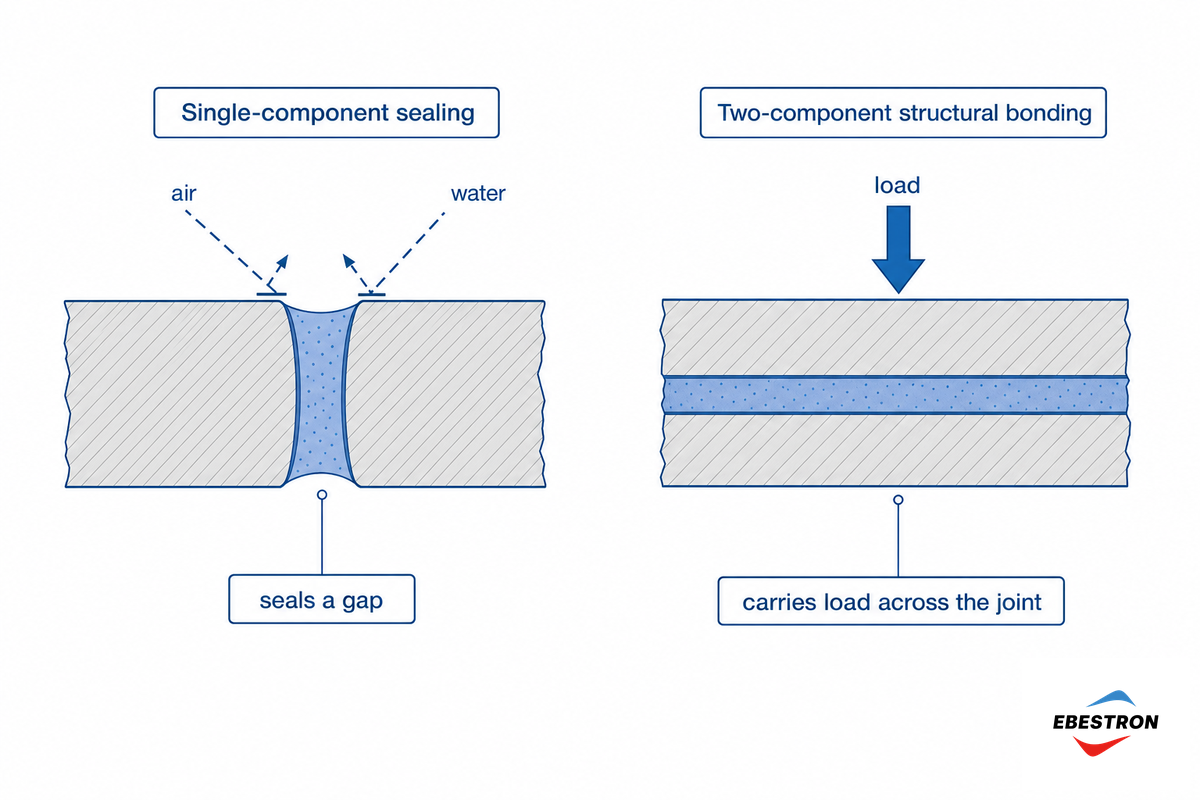
The clearest way to choose is by what the joint has to do. Single-component caulk and sealant, silicone, acrylic, hybrid, or one-part polyurethane, seal a gap against air, water, and movement, and cure slowly from the surface inward as they meet moisture in the air. Two-component structural adhesives, epoxy, polyurethane, MMA, and reactive acrylic, cure by chemical reaction the instant the parts combine, and they carry load across the bonded area. That load-bearing behavior is what double-shear lap-joint testing measures (National Library of Medicine).
Take a fabricator who has to bond a stainless panel to a frame, where the joint has to flex and still carry load. Grab the caulk gun out of the drawer and you will lay a pretty bead that comes apart under load, because a single-component sealant is not a structural adhesive. For that job you reach for a 2-K gun and a properly mixed two-part epoxy on a static mixer, so the bond cures to full strength and spreads the load across the whole joint, not just a few fasteners. Don’t just grab the gun on top, match the tool to the type of joint.
| Material type | Components | Right gun |
|---|---|---|
| Silicone sealant | 1 | Caulking gun |
| Acrylic (latex) caulk | 1 | Caulking gun |
| Hybrid / MS-polymer sealant | 1 | Caulking gun |
| One-part polyurethane sealant | 1 | Caulking gun |
| Butyl / solvent sealant | 1 | Caulking gun |
| Two-part epoxy adhesive | 2 | 2-K dispensing gun |
| Two-part polyurethane adhesive | 2 | 2-K dispensing gun |
| Methyl methacrylate (MMA) | 2 | 2-K dispensing gun |
| Two-part reactive acrylic | 2 | 2-K dispensing gun |
| Two-part silicone (RTV-2) | 2 | 2-K dispensing gun |
✔ Caulking gun — strengths
- Cheap, simple, sold everywhere
- Fast for sealing gaps and joints
- Capped cartridge stores for weeks
⚠ Caulking gun — limitations
- Can’t meter or mix two parts
- No structural, load-bearing bond
- Wrong tool for epoxy, MMA, or 2-K PU
How to Choose: The Seal-or-Bond Job Test
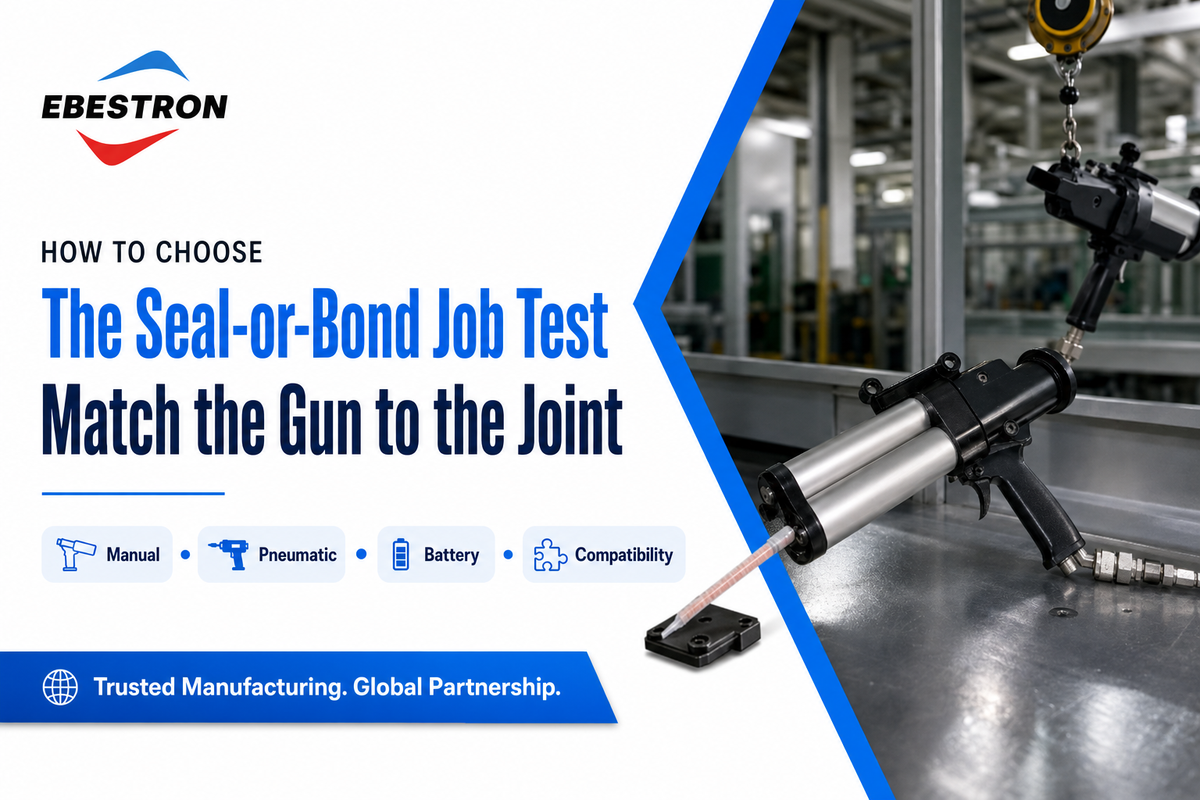
Before you pick a gun, run the Seal-or-Bond Job Test: ask what the joint must do. If the job is to seal a gap against air or water, reach for a caulking gun and a single-component sealant. If the job is to bond two surfaces that carry load, you need a two-component adhesive dispensing gun with a matched dual cartridge and static mixing nozzle. That one question routes most decisions.
Electric or pneumatic, which 2-K dispensing gun is better?
Duty and workspace decide. For low-to-medium volume bonding, a manual cartridge dispensing gun is precise and portable. For long high-viscosity runs on a line, a pneumatic dispensing gun gives steady force and a uniform bead without hand fatigue, given a compressor. Battery guns sit between, with motorized force and full mobility.
Compatibility checklist before you buy a 2-K gun
- Have your adhesive: match the cartridge ratio (1:1 through 10:1).
- Choose the same cartridge size (50, 200, 400 or 600 ml) & brand system
- Confirm the static mixer interface fits the cartridge
- Select the drive: manual, pneumatic, or battery, based on the volume and workspace requirements
Industry Outlook: Cordless Caulk Guns and the Rise of 2-K Bonding
These two tool families are pulling in opposite directions, and buyer expectations are shifting with them. In the hands of consumers, caulk gun use has become electric; new cordless and battery-powered models that feature auto-reversing action, drip-free dispensing and other “smart” benefits are by far the fastest growing segment and even as far out as 2025, searches for the term battery caulk gun as well as dripless caulking gun are trending up sharply. Even budget cordless guns now ship with auto-reverse and drip-free dispensing, features that used to cost extra.
On the professional side, the driver is structural. Electric-vehicle and automotive lightweighting is pushing manufacturers to bond mixed materials, aluminum, steel, and composite, where welding falls short, and two-component structural adhesives are central to joining battery packs and body panels (Assembly Magazine). That demand favors metered, repeatable 2-K dispensing, which is why pneumatic and battery dual cartridge guns keep gaining ground over manual ones for line work.
“Choosing a static mixer to mix and dispense two-component adhesives requires more than reading a sales catalog and selecting a part number.”
For context, analysts size the broader adhesive dispensing equipment market in the tens of billions of dollars, with single-digit growth through the early 2030s. The real value for a buyer, though, is the shift to metered, repeatable bonding, not the headline market number. If you’re designing for 2026, plan around both – a dependable, ergonomic sealing caulking gun and a matched 2-K dispensing system for any load bearing joint.
Frequently Asked Questions
Do you need a cartridge gun for caulk?
View Answer
For standard caulk in a 10 oz tube, a basic cartridge caulking gun is all you need, and it is the format almost every sealant brand uses. You only need a different gun if your sealant comes as a 400–600 ml sausage pack or in bulk, or if the job is a two-component adhesive, which requires a 2-K dispensing gun with a static mixer rather than any single-component caulking gun.
Is a sealant gun the same as a caulking gun?
View Answer
Yes. Sealant guns and caulking guns are the same single-component tool; the label depends only on whether the tube is sold as caulk or sealant. The meaningful difference is between a one-component gun and a two-component dispensing gun, because only the 2-K gun can meter and mix two reactive parts together through a static mixing nozzle.
What is the difference between a caulking gun and a two-component dispensing gun?
View Answer
Caulking guns push one ready-mixed sealant from a single barrel. Two-component dispensing guns push two parts — resin and hardener — from twin barrels through a static mixing nozzle at a fixed ratio, so they react and cure into a structural bond. One seals a gap against air and water; the other bonds two surfaces that carry structural load.
Can you use a caulking gun for two-part epoxy?
View Answer
Only if the epoxy comes in a dual cartridge with a matched static mixer — and then you are really using a 2-K gun. Plain caulking guns cannot meter or mix two parts, so the result is off-ratio and uncured.
What silicone gun do professionals use?
View Answer
For silicone and other single-component sealants, professionals choose a smooth-rod, drip-free caulking gun with a thrust ratio matched to the material, often 12:1 to 26:1 for control on thicker sealant, or a battery gun for long days. Silicone is a one-part material, so it never needs a two-component dispensing gun; the 2-K gun only comes in for structural bonding with a two-part adhesive such as epoxy or MMA.
Electric or pneumatic, which 2-K dispensing gun is better?
View Answer
Pneumatic guns suit high-volume line work with a compressor on hand; battery guns suit mobile work where steady motorized force matters more than uptime. Manual guns remain best for precise, low-volume bonding.
Need the right tool for a two-component adhesive?
Ebestron supplies various sizes of two component adhesive packaging and dispensing consumables, dual cartridges, static mixing nozzles, and dispensing guns matched by ratio and size. Just tell us your chosen adhesive and cartridge size and we’ll give you a compatible matching system.
About This Comparison
Ebestron manufactures and sells two-component adhesive packaging and dispensing systems, including dual cartridges, static mixing nozzles, and dispensing guns compatible with popular Mixpac, Cox, and Nordson brands. This guide was created to answer a familiar question we get from buyers: why is a professional 2-K cartridge gun not in the same class as the caulking gun I buy in the hardware store? The specifications here are industry-standard ranges, not proprietary figures. Reviewed by the Ebestron technical team.
References & Sources
- Rigid and Flexible Double-Shear Lap Adhesive JointsNational Library of Medicine (PMC)
- Composite Adhesive Joints with a Two-Part Structural EpoxyU.S. National Science Foundation (PAR)
- Types of Joining Methods: Adhesively Bonded StructuresUnion College
- Investigation of Adhesive Joints (ASTM D1002 / D3165)Wichita State NIAR / FAA
- Structural Adhesive, an overviewScienceDirect Topics
- Understanding Two-Component AdhesivesAdhesives & Sealants Industry
- Dispensing: How to Choose a Static MixerAssembly Magazine
- US 5,104,005, Dual Component Mechanically Operated Caulking GunGoogle Patents
Related Articles
- 18-Element vs 24-Element Static Mixershow mixer element count affects bond quality
- Static Mixing Nozzle Typesmatching the nozzle to the cartridge and ratio