Contacte a Ebestron


Especificações rápidas
| Tamanhos dos cartuchos | 50-600 mL (gama pneumática Ebestron) |
| Proporções de mistura | 1:1, 2:1, 10:1 |
| Pressão de ar regulada | 80-100 psi (5,5-6,9 bar); limite de 120 psi (8,3 bar) para pistolas 2K manuais |
| Consumo de ar habitual | Cerca de 2-3 SCFM por ciclo nos tamanhos de cartucho mais comuns (valor calculado, não uma especificação fixa — ver abaixo) |
| Limite de pressão do ar de limpeza (OSHA) | Inferior a 30 psi (2,1 bar), com proteção contra aparas e equipamento de proteção individual (29 CFR 1910.242(b)) |
As pistolas pneumáticas doseadoras de cartuchos transformam o ar comprimido da oficina num cordão regular e constante de adesivo bicomponente, mas a pistola é apenas metade do sistema pneumático. A capacidade do cordão para manter a proporção de mistura ao longo de cada turno ou para se desviar ao fim de três semanas depende tanto do compressor e da linha de ar que o liga à pistola como da própria pistola. A maioria dos guias de compra fica-se pela pistola; este guia aborda o que vem a seguir: como dimensionar o compressor, instalar a linha de ar, manter os vedantes e reguladores ajustados e determinar se um cordão irregular se deve ao fornecimento de ar ou a um problema na própria pistola.
A pistola pneumática doseadora de cartuchos requer ar filtrado a uma pressão regulada (80-100 psi), um compressor dimensionado para as necessidades reais de ar de cada ciclo da aplicação — e não apenas para o valor nominal em CFM — e um conjunto de filtro, regulador e lubrificador que impeça a entrada de humidade e partículas na válvula. Se algum destes requisitos não for cumprido, os sintomas — um cordão irregular ou inconsistente — podem parecer não ter relação com o sistema de ar.
Pontos-chave
- Nenhum fabricante publica valores de «CFM» para pistolas doseadoras de cartuchos; o consumo tem de ser calculado a partir do volume do cilindro e do tempo de ciclo.
- Comprar um compressor de ar com capacidade superior à necessária «por precaução» é um erro comum e dispendioso, não uma medida sensata de segurança.
- A limpeza de uma pistola ou linha de ar com ar comprimido é regida por uma norma da OSHA específica para a utilização de ar (29 CFR 1910.242(b)), e não pela regra geral sobre locais de trabalho perigosos, frequentemente citada em materiais de compra.
- Quando o cordão de adesivo doseado não apresenta o desempenho esperado, muitas vezes a causa está no fornecimento de ar — e o problema costuma exigir uma abordagem diferente da de uma avaria da pistola.
O que é uma pistola pneumática doseadora de cartuchos (e o que abrange este guia)
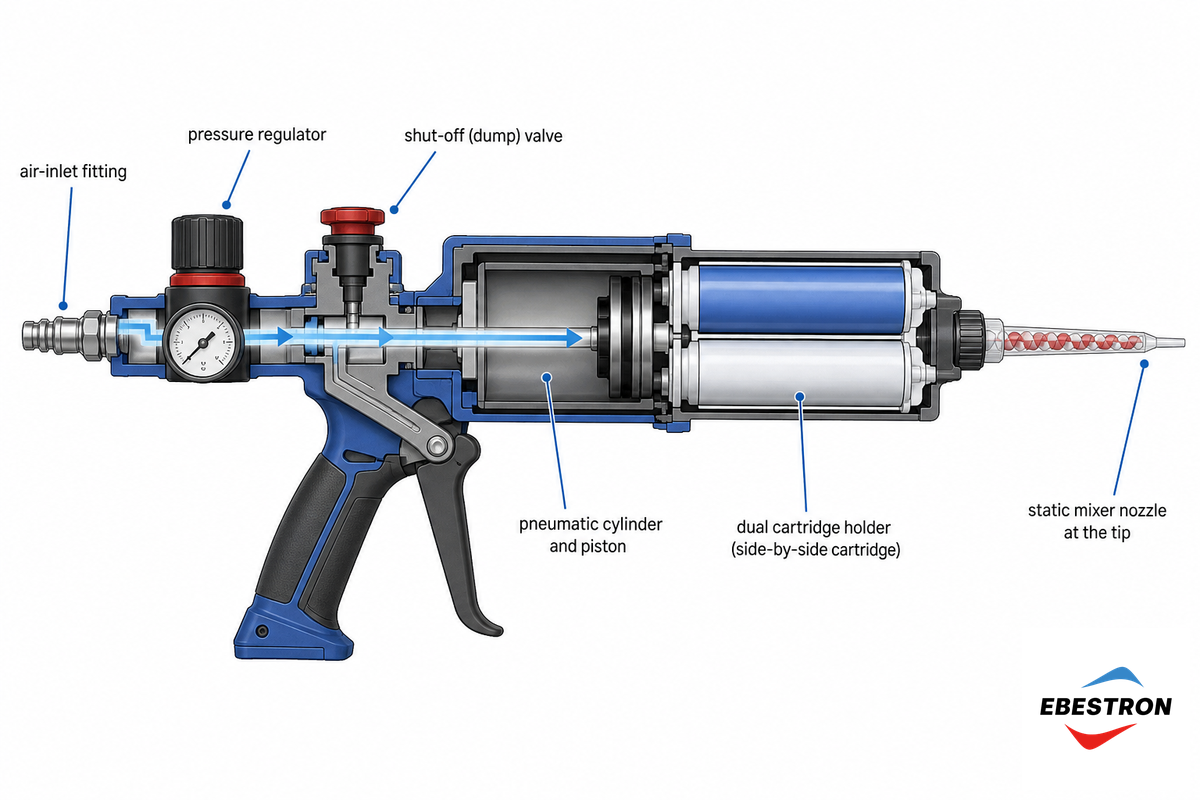
Uma pistola pneumática doseadora de cartuchos é uma ferramenta de aplicação manual que utiliza ar comprimido da oficina, em vez de uma fonte de alimentação elétrica ou de um gatilho acionado manualmente, para movimentar os êmbolos dos dois lados de um cartucho de adesivo bicomponente e aplicar o material numa proporção constante através de um misturador estático.
Este ar comprimido substitui a força manual, proporcionando maior consistência e controlo da aplicação. Por esse motivo, as pistolas doseadoras pneumáticas são comuns em oficinas onde se aplicam grandes volumes de adesivo ou onde o material é demasiado viscoso para ser aplicado manualmente. Em alguns mercados, esta categoria continua a ser designada por pistola pneumática para selantes, embora essa designação esconda uma distinção importante abrangida pelas regras gerais de segurança da ISO 4414:2010 para sistemas pneumáticos de potência fluida: uma pistola para selante monocomponente não tem forma de manter dois componentes na proporção de mistura correta, enquanto a função de uma pistola para cartucho 2K é dosear ambos os componentes em simultâneo. A Ebestron fabrica internamente as suas pistolas pneumáticas, os cartuchos duplos e os misturadores estáticos, ao abrigo de um sistema de qualidade em conformidade com CE/RoHS, em vez de adquirir estes três componentes separadamente. Por isso, a compatibilidade entre eles é garantida, em vez de ser presumida.
Este guia de compra parte do princípio de que já decidiu se uma pistola pneumática doseadora de cartuchos é adequada para a sua oficina. Para informações detalhadas sobre sistemas pneumáticos em comparação com pistolas para epóxi de acionamento manual ou a bateria, consulte os nossos guias Comparação entre pistolas pneumáticas, manuais e a bateria e Guia de compra de pistolas para epóxi com 3 tipos de acionamento. Aqui, respondemos às restantes questões práticas sobre a utilização da sua pistola pneumática doseadora de cartuchos Ebestron, incluindo as necessidades reais de ar, a instalação correta da linha de alimentação, a manutenção necessária para um funcionamento fiável a longo prazo e a distinção entre uma falha do sistema de ar e um problema na pistola.
Como funcionam as pistolas pneumáticas para cartuchos: regulador, válvula de corte e força de impulsão
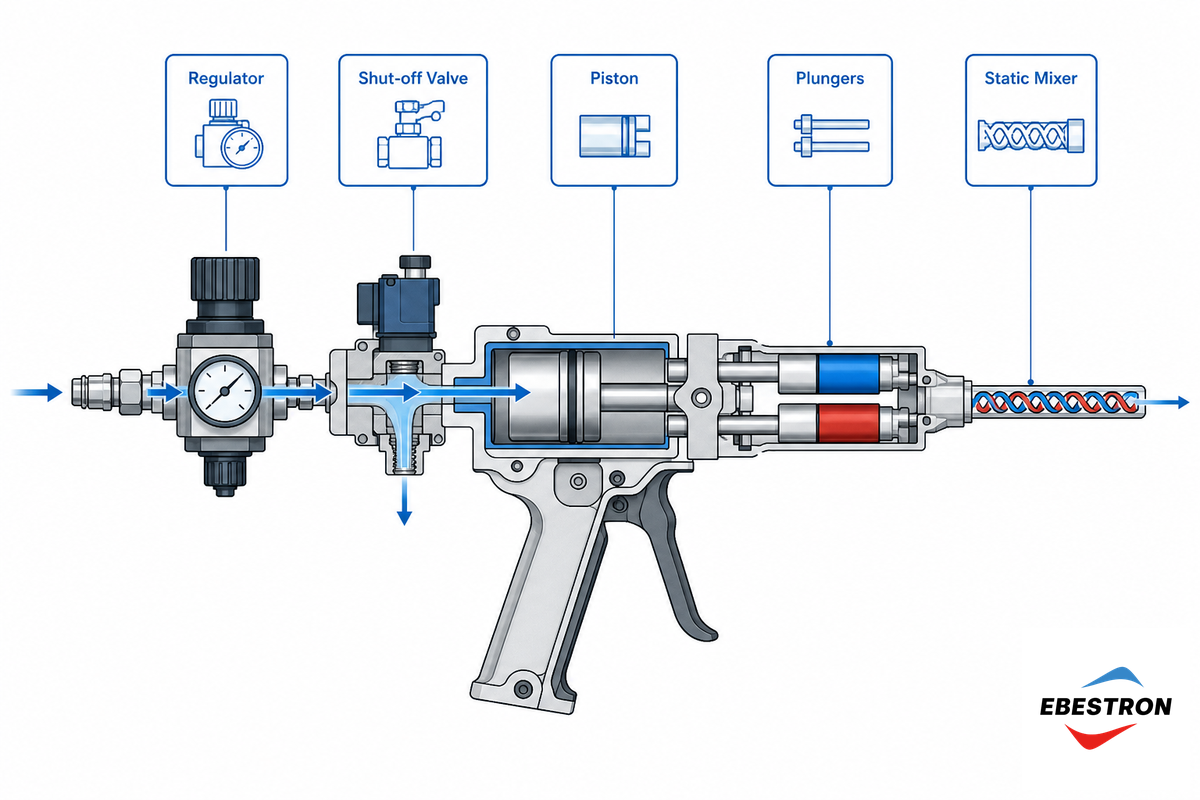
O ar entra na pistola através de um encaixe, passa por um regulador ajustável que controla a pressão de trabalho e, depois, por uma válvula de corte (descarga de ar) até chegar a um cilindro. Aí, atua sobre um êmbolo que empurra em simultâneo os dois êmbolos do cartucho, na proporção definida pelo conjunto de êmbolos.
Sem essa válvula de corte, instalada entre o regulador e o êmbolo, a pressão residual na linha continuaria a empurrar o êmbolo durante um ou dois instantes depois de o operador largar o gatilho. Isso provocaria um gotejamento ou uma acumulação alongada no fim do cordão. Se esta distinção passar despercebida na oficina, é fácil diagnosticar mal a falha: atribui-se um cordão fraco ou inconsistente a um lote de cartuchos defeituoso, trocam-se cartuchos durante semanas e a verdadeira causa — um regulador que perdeu a calibração — nunca é corrigida.
Isto não é uma coincidência de engenharia — está patenteado. Patente dos EUA 9 862 001 B2, da Sulzer Mixpac/Medmix, descreve um mecanismo de acionamento de doseamento com velocidade constante que inclui a mesma retração temporária do êmbolo após a libertação do gatilho, presente em praticamente qualquer pistola 2K do mercado para evitar pingos.
📐 Nota de engenharia
Pressão do regulador e relação de força de impulsão (são dois valores distintos, mas ambos são importantes). A primeira é a pressão do ar que passa pelo sistema: os reguladores normalmente utilizados com pistolas doseadoras manuais 2K indicam 80-100 psi (5,5-6,9 bar), e 120 psi (8,3 bar) parece ser aproximadamente o limite superior do intervalo eficaz. A segunda, definida pelo mecanismo da própria pistola doseadora, é o que amplifica essa pressão no êmbolo. Uma pistola doseadora com uma relação de força de impulsão de 18:1, ligada a uma alimentação de ar regulada a 90psi, exerce muito menos força efetiva na ponta do êmbolo do que uma unidade 26:1 à mesma pressão. Aumentar a pressão do regulador acima dos limites indicados para o misturador e o cartucho não acelera o processo. Aumenta a probabilidade de rachar o cartucho ou danificar o vedante do misturador.
Dimensionamento do compressor de ar: CFM, tamanho do depósito e ciclo de funcionamento
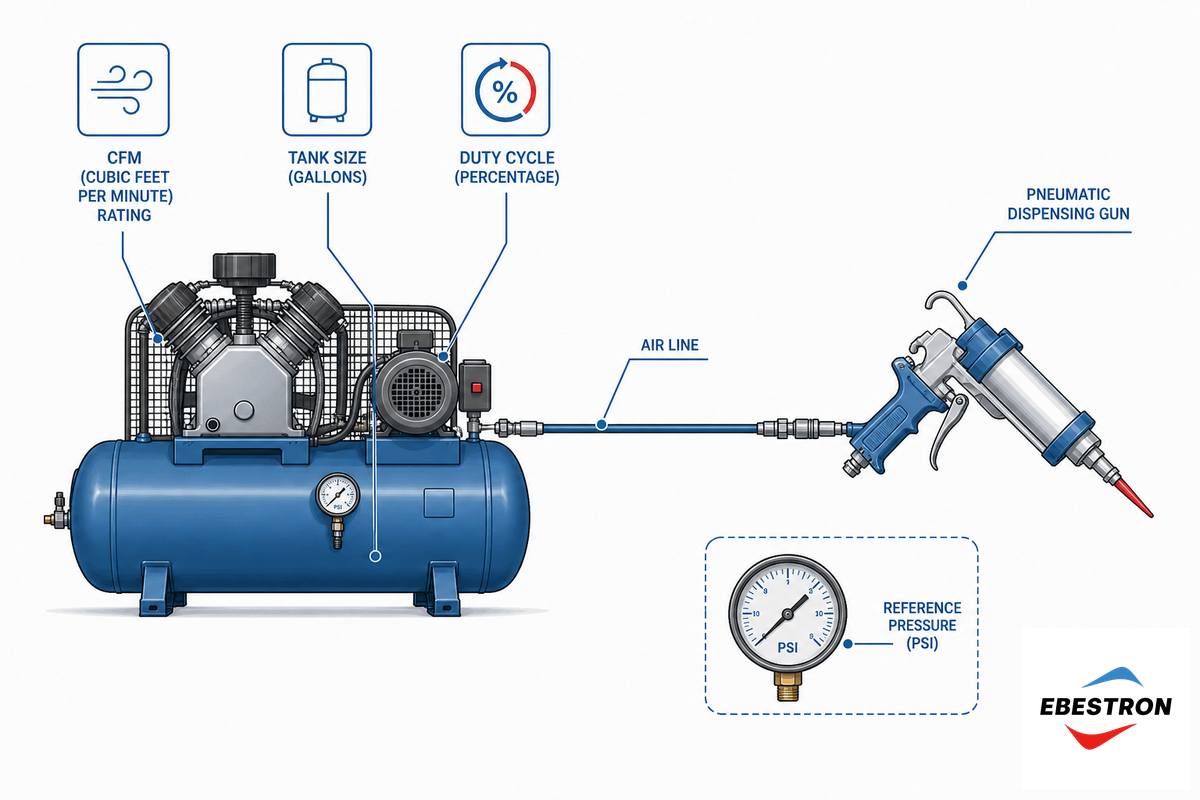
Eis um facto que surpreende muitos compradores: nenhum fabricante de pistolas para cartuchos publica um valor em CFM para as suas pistolas pneumáticas doseadoras — ao contrário do que acontece com uma chave de impacto ou uma retificadora de matriz, que indicam esse valor. Uma pistola doseadora não é uma ferramenta de fluxo contínuo: o consumo de ar ocorre em breves impulsos, no microssegundo em que o êmbolo avança em cada aplicação. Por isso, é necessário calcular a necessidade real com base no deslocamento do cilindro e na frequência de aplicação, e não no valor nominal.
As fontes do setor descrevem o cálculo subjacente como uma fórmula padrão de consumo de ar para cilindros pneumáticos: SCFM = 2 × (área do êmbolo × comprimento do curso) × ciclos por minuto × fator de compressão, dividido por 1 728 polegadas cúbicas por pé cúbico, sendo o fator de compressão (pressão da linha + 14.7) ÷ 14.7. Um exemplo frequentemente citado em referências de engenharia pneumática indica que um cilindro com diâmetro interno de 2 polegadas e curso de 4 polegadas, a 30 ciclos por minuto e 80 psi, requer cerca de 2.81 SCFM de ar livre. Embora o êmbolo da pistola para cartuchos seja muito mais pequeno, aplica-se o mesmo princípio. Assim, utilizando os valores reais do diâmetro interno e do curso da sua pistola (indicados na ficha técnica) e o número efetivo de aplicações por minuto, pode calcular o consumo real em vez de o estimar.
| Tipo de aplicação | Volume diário | Ciclo de funcionamento | Compressor recomendado | Regra prática para dimensionar o depósito |
|---|---|---|---|---|
| Bancada de laboratório/prototipagem | Menos de 10 cartuchos | Esporádico | Pequeno, de um estágio (classe de 1,5-2 HP) | Cerca de 1 gallon de capacidade do depósito por cada CFM de caudal do compressor |
| Bancada de produção ligeira | 10-30 cartuchos | Intermitente | Pequeno, de um estágio (classe de 2-3 HP) | Cerca de 1 gallon por CFM |
| Bancada de produção média | 30-100 cartuchos | Contínuo, numa única linha | Médio, de um estágio (classe de 5 HP) | Cerca de 2 gallons por CFM para uma regulação mais estável |
| Produção intensiva com uma pistola | 100+ cartuchos | Contínuo, numa única estação | 5-7,5 HP, de um estágio, ou pequeno, de dois estágios | Cerca de 2-3 gallons por CFM |
| Célula com várias pistolas (2 pistolas) | 150-250 cartuchos no total | Contínuo, com linha partilhada | Compressor partilhado, dimensionado para o SCFM combinado e com margem de capacidade | Cerca de 2-3 gallons por CFM |
| Célula com várias pistolas (3-4 pistolas) | 300+ cartuchos no total | Contínuo, com várias estações | Compressor dedicado à oficina, com tomadas individuais de ar | Até 3 gallons por CFM (recomendação do DOE) para compensar a procura simultânea |
| Linha de colagem de painéis automóveis | Adesivo estrutural, de alta viscosidade | Contínuo, ao ritmo da linha | Compressor de médio a grande porte, de um estágio, dimensionado para o tempo de ciclo da linha | Cerca de 2-3 gallons por CFM |
| Bancada de encapsulamento de componentes eletrónicos | Doseamento preciso, de baixo a médio volume | Intermitente, com elevada exigência de precisão | Pequeno compressor de um estágio, com regulação precisa; de preferência, sem óleo | Cerca de 1-2 gallons por CFM |
| Ancoragem na construção, em oficina ou no local de trabalho | Variável, com resina de ancoragem de alta viscosidade | Intermitente, portátil | Compressor portátil de um estágio, compatível com a alimentação elétrica disponível no local de trabalho | Cerca de 1-2 gallons por CFM |
Se utilizar uma pistola com um consumo médio de 2.8 SCFM e dosear ar de forma intermitente, em vez de funcionar continuamente a 2.8 SCFM, um compressor pequeno de um estágio, talvez com uma capacidade nominal de 4-5 SCFM a 90 psi e um depósito de ar modesto, será suficiente. A sua única função será repor o ar entre aplicações, em vez de fornecer continuamente 2.8 SCFM. Se ligar outra pistola à mesma linha de alimentação, deve contar com uma capacidade média de fornecimento de ar aproximadamente duas vezes superior. Em geral, isso significa escolher um compressor um escalão acima, em vez de tentar utilizar duas pistolas perto dos limites de um compressor pequeno.
⚠️ Importante — maior não significa automaticamente mais seguro
Muitos sentem-se tentados a comprar simplesmente a unidade maior que o orçamento permite, «por precaução». No entanto, quem realiza auditorias a sistemas de ar comprimido em muitas fábricas sabe que o sobredimensionamento é um problema real, comum e dispendioso. Comprar uma unidade de 50 HP quando uma de 25 HP seria mais do que suficiente pode custar milhares de dólares por ano em eletricidade, pois um compressor maior consome mais energia em toda a gama de funcionamento. Para escolher o compressor, é essencial considerar o SCFM e o ciclo de funcionamento e, se necessário, acrescentar um reservatório de ar ou um variador de frequência para responder a picos ocasionais de procura. Não se deve sobredimensionar ao ponto de desperdiçar energia. O guia de referência do Departamento de Energia dos Estados Unidos sobre sistemas de ar comprimido explica em detalhe esta relação entre o dimensionamento correto e o sobredimensionamento, muito além do que consta na ficha técnica de qualquer fornecedor de pistolas.
«Muitos fabricantes consideram boa ideia sobredimensionar o compressor de ar… Raramente compensa. Se a procura for muito variável, um acionamento de velocidade variável pode reduzir os custos de energia ao diminuir a velocidade do motor quando a procura é baixa — mas, mesmo nesse caso, geralmente não faz sentido comprar um compressor dimensionado para picos de procura raros.»
— Brad Taylor, Fluid-Aire Dynamics
Instalação da linha de ar: filtro, regulador, lubrificador e separador de humidade
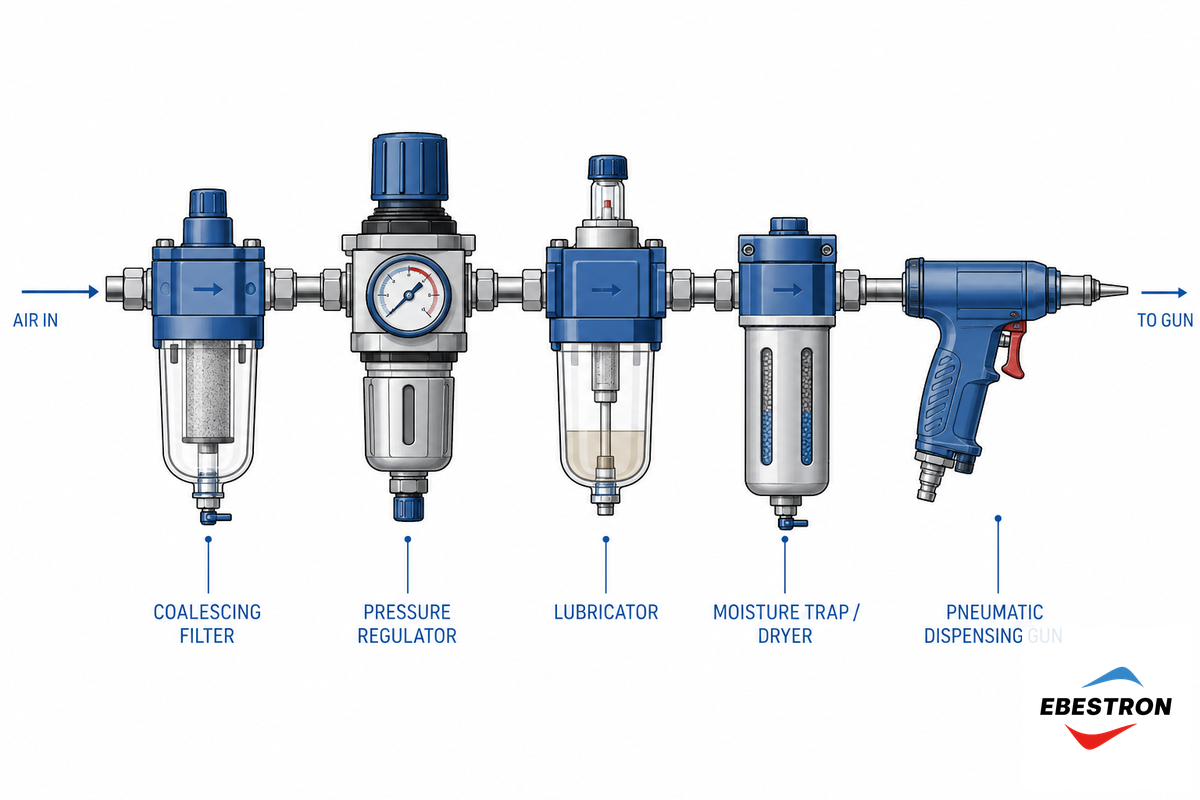
O compressor é apenas parte da solução. Os componentes entre o reservatório de ar e a pistola — a linha, os filtros e os reguladores — determinam se o ar que chega ao êmbolo está limpo, seco e à pressão pretendida ou se está sujo e húmido, provocando desgaste silencioso nas sedes do regulador e nas hastes da válvula de corte. Instalar o conjunto de filtro, regulador e lubrificador tão perto da pistola quanto a disposição do posto de trabalho permitir e ligar a pistola através de um adaptador de ligação rápida, em vez de um encaixe permanente, também facilita a substituição por uma segunda pistola pneumática quando a linha é partilhada.
| Componente | Função | Consequências se for omitido |
|---|---|---|
| Filtro coalescente | Retém partículas e humidade acumulada na linha | As partículas aceleram o desgaste da sede do regulador e do O-ring |
| Regulador | Define e mantém a pressão de trabalho, independentemente das flutuações a montante | A pressão varia com os ciclos do compressor e a espessura do cordão muda de uma aplicação para outra |
| Separador de humidade/secador | Remove a água condensada antes de esta chegar à pistola | A humidade corrói os componentes internos da válvula e pode chegar à interface do cartucho |
| Lubrificador (se especificado para a pistola) | Adiciona uma fina névoa de óleo para reduzir a fricção interna e o desgaste dos vedantes | Maior desgaste do vedante do êmbolo em pistolas concebidas para funcionar com lubrificação |
O maior problema é a humidade, precisamente por passar despercebida. Normalmente, não provoca fugas imediatas e visíveis; pode manifestar-se semanas depois, através de um regulador preso, de uma sede de válvula corroída ou de uma inconsistência inexplicável entre aplicações. Além disso, o aumento da perda de pressão causado por uma linha de ar parcialmente húmida pode parecer um sintoma de compressor subdimensionado. É mais uma razão para ser difícil perceber se os problemas são causados pela pistola ou pelo fornecimento de ar (ver o guia de resolução de problemas, mais adiante).
💡 Dica profissional
Os manómetros de pressão diferencial dos filtros são normalmente calibrados para o caudal nominal.
Um filtro de ar parcialmente obstruído pode apresentar uma restrição mínima com um caudal baixo e, ainda assim, interromper o fornecimento de ar assim que a procura aumenta. Por isso, deve ser verificado regularmente com base nas horas de utilização, e não apenas nas leituras do manómetro.
Quem abre regularmente uma linha de ar — para soprar um encaixe ou limpar uma ligação com a pistola de ar — deve ter em conta que a OSHA tem um regulamento para a utilização de ar comprimido na limpeza de equipamento (29 CFR 1910.242(b)). Este limita a pressão a menos de 30 psi quando a utilização inclui proteção contra aparas e equipamento de proteção individual. Esta regra é distinta das normas de classificação de locais perigosos, frequentemente citadas nas orientações dos fabricantes para a seleção de motores.
Plano de manutenção: vedantes, válvula do gatilho e calibração do regulador
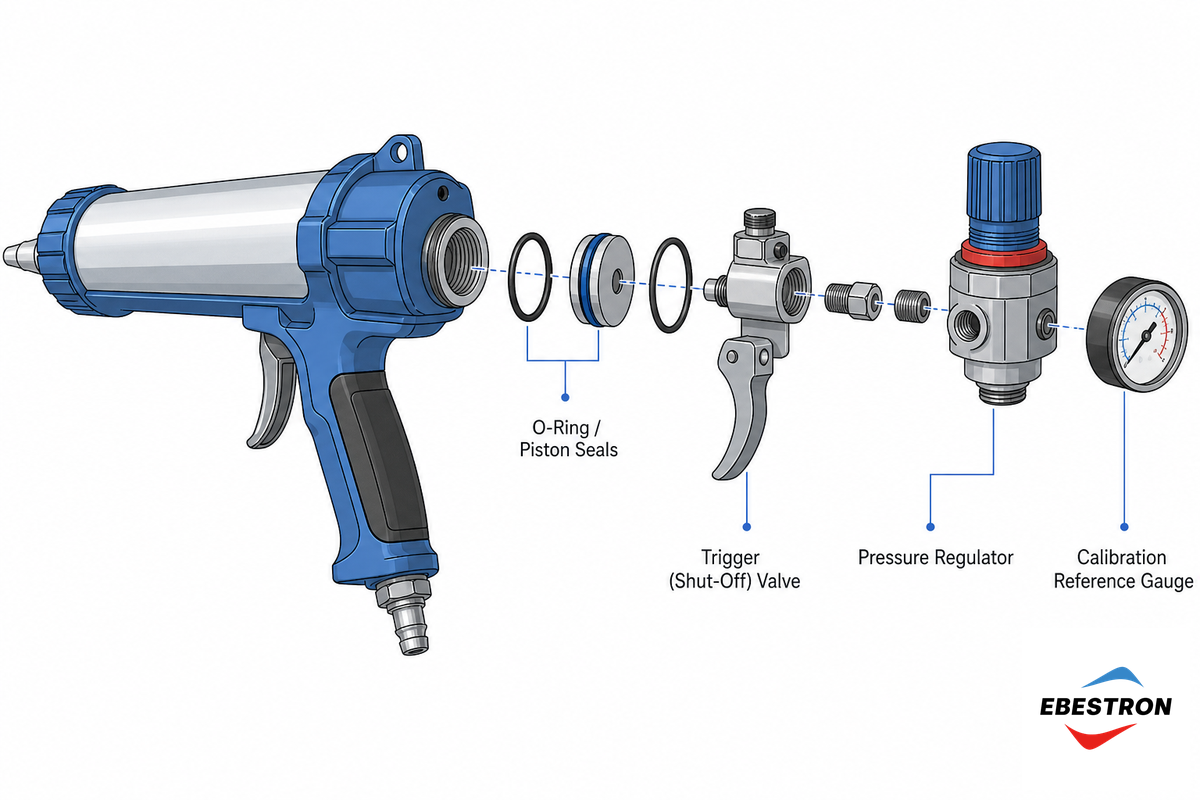
Nenhum organismo de normalização publicou intervalos de manutenção específicos para pistolas doseadoras de cartuchos. Os intervalos abaixo baseiam-se em procedimentos habituais de manutenção de ferramentas pneumáticas e sistemas de ar comprimido; não provêm de um manual especificamente destinado a pistolas de aplicação de adesivos. O documento mais próximo de uma referência aplicável é a ISO 4414:2010, Potência fluida pneumática — Regras gerais e requisitos de segurança, que define as expectativas gerais de manutenção e inspeção de sistemas pneumáticos sem mencionar esta categoria específica de ferramentas. Considere o plano abaixo uma lista de verificações básica, a adaptar às condições de funcionamento, e não uma especificação rígida do fabricante.
| Elemento | Intervalo habitual | O que verificar |
|---|---|---|
| Limpeza e inspeção visual | A cada turno/após cada trabalho | Resíduos de adesivo no êmbolo e no mecanismo do gatilho |
| Inspeção do filtro/regulador | Trimestralmente (cerca de 3 meses) | Pressão diferencial, humidade no copo e desvio do regulador em relação ao ponto de regulação |
| Substituição do O-ring/vedante | 3-6 meses | Desgaste do vedante do êmbolo e fugas de ar através do vedante |
| Vedante do veio/retentor de óleo (se aplicável) | 6-12 meses | Substituir mais cedo ao primeiro sinal de fuga |
| Revisão geral completa | Anualmente | Calibração do regulador com um manómetro de referência e inspeção completa da válvula |
Se o cordão da pistola se tiver desviado do valor inicial definido durante a colocação em serviço, um regulador mal ajustado é uma das causas mais comuns e frequentemente ignoradas. Antes de suspeitar de uma avaria na pistola ou no cartucho, é preferível verificar o regulador com um manómetro de referência calibrado. A maioria dos trabalhos nos O-rings e vedantes requer apenas a desmontagem parcial do corpo da pistola: retire o conjunto da válvula do gatilho, substitua as peças desgastadas e volte a montar. Raramente é necessário desmontar completamente a pistola numa oficina de reparação ou enviá-la ao fornecedor para assistência.
Resolução de problemas específicos das pistolas pneumáticas: a causa está no ar ou na pistola?
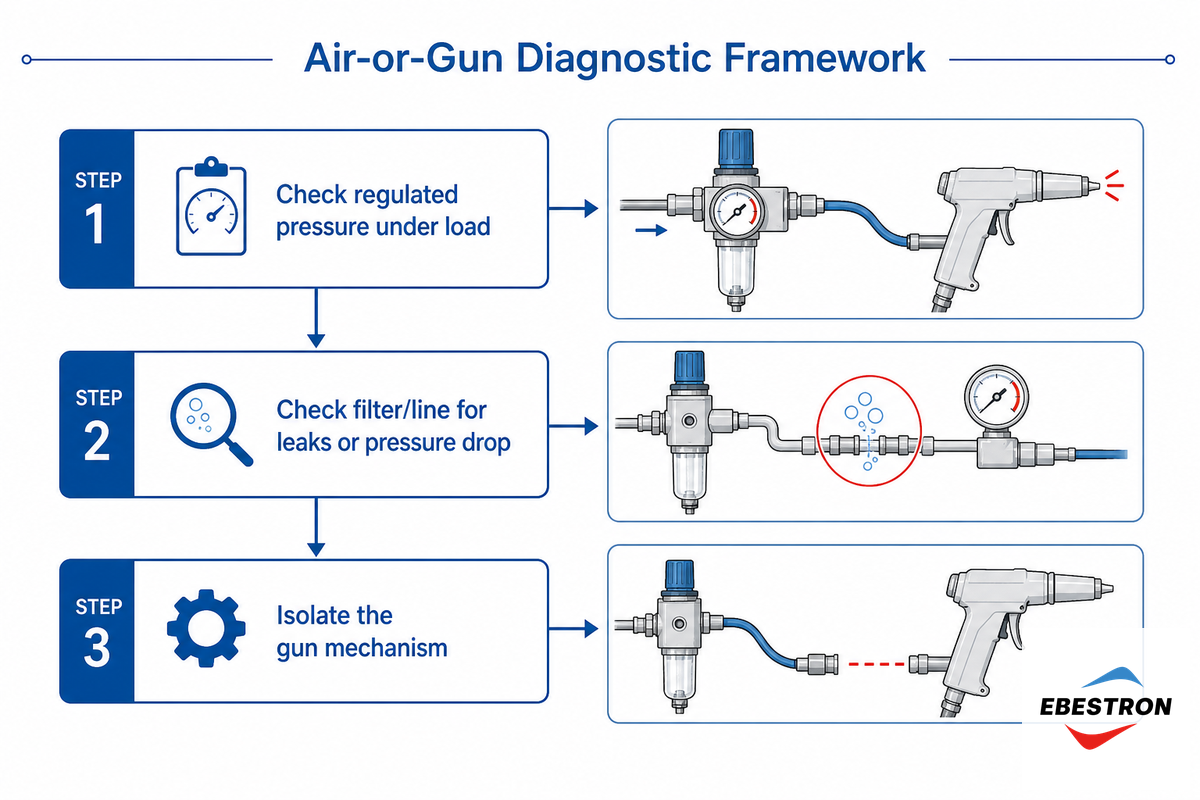
Quando uma pistola pneumática para cartuchos começa a funcionar mal, é natural suspeitar da pistola ou do cartucho. Muitas vezes, porém, a causa está mais acima, no sistema de fornecimento de ar, e a solução varia significativamente conforme a origem da falha no circuito de ar. Antes de pegar nas ferramentas, utilize o método de diagnóstico em 3 pontos abaixo para determinar se o problema está no ar ou na pistola.
Método de diagnóstico em 3 pontos: ar ou pistola
As 3 verificações que permitem distinguir um problema no fornecimento de ar de um problema na pistola ou no cartucho são a pressão da linha de ar com a pistola em carga, o comportamento da válvula de corte quando se larga o gatilho e o estado do filtro e do equipamento de separação de ar e humidade. Todas devem ser feitas no sistema de fornecimento de ar antes de abrir a pistola.
| Sintoma | Verifique primeiro (circuito de ar) | Se o circuito de ar estiver em boas condições (pistola/cartucho) |
|---|---|---|
| O cordão fica mais fino a meio do cartucho | Pressão na linha, junto à pistola e em carga — queda de pressão causada por um filtro obstruído ou uma linha subdimensionada | Vedante do êmbolo desgastado, com perda de força de impulsão |
| A pistola não doseia de todo | Verifique se o compressor está realmente a funcionar, se o regulador não está reduzido a zero e se a linha não está dobrada ou desligada | Misturador estático obstruído ou com o adesivo endurecido (não é um problema de ar — consulte o nosso guia sobre problemas de doseamento na pistola e no cartucho) |
| O adesivo goteja depois de largar o gatilho | A válvula de corte/descarga de ar retém pressão residual | Mecanismo antigotejamento desgastado no corpo da pistola |
| Cordão inconsistente ao longo de um turno, sem padrão claro | Humidade na linha e aumento da pressão diferencial do filtro que passou despercebido | Regulador descalibrado |
Em linha com relatos de utilização de pistolas pneumáticas para selantes e cartuchos, observámos uma comparação entre duas pistolas supostamente idênticas. Numa delas, o avanço do êmbolo por pressão no gatilho era apenas metade do avanço na outra. A diferença foi atribuída a uma disparidade na força de impulsão e na pressão do regulador, e não a um defeito no mecanismo da pistola. Quando a força produzida por dois conjuntos que deveriam ser idênticos parece inconsistente, verifique primeiro o circuito de ar para determinar se existe um problema mecânico.
Onde as pistolas pneumáticas continuam a ser a melhor opção: ciclo de funcionamento, viscosidade e instalações em zonas perigosas

Partindo do princípio de que conhece os princípios do sistema pneumático discutidos anteriormente, poderá perguntar-se se vale a pena manter o acionamento pneumático ou mudar para uma pistola a bateria. Há duas situações em que faz claramente sentido continuar a utilizar o sistema pneumático.
Uma dessas situações é a classificação das instalações do local de trabalho. As áreas perigosas, classificadas nos termos de 29 CFR 1910.307, estão sujeitas a restrições especiais quanto à utilização de aparelhos elétricos, incluindo equipamento normal alimentado por bateria, salvo se este tiver sido aprovado como intrinsecamente seguro ou à prova de explosão para utilização nessas áreas. O sistema pneumático evita por completo estas restrições, pois utiliza uma alimentação normal de ar comprimido e uma pistola sem motor nem bateria próprios; por conseguinte, a utilização de uma pistola pneumática é determinada pela conformidade das instalações, e não por preferência pessoal. Uma decisão errada tem custos reais em qualquer dos sentidos: uma instalação que adote pistolas elétricas a bateria numa área classificada de mistura de tintas ou solventes pode chumbar numa inspeção de segurança nos termos de 29 CFR 1910.307, enquanto equipar toda uma equipa móvel de campo com ar comprimido apenas acrescenta ao orçamento de investimento um compressor parado que ninguém utiliza.
O segundo fator a favor da continuidade dos sistemas pneumáticos é o ciclo de trabalho. As aplicações de grande volume e longa duração em postos fixos, como o trabalho em linhas de montagem, servidas por compressores e linhas de ar adequadamente dimensionados, estão perfeitamente ao alcance dos sistemas pneumáticos. Estes dispensam o incómodo de recarregar ou substituir baterias e permitem um funcionamento contínuo a partir de uma fonte de ar comprimido na extremidade de uma mangueira. Para aplicações remotas no terreno sem acesso a ar comprimido, uma pistola 2K elétrica a bateria é claramente preferível. Convém referir que alguns compradores que procuram uma pistola sem fios para selantes ou uma pistola elétrica para selantes procuram, na realidade, esta mesma categoria de pistolas 2K elétricas a bateria e ainda não perceberam que a sua ferramenta para selante monocomponente não mantém a proporção de mistura de 2 componentes. Para ajudar a escolher um sistema de acionamento, consulte a nossa comparação completa entre sistemas manuais, pneumáticos e elétricos a bateria.
Pronto para especificar o sistema, e não apenas a pistola?
As pistolas pneumáticas doseadoras de cartuchos fabricadas pela Ebestron foram concebidas para funcionar em conjunto com um sistema de compressor adequado, com cartuchos de 50-600 mL e proporções de mistura de 1:1, 2:1 e 10:1.
Peça amostras compatíveis com o seu sistema de ar →O custo real de utilização de uma pistola pneumática: exemplo prático de consumo de ar

Chamamos ao ar comprimido «o quarto serviço essencial» — e por boas razões: segundo fontes do setor, a energia representa cerca de 80% do custo total de propriedade de um sistema de ar comprimido. Uma parte considerável dessa energia perde-se sob a forma de calor durante o ciclo de compressão, em vez de ser utilizada para realizar trabalho na ferramenta. Por isso, o preço de uma pistola é apenas um pequeno detalhe em comparação. Pense numa oficina que nunca faz estas contas: a produção mantém-se estável, mas a fatura de energia continua a subir; sem um registo do tempo de funcionamento do compressor, é impossível distinguir um sistema bem regulado de um sistema com fugas. Se a unidade estiver a funcionar durante cerca de 30% do turno sem que nenhuma pistola esteja a dosear material — em linha com as estimativas do setor, segundo as quais as fugas, por si só, representam cerca de 30% do desperdício de ar comprimido numa oficina média —, isso é sinal de uma fuga não detetada ou de uma válvula presa na posição aberta algures na linha, e não dos cartuchos. É precisamente o modo de falha que as orientações do próprio DOE para sistemas de ar comprimido apontam como a maior fonte individual de desperdício de capacidade de produção numa fábrica.
Historicamente, o Departamento de Energia dos Estados Unidos (DOE) tem indicado custos de produção de ar comprimido entre 15 e 30 cêntimos por 1 000 pés cúbicos quando se desconhece o custo específico de uma instalação; com as tarifas de eletricidade atuais, fontes do setor situam muitos sistemas no intervalo de 25-35 cêntimos. Um cálculo publicado pelo DOE/ENERGY STAR do custo por CFM mostra como uma instalação pode apurar o seu próprio valor: custo anual de energia (potência do motor em HP × 0,746 × horas de funcionamento × tarifa de eletricidade ÷ eficiência do motor) dividido pelo volume anual de ar em milhares de pés cúbicos. Aplicando a fórmula a um compressor de 100 HP a funcionar 4 000 horas por ano, com uma tarifa de $0,10/kWh e eficiência do motor de 92%, que fornece 450 CFM, o resultado é cerca de $0,30 por 1 000 pés cúbicos.
📐 Exemplo prático — custo por cartucho
Considere o exemplo de consumo do cilindro de 2.81 SCFM referido no capítulo anterior sobre dimensionamento de compressores, uma tarifa de 0.30 $ por 1 000 pés cúbicos de ar na instalação e um cartucho que completa um ciclo a cada 20 segundos até dosear um cartucho de 400 ml totalmente cheio: o consumo é de cerca de 0.9 a 1.0 pés cúbicos de ar livre por cartucho. Isto representa apenas uma fração de cêntimo de custo de ar por cartucho. Porque passa este custo despercebido? O principal fator de custo do ar não é o consumo por cartucho, mas sim o desperdício contínuo de um sistema com fugas, sem regulação e sobredimensionado, que funciona o dia inteiro, todos os dias — é a isso que se referem os 80% do custo ao longo da vida útil. Por isso, se estiver a consultar anúncios de pistolas pneumáticas doseadoras de cartuchos à venda e a compará-las apenas pelo preço indicado da ferramenta, estará a comparar a parcela mais pequena de toda a equação.
Perspetivas do setor: porque o dimensionamento dos sistemas de ar continua a ser importante com o crescimento das pistolas elétricas a bateria

A principal tendência que observamos no equipamento de doseamento bicomponente é a transição para pistolas elétricas a bateria — por boas razões, como a ergonomia e a aplicação consistente do cordão, e não apenas pela novidade. Analisamos esta transição em maior detalhe no nosso guia de compra de pistolas epóxi com 3 tipos de acionamento. Ainda assim, isto não significa que a infraestrutura pneumática seja um beco sem saída. A classificação de risco das instalações e o ciclo de trabalho, e não o tipo de acionamento mais recente, determinam a escolha. Uma instalação classificada como área perigosa exclui dispositivos normais alimentados por bateria nos termos de 29 CFR 1910.307, independentemente do que esteja a acontecer no resto do mundo; uma aplicação fixa de elevado volume tira mais partido de um compressor e de uma linha de ar adequadamente dimensionados do que de uma sucessão de baterias a carregar. Para dar algum contexto de mercado, estima-se que o mercado global de equipamento de doseamento de adesivos tenha atingido cerca de $13 mil milhões em 2025 e esteja a caminho dos 20 mil milhões baixos em meados da década de 2030. Esta evolução não ocorre isoladamente, mas serve de contexto. As instalações que escolhem o acionamento com base na tendência mais falada, em vez de ponderarem estas duas variáveis, tendem a descobrir da pior maneira — muitas vezes depois de já terem encomendado as unidades elétricas a bateria — que metade das bancadas está numa área classificada onde o ar comprimido nunca foi opcional nos termos de 29 CFR 1910.307; um requisito de conformidade que nenhum relatório de crescimento do mercado assinalará.
Em suma, se estiver a encomendar equipamento novo para 2026, não deixe que a conveniência de «a bateria já está disponível» se sobreponha ao dimensionamento correto de qualquer sistema de ar pneumático que pretenda manter. É o dimensionamento correto do compressor, a utilização de componentes FRL adequados e uma rotina de manutenção que permitem à pistola pneumática funcionar de forma consistente em todos os turnos — precisamente o que procuram os compradores que pretende atrair quando optam por sistemas a bateria.
Perguntas frequentes
P: Preciso de um compressor de ar especial para uma pistola pneumática doseadora de cartuchos?
Ver resposta
Uma pistola pneumática doseadora de cartuchos não precisa de um compressor especializado, mas precisa de um devidamente dimensionado para a procura de ar real da pistola em cada ciclo, e não com base num valor de CFM indicado na placa de características, uma vez que os fabricantes não publicam classificações de CFM para esta categoria de ferramentas. Dimensione a unidade de acordo com o deslocamento do cilindro, a frequência dos ciclos e a pressão regulada.
Não precisa necessariamente de um compressor «especializado», mas sim de um compressor devidamente dimensionado. Uma pistola pneumática doseadora de cartuchos funciona apenas durante cada ciclo de doseamento e não consome ar continuamente; a procura real tem de ser calculada com base no deslocamento do cilindro da pistola, na frequência dos ciclos e na pressão regulada (provavelmente apenas alguns SCFM em média para a maioria dos tamanhos de cartucho), e não consultada na placa de características, uma vez que os fabricantes de pistolas para cartuchos não publicam classificações normalizadas de CFM para esta categoria de ferramentas. Um compressor pequeno de um estágio com um depósito devidamente dimensionado serve para uma bancada com uma pistola; depois, aumente a capacidade do compressor para suportar pistolas adicionais e uma utilização mais intensiva.