Get in touch with Ebestron Company

Updated June 2026 · Reviewed by the Ebestron technical team
Choosing between epoxy vs MMA vs polyurethane structural adhesives comes down to three trade-offs: how much load the joint carries, how fast your line needs to move, and how the bond is stressed in service. Epoxy is the rigid, high-strength benchmark; MMA (methyl methacrylate) cures fast and tolerates rough surfaces; polyurethane (PU) is the flexible, impact-absorbing option. This guide compares all three by the numbers, maps each to your substrate, and then shows the part most selection guides skip, how to dispense each chemistry correctly.
Quick answer: For maximum rigid strength and heat or chemical resistance, choose a two-part epoxy. For fast assembly, unprimed metals, and low-surface-energy plastics, choose an MMA (acrylic/methacrylate) adhesive. For flexible joints that must absorb vibration, impact, or thermal movement between dissimilar materials, choose a polyurethane. All three are two-part (two-component) systems that need the right cartridge ratio and static or dynamic mixing to perform as rated.
Quick Specs: The Three Structural Adhesive Chemistries
| Strongest in shear | Epoxy (~20-35 MPa apparent lap-shear) |
| Fastest to handling | MMA (fixture in minutes) |
| Most flexible / highest peel | Polyurethane (elongation often 100-500%) |
| Lowest surface prep | MMA (some primerless grades) |
| All three are | Two-part, cured by mixing resin + hardener/activator |
Epoxy vs MMA vs Polyurethane at a Glance
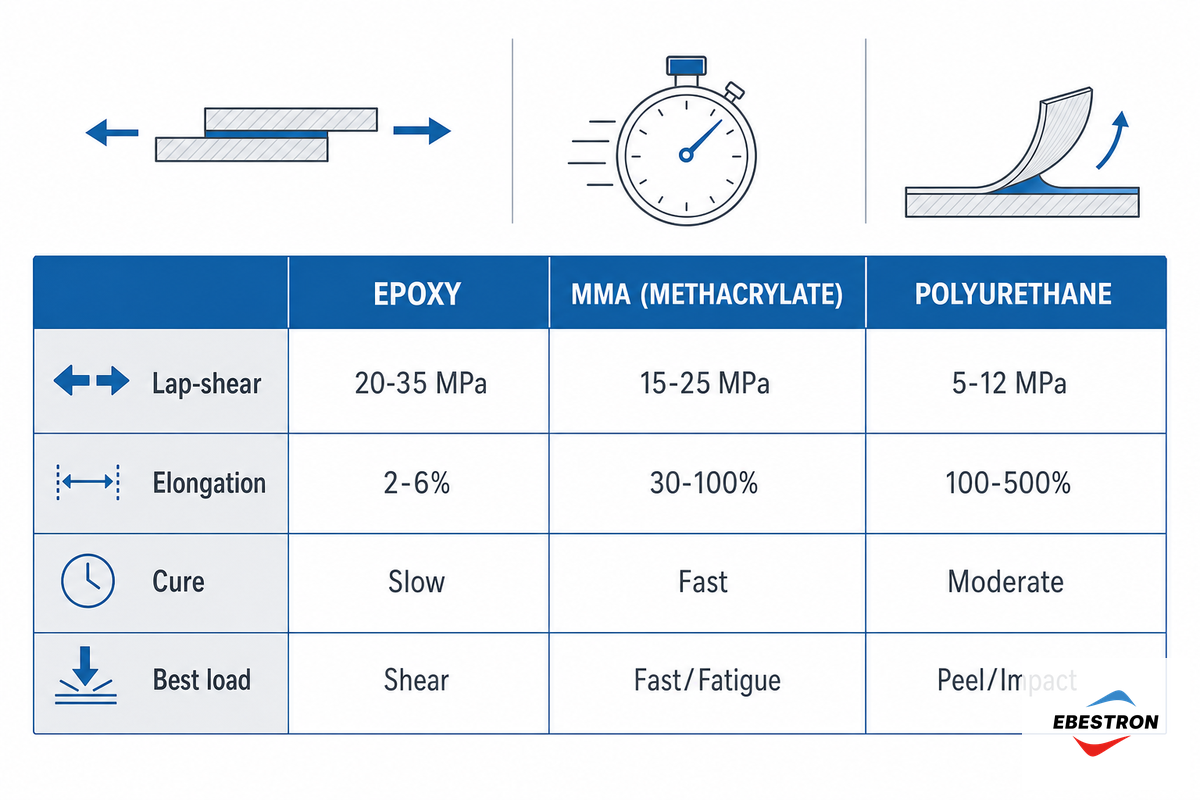
The fastest way to shortlist a chemistry is to read across one row of the comparison below. Epoxy wins rigid shear strength and environmental resistance; MMA trades a little ultimate strength for speed and surface tolerance; polyurethane trades strength for flexibility and impact absorption. Across structural applications, the three main types of structural adhesives balance strength and flexibility differently, and the key differences between them come down to chemistry. The table that follows is our Epoxy-MMA-PU Bond-Property Fingerprinta single side-by-side view of the properties that actually drive selection.
| Property | Epoxy | MMA (Methacrylate) | Polyurethane (PU) |
|---|---|---|---|
| Cure chemistry | Resin + amine hardener (step-growth) | Acrylic, free-radical (cures on mix) | Isocyanate + polyol (urethane) |
| Apparent lap-shear (ASTM D1002)* | ~20-35 MPa (highest) | ~15-25 MPa | ~5-12 MPa |
| Elongation at break | 2-6% (rigid) | ~30-100% (toughened) | 100-500% (elastic) |
| Handling / fixture time | Slow (minutes to hours) | Fast (often under 5-20 min) | Moderate; full cure up to 7 days |
| Peel / impact toughness | Low (brittle unless toughened) | High | Highest |
| Heat & chemical resistance | Best (some to ~200°C) | Good | Moderate; hygroscopic |
| Surface-prep tolerance | Needs clean, abraded surface | Most forgiving (primerless grades) | Needs clean, moisture-managed |
| Open / working time | 5 min to 2 hr | 1 to 20 min | 1 min to 45 min |
| Best-fit load type | Rigid shear / compression | Fast structural / fatigue | Peel / impact / vibration |
| Typical mix ratios | 1:1, 2:1, 10:1 | 10:1 or 1:1 | 1:1, 10:1 |
*Apparent lap-shear is a comparative test value measured on standard single-lap metal specimens by tension loading (ASTM D1002 method, Oregon State University). It ranks chemistries; it is not a design-allowable stress. Always validate on your own substrate, bondline, and cure schedule.
💡 Pro Tip
Read the table by load type, not by a single “strongest” number. A joint loaded in clean shear favours epoxy; a joint that flexes, peels, or sees impact often performs better with MMA or PU even though their headline shear number is lower.
The Three Chemistries and How They Cure
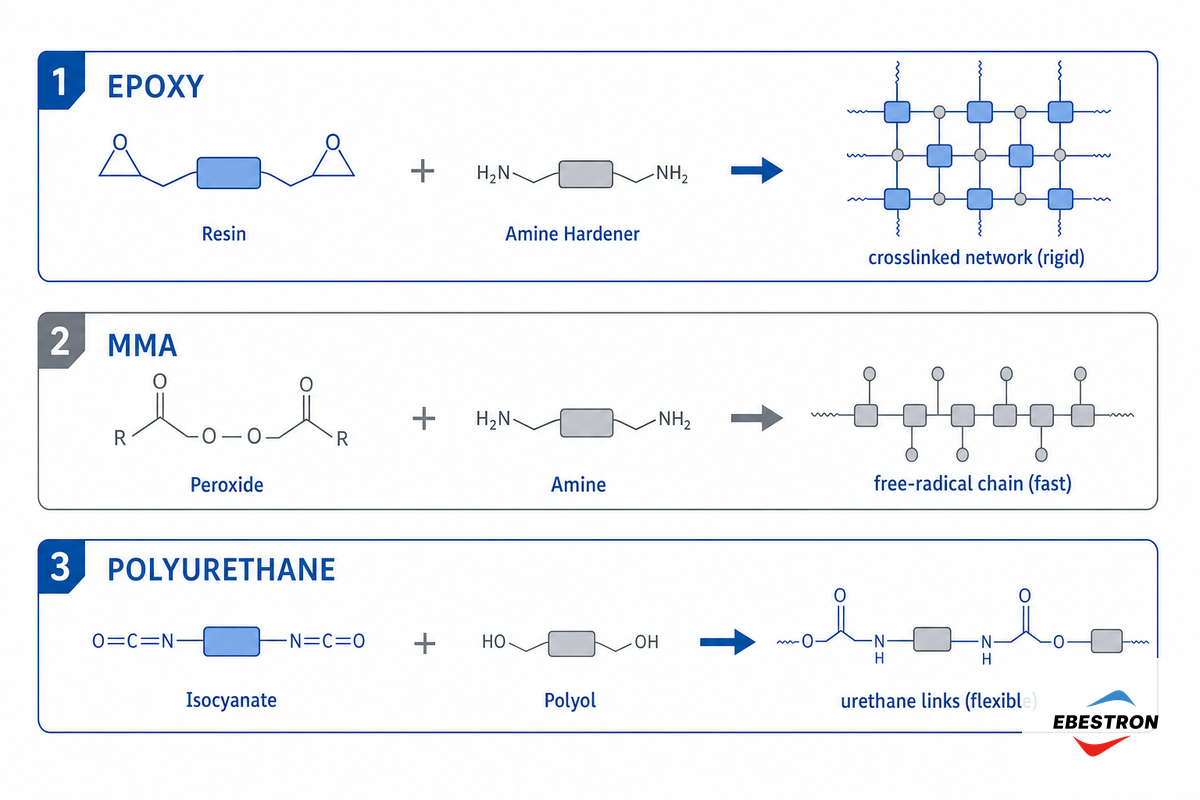
Each structural adhesive is a two-component system, but the cure chemistry, and therefore the working behaviour, is different. Understanding the cure mechanism explains every downstream trade-off in strength, speed, and surface tolerance.
What is an epoxy structural adhesive?
An epoxy structural adhesive cures when an epoxy resin reacts with an amine or anhydride hardener in a step-growth reaction that builds a dense, highly crosslinked network. That high crosslink density gives epoxy the highest cohesive and shear strength of the three chemistries, along with the best chemical and temperature resistance, and also makes a standard epoxy rigid and relatively brittle.
Manufacturer technical literature reports typical epoxy tensile strengths of 27-36 MPa with elongation of just 2-6%, a behaviour confirmed by peer-reviewed thermomechanical analysis of epoxy adhesives. Built from a resin and a hardener, epoxy adhesives are used wherever structural strength is paramount, the same chemistry behind everyday epoxy glue, and remain the default for structural metal bonding, composite bonding, and high-temperature joints.
What is an MMA (methacrylate) adhesive?
An MMA, methyl methacrylate, also called acrylic adhesives or methacrylate adhesives, cures by a free-radical reaction: a peroxide initiator and an amine accelerator trigger a rapid, exothermic polymerisation the moment the two parts mix. The result is fast handling strength, often within minutes, and a tougher, more impact-resistant bond than epoxy.
The low-viscosity methacrylate monomer can wet and penetrate thin oil films and light mill scale, so certain primerless MMA grades bond lightly contaminated metal and low-surface-energy plastics with less preparation than epoxy. The trade-off is a strong odour and a ceiling on ultimate strength, MMAs typically don’t exceed about 25 MPa apparent lap-shear, but in return methyl methacrylate adhesives bring high impact resistance and fatigue strength.
What is a polyurethane (PU) structural adhesive?
A two-component polyurethane adhesive, also called a structural polyurethane adhesive, or simply PU adhesive, cures when an isocyanate component reacts with a polyol to form flexible urethane linkages. The resulting polymer is elastic rather than rigid, with elongation that can run from 100% to several hundred percent.
Polyurethanes are well known for that flexibility, which lets PU absorb vibration, impact, and the differential movement between dissimilar materials, the reason structural PU dominates windshield bonding and panel sealing. The cost is lower shear strength: structural polyurethanes commonly fall in the single-digit-to-low-teens MPa range, and flexible marine-grade sealants test lower still in tension, along with sensitivity to moisture during cure and over service life.
One caveat the marketing rarely mentions: toughened “core-shell” MMAs and flexibilised two-part epoxies blur these lines. A toughened epoxy can absorb far more impact than a standard one, and a structural acrylic can be formulated stiffer than a basic PU. Chemistry family sets the starting point; the specific formulation move it. In commercial terms you’ll see these chemistries packaged as products from Plexus, 3M, Fusor, Loctite, Sikaflex, and SCIGRIP, but the selection logic below is chemistry-first.
Strength, Flexibility and Impact, How They Actually Perform
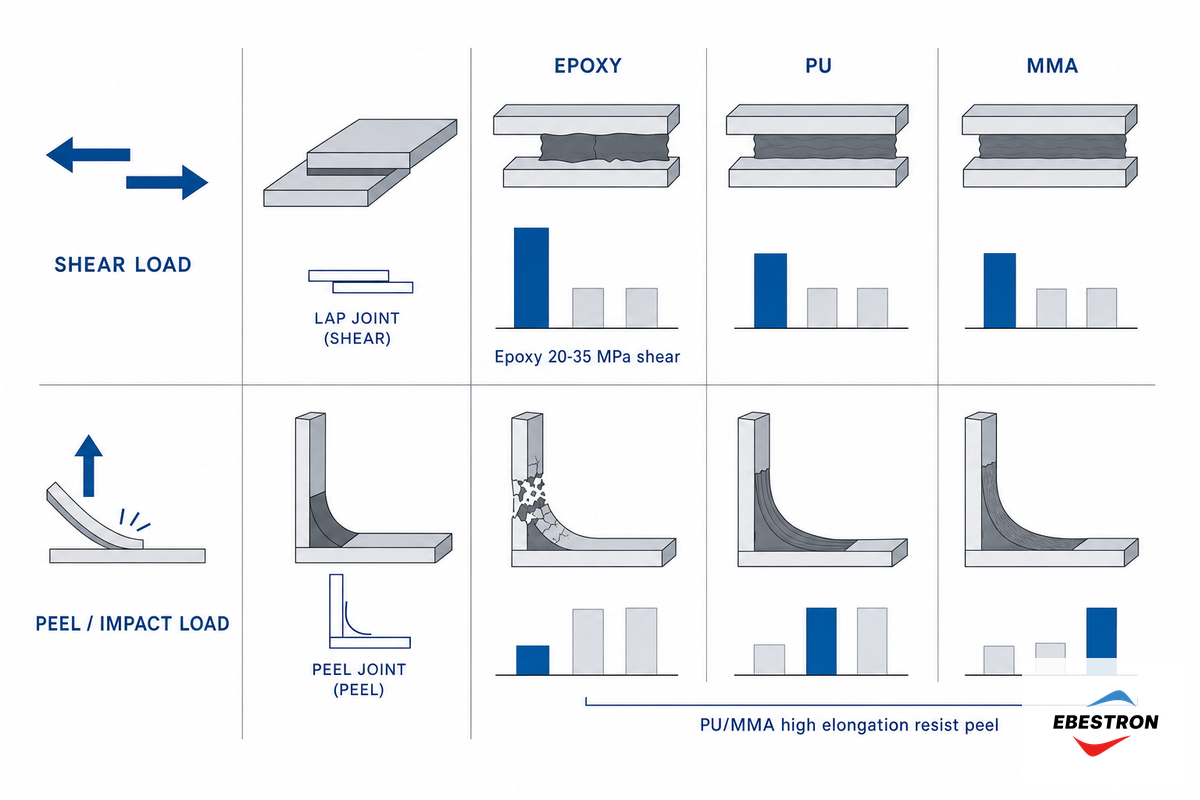
There’s no single “strongest” structural adhesive; the winner depend on how the joint is loaded. In clean shear, epoxy leads. Under peel, cleavage, or impact, a rigid epoxy can fail at a fraction of its rated shear strength while a ductile PU or MMA holds. Research on bonded joints shows the failure picture is rarely about the adhesive number alone, a peer-reviewed multi-mechanics review notes that local bonding improvements don’t always translate into global joint stability.
✔ Where each wins
- Epoxy: rigid shear, compression, high-temperature, chemical exposure
- MMA: fast structural assembly, fatigue, dissimilar metals, unprimed surfaces
- PU: peel, impact, vibration, thermal-cycling and dissimilar-material movement
⚠ Where each is weak
- Epoxy: brittle under peel/cleavage; slow; poor on flexible substrates
- MMA: strong odour; ultimate strength ceiling (~25 MPa); flammable monomer
- PU: lower shear strength; hygroscopic; ages with moisture exposure
Is polyurethane glue stronger than epoxy?
In pure shear, no, epoxy is stronger, with apparent lap-shear of roughly 20-35 MPa versus single-digit-to-low-teens MPa for most structural polyurethanes. But “stronger” is the wrong question for many joints: polyurethane and MMA carry far higher elongation and toughness, so under peel, impact, or vibration they often keep a joint intact where a rigid epoxy cracks.
Engineering studies of peel-dominant joints contrast a brittle epoxy against a ductile polyurethane precisely because the ductile adhesive resists crack propagation better. Choose epoxy when the load is shear and the substrate is stiff; choose PU or a toughened MMA when the load peels, flexes, or cycles.
📐 Engineering Note
Design adhesive joints to load the bond in shear, not peel or cleavage. U.S. government joint-stress analysis shows that peak shear and peel stresses concentrate at the ends of the overlap and rise with bondline thickness. A wider, thinner overlap loaded in shear lets even a brittle epoxy reach its rated strength; a thick, peel-loaded joint won’t.
“The most common selection mistake we see is picking an adhesive by its headline shear number and then loading the joint in peel. Choose the chemistry for how the joint is actually stressed, design the bond to work in shear, and the strength figure looks after itself.”
Structural-bonding application engineers, a recurring theme across field technical guidance
Cure Speed, Pot Life and Surface Prep, The Production Reality
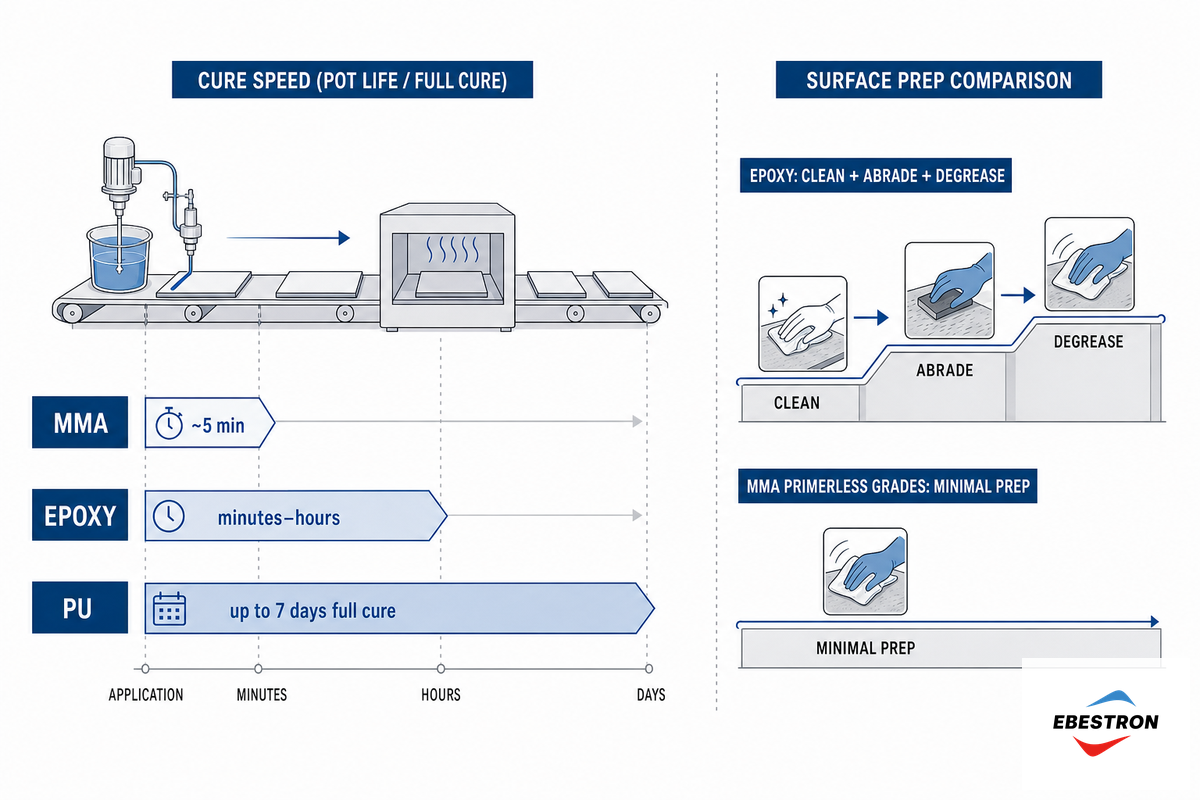
The chemistry that win on a datasheet can lose on the line. Cure time and cure speed set throughput, pot life sets how you dispense, and surface-prep requirements set labour cost. MMA cures fastest; epoxy gives the longest working time but the slowest fixture; PU sits in between but can take days to reach full strength.
The Surface-Prep Penalty
The hidden cost difference between these chemistries is surface preparation. Epoxy needs a clean, degreased, abraded surface to bond reliably, skip that and the joint fail at the interface. Certain primerless MMA grades, by contrast, are formulated to bond lightly oiled or mill-scaled metal with minimal prep, which can remove a full cleaning station from an assembly line. That’s the Surface-Prep Penalty: not the adhesive price, but the labour and cycle time around it.
Two honest qualifications, though. MMA’s tolerance is formulation-specificit applies to primerless acrylic grades, not to every MMA, and it reduces preparation rather than eliminating it. Independent fracture-mechanics studies of MMA on steel still grit-blast, solvent-degrease, and cure for two weeks to get repeatable data. Academic adhesion research is a useful reality check here: university testing notes that even sanded surfaces don’t always produce high-strength joints, because abrasion debris can fill the surface and block wetting. Treat low prep as a production advantage on suitable grades, not a licence to bond dirty parts.
⚠️ Common mistake: faster cure is not always better
A pot life that is too short for your part starves the joint — the adhesive begins to gel before you finish placing and clamping, trapping voids and leaving a weak bond. Match pot life to part size and your dispensing method, not to the fastest number on the shelf.
Worked example: pot life vs throughput
Suppose a fast MMA has a 5-minute pot life and you dispense a 25 mL bead per part. Hand-mixing a 200 mL batch means you must place roughly 200 ÷ 25 = 8 parts within five minutes, about one part every 37 seconds, or the unused remainder gels and is scrapped. At a realistic 60-second placement, you waste 3 parts’ worth of adhesive per batch. Switch to a 200 mL dual cartridge with a static mixer dispensing on demand, and each 25 mL shot mixes only as you pull the trigger: pot life resets every shot, scrap drops to near zero, and the same 5-minute MMA now suits a slow, careful placement. The chemistry didn’t change, the dispensing method unlocked it.
Temperature, Chemical and Environmental Resistance
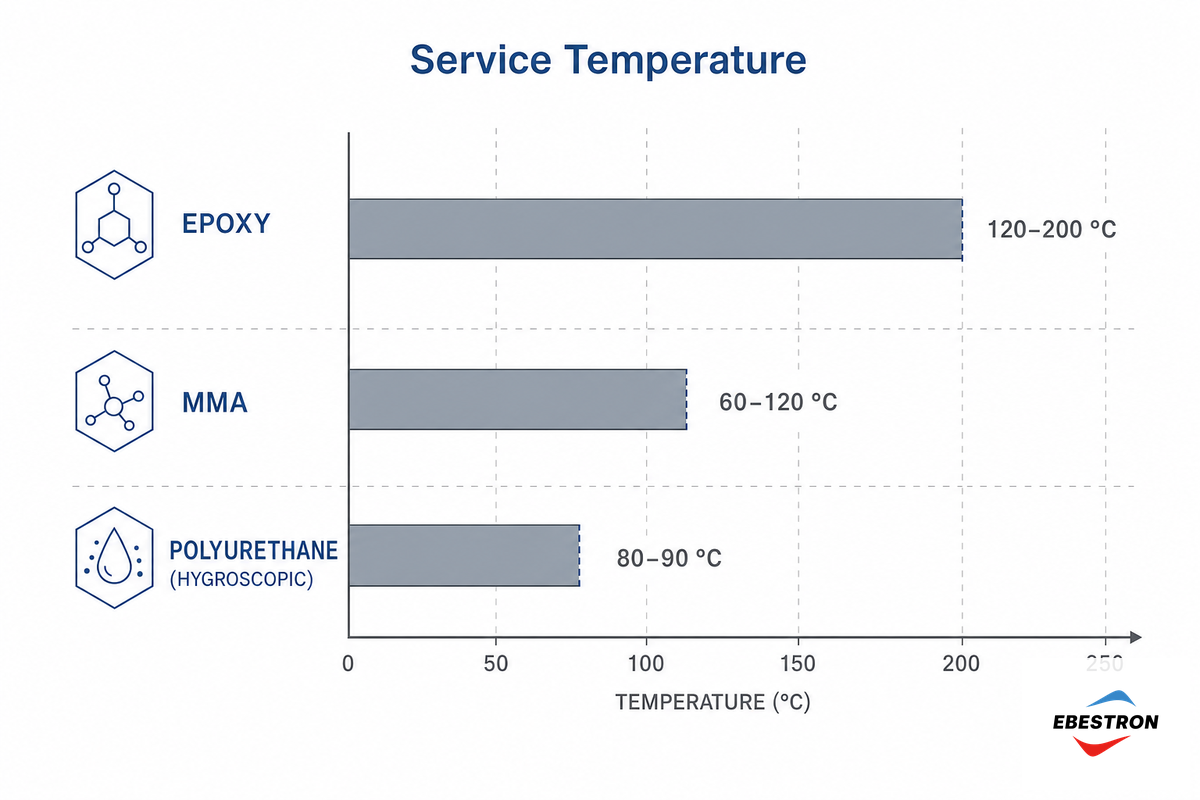
Service environment can override every other factor. Epoxy offers the best heat and chemical resistance of the three; MMA is balanced; PU resists UV and abrasion well but has a lower temperature ceiling and a moisture vulnerability that matters over a part’s whole service life.
Which adhesive is best for high-temperature applications?
Epoxy. Many well-formulated structural epoxies hold useful strength at elevated temperatures, commonly to around 120°C, with specialised heat-resistant grades rated higher still, and they shrug off a wider range of solvents and fuels than MMA or PU. Exact ratings are grade-specific, so check the datasheet against your service temperature.
NASA bond-strength testing under temperature confirms the pattern: adhesive lap-shear strength and modulus change with temperature, so a chemistry rated at room temperature may behave very differently hottemperature effects on adhesive bond strength are significant and chemistry-dependent. This bites hardest on parts that look benign at the bench: a polyurethane bond comfortable at 25°C can creep toward its roughly 80-90°C ceiling on a sun-baked dashboard or near a motor, while the same joint in epoxy holds, which is why under-hood and high-temperature assemblies default to epoxy.
Polyurethane’s weak spot is the opposite end: it’s hygroscopic, and moisture exposure both during cure and over years of service can degrade its mechanical properties. Its flexibility is also viscoelastic, rate- and temperature-dependent, so a PU joint that feels compliant under slow load can stiffen under impact. Specify PU where its elasticity, UV resistance, and abrasion durability pay off (exterior, dissimilar-material, vibration), and design for moisture management to protect long-term durability.
Matching the Adhesive to Your Substrate
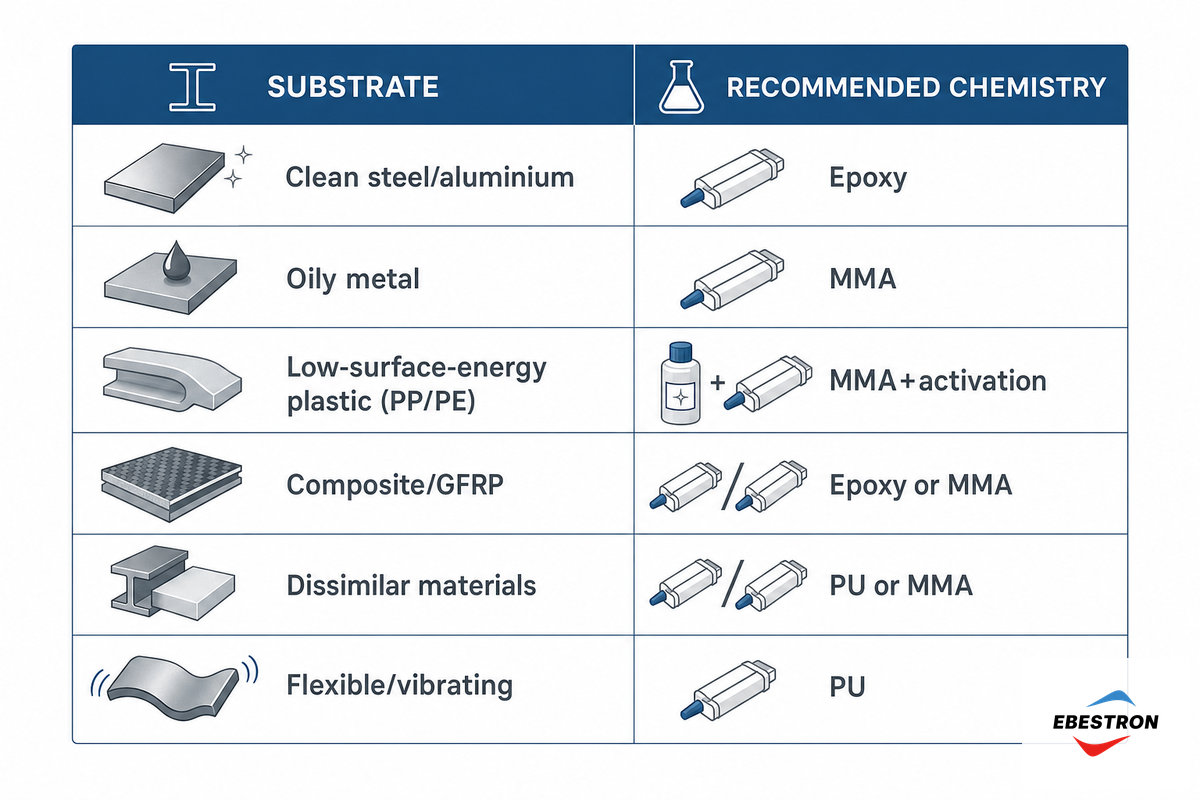
Substrate often decides the chemistry before strength does. Stiff metals and composites suit epoxy; low-surface-energy plastics and dissimilar-material joints push you toward MMA or PU. To compare epoxy with the alternatives, weigh the differences between polyurethane and epoxy, flexibility versus rigidity, alongside epoxy vs methacrylate on cure speed and prep. Compared to polyurethane, epoxy is stiffer and stronger; polyurethane vs epoxy wins on movement, and polyurethane versus a brittle epoxy is the safer pick for flexing joints. These structural adhesives vs one another rarely have a single universal winner. Use the matrix below as a starting shortlist, then validate on your actual material and prep.
| Substrate type | First choice | Why |
|---|---|---|
| Steel / aluminium, clean, rigid | Epoxy | Highest shear; chemical/heat resistance |
| Metal, oily or mill-scaled | MMA (primerless) | Monomer penetrates light contamination |
| Low-surface-energy plastic (PP, PE, POM) | MMA + activation | Acrylic adhesion; surface still often needs flame/plasma/corona |
| Composite / GFRP panels | Epoxy or MMA | Distributes load; avoids drilled-hole stress risers |
| Dissimilar materials (metal-to-plastic, glass) | Polyurethane or MMA | Absorbs differential thermal expansion |
| Flexible or vibrating assemblies | Polyurethane | High elongation; damps movement |
| Glass, ceramic, stone | Epoxy or PU | Epoxy for rigid bond; PU where movement or sealing matters |
| Rubber / elastomer | Polyurethane or MMA | Flexible bond line matches substrate movement |
| Painted / pre-coated metal | MMA | Bonds to the coating with minimal prep; verify coating adhesion |
What is the difference between epoxy and MMA adhesive?
The core difference is cure chemistry and what it buys you. Epoxy cures by a slow step-growth reaction into a rigid, high-strength, chemically resistant network that needs a clean, prepared surface. MMA cures fast by free-radical polymerisation into a tougher, more impact-resistant bond that tolerates rougher, lightly contaminated surfaces but tops out lower in ultimate shear and carries a strong odour.
Put simply: reach for epoxy when you need maximum rigid strength and environmental resistance, and MMA when you need speed, toughness, and minimal surface prep, for example bonding dissimilar metals on a moving line. For aluminium and dissimilar-metal joints in particular, peer-reviewed work treats methacrylate and epoxy as the two leading structural options, evaluated by single-lap shear per the ASTM D1002 single-overlap tension test.
⚠️ Important: structural adhesives complement, not replace, safety-critical welds
Adhesives excel at distributing load and joining materials you cannot weld, but field practitioners are blunt that an adhesive has no place substituting for a structural weld in a safety-critical load path. Use adhesive bonding to replace rivets and spot welds in panel and assembly work, and to bond dissimilar materials — not to stand in for a certified structural weld.
The Selection Framework, Load, Speed and Service
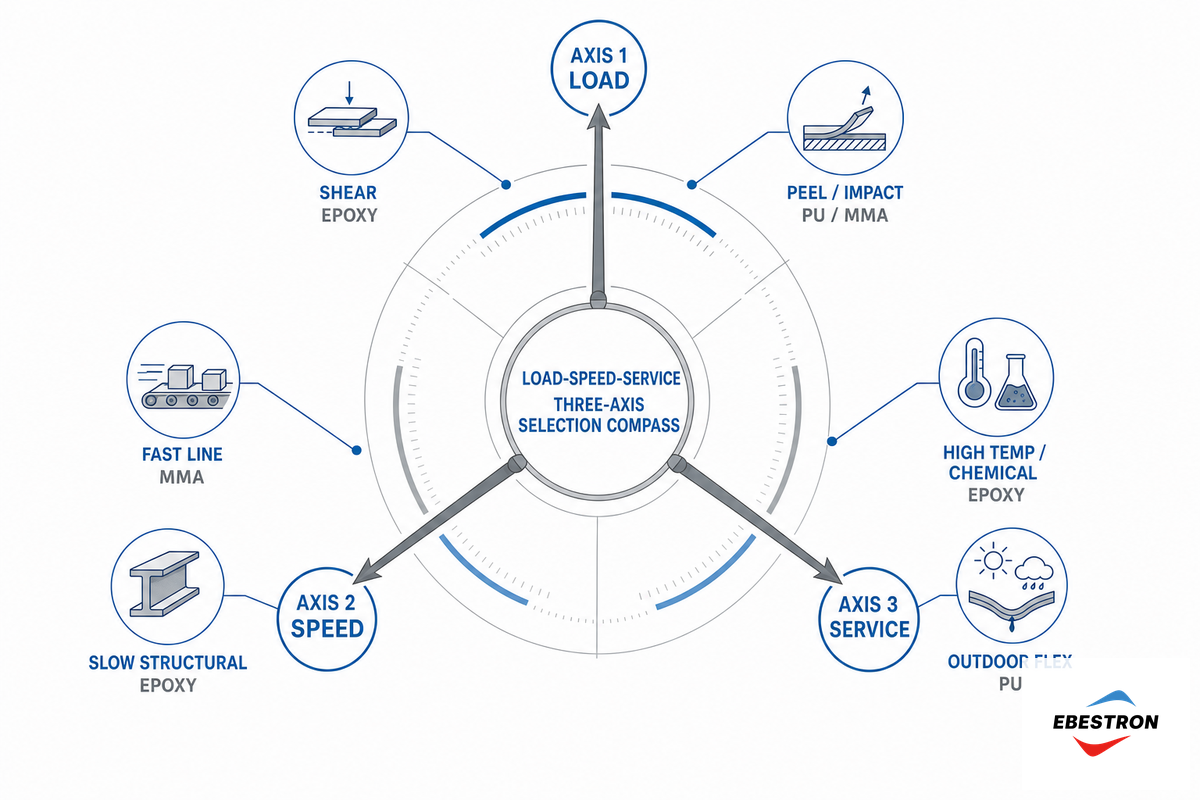
When the table leave you between two chemistries, run the job through three questions. We call it the Load-Speed-Service Selection Compass, and it resolves most real decisions in under a minute.
The 3-Axis Load-Speed-Service Framework
The Load-Speed-Service Selection Compass
- Load type. Rigid shear or compression → epoxy. Peel, impact, or vibration → PU or toughened MMA.
- Production speed. Fast line, fixture in minutes → MMA. Slow or heat-cured structural assembly → epoxy.
- Service environment. High temperature or chemical exposure → epoxy. Outdoor, flexing, dissimilar-material movement → PU.
When two axes point at different chemistries, weight the one that, if it fails, scraps the part, usually load type for structural joints, service environment for outdoor parts. Engineering work on bonding at structural scale reinforces the same point: the right adhesive is the one matched to the load path, not the one with the biggest headline number.
Choosing the right structural adhesive is rarely about naming the single best adhesive; it’s about the best adhesive for your application. All three are two-part systems used for structural bonding across various substrates, each with good resistance in its niche, so the right adhesive is simply the one matched to your load, speed and service. Because all three are two-component (two-part) systems, the right choice between epoxy vs MMA vs polyurethane is only half the decision. The other half is dispensing the chemistry you picked at its rated mix ratio, which is where most selection guides stop and where bonds quietly fail.
From Chemistry to Cartridge, Dispensing Each Correctly
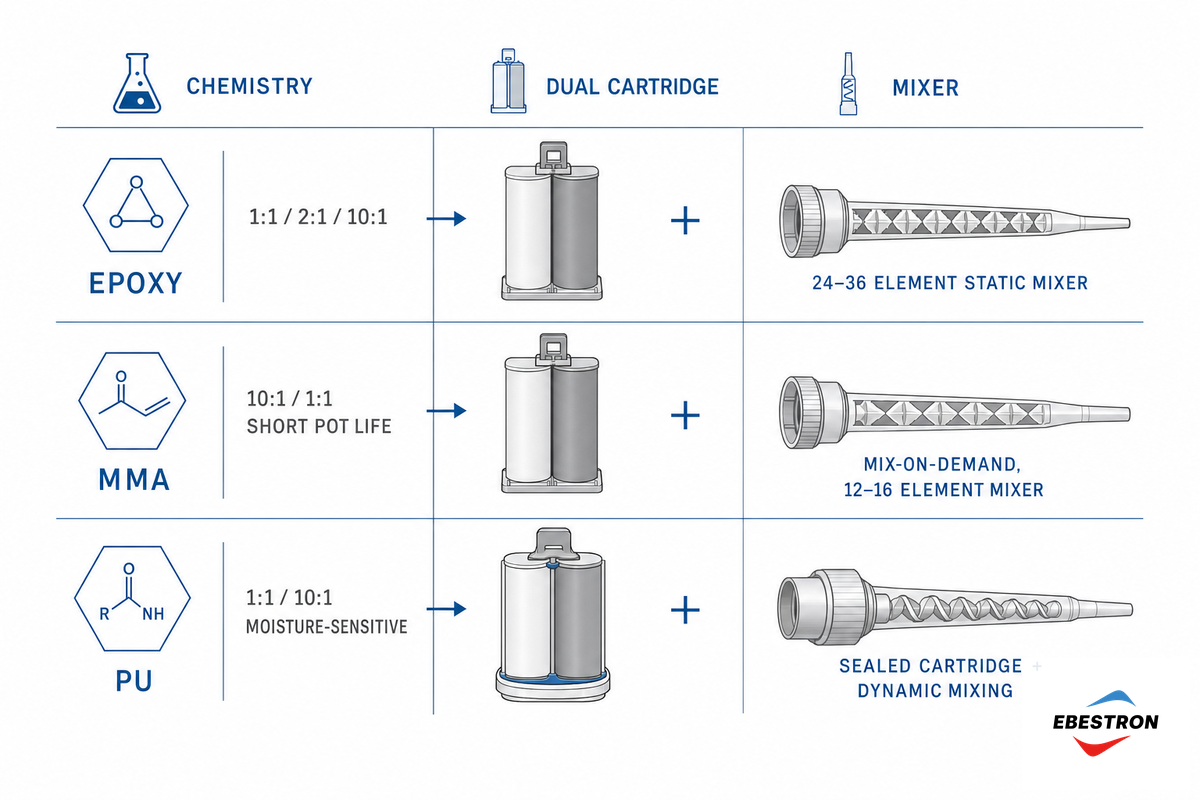
A two-part structural adhesive only reaches its datasheet strength if the two components are metered at the correct ratio and mixed homogeneously, off-ratio or under-mixed adhesive cures soft or not at all. Each chemistry has a dispensing fingerprint, and matching the cartridge, mixer, and gun to it’s as decisive as the chemistry choice. We call this the Chemistry-to-Cartridge Footprint.
| Chemistry | Common mix ratios | Dispensing fingerprint |
|---|---|---|
| Epoxy | 1:1, 2:1, 10:1 | Ratio-matched dual cartridge; static mixer with enough elements for higher viscosity; longer pot life forgives slower work |
| MMA | 10:1 or 1:1 | Short pot life demands mix-on-demand; static mixer sized for fast, low-viscosity flow; dispose of the mixer between long pauses |
| Polyurethane | 1:1, 10:1 | Moisture-sensitive — sealed cartridge; high-viscosity or filled grades favour dynamic mixing over static |
In practice this means three things. First, the cartridge must match the ratio: a 10:1 epoxy in a 1:1 cartridge dispenses off-ratio and cures soft, so start from a ratio-correct dual cartridge in the right volume, 50 mL for repairs up to 400-600 mL for production. Second, the mixer must suit the viscosity and cure speed: a thick epoxy (often 50,000-100,000 cP) needs more static mixer elementstypically 24 to 36 versus the 12 to 16 that suit a thin MMA, to fully blend, a fast MMA with a 5 min pot life needs the right mixing nozzle to flow before it gels, and a high-viscosity or filled PU above roughly 200,000 cP is often better served by a 2K polyurethane dynamic mixing system. Aim for a 0.1-0.3 mm bondline for shear-loaded joints. Third, the gun must deliver the thrust the ratio and viscosity demand, see our guide to choosing 2K dispensing guns and the deeper comparison of static vs dynamic mixing for 2K adhesives.
Where Structural Bonding Is Headed (2025-2026)
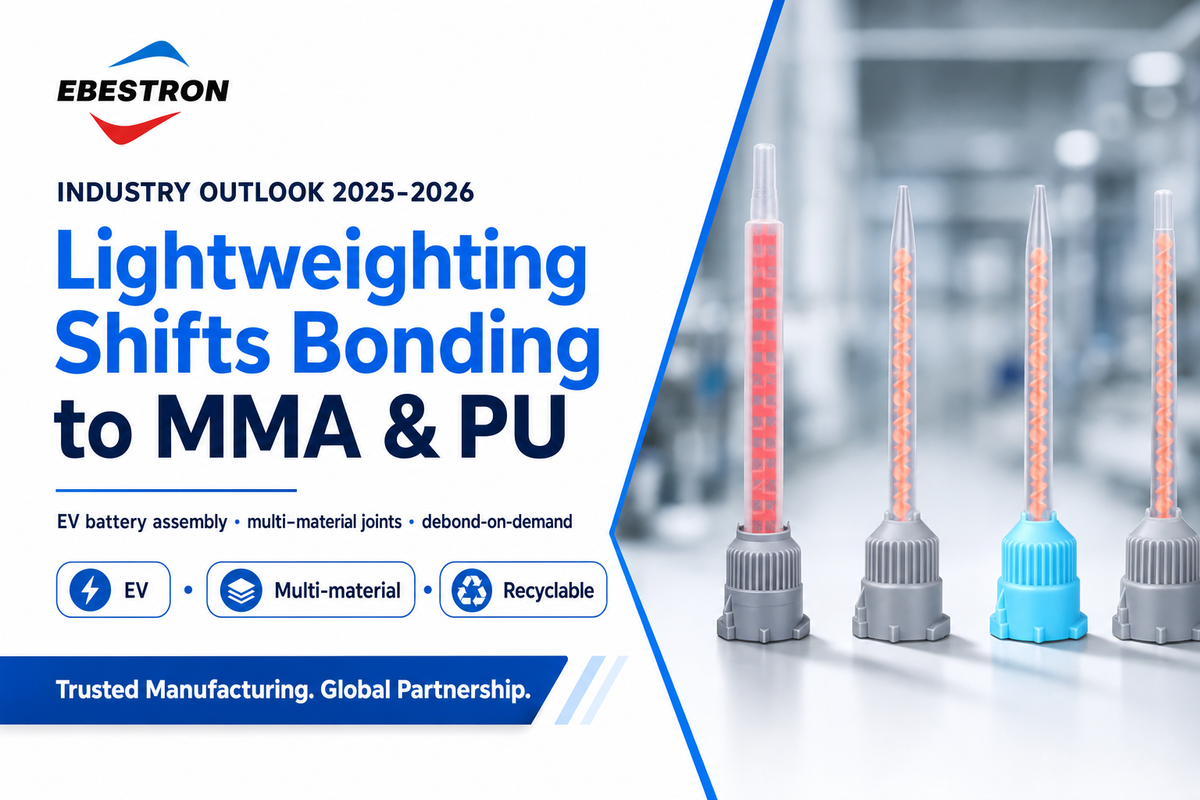
The biggest shift reshaping epoxy-vs-MMA-vs-PU selection isn’t a new chemistry, it’s the move to lightweight, multi-material assemblies. As automotive and EV makers join aluminium, steel, and composite in one structure, thermal-expansion mismatch and faster line speeds increasingly favour flexible, fast-curing MMA and PU over rigid epoxy.
That’s the load-bearing trend for buyers: a chemistry switch driven by substrate and line speed usually means a cartridge, mixer, and gun switch too. The dispensing spec move with the chemistry, not after it.
Two concrete developments sharpen the point. EV battery assembly now leans on MMA to bond module plates and cells and on PU to seal and manage heat, pushing both chemistries into high-volume production. On a real line that means re-validating hardware, not just the adhesive: a pack that moves from a 1-hour-pot-life epoxy to a 5-minute MMA for faster takt time also needs its static mixers and cartridges re-rated, or the first shift fails the bond and scraps cured nozzles by the hundred, a costly mistake when a pack carries 100-plus bonded cells. And a newer requirement, debond-on-demand structural adhesives that allow controlled disassembly for battery recycling and end-of-life, is moving from research into product roadmaps, because a bond that can never be reversed is a liability when a pack must be recycled. Patent activity through 2024 also points to low-odour, MMA-free acrylic formulations, easing the one ergonomic drawback that kept MMA out of some plants. Market analysts put the methacrylate-adhesive segment on a faster growth track than the broader structural-adhesive market, directional context, not a selection criterion, but it confirms where formulation effort is going.
If you’re specifying for a 2025-2026 program that mixes materials, plan for the chemistry and the dispensing hardware together: re-validate cartridge ratio, mixer type, and gun thrust whenever you switch chemistry for a new lightweight substrate.
Frequently Asked Questions
Q: Is polyurethane glue stronger than epoxy?
View Answer
Not in shear. Epoxy reaches roughly 20-35 MPa apparent lap-shear, while most structural polyurethanes sit in the single-digit-to-low-teens MPa range. But polyurethane carries far higher elongation and peel resistance, so in joints loaded by peel, impact, or vibration a flexible PU often outlasts a rigid epoxy that cracks. “Stronger” depends entirely on how the joint is loaded, so match the chemistry to the load type rather than to a single headline number.
Q: What is the difference between epoxy and MMA adhesive?
View Answer
Epoxy cures slowly into a rigid, high-strength, chemically resistant bond that needs a clean, abraded surface. MMA cures fast by free-radical polymerisation into a tougher, more impact-resistant bond that tolerates lightly contaminated surfaces but tops out around 25 MPa and has a strong odour. Choose epoxy for maximum rigid strength and heat or chemical resistance; choose MMA for speed, toughness, and minimal surface preparation.
Q: Which structural adhesive cures fastest?
View Answer
MMA (methacrylate) cures fastest, often reaching handling strength in minutes because its free-radical reaction is rapid and exothermic. Epoxy and polyurethane cure more slowly, with polyurethane sometimes needing up to seven days for full strength. Remember that the fastest cure is not always the best choice — too short a pot life can trap voids in larger parts.
Q: Do MMA and polyurethane adhesives need surface preparation or primer?
View Answer
It depends on grade and substrate. Certain primerless MMA grades bond lightly oiled or mill-scaled metal with minimal prep, but that tolerance is formulation-specific. Polyurethane needs a clean, dry surface, and low-surface-energy plastics like polypropylene often need flame or plasma activation first.
Q: Which adhesive is best for dissimilar materials and thermal expansion?
View Answer
Polyurethane or a toughened MMA. Their high elongation lets the bond flex as dissimilar materials expand and contract at different rates, where a rigid epoxy would build stress and crack — which is why these chemistries dominate windshield and multi-material panel bonding.
Q: What mix ratio and dispensing setup does each chemistry need?
View Answer
Each chemistry needs a different setup: epoxies commonly run at 1:1, 2:1, or 10:1 and tolerate a static mixer thanks to their longer pot life, MMAs are usually 10:1 or 1:1 and need mix-on-demand dispensing because their short pot life gels a static mixer quickly, and polyurethanes run at 1:1 or 10:1 and often prefer dynamic mixing in a sealed cartridge when high-viscosity or filled. Match the dual cartridge ratio, mixer, and gun to your chemistry, or the bond will not reach its rated strength.
Picked your chemistry? Match the hardware that makes it work.
Once you’ve chosen between epoxy, MMA, and polyurethane, Ebestron supplies the dispensing consumables that make that chemistry perform: ratio-correct dual cartridges in 50 mL to 600 mL sizes, static and dynamic mixers matched to viscosity, and 2K dispensing guns compatible with Sulzer Mixpac, Nordson, and 3M systems. Tell us your chemistry and mix ratio, and we’ll match the hardware.
About This Comparison
Ebestron manufactures the two-component dispensing consumables, dual cartridges, static and dynamic mixers, and applicator guns, used to apply epoxy, MMA, and polyurethane structural adhesives. We wrote this comparison from that dispensing vantage point, where mix ratio and mixer choice decide whether a correctly selected chemistry actually performs. Strength figures are typical, comparative values drawn from published standards and manufacturer literature; validate any number against your own substrate, bondline, and cure schedule. Reviewed by the Ebestron technical team.
References & Sources
- ASTM D1002 Apparent Shear Strength of Single-Lap-Joint Adhesively Bonded Metal Specimens (method overview)Oregon State University
- Investigation of Thick Bondline Adhesive Joints (DOT/FAA-AR-01-33)U.S. Federal Aviation Administration / NIAR, Wichita State University
- Temperature Effects on Adhesive Bond Strengths and ModulusNASA Technical Reports Server
- Methods of Analysis and Failure Predictions for Adhesively Bonded JointsU.S. Government Publishing Office
- Strength in Adhesion: A Multi-Mechanics ReviewNational Library of Medicine (PMC)
- Thermomechanical Analyses of Novel Epoxy AdhesivesNational Library of Medicine (PMC)
- A Comparison of the Properties and Strengths of AdhesivesUniversity of Northern Iowa
- Testing the Scalability of Adhesives in ArchitectureUniversity of Massachusetts
- Acrylate Structural Adhesive Free of MMA (WO2022106722A1)WIPO / Google Patents
Related Articles
- Static vs Dynamic Mixing for 2K Adhesiveswhich mixer suits epoxy, MMA, or PU
- Static Mixing Nozzle Typesbayonet, square-base and bell connections explained
- How to Choose a 2K Dispensing Gunthrust ratio and viscosity matching
- Industrial Epoxy Gun Buyer Guidemanual, pneumatic and battery drive types