Get in touch with Ebestron Company


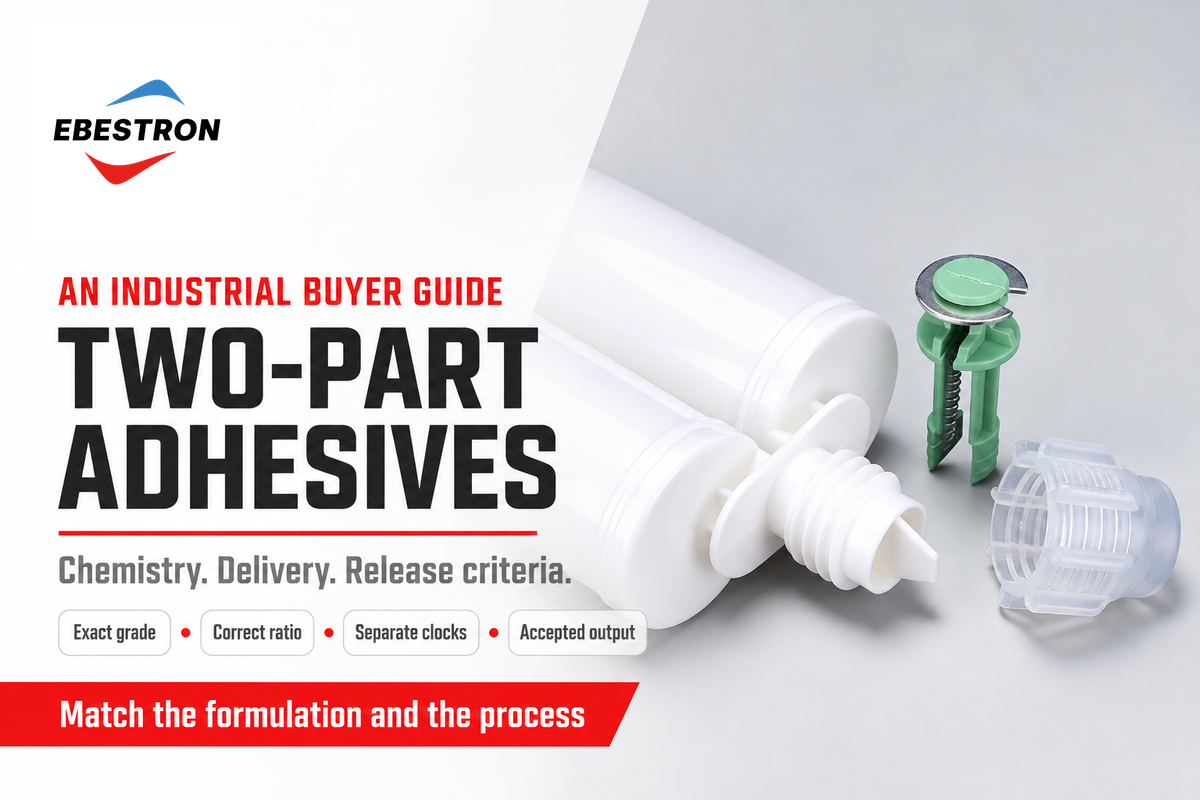
What’s a two part adhesive? It is an adhesive formulation supplied as two components that are used together according to the manufacturer’s instructions. Familiar examples combine resin and hardener to start curing. For a production buyer, key considerations are what formulation is suitable for the joint, how the components are delivered, and when the bonded assembly can be moved.
A cartridge marked with the correct ratio addresses only a part of this problem in industrial applications. It does not establish chemical compatibility, mixing quality or usable working time. This guide separates these considerations and helps you connect the adhesive supplier, packaging supplier, and the production team.
Quick Specs: the fields that define a two-component system
- Chemistry: epoxy, Acrylic, polyurethane or silicone, followed by the exact grade.
- Mix ratio: component order and whether the ratio is by mass or volume.
- Timing: working conditions, handling criterion and full-cure schedule.
- Delivery: cartridge or bulk system, outlet, mixer and dispenser interface.
- Acceptance: the actual substrates, joint and inspection method.
TL;DR: Two-part doesn’t mean epoxy, and epoxy doesn’t mean a universal bond strength. Keep metering and mixing separate, and consider working and release times separately. When making decisions, compare alternatives based on the same accepted output and costs.
What Is a Two-Part Adhesive and Why Keep Parts Separate?
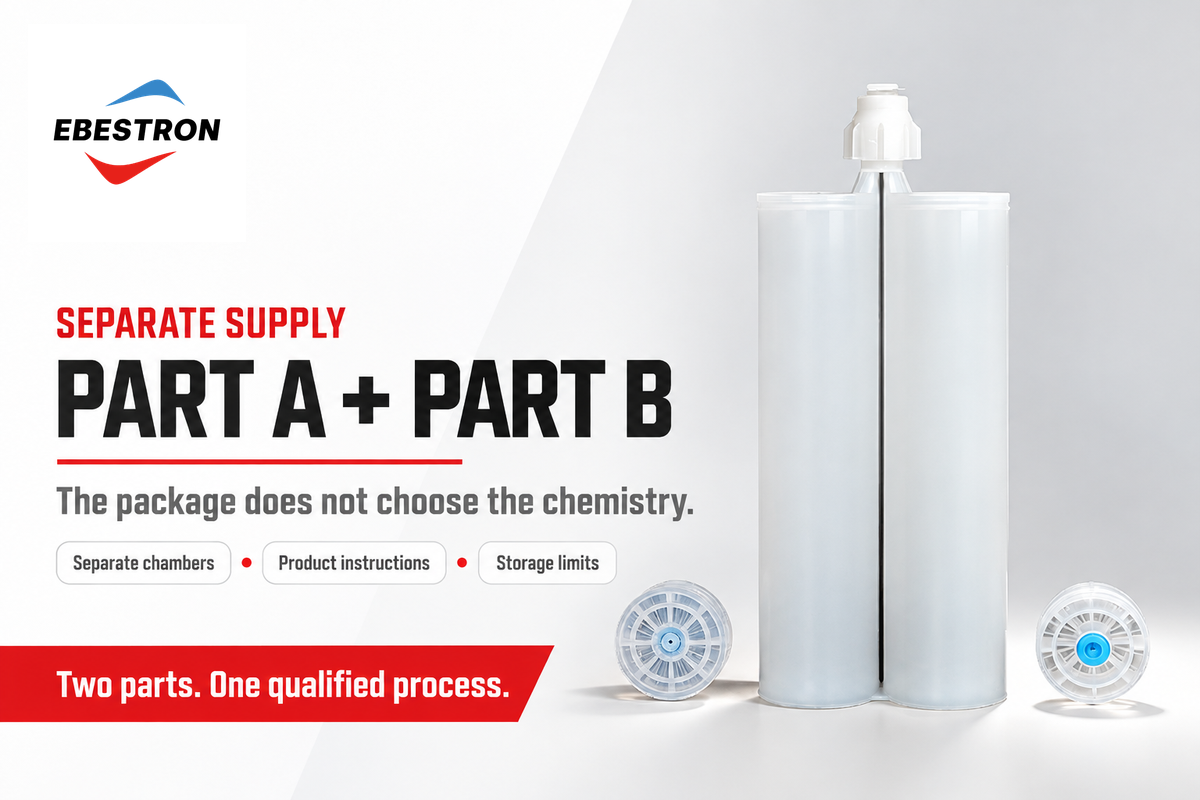
A two-part adhesive is a system supplied in two components to be used together, rather than a single chemistry or strength category. Many reactive grades, upon contact, undergo a chemical curing process. Contact and mixing are determined by the product instructions. These may also describe other drying or further processing steps.
A conventional epoxy adhesive contains a resin component on one side and a compatible curing agent on the other. The components may be liquid or paste form. Fillers and other components may be present on both sides; therefore, calling the second component “pure hardener” may not be accurate.
Why Must the Two Components Be Packaged Separately?
Packaging components separately keeps them from reacting with each other. Parts A and B may be stored in separate chambers in a dual cartridge. In a bulk dispensing system, a supply container may house one component while the other is housed in a separate supply container. Separating the components doesn’t mean they have an extended shelf life. Temperature, moisture, closure, and expiry instructions are still valid.
Application formats extend beyond mixing. Permabond’s acrylic guidance describes surface-activated products with activator on one surface and resin on the other, plus mixed and bead-on-bead systems. An ordinary cartridge formulation may not be converted to a no-mix format by placing each component in different parts.
Not all two-part epoxy formats require the components be ready for immediate cartridge mixing. Premixed and frozen formats exist alongside others that are separately packaged. How the product is handled is product-specific.
Single-component adhesives may qualify when they meet the joint and process requirements. Switching to two-component adhesives means an additional responsibility of either metering or applying the component. It’s more useful to evaluate processes to determine if requirements are met. Our 1K versus 2K adhesive guide discusses qualifying processes in more detail.
Two-Part Epoxy, Acrylic, Polyurethane and Silicone
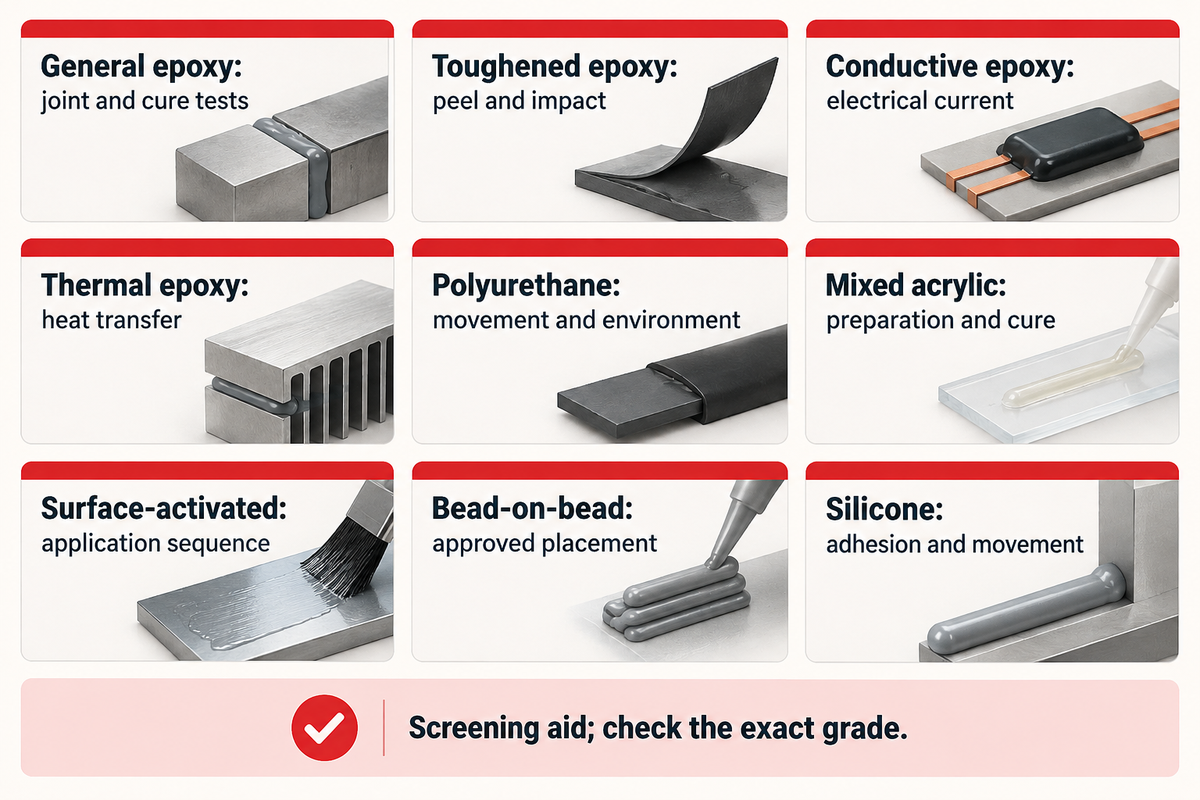
Epoxy, acrylic, polyurethane, and silicone identify useful formulation families, but those labels don’t choose a grade for you. Initially consider the load, movement, and environment, as well as the requirements and constraints of the production process. Then evaluate the products with the data relevant to the above. Then shortlist products with relevant data, including a single-component alternative when its curing method fits the available equipment and assembly sequence.
The table below shows the intersection of application, chemistry, and functional grade. The table is a screening aid rather than a ranking of structural adhesives. The application formats come from the instructions provided by Permabond.
| Candidate or format | Useful screening question | Evidence needed before selection |
|---|---|---|
| General two-part epoxy adhesive | Does a comparatively rigid bond suit the joint? | Substrate-specific results and the specified cure schedule |
| Toughened epoxy | Are toughness and resistance to peel or impact part of the requirement? | Relevant load mode, conditioning and failure description |
| Electrically conductive epoxy | Must the bond carry electrical current? | Electrical properties and joint performance for the selected grade |
| Thermally conductive epoxy | Is heat transfer through the bondline required? | Thermal conductivity under the intended bondline conditions |
| Two-part polyurethane adhesive | Does the assembly require a more compliant adhesive layer? | Movement, environment and substrate tests for that urethane grade |
| Mixed acrylic adhesive | Does the grade’s preparation and cure route fit the station? | Approved surfaces, mix ratio and processing limits |
| Surface-activated acrylic | Can the specified activator/resin sequence be controlled? | Manufacturer-defined surface application and assembly instructions |
| Bead-on-bead acrylic | Is the product specifically designed for separate-bead application? | Approved bead placement and component contact method |
| Two-component silicone | Is a compliant bond or seal the main task? | Adhesion, movement and service-environment qualification |
Adhesive chemistry and functional grades merit their own line in the specification. Electrical conduction is different from electrical insulation. Yet again, a different requirement would be heat transfer. MasterBond’s published epoxy systems illustrate these. The properties of these grades belong to the products, not to every epoxy resin or to an empty dispensing cartridge.
Is 2 part epoxy stronger than super glue?
There’s no single general ranking of two-part epoxy and super glue. A cyanoacrylate adhesive may fit a close-fitting assembly with a fast fixture requirement, while a selected epoxy can address a different joint geometry or gap filling task. Compare tested joints exposed to the same loading and environmental conditions. A greater catalog shear value of another specimen doesn’t help settle that comparison.
For a deeper family comparison, use our epoxy versus MMA versus polyurethane guide. Keep the shortlist short enough to test. “High shear and peel strength” is a property claim to substantiate for the chosen product, not a benefit automatically delivered by a two-part label.
Mix Ratio: Metering and Mixing Are Different
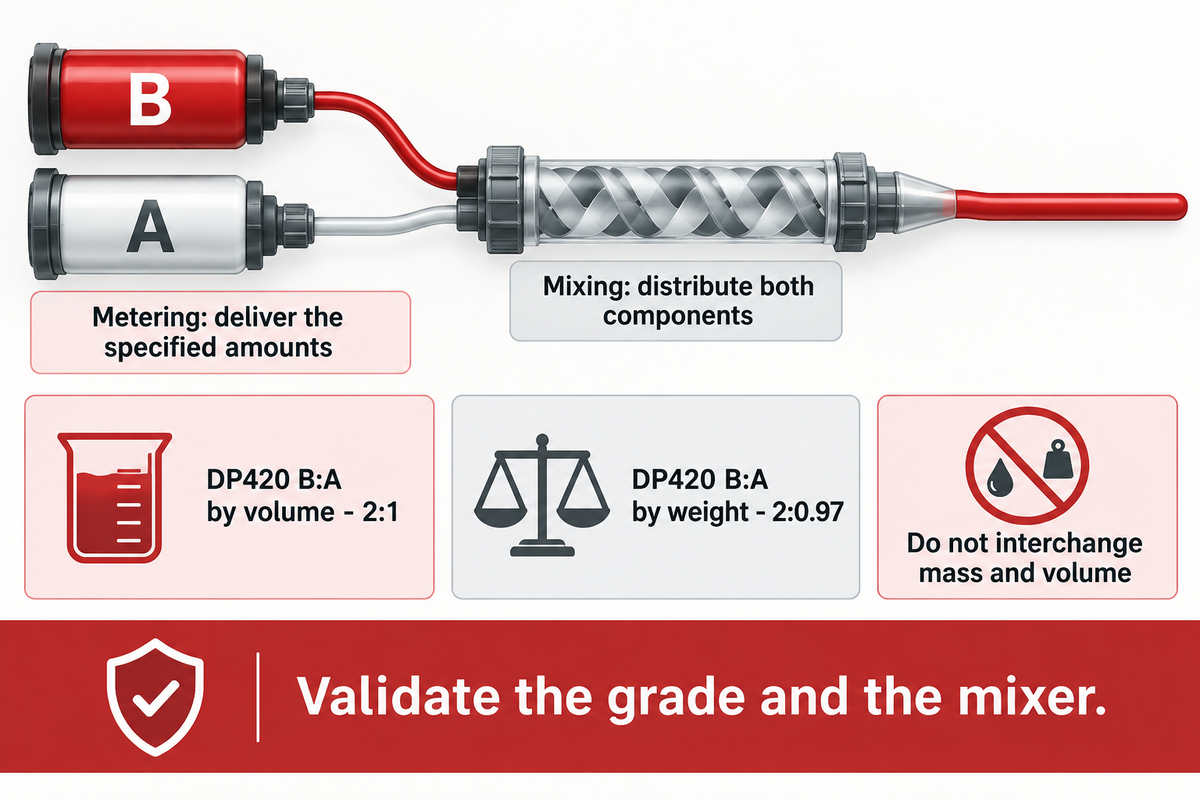
Correct metering supplies the required quantity of the two components, and correct mixing distributes them sufficiently for the approved process. A dispenser can satisfy the first condition while a mismatched mixer fails the second. Identify the order of the components, the ratio basis and the mixing arrangement before treating an apparently uniform bead as an acceptable mixture.
One useful example is 3M’s September 2024 DP420 Black technical data sheet. It lists B:A as 2:1 by volume and 2:0.97 by weight. The numbers differ because mass and volume are different quantities. Reversing the component order changes the instruction again. A ratio written without its labels is an incomplete specification.
Use the grade’s published values rather than trying to improve cure speed by adding hardener. In Szabelski’s 2022 mixing-ratio study, altered ratios affected two particular epoxy formulations tested in steel-cylinder butt joints. Those findings don’t create a safe deviation band for other part epoxy adhesives, substrates or load cases.
We’ll illustrate with a handoff between purchasing and a maintenance technician. Purchasing orders a “2:1” cartridge because that number matches a dispenser specification. The technician then finds a mass based mixing note on a work instruction copied from a different grade. Both documents look plausible, but they describe different quantities and may even reverse the component order. The team stops the process, places the material of the same grade next to the current data sheet, and determines which chamber contains what. With that, the team can settle the geometry of the cartridge, along with the dispenser. The case is a documentation failure caught prior to bonding, and not evidence that a particular ratio error results in a specified reject rate.
A static mixer also needs a suitable inlet connection, mixing geometry, outlet and pressure arrangement. Nordson’s selection guidance treats cartridge type, material, ratio and deposit requirements as linked choices. See our static mixer guide for that separate selection task.
Ratio weight-to-volume conversions can be found in our ratio weight-to-volume converter. It’s helpful to reference that converter for density-related math. The converter can’t determine missing densities or validate a formulation. If a mixture is still sticky or streaky, use the dedicated 2K dispensing troubleshooting guide instead of adjusting the ratio.
The 3-Clock Production Handoff: Working, Handling and Full Cure
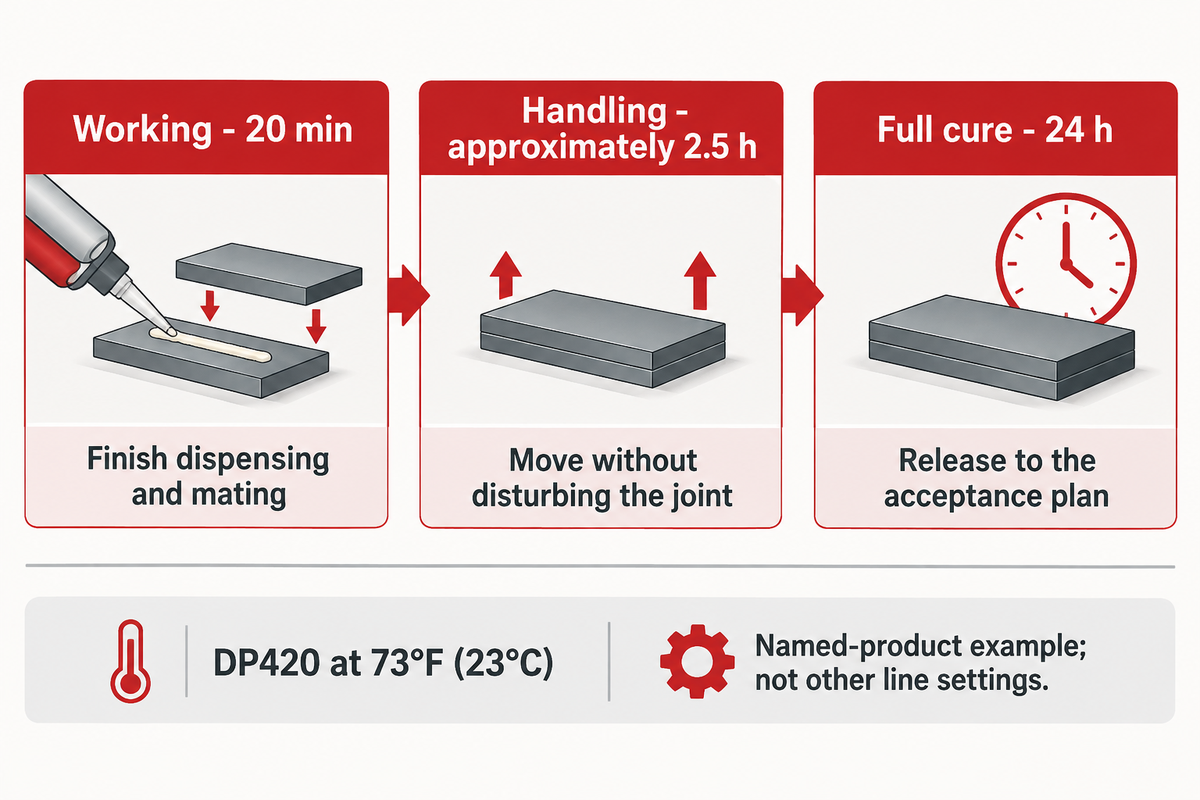
The 3-Clock Production Handoff describes separate limits for completing assembly, moving the joint and releasing the item for its intended service. Working time does not establish handling strength, and handling strength does not establish full cure. Each release decision needs the supplier’s definition, stated conditions and a criterion appropriate to the actual assembly.
Framework: The 3-Clock Production Handoff assigns conditions, owners, and release criteria to working, handling, and cure decisions.
“Different manufacturers/suppliers may use different conventions to define the working life, pot life, and gel time of an epoxy.”
That is important when a supplier says a grade cures at room temperature. “Room temperature” still requires a stated test condition. The 3M DP420 product page lists the following times at 73°F (23°C). These are named-product examples, not line settings for other adhesives.
20 minDP420 working time
≈2.5 hDP420 handling time
24 hDP420 full cure
| Clock | Decision to control | Trial record |
|---|---|---|
| Working | Finish dispensing and mating within the approved interval | Material temperature, timing start, deposit and assembly sequence |
| Handling | Move or unfixture without disturbing the joint | Actual movement/load criterion and fixture arrangement |
| Full cure | Release according to the specified cure and acceptance plan | Time-temperature history and required acceptance evidence |
The TDS gives another example. At 23°C, it gives a worklife of 30 minutes for 5 g mixed, 20 minutes for 10 g, and 15 minutes for 20 g. Tests of mixed mass aren’t the same as the general working time description on the page or the thin adhesive film on a part. Record the test quantity and compare to supplier’s data.
Suppose there’s a fixture cell that dispenses several assemblies before mating the first joint. The operator starts the stopwatch at the first dispense, while a planner has counted only the last pressing operation. Neither person has necessarily violated a published time; they have defined different intervals. The trial lead captures the complete dispense-to-mate sequence, the material temperature and when each fixture is released. Quality defines what movement the joint must withstand at release. The cured specimens are evaluated on the agreed schedule. This illustrative sequence creates three accountable decisions instead of one ambiguous “cure time,” without inventing a multiplier between the supplier’s minutes and the station’s cycle.
Heat generation is also influenced by quantity. MasterBond notes that large batches of fast-setting epoxies can become impractical due to exotherm. Don’t extrapolate a small cup pot life to a larger retained batch. Follow the limits of the formulation supplier’s batch size, containers and processes when planning to mix the adhesive or cure at ambient conditions.
Match Two-Part Adhesive Bond Strength to the Joint
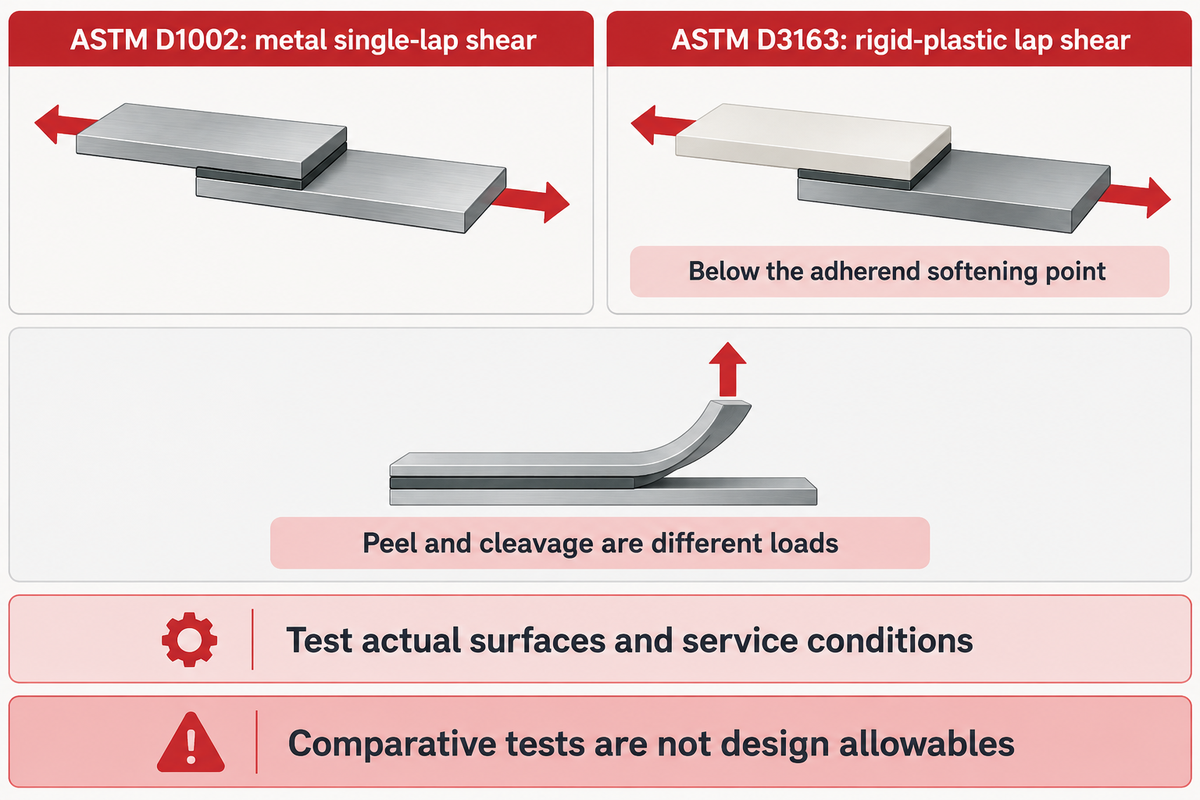
Two-part adhesive bond strength is a joint- and condition-specific property. It isn’t a stand-alone number that gets transferred to every assembly. Several factors affect this, including surface preparation, joint geometry, the thickness of the adhesive layer, cure and the type of loading. Published test results can help shortlist products. Final acceptance, however, should be based on representative materials and actual service conditions.
ASTM D1002-10(2019) covers apparent shear strength of metal single-lap joints and is useful for comparative testing. ASTM D3163-01(2023) addresses rigid-plastic lap-shear specimens within its stated scope. The latter excludes anisotropic reinforced laminates and applies below the adherends’ softening point. Neither public scope supplies a universal design stress for your part.
What does 2 part epoxy not stick to?
Adhesion of a plastic can’t be confirmed with certainty without representative testing. The relevant surface may be a coating, contamination layer or treated skin rather than the underlying metal or plastic. Tell the formulator of the exact surface and finish, and use its instructions and representative samples for testing. A successful bond to one plastic of a grade doesn’t indicate that other plastic grades with another surface condition are also bondable.
A strong bond under lap shear can still face a different problem under peel and cleavage stresses. Load sharing in a joint changes how loads reach the bondline. More layers of adhesive are not a reliable remedy for a poor load path, and additional thickness must remain within the selected product’s instructions.
For example, a buyer choosing an epoxy resin for a coated bracket needs the coating system represented in the trial. A test on bare steel would provide a different answer. Know if failure occurred at the surface, in the adhesive, or in the substrate. That kind of observation makes a strength test result more useful than a number.
NASA’s PRC-1001 process specification illustrates the discipline of using representative material, equipment and cure conditions for verification. Its scope is JSC space-flight-related hardware. Borrowing that testing discipline doesn’t give a commercial joint an aerospace approval, and this guide doesn’t reproduce licensed test procedures.
From Two-Part Adhesive Cartridge Capacity to the Assembly Line
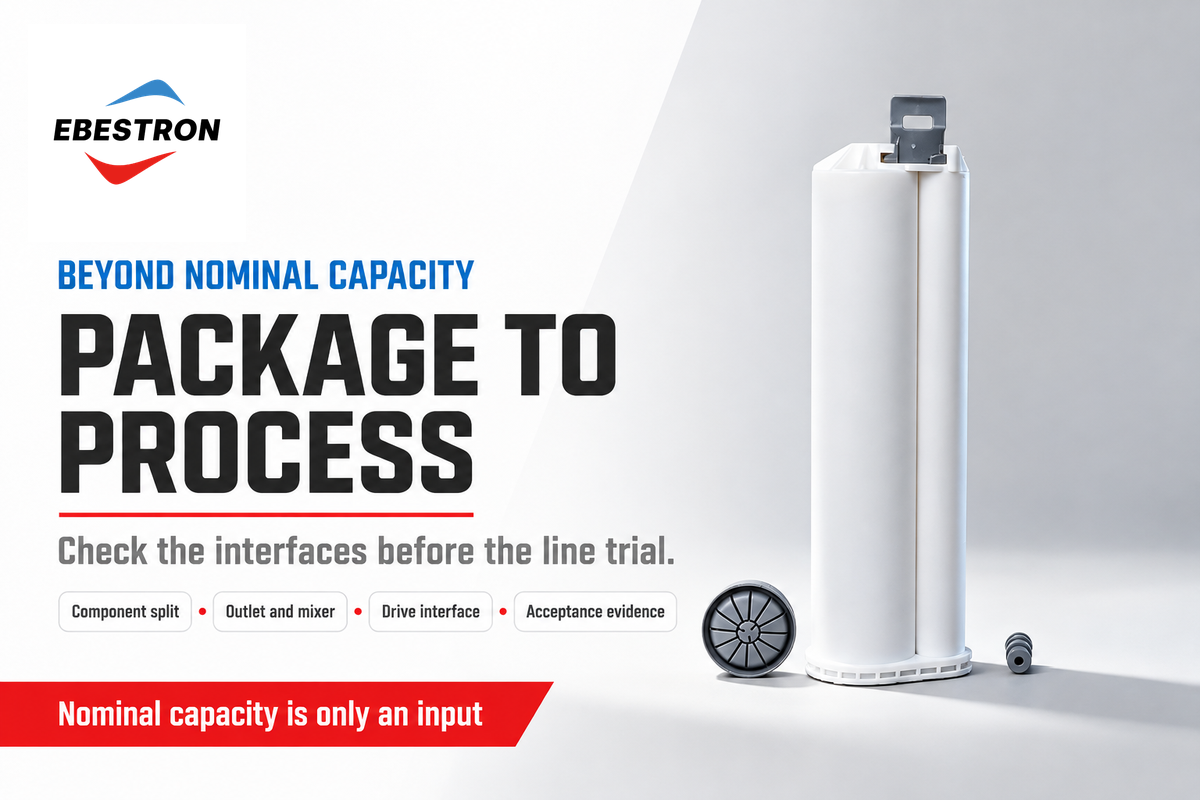
Package size determines cartridge capacity. For production suitability, there are other requirements, such as the right component split, outlet, mixer, dispenser and material-contact approval. Select these interfaces as a connected system after the adhesive grade is fixed. A cartridge that physically fits a gun has answered a mechanical question; storage compatibility and mixing performance are two other qualification questions that remain to be answered.
Ebestron makes packaging and dispensing consumables. Their public dual cartridge catalog carries nominal 50 mL, 200 mL, 400 mL, 600 mL and 1500 mL packages. Those packages don’t establish usable adhesive yield, chemical compatibility or approval for a third-party formulation.
Separate responsibilities for the inquiry. Storage, contact-material and cure requirements for formulation are specified by the adhesive supplier. The Packaging supplier gives cartridge and outlet details. The dispenser supplier provides the interface details for the drive and equipment. Your Production and Quality teams establish an approved combination and define acceptance criteria.
Nordson’s mixer documentation makes the interface question more concrete. When selecting a replacement nozzle, there are variables such as type, material, ratio, and outlet that remain to be determined. Thus, a change to a mixer or cartridge should be observable in the production trial record, rather than hidden in a substitution made by the purchasing department.
Usable yield is different from nominal fill. Material retained in the package, mixer, and restart purge is included in the measured run record. For station operation, follow our two-part adhesive cartridge instructions; for the broader equipment choice, see two-part adhesive dispensing methods. Neither guide replaces the chosen grade’s processing instructions.
Count Two-Part Adhesive Cost per Accepted Assembly
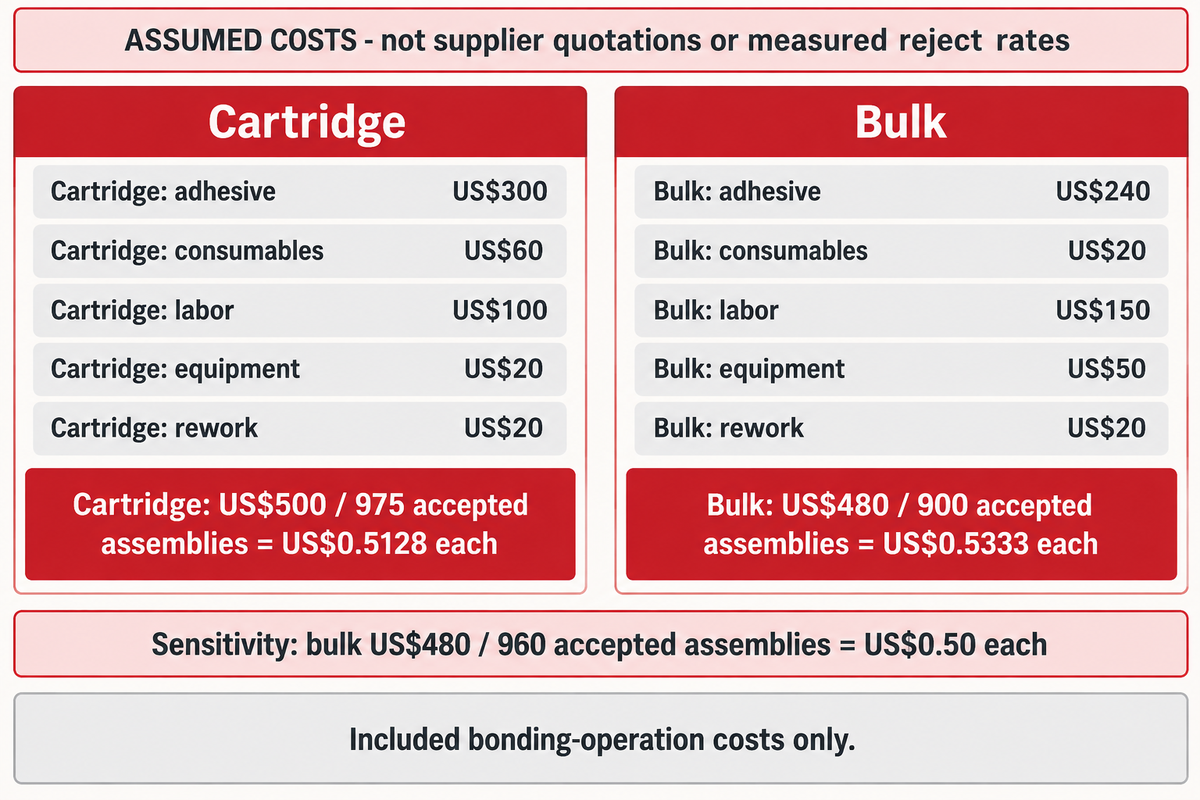
The pertinent packaging comparison is the accounted bonding-operation cost divided by assemblies accepted under the same inspection rules. A lower material bill can lose its advantage when labor, consumables, restart losses, or rejected output differ. Declare the accounting boundary first, because the cheapest result inside a narrow calculation may not be the cheapest for the complete production process.
ASQ’s cost of quality framework is illustrated in this link. This filled example covers only a few of the bonding operation costs. Labor includes the same inspection scope in both options; rework is a separate, non-duplicated line. All dollar amounts and output counts are assumed inputs not Ebestron prices, measured reject rates, or market benchmarks.
| Run record | Cartridge option | Bulk option |
|---|---|---|
| Adhesive cost | US$300 | US$240 |
| Mixers and other consumables | US$60 | US$20 |
| Operating labor, including agreed inspection | US$100 | US$150 |
| Allocated equipment cost | US$20 | US$50 |
| Separately accounted rework | US$20 | US$20 |
| Total included run cost | US$500 | US$480 |
| Accepted assemblies | 975 assemblies | 900 assemblies |
| Cost per accepted assembly | US$0.5128 | US$0.5333 |
| Equivalent cost per 1,000 accepted assemblies | US$512.82 | US$533.33 |
Calculation: US$500 ÷ 975 accepted assemblies = US$0.5128 per accepted assembly. For bulk, US$480 ÷ 900 = US$0.5333. If the same bulk run cost instead produces 960 accepted assemblies, its result becomes US$0.50 each. That change reverses the illustrative preference without changing the purchase price.
Imagined purchasing review. Picture a purchasing review in which the bulk offer first wins because its adhesive line is US$60 lower. Production brings the completed run sheet rather than arguing about package preference. Both teams agree which inspection makes an assembly accepted, check that rework labor isn’t counted twice, and compare totals filled. The cartridge option wins this particular assumed run, while the 960-part sensitivity shows how easily that decision can change. Finance adds any costs not included prior to a purchase decision. The example gives the team a repeatable calculation, but it does not establish that cartridges produce fewer defects or that bulk equipment cannot deliver a better result.
Hidden bottleneck: a pause can lead to material setting in the mixer, followed by a mixer change, purge and additional labor. Record the actual sequence and quantities. Our nozzle waste cost estimator addresses that. It doesn’t predict accepted part count.
For the complete comparison, add any differing substrate loss, drying or heating, ventilation and exposure controls, cleaning, training, downtime and downstream failure costs. Don’t consider an accepted count at one inspection point to be proof of lifetime reliability. The acceptance rule and cost boundary have to move with the number.
Takeaway: Compare the qualified process and its accepted output. Cartridge price, bulk price and nominal capacity are inputs to that decision, not the decision itself.
Prepare a Formulation-and-Package Trial Brief
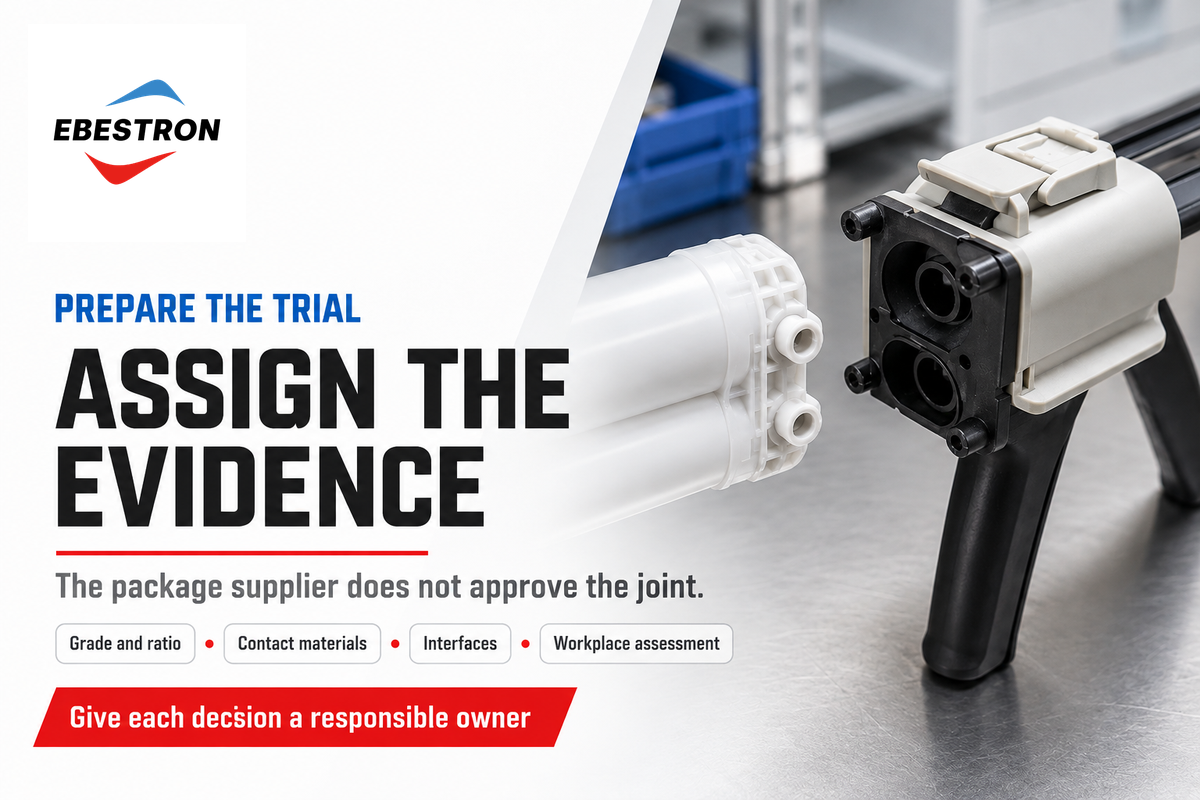
A good trial brief outlines the adhesive formulation, contact surfaces, delivery interfaces and acceptance plan prior to ordering a complete system. Distribute each element to the person who can substantiate it. The packaging manufacturer can describe its consumables, while the formulation supplier and your engineering team resolve material suitability, cure and joint performance.
Start with an exact grade and revision, then record how the two components are mixed or applied. Instructions such as “Mix the resin and a hardener” are way too general for a controlled assembly. The operator needs the components, approved quantities and application sequence.
| Field | Lead owner | Evidence to record |
|---|---|---|
| Adhesive grade and revision | Formulation supplier | Current technical data sheet and processing instructions |
| Substrate and surface finish | Design/production | Actual materials, coatings and preparation route |
| Component order and ratio basis | Formulation supplier | Labelled mass or volume instruction |
| Package contact and storage | Formulation/packaging suppliers | Proposed contact materials and formulation approval |
| Cartridge and drive interface | Packaging/equipment suppliers | Drawings, component split and equipment fit |
| Mixer and outlet | Process engineering | Approved combination and mixing verification |
| Working interval | Production engineering | Temperature, quantity and complete dispense-to-mate sequence |
| Handling and full cure | Engineering/quality | Separate release criteria and cure record |
| Workplace controls | Qualified workplace safety personnel | Current component SDS and process assessment |
| Joint acceptance | Design/quality | Representative specimens, service conditions and failure criteria |
| Cost boundary and output | Production/purchasing/finance | Included costs, consistent inspection and accepted counts |
NIOSH states that some uncured epoxy or resin components can be hazardous and refers users to the label and safety data sheet. Have qualified workplace personnel assess the actual components and process prior to the trial, including exposure controls and waste. A cured sample or a package-fit check does not complete that assessment.
Use the same brief when a component changes. A representative-process approach offered by NASA gives an example of documenting material, equipment and cure, and the Open University’s adhesive-bonding overview gives an example of why mixing and joint loading are relevant. Neither source approves your production combination. When requesting packaging from Ebestron, provide the grade, nominal capacity, component split and interfaces, as described in this brief.
What Is Changing in Two-Part Adhesive Process Control?
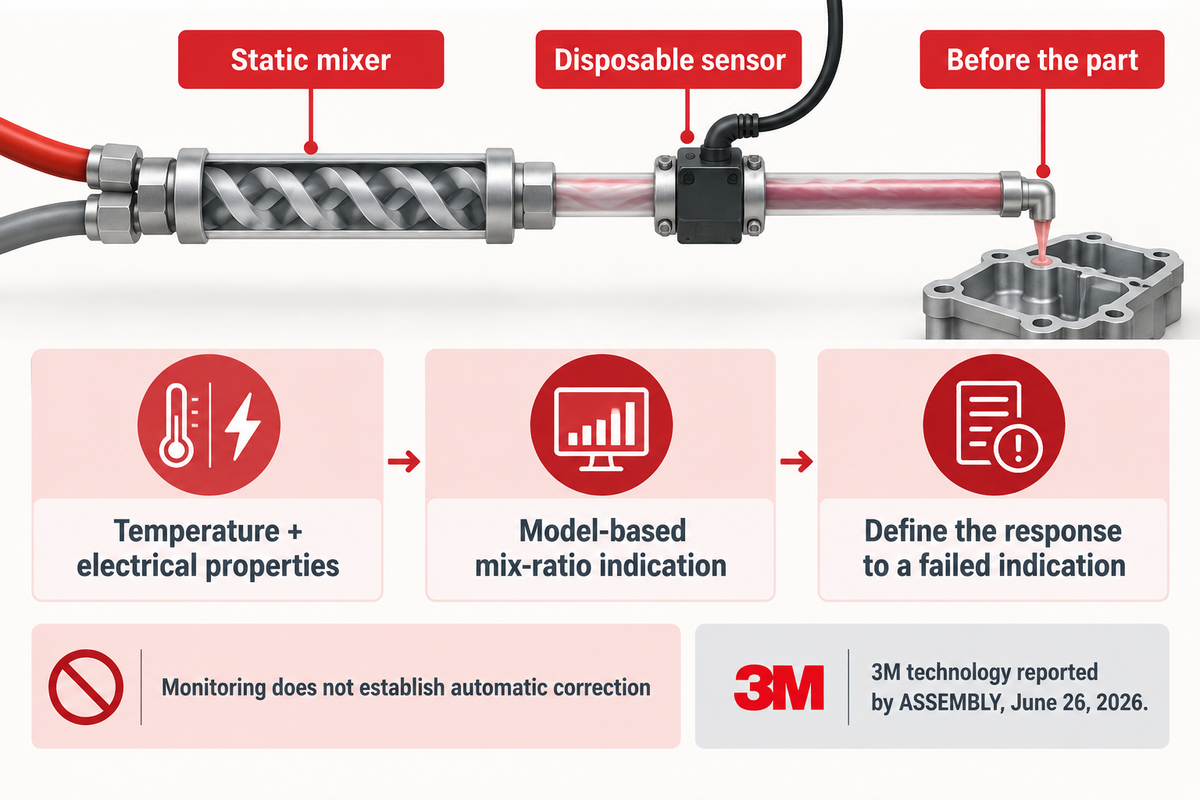
Process monitoring is making the delivered mixture a more visible production variable, so buyers can ask for evidence beyond a dispenser’s nominal ratio. The useful procurement question is what a system measures, how it interprets the signal and what happens to an affected assembly. A pass indication is recorded; however, it still requires approval of an adequate relationship to the product and process.
In June 26, 2026 reporting in ASSEMBLY, J.J. Moore describes 3M’s Adhesive Mix Monitor and quotes 3M engineer Alissa Wenner. The reported arrangement places a disposable sensor after the static mixer and before the part. Temperature and electrical-property measurements feed a model used to indicate mix ratio. The article mentions pass/fail output and describes the connection of the device to the production system.
Monitoring and correction are different functions. The article does not establish that the device automatically adjusts a dispenser to correct a mixture. The development is useful because it gives an engineering team another signal to investigate and record, not because it removes the need for process qualification.
To properly respond to a 2026 equipment inquiry, determine whether the monitoring system supports the material in question, what calibration or model configuration is required, and how the signal relates to a dispense and assembly. Define an appropriate action for a failed indication. Holding a part, checking equipment and releasing production are separate actions; an alarm without an agreed response leaves the practical problem unresolved.
Traceability requires defined limits. While a time-stamped mixture indication may support a process record, it doesn’t by itself prove surface cleanliness, joint loading, final cure or the long-term performance of the bond. Keep related records and don’t expect a single sensor to take the place of several records. A trial should show what the new measurement adds to the existing acceptance plan.
This is more of a dated, technical development, as opposed to, a market-growth forecast. The data points to a more in-depth, supplier-specific discussion regarding measurement and response. The data doesn’t support a claim that every two-component line needs this device, or that Ebestron owns this technology. The same formulation-and-package trial brief remains the starting point whether the station uses manual records or connected monitoring.
Frequently Asked Questions
Will epoxy glue stick to wood?
View Answer
Epoxy can bond many woods, but whether it’s suitable or not depends on factors like grade, condition of the wood, joint design and the exposure condition. Give the supplier the species, engineered-wood product, surface treatment and the preparation method. For moisture-related criteria, don’t rely on general limits; take the limits specified on the product’s instruction and use them. For a loaded or repaired assembly, agree the joint and acceptance method before use. The term “epoxy glue” alone doesn’t mean that a repair using that epoxy is structurally adequate.
What are the different types of epoxy?
View Answer
Epoxy products are divided into groups based on application method, curing system and function. Two-part epoxies combine supplied components, while some other epoxy products are one component grades with different process requirements. Functional versions include toughened, electrically conductive, thermally conductive and insulating products. Those descriptions can overlap within the same formulation. Each epoxy system is different and one should read the processing instructions of the actual product to be used, rather than assume all products in a particular group use the same cure, ratios and surface requirements.
What is panel bonding adhesive?
View Answer
Panel bonding adhesive is used to join panels during defined assembly or repair processes. The name describes an application rather than a single chemistry. Instructions for use determine what materials can be bonded, preparation of the substrates, joint design and the routing of cure. In automotive repair, the vehicle manufacturer’s approved procedure also matters; a general-purpose two-part adhesive is not automatically an approved substitute. The exact location of the repair and the type of panel being repaired should influence the product selected and the repair process.
What is the strongest structural adhesive?
View Answer
Published shear strength alone doesn’t establish peel strength or allowable design loads for a given joint. A given design load shouldn’t be assumed to be valid for all joint configurations.
Can I change the hardener ratio to make an adhesive cure faster?
View Answer
The properties of a given material can be adversely affected by the use of an improper mixing ratio. As such, adjusting the mixing ratio isn’t permitted. If the production window is unsuitable, ask the formulation supplier for an approved grade or schedule rather than adjusting part B yourself.
References & Sources
- Structural adhesives: The basics — CompositesWorld, family and application context.
- Adhesive Joint Degradation Due to Hardener-to-Epoxy Ratio Inaccuracy under Varying Curing and Thermal Operating Conditions — Jarosław Szabelski, Materials (2022), original mixing-ratio study.
- ASTM D1002-10(2019), public scope — ASTM International, metal single-lap-joint apparent shear testing.
- ASTM D3163-01(2023), public scope — ASTM International, rigid-plastic lap-shear testing.
- PRC-1001: Process Specification for Adhesive Bonding — National Aeronautics and Space Administration, Johnson Space Center.
- Cost of Quality — American Society for Quality.
- About Epoxies and Resins and Reproductive Health — National Institute for Occupational Safety and Health, April 2024; cited for uncured-component and safety-instruction guidance.
- Adhesive bonding — The Open University, engineering overview.
- Real-Time Monitoring Brings Process Control to Two-Part Adhesive Dispensing — ASSEMBLY, J.J. Moore, June 26, 2026.