Get in touch with Ebestron Company

Quick Specs
| Open cross-brand systems | Mixpac A-System, C-System; Nordson EFD bayonet/bell-mouth; Cox and 3M equivalents |
| Closed / proprietary systems | Mixpac B-System, F-System (patent-protected connection) |
| Mix ratios | 1:1, 2:1, 4:1, 10:1 |
| Cartridge volumes | 25 mL to 1,500 mL (side-by-side); 75-380 mL (coaxial) |
| Drive types | Manual, pneumatic, battery-powered |
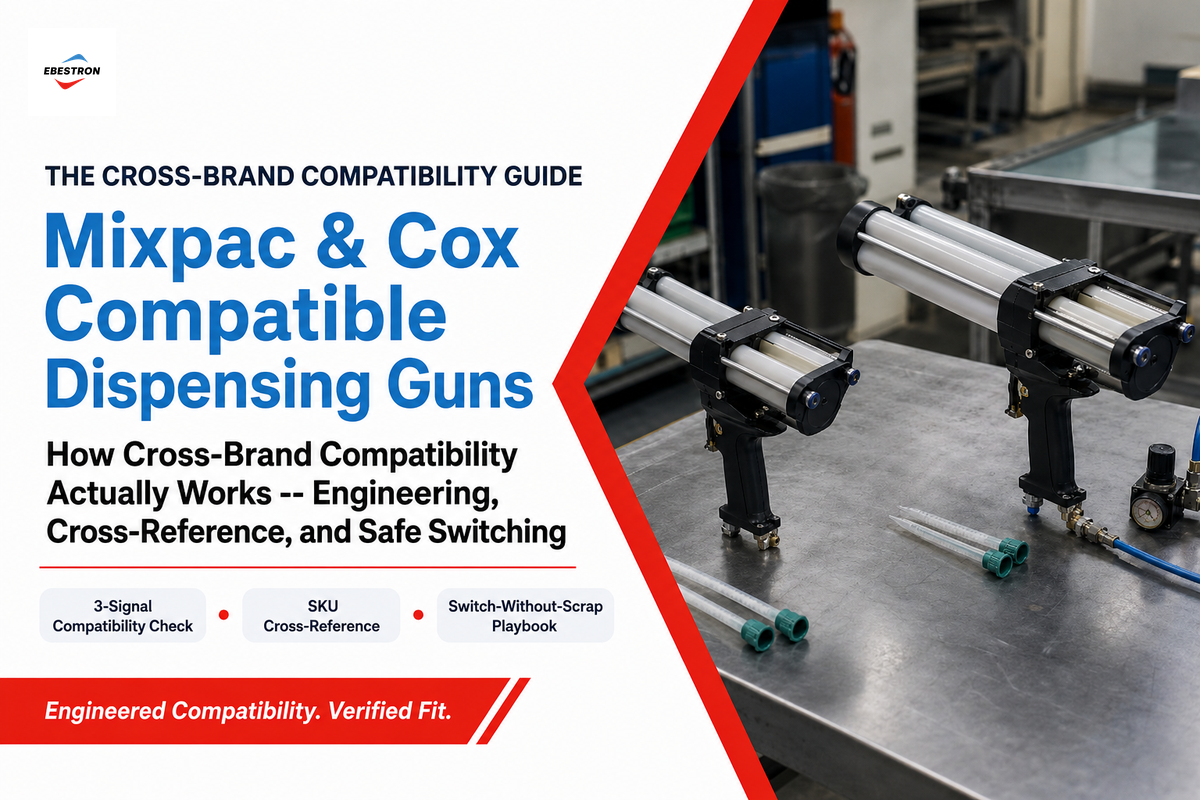
Mixpac & Cox Compatible Dispensing Guns are third-party dispensing guns engineered to accept cartridges from either brand’s open system families. Cross-brand fit works only when three physical signals line up: the cartridge system, the mix ratio, and the cartridge volume. Get any one of these wrong, and the gun either fails to seat the cartridge or meters the two parts inaccurately, even if the parts seem to snap together.
In short: A dispensing gun accepts a cartridge from a different brand only when the connection geometry, the mix ratio (set by the plunger pair), and the cartridge volume all match. Mixpac’s A-System and C-System are built to an open geometry that Cox, 3M, and Nordson EFD equipment also uses. Mixpac’s B-System and F-System are patent-protected and are not designed for open cross-brand fitment.
Key Facts
- Industry technical sources indicate that Mixpac B-System and F-System are proprietary connections, not manufactured to the open geometry standards common in the market. For F-System specifically, that closed status has a dated data point behind it: trade press reported a patent infringement case medmix filed over F-System connection hardware in China in 2024.
- Just because the cartridge clicks into place doesn’t guarantee compatibility. Piston alignment and pressure balance will be off if cartridge length, flange design or nozzle resistance differ, even with perfect mechanical snap.
- Off-ratio dispensing and bead stalling typically point to mixer diameter and element selection – or to the adhesive’s own extrusion pressure at temperature – not to a faulty cartridge.
- With one multi-ratio gun, you can replace two or three of the ratio-specific guns that a shop might otherwise need to keep in inventory.
What “Mixpac and Cox Compatible” Actually Means
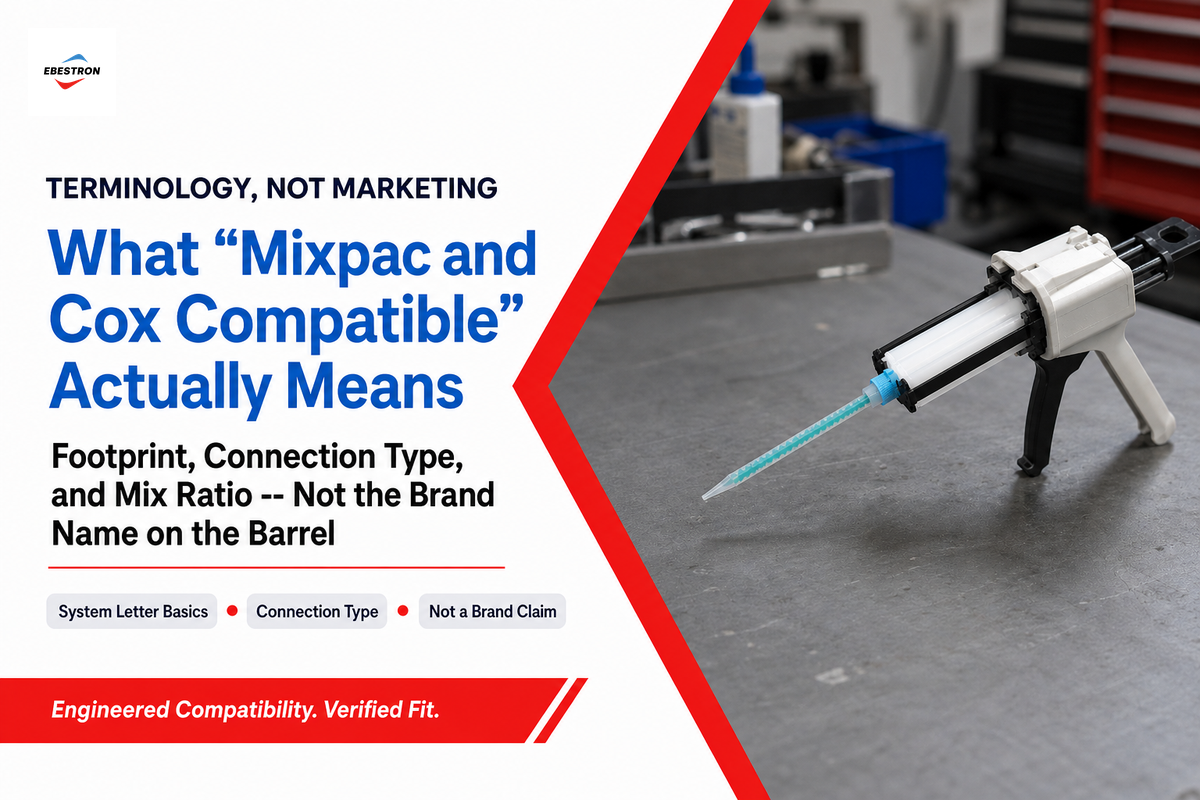
In this context, “compatible” means a dispensing gun with one brand’s connection geometry can operate a cartridge from another brand with no modifications. Mixpac™ (now part of medmix, formerly Sulzer Mixpac) and Cox™ — sold in some regions alongside its sibling brand MK — are the best-known providers of these two-component cartridge systems for sealant and adhesive dispensing, offering manual, pneumatic, and battery-powered guns alike.
Cox and MK equipment shows up across general industrial, aerospace, and fabrication work as often as it does in construction.
Automotive, electronics, and construction assembly lines all run some version of this hardware, and getting the terminology wrong is the root cause of most cross-brand ordering mistakes — buyers ask for a “Mixpac gun” the way they’d ask for a “Kleenex,” without realizing the term covers several mechanically distinct product families. Ebestron engineers its own mixpac dispensing range in-house specifically to the open-system geometry described below, which is one structural reason system-family identification, not brand name, is the real purchasing question.
What confuses buyers is the idea that “mixpac” or “Cox” is a single, unified connection standard. In fact, it isn’t. Both brands offer guns and cartridges across several product lines, but only certain product lines are built to an open standard that allows third-party guns, such as those from Ebestron, to drive them. What follows explains how to determine which of those product lines are open, how to interpret cartridge part numbers, and how to switch to a different gun manufacturer without discarding existing cartridge inventory. It also covers how to verify fitment before ordering. Ebestron’s dispensing gun range is designed to handle all of the drive types referenced in this guide.
💡 Pro Tip
Always check the gun’s model number to determine its product family — for example, medmix uses DMA/DMB for Mixpac manual A-System products, EAD/EA for Cox-branded pneumatic guns, and a parallel MK and Cox manual lineup shares the same underlying geometry — before ordering either a third-party gun or a new cartridge.
The Engineering Behind Cross-Brand Compatibility
What Is a Two-Component Dispenser, and How Does It Work?
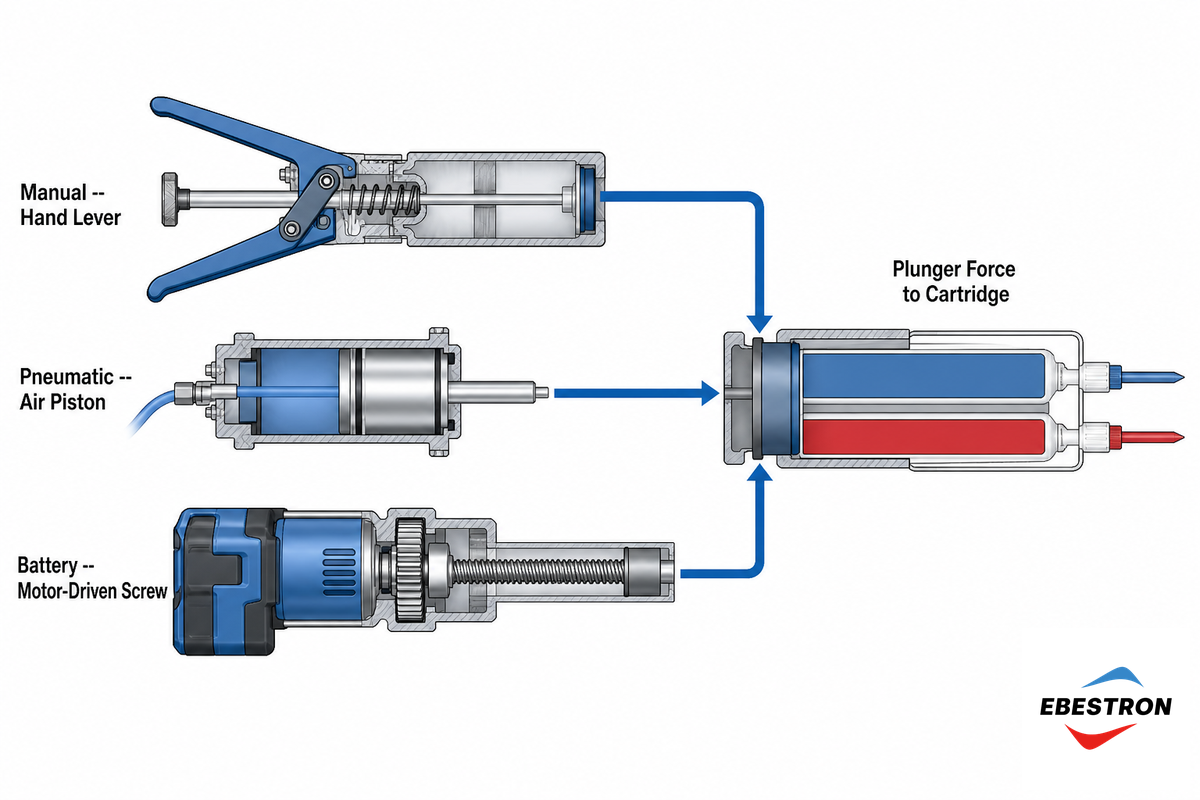
A two-component dispenser is a mechanically operated applicator. It advances two separate plungers into the cartridge to simultaneously push Part A and Part B through a static mixer. Plunger diameter is what fixes the ratio. Swapping the plunger assembly lets you run a single 50 ml gun body at 1:1 on one job and 2:1 on the next.
⚙️ Engineering Note: U.S. Patent US9409193B2, one patent filed in this equipment category, describes a manual dispensing gun embodiment in which a trigger squeezes piston rods and piston plates, moving the cartridge’s internal seals forward simultaneously at a rate fixed by the diameter ratio of the two piston rods. Individual manufacturer implementations vary. Across the 50-600 mL manual range, manufacturer and distributor spec sheets commonly show roughly 1.25 kN to 6.4 kN (about 280-1,440 lbs) of thrust at the plunger face, in a gun body typically weighing 1.1-1.9 kg; multi-ratio configurable guns in the same range are usually listed slightly heavier, around 3.5-4.6 kN thrust capacity. Exact figures vary by brand and model — confirm against the specific gun’s own datasheet before specifying thrust-critical applications.
There’s a physical-and ergonomic cost to every manual cycle that’s rarely part of the buying consideration. The National Institute for Occupational Safety and Health’s “Guide to Selecting Non-Powered Hand Tools” identifies Force, Repetition and awkward Wrist posture as the top risk factors for the development of work-related strain injuries to the hands and wrist – and an operator running hundreds of dispensing cycles on a high-force manual gun is classic for those three risk factors. This is a major reason that higher-volume production operations running 400 mL and 600 mL cartridges opt for pneumatic dispensing guns or a battery unit rather than pushing a manual trigger all day; lighter-duty benchwork still often runs on manual cartridge dispensing guns, while mobile or cordless setups increasingly move to battery and electric cartridge guns. Any three drive types should adhere to the same fitment requirements discussed below, drive type is simply the force generation mechanism and not the fitment logic itself. Whether the job calls for handheld dispensing of a 1K single-component sealant or a 2K component adhesive, the drive-type logic is the same across pneumatic and battery operated equipment; a component battery pack simply replaces the air line as the force source. In general, pneumatic guns of this class will run on an adjustable compressed-air regulator that’s limited to a maximum 100 PSI – if comparing pneumatic vs manual vs battery drives the economics of compressed air usage must be a consideration.Compressed air represents an average of about 10% of a plant’s total energy costs, and around 30% of that air is lost to leakage before reaching the dispensing gun.
“Compatibility is not a brand property, it is a footprint property defined by volume, ratio, and system.”
Craig Blum, Nordson EFD, writing in Adhesives & Sealants Industry
The 3-Signal Compatibility Field Guide
These three indicators will address one particular question: Is this gun capable of driving this cartridge in this ratio? They won’t address a separate question: How good is the resultant mixture, which is determined by such factors as mixer element count, mixing nozzle geometry, and the viscosity of the mix relative to the mixing nozzle ratio. (See Ebestron’s Sulzer Mixpac & 3M compatible mixers guide). Separate questions will prevent ordering a gun that fit a cartridge with a poorly performing mixer or vice-versa.
| System Family | Connection Type | Common Ratios | Cross-Brand Status |
|---|---|---|---|
| Mixpac A-System | Square-back, side-by-side | 1:1, 2:1 | Open — Cox, 3M, Nordson EFD equivalents fit |
| Mixpac C-System | Rectangular flange, side-by-side | 1:1, 2:1, 4:1, 10:1 | Open — bayonet and bell-mouth variants interoperate |
| Mixpac B-System | Proprietary bayonet | 1:1, 2:1 | Closed — patent-protected, not intended for cross-brand fit |
| Mixpac F-System | Proprietary bayonet | 1:1, 2:1, 4:1 | Closed — medmix reportedly pursued a China patent infringement action over F-System hardware in 2024 |
| Cox / Nordson EFD equivalents | Bell-mouth, threaded nut | 1:1, 2:1, 4:1, 10:1 | Open — shares A/C-System geometry conventions |
| Coaxial systems | Concentric cartridge, 75-380 mL | 1:1, 2:1, 4:1, 10:1 | Open across brands within the coaxial format |
Key Takeaway: If your existing gun or cartridge is stamped A-System or C-System, cross-brand replacement guns are a standard, low-risk purchase. If it’s stamped B-System or F-System, treat it as a closed ecosystem and verify fitment before ordering — see the checklist later in this guide.
SKU and Part-Number Cross-Reference
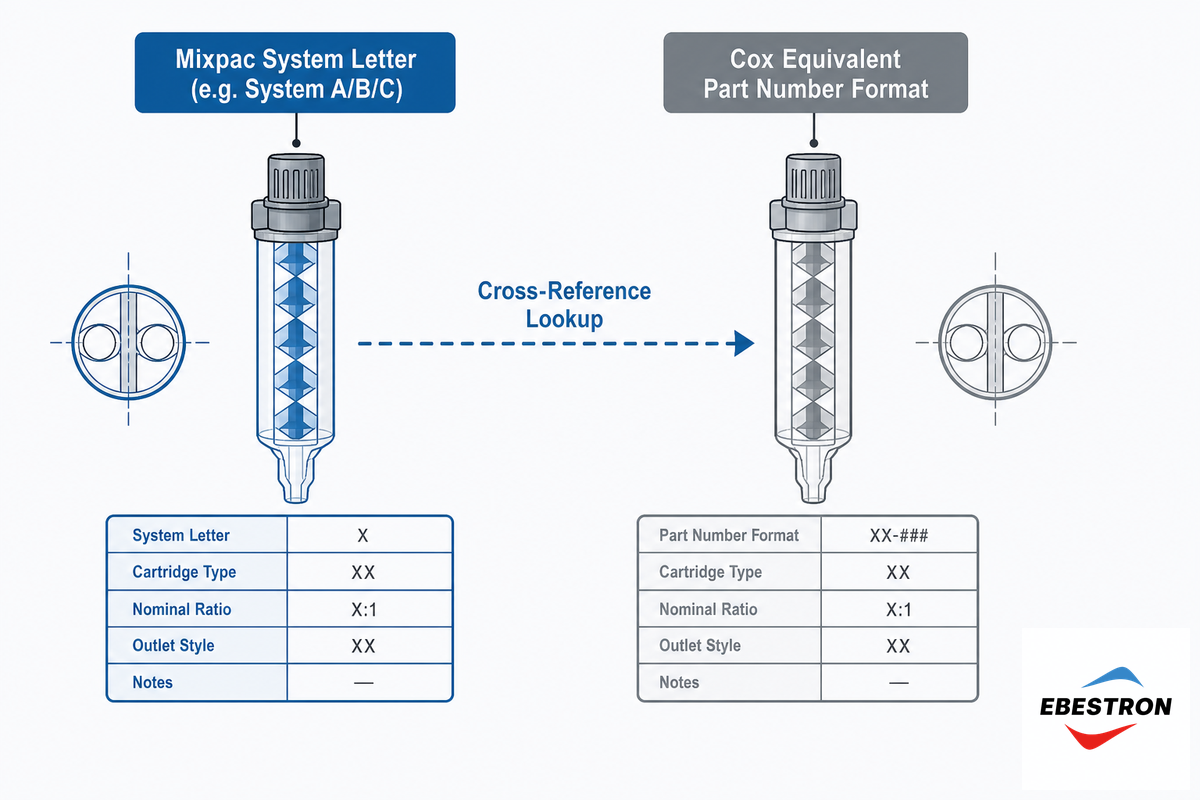
Ordering the wrong gun for an existing cartridge stock is an expensive mistake — and it usually happens because the buyer read the volume off a listing without checking the ratio and system codes buried in the same part number. Your part number tells you ratio, volume and system prior to removing the part from its packaging, which is why Ebestron trains its sales team to confirm all three codes before quoting a replacement. The same sulzer mixpac dispensing part-number logic scales from 25ml and 50ml cartridges up through 200ml and 400ml, all the way to 1500 ml bulk cartridges — the coding convention doesn’t change with volume. medmix’s mixpac™ COX EAD600PC-11, part number 177862, is a dedicated 1:1 pneumatic gun (the “PC” flags pneumatic drive) for 300 mL x 300 mL cartridges. Distributor listings show a nominal thrust rating of 1,188 lbs – the “600” refers to the dual-cartridge total volume, and the “-11” suffix denotes a medmix standard 1:1 configuration.
What Type of Cartridge Gun Fits a 50 mL Mixpac Cartridge?
A 50 mL Mixpac cartridge in the AA/AB square-back format — the same footprint as medmix’s own DMA 51 manual gun — mounts on any brand’s standard 50 mL manual or pneumatic gun body, as long as that gun accepts the AA/AB System connection. Gun compatibility, not adhesive brand, is the question that matters here.
Guns of this type, including the DMA 51 (roughly 0.18 kg — worth noting for one-handed or overhead dispensing), commonly ship with a 1:1/2:1 plunger pair as standard and accept an optional 4:1 or 10:1 plunger swap. Roughly a dozen adhesive brands marketed for this cartridge size — Chem-Set, Parker Lord, Loctite, Araldite, Devcon, 3M, Permabond, ASI, and Plexus among them — all use the same 50 mL AA/AB footprint.
| Model / Part Number | Volume | Ratio | Drive |
|---|---|---|---|
| DMA 51 | 50 mL | 1:1 / 2:1 std, 4:1 / 10:1 optional | Manual |
| EA150M | 300 mL | Multi-ratio | Manual |
| EAD600PC-11 (P/N 177862) | 600 mL (300+300) | 1:1 | Pneumatic |
| EAD600MC-11/21 | 600 mL | Multi-ratio | Manual |
| DM 200 / DM 400 | 200 mL / 400 mL | Standard two-part | Manual |
| DP2X 400 | 400 mL | 1:1 / 2:1 / 4:1 / 10:1 | Pneumatic |
Third party pneumatic guns which are built for C-System and F-System envelope (such as the Infinity Bond Versa Air gun) are advertised as being compatible for both systems over a 200 to 490 mL range in all four common ratios, indicating that C-System’s open architecture continues on to pneumatic drive in addition to manual operation. U.S. Patent US7144170B2 describes the same class of dual-cartridge mechanism carried across both drive types: piston rods and cartridge piston seals advancing simultaneously through the multi-component cylindrical cartridge, independent of whether the trigger force is manual or pneumatic.
Side-by-Side and Coaxial Systems: Ratios and Volumes Explained
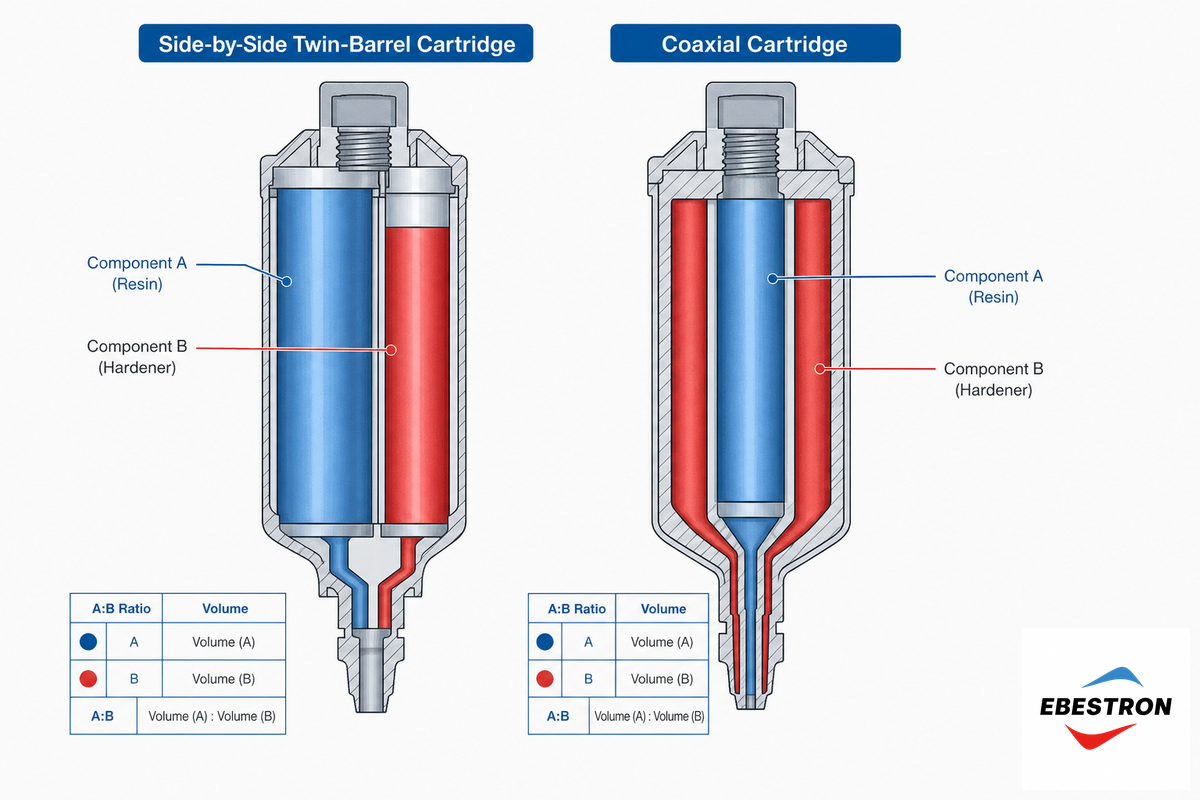
Ratios are fixed: A gun body that comes equipped with 1:1/2:1 plunger pair can work with a number of different adhesive brands of the same footprint size, but it won’t work with just any ratio. That’s because the relative diameters of the two piston rods (Part A vs. Part B) dictate the mix ratio that’s specified for the cartridge- a 10:1 gun has a much larger diameter rod for Part A and a much smaller diameter rod for Part B. When you swap out the plunger pair for a 1:1 on that same gun, you effectively have the same cartridge working, just delivering equal volumes of both components.
Cartridge System Type Atlas
Side-by-side cartridges (with two barrels mounted side-by-side) dominate the market, spanning 50 ml cartridges for dental and electronics work up through large-scale (up to 1,500mL) construction and truck-bed liner jobs. Coaxial cartridges (one barrel is housed within the other) represent the minority and are more prevalent in specialty sealant and marine applications where a more compact (75-380mL) footprint is desirable. U.S. Patent US5676280A details the dual-vessel body construction behind the side-by-side format, built specifically to prevent cross-contamination between the two components before they reach the mixer.
| Type | Volume Range | Ratios | Typical Application |
|---|---|---|---|
| Side-by-side, small | 25-50 mL | 1:1, 2:1 | Dental, electronics potting |
| Side-by-side, mid | 200-300 mL | 1:1, 2:1, 4:1 | Automotive aftermarket |
| Side-by-side, large | 400-600 mL | 1:1, 2:1, 4:1, 10:1 | Construction anchoring |
| Side-by-side, bulk | up to 1,500 mL | 2:1, 4:1, 10:1 | Truck bed liner, industrial |
| Coaxial, small | 75-150 mL | 1:1, 2:1 | Specialty sealants |
| Coaxial, large | up to 380 mL | 1:1, 2:1, 4:1 | Marine assembly |
| Multi-ratio configurable | 300-400 mL | 1:1 to 10:1, plunger-swap configurable | Mixed-batch production runs |
| B/F-System (closed) | Varies by model | 1:1, 2:1, 4:1 | OEM-locked medmix systems, not cross-brand compatible |
Key Takeaway: A side-by-side gun cannot drive a coaxial cartridge and vice versa — the two formats are mechanically distinct, not just differently shaped. Confirm the format before assuming ratio and volume compatibility apply.
Adhesive Chemistry Compatibility
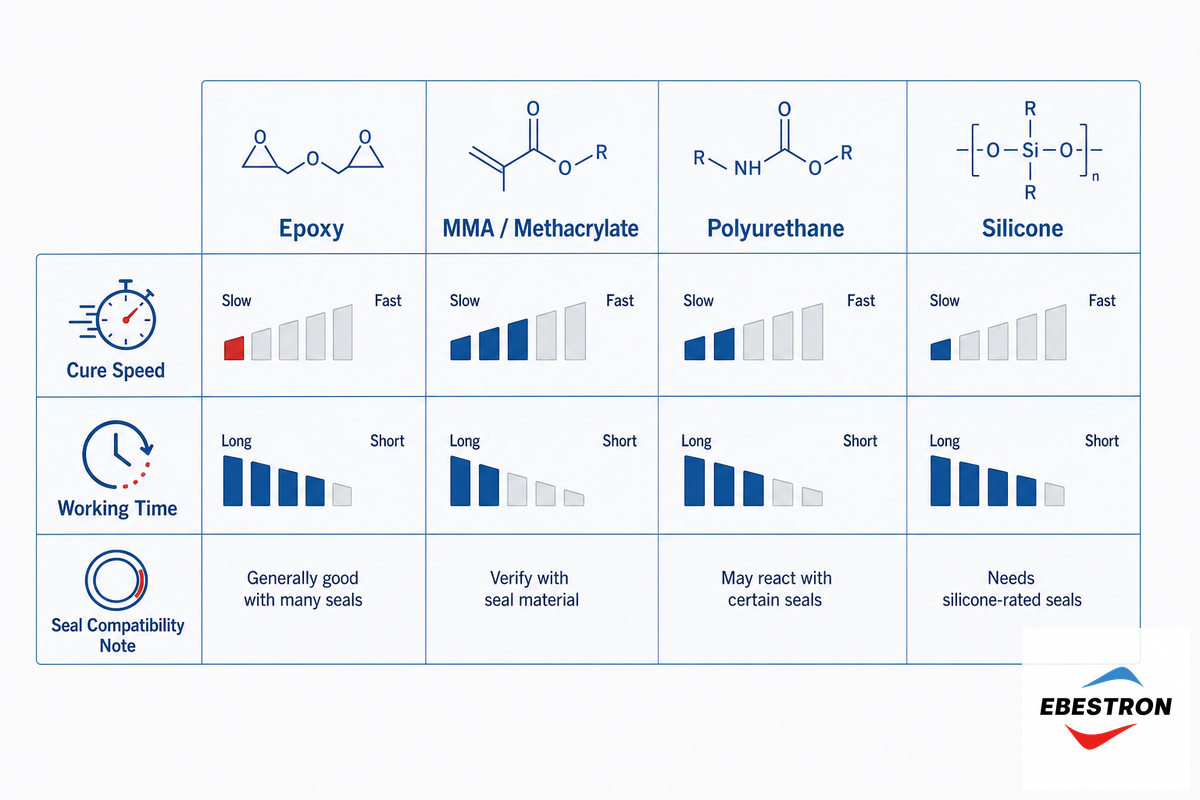
The four main adhesive families sold into mixpac and Cox cartridge formats include epoxy, polyurethane, silicone and MMA (methyl methacrylate, which is acrylic based, thus sharing the seal compatibility of acrylic adhesives). Each component adhesive has a different cure profile and different demands on the cartridge’s internal seals and the static mixer material — a structural-bonding epoxy behaves differently under pressure than a fast-cure MMA panel adhesive, even inside an identical cartridge footprint. Viscosity also varies from a thin, free-flowing dose to a heavy paste, which is part of why thrust class matters as much as chemistry when specifying a gun.
✔ Advantages of Cartridge-Format Dispensing
- Fixed ratio eliminates hand-mixing error
- Single-use mixer prevents cross-batch contamination
- Chemistry-agnostic gun body works across epoxy, PU, silicone, and MMA cartridges that share the same footprint
⚠ Limitations
- It’s always a good practice to ensure that your seals and cartridge have the same chemistry as your intended application to avoid the risk of degradation and failure from solvent compatibility.
- Fast cure mma panel cartridges typically have shorter working times once they’re engaged and ready to be dispensed, so make sure you’re ready before dispensing.
- Required mixer element count depends on your mix’s overall viscosity and the chemistry you’re working with.
Another aspect to cartridges that buyers often overlook is compliance: because Parts A and B are chemically distinct products packaged as a single dual-chamber cartridge, U.S. hazard communication rules regard each half as its own separate container. In a formal interpretation of the rules concerning separate SDSs and labels for dual components, OSHA explains that Part A and B each requires its own label and SDS, and that any hazards created from the reaction product (after the components mix) need to be included in the SDS, typically under the headings of stability/reactivity, handling, or exposure controls. A dual-chamber cartridge that may “fit” mechanically but lacks separate A/B labeling and documentation is a purchasing red flag on top of any compatibility issues related to the dispenser gun.
⚠️ Important
The most common error field technicians encounter with regard to seal compatibility is the assumption that the dispenser gun’s seals are chemistry neutral. Particularly with silicone-based adhesives, gun seals that are not specifically rated for silicone-formulated release agents often end up – or are – damaged or degraded. If you intend to switch chemistries on a gun that already has been specified with seals for a different chemist, always check the gun manufacturer’s specification of seal material before hand.
How to Switch Gun Suppliers Without Replacing Your Cartridges

Staying locked to one OEM gun brand is a common, expensive habit — the trade-off is rarely examined because switching feels riskier than it actually is once the system family is confirmed. A shop can upgrade to a third-party gun vendor – even one such as Ebestron, whose catalog includes a compatible Mixpac & Cox compatible dispensing gun range engineered and quality-checked in-house – without sacrificing any inventory of existing A-System or C-System cartridges if they follow a deliberate sequence.
The Switch-Without-Scrap Playbook
Here’s a four-step procedure for upgrading a facility’s OEM dispenser gun fleet to a compatible third-party vendor, while continuing to run down existing cartridge inventory.
The Switch-Without-Scrap Playbook
- Determine the system type. You can do this by consulting the gun body or cartridge itself, where you should find a Part A, B, C or F-System identifier. Order accordingly.
- Ascertain open status. Part A and C-Systems (and the Cox and Nordson EFD equivalents) are open; Part B and F-Systems are closed.
- Order one sample gun first. Run the sample with your existing inventory of cartridges and mixer elements prior to making a volume purchase.
- Phase in new guns as old ones come off service. Don’t replace the entire fleet of guns in one go; do it as each gun reaches its service life to balance the depletion of both the gun and the cartridge inventory.
Cost benefits from following this procedure are significant. OEM pneumatic guns of this caliber, such as the Sulzer Mixpac DP2X 400, typically list from about $439 to $460. OEM manual guns run a wider range: roughly $29 to $807 for Cox, $39 to $906 for Albion’s higher-ratio models, and as low as $26-$36 for Albion’s basic manual caulk-format guns. One multi-ratio gun replacing multiple ratio-specific models multiplies these savings across a large gun fleet, and U.S. Patent US5535922A provides the basis for how a single gun body design can accommodate different cartridge modules.
Key Factors to Consider Before Switching
- Current cartridge system family (A/B/C/F)
- Remaining cartridge inventory value
- Gun fleet service/replacement schedule
- Whether any guns are still under OEM warranty
Verifying Fitment Before You Order
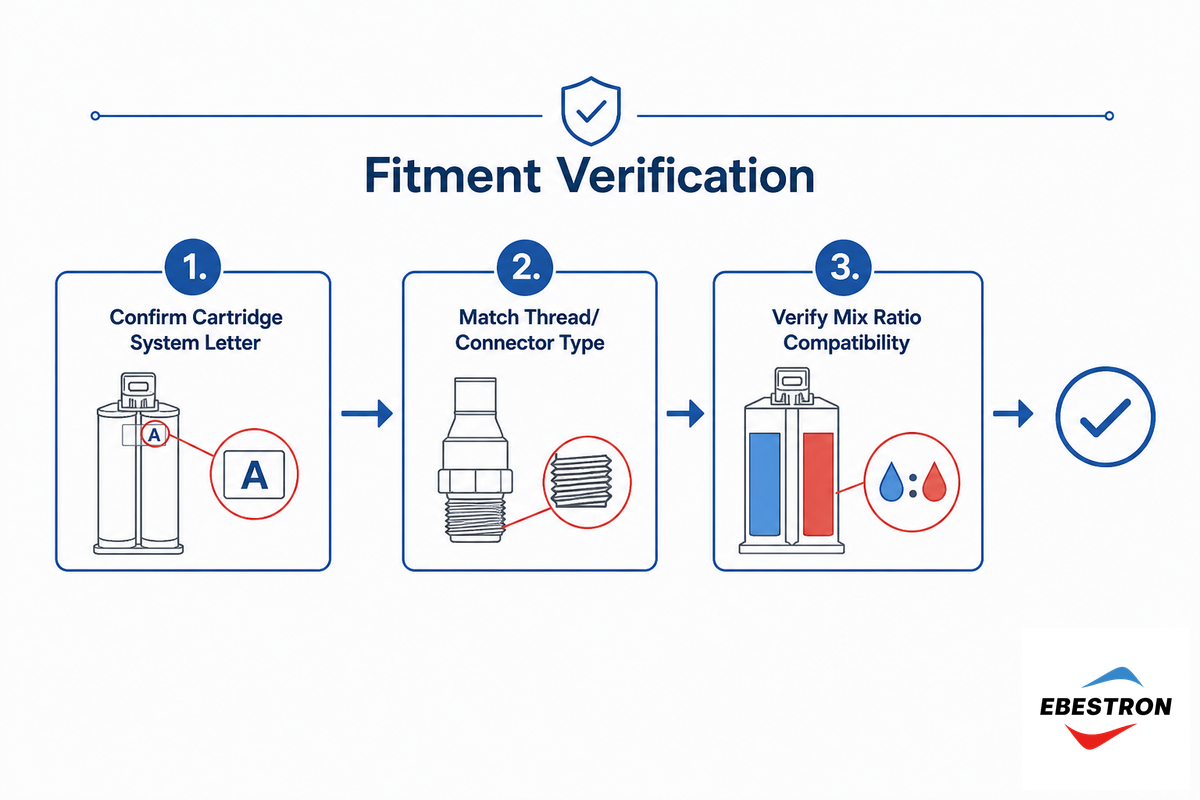
Return rates on cross-brand orders climb sharply when buyers skip this step, and the underlying cause is almost always the same: they judged compatibility by eye instead of by the three signals that actually determine it. Just three quick steps will identify nearly all possible fitment errors without even needing to look up part numbers prior to ordering a third-party gun or cartridge for a mixed-brand application, and Ebestron’s own quality team runs the same three checks before any OEM-replacement order ships. The underlying reason these three checks work is mechanical: U.S. Patent US4113151A describes how a fluid-driven dispensing gun’s rear-wall piston must advance flush against the cartridge’s open end for the whole assembly to pressurize correctly — exactly the alignment that connection type, ratio, and length verify before you ever pull the trigger.
The 3-Question Fitment Threshold Test
The 3-Question Fitment Threshold Test
- ✔ Take a photograph of the cartridge-end connection to the gun – is it a bayonet, bell-mouth, or integral threaded nut? That geometry identifies the system family before the cartridge box even arrives.
- ✔ Match the ratio stamp on the plunger pair to the ratio printed on the cartridge – a mismatch means incorrect metering even when the cartridge physically seats.
- ✔ Confirm cartridge length and flange design against the gun’s rated envelope – length and flange affect piston alignment and pressure balance independently of system family and ratio.
Passing all three questions is a strong indicator of correct fitment; failing any one of them-even if the cartridge physically clicks into the gun-is an infallible indicator of off-ratio dispense, seating issues or premature seal wear.
Troubleshooting Cross-Brand Fitment Issues
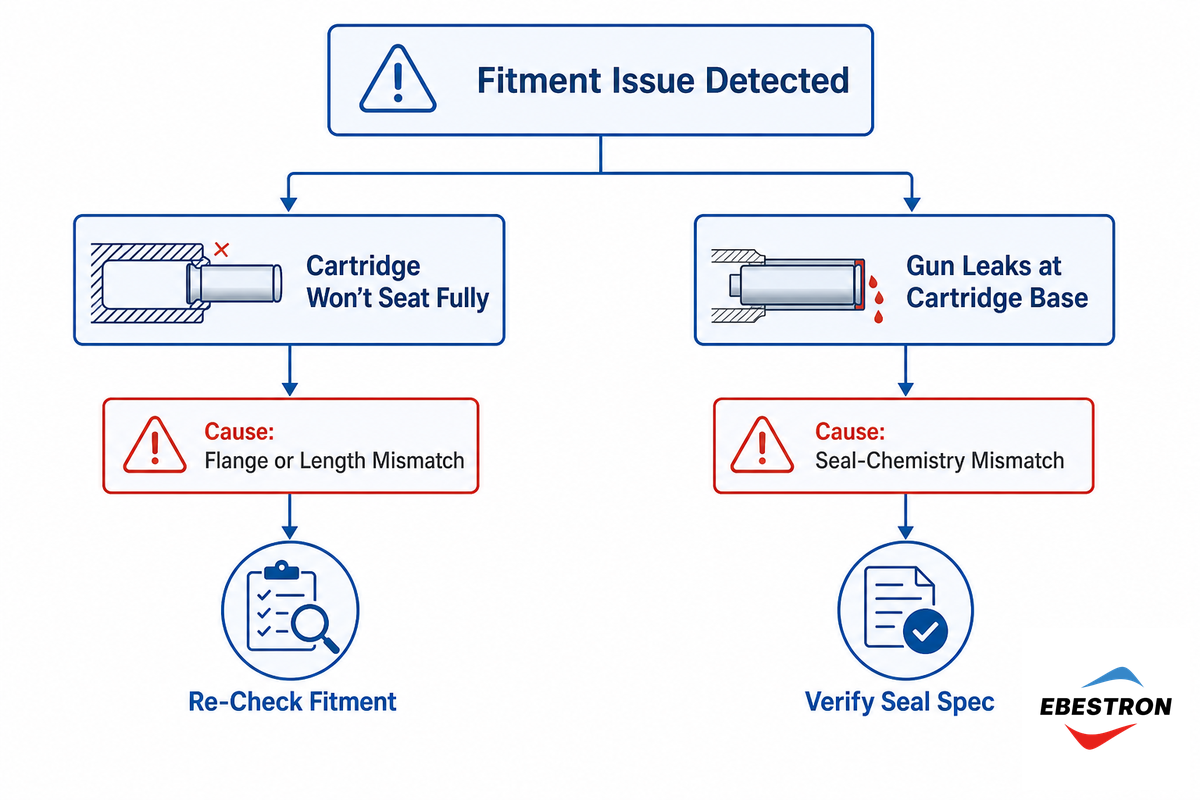
Most cross-brand fitment issues can be traced to just a few causes; the solution is a diagnosis step, not a warranty action — and working through the table below beats repeated forceful re-seating attempts, which OSHA’s ergonomics guidance flags as exactly the kind of repetitive, forceful hand exertion that raises strain-injury risk.
| Symptom | Likely Cause | Fix |
|---|---|---|
| Bead stalls mid-dispense | Mixer element/diameter mismatch, or adhesive extrusion force rising with temperature | Confirm mixer sizing; check working temperature against the adhesive’s rated extrusion range |
| Off-ratio output | Wrong plunger pair installed, or cartridge from an unmatched ratio family | Re-check plunger stamp against cartridge ratio label |
| Cartridge won’t seat fully | Flange or length mismatch, not a ratio or volume problem | Re-run the 3-Question Fitment Threshold Test above |
| First bead looks under-mixed | Normal — the first segment from a fresh static mixer is not always fully blended | Purge the first bead before applying to the workpiece |
| Gun leaks at the cartridge base | Seal material incompatible with the adhesive chemistry in use | Verify seal-material spec against the chemistry table above before continued use |
💡 Pro Tip
Always purge the first bead from a fresh static mixer before applying material to the actual joint or bond line-technical guidance across the industry consistently emphasizes that the first emitted material isn’t always fully mixed regardless of gun brand or mixer quality.
Industry Outlook: Why Cross-Brand Compatibility Is Becoming a Procurement Requirement

(Updated July 2026) Customer search behavior is a leading indicator here, and its telling a specific story: brand-specific searches for “cox gun” declined roughly 76% YoY while the generic category term “epoxy gun” stayed flat. That gap isn’t random – it parallels a real, dated 2024 event reported by trade press: medmix brought a patent infringement suit in China related to its F-System connection hardware – corroborating evidence that mixpac systems split into open systems (A, C) and closed-by-design, actively-defended systems (B, F). When a brand actively defends a patent, buyers who search by brand name only become increasingly aware that “brand” alone doesn’t give you the answer to “what system family will it connect to?” What this means for buyers: include system-family confirmation in your official RFQ or purchase-order language now, not as a post-delivery surprise. Ebestron builds its cross-brand catalog around exactly this shift, engineering each gun to a documented system-family spec sheet rather than a single OEM brand match, for automotive, electronics, and construction customers who source across multiple regions. Patent protection on connection hardware is not a theoretical risk: mechanisms like the one described in U.S. Patent US9409193B2 are the kind of claims brands actively defend, which is exactly why buyers should confirm a system’s open status rather than assume it.
On the technology side, sustainability considerations are beginning to impact cartridge design choices, not just gun design ones. medmix’s own greenLine two-component cartridge system received an industry innovation award in 2024 for its less-wasteful approach, and in addition, recycled-content cartridge lines are on track to enter mainstream procurement dialogues alongside cost and lead time in 2026-meaning it would be wise for buyers assessing a gun or cartridge switch to pose questions about recycled-content options now, not treat it as a future consideration.
As a context only: third-party market research has projected the world-wide adhesive dispensing equipment market at around $8.72 billion in 2025 and trending to reach $12.25 billion by 2035 (about 3.5% CAGR)-directional sizing, not a specific catalyst for the compatibility trend detailed above.
Frequently Asked Questions
Q: Are Mixpac and Cox gun systems really interchangeable?
View Answer
Only within the open system families. Mixpac’s A-System and C-System share connection geometry with Cox, 3M, and Nordson EFD equipment, so a gun built to one family accepts a cartridge from any brand using the same geometry, ratio, and volume. Mixpac’s B-System and F-System are treated as proprietary — medmix pursued a 2024 patent infringement action in China over F-System hardware — and neither is open. Check the system stamp before assuming interchangeability.
Q: What is a two-component dispenser, and how does it work?
View Answer
A two-component dispenser is a mechanical gun that advances two piston rods into a dual-chamber cartridge at a fixed rate, pushing Part A and Part B through a static mixer at the ratio set by the plunger pair’s diameters. Trigger mechanism alone — manual, pneumatic, or battery-driven — only supplies the force; plunger geometry fixes the ratio. Swapping the plunger pair is how one gun body runs 1:1 in one job and 4:1 in the next.
Q: What’s the difference between an adhesive dispensing gun and a caulking gun?
View Answer
A standard caulking gun drives a single-component tube with one plunger and no mixing element — fine for sealants that cure on air or moisture exposure. An adhesive dispensing gun for two-component materials drives two plungers through a dual-chamber cartridge and a static mixer, metering Part A and Part B at a fixed ratio. That precision exists because structural epoxies, polyurethanes, and MMAs need a repeatable ratio hand-mixing cannot reliably deliver.
Q: What materials can I dispense with a two-component cartridge gun?
View Answer
The four chemistries most commonly sold in this cartridge format are epoxy, polyurethane, silicone, and methacrylate (MMA), covering structural bonding, sealing, potting, and fast-cure panel-bonding applications. Seal-material compatibility varies by chemistry, so confirm the gun’s seal spec against your adhesive before switching chemistries on an existing gun body.
Q: Can the same gun handle both small-scale and industrial-volume work?
View Answer
Within a volume range, yes — the same gun body across a plunger-pair swap can move from prototyping to short production runs. Crossing from a 50 mL bench gun to a 1,500 mL industrial cartridge is a different gun class, not a plunger swap.
Q: Where are Ebestron dispensing guns made?
View Answer
Ebestron designs and manufactures its dispensing gun range in-house in Kunshan, Jiangsu, China, covering R&D, production, and after-sales support under one roof — the same facility that engineers the Mixpac and Cox compatible cartridge systems referenced throughout this guide.
The Team Behind This Report
This guide compiles engineering documentation, USPTO patent filings, and regulatory guidance specific to Mixpac and Cox dual-cartridge system compatibility, the mechanical and part-number questions this guide covers sit alongside, but separately from, the gun-selection decision covered on our product page. Reviewed by the Ebestron technical team.
References & Sources
- Ergonomics, Overview — Occupational Safety and Health Administration
- Standard Interpretation: Separate SDSs and Labels for Dual Components — U.S. Department of Labor / OSHA
- Easy Ergonomics: A Guide to Selecting Non-Powered Hand Tools — NIOSH Publication No. 2004-164
- Adhesive Standards — Adhesive and Sealant Council
- ASTM D5267-97(2026): Standard Test Method for Determination of Extrudability of Cartridge Adhesives — ASTM International
- medmix Files Patent Infringement Lawsuit in China — Adhesives & Sealants Industry
- US9409193B2, Dual Component Dispensing and Mixing Systems — Google Patents / USPTO
Related Articles
- Sulzer Mixpac & 3M Compatible Mixers Guide — static mixer and nozzle cross-brand compatibility, the companion question to gun compatibility
- Pneumatic Cartridge Dispensing Guns Guide — air-supply sizing, FRL setup, and pneumatic-specific maintenance
- Battery & Electric Cartridge Dispensing Guns Guide — motor and battery-platform selection for cordless dispensing
- Epoxy Applicator Guns Guide — drive-type and ratio selection specific to epoxy dispensing