Get in touch with Ebestron Company

By GW · Updated October 2026
Empty Cartridges Bulk Wholesale OEM means purchasing unfilled cartridge packages in a specified two-component adhesive application. Wholesale empty bodies and complete assemblies can be different offers. To begin, ask what constitutes a set, including all components, the filling arrangement and acceptance evidence.
Empty Cartridges Bulk Wholesale OEM procurement requires an agreed component list, a tested cartridge, mixer, dispenser combination, formulation-specific qualification and a batch-release record. Compare quotes by complete accepted sets.
Quick specs for the purchasing brief
Document the adhesive’s two-component ratio and the basis for the ratio, the required filling volume, and the precise component revisions. Also document the responsibilities for filling and the evidence required for release. Values for the aforementioned components are drawn from your formulation and selected package; this guide provides a purchasing methodology for adhesives and doesn’t specify universal operating conditions.
- A fitted mixer doesn’t establish a qualified filled package.
- Approved samples and incoming-lot acceptance answer different questions.
- A complete-set price needs the same inclusions and acceptance assumptions in every offer.
Define a complete empty adhesive cartridge set
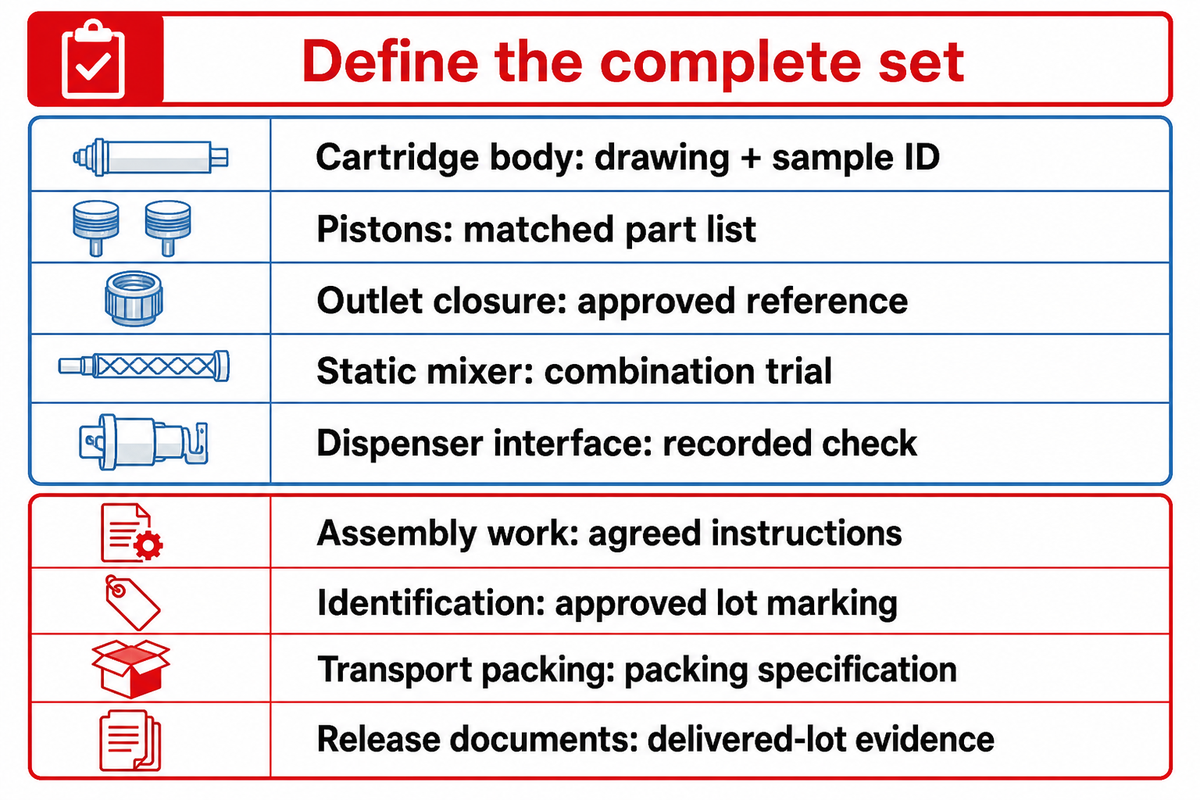
A complete empty adhesive cartridge set means the collection of approved components your filling and dispensing process requires. Define that set in a bill of materials before requesting wholesale pricing. Identify included parts, separately supplied items and assembly work so purchasing can compare offers against the same usable output.
“Empty cartridge” can be a body-only line item or part of a supplied assembly. Anthony Martucci’s technical article on 2K packaging components, published by Adhesives & Sealants Industry in 2012, describes cartridge, piston and nose-plug choices alongside filling considerations. Martucci was a Nordson EFD product manager at the time of publication; the article does not independently certify a supplier’s package.
Do the cartridges include pistons, caps and mixers?
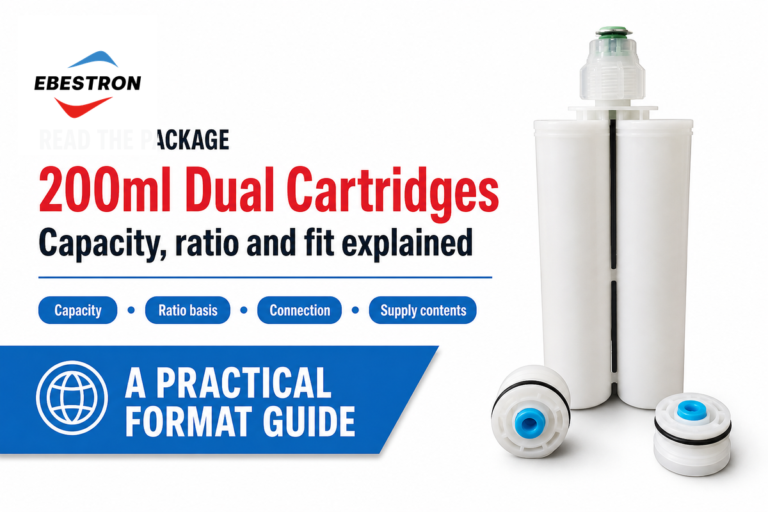
Inclusions depend on the specific quotation. The supplier should mark each item included, individually priced or supplied by your filler, with its part number and quantity. A picture of an assembled package won’t resolve the question. The purchase order should carry the agreed-to list with any exclusions.
When purchasing cartridges wholesale, include the following information in your quotation request. These are buyer-defined fields, not a claim that every cartridge design has the same loose parts. For bulk purchasing, a component part list, provided to the receiving staff, resolves the question.
| Item or record | Specify in the offer | Acceptance evidence | Limitations / not suitable for |
|---|---|---|---|
| Cartridge body | Part number and drawing revision | Approved drawing and sample ID | Capacity label alone cannot prove fit |
| Pistons | Type, material and quantity per set | Matched part list | Same diameter does not establish sealing behavior |
| Outlet closure | Plug/cap arrangement and assembly state | Approved closure reference | Do not assume the pictured closure is included |
| Static mixer | Exact mixer and attachment parts | Trial record for the offered combination | Attachment fit does not prove mixing performance |
| Dispenser interface | Gun or equipment model and configuration | Recorded fit and dispensing check | Nominal volume does not identify the interface |
| Assembly work | Who installs each component and when | Agreed filling/assembly instructions | Loose and preassembled prices are different scopes |
| Identification | Part, revision and lot markings | Readable approved marking sample | A logo is not a lot identifier |
| Transport packing | Carton count and protection method | Packing specification | Body count is not necessarily complete-set count |
| Release documents | Inspection records and agreed change notice | Documents tied to the delivered lot | A generic brochure cannot release a batch |
Suppose the order is for 10,000 cartridge bodies. The buyer’s approved set also requires a closure set, but only 9,600 approved closure sets arrive. Even if each body is acceptable, the available inventory supports at most 9,600 complete sets. The remaining 400 bodies are incomplete. Purchasing needs to define when the missing parts will become available, and Production needs an honest release quantity. That distinction prevents a receiving count from turning into a filling commitment the store cannot support. Prior to scheduling the work, convert component inventory into set-equivalent quantities.
The price scope of the order resolves the first price objection. If an offer excludes mixers because the filler provides them, this exclusion and its cost should be included in the comparison. An offer for bodies only can be a valid choice if the remaining approved parts are available.
Translate the adhesive brief into cartridge specifications
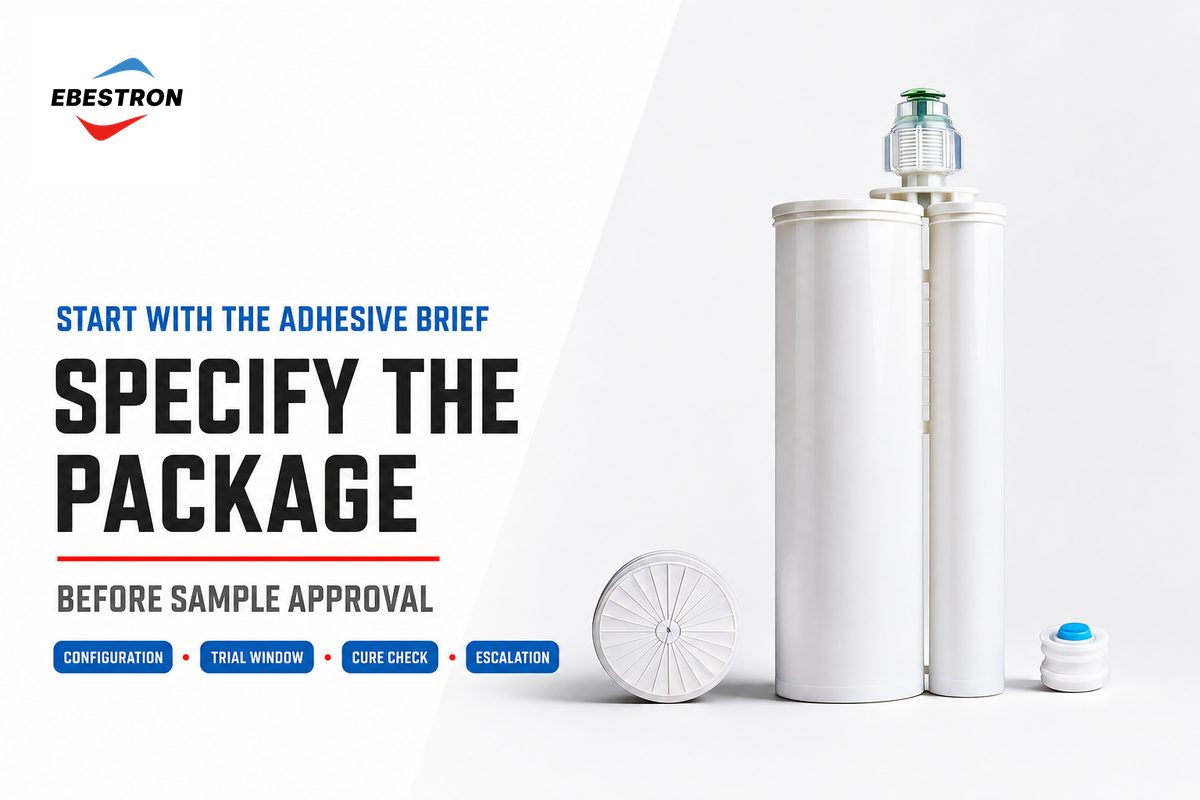
Turn the adhesive brief into a controlled specification with the formulation owner and filler. Record ratio basis, required usable fill, material identities and physical interfaces. Resolve missing values before sample approval because a catalog family name can’t describe the exact package that the filling line must accept.
Starting with the existing adhesive instructions, copy the specified ratio, ensuring the basis is also included (volume or mass). A ratio without a basis leads the supplier to guess. Record fill requirements in mL and any mass checks in grams with the formulation owner’s method of relating the two.
Separate nominal capacity from intended fill quantity. For a project considering 50 mL dual-cartridge options, solicit the offered drawing and usable fill information instead of assuming the family label answers every question regarding dimensions. Detailed cartridge formats belong in the product specification; the purchasing brief should point to its approved revision.
Keep acceptance properties distinct from typical resin data. A February 2026 ASI materials article by medmix employees Tobias Bodenmüller and Michael Kipperer makes that distinction when discussing cartridge development. Their examples aren’t Ebestron tests. For your order, request the material specification that governs the offered part and agree which changes require notice.
What conditions must quality empty cartridges meet for your application? Neither a “high-quality” label nor a “premium empty cartridge” description identifies the offered resin grade. Return an incomplete brief with the missing fields highlighted. A sample can resolve a design question, but an unlabeled sample can’t define which material, drawing or production revision you approved.
Check the cartridge, mixer and dispenser together
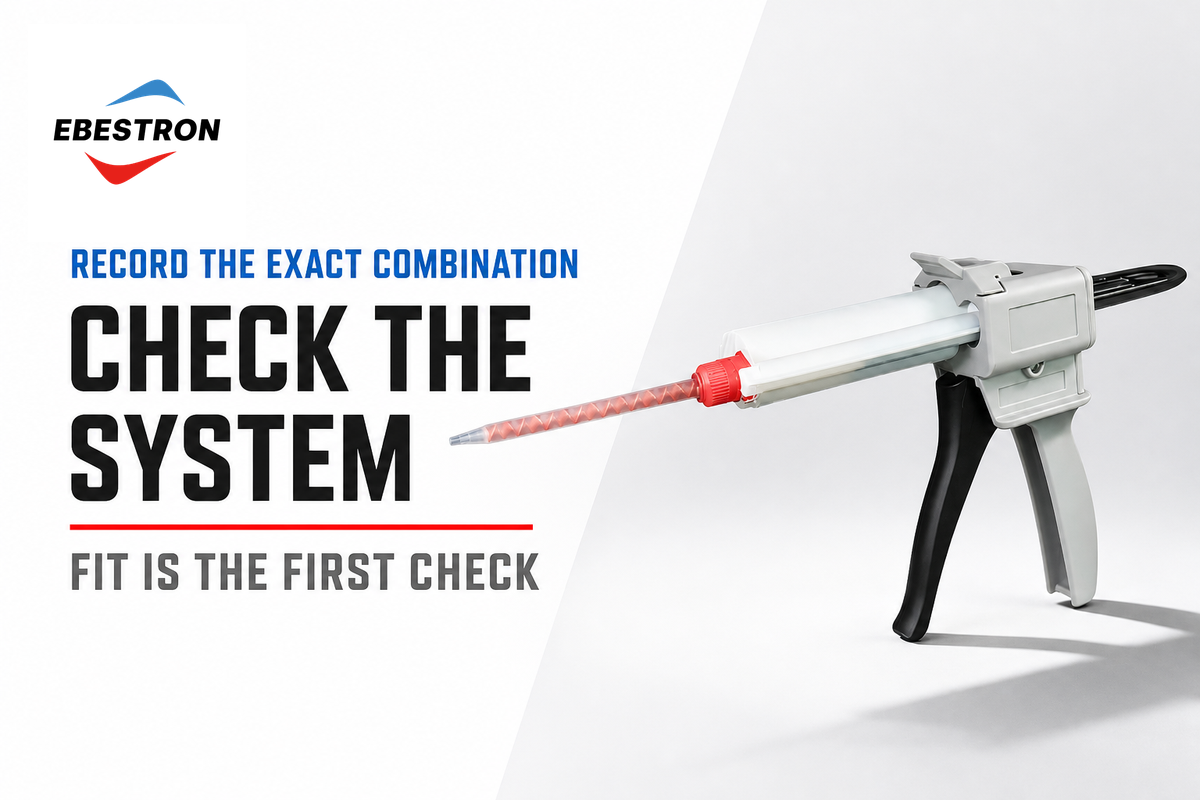
Approve the cartridge, mixer and dispenser as one recorded combination for the intended adhesive. Capture the exact part identities and test conditions, and retain the results with the sample approval. Mechanical attachment is the first check; the combination must also meet the application criteria set by the responsible team.
Use the epoxy mixing nozzle options and the separate guide to selecting a 2K dispensing gun to identify candidates. Bring their exact references back into one trial record. “Compatible with” is too broad unless it identifies the parts and the limits of the claim.
The discussion of the variable fill state can include differences and effects related to air in the dispensing, and differences in the designs of the plungers. Thus, including the effect of fill state is part of the approval process. Ask the filler to document its approved procedure and have the formulation owner specify the output checks. No general element count, pressure or purge quantity can replace this project-specific agreement.
Suppose a purchaser approves a sample with one mixer and receives a bulk quote with a different mixer, but under the same general description. Both are attached to the outlet. The purchasing agency sees an unchanged cartridge fit; the manufacturing agency sees an untested combination. The substitution should be paused, and the changes that were made from the normal process should be determined. The responsible design engineer should be consulted to determine the checks that need to be performed. The answer may be a narrow comparison trial. Retain the original results to provide a baseline for the comparison. Written approval to substitute the mixer is cheaper than attempting to determine why two samples, which were each approved, differ after filling has begun.
A statement to “use the mixer in stock” is reasonable only if its exact identity and qualification are provided. Record the agreed result; don’t turn a single fit check into a cross-brand interchangeability promise.
Validate the filled package for your formulation
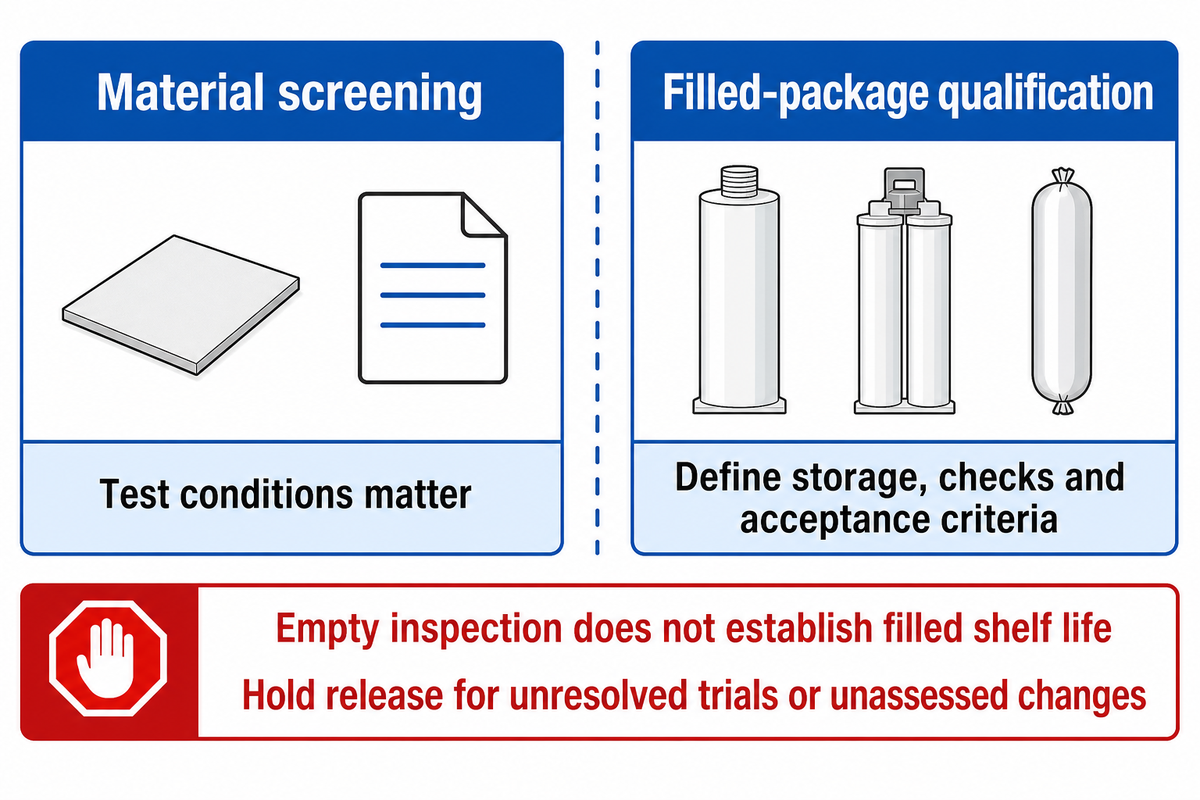
Test the adhesive package filled according to its intended use and storage. Empty-part inspection won’t determine the shelf life of the adhesive package when filled. The formulation owner should define the evidence needed to demonstrate the performance of the material in contact, sealing and dispensing and the final adhesive performance. The definitions and acceptance criteria should be established prior to the trial.
ASTM D543-21 determines the resistance of plastics to various chemicals. In the guidance, it says that test conditions and similarity to service conditions determine the interpretation of results. Resistance results can be used to screen materials. It does not, by itself, prove the complete assembly of cartridge or the shelf life of an adhesive stored in it.
Build the trial brief around the actual formulation and provided components. Decide storage conditions, evaluation intervals, checks to be performed, and who makes each determination. Keep observations and conclusions separate. A result is observed; it doesn’t mean that a conclusion has been established. A force change, leakage, or inconsistent output is a result and must be evaluated.
When not to release a bulk order
Hold the release if the package being tested can’t be traced to an approved sample, a required filled test remains unresolved, or a component substitution has not been assessed. The hold should define the missing evidence and identify who can supply the information. Requests for “better quality” aren’t helpful.
For example, a supplier may present a polymer resistance result while the filler still needs evidence for the assembled piston and closure under the intended storage conditions. Test-scope limits of ASTM standards explain why the first document cannot answer the second question. Usually, the relevant package evaluation is what should be requested; additional unrelated documents should not be added to the file. If work is proposed to be done in an accelerated manner, the formulation owner should be asked how this supports the claimed storage period; this guide does not provide a universal conversion.
Not all documents needed with a sense of urgency are equally important. Separate a pending commercial detail from an unresolved acceptance requirement, document the decision and release only the scope that the responsible quality team has approved. The decision should be clearly communicated and only the approved scope should be released. Printing or labeling approval must also have an owner before a custom filled product is shipped.
Compare matched systems with separately sourced components
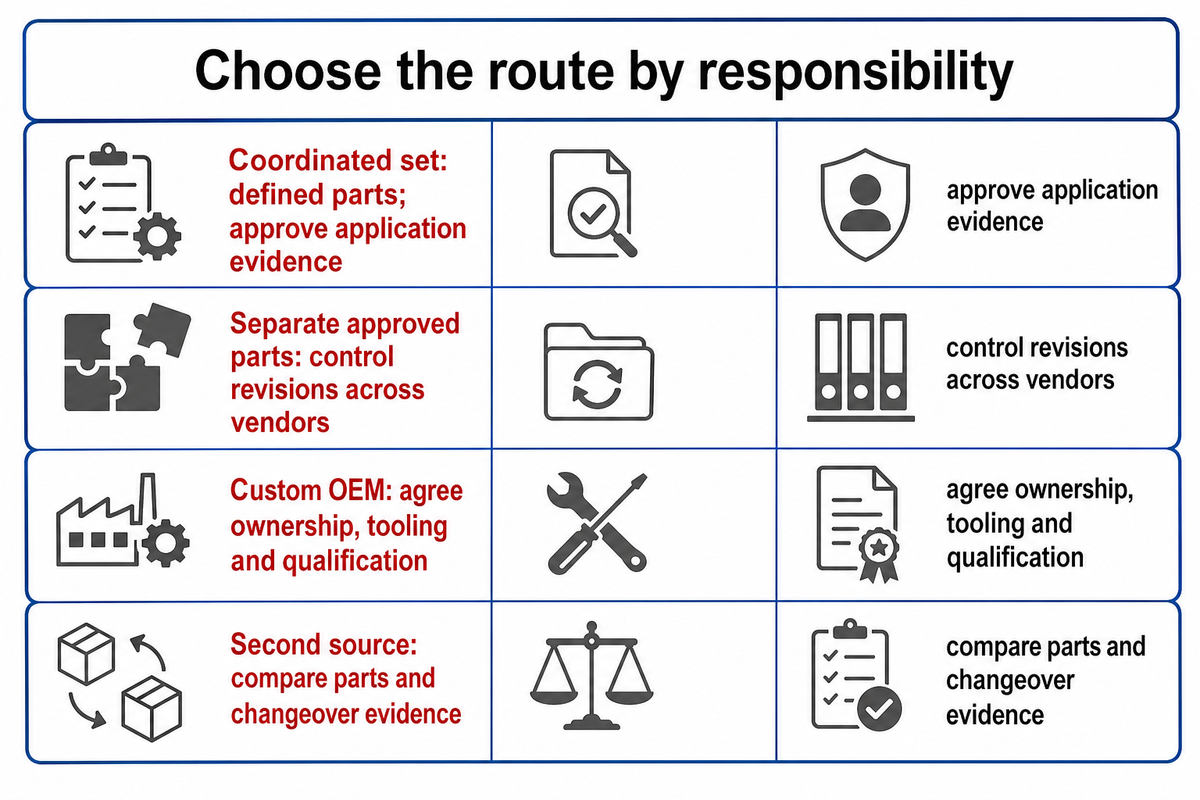
Routing based on who owns interface control and qualification work can reduce the number of supplier handoffs. Separate sourcing based on an approved, established bill of materials can work just as well. Neither approach alleviates the need to confirm the actual formulation, offered parts, and intended method of production.
The NIST Manufacturing Extension Partnership guide to supplier relationships recommends looking beyond unit price and establishing clear expectations. Apply that principle to the work between suppliers: who investigates a mismatch, authorizes a replacement and updates the shared record?
| Route | Useful starting condition | Responsibility to assign | Limitation |
|---|---|---|---|
| Coordinated supplied set | Buyer wants a defined component combination | Supplier identifies the matched parts; buyer approves application evidence | A matched set is not a universal shelf-life claim |
| Separately sourced approved parts | Buyer controls an existing qualified bill of materials | Buyer or integrator manages revisions and substitutions across vendors | Lower component prices may add coordination work |
| Custom OEM package | Documented requirement cannot be met by the approved stock design | Agree drawing ownership, tooling scope and qualification milestones | A drawing proposal is not a production approval |
| Second source | Continuity need justifies another qualified supply route | Compare the offered parts and agree the changeover evidence | A familiar part description cannot authorize substitution |
In the case of an experienced filler and an approved stock, a separate component order wouldn’t be a big deal. However, for a new formulation or combination, that would create a lot of interfaces to sort out. Put that workload beside the price instead of treating supplier count as a quality score.
Approve a pilot before releasing the bulk order
Use the pilot as a basis for an approved package, and establish a repeatable record of the tested conditions. Incoming-lot acceptance then checks delivered production against agreed requirements. A successful trial of a package can’t be assumed to approve every subsequent shipment.
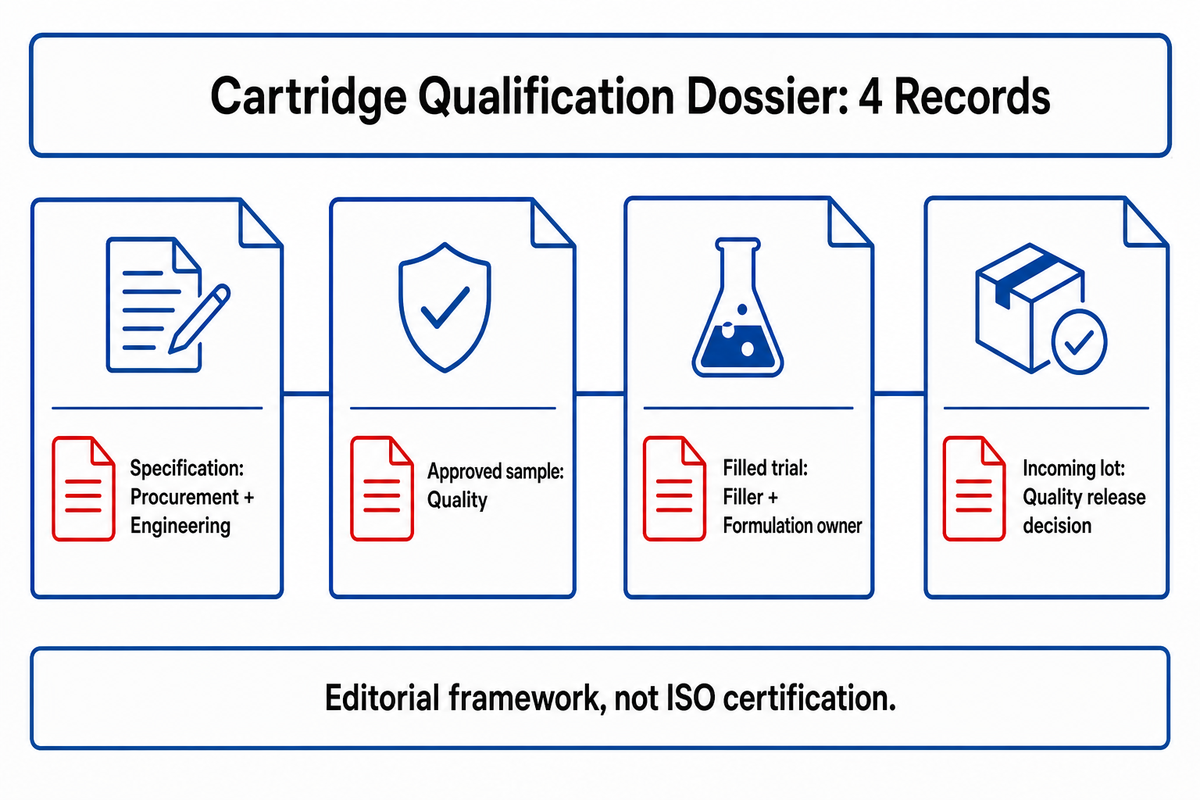
Cartridge Qualification Dossier: 4 Records
The Cartridge Qualification Dossier links 4 records: the agreed specification, approved sample, filled trial and incoming-lot release of a package.
This is an editorial purchasing framework, not an ISO certification scheme. Assign an owner to each record and continue the same package reference through the sequence.
- Freeze the specification. Procurement and engineering agree the component list, revisions, inclusions and required evidence.
- Identify the approved sample. Quality records sample IDs, offered parts and any limits on the approval.
- Document the filled trial. The filler and formulation owner record conditions, acceptance criteria, results and unresolved issues.
- Release the incoming lot. Quality links the delivered lot to the approved package and records the agreed inspection result and disposition.
Continue filling instructions with the trial file. The existing two-part cartridge setup and use guide addresses operating sequence. Confirm the instructions for your part. Where another company fills the package, agree the contract filling scope and who approves the filled-product label.
Acceptance sampling is “not to estimate the quality of the lot.”
NIST says acceptance sampling is a means to make a decision regarding acceptance of a lot and doesn’t take the place of process control. If a decision is made to accept a lot, this doesn’t mean all of the items in the lot are defect-free. Agree the sampling method, acceptance criteria and response to a rejected lot before delivery.
If ISO sampling is selected, distinguish the order pattern. ISO 2859-1:2026, published in January 2026, addresses continuing series with switching rules. ISO 2859-2:2020 addresses isolated lots and short series where such rules are inapplicable. The parties must select an appropriate plan; a standard number alone does not specify it.
A short pilot order is not automatically evidence of long-run consistency. The buyer may want to release a larger, immediate order. Identify which requirements the pilot demonstrated, and which are still open. Keep the order quantity separate from the agreed inspection sample size. This document doesn’t provide universal sample size counts or acceptance limits.
Compare quotes on a usable-set basis
Compare empty-cartridge quotes for the same package scope, included costs and definition of a usable set. Divide comparable order costs by complete accepted sets and consider uncertain inputs separately. Depending on your analysis, a lower asking price may be a better offer, but this is only valid if you compare the quotes consistently.
How much does an empty cartridge cost?
There’s no single, reliable price for the scope of this document. Wholesale pricing depends on the parts offered, assembly and customization, quantities and terms of sale. Obtain quotes for the same bill of materials. Ask for separate lines for samples, tooling or setup, packing, freight and any work left to the filler.
ASQ’s cost-of-quality framework distinguishes prevention and appraisal from internal and external failure costs. Scrap, rework and returns can affect the economics. Include relevant costs consistently, and avoid charging the same loss twice when an accepted-set denominator already excludes unusable units.
| Comparison field | Offer A | Offer B | How to interpret it |
|---|---|---|---|
| Delivered set-equivalent quantity | 10,000 sets | 10,000 sets | Same required component scope |
| Quoted parts cost | $4,800 | $5,000 | Illustrative written-quote inputs |
| Freight and agreed packing | $260 | $150 | Same delivery boundary |
| Order-specific inspection/handling | $100 | $100 | Same cost categories in both offers |
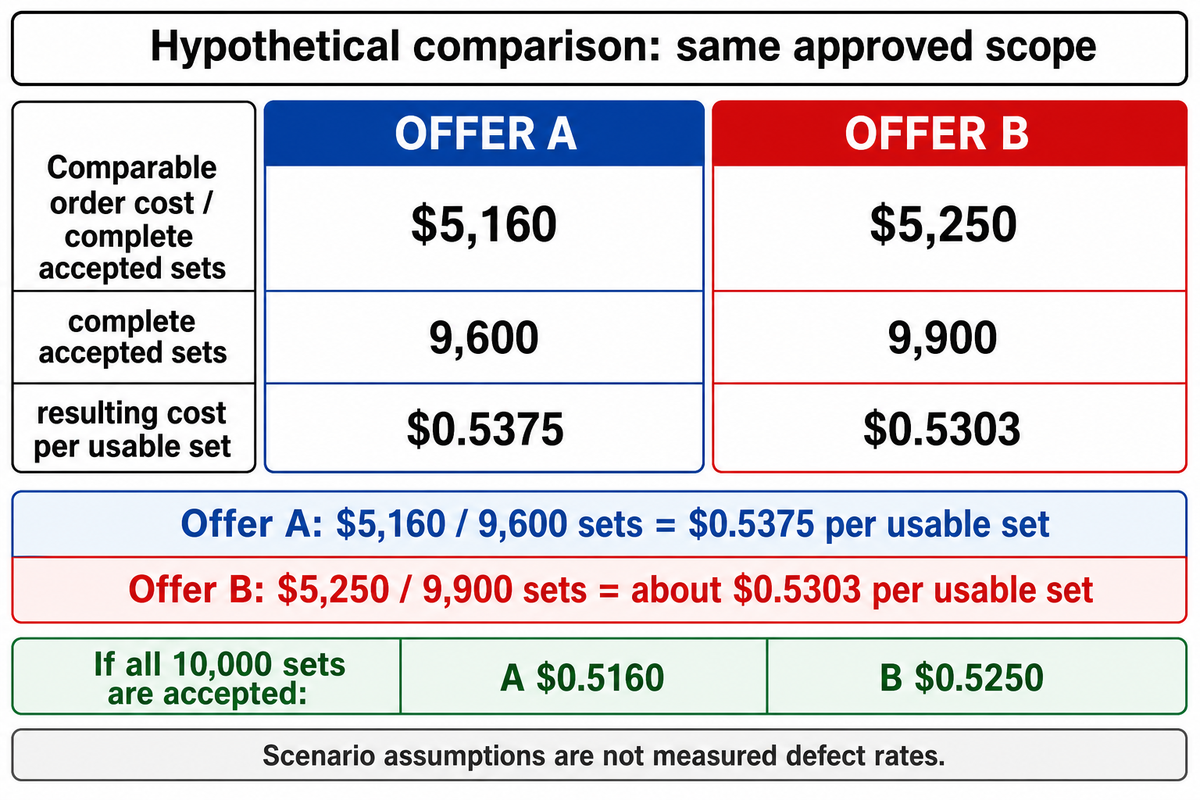
| Comparable order cost | $5,160 | $5,250 | Sum of the three cost lines |
| Complete accepted sets | 9,600 sets | 9,900 sets | Hypothetical outcome, not an expected supplier rate |
| Quantity outside the accepted count | 400 sets | 100 sets | Disposition and recoverability must be investigated |
| Cost per usable set | $0.5375 | $0.5303 | Comparable cost divided by accepted count |
| Cost per 1,000 usable sets | $537.50 | $530.30 | Rounded after division |
| If all 10,000 sets are accepted | $0.5160 per set | $0.5250 per set | A becomes lower on these unchanged cost inputs |
In this fictional comparison, A costs $5,160 ÷ 9,600 = $0.5375 per usable set. B costs $5,250 ÷ 9,900 = about $0.5303. B has the lower evaluated cost despite its higher parts price. If both orders yield 10,000 accepted sets, the ranking reverses: A is $0.5160 and B is $0.5250. The decision therefore rests on the accepted quantities as well as price. Before ordering, run scenarios with explicit assumptions; after receipt, replace assumptions with observed counts. Don’t present an uncertain forecast as a measured defect rate.
Recovered parts, replacements or credits affect the analysis. So do adhesive loss and additional handling if a problem is discovered after filling. Consider these costs if supported, and establish a clear limit, as bulk pricing alone may not point to their existence.
Request the evidence behind an OEM cartridge quote
The supplier should receive a request separating information for public screening from documents for order approval. A search engine can identify a cartridge range and contact route. The offered drawing, approved materials, sample record and lot documents must demonstrate the actual package you’re buying and any agreed customization.
Make a request for a controlled drawing and revision, a component list with inclusions, a material specification, sample identification and a proposed lot marking method. Add the inspection documents you need at receipt and the changes that require notice. For custom OEM work, identify who approves drawings and artwork prior to production.
Public standards, third-party patents, and another manufacturer’s laboratory results don’t prove a supplier’s ownership or capability. Match each claim to the organization and product it actually concerns. The 2026 materials article is background information for questions regarding material changes and doesn’t qualify a different company’s cartridge.
A wholesale supplier can offer several bulk options without qualifying your formulation. Specific information is needed in the next request. Make the next request specific: Send the scope of components, intended filling route, and approval questions, in combination. If the quote promises USA inventory, confirm which exact approved parts are available and whether the stock completes your required sets. Ask when missing evidence will be provided.
Key takeaway
A bulk order is ready for release when its specification, approved sample, filled trial and incoming-lot decision refer to the same controlled package.
For Ebestron supply options and quotes, take the brief you’ve prepared to the Empty Cartridges Bulk Wholesale OEM solution page. Include your intended order quantity and the documents still needed for approval.
Frequently asked questions
Are empty cartridges interchangeable across Mixpac and Nordson systems?
A brand reference or nominal capacity alone does not establish interchangeability.
Ask for the exact cartridge, piston, closure, mixer, and dispenser combination, including part numbers and drawing revisions. Request the supplier’s stated limitations, then qualify representative samples with your adhesive and filling process. Keep the approved combination on the purchase order so that an apparently similar substitute is flagged. Fit-check only assesses part compatibility; it doesn’t assess filled-package storage life or final adhesive performance.
Can empty adhesive cartridges carry our private label?
Private labeling depends on the offered cartridge and the supplier’s agreed process.
Request the printable area, artwork requirements, identification method and approval sample before committing to the order. Maintain legibility of lot information and agree who will authorize artwork changes. The filling or formulation owner must approve the information for the final filled product and the intended market. Decorative brand marks don’t replace traceability. Request whether printing changes the minimum, lead time or repeat order setup cost. Document those terms separately from the cost of the empty part.
What determines the minimum order quantity for wholesale purchases?
Minimum quantities depend on the quoted production and customization scope.
Commercial terms for stock parts, special assembly, printing and custom colors, as well as tooling, may differ. Ask for separate minimums for samples, the first production order and repeat purchases. Determine if the minimum applies to bodies or complete sets. Ask if split deliveries are offered. There is no universal minimum for empty adhesive cartridges. Compare suppliers using the same approved component list, because a lower minimum is less useful if required parts are excluded.
Does an empty cartridge have the same shelf life as the filled adhesive?
Empty-component storage guidance does not establish filled-adhesive shelf life.
The filled package combines the formulation, cartridge body, pistons and closure under particular storage conditions. Ask the formulation owner which evidence supports the proposed storage period and how the offered package relates to that evidence. Keep empty part handling guide in receiving and filled part qualification in application. Don’t copy one time limit to the other without supporting approval.
What should happen if a supplier changes a piston or cartridge resin?
Identify the change and assess its effect before releasing the changed package.
Request the revised part or material identification, effective date, affected lots and supporting evidence. Engineering and Quality will make a determination of which checks need repeating, and link the determination to the new revision and order. Retain the previous approval record for comparison. Unchanged external dimensions or a familiar part number do not settle the assessment. Agree notice responsibilities before the first bulk order so the decision is not improvised after delivery.
About this purchasing guide
GW prepared this guide for buyers comparing empty adhesive cartridge orders on the Ebestron website. The worksheets illustrate a combination of public technical data and editorial purchasing methods. The cost example is fictitious and doesn’t contain customer production data. Supplier-authored sources retain their attribution, and no third-party patent or test result is presented as Ebestron’s. Read About Ebestron for company background.
References & Sources
- An Introduction to 2K Packaging Components Adhesives & Sealants Industry; Anthony Martucci, Nordson EFD, 2012.
- Sustainability Without Sacrifice: Reliable Cartridge Systems for Demanding Adhesive Applications Adhesives & Sealants Industry; medmix-affiliated authors, February 2026.
- ASTM D543-21: Resistance of Plastics to Chemical Reagents ASTM International; public scope and significance.
- Rethink Your Supply Chain Strategy for Better Outcomes National Institute of Standards and Technology, Manufacturing Extension Partnership.
- What Is Acceptance Sampling? NIST/SEMATECH e-Handbook of Statistical Methods.
- ISO 2859-1:2026 International Organization for Standardization; public abstract and edition information.
- ISO 2859-2:2020 International Organization for Standardization; public abstract.
- Cost of Quality American Society for Quality.