Get in touch with Ebestron Company


Updated October 2026
RTV stands for room-temperature vulcanizing. On a sealant or gasket tube, RTV means RTV silicone, a silicone rubber that cures at room temperature without an oven. One-part RTV cures with air moisture, and two-part RTV cures when a base and a curing agent are mixed.
RTV silicone is a room-temperature-vulcanizing silicone rubber. Momentive’s one-part RTV100 grades go tack-free in 20 to 30 minutes and cure about 3 mm deep in 24 hours at 25 °C and 50% RH. Two-part addition-cure RTV cures in deep and enclosed joints without air moisture.
Key points
- Under the quasi-steady diffusion model used in this guide, doubling the depth of a one-part bead roughly quadruples its estimated cure time.
- Color isn’t a rating: NSF lists Momentive’s red RTV 106 at 500 °F and two other Momentive red grades at 400 °F.
- One silicone maker’s guide warns that oxime fumes can corrode copper inside a closed housing; alkoxy cure releases methanol instead.
- Standard silicone RTV is generally unsuitable for continuous fuel contact; fuel-resistant fluorosilicone formulations are one option for fuel-wetted joints.
Quick Specs
| Full name | Room-temperature-vulcanizing (RTV) silicone rubber |
| Base polymer | PDMS-based polymer with filler and a crosslinker (silane for condensation cure, hydride siloxane for addition cure) |
| Cure trigger | Air moisture (RTV-1) or a mixed curing agent (RTV-2) |
| Tack-free time | 20–30 min (Momentive RTV100 datasheet) |
| Cure-through | About 3 mm in 24 h at 25 °C, 50% RH (Momentive RTV100) |
| Deepest one-part section | 6 mm (1/4 in) for Momentive RTV100 |
| Hardness | 15–40 Shore A for most grades |
| Heat resistance | 204 °C (400 °F) and higher, grade dependent |
What Does RTV Stand For?
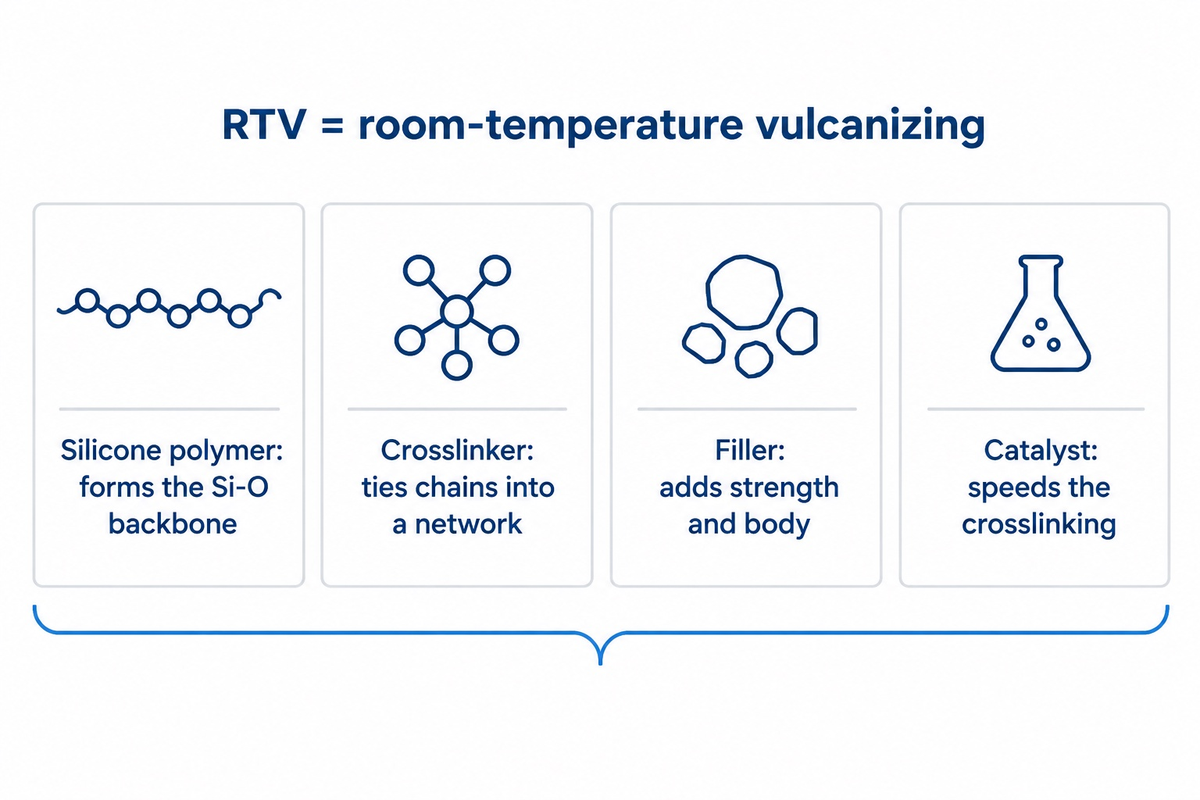
RTV stands for room-temperature vulcanizing. This means the liquid or paste crosslinks and transforms into rubber at ambient temperature instead of in a heated press. The letters name the cure condition. The cure chemistry is a separate line on the datasheet, written as acetoxy, oxime, alkoxy, tin or platinum.
The Wikipedia entry on RTV silicone describes the material as silicone polymers, fillers and organoreactive silane catalysts. It’s sold as a one-component product or as two components, a base and a curative, which production lines often load into two-part dual cartridges. One-part silicones take moisture from the air and cure from the outside toward the center.
| Ingredient | Job in the compound | Common example |
|---|---|---|
| Silicone polymer | Forms the flexible Si–O backbone of the rubber | Polydimethylsiloxane (PDMS) |
| Crosslinker | Ties polymer chains into a network as it reacts | Acetoxy, oxime or alkoxy silane (condensation); hydride siloxane (addition) |
| Filler | Adds strength and body; some fillers raise thermal conductivity | Fumed silica; oxides or nitrides for heat transfer |
| Catalyst | Speeds the crosslinking reaction | Tin compound such as dibutyltin dilaurate, or platinum |
The bare acronym also names broadcasters such as RTV Slovenia and the trade phrase return to vendor. On a sealant, a gasket maker or mold rubber, it always refers to the cure method.
Is RTV the same as silicone?
RTV is one family of silicone rubbers, defined by curing at room temperature. Heat-cured silicone (HTV) and liquid silicone rubbers (LSR) require heat to vulcanize, so a molded silicone part or silicone hose is usually not RTV. A tube of silicone caulk that cures in air is one-part RTV.
At the joint, the difference is obvious. An RTV silicone sealant can be formed in place. Heat-cured silicone, on the other hand, arrives as a finished part and has to be cut or molded to size.
How RTV Silicone Cures: Condensation, Addition and the Five Cure Systems
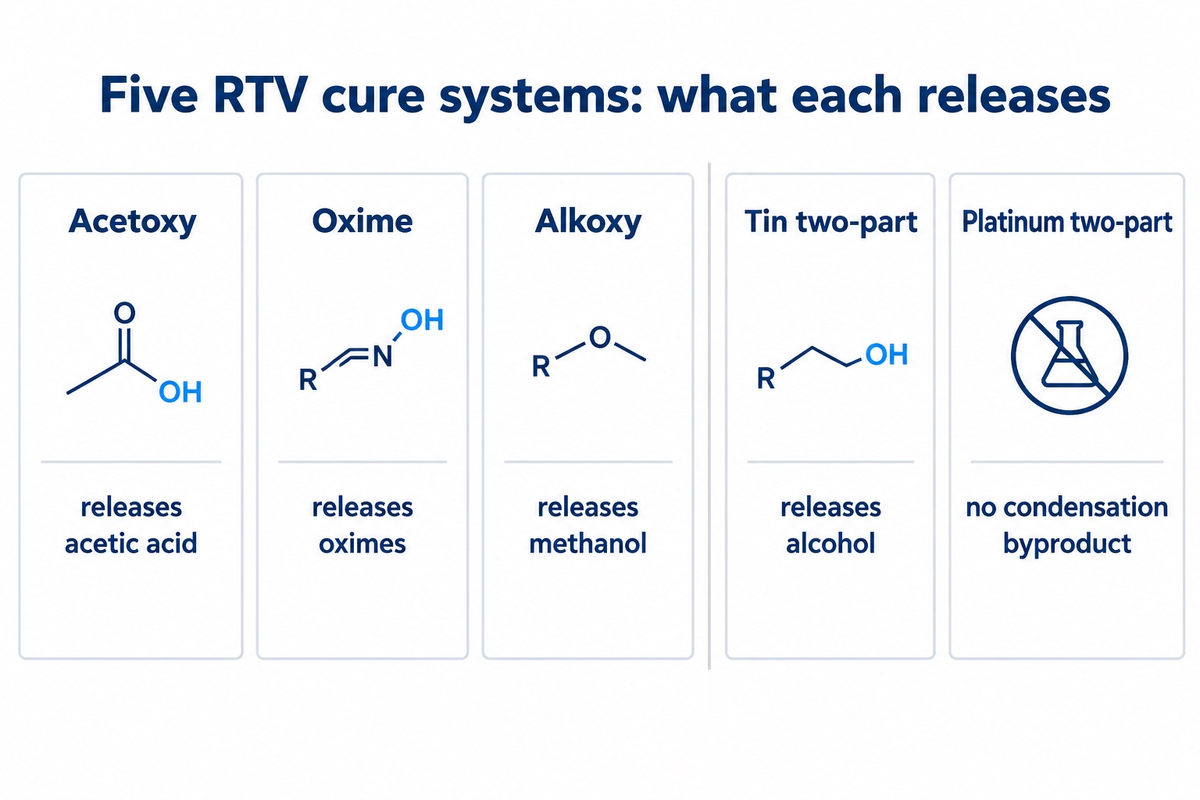
RTV silicone cures in one of two ways. Condensation cure links polymer chains and releases small molecules like acetic acid, oxime or methanol. The other way is an addition cure. In that case, no condensation byproduct is released, and that byproduct difference decides which metals and electronics a grade can sit near.
Momentive’s RTV100 datasheet states that acetic acid vapor leaves the bead as it cures, and that the vinegar odor disappears once curing ends. The same datasheet says these sealants aren’t for delicate electronics where copper and brass are susceptible to corrosion.
Acetoxy grades release acetic acid. Oxime grades release oximes and, according to a guide by silicone maker Novagard in the Adhesives & Sealants Industry, fumes from both can corrode copper in an enclosed space. Alkoxy cure releases methanol, which, according to the same guide, is non-corrosive for sensitive electronics.
| Property | Acetoxy (1-part) | Oxime (1-part) | Alkoxy (1-part) | Tin (2-part) | Platinum (2-part) |
|---|---|---|---|---|---|
| Reaction | Condensation | Condensation | Condensation | Condensation | Addition |
| Cure trigger | Air moisture | Air moisture | Air moisture | Mixing with tin catalyst | Mixing with platinum catalyst |
| Byproduct | Acetic acid | Oxime (ketonic fumes) | Methanol | Alcohol | None |
| Odor while curing | Vinegar | Low | Low | Low | Low |
| Copper in a closed housing | Corrodes | Can corrode | Non-corrosive | Check datasheet | Non-corrosive |
| Deep sections | Up to 6 mm (Momentive RTV100) | Moisture-limited | Moisture-limited | Cures through | Cures through |
| Main disadvantage | Acid attacks metals | Fumes in enclosures | Slower skin-over | More shrinkage over time | Inhibited by sulfur, tin, amines |
| Typical use | Glass, general sealing | Automotive gasket maker | Electronics, sensitive metals | Low-cost mold rubber | Precision molds, potting |
| Example product family | Momentive RTV100 series | Permatex Ultra Black | Noncorrosive MIL-DTL-46146 grades | Tin-cure mold rubbers | Platinum mold and potting rubbers |
Momentive’s RTV100 series (RTV102 to RTV118) releases acetic acid, so it’s acetoxy cure. Permatex Ultra Black is oxime cure. Grades qualified to MIL-DTL-46146 belong to the non-corrosive class. Because a brand can sell more than one cure type, the product number, not the brand, determines this.
Permatex lists its Ultra Black gasket maker as an oxime silicone and labels it sensor safe and non-corrosive. The “sensor safe” claim refers to the automotive exhaust system’s oxygen sensors; a sealed electronics box with bare copper is a different exposure, and an alkoxy or platinum grade would be the safer choice there.
Tin catalysts such as dibutyltin dilaurate drive the two-part condensation cure. In US patent 4,960,847, Shin-Etsu describes a moisture-crosslinked RTV compound that resists engine and gear oils, written for formed-in-place gaskets in cars.
RTV Cure Time: Skin-Over, Tack-Free and Full Cure
Momentive’s datasheet for its RTV100 series lists a tack-free time of 20 to 30 minutes. It also lists cure-through of about 3 mm in 24 hours at 25 °C and 50% relative humidity. Handling strength takes 12 to 24 hours, and full bond strength takes longer.
Three stages are important on the shop floor. Skin-over is when the surface stops transferring to a finger. Tack-free is when the surface no longer feels sticky. Cure-through is when the rubber has formed through the entire bead, and the bond continues to strengthen after this point.
How long does RTV take to cure before starting an engine?
Allow 24 hours for a complete cure of Ultra Black, as stated by Permatex. Plan on the longer side before oil, pressure or engine starting, since cure times vary with temperature, humidity and gap. The tack-free wait is 2 hours, and other factors (gap size, environmental conditions, etc.) will affect actual cure time. Thicker beads will also take longer to fully cure.
The Ultra Black instructions say to set for at least two hours and then re-torque the flange at least a quarter to half of a turn. Fast return-to-service gasket makers form a separate product class with their own published times.
3-mm Depth-Squared Cure Yardstick for thick beads
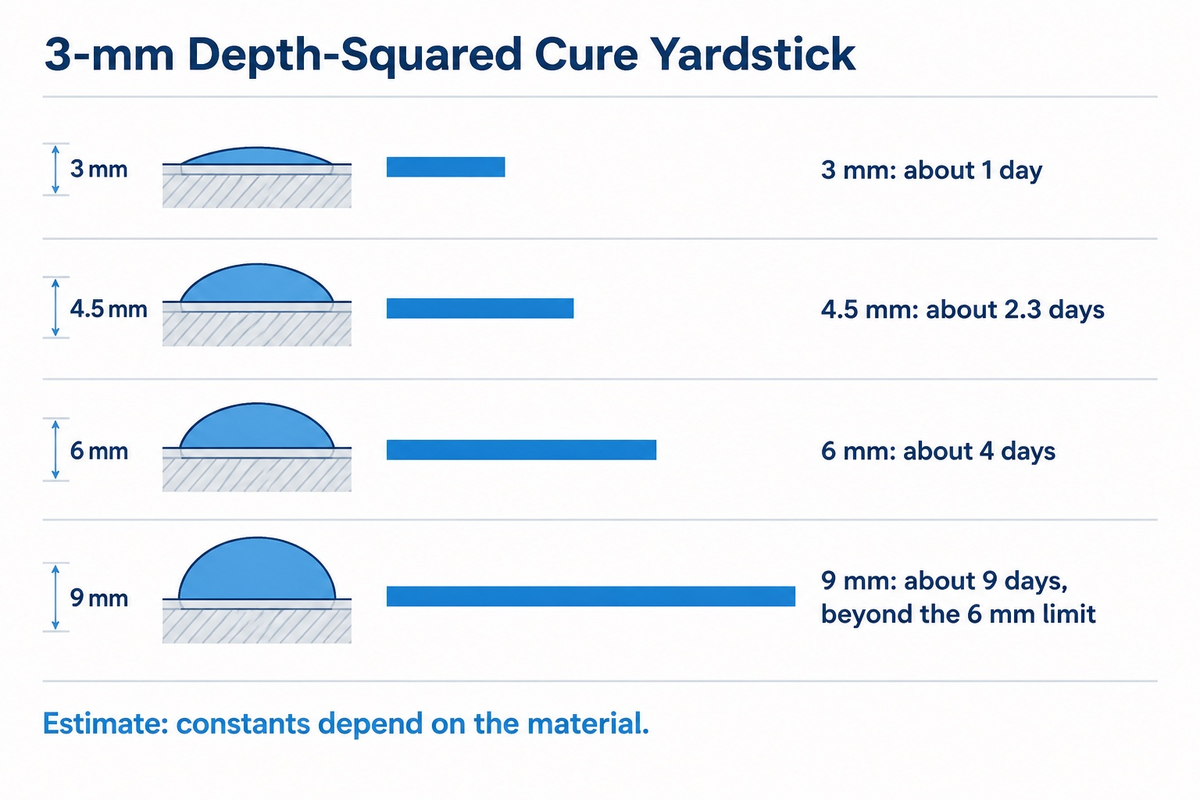
The 3-mm Depth-Squared Cure Yardstick estimates one-part RTV cure time from bead depth: divide the depth by 3 mm, square it, and read the answer in days.
It’s due to cure kinetics. The Journal of the Society of Chemical Engineers, Japan published a study that demonstrated that, at quasi-steady state, cure time is a quadratic function of cured depth. Moisture diffuses through the already-cured rubber, so additional millimeters take even longer.
Assumed inputs: an open bead exposed on one face, 3 mm cured in the first 24 hours at 25 °C and 50% RH per the Momentive datasheet, and steady diffusion.
| Bead depth | Depth ÷ 3 mm, squared | Estimated cure-through |
|---|---|---|
| 3 mm | 1 | About 1 day |
| 4.5 mm | 2.25 | About 2.3 days |
| 6 mm | 4 | About 4 days |
| 9 mm | 9 | About 9 days under the model inputs (beyond Momentive RTV100’s stated 6 mm section limit) |
With the above assumptions, a 6 mm bead takes about four days to cure rather than two, but treat that as an estimate: the study’s constants depend on the material and its cure mechanism. Each formulation has its own cure rate. Momentive limits its RTV100 sealants to 6 mm sections and, for deeper ones, recommends its one-component addition-cure or two-component compounds.
Outside variables also affect the cure clock. For example, Wikipedia mentions that for a silicone rubber, as temperature, relative humidity and the surface area to volume ratio increase, cure time decreases. A cure-time note from Seal-Bond mentions that hot weather doesn’t always mean fast cure, because a hot, dry day can slow a moisture cure.
One-Part RTV-1 vs Two-Part RTV-2 Silicone
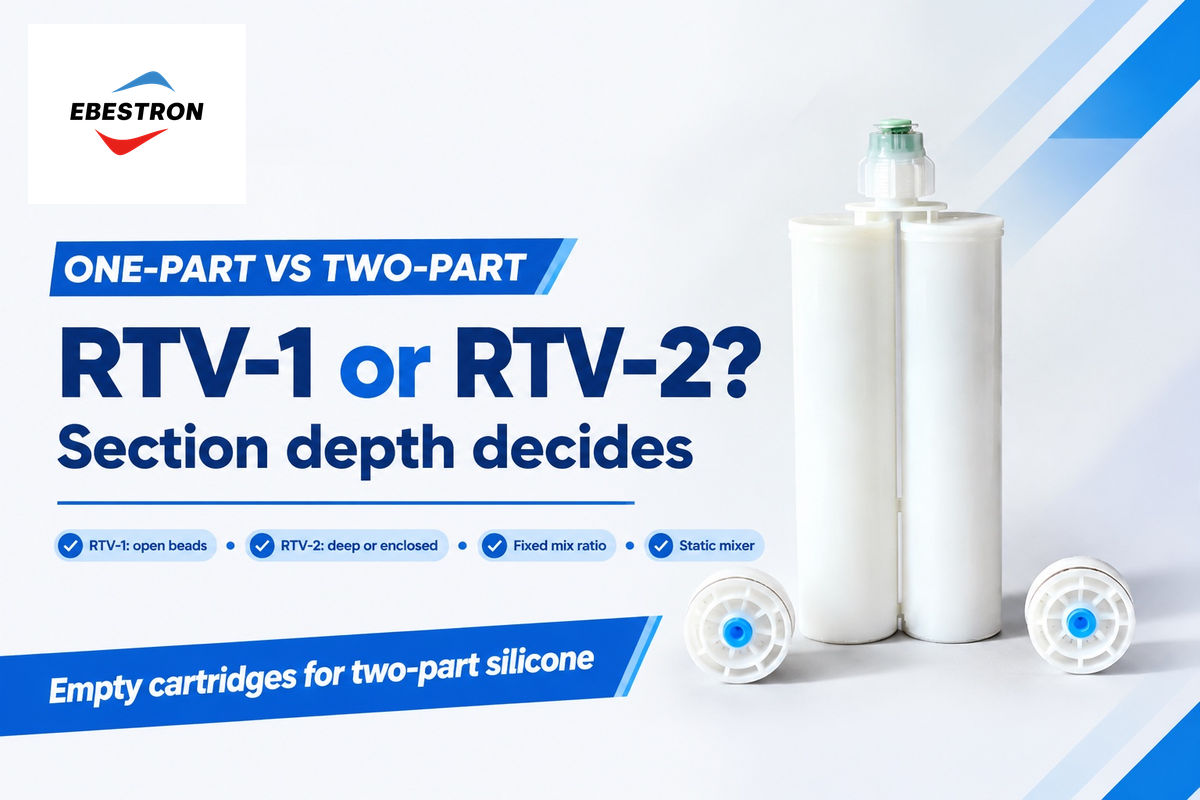
Use a one-part RTV-1 for open beads within the product’s section limit, keep Momentive’s RTV100 to 6 mm, and allow cure time for the real depth; under the depth-squared yardstick above that would take about one day at 3 mm and four days at 6 mm. Use a two-part RTV-2 when the section is deeper or fully enclosed or when parts must move on in hours. RTV-2 is a two-component system: it adds a mixing step and a pot life, and addition-cure grades cure through the mixed material without air moisture.
One-part RTV-1
- Cures with air moisture, no mixing
- About 3 mm per first 24 hours (Momentive RTV100)
- Sections up to 6 mm (Momentive RTV100)
- Tubes and single cartridges
Two-part RTV-2
- Base plus curing agent, tin or platinum
- Cures without air moisture, so deep and enclosed sections cure
- Fixed mix ratio and pot life
- Dual cartridges with a static mixer, or meter-mix
Two-part systems split into tin and platinum. Smooth-On’s mold-rubber FAQ explains that tin silicone is usually cheaper but shrinks more over time, and warns that sulfur can stop platinum-cure silicone from curing. Dow’s inhibitor list adds tin salts, phosphorus compounds, amine-stabilized solvents and latex.
GE’s US patent 4,340,709 shows how an addition system works: two packages are mixed, a platinum catalyst at 0.1 to 500 parts per million joins silicon hydride to vinyl groups, and the compound cures at room temperature or faster with heat.
| If the joint is | Choose | Because |
|---|---|---|
| An open bead about 3 mm deep, one day of cure is fine | RTV-1 acetoxy or oxime | No mixing, about 3 mm cures in 24 h |
| Deeper than 6 mm | RTV-2 | Moisture-cure time rises steeply with depth |
| Fully enclosed potting | RTV-2 | No air path for moisture |
| Bare copper or brass in a closed box | Noncorrosive platinum RTV-2, checked against the housing materials | Cures without air moisture and releases no condensation byproduct |
| Near an engine oxygen sensor | Grade labeled sensor safe | Volatile silicone can contaminate the sensor |
| A mold over sulfur clay or latex | Tin RTV-2 | Sulfur inhibits platinum cure |
| A production mold that must hold size | Platinum RTV-2 | Tin molds shrink more over time |
| Wetted by fuel | Fluorosilicone RTV | Silicone RTV is generally not fuel resistant |
| A rigid machined flange, gap 0.25 mm or less | Anaerobic flange sealant | Cures in thin metal-to-metal gaps |
| A building joint written to a spec | ASTM C920 classified sealant | Type, grade, class and use are specified |
For details on how mixing hardware behind RTV-2 works, take a look at how static mixing tubes blend the two sides as they exit the cartridge. The chemistry of base and hardener is covered in how two-part adhesives cure.
High-viscosity silicone pastes sometimes need a powered mixer, which is compared in static vs dynamic mixing.
RTV Colors and High-Temp Grades: What Black, Grey, Red, Blue and Copper Mean
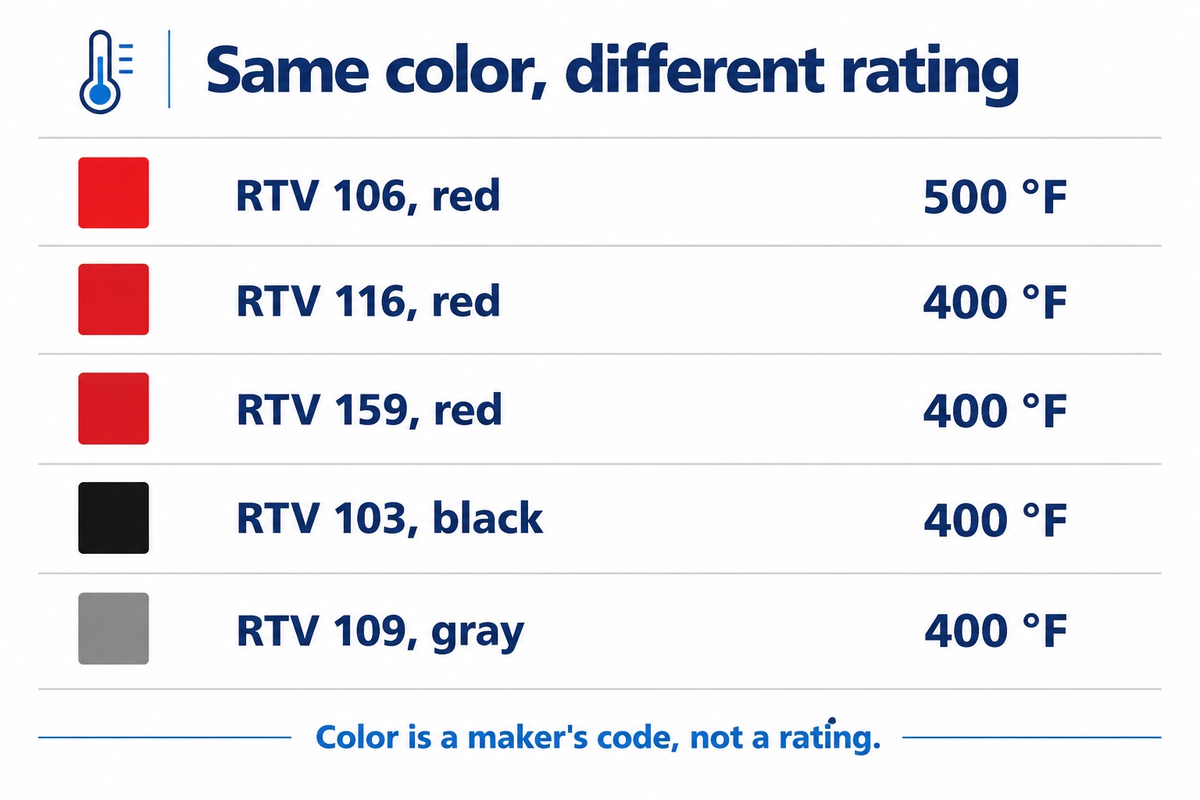
RTV color is a manufacturer code, not an industry standard. An NSF certification listing shows it plainly. Momentive’s red RTV 106 is listed for food contact up to 500 °F, while red RTV 116 and RTV 159 are listed at 400 °F, the same as black RTV 103.
| Grade | Color | NSF listed maximum |
|---|---|---|
| RTV 106 | Red | 500 °F (260 °C) |
| RTV 116 | Red | 400 °F (204 °C) |
| RTV 159 | Red | 400 °F (204 °C) |
| RTV 103 | Black | 400 °F (204 °C) |
| RTV 109 | Gray | 400 °F (204 °C) |
The source is the NSF/ANSI 51 listing for RTV silicone. One user on a Q&A forum reported picking black over red because the black tube carried the higher rating in that user’s product line.
What color is RTV?
Common RTV colors are clear, white, black, grey, red, blue and copper, and each company uses color to denote its product lines. According to the Momentive RTV100 datasheet, its grades list maximum continuous operating temperatures of 204-260 °C and intermittent ones of 260-315 °C.
Permatex’s selector chart rates one high-temperature gasket maker to 371 °C (700 °F) intermittent. Intermittent means short exposures; the continuous figure is the one to design around for an exhaust-side or oven-side joint. Pick the grade by those two numbers and its oil or fluid rating, then accept whatever color it comes in.
RTV Gasket Maker vs Cut Gaskets and Anaerobic Sealants
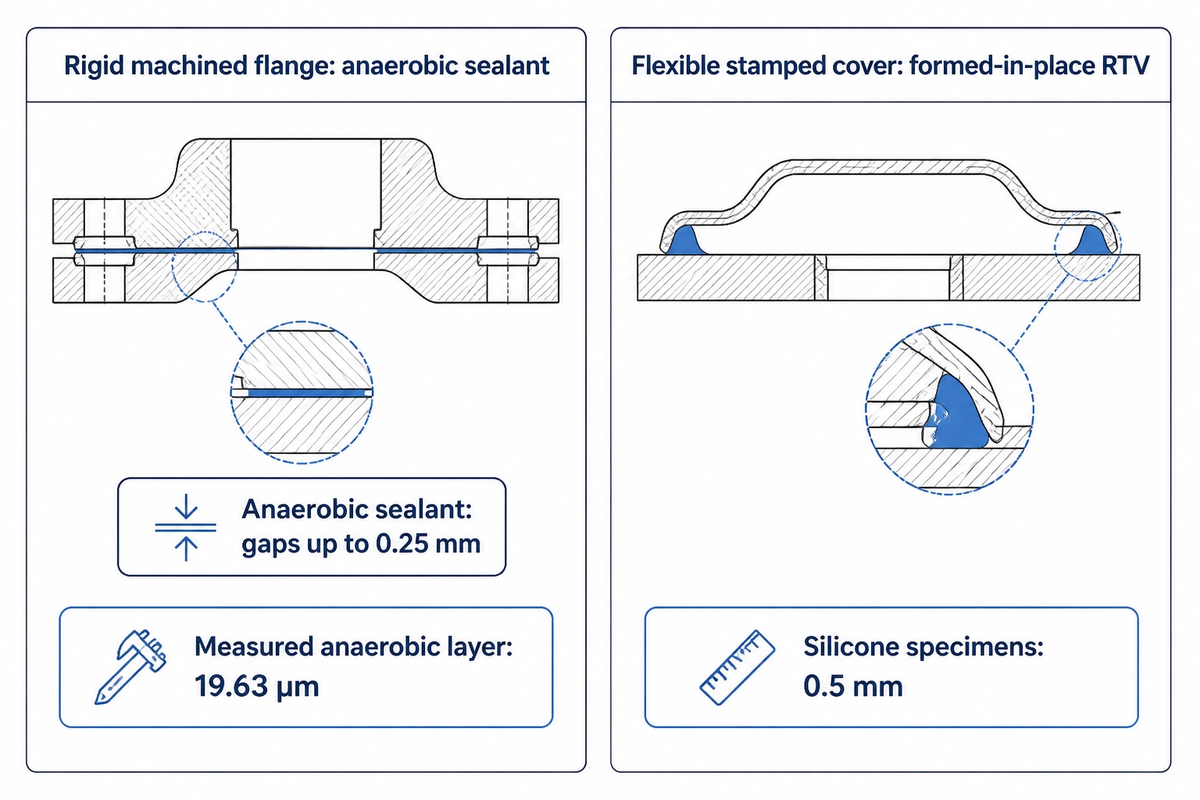
A formed-in-place RTV silicone gasket is better than a cut gasket for flexible, stamped covers, and anaerobic flange sealant is better for rigid, machined flanges. LOCTITE 518 is rated by Henkel to perform for gaps up to 0.25 mm (0.01 in) for rigid flanges. RTV gasket maker or a cut gasket is better for larger gaps and flexibility.
Anaerobic sealants cure when they’re shut off from air between metal surfaces, and the close-fitting flange keeps the layer thin. A 2001 flange study on sealants versus gaskets measured a LOCTITE 510 anaerobic layer at an average 19.63 µm. Its silicone specimens were set at 0.5 mm, about 25 times thicker.
An Assembly magazine review of liquid gaskets describes form-in-place anaerobics for high-pressure joints between rigid metal parts. It recommends cure-in-place gaskets for assemblies that are opened often for service.
Is RTV better than a gasket?
RTV is better than a cut gasket for stamped steel and/or plastic covers that flex. It’s better than a cut gasket for flanges with uneven metal surfaces that a sheet gasket can’t follow, because the liquid sealer fills low spots. Keep a cut gasket where it’s specified by the manual, where gasket thickness sets a clearance, or where the joint sees fuel.
Fuel is the hard limit. The U.S. specification for noncorrosive RTV, MIL-DTL-46146, defines its compounds as non-fuel resistant, so a fuel-wetted flange needs fluorosilicone or a gasket rated for fuel. Engine oil is a different exposure: oil-resistant RTV grades are made for oil-wetted covers, and coolant joints require a grade rated for coolant.
For automotive panel and seam work using two-part cartridges, see automotive adhesive cartridges.
RTV Compared With Silicone Caulk, HTV, LSR and Polyurethane Sealant
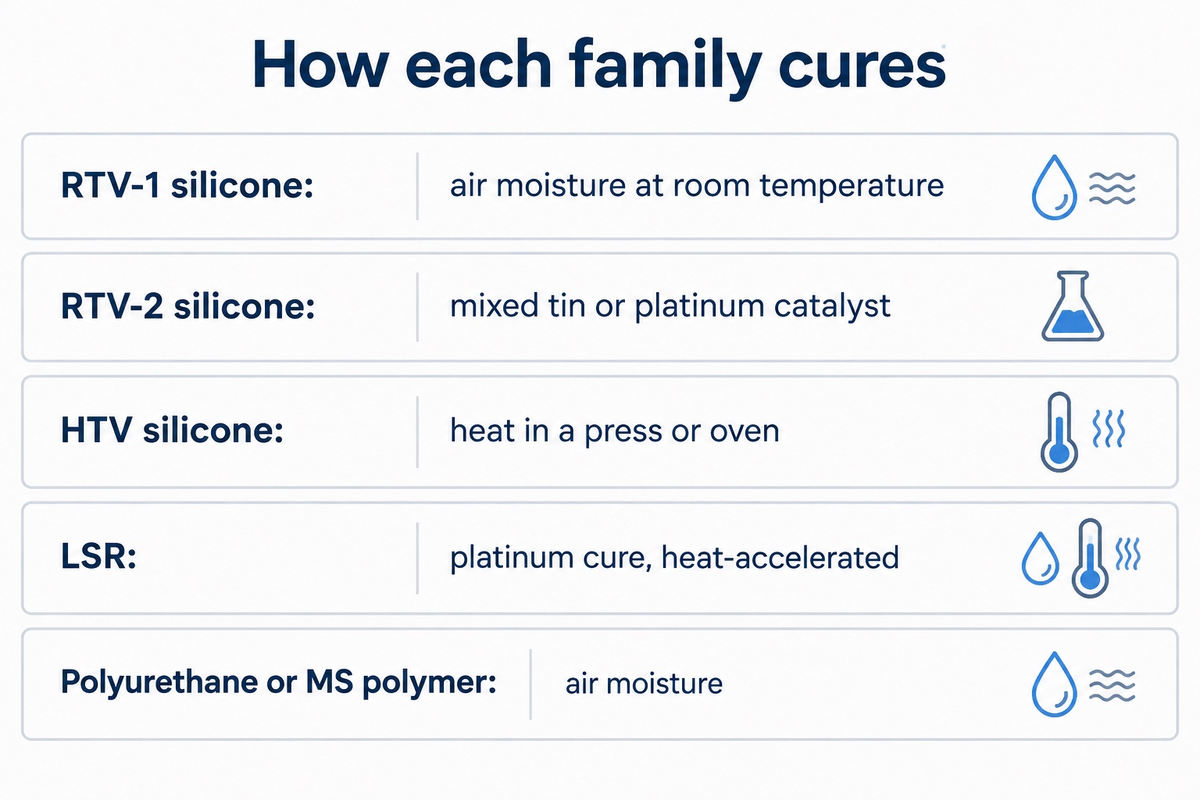
RTV silicone cures at room temperature, HTV and LSR require heat to vulcanize, and polyurethane and MS polymer sealants are other polymer families that cure with moisture. Silicone caulk in a tube is usually one-part RTV, therefore the real choice is between silicone and the other sealants.
| Family | How it cures | Typical form |
|---|---|---|
| RTV-1 silicone | Air moisture at room temperature | Tube or cartridge paste |
| RTV-2 silicone | Mixed tin or platinum catalyst | Pourable or paste, two parts |
| HTV silicone | Heat in a press or oven | Molded or extruded parts |
| LSR | Platinum cure, heat-accelerated | Injection-molded parts |
| Polyurethane or MS polymer | Air moisture | Construction and panel sealant |
Building joints are covered in the current edition of ASTM C920-18(2024), which has been active since November 2024. It covers single-component or multicomponent cold-applied elastomeric joint sealants and classifies them by type, grade, class and use. Traffic-use sealants must attain a hardness of 25 to 50, and non-traffic sealants of 15 to 50.
A sealant that meets C920 states its type, grade, class and use on its datasheet, and that classification, not the word caulk, tells a specifier whether a tube fits the joint.
Where RTV Silicone Is Used: Engines, Electronics, Molds and Aerospace
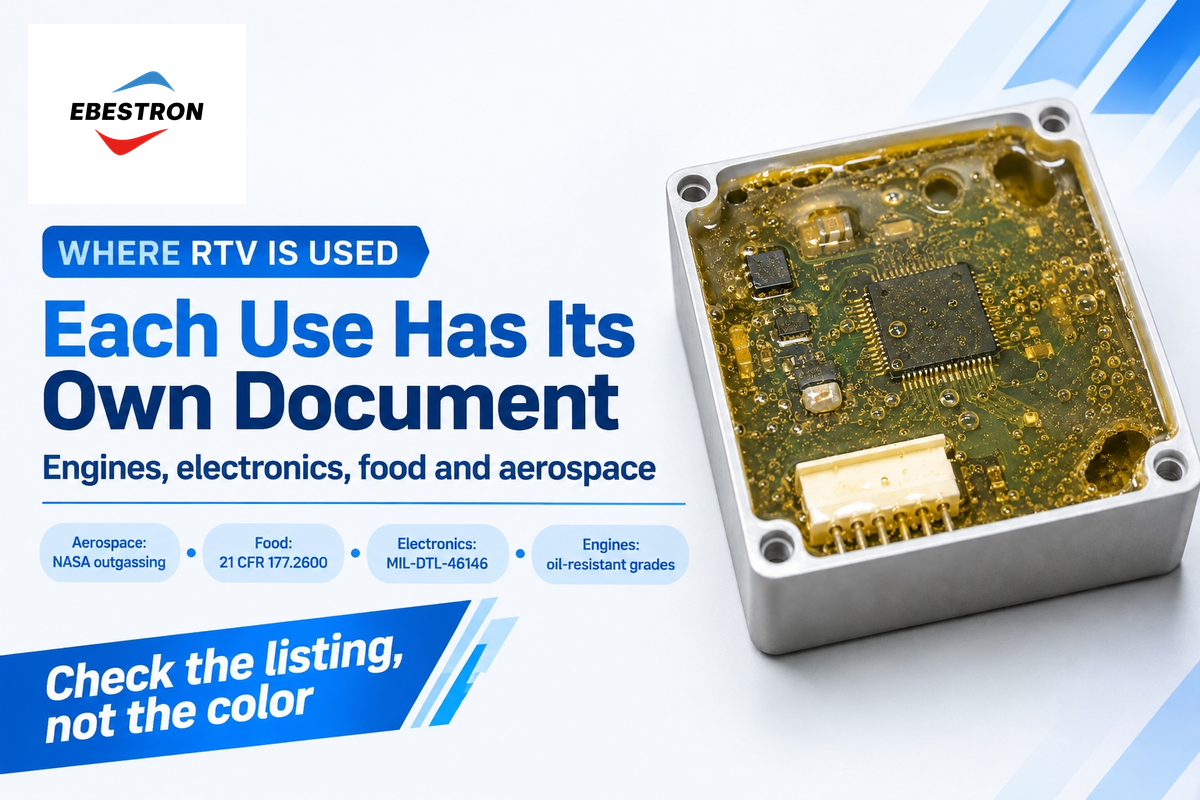
RTV silicone seals engine covers as formed-in-place gaskets, pots electronics, casts flexible molds and bonds aircraft parts. Each use has its own qualification language: NASA outgassing limits, FDA 21 CFR 177.2600 for food contact, and the military specifications MIL-A-46106 and MIL-DTL-46146.
For spacecraft and other low-outgassing projects, NASA uses ASTM E595 to vet materials and its lessons learned record states the cut-off directly:
“Only materials that meet the criteria of ASTM E-595-77/84 [i.e., have a total mass loss (TML) < 1.0% and a collected volatile condensable mass (CVCM) < 0.10%] are approved for use in a space environment unless application considerations dictate otherwise.”
The NASA Goddard outgassing database lists TML and CVCM results by product, which is where a buyer looks up a specific RTV grade.
For electronics, non-corrosive grades are used. The MIL-DTL-46146 in the DLA ASSIST database covers one-part RTV silicone for use with sensitive metals and equipment. Revision C was published on 17 February 2025, and Amendment 1 was published on 13 April 2026. The older MIL-A-46106B covers three groups of general one-part RTV adhesive-sealants.
For electronics potting and encapsulation, see Electronics Potting Cartridge Systems.
For food equipment, 21 CFR 177.2600 states that rubber articles intended for repeated use may be safely used in holding or processing food, subject to the provisions of this section. Methyl silicone elastomers are among the base polymers listed.
Making molds is the other major application. In mold-making, RTV silicone rubber reproduces fine detail for prototypes, furniture and sculpture, and optically clear grades serve lens applications. Mold grades run from very soft to medium, 15 to 40 Shore A, and a vacuum chamber is used to degas the mixed compound and pull out air bubbles before pouring.
Silicone molds release polyurethane, polyester and epoxy castings without a heavy release agent, and their texture survives repeat pours.
Cockpit instruments and engine electronics potting and engine gasketing are among the industrial applications of RTV silicone in aviation and aerospace, Wikipedia says.
How to Apply, Remove and Paint RTV Silicone
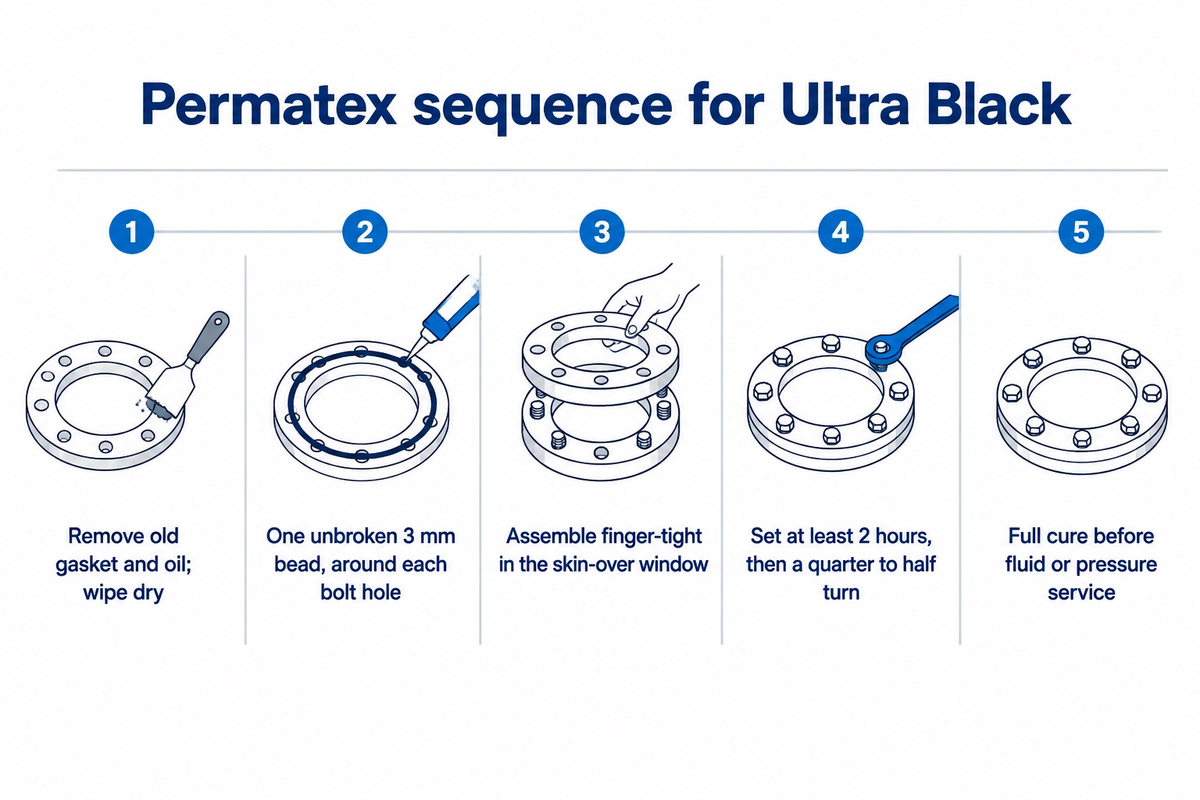
For automotive RTV gasketing, Permatex says a 1/8 in (3 mm) bead is usually sufficient, run continuously on one clean, dry mating surface. For Ultra Black, it says to assemble finger-tight while wet, let the bead set for at least two hours, and then tighten a quarter to half turn. Excess squeezes out and can clog an oil pickup screen.
Permatex’s sequence for automotive gasketing with Ultra Black:
- Remove old gasket material and oil; wipe both faces dry.
- Run one unbroken bead about 3 mm wide on one face, circling each bolt hole.
- For Ultra Black, assemble within the skin-over window, finger-tight only.
- For Ultra Black, let it set at least 2 hours, then tighten a quarter to half turn more.
- Momentive reports through-cure of a 3 mm section in about 24 hours at 25 °C and 50% relative humidity; thicker sections take longer. Full cure is required before fluid or pressure service.
Uncured RTV can be wiped off with a dry rag. Cured RTV needs to be removed mechanically: first remove the bulk with a plastic scraper, and then remove the film before resealing. Fresh RTV bonds poorly to oil and other residue. See using a two-part cartridge for the technique for dispensing RTV from cartridges.
Can you paint RTV silicone?
Paints generally don’t adhere to cured RTV sealants, because the release properties that make silicone a good mold rubber also make it shed coatings. If you must paint the joint, use a paintable sealant family, such as polyurethane or MS polymer, or mask the bead and paint the joint.
Where silicone is required for heat or flexibility, leave the bead unpainted and run it neatly; a crack or flake in paint over silicone looks worse than a clean, bare bead.
Buying RTV for a Production Line: Tubes, Bulk or Dual Cartridges
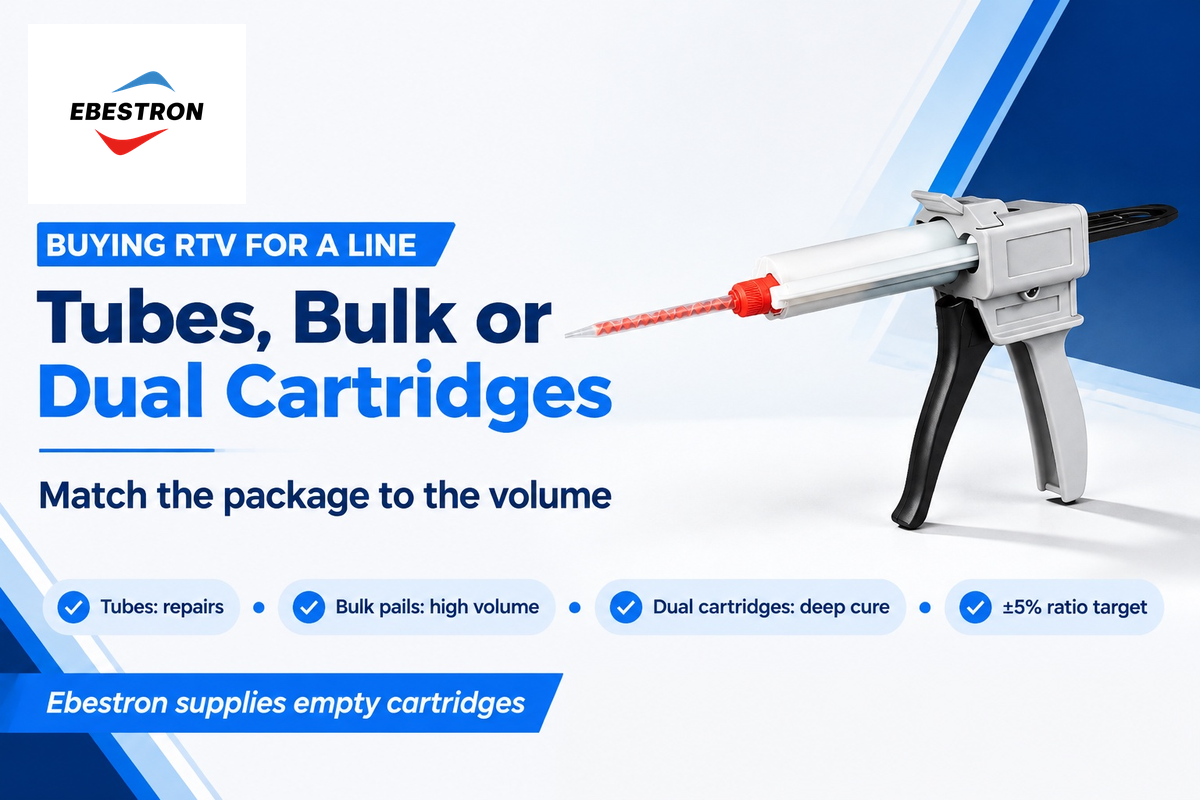
For repairs or low volume, buy one-part RTV in tubes; for high volume, buy in bulk pails with moisture-protected pumping and metered dispensing. A dual cartridge with a static mixer is a good choice when a moderate-volume line needs deep cure.
According to Momentive’s datasheet, for larger volumes, a bulk purchase will have the lowest cost; however, a larger first investment in dispensing equipment is required. A dual cartridge meters both sides at a set ratio every shot.
Ebestron supplies empty dual cartridges in the volume range of 50 to 1,500 mL in ratios of 1:1, 2:1, 4:1 and 10:1 with polypropylene barrels for silicones. The 400 mL 1:1 PP build is listed for two-component silicone gaskets and weather seals, with a target mix-ratio tolerance of ±5% by volume.
That ±5% is the cartridge’s metering target. The silicone’s own datasheet sets the ratio basis, weight or volume, and how far the mix can drift before cure suffers. A 10:1 ratio by volume can differ from 10:1 by weight for the same product.
Assumed inputs: a 3 mm round bead, a 600 mm flange perimeter, a 400 mL 1:1 cartridge, and 5 mL lost to the first purge through a new mixer.
Bead volume is π ÷ 4 × 3² mm² × 600 mm, or 4,241 mm³, which is 4.24 mL per joint. One cartridge then covers (400 − 5) ÷ 4.24, or about 93 joints, if the mixed material stays inside its pot life. Every mixer change costs another purge, so short pot lives cut that count. Material cost per joint is 4.24 mL times the silicone’s price per mL.
RFQ checklist, copy these into your quote request:
| Parameter | Recommended range | Why it matters | How to verify |
|---|---|---|---|
| Cure system | Alkoxy or platinum near copper; oxime for engine covers | Byproduct decides corrosion risk | Silicone TDS cure type line |
| Mix ratio and basis | 1:1 or 10:1, by volume | Cartridge chambers meter volume | Silicone TDS ratio by volume |
| Cartridge size and system | 400 mL 1:1 for gasket runs; 50 mL for small batches | Matches gun and bead count | Fit a sample in your gun |
| Barrel material | PP for silicone | Chemical resistance at lowest cost | Cartridge spec sheet |
| Ratio tolerance | Within the silicone supplier’s stated tolerance; Ebestron lists a ±5% volumetric cartridge target | Off-ratio mixing can impair cure | Check output ratio; convert masses to volumes with each part’s density |
| Section depth | 6 mm or less for one-part (Momentive RTV100 limit) | Moisture cure slows with thickness | Cut a test bead and check the core |
| Fluid contact | Oil-resistant grade; fluorosilicone for fuel | Silicone RTV is generally not fuel resistant | TDS fluid resistance table |
| Lead time | Ebestron typical: 5–10 working days | Line start dates | Written quote with MOQ split |
For the cartridge range, see dual cartridges for two-part silicone and the 400 mL 1:1 silicone cartridge. Matching tools are on the manual cartridge dispensing guns page.
FAQ
Q: Does RTV silicone stick to plastic?
RTV silicone sticks to some rigid plastics without a primer and gives only fair adhesion to many flexible plastics.
Momentive’s datasheet mentions that with flexible plastics that contain migrating plasticizers, the plasticizer migrates to the surface and weakens the bond. Momentive suggests a silicone primer for difficult plastics, applied over a solvent wipe of naphtha or MEK.
Q: Is RTV silicone waterproof?
Yes, cured RTV silicone is waterproof and is used to seal windows, bathrooms, pipes and vents.
Keep water off the joint until the sealant has fully cured, because a tack-free surface isn’t the same as cure-through. For a Momentive RTV100 bead about 3 mm deep, that means about a day at 25 °C and 50% RH, and longer for thicker beads.
Q: Is RTV conductive?
No, standard RTV silicone is an electrical insulator, which is why it is used to pot and seal electronics.
Momentive’s datasheet lists a dielectric strength of 16 to 20 kV/mm across its RTV100 grades. Thermally conductive grades use nitride and oxide fillers to move heat, which is thermal conductivity, not electrical conductivity.
Q: Why does RTV smell like vinegar?
As it cures, acetoxy RTV releases acetic acid, which is what vinegar smells of.
The odor disappears once the bead has fully cured.
Q: Does RTV have a shelf life?
Yes, RTV has a shelf life and the package has a use-by date for the unopened product.
One-part RTVs cure over time with the help of moisture, so a plug forms at the tip of the open nozzle. Cap the tube tightly, and store it cool and dry. Two-part kits keep the base and curing agent separate, and a sealed dual cartridge stores like a sealed tube. If the nozzle plugs up, cut out and discard the cured plug before judging the rest of the tube. Use the remaining RTV only if it is within its use-by date and still extrudes smoothly.
Q: Will RTV stick to cured RTV?
Often yes: Momentive’s RTV100 sealants bond to clean cured silicone rubber without a primer.
Other formulations may vary, so test one joint. Oil and a loose old bead break the bond, so cut back to clean material first.
Q: Is RTV silicone food safe?
Certain RTV grades may be used with food contact surfaces, but only those certified or formulated for food contact should be used.
In the United States, 21 CFR 177.2600 covers rubber articles for repeated food contact, and it lists methyl silicone elastomers among the permitted base polymers. NSF/ANSI 51 listings name specific grades and their temperature limits, such as Momentive RTV 106 at 500 °F. A general-purpose hardware-store tube is not food-contact certified unless its label or listing says so, so pick a grade the listing shows as compliant for that use.
Q: Can RTV be used as an adhesive?
Yes, RTV silicone adhesive bonds glass and many other materials while also sealing the joint.
As a silicone adhesive, it provides a low-strength, flexible bond. For high-load structural joints, epoxy and methacrylate adhesives are the usual alternatives.
Running two-part RTV on a line? Ebestron supplies empty dual cartridges from 50 to 1,500 mL in 1:1 and 10:1 ratios, built to the A/B/C/F-System and Nordson footprints, plus matching static mixers and dispensing guns. Send your silicone’s ratio, viscosity and bead size, and we’ll match a cartridge and mixer to it.
About This Analysis
This guide draws on producer datasheets for RTV silicone and on records from NASA, FDA, NSF, ASTM and the DLA specification database. Ebestron makes dual cartridges and static mixers for two-part silicone, not the sealants named here.
References & Sources
- RTV silicone Wikipedia
- How to Choose a Silicone Sealant Adhesives & Sealants Industry
- US 4,960,847: Room temperature vulcanizable organopolysiloxane composition U.S. patent
- The Analysis of Curing Kinetics of Sealants Kagaku Kogaku Ronbunshu, J-STAGE
- US 4,340,709: Addition curing silicone compositions U.S. patent
- NSF/ANSI 51 listings: RTV silicone NSF International
- Sealants versus gaskets: the development of an interactive design tool research paper (2001)
- Form-in-place and cure-in-place gaskets Assembly
- ASTM C920-18(2024) Standard Specification for Elastomeric Joint Sealants ASTM International
- Lesson 778: Selection of Spacecraft Materials and Supporting Vacuum Outgassing Data NASA Lessons Learned
- Outgassing Database NASA Goddard Space Flight Center
- MIL-DTL-46146: Adhesives-Sealants, Silicone, RTV, Noncorrosive Defense Logistics Agency ASSIST
- MIL-A-46106B: Adhesive-Sealants, Silicone, RTV, One-Component U.S. military specification
- 21 CFR 177.2600 Rubber articles intended for repeated use eCFR, U.S. Government