Get in touch with Ebestron Company

Silicones can feel dry way before they’re ready for normal use. As an example, GE Supreme Kitchen & Bath notes a typical 24 hours to cure fully while its early water-exposure time is only 30 minutes under specified conditions. So, how long does silicone take to dry? For showering, use the water-ready interval; for a bonded part, use its strength-development schedule.
Silicone drying time has three checkpoints: touch, water and load. A dry skin can cover uncured material. Use the product’s water-ready interval for a shower repair and its cure or strength schedule before loading a bonded joint.
Key points
- Early shower use and full cure can have different waiting times on the same tube.
- One-part moisture-cure silicone needs atmospheric moisture to cure; aggressively drying the air can slow it.
- Two-part material needs the correct mix and compatible contact surfaces.
- A separate test bead helps trace a curing problem, but the installed joint can still have an uncured core after the test bead has cured.
Silicone Drying Time: Skin, Water Exposure and Full Cure
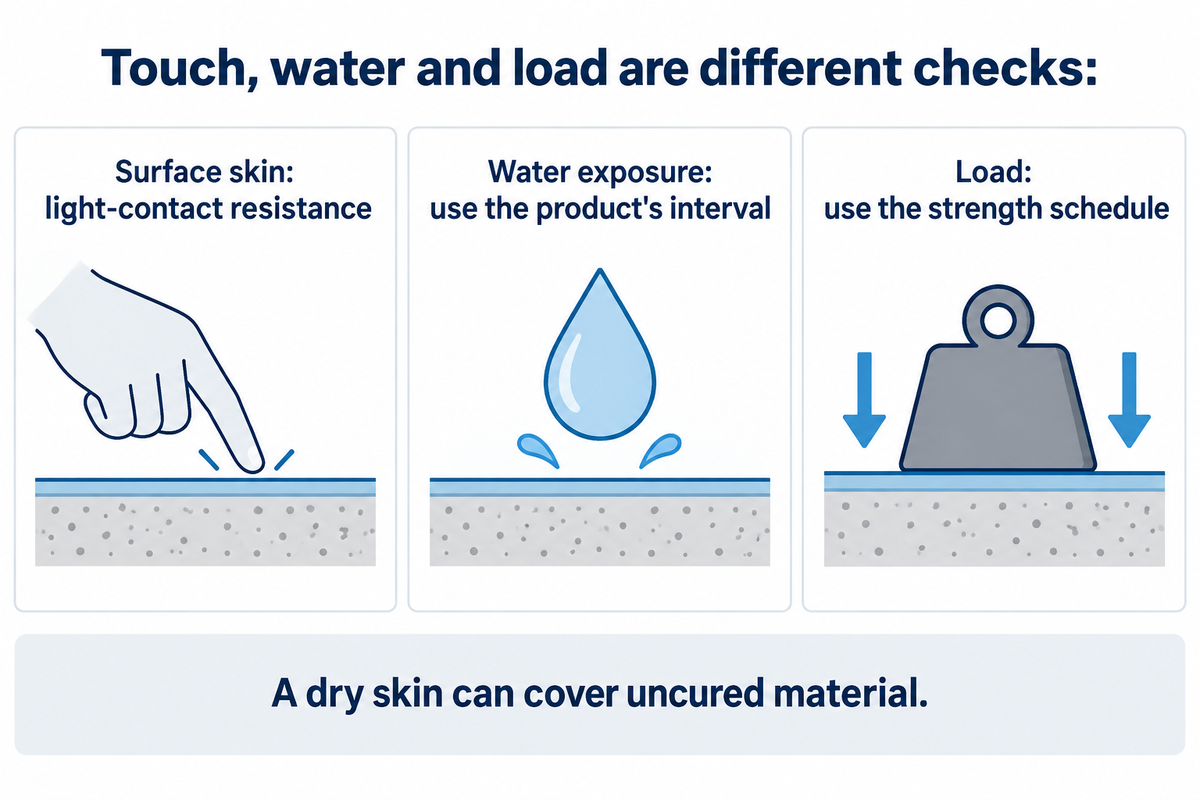
GE Supreme Kitchen & Bath lists 24 hours as its typical full-cure time, but the surface and water-ready milestones arrive earlier. Those stages pertain to different attributes. The 3-Stage Touch-Water-Load Check keeps them separate: identify what you plan to do next, and then use the corresponding instruction on the product.
The first stage is the formation of skin. A liquid or paste develops a surface that resists sticking to a light contact. After that, a bathroom product may be ready for specified water exposure. Full cure and useful bond strength concern the material beneath that skin and its connection to the substrate.
ASTM C679-15(2022) describes tack-free time as a measure of surface cure. The standard links that measurement to resistance against light contact, dirt pickup and impinging rain. So a fingertip check tells you the surface has cured; before loading a bonded joint, use the product’s cure or strength schedule.
| Product and milestone | Published time or limit | Conditions and meaning |
|---|---|---|
| GE Supreme Kitchen & Bath: tack-free | 30 minutes | 72°F (22°C), 50% relative humidity; surface test |
| GE Supreme: early water exposure | 30 minutes | Maximum 3/16-inch bead; at least 65°F and 50% humidity |
| GE Supreme: other early-water conditions | 8 hours | Manufacturer’s alternative wait when those conditions are not met |
| GE Supreme: touching or cleaning | Wait 24 hours | Separate restriction from early water exposure |
| GE Supreme: full cure | 24 hours, typical | Typical-property value; joint depth and moisture access still matter |
| GE Supreme: depth of cure | 2–3 mm per 24 hours | 23 ± 1°C, 50 ± 5% relative humidity, adequate moisture |
| Momentive RTV100: tack-free surface | 15–30 minutes | 25°C (77°F), 50% relative humidity |
| Momentive RTV100: through-cure | About 24 hours for 3 mm | 25°C (77°F), 50% relative humidity |
| Momentive RTV100: maximum section | 6 mm (1/4 inch) | Product-family thickness limit; thicker sections need another system |
The product values above are from the GE Supreme Silicone Kitchen & Bath and Momentive RTV100 technical data sheets.
How long does it take for RTV silicone to cure?
Momentive’s RTV100 data sheet gives about one day for a 3 mm section at its stated room conditions. RTV silicone means room temperature vulcanizing silicone, a broader family that includes other cure systems. Our article on RTV silicone chemistry covers those systems. Use the product number to specify the waiting time.
“A critical parameter for sealant performance appears to be the extent of cure at the onset of movement.”
White’s experiment studied one part silicone under movement cycles. Loading times were experimental settings, not a recommended household cure time. A bonded part or moving joint needs its specified strength target before use.
How Long Before Silicone Can Get Wet?
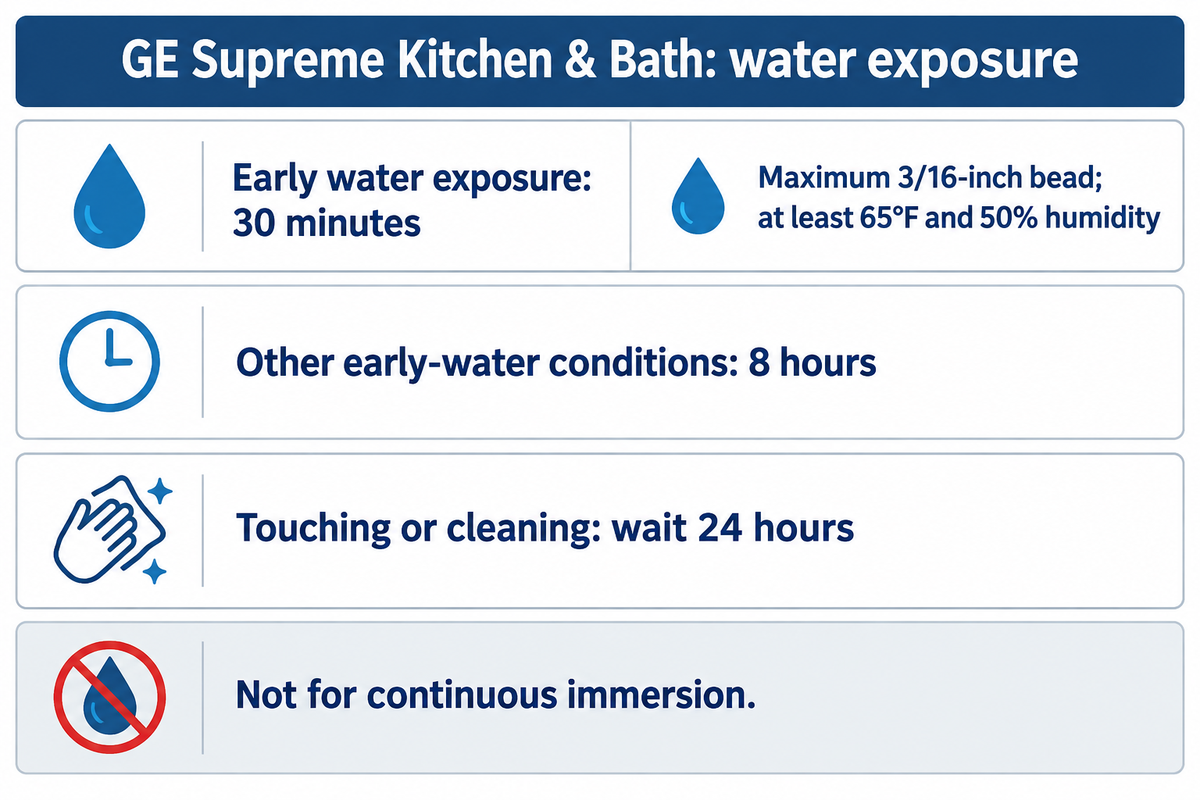
GE Supreme Kitchen & Bath permits water exposure after 30 minutes only within the bead-size, temperature and humidity conditions listed above; its alternative wait is 8 hours. A different silicone sealant may require more wait time. Keep the repair dry until the interval for that product and installation has passed. See the GE Supreme technical data sheet for these product-specific water-exposure conditions.
Read the fine print before scheduling your shower. “Water-resistant” can mean an early surface condition, whereas a finished watertight seal also requires continuous adhesion around the tub, tile or sink. Scrubbing, cleaning chemicals and standing water place different demands on fresh material.
For a bathtub repair, leave the new bead alone during the wait time. Don’t poke it every hour or wipe a skin. Restrictions on touching and cleaning still apply to GE’s silicone after its early water exposure period. An exterior window needs product instructions for exposure to rain; a bathroom shower claim can’t provide that automatically.
Continuous underwater use is different. GE Supreme excludes continuous immersion, so waiting extra days will not turn it into an aquarium or permanently submerged sealant. Use the right product for the right service and then apply it.
If the tube has been disposed of, look for the product name in your purchase records instead of treating leaving it overnight as approval to shower. “Dry for 24 hours” and “at least 24 hours to cure” are only useful when they pertain to the product you actually installed.
Why Thickness, Temperature and Humidity Change Cure Time
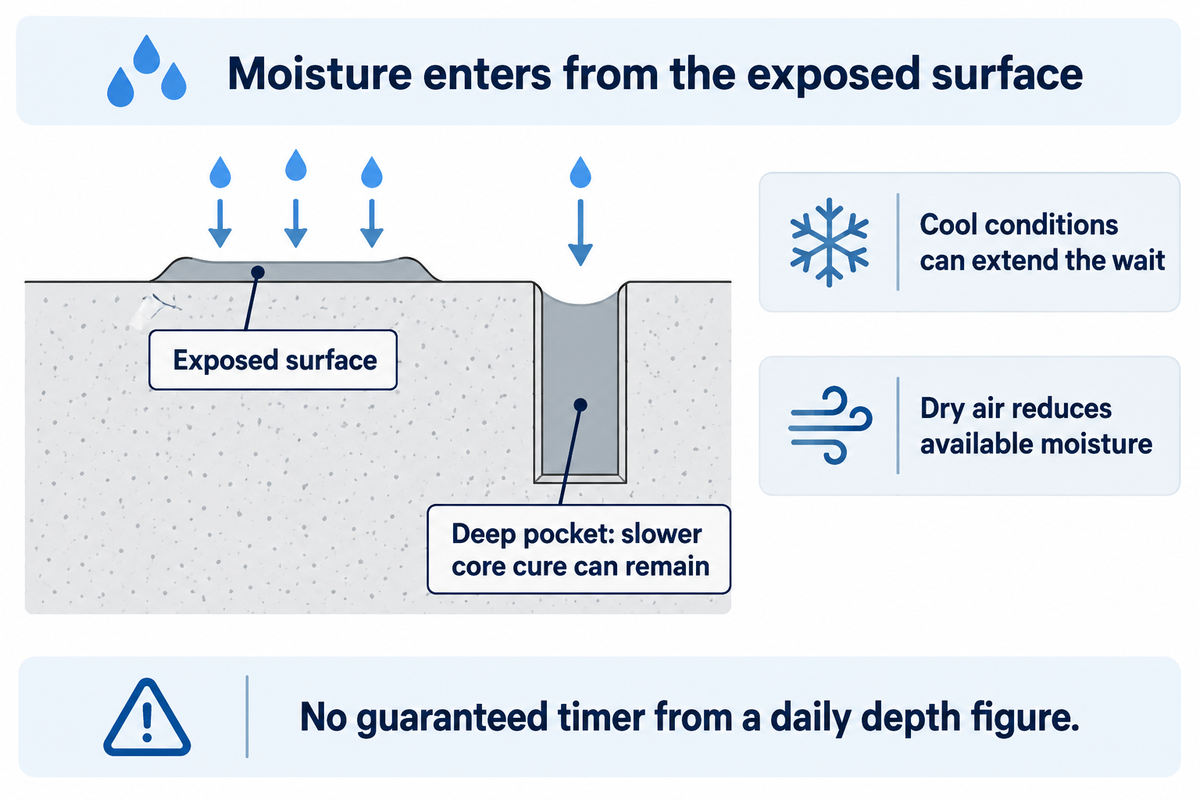
A 3 mm bead and a deep pocket expose very different amounts of material to air moisture. One-part silicone cures inward from the exposed surface, resembling a crust forming over a softer center. A larger depth can take longer even when the outer skin feels rubbery and the ambient room temperature seems comfortable.
During cure, the polymer changes chemically to a crosslinked network. Caulk drying time works differently for many other acrylic products: water evaporates. A paintable acrylic at a drywall trim joint and a moisture-cure silicone around a shower therefore need different schedules. Acetoxy silicone yields acetic acid as a byproduct during this reaction. Humidity provides reaction moisture; oxygen isn’t the ingredient that sets the ordinary moisture-cure bead.
A 2002 study of PTFE contact with an alkoxysilicone sealant found that contact changed the cured surface’s appearance without changing the cure rate in its test. Surface appearance and progress through the material can diverge.
Cool conditions can extend the time required to achieve cure. Dry conditions can reduce the available moisture. Maintain the temperature and humidity range specified for application and cure. Don’t extrapolate a millimeters-per-day figure for a product into a guaranteed timer for a thick, enclosed joint. Momentive explicitly limits the section thickness of the RTV100 products described above.
Consider the joint shape as well. A suitable backer rod controls sealant depth in a designed joint; filling the whole cavity wastes material and can leave a slow-curing core. The prescribed preparation is required for clean ceramic, glass and other non-porous surfaces. Porous materials like concrete may require a different preparation or the use of a primer. Use a primer only where the instructions for the sealant/substrate call for primer, and allow the primer its own prep time.
One-Part vs Two-Part Silicone: Which Cures Faster?
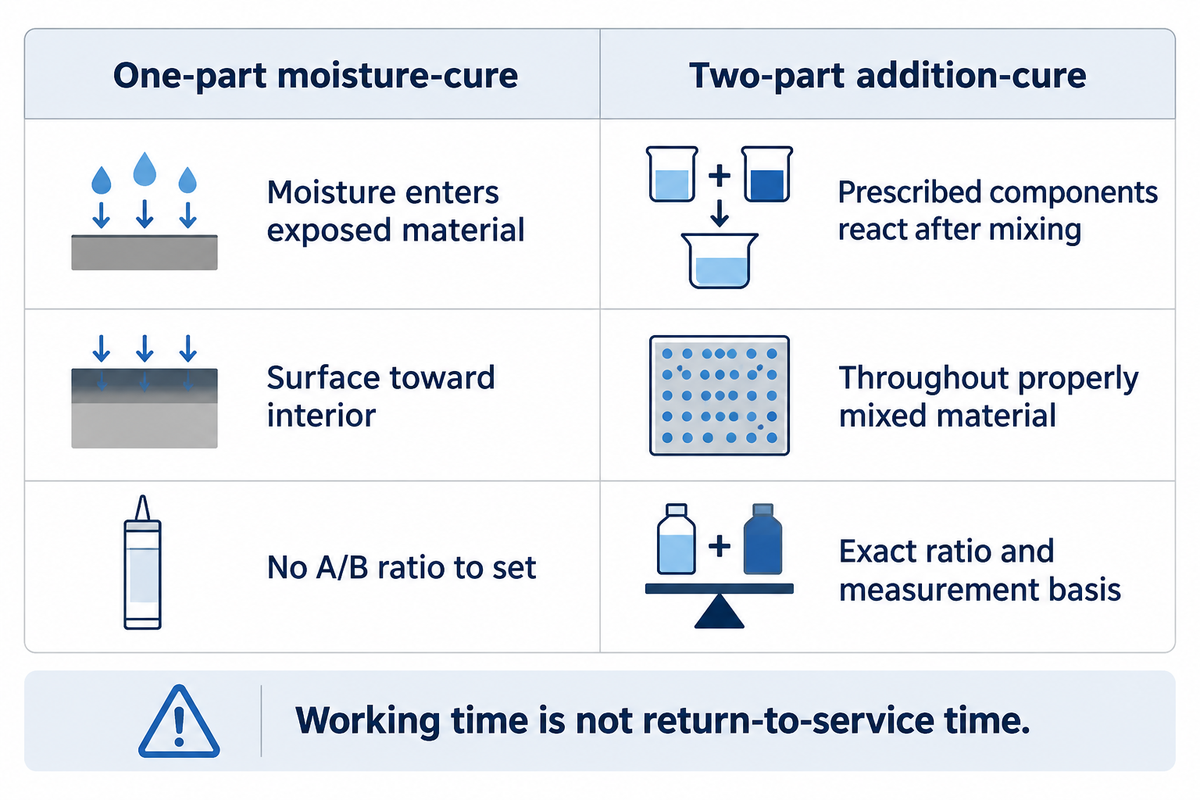
Two-part addition-cure silicone isn’t automatically faster at room temperature: one materials-database listing for the Wacker ELASTOSIL product in the mixing-ratio example below gives 1,440 minutes at 23°C, against 10 minutes at 100°C. It often suits deep or enclosed sections because a properly mixed formulation reacts through the bulk. Compare the time to the same milestone, at the same temperature, rather than comparing one product’s surface skin with another’s full cure.
| Process choice | One-part moisture-cure | Two-part addition-cure |
|---|---|---|
| Cure trigger | Moisture entering exposed material | Reaction after the prescribed components are mixed |
| Usual progression | Outside surface toward the interior | Throughout properly mixed material |
| Deep sections | Restricted by moisture access and product limits | Often selected for bulk casting or potting |
| Mixing ratio | No A/B ratio to set | Exact ratio and measurement basis required |
| Working window | Tool before the surface skins | Finish dispensing and assembly within working time |
| Temperature | Keep within application and cure limits | Use the formulation’s room-temperature or heated schedule |
| Humidity | A reaction input, not simply something to remove | Do not apply the one-part humidity rule automatically |
| Failure pattern | Slow core cure in thick or confined joints | Off-ratio, poorly mixed or inhibited regions |
| Release decision | Required water, strength or service milestone | Required hardness, handling strength or service milestone |
Pot life is the time during which the material may be mixed and worked. It isn’t the time the finished assembly must wait to return to service. A formulation can have a short working window and still need a longer cure before handling or loading.
For Wacker ELASTOSIL RT 601 A/B, a 9:1 ratio (by weight or volume) is specified. Other systems may have different ratios, and weight and volume ratios are not generally interchangeable. A shortcut to use an excess of curing agent isn’t allowable.
A 2025 laboratory study of two-part PDMS in different molds tested 55, 65 and 75°C with 2 hours, 6 hours and 12 hours of curing. The mold material altered the outcome of the study. Those settings belong to that laboratory formulation and process; heating a bathroom bead to those temperatures isn’t a repair method.
How to Help Silicone Cure Without Damaging the Joint
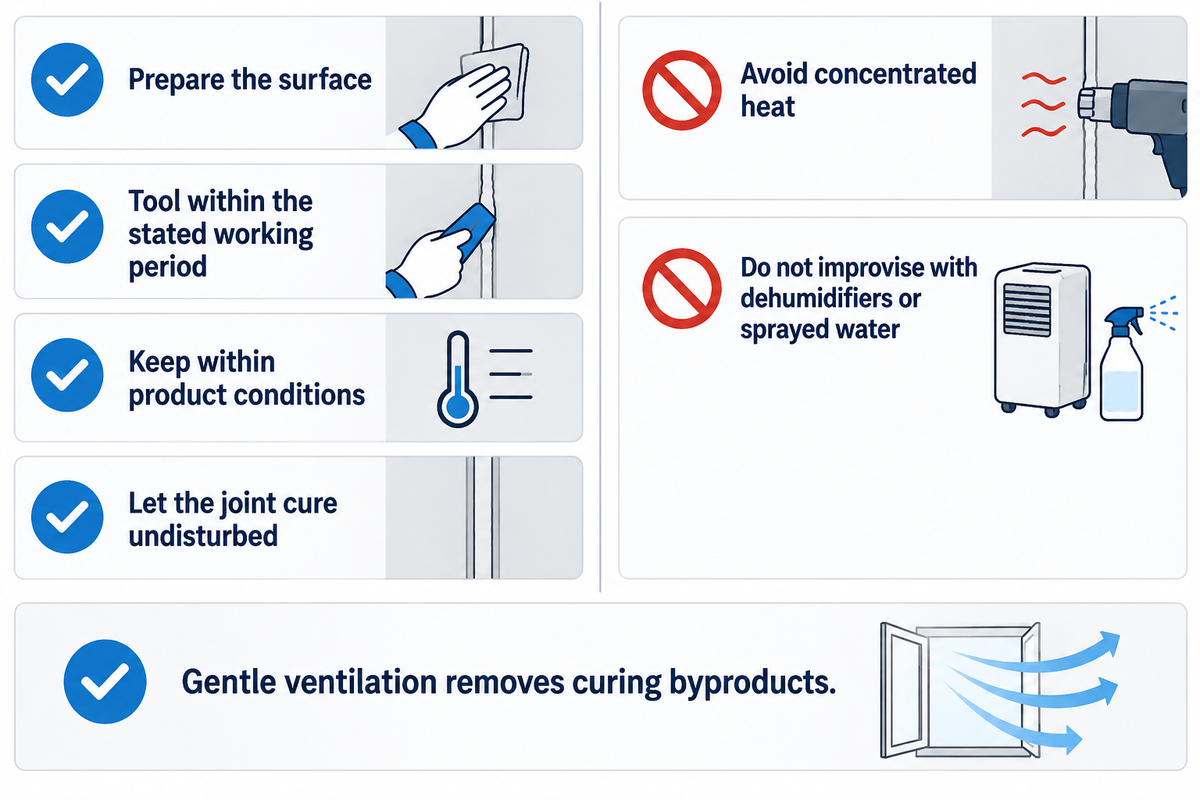
The best way to help silicone cure is to apply the right bead on a prepared surface and keep the room within the product conditions. Good ventilation takes away curing byproducts. Trying to speed things up with a concentrated heat source can disturb those conditions. Direct heat, a dehumidifier or water sprayed onto a fresh bead can change the conditions in ways the label did not authorize.
Before you cut the nozzle, size the opening for the intended joint. Apply a continuous bead, tool it in the stated working period, then let it cure undisturbed. More sealant doesn’t repair a badly prepared edge. Old residue, loose grout or damp contamination can leave bad adhesion even after the material has hardened. A bead that peels off can leave a leak path even if the silicone itself is waterproof. If peeling occurs or a crack opens, check the joint and movement of the substrate before adding more material.
Can a hair dryer be used to speed up the curing process of Selleys Wet Area Silicone?
No. Selleys says its Wet Area Silicone needs moisture and that a hair dryer can hinder curing by drying the area. So, gentle room ventilation is the better choice. A heater aimed at the bead can create a hot surface while the joint beneath stays cooler, so don’t use surface warmth as a readiness check.
For bathrooms and kitchens with a short shutdown window, pick an appropriate fast-water-ready product first. Buying high-quality silicone does not make every product suitable for the same repair or eliminate its curing conditions.
Silicone Still Sticky? Decide Whether to Wait or Replace It
Wait if a one-part bead is within its stated curing window; replace demonstrably off-ratio or persistently uncured material after checking the cause. Protect a slowly curing bead and maintain the required conditions. If a two-part mixture remains liquid, streaky or soft only against one material, investigate mixing and contact inhibition rather than waiting to check again the next day.
A reading of 48 hours or 72 hours isn’t a universal discard rule. Start with the expected cure interval for that formulation and the actual bead depth and the room conditions. A wet center beneath a skin suggests a different problem from a whole batch that never gels.
How do I tell if caulk is cured?
A rubbery, non-tacky surface means the skin has formed; count the bead as cured only after the product’s full-cure interval (GE Supreme lists 24 hours as typical) and any required acceptance checks. Don’t puncture a working seal to check it. For a production bond, use the required hardness, adhesion or handling-strength check; for a shower, follow its water-exposure instructions.
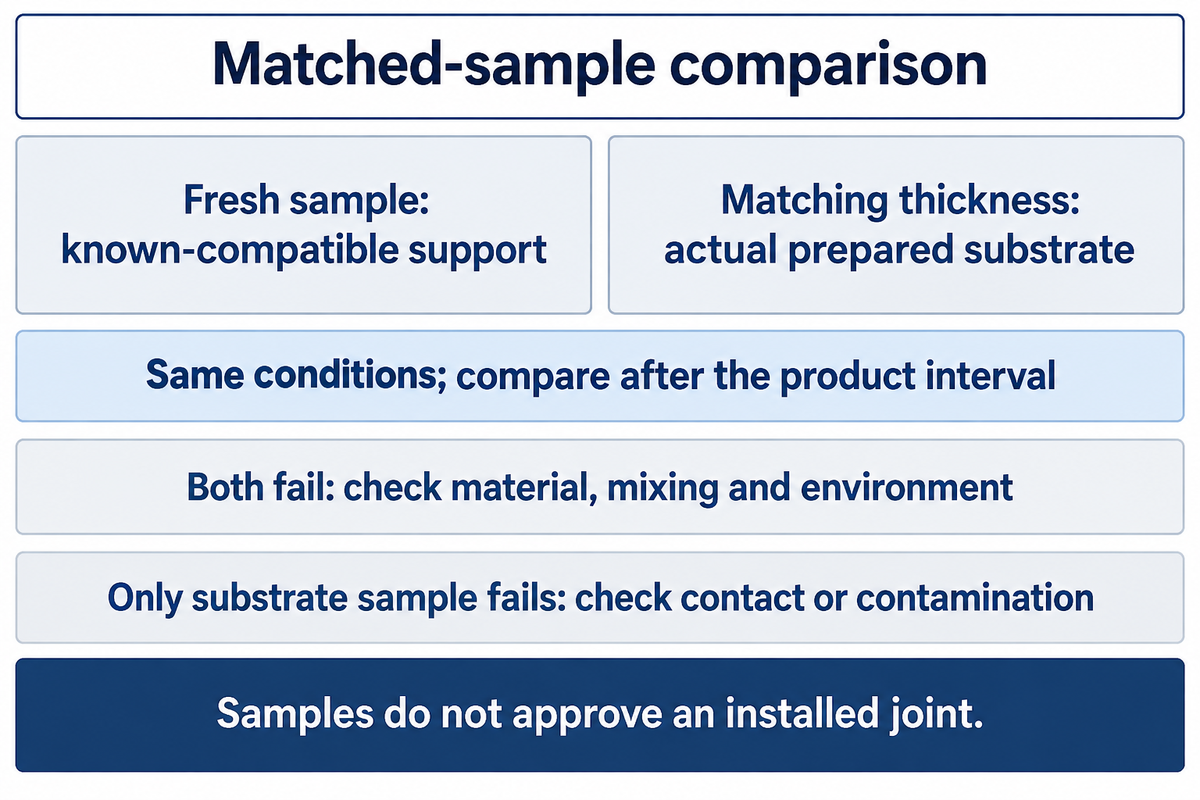
Use a matched-sample comparison to reduce the scope of a continuing problem.
- Make a small fresh sample from the same batch, following the exact ratio and mixing instructions, on a known-compatible support.
- Make a second sample with matching thickness on the actual substrate, using the same surface preparation.
- Keep both under the same specified conditions and compare them after the product’s expected interval.
- If both fail, investigate material condition, mixing and environment. If only the substrate sample fails, investigate the contact surface or contamination.
An installed joint can keep an uncured core or a weak bond even when separate samples have cured. Replace demonstrably off-ratio or persistently uncured material according to the product instructions instead of covering it with a new skin.
In a study of 16 stereolithography resins, chemicals leaching from printed molds poisoned the platinum catalyst used to cure PDMS. This is a specific example of a two-part casting problem and shouldn’t be generalized to a tacky bathroom bead. Wacker also warns that several contact materials can inhibit its platinum-cured product.
Choosing Cartridges and Mixers for Two-Part Silicone
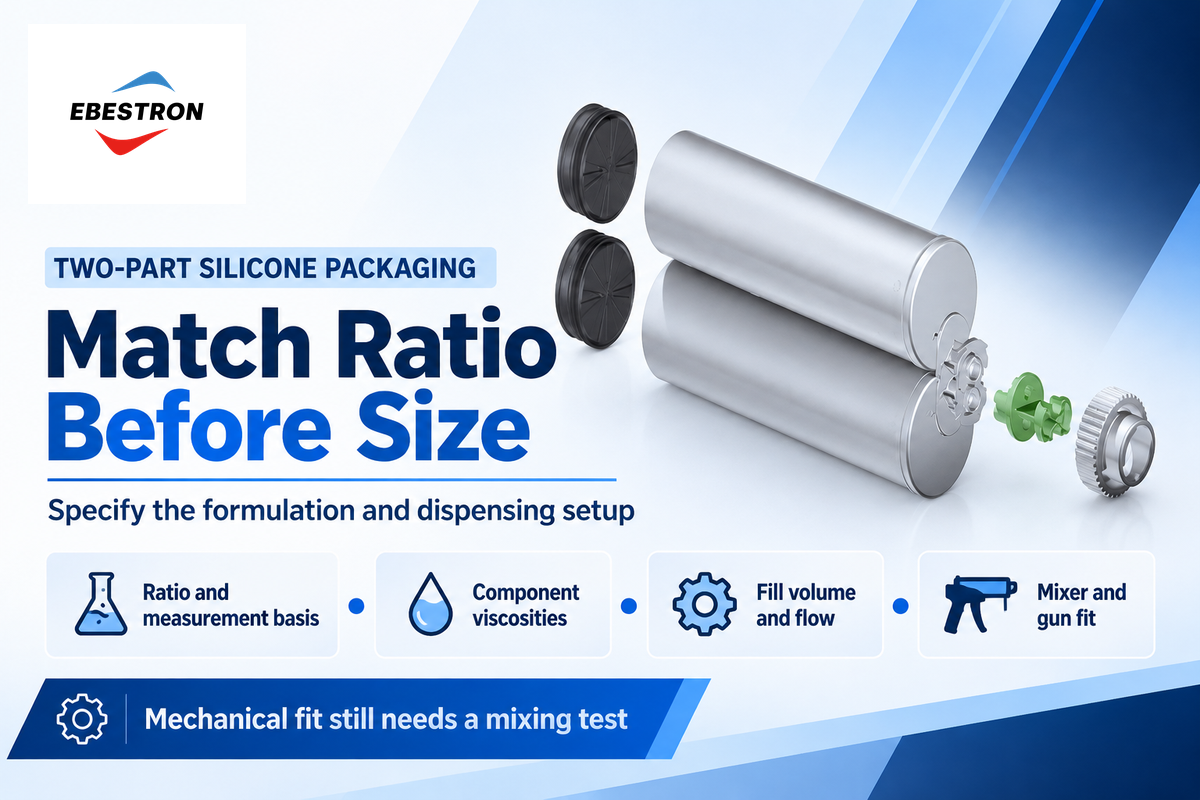
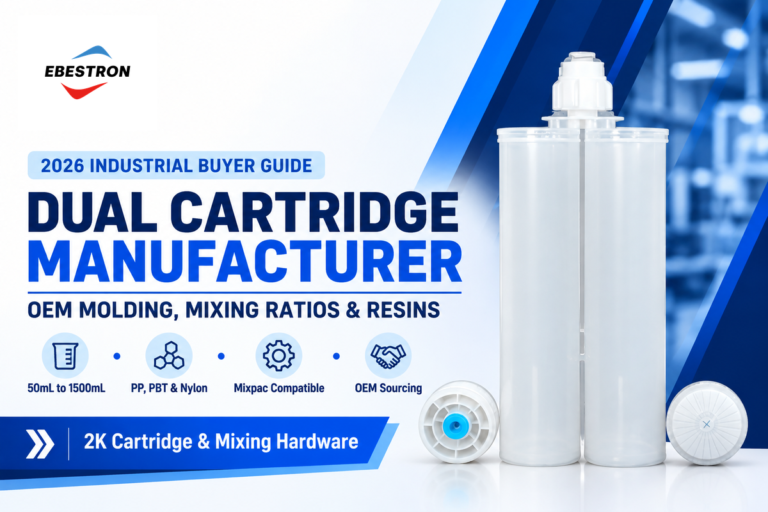
Match the cartridge ratio to the silicone formulation before choosing package size. Ebestron supplies empty dual cartridges from 50 mL to 1500 mL, with standard ratios of 1:1, 2:1, 4:1 and 10:1. A 10:1 cartridge shouldn’t be substituted for the 9:1 Wacker example, even though the numbers are similar.
Our dual-cartridge packaging range keeps components separate until dispensing. Larger 400 mL and 600 mL cartridge options are available for different fill-volume requirements. Package capacity doesn’t determine silicone cure speed.
For a packaging inquiry, include the ratio and measurement basis of the formulation, both component viscosities, the required fill volume, target flow, and expected pauses between shots. Give the outlet interface and substrate used in assembly. Match static mixers for the dispensing system and compatible dispensing guns for this combination. A mixer that fits mechanically still requires a mixing-performance test with the intended material.
Fast-Cure Silicone: What Is Changing?
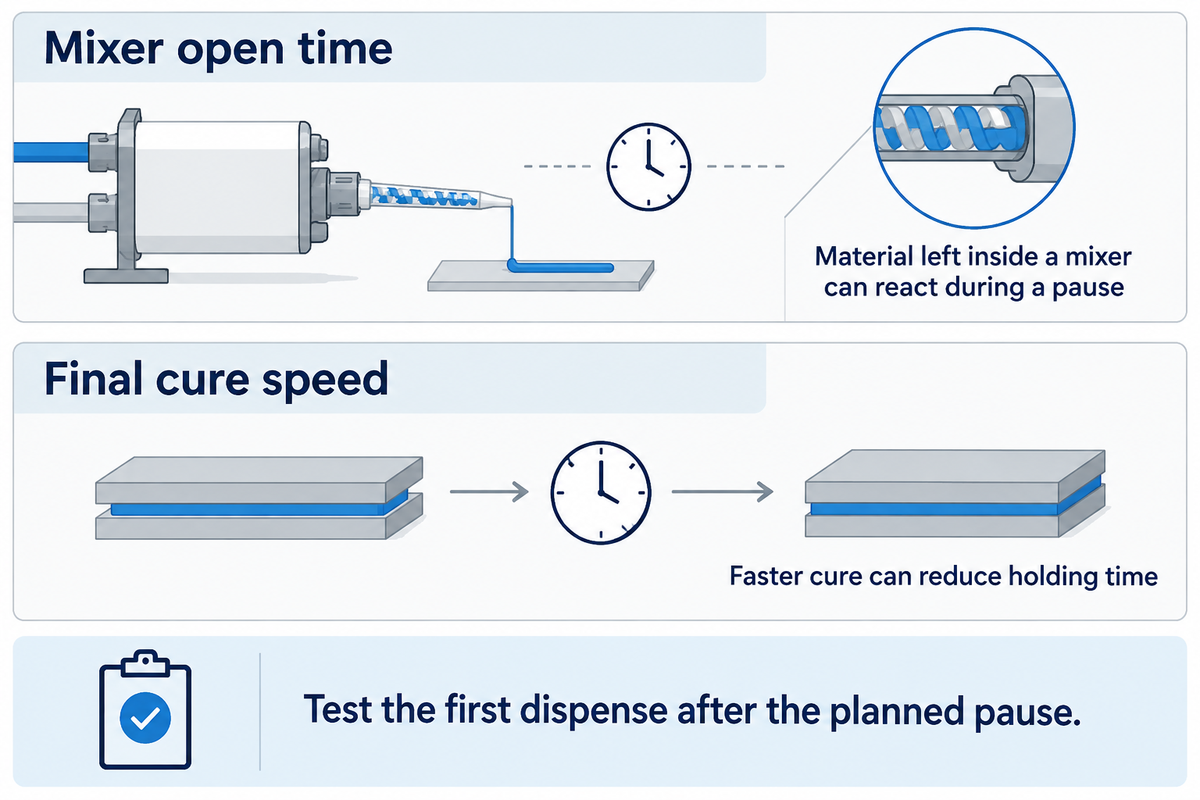
Recent formulation work aims to combine faster silicone cure with longer usable pauses inside a mixer. Longer usable pauses and faster curing are important to assembly and production users. Material left inside a mixer can react during a pause, while the operator still needs time to position parts. Mixer open time and final cure speed therefore need separate entries in a process specification.
Sika Technology AG’s US12590185B2 patent, published on March 31, 2026, addresses rapid-curing two-component silicone with longer mixer open time. Its formulation work illustrates the tradeoff between fast production and usable dispensing pauses. The patent belongs to Sika; it isn’t an Ebestron formulation or a product-availability announcement.
When dealing with fast-cure silicone, compare the longest planned pause to the mixer time and test the first dispense after the pause. Faster final cure can reduce holding time yet increase waste if the mixer blocks between parts. A home repair is easier; pick the right joint and product, then follow its stated water-ready time.
Frequently Asked Questions (FAQs)
Can I apply a second layer of silicone?
For GE Supreme repairs, remove old silicone rather than applying a second layer over it.
GE Supreme’s preparation instructions require old sealants and other adhesion inhibitors to be removed from the bonding surfaces. A fresh layer over an unsound bead leaves that weak interface underneath. Clean the exposed surfaces using the approved preparation method, then apply the replacement bead to the sound joint.
How do I remove excess silicone?
Remove excess silicone within the product’s tooling window, using the method recommended for the surface.
After cure, removal usually requires careful mechanical work. Protect the tile, tub finish or glass from scratches. A remover suitable for one surface may damage another. Clear away remaining residue before resealing, and let the prepared joint reach the required dry condition.
Is silicone heat resistant?
Cured silicone can tolerate heat within its particular product rating, but heat resistance doesn’t set the curing schedule.
A high service-temperature limit isn’t permission to bake a fresh seal. The application temperature, cure temperature and continuous operating temperature are separate specifications. Choose the correct grade for a hot assembly and follow its own curing instructions.
Can I paint over 100% silicone?
Usually no: ordinary 100% silicone isn’t paintable. GE Supreme specifically excludes painting. Where a painted finish is required, select a paintable sealant compatible with the joint and follow its paint-over interval.
How should I store silicone, and does shelf life matter?
Keep silicone sealed in its original packaging under the manufacturer’s storage conditions, and use the product’s stated shelf life for stock planning.
An opened moisture-cure cartridge can develop a plug because air has reached the nozzle. A soft plug doesn’t establish the condition of the remaining contents. Two-part packs also need protected outlets so the components don’t cross-contaminate. Record the opening date and batch number when a pack enters production. If cure behavior changes, compare properly stored material and the working batch under the same conditions before committing more assemblies. Never mix unmatched components simply to use up old stock.
Planning a two-part silicone package? Send Ebestron your mixing ratio, fill volume and dispensing setup. We can help match the empty cartridge, mixer and gun so you can evaluate the chosen formulation in the intended process. Keep curing requirements in the material specification and packaging requirements in the dispensing specification.
This guide combines named product directions with published research. Product schedules are the property of the respective manufacturers; Ebestron supplies the dispensing packages. No in-house silicone curing experiments are claimed.
References & Sources
- ASTM C679-15(2022): tack-free time of elastomeric sealants
- NIST: movement during cure and sealant mechanical properties
- Comyn, de Buyl and Subramanian: PTFE contact and moisture cure
- Original research on mold materials and PDMS curing conditions
- PDMS curing inhibition on 3D-printed molds
- Sika patent US12590185B2: rapid cure and mixer open time