Get in touch with Ebestron Company

Polyurethane sealant is a durable elastomeric joint filler made from isocyanate-terminated prepolymers. It is a tough paintable rubber seal. At 23 °C and 50% relative humidity, the 1K moisture-curing polyurethane grades described in the cited research cure approximately 2–4 mm in 24 hours. Two-component (2K, Type M) polyurethane systems crosslink through a polyol-isocyanate reaction throughout the mixed bead. The full cure time is dependent on the formulation, bead geometry, and the curing temperature. Engineers prefer polyurethane systems over silicone or hybrid MS polymers when concrete expansion joints, warehouse floors, or vehicle seams are subjected to heavy wheel traffic and mechanical abrasion.
Engineering Selection Summary: The Skin-Depth vs Crosslink-Clock Matrix
- One-component moisture-cure (Type S) grades are suitable for perimeter window, door, masonry, and slab joints up to 12 mm deep. Common industrial package sizes include 300 mL (10.1 US fl oz) cartridges and 600 mL foil sausages.
- Two-component (Type M) polyurethane systems are suitable for deep structural seams, cold-weather conditions and quick OEM assembly lines. They use 50 mL to 1500 mL dual cartridges with either a static or a dynamic mixing nozzle.
- Under ISO 11600 and EN 15651-1, 25LM sealants keep secant modulus at or below 0.4 N/mm² at 23 °C and 0.6 N/mm² at −20 °C. In ASTM C920-18(2024), Class 25 identifies movement capability without an LM designation.
What Is Polyurethane Sealant and How Does Isocyanate Cure Chemistry Work?
A polyurethane sealant is a reactive polymer compound that seals moving joints between concrete, mortar, metal, wood, and masonry surfaces. Unlike acrylic latex caulk, polyurethane doesn’t harden by simple water evaporation. Its liquid prepolymer backbone is terminated at each end by reactive isocyanate groups. Upon exposure to moisture or a polyol, the network is formed.
This crosslinked network offers caulk mechanical durability. Standard construction grades reach Shore A hardness levels from 20 to 50 (ASTM C920 Class 25). Cured beads withstand forklift wheel abrasion and mechanical puncture. They can be painted with either acrylic or polyurethane paints.
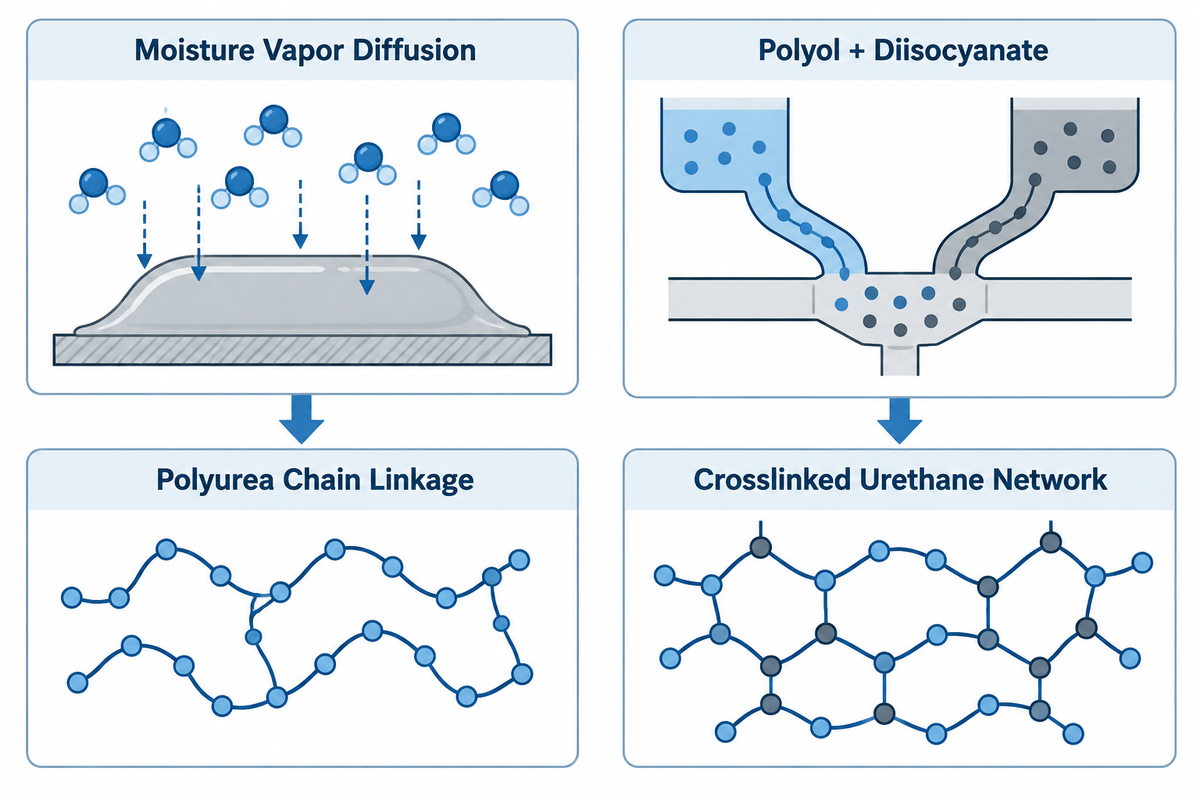
In one-component (1K) systems, a bead undergoes two chemical steps for curing. The first step involves the diffusion of water vapor from the atmosphere into the bead. The water vapor reacts with an isocyanate group (R-NCO + H₂O) to form a carbamic acid (R-NHCOOH). The carbamic acid immediately dissociates to produce an amine (R-NH₂) and carbon dioxide (CO₂). In the second step, the newly formed amine group reacts with an isocyanate group to form a polyurea linkage, which adds flexibility to the polymer chain.
In two-component (2K) systems, polyurethane sealant doesn’t rely on the diffusion of water vapor from the atmosphere to cure. The Component A (resin) of the curative is a hydroxyl-terminated polyol. The Component B (hardener) is a polymeric diisocyanate (MDI or HDI) crosslinker. The hydroxyl and isocyanate groups react to form urethane linkages to crosslink the polymer network.
Despite its strong points, specifiers should be aware of four main limitations of polyurethane sealant. First, reactive diisocyanate monomers are present in uncured products. OSHA chemical weatherization guidance and OSHA isocyanate hazard standards set a ceiling Permissible Exposure Limit (PEL) of 0.02 ppm for MDI and 2,4-TDI. In order to protect workers from skin sensitization and occupational asthma, crews use nitrile gloves and work with locally exhausted ventilation. Second, moisture-curing 1K joints may take a long time to fully cure in deep sections or very cold temperatures. Third, if a substrate isn’t fully dry, moisture on the substrate can cause CO₂ bubbling. Fourth, aromatic polyurethane grades chalk faster than silicone products under intense solar UV radiation.
Why Do Polyurethane Sealants Bubble or Foam During High-Humidity Cure?
Moisture-curing polyurethane beads cure into an elastomer matrix as isocyanate groups react with moisture. When they’re exposed to moisture, they undergo a chemical reaction to produce CO₂. This gas, if it isn’t able to escape the beads, may cause them to bubble, as explained in the Adhesives & Sealants Industry.
Three jobsite errors turn normal gas diffusion into visible foaming blisters. First, gunning sealant onto damp concrete traps liquid water under the bead. Field threads on r/Concrete self-leveling sealant applications confirm that rain or slab moisture within 24 hours causes surface bubbling. Second, as contractors report on r/Concrete deep expansion joint discussions, filling deep expansion joints with sand creates a wet reservoir. Sand wicks slab moisture straight into the uncured urethane and causes severe bubbling. Third, puncturing a closed-cell polyethylene backer rod with a sharp tool releases trapped blowing gas into the wet sealant.
Worked Example, Reducing Blisters on a Sun-Heated Concrete Apron: A crew guns a 12 mm wide by 6 mm deep 1K gray polyurethane bead at 1:00 PM. The concrete slab warms from 24 °C to 36 °C under direct sun. Expanding pore air and water vapor push out of the concrete and blow 3 mm blisters down the joint. Installing sealant while the slab is cooling can reduce substrate outgassing. Switching to a 2K polyurethane changes the cure mechanism, though it doesn’t stop air or vapor from escaping warm concrete.
1K Moisture-Cure vs 2K Polyurethane Sealant: Cure Depth, Dynamic Mixing, and Packaging
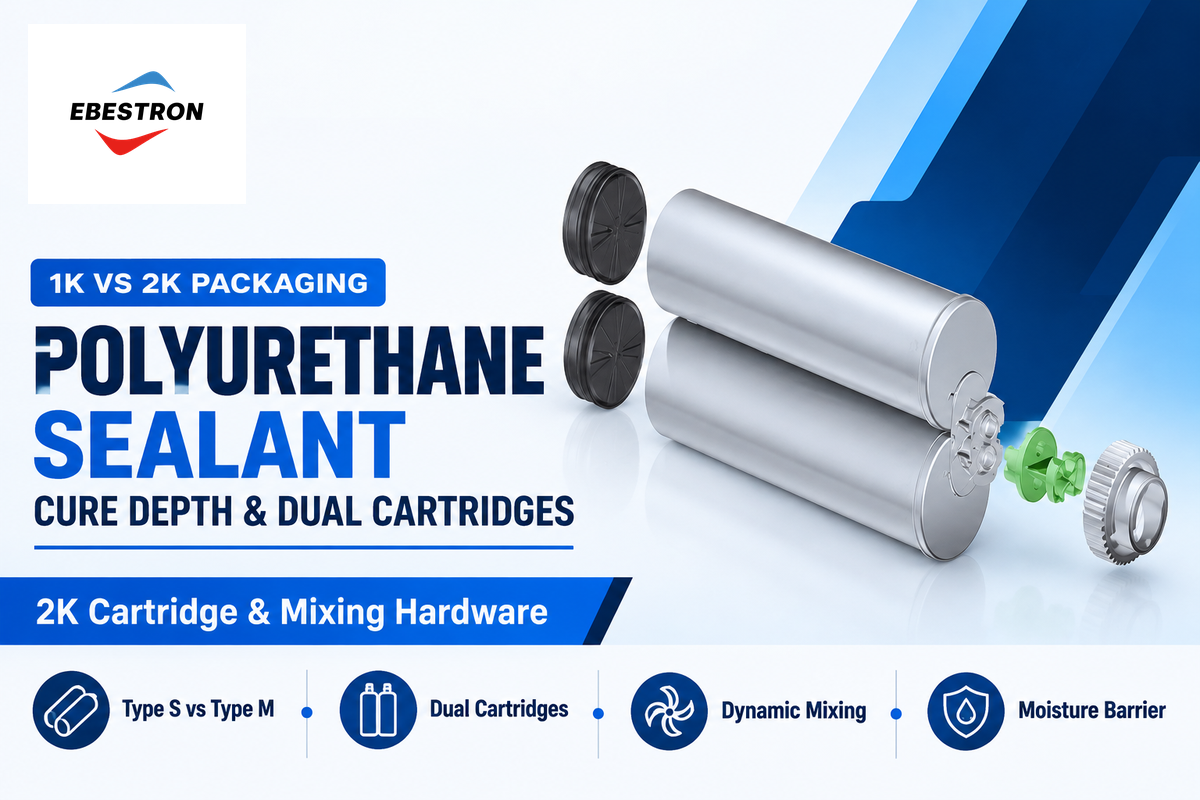
Choose a 1K tube for standard joints and a 2K dual cartridge for deep structural seams or fast OEM assembly lines. Both require a moisture barrier package to protect shelf stability. A 1K polyurethane sealant cures from the outside in. An outer polyurea skin forms in 60 to 180 minutes at 23 °C and 50% RH. After the first skin forms, airborne water vapor must permeate through that cured rubber barrier to reach the wet core. How long it takes for the water to fully cure the core depends on the depth. Cure speed drops sharply with depth: a thin 3 mm bead cures in about 24 hours, while a deep pocket takes much longer.
The construction of the container helps a 1K polyurethane sealant maintain shelf stability when stored with moisture-tight seals. Manufacturers package industrial 1K grades in 300 mL (10.1 US fl oz) cartridges or 600 mL foil sausages; verify container material and barrier construction on the product data sheet.
Two-component (2K) polyurethane sealants cure through a polyol-isocyanate reaction when their components are combined, without relying on atmospheric moisture, though water on the substrate can still react with isocyanate. By separating the components, reliance on atmospheric moisture to cure the coating is removed. Suitable barrels and outlet seals also help control moisture during storage. Our two-component polyurethane mixing ratio and cure guide covers 50 mL, 200 mL, 400 mL, 600 mL, and 1500 mL cartridges across 1:1, 2:1, 4:1, and 10:1 mixing ratios. Thick PP, PA, or PBT cartridge walls, along with outlet and piston seals, also help control moisture during storage.
| Parameter | 1K Moisture-Cure (ASTM C920 Type S) | 2K Reactive-Cure (ASTM C920 Type M) |
|---|---|---|
| Cure Mechanism | Atmospheric water diffusion (NCO + H₂O → polyurea + CO₂) | Internal chemical crosslink (NCO + OH → urethane) |
| Through-Cure Rate | Roughly 2 to 4 mm per 24 hours at 23 °C and 50% RH | Full bulk cure depends on formulation, bead dimensions, and temperature |
| Single-Pass Depth | Constrained by humidity diffusion into deep beads | Not limited by atmospheric moisture diffusion; constrained by heat buildup, mixing quality, formulation limits, and joint movement design |
| Standard Packaging | 300 mL (10.1 US fl oz) cartridge; 600 mL foil sausage | 50 mL to 1500 mL 2K side-by-side cartridge (1:1 to 10:1) |
| Mixing Hardware | Direct cone nozzle (no mixer needed) | 12–24 element static tube or 2,500–12,000 RPM dynamic nozzle |
When Does a 2K Polyurethane Sealant Require a Dynamic Mixing Nozzle Instead of a Static Tube?
Two-component polyurethanes, as mentioned in US20180251590A1 and EP3020744A1, can be blended by using either static or dynamic mixers. Passive tubes (also called static tubes) can present challenges for large mix ratios and high viscosity differences of the two components. In a passive static tube, stationary helical baffles split and fold the two component streams. This can be effective for low viscosity component streams of polyurethanes. When a thin isocyanate activator meets a thick thixotropic polyol paste at 4:1 or 10:1, the thin fluid can channel along the wall.
For sealants with matched component viscosities (1:1 and 2:1), compact static mixer geometries reduce material loss significantly. According to an engineering study in Adhesives & Sealants Industry third generation static mixing nozzles reduced purge and retained nozzle waste from 19.1 mL to 5.0 mL. That represented a 74% reduction in waste compared to long legacy spiral static tubes, while achieving uniform mixing.
Wide mix ratios or high-viscosity pastes often need active mechanical shear, as shown in our static helical vs dynamic rotor mixing threshold guide. Production lines mount motor-driven dynamic mixing nozzles for 2K sealants onto pneumatic or electric dispensers. An external drive spindle spins the internal rotor at 2,500 to 4,000 RPM for foaming polyurethanes or 4,000 to 8,000 RPM for structural adhesives. High-viscosity thixotropic sealants run at 8,000 to 12,000 RPM through a 6.3 mm to 8 mm outlet with low backpressure.
Worked Example- Dispensing a 10:1 Bus-Roof Seam Sealant: A coach builder dispenses a non-sag 10:1 2K polyurethane sealant from a 400 mL dual cartridge along a 6 m aluminum roof seam. Long, static mixer tubes create high backpressure and slow the speed of bead advance. Switching to a dynamic mixer spinning at 8,500 RPM lowers backpressure and provides a uniform bead along the seam.
Types and Grades of Polyurethane Sealant: Self-Leveling vs Non-Sag and ASTM C920 Classes
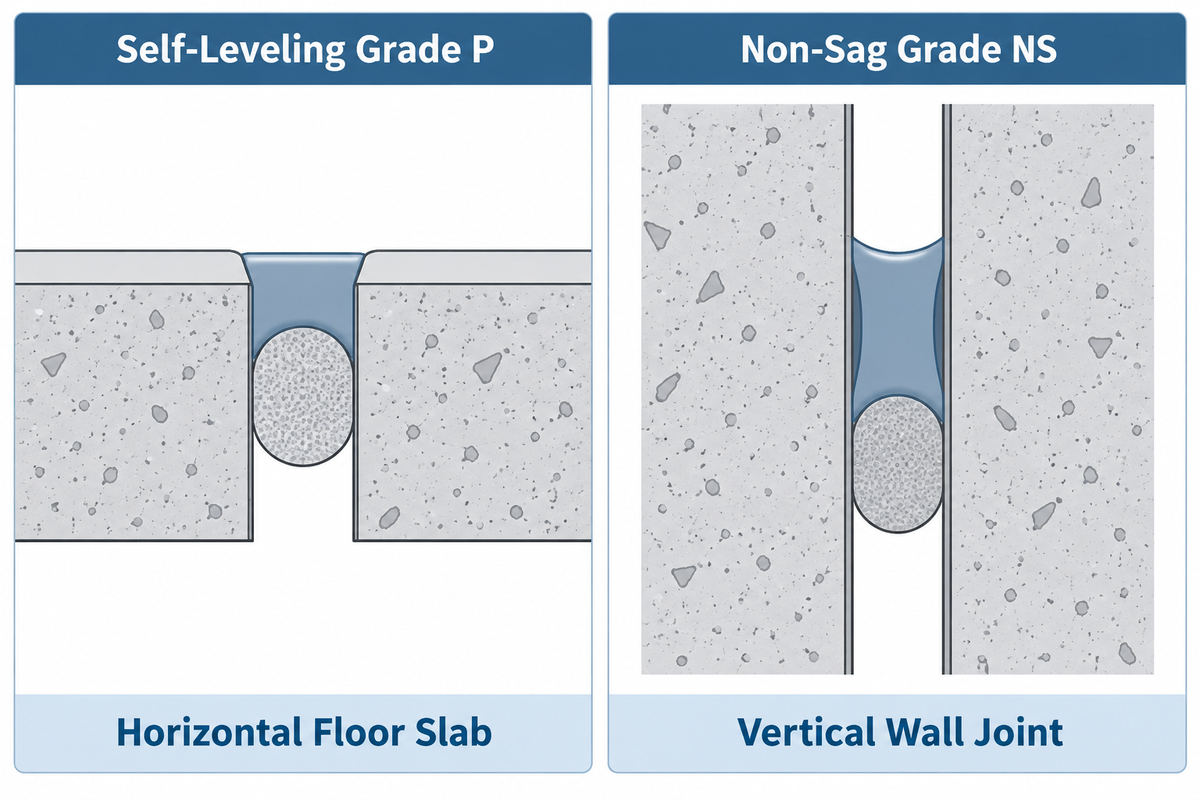
Where a polyurethane joint sealant can work safely is determined by flow grade and cyclic movement class. Commercial products, like Sikaflex®, split into two rheological grades: self-leveling (Grade P, pourable, often marked as “SL”) and non-sag (Grade NS, gun-grade paste). Applying the wrong flow grade ruins the joint geometry before it even starts to cure.
Self-leveling polyurethane sealant (Grade P / SL) flows under its own weight to create a smooth, flat horizontal finish without the need for manual tooling. It is used for horizontal joints in floors, warehouse slabs, plazas, and sidewalks. If a Grade P self-leveling sealant is poured or gunned into a joint on a vertical wall or steep ramp, it can run out of the joint and puddle at the bottom.
Non-sag polyurethane sealant (Grade NS) has thixotropes and holds a bead profile upright or overhead, without slumping. It is used to fill vertical joints, like precast panels, brick masonry expansion joints, window and door frames, and overhead soffits. A rounded slicking tool is used to strike the bead and wet-out the walls of the joint, leaving a clean, smooth finish.
What Do ASTM C920 Type S/M, Grade P/NS, and Class 25/50 Mean on a Sealant Data Sheet?
Under ASTM C920-18(2024) reapproved in November 2024, every compliant elastomeric joint sealant carries a classification covering curing components (Type), flow behavior (Grade), movement capability (Class), and verified substrates (Use). Field adhesion also relies on substrate compatibility and installation quality.
| Classification Category & Class | Standard Designation | Verified Engineering Meaning & Test Boundary |
|---|---|---|
| Component Type S | ASTM C920 Type S | Single-component moisture-cure cartridge or foil sausage ready for direct gunning. |
| Component Type M | ASTM C920 Type M | Multi-component (2K+) reactive kit mixed through a static or dynamic nozzle at application. |
| Flow Grade P | ASTM C920 Grade P (SL) | Pourable self-leveling rheology designed for horizontal deck and floor joints. |
| Flow Grade NS | ASTM C920 Grade NS | Non-sag thixotropic paste formulated for vertical walls and overhead joints. |
| Movement Class 25 | ASTM C920 Class 25 | Rated for ±25% cyclic joint movement under ASTM C920. |
| Traffic Service Use | Use T / Use NT / Use I | Use T covers pedestrian and vehicle traffic; Use NT covers non-traffic facades; Use I covers liquid immersion. |
| Substrate Use | Use M / Use G / Use A / Use O | Use M means Mortar; Use G means Glass; Use A means Aluminum; Use O means Other specified substrates. |
| Modulus Category 25LM | ISO 11600 / EN 15651-1 25LM | Secant modulus ≤0.4 N/mm² at 23 °C and ≤0.6 N/mm² at −20 °C under ISO 11600 and EN 15651-1. |
| Cold Climate Designation CC | EN 15651-1 F-EXT-INT-CC | Cold-climate compliance for low-modulus facade sealants requiring secant tensile modulus ≤0.9 N/mm² at −30 °C. |
Two common specification errors trip up project engineers. First, there are several trade guides that misstate Use M as Metal and Use A as Adhesion. In ASTM C920 and ASTM C1375, Use M means Mortar (Portland cement mortar blocks) and Use A means Aluminum. Passing Use M, G, and A only proves adhesion to those three standard laboratory coupons. ASTM C920 Use O identifies other specified substrates, and peel testing assesses adhesion to project substrates with the selected surface preparation and primer.
Second, ISO 11600 and EN 15651-1 classify 25LM sealants using secant modulus limits of ≤0.4 N/mm² at 23 °C and ≤0.6 N/mm² at −20 °C. Exceeding either limit places the sealant in the 25HM high-modulus category. For fragile EIFS stucco or soft sandstone, a low-modulus sealant reduces stress on joint edges; an EN 15651-1 25LM CC product combines low-modulus classification with cold-climate performance (≤0.9 N/mm² at −30 °C).
Specifying a Cold-Storage Dock Joint: A freezer warehouse floor operates at −25 °C under heavy reach-truck wheels. The engineer selects an ASTM C920 Type M, Grade P, Class 25, Use T, Use M 2K polyurethane for the interior floor slab. The spec calls for an EN 15651-1 25LM CC non-sag sealant to reduce winter edge stress for the exterior insulated facade panels.
Polyurethane vs Silicone vs Hybrid MS Polymer Sealants: Engineering Trade-Offs
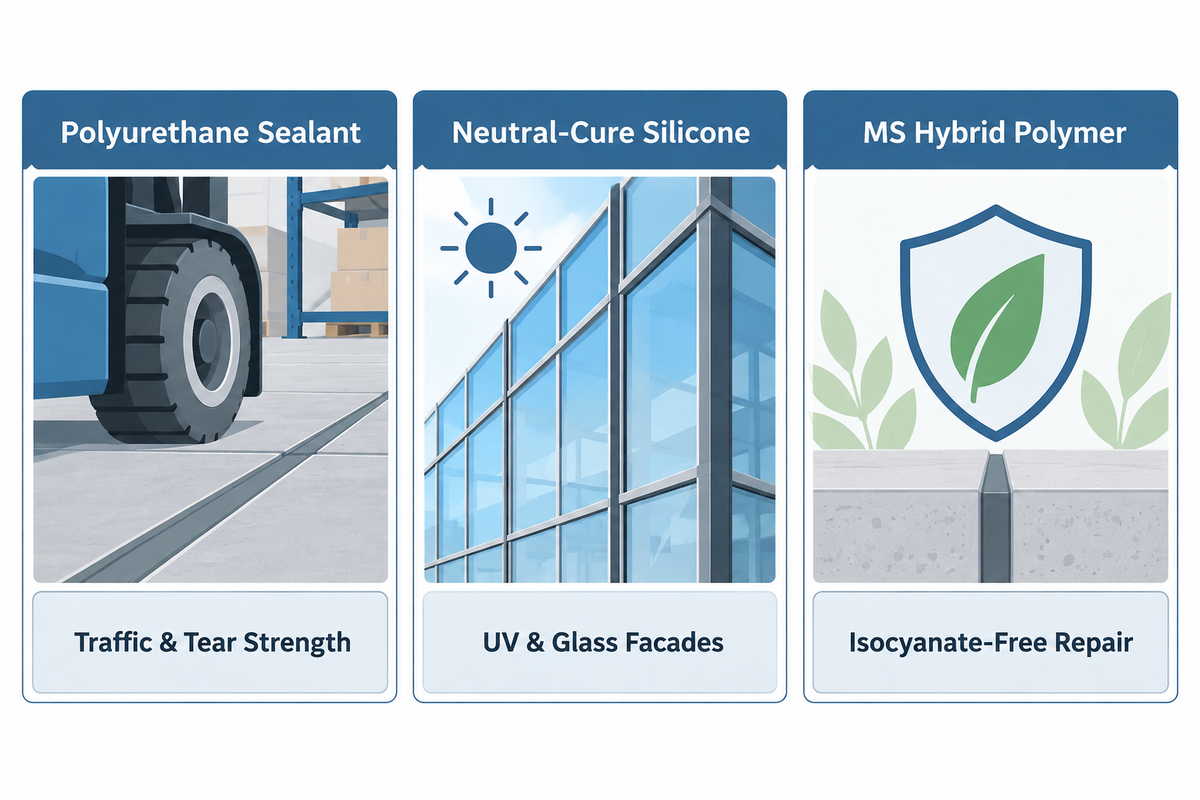
No single elastomer fits every building or industrial joint. When engineers compare polyurethane with silicone sealant or versatile silyl-modified polyether (MS hybrid polymer) options, four factors govern their selection. These are: tear strength under traffic, UV resistance, paintability, and isocyanate rules. For structural rigid-to-flexible bonding, see our structural epoxy vs MMA vs polyurethane adhesive comparison. For silicone cure behavior, see our silicone sealant skin-over and full cure timeline.
| Performance Criterion | Polyurethane Sealant (1K / 2K PU) | Neutral-Cure Silicone Sealant | MS Hybrid Polymer (SMP) |
|---|---|---|---|
| Polymer Backbone | Organic urethane / polyurea | Inorganic siloxane (Si–O–Si) | Silyl-terminated polyether |
| Typical Shore A Hardness | 20 to 50 (high puncture & traffic resistance) | Soft, low-stress facade cushion | Balanced modulus and wet grab |
| ASTM C920 Movement Class | Class 25 and higher traffic grades | High-movement facade glazing classes | Class 25 general facade and floor grades |
| UV & Weathering | Moderate; aromatic grades chalk in direct UV | Superior long-term UV and ozone stability | High UV stability; non-yellowing |
| Paintability | Paintable after cure; no free silicone oil | Not paintable; fluid bleed can stain stone | Paintable; verify coating compatibility |
| Isocyanate Regulatory Rule | Standard ≥0.1% wt (or <0.1% low-monomer) | Isocyanate-free chemistry | Isocyanate-free chemistry |
For heavy-duty pedestrian plazas, forklift aisles and parking decks, Polyurethane outperforms Silicone and hybrid MS polymer. It provides high tear strength and bulk two-component curing for joints under heavier reach-truck traffic. For exposure to chemicals or fuel, check the product data sheet and standard of the sealant. Hybrid MS polymer sealant is favored when crews want an isocyanate-free, low VOC one component sealant for damp facade repairs. Silicone-free polyurethane avoids contamination with silicone oil in the sealant. Even so, other migrating ingredients in the formulation can affect the final paint finish or stain porous stone.
Silicone remains the best option for glass curtain walls, skylights, and high-movement facades that are exposed to intense sunlight. The inorganic nature of the Si-O backbone allows it to withstand UV degradation much longer than aromatic polyurethanes which eventually chalk and require repainting.
Can You Paint Over Polyurethane Sealant or Apply It Over Old Silicone?
Yes, cured polyurethane sealant can be painted over with waterborne elastomeric acrylic, latex, or polyurethane topcoats. However, fresh polyurethane sealant won’t stick reliably over old silicone residue. Paint polyurethane sealant only after it reaches the manufacturer’s paint-ready condition. Full through-cure of polyurethane sealant depends on depth, formulation, temperature, and relative humidity.
Always let a 1K moisture-cure polyurethane finish outgassing before painting. Rigid alkyds and oil-based enamels won’t work on moving expansion joints. A brittle alkyd paint crust cracks as soon as the underlying Class 25 polyurethane stretches in winter.
If a joint previously held silicone caulk, simple solvent cleaning may leave residues that impair adhesion. Silicone oils can penetrate porous concrete and leave a film on metal surfaces. Repair crews must grind or saw-cut concrete joint walls back to expose clean aggregate. For metal frames, abrade and solvent-clean with the two-cloth method to prepare the surface, then apply the manufacturer’s recommended primer.
Industrial and Construction Applications: Concrete Expansion Joints, Marine Decks, and Automotive Seams
Polyurethane sealant is used across civil construction, commercial buildings, marine decks, and industrial OEM manufacturing to provide a waterproof and flexible seal.
- For warehouse floors and concrete expansion joints (Use T / Use M), use sealants to provide flexibility and accommodate movement.
- Precast concrete, brick masonry, and window perimeters (Use NT/ Use A) use non-sag Class 25 polyurethanes in gray, black, or white. Crews seal panel gaps and aluminum window or door frames before painting.
- Moisture-cure polyurethanes are used to bond marine teak decks and hull-to-deck beddings in fiberglass boats. Installers avoid portlights made of polycarbonate and ABS plastics that stress-crack.
- Polyurethane sealants are used to bond windshields, seal refrigerated trailer floors, and damp sheet-metal vibration.
- 300 mL (10.1 oz) cartridges are used to seal waterproof kitchen utility penetrations and trim masonry steps and siding (Repair work by DIY or professionals).
Why Does ASTM C920 Exclude Highway and Bridge Deck Joints?
ASTM C920-18 (2024) does not cover highways, airfields, and bridges.
A sealant classified under ASTM C920 can qualify for a highway or airport apron project only if it meets the project’s dedicated pavement sealant specification. Civil engineers govern horizontal pavement joints under three specialized material standards tied to distinct chemistries and installation methods:
- ASTM D6690 covers hot-applied joint and crack sealants heated in melter kettles for concrete and asphalt highways. It excludes fuel-spill areas and cold-applied 1K or 2K polyurethanes.
- ASTM D5893 / D5893M covers cold-applied, single-component, chemically curing silicone sealants for Portland cement concrete highways. It excludes fuel-spill areas.
- ASTM D7116 covers hot-applied jet-fuel-resistant joint sealants for Portland cement concrete pavements in airfield aprons and refueling pads.
Polyurethane Sealant Cure Time, Temperature Limits, and Skin-Over Mechanics
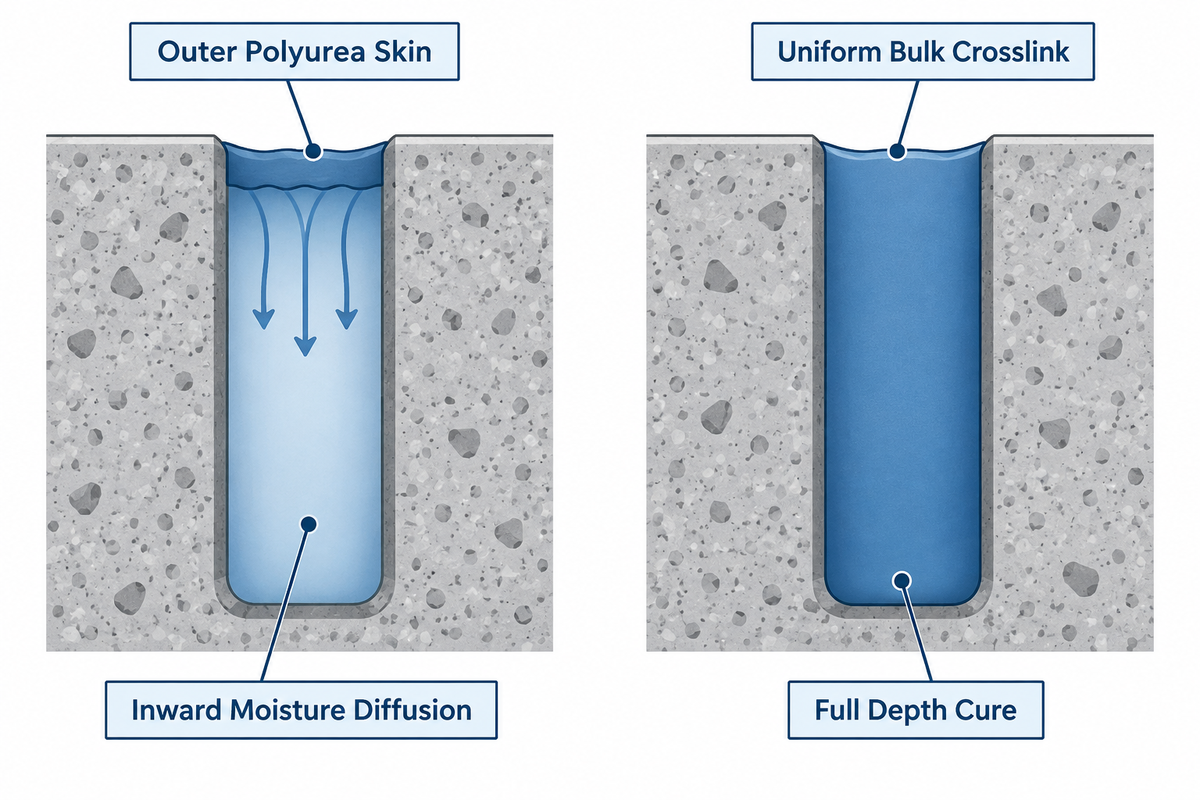
The curing mechanisms of 1K polyurethane and 2K polyurethane are polar opposites. Every stage of 1K polyurethane curing is dictated by ambient temperature and relative humidity. By contrast, 2K polyurethane curing is dictated by internal catalyst kinetics and thermal activation energy. Separating initial skin formation from full through-cure prevents crews from exposing fresh joints to washdowns, paint, or wheel traffic too soon.
At 23 °C and 50% RH, initial skin formation takes 60 to 180 minutes before inward curing proceeds. Inward curing then takes over. Low temperatures slow curing in both 1K and 2K polyurethanes, extending 1K tack-free and through-cure times when cold air holds little moisture vapor.
| Ambient Regime | 1K Skin Formation | 1K Depth Cure Rate | 2K Reactive-Cure Behavior |
|---|---|---|---|
| Cold & Dry Conditions | Extended skin-over window | Slower diffusion below 2 mm/24 h | Longer pot life; bulk cure without air moisture |
| Standard Lab (23 °C / 50% RH) | 60 to 180 minutes | 2 to 4 mm per 24 hours | Bulk crosslink throughout bead; working life measured per ISO 10364:2024 |
| Hot & Humid Conditions | Accelerated skin formation (CO₂ bubble risk) | Faster outer shell cure | Shorter nozzle working life; rapid gelation |
How Fast Does 1K Polyurethane Sealant Cure per Millimeter Compared to 2K Systems?
At 23 °C and 50% relative humidity, a 1K moisture-curing polyurethane sealant cures from the surface inward as moisture diffuses through the outer skin. Due to the harder, more dense rubber skin, the cure rate slows with time. By contrast, a 2K reactive polyurethane cures throughout the mixed bead, with full cure time depending on formulation, bead geometry, and temperature.
For two-component sealants, working life (pot life) is measured under standardized laboratory protocols. The revised ISO 10364:2024 standard defines multiple test methods that track viscosity rise, extrusion rate, or bond strength retention. Different test methods yield different working-life numbers on the same adhesive. On an automated line, nozzle pot life sets the maximum pause before purging or changing the mixing tip.
Worked Example, Reopening a Deep Plaza Expansion Joint: A crew repairs a 20 mm wide by 10 mm deep pedestrian plaza joint in cool autumn air. Because a 1K Grade P polyurethane relies on slow inward moisture diffusion, reaching full depth cure requires several days of barricade closure. Dispensing a 2K self-leveling polyurethane from a 600 mL dual cartridge achieves through-cure across the full 10 mm depth in hours.
Joint Geometry, Backer Rod Sizing, and Troubleshooting Adhesion or Cohesive Failure
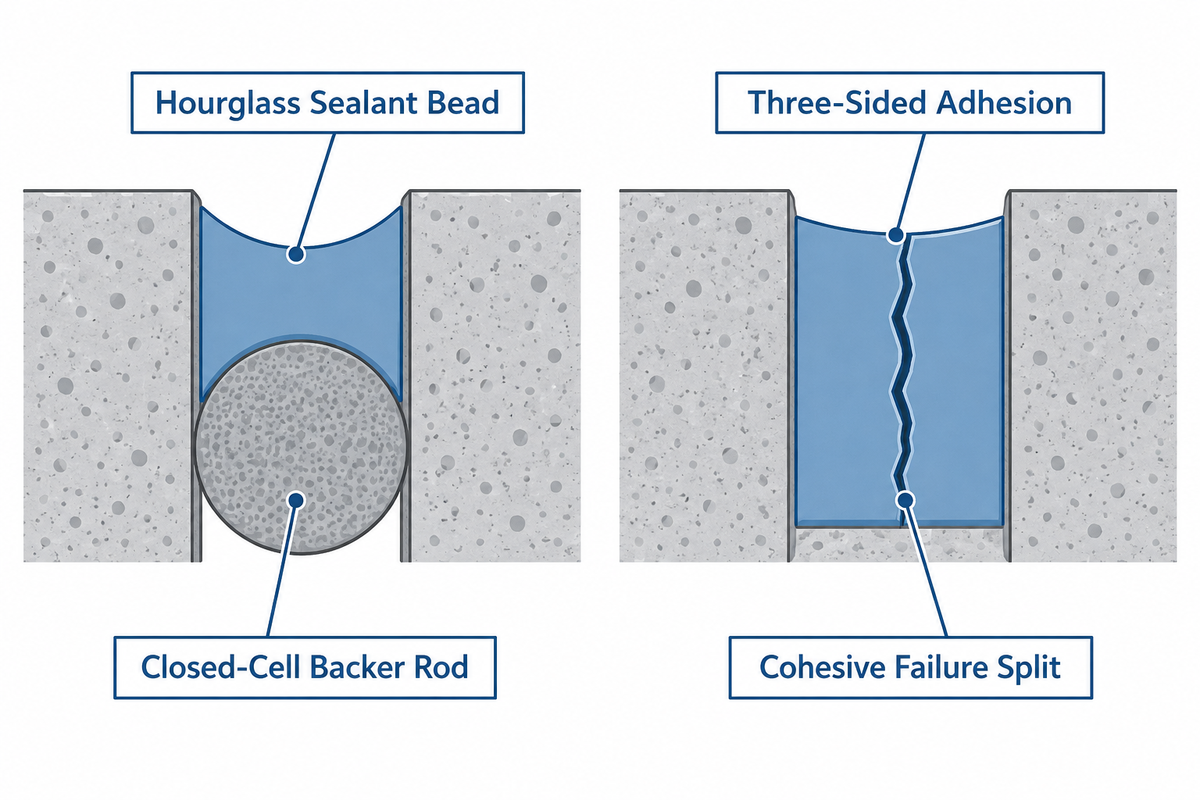
Even a high-movement polyurethane sealant will fail if installed with the wrong width-to-depth ratio or bonded on three sides. Elastomeric beads behave like rubber bands. A thin hourglass profile with wide walls stretches the joint and reduces peel stress. A thick square plug creates high tensile stress on the bond line.
As shown in backer rod guides from both Danterr and FoamNoodles, all moving joints require a polyethylene backer rod or bond-breaker tape at the bottom. Bonding wet polyurethane to the bottom of the channel and to both walls creates three-sided adhesion. That bottom face, locked in place, tears the elastomer during winter contraction cycles.
Backer rod material selection also protects 1K polyurethanes from bubbling. Closed-cell polyethylene rod repels water and is acceptable for horizontal slabs, as long as crews use a blunt roller tool that never punctures the rod skin. Open-cell foam rod won’t outgas if compressed; however, it must never sit in wet horizontal joints where it can trap water.
How Do You Size Joint Width-to-Depth Ratios Under ASTM C1193?
Under ASTM C1193 joint design guidelines, use a 1:1 width-to-depth ratio for narrow joints under 12 mm (1/2 in) wide. Use a 2:1 width-to-depth ratio for wider joints from 12 mm (1/2 in) to 25 mm (1 in) wide, subject to the manufacturer’s data sheet (ASTM C1193 §4.2). Selecting bead depth from the manufacturer’s joint-design guidance ensures an hourglass profile that flexes without overstressing the bond line.
For expansion joints wider than 25 mm (1 in), standard practice caps sealant depth at about 12 mm (1/2 in) unless the manufacturer specifies otherwise. Engineers calculate thermal panel movement (ΔL = α × L × ΔT) and apply an ASTM C1193 safety factor of 1.25 to 1.5 over the sealant’s movement class. Select a backer rod diameter wider than the joint slot so it stays firmly compressed during tooling.
ASTM C1193 §4.3–4.4 notes that joint sealants have a finite service life and require periodic inspection and replacement. When diagnosing field failures, engineers use ISO 10365 failure codes:
- Adhesive Failure (AF) happens when the bead peels off concrete, mortar, or metal walls. Some of the reasons are dust, laitance, form oil, and missing primer.
- Cohesive Failure (CF) is characterized by central splitting of the bead while maintaining bond to both walls. It’s caused by three-sided adhesion, or movement beyond the Class limit.
- Substrate Delamination (CSF) happens when mortar or EIFS or concrete spalls behind the bond line. At the same strain, a high-modulus (25HM) sealant transfers greater stress to joint edges than a low-modulus (25LM) grade.
Worked Example, Sizing a Precast Concrete Panel Joint: A 6 m precast concrete panel (α = 10 × 10⁻⁶ /°C) undergoes a 60 °C seasonal temperature swing, creating 3.6 mm of thermal movement. Applying a Class 25 (0.25) polyurethane sealant with a 1.35 safety factor requires a minimum width of W = (3.6 / 0.25) × 1.35 = 19.4 mm (rounded to 20 mm). At a 2:1 ratio, the crew installs a closed-cell backer rod to form a 20 mm wide by 10 mm deep bead.
What Is Changing in 2026: Low-Monomer Isocyanate Rules, VOC Deadlines, and Automated 2K Dispensing
Between 2024 and 2026, contractors and OEM plants face four major shifts in polyurethane sealant rules, testing, and dispensing. They cover low-monomer isocyanate limits, VOC and solvent deadlines, glass interlayer testing, and automated 2K cartridges:
- EU REACH Annex XVII Entry 74 requires EU industrial users to renew safety training every 5 years for mixtures with 0.1% wt or more monomeric diisocyanate. This mandate is detailed in DIC Global’s REACH compliance brief and USD Analytics’ 2026–2034 Polyurethane Sealants Market report. Formulators such as Sika (Sikaflex® Purform®) are shifting to ultra-low-monomer (<0.1% wt) prepolymers.
- In Southern California, South Coast AQMD Rule 1168 establishes architectural sealant VOC limits (250 g/L for standard architectural sealants, and other limits for clear paintable categories). Separately, Rule 1171 regulates solvent cleaning: cleanup blends containing t-BAc or pCBtF made before January 1, 2026 face a January 1, 2027 sell-through cutoff and a July 1, 2028 use cutoff.
- As reported by USGlass Magazine, the newly developed ASTM C1956-25 test method assesses the migration of plasticizers and by-products between glazing sealants and laminated safety glass interlayers.
- As plants begin to use two-component reactive polyurethanes (Adhesives & Sealants Industry), automated equipment begins to package sealants in dual side-by-side cartridges as opposed to open drums.
In North American and European construction, formulated polyurethane sealant suppliers cited in regulatory and market briefs include Sika (Sikaflex®). No single brand is best for every joint, so specifiers match ASTM C920 or EN 15651-1 test data to project requirements. For adhesive formulators and assembly lines needing 2K packaging and mixing hardware, Ebestron manufactures 2K side-by-side cartridges from 50 mL to 1500 mL. Available ratios include 1:1, 2:1, 4:1, and 10:1 in PP, PA, and PBT resins. Ebestron also supplies disposable static mixing tubes (12 to 24 elements, 5.4 mm and 6.3 mm outlets) and 2K polyurethane dynamic mixing nozzles and applicators. These dynamic nozzles feature 6.3 mm to 8 mm outlets, run at 2,500 to 12,000 RPM, and fit 3M™ Dynamic Mixing System 05847 red and 55847 purple interfaces. Custom cartridge resin validation, piston O-ring selection, and bulk OEM packaging require a direct engineering quote.
Frequently Asked Questions (FAQ)
What solvent removes uncured vs fully cured polyurethane sealant from metal and masonry?
Isopropyl alcohol (IPA), xylene, or mineral spirits dissolve uncured polyurethane sealant from tools and other non-porous metal surfaces prior to crosslinking. Once polyurethane cures to thermoset rubber, solvents may soften or swell it, but removal generally requires cutting, wire brushing, or scraping.
Use the two-cloth wiping method when removing wet paste from a joint margin to easily remove prepolymer from the surface. Flooding a concrete wall with mineral spirits, then gunning sealant, traps mineral spirits behind the wall, and primers won’t adhere to the wall. In areas governed by South Coast AQMD Rule 1171, verify that cleanup solvents don’t contain restricted t-BAc or pCBtF, prior to the 2027-2028 phase out dates.
What is the shelf life of unopened 1K and 2K polyurethane sealant cartridges and how do you spot moisture-compromised stock?
Unopened 1K and 2K polyurethane sealant cartridges must be used within the shelf-life window printed on the manufacturer’s lot label when stored in cool, dry conditions. Separated dual cartridges help isolate the polyol and isocyanate components inside thick PP, PA, or PBT barrels during storage.
Prior to gunning a joint, test 1K stock by piercing the nozzle membrane and extruding a short test bead. A stuck plunger may also be caused by a mechanical problem, so these symptoms alone do not locate a moisture leak. On 2K dual cartridges, check the outlet ports for white crystalline urea crusts on the Part B isocyanate side. Always purge initial material according to cartridge and mixer instructions prior to gunning into the joint.
How do you calculate how many 300 mL cartridges or 600 mL foil sausages a concrete expansion joint project requires?
To get the milliliters of sealant per linear meter, multiply joint width by depth in millimeters, then add 12% for waste. Divide the total milliliters required by the project by 300 mL per standard cartridge or 600 mL per foil sausage, and round up to whole packs.
For example, a 12 mm wide by 6 mm deep slab expansion joint (assuming a product permitting a 2:1 profile) uses 12 × 6 = 72 mL of polyurethane per linear meter. A 100 m run needs 7,200 mL net volume, or 8,064 mL after adding 12% for tooling and nozzle hold-up waste. That requires 27 standard 300 mL (10.1 US fl oz) cartridges or 14 foil sausages (600 mL), rounding up to whole packs. Compared with 300 mL cartridges, 600 mL sausages require half as many packs for the same nominal volume, and 1500 mL 2K cartridges require even fewer.
Is cured polyurethane sealant safe for submerged potable water tanks or food-contact joints?
No, standard construction polyurethane sealants cannot be used in potable water immersion or direct food contact. Drinking-water tanks require NSF/ANSI/CAN 61 and ASTM C920 Use I grades, while food-contact seams require FDA 21 CFR 175.300 compliance.
Why does polyurethane sealant stay tacky for days in cold weather?
Low temperatures slow both 1K and 2K curing, though 2K systems crosslink without atmospheric moisture. 2K systems, however, crosslink even in the absence of moisture. Cold air holds little moisture vapor, so 1K polyurethane stays tacky in cold weather.
References & Sources
- U.S. Occupational Safety and Health Administration (OSHA): Green Job Hazards: Weatherization – Chemical Hazards (Polyurethane Sealants & MDI/TDI 0.02 ppm PEL).
- U.S. Occupational Safety and Health Administration (OSHA): Isocyanates, Safety and Health Topics.
- South Coast Air Quality Management District (SCAQMD): Rule 1168 Adhesive and Sealant Applications & Rule 1171 Solvent Cleaning Compliance Framework.
- International Organization for Standardization (ISO): ISO 10364:2024 Structural Adhesives, Determination of the Working Life (Pot Life) of Multi-Component Adhesives.
- US Made Supply Technical Reference: ASTM C920-18 (2024) Standard Specification for Elastomeric Joint Sealants.
- Siway Sealants Standards Reference: EN 15651-1, ISO 11600 (25LM / 25HM), and ASTM C920 Modulus & Movement Classification.
- Adhesives & Sealants Industry (ASI): The Next Generation of Static Mixing Nozzles (19.1 mL to 5.0 mL Waste Reduction Study).
- Adhesives & Sealants Industry (ASI): Moisture-Cure Polyurethane Adhesives: Reaction Mechanism and CO₂ Release.
- Adhesives & Sealants Industry (ASI): Meter-Mix Dispensing for Polyurethane Elastomers.
- USGlass Magazine: When Sealants Meet Interlayers: ASTM C1956-25 Test Method Overview.
- DIC Global Regulatory Technical Brief: Understanding the Restriction of Diisocyanates Under EU REACH Annex XVII.
- USD Analytics Market Research: Polyurethane Sealants Market Growth Outlook (2026 – 2034) & Ultra-Low Monomer Adoption.
- Google Patents (USPTO / EPO): US20180251590A1 and EP3020744A1 Two-Component Polyurethane Static and Dynamic Mixing Systems.