
Get in touch with Ebestron Company


By CYH · Updated October 2026
The driven element of the 2K Polyurethane Dynamic Mixing system combines two independently supplied components before application. The mixer affects distribution of the mixture; the metering system determines the amount of each component delivered. Good results require correct metering and mixing, a proper cure schedule and an acceptance test.
An irregular bead, a soft casting, and a foamed gasket all present questions. This guide explains how to decipher the resin data, pick a relevant comparison, and determine what a trial actually proves. It explains the use of manufacturing applications for industrial adhesives, potting compounds and formed-in-place gaskets. Paint spray and woodworking finish instructions are related to the different coating process.
Candidates for the hardware after the material requirements are clear are discussed in the 2K Polyurethane Dynamic Mixing section. The guide below addresses the material and testing needs for that section.
Quick specification check: identify the exact material grade, confirm the delivered ratio, then compare samples under matched conditions. Judge the cured application as well as the freshly dispensed bead.
2K Polyurethane Chemistry and the Mixer’s Job
2K urethane processing brings reactive materials together in a specific ratio and distributes them before the mixture becomes too viscous to use. It cannot supply a missing component, reverse moisture contamination or turn an unsuitable formulation into the right material for a joint.
How Does 2K Polyurethane Dynamic Mixing Work?
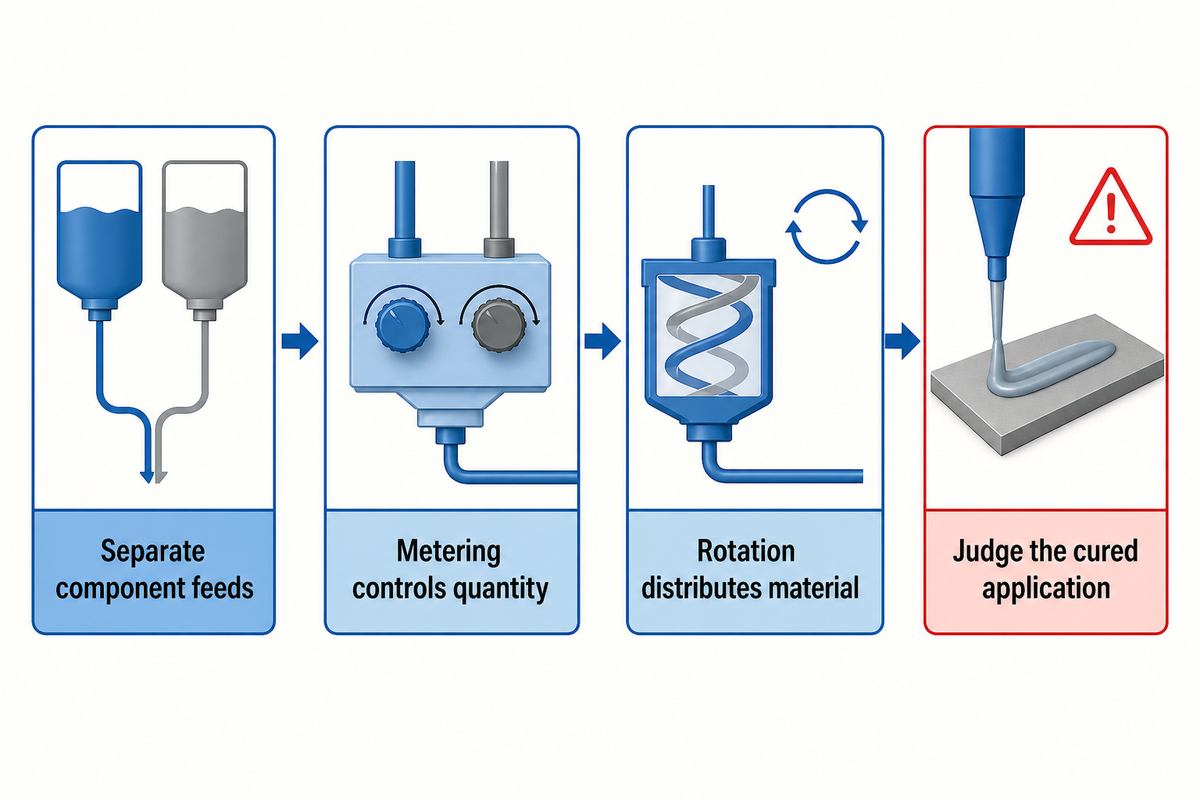
Different feeds are directed to a chamber that has a rotating element. The element distributes the streams of material while mixed material is ejected. The quantity of component delivered upstream is controlled by a metering system. The mixing head works on the material it receives. The final test is if the delivered mixture cures and performs in the intended application.
In common polyurethane chemistry, hydroxyl groups react with isocyanate groups, as described in OSHA’s isocyanates overview. Commercial formulations may also include fillers, pigments, and additives. While component labels may appear similar, assume nothing. Their component labels are supplier-specific: do not assume that every “Part A” is the same chemical family, or that a hardener is merely an optional catalyst.
David Mandeville’s meter-mix dispensing article separates ratio and flow control from mixing technology. That distinction matters when troubleshooting: increasing rotor speed can’t correct a feed system delivering the wrong proportions. Our general 2K dynamic mixing guide covers the wider equipment architecture and sampling sequence.
Resin and Hardener Data That Define the Mix
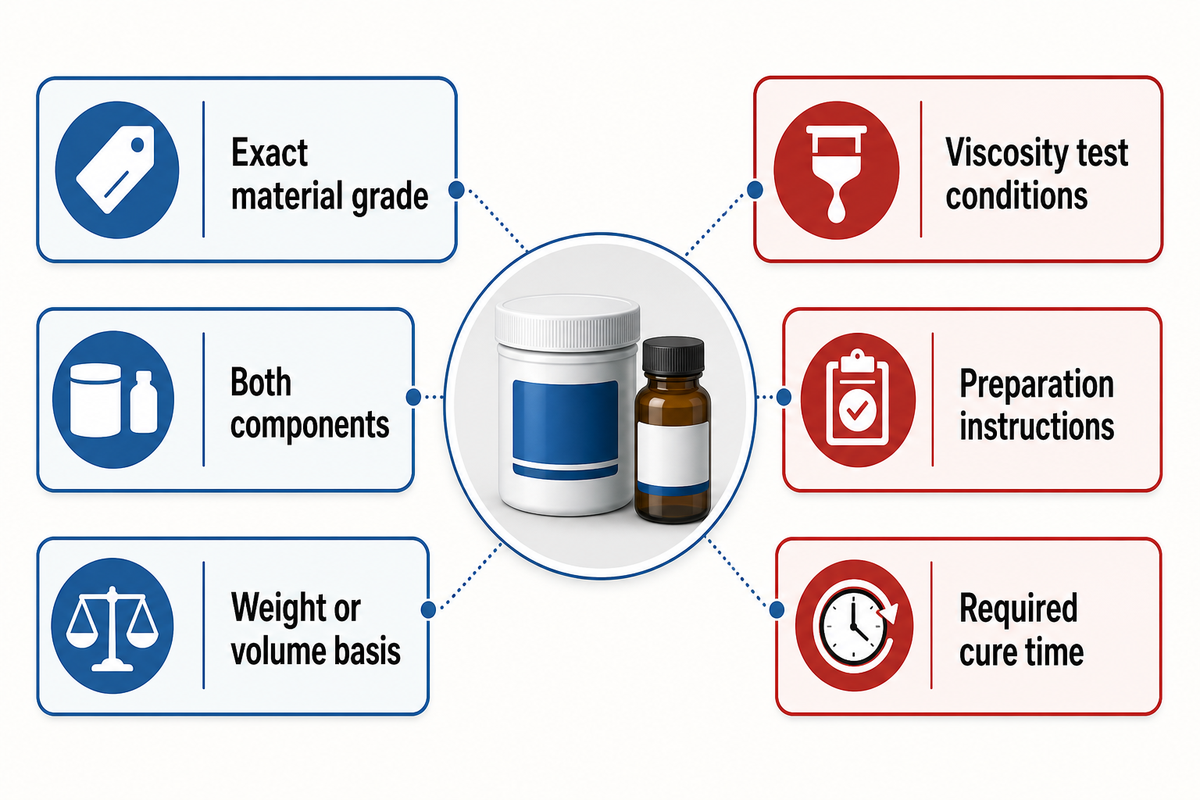
A good polyurethane material specification provides both components, the ratio basis, the conditions under which viscosity measurements are made, preparation instructions, and the time required for complete cure. All of this information is useful, and a viscosity specification alone isn’t enough. Read the exact grade specification and test conditions before selecting cartridges and judging nozzle sizes, because materials with the same polyurethane name may require different handling.
What Mixing Ratio Does a 2K Polyurethane Need?
Use the ratio prescribed for the exact two-component formulation, including whether it is by weight or by volume. These ratios aren’t interchangeable when component densities differ. The supplier’s component order (A:B and B:A) also needs to be preserved. A cartridge’s nominal ratio must match the intended dispensing arrangement.
| Published item | SikaForce-710 L100 | SikaForce-646 L2 F |
|---|---|---|
| Document used | Singapore sheet, April 2026 | Germany sheet, August 2025 |
| A:B ratio by volume | 100:25 | 100:42 |
| A:B ratio by weight | 100:19 | 100:35 |
| Component A density | 1.64 kg/L | 1.47 g/cm³ |
| Component B density | 1.23 kg/L | 1.23 g/cm³ |
| Component A viscosity | 22,000 mPa·s | 4,500 mPa·s |
| Component B viscosity | 300 mPa·s | 300 mPa·s |
| Mixed viscosity | 10,000 mPa·s | 3,400 mPa·s |
| Pot life, CQP536-3 | 100 minutes | 2 minutes |
| Open time | 135 minutes (CQP526-3) | 4 minutes (CQP590-3) |
| Listed test conditions | 23°C and 50% relative humidity | 23°C |
| Application distinction | Two-component panel-bonding adhesive | Foaming panel adhesive for continuous lines |
Values as listed are in Sika’s product data sheets. These values illustrate separate formulations, not competing mixer performance. Keep each value attached to its grade and test conditions; a 100-minute pot life does not establish a 100-minute pause allowance inside a mixing head.
The formulation determines the molecular balance between the reactive components. ASTM D4274-23 identifies hydroxyl content as information needed to formulate polyurethane systems. That is a reason to preserve a supplied kit’s ratio, not an invitation to alter it on the line. For viscosity, ASTM D4878-23 distinguishes test methods and states a temperature; comparing numbers without those details can mislead equipment selection.
Consider a hypothetical line change between the two grades in the table. Keeping the previous ratio while changing only the nozzle would invalidate the trial before mixing quality was assessed. Procurement needs the new grade documents; production needs the matching metering setup; quality needs the correct cure interval. The shorter pot life of the second grade changes trial scheduling; the longer working time of the first can’t be carried over.
Record required component pre-stirring and storage conditions, as well as how sediment should be handled. Follow the grade instructions. Component prep can introduce air. Check adhesive cartridge selection separately from the geometry of the mixing element: capacity, ratio and connection are different specifications. The two specify different things.
Static or Dynamic Mixing for This Polyurethane?
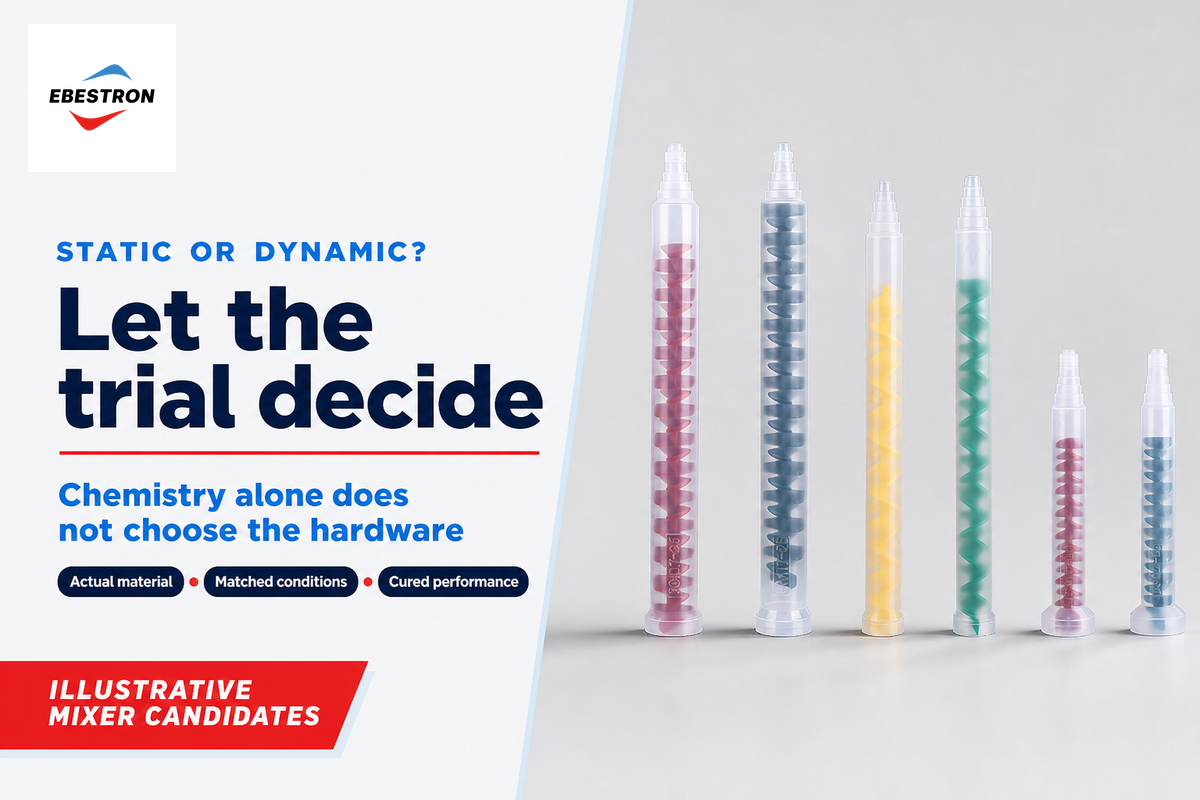
Dynamic mixing is justified if a trial shows that the powered head solves a material distribution problem. A polyurethane label by itself doesn’t show that need. Static mixers remain a workable choice for many two-component systems, while dynamic equipment adds a drive, operating settings and maintenance tasks that must earn their place.
A large viscosity difference between the two components, fillers or difficult flow behavior can justify a powered mixing trial. Keep the actual resin, temperature, flow and specimen constant when comparing candidates. Measure cured performance rather than select fresh beads for a more uniform appearance.
Christian Dixon’s 2021 university study of polyurethane static mixing is a useful limit on simplistic shear claims. Dixon compared static geometries and batch mixing, and reaction development didn’t follow the “more shear is always better” rule. Dixon’s study didn’t test an Ebestron dynamic head, so its findings can’t rank products with that dynamic head.
For a hypothetical potting cell meeting void and cured-property requirements, a dynamic upgrade needs a defined benefit: a wider acceptable flow range, fewer rejected parts, etc. Purchasing a motor because the material is “high performance” adds cost without defining success. For broader trade-off analysis between static and dynamic mixing, see the comparison for equipment.
Moisture Bubbles, Entrained Air and Intended Foam
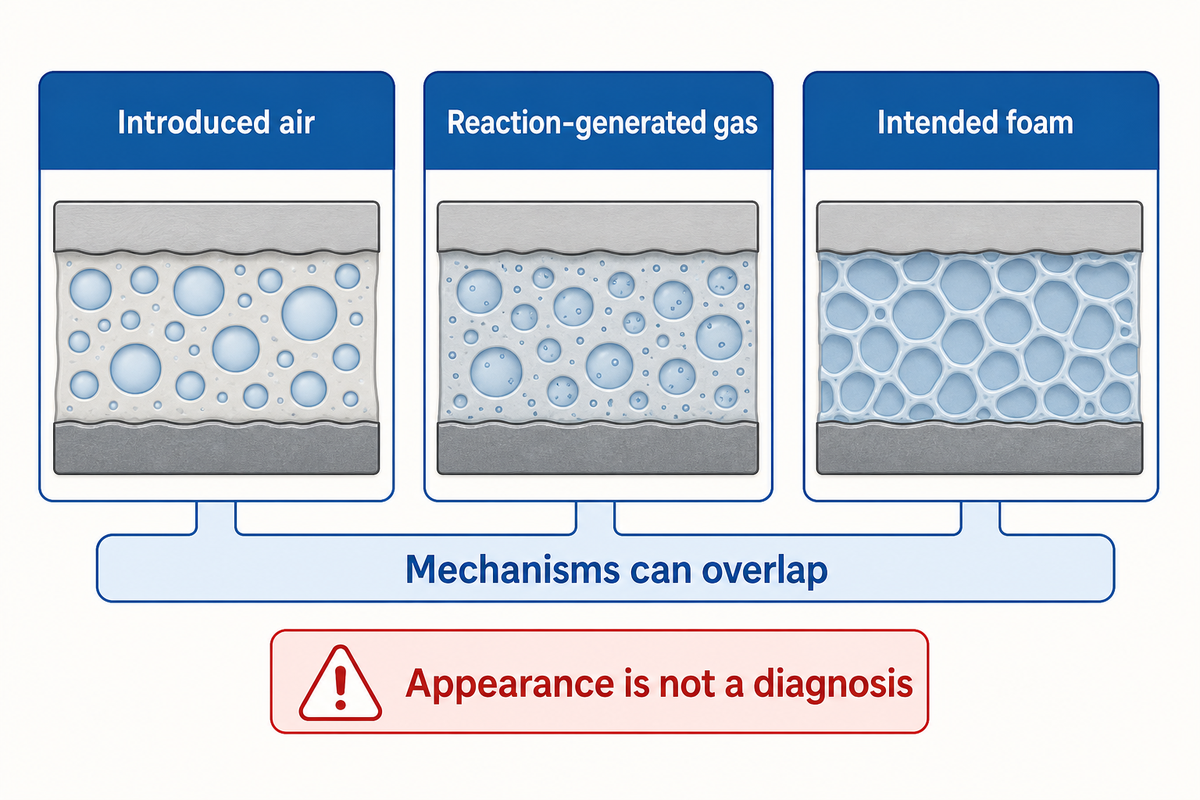
Gas in polyurethane can be from introduced air, chemical reaction, or a foaming formulation. In the presence of gas, determining the reason requires analysis beyond apparent bubbles. First, ensure you understand the application and determine the solid product or structure requirements. Was a solid bondline or casting required? If so, the question becomes how did gas get involved? Was controlled gas structure required for the application?
Air can be introduced during component preparation, transfer or mixing. Moisture can participate in a reaction with isocyanates to generate carbon dioxide. In either case, if the intended solid is to be a dense product, the voids would be undesirable. For a foam gasket, gas generation is required. The question becomes, are the cell structure and gasket dimensions sufficient to meet the application requirements?
A 2022 study by Brondi and colleagues shows why the categories aren’t exclusive. In the water-blown foam they studied, entrained air bubbles later grew as carbon dioxide, a reaction product, diffused into them. The experiment supports coupled mechanisms; laboratory mixing speeds aren’t settings for an industrial nozzle.
Visualize a clear potting sample that improves after reducing rotor speed. Improvement could mean less air is incorporated, a different mixing history, or a change in the reaction. A clear potting sample, by itself, doesn’t demonstrate the original material was dry and properly proportioned. Retain samples from both conditions. Compare the cure of both samples at the same interval. Inspect how the component is handled. A visually improved sample that’s still soft hasn’t passed.
In the published SikaForce-646 L2 F instructions, there’s a useful application contrast. This panel adhesive is foaming by design. Every visible cell shouldn’t be assumed a mixing failure. Also, a foaming result doesn’t define what’s an acceptable electrical potting compound.
When the separate two-part cartridge operating guide is consulted alongside the material and equipment instructions for cartridge-fed tests, keep observations of unexpected voids separate from conclusions. Note where bubbles are initially formed, whether they develop after dispensing, and if the same occurs with a supplier-recommended reference sample. Record the material lot, component condition and sample timing. These records provide the material supplier with something more than a picture labeled “bad mix.”
Pot Life, Temperature and Material Residence
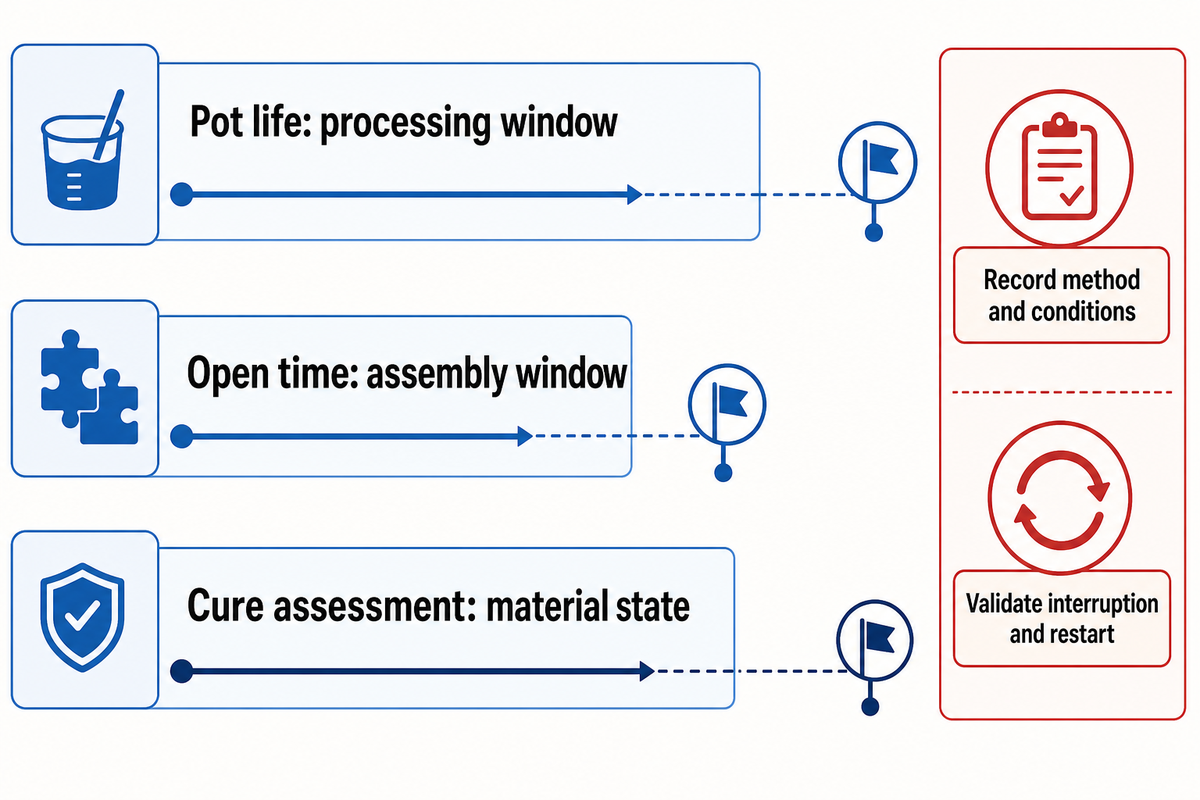
Pot life refers to the time during which the mixture is workable under defined conditions. It isn’t always the time for which a reactive mixture can be kept idle in a head. There are other factors like temperature of the mixture, quantity of mixture, end point of test etc. These factors affect interpretation of the pot-life measurement. To carry out tests, we have to plan for pot life and establish the behavior of interruption and restart for equipment and application.
“The different methods described in this document to measure the property do not necessarily provide identical results.”
Keep pot life, open time, and the time to assess cured properties in separate fields. Pot life is a processing window under a specified method. Open time is the available time to assemble components. The time to assess cured properties is the time to assess the state of the material at the end of the curing process. Substituting one for the other can lead to a premature assessment of a sample.
The two Sika examples provide both pot life and open time. Since the values are different, a distinction is made. However, the data sheets don’t provide a universal pause limit for every nozzle. The history of a mixed material confined to a restricted space differs from that of a thin bondline, and reaction heat can change that history further.
To carry out a trial, note the actual temperature of the material, ambient conditions, quantity of mixture, dispensing duration and each pause. Start the cure timer in a consistent manner. Reach an agreement with the material supplier and equipment integrator regarding the interruption and restart procedure before fixing a production pause based on a pot-life figure. The pot-life and pressure planning tool is a separate planning aid, and its output can’t replace a grade-specific trial.
ISO 10364:2024 was listed as published when checked in October 2026, with a draft successor under development. Record the method and edition on the trial report. A draft revision does not indicate that the current method has been withdrawn or that the mixing equipment must be replaced.
Rotor Speed and Flow: Validate a Polyurethane Window
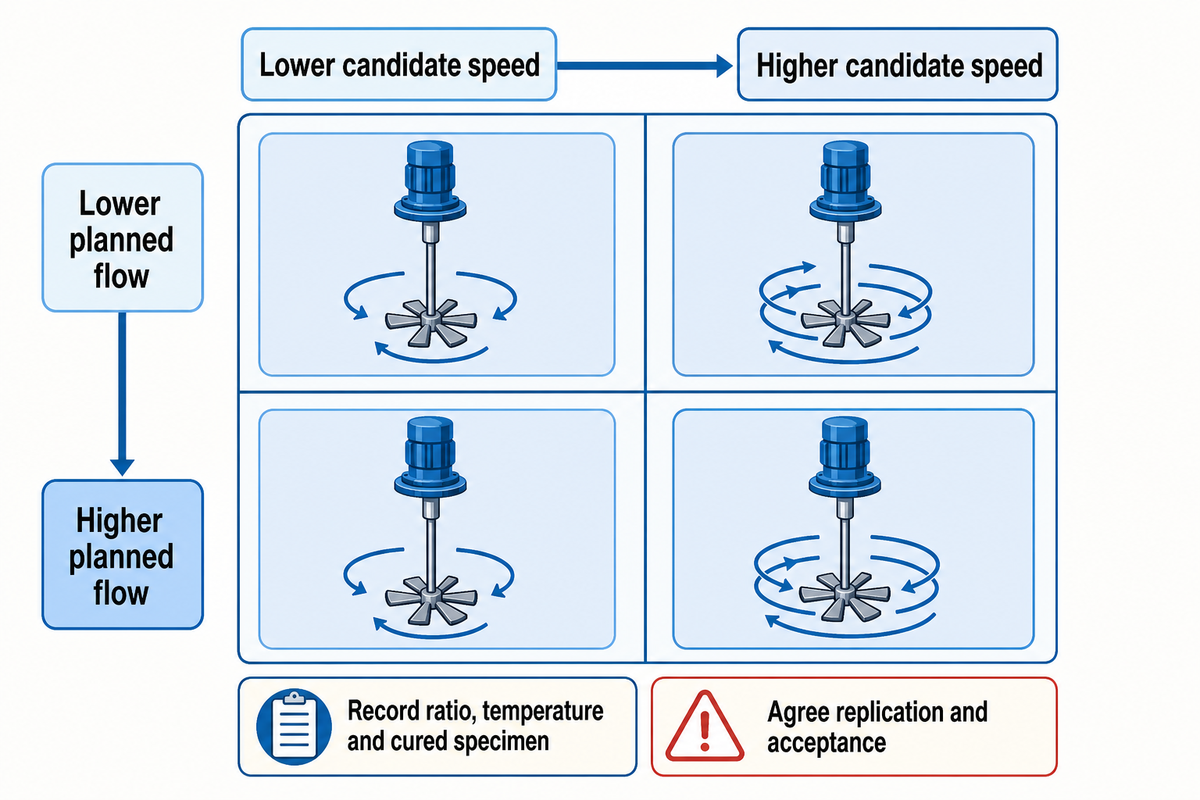
Flow and rotor speed must be assessed together, as the time material spends in the chamber changes with the process conditions. A tested condition is established with a satisfactory sample at a given flow and rotor speed. A production window requires evidence across all the conditions the line will use, including planned interruptions and stoppages.
Begin with the permitted ranges of the material supplier and equipment maker. Pick trial conditions representing the intended line and not copying a speed from another mixer. Record the head geometry, the actual flow, the setting of the rotor, the temperature of the material, the ratio delivered and the identification of the specimen in order to reproduce the result.
| Trial cell | Flow condition | Rotor condition | Evidence to retain |
|---|---|---|---|
| A | Lower planned flow | Lower candidate speed | Ratio result, temperature, cured specimen |
| B | Lower planned flow | Higher candidate speed | Same measurements and cure interval |
| C | Higher planned flow | Lower candidate speed | Same measurements and cure interval |
| D | Higher planned flow | Higher candidate speed | Same measurements and cure interval |
By “higher” and “lower” are meant values within the permitted candidate range, which are recorded numerically in the trial sheet. As stated in the NIST discussion of one-factor-at-a-time experiments, changing factors individually may omit interactions. This design is a preliminary layout for qualification, and not a claim that four samples establish statistical confidence; agree replication and acceptance before testing.
In foaming service, agitation may change the inclusion of air and the development of the reaction. At a different flow, a speed that previously worked well may result in an unacceptable product. Don’t improve appearance while letting the ratio or temperature drift. An acceptable region must comply with all the agreed to criteria for the product, not just the result that looks best.
For the plant manager, the useful outcome is defining an operating range and a response when the line is out of the range. For finance, it is the effect on accepted production and interruptions.
Soft Cure and Streaks: Run Paired Comparisons
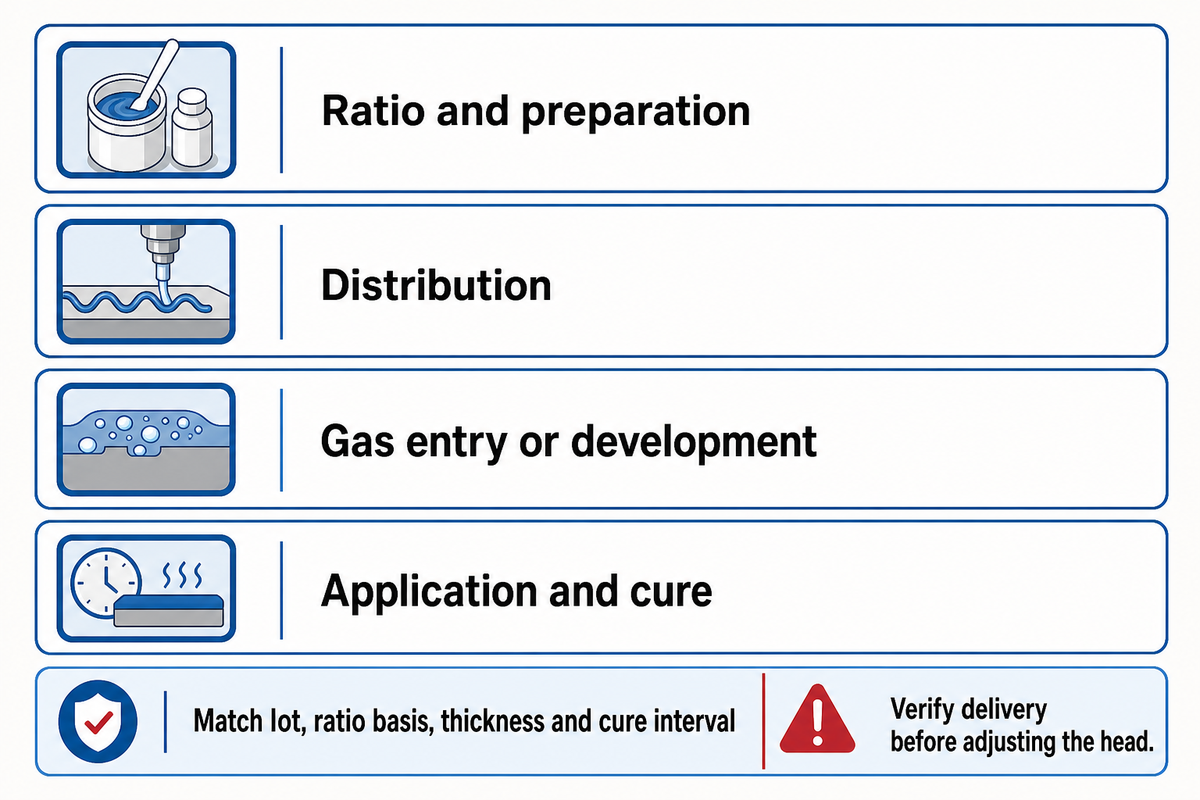
Soft cure and streaks are symptoms, not unique diagnoses, and require an examination of multiple aspects of the material preparation, delivered ratio, mixing, and the application effect. The four branches below may overlap: an improvement to a sample often narrows the scope of the investigation. However, that doesn’t indicate that all of the possible causes have been eliminated.
| Investigation branch | Matched comparison | Record | Next action |
|---|---|---|---|
| Ratio and preparation | Suspect output versus verified component delivery; same material lot and temperature | Actual A:B basis, delivery result, component preparation | Resolve delivery or material-preparation discrepancy before comparing mixer designs |
| Distribution | Approved reference preparation versus machine output at matched ratio and cure conditions | Streak pattern and agreed cured-property result | Investigate head geometry and operating settings when the machine result differs |
| Gas entry or development | Controlled handling condition versus the suspect handling condition | Void development over time, component condition, cured sample | Review air entry and moisture pathways together; do not diagnose gas from appearance alone |
| Application and cure | Comparable specimens with the intended substrate, geometry and cure interval | Bondline or casting dimensions, timing, substrate preparation | Correct the application comparison before attributing failure to the nozzle |
The NIST definition of paired observations requires a meaningful correspondence between measurements. In practical comparisons of samples, keep the shared conditions and material the same and identify the factor being examined. Poor evidence to support a nozzle decision may be provided by batch preparations done at different temperatures and aged differently.
Consider a machine-dispensed adhesive that remains soft and a supplier-approved reference preparation that cures as expected. If both specimens used the same lot, ratio basis, thickness and cure interval, the difference supports investigating delivery and mixing. It still doesn’t distinguish an inaccurate delivery from inadequate distribution. Before an adjustment is made to the head, component delivery should be verified.
When sampling, follow the material safety data sheets and site exposure controls, including protection against contact with uncured material. The effects of exposure to uncured material during sampling should be prevented in accordance with an agreed trial procedure. A visually quiet dispensing process doesn’t eliminate handling exposure.
Appoint an owner to each unresolved branch. The material supplier addresses formulation and preparation; the equipment integrator addresses delivery and operating behavior; the nozzle supplier addresses mixing component and fit. Quality retains the comparison samples and acceptance record. Therefore, a failed trial makes for a good decision point, as opposed to a cycle of unrecorded nozzle substitutions.
Application Acceptance: Bondlines, Potting and Gaskets
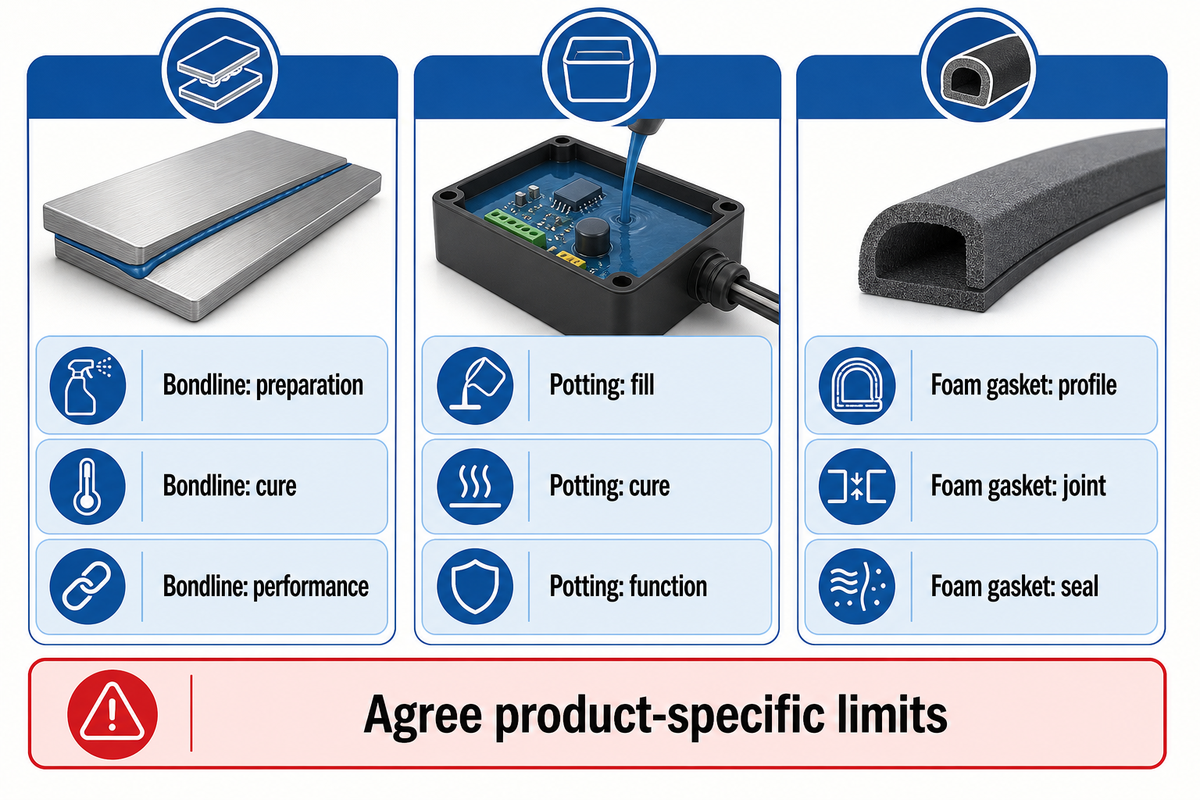
A mixed polyurethane passes when the finished application meets its agreed requirements. Bondlines, potting and foam gaskets require different specimens and measurements because they perform different functions. Define those requirements and establish acceptance criteria for defects prior to the mixer trial. During the trial, observe any defects and connect them to consequences and a release decision.
| Application category | Representative specimen | What to assess | Release decision |
|---|---|---|---|
| Bondline, preparation | Actual adherends and approved surface preparation | Compatibility, including any specified primer | Reject comparisons with different preparation |
| Bondline, cure | Joint made at the intended bondline thickness | Cure at the agreed interval | Assess only after the specified cure |
| Bondline, performance | Joint specimen under relevant conditioning | Required mechanical performance | Accept against the agreed joint requirement |
| Potting, fill | Representative enclosure and compatible plastic housing, if used | Complete fill and void distribution | Compare the agreed void and fill criteria |
| Potting, cure | Representative casting depth and component arrangement | Cure throughout the representative specimen | Reject a surface-only cure assessment |
| Potting, function | Cured assembly representative of the product | Required electrical insulation or optical properties | Confirm function rather than appearance alone |
| Foam gasket, profile | Representative contour | Bead dimensions and cell structure | Accept against the agreed profile requirement |
| Foam gasket, joint | Start/end overlap on the intended surface | Continuity and adhesion | Reject an untested start/end junction |
| Foam gasket, seal | Formed seal under intended assembly conditions | Required sealing behavior | Production and quality approve the application result |
For a metal bondline, ASTM D1002-10(2019) states a comparative single-lap test method. Public advisory notes for the test caution against using apparent shear results from the test as design-allowable stresses for structural joints. A lap specimen is useful evidence when its scope matches the question; it is not a universal certificate for potting or foam sealing.
Public application examples vary significantly. An optically clear potting resin is sold for the clear encapsulation of LEDs, while formed-in-place polyurethane foam develops its cellular structure along a contour. Neither example can serve as a complete acceptance criterion for the other.
Imagine a buyer looking at two trial samples for a gasket project. One has a smooth visible bead; the other has documented results on the intended contour, including start/end joint. The first sample may appear better, but the buyer still has the release question. Procurement should request the missing application test. The nozzle price of the first sample can’t be considered the lower cost qualified sample until the application test is performed. Finance can compare accepted output only after both candidates meet the same requirement.
For chemical resistance, abrasion, durability, or exterior, ultraviolet (UV) exposure, define the service condition and material test with the supplier. A claim of “excellent resistance” is required to state the exposure condition and test result. A mixer cannot create an unformulated property, and a successful room-temperature cure does not establish long-term resistance. Production can’t repeat the approved result unless the evidence and criteria have been approved and recorded.
Supplier Handoff: Keep Chemistry and Hardware Decisions Together
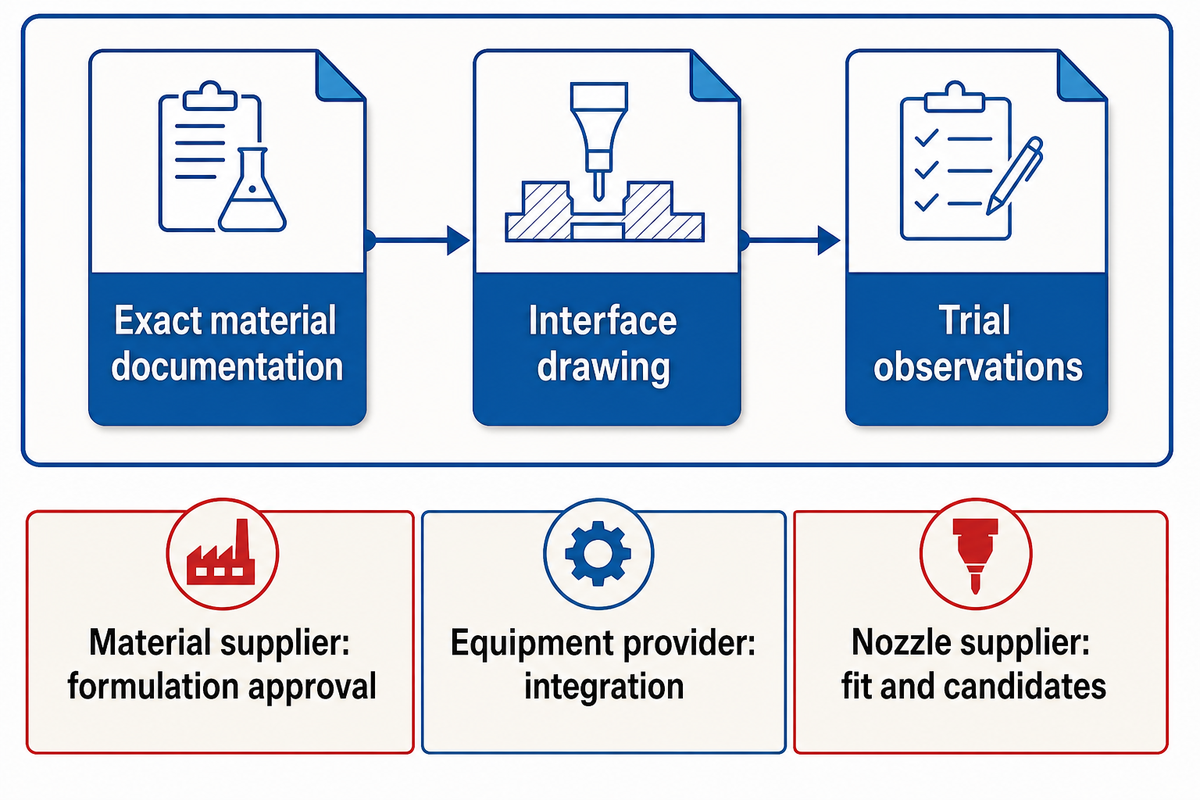
A useful supplier handoff connects the exact polyurethane grade with the delivery system, mix head and expected finished outcome. Send material documentation and trial observations together. A request that only identifies “2K polyurethane” leaves the supplier to speculate on the grade and its properties, the connection fit, and what the customer considers a successful outcome.
Include component identities, ratio basis, viscosity conditions, preparation instructions, planned flow, interruption pattern and representative specimen requirements. Add an interface drawing and the machinery drive arrangement. The nozzle interface types help organize the connection discussion; a matching capacity or ratio doesn’t establish mechanical interchangeability.
Ebestron offers a line of mixing-nozzle and applicator products. Use the material and acceptance criteria to assess possible product candidates. Keep formulation approval with the materials supplier and system integration with the equipment provider.
For existing assemblies, the mixer fitment finder helps organize interface questions; verify the drawing with the supplier before placing an order. The most useful next step is a documented trial request: the defect to be corrected, the conditions to be reproduced and the measurement to be taken that will tell if the trial was successful.
Frequently Asked Questions
Can a dynamic mixer correct an incorrect polyurethane ratio?
A dynamic mixer cannot replace a missing quantity of either component.
Check the delivered quantities using the material supplier’s specified ratio basis and the equipment’s approved measurement procedure. Keep component order explicit and distinguish mass from volume. Once delivery is correct, a comparison can examine distribution within the mixture. Changing rotor speed while leaving a ratio error in place doesn’t establish whether the nozzle is suitable, even when the bead becomes more uniform.
Why can polyurethane remain soft even when its color looks uniform?
Uniform color does not prove that a polyurethane mixture has the right ratio or has completed its required cure.
Compare the actual component delivery, material preparation, temperature and elapsed cure time with the grade instructions. Use a representative specimen and an agreed cured-property test. Color can help reveal gross streaking, but pigments and additives can obscure differences in composition. A matched reference preparation can narrow the investigation; its result doesn’t identify a single root cause without checking the other changed conditions.
Is the pot life on the datasheet the maximum pause time?
Published pot life is not automatically an allowable pause inside a mixing head.
Read the test method and conditions attached to the value, then distinguish that measurement from the equipment’s actual material history. A confined mixed volume, a thin bondline and a laboratory sample need not develop in the same way. Agree interruption and restart procedures for the grade and head, and assess the restarted output against the intended application rather than relying on the clock alone.
Does every two-component polyurethane require dynamic mixing?
Many two-component polyurethanes can use a suitable static mixer.
Choose powered mixing when a controlled trial demonstrates a useful improvement for the actual formulation and operating conditions. Both arrangements require mixing that suits the grade; chemistry name alone doesn’t decide the hardware.
What is 2K polyurethane clear coat?
A 2K polyurethane clear coat is a transparent two-component coating used to form a protective finish.
Its resin and hardener are combined according to the coating manufacturer’s instructions. That application is different from adhesive dispensing, electrical potting or foam gasketing. Don’t transfer a clear-coat mixing ratio, reducer addition or spray procedure into one of those industrial material systems merely because both are called 2K polyurethane.
Can bubbles alone prove that moisture caused the defect?
Bubbles alone cannot distinguish moisture reaction from introduced air or intentional foaming.
Record when and where voids develop, compare controlled handling conditions and assess cure. Air inclusion and reaction-generated gas can also interact within the same material.
What should accompany a request for replacement mixing nozzles?
Send the exact material grade, component data, interface details and the application result the nozzle must achieve.
Include the ratio basis, viscosity measurement conditions, preparation instructions, planned flow and interruption pattern. Identify the existing drive and dispensing arrangement, and provide an interface drawing rather than relying on a nominal capacity. Attach representative sample observations and the agreed acceptance test. State which equipment will remain in place. This lets the nozzle supplier address fit and candidates while the material supplier and integrator resolve formulation and delivery questions.
Related Articles
- 50 ml dual cartridge sizing and buying guide
- Mixing nozzle interfaces and fit checks
- How to choose a two-component adhesive cartridge
- Static versus dynamic mixing for two-component adhesives
References & Sources
- Isocyanates overview Occupational Safety and Health Administration
- Meter/Mix Dispensing for Polyurethane Elastomers David Mandeville, Adhesives & Sealants Industry, 2012
- ASTM D4274-23: Determination of Hydroxyl Numbers of Polyols ASTM International, public scope
- ASTM D4878-23: Determination of Viscosity of Polyols ASTM International, public scope
- Polyurethane static-mixing study, 2021 Christian R. Dixon, University of Southern Mississippi; thesis abstract
- Role of air bubble inclusion on polyurethane reaction kinetics Brondi and colleagues, 2022; University of Valladolid repository
- ISO 10364:2024: Determination of the pot life of multi-component adhesives International Organization for Standardization, public abstract
- One variable at a time National Institute of Standards and Technology, Engineering Statistics Handbook
- Analysis of paired observations National Institute of Standards and Technology, Engineering Statistics Handbook
- ASTM D1002-10(2019): Apparent Shear Strength of Single-Lap-Joint Adhesively Bonded Metal Specimens ASTM International, public scope and significance