Get in touch with Ebestron Company


Last Updated July 2026 by the Ebestron Technical Team.
Quick Specs
| Systems covered | Sulzer Mixpac A/B/C/F, 3M Scotch-Weld EPX |
| 3M catalog numbers referenced | 08193, 08194, 38191, 38195 |
| Sulzer Mixpac series referenced | MAH, MBH, MCH |
| Connection types | Bayonet, bell (retaining nut) |
| Mix ratios | 1:1, 2:1 |
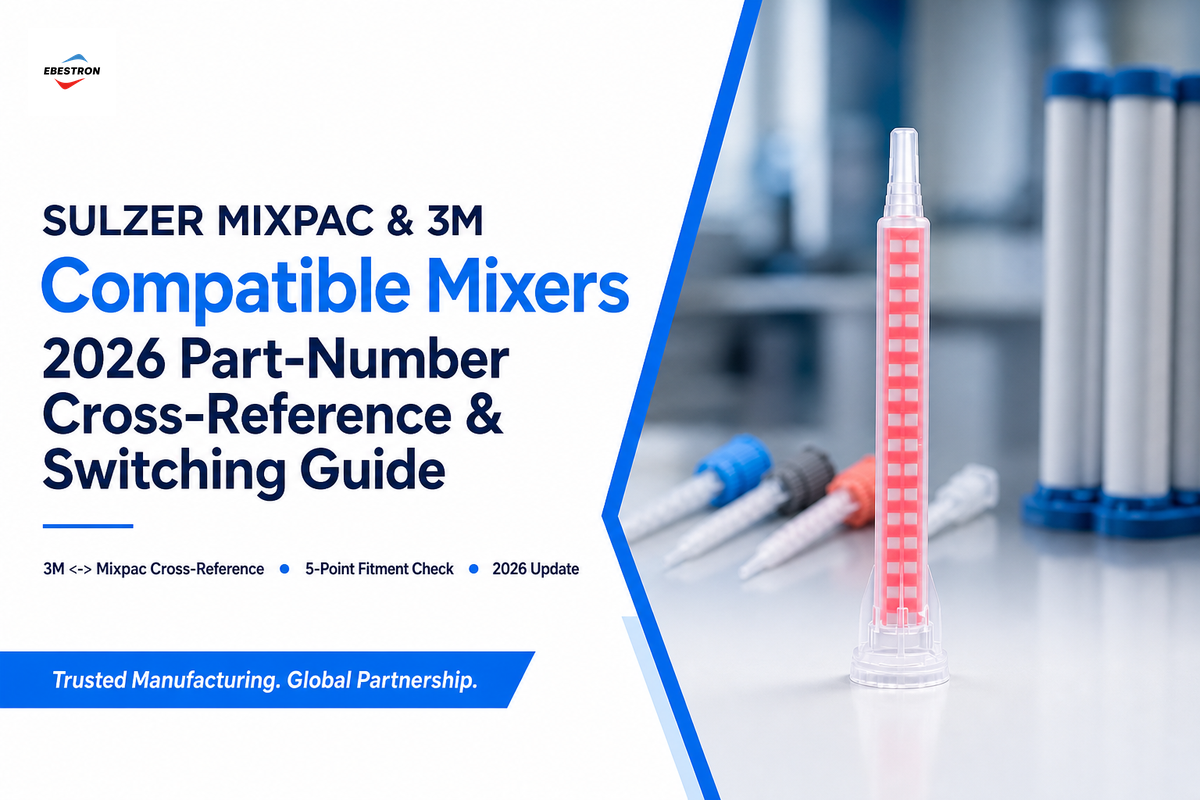
Sulzer Mixpac & 3M Compatible Mixers are static mixing nozzles designed to fit either brand’s cartridge system while carrying a different part number than the original part. You’ll see the same part called a static mixer nozzle, a static mixer nozzle mixing tip, or just a mixing tube depending on the catalog – Sulzer Mixpac (now part of Medmix) and 3M both sell disposable static mixers as standard accessories alongside their dispensing applicators, sized from 50 ml cartridges up through large-format adhesive cartridges. The wetted housing is typically PP (polypropylene), chosen for broad chemistry resistance across epoxy, polyurethane, silicone, acrylic, and sealant formulations, and these mixing systems show up everywhere from aerospace assembly to general dispenser work – any part sold as compatible with Sulzer Mixpac hardware has to match all three criteria below regardless of the application. The latter – part number – is where most cross-referencing fails: Sulzer Mixpac’s codes (system, bore size, element count) describe what the product is, but 3M catalog numbers are opaque. Finding a 3M 08193 part requires looking up the number, not decoding it.
This page is that lookup, plus the three questions that always follow it: Can you run one brand of cartridge on the other brand’s gun? How can I be sure a “compatible” part is actually the right thing before committing a whole run? And what happens when the switch go south? For pricing, sourcing, and the full specification comparison, see the Sulzer Mixpac & 3M compatible mixer product page.
What “Compatible” Actually Means When You Cross a Sulzer Mixpac and a 3M Cartridge
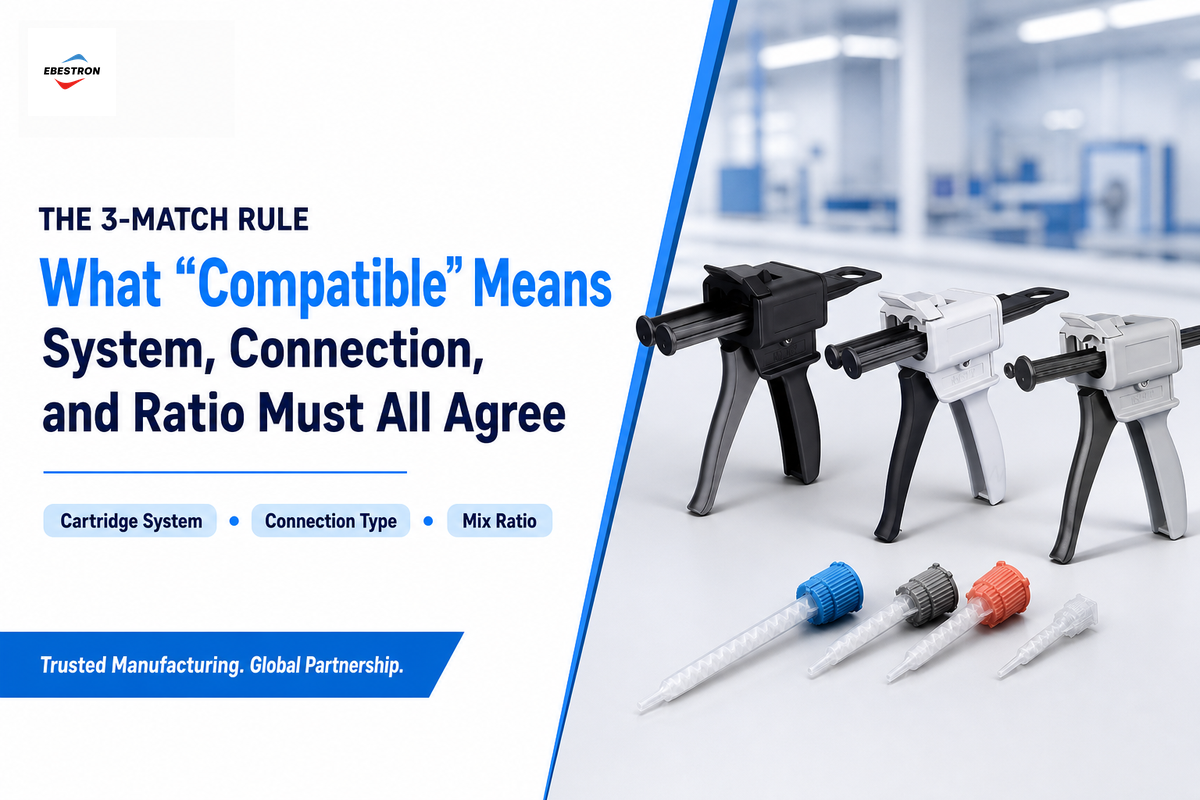
ICC-ES defines a two-component dispensing system for adhesive anchor systems as three components working together: the cartridge, the static mixing nozzle, and the dispensing tool. Switching brands means you’re trying to align three different pieces of hardware – not one unified component.
📐 The 3-Match Rule
- cartridge system: A 3M EPX-family or a Sulzer Mixpac A/B/C/F set the shape of the outlet the nozzle need to meet.
- Connection type: Is the cartridge a bayonet-type (small) or a bell-type (200ml+)? If not, the nozzle won’t seat and seal.
- Mix Ratio: Is a 1:1 cartridge system being mated to a 2:1 nozzle? Then your beads are going off-ratio before the mixing elements can act.
If all three components are correct, then a compatible mixer functions as intended – they use well-understood, open-source static mixing engineering – the original split-and-recombine element design has been public prior art since the 1960s (see US3286992A), not a proprietary secret. It does NOT do this: Copy the cosmetic details of another part (shape of dome, color, embossed logo), without mimicking the actual engineering. (See Verification below for the more significant difference.)
Skip the 3-Match Rule and the failure rarely shows up at the bench – it shows up three stations downstream. On a 1:1 structural-epoxy assembly line, an operator can still force a bell-mount nozzle onto the wrong bayonet adaptor with enough hand pressure; the joint looks fine at application and only fails when the bead peels under load at final QC. Ebestron’s engineers, drawing on years of in-house precision tooling experience, confirm the system letter before quoting any cross-brand part for exactly this reason – a mismatch caught before the order ships costs nothing, while the same mismatch caught on the production line costs roughly 1 hour of rework and a missed shift count.
Sulzer Mixpac ↔ 3M Part-Number Cross-Reference Table
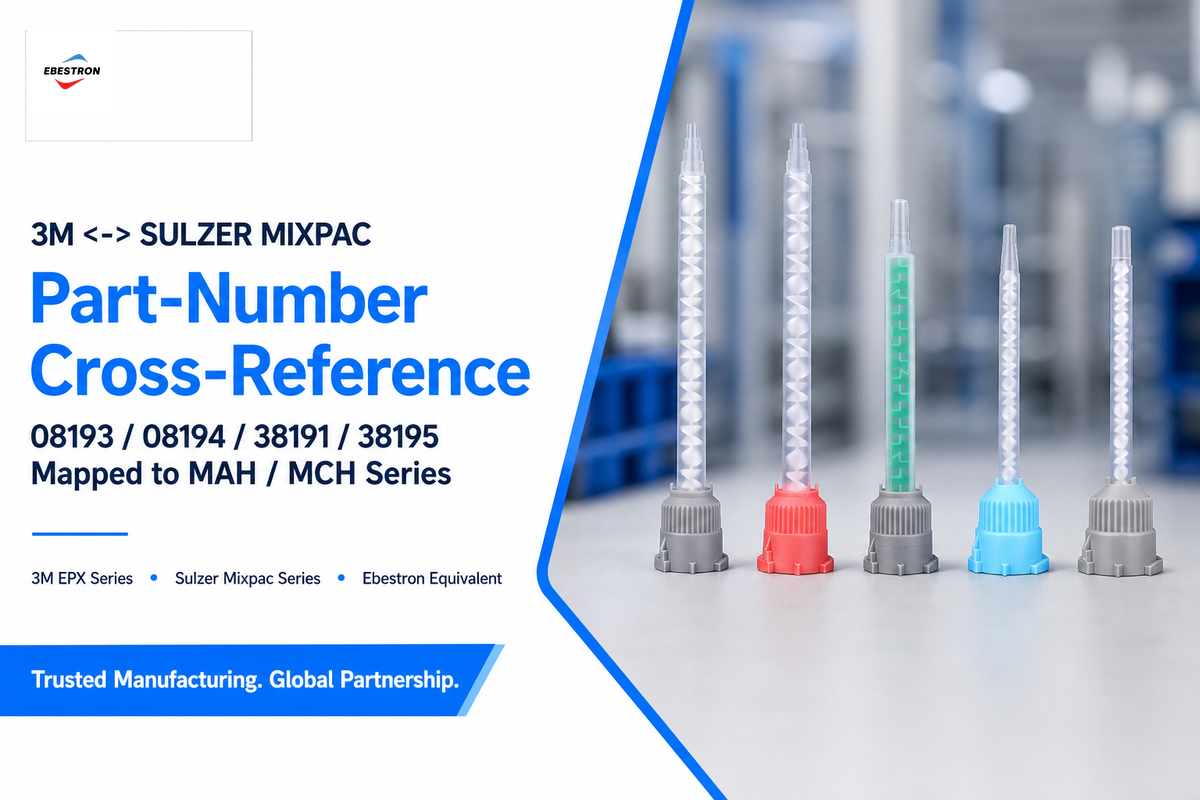
Buyers often have a part with a 3M number like 08193, 08194, 38191 or 38195 on hand and don’t know what the numbers mean. Unlike a Sulzer Mixpac code, there’s no obvious logic; the 3M part number must be looked up against a chart. Here’s the cross-reference table. We list parts at the level (precision) they’re marketed to the aftermarket.
| 3M Model / Catalog # | 3M Family / Size / Ratio | Sulzer Mixpac System Type | Connection | Ebestron Compatible Bore / Elements |
|---|---|---|---|---|
| 3M™ EPX 38195 | Scotch-Weld, 50 ml, 1:1 / 2:1 | MAH series (A-system) | Bayonet | 4 mm / 16 el |
| 3M™ EPX 38191 | Scotch-Weld, 50 ml, 1:1 / 2:1 | MAH series (A-system) | Bayonet | 4-6 mm / 14-17 el |
| 3M™ EPX 08193 | Scotch-Weld, 200 ml, 1:1 / 2:1 | MCH series (C-system) | Bell (retaining nut) | 6.5 mm / 18-21 el |
| 3M™ EPX 08194 | Scotch-Weld, 200 ml, 1:1 / 2:1 | MCH series (C-system) | Bell (retaining nut) | 6.5 mm / 18-21 el |
| 3M™ EPX square orange (10:1, 45 ml) | Scotch-Weld, 45 ml, 10:1 | MAHX series (A-system, 10:1) | Bayonet | Sized to 10:1 ratio band |
| No direct 3M catalog equivalent | – | MCQ (Quadro square-element, C-system) | Bell (retaining nut) | Same bore band as MCH, shorter tube |
| No direct 3M catalog equivalent | – | MKH / MKHX (K-system, micro-dosing) | Integrated plunger | 2.5-10 ml cartridges, lab/electronics scale |
| Not cross-compatible | 25 / 50 / 75 ml | MBH / MBHX (B-system) | Interlock (patented) | OEM-only — see verification check below |
| Not cross-compatible | 200 / 400 ml | MFH / MFQX (F-system) | Interlock (patented) | OEM-only — see verification check below |
📐 Data Provenance
This table is built at system level – 3M catalog number to Sulzer Mixpac series family, connection type, and Ebestron’s matched bore/element spec – cross-checked against 3M’s own product listing and Ebestron’s manufactured range. It is not a claim that every individual 3M lot number has one single Sulzer part number twin; within a system family, bore and element count are what actually have to match your chemistry (see the product page’s full spec tables for exact selection by chemistry).
Reading a 3M “Opaque” Catalog Number (3M Doesn’t Self-Decode Like Sulzer)
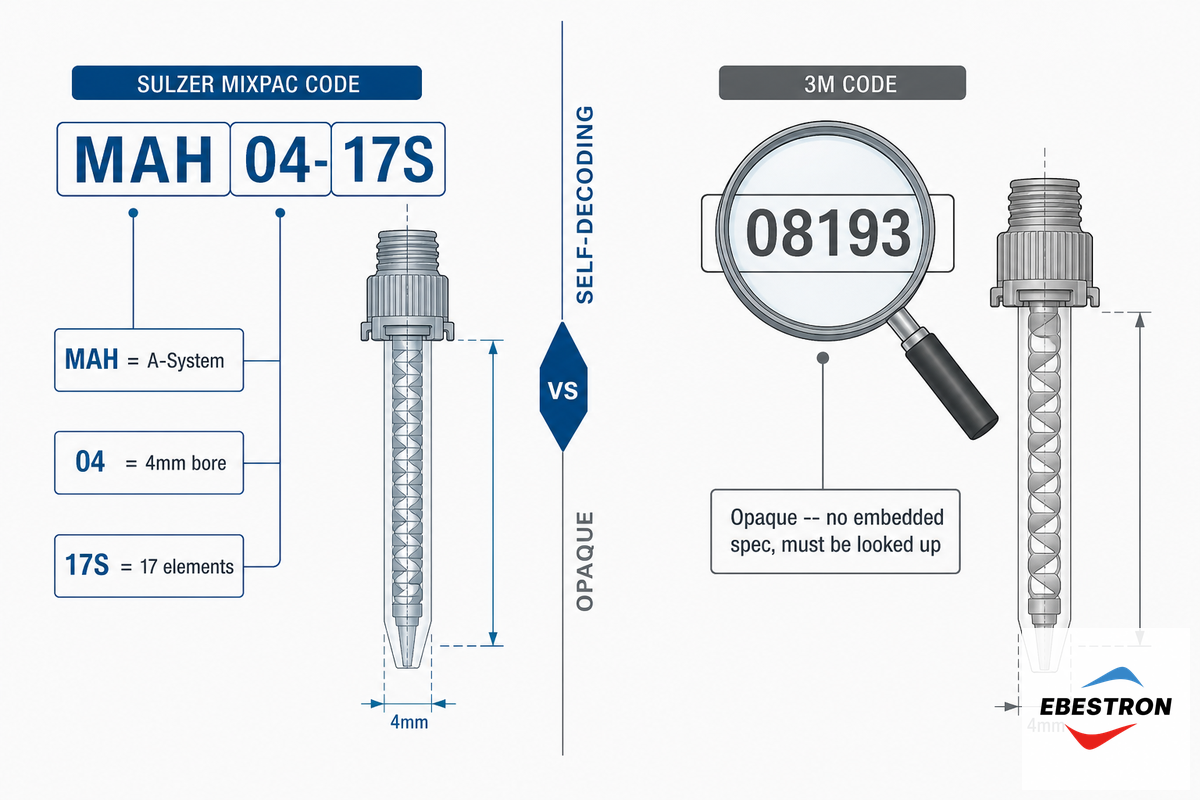
A Sulzer Mixpac code like MAH 04-17S tells you almost everything on sight: system letter, 4 mm bore, 17 elements. A 3M number like 08193 tells you nothing – it’s a sequential catalog digit, not a spec. That difference is exactly why the table above exists: for a Sulzer part, you can decode; for a 3M part, you have to look it up.
When the molded number is worn off or the box is long gone, a November 2024 technical bulletin from adhesive-dispensing distributor Intertronics lays out the fallback: identify by physical shape first – element cross-section (round/helical vs. square/quadro) and inlet type (bayonet lugs vs. bell retaining nut) – then narrow to a system family before confirming the exact bore and element count against your adhesive’s data sheet – the same inlet-coding logic that makes one system’s nozzle refuse to seat on another’s cartridge is documented in dual-inlet mixer patents such as EP0885651A1. Shape gets you to the right family; it doesn’t replace confirming bore and element count against your chemistry.
Some listings pack in more detail than the catalog number alone: a helical static mixer built for meter mix dispensing (MMD) equipment, a shroud-protected inlet, or a side-by-side cartridge rather than coaxial. Materials matter here too – PA (nylon) housings hold up to methacrylate resin systems better than plain PP, and the mixer’s inner diameter has to match the cartridge outlet surface exactly regardless of brand. A 50ml cartridge running 18 elements of resin-based epoxy and a 50 ml Mixpac cartridge running the same chemistry both size the same way – the catalog number changes, the physics doesn’t.
This gap costs real time on a production floor: an assembly technician holding a worn 3M part with no readable digits has to stop the line, photograph the base, and wait on a supplier reply before the next shift can run – a delay that a self-decoding Sulzer Mixpac code never creates. Ebestron’s engineering team resolves this the same way the bulletin recommends, by matching bore diameter and element count against submitted photos rather than guessing from a half-legible catalog number, and confirms fit before the replacement case ships. Because CE and RoHS documentation travels with every confirmed match, the risk of a compliance gap on a re-order is closed at the same time as the fitment risk.
3M-to-Mixpac Switch Path: Moving Between an OEM Gun and a Compatible Setup
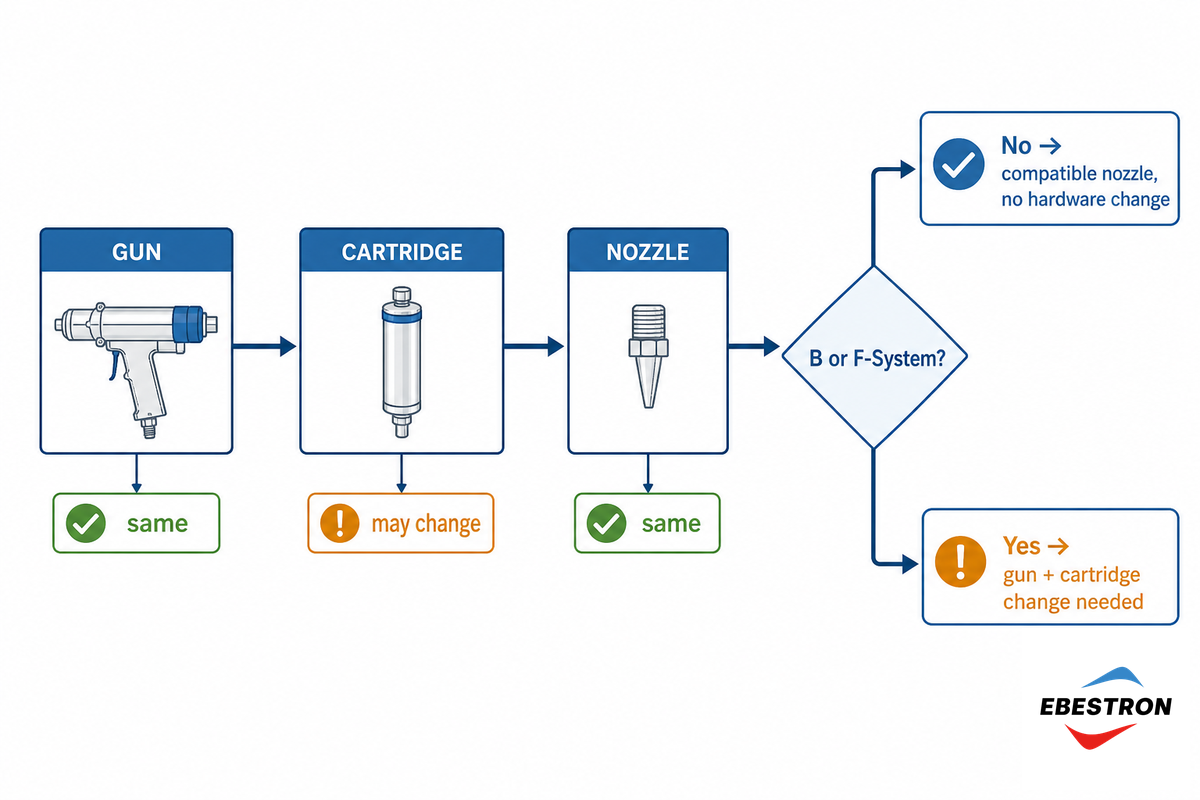
Buyers researching this rarely start from zero – they already own a 3M EPX gun or a Sulzer Mixpac gun and want to know what changes and what doesn’t if they switch cartridge or nozzle brands. The gun, cartridge, and nozzle don’t all move together; each has its own compatibility question.
3M-to-Mixpac Switch Path — What Actually Has to Change
| If your gun is… | And your target cartridge is… | What changes |
|---|---|---|
| 3M EPX bayonet gun, 50 ml | Sulzer Mixpac A-system, 50 ml | Nothing mechanical — same bayonet family, swap cartridge and nozzle only |
| 3M EPX bell gun, 200 ml | Sulzer Mixpac C-system, 200 ml | Nothing mechanical — same bell/retaining-nut family |
| Any open-system gun | Sulzer Mixpac B-system or F-system | Gun and cartridge both — these use a patented interlock connection, generally not open to cross-brand hardware |
Where this goes wrong is the third row: B-system and F-system aren’t a nozzle-only decision. Confirm which system your gun actually is before ordering a cross-brand cartridge for it – a bayonet or bell gun will take a compatible nozzle with no hardware change at all; a B/F-system gun usually won’t – the coded ledges and grooves that make an interlock connection reject the wrong part are exactly what a mixer/cartridge connection-coding patent like US9010578B2 describes.
An automotive panel-bonding line switching a 200 ml bell-mount 3M gun to a Sulzer Mixpac-compatible cartridge is a same-day changeover: no new gun, no requalification of the gun itself, just a cartridge and nozzle swap confirmed against the Switch Path table above. The risk case is the opposite direction – a buyer who assumes a B-system gun is just another bell-mount and orders a generic cartridge for it discovers the mismatch at the loading dock, not before. Ebestron’s engineering team flags the system type from the OEM code before quoting, precisely to keep that discovery from happening on your receiving floor instead of in an email.
5-Point Fitment Verification Check Before You Switch
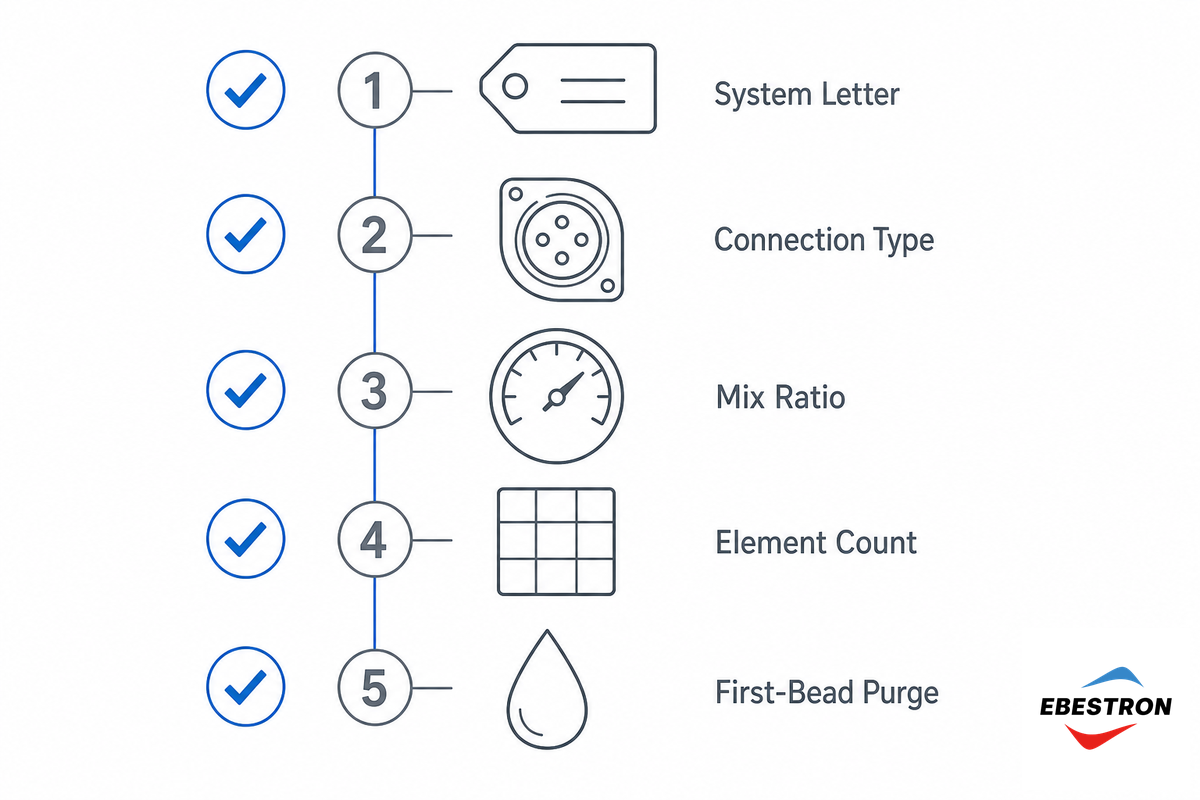
Sulzer Mixpac has a documented history of litigating parts that copy its dental mixing-tip trade dress – courts in Cologne (2010/2011), the Southern District of New York (2009), Düsseldorf, and Munich (2020) have all ruled against near-identical copies of its colored dome mixing tips, and Sulzer’s own guidance for spotting a genuine tip is the MIXPAC name stamped on the retaining ring plus a Candy Color Quality Seal. That’s a different question from whether a functionally-engineered, differently-marked “compatible with” part is legitimate – it is, and it’s what this guide is about – but it’s exactly why verifying before you switch is worth five minutes.
- ✔ Confirm the system letter (A/B/C/F or EPX) printed or molded on both the old and new part – not just the bore.
- ✔ Match connection type physically – bayonet lugs vs. bell retaining nut – before ordering a case quantity.
- ✔ Ensure the mix ratio stamped on the cartridge is the nozzle’s rated ratio, not just its bore.
- ✔ Confirm that the element count is within your chemistry’s band (see the site’s chemistry-by-element tables), don’t just assume ‘more is better’.
- ✔ Perform a ‘first bead purge’ on a test part prior to a production run – discard roughly one nozzle internal volume before the first actual bead (the same purge principle OSHA references for controlling isocyanate exposure when a fresh mix line is first opened).
“Every fitment complaint we trace back to one of two things: the system letter didn’t actually match, or nobody purged the first shot. Neither one is a defect in the part, they’re both five-second checks somebody skipped.”
Ebestron Engineering Team, Adhesive Dispensing R&D, Kunshan
Skipping this check is the reason a returned case costs more than the parts in it: an electronics-potting line that receives an unverified cross-brand nozzle and runs it anyway risks a full production shift on an unqualified part, not just a bad bead. Ebestron ships every compatible order with CE and RoHS documentation precisely so the fitment risk is closed before the case reaches your dock, not discovered on it.
Troubleshooting: When a Cross-Brand Mixer Won’t Seat or Starts Leaking
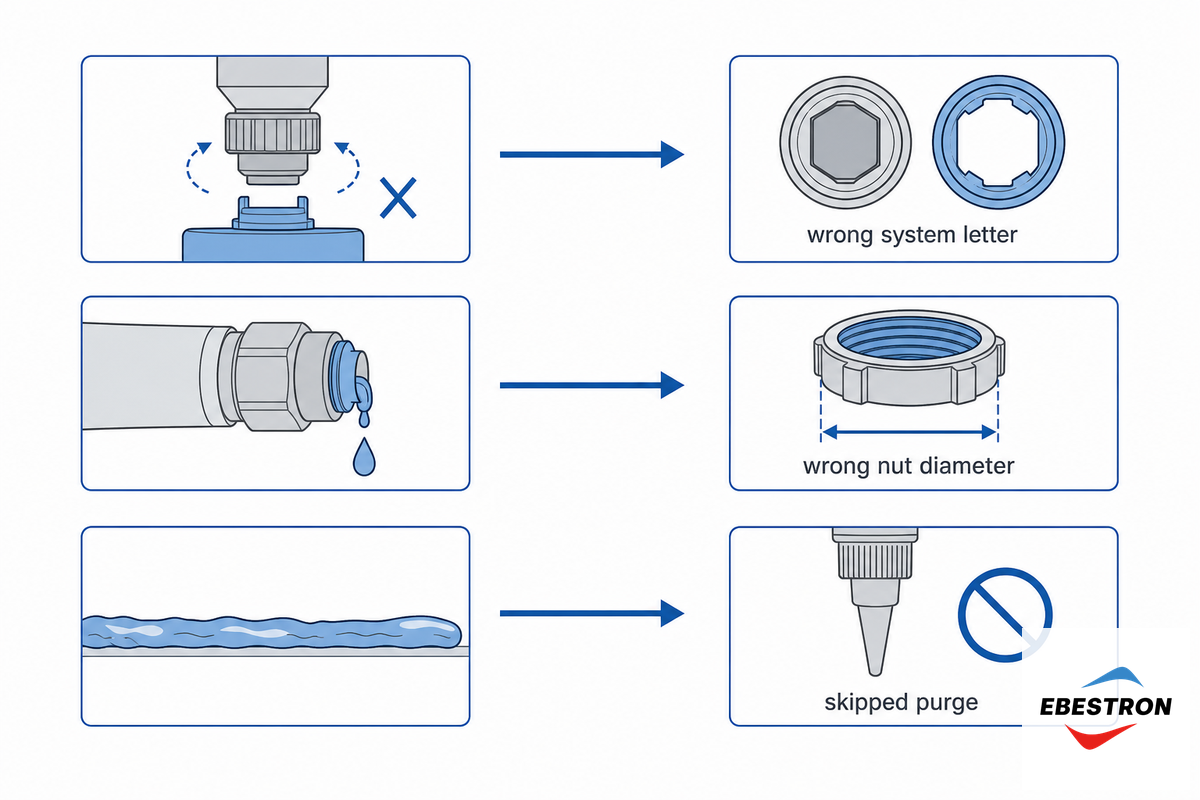
Most of the five symptoms below trace back to the same root cause: the geometry that actually fixes a mixer’s spec – jacket, element cross-section, and count, as documented in patent filings such as US7484881B2 – was matched to a bore number instead of the full system code.
| Symptom | Most likely cause | Fix |
|---|---|---|
| Nozzle won’t twist-lock on | Bayonet lug spacing from a different system family | Re-confirm system letter, not just bore size |
| Leaks at the retaining-nut joint | Bell nut from a different cartridge diameter | Match nut thread and neck diameter, not just cartridge volume |
| First bead is streaky or off-color | Skipped purge on a fresh nozzle | Discard the first ~1 nozzle-volume before the real bead |
| Gun won’t seat cartridge at all | Attempting a B/F-system cartridge in an open-system gun | Confirm system before ordering — see Switch Path table above |
| High hand effort, incomplete bead | Element count too high for a manual gun | Match element count to chemistry, step up to pneumatic if the count is genuinely required |
The root cause behind most of these five symptoms is the same structural gap: a buyer confirmed bore diameter but skipped the system-letter check, because the two numbers look interchangeable on a spec sheet and aren’t. Ebestron’s engineering team sees this pattern most often on 200 ml bell-mount lines switching between 3M and Sulzer Mixpac cartridges, where the retaining-nut thread pitch is the detail a bore-only comparison misses – confirming both against the OEM code, not just the diameter, resolves it before the gun ever reaches the line.
Does Switching Brands Change Your Chemistry Math?
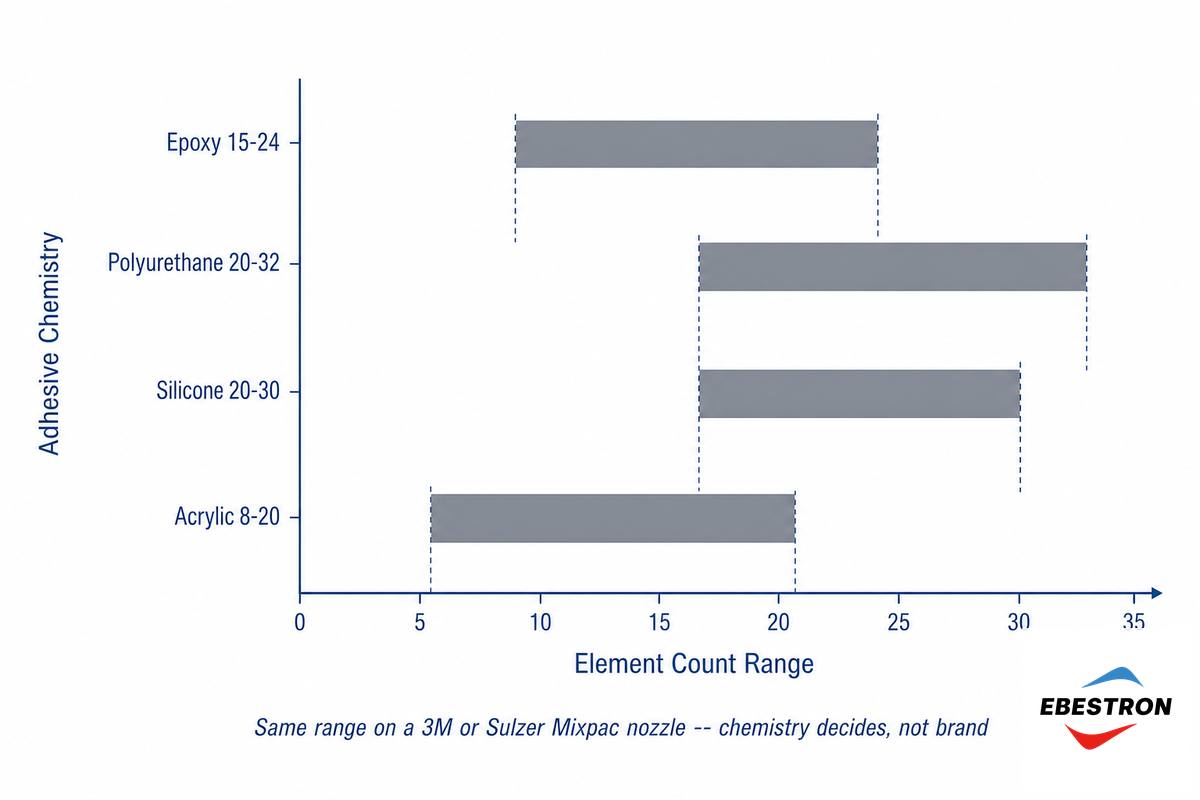
No – element counts follow the adhesive’s chemistry and mix ratio, not the brand on the cartridge. A 1:1 general-purpose epoxy sits in roughly the same 15-24 element band whether dispensed through a 3M EPX nozzle or a Sulzer Mixpac-compatible one; a 10:1 polyurethane needs a wider 20-32 element band either way, brand aside. The brand changes, the chemistry math doesn’t.
Worked example: switching a 2:1 epoxy from a 3M 08193 (18-21 elements) to its Sulzer Mixpac MCH equivalent keeps you in the same 18-24 element range for that chemistry. For the full chemistry-to-element-count tables and the 2ⁿ striation math behind them, see the site’s static mixing nozzle guide and 18 vs 24 element comparison.
The mistake we see most on a switch is the opposite assumption: a buyer moving a 10:1 polyurethane assembly job from a 3M nozzle to a compatible one who keeps the old 15-24-element epoxy habit out of routine, then wonders why the bead cures inconsistently under load. The chemistry didn’t change and the ratio didn’t change, so the element band shouldn’t change either – Ebestron’s engineering team sizes every cross-brand quote to the adhesive’s actual chemistry and ratio, not to whatever count happened to be on the part being replaced. That discipline is why the same CE-documented spec sheet applies whether the nozzle ships under a 3M or a Sulzer Mixpac cross-reference code.
The Real Cost of Switching: OEM Sunk Stock, Gun Investment, and Transition Waste

Comparing prices on a per-nozzle basis (100 index vs. 30-55 index, per the product page’s own published figures) is insufficient. The real deciding number when switching during production is the cost of the transition: surplus OEM cartridge stock that will go to waste, the additional cost of new hardware if needed (often zero unless it’s B-system/F-system – see the Switch Path table above), and the time investment of a requalification run (trial batch and purge check) – the same qualification discipline ISO 9001-audited quality systems already require for any changed supplier input.
✔ Switching costs less when…
- Same system family (bayonet-to-bayonet, bell-to-bell) — zero gun cost
- OEM stock is already near depletion
- Ratio and chemistry stay identical
⚠ Switching costs more when…
- Target system is B/F-system (possible gun change)
- Large OEM inventory not yet consumed
- Requalification testing is mandated by your QMS
The real risk in a rushed switch isn’t the per-nozzle price gap – the reason it costs more is a production line that burns through a full shift’s OEM stock mid-run and has to stop for a supplier reorder because nobody tracked depletion against the changeover date. Ebestron quantifies this for every quote by asking for your current monthly cartridge volume and OEM stock-on-hand before proposing a transition date, precisely because a same-day changeover on a bayonet or bell system removes that structural risk; a B/F-system changeover, which needs a gun swap, doesn’t.
Common Mistakes When Cross-Referencing Sulzer Mixpac and 3M Parts
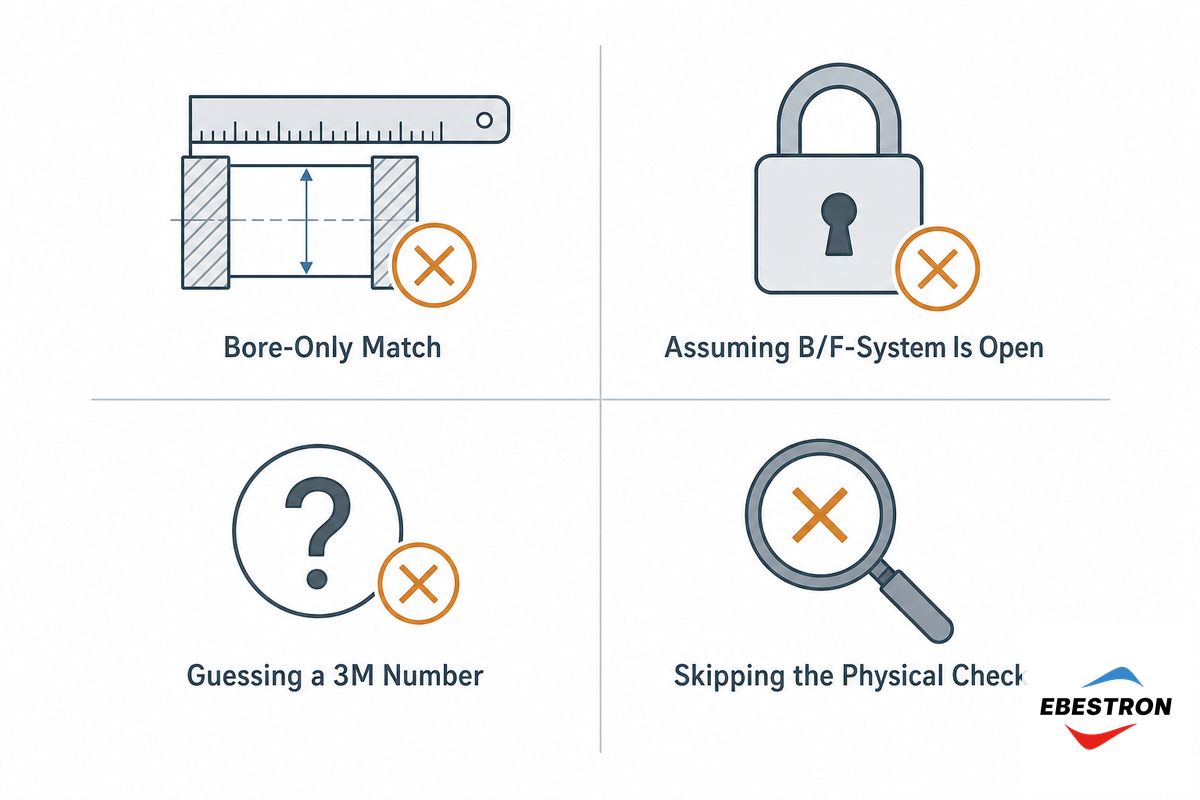
- ✔ Assuming system match and matching bore number only.
- ✔ Assuming B-system and F-system are equivalent to the open systems – these proprietary connections are typically patented and non-interchangeable.
- ✔ Interpreting 3M catalog numbers as directly decoded data, similar to Sulzer Mixpac’s format – it isn’t; cross-reference instead.
- ✔ Neglecting the physical connector match check because the bore number on the box ‘looks correct’ – the fixed internal-baffle geometry that actually governs mix quality is described in static mixing device patents such as US4538920A, not on the label.
Every one of these four traces back to the same root problem: treating a single number – bore, ratio, or catalog digit – as sufficient evidence of fit, when the 3-Match Rule requires all three to agree. Ebestron’s engineering team catches roughly a case a month where a customer’s own cross-reference attempt missed the system letter specifically, which is the single costliest mistake on this list because it’s the one that stops production, not just wastes a few nozzles.
Industry Outlook: What’s Changing in Cross-Brand Mixer Compatibility

The best predictor for 2026 purchases isn’t a new mixer design; it’s how aggressively Sulzer Mixpac defends its proprietary connectors. Court decisions in the US, Germany, and Switzerland dating back to 2009 through 2020 consistently reflect enforcement actions against copy-cat designs, including a 2020 injunction from a German district court in Munich. That history is why B and F systems are flagged as OEM-only throughout this guide.
It isn’t one-sided, though: in 2024, the Delhi High Court in India went the other way, upholding a rejection of a Sulzer Mixpac static-mixer patent application on prior-art grounds – a reminder that patent status varies by jurisdiction and isn’t automatically assumed in every market. For 2026 sourcing, the practical takeaway is to treat connection-type openness as something to verify per system, not something that’s settled once and stays settled. Separately, vendor-reported R&D continues on lower-element-count mixer geometries (one manufacturer claims full mixing in as few as ~7 elements versus a conventional 24-32) – worth tracking, but still a single-source figure, not yet an industry-wide shift. Chemistry itself keeps moving too: the pot-life verification standard governing multi-component structural adhesives, ISO 10364, received its own 2024 revision.
For a buyer sourcing on a 12-month contract, the practical risk isn’t a design change – it’s a supply gap, because a single-source part that gets litigated or reclassified mid-contract disappears without warning. Ebestron addresses this the same way it addresses any patent-status question: by keeping the open-system inventory (A, C, and K on the Sulzer Mixpac side, EPX on the 3M side) as the default recommendation, and flagging B/F-system quotes as OEM-verification-required rather than assuming availability a year out.
Frequently Asked Questions
Q: Will an Ebestron nozzle really fit my Sulzer Mixpac or 3M gun?
View Answer
Yes, when the system letter, connection type, and mix ratio all match — the same 3-Match Rule this guide walks through. Send the OEM code molded on your current part (an MAH/MBH/MCH number for Sulzer, or an 08193/38195-style number for 3M) and Ebestron confirms the compatible equivalent before you order, using the same cross-reference logic as the table above. B-system and F-system cartridges are the exception worth flagging up front, since their connections are patent-protected and generally OEM-only.
Q: Is a compatible nozzle as good as a name brand?
View Answer
When the geometry genuinely matches — same bore, same element count, same connection — mix quality comes from that match, not the brand name molded on the housing. The distinction that actually matters legally is between a functionally-engineered compatible part (legitimate, and what this guide covers) and a part that copies another brand’s proprietary trade dress (the subject of the litigation history noted in the verification section above) — those are not the same category of product.
Q: What about a mixing nozzle for epoxy I bought retail, can you replace it?
View Answer
Almost always. Retail two-part cartridge nozzles — including 3M and Sulzer Mixpac branded ones sold in hardware and auto-body stores — follow the same A/B/C/F and EPX system conventions used across industrial dispensing. Match the cartridge size and ratio against the cross-reference table above and a factory-direct equivalent will drop straight in, typically at a lower per-piece cost than the retail original.
Q: Do 3M and Sulzer Mixpac part numbers ever match by coincidence?
View Answer
No. Sulzer Mixpac codes encode system, bore, and element count directly; 3M’s catalog numbers are sequential and carry no spec information at all. Any apparent similarity between a 3M and a Sulzer Mixpac number is coincidental, not a cross-reference shortcut.
Q: What’s the biggest risk in switching from 3M to a Mixpac-compatible setup mid-production?
View Answer
Skipping the requalification step, not the hardware itself. If the system family and ratio match, a cross-brand nozzle swap is mechanically routine — the actual risk is running a full production batch on the new part before confirming a clean first bead and consistent cure on a small trial run first. That’s a five-minute check that prevents a much larger rework problem downstream.
Q: Can I mix OEM 3M and Mixpac-compatible parts on the same production line?
View Answer
Yes, as long as each gun-cartridge-nozzle combination satisfies the 3-Match Rule on its own station. No need to standardize on one brand line-wide – run OEM 3M stock down on one station while qualifying a Sulzer Mixpac-compatible setup on another, then consolidate once the trial station clears QC. Keep the two brands in separate bins if your QMS requires single-supplier traceability per part number.
Why We Write This
Ebestron manufactures the compatible static mixing nozzles this cross-reference table describes – bayonet and bell connections engineered to fit Sulzer Mixpac and 3M EPX systems directly. We built this page because the two most common support requests we field are “what does my 3M number actually mean” and “will this really fit,” and no page on our own site – or anywhere else we could find – answered both from a single lookup table. Reviewed by the Ebestron technical team.
References & Sources
- ELC-2582 Evaluation Report — ICC Evaluation Service
- ELC-4457 Evaluation Report — ICC Evaluation Service
- SGW-64294-01, Concrete Doweling Specification — U.S. Department of Energy, Hanford Site
- Static Mixers for High-Viscosity Systems: From Classical to Machine-Learning-Optimized Design — ACS Omega (2025)
- A Review on the Mixing Quality of Static Mixers — von Damnitz et al., MDPI Processes (2025)
- Sulzer Mixpac Continues to Enforce Its Rights and Protect Its Customers — Sulzer Mixpac Ltd, official media release (2021)
- Sulzer Mixpac Patent Appeal Fails as Indian Court Backs Prior Art Finding — MLex (2024)
- Isocyanates: Evaluating Exposure — Occupational Safety and Health Administration
- TB2024-23: How to Identify a Mixing Nozzle — Intertronics, technical bulletin (Nov 2024)
- US3286992A, Mixing Device — Armeniades, Johnson & Raphael, Arthur D. Little Inc. (USPTO via Google Patents)
- EP0885651A1, Mixer — Wilhelm A. Keller (EPO via Google Patents)
- US9010578B2, Mixer/Cartridge Connection Coding — USPTO via Google Patents
- US7484881B2, Dispenser and Mixer Geometry — USPTO via Google Patents
- US4538920A, Static Mixing Device — USPTO via Google Patents
- ISO 9001:2015, Quality Management Systems — International Organization for Standardization
- ISO 10364:2024, Structural Adhesives — Pot Life of Multi-Part Adhesives — International Organization for Standardization
Related Articles
- Sulzer Mixpac & 3M Compatible Mixers, full product & OEM sourcing page
- Static Mixing Nozzle Types: Bayonet, Bell-Mouth, Cross & Square Connections Explained
- Static Mixing Nozzles for 2-Part Adhesives: 2026 Guide
- 18 vs 24 Element Static Mixers: Selection Guide
- Dispensing Gun Troubleshooting: 5 Common 2K Cartridge Gun Problems and Fixes
- Mixpac & Cox Compatible Dispensing Guns
- About Ebestron