Póngase en contacto con Ebestron Company


Última actualización: julio de 2026, a cargo del equipo técnico de Ebestron.
Datos rápidos
| Sistemas incluidos | Sulzer Mixpac A/B/C/F, 3M Scotch-Weld EPX |
| Números de catálogo de 3M mencionados | 08193, 08194, 38191, 38195 |
| Series Sulzer Mixpac mencionadas | MAH, MBH, MCH |
| Tipos de conexión | Bayoneta, campana (tuerca de retención) |
| Relaciones de mezcla | 1:1, 2:1 |
Los mezcladores compatibles con Sulzer Mixpac y 3M son boquillas mezcladoras estáticas diseñadas para encajar en los sistemas de cartucho de cualquiera de las dos marcas, aunque llevan un número de pieza distinto al original. Según el catálogo, un mismo componente puede denominarse boquilla mezcladora estática, punta mezcladora de boquilla estática o, sencillamente, tubo mezclador. Tanto Sulzer Mixpac (ahora parte de Medmix) como 3M venden mezcladores estáticos desechables como accesorios estándar para sus pistolas de aplicación, en tamaños que van desde cartuchos de 50 ml hasta cartuchos de adhesivo de gran formato. La carcasa en contacto con el fluido suele ser de PP (polipropileno), elegido por su amplia resistencia química frente a formulaciones de epoxi, poliuretano, silicona, acrílico y sellantes. Estos sistemas de mezcla se utilizan en todo tipo de aplicaciones, desde el ensamblaje aeroespacial hasta trabajos generales de dosificación. Sea cual sea la aplicación, toda pieza que se venda como compatible con equipos Sulzer Mixpac debe cumplir los tres criterios siguientes. El número de pieza es el aspecto en el que más suelen fallar las referencias cruzadas: los códigos de Sulzer Mixpac (sistema, diámetro interior y número de elementos) describen el producto, pero los números de catálogo de 3M son opacos. Para encontrar la pieza 3M 08193 hay que consultar el número, no descifrarlo.
Esta página permite consultar esas referencias y responde a las tres preguntas que suelen surgir a continuación: ¿Se puede utilizar un cartucho de una marca en la pistola de otra? ¿Cómo puede asegurarse de que una pieza «compatible» es realmente la adecuada antes de comprometerse con toda una serie de producción? ¿Y qué ocurre cuando el cambio sale mal? Para consultar precios, abastecimiento y la comparación completa de especificaciones, visite la página de producto de mezcladores compatibles con Sulzer Mixpac y 3M.
Qué significa realmente «compatible» al combinar un cartucho Sulzer Mixpac con uno de 3M
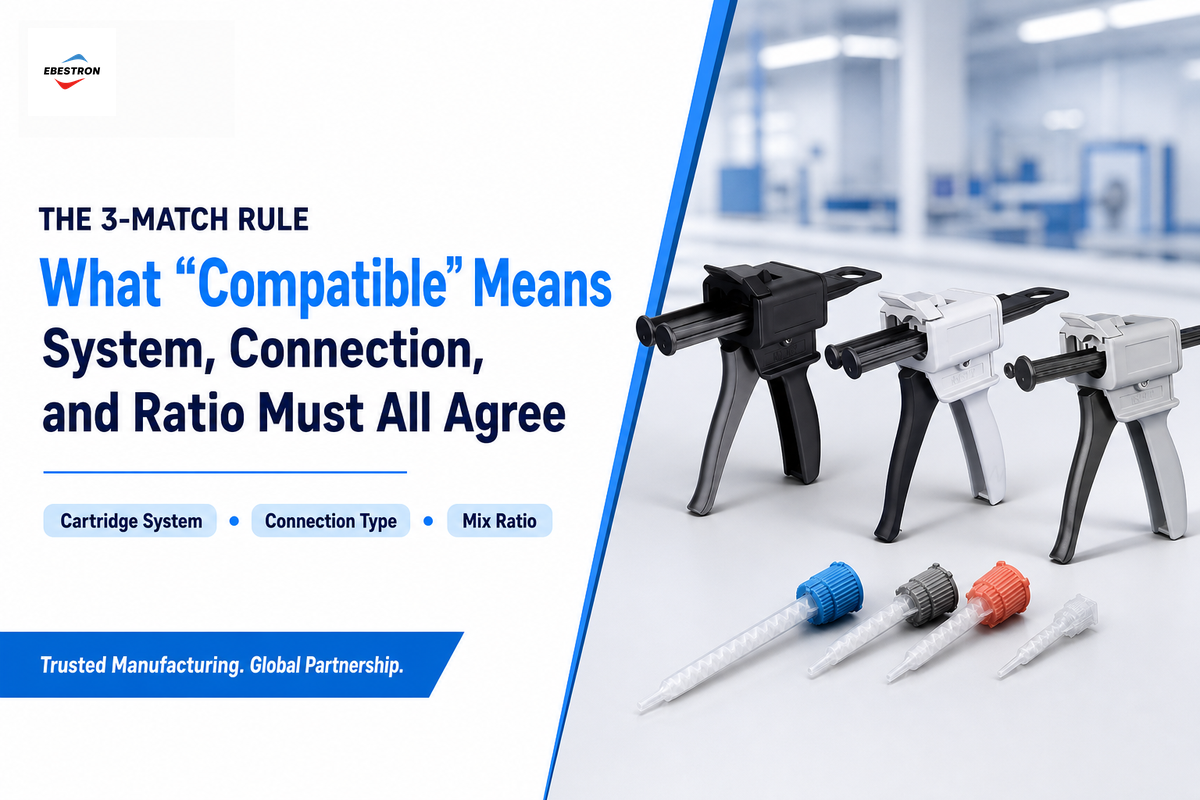
ICC-ES define un sistema de dispensación bicomponente para anclajes adhesivos como un conjunto de tres componentes que trabajan juntos: el cartucho, la boquilla mezcladora estática y la herramienta de dispensación. Cambiar de marca implica hacer coincidir tres piezas de equipo diferentes, no un único componente integrado.
📐 La regla de las 3 coincidencias
- Sistema de cartucho: una familia 3M EPX o un conjunto Sulzer Mixpac A/B/C/F determina la forma de la salida con la que debe encajar la boquilla.
- Tipo de conexión: ¿El cartucho es de tipo bayoneta (pequeño) o de tipo campana (200ml+)? Si no coincide, la boquilla no asentará ni sellará.
- Relación de mezcla: ¿Se está acoplando un sistema de cartucho 1:1 a una boquilla 2:1? En ese caso, las dosis salen con una proporción incorrecta antes de que actúen los elementos mezcladores.
Si los tres componentes son los adecuados, el mezclador compatible funciona como se espera: se basa en principios de ingeniería de mezcla estática conocidos y de uso libre. El diseño original de elementos que dividen y recombinan el material es de dominio público desde la década de 1960 (véase US3286992A); no es un secreto propietario. NO hace esto: copiar los detalles estéticos de otra pieza (la forma de la cúpula, el color o el logotipo en relieve) sin reproducir la ingeniería real. (Consulte la sección Verificación para conocer la diferencia más significativa).
Si se pasa por alto la regla de las 3 coincidencias, el fallo rara vez aparece en el banco de trabajo: suele manifestarse tres puestos más adelante. En una línea de montaje con epoxi estructural 1:1, un operario aún puede forzar una boquilla con montaje de campana en un adaptador de bayoneta incorrecto aplicando suficiente presión con la mano. La unión parece correcta durante la aplicación y solo falla cuando el cordón se desprende bajo carga en el control de calidad final. Los ingenieros de Ebestron, con años de experiencia interna en herramientas de precisión, confirman la letra del sistema antes de presupuestar cualquier pieza compatible de otra marca por este motivo: detectar una incompatibilidad antes de enviar el pedido no cuesta nada, mientras que detectarla en la línea de producción supone aproximadamente 1 hora de retrabajo y perder el recuento de producción de un turno.
Tabla de referencias cruzadas de números de pieza Sulzer Mixpac ↔ 3M

A menudo, los compradores tienen a mano una pieza con un número de 3M como 08193, 08194, 38191 o 38195 y no saben qué significan esos números. A diferencia de un código Sulzer Mixpac, no hay una lógica evidente; hay que consultar el número de pieza de 3M en una tabla. Aquí está la tabla de referencias cruzadas. Indicamos las piezas con el nivel de precisión con el que se comercializan en el mercado posventa.
| Modelo / n.º de catálogo de 3M | Familia / tamaño / relación de mezcla de 3M | Tipo de sistema Sulzer Mixpac | Conexión | Diámetro interior / elementos compatibles de Ebestron |
|---|---|---|---|---|
| 3M™ EPX 38195 | Scotch-Weld, 50 ml, 1:1 / 2:1 | Serie MAH (sistema A) | Bayoneta | 4 mm / 16 elementos |
| 3M™ EPX 38191 | Scotch-Weld, 50 ml, 1:1 / 2:1 | Serie MAH (sistema A) | Bayoneta | 4-6 mm / 14-17 elementos |
| 3M™ EPX 08193 | Scotch-Weld, 200 ml, 1:1 / 2:1 | Serie MCH (sistema C) | Campana (tuerca de retención) | 6,5 mm / 18-21 elementos |
| 3M™ EPX 08194 | Scotch-Weld, 200 ml, 1:1 / 2:1 | Serie MCH (sistema C) | Campana (tuerca de retención) | 6,5 mm / 18-21 elementos |
| 3M™ EPX cuadrado naranja (10:1, 45 ml) | Scotch-Weld, 45 ml, 10:1 | Serie MAHX (sistema A, 10:1) | Bayoneta | Dimensionado para una relación de mezcla de 10:1 |
| Sin equivalente directo en el catálogo de 3M | – | MCQ (elemento cuadrado Quadro, sistema C) | Campana (tuerca de retención) | Mismo intervalo de diámetro interior que MCH, tubo más corto |
| Sin equivalente directo en el catálogo de 3M | – | MKH / MKHX (sistema K, microdosificación) | Émbolo integrado | Cartuchos de 2,5-10 ml, escala de laboratorio/electrónica |
| No compatible entre sistemas | 25 / 50 / 75 ml | MBH / MBHX (sistema B) | Enclavamiento (patentado) | Solo para fabricantes de equipos originales; consulte la comprobación de verificación más abajo |
| No compatible entre sistemas | 200 / 400 ml | MFH / MFQX (sistema F) | Enclavamiento (patentado) | Solo para fabricantes de equipos originales; consulte la comprobación de verificación más abajo |
📐 Procedencia de los datos
Esta tabla se ha elaborado a nivel de sistema: número de catálogo de 3M, familia de series Sulzer Mixpac, tipo de conexión y especificaciones emparejadas de diámetro interior y número de elementos de Ebestron. Se ha contrastado con la ficha de producto de 3M y la gama fabricada por Ebestron. No se afirma que cada número de lote individual de 3M tenga una única pieza gemela de Sulzer; dentro de una familia de sistemas, el diámetro interior y el número de elementos son los parámetros que realmente deben coincidir con la química del adhesivo (consulte las tablas de especificaciones completas en la página del producto para seleccionar la opción exacta según la química).
Cómo interpretar un número de catálogo «opaco» de 3M (3M no permite descifrarlo como Sulzer)
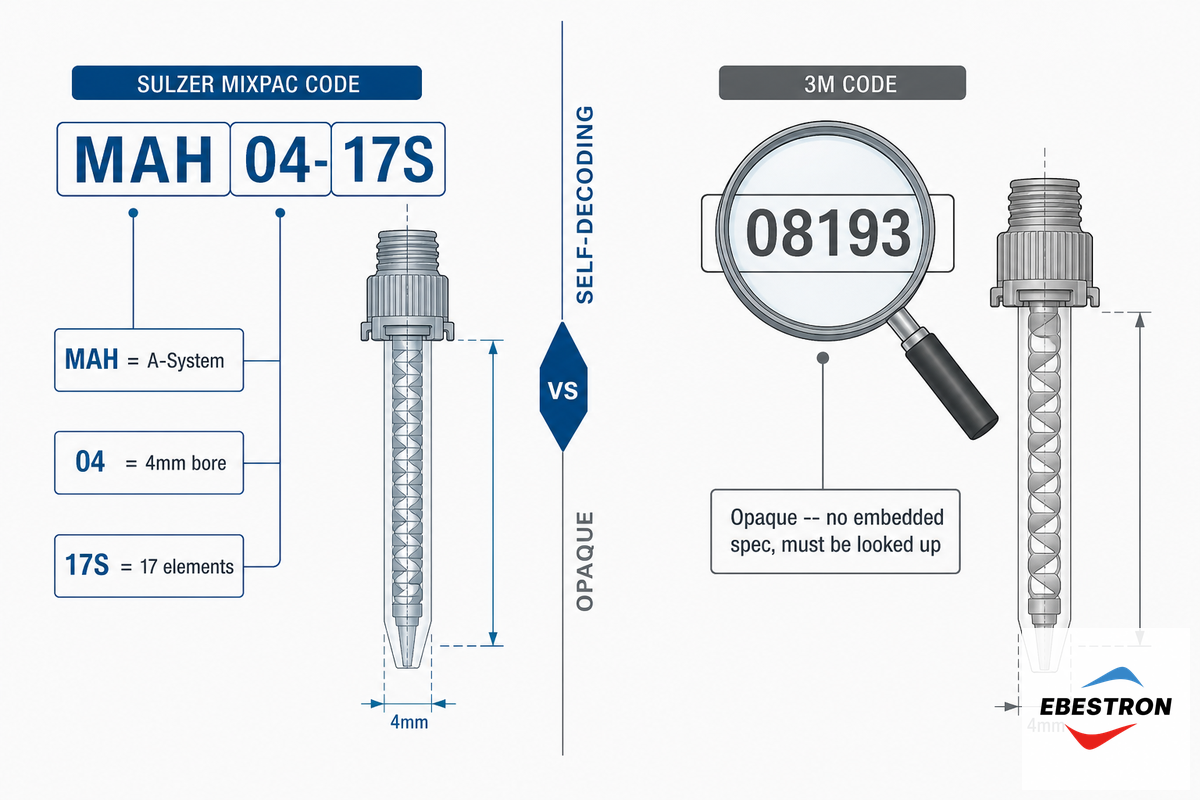
Un código de Sulzer Mixpac como MAH 04-17S permite conocer casi todo de un vistazo: la letra del sistema, un diámetro interior de 4 mm y 17 elementos. Un número de 3M como 08193 no dice nada: es un número de catálogo secuencial, no una especificación. Esa diferencia explica por qué existe la tabla anterior: el número de una pieza Sulzer se puede descifrar; el de una pieza 3M hay que consultarlo.
Cuando el número moldeado se ha desgastado o ya no se conserva la caja, un boletín técnico de noviembre de 2024 del distribuidor de equipos de dosificación de adhesivos Intertronics indica el procedimiento alternativo: primero, identificar la forma física —la sección transversal del elemento (redonda/helicoidal o cuadrada/Quadro) y el tipo de entrada (salientes de bayoneta o tuerca de retención tipo campana)—; después, reducir las opciones a una familia de sistemas antes de confirmar el diámetro interior y el número exacto de elementos según la ficha técnica del adhesivo. La misma lógica de codificación de entradas, que impide que la boquilla de un sistema encaje en el cartucho de otro, está documentada en patentes de mezcladores con doble entrada, como EP0885651A1. La forma permite identificar la familia adecuada, pero no sustituye la comprobación del diámetro interior y el número de elementos según la química del adhesivo.
Algunas fichas aportan más detalles que el número de catálogo por sí solo: un mezclador estático helicoidal diseñado para equipos de dosificación y mezcla (MMD), una entrada protegida por un capuchón o un cartucho en paralelo en lugar de coaxial. Los materiales también importan: las carcasas de PA (nailon) resisten mejor los sistemas de resina de metacrilato que las de PP sin modificar, y el diámetro interior del mezclador debe coincidir exactamente con la superficie de salida del cartucho, sea cual sea la marca. Un cartucho de 50ml con 18 elementos para epoxi a base de resina y un cartucho Mixpac de 50 ml con la misma química se dimensionan igual: cambia el número de catálogo, no la física.
Esta diferencia supone una pérdida real de tiempo en la planta de producción: un técnico de montaje que tiene en la mano una pieza 3M desgastada y sin números legibles debe parar la línea, fotografiar la base y esperar la respuesta de un proveedor antes de que pueda trabajar el siguiente turno. Ese retraso nunca se produce con un código Sulzer Mixpac que se descifra por sí solo. El equipo de ingeniería de Ebestron resuelve estos casos como recomienda el boletín: coteja el diámetro interior y el número de elementos con las fotos enviadas, en vez de hacer conjeturas a partir de un número de catálogo apenas legible, y confirma el ajuste antes de enviar la caja de repuestos. Como la documentación CE y RoHS acompaña cada coincidencia confirmada, también se elimina el riesgo de incumplimiento en un nuevo pedido.
Cómo cambiar de 3M a Mixpac: pasar de una pistola original a una configuración compatible
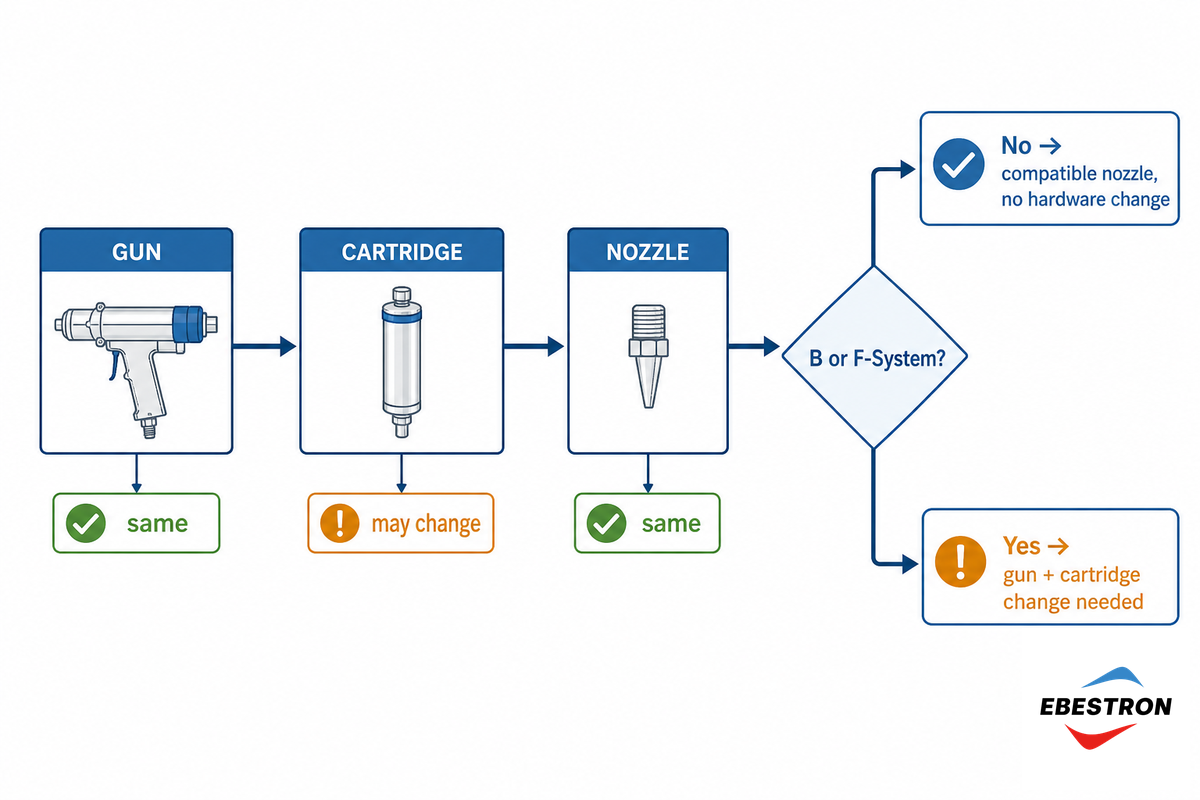
Quienes investigan este tema rara vez parten de cero: ya tienen una pistola 3M EPX o Sulzer Mixpac y quieren saber qué cambia y qué se mantiene al cambiar de marca de cartucho o boquilla. La pistola, el cartucho y la boquilla no cambian todos a la vez; cada uno plantea su propia cuestión de compatibilidad.
Cómo cambiar de 3M a Mixpac: qué debe cambiar realmente
| Si su pistola es… | Y el cartucho de destino es… | Qué cambia |
|---|---|---|
| Pistola 3M EPX de bayoneta, 50 ml | Sistema A de Sulzer Mixpac, 50 ml | Nada mecánico: misma familia de bayoneta; solo hay que cambiar el cartucho y la boquilla |
| Pistola 3M EPX de campana, 200 ml | Sistema C de Sulzer Mixpac, 200 ml | Nada mecánico: misma familia de campana/tuerca de retención |
| Cualquier pistola de sistema abierto | Sistema B o F de Sulzer Mixpac | Hay que cambiar tanto la pistola como el cartucho: utilizan una conexión con enclavamiento patentada que, por lo general, no admite equipos de otras marcas |
La tercera fila es donde suelen surgir los problemas: con los sistemas B y F no basta con cambiar la boquilla. Confirme qué sistema es realmente su pistola antes de pedir un cartucho de otra marca. Una pistola de bayoneta o de campana admite una boquilla compatible sin modificar el equipo; una pistola de sistema B/F, por lo general, no. Los resaltes y ranuras codificados que impiden que una pieza incorrecta encaje en una conexión con enclavamiento son precisamente los que describe una patente de codificación de conexiones entre mezclador y cartucho, como US9010578B2.
Cambiar en el mismo día una pistola 3M de 200 ml con montaje de campana por un cartucho compatible con Sulzer Mixpac en una línea de unión de paneles de automoción no requiere una pistola nueva ni recalificar la pistola: basta con cambiar el cartucho y la boquilla tras confirmarlo con la tabla de cambios anterior. El riesgo aparece en el caso opuesto: quien da por hecho que una pistola de sistema B es otra pistola de campana y pide un cartucho genérico descubre la incompatibilidad en el muelle de recepción, no antes. Antes de preparar el presupuesto, el equipo de ingeniería de Ebestron identifica el tipo de sistema a partir del código del fabricante original, precisamente para evitar que el problema se descubra en su zona de recepción y no por correo electrónico.
Comprobación del ajuste en 5 puntos antes de cambiar
Sulzer Mixpac tiene un historial documentado de litigios contra piezas que copian la imagen comercial de sus puntas mezcladoras dentales: tribunales de Colonia (2010/2011), del Distrito Sur de Nueva York (2009), de Düsseldorf y de Múnich (2020) han fallado contra copias casi idénticas de sus puntas mezcladoras con cúpula de color. La propia guía de Sulzer para reconocer una punta auténtica indica que debe llevar el nombre MIXPAC estampado en el anillo de retención y el Candy Color Quality Seal. Es una cuestión distinta de si es legítima una pieza de ingeniería funcional y con marcas diferentes que se anuncia como «compatible con»: lo es, y esta guía trata de eso. Pero precisamente por eso merece la pena dedicar cinco minutos a verificarla antes de cambiar.
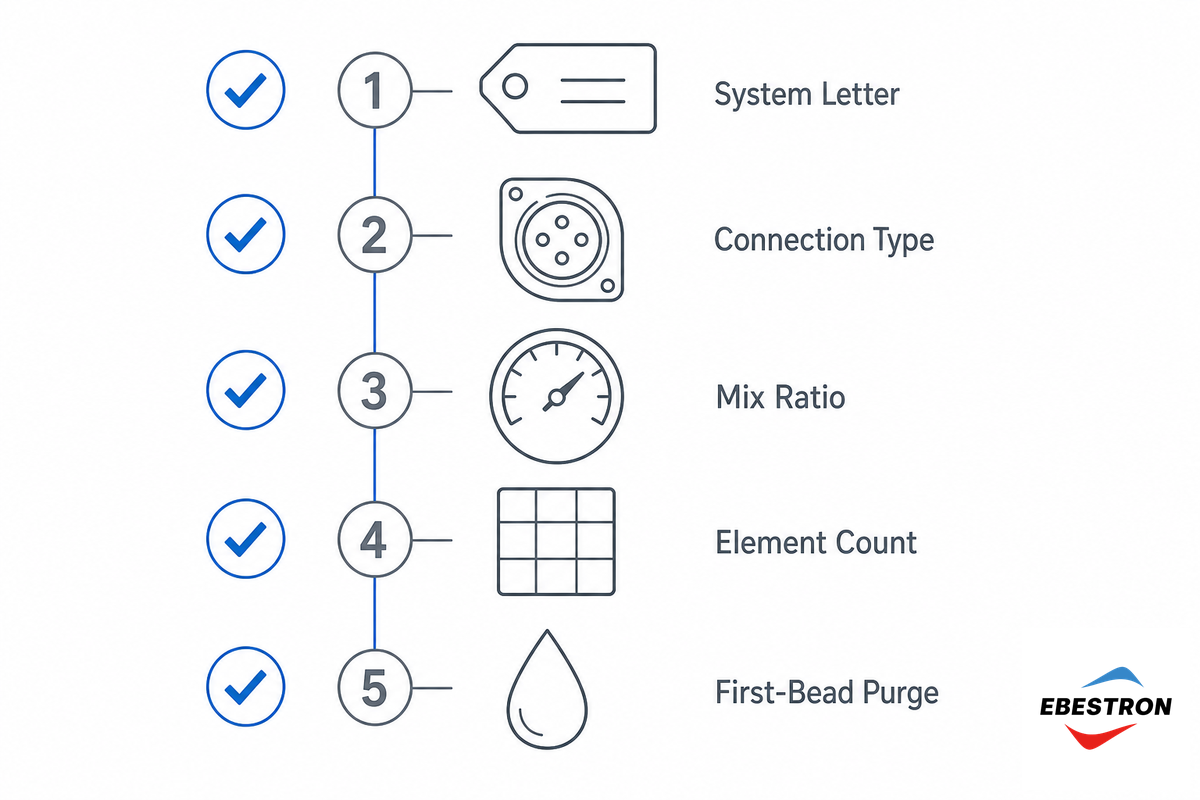
- ✔ Confirme la letra del sistema (A/B/C/F o EPX) impresa o moldeada tanto en la pieza antigua como en la nueva; no compruebe solo el diámetro interior.
- ✔ Compruebe físicamente el tipo de conexión —salientes de bayoneta o tuerca de retención tipo campana— antes de pedir una cantidad por cajas.
- ✔ Asegúrese de que la relación de mezcla marcada en el cartucho coincide con la relación nominal de la boquilla; no se fije solo en el diámetro interior.
- ✔ Confirme que el número de elementos se encuentra dentro del intervalo adecuado para la química del adhesivo (consulte las tablas de química y número de elementos del sitio); no dé por sentado que «más es mejor».
- ✔ Realice una «purga del primer cordón» en una pieza de prueba antes de iniciar la producción: deseche aproximadamente un volumen interno de boquilla antes de aplicar el primer cordón real (el mismo principio de purga que la OSHA menciona para controlar la exposición a isocianatos al abrir por primera vez una línea de mezcla nueva).
«Cada reclamación de ajuste que investigamos se debe a una de dos causas: la letra del sistema no coincidía realmente o nadie purgó la primera dosis. Ninguna de las dos es un defecto de la pieza; son comprobaciones de cinco segundos que alguien se saltó».
Equipo de ingeniería de Ebestron, I+D de dosificación de adhesivos, Kunshan
Saltarse esta comprobación es la razón por la que devolver una caja cuesta más que las piezas que contiene: una línea de encapsulado de componentes electrónicos que recibe una boquilla de otra marca sin verificar y la utiliza de todos modos se arriesga a perder un turno completo de producción con una pieza no cualificada, no solo a obtener un cordón defectuoso. Ebestron envía todos los pedidos compatibles con documentación CE y RoHS precisamente para resolver el riesgo de ajuste antes de que la caja llegue a su muelle, no después.
Resolución de problemas: cuando un mezclador de otra marca no encaja o empieza a tener fugas
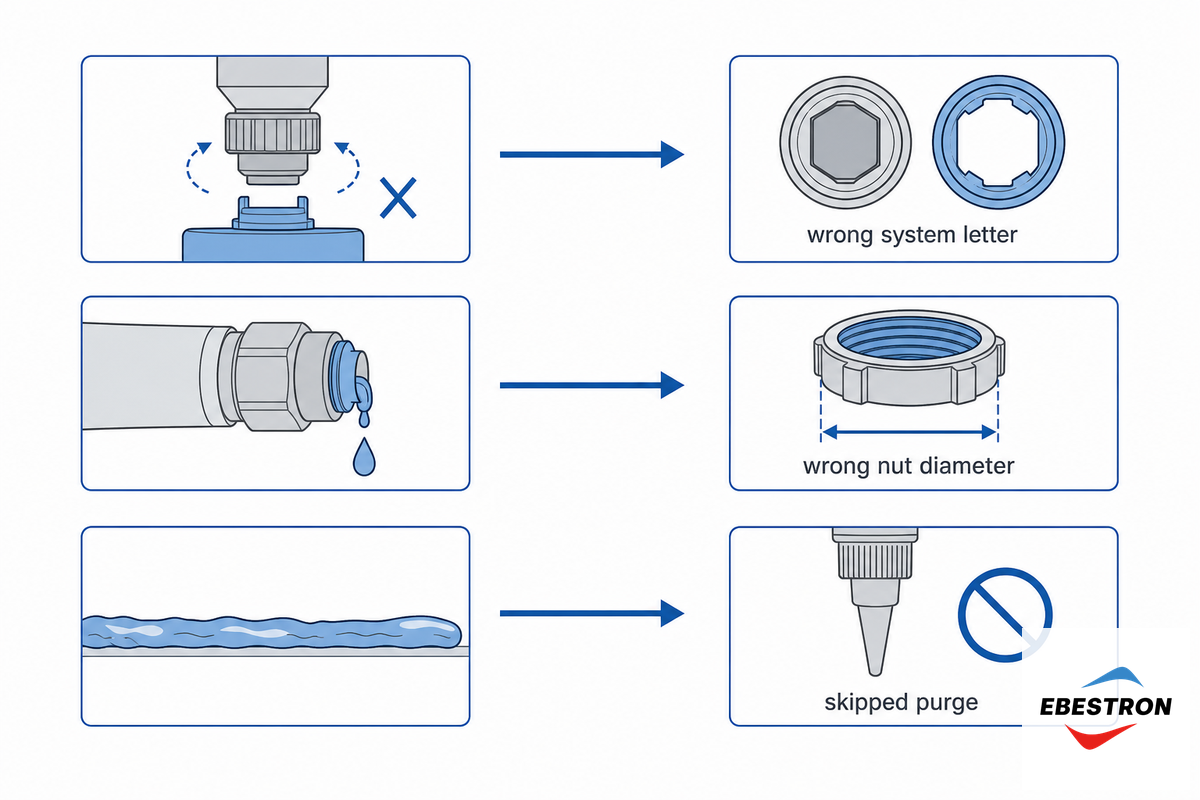
La mayoría de los cinco síntomas siguientes se deben a la misma causa: se eligió el diámetro interior sin comprobar la geometría que realmente determina las especificaciones de un mezclador —camisa, sección transversal del elemento y número de elementos—, tal como se documenta en patentes como US7484881B2, en lugar de cotejar el código completo del sistema.
| Síntoma | Causa más probable | Solución |
|---|---|---|
| La boquilla no encaja al girarla | Separación entre los salientes de bayoneta propia de otra familia de sistemas | Vuelva a confirmar la letra del sistema, no solo el diámetro interior |
| Fugas en la unión de la tuerca de retención | Tuerca de campana de un cartucho con otro diámetro | Compruebe la rosca de la tuerca y el diámetro del cuello, no solo el volumen del cartucho |
| El primer cordón presenta vetas o un color irregular | No se ha purgado la boquilla nueva | Deseche aproximadamente el equivalente a ~1 volumen de boquilla antes de aplicar el cordón real |
| La pistola no admite el cartucho | Se intenta introducir un cartucho de sistema B/F en una pistola de sistema abierto | Confirme el sistema antes de hacer el pedido; consulte la tabla de cambios anterior |
| Se necesita mucha fuerza manual y el cordón queda incompleto | El número de elementos es demasiado alto para una pistola manual | Adapte el número de elementos a la química; si realmente necesita ese número, pase a un sistema neumático |
La causa de fondo de la mayoría de estos cinco síntomas es la misma diferencia estructural: el comprador comprobó el diámetro interior, pero pasó por alto la letra del sistema porque ambos números parecen intercambiables en una ficha técnica y no lo son. El equipo de ingeniería de Ebestron observa este patrón sobre todo en líneas de 200 ml con montaje de campana que cambian entre cartuchos 3M y Sulzer Mixpac, donde una comparación basada solo en el diámetro interior pasa por alto el paso de rosca de la tuerca de retención. Cotejar ambos datos con el código del fabricante original, no solo con el diámetro, permite resolverlo antes de que la pistola llegue a la línea.
¿Cambiar de marca modifica los cálculos de la mezcla?
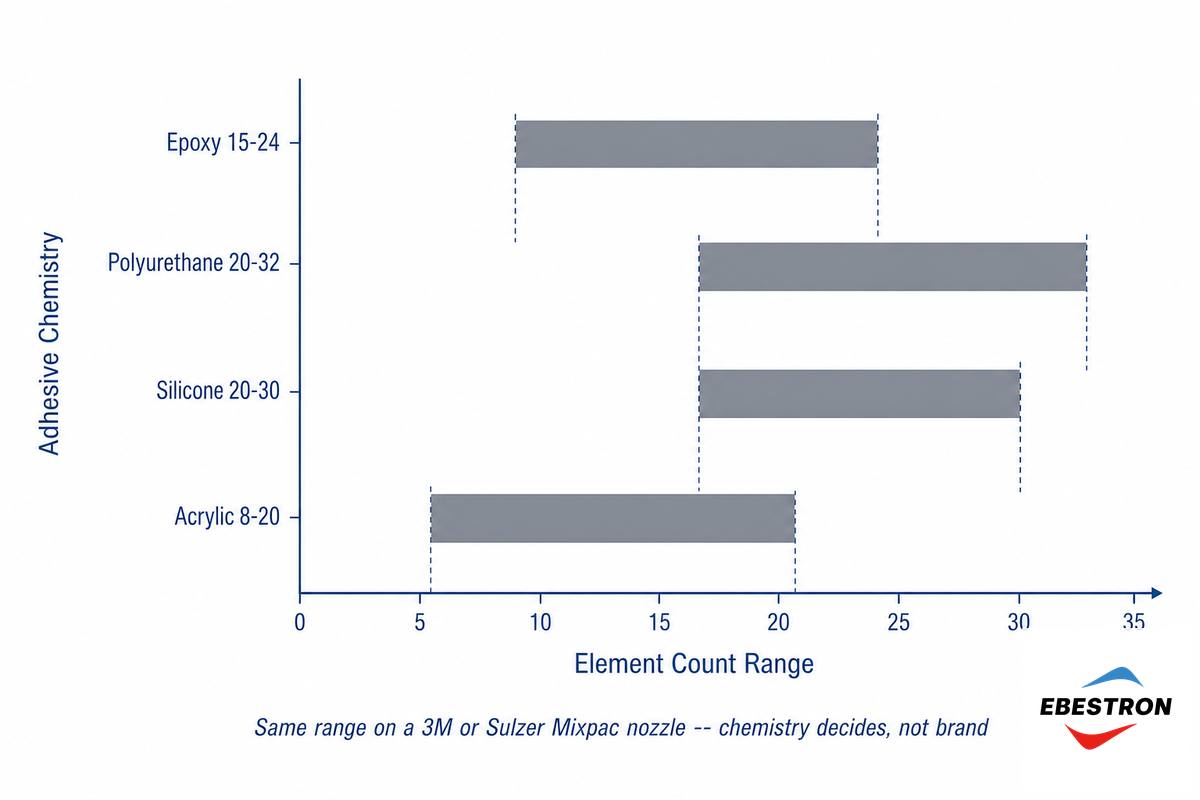
No: el número de elementos depende de la química del adhesivo y de la relación de mezcla, no de la marca del cartucho. Un epoxi de uso general 1:1 suele requerir aproximadamente entre 15-24 elementos, tanto si se dispensa con una boquilla 3M EPX como con una compatible con Sulzer Mixpac; un poliuretano 10:1 necesita un intervalo más amplio, de 20-32 elementos, en ambos casos. La marca cambia; los cálculos de la mezcla, no.
Ejemplo práctico: al cambiar un epoxi 2:1 de una 3M 08193 (18-21 elementos) a su equivalente Sulzer Mixpac MCH, se mantiene el intervalo de 18-24 elementos para esa química. Para consultar las tablas completas de química y número de elementos y los cálculos de estriación 2ⁿ, consulte la guía de boquillas mezcladoras estáticas y la comparativa de 18 frente a 24 elementos del sitio.
El error más habitual al cambiar es dar por supuesto lo contrario: un comprador cambia una aplicación de montaje con poliuretano 10:1 de una boquilla 3M a una compatible, pero sigue usando por costumbre el antiguo intervalo de 15-24 elementos para epoxi, y luego se pregunta por qué el cordón cura de forma irregular bajo carga. La química no ha cambiado y la relación tampoco, así que el intervalo de elementos tampoco debería cambiar. El equipo de ingeniería de Ebestron dimensiona cada presupuesto de piezas compatibles de otra marca según la química y la relación de mezcla reales del adhesivo, no según el número de elementos de la pieza sustituida. Por eso la misma ficha técnica con documentación CE sirve tanto si la boquilla se envía con un código de referencia cruzada de 3M como de Sulzer Mixpac.
El coste real del cambio: existencias de fabricantes originales ya adquiridas, inversión en pistolas y residuos de transición

Comparar los precios por boquilla (índice 100 frente a índice 30-55, según las cifras publicadas en la página del producto) no es suficiente. El dato decisivo al cambiar durante la producción es el coste de la transición: existencias sobrantes de cartuchos del fabricante original que acabarán desperdiciándose, coste adicional de equipo nuevo si se necesita (a menudo cero, salvo en sistemas B/F; consulte la tabla de cambios anterior) y tiempo invertido en una nueva cualificación (lote de prueba y comprobación de purga). Es la misma disciplina de cualificación que ya exigen los sistemas de calidad auditados conforme a ISO 9001 para cualquier cambio de proveedor.
✔ El cambio cuesta menos cuando…
- La familia del sistema es la misma (bayoneta con bayoneta, campana con campana): coste de pistola cero
- Las existencias del fabricante original están casi agotadas
- La relación y la química se mantienen idénticas
⚠ El cambio cuesta más cuando…
- El sistema de destino es B/F (puede que haya que cambiar la pistola)
- Quedan muchas existencias del fabricante original sin consumir
- Su sistema de gestión de calidad exige realizar pruebas de nueva cualificación
El verdadero riesgo de cambiar con prisas no es la diferencia de precio por boquilla. El coste adicional se debe a que una línea de producción agota las existencias del fabricante original a mitad del turno y tiene que parar para volver a hacer un pedido al proveedor, porque nadie controló el agotamiento de existencias en relación con la fecha del cambio. Para calcularlo en cada presupuesto, Ebestron pregunta por el volumen mensual actual de cartuchos y las existencias del fabricante original, precisamente porque un cambio en el mismo día en un sistema de bayoneta o campana elimina ese riesgo estructural; un cambio en un sistema B/F, que requiere sustituir la pistola, no.
Errores comunes al buscar referencias cruzadas de piezas Sulzer Mixpac y 3M
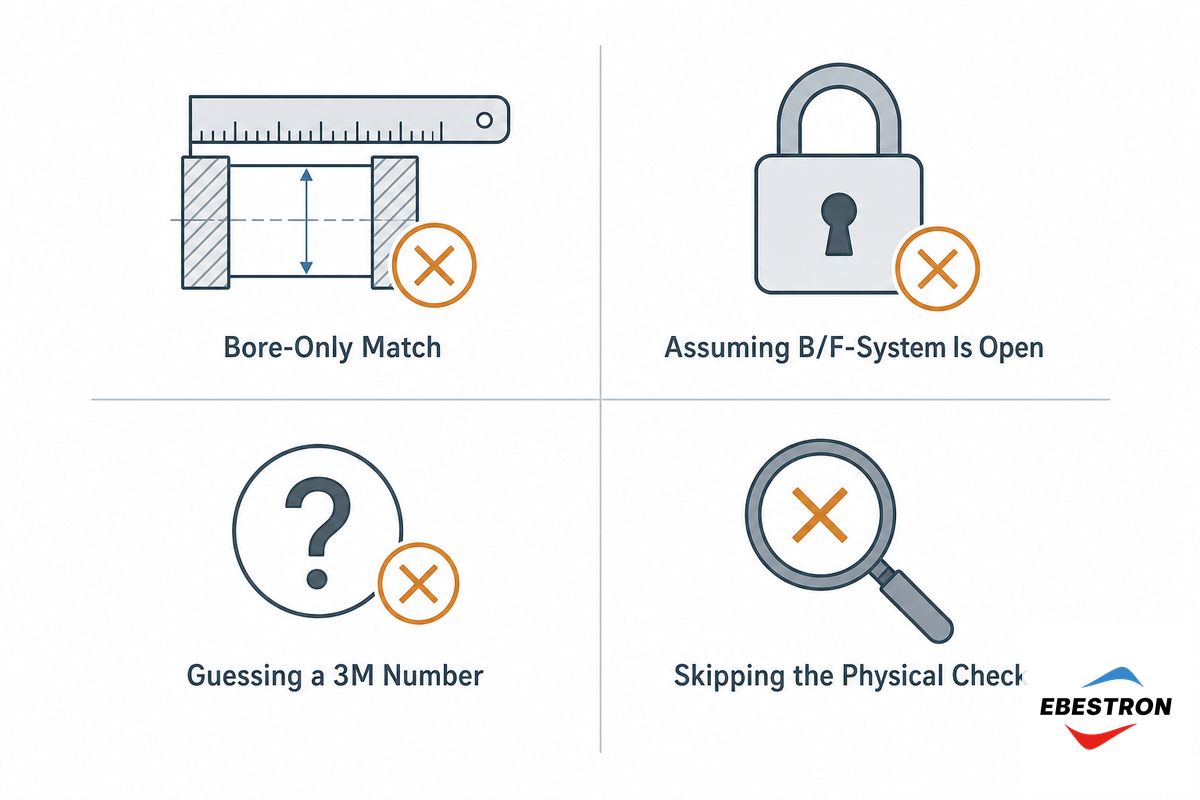
- ✔ Dar por hecho que el sistema coincide y fijarse solo en el diámetro del orificio.
- ✔ Suponer que los sistemas B y F equivalen a los sistemas abiertos: estas conexiones patentadas suelen estar protegidas por patente y no son intercambiables.
- ✔ Interpretar los números de catálogo de 3M como datos que pueden descodificarse directamente, igual que el formato de Sulzer Mixpac. No es así: hay que consultar una tabla de equivalencias.
- ✔ Omitir la comprobación de que la conexión física coincide porque el número del diámetro del orificio de la caja «parece correcto». La geometría fija de los deflectores internos, que es la que determina la calidad de la mezcla, se describe en patentes de dispositivos de mezcla estática como US4538920A, no en la etiqueta.
Los cuatro errores tienen el mismo origen: considerar que un solo número —el diámetro del orificio, la relación de mezcla o una cifra del catálogo— basta para confirmar la compatibilidad, cuando la regla de las 3 coincidencias exige que coincidan los tres datos. El equipo técnico de Ebestron detecta aproximadamente un caso al mes en el que el propio intento del cliente de buscar una equivalencia pasa por alto específicamente la letra del sistema. Es el error más costoso de esta lista, porque detiene la producción en lugar de limitarse a desperdiciar unas cuantas boquillas.
Perspectivas del sector: cambios en la compatibilidad entre mezcladores de distintas marcas

El mejor indicador de las compras de 2026 no es un nuevo diseño de mezclador, sino hasta qué punto Sulzer Mixpac defiende sus conexiones patentadas. Las resoluciones judiciales de Estados Unidos, Alemania y Suiza dictadas entre 2009 y 2020 reflejan de forma sistemática medidas contra diseños imitativos, incluida una medida cautelar dictada en 2020 por un tribunal regional de Múnich. Por ese historial, esta guía identifica los sistemas B y F como exclusivos del fabricante original.
Sin embargo, no todo ha seguido la misma línea: en 2024, el Tribunal Superior de Delhi, en India, falló en sentido contrario y confirmó el rechazo de una solicitud de patente de Sulzer Mixpac para un mezclador estático por motivos de estado de la técnica. Esto recuerda que la situación de las patentes varía según la jurisdicción y no puede darse por supuesta en todos los mercados. Para las compras de 2026, la conclusión práctica es que hay que verificar si el tipo de conexión es abierto para cada sistema; no debe darse por hecho que esa situación queda resuelta de una vez para siempre. Por otra parte, los proveedores siguen informando de trabajos de investigación y desarrollo sobre geometrías de mezclador con menos elementos (un fabricante afirma que logra una mezcla completa con tan solo ~7 elementos, frente a los 24-32 habituales). Es un dato que conviene seguir, pero procede de una sola fuente y todavía no refleja un cambio generalizado en el sector. La química también evoluciona: la norma de verificación del tiempo de utilización de adhesivos estructurales multicomponente, ISO 10364, recibió su propia revisión en 2024.
Para un comprador que negocia un contrato de 12 meses, el riesgo práctico no es un cambio de diseño, sino una interrupción del suministro: si una pieza de un único proveedor es objeto de un litigio o cambia de clasificación a mitad del contrato, puede desaparecer sin previo aviso. Ebestron aborda esta cuestión de patentes como cualquier otra: recomienda por defecto el inventario de sistemas abiertos (A, C y K en Sulzer Mixpac; EPX en 3M) y señala que los presupuestos para sistemas B/F requieren verificar con el fabricante original, en lugar de dar por sentada su disponibilidad dentro de un año.
Preguntas frecuentes
P: ¿Una boquilla de Ebestron encajará de verdad en mi pistola dosificadora Sulzer Mixpac o 3M?
Ver respuesta
Sí, siempre que coincidan la letra del sistema, el tipo de conexión y la relación de mezcla: es la misma regla de las 3 coincidencias que explica esta guía. Envíe el código del fabricante original moldeado en la pieza que utiliza (un número MAH/MBH/MCH para Sulzer o uno del tipo 08193/38195 para 3M) y Ebestron confirmará la equivalencia compatible antes de que haga el pedido, aplicando el mismo criterio de equivalencias que en la tabla anterior. Conviene señalar desde el principio que los cartuchos de los sistemas B y F son la excepción, ya que sus conexiones están protegidas por patente y, por lo general, solo están disponibles como piezas del fabricante original.
P: ¿Una boquilla compatible ofrece la misma calidad que una de marca?
Ver respuesta
Cuando la geometría coincide realmente —mismo diámetro del orificio, mismo número de elementos y misma conexión—, la calidad de la mezcla depende de esa compatibilidad, no de la marca moldeada en el cuerpo. La distinción que importa desde el punto de vista jurídico es entre una pieza compatible diseñada para funcionar correctamente (legítima y objeto de esta guía) y una pieza que copia la imagen comercial protegida de otra marca (tema del historial de litigios mencionado en la sección de verificación anterior). Son categorías de producto distintas.
P: ¿Pueden sustituir la boquilla mezcladora para epoxi que compré en una tienda?
Ver respuesta
Casi siempre. Las boquillas para cartuchos de dos componentes que se venden al por menor —incluidas las de las marcas 3M y Sulzer Mixpac que se comercializan en ferreterías y tiendas de carrocería— siguen las mismas convenciones de los sistemas A/B/C/F y EPX que se utilizan en la dosificación industrial. Compare el tamaño y la relación de mezcla del cartucho con la tabla de equivalencias anterior y podrá instalar directamente una pieza equivalente suministrada de fábrica, normalmente con un coste por unidad inferior al de la pieza original vendida al por menor.
P: ¿Puede coincidir por casualidad el número de referencia de una pieza de 3M con uno de Sulzer Mixpac?
Ver respuesta
No. Los códigos de Sulzer Mixpac indican directamente el sistema, el diámetro del orificio y el número de elementos; los números de catálogo de 3M son secuenciales y no contienen información sobre las especificaciones. Cualquier parecido entre un número de 3M y uno de Sulzer Mixpac es casual y no sirve para buscar una equivalencia.
P: ¿Cuál es el mayor riesgo de pasar de 3M a una configuración compatible con Mixpac en plena producción?
Ver respuesta
Saltarse la etapa de recalificación, no cambiar el componente. Si coinciden la familia del sistema y la relación de mezcla, cambiar una boquilla por otra de una marca distinta es una operación mecánica rutinaria. El riesgo real está en ejecutar un lote completo de producción con la pieza nueva antes de comprobar, primero en una prueba a pequeña escala, que se forma un primer cordón uniforme y que el curado es constante. Esta comprobación de cinco minutos evita un problema de retrabajo mucho mayor más adelante.
P: ¿Puedo combinar piezas originales de 3M con piezas compatibles con Mixpac en la misma línea de producción?
Ver respuesta
Sí, siempre que cada combinación de pistola, cartucho y boquilla cumpla por separado la regla de las 3 coincidencias en su estación. No es necesario estandarizar toda la línea con una sola marca: agote el material de 3M original en una estación mientras valida una configuración compatible con Sulzer Mixpac en otra; después, consolide el cambio cuando la estación de prueba supere el control de calidad. Si su sistema de gestión de calidad exige trazabilidad de un único proveedor para cada número de referencia, guarde las dos marcas en cajas separadas.
Por qué escribimos este artículo
Ebestron fabrica las boquillas mezcladoras estáticas compatibles que se describen en esta tabla de equivalencias: conexiones de bayoneta y de campana diseñadas para encajar directamente en los sistemas Sulzer Mixpac y 3M EPX. Creamos esta página porque las dos consultas de asistencia que recibimos con más frecuencia son «¿qué significa realmente mi número de 3M?» y «¿encajará de verdad?», y ninguna página de nuestro sitio —ni de ningún otro que pudiéramos encontrar— respondía a ambas preguntas en una sola tabla. Revisado por el equipo técnico de Ebestron.
Referencias y fuentes
- Informe de evaluación ELC-2582 — ICC Evaluation Service
- Informe de evaluación ELC-4457 — ICC Evaluation Service
- SGW-64294-01, especificación para anclajes en hormigón — Departamento de Energía de Estados Unidos, emplazamiento de Hanford
- Mezcladores estáticos para sistemas de alta viscosidad: del diseño clásico al optimizado mediante aprendizaje automático — ACS Omega (2025)
- Revisión de la calidad de mezcla de los mezcladores estáticos — von Damnitz et al., MDPI Processes (2025)
- Sulzer Mixpac sigue defendiendo sus derechos y protegiendo a sus clientes — Sulzer Mixpac Ltd, comunicado oficial (2021)
- Fracasa el recurso de Sulzer Mixpac sobre la patente de un mezclador estático al respaldar un tribunal indio la existencia de antecedentes técnicos — MLex (2024)
- Isocianatos: evaluación de la exposición — Administración de Seguridad y Salud Ocupacional
- TB2024-23: cómo identificar una boquilla mezcladora — Intertronics, boletín técnico (nov 2024)
- US3286992A, dispositivo de mezcla — Armeniades, Johnson y Raphael, Arthur D. Little Inc. (USPTO vía Google Patents)
- EP0885651A1, mezclador — Wilhelm A. Keller (EPO vía Google Patents)
- US9010578B2, codificación de la conexión entre mezclador y cartucho — USPTO vía Google Patents
- US7484881B2, geometría del dosificador y del mezclador — USPTO vía Google Patents
- US4538920A, dispositivo de mezcla estática — USPTO vía Google Patents
- ISO 9001:2015, sistemas de gestión de la calidad — Organización Internacional de Normalización
- ISO 10364:2024, adhesivos estructurales: tiempo de utilización de los adhesivos multicomponente — Organización Internacional de Normalización
Artículos relacionados
- Mezcladores compatibles con Sulzer Mixpac y 3M: página completa de productos y suministro de piezas originales
- Tipos de boquillas mezcladoras estáticas: explicación de las conexiones de bayoneta, campana, cruz y cuadradas
- Boquillas mezcladoras estáticas para adhesivos de dos componentes: guía de 2026
- Mezcladores estáticos de 18 frente a 24 elementos: guía de selección
- Solución de problemas de pistolas de aplicación: 5 problemas habituales con pistolas para cartuchos 2K y sus soluciones
- Pistolas de aplicación compatibles con Mixpac y Cox
- Acerca de Ebestron