Get in touch with Ebestron Company

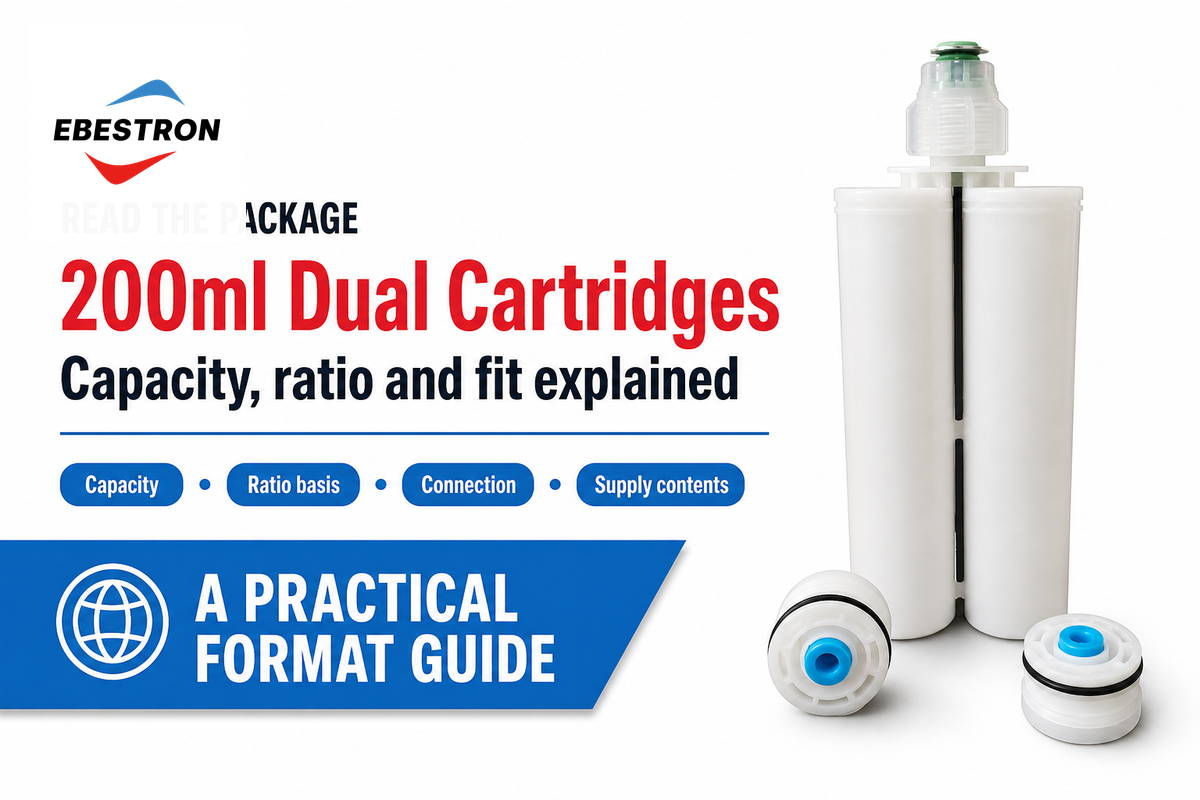
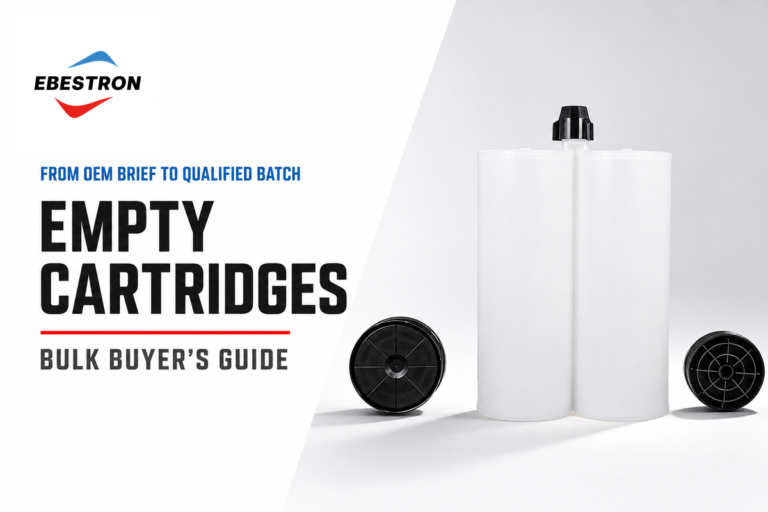
200ml dual cartridges keep the two components of an adhesive separate in different chambers and hold them until they’re ready to be dispensed. The size label on the package is just a starting point. The interpretation of a package label depends upon the mix ratio, supplied parts and outlet connection. Reading the package labels can help ensure that you don’t inadvertently order a nozzle that attaches to the cartridge but has never been specified for the adhesive.
Quick answer
Read five labels before choosing a replacement: capacity, adhesive ratio and its basis, cartridge construction, outlet connection, and supply contents. A 200 ml designation alone does not specify net adhesive fill, gun compatibility, extrusion pressure or restart time.
200ml dual cartridges and their five key labels
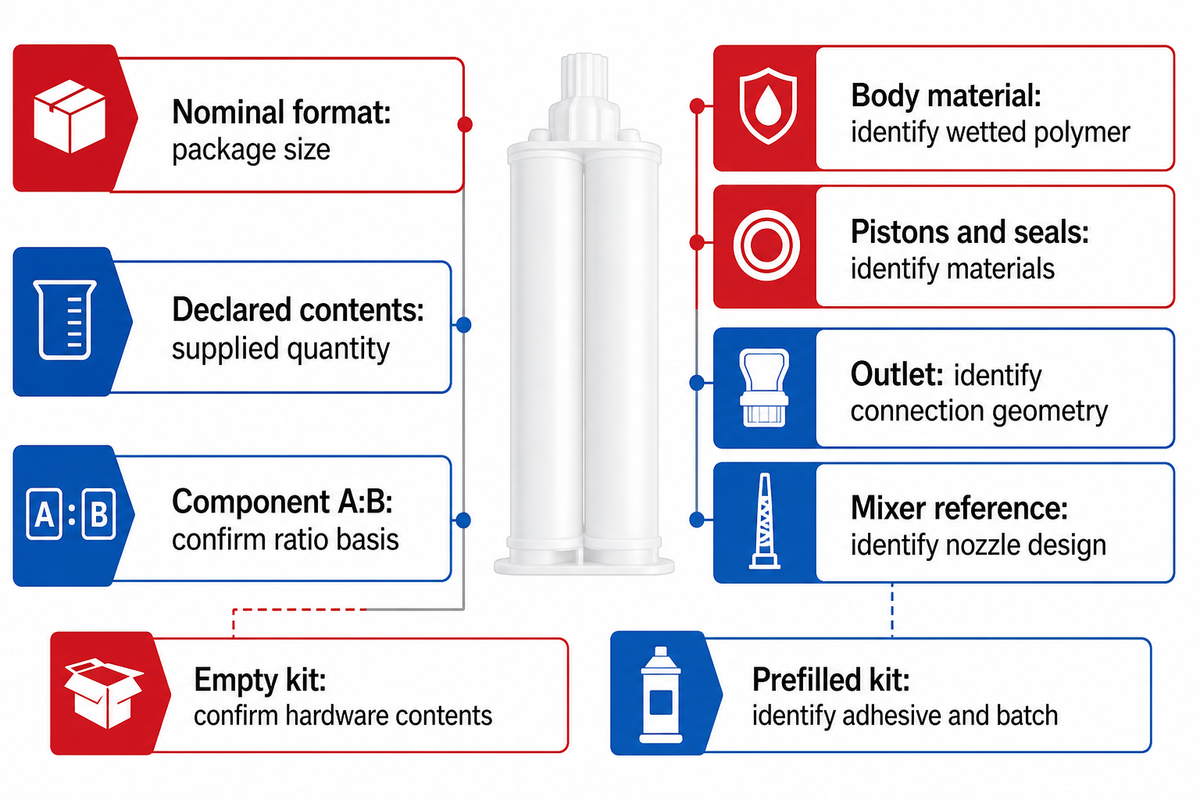
A dual cartridge is a package for keeping reactive components apart before use. Its labels describe different things: nominal capacity identifies the format; the mix ratio describes proportions; construction identifies wetted parts; the outlet defines a connection; supply contents explain what arrives. Treating these as separate fields makes a catalogue entry easier to read.
How do 200ml dual cartridges work?
An applicator in conjunction with a static mixer is a system to advance the pistons and provide a means to divide and recombine the component streams. TWI’s explanation of reactive adhesive dispensing describes this system and differentiates it from other mixing systems. The package and dispenser must be aligned with the adhesive ratio specified.
| Label group | Field or type | What it tells you | What it leaves open |
|---|---|---|---|
| Capacity | Nominal format | Package size class, such as 200 ml | Exact usable cavity volume |
| Capacity | Declared adhesive contents | Quantity stated for a filled product | How much reaches the joint after dispensing |
| Ratio | Component A:B | Relative proportions, such as 2:1 | Whether the stated basis is volume or mass |
| Construction | Body material | Plastic in contact with stored material | Suitability of every seal in the assembly |
| Construction | Pistons and seals | Moving closures and their specified materials | Compatibility inferred from body color |
| Connection | Outlet and attachment | Geometry used to connect the mixer | Mix quality from physical attachment alone |
| Connection | Mixer part reference | Identified nozzle design | Suitability for another adhesive formula |
| Supply contents | Empty body or component kit | Hardware supplied for filling | Presence of resin, hardener or a gun |
| Supply contents | Prefilled adhesive kit | Packaged components identified by product and batch | Whether spare mixers are included |
The decoder merges distinctions in components described in reviewed technical sources; it’s an editorial reading aid, not a product specification. A photo can show two barrels without mention of missing fields. Request the part description if a listing states only “dual component cartridge kit.”
Nominal 200ml size versus actual adhesive volume
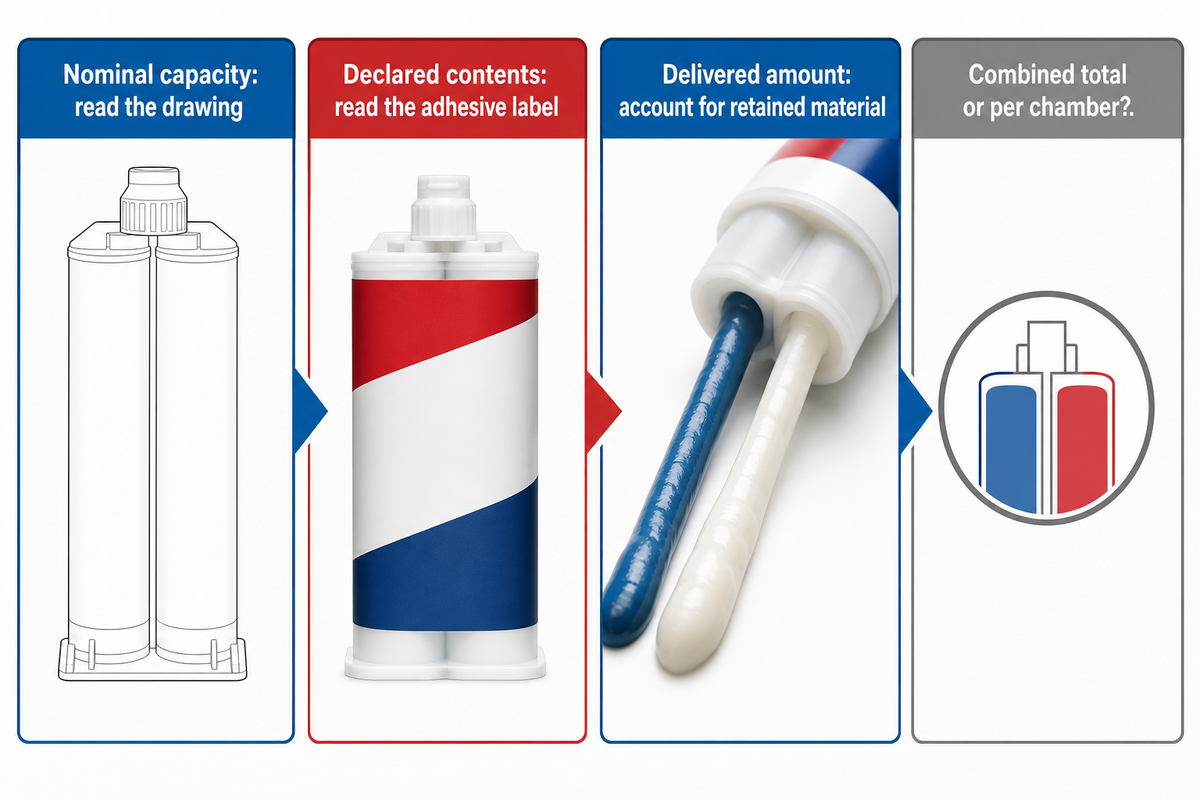
The nominal size of an empty cartridge and the declared contents of a filled adhesive product answer different questions. Read the cartridge drawing for capacity and the adhesive label for quantity supplied. Neither figure, by itself, gives the amount of mixed material delivered to a bond line or a potting cavity.
Suppose a hypothetical customer is evaluating an empty 200 ml body and a 200 ml pre-filled kit. The empty body and the pre-filled kit both state 200 ml, but the empty body is hardware and the pre-filled kit is supplied material. The customer must determine if pistons and a cap come with the empty body, and if the 200 ml kit includes a proper mixer. A job requiring 200 ml at the point of application creates another question: the material retained in the package or mixer must be determined using the system’s data. Comparing just the headline price would put the offers on different terms.
For a dual package, confirm whether the quoted volume is the total volume or individual chamber capacity. A total volume of 200 ml should never be silently read as 200 ml in each chamber. Equally, referring to a body as “nominal” doesn’t negate the net content claim of a filled product.
Mix ratio and chamber volumes explained
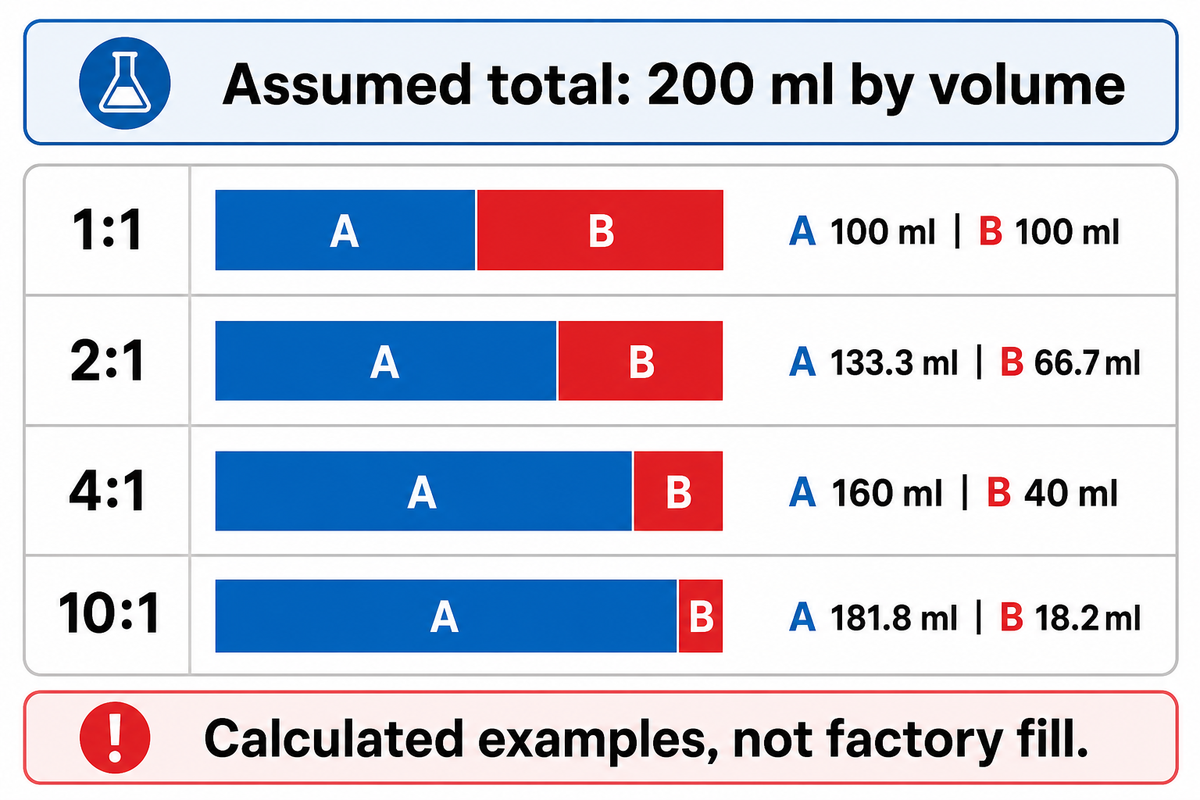
A mix ratio gives the relationship of the constituents on a stated basis. For a volumetric ratio of 2:1, two units of A are accompanied by one unit of B. If the components have different densities, a ratio by weight would be different; don’t substitute one basis for the other.
| A:B by volume | Component A | Component B | Meaning |
|---|---|---|---|
| 1:1 | 100 ml | 100 ml | Equal volumes |
| 2:1 | 133.3 ml | 66.7 ml | A is twice B |
| 4:1 | 160 ml | 40 ml | A is four times B |
| 10:1 | 181.8 ml | 18.2 ml | A is ten times B |
Values are calculated, and rounded to the nearest 0.1 where necessary. These examples describe relative proportions, and aren’t offered models, nor do they describe chamber dimensions or actual factory fill. Assuming a total V and a volumetric ratio of a:b, A = V × a ÷ (a + b) and B = V × b ÷ (a + b).
A technician wants to check a proposed 2:1 package on paper, assuming a combined volume of 200 ml. The ratio contains three equal shares, so 200 ÷ 3 gives about 66.7 ml per share. Component A takes two of the parts, or 133.3 ml, and part b takes the remaining 66.7 ml. Adding these gives 200 ml. This checks the arithmetic, but the technician still has to check the adhesive’s ratio basis and see the package drawing. An adhesive specification giving a weight ratio makes this volume calculation invalid for weighing the main resin and second component without the relevant density.
A useful arithmetic check
180 ml plus 20 ml totals 200 ml, but the ratio is 9:1. A 10:1 split has eleven shares, which gives about 181.8 ml and 18.2 ml for the same assumed total.
Changing the adhesive ratio isn’t a way to specify a faster cure. Follow the formulation’s instruction. Likewise, a gun’s mechanical thrust ratio describes its mechanism and isn’t the adhesive’s A:B ratio.
Cartridge bodies, pistons and outlet connections
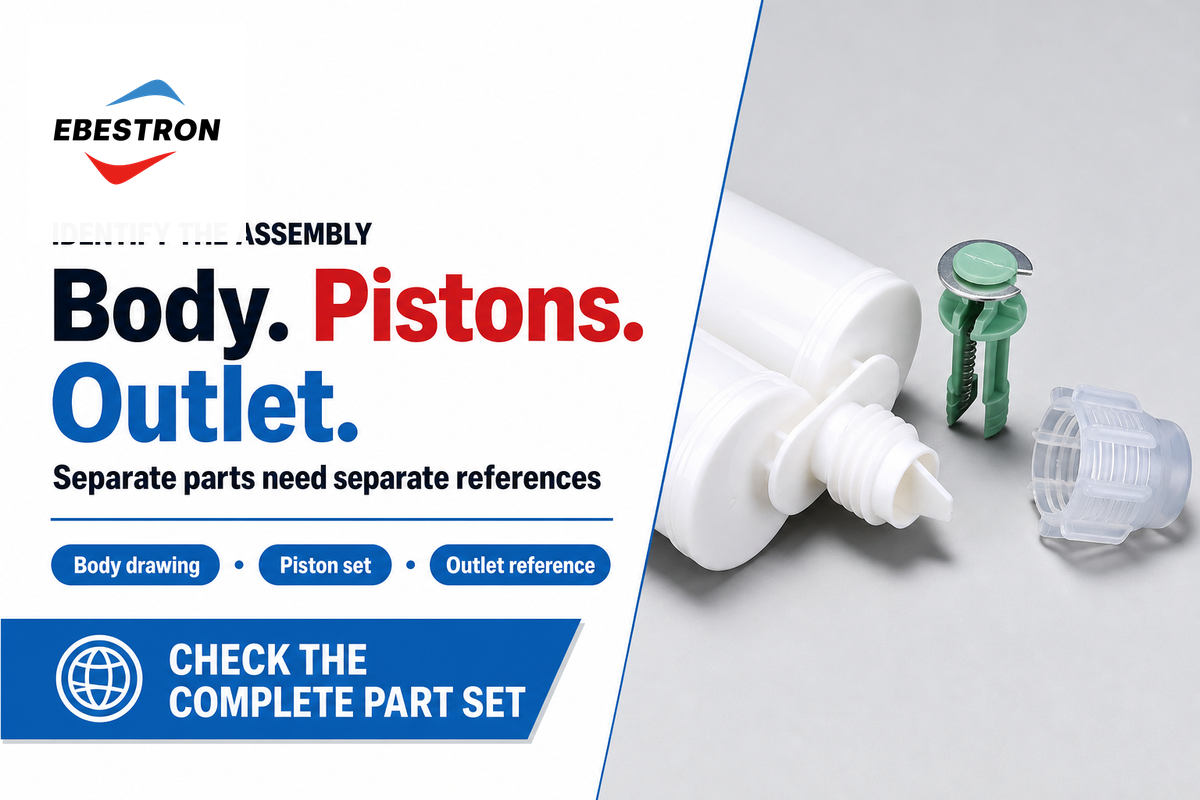
Read the cartridge body, pistons, seals and outlets as separate parts of the assembly. A body description of polypropylene identifies one material and provides little information on the sealing surfaces and the behavior of the adhesive. Component drawings and material specifications provide a firmer basis for comparison than the color of the barrel, a familiar silhouette, or a generic system name.
In “Finding the Match”, supplier specialist Craig A. Blum describes how body compatibility and piston or seal behavior can differ. The 2009 article is useful technical background; its examples aren’t current test results for an Ebestron product. A body that suits a formulation doesn’t automatically establish that its seal material does too.
An open end at the back, a piston design, and a tip cap seal at the front each need the correct drawing reference. If a listing states dual air-vented pistons, determine what that means with regard to the filling process; the term doesn’t supply filling instructions. Likewise, a stepped end at a nozzle describes a shape, not an entire specification of compatibility.
System labels should be read with their maker’s part references. A legacy Sulzer label is still incomplete without a drawing. A nozzle specified for use with the C-system dual cartridge must be matched to that particular assembly; the name doesn’t describe every 200 ml package. The guide to identifying nozzle attachment types provides more information on the vocabulary.
For a 200 ml request, provide the body part, piston set, and outlet drawing. Procurement can then compare the assembly that’s being quoted with the assembly that’s currently being used. A matching volume on two web pages isn’t sufficient to determine those parts are interchangeable.
Matching a 200ml cartridge gun and static mixer
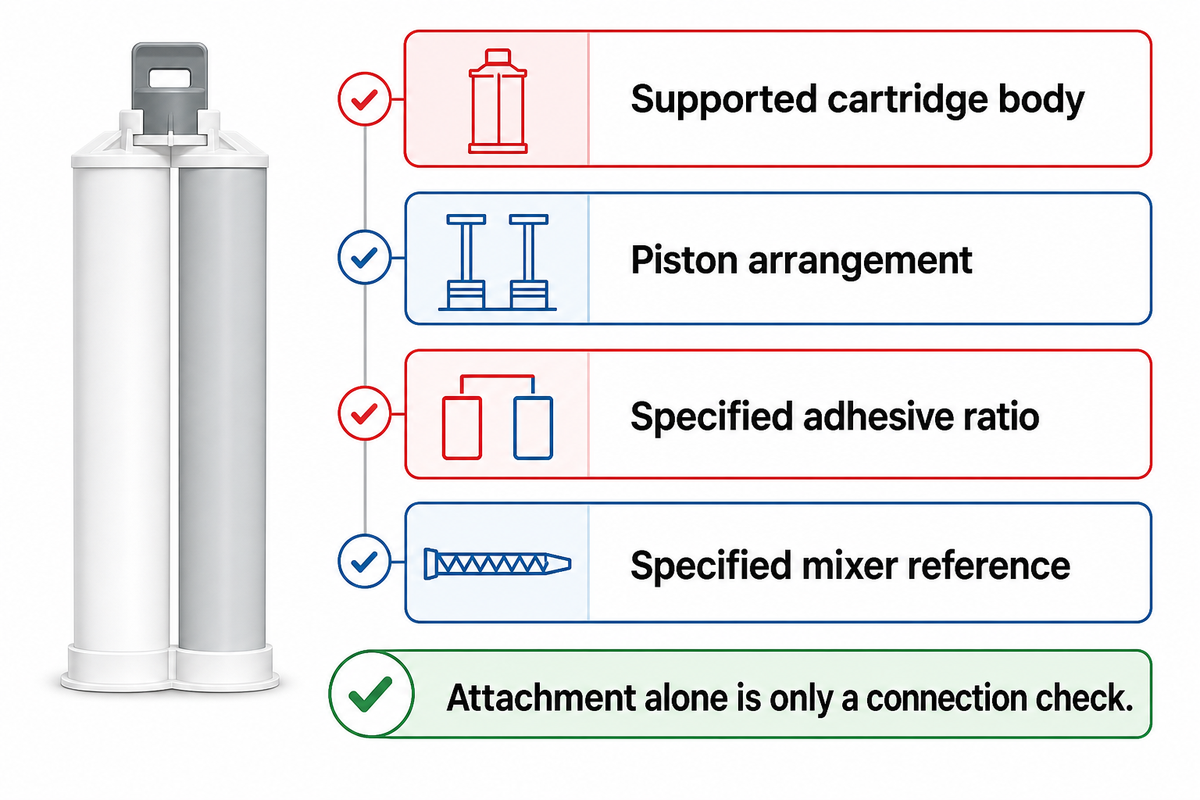
The physical configuration of the cartridge’s support, the piston arrangement, the adhesive ratio, and the specified mixer must match the dispensing setup. A nozzle locking onto the outlet has only passed a connection check. The internal geometry of the nozzle and the adhesive’s flow behavior impact whether the setup can dispense and mix as required.
Cartridge gun dispensers are designed for a defined package arrangement. Craig Blum’s technical article on cartridge systems explains size and ratio matching, including dispensers with changeover capability. Some guns are available with more than one supported setup. For a 200ml dual cartridge gun, identify the supported body, piston arrangement, adhesive ratio and mixer reference as one matching chain.
The ASSEMBLY Article on choosing a static mixer mentions the outlet geometry, internal diameter, and mixing elements as variables for selection. It also states that not all epoxy needs the same element count. An industry standard manual gun description can’t verify that two products are compatible and neither can a nozzle’s external appearance.
Extrusion is another question. ASTM D5267-97(2026) describes the method for measuring the force required to extrude an adhesive from a cartridge at a given temperature. Its public scope supplies no universal gun force or pressure setting. Respect the chosen equipment’s instructions and component ratings.
A hand applicator should fit comfortably into the hand while holding the selected package; that’s a separate check from its cartridge compatibility. A manual dual cartridge gun, air-powered dispensers and bench robots can involve different installation requirements. Equipment selection beyond label interpretation is covered in the dispensing-gun selection guide.
Empty adhesive cartridges, prefilled kits and mix-and-pour
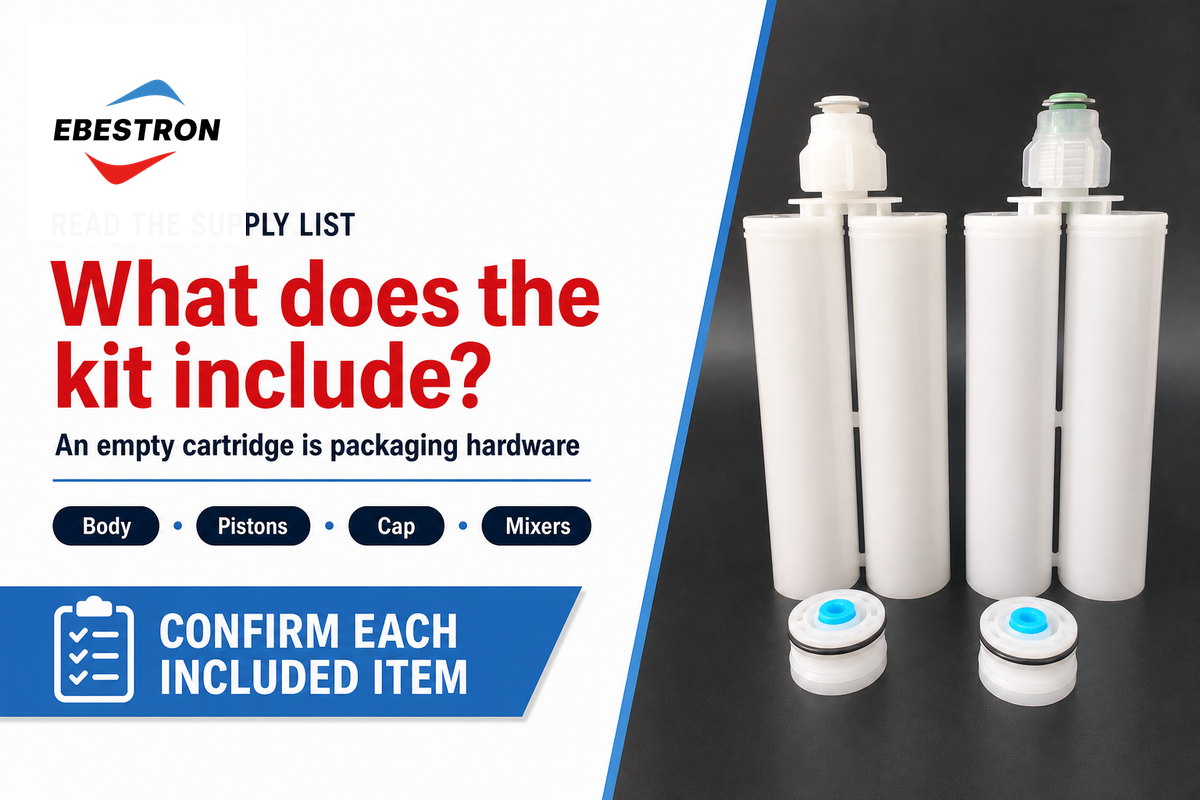
An empty cartridge supplies packaging hardware; a prefilled kit supplies the adhesive components. A mix-and-pour method breaks measuring and mixing into separate steps. One may begin evaluating options by who supplies the material and who controls its preparation. That is, one shouldn’t make assumptions about ease and cost of using a particular package (e.g., assuming that an empty cartridge is always cheaper to use).
Industrial dispensing components can be sold individually. Examine the itemized contents for the body, pistons, cap and mixers. A title such as “dual cartridge kit 200ml size” doesn’t indicate if an adhesive or a gun is included. Small- and large-volume syringe barrels, and twin cartridges require corresponding parts; resemblance to a familiar syringe isn’t sufficient.
Two part epoxies, two-part silicones and PU polyurethanes have formulation-specific instructions. Potting compounds and other assembly fluids may require different preparation although their packages look similar. Controlled application of two component epoxies follows the specified method and ratio of mixing. A static nozzle retains some material; “never waste material” isn’t a good reference.
| Supply route | Useful when | Remaining responsibility |
|---|---|---|
| Prefilled kit | A supplier offers the identified adhesive in a specified package-and-mixer combination | Confirm suitability for the application and follow the kit instructions |
| Empty cartridge | You have a defined filling process and can verify the complete package with the formulation | Control filling, sealing, component identity and subsequent use |
| Mix and pour | The adhesive instructions and application permit separate measuring and mixing | Control the ratio, mixing method and time available for application |
The availability of spare mixers should also appear in a kit comparison. Replacing a used mixer may be part of a product’s instructions, but the necessary part and restart conditions must also be specified in that product. Coverage of other selection issues is available in the extended adhesive-cartridge selection guide.
Comparing 50 ml packages against 200ml and 400ml and 600ml is a different sizing decision. The smaller cartridge guide’s pack size discussion covers this comparison.
Reading the instructions for a filled adhesive kit
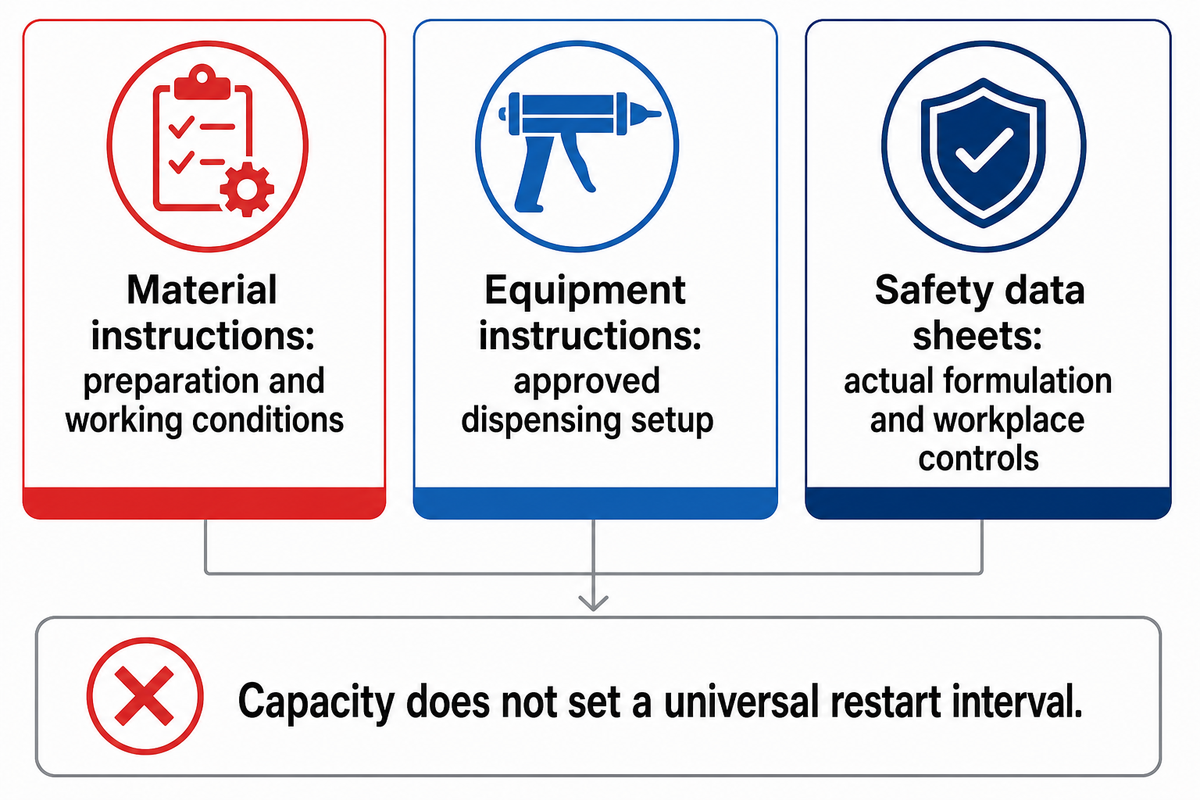
A filled adhesive kit requires instructions for the actual material and the dispensing hardware. One must evaluate the component identities, the basis for the ratio, and the requirements for preparation and the stated working conditions. The cartridge’s nominal size can’t provide a universal startup sequence, purge quantity or restart interval. Replacement mixers must also comply with the instructions of the product.
How are 200ml dual cartridges used?
They’re used in conjunction with a documented adhesive-dispensing system: a compatible applicator advances the pistons in the specified package and delivers the material to the approved mixing arrangement. Prior to use, review the instructions for preparation and application. The site’s two-part cartridge operating walkthrough provides a general description of the sequence.
OSHA’s chemical-hazards guidance explains the role of labels, safety data sheets and worker information. Chemistry matters: OSHA’s isocyanates overview includes adhesive-related exposures. That doesn’t mean every cartridge contains isocyanates. Use the actual formulation’s sheets and the controls appropriate to the workplace.
Working-life figures also need their test context. The public abstract of ISO 10364:2024 cautions:
“The different methods described in this document to measure the property do not necessarily provide identical results.”
Pot-life doesn’t provide authorization to leave any 200 ml setup idle and restart it later. This isn’t a general permission to do so. Check the instructions and replacement conditions.
Keeping a 200ml format record before ordering
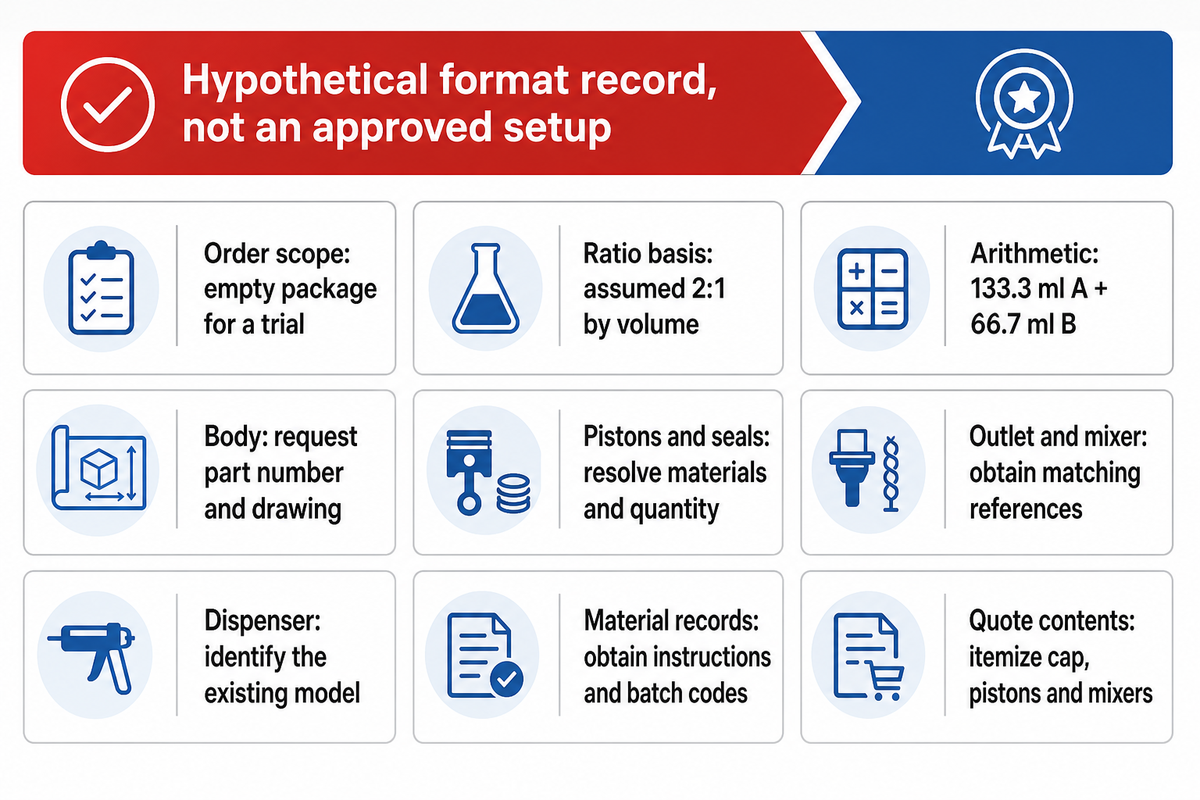
A format record preserves the identity of the package separately from assumptions about adhesive use. The record must identify what the label or drawing actually establishes; the quotes must provide the answers to questions. Procurement needs a defined part set; operators need the corresponding installed part set; quality needs the basis of the ratio and the current instruction for the product; and finance needs comparable kit contents.
| Field | Example entry | Next decision and limit |
|---|---|---|
| Order scope | Empty 200 ml package for a proposed trial | Procurement requests hardware; adhesive is a separate item |
| Ratio basis | Assumed 2:1 by volume for this example | Quality confirms the actual formulation’s required basis |
| Arithmetic check | Assumed total 200 ml: 133.3 ml A + 66.7 ml B | Do not treat calculated shares as drawing dimensions |
| Body identity | Part number and drawing not yet supplied | Request both before identifying a replacement |
| Pistons and seals | Materials and supplied quantity not yet specified | Resolve the complete part set, not only the body polymer |
| Outlet and mixer | No confirmed matching nozzle reference | Obtain the specified connection and mixer part |
| Dispenser | Existing applicator model must be identified | Operator checks its supported cartridge and ratio setup |
| Material records | Product instructions, labels and batch codes needed | Quality records formulation identity and current revision |
| Quote inclusions | Cap, pistons and spare mixers to be itemized | Finance compares equal contents; no assumed cost saving |
The example is a synthesis of the label and component distinctions previously shown. The intent is to identify unresolved entries rather than fabricate part numbers.
Imagine a small assembly shop replacing a package used for an electronics-potting trial. Purchasing has a 200 ml description and a photo; the operator has an applicator but no model recorded on the request. Quality has a 2:1 ratio in a note without its basis. Ordering would immediately turn three missing identifiers into assumptions. The record instead separates the tasks: purchasing requests the body and mixer references, the operator identifies the applicator, and quality verifies the ratio basis. Finance can then compare the included parts across the offers. None of the checks determine that the adhesive meets the finished assembly performance requirements. Application acceptance remains a separate decision.
Test names need the same care. ASTM D1002-10(2019) addresses comparative apparent shear testing of metal single-lap specimens. Citing it does not certify a cartridge, establish mixer compatibility or provide a universal design stress.
For Ebestron’s available format details, take the completed identifiers to the 200ml dual-cartridge solution page. Include the proposed ratio, body drawing, outlet reference and dispenser model with your inquiry so the discussion starts from a defined package.
200ml dual cartridge questions
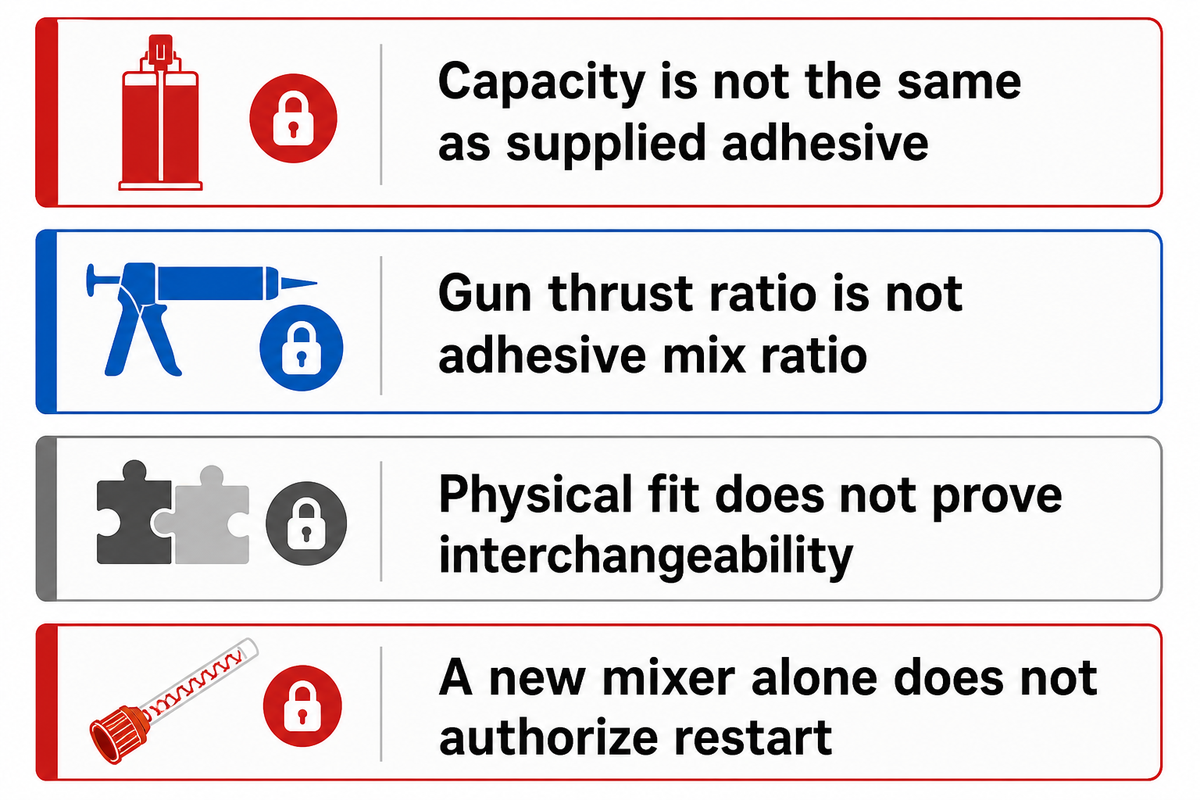
Questions regarding this format typically involve a missing qualifier: total vs. chamber volume, mass vs. volume ratio, or physical fit vs. specified mixing performance. The answers given in this record maintain those distinctions. The identified adhesive and equipment instructions govern any decision to dispense, replace the mixer or restart a filled package.
Does the 200ml label tell me how much adhesive is supplied?
For an empty package, the size label doesn’t imply adhesive is inside. For a filled product, read the declared contents and the component information and confirm whether the quantity is combined or per component. Keep in mind that usable hardware capacity, supplied contents and the amount delivered to the application are separate quantities and shouldn’t be substituted for one another for a material calculation.
Can a 2:1 cartridge be used for an adhesive requiring 1:1?
Those ratios shouldn’t be considered interchangeable. The package and dispenser must deliver the adhesive’s specified proportions on the correct basis. A cartridge that’s made to fit the gun isn’t an approved substitute just because it fits. Verify the material instructions and supported package setups; an arithmetic example shouldn’t be considered authorization for a change in formulation ratio.
Will any mixer labelled 200ml fit my cartridge?
No. The nominal package size doesn’t determine the outlet size or fully define a mixer. An attaching mixer also needs to be assessed for the adhesive and dispensing conditions. Compare part references and drawings. A system name, barrel color or “industry standard” description is insufficient evidence of physical and functional interchangeability.
Does an empty dual-cartridge kit include epoxy?
No. Read the itemized supply list for adhesive, body, pistons, cap and mixers. “Kit” could be considered a hardware set. A prefilled 2-part adhesive product should declare its contents and be provided with material information.
Can I fit a new mixer nozzle and restart later?
Follow the adhesive and equipment instructions for replacement, storage and restart. A new mixer nozzle alone doesn’t indicate that the remaining material or outlet is fit for reuse. No universal idle period is defined by a 200 ml capacity label.
Is a gun’s thrust ratio the same as the adhesive mix ratio?
No. Mechanical thrust ratio describes the gun mechanism. Adhesive mix ratio describes the relative amounts of components, with a mass or volume basis. Record the two quantities separately, when comparing an applicator and a two-component package.
Does a dual cartridge require dynamic mixing?
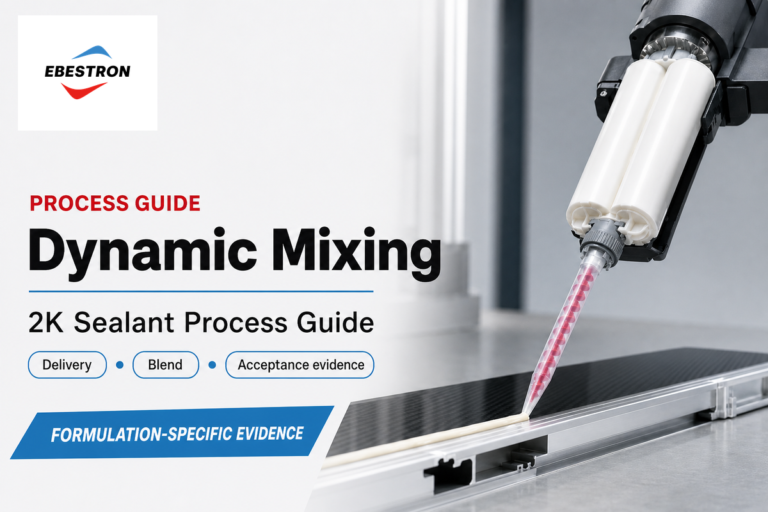
No. Dual cartridges can use a specified static mixer. A powered dynamic mixing head adds a different mixing mechanism; it doesn’t, by itself, determine the correct feed ratio. The static and dynamic mixing comparison explains when that distinction matters.
References & Sources
- What options are there for mixing and dispensing reactive adhesives? TWI.
- Finding the Match Adhesives & Sealants Industry, Craig A. Blum, July 2009; supplier-authored technical background.
- Two-Component Adhesive and Sealant Cartridge Systems Adhesives & Sealants Industry, Craig A. Blum, January 2009; supplier-authored technical background.
- Dispensing: How to Choose a Static Mixer ASSEMBLY, May 2003.
- ASTM D5267-97(2026), Determination of Extrudability of Cartridge Adhesives ASTM International, public scope.
- Chemical Hazards and Toxic Substances U.S. Occupational Safety and Health Administration.
- Isocyanates U.S. Occupational Safety and Health Administration.
- ISO 10364:2024, Structural adhesives — Determination of the pot life (working life) of multi-component adhesives International Organization for Standardization, public abstract.
- ASTM D1002-10(2019), Apparent Shear Strength of Single-Lap-Joint Adhesively Bonded Metal Specimens by Tension Loading ASTM International, public scope.