
Get in touch with Ebestron Company

What Is a Static Mixer? Complete Guide


Static Mixer Guide
What is a Static Mixer? It’s a device for mixing flows of liquid, gas, paste, or adhesives as they pass over internal fixed structures in a tube or nozzle with no powered moving parts in the flow stream.
Quick Specs
| What it is | A motionless mixer that uses internal elements, baffles, or shaped passages to divide and recombine flow. |
|---|---|
| What drives mixing | Flow from a pump, pressure vessel, cartridge plunger, or dispensing gun. |
| Common formats | Inline pipe mixer, sanitary process mixer, disposable static mixer nozzle, and molded plastic cartridge mixer. |
| Main tradeoff | Better homogeneity usually costs pressure drop, dispensing force, retained material, or all three. |
| Adhesive nozzle range | Ebestron nozzle pages list 3-13 mm bore options, 7-49 elements, 1:1 to 10:1 ratios, and 50/200/400 ml cartridge systems. |
What Is a Static Mixer?
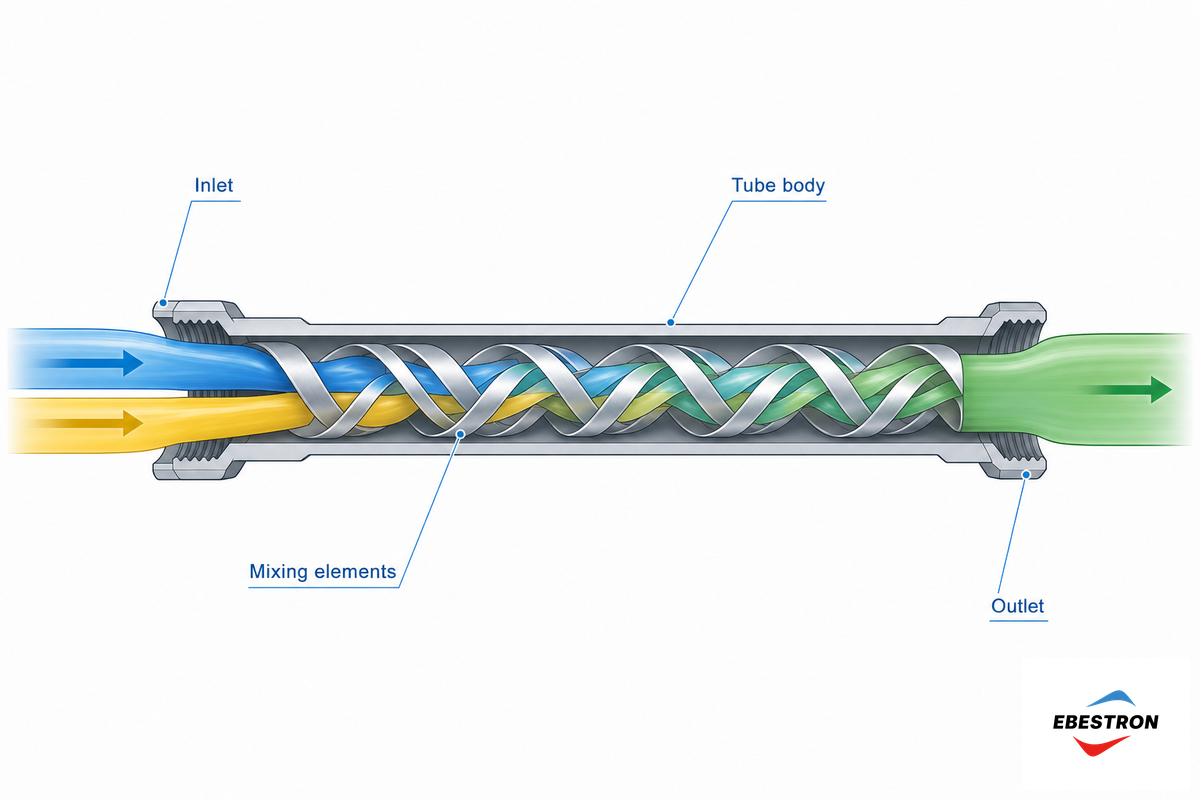
This fixed, in-tube mixing system is a static mixer. Instead of having a rotating impeller, it consists of a set of internal structures which force the input streams to divide, rotate, stretch, fold, and re-meet as the fluid stream flows down the tube or nozzle. Because the stream flows past stationary structures, it is also called a motionless mixer.
In its inspection guide, the U.S. Food and Drug Administration refers to Kenics static mixers as in-line piping equipment for heating and mixing liquids, suspensions, slurries, pastes, and gases in food, drug, and cosmetic plants. It also notes the value of no moving parts and easy cleaning in sanitary designs.
Adhesive packaging buyers often use the term for a static mixing tube attached to the dispensing nozzle on a dual-cartridge device. Process engineers may use it for a stainless-steel inline mixer installed in piping. Both types use similar physical principles but need different engineering checks.
How a Static Mixer Works: Baffle, Miscible, Laminar, and Turbulent Flow
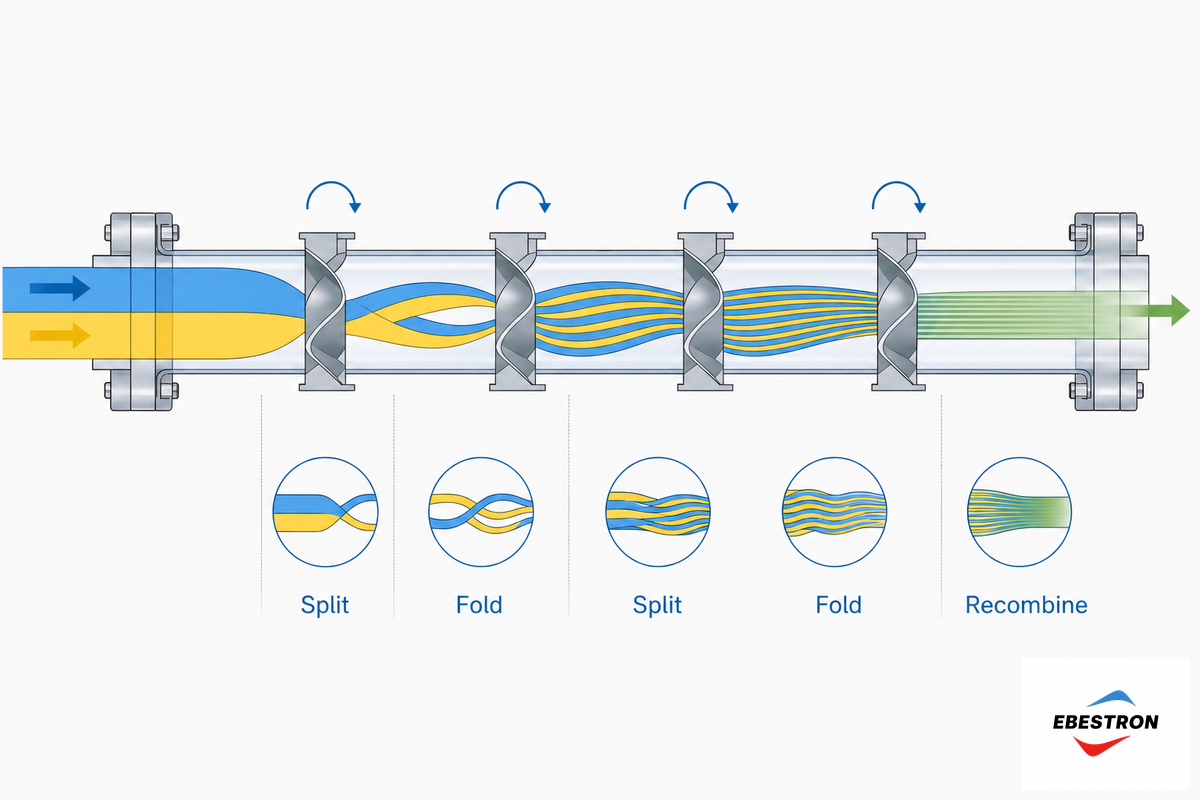
The science behind the device relies on flow energy moving through specially shaped structures in the mixing element. Kenics helical designs twist each cross-section by redirecting the flow from inside to outside the pipe and back in again as it advances. Other designs use baffle plates, corrugated tubes, or vortex-generating shapes to create a radial mix with numerous splits and reunions of streams as they advance.
How does a static mixer work?
Visualize a pair of colored streams being fed into a clear tube. As flow passes through the first mixing element, streams of individual colors will be divided into thinner and thinner layers. The next mixing element turns this collection of layers 180° then divides each one into even thinner layers again. Molecular forces take care of small distances between unlike elements.
While high viscosity flow makes it difficult to create turbulence, the geometry of the mixing element keeps the mixing action active. In laminar flow, the element geometry creates repeated folding and stretching. In turbulent flow, the same device can help move material from wall to center and back again. The 2014 review in Chemical Engineering Research and Design describes these devices as promoting secondary transverse flows and mass or heat transfer across the pipe section.
Engineering note: pressure drop is not a side issue. One 2023 numerical study on laminar-flow mixers found that four triangular baffles raised the mixing index but also raised pressure drop, while a changed angle of attack improved mixing and reduced pressure drop in that model. Choose the fewest elements and the right geometry that still reach the required degree of mixing.
Inline Static Mixers vs Cartridge Static Mixing Nozzles
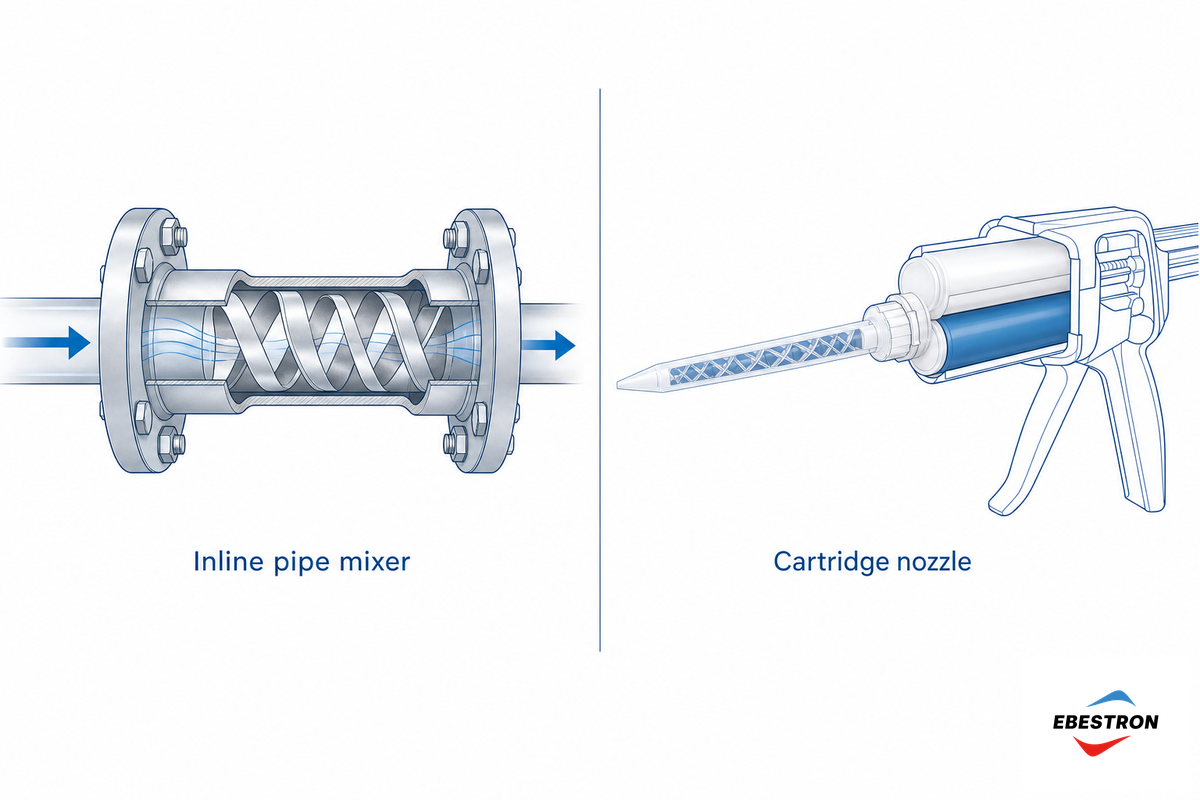
To make selection as simple as possible, separate mixers into two broad families: those which install on a nozzle or cartridge and those which insert into a pipe or other in-line process.
| Question | Inline static mixer | Cartridge static mixing nozzle |
|---|---|---|
| Where it sits | Inside a process pipe or sanitary tube. | On the outlet of a two-part adhesive cartridge or meter-mix head. |
| Typical material | Water, chemicals, food product, slurry, gas-liquid flow. | Epoxy, polyurethane, silicone, MMA, acrylic, or other 2K adhesive. |
| Main buying risk | Incorrect pipe size, flow rate, material compatibility, or head loss. | Wrong connection, wrong ratio system, too much back pressure, or poor cure. |
Most inline static mixers are specified as part of an industrial process, so flow rate, pressure limit, cleaning method, and fluid compatibility carry more weight than cartridge fit. In buying workflow, a disposable nozzle is close to an industrial static mixer in principle but not in purchasing details.
If you are working with dual cartridges, start with the static mixing tubes family and confirm cartridge fit before comparing element count.
Main Static Mixer Types: Helical, Quadro, Pipe, and Disposable Nozzle
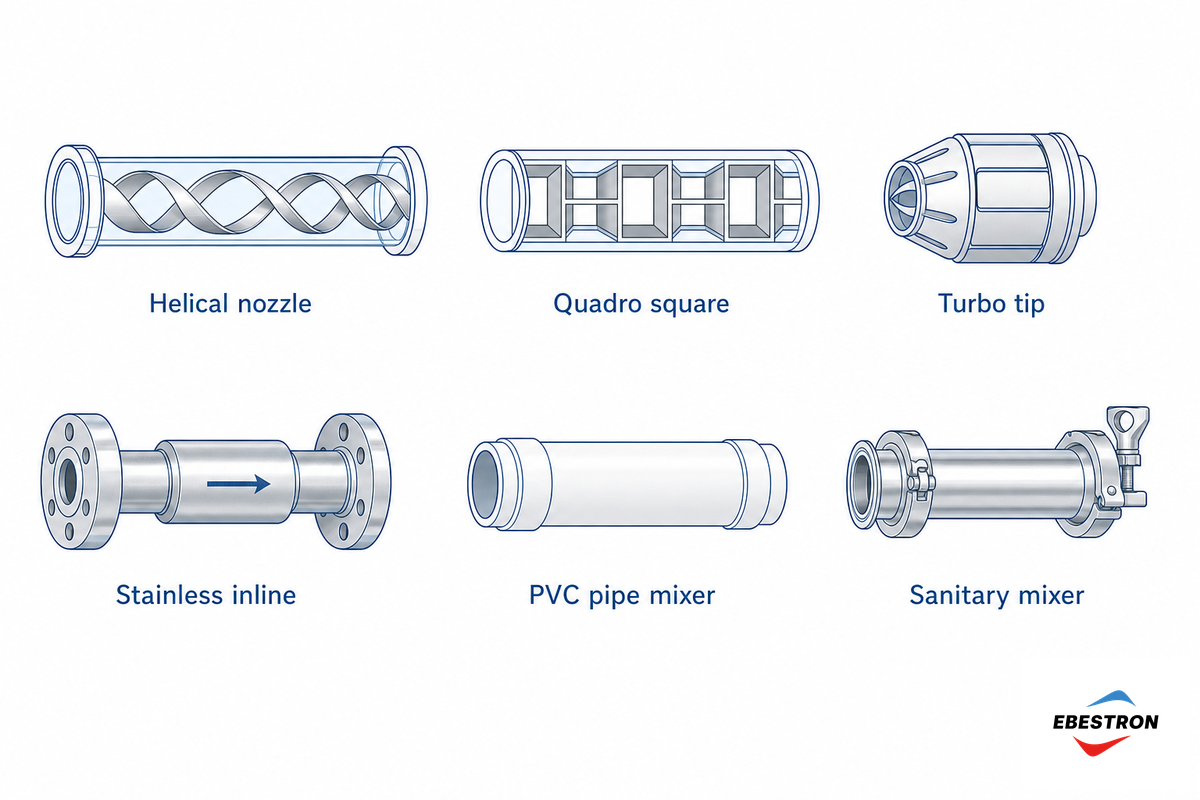
Mixers are best classified by type, element shape, and application; there is not a universally “best” design. Choosing for in-pipe process use is different from choosing for 50 ml cartridge epoxy dispensing.
What does a static mixer look like?
It may appear as a short stainless pipe spool, a long clear plastic tube, a stepped adhesive nozzle, or a square-body mixer with a bayonet mount. The important details sit inside the body: helixes, square elements, baffles, grids, or shaped inserts.
| Type | Typical use | Selection risk |
|---|---|---|
| Helical disposable nozzle | 2-part adhesive cartridges | Too long can waste adhesive and raise force. |
| Quadro or square mixer | Compact adhesive dispensing | Connection and ratio system must match. |
| Turbo-style nozzle | Shorter dispense path where force matters | Needs material validation before production. |
| Stainless inline mixer | Food, chemical, pharma, water treatment | Sanitary design and cleaning method matter. |
| PVC or CPVC pipe mixer | Water, chemical dosing, low-corrosion services | Pressure and chemical compatibility limits. |
| Sanitary removable-element mixer | Food and cosmetic plants | Cleaning, inspection, and seal design. |
| Gas-liquid mixer | Contacting, aeration, dispersion | Bubble size and residence time. |
| Meter-mix disposable mixer | Production dispensing equipment | Shot size, purge cycle, and retained volume. |
| Micro or lab mixer | R&D, sampling, small-flow testing | Scale-up may not transfer directly. |
The helical static mixer usually relies on twisted static mixing elements. Cartridge nozzles may be polypropylene, nylon, acetal, or another plastic, and many designs depend on internal baffles or elements rather than a smooth bore.
Ebestron cartridge systems should be compared across helical, Quadro, and turbo static mixers before you lock in a code.
The 9-Point Static Mixer Fit Matrix
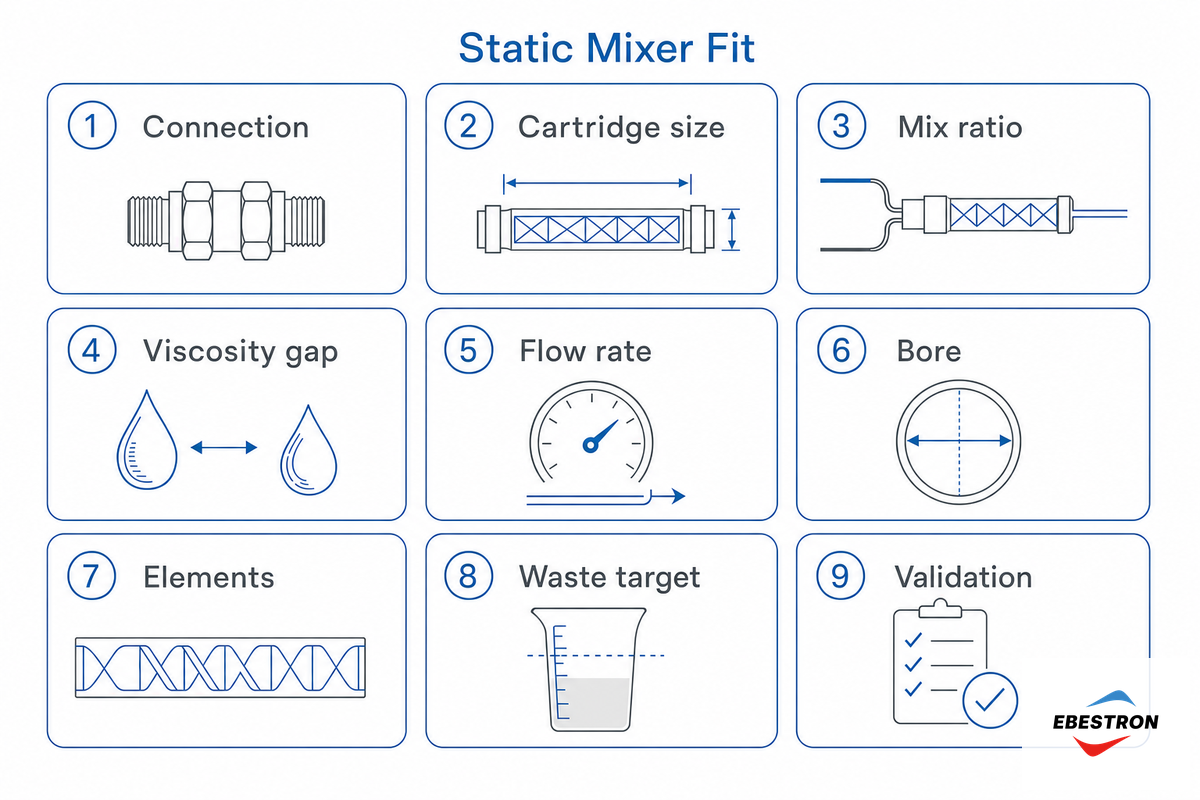
Use this when the spec sheet falls short. Turn “which mixer should I purchase” into a conditional choice.
| Fit point | What to check | Why it changes the choice |
|---|---|---|
| 1. Connection | Bayonet, bell, square, stepped, or threaded outlet. | Even a perfect mixer is useless if it will not lock onto the cartridge. |
| 2. Cartridge size | 50 ml, 200 ml, 400 ml, 600 ml, or meter-mix system. | Larger systems can push higher flow but may waste more in the mixer. |
| 3. Mix ratio | 1:1, 2:1, 4:1, 10:1, or custom metering. | Unbalanced streams need geometry that helps the minor component distribute. |
| 4. Viscosity gap | Similar or very different A/B component viscosities. | Large gaps can leave streaks unless the mixer gives enough flow division. |
| 5. Flow rate | Manual bead, robotic bead, potting shot, or continuous dispense. | Flow rate changes shear, residence time, and back pressure. |
| 6. Bore | Outlet inside diameter and bead size. | Too small raises pressure; too large can make bead control poor. |
| 7. Number of elements | Minimum elements that pass cure and appearance tests. | More elements are not automatically better if they add force and retained adhesive. |
| 8. Waste target | Purge volume, retained volume, and nozzle changes per shift. | Cheaper units can cost more if they trap high-value adhesive. |
| 9. Validation method | Color streak, hardness, cure, destructive test, or production trial. | Your final mixer choice should pass the same check your product depends on. |
In a specific application, the number of mixing elements is only one input. This device with no moving parts can still behave very differently when the two streams enter a molded plastic cartridge, a meter-mix head, or a pipe. Always test the parts in the same mix and dispense pattern you expect in production; do not assume 24 elements is a universal answer.
In simple terms, a static mixer consists of stationary elements within a body, but those elements are made in different materials and shapes. Polypropylene and polyacetal are common in cartridge nozzles, while PVC, CPVC, and stainless steel are common in pipe systems. Low-energy mixing still has a tradeoff: the energy required for mixing appears as pressure loss or dispensing force.
Use Ebestron’s 6-factor static mixer selector, cartridge fit finder, or spec-code decoder when you already know the cartridge family but need the correct mixer code.
Adhesive Static Mixer Nozzles: Bore, Elements, Ratio, and Cartridge Fit
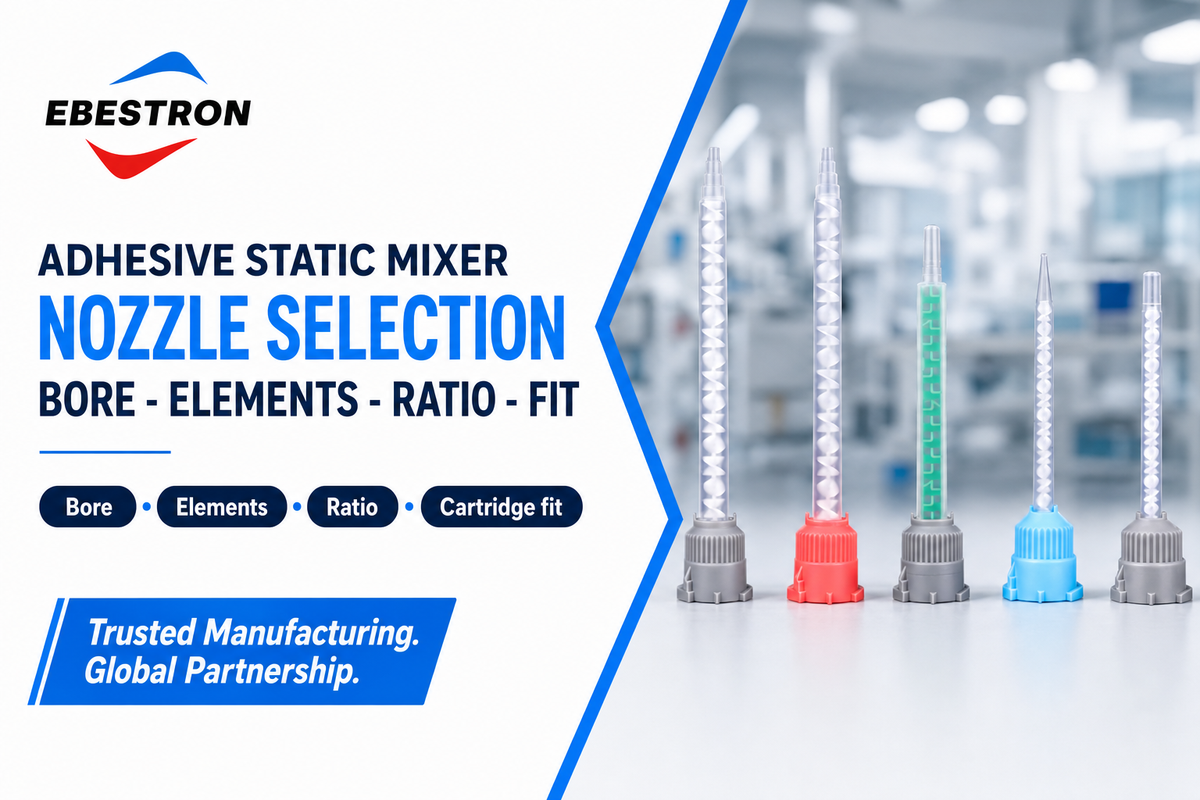
In adhesive packaging, a mixing nozzle is both a device and a consumable. It has to fit the cartridge, keep the A and B streams in ratio, mix before the bead exits, and avoid excess retained material.
Ebestron’s product pages list nozzles for 1:1 to 10:1 ratios, 3-13 mm outlet bore ranges, 7-49 mixing elements, and common 50 ml, 200 ml, and 400 ml cartridge systems. That range is useful because the same adhesive family can need a different tube when the cartridge size, shot volume, or viscosity changes.
Epoxy dispensing usually starts with epoxy mixing nozzles. If you are replacing an existing brand code, use the static mixer cross-reference lookup. If the cartridge uses Sulzer Mixpac or 3M-style fitment, check Sulzer Mixpac and 3M compatible mixers.
Do not select by element count alone. An article in Adhesives & Sealants Industry reports that common first-generation helical nozzles often need 24 to 32 elements for two-part adhesives, while newer geometries may reach similar mixing with fewer elements in some applications. Because that article discusses one technology path, treat it as a reason to test geometry, not as a universal replacement rule.
Regulated material paths need mixer fit and compliance review handled as separate checks. Food-contact polymer questions may point to 21 CFR Part 177, while production aids and related substances may require a separate check against 21 CFR Part 178. Cured-rubber or elastomer hardness checks often use ASTM D2240 as a Shore hardness reference; it does not replace a material supplier’s cure schedule.
| Validation field | Record this before approval | Reason |
|---|---|---|
| Bore family | 3 mm, 6 mm, 10 mm, or 13 mm outlet class. | A small bore can raise force; a large bore can change bead control. |
| Bead sample | 100 mm trial bead plus a 200 mm repeat bead, with a 10 mm tip-to-surface note and 30 cm photo distance. | The same mixer can look different when gun angle changes. |
| Pressure screen | Record the actual 50 psi or 100 psi readout only if the equipment provides one. | Back pressure is easier to compare when the line has a numeric baseline. |
| Cure check | 24 hour and 72 hour result, based on the adhesive data sheet. | Some defects do not show at the first visual check. |
| Shift baseline | 8 hour nozzle count, retained volume, and rejected joints. | A project should compare throughput and rework rate before and after a mixer change. |
| Review interval | 1 year review, or sooner after material change. | New resin lots, cartridges, or operators can change installation behavior. |
Static Mixer Applications in Industrial Process, Water Treatment, and Food Lines
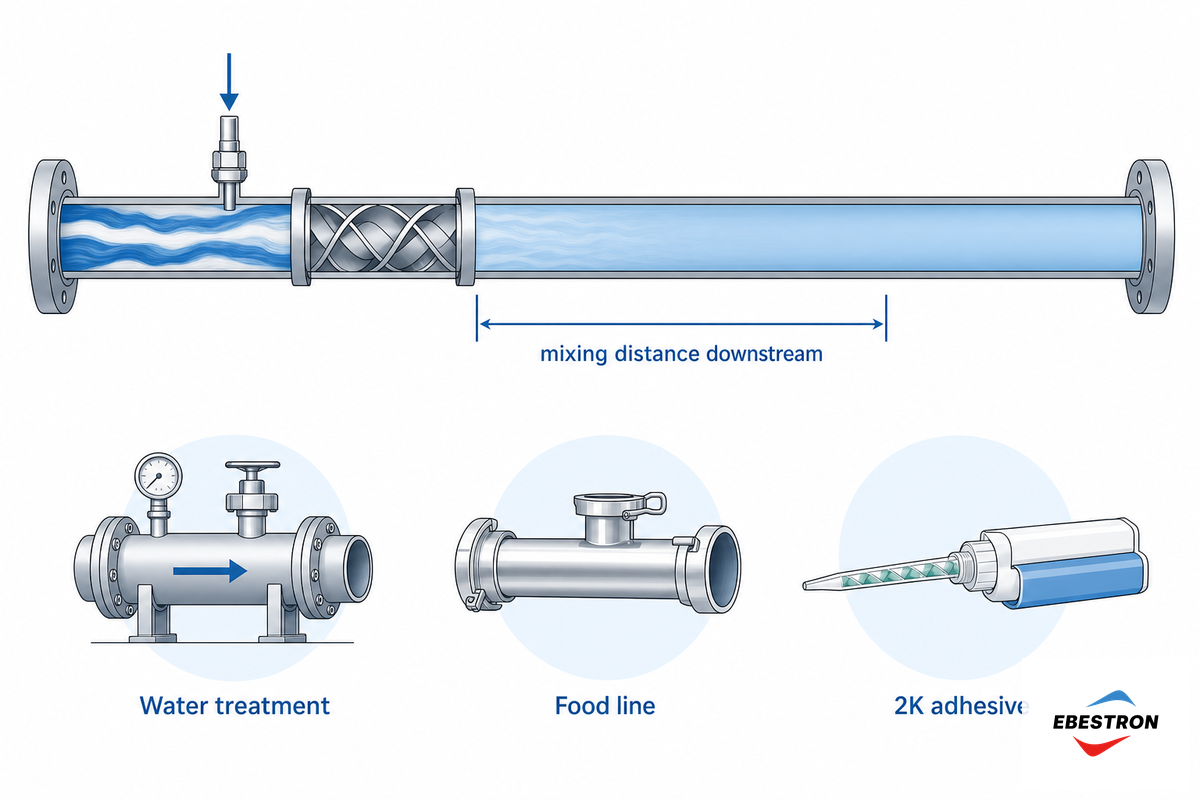
These devices appear across many industries because they can mix inside a closed flow path. That makes them useful when tanks are too large, moving parts are undesirable, or a short residence time is helpful.
| Application | Typical medium | Mixer format | Risk to check |
|---|---|---|---|
| 2K adhesive dispensing | Epoxy, PU, silicone, MMA | Disposable nozzle | Cartridge fit, cure, pressure, waste |
| Electronics potting | Filled epoxy or silicone | Static nozzle plus cartridge | Air bubbles and flow control |
| Water treatment | Water plus injected chemical | Pipe static mixer | Mixing distance and head loss |
| Food and cosmetic lines | Creams, pastes, slurries, liquids | Sanitary inline mixer | Cleaning and inspection |
| Chemical processing | Miscible or immiscible liquids | Metal or polymer inline mixer | Heat, corrosion, pressure drop |
| Construction bonding | Structural adhesive | Cartridge nozzle | Bead size and open time |
In water treatment, one ballast-water study reported about 95 percent mixing quality at around eight pipe diameters downstream of the mixer outlet in its tested system. That does not mean every pipe mixer needs the same distance, but it shows why downstream distance and measurement method matter.
In wastewater treatment and chemical dosing, the main concern is often energy consumption and head loss, not cartridge fit. Radial mixing can help distribute injected chemicals, but the right design still depends on velocity, residence time, and acceptable pressure drop.
Process-line documentation should use the same unit system across the drawing, purchase order, and field report. The NIST SI units reference is useful when a project team is mixing mm, inch, psi, and metric flow terms in one specification.
Inline Static Mixers, Baffles, and Miscible Liquid Terms
Industrial documents use a wider vocabulary than adhesive packaging pages. Static mixers are used in wastewater treatment, food and beverage lines, crude oil sampling, chemical processing, and immiscible liquids service. Inline mixers and channel mixers may be specified when fluids flow continuously through existing systems.
A process datasheet may call for inline static mixers, industrial static mixer bodies, or static mixing elements depending on the specific application. Read those lines together: viscosity, flow rate, pressure drop, number of mixing elements, laminar flow, turbulent flow, internal baffles or elements, degree of mixing, and homogeneity are connected design inputs rather than separate shopping filters.
Many different static mixers are available, and static mixers are installed wherever the diameter of the mixer, pipe size, temperature and velocity, and allowable head loss fit the process. Static mixers create flow division, recombine material layers, and can equalize concentration, but various designs behave differently. A plant engineer usually reads static mixer performance as a homogeneous mix at the lowest practical energy required.
Adhesive applications connect to Ebestron’s pages for electronics potting cartridge systems, construction adhesive cartridges, dual cartridges, and epoxy applicator guns.
Common Static Mixer Problems: Streaks, Air Bubbles, Off-Ratio Cure, and Back Pressure
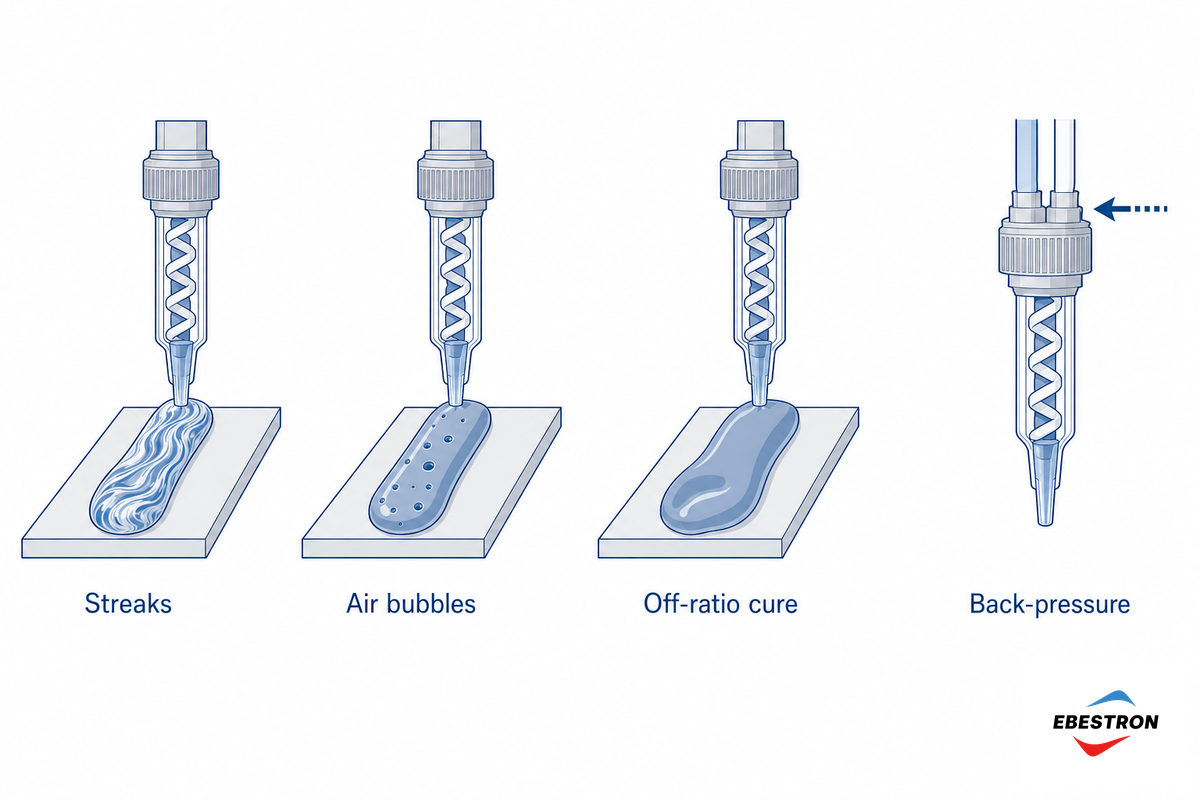
Visual, mechanical, and ergonomic complaints tied to these mixers usually show up at the bead or at cure.
- Streaks in the bead may mean the mix lacks flow division, the ratio is wrong, or the viscosity gap is too high for the selected nozzle.
- Air bubbles can come from entrained air in the material, rough cartridge handling, excessive agitation before dispensing, or geometry that traps pockets at the inlet.
- Soft spots or off-ratio cure should push you to check cartridge ratio, plunger balance, first purge, and nozzle match.
- High hand force or machine pressure often points to small bore, too many elements, high flow rate, or cold material.
- Material waste grows when long nozzles and frequent changes make retained volume more expensive than the mixer.
Buyers can treat a homogeneous bead as the practical signal, but the degree of mixing should be judged by the product’s real acceptance test, not by appearance alone.
Chemical-handling work should also be reviewed against the OSHA Hazard Communication standard and the NIOSH Pocket Guide when solvent, isocyanate, amine, or other exposure concerns are present. This is a safety-document check, not a static-mixer performance claim.
During a production deployment, record the project timeline, installation notes, baseline throughput, rework rate, and rejected joints before a nozzle change. After the trial, compare the same fields instead of relying only on a cleaner-looking bead.
If waste is a continuing problem, compare nozzle changes per shift with adhesive retained per mixer. Ebestron’s adhesive waste calculator and waste cost calculator can help procurement compare unit price against material loss.
Cost and Waste: Why Mixer Geometry Can Matter More Than Unit Price

Although disposable mixer cartridges are comparatively cheap in their own right, the material retained inside them may not be. So unit price does not paint the full story.
| Cost driver | What to measure | Why it matters |
|---|---|---|
| Nozzle unit price | Price per mixer | Important, but often smaller than adhesive loss. |
| Purge volume | Material dispensed before usable bead | High purge volume repeats at every nozzle change. |
| Retained volume | Material left inside after use | This is hidden scrap. |
| Rework risk | Soft cure, streaks, missed fill, leaks | One failed assembly can erase nozzle savings. |
| Validation labor | Tests needed before changeover | A new geometry needs proof under production conditions. |
Adhesives & Sealants Industry reported that conventional helical and square mixers can waste as much as 20 ml of adhesive per nozzle when purged and retained material are counted. In the same article, the discussion gave 19.1 ml average waste for first- and second-generation nozzles and 5.0 ml for a newer nozzle class. Because the author represents a nozzle manufacturer, use those figures as a prompt to calculate your own line data, not as a blanket guarantee.
What Is Changing in Static Mixing in 2026?
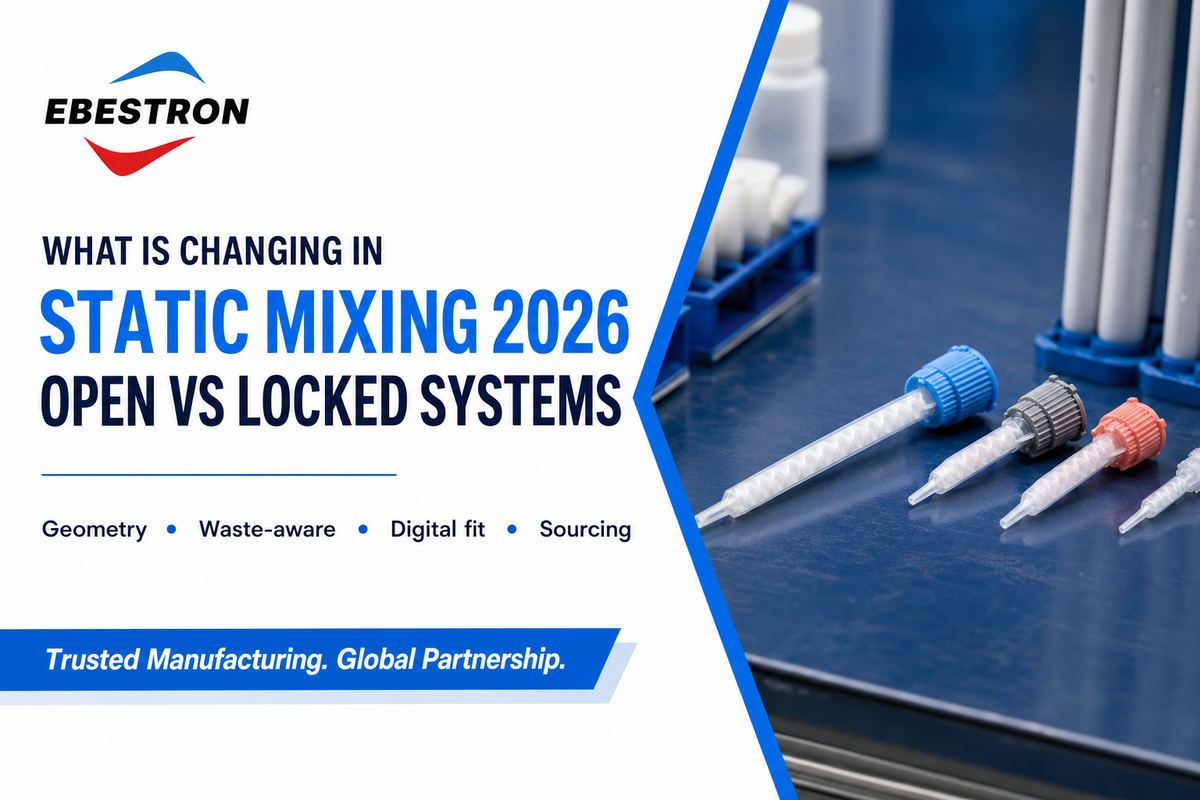
Three changes are worth watching, without pretending the entire market moves at the same speed.
- Geometry-led selection matters because newer studies keep testing baffles, corrugations, angles, and vortex generators; geometry can change both homogeneity and pressure drop.
- Waste-aware adhesive dispensing pushes teams beyond nozzle unit price and toward the amount of adhesive left inside each tube after use.
- Digital fit tools are becoming normal because buyers want cross-reference, cartridge-fit, and spec-decoding help before sending a purchase order.
Ebestron buyers can turn that into a practical workflow: identify the cartridge, confirm the ratio, choose a bore and element family, calculate waste exposure, and validate the cured result. Use the nozzle selector, mixer fitment finder, and mix-ratio material selector to shorten that first pass.
Ebestron Perspective
This article is for buyers who need to tell the difference between pipe-process mixers and disposable mixing nozzles for dual cartridge systems. Ebestron’s focus is strongest on cartridge fit, dispensing setup, and how well mixer tubes match the equipment.
If your concern is pipe diameter, plant pressure loss, process cleanliness, or dosing distance into flow streams, work with a process engineer. If your question is about 2-component cartridges, mixer codes, ratios, bores, elements, or replacement parts, begin with the Ebestron range and then validate with your specific material.
FAQ
What is the purpose of a static mixer?
The role of these devices is to improve mixing consistency in a tube, pipe, or nozzle without a driven impeller, using flow energy and internal stationary elements.
Is a static mixer better than an inline mixer?
Often, a static mixer is considered a specific category of an inline mixer. It is preferable when a low-maintenance, all-components-stay-in-one-place design fits your process. It is not preferred if your pressure drop, cleaning method, or flow rates do not fit the design.
What is the difference between a static mixer and an agitator?
The static mixer vs agitator comparison comes down to motion and vessel style. An agitator usually rotates inside a tank, while a static mixer stays fixed in a tube, nozzle, or pipe and depends on fluid flow.
How many mixing elements do I need?
You’ll need a sufficient quantity of mixer elements for your appearance tests, hardness test, cure test, or performance test. Additional mixer elements won’t hurt, but they can increase pressure drop and retained adhesive.
Does a static mixer need power?
The mixer does not have a built-in motor, so it requires flow from another source such as: a pump; a process line, pressure vessel or dispensed via an individual dispensing gun or cartridged by a plunger.
How do you know if a static mixer is the right solution for your process?
A static mixer may be an effective solution when fluids flow continuously, an external power source is not desired, and the material can be validated downstream. Check the mixer’s outlet orifice, inside diameter, number of elements, temperature and velocity, and the final test method before changing production parts.
Can a static mixer mix gas and liquid?
While this varies by design, some mixers are used for gas-liquid contact, gas dispersion, and bubble control. Appropriate designs consider bubble size, flow behavior, expected residence time, and acceptable pressure limits.
Are static mixer nozzles reusable?
Disposable adhesive nozzles are usually treated as single-use items because mixed adhesive cures inside the tube. Reusable inline mixers are a different category and may be removed for cleaning in sanitary fluid paths.
How do I know if my static mixer is causing pressure drop?
Following a mixer swap, watch for increasing difficulty turning a hand valve or push button, higher pump pressures, slower product dispensing, poor bead quality, or any new error codes coming from machine controllers. Compare element count, internal diameter, temperatures and dispensing volumes versus the values the prior mixer exhibited in similar situations; you don’t want to unnecessarily blame the cartridge without first troubleshooting the mixer elements and tubes.
Related Articles
References
- OSHA. Hazard Communication, 29 CFR 1910.1200.
- NIOSH. NIOSH Pocket Guide to Chemical Hazards.
- OSHA. Chemical Hazards and Toxic Substances.
- NIST. SI Units.
- ASTM International. ASTM D2240: Rubber Property, Durometer Hardness.
- eCFR. 21 CFR Part 177 and 21 CFR Part 178 should be checked directly when food-contact polymer or production-aid status matters.
Need Help Matching a Static Mixer Nozzle?
Send the cartridge size, mix ratio, outlet connection, adhesive type, target bead size, and current mixer code. Ebestron can help narrow the mixing tube family before you run your production validation.

Trending now