Get in touch with Ebestron Company


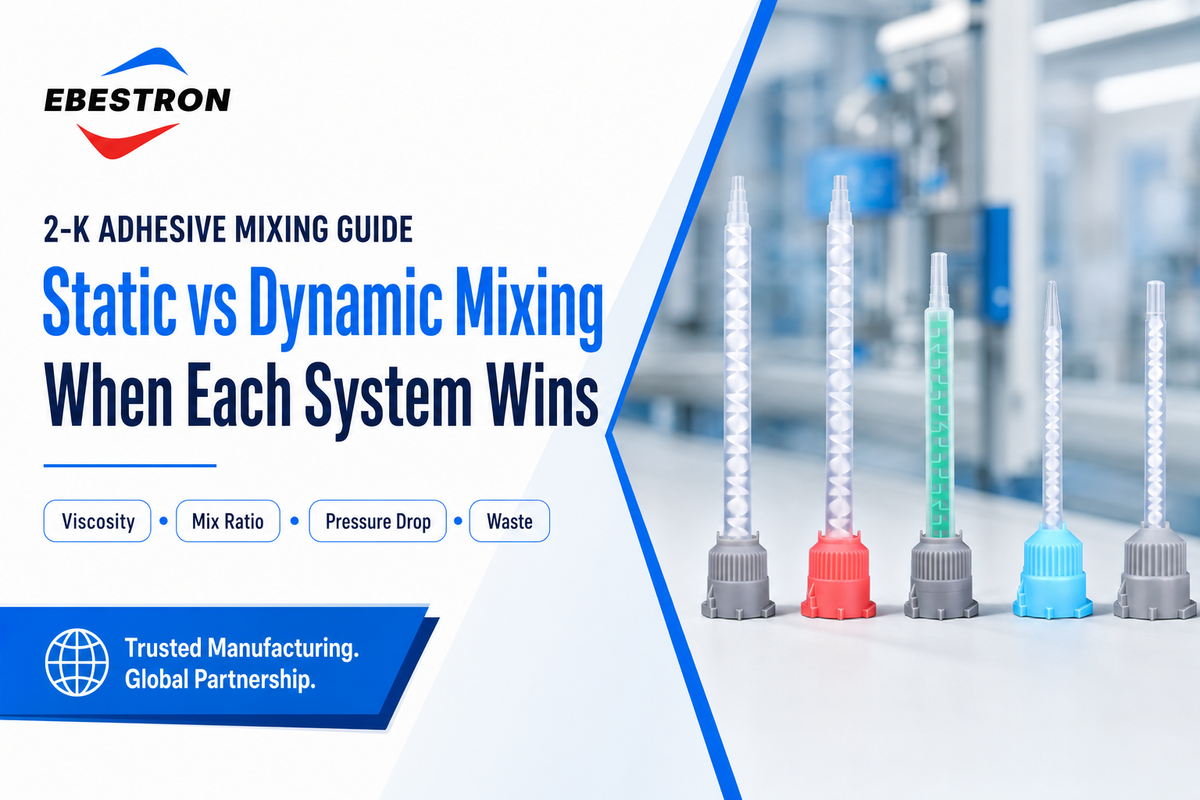
Static vs Dynamic Mixing for 2-K Adhesives isn’t a simple good-versus-better choice. Most cartridge jobs begin with a static mixer for small shots and low-to-medium viscosity materials. A powered mixing path becomes worth testing when viscosity gap, ratio, flow rate, gel time, or pressure drop makes a disposable nozzle unreliable.
That decision matter because a 2K adhesive doesn’t forgive poor mixing. If the A and B sides don’t meet in the right ratio, at the right speed, and with enough mixing energy, the result can show streaks, voids, soft cure, brittle cure, trapped air, or blocked nozzles. This guide give engineering and purchasing teams a practical way to compare the two systems before asking for a quote.
Quick Specs: Static Mixer Vs Dynamic Mixer
| Factor | Static mixer | Dynamic mixer |
|---|---|---|
| Typical format | Disposable nozzle on a cartridge, gun, or meter-mix machine | Powered mixing head with a rotating element |
| Best fit | Similar viscosities, manageable ratio, moderate shot size, portable work | High viscosity, large viscosity gap, high ratio, automated lines |
| Main risk | Pressure drop, hand force, retained volume, long residence time | Drive cost, cleaning, weight, RPM and flow-rate tuning |
| Validation focus | Element count, inside diameter, outlet, pressure, cure quality | Flow rate, ratio, RPM, mixer size, cleaning interval |
Static vs Dynamic Mixing for 2-K Adhesives: The Short Answer
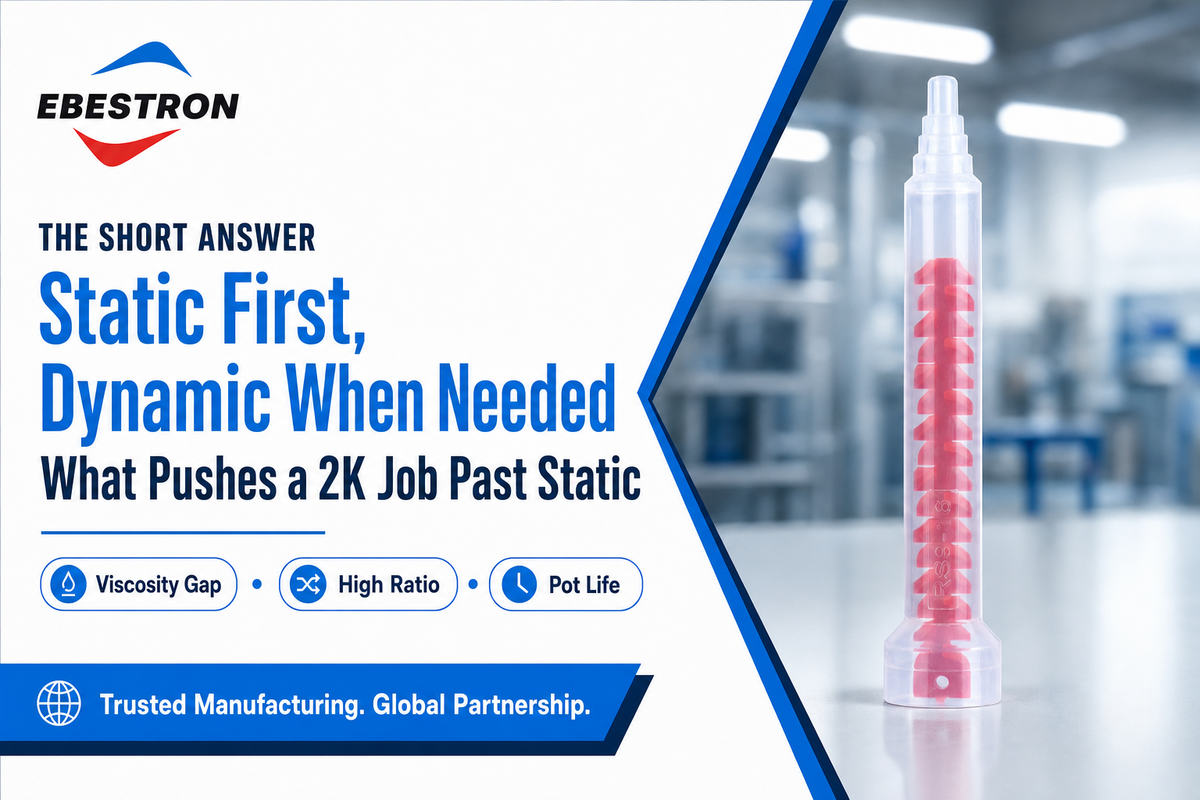
Start with a static mixer when the adhesive can be pushed through a disposable nozzle at stable ratio, acceptable pressure, and acceptable waste per changeover. Consider a dynamic mixer when the material pair is hard to combine through fixed elements alone, especially when one component is much thicker than the other or when the mix ratio is high.
For many purchasing teams, the first equipment split is simple: static mixing nozzles suit cartridge-based and many meter-mix jobs, while dynamic mixing systems for 2K sealants suit selected production lines where moving energy and process control are worth the extra hardware.
Static Mixing Advantages
- Simple consumable path for cartridges and many guns.
- No powered mixer drive at the nozzle.
- No cleaning of the disposable tube.
- Ease of repair, on-site assembly, field work and small runs.
Static Mixing Limits
- Viscosity/Length/Element Count increase => Increase in back pressure
- More retained adhesive when a longer nozzle is used.
- Can’t forgive you very quickly if A side and B side aren’t near the same.
- Risk of pre cure in mixer if pot life is too low.
Powered Mixing Advantages
- Rotor energy can help hard-to-mix materials.
- Lower pressure can be possible in high-output meter-mix lines.
- RPM becomes a tunable process variable.
- Useful for foams, gasketing, encapsulation, and selected sealant jobs.
Powered Mixing Limits
- Usually not a manual cartridge solution.
- Cleaning, flushing, or disassembly may be required.
- The head is heavier and less portable.
- RPM, flow, ratio, and pot life must be tested together.
How Static Mixing Works Inside A 2K Nozzle
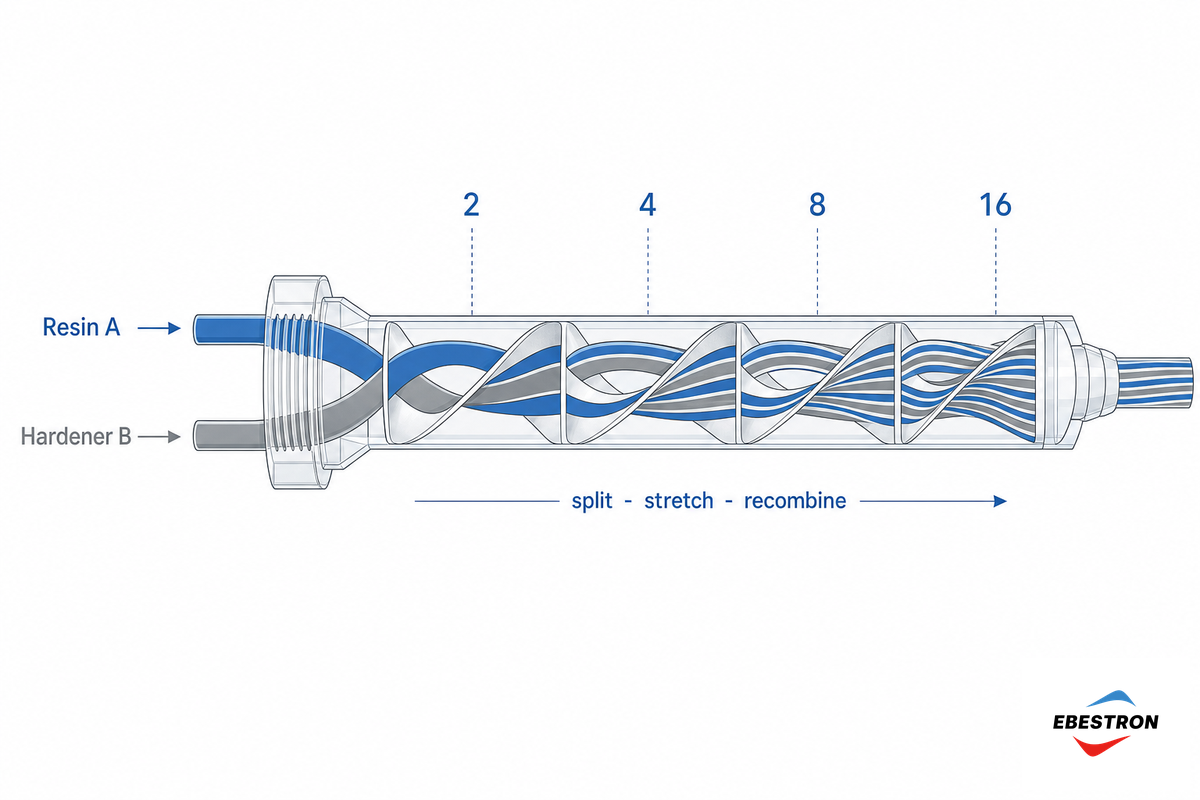
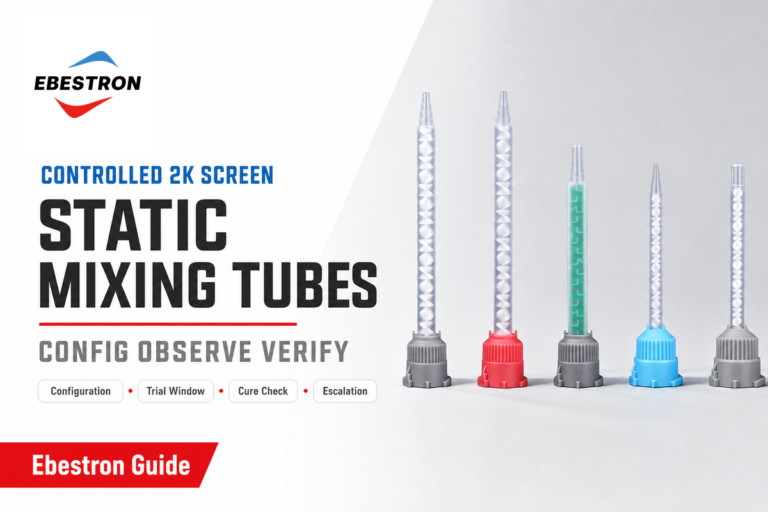
A static mixer is a tube with fixed internal geometry. Two adhesive components enter the nozzle, pass through repeated elements, and are split, stretched, redirected, and recombined. With each element, the A and B streams form thinner layers, which raises contact area and helps the material reach a more even mix before it leaves the tip.
The geometry may be helical, square, quadro, turbo, or another shape, but the selection questions stay similar. What’s the mix ratio? How thick is each side? What cartridge volume is used? Is the outlet a bell tip, stepped tip, luer tip, or custom dispensing tip? What pressure can the two-component dispensing guns or machine supply without off-ratio movement?
For cartridge jobs, start by matching the cartridge interface and outlet. Ebestron groups common consumables under static mixing tubes, helical and quadro static mixers, and Sulzer Mixpac and 3M compatible static mixers. Choosing the right family narrows the mechanical fit before you tune length, diameter, and element count.
What is the difference between a static mix and a dynamic mix?
Static mixing relies on fluid motion through fixed elements. A motor or air drive turns the rotor in a dynamic mixer. Static mixing spends pressure to create division and recombination. Rotor-driven mixing adds mechanical energy, which can help when fixed elements alone create too much resistance or too little mixing quality.
Engineering Note: Do Not Specify A Nozzle By Element Count Alone
Element count affects layer generation, but it also affects pressure drop, residence time, retained volume, and dispense force. In production, a 24-element mixer with the wrong inside diameter can perform worse than a shorter mixer with a better diameter, outlet, or cartridge match. Test ratio, A/B viscosity, temperature, flow rate, pressure or hand force, shot size, pot life, and cure result as one set.
When Static Mixers Start To Fail: Viscosity Gap, High Ratio, And Pot Life
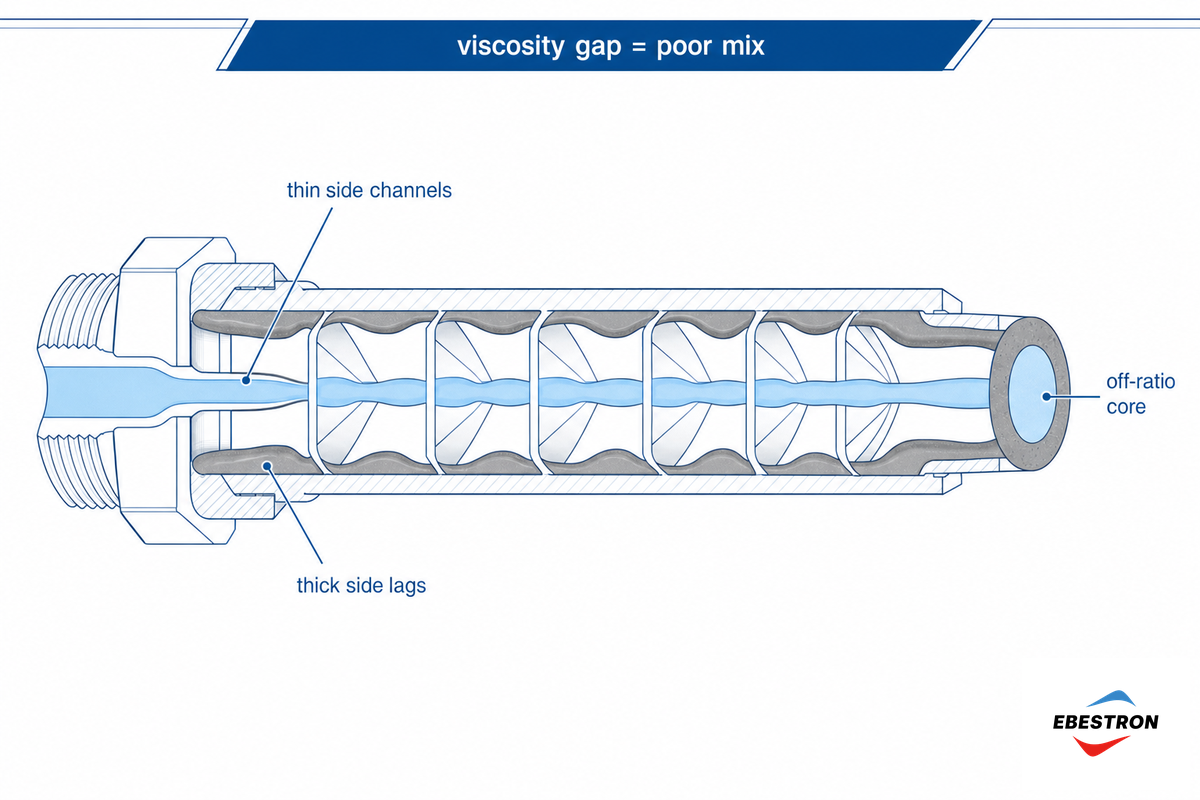
Static mixers begin to struggle when the material pair asks too much from fixed geometry. Common triggers include a large viscosity gap between the two components, high-viscosity resin, high filler loading, a high mix ratio, short pot life, or a flow rate that makes pressure rise faster than mixing quality improves.
Rheology matters here. Some two-component adhesives are shear-thinning, meaning their apparent viscosity can drop under shear. Others contain fillers that resist movement until enough force is applied. According to the Adhesive and Sealant Council, viscosity, ratio, mixer design, and element count all affect static mixer behavior for two-component adhesives. That’s why a catalog match should still be followed by a material trial.
Static Mixer Failure-Signal Ladder
| Signal | Likely meaning | Next check |
|---|---|---|
| Visible streaks | Poor mix quality or off-ratio feed | Check ratio, element geometry, and first-shot purge. |
| Soft or brittle cure | Wrong ratio, poor blend, or aged material | Run a ratio check and cure coupon. |
| High hand force | Pressure drop too high for gun or operator | Increase diameter, shorten mixer, or change gun thrust. |
| Clogging before the shot ends | Residence time exceeds pot life | Reduce mixer volume, increase flow, or review material temperature. |
| High purge waste | Retained volume is too costly for changeover rate | Compare nozzle volume, shot size, and purge interval. |
What are the limitations of static mixers?
The main limits are pressure drop, retained material, and reduced tolerance for difficult rheology. Static mixers can still handle many demanding materials, but the nozzle must be sized to the job. When the answer to every problem becomes “add more elements,” waste and pressure often rise before the cure result improve.
How Dynamic Mixing Works: Rotor Energy, RPM, Flow Rate, And Lower Pressure Drop
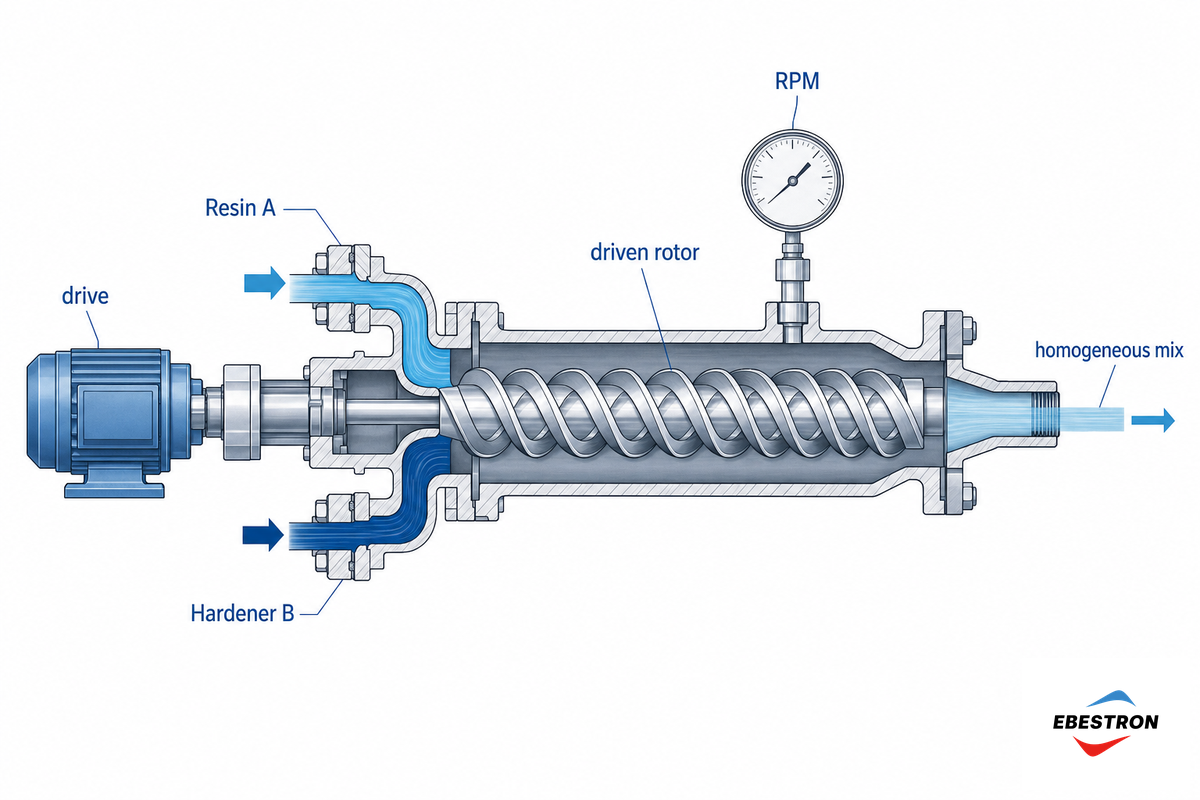
A dynamic mixer uses a driven rotor inside a chamber or tube. Instead of depending only on the adhesive’s movement through fixed elements, the mixer adds rotational energy. That makes RPM a process variable, along with flow rate, ratio, mixer size, material temperature, pressure, and pot life.
Dynamic mixing is a serious option for high-viscosity polyurethane, silicone, foam, potting, and gasketing jobs where a static mixer would require too much pressure or too much length. It can also help where a low-viscosity hardener must be blended into a much thicker base. For polyurethane projects, see 2K polyurethane dynamic mixing.
The trade is practical. Most dynamic mixers belong on meter-mix equipment, not hand cartridges. They must be driven, installed, tuned, and cleaned. If RPM is too high, heat and early cure can become problems. If RPM is too low, the material may not blend well enough. If flow rate is wrong, the job can show poor cure, trapped air, or wasted production time.
| Dynamic variable | Why it matters |
|---|---|
| Flow rate | Sets residence time and whether the rotor has enough time to blend the material. |
| Ratio | Controls cure chemistry; pressure balance helps keep A and B sides stable. |
| Mixer RPM | Adds energy, but too much rotation can add heat or shorten working time. |
| Mixer size | Affects hold-up, cleaning burden, flow capacity, and response during starts and stops. |
9-Factor Static-To-Dynamic Threshold Matrix
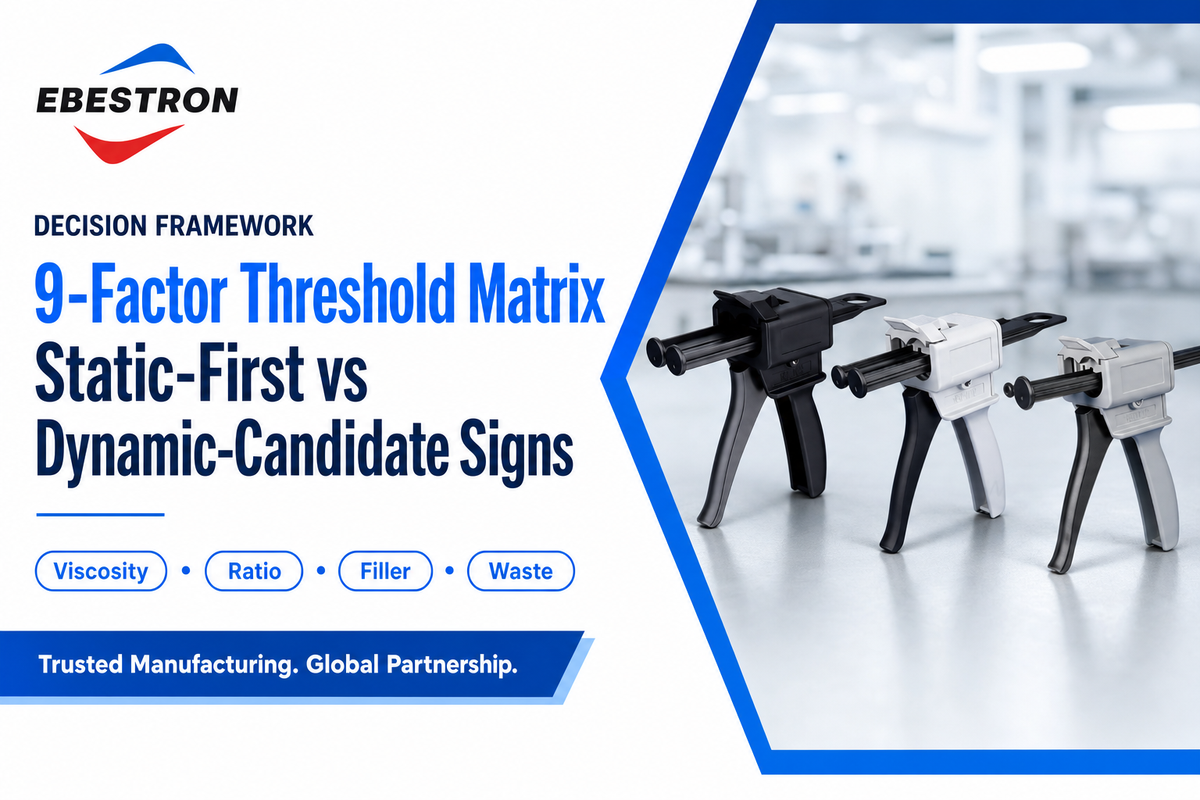
Use the decision matrix when someone asks, “Which mixer is best for my application?” A much better question to ask them is “Which failure mechanism is the greatest risk for this application?” If the material can be dispensed through a disposable tip using a static mixer with acceptable pressure, cure, and waste levels, static is often preferred. If several potential failure points are reaching threshold limits, then a dynamic mixer solution might be warranted.
| Factor | Static-first sign | Dynamic-candidate sign |
|---|---|---|
| 1. Viscosity gap | A and B sides are close enough to blend through fixed elements. | One side is far thicker, thixotropic, or filler-heavy. |
| 2. Mix ratio | Common cartridge ratios such as 1:1, 2:1, 4:1, or 10:1 are stable. | High ratio or nonstandard ratio needs metering control. |
| 3. Filler loading | Filled material still flows at target temperature. | Particles raise force, heat, or streak risk. |
| 4. Pot life | Material remains workable through the mixer and shot cycle. | Long residence time causes gel or blockage. |
| 5. Flow rate | Output target fits the nozzle without excess force. | Line speed demands more output than the nozzle can pass. |
| 6. Shot size | Shot volume is large enough that retained nozzle volume is acceptable. | Tiny shots and frequent pauses make purge waste costly. |
| 7. Equipment format | Manual, pneumatic, or simple meter-mix setup. | Automated line can support drive, controls, and cleaning. |
| 8. Cleaning tolerance | Disposable nozzle change is preferred. | Team accepts flushing, disassembly, or planned cleaning cycles. |
| 9. Waste cost | Nozzle cost and retained volume are small next to labor and part value. | Purge volume and frequent changeovers dominate the cost model. |
Waste, Cleaning, And True Cost: Disposable Nozzle Vs Powered Mixing Head

Static mixing looks less expensive because the nozzle is disposable and the equipment can be simple. Powered mixing looks more expensive because it adds a head, drive, controls, and cleaning. In many real jobs, the true cost is decided by changeover frequency, purge volume, rejected parts, and downtime rather than by the nozzle price alone.
Use the same material price, shot size, purge length, and changeover pattern when comparing both options. If a static mixer retains too much material for a small-shot job, a lower waste path may be worth testing. If a dynamic head require frequent cleaning between short runs, a disposable static mixer may still cost less in labor and downtime.
| Cost item | Ask this before choosing |
|---|---|
| Retained volume | How much adhesive stays inside the nozzle or head after each stop? |
| Purge interval | How often is the first shot discarded to protect cure quality? |
| Cleaning labor | Does the operator replace a nozzle, flush a head, or disassemble parts? |
| Line downtime | How many minutes are lost per change, clog, or cure issue? |
| Rejected parts | What is the cost of one weak bond, uncured bead, voided potting shot, or failed gasket? |
For static mixer waste estimates, compare expected shot size with cartridge volume and nozzle hold-up. An adhesive waste calculator can help turn a nozzle choice into a material-cost discussion before a buyer commits to production.
Match The Dispensing System: Cartridge, Gun, Ratio, Element Count, And Compatibility
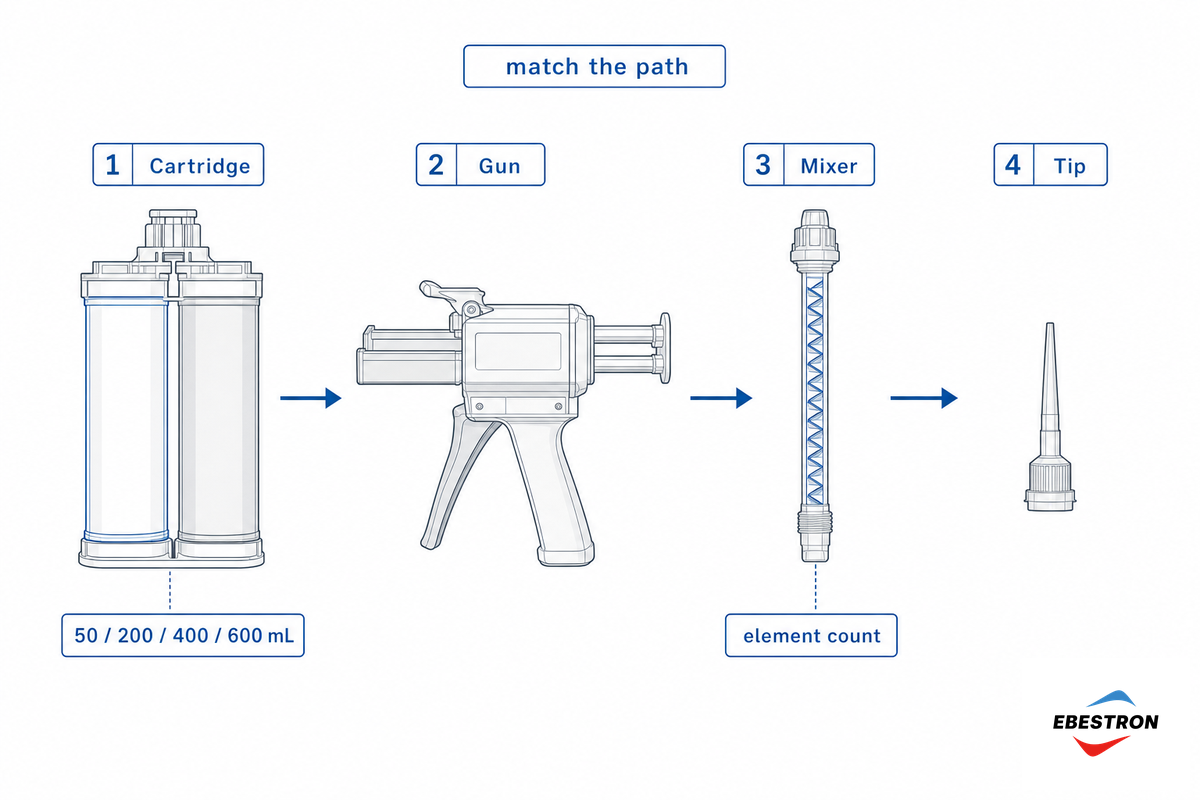
A good mixer recommendation starts with hardware facts. A quote request should give the supplier enough detail to narrow both fit and process risk. For example, a 400 mL 1:1 epoxy cartridge with moderate viscosity asks a different question than a high-ratio silicone line with robotic gasketing and short pauses between shots.
2K Mixer Quote-Ready Spec Checklist
- Mix ratio by volume and cartridge or machine format.
- A-side and B-side viscosity, including test temperature.
- Cartridge volume: 50 mL, 200 mL, 400 mL, 600 mL, or machine-fed.
- Static mixer interface, bell connection, bayonet, threaded or compatible.
- Desired flow rate, bead size, shot size, and pause time.
- Pot life, gel time, and cure acceptance method.
- Gun thrust, pneumatic pressure, or meter-mix pressure limit.
- Outlet type, dispensing needle, stepped tip, or automation needle.
- Cleaning rule: disposable nozzle, flush routine, or planned disassembly.
Use the next table as a validation record template, not as universal acceptance limits. The point is to collect the same fields for each static mixer, dynamic mixer, cartridge, gun, and 2K material trial.
| Validation field | Example entries to record |
|---|---|
| Cartridge volume | 50 mL, 200 mL, 400 mL, 600 mL |
| Test temperature | 23°C shop condition, 40°C warmed material condition |
| Outlet size | 1.5 mm tip, 2.5 mm stepped tip, 10 mm bead target |
| Pressure or force check | 30 PSI, 60 PSI, 100 PSI machine or gun reading |
| Shot and purge volume | 0.5 mL purge, 2 mL purge, 5 mL test shot |
| Scrap tracking | 2%, 5%, or 10% material loss band for cost comparison |
| Bead acceptance log | 8 mm bead, 12 mm bead, 15 mm bead during visual check |
What validation record should be kept before the mixer is approved?
For an in-house project, keep a baseline record before deployment: adhesive family, ratio, cartridge size, mixer family, 30 PSI and 60 PSI pressure readings, 1 mm and 2 mm bead notes, 24 hours cure check, throughput target, rework rate, and production outcome. This isn’t a formal case study, but it gives purchasing and process teams a field implementation trail before they release a static or dynamic mixer into daily production.
When bond strength testing is part of the approval plan, keep the mixer trial beside recognized adhesive test context such as ASTM D1002, ASTM D3163, and ISO 4587. For rheology-sensitive materials, NIST polymer flow and rheology work is a useful reminder that viscosity and shear behavior can change the mixer choice. TWI’s reactive adhesive mixing FAQ also supports comparing static, dynamic, and meter-mix options in one record.
| Approval record item | Why it matters |
|---|---|
| ASTM / ISO reference | ASTM D1002, ASTM D3163, and ISO 4587 keep bond-test language separate from mixer selection language. |
| Process baseline | Record 40 PSI, 80 PSI, 8 mm bead width, and 12 mm bead width before changing mixer style. |
| Production follow-up | Track 2% scrap, 5% scrap, 10% scrap, 1 hour purge interval, and 8 hours shift result after deployment. |
Ebestron’s related categories help turn the checklist into a part family. Use two-component dual cartridges for packaging format, 200 mL dual cartridges and 400 mL and 600 mL dual cartridges for volume matching, and Mixpac and COX compatible guns when the dispensing tool also needs to be checked.
What inside diameter and number of mixing elements create the right flow rate?
There’s no universal answer. Smaller inside diameters can improve shear but raise pressure. More elements can improve blending but add force, residence time, and retained volume. Larger diameters can reduce pressure but may reduce mixing intensity if the flow become too slow. Match diameter and element count to material viscosity, ratio, flow rate, pressure limit, and cure result.
Application Map: Epoxy, Polyurethane, Silicone, Foam, Potting, And Gasketing
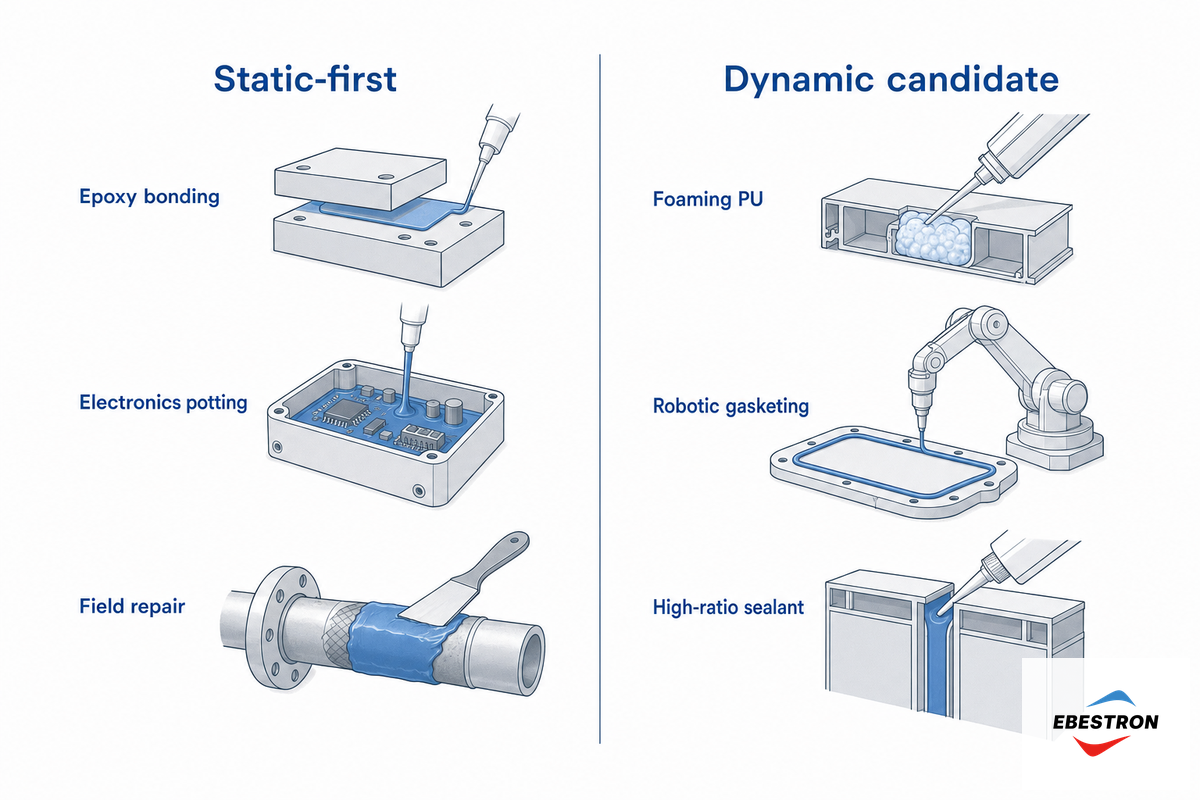
Adhesive chemistry changes the starting point. Epoxy bonding, polyurethane sealing, silicone gasketing, foam encapsulation, electronics potting, and repair dispensing don’t create the same mixing problem. Treat the table below as a first route for testing, not a final rule.
| Application | Static-first when | Dynamic candidate when |
|---|---|---|
| Epoxy bonding | Manual or pneumatic cartridge work with stable cure. | Very high viscosity resin or filler-rich paste creates force issues. |
| Polyurethane sealing | Moderate output and proven cartridge mix. | Automated line needs controlled flow, bead, and ratio. |
| Silicone gasketing | Short runs and disposable nozzle changes are acceptable. | Continuous robotic gasketing requires repeatable flow and mix energy. |
| Foam | Material supplier has validated the static path. | Cell structure, density, and reaction timing need rotor control. |
| Electronics potting | Small to medium shots and clean static mix results. | High output, low void tolerance, or automated cycle timing drives the choice. |
| Repair and field work | Portability and simple disposal matter most. | Rare, unless the repair bay uses fixed meter-mix equipment. |
For potting and assembly projects, compare the mixer with the broader pack-out. Ebestron also provides electronics potting cartridge systems, epoxy mixing nozzles, and industrial dispensing needles and precision tips that may affect the final dispensing result.
What Is Changing In 2K Mixing For 2026 Buyers
Three changes are worth watching for 2026 purchasing and engineering teams. First, more adhesive systems are moving toward higher viscosity, filler loading, and more exact process windows. Second, automated dispensing is making flow rate, pressure, and validation records more visible during sourcing. Third, static mixer geometry is getting more attention in high-viscosity process research, especially around pressure loss and mixing quality.
That doesn’t mean every buyer need a new mixing platform. It means a quote request should be cleaner than it was a few years ago. Ask for the cartridge, mixer, gun, and outlet as a matched path. When the job is automated, add flow rate, ratio check, RPM if dynamic, shot size, pause time, and cleaning method to the same request.
Practical Ebestron Perspective
If you already know your cartridge family, start with the compatible static mixer and validate cure, pressure, and purge waste. If you’re moving to an automated line, high-viscosity polyurethane, dynamic 3M-style work, or a repeated gasketing process, treat dynamic mixing as a process-window test rather than a simple part swap.
Request help matching a 2K mixer system with your ratio, viscosity, cartridge, gun, and output target.
FAQ
Is dynamic mixing always better than static mixing for 2-K adhesives?
No. Rotor-driven mixing adds energy, but it also adds drive hardware, tuning, cleaning, and cost. Static mixing is often better when the material flows through a disposable nozzle with stable ratio, acceptable pressure, and good cure. Consider the dynamic option when static nozzles become too long, too restrictive, too wasteful, or unable to produce a reliable blend.
Can a dynamic mixer be used with a manual cartridge?
Usually no. A dynamic mixer need a powered rotor and is normally tied to meter-mix or automated equipment. Manual cartridges normally use static mixing nozzles because the gun only push the two components through the cartridge outlet and disposable mixer.
Why are dynamic mixers less common than static ones?
They solve a narrower problem. Static mixing systems are simple to test, easy to replace, and suitable for many adhesives and sealants in cartridges. A dynamic mix path is selected when the 2K material needs rotor energy for mix quality, high output, or hard-to-blend viscosity behavior. That equipment choice normally belongs with meter-mixing equipment and process validation.
Does adding more static mixer elements always improve cure quality?
No. More elements can improve mixing, but they also raise pressure drop, retained volume, and residence time. If the adhesive has a short pot life, too much volume in the nozzle can create clogging. Check diameter, element shape, material temperature, pressure limit, and cure result together.
When should I choose a disposable static mixing nozzle?
Choose it when portability, low equipment cost, easy changeover, and no cleaning are more valuable than powered mixing control. It’s a strong fit for many epoxy, acrylic, polyurethane, and repair jobs when the ratio and viscosity are within the nozzle’s tested range.
How do viscosity and mix ratio affect mixer choice?
Large viscosity differences and high ratios make one stream harder to distribute into the other. Static mixers may need more elements or a different geometry, which raises pressure. Rotor-driven mixers can add energy and may suit hard-to-mix pairs, but they still need ratio and flow testing.
How can I reduce waste when changing 2K mixers?
Compare retained mixer volume, first-shot purge, pause time, shot size, and material price. Shorter static mixers may waste less but still must pass cure testing. Powered systems may reduce some purge patterns but can add cleaning waste, so compare the full changeover routine.
Which Ebestron pages should I check after reading this guide?
Start with the static mixer and dynamic mixing pages, then narrow by cartridge, gun, and application. If your job uses 3M-style dynamic equipment, review 3M Dynamic Mixing System compatible nozzles. For hand or pneumatic work, check cartridge size and gun compatibility before choosing the mixer.
Related Articles And Tools
References And Sources
- TWI Global: options for mixing and dispensing reactive adhesives
- Adhesive and Sealant Council: rheology and static mixer behavior
- ACS Omega / PMC: static mixers for high-viscosity systems
- AZoM: mixer selection for two-component adhesives
- Wikipedia: resin dispensing and dynamic mixing methods
- Wikipedia: static mixer design and applications