Get in touch with Ebestron Company

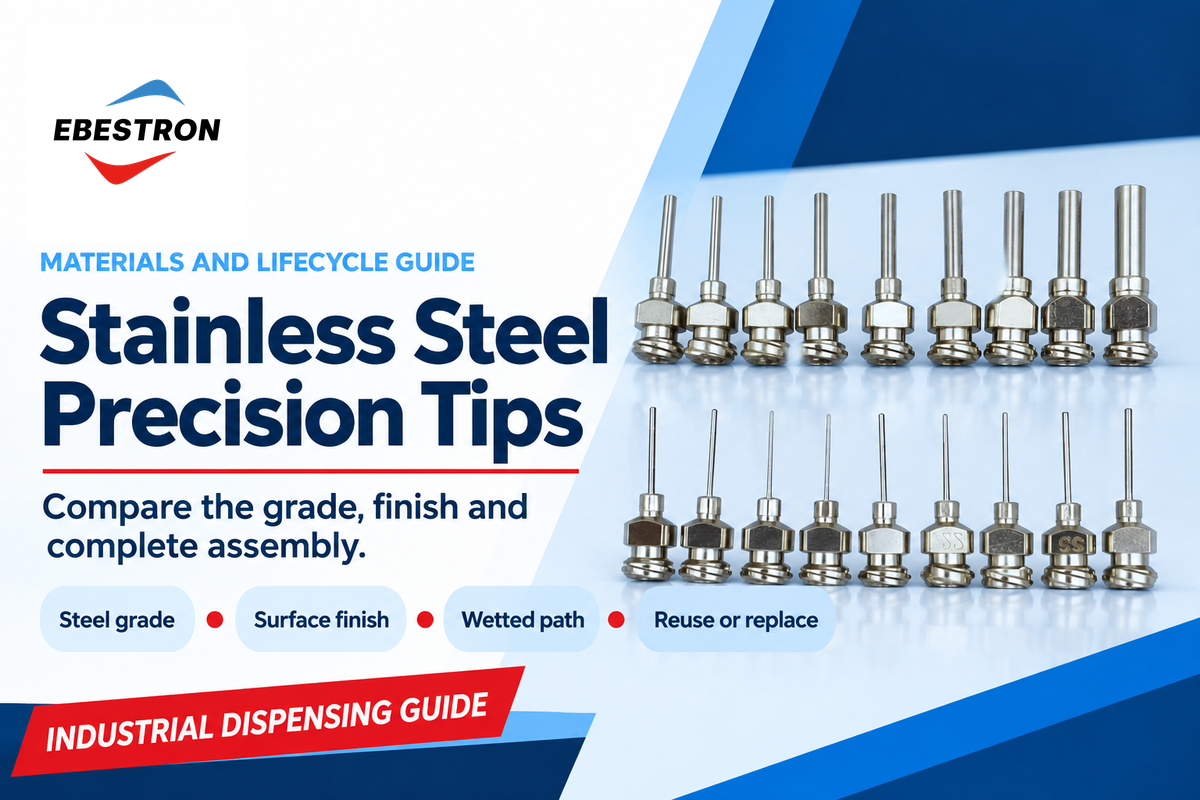
Precision Tips are employed to guide or direct fluid from a syringe or valve to a part. The stainless steel cannula of a Precision Tip offers a path for the fluid to follow. The behavior of this path with respect to adhesive is determined by various factors like the grade and bore condition, outlet shape and hub construction.
Although a tip may look clean, it may collect adhesive on its outer surface or contain fluid in its bore. A joint may be incompatible with a cleaning solvent. Knowledge of such differences will enable one to select a proper finish and understand when a replacement is warranted.
Quick Specs, what to identify
- Cannula: steel grade, actual inner diameter, length and outlet geometry.
- Surface: deburring, polishing, passivation or coating, with the treated area identified.
- Assembly: hub material, connection and tube-to-hub joint.
- Lifecycle: single-use or an explicitly reusable design with a defined cleaning method.
What Stainless Steel Precision Tips Do
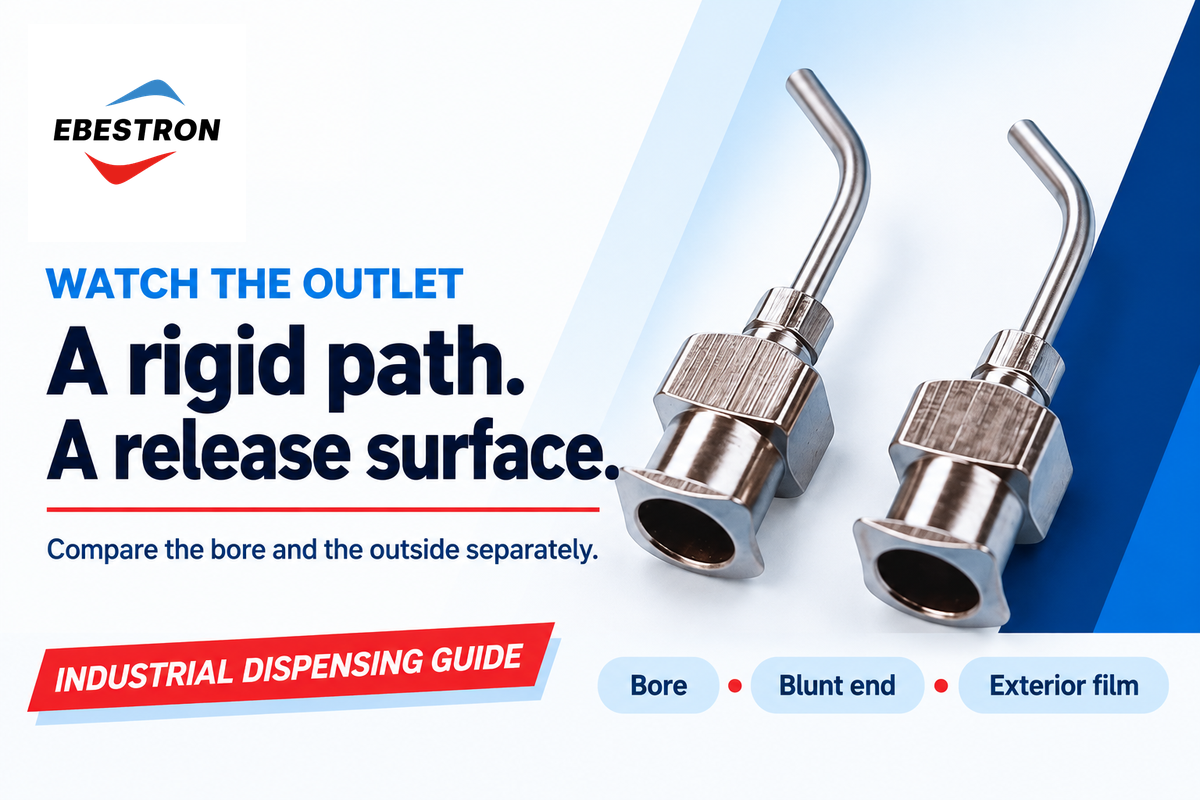
Precision dispensing tips direct material through a defined outlet and keep that outlet mechanically stable. The tip defines the surface from which the liquid transfers. The tip provides the final flow restriction, so its behavior is linked to that of the dispensing equipment.
In adhesive dispensing, a rigid needle can hold its position close to a small feature, and a bent tip can provide access around an obstruction. With glue, the important observation is how the material releases from the blunt end. A compatible sealant may instead leave a bead whose placement reveals an outlet-position problem.
Surface behavior matters alongside geometry. A 2023 study of STS304 dispensing needles observed low surface tension liquids spreading along the exterior of the needle before they drop. This explains why observing the liquid at the outlet can reveal more information than inspecting a dry, shiny needle.
During micro-dispensing of a small epoxy deposit, look at the material that leaves the bore and the material that stays on the outside separately. An external film and a plugged passage are different conditions. Note the behavior observed, and compare if a new tip yields repeatable deposits.
Choose Steel Grade for the Actual Fluid
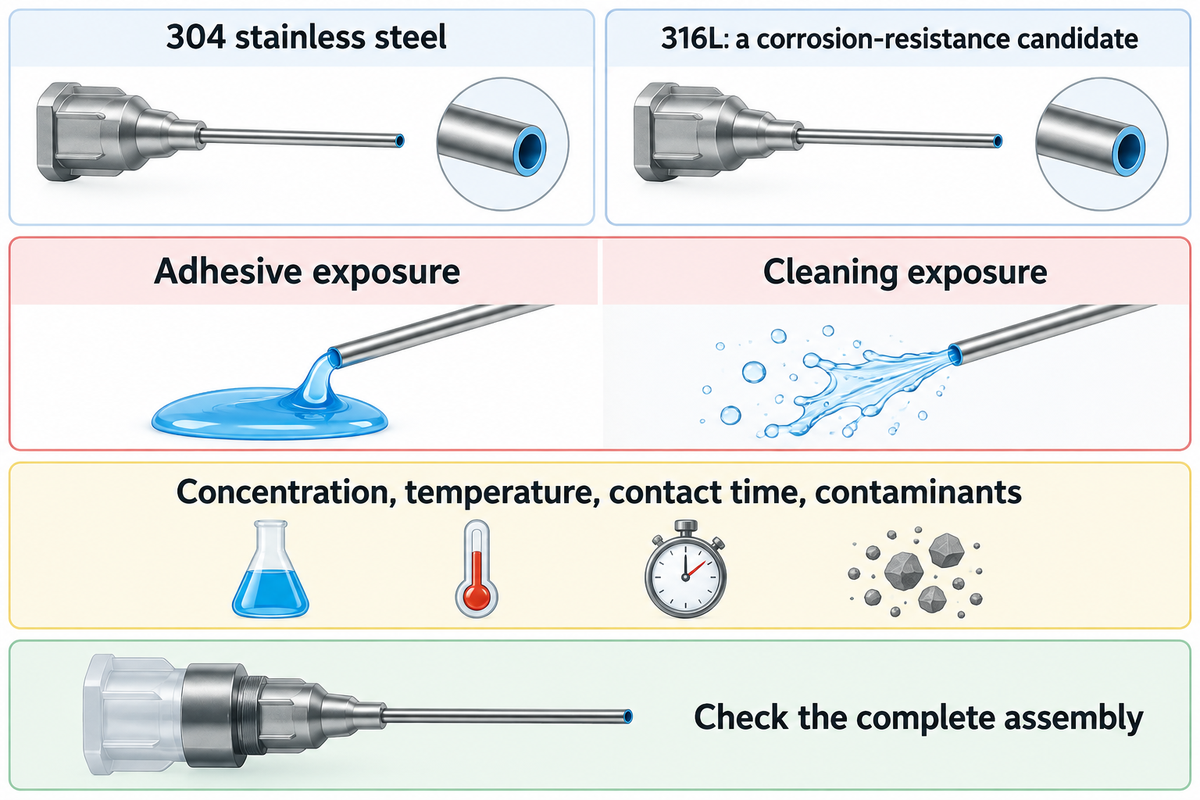
The selection of steel grades begins with the fluid and the conditions under which the steel is exposed to it. A 304 stainless steel tube can suit many dispensing applications; 316L becomes a candidate when greater corrosion resistance is needed. The cleaning fluid is part of that selection as well because it may come in contact with the tip under different conditions than the adhesive.
The British Stainless Steel Association’s 316/L guidance identifies molybdenum as a reason to consider this grade where 304 is inadequate, including chloride-containing environments. Therefore, molybdenum is suggested to increase corrosion resistance. Its approximate composition example includes 2% molybdenum; ASTM A240 sets 2.00–3.00% molybdenum for this grade in plate, sheet and strip, and tubing follows the composition table in its own product standard.
Concentration, temperature, contact time and contaminants change the exposure. Alloying research archived by the U.S. Department of Energy demonstrates the effect of composition and test conditions on corrosion and passivation. Its tests evaluate corrosion performance of modified steel samples in acidic chloride solutions.
Take a hypothetical assembly line that has accepted a 304 tip for the adhesive, then changed the cleaning chemical. Purchasing sees the same needle drawing and expects the same service. The operator, however, exposes the bore and joint to a different liquid for each cleaning. The sensible approach here is to assess the proposed cleaner’s compatibility with the assembled tip, rather than switching to 316L solely because it sounds like an upgrade. If the steel is still sound but the hub softens or the bond breaks, the hub or joint remains the limiting component.
Keep the adhesive’s material-compatibility guidance with the tip specification. Record the cleaner separately, with its use conditions. A material grade defines an alloy. The complete path of fluid contact determines if the assembly is suitable.
Separate Deburring, Passivation and Electropolishing
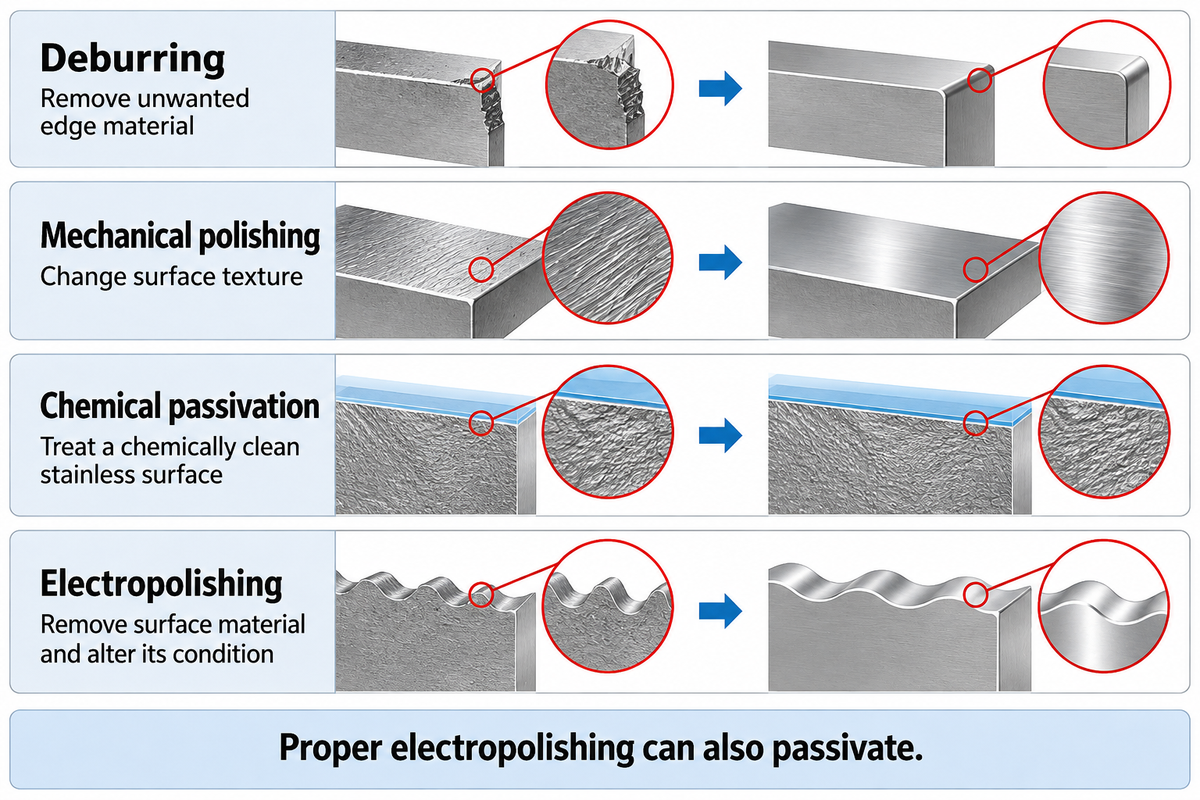
Deburring addresses unwanted metal at an edge; passivation addresses the stainless surface’s chemical condition; electropolishing removes surface material electrochemically. These operations serve different purposes, and a tip may receive more than one. A smooth-looking outlet still needs the correct shape, surface treatment and cleanliness for the fluid being dispensed.
| Operation | Purpose | What to describe on the part |
|---|---|---|
| Deburring | Remove unwanted edge material | Bore entrance and blunt outlet condition |
| Mechanical polishing | Change surface texture | Which internal or external area is polished |
| Chemical passivation | Treat a chemically clean stainless surface | Specified process and acceptance method |
| Electropolishing | Remove surface material and alter its condition | Treated surfaces and final geometry |
The current public scope of ASTM A967/A967M-25 covers chemical passivation treatments and alternative effectiveness tests. The listed treatment options also include electrochemical treatment, so a simplistic split between chemistry and electricity would not be correct.
“Surface passivation occurs simultaneously with electropolishing under proper operating conditions.”
Therefore, “passivated” and “electropolished” describe overlapping, rather than opposite, results. Alongside treatment, also specify a bore roughness requirement by value, area, and measurement method.
Finish work can change dimensions as well. In a 2023 AISI 316L electropolishing experiment, researchers examined surface quality alongside material removal and dimensional accuracy. Their rectangular specimens were different from needle tubes, but the purchasing lesson is valuable; instead of agreeing to a pre-treatment dimension as final, describe the finished bore and outlet.
How are stainless steel precision tips made?
Many stainless steel precision tips begin with a small tube that’s cut to length, shaped or bent as necessary, finished at the outlet, cleaned and joined to a hub. The joining and surface treatment vary with the design. Different manufacturing routes are followed for a bonded polymer hub, a metal hub and a machined precision nozzle.
A tube may be crimped, bonded or retained by another specified joint. An external weld isn’t something to be assumed from a metal appearance. A useful manufacturing description treats the steel cannula, hub, joint, finished flow path and cleaning condition as parts of a single assembly.
Read the Whole Tip from Hub to Blunt End
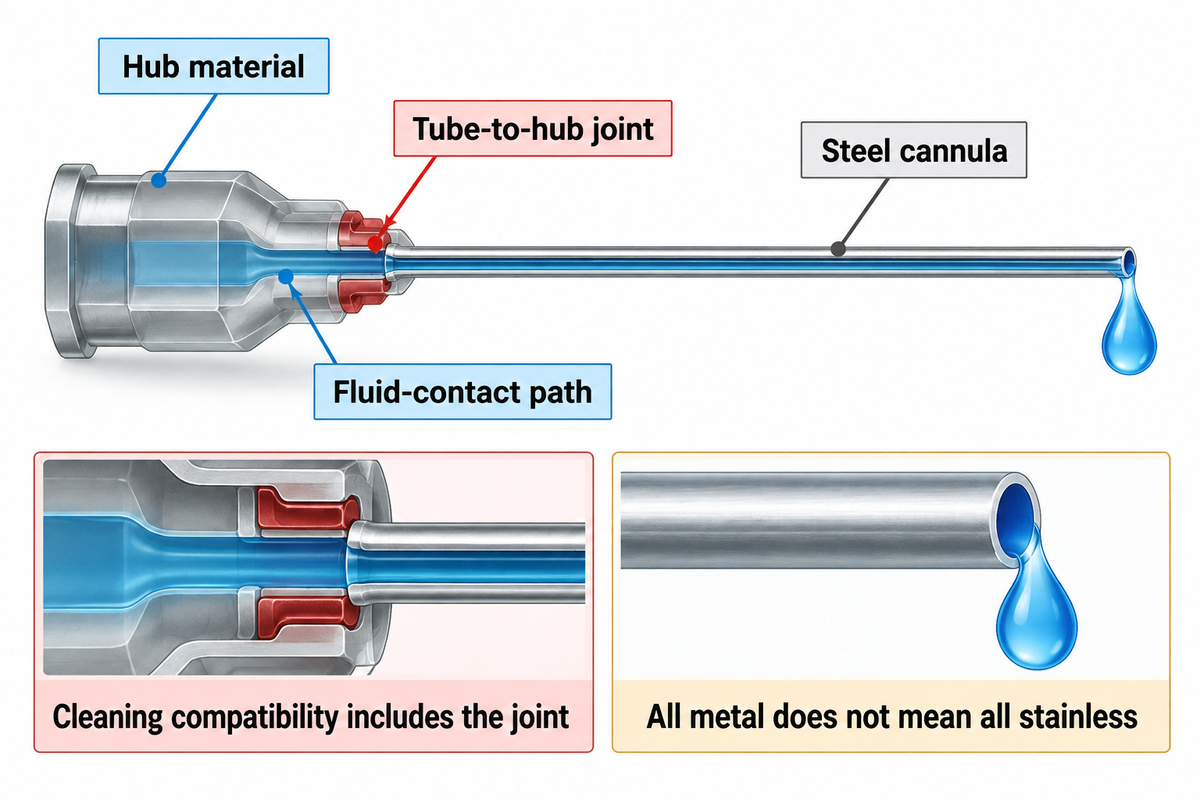
Stainless steel dispensing tips can contain several materials between the syringe and the outlet. The cannula may be steel while the hub may be polyethylene, polypropylene or another metal. The joint may introduce a further material. Chemical compatibility, allowable temperature and pressure therefore belong to the assembled part, including its connection.
Product designs illustrate the range. Polymer hubs attached to steel tubing, aluminum hubs with stainless cannulas, and reusable needles which combine steel shafts with nickel plated brass hubs are examples. “All metal” does not mean every component is stainless steel. A coating or plating on the hub adds another surface to identify.
The joint also needs attention during cleaning. Nordson’s published dispensing-tip application US20220331834A1 mentions cleaning solvents attacking a tube-to-hub adhesive bond as a design problem. Keep the joint’s material and cleaning needs with the cannula specification.
Trace the wetted path on the assembly drawing in front of you. Which surfaces does adhesive come in contact with? Which surfaces does the cleaner reach? A small amount of cured material left at the hub transition may remain hidden when the visible tube looks clear.
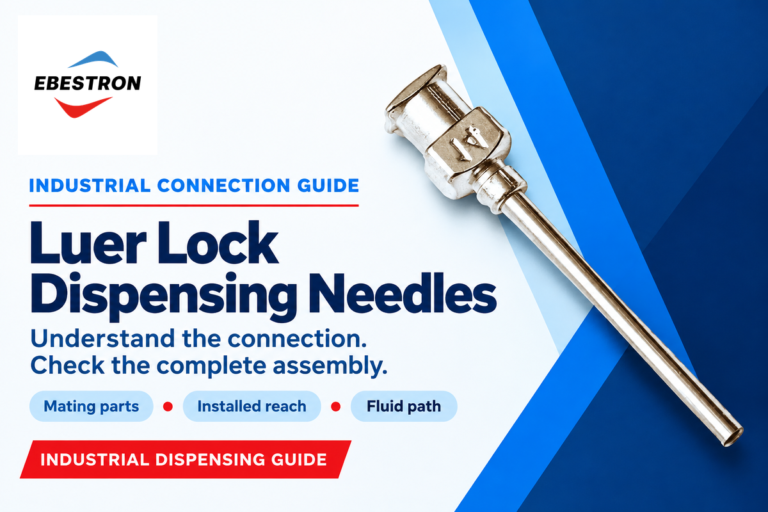
Examine the actual mating geometry of the dispensing syringe or cartridge adapter. A Luer-lock dispensing needle uses a different securing mechanism from a slip-fit tip. More details on choices available in length, wall and bore of the needle are provided in the dispensing needle selection guide.
When Plastic or PTFE-Lined Tips Work Better
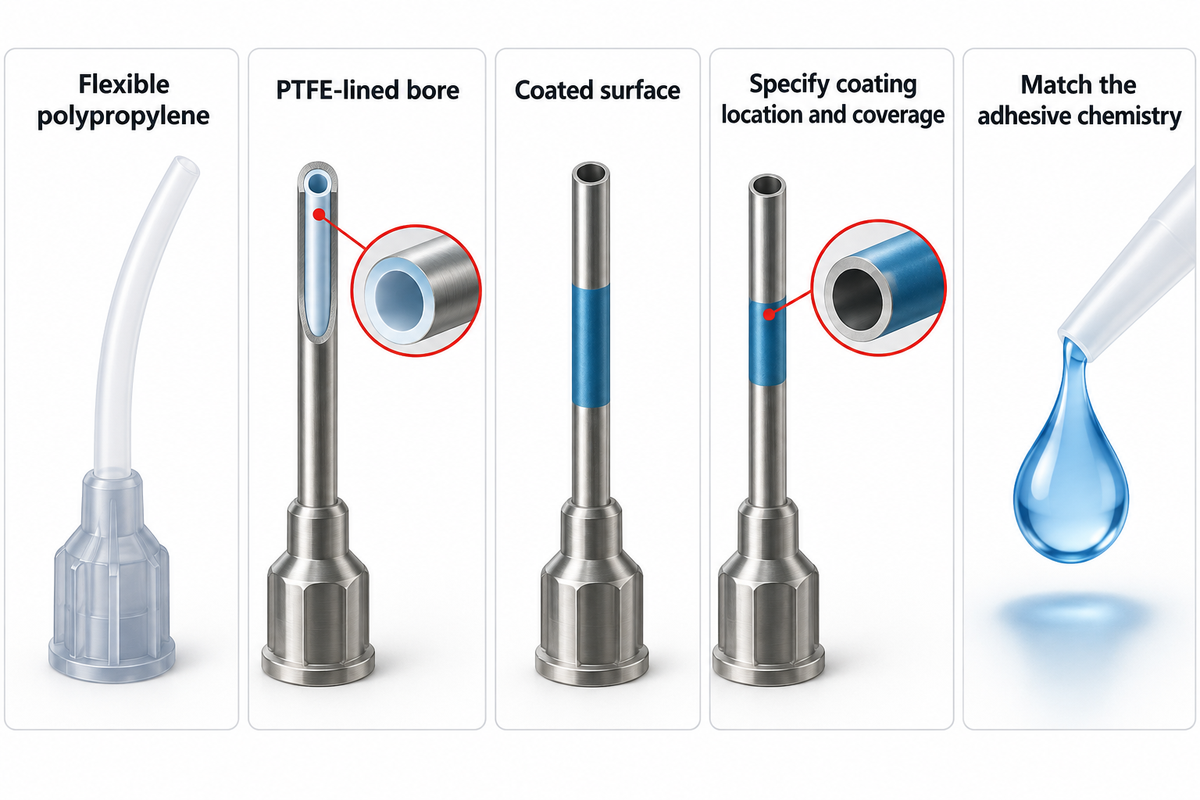
Plastic tips and PTFE-lined tips address different issues from a bare steel outlet. Flexible polypropylene helps where incidental contact could mark a delicate part; a liner changes the fluid-contact surface inside a steel shaft. Tapered dispensing tips can also be used for thick adhesive that doesn’t move well through a long, straight bore.
PTFE-lined and PTFE-coated are different descriptions. A liner is in the bore; a coating is on a surface. In product descriptions, a coated tip is reported to have less wicking and a cleaner cutoff. The location and extent of the coating should be part of the specification.
What are the benefits of PTFE-lined or coated dispensing needles?
For dispensing low-viscosity reactive fluids, a PTFE-lined needle can reduce contact with the metal bore. PTFE-coated designs can help control material spreading and release at the treated surface. Exterior wetting and cutoff concern release and spreading at the outlet, while internal curing concerns the bore’s fluid-contact surface. Lining and coating are different features.
There are physical reasons to differentiate the two. The STS304 needle wetting experiment changed the exterior surface, and different behavior of the released liquid was observed. So examine the surface the liquid releases from, and choose a commercial PTFE-lined tip by its construction and the adhesive being dispensed.
Let’s say a production team is looking at a watery cyanoacrylate and a UV-curable adhesive. A lined tip would be a good candidate for the cyanoacrylate trial. The light-curable material needs protection from ambient light along the path of the fluid as well. The two jobs should keep separate material records. Published guidance for one light-curable adhesive family lists nylon among compatible plastics, while cyanoacrylate dispensing guidance advises against using nylon. Taking the first fluid’s accepted-parts list into the second job can create curing problems even if an apparently similar steel needle is used.
Compare flexible plastic and PTFE-lined tip options when surface contact or fluid reactivity is the limiting factor. Brush tips, on the other hand, spread the material over an area; they serve a different deposit shape than a blunt dispensing needle.
Inspect the Tip Surfaces That Affect the Deposit
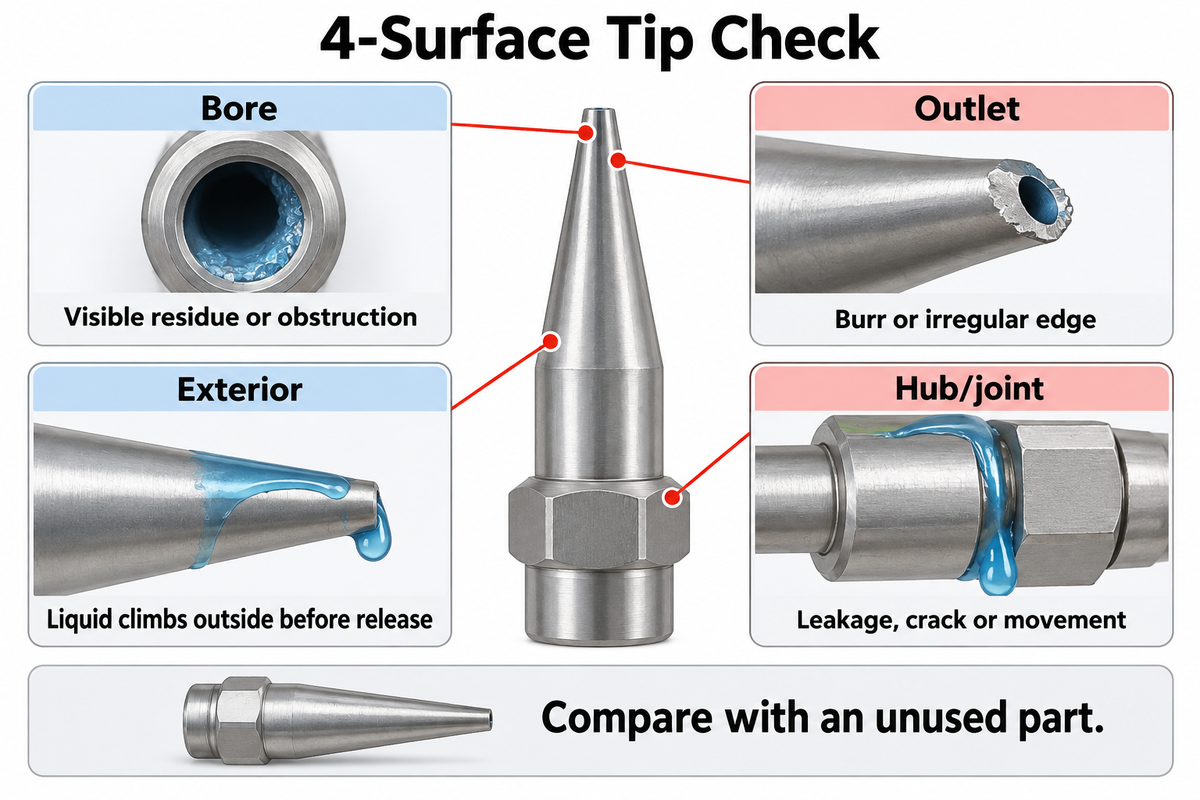
Naming a location (bore, outlet, exterior or hub joint) when doing an inspection helps to identify what’s affecting the deposit. A burr, cured residue, a wetting film or loose connection can each affect the deposit in a different way. Separating these observations helps the operator choose a useful action without changing several process variables together.
4-Surface Tip Check
When doing an inspection of a tip, compare the results of an unused tip against a tip that has been used. Check the specified burr-free edge separately from cured residue or a wetting film. Production can use observations to describe a stoppage, and quality staff can document a sample and provide a description of the defect. Procurement can also use the description to provide a definition of the replacement part needed.
| Area | Observed condition | Next action |
|---|---|---|
| Bore | Visible residue or obstruction | Replace a single-use tip; follow the defined method for an approved reusable design. |
| Bore | Appearance differs after cleaning | Retain the sample and cleaner record; compare with an unused part. |
| Outlet | Burr or irregular edge | Remove from service and record the edge condition. |
| Outlet | Bent or flattened end | Replace; check whether the tip contacted the part or fixture. |
| Outlet | Cured ring around the opening | Record the fluid and exposure; distinguish residue from permanent edge damage. |
| Exterior | Liquid climbs outside before release | Record wetting and cutoff; compare a suitable surface treatment with the same fluid. |
| Exterior | Discoloration or suspected pits | Set aside for inspection; keep the adhesive and cleaner identities with the sample. |
| Hub/joint | Leakage, crack or movement | Stop using the assembly and replace it. |
| Hub/joint | Residue at the tube transition | Check the transition against a clean reference; a clear outlet alone is insufficient. |
The needle surface study observed different release behavior after the needle’s exterior surface was changed. Thus, when making a coating comparison, you should evaluate spreading and release with the actual fluid. You shouldn’t assess the coating finish solely by its brightness.
Retain the removed tip along with its lot ID when a recurring defect must be investigated. With grease or ink, retain the material identification too, instead of assuming that visually similar deposits have the same chemistry. The blunt-tip setup and deposit troubleshooting guide addresses the separate issue of verifying dispenser settings and process conditions.
Cleaning, Reuse and the Cost of a Tip Change
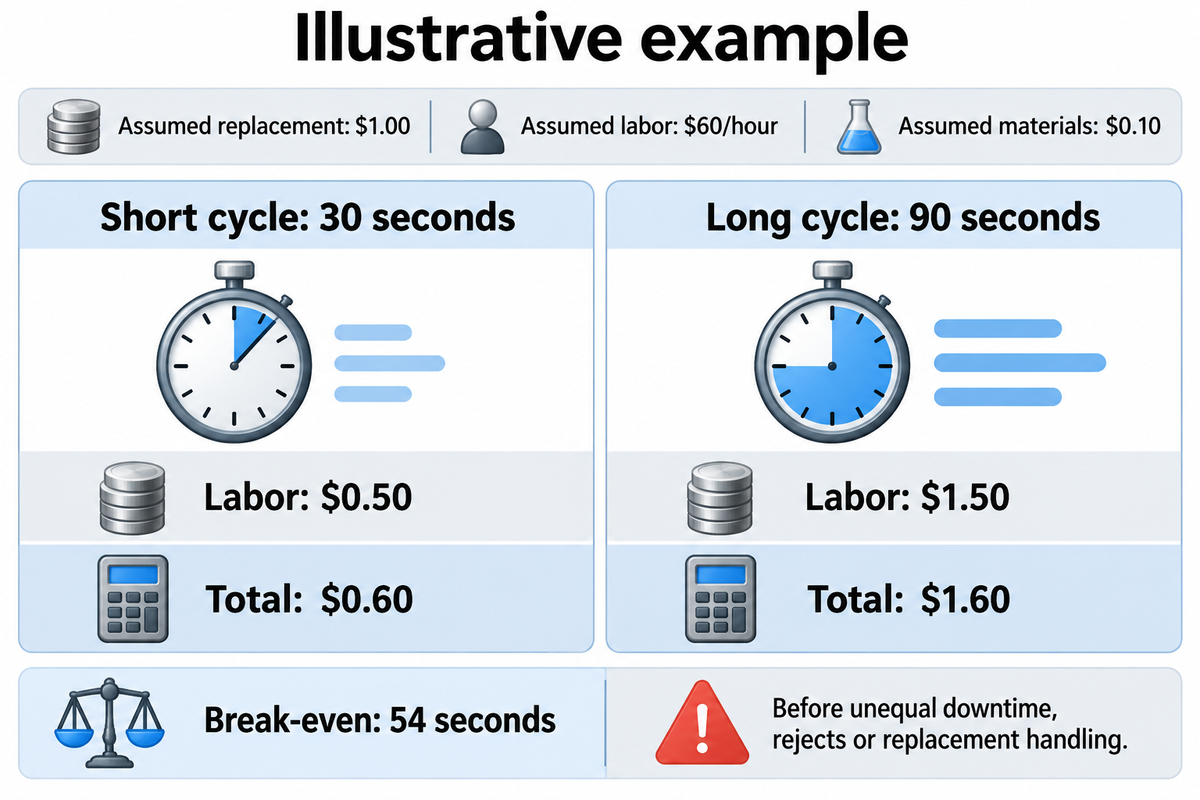
Economics favor cleaning tips accepted and designed for repeat use. Stainless steel isn’t an invitation to clean assembled needle tips repeatedly. Single-use tips should be replaced as instructed; reusable designs need a method that preserves the bore, outlet, hub and joint while removing the previous fluid.
Both product approaches exist. Some precision-tip manufacturers specify single-use. Others offer reusable metal-hub needles. Check the instructions for the part to see if they mention cleaning. The published hub-joint design problem also shows why cleaning compatibility includes the bonding material, rather than just the steel shaft.
Pack size affects the quoted price. A bulk catalog listing checked on November 2, 2026 displayed $429 for 500 metal-hub tips in its selected 14-gauge, half-inch variant: about $0.86 each before freight and tax. Pay attention to the construction and quantity when evaluating quotes.
For a reusable tip that’s approved, the operator’s time for handling, cleaning, drying and inspection should be accounted for in the workflow. The costs for cleaning and disposal also need to be accounted for. A cheaper tip can end up increasing costs if it takes a long time to process the tip.
| Input or result | Short cleaning cycle | Long cleaning cycle |
|---|---|---|
| New replacement tip, assumed | $1.00 | $1.00 |
| Total handling, cleaning and inspection | 30 seconds | 90 seconds |
| Labor rate, assumed | $60/hour | $60/hour |
| Calculated labor cost | $0.50 | $1.50 |
| Cleaning materials, assumed | $0.10 | $0.10 |
| Calculated cleaning cost | $0.60 | $1.60 |
| Difference from assumed replacement price | $0.40 less | $0.60 more |
| Cost comparison before unequal downtime or rejects | Cleaning costs less | Replacement costs less |
Cleaning costs are labor costs plus the cost of the materials. In the short cycle, $60 × (30 ÷ 3,600) + $0.10 = $0.60. At 90 seconds, the result is $1.60. With the assumed $1.00 replacement, the cleaning-time break-even is 54 seconds before differences in downtime, rejects or replacement handling.
In this worked example, which uses assumed costs, finance sees a potential $0.40 saving from the short cleaning cycle. The quality staff need the cleaned tip to produce acceptable deposits; savings from a part that can’t be used have no value. Production may favor replacement when cleaning interrupts an ongoing job. Measure both options under the same conditions, including the time to install a new tip. If cleaning takes the longer cycle, its labor and materials cost is already greater than the assumed purchase price, before even considering the cost of a lost deposit.
Use local measured times in place of the example inputs. For a different design that costs more initially and is reusable, include purchase cost across its demonstrated useful cycles as well.
Specify a Replacement Without Repeating the Trial
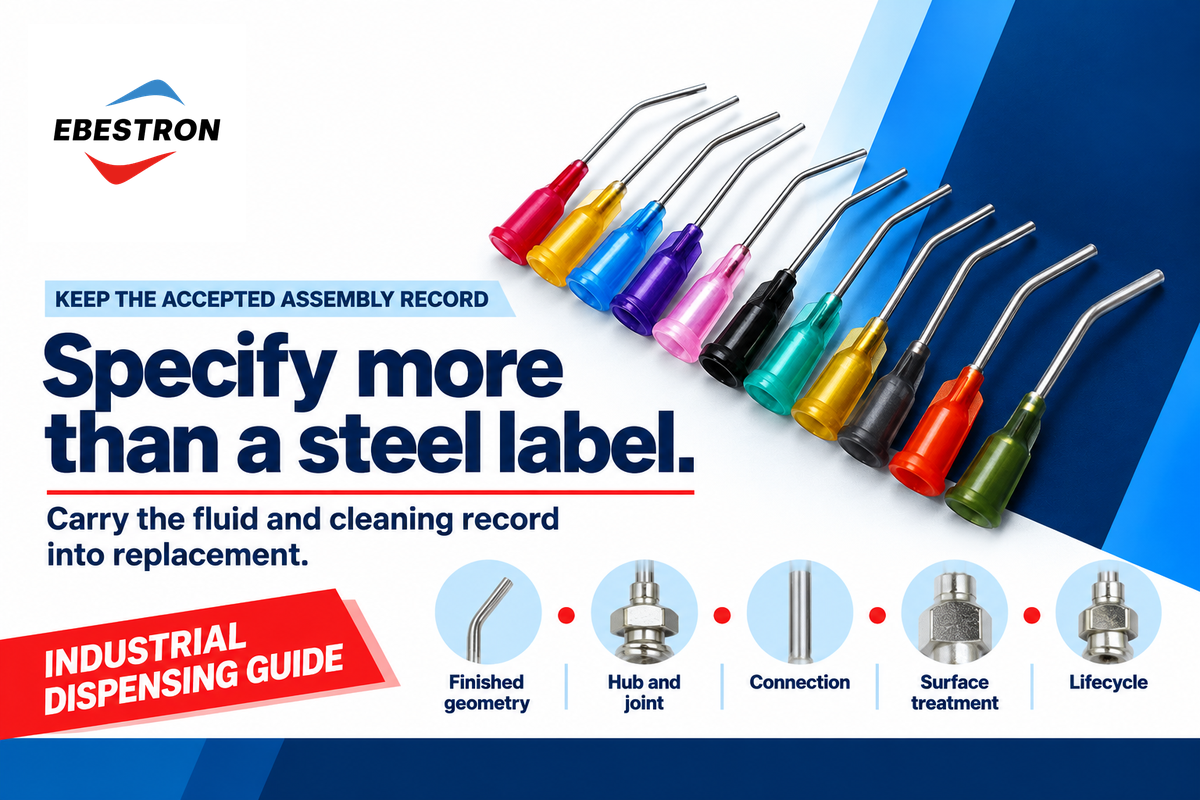
A suitable replacement specification records the accepted assembly, not just its gauge or color. Steel grade, finished bore and outlet, length, hub material, connection, surface treatment and lifecycle designation must be specified as well. Pair these requirements with the fluid and cleaner specs so a replacement part retains the features that made the original assembly acceptable.
The finished dimensional requirements after surface treatment must be included on the replacement record. For a precision nozzle, a change in finish and a change in bore can affect the same material flow even when the nominal material is the same. Compare fluid flow with the same adhesive when assessing replacement.
Are dispensing needles and tips compatible with automated dispensing systems?
Dispensing needles and tips can be integrated with automated systems when the connection, working length, and outlet position match the valve and tool arrangement. A robot changes how the tip is positioned; it doesn’t make every syringe tip interchangeable. The accepted assembly also has to work with the fluid, operating conditions and planned maintenance method.
For a bent needle, record the angle and orientation as well as the length. For a steel tapered dispensing nozzle, record the actual inlet and outlet geometry. Translate a tight tolerance request into finished dimensions and an agreed-upon measurement method. Keep the approved drawing or part number with the material record instead of replacing it with a generic “SS tip” description.
Nordson EFD and Techcon are some examples of dispensing tip manufacturers that manufacture stainless steel designs. Distributors may sell those brands alongside other product families. IntelliSpense has a reusable needle catalog where they can customize length, shape and angle of tips, with order quantity and lead time separated. Keep a standard catalog part and drawing-specific part separate in a replacement request.
The next place to compare products with the same specification is Ebestron’s “Stainless Steel Precision Tips” page. For company information, visit “Shanghai Ebestron New Materials Co., Ltd.”
Key takeaway
Keep the accepted tip’s finished geometry, surface treatment and whole-assembly materials together. That record makes a replacement comparison more useful than matching a stainless label or hub color.
Frequently Asked Questions
What is the difference between dispensing needles and dispensing tips?
In industrial dispensing, a dispensing needle usually means a narrow, tube-shaped outlet, often with a blunt end. Dispensing tip is the broader term and includes straight needles, tapered tips, flexible outlets and other shapes. Suppliers use the terms differently, so order by the drawing or part number, actual bore, length and connection rather than the product name alone.
Can stainless steel precision tips be repaired?
A damaged consumable tip is normally replaced. Straightening a bent outlet, drilling a blocked bore or grinding an edge can change its geometry and leave contamination behind. Cleaning an approved reusable design is maintenance, rather than repair. For an expensive serviceable nozzle, use the manufacturer’s defined replacement-part or repair route and retain the finished dimensional requirements.
Are stainless steel precision tips always the best choice?
No. A flexible plastic tip can be better near a scratch-sensitive surface, a tapered tip may suit a thick material, and a PTFE-lined design may suit a reactive low-viscosity adhesive. Steel remains useful where a rigid outlet is needed. Choose the fluid-contact surface and tip geometry together, rather than treating metal as the preferred material for every deposit.
Does a shiny tip mean it has been electropolished?
No. Mechanical polishing can also produce a bright appearance. Use the specified manufacturing finish and its acceptance record to identify electropolishing, rather than judging the process from shine.
How should unused stainless steel tips be stored?
Keep unused tips in their clean original packaging, with part and lot identification intact. Protect the outlet from contact with loose tools, dust and spilled chemicals. Take out the quantity needed for the job rather than leaving the full stock open beside the dispenser. A tip can acquire residue or a damaged edge before it ever carries adhesive. Keep different grades, bore sizes and finishes separated so that a similar hub color doesn’t cause a mix-up. Follow any packaging-specific storage instructions, and set aside opened or damaged packs when their cleanliness is in doubt.
References & Sources
- Performance Improvement of an STS304-Based Dispensing Needle via Electrochemical Etching original research abstract indexed by the U.S. National Library of Medicine.
- Stainless Steels to Behold, 316/L British Stainless Steel Association.
- Effects of alloying additions on corrosion and passivation behaviors of type 304 stainless steel Corrosion research abstract archived by the U.S. Department of Energy.
- ASTM A967/A967M-25 public scope ASTM International.
- ASTM B912-26 public scope ASTM International.
- Electropolishing Stainless Steel Optimization Using Surface Quality, Dimensional Accuracy, and Electrical Consumption Criteria original research in Materials, available through the National Library of Medicine.
- US20220331834A1: Dispense tips and methods of manufacturing the same Nordson application; used for its published joint-design explanation.
Have a tip drawing or an accepted sample? Send Ebestron the fluid type, finished dimensions, hub connection and cleaning requirement to discuss a suitable product option.