Get in touch with Ebestron Company

How Much Epoxy Resin Do You Need? Calculate Coverage, Volume and Kits

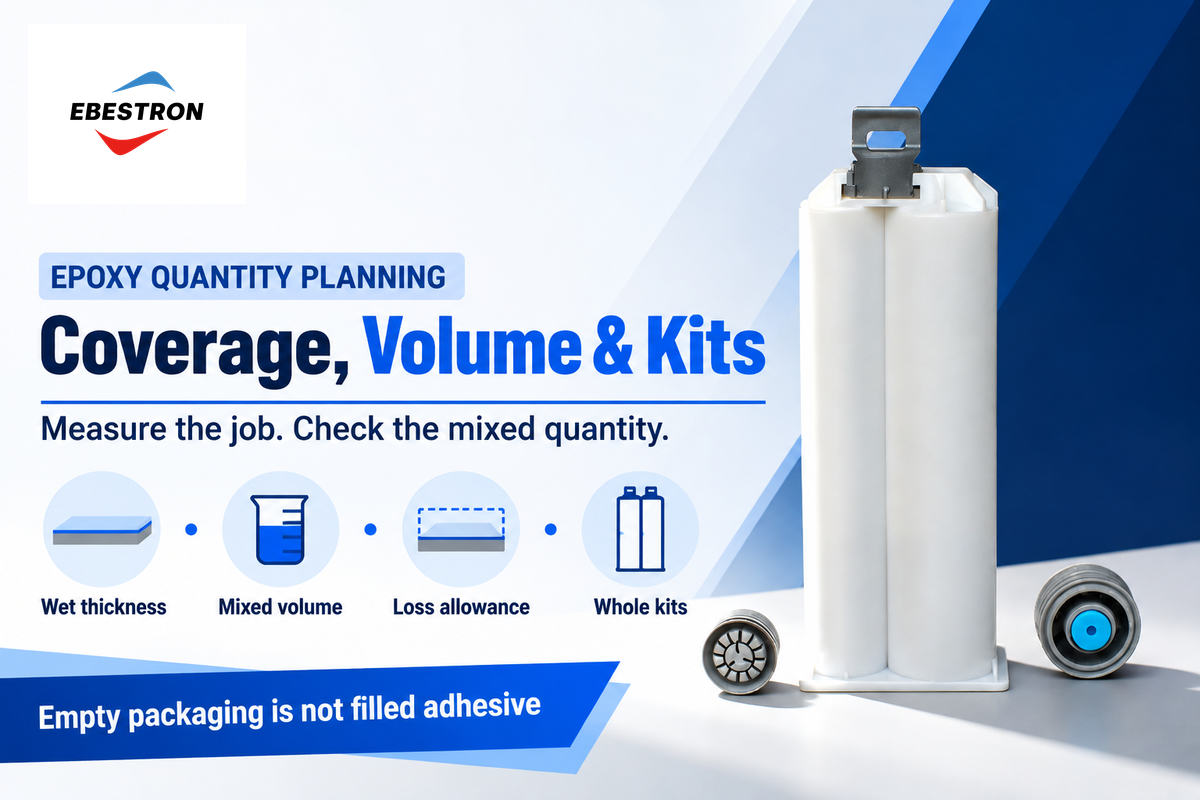
Epoxy resin coverage calculator explained: Multiply area in square meters by wet thickness in millimetres to get liters of mixed epoxy. A 2 m² surface at 3 mm needs 6 L before seal coats or losses. Use the product’s mixing ratio and convert the total requirement to complete kits.
If you are wondering how much epoxy to buy, estimate the space you want to fill first. Also consider material absorbed by the surface, and lost over the edge. An epoxy calculator will help you determine how much material the geometry requires. The steps below help turn that into a purchasing quantity.
How do you calculate how much resin you need?
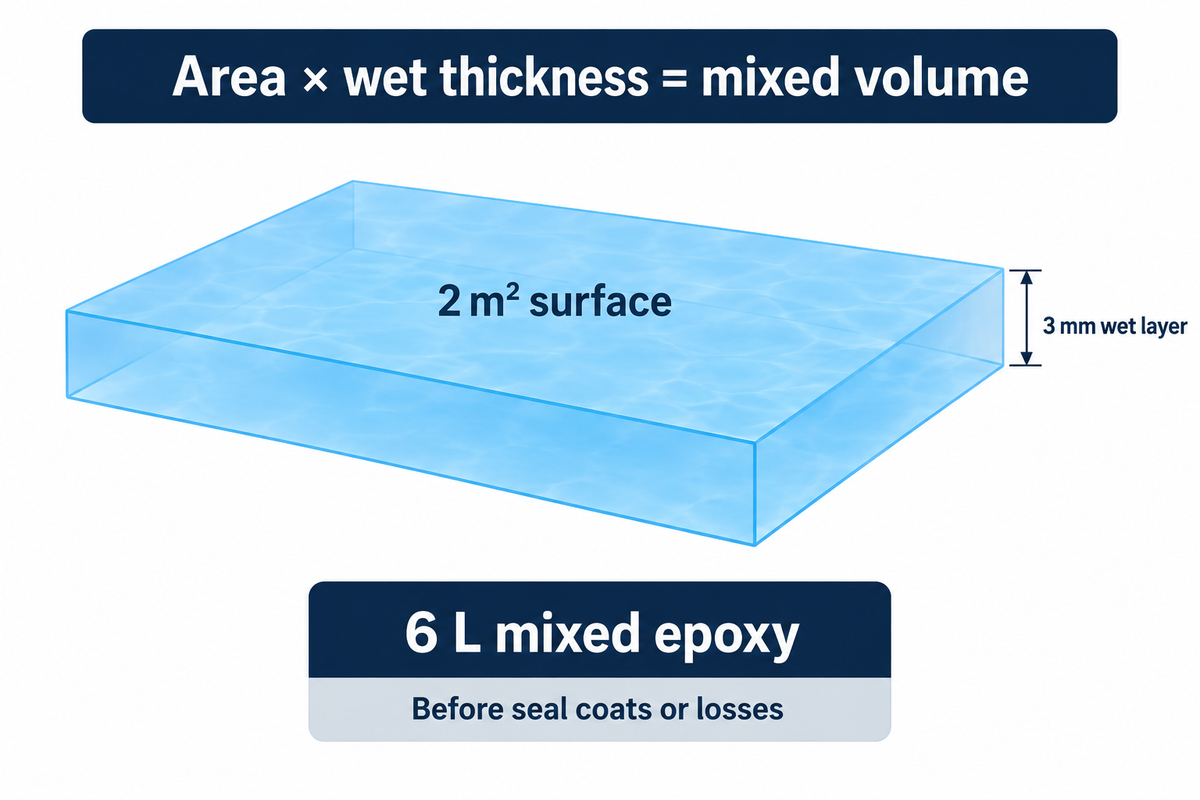
1 m² × 1 mm = 1 L. The result is the total mixed volume of resin and hardener required for a uniform wet layer. Measure the area and choose the product-specified wet thickness to determine how much epoxy resin the layer needs. This gives the resin needed on the surface before separate coating stages and process losses.
Theoretical mixed epoxy volume from area and wet thickness
For an ideal uniform wet layer, volume in litres equals area in square metres multiplied by thickness in millimetres. This is geometry, not a product coverage guarantee.
Theoretical mixed volume before losses
L
Enter measured coated area and intended wet thickness. Result is total mixed volume, not resin-only volume or mass. Excludes seal coats, absorption, edge runoff, container and mixer retention, voids, cure shrinkage and pack rounding. Use product documentation for permitted thickness and mixing limits; the calculator does not establish them.
Enter measured coated area and intended wet thickness. Result is total mixed volume, not resin-only volume or mass. Excludes seal coats, absorption, edge runoff, container and mixer retention, voids, cure shrinkage and pack rounding. Use product documentation for permitted thickness and mixing limits; the calculator does not establish them.
Enter every value to see the result.
This entry is ambiguous. Use a comma only as the decimal mark, for example 1,5, and do not type thousands separators.
The unit relationship comes from NIST’s volume definitions: a litre is a cubic decimetre. Picture a shallow tray. Increasing either its area or depth increases the volume in direct proportion; changing the brand on the bottles doesn’t affect that geometry.
“The liter (L) is a special name for the cubic decimeter”
Suppose a rectangular panel measures 2 m by 1 m, and its selected coating system calls for a 3 mm wet layer. These dimensions are just examples and aren’t to be taken as recommended layer thickness for all resins. Ordering 6 L of Part A and adding Part B would lead to a different total. Check the amount of epoxy resin shown on the kit label and see if both components are included before selecting a pack size.
Use an epoxy resin calculator for your project shape
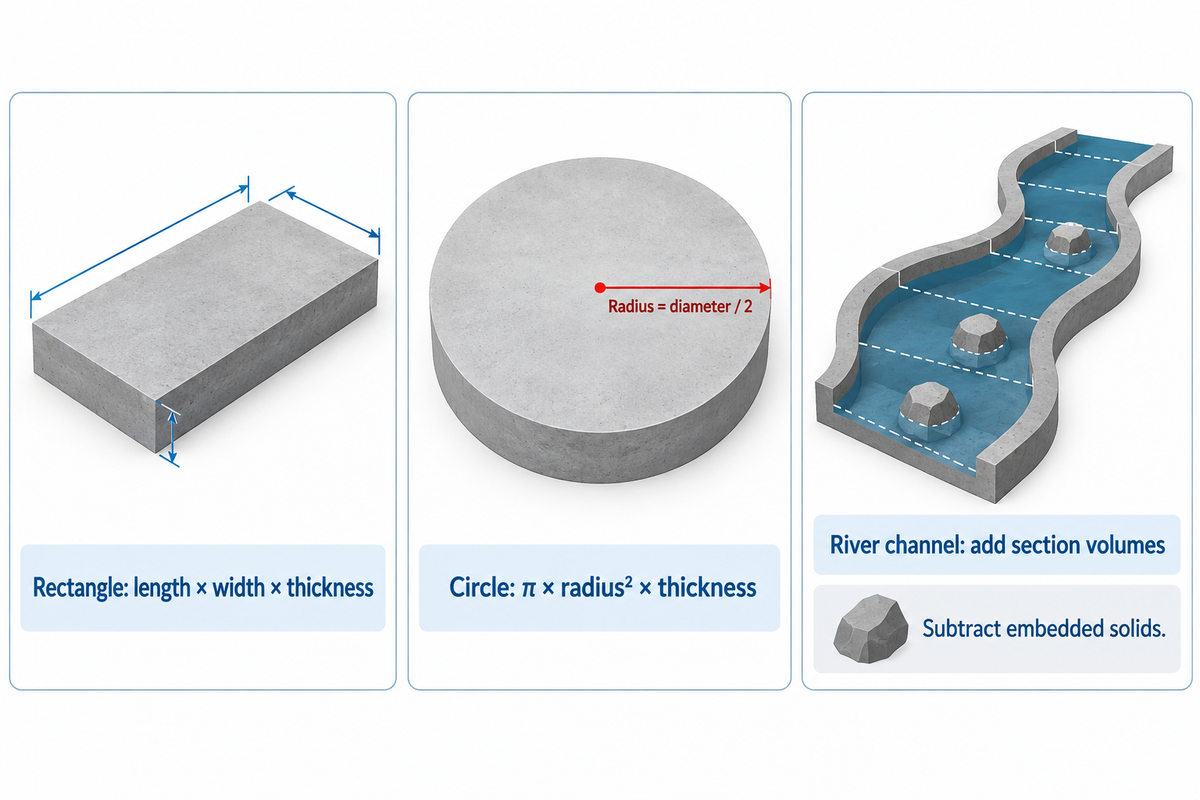
Rectangular projects use length × width × thickness. For round projects, use π × radius² × thickness, with radius = diameter / 2. Be consistent with your unit system. A resin coverage calculator that accepts inches needs inches in all pertinent boxes, including the thickness of epoxy. Decide on how much epoxy resin your project needs and then convert that to packs.
For a metric cross-check, 100 cm × 100 cm × 0.1 cm gives 1,000 cm³, or 1 L. NIST’s length conversion guidance also defines an inch as exactly 25.4 mm. A missing decimal in the depth box can change an order far more than a small handling allowance. Check the inputs before applying epoxy.
A round mold with an assumed 0.60 m diameter and a 5 mm fill depth takes about 1.414 L: π × 0.30² × 5. Using the diameter in place of the radius would quadruple the answer. Measure the inside mold dimensions and subtract the volume occupied by the inserts. Verify the casting resin permits the actual depth and batch size.
How much epoxy resin do I need for a river table?
The channel below requires about 4.32 L of liquid; estimate the open channel volume instead of the entire tabletop. Measure the length, average open width and depth of each section, and add the volumes of the sections. Subtract solid objects that are embedded. Irregularities in live edges make it difficult to estimate how much resin you need.
In a hypothetical 1.8 m long channel averaging 0.12 m wide with a 20 mm depth, the requirement is 4.32 L. A wider pocket changes that figure even when the table’s outside dimensions remain the same. Divide longer, irregular sections into shorter sections, get volume for each, and add them together to calculate the volume of the entire channel.
Epoxy coverage per gallon at different thicknesses
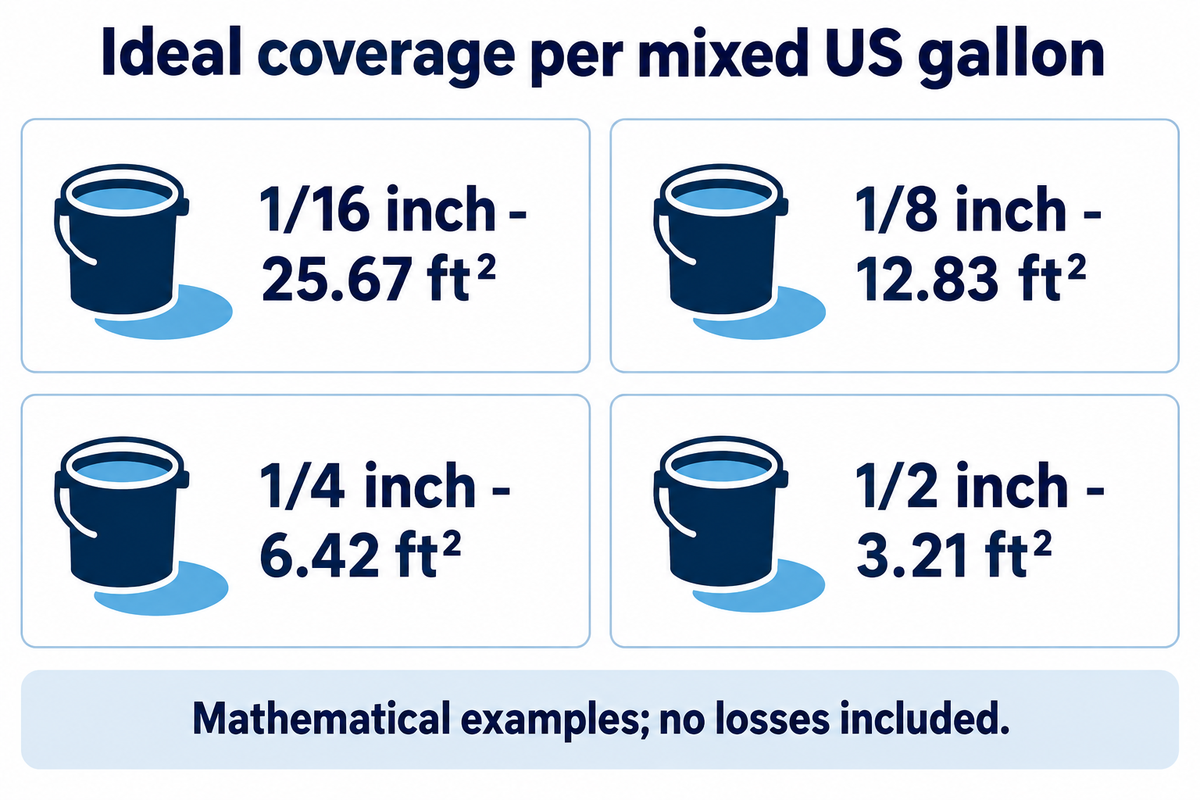
One US gallon of mixed epoxy covers about 12.83 ft² at a uniform 1/8-inch wet thickness, before losses. For a cover thickness of ¼ inch, the cover area would be about halved. A table top epoxy coverage recommendation can have several assumptions about the application, so use the thickness and definition of a gallon and compare figures before making any conclusions.
| Wet thickness | Inches | Ideal square feet per mixed gallon |
|---|---|---|
| 5 mil | 0.005 | 320.83 ft² |
| 10 mil | 0.010 | 160.42 ft² |
| 20 mil | 0.020 | 80.21 ft² |
| 1/32 inch | 0.03125 | 51.33 ft² |
| 1/16 inch | 0.0625 | 25.67 ft² |
| 1/8 inch | 0.125 | 12.83 ft² |
| 3/16 inch | 0.1875 | 8.56 ft² |
| 1/4 inch | 0.25 | 6.42 ft² |
| 1/2 inch | 0.5 | 3.21 ft² |
Calculated as 231 ÷ (144 × thickness in inches). These are mathematical thickness examples, not approved pour depths. No seal coat, absorption, runoff or mixing loss is included.
To work in the other direction, multiply area in square feet by 144 and by depth in inches to obtain volume in cubic inches; divide that cubic inch volume by 231 for US gallons. An imperial gallon is a different unit. Keep the same gallon definition through the calculation and the purchase label.
“12 square feet per mixed gallon” is approximate guidance for a particular application. Additional losses reduce covered area at a fixed uniform thickness. They can’t explain a larger area from the same volume. Avoid combining different brands’ figures into a single promised coverage range.
Convert litres to kilograms with mixed density
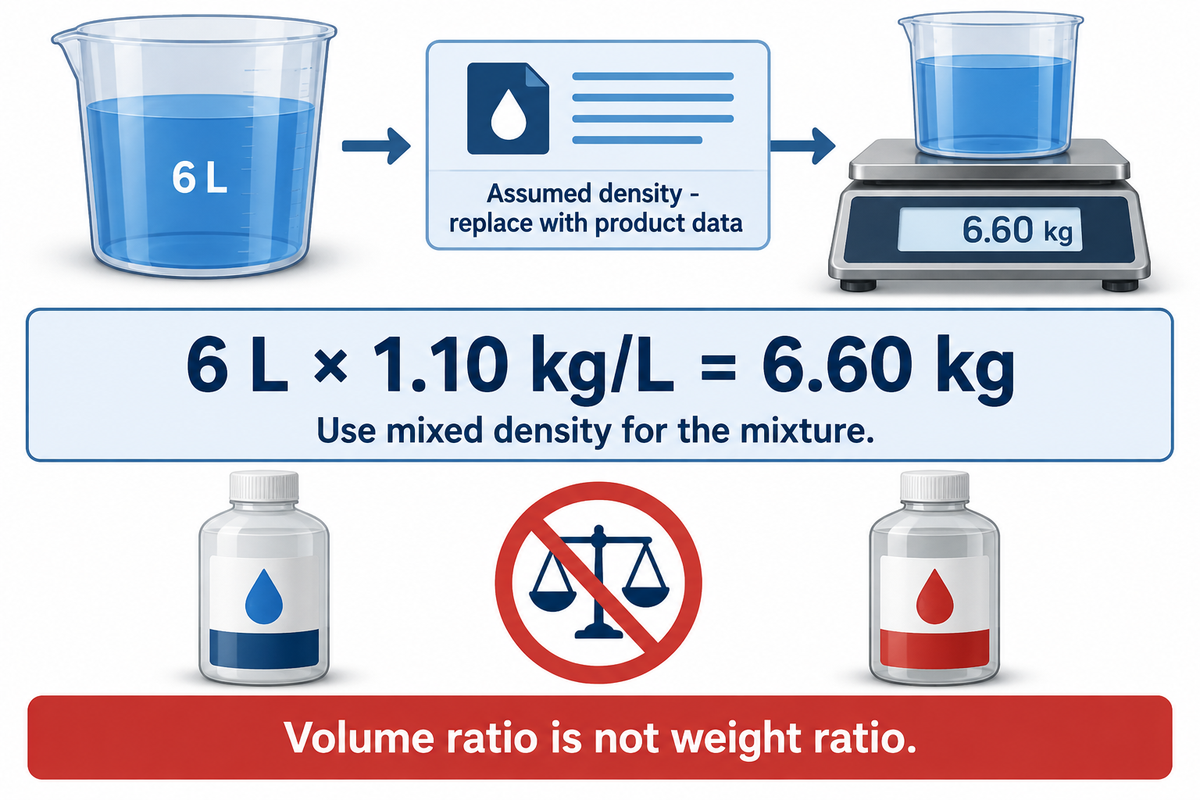
Multiply mixed volume in liters by mixed density in kilograms per liter to get kilograms. An assumed density of 1.10 kg/L converts 6 L to 6.60 kg. The assumed density of epoxy isn’t general; use the product data sheet of the adhesive or coating when ordering by mass.
Density can be defined as mass per volume as explained in NIST’s discussion of mass density. A supplier may list the density of Part A, Part B, and mixed values separately. Using the density of the resin component alone for the complete mixture may lead to an incorrect estimate of how much epoxy you need. Filled products require their own values.
How do you calculate the mix ratio by weight?
Use the weight ratio stated by the manufacturer. For instance, if a system requires 100 parts resin to 50 parts hardener by mass, a 900 g batch contains 600 g resin and 300 g hardener. Divide the batch mass by the total ratio parts and multiply by the share of the component. A volume ratio can’t be substituted without component density conversion.
Imagine an operator with a scale and a label that provides only a volumetric ratio. Measurement cups with equal markings don’t necessarily indicate equal weights. Using the wrong ratio could potentially result in an inadequately cured mixture. The next best option is to obtain the weight ratio for that system, rather than weighing equal masses. Zero the scale with the container in place, follow the dispensing sequence and scrape the sides and bottom while mixing as instructed. Our article on how epoxy mixing nozzles work explains the role of a static mixer in combining the metered components.
Epoxy seal coat vs flood coat: account for losses
A seal coat and a flood coat are separate demands. Each coat of epoxy is part of the quantity calculation. Epoxy that’s brushed into a porous surface doesn’t all remain as the later visible layer. Add each of the coating stages to the amount of epoxy needed, and account for the losses your process causes. A fixed extra percentage should not silently stand in for every surface and edge treatment.
On porous wood, using a thin layer of epoxy as a seal coat can help exclude air from entering a later pour. Whether you need a seal coat and for how long you leave the seal coat to cure is dictated by the product you’re using. A seal coat will increase the total epoxy needed even if the thickness of the flood coat remains the same. It’s too broad to say that sealing always prevents air bubbles.
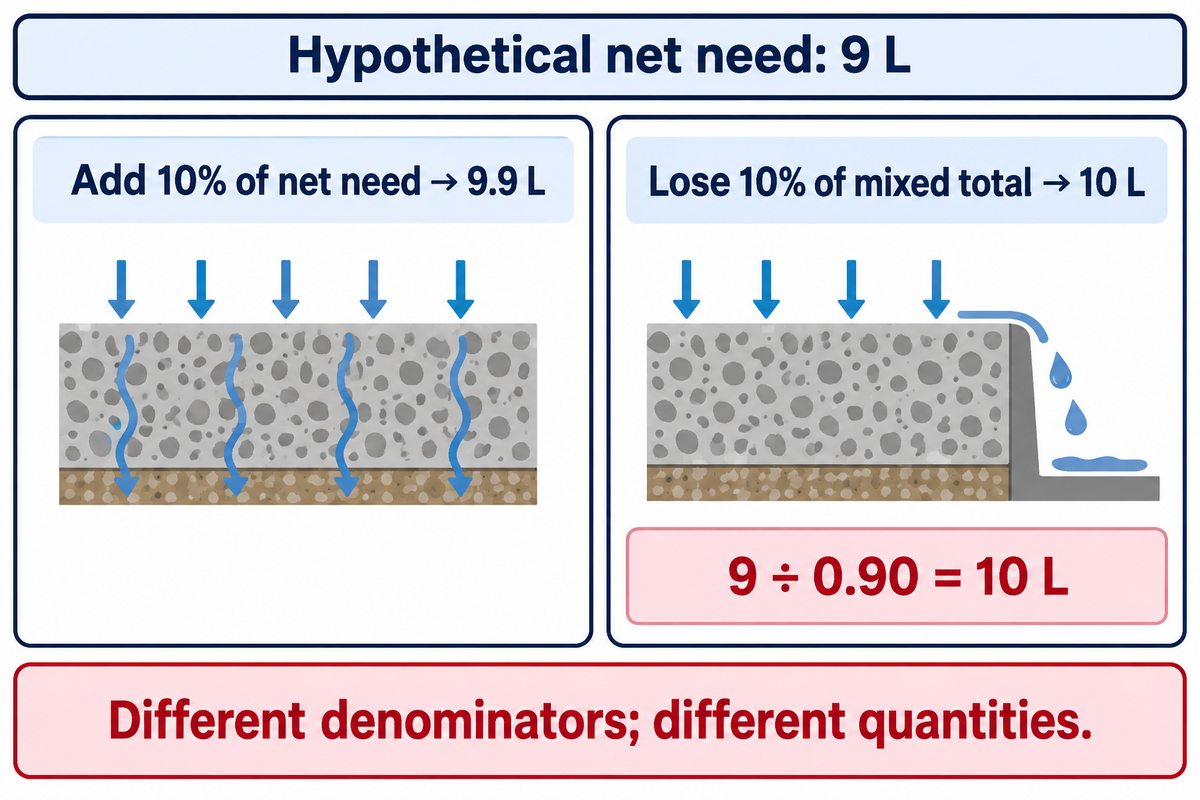
Keep the loss denominator clear.
For a hypothetical 9 L net requirement, adding 10% gives 9.9 L. If instead 10% of everything mixed is lost, the required amount is 9 ÷ 0.90 = 10 L. The percentages describe different quantities.
Letting the epoxy flow over a countertop edge behaves differently from containing it behind a dam. While wasted epoxy is retained by cups and mixing sticks, surface absorption creates a separate demand. Record the volume of extra epoxy as a separate volume or define an allowance. Don’t count edge loss again if the overall yield you’ve defined already includes edge loss.
Choose thickness for coatings, castings and bond lines
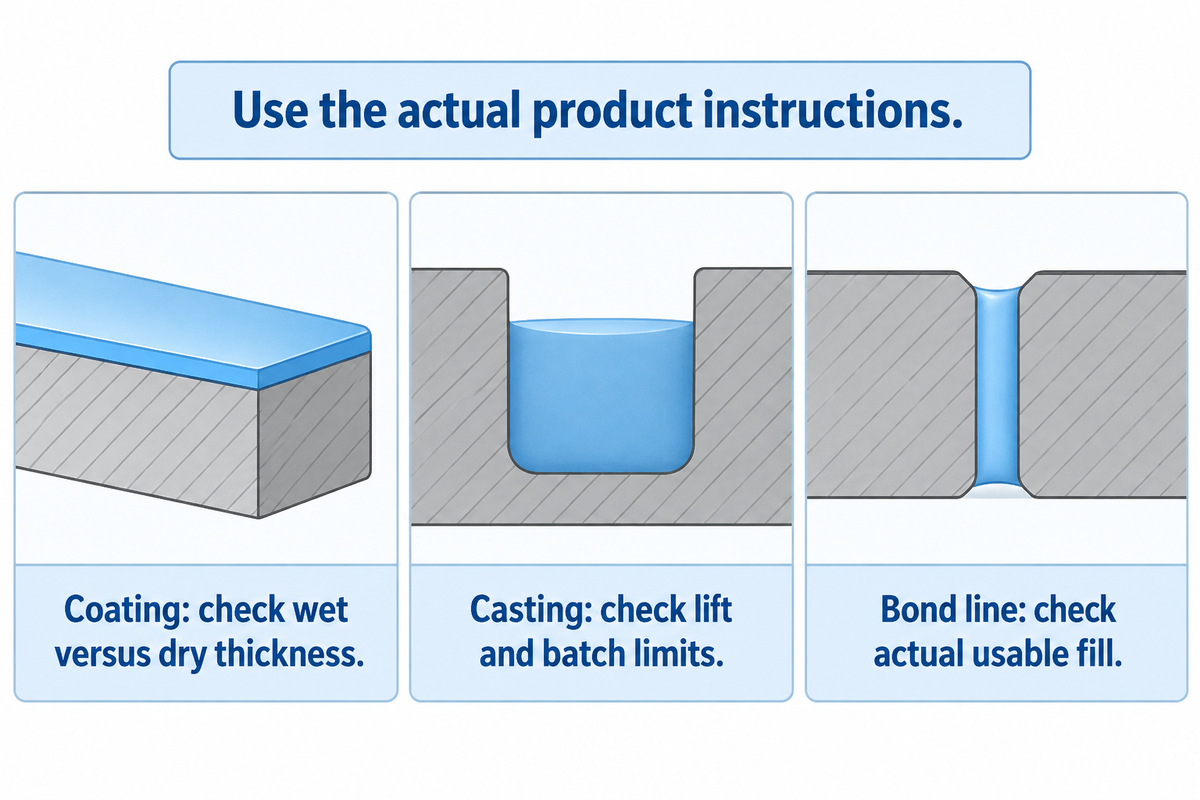
Consider actual product and application instructions when choosing thickness and calculating coverage. Different process limits apply to a thin layer on a panel, a deep pour epoxy casting and an adhesive bond line. Determine how much epoxy can be poured in each lift and how much can be mixed in a batch.
| Project | Start with | Separate check |
|---|---|---|
| Flat table tops | Surface area × wet thickness | Seal coat and edge runoff |
| Round table top | π × radius² × wet thickness | Diameter entered as radius |
| River table | Sum of channel sections | Irregular widths and solid displacement |
| Art resin panel | Area × selected wet layer | Porosity and edge treatment |
| Countertop or bar top | Each specified coat | Vertical edges and sealing stages |
| Deep casting | Empty cavity volume | Product-specific lift and batch limits |
| Floor coating | System coverage or film specification | Wet versus dry thickness and solids |
| Fiberglass laminate | Reinforcement/process resin demand | A flood-coat model is insufficient |
| Cartridge adhesive joint | Joint geometry and actual usable fill | Purge, retained material and squeeze-out |
Application distinctions are derived from published coating, resin-pour and dispensing guidance. Covering a table in a thin layer is different from filling a deep cavity.
When a coating specification gives dry thickness, the liquid requirement is dependent on the appropriate coverage and solids basis. ISO 3233-3:2015 describes a theoretical spreading-rate method and excludes coatings above the critical pigment volume concentration. ASTM D2697-22, section 4.1 likewise distinguishes liquid coating volume from the dry coating obtained.
Plan workable batches within the product’s amount of working time. Allot time for placing and finishing before epoxy hardens. Mixing a larger batch of epoxy changes heat buildup and handling time. If epoxy is applied in two stages, schedule each stage and its mixing losses separately.
How many epoxy kits should you buy?
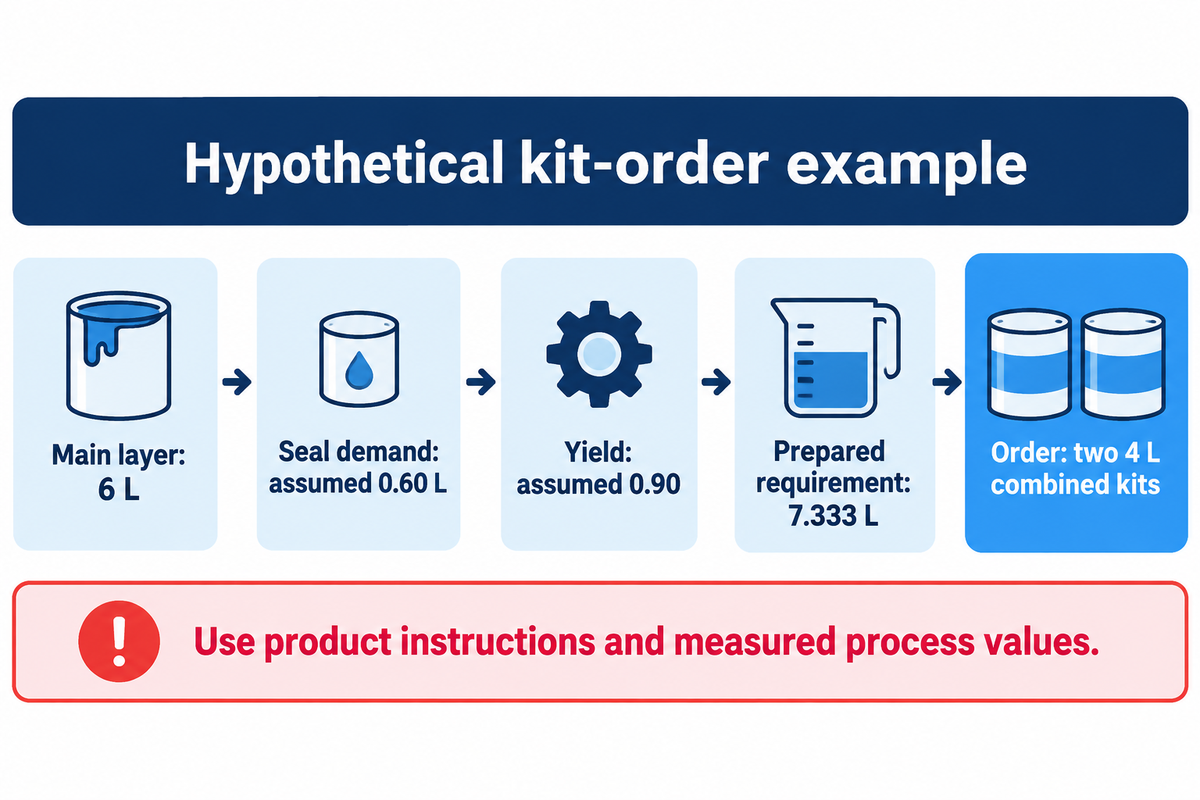
The worked example uses two 4 L combined kits for the 6 L main layer, seal coat and assumed losses. Divide the total prepared material requirement by the combined volume of one kit and round up. The Net-to-Kit Quantity Ladder is shown below. The seal coat demand, yield, and pack size are exemplars and should be changed to the system’s instructions and the measured process values.
| Step | Input or calculation | Result |
|---|---|---|
| 1. Main wet layer | 2 m² × 3 mm | 6.00 L |
| 2. Separate seal coat | Assumed additional demand | 0.60 L |
| 3. Net material demand | 6.00 + 0.60 | 6.60 L |
| 4. Prepared amount | 6.60 ÷ assumed 0.90 yield | 7.333 L |
| 5. Combined kit volume | Assumed Part A + Part B pack | 4.00 L |
| 6. Whole kits | Round 7.333 ÷ 4 upward | 2 kits |
| 7. Purchased total | 2 × 4.00 | 8.00 L |
| 8. Main-layer capacity | 8.00 × 0.90 − 0.60 | 6.60 L |
| 9. Main-layer headroom | 6.60 − 6.00 | 0.60 L |
The example uses stated inputs to derive needed arithmetic. The 90% yield applies to all prepared material in this model. Maintain full precision until the last step and rounding for kits.
When calculating how much epoxy to purchase, the important threshold is where an extra kit becomes necessary. Assuming the same yield and seal demand, two kits would cover a main layer of 6.60 L. Across 2 m², that’s 3.30 mm instead of the planned 3.00 mm. A larger required thickness crosses the third-kit threshold. This is a sensitivity analysis and not a 10% tolerance to the installation thickness or assurance that the surplus will be usable.
Staff can check thickness and batch scheduling; quality staff can verify the material and ratio; purchasing can check the mixed quantity required vs. the pack sizes available. If you run out of epoxy, a coating stage can stop, while buying an additional kit creates an obligation for storage and shelf life. Keep the original component labels with any unused material.
Estimate coverage from adhesive cartridges
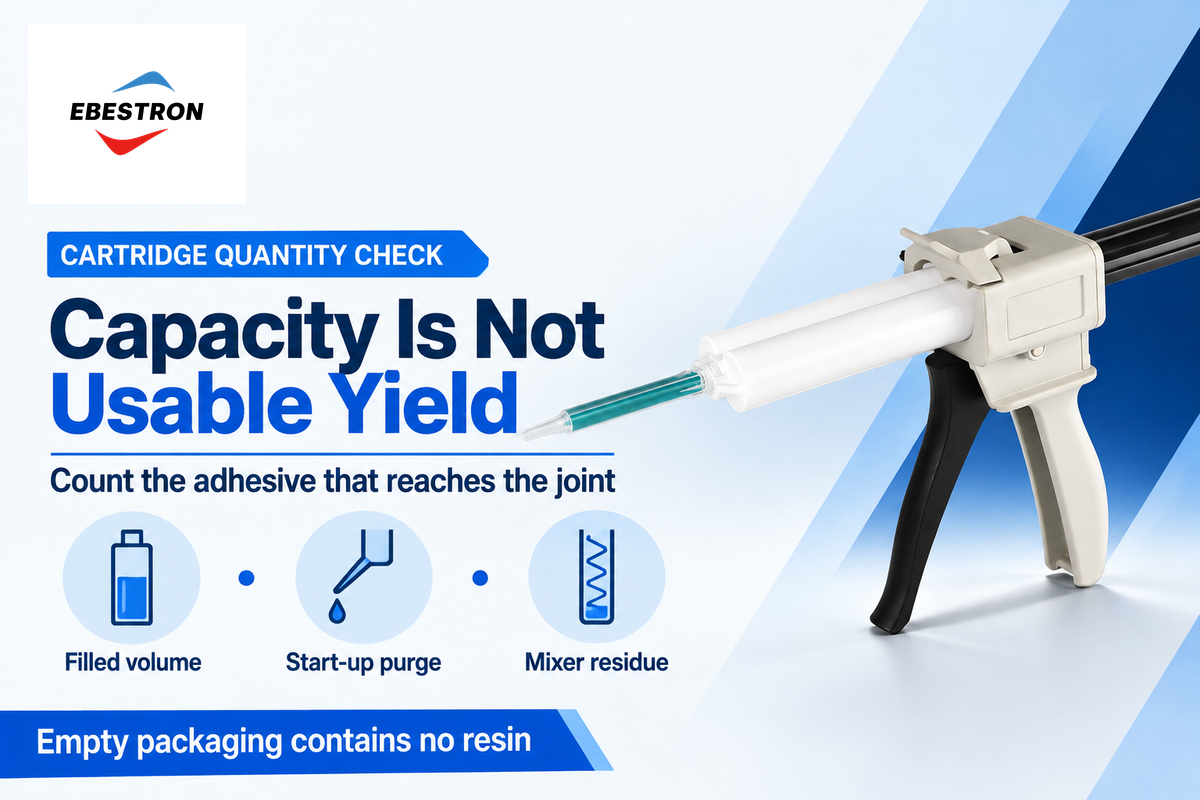
An ideal 50 mL filled system at an assumed 0.5 mm thickness covers 0.10 m² before loss. The calculation assumes a total mixed adhesive volume. Ebestron’s 50 mL dual cartridge options are empty packs with several ratio configurations. The adhesive formulator offers the chemistry and working instructions.
To demonstrate the importance of tracking various processes in a supply chain, let’s look at a simple assembly order. Let’s assume that the joints require a total quantity of 40 mL of mixed material. A nominal 50 mL fill provides a theoretical 10 mL margin. However, each mixer change can consume some of that margin. In addition, record the filled volume, start-up purge and material retained in discarded mixers on the same combined-volume basis. Only then can purchasing tell whether one cartridge is sufficient.
When using a two-part adhesive cartridge, match the dispenser, cartridge ratio and mixer connection to the filled system. Epoxy mixing nozzle selection also affects retained volume and mixing performance. Don’t subtract mixer residue a second time if an experimentally determined usable yield already includes it.
Indicate whether the purchasing enquiry is for filled adhesive or empty cartridges for bulk filling. An order for empty packaging doesn’t include the resin calculated for the joints.
Compare manufacturer epoxy calculators by their assumptions
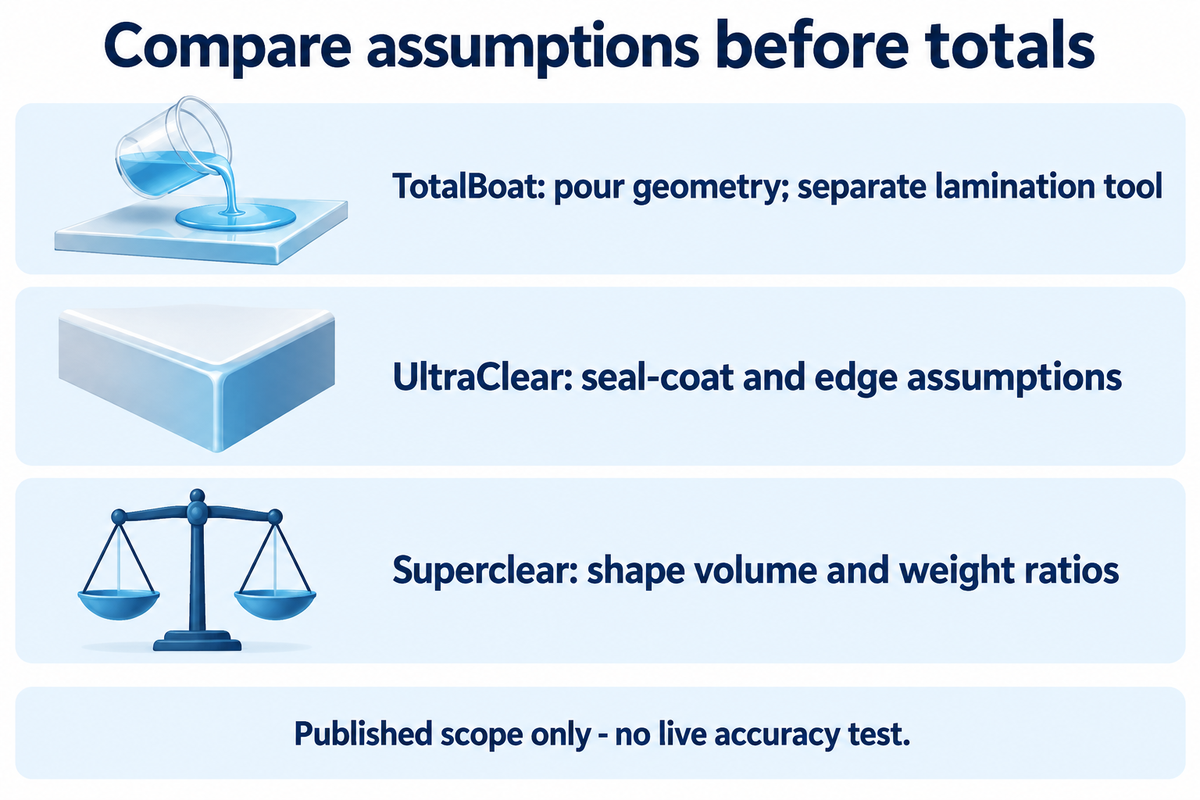
Compare calculators only after matching input dimensions, units and output basis. Estimating a resin pour in one calculator may differ from adding a seal coat or edge allowance to another. Therefore, different displayed totals can answer different questions.
| Manufacturer | Published scope | What to check before ordering |
|---|---|---|
| TotalBoat | Rectangular/round resin pours; separate lamination tool | Project type, thickness and additional material allowance |
| UltraClear | Table/bar-top quantity including seal-coat and edge assumptions | Porosity, dams versus runoff, included coating stages |
| Superclear | Shape-volume and product-specific weight-ratio tools | Selected formulation and whether the output is volume or component mass |
Based on publicly described inputs and scope reviewed in October 2026. No live calculator accuracy test or product endorsement is implied.
The primary difference is whether the epoxy coverage calculator returns the net amount of resin on the job or the gross amount to prepare. See whether the outcome includes additional epoxy for sealing. With table top and bar top work, a nominal coverage chart may represent a different process from the calculator. Corroborate those assumptions before deciding how much extra epoxy to acquire.
Check your quantity before ordering
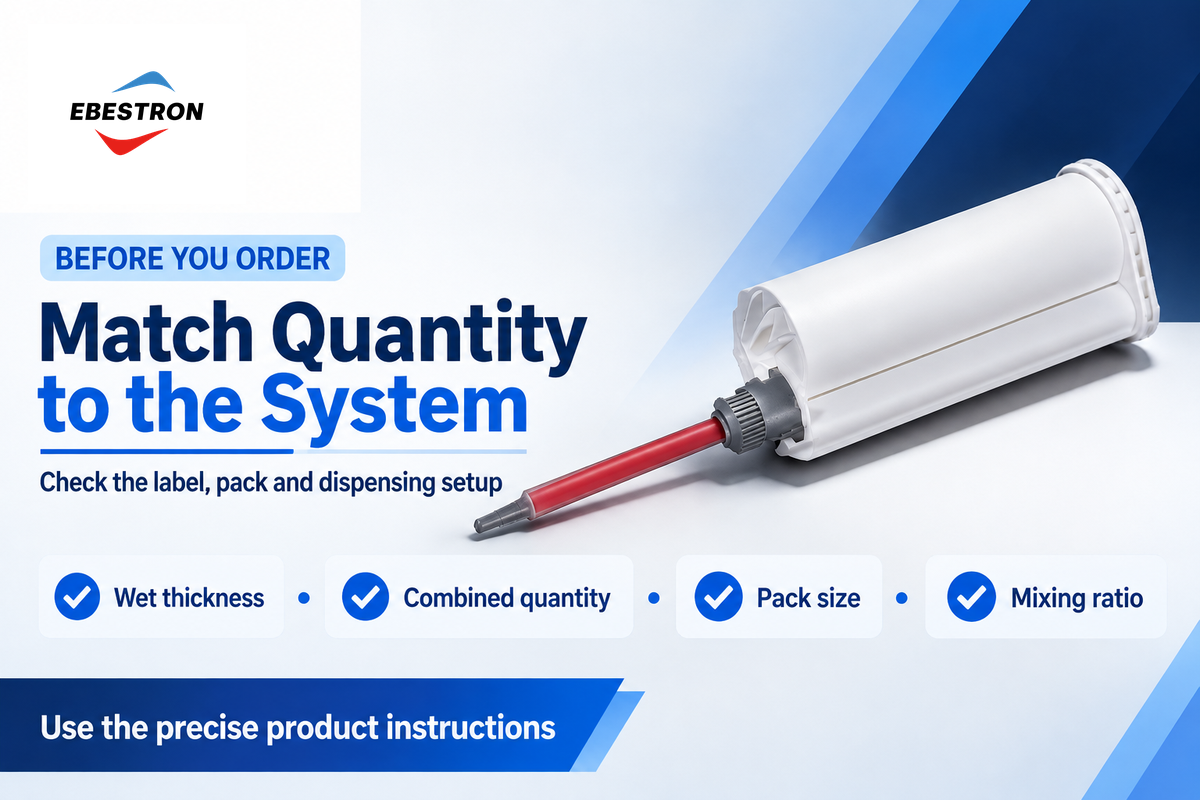
Verify the dimensions, wet-thickness, combined-component quantity and pack size before paying. Then check the precise product’s mixing ratio and batch instructions. The exact amount of epoxy shown on a screen is only as good as its inputs. Check them before deciding exactly how much epoxy to order, especially at a whole-kit boundary.
For a filled-cartridge system, discuss cartridge and mixer requirements based on the nominal fill, formulation’s volume ratio, dispensing system and anticipated starts. Those details let a packaging inquiry follow the quantity calculation without turning a tabletop coverage estimate into an adhesive performance claim.
Frequently Asked Questions
How many square feet will a 5 gallon bucket of epoxy cover?
About 64.2 square feet at a uniform one-eighth inch, assuming five US gallons of total mixed epoxy and no losses.
A thinner coating covers more area. Check whether the bucket contains only resin, whether hardener is additional, and whether the manufacturer’s coverage includes a primer or seal coat. Use the specified wet thickness for the selected system.
How many gallons of epoxy for 1000 square feet?
At an assumed 10-mil wet thickness, the ideal amount is about 6.23 US gallons.
Multiply 1,000 by 144 and by 0.010, then divide by 231. These figures describe mixed liquid volume. Use the specified coating system, account for its solids content where dry thickness matters, and add the actual layer and loss requirements before ordering.
What is the shelf life of epoxy resin?
Epoxy has no single shelf-life period across products, packages and storage conditions; use the manufacturer’s guidance for both components.
Keep the original labels and batch details, and distinguish unopened from opened-container guidance. Buying a larger kit to avoid running out can leave surplus epoxy on hand, but a coverage calculation can’t tell you whether that material remains suitable for a later job.
Is one gallon of epoxy resin plus hardener?
A mixed-gallon label means the combined components.
A gallon of Part A with separate hardener has a different total yield. Read the kit label.
Is the Calculator 100% Accurate?
No. The geometry requires accurate inputs and a uniform wet layer; actual consumption also changes with the application.
Surface variation, measurement error, absorption and process losses change the amount actually consumed.
Where packaging fits into this calculation
Ebestron supplies empty dual cartridges and mixing hardware. This guide connects epoxy volume calculations with packaging questions; it doesn’t present resin formulation data or claim factory trials. The worked purchase scenarios use declared assumptions so that formulators and buyers can substitute their own process values.
References & Sources
- SI Units, Volume, NIST.
- SI Units, Length, NIST.
- Guide to the SI, Chapter 8, NIST.
- ISO 3233-3:2015, volume non-volatile matter and theoretical spreading rate, public abstract.
- ASTM D2697-22, volume nonvolatile matter in coatings, public significance and scope.