Get in touch with Ebestron Company

3M Dynamic Mixing System Compatible Guide: Identify, Compare and Validate Parts

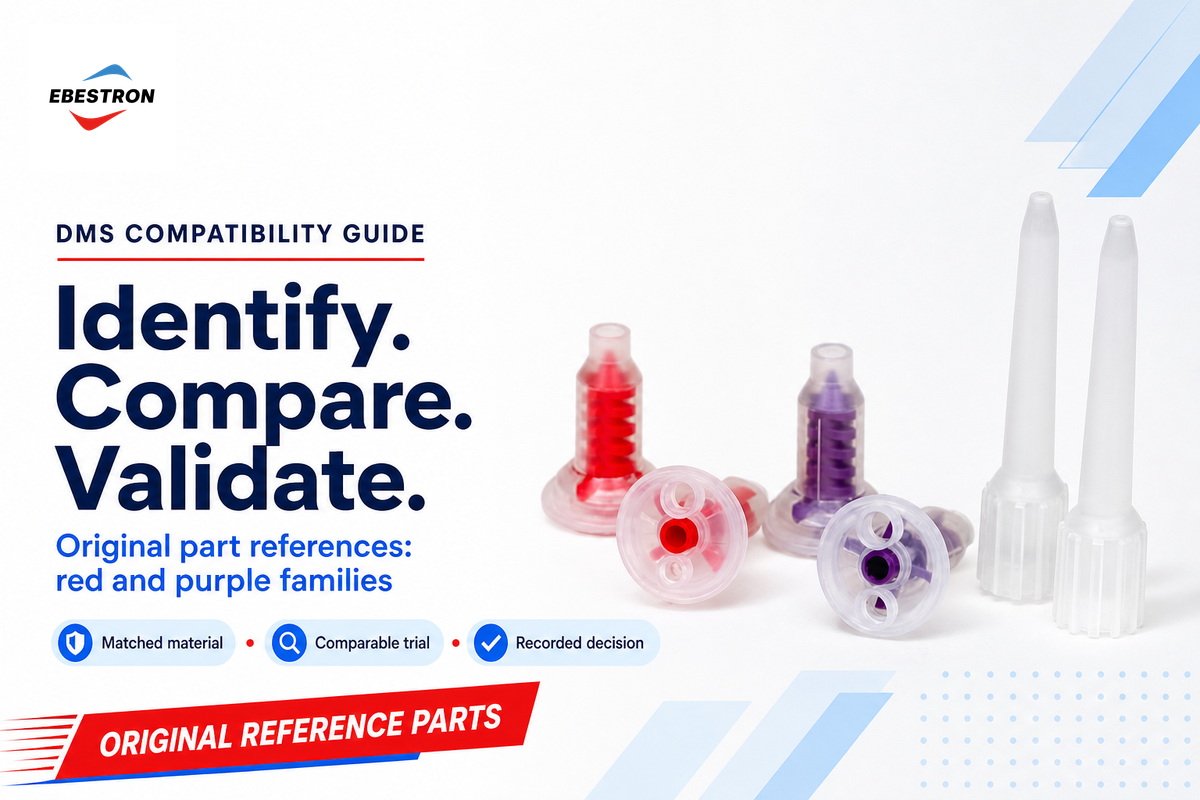
A 3M Dynamic Mixing System Compatible replacement should be assessed against the original named part and the material running through it. Start with the applicator label, cartridge identifier and nozzle. Then, examine the proposed replacement against the same criteria. Only then should the order be finalized.
The case is usually more detailed for the purchasing and quality teams. Is it the right nozzle? Sometimes the trial uses a different adhesive, an unidentified cartridge, or a different setting on the machine. The focus of this document is to untangle the variables and transform a sample evaluation into a record that supports purchasing.
Start here: Red 05847 identifies the original filler/glaze nozzle family; purple 55847 identifies the adhesive/sealer family. Record the exact material as well as the color. Evaluate the complete matched combination, then calculate whether the expected order volume repays the qualification work.
3M Dynamic Mixing System Compatible: What the Claim Means
Compatibility refers to the proposed replacement within a defined assembly. For automotive DMS consumables, the driven mixing system nozzle is integral to the assembly, alongside the dispensing tool, cartridge and material. The supplier’s product detail should provide the original and replacement stock codes, allowing the purchaser to distinguish the replaced component.
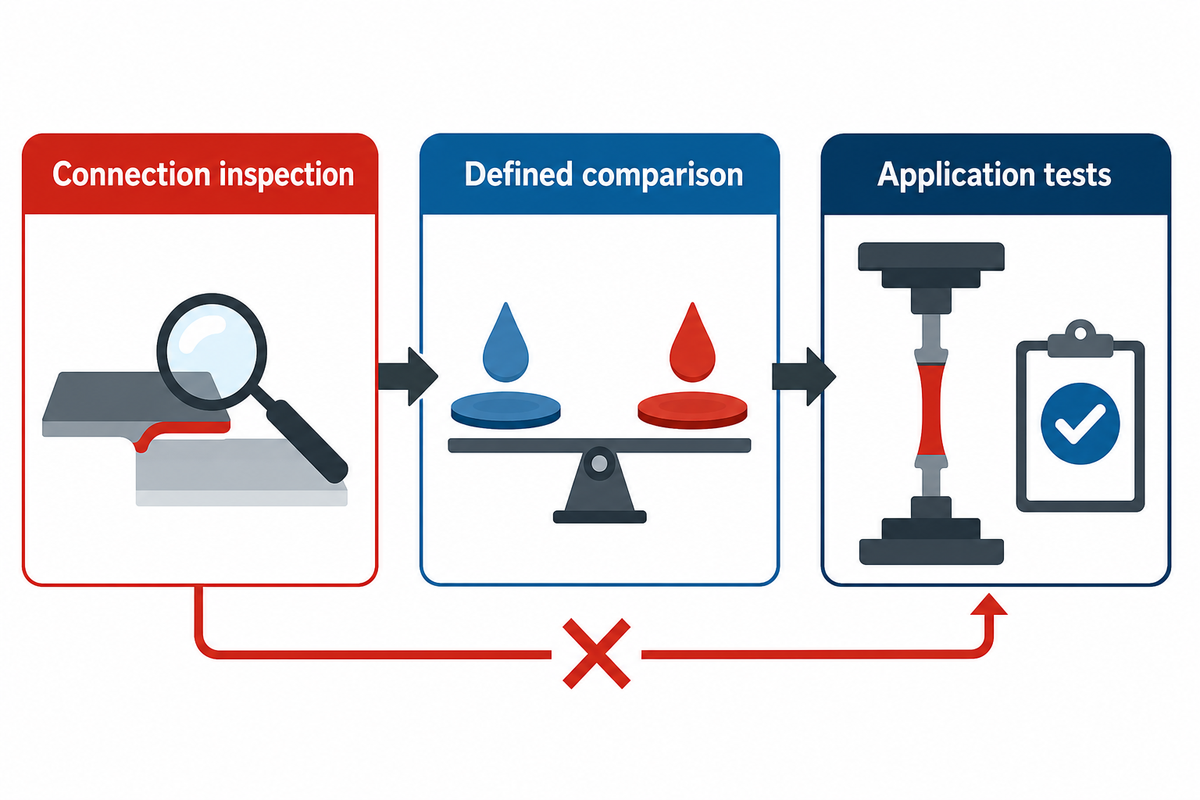
Separate the following questions: can the component connect correctly? Can the matched system dispense and blend the material? And does the application meet its acceptance criteria? For collision repair applications, each question requires a different observation. Connection inspection answers the first. A defined comparison answers the second. The material’s application tests answer the third.
The 3M™ Dynamic Mixing System Nozzle product page describes active mixing action for two-part body repair products. A driven element mixes the streams during dispensing. Our comparison of static and dynamic mixing describes the broader mechanisms at play.
“05847-compatible nozzle” describes a potential substitute for a consumable. A “new dispensing system” describes a broad set of changes. Keep those changes separate. A sample, quote and acceptance record should describe the same purchase.
3M DMS Identification: Applicator, Cartridge and Material
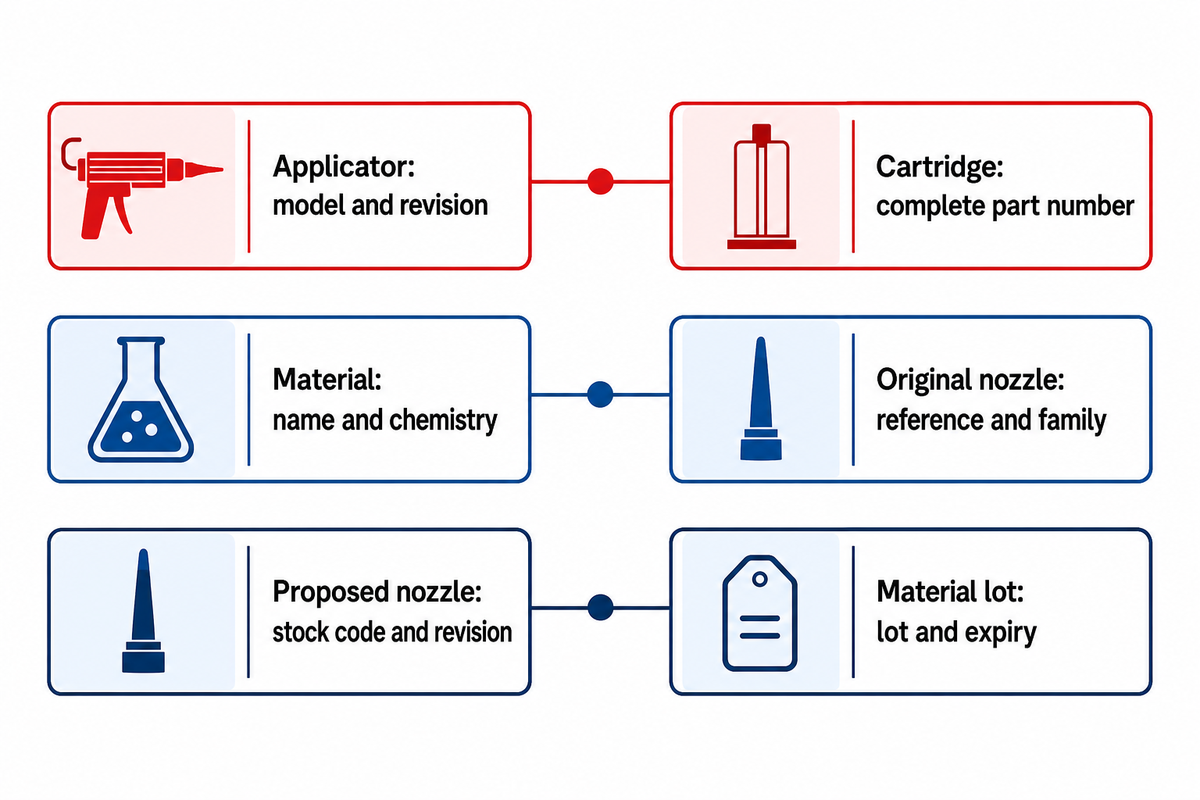
Before comparing replacements, describe an assembly using the part numbers from within the DMS. The 3M Dynamic Mixing Applicator reference 05846 describes the tool; the material cartridge has its own identifier and instructions. Keeping them together prevents a purchasing team from treating all cartridges loaded into a dispenser as the same product.
In an I-CAR interview with 3M’s Shawn Collins, cartridge chemistry, component ratio and applicator problems are discussed separately. That distinction is needed in the buying record. The front label can identify epoxy or urethane chemistry, while the precise product instructions define the material requirements.
| Field | Entry to retain | Buying decision |
|---|---|---|
| Applicator | Model and equipment revision | Keep the specified tool in the comparison |
| Cartridge | Complete manufacturer part number | Separate similar-looking packages |
| Material | Product name and chemistry | Use the correct application instructions |
| Capacity | Label value in mL | Identify the actual package |
| Mix ratio | Specified ratio and its basis | Preserve the intended component feed |
| Original nozzle | Reference number and family | Define the component being replaced |
| Proposed nozzle | Supplier stock code and revision | Make repeat orders traceable |
| Material lot | Lot and expiry information | Separate supply changes from nozzle changes |
| Application | Substrate and required properties | Select the relevant acceptance tests |
The broad order description “DMS cartridge” is a warning against shortcuts. A 2015 3M Canadian product table showed a listing of 05863 at 276 mL, 58115 at 450 mL and 58308 at 600 mL. Those entries show why a broad order description of “DMS cartridge” isn’t acceptable.
Specific static nozzle interface types and two-component dispensing gun selection are discussed separately. One identification feature is a dual cartridge outline.
3M DMS Nozzles: Red 05847 and Purple 55847
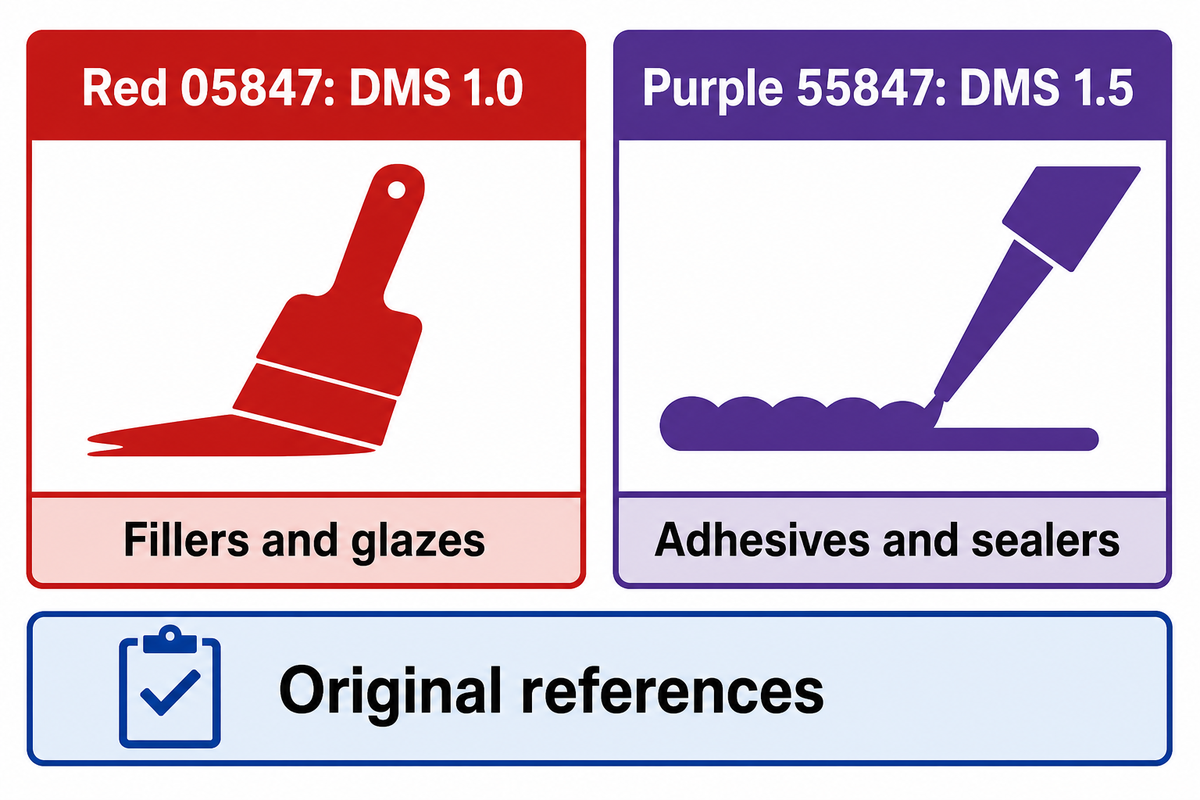
Red 05847 is from the original DMS 1.0 family for fillers and glazes; Purple 55847 is from DMS 1.5 for adhesives and sealers. Use those reference numbers with the material identity. Color aids in stock differentiation, but the entire part description should assist in making a purchasing decision.
| Original reference | Family | Brochure ratio label | Material group |
|---|---|---|---|
| 05847, red | DMS 1.0 | 50:1 | Fillers and glazes |
| 55847, purple | DMS 1.5 | 1:1 and 2:1 | Adhesives and sealers |
The manufacturer brochure supplies the numerical labels; the current product-family page retains the red/purple distinction. Neither ratio is a setting to improvise at the nozzle. The cartridge and dispensing arrangement feed the two parts, while the mixer blends the delivered streams.
Will these nozzles fit my 05846 applicator?
Choose the nozzle meant for the material cartridge used with the 05846 applicator. The original red and purple families cover different product lines, thus the gun number alone isn’t enough to determine the nozzle. An equivalent part proposed to be compatible should have the same cartridge connection and drive arrangement as the original.
Example: A customer receives a quote for “DMS tips” for two benches. One bench dispenses body filler. The other uses a seam sealer. When undifferentiated, it’s difficult to inspect the order and trace the sample results. Split the request according to the original references and attach the proposed replacement codes for each material. In a combined request, purchasing can negotiate quantities while keeping the technical records separate, and warehouse staff can compare delivered labels against the correct record instead of choosing based on color. Separation should be maintained on the reorder, even if they both come from the same supplier.
Material Requirements: Ratio, Preparation and Cure
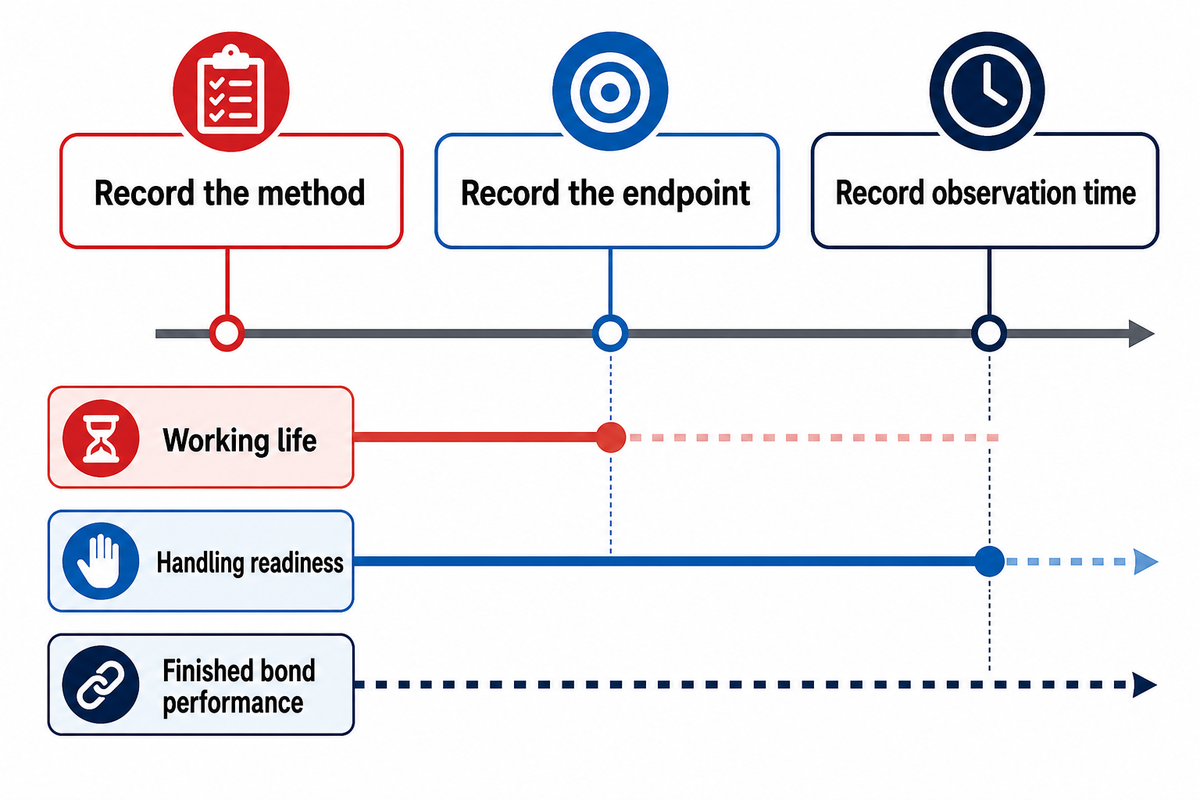
Materials determine the acceptable ratio, preparation and cure conditions for a DMS comparison. The resin and hardener complete the reaction. The instructions for the materials define what’s to be measured, the temperature and when the end point will be assessed.
Adhesives and sealants involve multiple chemistries. Polyester filler and two-part adhesives based on epoxy, urethane or silicone shouldn’t be lumped together in one operating recipe as two-component products. Product selection comes first. The comparison then uses the material’s handling and application requirements.
ISO 10364:2024 describes methods for determining the pot life of multipart adhesives. The public scope notes that different methods can produce different results and that some acrylic-based adhesives are unsuitable for the methods. Record the method as well as the elapsed time when comparing working life.
“The different methods described in this document to measure the property do not necessarily provide identical results.”
A statement of “cured correctly” leaves much unknown. More informative statements identify material instruction, test endpoint and observation time. Working life, handling readiness and the required finished bond performance address different questions. Report each of the endpoints where applicable.
DMS Nozzle Changes: Follow the Matched Product Instructions
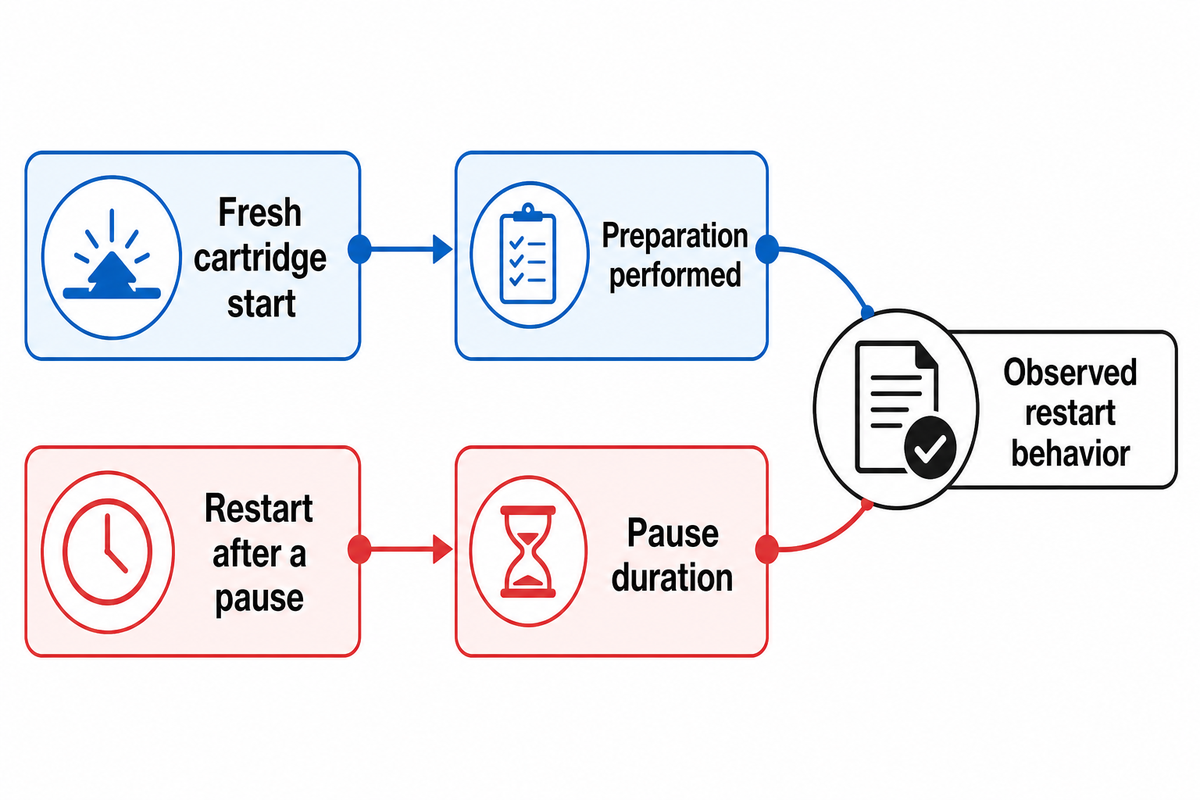
Nozzle changes should follow the matched product’s preparation and restart procedure. Equalization, outlet condition, and drive engagement affect the next dispense. The manufacturer determines the allowed method and sequence for each material and applicator, and the same preparation method is used for matched products during a comparison.
The official 3M demonstration by Shawn Collins and I-CAR’s plunger-leveling guidance address first use and nozzle changes, and include material that may have begun to cure near the outlet. These are reasons to record preparation rather than treating a fresh tip as the entire restart process.
From an operator’s perspective, the description of a practical record is short: identity of the material, preparation performed, nozzle installed, pause duration, and observed restart behavior. A trial run started with a fresh cartridge should be distinguished from a restarted trial run after a pause. The difference between a fresh start and a restart may explain why two records were entered in the log.
The 3M demonstration also discusses contamination around the mixing rod. Include related condition observations when passing a problem to the technical team. Pressure, speed and cleaning actions should be tied to matched instructions; changing them mid-comparison creates another variable.
Dynamic Mixing Problems: Record Symptoms Before Replacing Parts
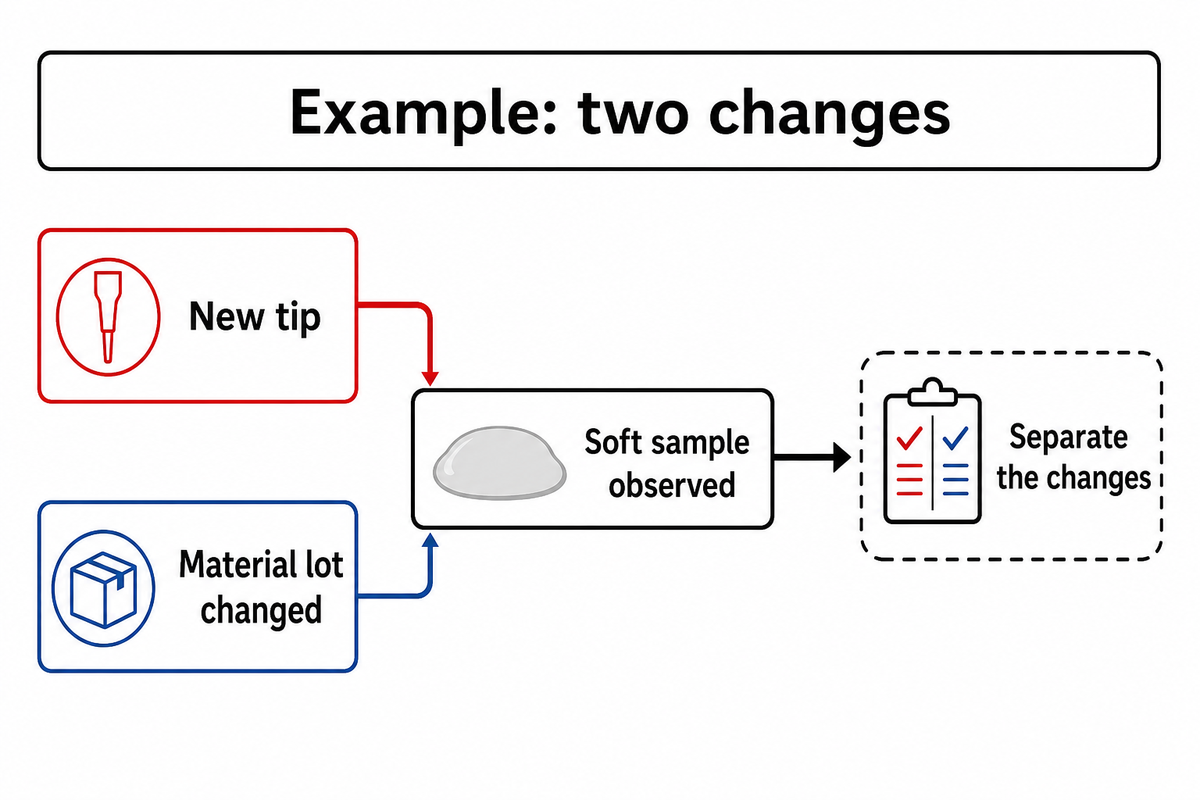
Record an observation of dynamic mixing before assigning a cause. Record differing appearance, interrupted fluid delivery and unexpected cure behavior as separate observations. An effective report shows the symptom, related material and equipment conditions and describes the problem, so that the technical team can differentiate problems with feed, application and mixing.
The I-CAR interview separates cartridge outlet issues, applicator issues and mixing or equalization problems. Assuming that all change in the bead is due to a new tip isn’t the best place to start. A pinhole observation also belongs beside the material and application conditions, rather than becoming an automatic nozzle verdict.
A 2011 study by Katnam and others assessed mixing technique and the formation of microvoids and tensile strength in specimens of two-part epoxy. It compared static mixing with hand mixing. The lesson learned from the trial is to incorporate expected performance (application requirements) with observed appearance.
Example: A new tip is reported to have produced a soft sample, but the material lot changed on the same morning. The purchasing team now has two changes and one failed observation. Rejecting the tip immediately would leave the material question unresolved; accepting it after a better-looking second sample would leave the cure question unresolved. The quality lead records both lots, the preparation sequence and the specified cure conditions, and then plans a comparison that separates the changes. The retained record is useful even before a cause is assigned: it prevents the next shift from repeating a different setup and calling it the same test.
ISO 10365:2022 supplies terminology for failure patterns in mechanically tested bonded assemblies. Where that testing is relevant, consistent descriptions help a supplier understand the result without guessing from “the bond failed.”
Original vs Compatible Nozzles: Build a Comparable Trial
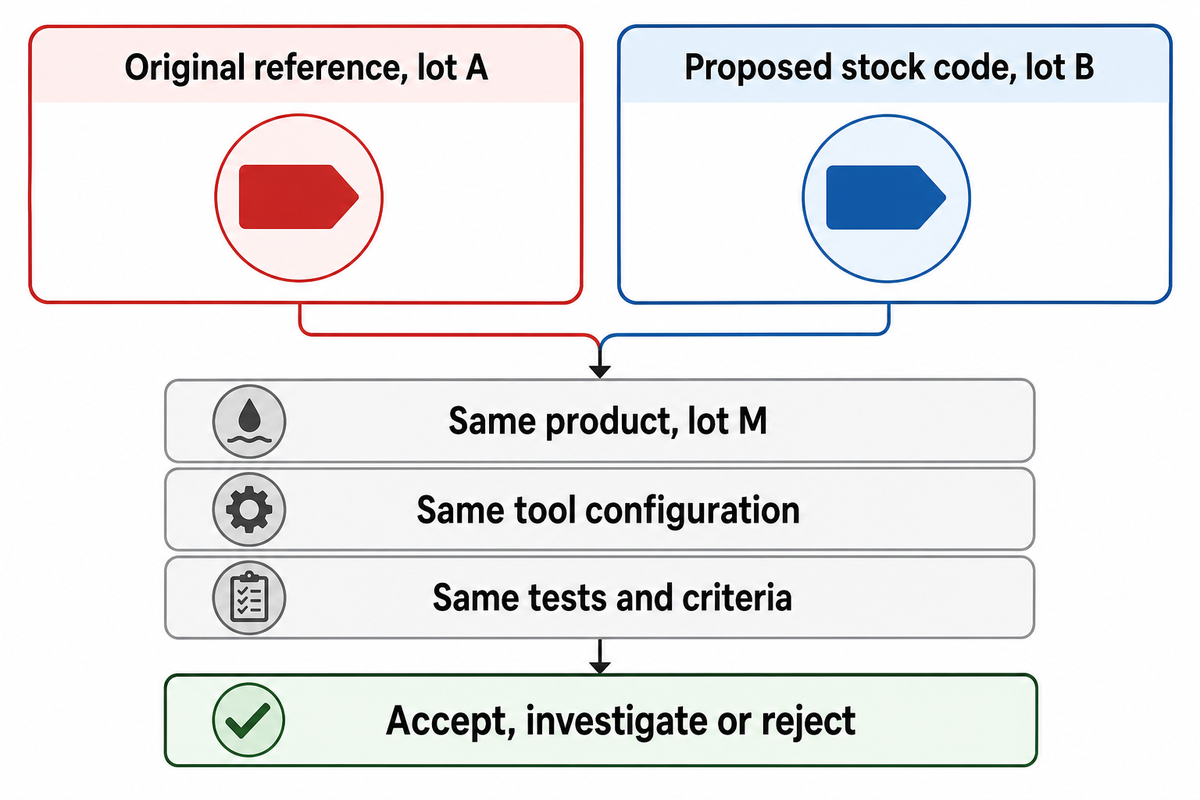
Compare the original and proposed compatible nozzles with the material and operating conditions held constant, and then record the changed component. State the application tests and acceptance criteria for the samples being evaluated. The result should identify the tested configuration and lots, so purchasing knows which proposed stock code the decision covers.
NIST’s explanation of confounding describes why combined effects can be difficult to separate. In this case, the hidden bottleneck is attribution: a nozzle change coupled with a material or setup change may consume a trial without answering the original question.
DMS Trial Change Log – example record design. The entries below provide a guide for organization; the quality team supplies the actual sample count and acceptance criteria. “A” and “B” differentiate comparison groups, not different materials.
| Recorded item | Group A | Group B | What the comparison resolves |
|---|---|---|---|
| Nozzle identity | Original reference, lot A | Proposed stock code, lot B | The intended changed component |
| Material | Named product, lot M | Same product, lot M | Material change excluded |
| Cartridge | Specified part and capacity | Same specification | Package change excluded |
| Applicator | Recorded model and revision | Same tool configuration | Equipment change excluded |
| Preparation | Matched instruction revision | Same preparation method | Restart method kept comparable |
| Conditions | Temperature and settings recorded | Matched conditions recorded | Setup drift becomes visible |
| Dispensing pattern | Defined run and pause sequence | Same sequence | Pause effects separated |
| Sample coverage | Count and lots identified | Count and lots identified | Scope of observations preserved |
| Performance endpoints | Specified tests and criteria | Same tests and criteria | Results compared on one basis |
| Disposition | Baseline observations retained | Accept, investigate or reject | Next purchasing action documented |
Upon completion of the comparison, keep the original measurements, along with the decision. Include the material properties in the record for the application. Observations related to handling may be pertinent to productivity. Appearance measurements may also be relevant and belong in the record. The quality team’s acceptance decision controls the release for the application.
Keep the first comparison separate from the acceptance of the incoming lot. NIST distinguishes short-run lot acceptance from long-run quality control. Record the sample coverage, acceptance plan and supplier changes for later deliveries. A trial covering one lot supports a decision about that tested lot and configuration; repeat supply needs its own control plan.
DMS Replacement Economics: Qualification Before Unit Savings
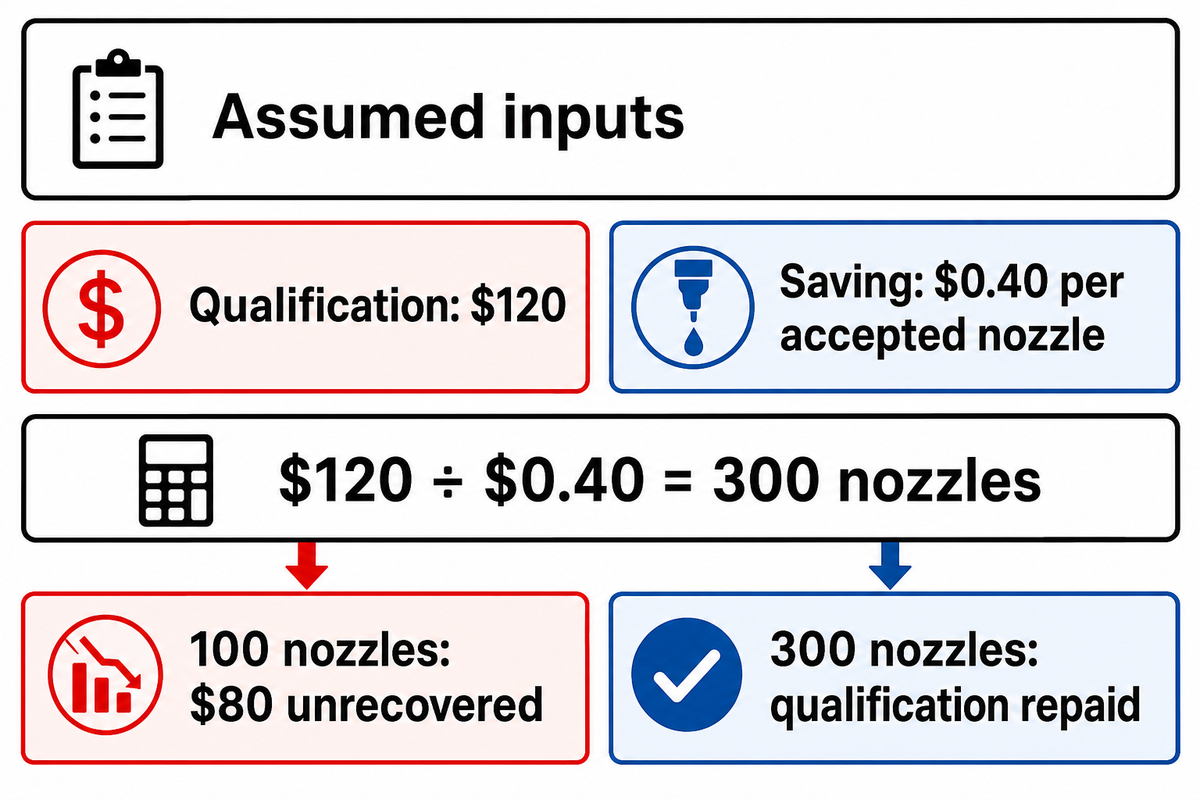
Replacement economics are based on qualifying a part and the cost savings associated with accepting the part. Divide the qualifying cost by the unit savings to find the volume necessary to recover the qualifying cost. This is done after technical acceptance and the saving has been quantified.
Qualification Lot Break-Even, assumed inputs: a purchasing team expects to spend $120 on qualification and save $0.40 per accepted nozzle. The calculation is $120 ÷ $0.40 = 300 nozzles. An order of 100 nozzles saves $40 in unit cost, leaving $80 of qualification expense unrecovered. At 300 nozzles, unit savings exactly repay the assumed qualification expense. For an owner planning a small job, that difference can favor keeping the existing supply. For a buyer expecting repeated accepted orders, the initial expense may be spread across a larger quantity. Finance should keep the qualification charge visible rather than judging the offer from the lower unit price alone.
Consider relevant delivery and handling costs when determining break-even unit savings. If the comparative part costs the same or more after relevant delivery and handling costs, then unit-price break-even savings don’t justify the purchase. Other savings would need to be measured and justified.
Consider waste, defects and operator time when assessing replacement economics, but include these only when the comparison measures them. Our Nozzle Spending Worksheet covers the consumption side of the calculation.
Compatible Nozzle Supplier: Turn the Trial into a Reorder Specification
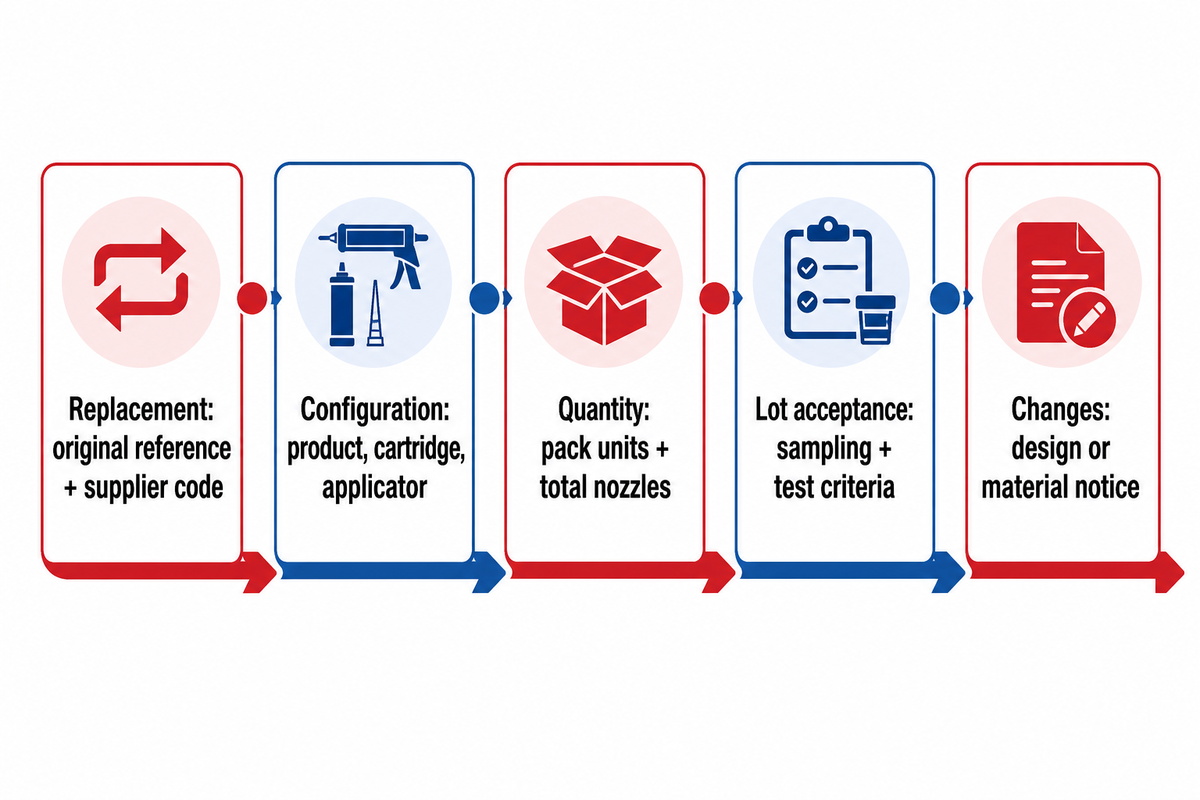
A reorder specification preserves the accepted replacement stock code and matched material and tested configuration. Add the lot records and the supplier’s change notification arrangement to allow comparison to a later delivery against the accepted supply. This gives procurement a repeatable order description, rather than remembering which sample looked right.
Use this compact request with the trial record. Verify the identity of the proposed part and the pack size quoted before comparing total order commitments.
RFQ checklist — copy these fields into the quote request
| Parameter | Requested entry | Why it matters | Acceptance record |
|---|---|---|---|
| Replacement identity | Original reference plus supplier code | Defines the substitution | Labels matched to sample |
| Material configuration | Product, cartridge and applicator | Preserves trial conditions | Completed change log |
| Order quantity | Units per pack and total nozzles | Makes quotations comparable | Written quotation |
| Lot acceptance | Agreed sampling and test criteria | Controls each delivery | Inspection and test records |
| Product changes | Notice for design or material changes | Triggers a scope review | Revision history |
Ebestron offers compatible nozzles referenced to 05847 and 55847, and a pneumatic applicator option referenced to 05846. Send the requested configuration through our 3M Dynamic Mixing System Compatible solutions page. The Ebestron Company Profile gives more information about the supplier. Original 3M product references identify the equipment family; proposed Ebestron stock code references should be included in the quotation and trial record.
Frequently Asked Questions
Does this guide cover dental impression mixing systems?
No. This guide covers automotive DMS body repair materials.
Dental Pentamix equipment and impression materials belong to a different product family. Their cartridge, mixing tip and drive requirements should be identified from the dental system’s own instructions. For an automotive order, retain the applicator label and the material cartridge identifier together. That keeps a broad search for dynamic mixing equipment from turning into a purchase from the wrong product category.
Does changing the mixing nozzle change the material ratio?
No. Select a nozzle for the material’s prescribed ratio rather than using a tip change to alter it.
The cartridge and dispensing arrangement supply the components, while the mixer blends the delivered streams. Keep the specified material, cartridge, applicator and nozzle combination together in the record. A switch between the red and purple families is therefore a product-selection question, not an adjustment method. Record the actual material identifier before comparing a proposed replacement, and retain the same feed requirements during the trial.
Is a uniform-looking bead enough to accept a replacement?
No. Include the material’s required cure and application performance tests.
A consistent appearance is one observation in the comparison. Record it beside the tested parts, material lot, preparation and conditions. The acceptance decision should use the relevant endpoints and criteria defined before the trial. Preserve the sample count and lot coverage with that decision so later purchasing records show which configuration was evaluated and which deliveries still require incoming acceptance.
Does buying one case prove a minimum order?
No. Case quantity and minimum order quantity are different purchasing terms.
A case describes packaging. The supplier’s quotation states the sale unit and any minimum order. Convert competing offers to the same number of nozzles before comparing prices, and include any delivery cost associated with that quantity.
Can the same label description guarantee repeat orders will match?
No. Reorder against the exact stock code, revision and accepted configuration.
A short description such as “purple DMS nozzle” leaves the supplier identity and product revision unspecified. Retain the original reference, replacement code, material identifier and trial record together. Add the batch information needed for incoming inspection. Photographs help warehouse staff recognize the assembly, but the written identifiers should remain on the order. A later change in connector geometry, material or stock code should trigger a review of the earlier acceptance scope. Purchasing can then distinguish an administrative renaming from a physical product change without relying on the memory of the person who handled the first sample.
Can a static mixer replace a dynamic nozzle?
Use the mixing arrangement specified for the complete dispensing system.
A static mixer uses fixed elements; the DMS nozzle uses active mixing. Moving between those arrangements is a system-selection change. Keep it separate from a trial that replaces one driven nozzle with a proposed compatible driven nozzle.
Where should I request an Ebestron compatible configuration?
Use the compatible-system solution page linked in the supplier section.
Send the applicator and cartridge identifiers, original nozzle reference and material instructions with the intended quantity. Include clear label photographs and any completed comparison records. State whether the request concerns a consumable replacement or a different dispensing platform, because the scope of the proposal changes. The response should identify the offered stock code and pack quantity for the quotation. Keep that response with the trial record so the proposed sample, accepted configuration and eventual reorder remain connected. If the intended application or material changes later, review that new combination before carrying the earlier decision into the next purchase.
References & Sources
- I-CAR: 3M adhesive cartridges, interview with Shawn Collins published 2019; page validated in 2026.
- I-CAR: Common Mistakes, Leveling Plungers published 2018; validated in 2023.
- ISO 10364:2024 public scope for multipart adhesive pot-life methods.
- ISO 10365:2022 bonded-assembly failure patterns.
- NIST: Confounding experimental-design background.
- NIST: What Is Acceptance Sampling? Lot acceptance and longer-term quality control.
- Katnam et al., 2011: Mixing technique and microvoid formation original epoxy study abstract.