
Get in touch with Ebestron Company
Adhesive Dispensing Tips: Plastic Tapered, Flexible & PTFE-Lined
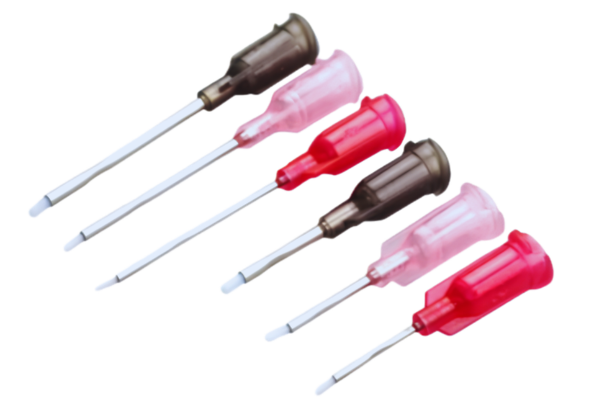
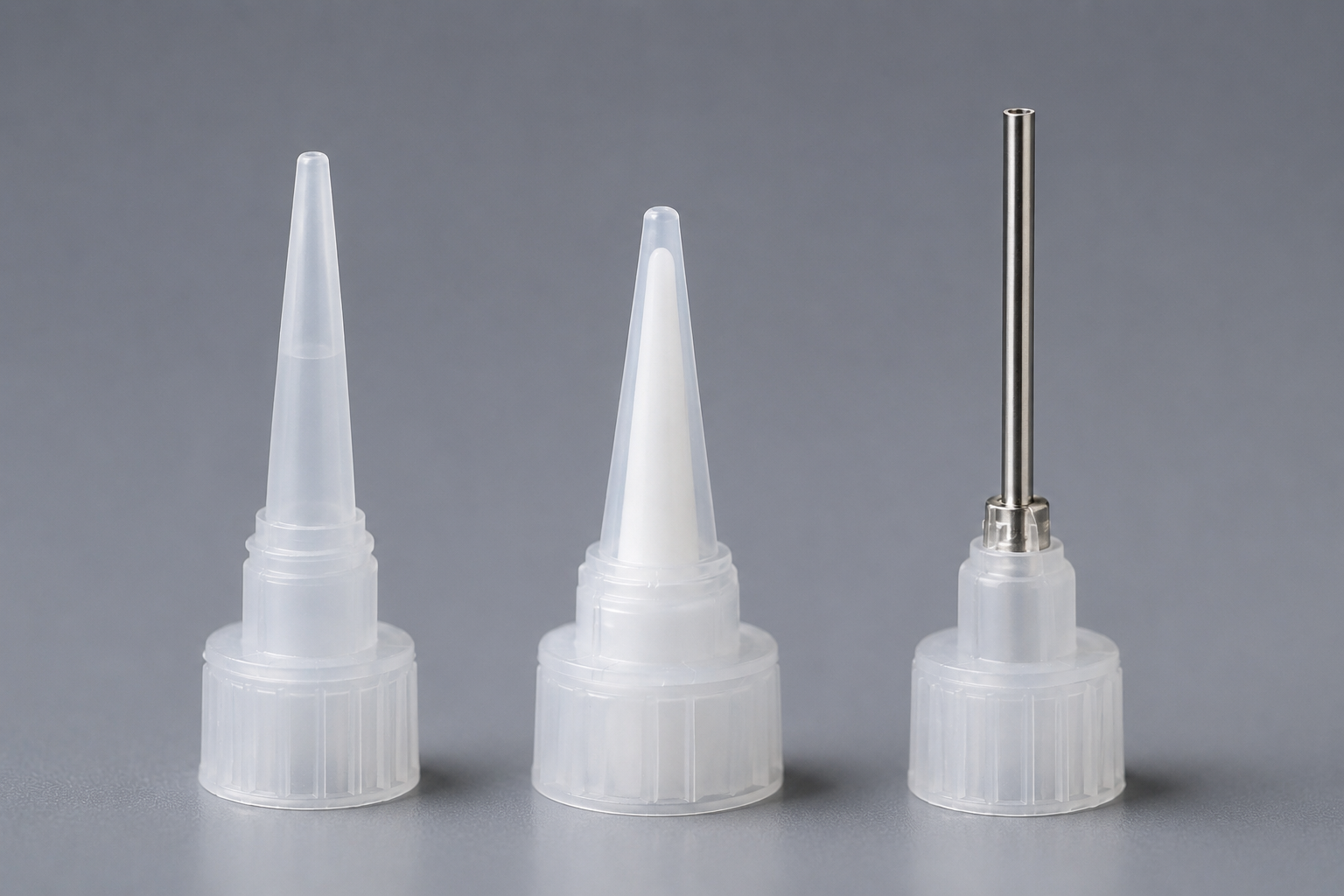
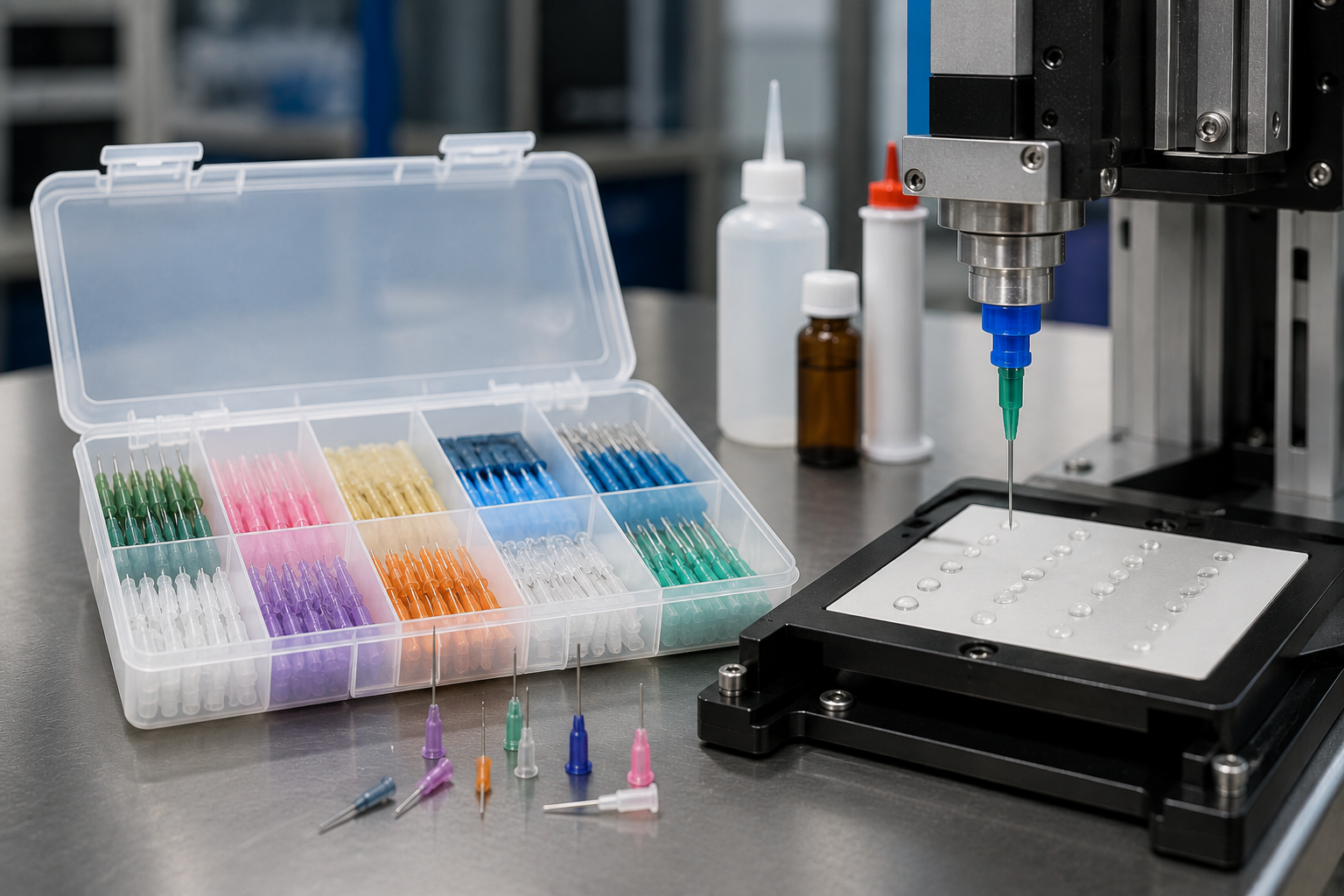
Adhesive dispensing tips fail in one predictable way – the tip clogs or glues itself shut, and your line stops. A smaller gauge is rarely the fix; the right tip material matched to your adhesive chemistry is. Ebestron builds plastic tapered, flexible polypropylene, and PTFE-lined dispensing tips in 14G to 28G on a standard luer-lock hub, so cyanoacrylate, epoxy, UV and anaerobic fluids each get a tip that will not cure inside it.
- 14G–28G Gauge range, color-coded
- 4 Tip materials (PP·Flex·PTFE·SS304)
- Luer Lock Fits standard syringes
- CE · RoHS Certified, REACH on request
- Burr-free Deburred, QC-inspected bore
- OEM Low MOQ · free samples
Why Your Dispensing Tip Keeps Clogging And Why Material Beats Gauge.
“I’ve tried using a sewing needle in the tip but after a while they still get clogged with dry glue.”
Ask anyone who dispenses super glue and the same complaint surfaces first: the tip clogs solid after a few shots. Gap-filling CA clogs after just a few uses because the resin is hygroscopic and thickens inside the bore.
The reflex is to poke it clear or drop to a finer gauge, and both make it worse. Here is the counter-intuitive part most buyers miss: a metal needle is the wrong default for cyanoacrylate. Cyanoacrylate cures by anionic polymerization, and the reaction is triggered by trace surface moisture and contact with bare metal or alkaline surfaces. A stainless cannula is exactly the surface that sets the glue off inside your tip.
01. Pain

The tip gums shut mid-run; operators lose minutes per session clearing it or swapping nozzles.
02. Cause
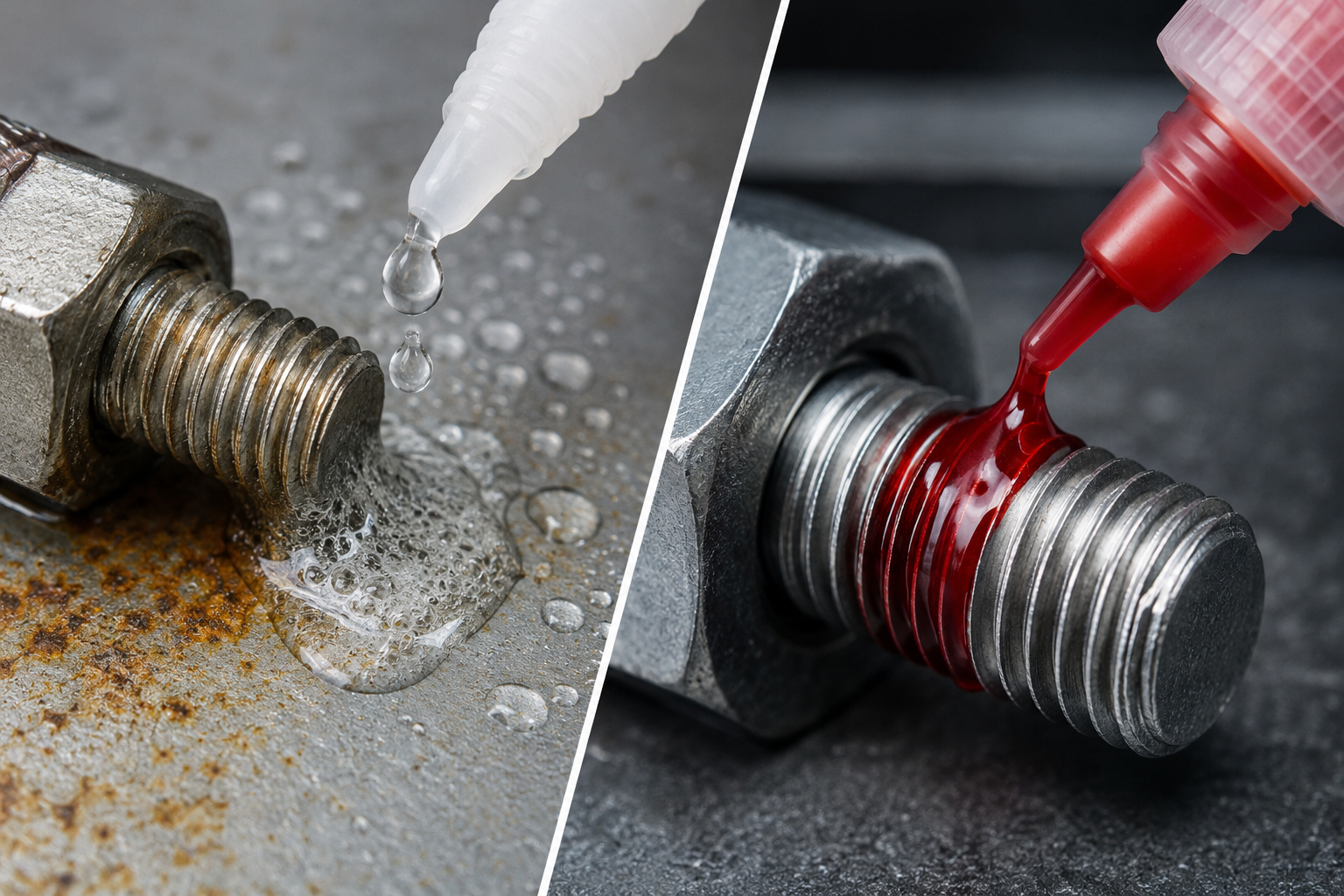
CA polymerizes on moisture + bare-metal/alkaline contact; an anaerobic threadlocker does the same on active metal.
03. Solution
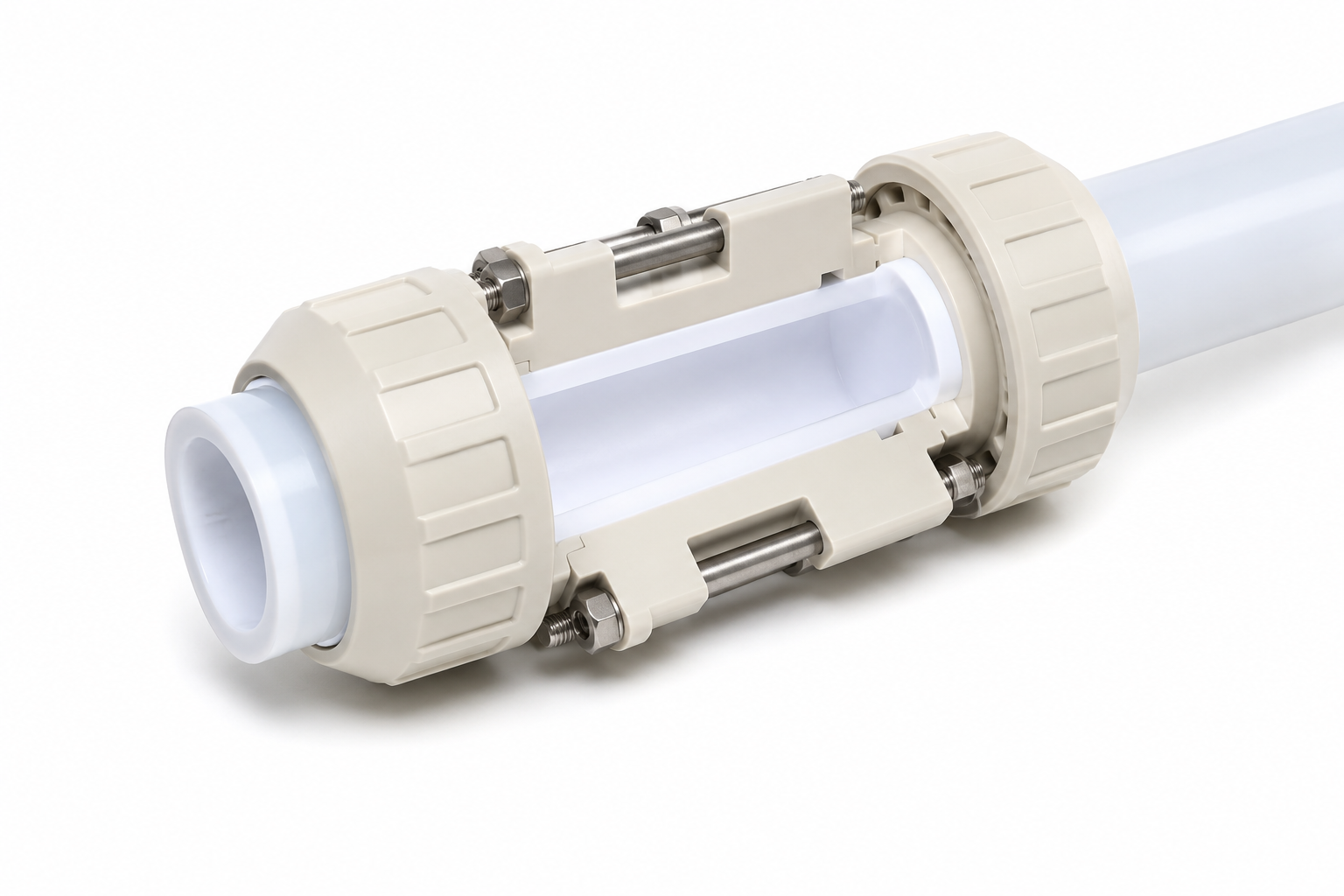
An inert, low-surface-energy flow path — PTFE-lined or all-plastic — that does not initiate the cure.
04. Proof
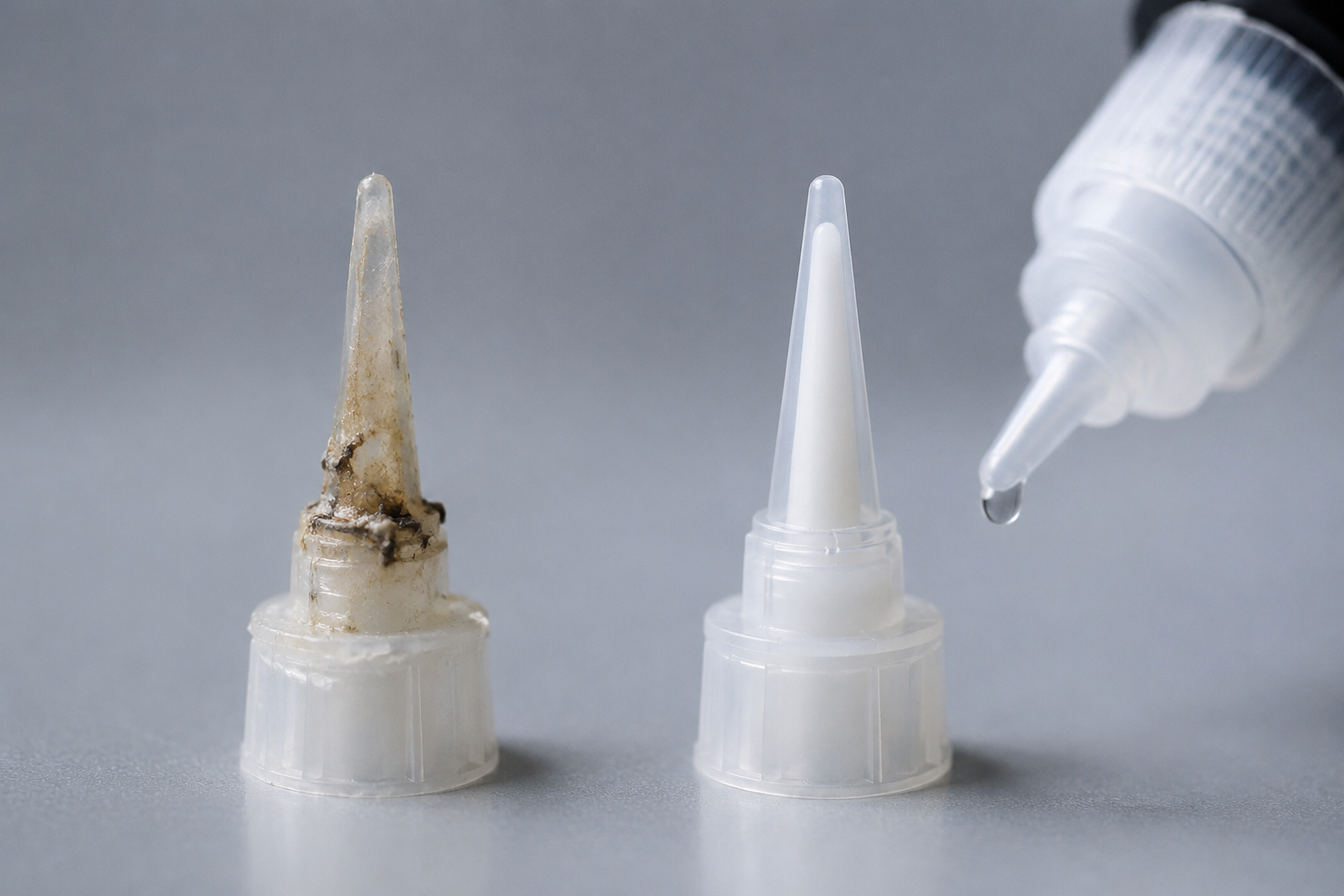
Industry practice is explicit that “PTFE-lined dispense tips prevent premature curing and clogging” for CA fluids.
This is also where the terms matter. A dispensing needle is the blunt-end metal cannula; a dispensing tip is the broader family that adds tapered, flexible and PTFE-lined options on the same luer-lock hub. The honest version of the dispensing tip vs needle debate is that the word matters less than the material inside it.
Why this is the most expensive small part on your line
Industrial buyers consistently name clogging as their number one problem, because a tip that fails mid-run can cost several minutes per fill to clear. The trade-off they miss is that the fix is chemistry, not a finer gauge. Ebestron engineers the flow path around the adhesive, and that material match is the differentiator behind a tip that stays open.
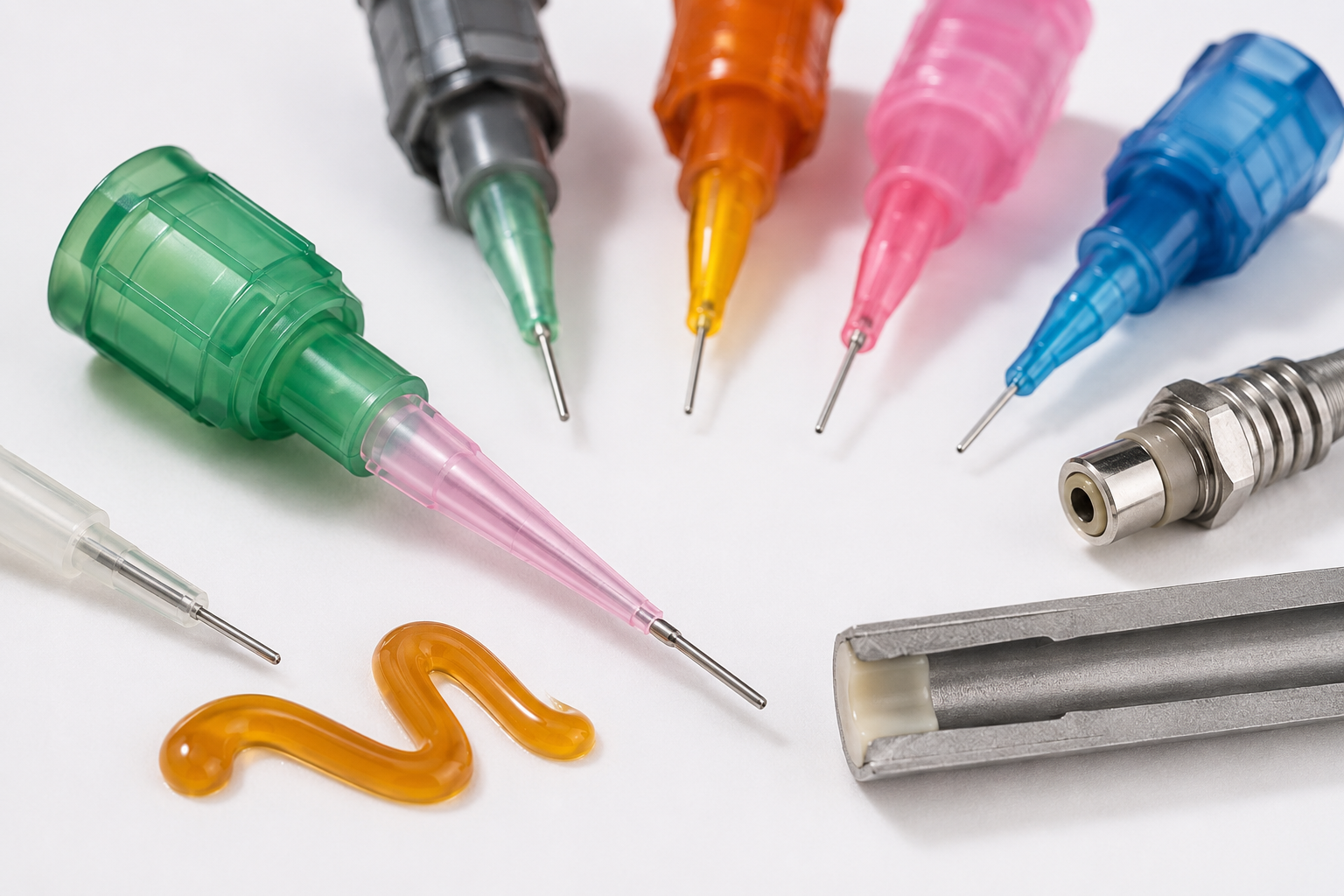
Want to test the material match on your own fluid?
> A quick bench test beats guesswork.
Request Free Sample KitThe 3-Material Tip Selection Matrix
Most supplier pages scatter their tip styles across ten sub-pages and leave you to guess. It comes down to two clean axes: material by chemistry, then gauge by viscosity. Get the material wrong and no gauge will save the deposit.
Start with a contradiction worth internalizing: a smaller gauge is not automatically more precise. Best practice is to begin with the largest gauge that still meets your bead size and work down, because small bores spike back-pressure and cause drooling and stringing.
| Tip material | Best chemistry | Viscosity fit | Reach / substrate | Why it wins |
|---|---|---|---|---|
| Plastic tapered (PE/PP) | Epoxy, paste, RTV silicone, solder paste, gel CA | Medium – high | Rigid, general line work | Conical smooth-flow bore cuts back-pressure; no metal-to-CA contact |
| Flexible (polypropylene) | Most adhesives, incl. UV-sensitive | Low – medium | Recessed, contoured, fragile parts | Bends to reach, trims to length, non-marring on finished surfaces |
| PTFE-lined (SS + PTFE) | Cyanoacrylate, anaerobic threadlocker | Low – medium | Precision, rigid | Inert non-stick liner will not cure-in-tip; the anti-clog default for CA |
| All-metal SS304 | Non-reactive fluids, abrasive/filled, high pressure | Any (esp. high) | Heavy continuous duty | Rigid and durable – but never for CA, which cures on the steel |
“A 27G needle allows great precision but the flow is very slow, while a 14G is fast and the wide one drips,” observed one electronics customer – a neat description of the back-pressure trade-off you manage with viscosity.
Ebestron Dispensing Tips – Types, Gauges & Specifications
Ebestron runs the full tip family on one luer-lock standard, so you can standardize a single hub across plastic tapered, flexible polypropylene and PTFE-lined heads. Beyond those, our range also covers blunt-tip dispensing needles and stainless steel dispensing needles from 14G to 28G, plus conical and bent geometries and multi-tube precision heads – all on the same luer-lock interface.
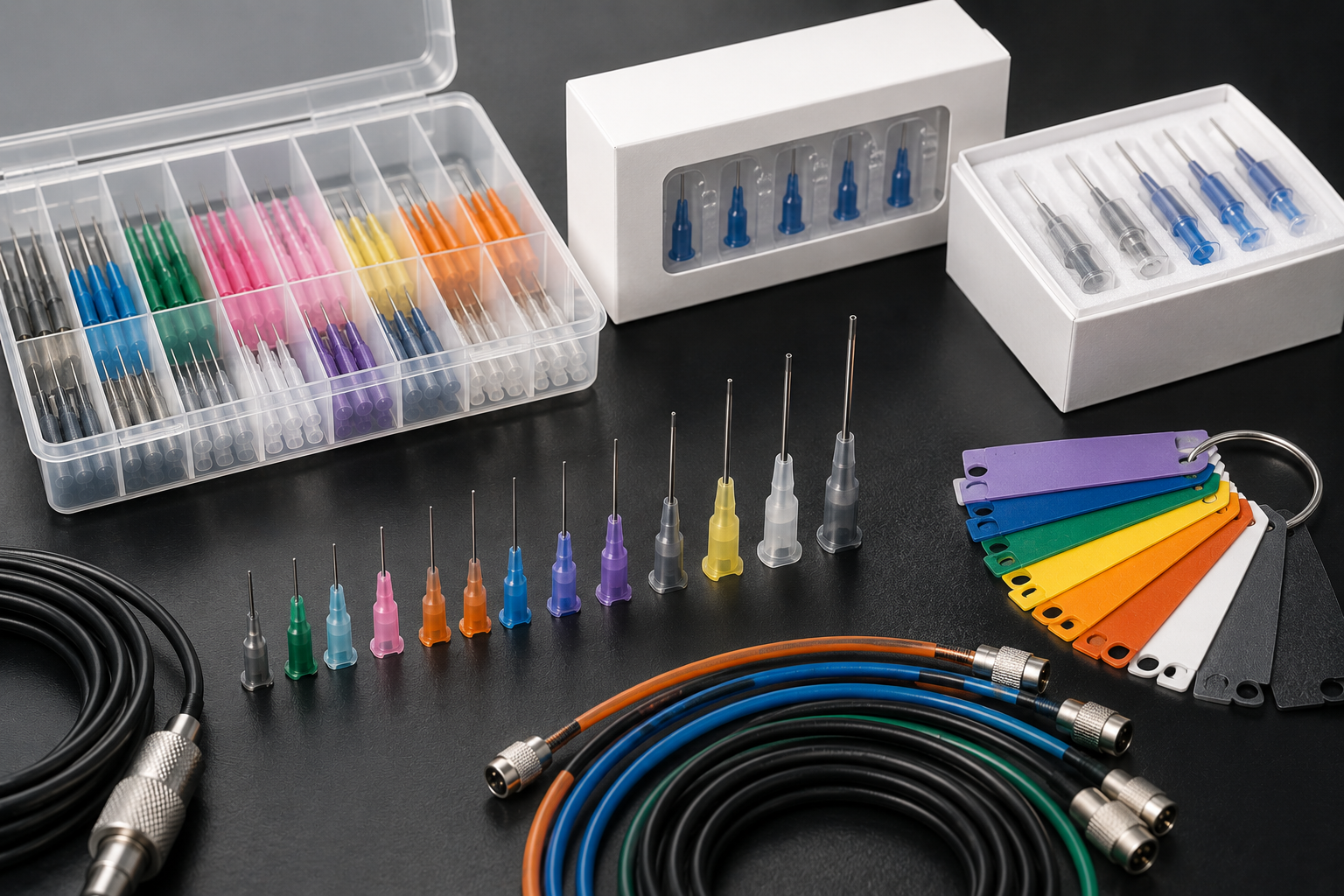
The Gauge-to-ID-Color Chart
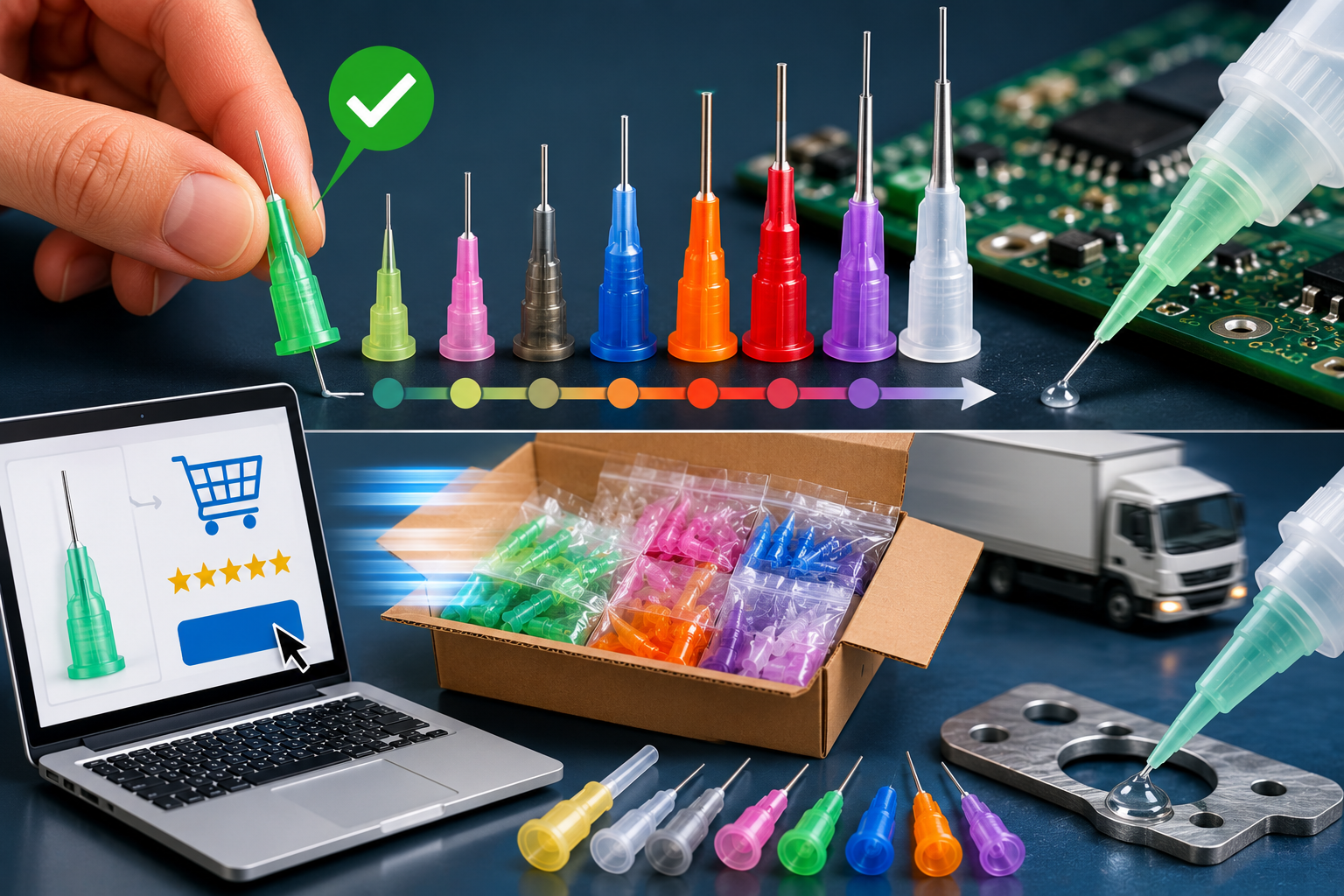
There is one thing buyers care about most, and that’s a clear gauge chart – nearly all vendors bury one on page 15 of a PDF. We have put it right here, on the page where it belongs. The following “ID” values are nominal common-wall IDs and have been correlated against other sources, and are NOT taken from a single vendor’s specification sheet.
| Gauge | Nominal ID (mm) | Hub color (convention) | Typical use |
|---|---|---|---|
| 14G | ~1.60 | Olive | Heavy paste, large beads |
| 16G | ~1.19 | Grey | High-viscosity general |
| 18G | ~0.84 | Green | Medium-viscosity general |
| 20G | ~0.60 | Pink | Medium / fine beads |
| 21G | ~0.51 | Purple | Fine beads |
| 22G | ~0.41 | Blue | Fine lines, small dots |
| 23G | ~0.34 | Orange | Precision dots |
| 25G | ~0.26 | Red | Micro-dots, low-viscosity |
| 27G | ~0.21 | Clear | Finest deposits |
One honest caveat on color
Hub colors is just an industry standard not necessarily a controlled standard-others use different and ISO needle-tubing standard ISO 9626 is non committal.[6] Set to the gauge and id, and use the color as a quick visual for reinstrumentation and confirm when comparing against a different supplier.
Decision Matrix – model to application
| Tip style | Material | Gauge range | Best-fit job |
|---|---|---|---|
| PP tapered | Polypropylene | 14G–25G | Thick epoxy, paste, gel CA – smooth flow, low pressure |
| Flexible PP | Polypropylene | 18G–25G | Reach into recesses; non-marring on delicate parts |
| PTFE-lined | SS304 + PTFE liner | 18G–27G | Cyanoacrylate & anaerobic – anti-clog |
| Blunt SS304 | 304 stainless | 14G–28G | Non-reactive, abrasive or high-pressure fluids |
| Bent 45°/90° | SS / plastic-steel | 16G–25G | Side-entry and under-component access |
Across electronics assembly, automotive, and general manufacturing, this set of tips handles light oils and sealants as readily as tough greases and heavy fillers. For a manufacturer the goal of this group of tips is simply to apply repeatable beads of product. It is only repeatable fluid dispensing that reduces scrap, lowers rework and supports sustained efficiency. It starts by selectiong the right tip – both material and diameter – for a given fluid, otherwise your fluid is going to wander.
What a mislabeled gauge really costs
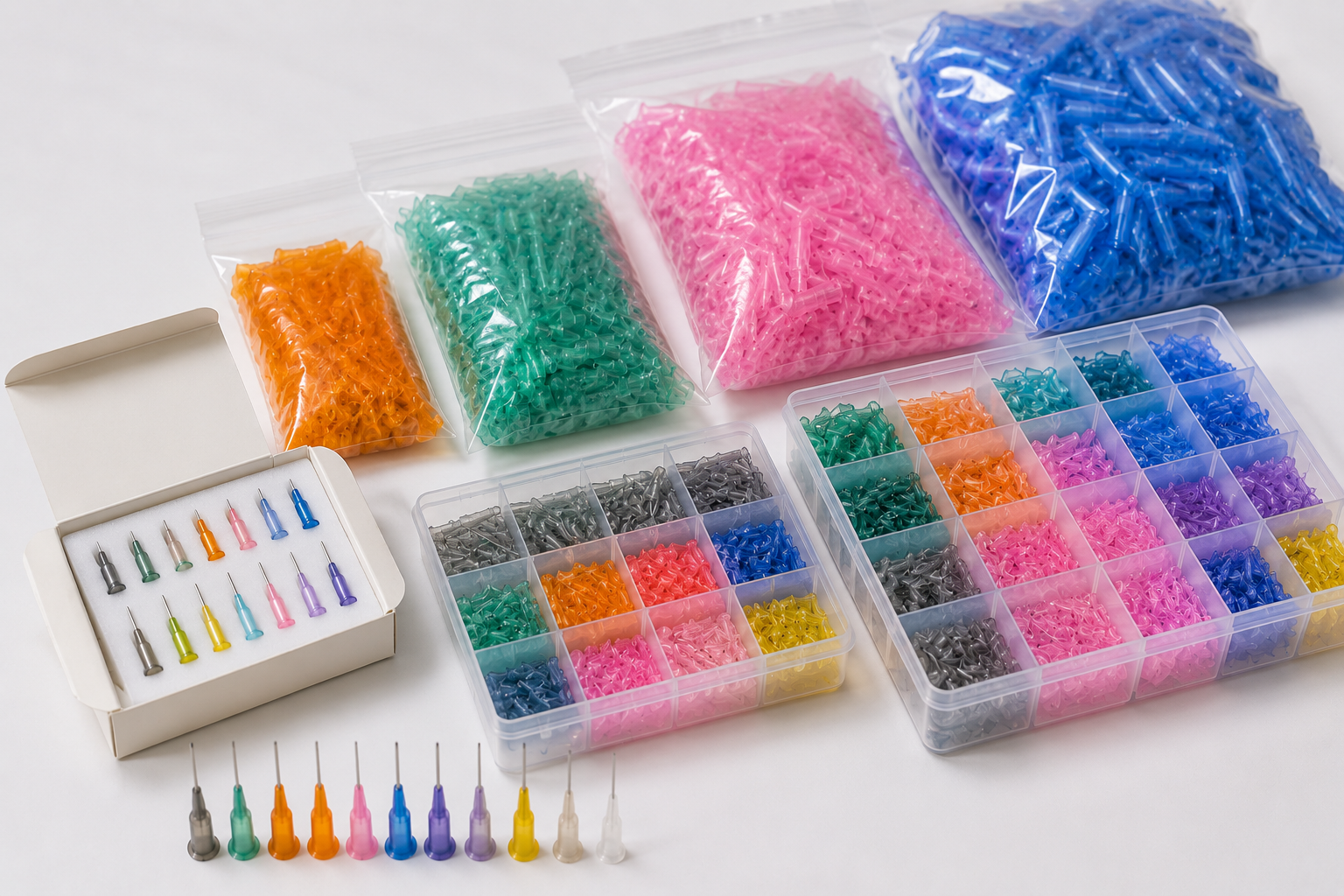
Low-cost bulk tips silently introduce problems: customers complain about needles arriving bent, or a gauge that doesn’t fit the specified label, meaning the bore you dispensed through is not the one you requested. To a regional or small/medium industrial buyer, that inconsistency shows up later as a 5% increase in reject rate no one connects back to the tips. Ebestron gauge-verifies and color-codes all its tips. And yes, you will also need our tip gauge color chart – but it only works if the gauge you are comparing against it is for real.
Match the Tip to Your Adhesive: the Adhesive-to-Tip Compatibility Map
This chart pre-exists your need to be troubleshooting clogged adhesive. Pick the right row for your class of adhesive, then apply your material to see the tip size in gauge you should be applying, by viscosity. We’ve adapted a few tables we compiled with various adhesive producers to arrive at a good general starting point, below the tip-type list you’ve been expecting all this time:
| Adhesive class | Recommended tip | Start gauge | Why |
|---|---|---|---|
| Cyanoacrylate (super glue) | PTFE-lined or all-plastic | 20G–25G | Bare metal catalyzes cure; inert bore stays open |
| Anaerobic (threadlocker, retainer) | PTFE-lined | 18G–22G | Cures on active metal without air; PTFE resists it |
| Epoxy / paste / RTV (high-viscosity) | Plastic tapered | 14G–18G | Conical bore lowers back-pressure, no internal step |
| UV-cure adhesive | UV-block tapered | 18G–22G | Opaque body blocks stray light from curing in-tip |
| Solder paste / filled | Plastic tapered or SS | 14G–18G | Keep ID at least ~5x particle size to avoid clog |
| Low-viscosity / watery | Small-gauge + chamfer | 22G–27G | Fix outer-wall wicking, not just the bore |
| Reach / fragile substrate | Flexible PP | 20G–25G | Bends to the work; will not scratch finishes |
“We see the same failure on the bench every week – a customer runs cyanoacrylate through a steel needle, it cures inside the cannula, and they blame the glue. Switch them to a PTFE-lined tip of the same gauge and the clogging stops. The liner is inert, so the adhesive has nothing to react with on the way out.”
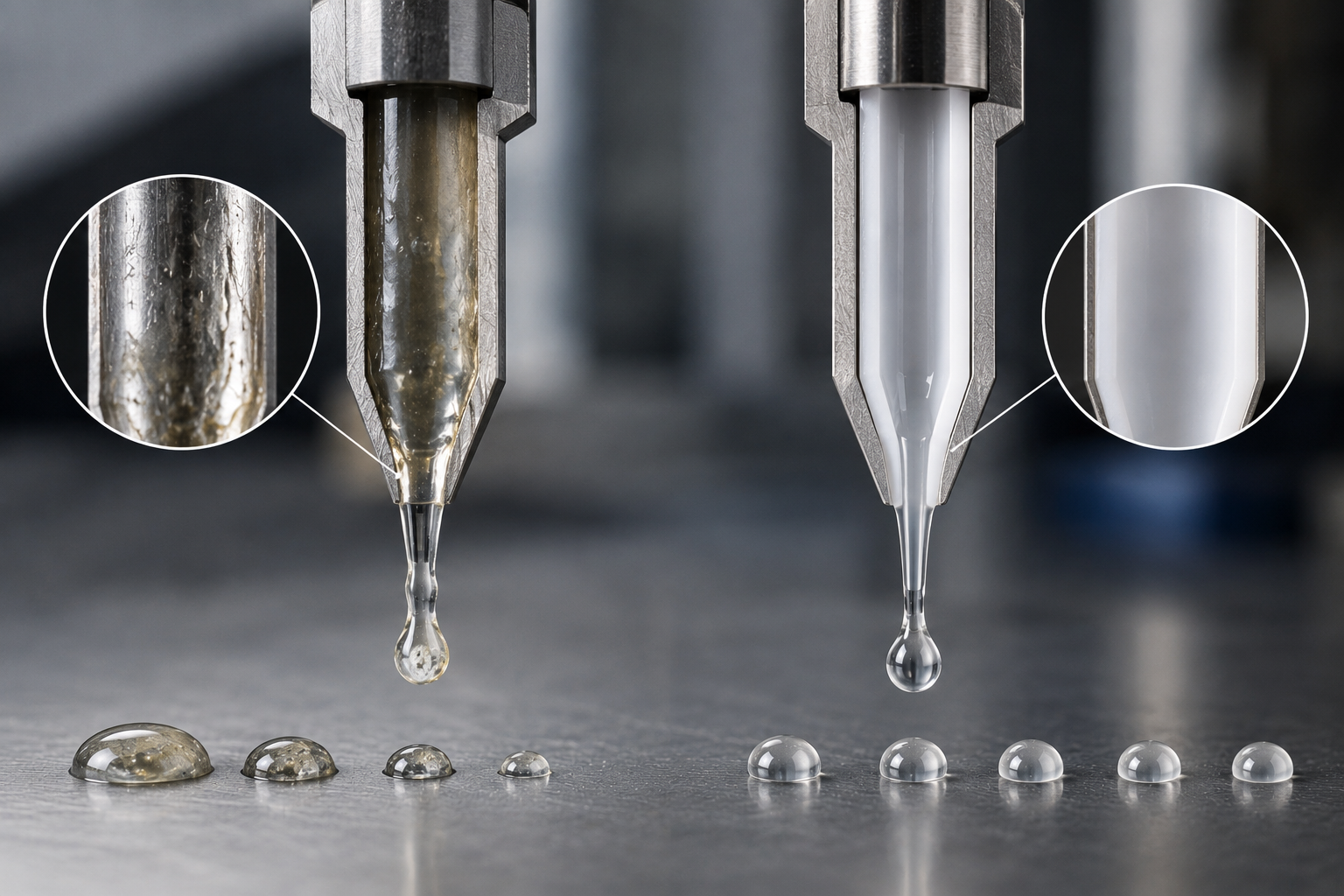
The Science of Flow Path
Why a non-stick flow path lays down consistent dots and beads comes down to straightforward science. PTFE possesses one of the lowest surface energy values and lowest friction coefficients known for solids, in addition to being completely chemically inert. Thus, a catalyzed adhesive has neither enough affinity for PTFE nor enough ability to react against it to trigger in transit.
In effect, a PTFE liner enables fluid to flow much more freely. This is precisely why PTFE tipped needles perform far better when used with CA than do metal needles of identical gauge, and why Ebestron’s plastic and flexible precision dispensing tips perform well wherever a rigid metal cannula is unnecessary.
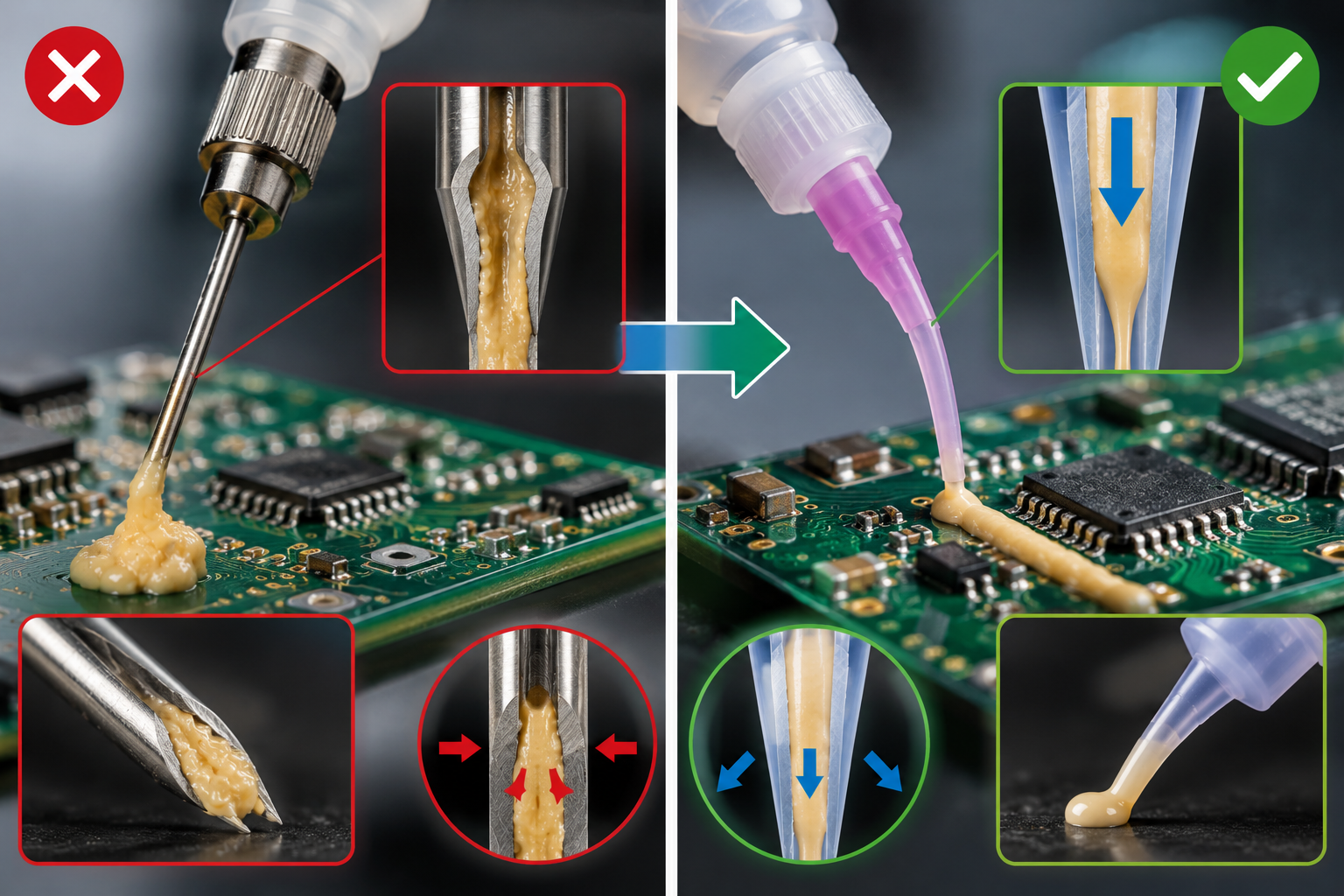
What electronics buyers actually say
The shop-floor verdict is blunt: plastic needles have a conic internal passage for easier flow of thick paste, which is why so many lines switch from rigid dispensing needle tips to polypropylene flexible tips for viscous flux and gel adhesives.
It is the same logic as the dispensing tip vs needle question – the material decides whether the fluid moves.
Action Required
Request a free sample kit → Dispensing a tricky chemistry?
and test the material match on your own fluid before you commit.
The Real Cost of a Dispensing Tip: the Cheapest Part Gates Your Biggest Cost
While tips may appear to be the cheapest components in your adhesive delivery process, it’s where much of your cost is silently hidden. A dispensing tip doesn’t just meter out adhesive-it is an active participant in controlling how much you waste and how much you need to rework. And that’s why purchasing tips based solely on price tags is just that-a price purchase rather than an investment decision, where real cost savings lie beyond your purchase order.
Where Ebestron sits versus the alternatives
| What you compare | Unbranded bulk import | Premium OEM brand | Ebestron |
|---|---|---|---|
| Bore finish | Burrs / molding flash reported | Burr-free, polished | Burr-free, deburred, QC-inspected |
| Gauge vs label | Frequently mismatched | Accurate | Gauge-verified, color-coded |
| Material range | 1–2 styles | Full range | Plastic / flexible / PTFE-lined / SS304 |
| Certifications | Usually none | ISO 9001 / RoHS | CE + RoHS (REACH on request) |
| Supply model | Reseller stock | High MOQ, longer lead | Factory-direct + OEM, flexible MOQ |
What this looks like on a real line
Imagine tens of thousands of circuit boards are being processed every day on a mid volume line. Should any tip deviate even a thousandth of an inch from its specified gauge, your bead gets thicker. Every resulting failed product goes into rework – which cost you the adhesive to do the original operation AND the new, improved application. Standardizing on a gauge verified, burr free tip isn’t just buying another part-it’s one of the cheapest Insurance Policies a high volume production line can buy.
Buyer Logic
Buyer logic in the field is consistent: mid-tier suppliers can match premium performance at lower cost, provided that quality is documented with certifications and batch testing. That is exactly the space Ebestron is built to fill – OEM consistency without the middleman markup, and it comes with the paperwork.
Want the math on your volume?
Get a quote based on your usage →Built for Production: Certified, Consistent, Supplied
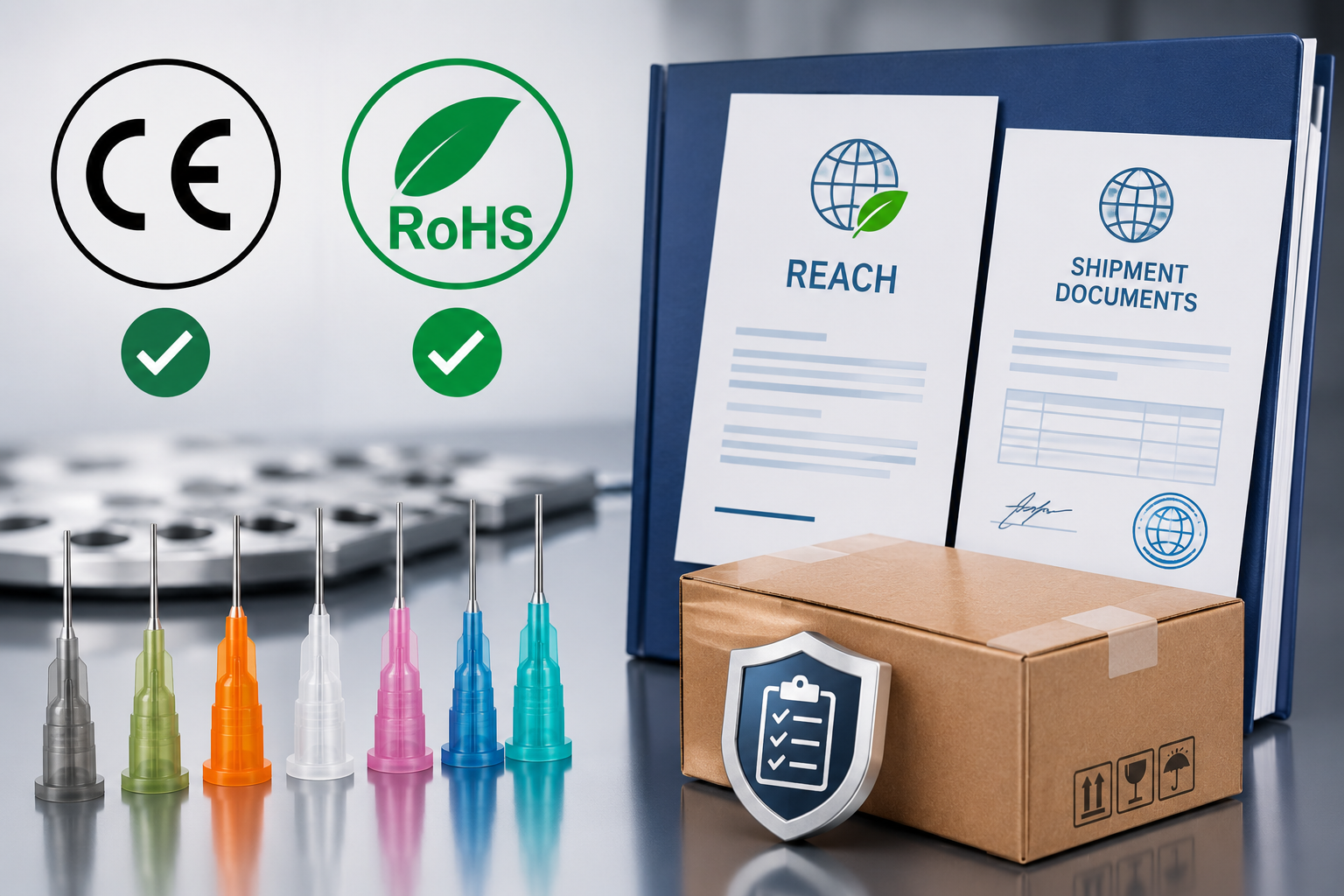
So it comes down to why move to a newer supplier – quality that you can depend on, in every batch that is supplied. It is about verifiable named certifications, not words; an established process, not just labels.
CE
Conformity markedRoHS
Restricted substancesREACH
On requestISO 9626
Needle-tubing referenceSilicone-free
No transfer contaminationConsistency isn’t left to chance. Tips are received smooth, burr-free, and ready to run to hold size throughout the order, hubs come with color-coding to each size and range (fast error free reordering), and PTFE tipped cannulas come with a passivated 304 stainless steel body referenced to ISO 9626 needle-tubing dimensions. Silicone free application is critical in optics and electronics where a silicone trace on the part will sacrifice adhesive bond on parts.
Why batch consistency is the real spec
“Good bargain” practices die a quiet death; bore diameter creeps off center, the bead closes or opens during a production run, and the problem only appears during Quality Control. Deburred, round bores with certified gauges insure deposits stay within specs, avoiding endless rework. Ebestron actually manufactures the part, not just selling it to you, and the inspection process happens in our shop.
Supplier Audit Standard
An EU or US buyer auditing a new supplier wants the bore held in tolerance across a 1000-piece lot, not a slogan – so we document it. Ebestron certifies each batch, and that is the difference a 2023-built factory earns by inspecting at the source rather than reselling someone else’s tips.
Evaluating us against an incumbent?
Request compliance documentation and a sample lot →Procurement: MOQ, Lead Time, OEM & Free Samples
Tip buying is not friction-free: while you get lower price per tip for volume orders, you extend lead time and lock up cash on the other hand small quantities ordered from distributors will make you pay for each piece more. Ebestron works on flexibility over both factors as ships direct factory.
What actually drives your price
Material
all-plastic and flexible PP tips sit at a lower price point than PTFE-lined or SS304 cannula tips.
Volume
unit price decreases with order quantity; sample kits and small trial lots offered for qualification first.
Customization
Custom gage, cable length, color-coding, and OEM or private labeled packaging affect lead time and tool charges.
Certification scope
CE / RoHS as standard. REACH or other shipment documents for a Fee (upon request).
Buyer advisory – de-risk before you scale
Test before purchase
Contact us for our free sample kit to run on your own adhesives and equipment to ensure the gauge you are considering performs properly under your real production pressure and temperature, since viscosity shifts with both.
First and first
once you decide, place the first and correct gauge size order; standard gauges are all stocked so you don’t have to invest in a huge order to have a reasonable delivery.

Get Pricing
Email or call us for a quote, tailored for you based on your selection of gauge sizes and quantities.
Engineering Tools & Calculators
Frequently Asked Questions
Trending now


![Dynamic Mixing Systems for 2K Sealants [Guide]](https://adhesivespackage.com/wp-content/uploads/2026/10/dynamic-mixing-systems-for-2k-sealants-guide-featured-1-150x150.png)