Get in touch with Ebestron Company
DISPENSING
ISO Certified
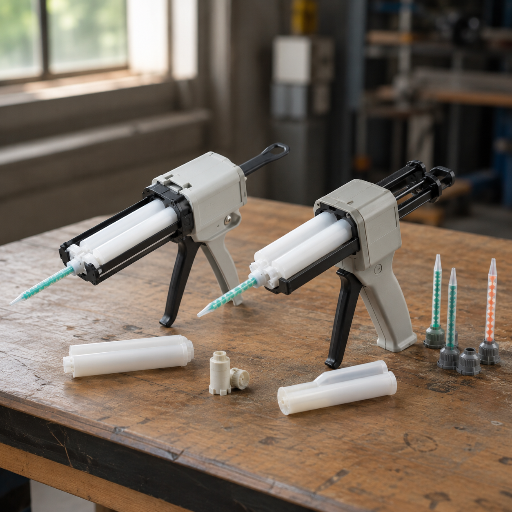
Mixpac & Cox Compatible Dispensing Guns
Factory-direct dual-cartridge adhesive applicator guns to fit YOUR line’s cartridges: no OEM-branded upcharge on a handle that simply move a plunger.
Solution Summary
-
Standard cartridge footprints: C-System / F-System
-
Mixpac & Cox fit: Matched by size + ratio, not brand
100% Precision Fit
50–600 ml
Cartridge sizes (side-by-side & coaxial)
1:1 · 2:1 · 4:1 · 10:1
Mix ratios, incl. multi-ratio guns
1.25–6.4 kN
Manual & pneumatic thrust class
OEM / ODM
R&D, production, QC in-house (Jiangsu)
Paying OEM Prices for a Tool That Just Drives a Plunger?
“Mixpac & Cox compatible dispensing guns exist for one reason: the gun is the most reusable part of a two-component system, yet it’s often the most overpriced. A dispensing gun is a mechanical applicator – it clips a dual cartridge, drives two pistons at a fixed ratio, and pushes both parts through a static mixer. The chemistry live in the cartridge and the mixer, not in the handle.”
“Yet branded equivalents retail anywhere from about $29 for a 50 ml manual unit to $807 for a 600 ml electric one. For a fabrication shop, a contract assembler, or a distributor restocking applicator guns by the dozen, that spread is pure margin leakage on a part that wear slowly and rarely changes design.”
The cost isn’t abstract. “An automotive body shop running 400 ml panel-bonding epoxy, or an aerospace assembly cell dispensing a 50 ml 2:1 structural acrylic, replaces applicator guns far more often than it changes adhesive suppliers – every worn handle bought at OEM retail is margin that never had to leave the building.”
Breaking the Compatibility Lock-in
The catch buyers actually feel is compatibility lock-in: “A larger side-by-side cartridge “requires a special dispensing gun that can only be used with a specific cartridge size and ratio.” Miss the footprint and the cartridge won’t seat, the plunger ratio won’t match, and the bead come out off-ratio.
We build guns to those exact footprints – the same 50-600 ml side-by-side and coaxial bodies, the same 1:1 through 10:1 plunger geometries – so a buyer keeps their existing Mixpac or Cox cartridges and only changes who makes the handle. Authoritative cartridge-system design is documented in industry references and USPTO dual-fluid cartridge patents such as US 7,237,693 B2.
Will It Fit? Mixpac & Cox Cartridge-Footprint Compatibility Matrix
The single question every buyer asks first is “will it seat my cartridges?” Compatibility isn’t a brand property – it’s a footprint property defined by three things: cartridge volume, mix ratio, and cartridge system (C-System vs F-System body). “Match those three and the gun fit, regardless of the name cast into the handle. Get any one wrong and the failure is immediate: a 400 ml cartridge won’t seat in a 200 ml gun, and a 10:1 cartridge forced into a 1:1 handle dispenses off-ratio so the bond never reaches full strength. The matrix below maps Ebestron gun classes to the OEM models that share each footprint, cross-checked against the cartridge geometry described in USPTO filings such as US 6,848,480 B2.”
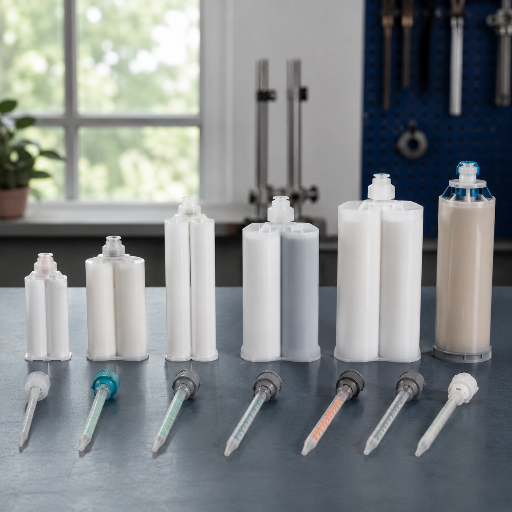
Mixpac & Cox Cartridge-Footprint Compatibility Matrix (matched by volume + ratio + system)
| Cartridge footprint | Volume | Ratios | Mixpac reference | Cox reference | Ebestron compatible class |
|---|---|---|---|---|---|
| 50 ml side-by-side | 50 ml | 1:1 / 2:1 | DMA50 / DMA 50 | MP25 / A25 | Ebestron 50 ml manual / pneumatic |
| 200 ml side-by-side | 200 ml | 1:1 / 2:1 / 4:1 / 10:1 | DM200 / S-System | M100 / M200MR | Ebestron 200 ml manual (multi-ratio) |
| 400 ml side-by-side | 400 ml | 1:1 / 2:1 / 4:1 / 10:1 | DM2X 400 / DP2X 400 | M200X / M200MR | Ebestron 400 ml manual & pneumatic |
| 600 ml side-by-side | 600 ml | 1:1 / 2:1 / 10:1 | DP400 / C-System 600 | A300HP / M300XL | Ebestron 600 ml pneumatic / manual |
| Coaxial | 75–380 ml | 1:1 / 2:1 / 4:1 / 10:1 | Coaxial C-System | Cox coaxial | Ebestron coaxial class |
Reference models are named for footprint identification only; Mixpac and Cox are trademarks of medmix and are used here solely to indicate cartridge compatibility. Ebestron guns are independent, compatible-equivalent products, not OEM parts.
Ebestron Compatible Dispensing Gun Range, Models & Selection
Off-ratio dispensing is the most common cause of weak two-part bonds, and it usually starts at the gun: too little thrust for a viscous epoxy, or a ratio mismatch between gun and cartridge, the two most expensive mistakes on any 2K assembly line. That’s why Ebestron’s gun range is organized with force class related to cartridge viscosity and plunger shape set to cartridge ratio – manual or pneumatic drive. We cover all the adhesives you find in industrial assembly, including 2 part epoxy, polyurethane, acrylic, methacrylate and polyester resin – thin fluids through highly viscous structural adhesive pastes. Drive mechanisms behind these thrust classes are documented in USPTO filings such as US 2011/0081499 A1.
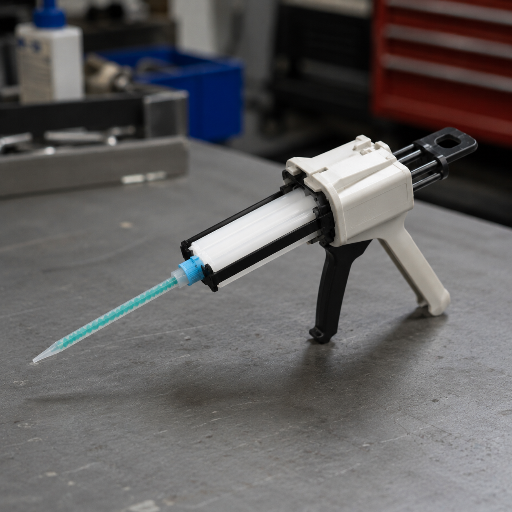
50 ml Manual
For dental, electronics, lab and repair work. Light, precise bead control for low-to-medium viscosity 2K materials.
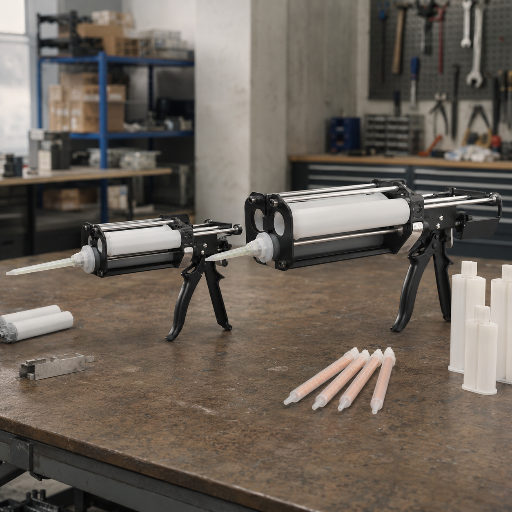
200 / 400 ml Manual
The automotive-aftermarket and general-assembly workhorse. Multi-ratio versions accept 1:1 to 10:1 in one tool.
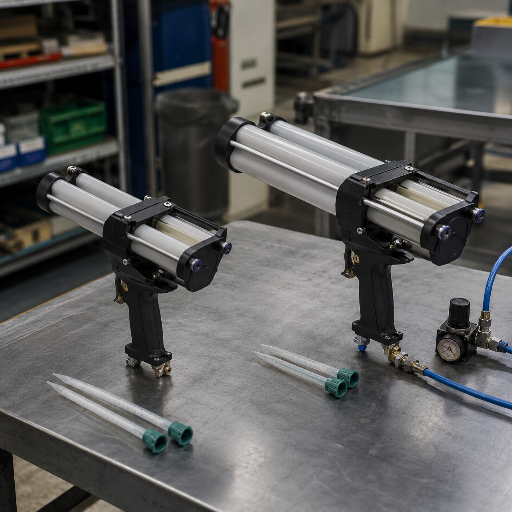
400 / 600 ml Pneumatic
For high-viscosity structural epoxy and high-duty-cycle lines. Air drive removes hand fatigue and steadies flow.
Decision Matrix — match the gun to the job (concrete values, not Yes/No)
| If your job is… | Material viscosity | Recommended drive | Thrust class | Typical volume |
|---|---|---|---|---|
| Small repairs, lab, electronics | Low–medium | Manual | 1.25 kN | 50 ml |
| Body-panel bonding, fillers | Medium | Manual multi-ratio | 3.5–4.6 kN | 200–400 ml |
| Structural epoxy, anchoring | High | Manual high-thrust / pneumatic | 6.4 kN | 400–600 ml |
| High duty cycle / production line | Any 2K | Pneumatic | up to ~7 kN class | 400–600 ml |
Manufacturing experience drives these pairings, not a catalog default:
We size every gun to the worst-case cartridge it will run, not the average. A 10:1 structural epoxy at room temperature can stall an under-thrust handle halfway down the cartridge, so for viscous 2K work we point buyers to the high-thrust manual or a pneumatic drive, never the lightest gun on the shelf.
Compatible Gun vs OEM Original, Specs and Cost, Side by Side
The only reason for “cheap” is matched mechanics. Dispensers are mechanics. Thrust output, ratio precision, weight, cartridge grip – these are all measurable factors. You can measure any candidate gun against the OEM’s performance specs.The force required to advance the seals of a 2K cartridge piston are directly part of dual component dispensing what the mechanism is engineered around, as described in US 2011/0081499 A1.
Functional comparison — Ebestron compatible class vs OEM-brand equivalent (400 ml)
| Parameter | Ebestron compatible | OEM-brand equivalent | Why it matters |
|---|---|---|---|
| Cartridge fit | 50–600 ml C/F-System | Same footprints | Identical seating — your cartridges drop in |
| Mix ratios | 1:1 / 2:1 / 4:1 / 10:1 | 1:1 / 2:1 / 4:1 / 10:1 | On-ratio bond strength |
| Max thrust | 1.25–6.4 kN | ~ up to 7 kN | Drives high-viscosity epoxy without stalling |
| Weight | ~1.1–1.9 kg | ~1.1–1.9 kg | Operator fatigue / ergonomics |
| Multi-ratio option | Yes (one gun, 4 ratios) | Often ratio-specific | Fewer guns to buy and stock |
| Indicative unit cost | Factory-direct (quote) | $29–$807 retail range | Margin recovered on a slow-wear tool |
The multi-ratio row is where most buyers find the real saving: because some guns allow quick changeability from one ratio to another within the same volume-size cartridge, a single multi-ratio Ebestron gun replaces the two or three ratio-specific OEM guns a shop would otherwise stock.
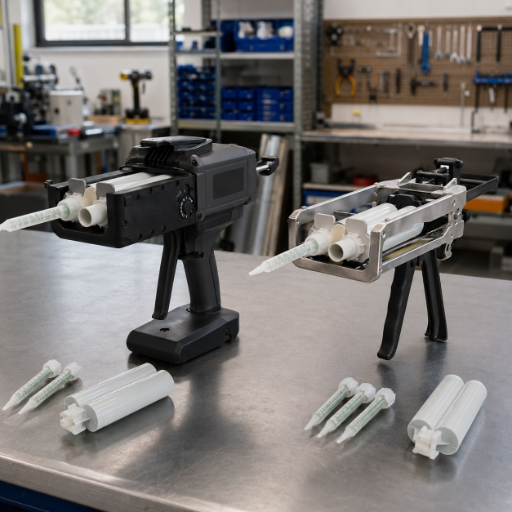
How to Choose: The 4-Variable Dispensing Gun Selection Path
“There’s not enough in a sales pamphlet to select a dispense gun. It’s all done by math on four numbers that are all related.” Select any two of the four, and you’ll usually isolate one optimum gun class.
Mix ratio, must match the cartridge, exactly
The plunger form drives the pistons at their correct respective rates – 1:1, 2:1, 4:1 or 10:1 ratio to each other. A 10:1 cart in a 1:1 gun results in overage, and the epoxy may not ever fully cure. Confirm your cartridge ratio against that the gun plunger; that’s the critical (and almost always skipped) step. US 2002/0145007 A1 shows the double-barrel piston which governs those proportions.
Cartridge volume & system, 50 to 600 ml, C vs F
Cartridges in side-by-side arrangements typically start at 50 ml volumes and go up to 1500 ml, in 1:1, 2:1, 4:1 or 10:1 ratio. Match to your cartridge’s C- or F-style body as well as capacity volume; you just can’t fit a 400 ml cartridge into a 200 ml body.
Drive, manual, pneumatic, or cordless
Manual guns are ideal for low pressure, small volumes, infrequent application and in less demanding circumstances. For a high-viscosity or any 2K adhesive in which smooth, predictable application translates to reliable bond strength – avoid all-pulses manual delivery in favor of pneumatic or cordless drive.
Thrust class, match force to viscosity
Higher thrust (and more so, higher internal thrust ratio, 12:1 to 52:1) is made for medium-to-high-viscosity products – a lower thrust is adequate with thin fluids. Being under-thrust by a viscous epoxy cartridge is the classic field failure. The gun class thrust is factory-sized against the hardest cartridge it’s expected to deliver for that gun class. Unlike generic, catalog guns that might specify a general, generic thrust level, regardless of material properties, that just may leave a half-used cartridge stranded mid job.
Quality Control & Compatibility Verification
The honest risk with any compatible part is the one buyers name out loud: “will it actually seat and dispense on-ratio like the original?” Our enterprise answers that the only way that holds up — by verifying every gun class against the real cartridge footprint it claims to fit, and controlling the dimensions that govern fit and ratio in-house. As an enterprise integrating R&D, production, sales and customer service, that verification loop stays under one roof rather than spread across a supply chain. That same dimensional discipline applies whether a gun ships to a single industrial workshop or to a 2 part adhesive distributor restocking by the pallet.
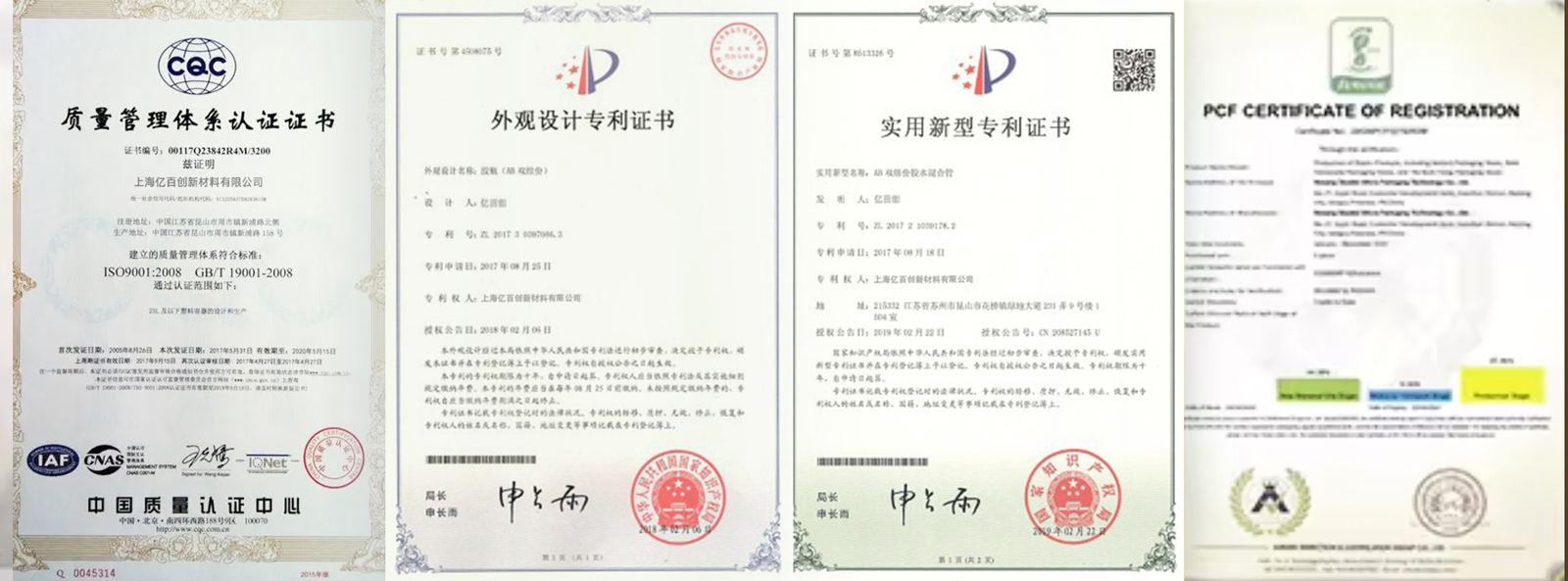
QC
VERIFIED
VERIFIED
Two important application and field considerations are built into every gun specification:
On-ratio piston travel.
Each gun design require the both pistons advance at exactly the correct ratio to each other. ratio drift between the pistons is the reason why an improperly mixing material results in a ‘soft’ cure. This on-ratio piston travel depends on double-barrel geometry set out in US 2002/0145007 A1.
Purge discipline.
The first discharged material from a fresh static mixer isn’t always fully mixed, so the first bead is purged, a gun with smooth, controllable trigger travel makes that purge consistent rather than wasteful. The honest version: no gun eliminates purge, but a steady trigger minimizes the trade-off between waste and a fully mixed bead.
Procurement Guide: Pricing Factors, MOQ, OEM/ODM, Lead Time
When buying a gun (or in volume for that matter), they’re also buying a supply relationship. Ebestron prices guns and sets the volume buy structure that supports those relationships factory direct-there are some clearly defined cost factors beyond simply what a shelf stock inventory would imply. Think of these for structuring your purchase quote request;
Pricing Factors Framework — what moves a factory-direct quote
01
Gun class & drive
Manual vs pneumatic; single-ratio vs multi-ratio
02
Order volume / tier
Sample → small batch → OEM bulk; unit cost falls with tier
03
Customization
Branding, color, packaging, special ratios (OEM/ODM)
04
Logistics
Incoterms, destination, consolidation with cartridges/mixers
Total-Cost View (TCO) — beyond the sticker price
Industry Insight
Two recurring costs typically outweigh unit price over a tool’s life. First, ratio-specific guns force shops to buy and stock multiple handles; a multi-ratio gun consolidates them. Second, where guns run on shop air, compressed air is expensive infrastructure, it can account for up to 10% of a factory’s energy cost, and around 30% of that air leaks away before it reaches the tool. (industry analysis of handheld dispensing equipment). For lower-duty lines, a manual or cordless-class gun sidesteps that overhead entirely. (Figures are industry references, not a brand-specific guarantee.)
Ebestron Solution
Ebestron has a three-part offering; samples for buyer’s validation; first quantity batch orders for initial roll-out; and OEM/ODM volume for private-label products – all backed by Ebestron’s in-house, application-specific design, and manufacturing support for unique ratio requirements, OEM branding, and custom packaging solutions. For a binding figure on your configuration, give us your gun class, desired quantity and customization details, and we’ll respond with a factory-direct quote.
Mixpac & Cox Compatible Dispensing Gun Selection Tools
01
Mixpac & Cox Compatibility Finder
Find the Ebestron gun class that fits your existing cartridge.
Access Tool
02
4-Variable Dispensing Gun Selector
Mix ratio × cartridge size × drive × material viscosity → one correct class.
Access Tool
03
Multi-Ratio Consolidation Calculator
See how many ratio-specific guns one multi-ratio gun replaces.
Access Tool
Engineered Excellence: Mixpac & Cox Compatible Solutions





FAQ
Yes, compatibility is determined by cartridge footprint (volume, mix ratio and C-System/F-System body), and Ebestron builds guns to those standard footprints. A gun matched to your cartridge’s size and ratio will seat and dispense the same cartridges you run today. Mixpac™ and Cox™ are trademarks of medmix; Ebestron products are independent compatible equivalents.
An adhesive dispensing gun drives a two-component (dual) cartridge, advancing both pistons at a fixed ratio so the two parts feed a static mixer on demand. Whether your team calls it a dual cartridge epoxy gun, a 2 part epoxy gun, or an epoxy applicator gun, the mechanism is identical, only the cartridge footprint and ratio change. A standard caulk gun drives a single-component tube. Some universal two-component cartridges can run in a heavy-duty caulk gun with a 12:1 or higher mechanical advantage, but most 2K work uses a dedicated dual-cartridge gun.
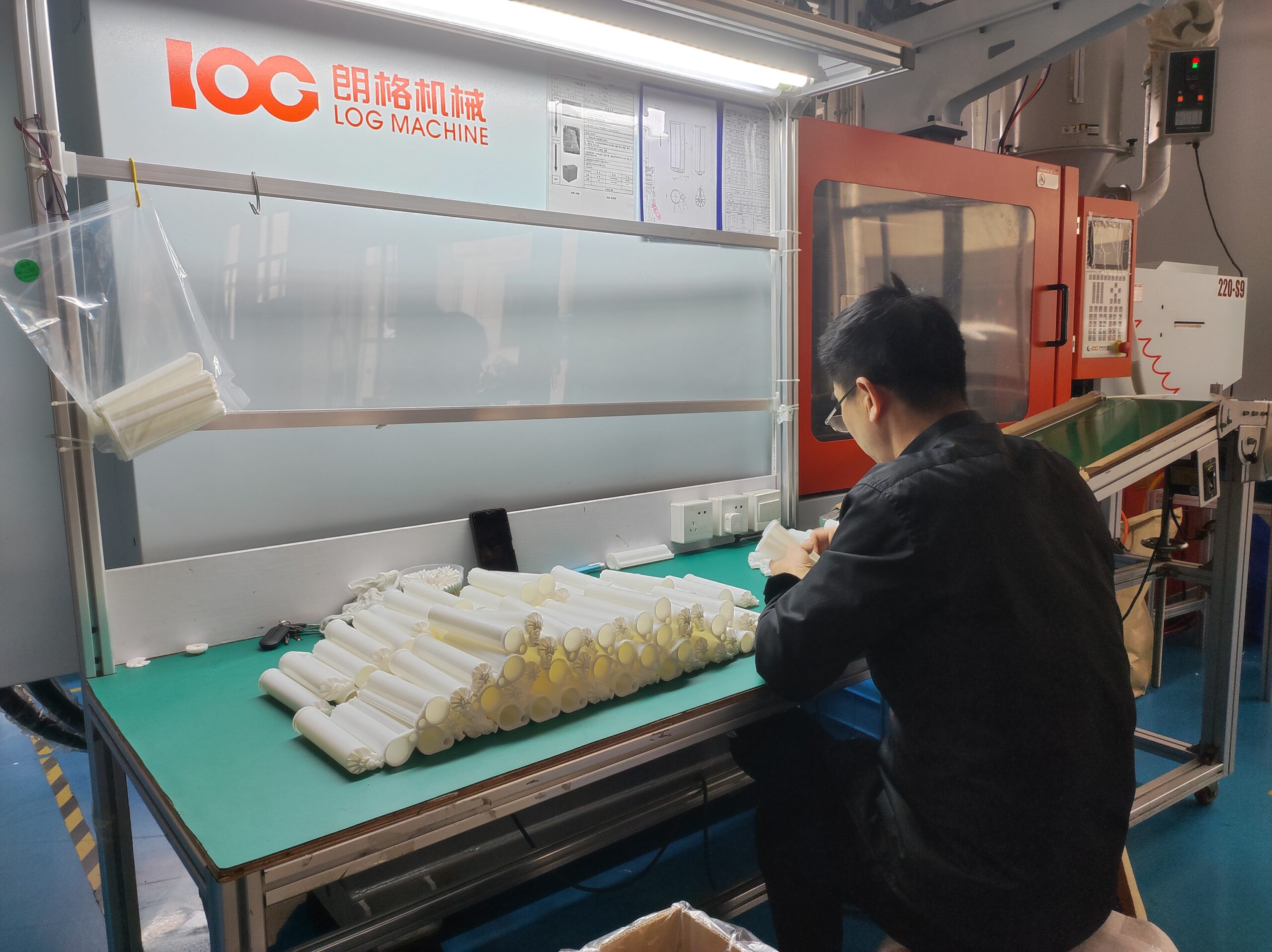
Ebestron is based in Jiangsu, China, and integrates R&D, production, sales and customer service in-house, specializing in adhesive-packaging consumables including dispensing guns, dual cartridges and mixing tubes.
Match the gun ratio to the cartridge ratio exactly (1:1, 2:1, 4:1 or 10:1), then match thrust to material viscosity, higher thrust (and higher thrust ratio) for viscous structural epoxies, lower for thin liquids. Multi-ratio guns cover several ratios in one tool. Send us your cartridge and material and we’ll specify the class.
Yes. Ebestron offers factory-direct pricing across sample, small-batch and OEM/ODM bulk tiers, with custom branding, color, packaging and special ratios. Request a quotation with your target volume and configuration.
OEM-brand equivalents retail roughly from $29 for a 50 ml manual to $807 for a 600 ml electric unit. Ebestron quotes factory-direct by gun class, order tier and customization, contact us for a figure on your configuration.
Keep Your Cartridges. Change Who Makes the Gun.
Share you cartridge’s dimension details; size, ‘footprint,’ preferred ratio and the target volumes and Ebestron will provide a quotation for the compatible ‘class’ of Ebestron Gun – Factory Direct.
Request a Quote
Trending now