Get in touch with Ebestron Company
SYSTEM / SPEC
Ebestron · 2K Adhesive Dispensing Systems
Blunt Tip Dispensing Needles
Blunt Tip Dispensing Needles & Tips for Precision Fluid & Adhesive Dispensing
The Ebestron blunt tip dispensing needles let you match bore size to your fluid, so the dispensing needles won’t clog, drip, or starve your bead. Each tip is packaged on a 304 stainless steel or polypropylene Luer Lock hub that will drop on any syringe, cartridge or valve you are currently using-Nordson EFD, Fisnar, Techcon or any standard Luer.
Request a Quote & Free Samples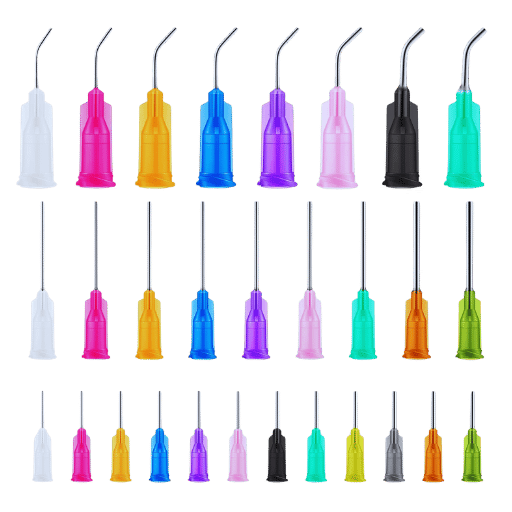
14–27G
Core gauge range (7–30G on request)
304 SS / PP / PTFE
Needle & tip materials
Luer Lock + Slip
Universal hub interface
6 tip types
Blunt / tapered / PTFE / flexible / bent / brush
CE · RoHS
Compliant & OEM/ODM
Burr-free bore
Electro-polished, passivated 304
Clogged Tips, Wrong Gauge, Inconsistent Beads — and How the Right Needle Fixes Them
Most failures that can be attributed to a single bad decision trace back to gauge size. The smaller the orifice of a fine gauge needle seems intuitively precise for high viscosity fluids like epoxies or tacky fluxes, yet when you try to extrude with it you quickly see back pressure build, the particles jump over a tight restriction, and the bead is starved or straggles. The truth, however, discovered on the test bench, is that the smaller opening isn’t more accurate it’s simply a choke point that’s the main culprit for clogging and stringing.
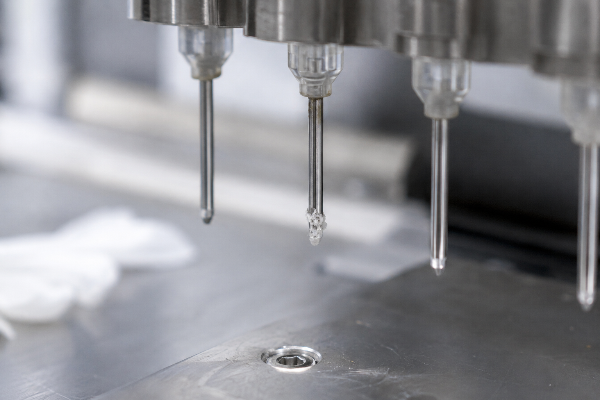
Why it clogs — the root cause
Since a blunt dispensing needle’s inner surface is uniform the fluid has no place to accelerate in front of the narrowest point at the end of the tip. As the inside diameter gets smaller and viscosity increases, the pressure required to maintain a given flow rate increases dramatically and particle-filled fluids simply bridge over a restricted orifice. The solution is to select the correct bore to accommodate both viscosity and particulate size and then pick a tip shape that works with the resistance of the fluid rather than against it.
That principle guides our engineers when building every needle. Match bore to your fluid or select a PTFE-lined or tapered tip profile as your fluid requires, and that same dispenser that strung and skipped through out an entire 8 hour shift will lay a tight clean bead every time. You can use the proven data here to select the right bore and geometry, then discover the precision products that make the bead perfect.
SPEC // GOVERNING PRINCIPLES
We build tips based on the two governing principles for dispensing: It’s simply physics that there’s a trade-off between fluid control and flow rate. Your tip ID must be at least 5 times larger than the largest filler particle and the centers of your dispensed dots will be approximately 2.5 times the tip’s inner diameter. It’s true no chart can replace testing on your own equipment: Dispense a 10 ml Luer lock syringe filled with your fluid for 30 seconds at your line pressure, and you’ll know more than you can from any specs you can buy; That’s why serious industrial buyers always get physical samples before buying their entire supply.
SYS-SPEC : NEEDLE RANGE
Ebestron Blunt Tip Needle & Tip Range
— Gauges, Materials, Lengths
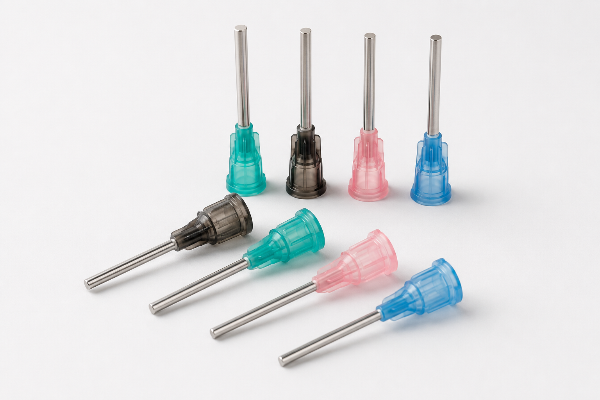
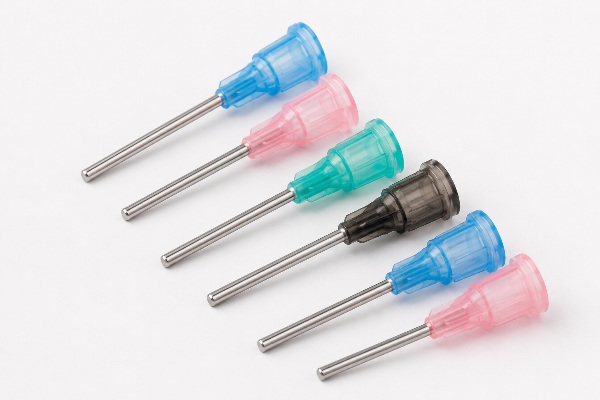
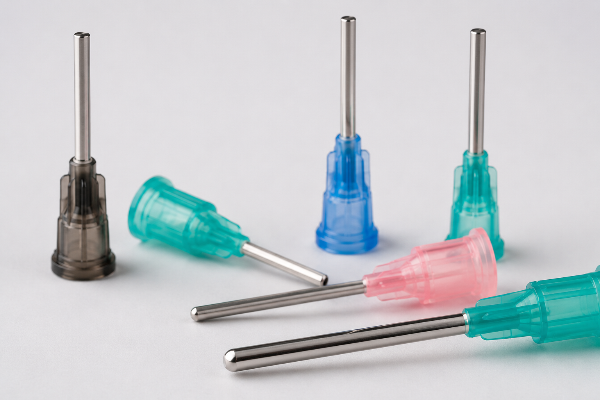
We make blunt tip dispensing needles in a full spectrum of working industrial gauges on either color-coded Luer Lock or Luer Slip hubs with 0.25, 0.5, 1.0 or 1.5 inch lengths.
As the required gauge for your fluid application, Ebestron engineers prefer that we match gauge to fluid before looking it up by part number because we’ve proven that’s where most dispensing process errors begin.
The Gauge-to-Viscosity Dispensing Needle Selection Matrix. Inner-diameter references (regular wall) correspond to ISO 9626 / Birmingham gauge and the published Nordson EFD and Jensen Global charts. We won’t cite a number that only matches one company’s products, because that is not industry truth. The bands are engineering guidance, not a single universal lookup, since particle size, pressure, and pump type all shift the result.
Gauge
OD (mm)
ID (mm)
Industrial color
Viscosity band
Typical fluids
14G
2.11
1.60
Olive
High
filled epoxy, thermal paste, RTV silicone, grease
16G
1.65
1.19
Grey
High–medium
thick paste, crystal glue
18G
1.27
0.84
Green
Medium–high
solder paste, UV adhesive, general bead
20G
0.91
0.61
Pink
Medium
epoxy dots, thick cyanoacrylate
22G
0.72
0.41
Blue
Medium
flux, ink beads, low-fill epoxy
25G
0.51
0.26
Red
Low–medium
flowable CA, ink, flux dots
27G
0.41
0.21
Clear
Low
solvents, lubricants, micro-dot CA
30G
0.31
0.15
Lavender
Low
reagents, micro-dosing
Tip Types & System Compatibility — Luer Lock/Slip, Nordson EFD, Fisnar, Techcon
 CH.01
CH.02
CH.03
CH.01
CH.02
CH.03
[FLOW-CTRL]
Choose Gauge then Tip Shape
The bore size (gauge) is determined first, but it is the shape of the tip opening which dictates the characteristics of the fluid as it exits. One of the biggest gains in dispensing performance occurs when shifting from a straight-bore needle to a tapered tip for thicker fluids: Nordson EFD reports that switching a general-purpose tip to a tapered tip reduces required dispensing pressure from 80 psi down to 30 psi on the same fluid. Because high pressure causes filled materials to separate inside the barrel, the tapered bore protects particle-filled adhesives too. That same geometry has been integrated into Ebestron tapered dispense tips as a matter of course, because a technician must often compromise between pressure and precise flow – two parameters the buyer must balance-with non-engineered, straight bored tips.
The 7-Tip-Type Application Map
Every Ebestron dispense tip is engineered for a specific dispensing task. Don’t select based on what worked yesterday for another fluid — pick by the chemistry of the fluid in front of you.
| Tip type | Material | Best-fit fluid | Why it wins | Trimmable |
|---|---|---|---|---|
| Blunt (general) | 304 SS | dots & beads, all viscosities | safe, consistent, won’t scratch components | No |
| Tapered / conical | polypropylene | filled epoxy, RTV, solder/braze paste | lowers back-pressure ~62%, anti-bridging | No |
| PTFE-lined (crimped) | PTFE in SS | cyanoacrylate, anaerobic, UV | liner resists cure-in-bore; crimp controls microdot | No |
| Flexible | polypropylene | scratch-sensitive, deep/curved access | protects substrate, reaches cavities | Yes (cut to length) |
| Bent 45° / 90° | 304 SS | dense PCB, SMT, confined joints | access obstructed areas; 100 psi max | No |
| Brush | nylon 6/12 | spreading flux, UV, solvents | even coat over area, not metering | No |
Universal Compatibility
Compatibility is built into the hub, not bolted on. Every Ebestron tip uses the standardized 6% Luer taper (ISO 80369-7), the international standard that supplanted ISO 594, so any syringe, cartridge, or valve mates regardless of who made it. The honest version: that is why our luer lock dispensing tips run on standard 2K mixing systems and dispense robots from Nordson EFD, Techcon, Fisnar, and PVA without an adapter — the differentiator a buyer can verify in 30 sec on their own bench.
Specify Luer Lock for anything pressurized
Luer Slip-friction fit only
A Luer Slip tip simply inserts over the taper (friction fit only) and is best used with single part dispensing, low-viscosity fluids, and dispensing methods that rely on hand application, rather than pressure. If a slip tip is used with pneumatic pressure on two-component systems like epoxies or polyurethanes, it can come off mid-dispense, wasting material and making a mess. Technicians put it bluntly on the forums: “wasting flux is sin.” We recommend using Luer Lock tip bodies with all automated dispense systems, cartridges and any application that employs pneumatic pressure.
[SPEC-01] // MATERIAL COMPATIBILITY
Stainless Steel vs Plastic vs PTFE — Material & Chemical Compatibility, and Burr-Free Quality
The needle material is a chemistry decision before it is a price decision, and getting it wrong is the hidden reason a “cheap needle” clogs and fails on the line. Ebestron engineers spec material against your chemistry, not against the lowest cost, because the wrong pairing is what turns a bargain tip into production downtime. For an unusual fluid, our team will recommend the right material for your application.
The Stainless vs Plastic vs PTFE Fluid-Path Decision Guide.
Fluid path
Strength
Use it for
Avoid on
304 stainless steel
precision bore, clog-resistant, durable
solder paste, epoxy, general production
—
Polypropylene (tapered/flexible)
scratch-free, low back-pressure, low cost
thick paste, delicate substrates
aggressive solvents
PTFE-lined
non-stick, inert
cyanoacrylate, anaerobic, reactive fluids
solder/braze paste
[QC-02] // BORE INSPECTION
“We electro-polish and passivate every 304 stainless cannula on our production line before it reaches a hub. A bright, burr-free bore with no free iron is the difference between a needle that meters cyanoacrylate cleanly for a full 8-hour shift and one that gums up in an hour — and it is the first thing Ebestron checks on a first-article sample.”— Ebestron Engineering Team, Dispensing Consumables
Ebestron vs Brand-Name Tips (Nordson EFD / Techcon) — Compatibility, Spec Parity, Cost
Premium brands set the quality bar, and Ebestron builds to it — the same 304 stainless, the same Luer geometry, the same color-coded gauges. Where we change the equation is unit cost and sourcing, because a dispensing needle is a consumable you reorder by the thousand and the price gap compounds fast.
SPECIFICATION PARITY
| Factor | Brand-name precision tips | Ebestron blunt tip needles |
|---|---|---|
| Cannula material | 304 SS | 304 SS (electro-polished, passivated) |
| Hub interface | Luer Lock / Slip (6% taper) | Luer Lock / Slip (ISO 80369-7 taper) |
| Gauge / color range | 14–32G, color-coded | 14–30G, matched color convention |
| Tip geometries | blunt / tapered / PTFE / flexible / bent / brush | blunt / tapered / PTFE / flexible / bent / brush |
| Indicative unit price | ~$0.80–$2.00 / tip (50-packs) | bulk & OEM pricing, low MOQ |
| Sourcing | single product line | same factory as your cartridges, mixers, guns |
PERFORMANCE DATA
80 → 30 psi
Switching a general-purpose tip to a tapered tip cuts dispensing pressure on filled fluids by roughly 62% — less filler separation, faster cycles, fewer clogs and less wasted material.
Source: Nordson EFD published application data. Actual savings vary by fluid, pump, and deposit size.
[DATA-STREAM::SPEC]
Buying Guide — Gauges, MOQ, Bulk Pricing, Lead Time, OEM, and Certifications
The advice of buyers on the forums for blunt tips is “first try a big assortment, then pick the winners.” And it usually reads like “You guys want to order a variety pack and then maybe a few of your preferred syringe – the overall cost will eventually be lower and you don’t have to scramble when you’re about to be in a bind.” Ebestron understands and builds pricing on that assumption because the cost of a single stockout is far greater than a large first order.
Pricing factor
How it moves your quote
Gauge & length mix
standard 14–27G in stock; fine/coarse gauges & custom lengths on request
Order quantity
per-tip price drops across volume tiers; low MOQ for first orders & trials
Material / tip type
PTFE-lined and electro-polished SS carry a process premium over plain PP
Private label / OEM
custom hub color, bagging, and branding available (OEM/ODM)
Lead time
roughly a 5 working day production run; DDP shipping typically 3–12 working days
Qualify a supplier in one sample order
Ask Ebestron for a first-article sample across two or three gauges before you commit a production volume. Check three things under magnification: a burr-free, concentric bore, a hub that seats with a firm Luer Lock quarter-turn, and clean dispensing of your actual fluid through a 10 mL syringe. Our factory sends samples for exactly this reason – the bore quality is easiest to trust once you have run it, and the honest version is that no datasheet earns that trust faster than a test in your own hand.
CE
EU conformity
RoHS
Restricted substances
304 SS
Passivated, electro-polished
OEM / ODM
Private label & R&D
ISO 80369-7
Luer taper interface



Blunt Tip Dispensing Needles Engineering Tools
gauge viscosity selector
Accurately match the optimal blunt needle specifications based on your specific fluid viscosity. Ensure consistent dispensing flow rates and eliminate clogging risks in high-volume production.
Access Interactive Tool →dot size particle calculator
Calculate the exact ratio between adhesive dot volume and fluid particle diameter. Provides high-precision digital references for electronic packaging and semiconductor dispensing applications.
Launch Calculator →bulk tip spend estimator
Evaluate consumable expenses and lifecycle wear for bulk dispensing needle procurement. Empower your supply chain management to optimize costs and maximize project ROI.
Estimate Spend ROI →
Dispensing Tech Specs
Frequently
Frequently
Asked Questions
01
What gauge dispensing needle do I use for epoxy or solder paste?
Match the bore to viscosity and particle size. Filled epoxy, thermal paste, and silicone run best at 14-18G with a tapered tip; solder paste typically needs a needle ID at least five times the largest powder particle (often 18-22G), and a coarse Type 3 paste wants around a 300µm ID. Thin cyanoacrylate, ink, or flux dispense cleanly at 22-27G.
02
Why does my dispensing needle keep clogging?
Usually the bore is too small for the fluid’s particle load, or the chemistry is curing inside a bare stainless tip. Size up a gauge and switch to a tapered tip for filled materials, and use a PTFE-lined tip for cyanoacrylates so the adhesive cannot grab the bore. Passivated stainless steel with no free iron also prevents the reaction that clogs CA.
03
Are Ebestron needles compatible with Nordson EFD, Fisnar, or Techcon?
Yes. Every tip uses the standard 6% Luer taper (ISO 80369-7), so Luer Lock and Luer Slip hubs mate with any matching syringe, cartridge, or valve from those systems without an adapter.
04
What is the difference between Luer Lock and Luer Slip?
Luer Slip is a friction fit on the bare taper; Luer Lock adds a threaded collar around the same taper. Luer Lock is the threaded option that holds under pressure and resists pop-off, so it is the right choice for pneumatic dispensing and viscous 2K materials.
05
Do the hub colors tell me the gauge?
Not reliably. Industrial dispensing tips follow a de-facto color convention (for example 18G green, 20G pink, 22G blue, 25G red), but it differs from the ISO 6009 medical hypodermic colors and is not standardized across every supplier. Always confirm the gauge and inner diameter by spec, not by color alone.
06
Blunt tip vs tapered tip — which should I choose?
Use a blunt tip for general dots and beads across viscosities, and a tapered tip when the fluid is thick or particle-filled, because the gradual bore cuts back-pressure and prevents bridging. For low-viscosity reactive fluids, a PTFE-lined crimped tip beats both.
07
Stainless steel, plastic, or PTFE — what material is best?
Stainless steel gives the most precise, durable, clog-resistant bore for production. Polypropylene is scratch-free and lowers back-pressure on thick paste, and PTFE lining is the answer for cyanoacrylates and other reactive fluids that cure inside a metal bore.
08
What is the MOQ and lead time?
Ebestron keeps MOQ low for first orders and trials, with per-tip pricing that drops across volume tiers. Production typically runs about 5 working days, with DDP delivery commonly 3-12 working days depending on destination – request a quote for your gauge mix and quantity.
Trending now