Get in touch with Ebestron Company
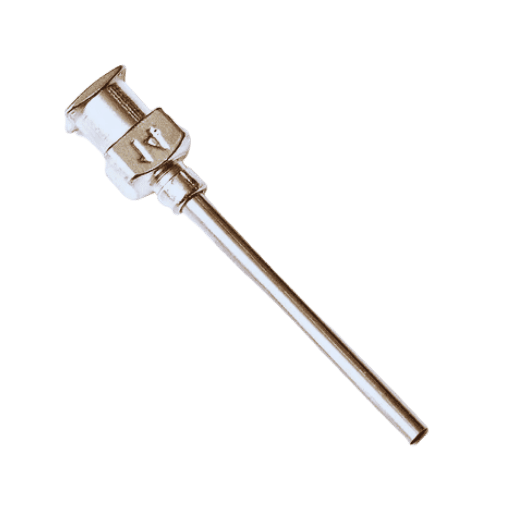
Luer Lock Dispensing Needles
Luer Lock Dispensing Needles — Industrial Blunt-Tip Fluid Dispensing | Ebestron
dispensing needles blunt-tip, Luer-lock. Created for a single goal: depositing a precise, repeat-bead of adhesive, epoxy, solder paste, or ink wherever and whenever desired. From tip to base Ebestron covers the full 8G-30G gauge line in two product families: all-metal stainless steel and color-coded plastic-hub. Every needle fits any standard Luer-lock and Luer-slip syringe, cartridge, or static mixer.
8G–30G
Full gauge ladder
2 Lines
All-metal SS + color-coded plastic hub
304 / 316
Stainless steel cannula grades
1/4″–1.5″
Length options (6.35–38.1 mm)
Luer-Lock
ISO 594 6% taper, fits lock + slip
OEM
Custom gauge, length, hub color
[SYS-DIAGNOSTIC]
Stop Wasting Adhesive on the Wrong Needle
dispensing needles fail in three predictable patterns: clog, string, or drip. Any one of those errors makes parts scrap, wastes material, and is usually caused by the gauge not matching the fluid. A blunt-tip Luer-lock needle from Ebestron, sized correctly and with the correct question mark out of that equation.
01
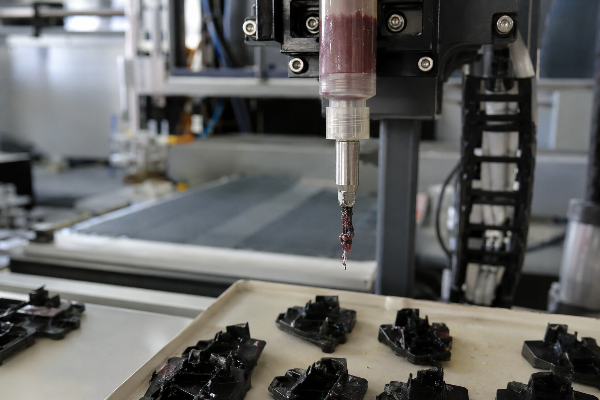
[ERR-CLOG]
A clogged tip will grind your production line to a halt mid-run and leave you with a mass scrap batch of purged parts as you clear it, clean it, and restart.
02
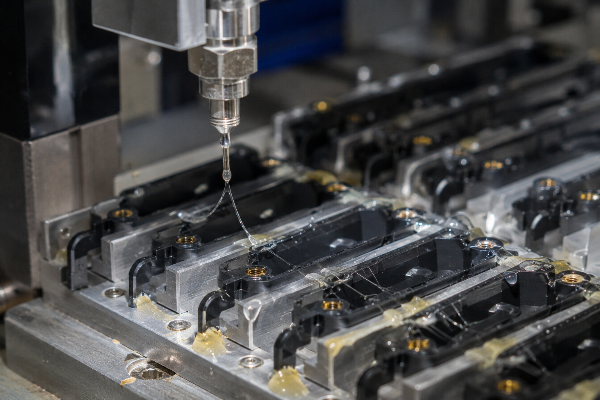
[ERR-OVERFLOW]
Over-sized a gauge and too much adhesive is deposited as the head comes home. That leads to bad tails, bridges, drips on the next few parts, and a costly mess.
03
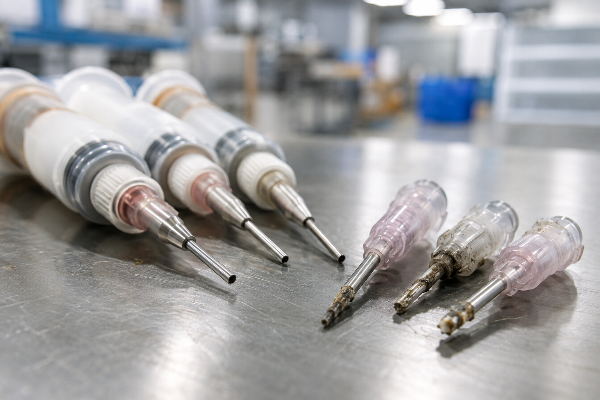
[ERR-CURE]
Cyanoacrylate and filled epoxy cure inside the bare metal bore of many tips, turning a cheap part into one you’ll be throwing away every hour.
[DATA-CONTEXT]
Those aren’t edge cases; they are what anyone building at volume experiences, typically within hours of installing any dispensing needle needle. Because what you’re typically seeing isn’t a tip-brand problem but a tip-brand-to-fluid mismatch. Our two needle line families are engineered precisely to overcome that mismatch – our USPTO dispense-tip patents outline how the tip geometry helps control the fluid.
[SPEC-PHYSICS]
Here is the physics at play.
needle fluid flow is a quartic relationship – to the fourth power – of the bore radius. A difference as small as 10% between an 8G and G+ tip results in a significant ~25% difference in volume deposited. That is why “just go one size finer,” often recommended, will likely fail. A smallerbore tip will bottom out and build significant back pressure-making any fluid push through it slowly, stall out completely or spurt on valve opening.
[EXECUTION-PROTOCOL]
The fix in one line
Match the inner diameter (ID) to viscosity, keep the tip as short as possible to reach the work piece, and choose a hub material that the chemical will not attack. As a rule of thumb, always use the shortest length that will do the bead and the largest gauge that can accomplish the required accuracy, as smaller gauges increase clogging potential. gauge selection chart with viscosities included can be viewed below (we’ve published IDs and ODs most suppliers do not)
[SYS-01] // FLUID DISPENSING ARCHITECTURE
[DATA-MATRIX] // PARAMETER MAPPING
Ebestron Dispensing Needles: Stainless-Steel And Color-Coded Plastic-Hub Lines
Ebestron offers dispensing needles for every chemistry across the entire range of gauge sizes-eight unique material chemistries across the full 8-30G size range, in two tip series-with a choice between a one-piece metal tip, or an all-plastic disposable.
[SPEC-01] // HEAVY DUTY
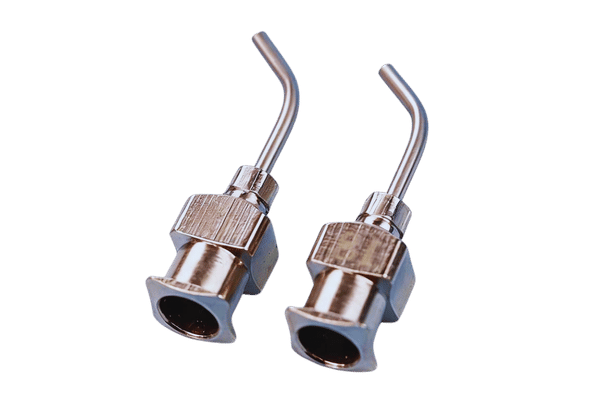
Line 1 — All-Metal Stainless Steel (8G–24G)
One-piece stainless steel luer lock hub and cannula with no crimp connection for strength; the plastic plastic-hub snaps on.
Ideal for applications involving filled epoxies, solder paste, greases, thermal pastes and high viscosity liquids where chemical resistance and durability are a concern.
Made with a stainless steel hub, which allows for cleaning and repeated reuse for highly stable, high-volume fluid dispensing applications, making it more cost-effective in the long run.
[SPEC-02] // AGILE DISPENSE
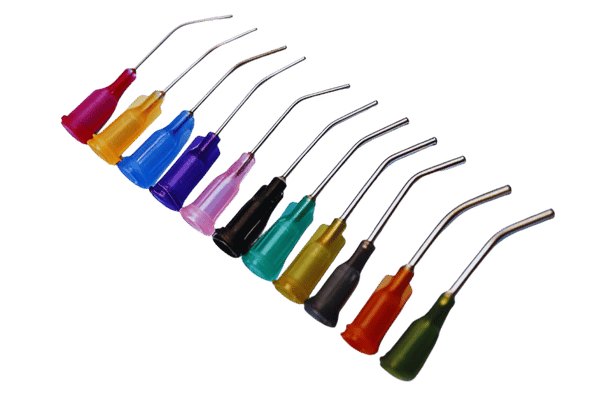
Line 2 — Color-Coded Plastic Hub + Stainless Cannula (16G–30G)
plastic-hub with the gauge color keyed to match for fast and efficient identification during set-up at the workbench.
Perfect for quick change over applications or reactive, fast-setting fluids when cleaning the tips is not economical.
Cost per piece is lower for both the high turnover line and for assorted multi-gauge kits.
All our stainless steel luer lock needle tips and color-coded luer lock needle tips fit on standard 6% Luer taper devices like our syringes, any cartridge adapters or two-component static mixing nozzles, which fit all Luer-lock and Luer-slip fittings. On luer lock vs luer slip: use Luer-lock for dispense under positive pressure (a slip joint can literally blow off the valve). industrial luers continue to follow the long-accepted 6% taper for ISO 594, not the new medical ISO 80369-7 tapered luer for a medical fitting.
Gauge Selection Chart — ID, OD, And Wall Per Gauge
This gauge selection guide by dispensing needle is what every buyer wants to see but most tip makers only print piecemeal – gauge|I.D.|O.D.|WALL for each gauge. Each gauge family is constructed to the same I.D., O.D., and wall-thickness reference dimensions and we can compare against other makers’ PublishedSpecs if we know gauge, O.D. and thickness – gauge specification for matching your fluid to appropriate wall-stock material by cross-reference.
Our stainless steel luer lock needles and color-coded luer lock needle tips span 8G to 30G; this dispensing needle gauge chart lists ID, OD, and wall per gauge.
| Gauge | Common Hub Color | OD (mm) | ID (mm) | Wall (mm) | Typical Fluid / Viscosity |
|---|---|---|---|---|---|
| 8G* | — | 4.19 | 3.43 | 0.38 | Very high: heavy grease, thick mastic |
| 13G* | — | 2.41 | 1.80 | 0.30 | High: thermal paste, filled epoxy, RTV |
| 14G | Olive | 2.108 | 1.600 | 0.254 | High: epoxy, RTV silicone, grease, solder paste |
| 16G | Gray | 1.651 | 1.194 | 0.229 | High/med: epoxy, paste, thick beads |
| 17G* | — | 1.473 | 1.067 | 0.20 | Med-high: UV adhesive, paste |
| 18G | Green | 1.270 | 0.838 | 0.216 | Med-high: UV adhesive, solder paste, general epoxy |
| 19G* | — | 1.067 | 0.686 | 0.19 | Med: epoxy, sealant |
| 20G | Pink | 0.908 | 0.603 | 0.152 | Med: adhesive, glue, oils, larger SMT paste |
How To Read This Chart
Use ID to judge flow rate and the gauge’s potential to clog. OD decides whether a tip fits in a specific fitting bore. The gauge I.D. shown is for regular-wall cannula tubing; for any thin-wall Sakufaj, the O.D. stays the same while the O.D. opens to a larger gauge I.D. which results in more flow for the same gauge dimension, however I.D. must take precedence for clogging potential of thick fluids. gauge ID I.D. thickness O.D. wall O.D. wall. The widely recognized industry colors identify our two distinct plastic-hub lines. They should never be mistaken for or substituted for standard tip identifications since our colors do not coincide with any vendor’s. gauge should dictate your specification and not brand colors alone.
* gauges marked with an asterisk (*) are our gauges, and others were chosen for comparative purposes (eg. Ebestron’s gauge 25G is equivalent to another maker’s 24G/25G/26G range) (Ebestron’s 24G to 26G values are individually specified and cross-referenced against all competitive lines). *8G to 26G were from our own internal manufacturing processes – we do cross-check those numbers against common brand specifications.
[COMP-EVAL] // STRUCTURAL ANALYSISWhich Line — All-Metal Vs Plastic Hub
Factor
All-Metal Stainless (8G–24G)
Plastic Hub + SS Cannula (16G–30G)
Best fluids
Filled epoxy, solder paste, RTV, grease, abrasive media
General adhesive, flux, ink, low-med epoxy, quick-change work
Reuse
Reusable (solvent-clean)
Disposable / dispense-and-discard
Pressure handling
Highest (one-piece metal)
High (threaded PP Luer-lock)
Temperature
Highest
Limited by polypropylene
Cost per piece
Higher upfront, lower per-shot if reused
Lowest per piece
Line-side ID
Stamped gauge
Color + gauge
“We stock two distinct lines of tips for our demanding customers: Our plastic-hub 13 gauge through 26 gauge are best when fluids are prone to settling, contain filling of various consistencies, or are just too difficult to manage with thinner fluids. We also have plastic-hub 6 gauge through 17 gauge for jobs that need quick changing on automated lines or where you’re dealing with aggressive chemistries and sensitive adhesives where only passesavized stainless works.”
Buying the wrong gauge, as the vast majority of clogs result from fluid-to-bore mismatch, means you’ve just lost half the battle already.
Choosing the Right Gauge and Tip for Your Fluid
Here are some facts that fly in the face of common assumptions that “smaller-is-better” which is the direct cause for 9 out of 10 fluid dispensing clogs: the larger the gauge for your fluid and the shortest length possible will minimize back-pressure, resulting in consistent delivery. Long-range tips and gauge tip ID add pressure and reduce flow: A clogged tip is nearly always an improper-gauge specification, not cheap part, deficient brand, or inferior-quality part.
Viscosity-to-Gauge Selector
Use this basic rule to match a gauge to your fluid for less clogging: Always select a gauge that provides an even bead without stretching: more is always better unless it clogs; thicker fluids require a wider range gauge and finer-tip ID’s should be reserved only for very light, water-thin fluids.
| Fluid / Viscosity Classification | Gauge Band Parameter | Operational Rationale |
|---|---|---|
| High (epoxy, solder paste, RTV silicone, grease, thermal paste) | 8G–16G | Large ID drops back-pressure so filled media flows without packing |
| Medium-high (UV adhesive, solder paste fine dots) | 16G–18G | Balances flow and dot control |
| Medium (general adhesive, thick cyanoacrylate, oils) | 19G–22G | Controlled bead without stalling |
| Low-medium (flowable CA, thin epoxy, ink, flux) | 23G–26G | Fine bead; watch clog risk on reactive fluids |
| Low (solvents, lubricants, micro-dots) | 27G–30G | Smallest controlled deposit; needs a dispenser, not hand force |
Two engineering anchors for sizing
For solder paste, keep the bore at least five times the largest powder particle — the “5-ball rule” — so Type 4 paste (about 38 micron particles) wants 27G or larger. Shot size tracks the gauge directly: at 400 centipoise, a 25 gauge taper places roughly a 0.003 mL micro-dot, while a 14 gauge taper lays down about 0.17 mL. As a working rule, a 16 gauge moves thick filled epoxy, a 20 gauge suits general adhesive, and a 22 gauge to 25 gauge places fine ink and flux dots.
Tip-Type Decision Matrix
Gauge determines the volume; tip material geometry and hub determine flow properties and the un-clogged fluids. Regarding blunt vs tapered tip needle decision, it’s clear: A blunt straight needle results into a specific inner diameter providing repetitive volumes; a dispensing tip tapered gives reduced back pressure especially for dense or loaded substances.
| Tip Type Specification | Optimal Fluids | Trade-off / Physics | Ebestron Line |
|---|---|---|---|
| Blunt straight, stainless | Precise beads, solder paste, abrasive/filled media | More restrictive on long lengths; defined ID for repeatable volume | All-metal SS |
| Blunt straight, plastic hub | General adhesive, ink, flux, quick-change work | Lower cost; dispose rather than clean | Color-coded plastic |
| Tapered / conical | Thick or filled fluids (epoxy, paste) | Lower back-pressure and clogging, but the pressure benefit shrinks at ultra-fine bores | On request |
| PTFE-lined | Cyanoacrylate, anaerobics, UV-cure | Non-stick bore stops in-tip curing; the right call for reactive fluids | Recommended for CA |
On the tapered vs blunt tip needle choice, use the shortest length and largest gauge the bead allows; a tapered dispensing tip lowers back-pressure on thick or filled fluids.
[SYS-01] SPECIFICATION
Where Ebestron Needles Dispense
In both cases it is still the gauge ladder that does that because the matching principle is still the same: ID for fluid, length for reach. These are two of the things that people who want to buy from you will be the ones to complain about.
SEQ
Application
Typical Gauge
Fluid / Note
01
SMT solder-paste dots
22G–30G
Type 4/5/6 paste; 28–30G for the finest pads (5-ball rule)
02
PCB conformal coating (selective bead)
18G–22G
Edge and keep-out beads where spray cannot reach
03
Epoxy potting / underfill
14G–22G
16G for high-volume pours, 22G for fine layers
04
LED / die-attach micro-dots
27G + 1/4″
Short length gives maximum dot control
05
Cyanoacrylate / ink / flux
22G–30G
Reactive fluids: PTFE-lined or dispense-and-discard
Among them all, the gauge is the smallest item on materials bill and the biggest lever on dispensing cost, because a plugged or overdumped tip makes inconsistent deposits, waste costly scrap and the chance of stopping production. Ebestrons 2 brands are engineered so the same choice is valid for a 14 gauge epoxy dot or a 30 gauge flux spot, and the gauge mix pricing Ebestron provides is for your specific production consumption volume, not some generalized list price.
Smallest part.Biggest lever.
Across manufacturing, scrap and rework run to roughly 2.2% of annual revenue and unplanned stoppages can consume around 11% — both driven up by a needle that clogs or over-dispenses. The needle itself is cents; the deposit it places is what protects yield.
Material Grades, Passivation, and Luer Conformance
The honest answer to a real risk — can an unknown supplier hold tolerance? — is to make precision a number you can demand, not a brand you must trust. One company’s dispensing tips may look identical to the next, so the difference stays hidden until a burr or contaminated bore inconsistently ruins a deposit. Because precision is a measurable property, Ebestron certifies cannula grade, passivation method, and ID tolerance against a defect-rate target below 0.1%, and we will not claim a number we cannot verify.
DOCUMENT REF: MAT-304/316
304 vs 316 Stainless — Match the Grade to the Fluid
The difference that matters is molybdenum: 316 adds 2–3% Mo for markedly better resistance to chloride and acidic attack, while 304 is fully serviceable for general adhesives, epoxy, and grease. Specify 316 cannula for aggressive flux, solder paste, and corrosive cyanoacrylate; specify 304 for everyday adhesive and potting work.
STANDARD COMPLIANCE: ISO-9626
Cleanliness is a spec, not a slogan
The structural reason cleanliness matters: passivation per ISO 9626-geometry stainless removes free iron and rebuilds the chromium-oxide film, which is what keeps a bore from corroding and inconsistently contaminating sensitive fluids such as cyanoacrylate and UV-cure. Ebestron states the passivation method (for example ASTM A967 citric) and the free-iron verification test from a controlled production line, because vague “high quality” language is not an answer a procurement audit can use. Industry patents back the standard, specifying tolerances in thousandths of an inch with electropolished, burr-free bores; management-system and substance documents such as ISO 9001 or RoHS / REACH statements are available to confirm on request rather than assumed.
Ordering: Gauges in Stock, MOQ, Lead Time, OEM and Bulk
Our entire 8G-30G product ladder is supplied on both lines, and in all four lengths, meaning a single Ebestron source handles everything from your fine-pitch micro-dots to your filled-epoxy pours. When you purchase on unit cost alone in the procurement cycle, you run into the costly error of finding that cheap needle was no bargain once a clogged tip slows down your cycle and you’re burning material through scrap. Ebestron solves this with guaranteed lot-to-lot ID, and a quote based on your actual process parameters. Don’t invest until you test your adhesive flow on sample, then gauge and standardize on what’s working, you’ll find all the answers on pack size, delivery lead-time, and luer engagement you’re looking for.
01 // PARAMETERS
What drives your quote
Not based on any listed ‘price list’, pricing depends on few easily understandable drivers – gauge and length make/mixture, choice of line (all-metal or plastic hub), grade of cannula (304 or 316), order volume, pack size, plus any OEM personalization. Share gauge series, fluids and annual volume – we revert a tailor-made quotation and lead time – often within 5 days from stock at our production depot.
Expand +02 // VALIDATION
Pre-Test Before The Pack
One multi-gauge sample kit allows you to flow and test gauge with your fluid – it’s our standard buying process (not the obstacle). You’re buying a sample kit!
03 // CUSTOMIZATION
OEM/ODM.
Supported in our Repeat Programs: OEM or customize gauge/length and hue colors; private labeling/packing is a customisable option.
04 // STANDARDS
Compatibility and Luer-slip interface- Verified.
The 6% Luer-lock taper matches the taper of Luer-lock and Luer-slip syringes, cartridge adapters, and static mixers per ISO 594-Use Luer-lock fitting for pneumatic, high-pressure dispenses to help avoid blow-off.
Interactive Luer Lock Dispensing Tools
gauge selector
Determine the optimal needle gauge for your specific fluid dispensing requirements.
Access Tool
gauge lookup
Cross-reference precise specifications to ensure perfect compatibility with your equipment.
Access Tool
sample kit builder
Configure a tailored sample kit of dispensing needles for your specific testing needs.
Access Tool
Dispensing Needles — Frequently Asked Questions
What gauge dispensing needle do I need for my fluid?
Match the bore to viscosity – NOT as fine as possible. If fluid (epoxy, paste solder,RTV) is high vis, run 8g – 16g. General adhesives & thick cyano = 19g – 22g. Inks thin, solder flux, solvents 25g- 30g. START BY USING VISCOSITY TO gauge selector at top; then always test your adhesive flow on a sample before you standardize.
What is the difference between a blunt-tip dispensing needle and a hypodermic needle?
dispensing needle is a blunt, not beveled – meant to deliver fluid, not to puncture. These are industrial, non-sterile consumables used with adhesives and fluids, not medical devices; though they can pierce the skin, wear proper eye protection and gloves.
Will these fit my syringe — Luer lock or Luer slip?
On luer lock vs luer slip: both connect. A Luer-lock needle shares the 6% taper with Luer-slip, so it mates to either. Use Luer-lock under air pressure – a slip fit can blow off.
Which needle should I use for cyanoacrylate (super glue)?
Cyanoacrylate cures to air-borne moisture, so bare stainless or plastic-hub needles clog in tip; to avoid this, use either a non-stick, PTFE-lined needle bore, or designate a low-cost plastic-hub as dispense-and-discard. We will tailor a needle to your application given the fluid and desired gauge.
Why does my dispensing needle keep clogging?
Clogging of the needle is normally an under-sized gauge for your fluid, not a poor needle; when applying filled materials, make sure your needle gauge is at least five times larger than the largest particle, and for viscous or reactive fluid, consider a non-stick PTFE-lined bore. Further miniaturization does not usually help – as tip diameter decreases, clog risk rises.
Stainless steel or plastic hub — which is better?
No one option is universally best: stainless for filled, harsh, high-temp, reusable work; color-coded plastic-hub for light, low-cost, disposable runs. For aggressive flux or CA, use a PTFE-lined bore.
Can I reuse dispensing needles?
Reusable stainless needles cut cost-per-shot on stable fluids – solvent-wash and re-run. Plastic-hub needles are made for dispense-and-discard with fast-setting or reactive adhesives.
What is the minimum order, and can I get a sample first?
Absolutely! Our multi-gauge sample kit is specifically designed to allow you to test various sizes against your specific fluids before committing to a volume purchase, ensuring you achieve the best flow and control for your unique applications. Just let us know your gauge, fluid and yearly volume for a quote!