Póngase en contacto con la empresa Ebestron


Especificaciones rápidas
| Tamaños de cartuchos | 50-600 mL (línea neumática Ebestron) |
| Ratios de mezcla | 1:1, 2:1, 10:1 |
| Presión de aire regulada | 80-100 psi (5,5-6,9 bar); Techo de 120 psi (8,3 bar) para pistolas portátiles 2K |
| Demanda aérea típica | Aproximadamente 2-3 SCFM por ciclo en tamaños de cartucho comunes (calculado, no una especificación fija « ver más abajo) |
| Límite de presión de aire de limpieza (OSHA) | Menos de 30 psi (2,1 bar), con protección de virutas y EPI (29 CFR 1910.242(b)) |
Las pistolas dispensadoras de cartuchos neumáticos transforman el aire de taller en una cuenta confiable e incansable de adhesivos de dos componentes, pero la pistola es solo la mitad de neumática. Si esa cuenta mantiene la relación de cambio tras cambio o se desvía en la tercera semana depende tanto del compresor y la línea de aire que lo conecta al arma como de la propia pistola. Si bien la mayoría de las guías de compra se detienen en seco en el arma, esta guía continúa donde lo dejan: cómo dimensionar el compresor, montar la línea de aire, mantener los sellos y reguladores ajustados y determinar si una cuenta fuera del objetivo es causada por un problema de suministro de aire o un problema con el arma.
La pistola dispensadora de cartucho neumático requiere aire filtrado suministrado a presión regulada (80-100 psi), un compresor que tenga el tamaño adecuado para los requisitos reales de aire ciclo por ciclo de la aplicación y no solo la clasificación CFM de la placa de identificación, y un filtro-regulador- lubricador que evita que la humedad y las partículas entren en la válvula. Si no se cumple alguno de estos requisitos, los síntomas (una perla vacilante o inconsistente) parecen no estar relacionados con el sistema de aire.
Puntos clave
- No existen clasificaciones “CFM” disponibles de ningún fabricante para una pistola dispensadora de cartuchos; debe calcularse a partir del volumen del cilindro y el tiempo del ciclo.
- Comprar un compresor de aire “sólo para ser seguro” a una capacidad mayor de la necesaria es un error costoso y comúnmente cometido, no una salvaguardia sensata.
- La limpieza de una pistola o línea de aire con aire comprimido se rige por una norma OSHA específica para el uso del aire (29 CFR 1910.242(b)), en lugar de la regla general de ubicación peligrosa en el lugar de trabajo que a menudo se cita al comprar recursos.
- Cuando la perla adhesiva dispensada no funciona según las expectativas, un problema de suministro de aire suele ser el culpable y, por lo general, se trata de manera diferente a un mal funcionamiento de una pistola.
¿qué es una pistola dispensadora de cartuchos neumáticos (y qué cubre esta guía)
Una pistola dispensadora de cartucho neumático es una herramienta aplicadora manual que utiliza aire comprimido en lugar de una fuente de energía eléctrica o un gatillo manual para operar los émbolos en ambos lados de un cartucho adhesivo de dos componentes y aplicar el material en una proporción constante a través de un mezclador estático.
Este aire comprimido sirve como reemplazo manual de la fuerza para una mejor consistencia y control de la aplicación. Por esta razón, las pistolas dispensadoras de cartuchos neumáticos prevalecen en los talleres que aplican adhesivos en gran volumen o donde el material es demasiado rígido para aplicarlo con energía manual. Algunos mercados todavía llaman a esta categoría pistola de calafateo neumática, aunque esa etiqueta desdibuja una distinción importante cubierta por las reglas generales de seguridad de ISO 4414:2010 para sistemas de energía de fluidos neumáticos: una pistola de calafateo de un solo componente no tiene forma de contener dos partes en relación, mientras que un cartucho 2K todo el trabajo es medir ambos lados juntos. Ebestron construye sus pistolas neumáticas, cartuchos dobles y mezcladores estáticos internamente bajo un sistema de calidad compatible con CE/RoHS en lugar de obtener los tres por separado, razón por la cual el ajuste entre ellos está garantizado en lugar de asumido.
Esta guía de compra supone que ya ha tomado la decisión de si una pistola dispensadora de cartucho neumático es adecuada para su taller, con información detallada sobre el sistema neumático versus las pistolas epoxi accionadas manualmente y a batería que se tratan en nuestra Comparación de neumáticos versus manuales versus baterías guía y La guía de compra de pistolas epoxi de 3 unidades. Aquí, respondemos las preguntas prácticas restantes sobre el uso de su existente Pistola dispensadora de cartucho neumático Ebestron, incluido lo que realmente necesita en términos de aire, cómo instalar correctamente la línea de suministro de aire, qué mantenimiento se necesita para un funcionamiento confiable a largo plazo y cómo distinguir entre una falla del sistema de aire y un problema con el arma.
Cómo funcionan las pistolas de cartucho neumático: regulador, válvula de cierre y empuje
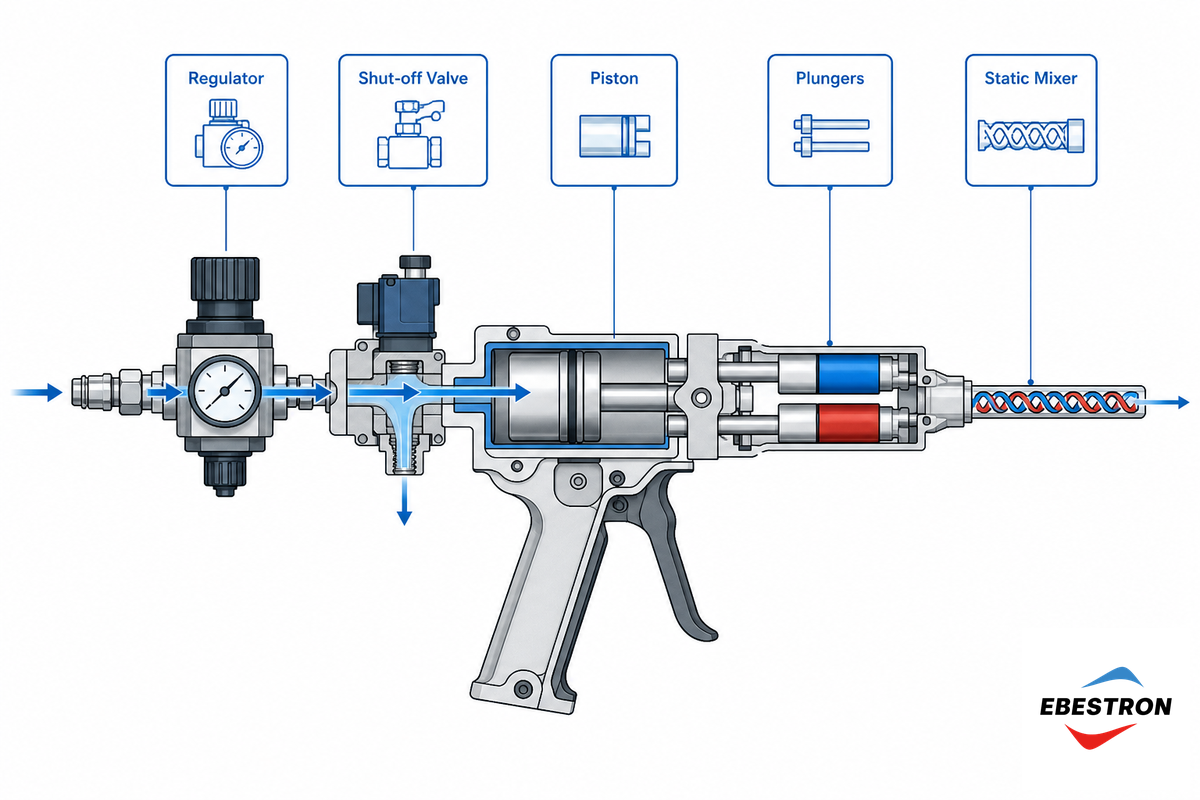
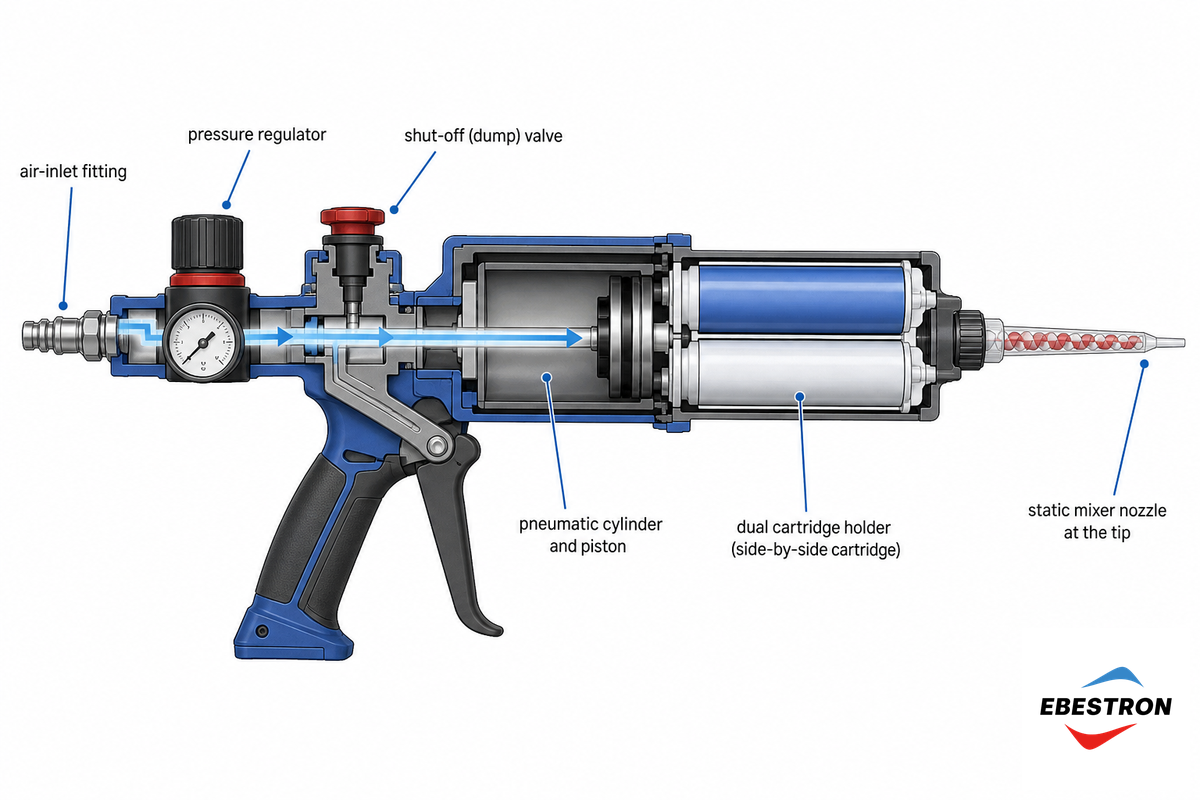
El aire ingresa al arma a través de un accesorio, se mueve a través de un regulador ajustable para controlar la presión de trabajo y luego a través de una válvula de cierre (descarga de aire) hacia un cilindro donde actúa sobre un pistón, empujando ambos émbolos del cartucho hacia adelante juntos (en el relación integrada en el juego de émbolos).
Sin esa válvula de cierre (colocada entre el regulador y el pistón), la presión restante de la línea seguiría empujando el émbolo durante uno o dos tiempos después de que el operador soltara el gatillo. Esto provocaría un goteo o una gota prolongada al final de una perla. Si se pierde esta distinción en el taller, el modo de falla es fácil de diagnosticar erróneamente: una perla débil o inconsistente se atribuye a un lote malo de cartuchos, los cartuchos se intercambian durante semanas y la causa real “un regulador que se ha salido de la calibración ^ nunca se toca.
Esto no es una coincidencia de ingeniería: está patentado. Patente estadounidense 9.862.001 B2, de Sulzer Mixpac/Medmix, detalla un mecanismo de accionamiento dispensador de velocidad constante que incluye la misma retirada temporal del émbolo al soltar el mecanismo de disparo que se encuentra en prácticamente cualquier arma 2K en el mercado para prevenir goteos.
📐 Nota de ingeniería
Presión del regulador y relación de empuje (son dos números separados pero ambos importantes). El primero es la presión del aire que empuja 'los reguladores comúnmente utilizados con pistolas dispensadoras portátiles 2K leen 80-100 psi (5,5-6,9 bar), y 120 psi (8,3 bar) parece estar en la parte superior del rango efectivo -ñi, mientras que el segundo, fijado en el mecanismo de la propia pistola dispensadora, es lo que amplifica esa presión en el émbolo. La pistola dispensadora con una relación de empuje de 18:1 en un suministro de aire regulado de 90psi ejerce mucha menos fuerza real sobre la punta del émbolo que una unidad de 26:1 a la misma presión. Bombear la presión del regulador por encima de los límites nominales del mezclador y el cartucho no lo hace más rápido. Hace que sea más probable que dividas el cartucho o soples el sello del mezclador.
Dimensionamiento de su compresor de aire: CFM, tamaño del tanque y ciclo de trabajo
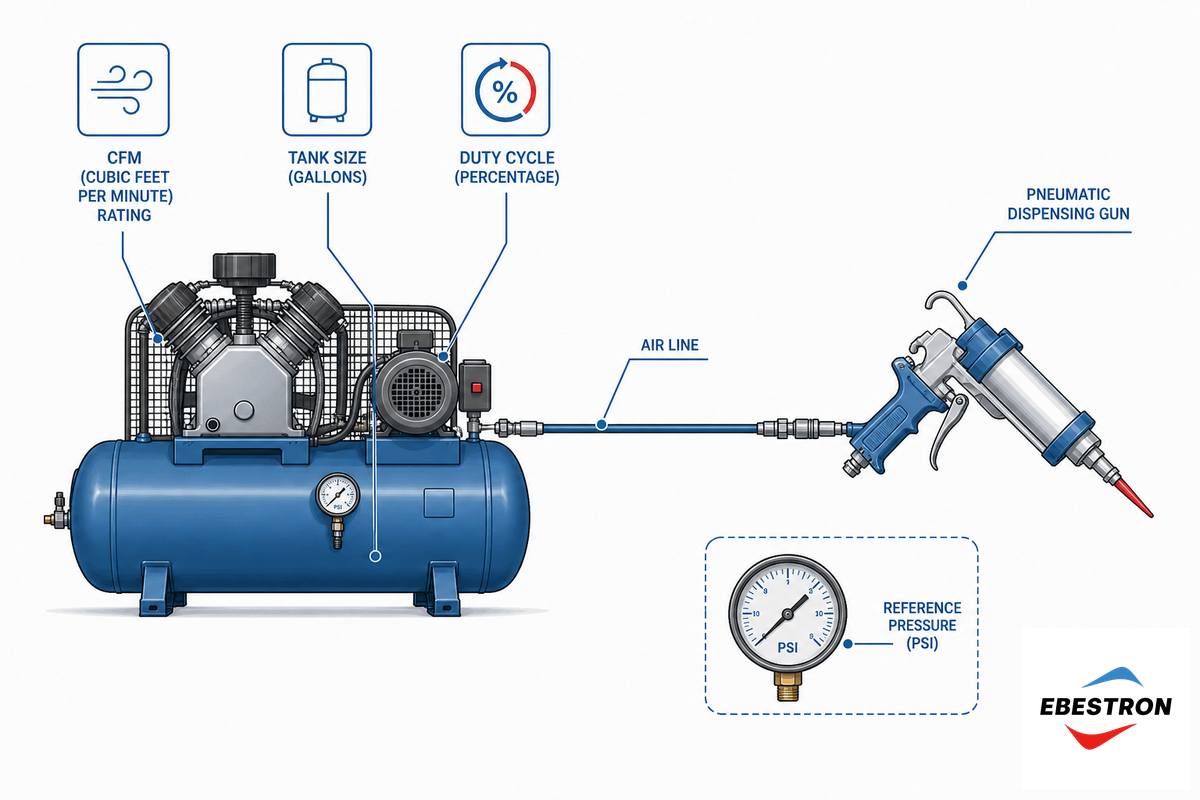
He aquí un hecho que muy pocos compradores esperan: ninguno de los fabricantes de cartuchos imprime nunca un valor CFM para sus pistolas dispensadoras neumáticas, a diferencia de una llave de impacto o una amoladora que muestra su clasificación. Una pistola dispensadora no es una herramienta de flujo continuo: el uso de aire se produce en pequeños incrementos en el microsegundo que tarda el émbolo en avanzar en cada disparo, y usted mismo debe calcular la verdadera demanda a partir del desplazamiento del cilindro y de la frecuencia de disparo en lugar de la placa de identificación.
Fuentes de la industria describen el cálculo subyacente como una fórmula estándar de consumo de aire del cilindro neumático: SCFM = 2 × (área del pistón × longitud de carrera) × ciclos por minuto × factor de compresión, dividido por 1728 pulgadas cúbicas por pie cúbico, donde el El factor de compresión es (presión de línea + 14,7) ~ 14,7. Un ejemplo comúnmente citado en referencias de ingeniería neumática muestra que un cilindro de 2 pulgadas por 4 pulgadas de carrera, que circula a 30 veces por minuto a 80 psi, requiere aproximadamente 2,81 SCFM de aire libre. Aunque el pistón de la pistola de cartucho es mucho más pequeño, se aplican las mismas matemáticas básicas, por lo que al conectar las cifras reales de diámetro y carrera de su propia arma (de su hoja de datos) y sus disparos reales por minuto, puede derivar su propio número de uso genuino en lugar de adivinar.
| Tipo de aplicación | Volumen diario | Ciclo de trabajo | Recommended compressor | Tank sizing rule of thumb |
|---|---|---|---|---|
| Lab / prototype bench | Under 10 cartridges | Sporadic | Small single-stage (1.5-2 HP class) | ~1 gallon of tank per CFM of compressor output |
| Light production bench | 10-30 cartridges | Intermittent | Small single-stage (2-3 HP class) | ~1 gallon per CFM |
| Medium production bench | 30-100 cartridges | Steady, single line | Mid single-stage (5 HP class) | ~2 gallons per CFM for smoother regulation |
| Heavy single-gun production | 100+ cartridges | Continuous, single station | 5-7.5 HP single-stage or small two-stage | ~2-3 gallons per CFM |
| Multi-gun cell (2 guns) | 150-250 cartridges combined | Continuous, shared line | Shared compressor sized to combined SCFM plus headroom | ~2-3 gallons per CFM |
| Multi-gun cell (3-4 guns) | 300+ cartridges combined | Continuous, multi-station | Dedicated shop compressor with individual drops | Up to 3 gallons per CFM (DOE guidance) to buffer simultaneous demand |
| Automotive panel bonding line | High, structural adhesive | Continuous, line-paced | Mid-to-large single-stage sized to line takt time | ~2-3 gallons per CFM |
| Electronics potting bench | Low-to-medium, precise dosing | Intermittent, precision-critical | Small single-stage with tight regulation, oil-free preferred | ~1-2 gallons per CFM |
| Construction anchoring, shop/field | Variable, high-viscosity anchor resin | Intermittent, portable | Portable single-stage matched to jobsite power | ~1-2 gallons per CFM |
If you were running one gun at 2.8 average SCFM, and only intermittently dispensing air rather than continuously running at 2.8 SCFM, a small single stage compressor, maybe rated 4-5 SCFM at 90 psi, with a modest air tank would suffice – its only role being to catch up between shots rather than run continuously at 2.8 SCFM. If you add another gun to the same supply line, then you need to assume something more like twice that average air delivery – which usually indicates that you should up your compressor size a step rather than trying to run two guns at near a single small compressor’s limits.
⚠¦ Important — Bigger Is Not Automatically Safer
Many are tempted to simply buy the biggest unit the budget will allow “just to be safe.” But if you ask the people who conduct audits on compressed-air systems in many plants, over-sizing is a real and common and costly problem. Purchasing a 50 HP unit where a 25 HP unit would easily suffice may be costing you thousands of dollars a year in electricity since a larger compressor draws more energy across the entire operating spectrum. The key to compressor selection is SCFM, operating cycle, and perhaps adding an additional air receiver or variable frequency drive for the occasional demand, not oversizing to the point that energy dollars go to waste — this exact sizing-and-oversizing tradeoff is what the U.S. Department of Energy’s compressed-air system sourcebook walks plants through in far more depth than any single gun vendor’s spec sheet will.
“Many manufacturers believe it’s a good idea to oversize their air compressor… It rarely pays off. If your demand is highly variable, a variable-speed drive can reduce energy costs by ramping down motor speed when demand is low — but even then, it usually doesn’t make sense to buy a compressor sized for peak demand you rarely see.”
— Brad Taylor, Fluid-Aire Dynamics
Configuración de la línea de aire: filtro, regulador, lubricador y trampa de humedad
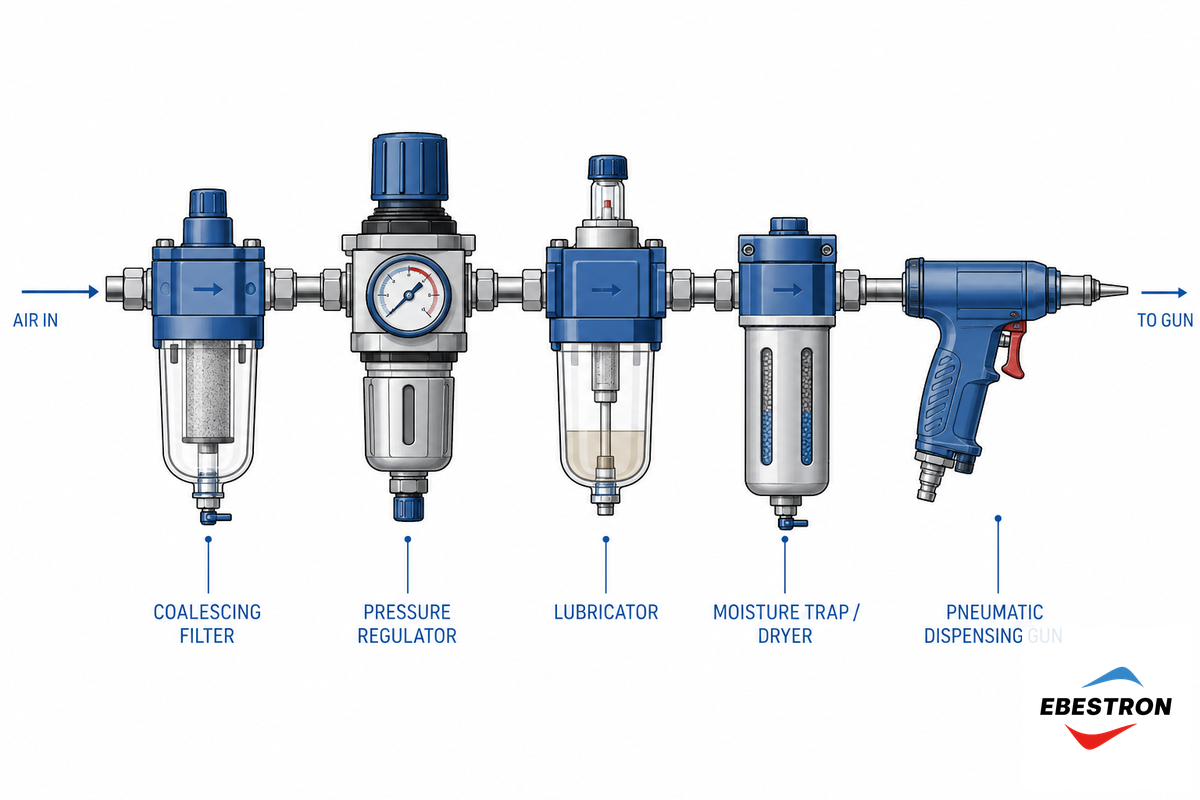
Even the compressor itself is only part of the story. What goes on between the air receiver and the gun-the line set, the filters, the regulators-can and does make the air that hit your piston clean and dry at the pressure you demand, or dirty and wet, causing silent wear on the regulator seats and on the shutoff valve stems. Mounting the filter-regulator-lubricator assembly as close to the gun as the workstation layout allows, and connecting the gun itself through a quick-connect adapter rather than a permanent fitting, also makes it far faster to swap a second air-powered gun onto the same drop when a line is shared.
| Componente | What it does | Si te lo saltas |
|---|---|---|
| Coalescing filter | Strips particulate and bulk moisture from the line | Grit accelerates regulator seat and O-ring wear |
| Regulator | Sets and holds working pressure independent of upstream fluctuation | Pressure drifts with compressor cycling, bead thickness varies shot to shot |
| Moisture trap / dryer | Removes condensed water before it reaches the gun | Moisture corrodes internal valve components and can push into the cartridge interface |
| Lubricator (if gun spec calls for it) | Adds a fine oil mist to reduce internal friction and seal wear | Faster wear on the piston seal in guns designed to run lubricated |
The greatest villain here’s moisture, and the fact that it’s such a quiet one. Moisture typically doesn’t cause immediate noticeable leaks; it can manifest weeks later as a sticky regulator, an corroded valve seat, or an unexplained lack of consistency from shot to shot. Also, the increased pressure loss caused by a partially wet airline often looks just like the symptoms of an undersized compressor-another reason it’s so difficult to know if it’s your gun or your air supply that’s causing problems (see the Troubleshooting Guide, later).
💡 Consejo profesional
Filter differential pressure gauges are normally calibrated at rated flow.
It is very easy for a partially plugged air filter to show minimal restriction at low flow, but then cut off air supply the moment demand goes up, so these should be checked regularly based on usage hours, not just gauge readings.
For those who regularly open an air line (blowing out a fitting, cleaning out a connection with the air gun) keep in mind that OSHA has a regulation for the use of compressed air in the cleaning of equipment (29 CFR 1910.242(b)) that restricts use to under 30 psi when such usage involves chip guarding and personal protective equipment; this rule is distinct from the rules governing the classification of hazardous locations often cited by manufacturers’ guidelines for motor selection.
Programa de mantenimiento: sellos, válvula de gatillo y calibración del regulador
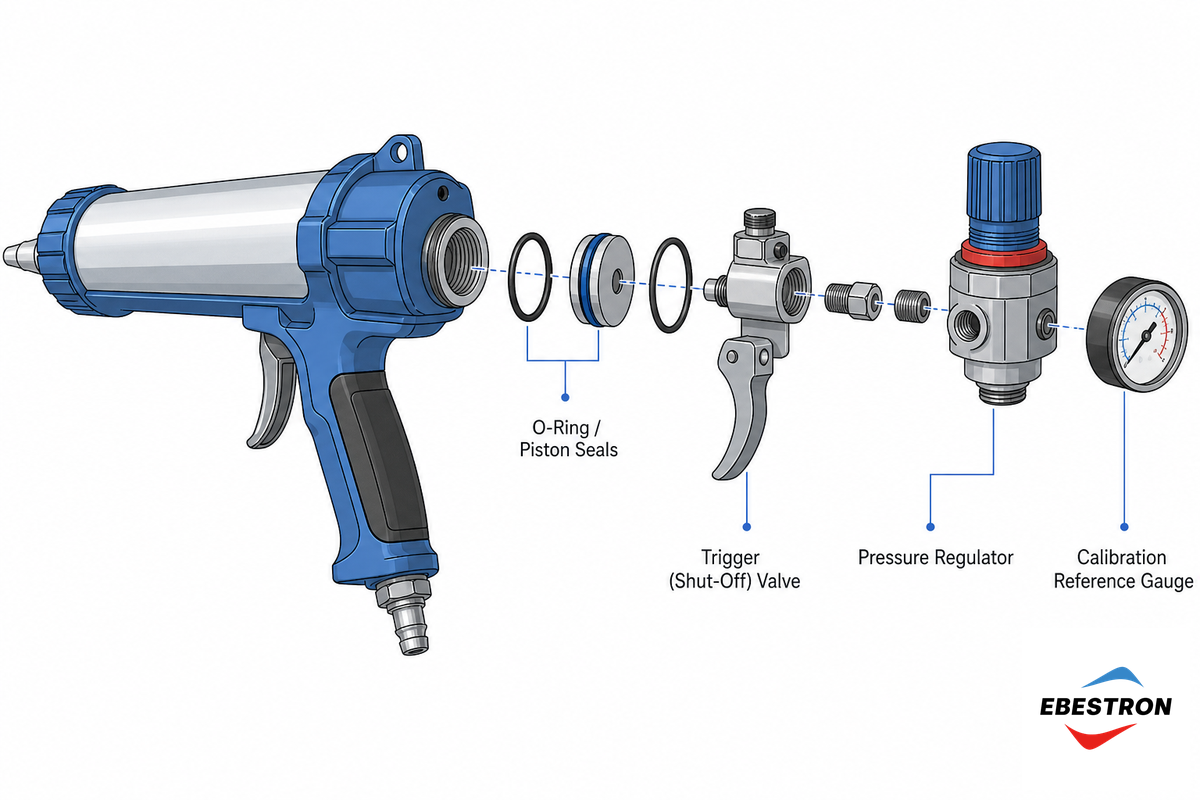
No cartridge-gun-specific maintenance-interval standard exists that has been published by any standards body — the intervals below are derived from common pneumatic-tool and compressed-air-system maintenance procedures and aren’t from a manual specifically intended for adhesive dispensing guns. The closest thing to a governing document is ISO 4414:2010, Pneumatic Fluid Power — General Rules and Safety Requirements, which sets the general upkeep and inspection expectations for pneumatic systems without naming this specific tool category. Regard the schedule below as a basic check list to customize to your operational parameters, not as a rigid factory spec.
| Item | Typical interval | Qué comprobar |
|---|---|---|
| Wipe-down & visual check | Every shift / after every job | Adhesive residue on plunger and trigger mechanism |
| Filter/regulator inspection | Quarterly (roughly 3 months) | Differential pressure, moisture in bowl, regulator drift from set point |
| O-ring / seal replacement | 3-6 months | Piston seal wear, air leakage past the seal |
| Shaft/oil seal (if applicable) | 6-12 months | Replace sooner at first sign of leakage |
| Full thorough service | Annual | Regulator calibration against a reference gauge, full valve inspection |
If the bead on your gun has been wandering from the original setting when commissioning it, a poorly set regulator is one of the most common-and often-overlooked-culprits. Best to check the regulator setting against a calibrated reference gauge before suspecting either the gun or the cartridge is malfunctioning. Most O-ring and seal work needs only partial disassembly of the gun body — pull the trigger-valve assembly, swap the worn parts, and reassemble; it rarely calls for a full repair-shop teardown or sending the gun back to your supplier for service.
Solución de problemas neumáticos específicos: ¿es el aire o el arma?
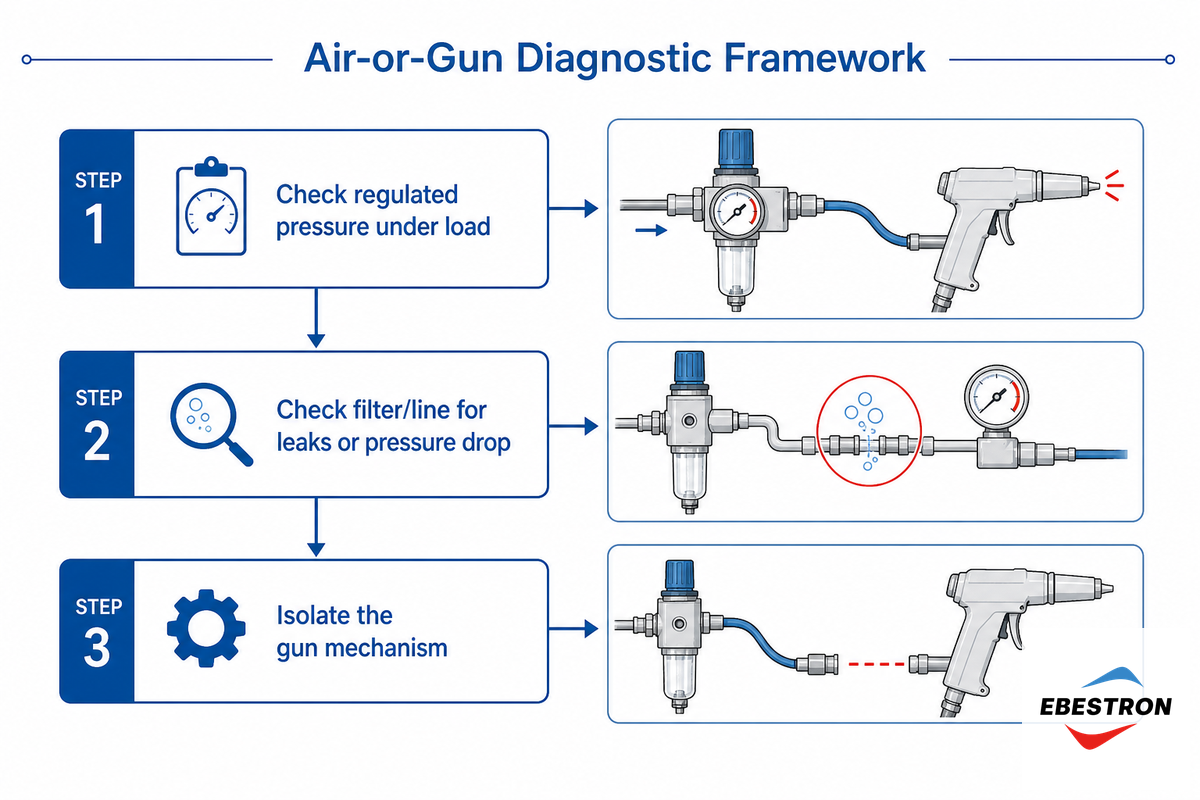
When your pneumatic cartridge gun begins to act up, it’s a natural impulse to assume either the gun or the cartridge is the problem. Quite frequently the culprit lies farther up the supply line in the air delivery system — and the fix vary significantly depending on where the air-side malfunction is located. Before reaching for the tool kit, use the 3-Point Air or Gun Diagnostic Framework below.
El marco de diagnóstico de armas o aire de 3 puntos
The 3 checks that can separate an air-supply problem from a gun/cartridge issue — load-bearing air line pressure, behavior of the shut-off valve as the trigger is released, and condition of filter and air/moisture separation equipment – should all be conducted on the air-supply system before you open the gun.
| Síntoma | Check this first (air side) | If air checks out (gun/cartridge side) |
|---|---|---|
| Bead thins out mid-cartridge | Line pressure at the gun under load — pressure drop from a restricted filter or undersized line | Worn piston seal losing thrust |
| Gun won’t dispense at all | Compressor actually running, regulator not backed off to zero, line not kinked/disconnected | Blocked or hardened static mixer (not an air problem — see our gun- and cartridge-side dispensing problems guide) |
| Drips after trigger release | Shut-off/air-dump valve holding residual pressure | Worn anti-drip mechanism inside the gun body |
| Bead inconsistent across a shift, no clear pattern | Moisture in the line, filter differential creeping up unnoticed | Regulator drifted out of calibration |
Consistent with field reports concerning pneumatic caulk and cartridge guns, we’ve observed a comparison of two supposedly identical guns, in one case the travel of the plunger per squeeze of the trigger on one gun being only half that of the other gun, this difference being attributed to a disparity in thrust and regulator pressures rather than a defect in the gun mechanism itself. When force output from what should be two identical setups appears inconsistent, examine the air side first to determine whether or not you’ve a mechanical problem.
Donde la neumática aún gana: ciclo de trabajo, viscosidad e instalaciones en áreas peligrosas

Assuming that you’re familiar with the principles of the pneumatic air-system system discussed previously, you might ask whether it’s worth staying on pneumatic or migrating to a battery-powered gun. There are two conditions under which it definitely makes sense to continue using your pneumatic system.
One such condition is the facility class of the workplace. Hazardous locations (as classified by 29 CFR 1910.307) are subject to special restrictions on the use of electrical apparatus, including standard battery-powered equipment, unless such equipment is approved as being intrinsically safe or explosion-proof for use in such locations. The pneumatic system avoid these restrictions altogether by using a standard compressed-air supply and an on-board gun without its own motor and battery system; accordingly, use of a pneumatic gun is dictated by facility compliance rather than personal preference. Getting this decision wrong has a real cost either direction: a facility that standardizes on battery-electric guns inside a classified paint-mixing or solvent area can fail a safety inspection outright under 29 CFR 1910.307, while over-committing an entire mobile field crew to compressed air just adds an idle compressor no one uses to the capital budget.
The second factor favoring continuing with the pneumatic systems is duty cycle. High and sustained volume applications in fixed workstations such as assembly line work that are serviced by properly sized compressors and air lines are well within the capacity of the pneumatic systems; they don’t require the hassle of recharging or replacing batteries and they allow continuous operation from a compressed-air source at the end of a hose. For remote field applications that don’t include compressed air, a battery-electric 2K gun clearly is preferable — worth noting that some buyers searching for a cordless caulking gun or electric caulking gun are actually after this same battery-electric 2K category and haven’t realized their single-component caulk tool won’t hold a two-part ratio — but see our full manual vs pneumatic vs battery-electric comparison for reference if you still need to select a power system.
Ready to spec the system, not just the gun?
The pneumatic cartridge dispensing guns manufactured by Ebestron are engineered to work in concert with a suitable compressor system, across 50-600 mL cartridges and 1:1, 2:1, and 10:1 ratios.
El costo real de operar una pistola neumática: un ejemplo de consumo de aire trabajado

We call compressed air “the fourth utility” – and for good reason, as according to industry sources, energy accounts for about 80% of the total cost of owning a compressed-air system. A good chunk of this energy is wasted as heat during the compression cycle, rather than used to perform work on the tool. So, the price tag on a gun is a mere blip on the radar in comparison. Consider a shop that never runs this math: production stays flat but the energy bill keeps climbing, and with no compressor-runtime log there’s no way to tell a well-tuned system from a leaking one — if the unit is cycling through roughly 30% of the shift with no gun actually dispensing — in line with industry estimates that leaks alone account for about 30% of compressed-air waste in an average shop — that’s the signature of an undetected leak or a stuck-open valve somewhere in the line, not the cartridges themselves — exactly the failure mode the DOE’s own compressed-air-system guidance flags as the single biggest source of wasted generation capacity in a plant.
Historically, the U.S. Department of Energy has referenced compressed-air generation costs of 15 to 30 cents per 1,000 cubic feet where a facility’s own cost is unknown; with current electricity rates, industry sources place many systems in the 25-35 cent range. A published DOE/ENERGY STAR cost-per-CFM calculation illustrates how a facility can derive its own figure: annual energy cost (motor horsepower × 0.746 × operating hours × electricity rate ÷ motor efficiency) divided by annual air volume in thousand cubic feet. Worked through with a 100 HP compressor running 4,000 hours a year at $0.10/kWh and 92% motor efficiency, delivering 450 CFM, the result comes out to roughly $0.30 per 1,000 cubic feet.
📐 Worked Example — Cost Per Cartridge
Consider that 2.81 SCFM cylinder-consumption example from the compressor-sizing chapter above, a $0.30 per 1,000 cubic feet facility air-cost rate, and a cartridge that cycles every 20 seconds to dispense to a fully loaded 400 ml cartridge: This is around 0.9 to 1.0 cubic feet of free air used per cartridge. This represents just fractions of a cent of air cost per cartridge. Why goes that unrecognized? The main cost driver for air isn’t per cartridge usage, but rather the wasteful background operations from a leaky, unregulated, and oversized system that runs all day every day-which is what that 80% of lifetime cost refers to. So if you’re shopping listings of pneumatic cartridge dispensing guns for sale and comparing them purely on the sticker price of the tool, you’re benchmarking the smallest line item in the whole equation.
Perspectivas de la industria: por qué el diseño de sistemas aéreos sigue siendo importante a medida que crece la electricidad con batería

By far the biggest trend we’re seeing in two-component dispensing equipment is the move toward battery-electric guns – and for the right reasons (ergonomics, reliable bead delivery) not necessarily just novelty; we explore this transition more thoroughly in our 3-drive epoxy gun buyer’s guide. That said, this doesn’t mean that the pneumatic infrastructure is a dead-end street. The facility’s hazard classification and duty cycle, and not the newest type of drive, determines your destiny; a hazardous location class site will preclude standard battery-operated devices in the context of 29 CFR 1910.307 no matter what’s happening broadly in the rest of the world, and a stationary high-volume application gets more true bang for the buck from an adequately sized compressor and airline than from charging a succession of batteries. The adhesive’s dispensing equipment, to provide some market perspective alone, is believed to represent an overall industry market estimated around $13 billion in 2025 and trending toward low-$20 billions in mid-2030s-and not in a vacuum, but this is an explanation for this background. Facilities that pick a drive based on which trend is loudest, rather than on these two variables, tend to find out the hard way — often after the battery-electric units are already on order — that half the bench sits in a classified area where compressed air was never optional under 29 CFR 1910.307 in the first place — a compliance fact no market-growth report will flag for you.
Here’s the bottom line takeaway if you’re ordering new gear for 2026: don’t allow the convenience of “the battery is available now” to override proper air-system design for any pneumatic line that you plan to keep. Properly sizing a compressor, real FRL components, and following a maintenance routine are what provide a pneumatic gun the consistent shift-to-shift operation the buyers you want to attract when they move to battery are seeking in the first place.
Preguntas frecuentes
P: ¿Necesito un compresor de aire especial para una pistola dispensadora de cartuchos neumáticos?
Ver respuesta
A pneumatic cartridge dispensing gun does not need a specialty compressor, but it does need one correctly sized to the gun’s actual cycle-by-cycle air demand rather than to a nameplate CFM figure, since manufacturers do not publish CFM ratings for this tool category. Size the unit to your cylinder displacement, cycle rate, and regulated pressure.
Not necessarily a “specialty” compressor, but a correctly sized one. A pneumatic cartridge dispensing gun operates only during each dispensing cycle and doesn’t pull air continuously; its actual demand has to be calculated based on the gun’s cylinder displacement, rate of cycles, and your regulated pressure (likely just a few SCFM average on most cartridge sizes), not read from the nameplate, since cartridge-gun manufacturers do not publish standard CFM ratings for this tool category. A small single-stage compressor with an adequately sized tank will do a decent job for one-gun benches, and then add more compressor capacity to support additional guns and higher usage patterns.