Get in touch with Ebestron Company


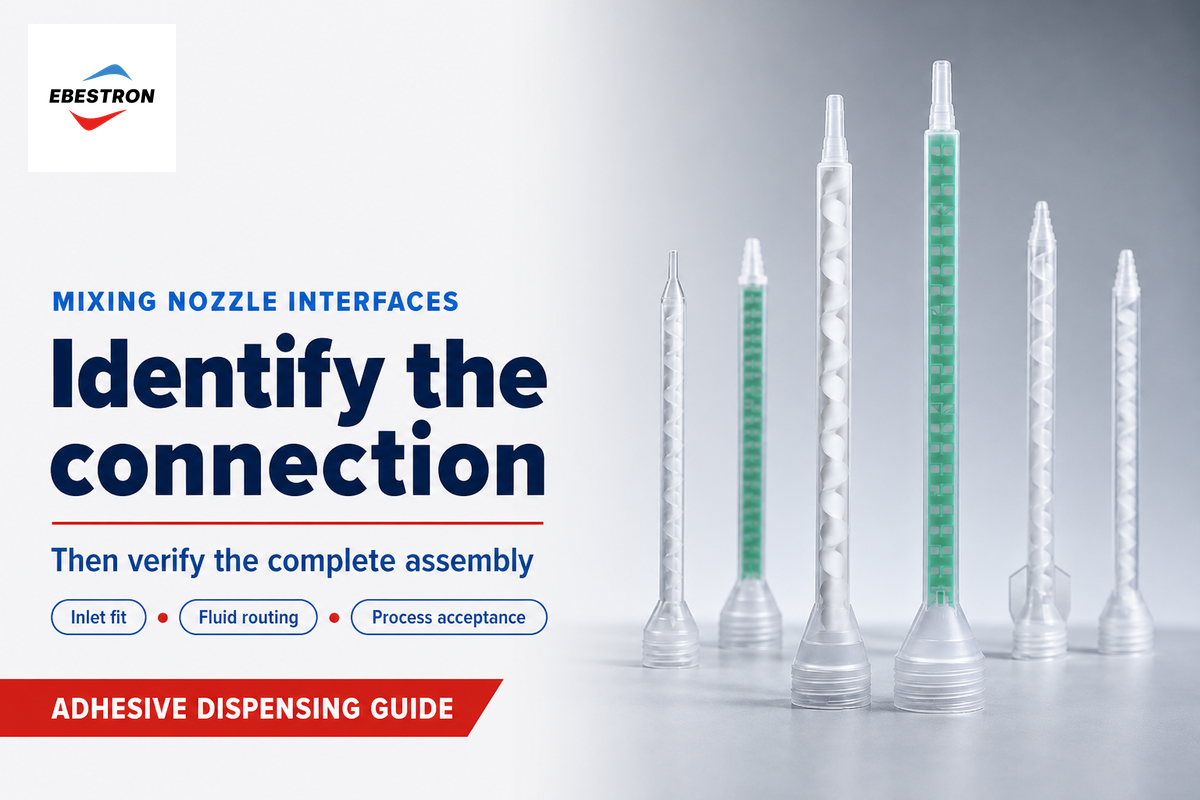
Selection of Mixing Nozzles by Interface Type begins with the cartridge outlet. Identify how the mixer attaches, then match its fluid paths and mixing configuration to the adhesive. A similar color base or a matching lower portion can help in identifying the model, but the production group needs a specific cartridge and nozzle pairing.
Mixing Nozzles by Interface Type are grouped by their cartridge connection, such as bayonet, bell with retaining nut, or an integrated threaded inlet. Select the documented mating system first, then evaluate mixing and dispensing under the intended process conditions.
Quick identification checks
- Capacity is a clue: Nordson lists both 50 mL and 160 mL bayonet cartridges.
- Record the inlet connection, internal mixing element and outlet tip separately.
- Keep the cartridge, mixer and retaining hardware associated with their complete part numbers.
- Evaluate mechanical fit, component routing and process performance as separate decisions.
This document provides the connection language, the level of detail to capture and the verification to replace a production nozzle. It provides a fit record to capture the level of detail required and a troubleshooting guide to engineering, quality and purchasing teams. Requests for quotation are handled on the attached interface selection page.
Interface anatomy: inlet, mixer tube and outlet tip
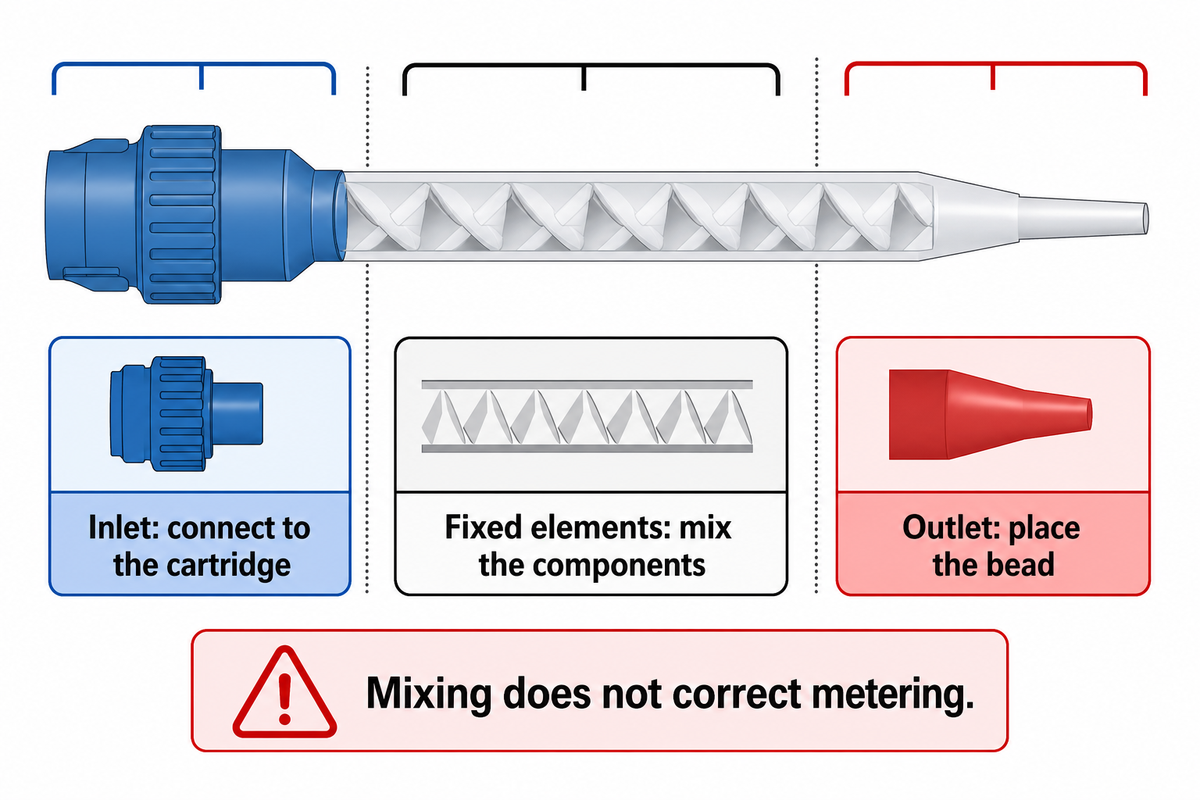
A cartridge mixing nozzle has an inlet that connects to the package, internal elements that mix the components, and an outlet that positions the mixed material. Even though the components perform different functions, they’re part of the same system and can influence flow. For example, changing the tip or the mixing configuration of a mixer can affect flow, even if the inlet remains the same.
What is a mixing nozzle?
A mixing nozzle is a mixing attachment for the adhesive components. In a disposable static mixer, the elements are fixed and the dispenser pushes the material through the tube. The connection holds the mixer against the cartridge outlet; the dispensing tip controls where the mixed material leaves.
The University of Michigan’s static mixer overview states that stationary elements divide and redirect flowing material. In a cartridge system, the energy is supplied by pumping and resistance to flow is provided by the mixer. The mixer combines the streams being delivered, and in a cartridge system doesn’t verify or correct the metering ratio.
An epoxy resin adhesive used to bond plastic parts requires that the inlet accept the components correctly, that the internal configuration adequately mix the liquid components, and that the outlet place the bead in the joint. A nozzle can pass the first check while still leaving the operator with poor mixing or an unsuitable bead.
Use three different fields on a drawing or purchase description: inlet/interface, mixing configuration, and outlet/termination. A note stating only “square mixer tube” doesn’t resolve the cartridge connection. The companion helical, Quadro and Turbo static mixer guide covers the mixing configurations in more detail.
Mixing Nozzles by Interface Type: connection comparison
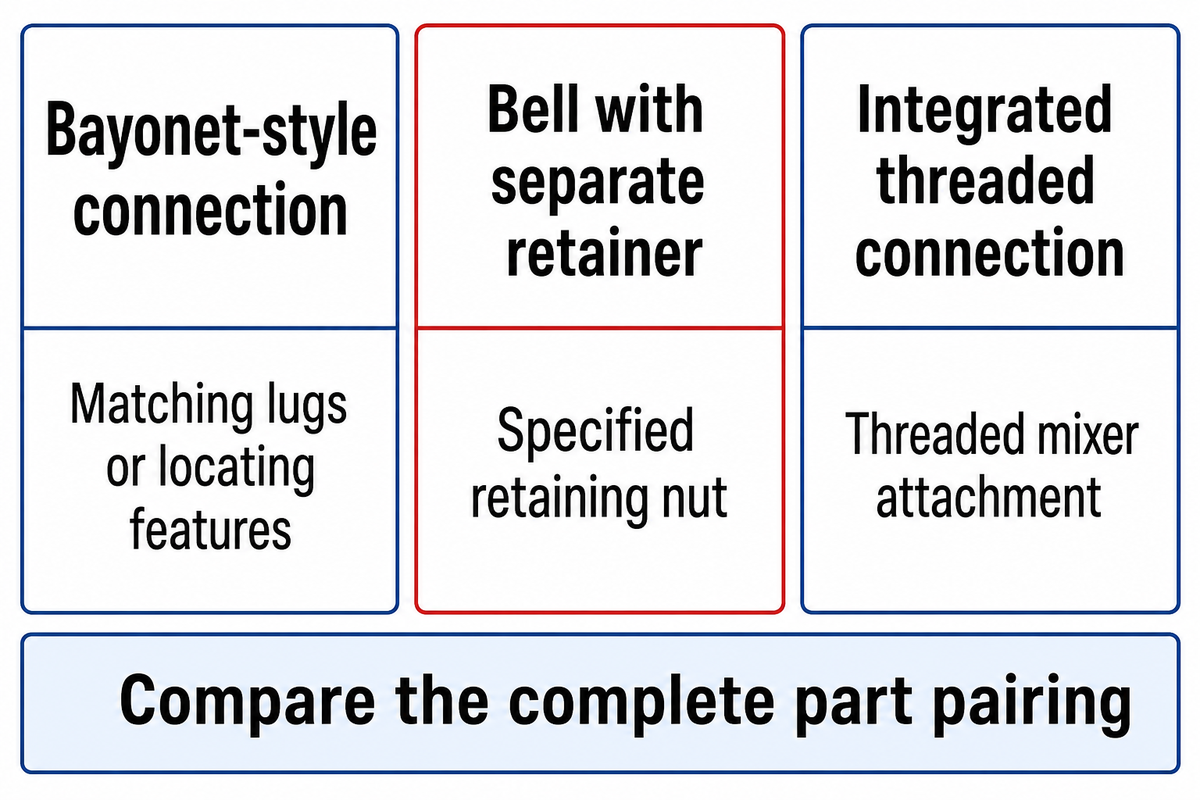
Features such as a bayonet or bell, or integrated thread, help organize a nozzle search. The system designation and mating drawing determine the actual connection. Compare the locking feature, seat, component ports and retention hardware together before treating two mixer nozzles as candidates for the same cartridge.
Shortcuts don’t always work. In its static mixer selection guide, Nordson lists bayonet cartridges in 50 mL and 160 mL sizes. Its Side x Side range includes 200, 300, 400, 600 and 1500 mL cartridges for standard bell or integral-nut style mixers. These are examples from Nordson’s systems, not universal size limits.
| Feature to compare | Bayonet-style connection | Bell with separate retainer | Integrated threaded connection |
|---|---|---|---|
| Retention feature | Lugs or locating features engage the matching outlet. | A specified retaining nut holds the mixer inlet. | A threaded feature is part of the mixer attachment. |
| First identification field | Cartridge system and mixer part number. | Cartridge, mixer and separate nut part numbers. | Cartridge outlet and complete mixer part number. |
| Mating drawing detail | Lug positions, keys and engagement geometry. | Inlet flange, seat and retainer contact surfaces. | Thread form, engagement and seating arrangement. |
| Component entry | Port layout and ratio-specific coding. | Port alignment and intended inlet arrangement. | Port alignment behind the threaded attachment. |
| Hardware to retain | Specified collar or locking parts, where used. | The matching nut, alongside the nozzle sample. | Any additional components named in the assembly drawing. |
| Capacity example | Nordson lists 50 mL and 160 mL. | Nordson lists bell options for its Side x Side range. | Nordson lists integral-nut options for that range. |
| Tube-shape question | Identify the element separately from the inlet. | A square mixer can have a bell-shaped inlet. | A square mixer can also have an integral-nut inlet. |
| Replacement review | Compare the complete proposed part pairing. | Compare the nozzle and retainer as an assembly. | Compare both thread engagement and final seating. |
| Process acceptance | Run the specified adhesive and dispensing checks. | Run those checks with the specified retainer fitted. | Run those checks with the documented threaded assembly. |
Source basis: From Nordson’s named systems and Anthony Martucci’s 2016 ASI technical article, which describes a square mixer series with bell-shaped or integral-nut inlets. Comparison fields are an editorial purchasing aid.
A buyer replacing a 200 mL cartridge mixer needs more than a “200ml compatible” listing. The next, most helpful, distinction is whether the inlet, retaining arrangement and the paths for the component(s) match the current system. Keep capacity in the description. The part pairing is helpful too. The published manufacturer examples above do not confirm current stock or cross-brand compatibility; request current part drawings for the proposed assembly.
Bayonet mixing nozzles: lugs, keys and ratio
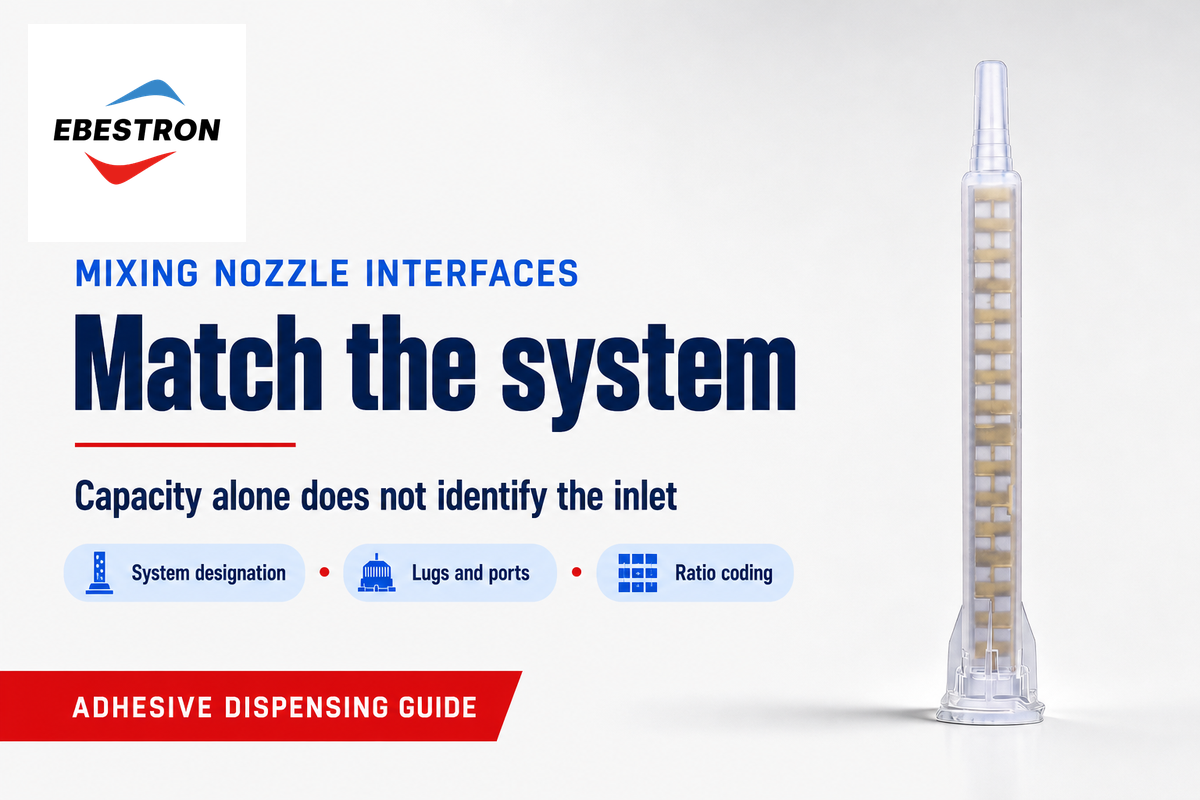
Bayonet mixing nozzles rely on matching locating and locking features at the cartridge outlet. Important details are complete system designation, lugs, inlet ports and ratio-related coding. A 50 mL capacity cartridge defines capacity, and the manufacturer specifies which bayonet mixer belongs on that cartridge.
Kevin Brownsill, Head of Learning and Development at Intertronics, describes MIXPAC connections in his nozzle identification article. He identifies A-System as Bayonet, C-System as a retaining threaded nut, and B/F-Systems as interlocking. Use those names with those systems rather than generalizing to a single family.
“the A-System uses a bayonet, and the C-System uses a retaining threaded nut”
Keying can also impact orientation and retention. The technical disclosure in US9010578B2 mentions complementary ports and coding characteristics in a specific mixer-and-cartridge design. As such, even if two bases appear similar, the inlet details ought to be captured. It doesn’t convert the design illustrated in the patent to a specification for every bayonet nozzle.
Example: A purchasing team needs a replacement for a 50 mL, 2:1 epoxy cartridge. The candidate listing shows the same overall color and a similar twist attachment. Engineering captures the complete part number of the cartridge, and reviews the inlet view of the candidate mixer against the approved mixer. The ratio marking agrees, but the supplier hasn’t identified the cartridge series. Purchasing holds the production order and requests that specific pairing. A sample can then be assessed with the intended adhesive gun and application procedure. The missing item is a defined assembly, not another picture of a green tube.
Apply the same discipline to dual-component adhesive cartridges from 3M or another brand. Keep the brand, system, capacity and ratio as separate fields. Identical-looking adhesive mixing nozzles still need their documented mating combination.
Bell-mouth static mixers and retaining nuts
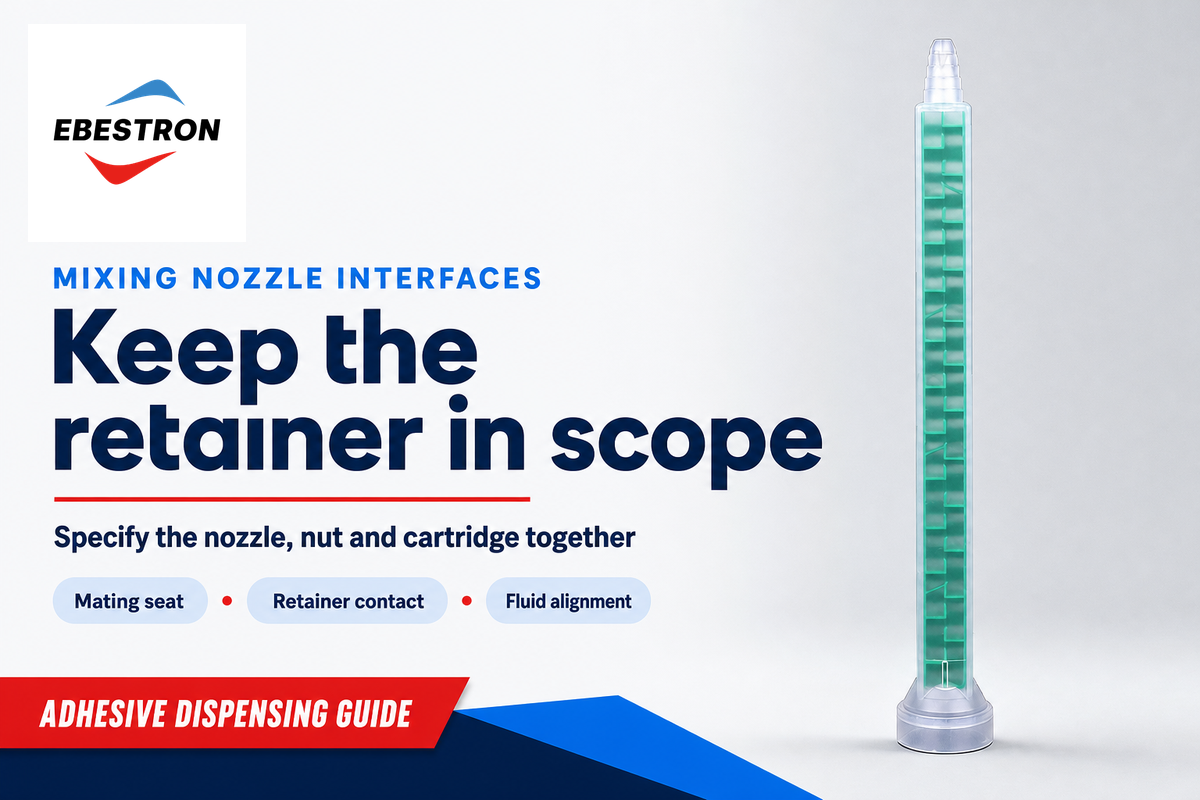
A bell-mouth mixer retained by a separate nut must be considered together with that nut and the cartridge outlet. The retainer nuts hold the inlet in its proper position. The mating seat completes the connection. Selecting the nozzle alone leaves part of the mechanical assembly unspecified.
Brownsill’s C-System description mentions the retaining nut by name. Martucci’s ASI article offers a helpful comparison: the square mixer series he describes offers bell-shaped or integral-nut inlets, with barbed or stepped outlets. Therefore, internal geometry can appear with different means of attachment and discharge.
Martucci’s 2016 description is a historical design example, not an independent performance test or a current product catalog. Keep the nozzle and nut together with the cartridge on the bench. A thread that begins to engage is a single observation. Related checks include the position of the inlet against its seat, the contact of the retainer nut with the nozzle and the alignment of the fluid passages. Use the current assembly drawing for the intended engagement; this guide supplies no universal tightening torque.
Example: A maintenance buyer receives a sample of a mixer for a 400 mL cartridge system. Its mixing section is like an approved part, and the old nut can be placed over its base. During comparison, the position of the nozzle flange is different under the retainer. Maintenance leaves both samples side-by-side and takes photos of them with relevant drawing dimensions. The supplier must resolve the nozzle-and-nut combination before a process trial is scheduled. Reordering the previous approved assembly is a clearer interim purchasing decision than assuming the existing nut makes the new nozzle equivalent.
For a 400 mL replacement, write the retainer part number on the same purchase requisition with the mixer part number. This simple association aids in preventing the issue of a correct-looking nozzle with hardware selected for a different mating arrangement.
Cross and square labels: verify the actual inlet
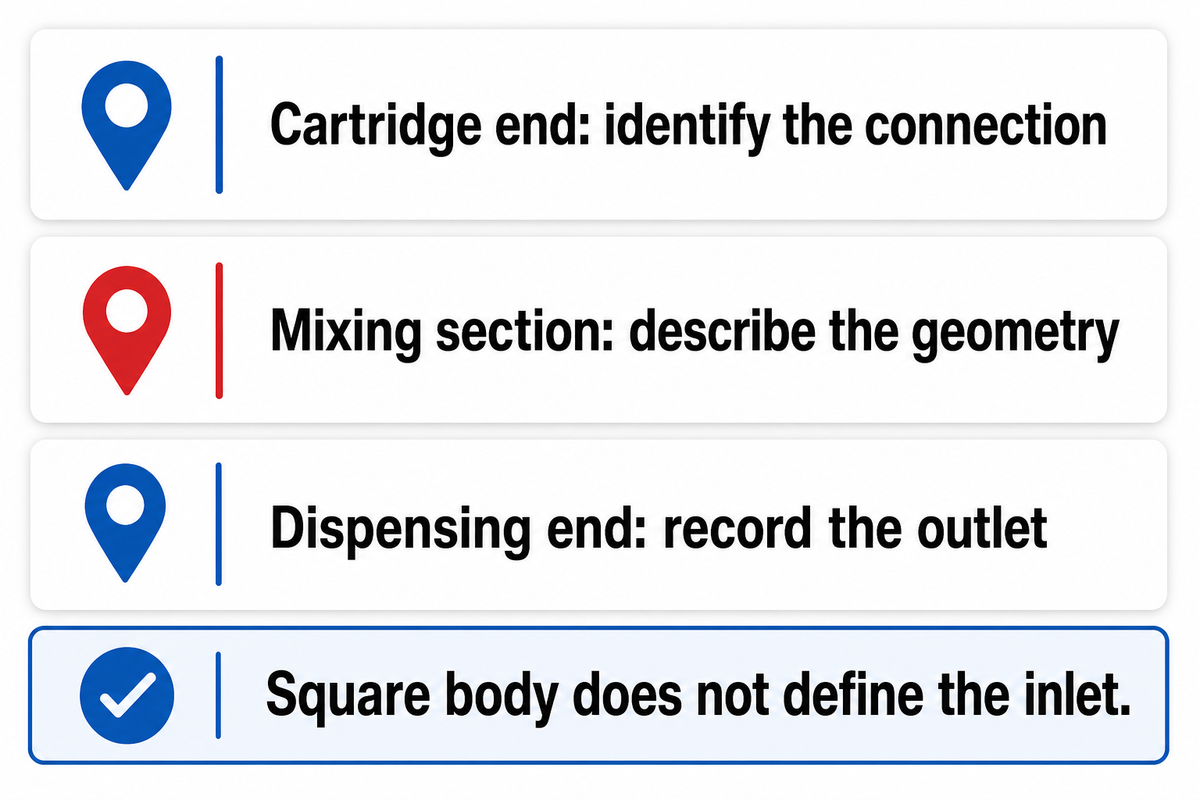
Square and cross labels require a location. This may be on the cartridge connection, the housing, or the internal mixing section. A square static mixer tube shows one of the visible features, and the inlet drawing defines the connection.
Martucci describes a square mixer series with both bell-shaped and integral-nut inlet options. Brownsill also lists element shape and connection interface separately. Therefore, saying that a body is square leaves us with another question: How does that particular mixer attach?
Label the cartridge end, mixing section and dispensing end on the photograph. If “cross” refers to a feature at the base, record its position and the corresponding outlet feature. If “cross” describes the internal geometry, describe that in the mixing configuration. A supplier can then respond to the actual feature instead of interpreting an ambiguous label.
The same applies to “spiral,” which may describe helical elements within the plastic tube. Keep that word separate from a system name such as the C-System. A request reading “200 mL cartridge, specified retaining nut, square mixing section, stepped outlet” carries more useful information than “square connector,” provided the actual part numbers accompany it.
Key takeaway
Name the inlet, mixing section and outlet separately. Then preserve the complete cartridge, nozzle and retention-hardware pairing in the purchasing record.
Cartridge matching: the 4-Gate Fit Record
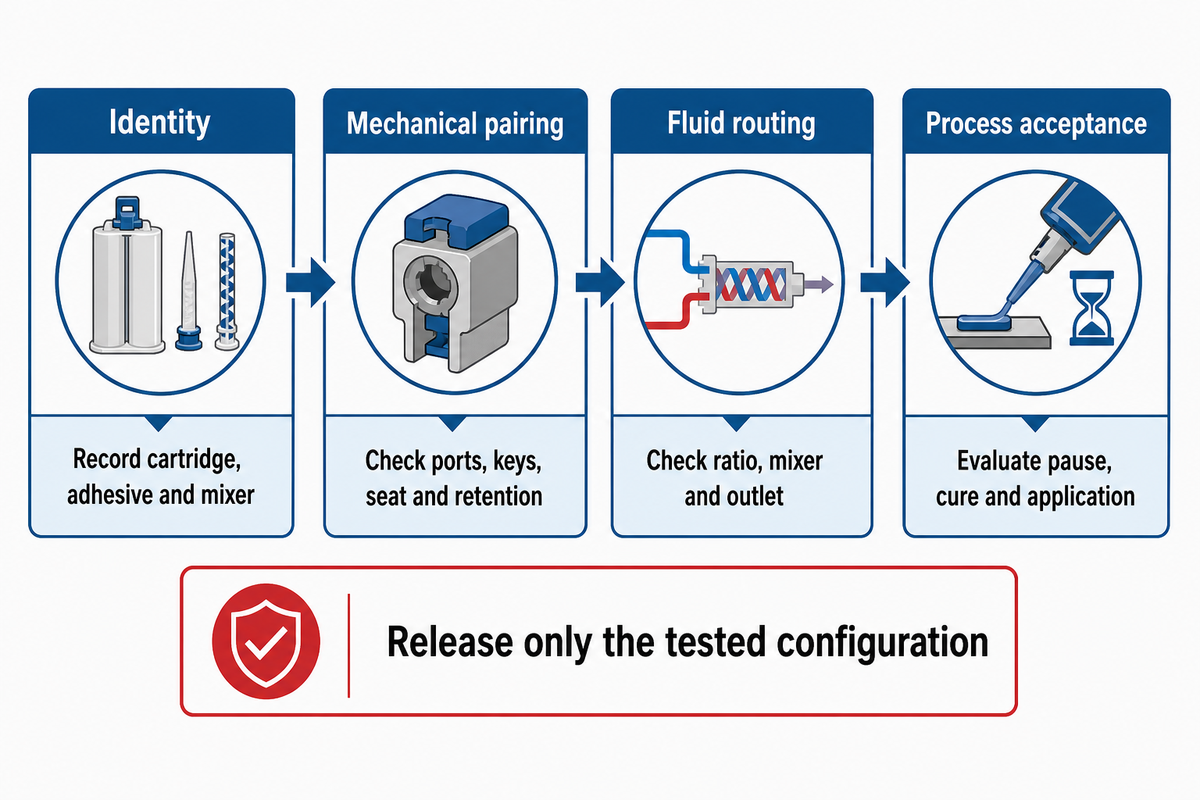
The 4-Gate Fit Record defines replacement review as identity, mechanical pairing, fluid routing and process acceptance. Each of those defines an endpoint which allows purchasing to differentiate an identified component from an assembly that has been approved for a given job. The record is an editorial worksheet; the acceptance criteria come from the product and application requirements.
Start with an approved assembly, if one exists. Keep all the part numbers, the revision numbers of the drawings, the adhesive identification number, and the known rheological behavior of the material, rather than reducing it to an unexplained viscosity number. The endpoint of the trial is defined by quality, engineering evaluates the feasibility of the pairing and production determines the operating conditions.
Evaluating mixing quality requires a defined purpose. Alberini and colleagues’ Kenics KM study compared several ways to characterize mixing in shear-thinning streams. Their lab set-up is different from the cartridge nozzle, but illustrates the point that quality measures must address the needs of the downstream process. A visually uniform bead and an accepted finished bond are different observations.
Example: a team proposes replacing the nozzle on a 50 mL, 2:1 cartridge used for an assembly bead. The current part is identified and the supplier has recommended a specific replacement. Drawing comparisons have been completed; however, the team has not completed a normal pause-and-restart with the candidate part. The record below shows how to document that incomplete decision. No trial measurements are assumed. The supplier can provide evaluation samples, and the production release will be held until quality records the agreed results for the actual adhesive, dispenser, bead and cure conditions.
| Stage and record field | Example entry | Evidence or next action | Owner |
|---|---|---|---|
| Identity: cartridge | 50 mL, 2:1; complete approved part number attached. | Retain the label and current drawing revision. | Engineering |
| Identity: adhesive | Specified epoxy product; production lot to be recorded. | Attach the current technical datasheet. | Quality |
| Identity: candidate mixer | Supplier’s proposed part number recorded. | Obtain its drawing and intended mating system. | Purchasing |
| Mechanical pairing: inlet | Drawing comparison completed; physical sample pending. | Record port, key, seat and locking observations. | Engineering |
| Mechanical pairing: retention | Specified hardware identified. | Keep the hardware with the evaluation assembly. | Engineering |
| Fluid routing: ratio | 2:1 cartridge and matching dispensing arrangement listed. | Follow the approved startup and ratio-check procedure. | Production |
| Fluid routing: mixer and tip | Geometry, element count and outlet recorded. | Compare flow and bead placement against job requirements. | Production |
| Process: pause and cure | Normal pause/restart trial not yet run. | Record conditions and the agreed mixing/cure checks. | Quality |
| Release decision | Evaluation samples only; production release pending. | Sign off the tested configuration and application scope. | Quality and purchasing |
The fields support the identification and process variables discussed by Brownsill, Nordson and David W. Kirsch’s static mixer selection article. Results for mechanical fit and mixing should be distinguishable from results for final-use acceptance.
What is a nozzle tip?
A nozzle tip, the dispensing end that directs mixed material to the work, often has an opening or attachment that affects bead placement and access. A nozzle tip is more appropriately described in the outlet field of the fit record, with the mixer, as opposed to replacing the description of the cartridge connection.
Mixing nozzle tips allow for the use of stepped outlets, adapters and application-specific attachments. The selection of dispensing needles and precision tips addresses that downstream task. Changing a tip can change flow resistance and bead placement. Maintain the configuration of the assembly in the record of approved installations.
Mixing nozzle leaks, locking failures and poor mixing
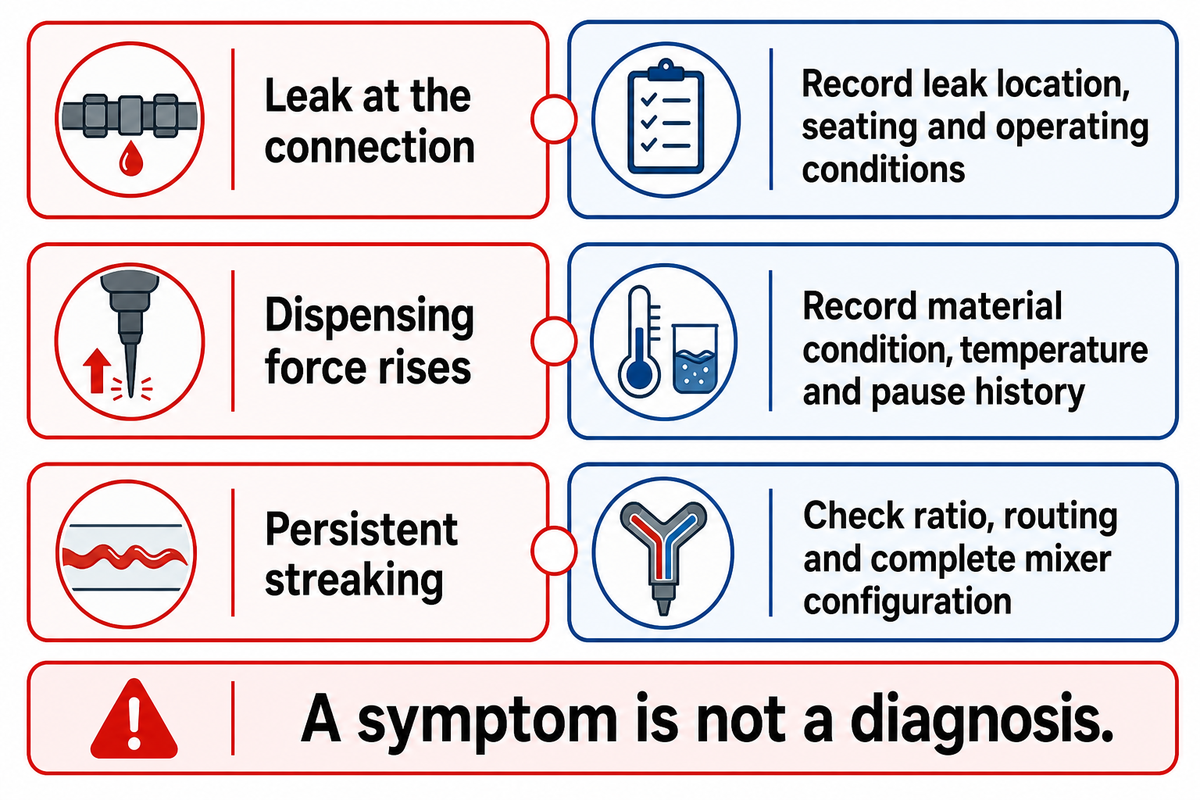
An identified dispensing symptom says what to investigate, not what the cause is. Separate attachment problems from material-flow, component-ratio and mixing problems by recording the assembly and the conditions when the fault appears. Keep possible causes of a symptom competing until they’re eliminated by relevant inspections or checked by means of a controlled test.
Permabond’s epoxy dispensing guidance identifies a blocked nozzle or excessive viscosity and back-pressure as alternatives when material flows without the nozzle but struggles through it. The manufacturer also mentions start-up piston imbalance and incorrect ratio settings on the equipment. Replacing the interface alone wouldn’t remedy all of these possible causes.
| Observed symptom | Evidence to collect | Next review or action | Keep this alternative open |
|---|---|---|---|
| Mixer will not locate | System IDs and inlet/outlet views. | Compare keys and ports with the specified pair. | Damaged or contaminated mating features. |
| Retainer engages but seating looks uneven | Retainer identity and contact positions. | Review the whole retaining assembly. | Wrong hardware as well as wrong nozzle. |
| Material escapes at the connection | Leak location, seating condition and operating record. | Stop the trial and inspect under the equipment procedure. | Fit, component condition and flow resistance. |
| Dispensing force rises | Material condition, temperature and pause history. | Review blockage and viscosity against the approved process. | Cartridge or dispensing-tool problems. |
| First bead differs from later material | Startup sequence and initial bead observations. | Apply the adhesive maker’s startup/discard procedure. | Piston imbalance or component delivery. |
| Persistent streaking | Ratio, routing and complete mixer configuration. | Check delivery and mixing separately. | Material condition or interrupted component flow. |
| Trouble appears after a pause | Elapsed pause, temperature and restart behavior. | Evaluate the specified pause/restart cycle. | Curing in the tube and other flow restrictions. |
| Cure result misses the requirement | Adhesive lot, ratio, cure conditions and test method. | Separate mixing acceptance from application testing. | Preparation or curing conditions. |
| Bead placement changes after a tip swap | Old/new outlet details and dispensing conditions. | Return to the approved outlet or evaluate the new combination. | Changes elsewhere in the dispensing setup. |
The table is a synthesis of the cited identification and dispensing guidelines. Published in 2015 by Permabond, the cited guidance offers some possible reasons, but doesn’t validate the diagnosis independently for your application. Adhere to the current adhesive and device instructions. Follow the instructions to stop, depressurize and handle the device prior to opening an assembly for inspection.
Pause time deserves its own record. ISO 10364:2024 describes pot-life measurement methods and states that different methods need not produce identical results. The listed pot life of an adhesive does not guarantee a pause allowance inside your nozzle. Record the actual material temperature, elapsed pause and restart acceptance condition.
For a 50 mL epoxy mixing nozzle that works at startup but struggles after a break, retain the pause history alongside the cartridge and mixer identities. That directs the investigation towards the change in the process condition instead of assuming the inlet family became unsuitable. The two-part adhesive cartridge use guide covers the associated activities.
Replacement nozzle purchasing and sample approval
When making a replacement request, the current assembly, the changed assembly and the acceptance task should be named. A reproducible description meets the need of purchasing; dispensing behavior serves production; and a defined test addresses the need of quality. Keep those responsibilities visible so a supplier’s candidate recommendation can progress to a controlled sample decision.
Copy the following fields into an inquiry. A general description like “AB glue nozzle” identifies a two-component adhesive task, but provides little else. The response from the supplier should include a proposed configuration in detail.
- Current parts: cartridge brand, system, full part number, capacity and ratio; existing nozzle and retaining hardware.
- Images and drawings: cartridge label, outlet face, mixer inlet and side profile; drawing revisions, inlet diameter and other relevant dimensions in mm.
- Material: complete adhesive product name, component ratio, stated viscosity conditions and known rheological behavior.
- Dispensing setup: adhesive gun or machine model, approved operating conditions and any outlet attachments.
- Production task: Type of deposit (or bead) required, access constraints and normal pause/restart sequence.
- Acceptance: mixing and/or cure observation; checks; mechanical pairing; application test; and approver.
- Change control: sample identification; approved part pairing and what requires further evaluation.
Ask the supplier to distinguish a dimensional cross-reference from an adhesive/process recommendation. A plastic inlet that attaches correctly still has to withstand the specified operation, and a clean-looking bead still has to meet the job’s cure and bond requirements.
Do
- Keep the complete approved part pairing.
- Record actual evaluation conditions.
- Assign an owner to each unresolved item.
Don’t
- Approve a replacement from color alone.
- Omit a separate retaining nut from the request.
- Transfer a trial result to an untested configuration.
Send the cartridge/nozzle details with your request. For product-specific questions, use Ebestron’s Mixing Nozzles by Interface Type selection page. This will support a more informed discussion on the assembly.
Frequently Asked Questions
Are mixing nozzles interchangeable between brands?
Cross-brand interchangeability must be established for the specific cartridge, mixer and retaining assembly.
A shared family label narrows the search, but the proposed replacement still needs the correct inlet geometry, component routing and mixing configuration. Keep the manufacturer’s part cross-reference or drawing with the sample record. Production approval should cover the actual adhesive and dispensing process, including the required outlet and normal pause/restart behavior, rather than relying on appearance.
Does a 50 mL cartridge always use a bayonet mixer?
A 50 mL capacity label is insufficient to identify the cartridge connection.
Capacity describes the package volume. The cartridge system, inlet features and specified mating mixer supply the connection information. Nordson’s own guide also lists 160 mL bayonet cartridges, so a small-versus-large capacity rule is unreliable. Keep the volume in the purchase description alongside the complete system designation, ratio and part numbers for the actual assembly being replaced.
Can a mixer correct the cartridge’s mixing ratio?
A static mixer blends the incoming components; it does not independently repair incorrect metering.
The cartridge and dispensing arrangement must deliver the adhesive’s specified proportions. When cure is inconsistent, examine component delivery and the startup procedure as well as the mixer configuration. Permabond identifies both initial piston imbalance and incorrect equipment settings as possible sources of ratio problems. A different nozzle should therefore be evaluated as one possible process change, not assumed to be the cure.
Is a square mixer the same as a square connector?
A square mixer body and a square connection describe different features.
Locate the feature on the drawing. Square may describe the housing or internal geometry; the cartridge end still needs its own inlet and system designation. Martucci’s square-mixer example includes bell-shaped and integral-nut inlet options.
What should I send a supplier when the old nozzle has no readable part number?
Send the cartridge identity and clear photographs of the complete mating assembly.
Include the cartridge label, outlet face, old nozzle inlet, side profile and any retaining nut. Add the adhesive product name, ratio, capacity and dispenser model. Keep the old parts associated so the supplier can compare their relationship. A dimensional sketch is useful when it identifies the measured feature and unit clearly. Request a specific candidate part number with its drawing and proposed mating system. Then agree on the sample evaluation and acceptance conditions. Where the original assembly cannot be identified, keep the candidate at evaluation status until the mechanical and process questions have been resolved.
Prepared by CYH for Ebestron. The comparisons and worksheets are a combination of cited technical references with editorial purchasing examples. No original factory trials are claimed. Learn more about Ebestron’s adhesive packaging business.
References & Sources
- Mixers: Static Mixer section University of Michigan, Visual Encyclopedia of Chemical Engineering Equipment.
- Mixing Two-Component Fluids in Exacting Proportions Anthony Martucci (Nordson EFD), Adhesives & Sealants Industry, 2016.
- How to identify a mixing nozzle Kevin Brownsill, Intertronics, published by Converter, 2024.
- US9010578B2 technical disclosure Google Patents reproduction; cited for connection design only.
- Assessment of different methods of analysis to characterise the mixing of shear-thinning fluids in a Kenics KM static mixer using PLIF Alberini and colleagues, University of Birmingham research record, 2014.
- How to Choose a Static Mixer to Properly Mix a Two-Component Adhesive David W. Kirsch (Sulzer Mixpac USA), Adhesives & Sealants Industry, 2007.
- ISO 10364:2024: Determination of the pot life of multi-component adhesives International Organization for Standardization, public abstract.