Get in touch with Ebestron Company


Updated June 2026 · Reviewed by the Ebestron technical team
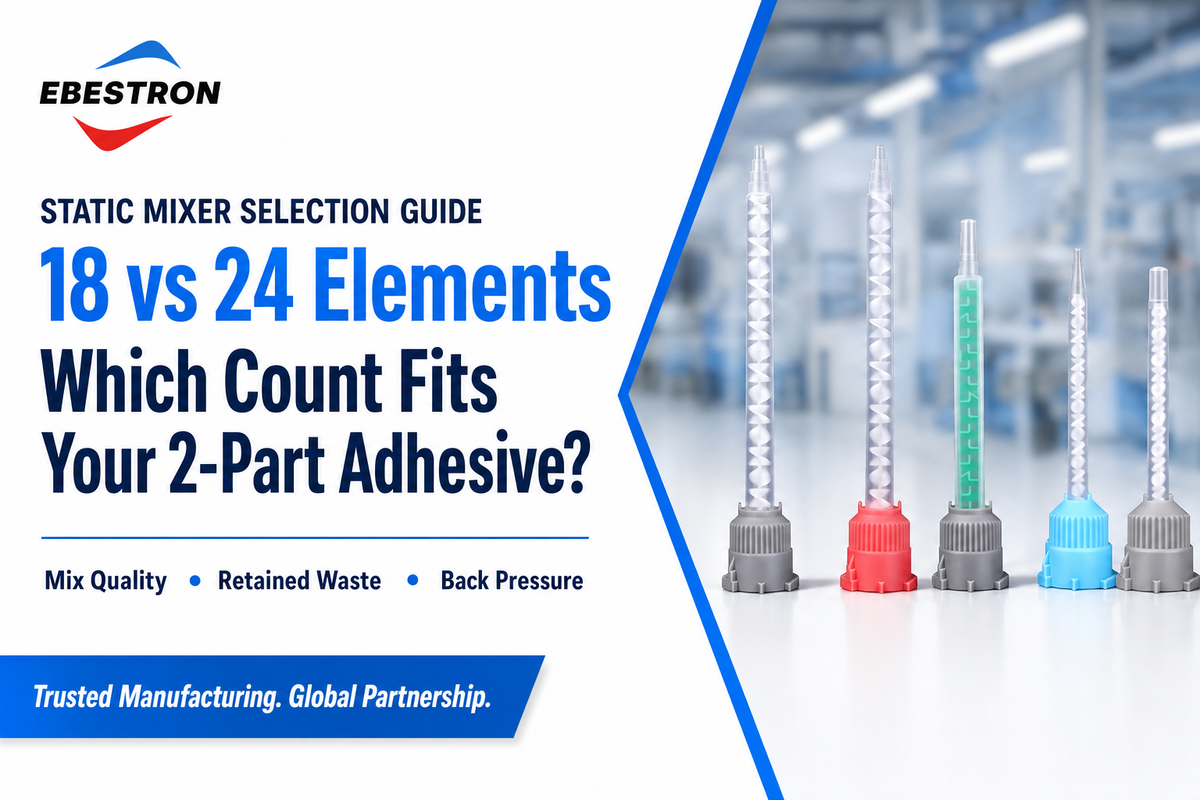
Picking 18 vs 24 element static mixers for a two-part adhesive seems like an obvious “more is better” call, but the static mixer element count you choose drives mix quality, retained-adhesive waste, and back pressure all at once, and the wrong pick quietly costs you material on every dispense. This guide compares the two head-to-head, shows how each extra element drive up waste, and gives you a repeatable way to decide.
In short: A static mixer’s element count is the number of helical or square baffles inside the nozzle, and each element roughly doubles the number of fluid layers (striations). For most two-part epoxies, 18 and 24 elements both fall inside the usable band, 18 cuts waste and back pressure, while 24 buys mixing margin for off-ratio, high-viscosity, or critical bonds. Element count is only a fair comparison when the two nozzles share the same diameter, geometry, chemistry, and mix ratio.
Quick Specs: Static Mixer Element Count
| What an element is | One helical or square baffle that splits and re-orients the two components |
| Striation rule | Layers double per element (≈2ⁿ); 20 elements ≈ 1,000,000 layers |
| 2K adhesive range | 7 elements (bayonet) to 56 elements; epoxy commonly 15–24 |
| 18 → 24 (+6 elements) | Longer tube → more striations, more retained waste, higher back pressure |
| Fair-comparison rule | Only compare counts at equal diameter, geometry, chemistry, and ratio |
What “Element Count” Actually Means (and Why 2ⁿ Matters)
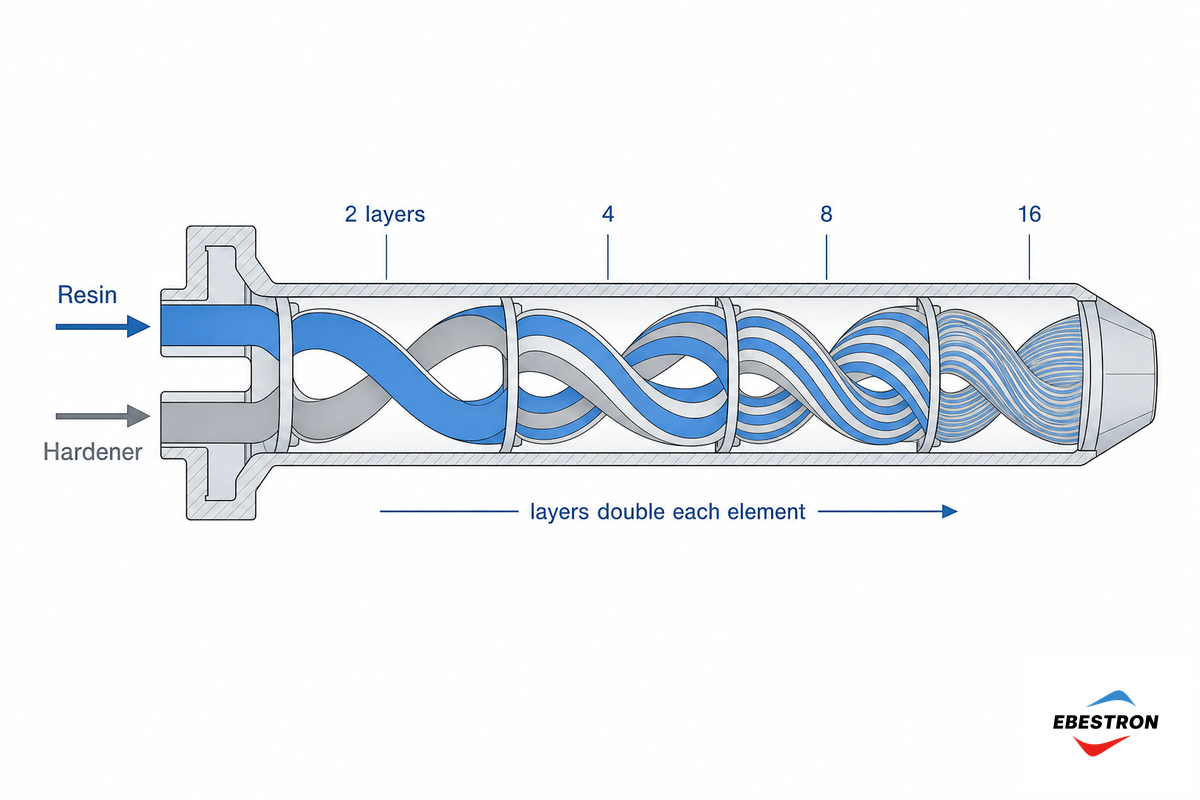
A static mixer, also sold as a static mixing nozzle, static mixer nozzle, mix tube, or mixing tip, is a disposable tube packed with a fixed series of baffles called elements. As resin and hardener push through, each element splits and folds the flow, so the thin layers (striations) roughly double at every element. Materials engineers at Huntsman note that 20 elements produce over one million layers, enough to turn two streams into a homogenous mix.
What is an “element” in a static mixer?
An element is a single internal baffle that divides the flow in two and rotates it before the next baffle divides it again. Because the layer count doubles each time, mixing improves geometrically, not linearly: an 18-element nozzle yields roughly 2¹⁸ (about 262,000) striations, a 24-element nozzle about 2²⁴ (16.8 million). Past a uniform mix, extra elements add cost, not quality.
2 layers
start
start
4
el. 1
el. 1
8
el. 2
el. 2
16
el. 3
el. 3
…2ⁿ
el. n
el. n
Mix quality is usually scored by the coefficient of variation (CoV) of the blended stream: a radial CoV of 0.05 or lower — “95% mixing or better” — is acceptable for most processes, and CoV falls as elements are added. Peer-reviewed work on high-viscosity static mixing confirms that mixer length, the number of elements, is the dominant geometric lever on CoV, alongside diameter. Those are the two levers Ebestron tunes when matching a static mixer to a production line. For background on the hardware itself, see our overview of two-component static mixing nozzles.
18 vs 24 Static Mixer Elements: A Side-by-Side Comparison
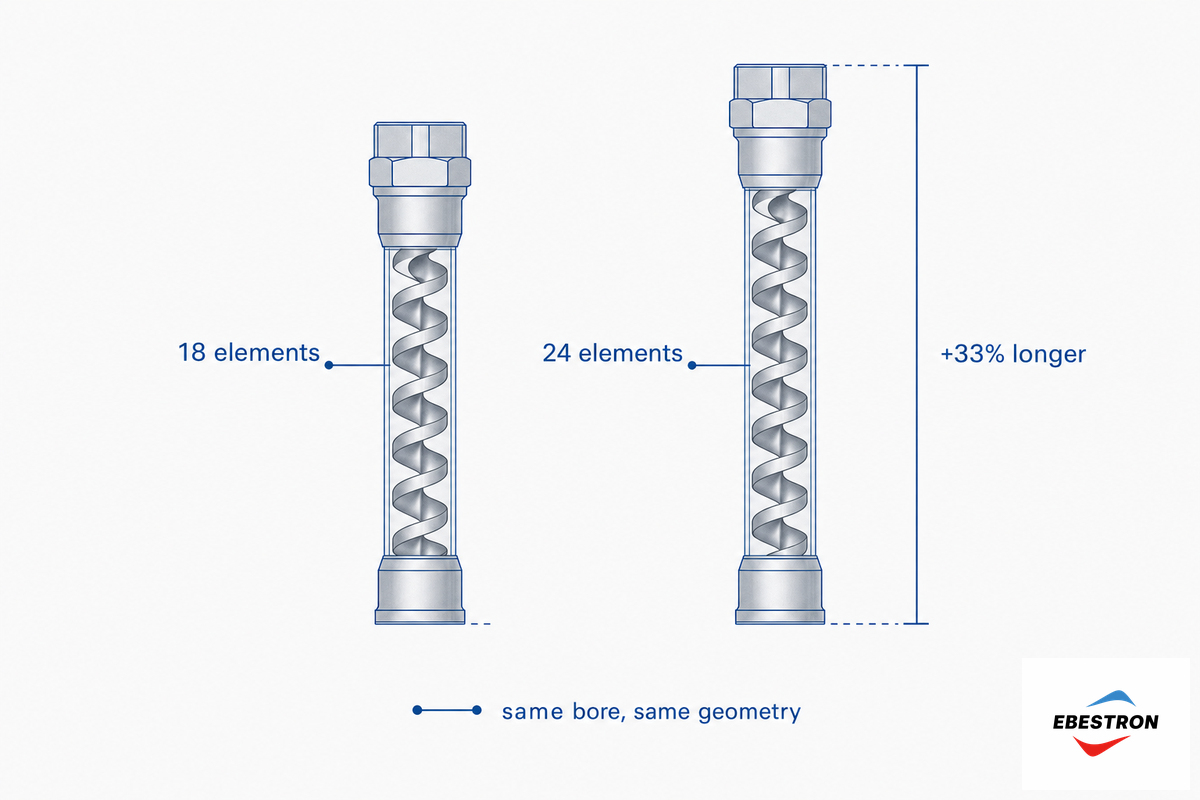
For an apples-to-apples choice, same diameter, same helical geometry, same chemistry and mix ratio, here’s how an 18-element and a 24-element nozzle differ. These waste figures use the industry rule that a nozzle must be purged by about its own internal volume before use, then holds roughly twice that volume after cure, so total waste scales with tube length, and therefore with element count, a length-driven relationship documented in peer-reviewed static-mixing research.
| Factor | 18 Elements | 24 Elements |
|---|---|---|
| Theoretical striations (≈2ⁿ) | ~262,000 | ~16,800,000 |
| Relative tube length | Baseline | ≈ +33% longer |
| Retained-adhesive waste per change | Lower (≈ baseline) | ≈ +33% more |
| Back pressure / hand effort | Lower — easier manual squeeze | Higher — favors a pneumatic gun |
| Mixing margin (off-ratio / viscous) | Adequate for 1:1, low-viscosity | Better for ≥4:1 or high-viscosity |
| Cost per nozzle | Lower | Higher |
| Best-fit job | Easy-mix 1:1 epoxies, frequent changes, manual work | Wide-ratio, high-viscosity, structural or critical bonds |
Source: striation and waste-scaling principles per Adhesives & Sealants Industry and Huntsman/AZoM; figures are order-of-magnitude for like-for-like nozzles.
✔ Why pick MORE elements (24)
- Wide mix ratios (4:1, 10:1) reach on-ratio homogeneity
- Big viscosity gap between resin and hardener
- Structural or safety-critical bond lines
- Pneumatic dispensing handles the extra back pressure
⚠ Why pick FEWER elements (18)
- Easy 1:1, low-viscosity epoxies already mix fully
- High nozzle-change frequency multiplies waste savings
- Manual cartridge guns, lower squeeze effort
- Short pot-life chemistry, less material trapped per change
The Real Cost of More Static Mixer Elements: Waste, Purge & Back Pressure
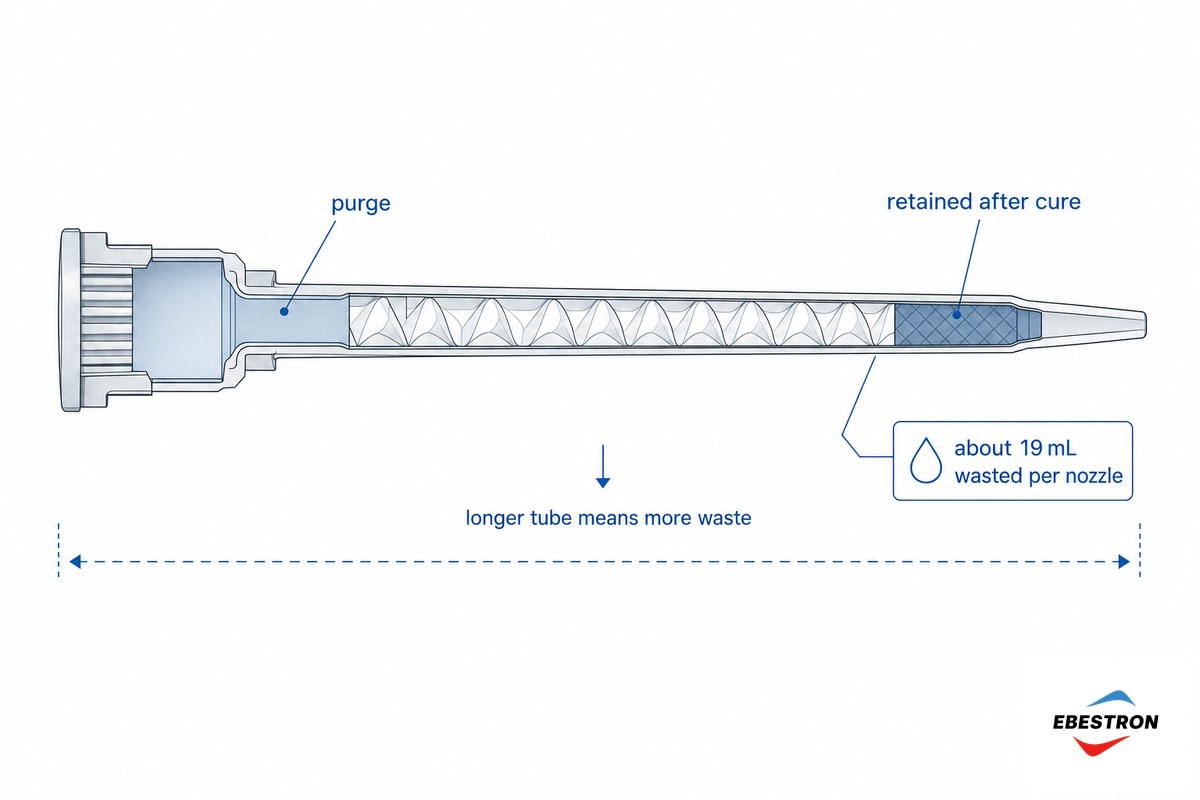
Every disposable nozzle traps adhesive you never apply. A 2022 industry analysis in Adhesives & Sealants Industry reported that conventional helical and square mixers can waste as much as 20 mL per nozzle, one estimate put the average near 19 mL once you count both the purge before use and the cured plug retained afterward. Your exact figure depends on the nozzle, but the relationship underneath it doesn’t change: waste scales with internal volume, internal volume scales with length, and length scales with element count, so the six extra elements in a 24 versus an 18 aren’t free.
📐 Engineering Note — work the waste yourself
Retained volume ≈ internal volume of the mixing length ≈ π × (ID/2)² × L. Going from 18 to 24 elements at the same diameter adds about 33% to L, so it adds about 33% to retained waste. If your 18-element nozzle wastes ~15 mL per change, the same-diameter 24-element nozzle wastes ~20 mL, about 5 mL more each time. At 1,000 changes a year that’s roughly 5 liters of extra two-part adhesive scrapped annually, just from the longer tube. Plug in your own measured mL-per-nozzle and annual change count to size the trade for your line.
More elements also raise back pressure. As AZoM notes, restricting flow through more baffles drives up pumping pressure or drops output, which is most punishing with high-viscosity adhesives. On a manual cartridge gun that means more hand effort and fatigue; a pneumatic applicator absorbs it. As a practical rule, confirmed across cartridge-dispensing guides, match nozzle diameter to viscosity first, a too-thin nozzle on thick adhesive spikes pressure no matter the element count. When you need lower back pressure for thick, fast jobs, our dynamic mixing systems for 2K sealants are the alternative to stacking elements. As a nozzle manufacturer, Ebestron sizes static mixers for automotive and structural assembly lines, where back pressure and the 5 mL or so of waste per change both eat into margin.
The Element-Count Illusion: Why 18 vs 24 Is (and Isn’t) a Fair Fight
Here’s the part most catalogs skip. Element count is a useful shorthand, but on its own it’s an unreliable selector, the same industry analysis concluded that “element count has become an erroneous method for reliably selecting a mixing nozzle,” and that comparing nozzles by measured mixing performance is far more dependable. Three facts explain why a bare “18 vs 24” can mislead.
The Element-Count Illusion — three reasons count alone misleads
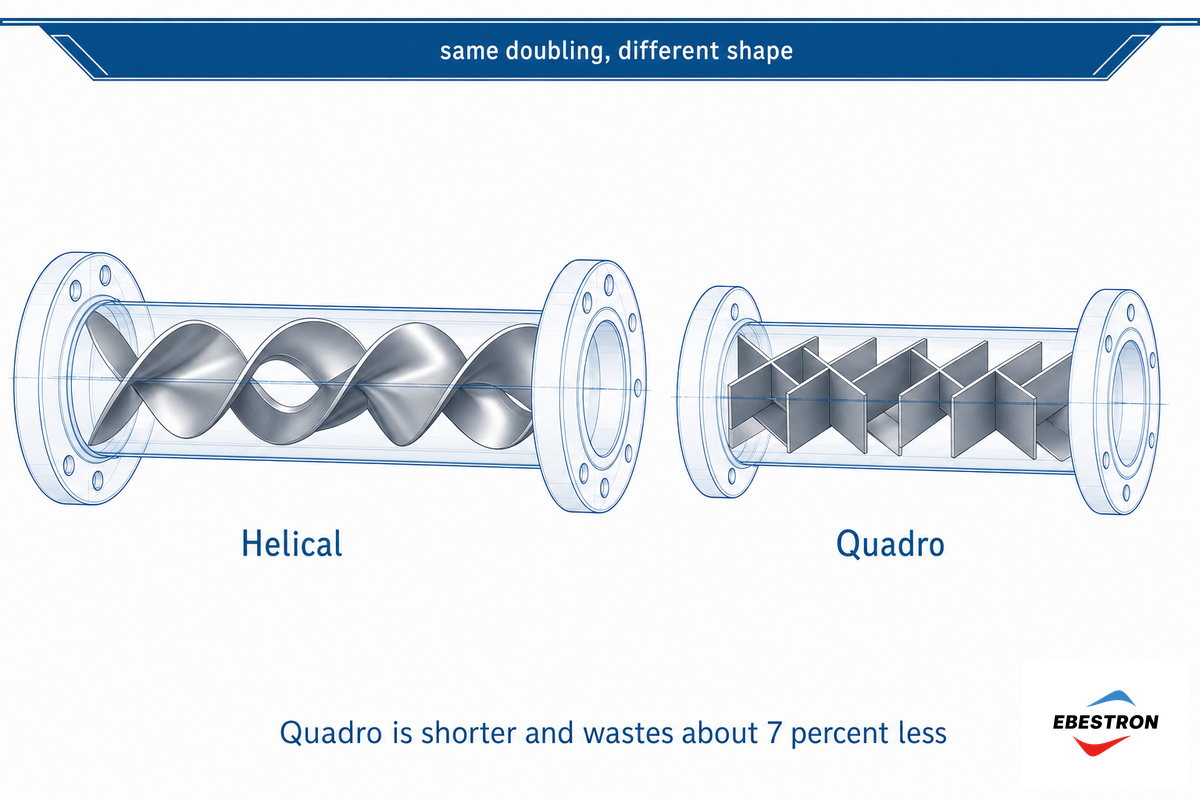
- Square ≠ fewer elements. Helical and square (quadro) mixers both use the same baker’s-transformation doubling, so a square mixer still needs about 24–32 elements and only trims roughly 7% of waste versus helical, it’s shorter per element, not fewer of them.
- Geometry inverts the count. A peer-reviewed Kenics study found that at the same target CoV of 0.05, a low-aspect-ratio element needed 12 elements while a high-aspect-ratio element needed only 4. A 24-element short-aspect nozzle and an 18-element long-aspect nozzle can swap places on mix quality and waste.
- The real count cut is new geometry. Third-generation, computer-optimized and 3D-printed elements claim roughly ten times the layering per element, reaching full mix in as few as seven elements, a genuine count reduction that ordinary square nozzles never delivered.
One trap is treating the count as the whole spec. Because geometry and aspect ratio change what a number delivers, Ebestron has watched a 24-element quadro and a 24-element helical differ by 7% or more in waste on the same automotive bonding job, and picking by count alone risks an under-mixed, weak bond. That’s why the honest comparison is always like-for-like, then a test.
What is a Turbo or Quadro static mixer?
A Quadro (Turbo, or square) static mixer uses square cross-section elements instead of the helical spiral. They’re shorter element-for-element, which trims a little retained waste, but rely on the same doubling and need a similar element count. Patent literature on two-part dispensing states it plainly: more elements give superior mixing but carry their own penalties. So compare an 18 against a 24 only when diameter, geometry, chemistry, and ratio all match.
“Element count has become an erroneous method for reliably selecting a mixing nozzle for a given application. It is far more reliable to compare mixer options using direct empirical data.”
Match Static Mixer Element Count to Material: Viscosity, Mix Ratio & Chemistry
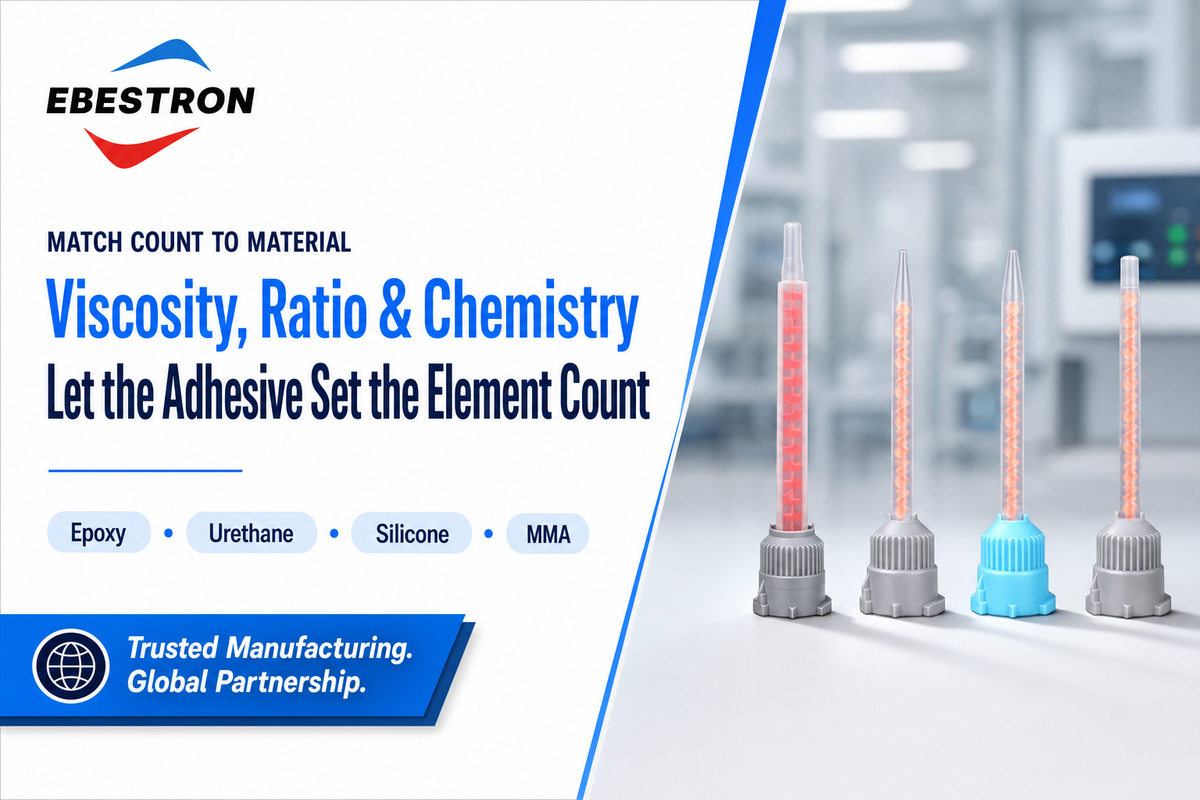
What pushes your count up or down is the adhesive itself: its chemistry, mix ratio, and viscosity. Close 1:1 ratios with low viscosity mix in fewer elements; a wide ratio such as 10:1, or a big viscosity gap between resin and hardener, needs more. Across epoxy glue, urethane, and silicone, the glue-mixing job is the same, fold the two-part chemistry into a uniform blend, but the right count is a recommendation per chemistry, not a constant, and nozzles for two-part adhesives are spec’d to mix two-part materials at a stated ratio. A study on incorrect mix ratio showed that off-ratio dispensing measurably lowers bonded-joint strength, which is exactly what too few elements on a hard-to-mix system produce. The commonly cited element bands by chemistry are below; treat them as starting ranges, then validate.
| Adhesive Class | Typical Mix Ratio | Element Count | Bore Diameter | Selection Note |
|---|---|---|---|---|
| Acrylic / MMA, fast-set | 1:1–10:1 | 8–20 | 2.4–6.4 mm | Close-ratio, mixes quickly |
| Epoxy, general-purpose | 1:1–2:1 | 15–24 | 4.0–6.4 mm | 18 vs 24 lives here |
| Epoxy, filled / structural | 1:1–4:1 | 18–24 | 5.4–8.0 mm | Fillers push the count up |
| Methacrylate (MMA) structural | 1:1–10:1 | 16–24 | 4.0–8.0 mm | Metal and plastic bonding |
| Polyurethane foam | 1:1 | 10–24 | 4.0–8.0 mm | Expanding; watch back pressure |
| Polyurethane, structural | 2:1–4:1 | 20–32 | 6.4–9.0 mm | Wide ratio, viscous |
| Silicone (RTV) | 1:1–10:1 | 20–30 | 5.4–8.0 mm | High viscosity |
| Polysulfide | 2:1 | 24–32 | 6.4–9.3 mm | Hard to mix |
| Urethane, abrasion-resistant | 4:1–10:1 | 24–36 | 8.0–12.6 mm | Wide-ratio, high-viscosity |
Source: industry selection ranges (Adhesives & Sealants Industry; manufacturer selection guides). Treat as starting ranges, final element count also depends on bore diameter, element geometry, and a validated mix-quality test, not chemistry alone.
Viscosity drives diameter as much as count: thin fluids (under ~5,000 cP) use small-bore elements around 2.4–6.4 mm, medium fluids step up to ~5.4–8 mm, and thick or filled adhesives over ~50,000 cP need 9 mm or larger to keep back pressure manageable. Get the diameter right first, then settle the element count. For ratio-specific hardware, see our breakdown of epoxy mixing nozzle sizing and ratios. Ebestron matches element count and bore diameter to your chemistry across automotive, electronics, and structural assembly work.
Cartridge Compatibility & Reading the Element Count Off the Nozzle
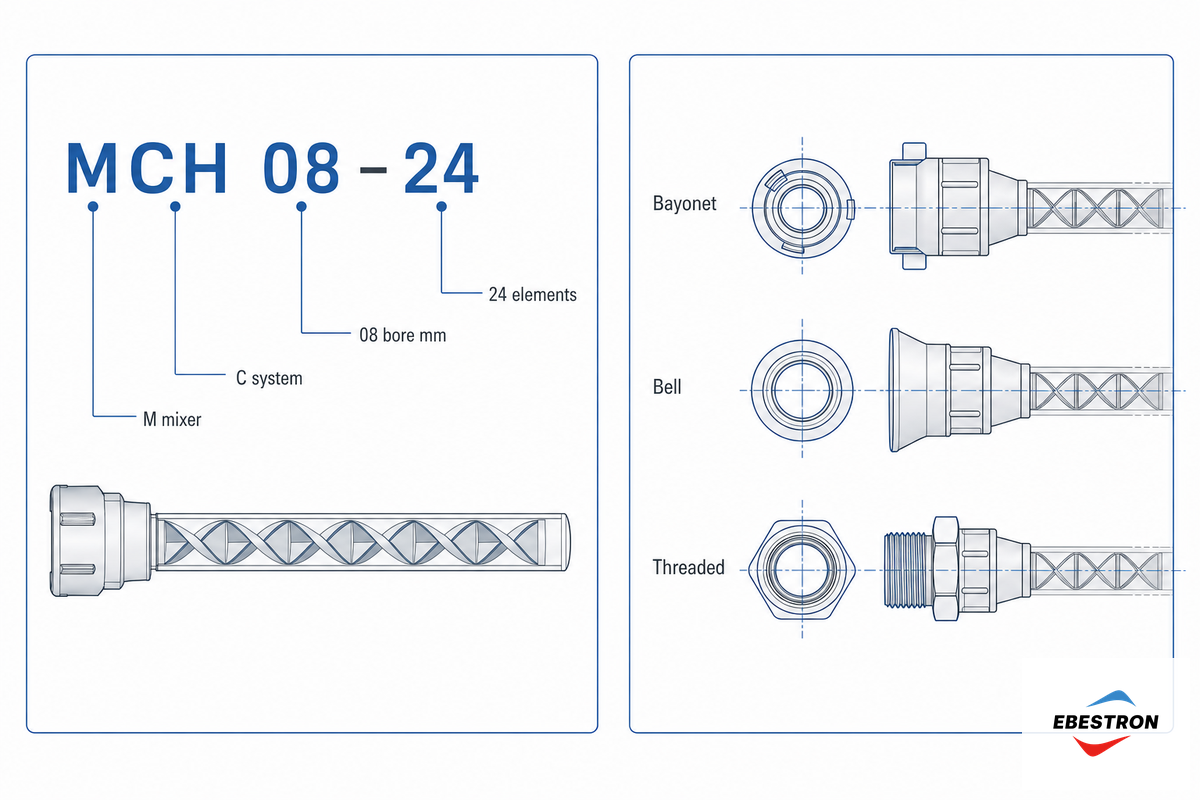
Element count is bounded by what your cartridge system offers. Across 2K packaging, element counts run from about 7 on small bayonet tips up to 56 on large bell mixers, with element diameters from roughly 2.4 mm to 12.6 mm. Bayonet connections (a twist-and-lock) suit 9–50ml cartridges, the small dual cartridges; bell connections, round, square, or rotary, serve 200ml cartridges and larger; threaded inline mixers cover the biggest sizes without a separate retaining nut. So an “18 vs 24” decision is really “which counts does my A/B/C/F-system cartridge support,” which you can cross-check against Mixpac and Nordson compatible cartridges. These mixer nozzles ship as both OEM and generic static mixing nozzles to fit Sulzer Mixpac, Nordson, and 3M adhesive dispensing systems; match the adhesive cartridges, the tip style, and the mixing nozzle tips to your specification, not just the count.
To identify an unknown nozzle before reordering, read the markings molded into the housing: most carry the brand, the diameter, and the element count. For instance, a part number like MCH 08-24T decodes to an 8 mm bore with 24 elements; a Nordson C-system bell tip may carry 18 elements. On 3M™ static mixing nozzles, the same molded markings flag the cartridge family and whether the tip suits adhesives, sealers and foams, or a spray outlet; replace a used nozzle with the same spec rather than guessing. Matching those three numbers, not just the count, is how you reorder the same performance. To pair the right gun with these nozzles, see our guide to manual and pneumatic dispensing guns, and for fine deposits, our industrial dispensing needles and precision tips. Ebestron manufactures nozzles across these bayonet, bell, and threaded systems to fit the Mixpac, Nordson, 3M, and Loctite cartridges used on automotive and industrial assembly lines.
The 18-vs-24 Decision Ladder: Pick the Right Count in 6 Steps
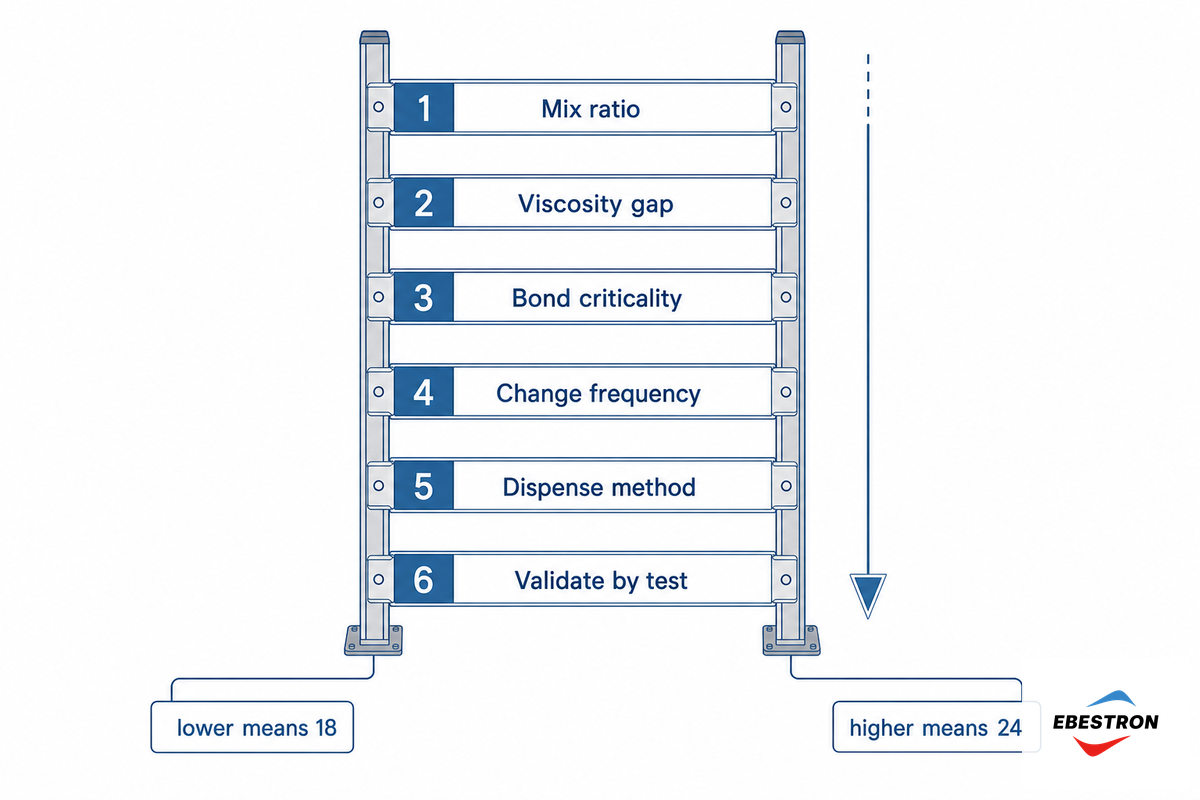
How do I know which disposable static mixer is right for my application?
Work down this ladder and stop at the first step that forces a higher count; if nothing does, choose the lower-waste 18. The ladder turn the scattered drivers above into one repeatable call you can apply to any two-part adhesive.
- Mix ratioat or near 1:1, start at 18; at 4:1 or wider, step to 24, because off-ratio fluids need more folds to reach homogeneity.
- Viscosity gapif resin and hardener viscosities differ sharply, or either is thick or thixotropic, choose 24 (and a larger diameter).
- Bond criticalitystructural, safety, or appearance-critical joints justify the extra mixing margin of 24; non-structural tacking doesn’t.
- Change frequency & pot lifemany short runs or fast-curing chemistry favor 18, because every nozzle change at 24 throws away about 33% more adhesive.
- Dispense methoda manual cartridge gun leans to 18 (lower back pressure); a pneumatic or meter-mix machine can carry 24 comfortably.
- Validate by testa clean-looking bead is not proof. Confirm the choice with a lap-shear test (per ASTM D1002) on your actual substrate and cure schedule before you lock a SKU; if 18 passes, keep the waste savings.
Why 18 beats 24: a 1:1, low-viscosity epoxy on a manual gun, changed often, on a non-critical bond, 18 mixes fully and saves material on every shot. To match these calls to stocked parts, see how Ebestron sizes static mixers across cartridge systems.
Common Static Mixer Element-Count Selection Mistakes (From the Field)
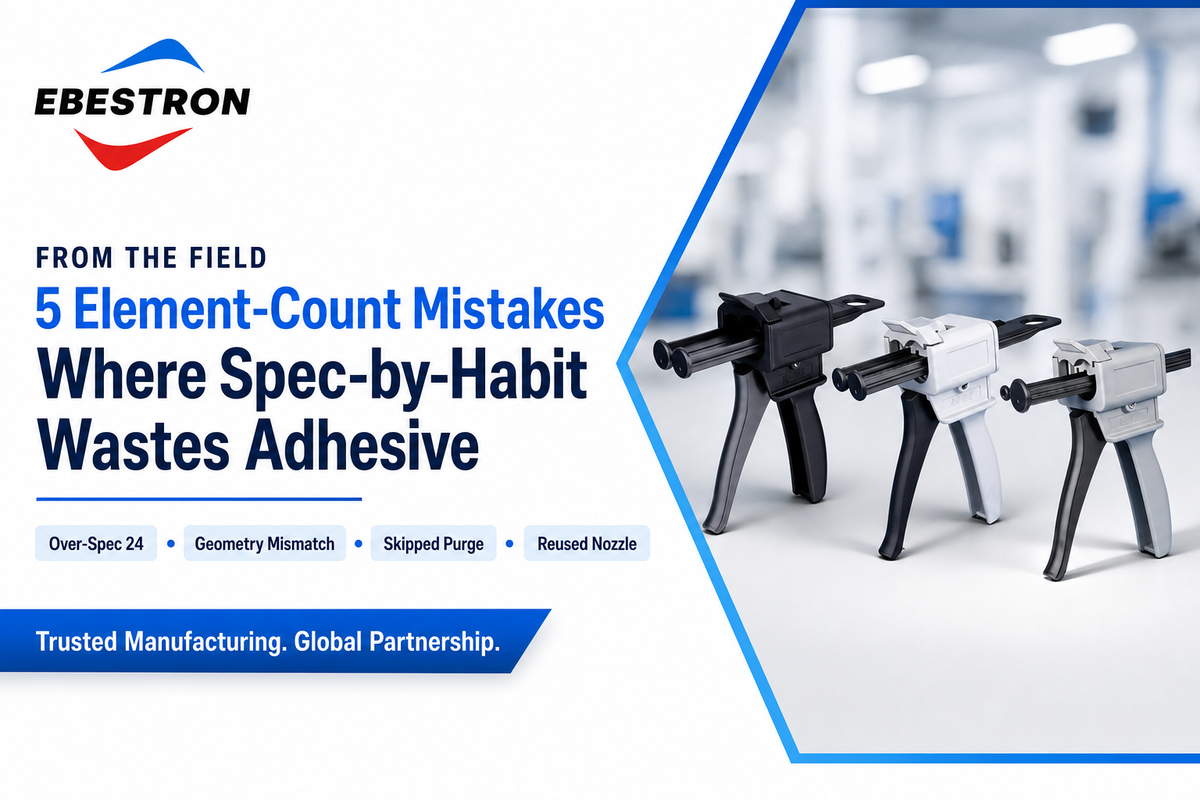
As a nozzle manufacturer, Ebestron sees these five element-count mistakes most often when buyers spec 24 by habit, each one either wastes adhesive (5 mL or more per change) or risks a weak, under-mixed bond on a production line.
- ⚠Over-specifying 24 for an easy 1:1 job. Buying mixing margin you don’t need and paying for it in retained adhesive on every change.
- ⚠Comparing counts across geometries. An 18 quadro and a 24 helical aren’t interchangeable; geometry and aspect ratio change what a count means, the very limitation that patent EP 2,089,309 ties to element count.
- ⚠Skipping the purge: the first slug through a fresh nozzle is unmixed or under-mixed; practitioners on engineering forums trace bad first beads to dispensing before a full purge.
- ⚠Reusing a cured nozzle. Leave the used nozzle on as a cartridge cap, but fit a fresh one next run, a cured plug restricts flow and ruins the mix.
- ⚠Introducing air at the nozzle: Degas components separately; air pulled in at the inlet, not the element count, is the usual cause of bubbles in the bead.
Industry Outlook: From “Add Elements for Safety” to “Minimize Elements and Waste”
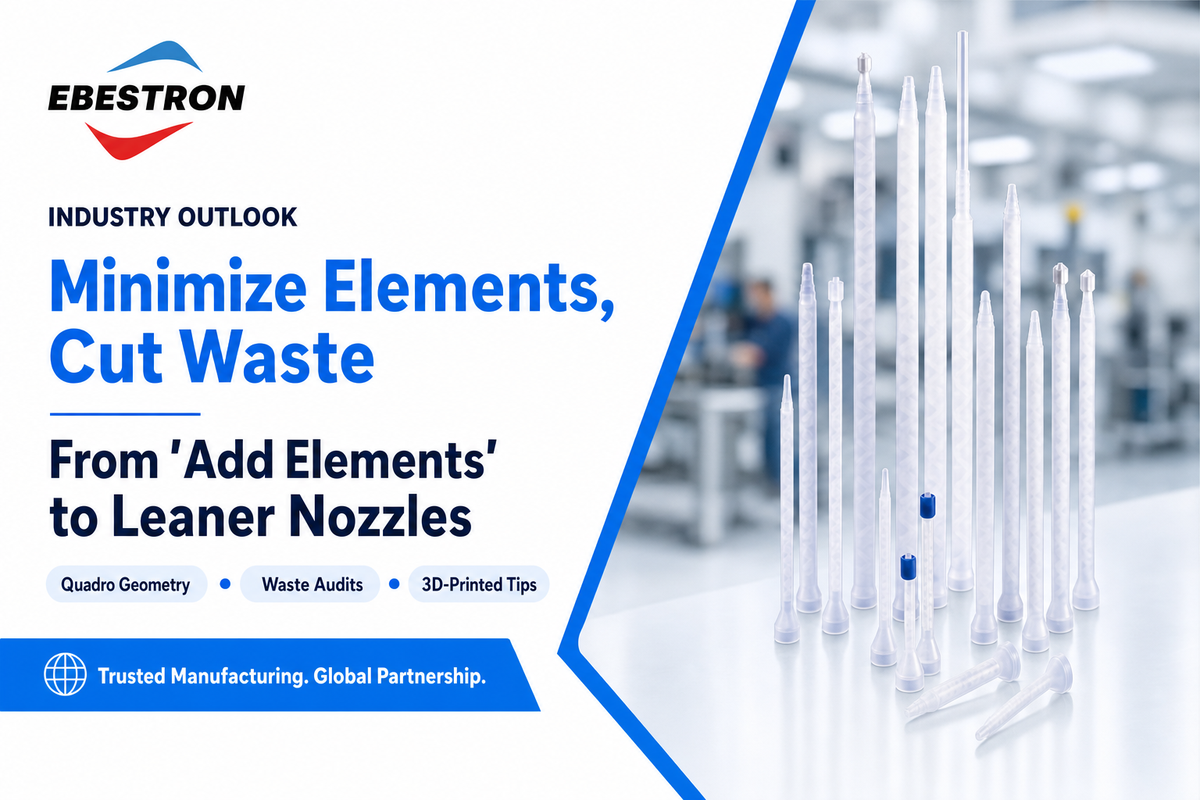
Buyers’ selection instinct is changing. For decades the safe move was to add elements; now, with manufacturers quantifying that a typical line scraps on the order of 1,000 nozzles a year, the live pressure is to specify the minimum count that hits validated mix quality, because every extra element is measurable waste in both dollars and ESG reporting. That’s a buyer-decision shift, not just a market statistic: when single-use adhesive waste becomes a tracked cost line, over-specified 24-element nozzles get audited off the shelf.
Two forces accelerate it. First, additive manufacturing and computer-optimized geometries, surveyed for advanced dispensing in a 2024 ACS Engineering Au revieware turning waste-per-nozzle into an engineered spec rather than a fixed cost. Second, a 2024 update to EN ISO 10364 keeps pot-life verification current, reinforcing that the nozzle must respect cure timing, not just layer count. For market context, analysts size the static mixer segment in the low single-digit billions of dollars with mid-single-digit annual growth, directional background only. If you are planning 2026 tooling, audit your standard nozzle SKU against your actual ratio, viscosity, and validated CoV before you reorder; you may be paying for elements you don’t use. As a manufacturer, Ebestron is steering its own range toward lower-element, lower-waste nozzles for 1:1 automotive and assembly work, where an over-specified 24 throws away roughly 5 mL of adhesive on every change.
Frequently Asked Questions
Q: What is a static mixing nozzle?
View Answer
A static mixing nozzle is a disposable tube holding a fixed series of internal baffles, called elements, that blend a two-part adhesive as it is pushed through. Each element splits and folds the flow, doubling the fluid layers, so the resin and hardener leave the tip fully mixed and ready to apply.
Q: How many elements does a static mixer need?
View Answer
It depends on the chemistry, mix ratio, and viscosity, but two-part adhesive nozzles run from about 7 elements on small bayonet tips to 56 on large bell mixers, with most epoxies in the 15-24 band. Close 1:1, low-viscosity systems mix fully in fewer elements, while a wide ratio or a big viscosity gap needs more to reach a uniform, on-ratio blend. Start lower, then confirm with a test bead before committing to a standard part for the line.
Q: Is a 24-element nozzle always better than an 18-element one?
View Answer
No, not always. Once a mix is already uniform, extra elements only add retained-adhesive waste, back pressure, and cost. A 24 helps with wide ratios, high viscosity, or critical bonds, but for an easy 1:1 epoxy an 18 mixes just as well while wasting less per change. Confirm the lower count with a lap-shear test first.
Q: What’s the difference between helical and quadro static mixers?
View Answer
Helical mixers use spiral elements; quadro mixers use square ones that are shorter per element. Quadro trims about 7% of waste but relies on the same doubling, so it needs a similar element count, not far fewer; it is just a shorter, lower-waste tube.
Q: Do more elements waste more adhesive?
View Answer
Yes. The adhesive trapped in a nozzle scales with its internal volume, which scales with length and therefore with element count. A nozzle is also purged by roughly one internal volume before use and holds about twice that after cure, so conventional mixers waste close to 19 mL each. Going from 18 to 24 at one diameter adds about a third more waste per change, which over a year of changes adds up to liters of scrapped adhesive.
Q: Can you reuse a static mixing nozzle?
View Answer
No. Once adhesive cures inside, the elements clog and the next mix fails. Leave the used nozzle on as a cap to seal the cartridge, then fit a fresh one for the next run, because a cured plug only restricts flow and spoils the mix.
Q: How do I find the element count of a nozzle?
View Answer
Read the markings molded into the nozzle housing. Most carry the brand, the bore diameter, and the element count, often inside the part number, so an 08-24T code means an 8 mm bore with 24 elements. Match all three numbers when you reorder, not just the count, because diameter and geometry change what that count delivers; when the molding is worn, measure the bore and count the visible elements at the outlet before you reorder.
Spec the right element count, stop wasting adhesive
Ebestron manufactures two-component static mixing nozzles across bayonet, bell, and threaded systems, compatible with Mixpac, Nordson, 3M, and Loctite cartridges. Tell us your chemistry, ratio, and cartridge, we’ll match the element count to your job.
About This Analysis
This guide compiles peer-reviewed static-mixing research, US and European patents, current adhesive standards (EN ISO 10364:2024, ASTM D1002), and trade-press reporting on disposable 2K mixing nozzles. As a manufacturer of static mixing nozzles, Ebestron sees element count chosen by habit far more often than by validated mix quality; the figures here are order-of-magnitude for like-for-like nozzles, and your results depend on your specific diameter, geometry, chemistry, and cure. Reviewed by the Ebestron technical team.
References & Sources
- Static Mixers for High-Viscosity Systems — U.S. National Library of Medicine (PMC)
- Effect of Aspect Ratio on Kenics Static Mixer Performance — MDPI Processes
- Nozzle Innovations for Advanced Dispensing — ACS Engineering Au (2024)
- US 4,538,920, Static Mixing Device — USPTO via Google Patents
- EP 2,089,309, Two-Part Dispenser with Mixer — EPO via Google Patents
- EN ISO 10364:2024, Pot Life of Multi-Component Structural Adhesives — ISO
- Effect of Incorrect Mix Ratio on Two-Component Adhesive Strength — MATEC Web of Conferences
- The Next Generation of Static Mixing Nozzles — Adhesives & Sealants Industry
- Mixer Selection for Two-Component Adhesives — AZoM / Huntsman Advanced Materials
Related Articles
- What Is a Static Mixing Nozzle? A Complete Guide — the fundamentals behind element count
- How to Choose a Static Mixer for Two-Part Adhesives — the full selection workflow
- Helical vs Quadro Static Mixers: Mix Quality & Waste Compared
- Epoxy Mixing Nozzles & Tips: Sizing, Ratios & Compatibility