تواصل مع شركة Ebestron

تم التحديث في يوليو 2026 · تمت المراجعة من قبل الفريق الفني لشركة Shanghai Ebestron New Materials Co. Ltd
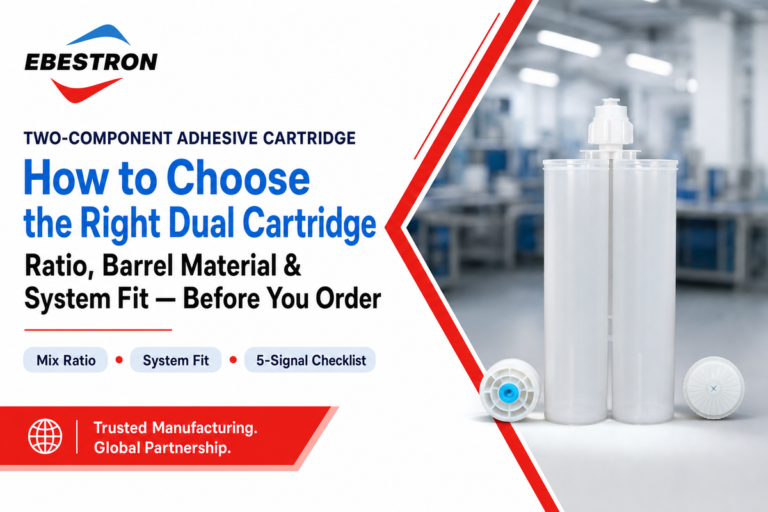
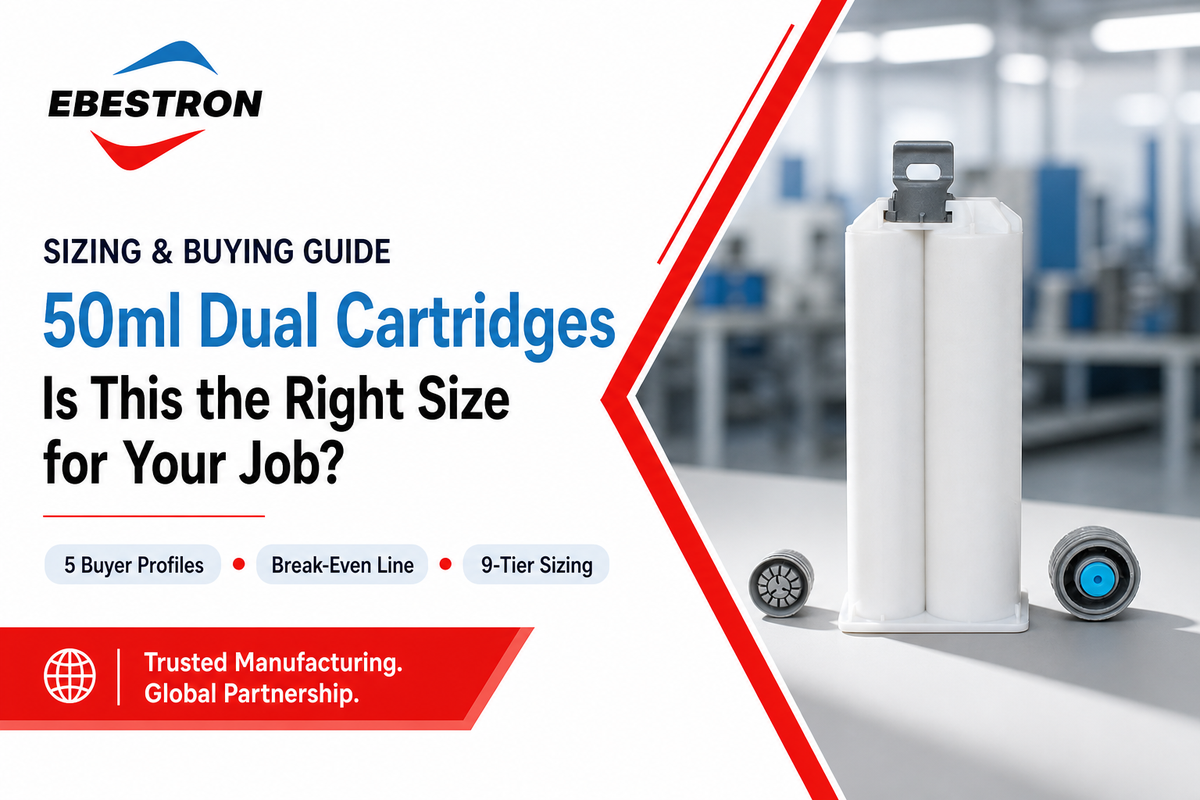
50ml dual cartridges are the smallest standard side-by-side format in the two-component adhesive world, and they’re also the size buyers second-guess the most. A 50ml dual cartridge is cheap enough to order as a trial, small enough to run by hand, and, if you pick it for the wrong job, expensive enough in wasted changeovers to notice by the end of a production month. This guide isn’t another spec sheet or another step-by-step dispensing tutorial. It answers the question those pages skip: is 50ml actually the right cartridge for what you’re doing, and when does it stop making sense?
Quick Specs: 50ml Dual Cartridges at a Glance
| Standard sizes | 50، 200، 400، 600 مل (حتى 1500 مل السائبة) |
| Mix ratios (50ml) | 1:1, 2:1, 4:1 (A-System) · 10:1 (B/S-System) |
| مواد برميل | PP، PA، PBT |
| Systems | Sulzer Mixpac A/B-System, Nordson EFD-compatible |
| Full spec sheet | 50ml dual cartridge product page → |
Who Actually Needs a 50ml Dual Cartridge?
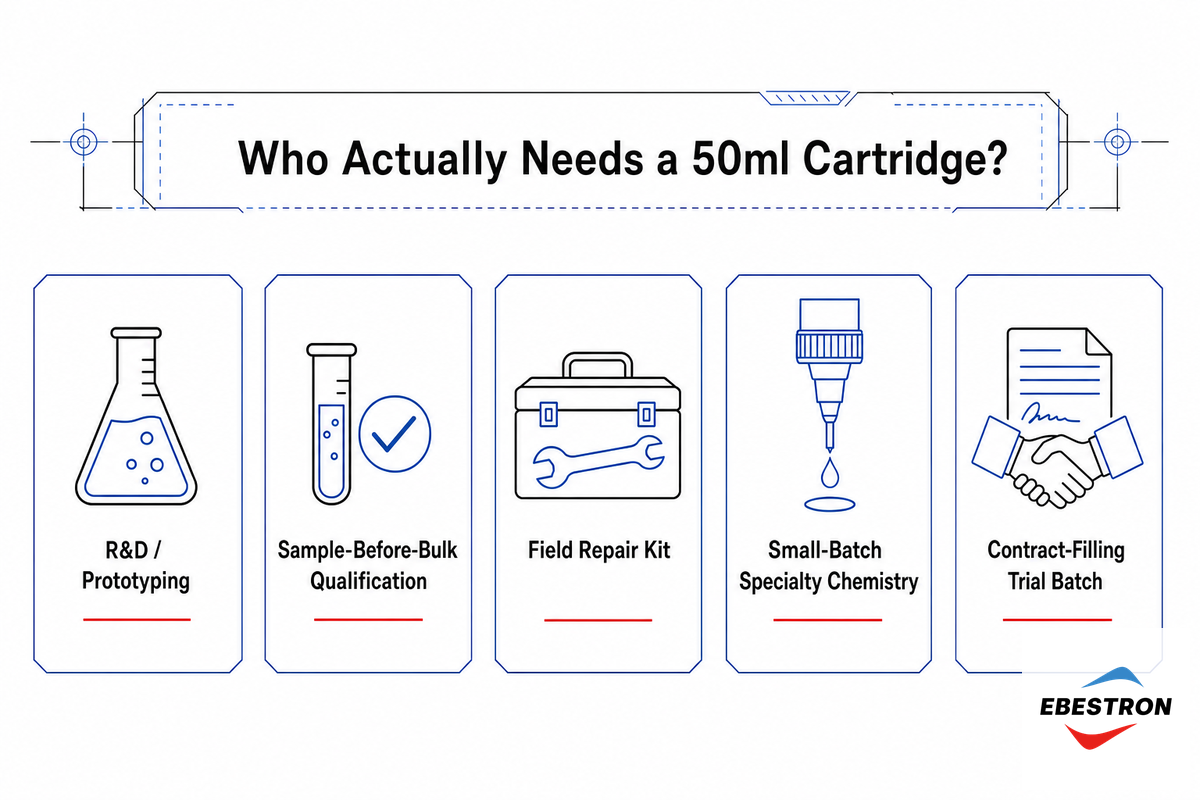
Cartridge size is a job-fit question before it’s a price question. Volume-focused sales pages tend to sell every format to everyone; in practice, the 50ml side-by-side earns its place in five recurring buyer situations, and the honest answer for a lot of production lines is that it doesn’t fit at all.
Industry technical coverage backs this up directly. Writing in صناعة المواد اللاصقة والمواد المانعة للتسرب, Nordson EFD’s Craig Blum notes that cartridge-format choice tends to follow existing market habits, pointing to “a 50-mL side-by-side in dental,” alongside larger formats standard in automotive aftermarket, marine, and construction anchoring work. That’s a trade-press observation of common practice, not a dental-industry standard mandating this exact hardware, but it matches what shows up independently in real usage: a National Highway Traffic Safety Administration technical service bulletin documents 50ml two-component cartridges (the Fusor-brand family) as the standard small-format unit for automotive panel and trim adhesive repair, and hobbyist forums for kayak-hull and rowing-machine tank repairs consistently point first-time buyers toward a 50ml cartridge with a hand plunger or entry-level gun rather than a production-scale system.
| Buyer profile | نسبة نموذجية | Why 50ml fits |
|---|---|---|
| R&D / prototyping | 1:1, 2:1 | One or two bonds per test cycle; a 200ml+ cartridge would go stale before it’s used up |
| Sample-before-bulk qualification | Matches target production ratio | Lets you run real dispense trials on your own gun before committing to a bulk order |
| Field repair / service kits | 1:1, 4:1 | Light, single-use-friendly, and confirmed as the standard automotive body-shop panel-repair format |
| Small-batch specialty chemistry | 2:1, 10:1 | Electronics potting and industry-observed dental micro-dosing both run small, precise shots — not high-volume beads |
| Contract-filling trial runs | Customer-specified | Lets a formulator qualify a new resin in a cheap barrel before tooling a 400/600ml run |
If your situation isn’t on that list, you’re running the same bead hundreds of times a shift, or your chemistry needs a large single continuous pour, the honest next step is to keep reading, because the size that actually fits you is probably bigger.
50ml vs 200ml vs 400/600ml: The Shot-Count Break-Even Line
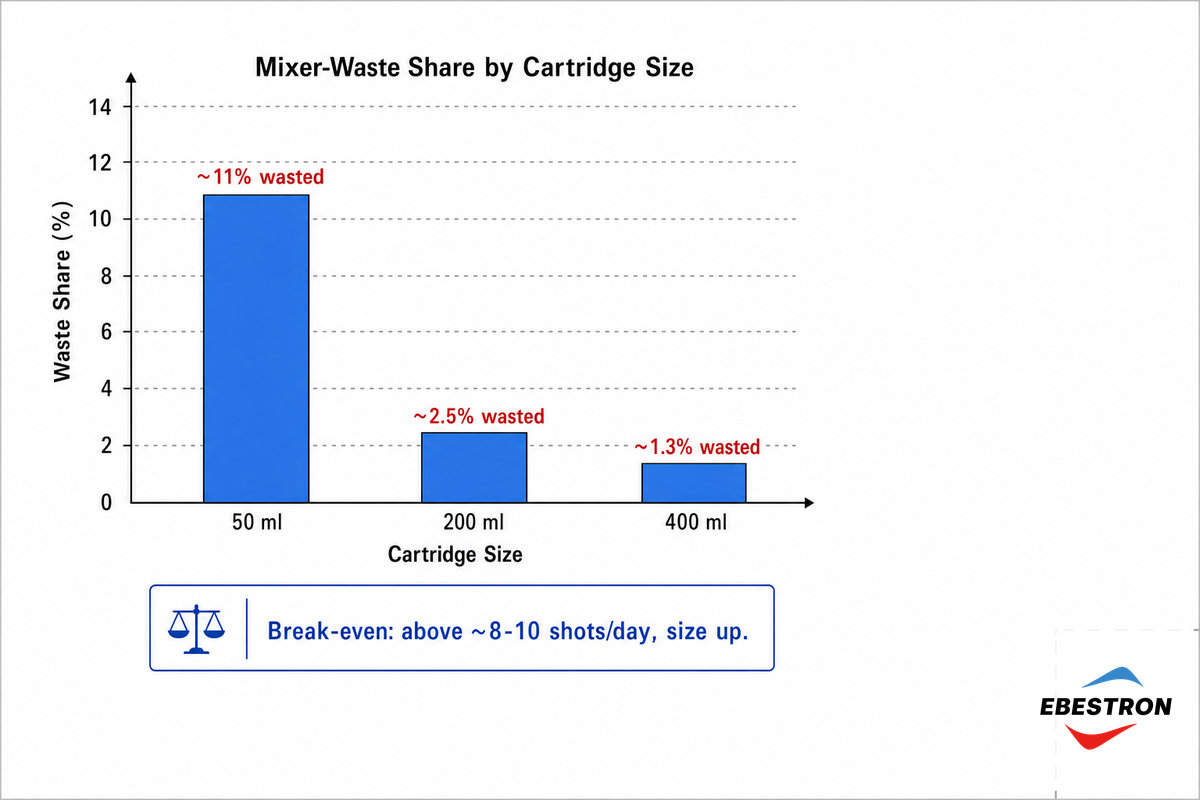
Every cartridge switch has a real cost nobody prices into the per-unit quote: the static mixer you throw away every time you change cartridges. Industry testing reported in صناعة المواد اللاصقة والمواد المانعة للتسرب found that conventional static mixers waste an average of 19.1 mL of mixed adhesive per nozzle — material that never reaches a joint; treat this as a representative industry figure rather than a number that updates yearly, since mixer geometry and retained-volume physics don’t change quickly. A related manufacturer white paper on Xemex low-waste mixer geometry measured retained volumes as low as 2.5 mL, against 5-10 mL for standard 24-element mixers, a reduction of up to 75%. That number is the whole game: the smaller your cartridge, the more often you change the mixer relative to the adhesive you actually place, so the wasted fraction of every barrel climbs.
Is 50ml Actually Cheaper Per Shot Than 200ml?
Only above a certain changeover frequency, below roughly 8-10 shots per day, the 50ml format still wins on flexibility, since nothing goes stale on the shelf; above that frequency, the retained-volume math flips in favor of sizing up to 200ml, because the smaller cartridge wastes a proportionally larger share of its volume to the same fixed mixer purge on every single changeover.
Here’s the arithmetic with real numbers substituted: say a 50ml barrel delivers roughly 45 mL of usable adhesive after a 5 mL mixer purge (about 11% lost to the nozzle), while a 200ml barrel loses the same fixed ~5 mL to its own mixer purge, only about 2.5% of the barrel. Run four 50ml cartridges to match one 200ml cartridge’s volume, and you’ve thrown away four mixers’ worth of retained adhesive instead of one, call it 20 mL lost against 5 mL lost, a four-fold waste multiplier for doing the same total job in the smaller format. No cartridge-size buying guide currently publishes this crossover explicitly, it has to be derived from the mixer-waste data, not looked up.
| حجم الخرطوشة | Approx. usable yield | Waste share per changeover |
|---|---|---|
| 50 مل | ~45 ml | ~11% |
| 200 مل | ~195 ml | ~2.5% |
| 400 مل | ~395 ml | ~1.3% |
⚠️ مهم
This is a directional framework built from published mixer-waste figures, not a certified engineering formula — your actual shot volume, mixer choice, and purge discipline will shift the exact crossover point. Treat it as a starting estimate to validate on your own line, the same way qualification-testing guidance recommends validating any sample lot before a bulk order.
The 9-Tier Shot-Volume Sizing Framework
Putting the break-even logic into a single lookup: match your daily shot count to a tier below, and the size, typical ratio, and waste share follow directly from the mixer-purge math above.
| Daily shot volume | Fit tier | Best-fit size | نسبة نموذجية | Waste share / changeover |
|---|---|---|---|---|
| 1–2 shots | Ideal | 50 مل | 1:1 | ~11% |
| 3–5 shots | Ideal | 50 مل | 2:1 | ~11% |
| 6–10 shots | Borderline | 50 مل | 4:1 | ~11% |
| 11–20 shots | Ideal | 200 مل | 1:1 | ~2.5% |
| 21–30 shots | جيد | 200 مل | 2:1 | ~2.5% |
| 31–50 shots | Ideal | 400 مل | 1:1 | ~1.3% |
| 51–80 shots | جيد | 400 مل | 2:1 | ~1.3% |
| 81–120 shots | Ideal | 600 مل | 1:1 | ~1% |
| 120+ shots | Automate | 600 ml / 1500 ml bulk | Custom | <1% |
“Buyers ask us for the cheapest cartridge, but the number that actually decides their cost is how many times a day they’re throwing away a mixer. We size a customer’s format by their changeover count first and their unit price second, get that order backwards and the invoice looks fine right up until the monthly waste report doesn’t.”
Ebestron Engineering Team, Cartridge Application Support
Need the larger formats’ full specs? See the 400ml and 600ml dual cartridge lineup.
What’s in an Ebestron 50ml Cartridge Set (Full Specs on the Product Page)
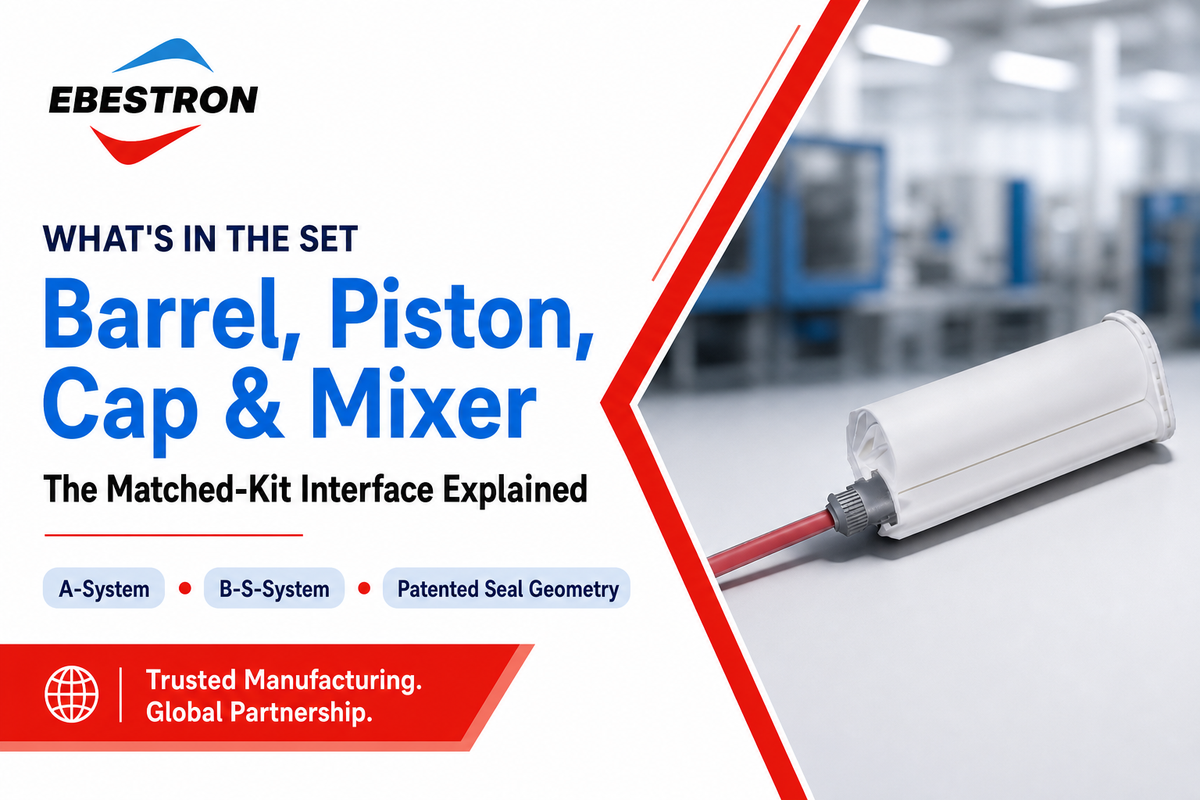
An Ebestron 50ml set ships as a matched kit, barrel, piston, cap, and static mixer, molded to one cavity standard so the sample you approve is the lot you receive in bulk, because Ebestron controls tooling in-house under an ISO 9001-aligned process rather than outsourcing the barrel and piston to separate vendors, which is the usual cause of a lot-to-lot fit problem.
The A-System (square-back) covers 1:1, 2:1, and 4:1 ratios in PP or PA; the B/S-System (round-back, grey cap) covers 10:1 for methacrylate chemistries in PBT. The piston-to-barrel seal follows the guide-geometry principle described in US Patent 7,748,577 B2 (cartridge piston sealing under biased plunger load) — the same family of engineering that keeps a piston from tilting and letting Part A bypass into Part B under back-pressure. For the complete ratio-by-material decision matrix, compatibility cross-reference, and OEM/bulk ordering details, see the full 50ml dual cartridge product page — this guide stays focused on whether 50ml is the right call in the first place.
The same dual-chamber cartridge design and manufacturing processes scale from this 50ml part epoxy set up through the 200 ml cartridge and the larger side-by-side cartridges, and down to empty cartridges sold bulk for OEM contract fillers, the ratio cartridge geometry, the fluid dispensing tolerances, and the mix and dispense mechanics don’t change with volume, only the shot size does. Beyond the epoxy and polyurethane systems this guide focuses on, the identical dual component format also packages acrylic and urethane two-component materials, and, on the industrial applications side, Ebestron’s guns are available across manual, pneumatic, and battery drive types for whichever two-part materials and two-part epoxy chemistry a given production line runs. It’s worth distinguishing this from single-part, one component sealants sold in ordinary caulk or caulk gun packaging: a 2K cartridge and a caulking tube push a completely different packaging and dispensing two-component logic through the barrel, which is exactly the confusion the next section clears up.
Matching the Gun and Mixer
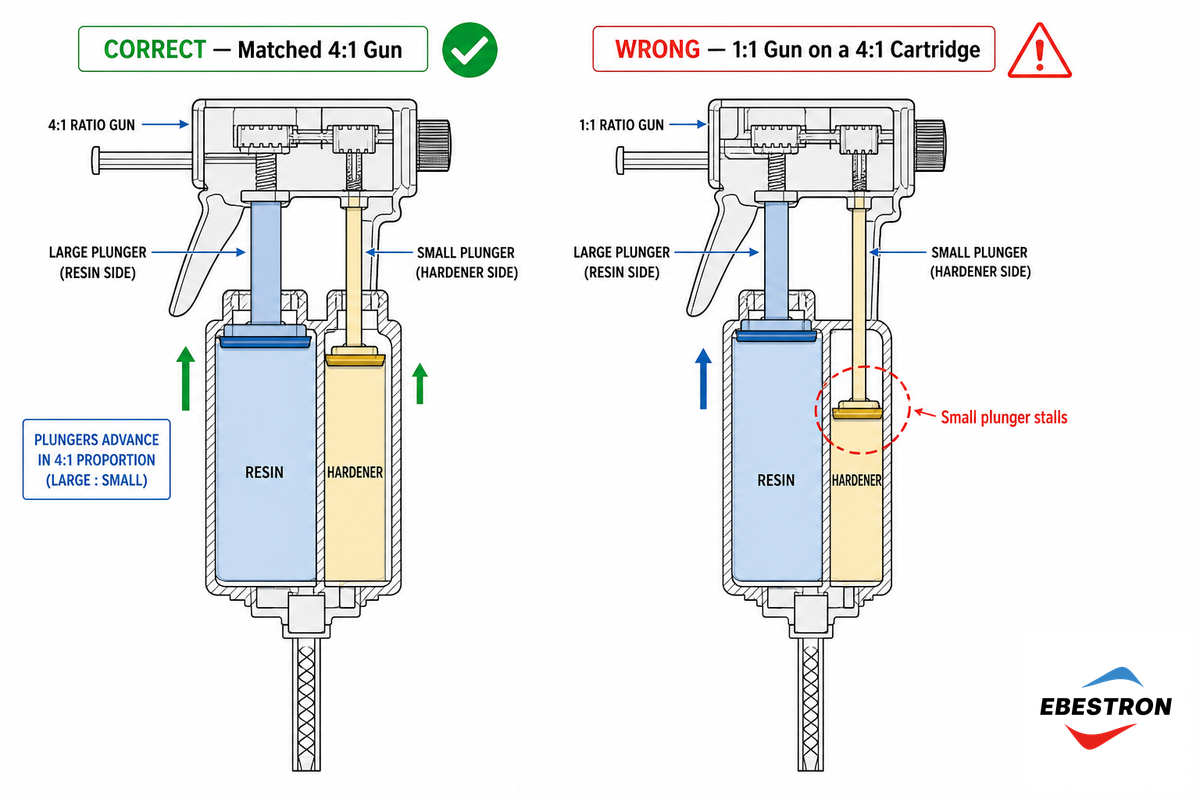
A 50ml cartridge is only half the system, cartridge dispensing always pairs an adhesive dispenser sized to the same ratio with a mixer sized to the chemistry, and the single most expensive mistake at this stage is buying the cartridge before confirming the gun fits it. This is the same manual-gun logic as meter-mix equipment on a production line, just scaled down to a hand tool for a 2 part shot instead of a continuous pumped feed. Ebestron engineers this fit deliberately: every 50ml barrel is molded to a documented A-System or B/S-System interface, the same guided-piston principle behind US Patent 7,748,577 B2, so a matched gun advances both plungers at the correct 1:1 through 10:1 ratio, not an approximate one. A 10:1 cartridge needs a 10:1 gun; put it in a 1:1 gun on the assembly line and the small hardener piston stalls or overfeeds, throwing the mix off-ratio before it ever reaches the joint, because the two plungers are no longer advancing in the proportion the barrel was molded to deliver. One buyer’s 50-cartridge trial order went to waste in the field this way, the barrels were correct, but the gun on hand was a 1:1 model left over from a different production line. We cover drive-type selection (manual, pneumatic running on 90-100 PSI shop air, battery) in full in كيفية اختيار مسدس توزيع 2K, and mixer geometry, bayonet, bell, helical vs. quadro, in أنواع فوهات الخلط الثابتة. If you already know how to load and purge a cartridge, our step-by-step dispensing guide covers the full 7-step process this article assumes. Confirm your gun’s ratio and cartridge system before you request a 50ml sample — it’s a five-minute check against a wasted trial order.
How to Buy Your First 50ml Batch (Sample-Test-First Checklist)
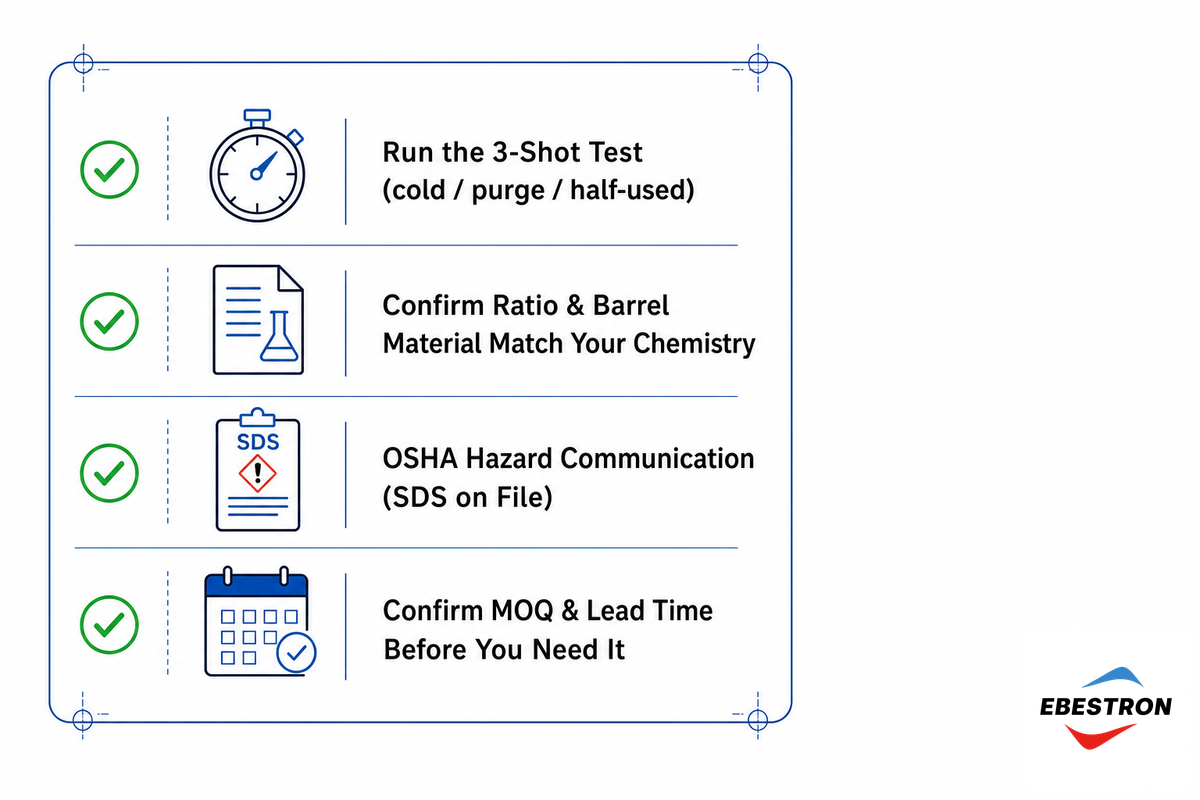
The point of buying in 50ml first is that a small format lets you catch a bad fit before you own 400 liters of it. Academic guidance on adhesive bond qualification is explicit that small-scale testing is comparative, not a production certification, a single-lap coupon test tells you whether a combination behaves consistently, not that it’s cleared for every joint geometry and load case you’ll eventually run. Treat a 50ml trial the same way: it screens for compatibility problems, not a production sign-off.
- ✔ Chemistry compatibility, confirm your resin/hardener matches the barrel material (PP for epoxy/PU/silicone, PA/PBT for MMA and other volatile actives)
- ✔ Piston-seal pressure test, dispense a full barrel and watch for bypass or blow-by at your gun’s working pressure
- ✔ Mix-ratio verification, check the purged bead for even color/consistency before trusting the ratio on a real joint
- ✔ Shelf-life read on your storage conditions, epoxy storage-temperature studies show viable ranges vary by formulation (commonly cited around 5-30°C), so confirm against your own facility, not a generic number
- ✔ Safety data sheet on file, OSHA’s hazard communication rule (29 CFR 1910.1200) applies to reactive two-component chemistries even in small sealed cartridges; confirm your SDS is current before the first shift handles it
- ✔ MOQ and lead-time check, confirm the bulk-order tier and turnaround before you need it, not after your trial passes (the same “validate at small scale before the batch grows” logic the Federal Register requires for pharmaceutical batch-size scale-up)
How Many Test Shots Should I Run Before Scaling From 50ml to Bulk?
There’s no universal number, but a practical floor is three shots covering the full failure envelope, not just a lucky first bead: one shot cold, one shot after a full equalize-and-purge cycle, and one shot after letting the cartridge sit half-used for your expected changeover interval. If all three come out on-ratio and fully cured, you’ve screened for the failure modes that actually show up at scale.
Run the cold shot at ambient shop temperature without conditioning, since that catches a high-viscosity start; the equalize-and-purge shot catches an unequalized first bead; and the half-used-and-resumed shot catches a partially-used barrel going stale between shifts. This isn’t a certified qualification protocol; it’s the minimum screen before you commit to a 200-liter order based on one good bead.
Common 50ml Sizing Mistakes (and What They Actually Cost)
سيناريو: A contract filler qualifying a new 2:1 structural epoxy runs their trial on 50ml cartridges, the right call for qualification. But when the customer’s order comes in at 2,000 shots a month, they keep ordering 50ml because “it already works.” At roughly 40 changeovers a day against the waste math above, they’re discarding four times the mixed adhesive they would on a 200ml line, and paying a line operator to swap cartridges 40 times instead of 10. Nobody sized the mistake, it just showed up as a slightly worse margin every month, exactly the kind of gap a proper qualification-testing pass before the 2,000-shot order would have surfaced.
سيناريو: A buyer worried about running out mid-job orders 400ml “just in case” for a bench-repair task that uses one or two shots a week. Six months later, half the cartridges in the drawer are past their practical shelf window, and the barrel that does get used still wastes the same fixed mixer volume as it would on a full run, the buyer paid for capacity they never touched.
Mistake → Real Cost → Fix
- Staying on 50ml past ~10 shots/day → 4× mixer waste + extra changeover labor → re-run the Shot-Count Break-Even math and size up
- Buying 400ml “just in case” for low-frequency work → shelf-life risk on unused stock → buy 50ml and reorder as needed
What’s Changing for 50ml Buyers (2026 Outlook)
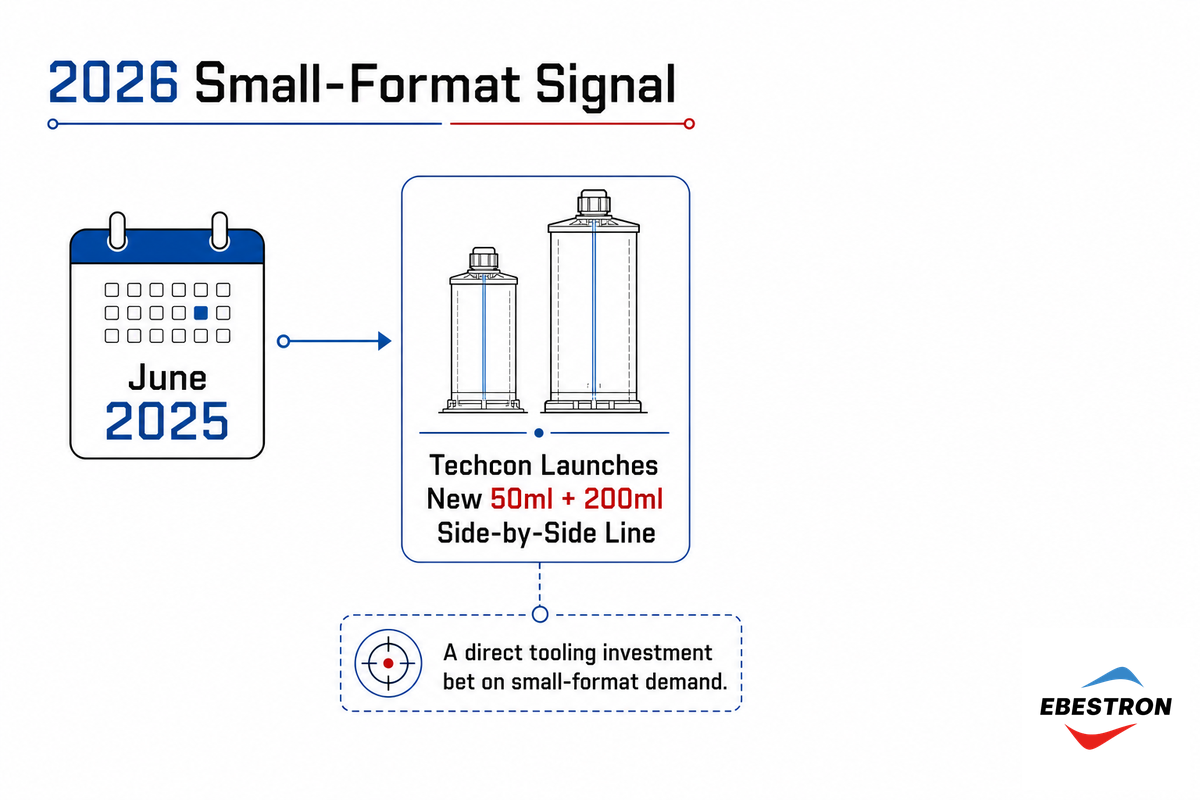
The decisive shift for 50ml buyers isn’t a market-growth headline, it’s what equipment makers are actually shipping: in June 2025, Techcon (part of OK International) launched a new side-by-side dispensing cartridge line specifically in 50ml and 200ml sizes across three standard ratios, with 400/490ml formats to follow, a direct product bet that the small-format segment is worth building new tooling for.
Independent market-research firms publish 2025 category-size estimates that vary by several multiples depending on how narrowly or broadly the segment is scoped, which says more about inconsistent market-sizing methodology than about anything a buyer can act on, the Techcon tooling investment is the more reliable signal precisely because it’s a verifiable capital decision, not a modeled estimate.
That matters for 50ml buyers specifically because two-component bonding is moving into higher-stakes, higher-volume work, EV battery assembly, electronics potting, structural joints, where every off-ratio bead carries real rework cost. As buyers de-risk bigger automated commitments, the 50ml format’s role as the cheap qualification step before scaling becomes more valuable, not less: it’s the format you use to prove a joint works before you tool up a 400ml automated line around it. Separately, packaging material sourcing is also shifting, recycled-polypropylene 50ml cartridge sets have been commercially available since 2022, reflecting a slow but real move toward recycled-content barrels in this format. That’s a materials-sourcing trend worth watching, not a disposal or compliance answer by itself, hazardous-waste determination for spent cartridges and residue still falls under standard 40 CFR 262.11 chemical-handling rules regardless of what the barrel is made from.
The practical move for 2026: standardize on one or two cartridge formats so your gun and mixer inventory stays simple as volume grows, and keep the manual 50ml process as your documented fallback and qualification step behind any automated line. Ebestron’s own production line runs this same standardization discipline in-house, molding the 50ml through 1500ml family on one cavity standard so a qualification run on 50ml scales to bulk without a tooling change.
الأسئلة الشائعة، خراطيش مزدوجة سعة 50 مل
Q: Can I use a 50ml cartridge for a job that really needs 200ml?
عرض الإجابة
ميكانيكيًا، نعم، ما عليك سوى تشغيل المزيد منها. اقتصاديًا، يعتمد الأمر على عدد اللقطات اليومية: بعد ما يقرب من 8-10 عمليات تغيير يوميًا، تضيف نفايات الخلاط الثابتة في كل برميل سعة 50 مل ما يصل إلى عدة أضعاف ما يمكن أن تهدره خرطوشة واحدة سعة 200 مل لنفس الحجم الإجمالي، بالإضافة إلى العمالة الإضافية لكل مبادلة.
Q: Is there a minimum order quantity for 50ml OEM or private-label cartridges?
عرض الإجابة
يعتمد موك على ما إذا كنت تريد خراطيش مخزون محايدة (الأسرع والأدنى) أو تشغيل ألوان/طباعة/علامة خاصة مخصصة (الحد الأدنى الأعلى لتغطية الأدوات والإعداد). يقتبس Ebestron موك مقابل النسبة والمواد ونطاق التخصيص المحدد بدلاً من رقم ثابت واحد، اطلب عرض أسعار بالحجم المستهدف للحصول على رقم دقيق.
Q: Can the same 50ml barrel handle both epoxy and MMA (10:1) chemistries?
عرض الإجابة
No, the two use different barrel systems by design, and swapping them is a common early mistake. Epoxy, polyurethane, and silicone run in the A-System (PP, square-back) across 1:1/2:1/4:1 ratios; 10:1 methacrylate (MMA) chemistries need the B/S-System (PBT, round-back, grey cap) because PP permits slow permeation of volatile MMA components over time, which can shorten shelf life and drift the delivered ratio.
Q: Do I need a different gun for 50ml than for 200ml cartridges?
عرض الإجابة
Yes, cartridge guns are sized to a specific barrel diameter and ratio, so a 50ml gun won’t seat a 200ml cartridge and vice versa.
Q: How long can I store an unopened 50ml cartridge before ratio accuracy is at risk?
عرض الإجابة
Unopened shelf life depends on the adhesive chemistry and storage temperature more than the cartridge itself, published epoxy storage studies show viable ranges commonly around 5-30°C, but always confirm the specific figure against your adhesive’s own datasheet and date code, not a generic industry number.
Q: What’s the realistic cost difference between 50ml and 200ml over a year of moderate use?
عرض الإجابة
It scales with your changeover frequency, not a fixed percentage. At low volume (a handful of shots a week), 50ml wins on flexibility and near-zero waste from oversized unused stock. At moderate-to-high volume (multiple shots a day, every day), the fixed mixer-waste penalty on each small barrel compounds, a shop running 10+ changeovers daily on 50ml is discarding roughly four times the mixed adhesive, per changeover, that the same total volume would waste on 200ml, before counting the extra labor minutes spent swapping cartridges more often. Run the Shot-Count Break-Even math above with your own monthly volume to see which side of the line you’re on.
لماذا كتبنا هذا الدليل
Ebestron manufactures the 50ml through 1500ml dual cartridges, static mixers, and dispensing guns this guide is built around, and the sizing questions we hear most from new customers aren’t about specs, they’re “will 50ml actually work for what I’m doing.” This guide answers that question with the retained-volume math and buyer-profile evidence behind it, rather than another list of ratios you can already find on our product page. Reviewed by the Ebestron technical team.
المراجع والمصادر
- Two-Component Adhesive and Sealant Cartridge Systems — Craig Blum, Adhesives & Sealants Industry
- الجيل القادم من فوهات الخلط الثابتة صناعة المواد اللاصقة والمواد المانعة للتسرب
- Mixing Performance of Xemex Static Mixer — Ellsworth Adhesives white paper
- Technical Service Bulletin, Two-Component Adhesive Cartridge Procedure — U.S. National Highway Traffic Safety Administration
- Adhesive Bond Qualification Guidance for Aircraft Design and Certification — Wichita State University, National Institute for Aviation Research
- Comprehensive Investigation of Epoxy Adhesives for Structural Applications — PubMed Central, National Institutes of Health
- الدليل الفني لإدارة السلامة والصحة المهنية، القسم الثالث: المخاطر الصحية — U.S. Department of Labor
- Techcon Launches New Side-By-Side Dispensing Cartridge Line — PRNewswire, June 25, 2025
- US Patent 7,748,577 B2, Cartridge Piston 2 براءات اختراع جوجل
- Federal Register, Changes in Batch Size (Scale-Up/Scale-Down) — U.S. Government Publishing Office
- 40 CFR 262.11, Hazardous Waste Determination — U.S. Environmental Protection Agency (eCFR)
مقالات ذات صلة
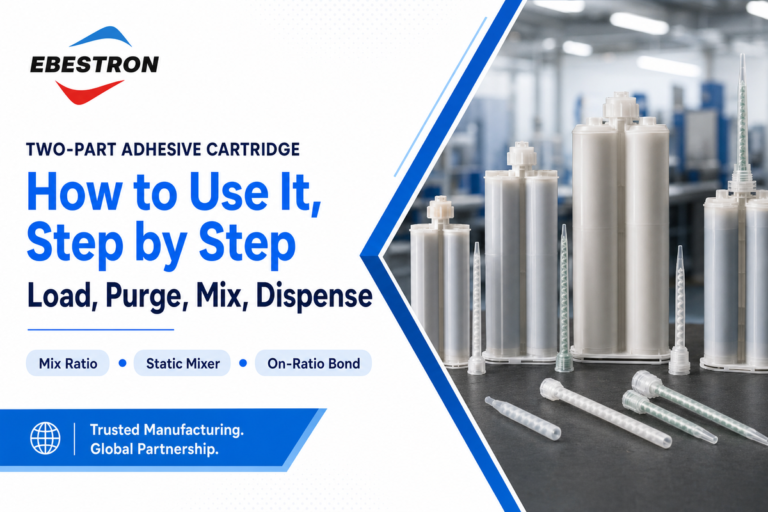
- كيفية استخدام خرطوشة لاصقة من جزأين — the full step-by-step dispensing walkthrough
- كيفية اختيار مسدس توزيع 2K — matching drive type and thrust ratio to your cartridge
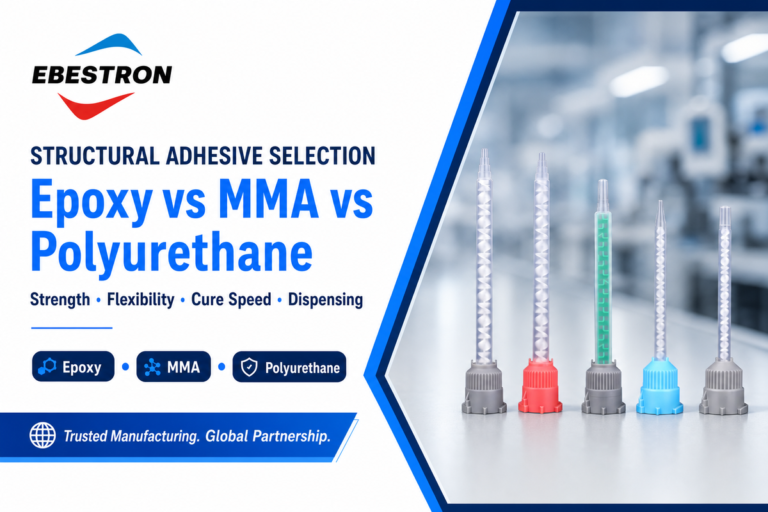
- Epoxy vs MMA vs Polyurethane — choosing the right structural adhesive chemistry
- 400ml & 600ml Dual Cartridges — the large-format sibling product line